PRIVATE LABEL BRAND SUCCESS
FOCUS ON COSMETICS AND PERSONAL CARE RETAILING IN
BULGARIA
Stephanie Langwieser
Dissertation written under the supervision of André Pinho
Dissertation submitted in partial fulfilment of requirements for the MSc in Management with Specialization in Strategic Marketing, at the Universidade Católica Portuguesa, January 2019.
2
ABSTRACT
Title: “Private Label Brand Success - Focus on Cosmetics and Personal Care Retailing in Bulgaria”
Author: Stephanie Langwieser
Keywords: Private Label, Store Brand, Bulgaria, Emerging Markets, Culture, Marketing Strategies
The private labels´ positive development took mainly place in the Western word while in emerging countries private label brands have usually performed far less. This study investigated the development as well as consumer attitudes towards private labels of the cosmetics and personal care category in the Bulgarian market. Specifically, country-level market factors and culture-specific personality traits were researched with the help of qualitative as well as quantitative methods. The study found that Bulgarian market factors are generally attractive and show growth potentials and market opportunities for private labels, also within the cosmetics and personal care category. However, private label brands are still not well perceived by the Bulgarian customers. Negative consumer attitudes towards cosmetics and personal care private labels might be correlated with culture-specific personality traits of Bulgarians, including being collectivistic, having a masculine culture and being materialistic. Negative attitudes results in low demand and a lack of incentives for retailers engaging in marketing activities.
3
SUMÁRIO
Título: “Sucesso da Marca de Marca Própria - Foco em Cosméticos e Revenda de Cuidados Pessoais na Bulgária”
Autor: Stephanie Langwieser
Keywords: Marca Própria, Marca da Loja, Bulgária, Mercados Emergentes, Cultura, Estratégias de Marketing
O desenvolvimento positivo das marcas próprias teve lugar principalmente na palavra ocidental, enquanto nos países emergentes marcas próprias usualmente tiveram um desempenho muito menor. Este estudo investigou o desenvolvimento, bem como as atitudes dos consumidores em relação as marcas próprias da categoria de cosméticos e cuidados pessoais no mercado búlgaro. Em específico, fatores de mercado em nível de país e traços de personalidade específicos da cultura foram pesquisados com a ajuda de métodos qualitativos e quantitativos. O estudo descobriu que os fatores do mercado búlgaro são geralmente atraentes e mostram potenciais de crescimento e oportunidades de mercado para marcas próprias, também dentro da categoria de cosméticos e cuidados pessoais. No entanto, as marcas próprias ainda não são bem percebidas pelos clientes búlgaros. Atitudes negativas do consumidor em relação as marcas próprias de cosméticos e cuidados pessoais podem estar correlacionadas com traços de personalidade específicos da cultura de búlgaros, incluindo ser coletivistas, ter uma cultura masculina e ser materialistas. Atitudes negativas resultam em baixa demanda e falta de incentivos para os varejistas se engajarem em atividades de marketing.
4
ACKNOWLEDGMENTS
I would first like to thank my thesis advisor André Pinho of the Universidade Católica Portuguesa. His immense knowledge and advices have been invaluable for me.
My special appreciation and thanks also go to Andreas Reichenbach, Ivana Marinkovic, Peter Esberger, Anna Lettner, Svetla Radivoeva, Daniel Fruehwirth and the whole MANE Austria GmbH team for their passionate support and guidance.
I would like to express my sincere gratitude to all experts who were interviewed for this thesis and who shared with me their knowledge and brilliant comments. Of course, I would also like to thank everyone who participated in the consumer survey. This thesis would not have been possible without them.
Finally, I would like to thank my family, boyfriend and close friends for their ongoing support and motivation.
5
TABLE OF CONTENTS
Abstract ... 2
Sumário ... 3
Acknowledgments ... 4
List of tables and figures ... 7
1. Introduction ... 8
1.1 Problem statement and research questions ... 9
1.2 Bulgaria - Market overview ... 10
1.3 Cosmetics & personal care in Bulgaria ... 12
2. Literature review ... 16
2.1 Country-level market factors ... 16
2.2 Culture-specific personality traits ... 20
3. Methodology ... 24
3.1 Expert interviews ... 24
3.2 Consumer survey ... 25
4. Results analysis & discussion ... 31
4.1 Expert interviews ... 31
4.2 Consumer survey ... 36
4.3 Discussion ... 45
5. Conclusions and limitations ... 47
5.1 Main findings ... 47
5.2 Conclusions ... 47
5.3 Outlook ... 49
5.4 Managerial Implications ... 49
5.5 Limitations and further research ... 52
6
Appendix ... 58
Appendix1: Interview guideline (Brenntag Bulgaria) ... 58
Appendix 2: Interview questions (12 Bulgarian firms) ... 59
Appendix 3: List of contacted firms for the interview ... 60
Appendix 4: Consumer survey Bulgarian ... 61
Appendix 5: Consumer survey English ... 65
7
LIST OF TABLES AND FIGURES
Table 1: Key Facts about Bulgaria ... 10
Table 2: Macroeconomic Data and Forecast - Bulgaria ... 11
Table 3: Sales of Beauty and Personal Care: Value 2012-2017... 12
Table 4: Percentage retail value rsp (Euromonitor, 2018) ... 13
Table 5: Penetration of PLB in Cosmetics & Personal Care by Category: % Value ... 15
Table 6: Conceptual Model ... 27
Table 7: Constructs and corresponding Likert items ... 29
Table 8: Attributes ... 29
Table 9: Results of the expert interviews ... 35
Table 10: Basic information in percentages ... 37
Table 11: Descriptive Analysis: Long-term/short-term orientation ... 39
Table 12: Descriptive Analysis: Collectivism/Individualism ... 40
Table 13: Descriptive Analysis: Femininity/Masculinity ... 40
Table 14: Descriptive Analysis: Need for cognition ... 41
Table 15: Descriptive Analysis: Materialism ... 41
Table 16: Results of the hypotheses testing ... 44
Figure 1: Hofstede´s 6-D Model© - Bulgaria ... 25
Figure 2: Importance of attributes when buying cosmetics and personal care ... 38
8
1. INTRODUCTION
In the past, retailing stores sold bland looking goods with downplayed designs, often indicating poor quality under their private label brands (PLB). Likewise called store brands or generic brands these PLB refer to goods that are manufactured for and sold under the name of a specific retailer (Patti and Fisk, 1982). In the past, these brands could solely fight for the attention of very budget conscious shoppers.
However, private label brands´ story has changed. These originally “low-price alternatives” to manufacturer brands gradually developed their own brand identity. Private labels started to be used by retailers to build loyalty, their appearance was polished by artful illustrations and consumers started to develop favourable perceptions.
The private labels´ positive development took place primarily in the Western word, particularly in Western Europe (Nielsen, 2014). In a survey carried out by Nielsen in 2014, Switzerland has the highest private-label share around the world at 45%, followed closely by the U.K. and Spain at 41% each. In emerging countries, private label brands have usually developed far less (Nielsen, 2014). While value share is at or above 15% in developed regions (and as high as 45% in Europe), it is below 10% in most developing countries according to Nielsen´s study in 2014. Bulgaria is the country with the lowest GDP/capita within the EU and can be classified as an emerging country (Eurostat, 2018). Bulgaria´s rate of purchasing power standards (PPS) was 47% of the EU average in 2014, while Luxemburg, country with the highest PPS in the EU, shows a rate of 257%, while the neighbouring countries Romania and Greece are at 55% and 73% respectively (Eurostat data, 2014). It is not surprising that Bulgarian consumers are price sensitive which would indicate an emerging trend of consumer orientation towards cheaper private label products. However, as demonstrated by industry reports, private label brands are still not well identified by customers in Bulgaria and even though the market share of private labels is expected to increase in the future, it is growing far less than in other countries in Europe (USDA Foreign Agricultural Service, 2016).
The majority of private label fast moving consumer goods (fmcgs) can be found within the packaged food category which accounted for 77% of value sales in 2012 (Euromonitor International, 2014). The greatest penetration, of almost 14%, registered the sector of tissue and hygiene products (Euromonitor International, 2014). Notwithstanding, retailers have found it
9 challenging to penetrate the cosmetics and personal care category where private label penetration was just 3% in 2012 (Euromonitor International, 2014).
1.1 PROBLEM STATEMENT AND RESEARCH QUESTIONS
Research has investigated the disparity between developed and emerging markets regarding PLB development through different factors including country-level market factors (Cuneo et al., 2015), marketing activities carried out by retailers (Steenkamp and Geyskens, 2014) as well as the influence of cultures (Budhathoki et al., 2018). However, the development as well as consumer attitudes towards PLB of the cosmetics and personal care category in the Bulgarian market has rarely been researched so far.
As a consequence, the following research questions have been developed:
RQ 1: How do country-level market factors influence the development of cosmetics and personal care private labels in Bulgaria?
RQ 2: How do culture-specific personality traits of Bulgarian consumers influence their attitude towards cosmetics and personal care private labels?
10
1.2 BULGARIA - MARKET OVERVIEW
To give a quick overview of the country, table 1 summarizes key facts about Bulgaria.
Capital Sofia
Official EU language Bulgarian
EU member country since 1 January 2007
Currency Bulgarian lev BGN
(Bulgaria has committed to adopt the euro once it fulfils the necessary conditions.)
Schengen Bulgaria is currently in the process of joining the
Schengen area. Table 1: Key Facts about Bulgaria (European Union, 2018)
Industry (23.8%), wholesale and retail trade were the most essential sectors of Bulgaria’s economy in 2016 (European Union, 2018).
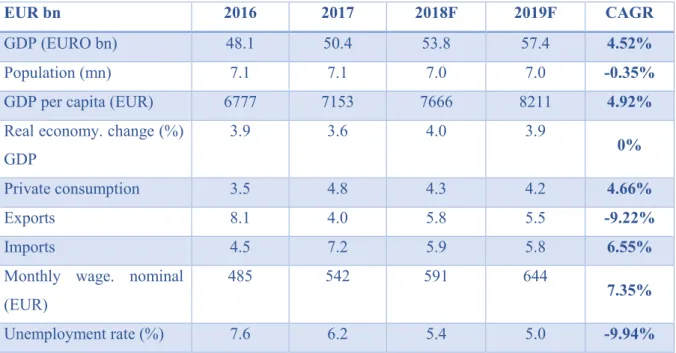
Germany, Italy and Romania are Bulgaria´s most important export partners within the EU, while outside the EU Bulgaria exports most to Turkey and China (European Union, 2018). In like manner, Germany, Italy and Romania are Bulgaria´s main partners in terms of imports, while outside the EU most imports originate from Russia and Turkey (European Union, 2018). In 2018, Bulgaria´s economy is expected to show the fastest growth rate since the global financial crisis (UniCredit Research, 2018). Real GDP growth is forecasted to reach 4.0% yoy this year, due to rapidly rising income, a rebound in residential construction and EU funds absorption as well as stronger releveraging in the household sector (UniCredit Research, 2018). Consequently, growth is expected to be resilient enough to slow only marginally in 2019 to 3.9% yoy.
Bulgaria´s situation in the labour market continues to show a favourable development (UniCredit Research, 2018). The unemployment rate fell to 5.7% in 1Q18 (seasonally adjusted) which is close to its all-time low (UniCredit Research, 2018).
The favourable economic outlook for 2018-2019 triggers positive consumer expectations about future income and should therefore positively affect buying power of cosmetics and personal care in the forcasted period (Euromonitor, 2018).
11 The table below gives an overview of Bulgaria´s macroeconomic data including a forecast.
EUR bn 2016 2017 2018F 2019F CAGR
GDP (EURO bn) 48.1 50.4 53.8 57.4 4.52%
Population (mn) 7.1 7.1 7.0 7.0 -0.35%
GDP per capita (EUR) 6777 7153 7666 8211 4.92%
Real economy. change (%) GDP 3.9 3.6 4.0 3.9 0% Private consumption 3.5 4.8 4.3 4.2 4.66% Exports 8.1 4.0 5.8 5.5 -9.22% Imports 4.5 7.2 5.9 5.8 6.55%
Monthly wage. nominal (EUR)
485 542 591 644
7.35%
Unemployment rate (%) 7.6 6.2 5.4 5.0 -9.94%
12
1.3 COSMETICS & PERSONAL CARE IN BULGARIA
The cosmetics and personal care industry can also be referred to as beauty and personal care industry and includes the following product categories: Baby and child-specific products, bath and shower, colour cosmetics, deodorants, depilatories, hair care, men's grooming, oral care, skin care and sun care.
1.3.1 INDUSTRY REVENUE
The development of the industry´s revenue in million euros showed a constant rise from 2013 until 2017 (Euromonitor, 2018). In 2017, revenues in the cosmetics and personal care market amount to €415.53 million (Euromonitor, 2018).
Beauty & Personal
Care 2013 2014 2015 2016 2017 CAGR
Total Sales
in million € 363.7 373.56 384.4 399.22 415.53 2.7 % Table 3: Sales of Beauty and Personal Care: Value 2012-2017 (Euromonitor, 2018)
Forecasts until 2021 predict that the industry´s revenues will grow further (Statista, 2018).In 2018, the average revenue per person within the category amounts to €57.54 which is low in comparison to Europe´s average of €143.08 in 2018 (Statista, 2018). However, it should be taken into account that Bulgaria is the country with the lowest GDP/capita within the EU and its rate of GDP per capita in PPS was only 49% of the EU average in 2017 (Eurostat, 2018).
1.3.2 COMPETITIVE LANDSCAPE
Bulgaria´s retailer landscape it clearly indicates that foreign companies like dm-Drogerie Markt (Dm), Metro, Kaufland, Billa, Lidl and Carrefour are present at the market (Euromonitor, 2014). Within cosmetics and personal care, multinational companies like L’Oréal Bulgaria, Unilever Bulgaria and Henkel Bulgaria were amongst the fastest growing companies thanks to a high number of new launches within dynamic categories like colour cosmetics, baby and child-specific care and hair care (Euromonitor, 2018). A key growth driver in cosmetics and personal care is the dynamic development of drugstores like dm-Drogerie Markt (Dm) and Lilly in urban areas (Euromonitor, 2018).
13 The table below shows the most important brands within this category and their development from 2013 until 2017. L'Oréal Bulgaria, Avon Bulgaria and Beiersdorf Bulgaria are the market leaders in Bulgaria.
Company 2013 2014 2015 2016 2017 CAGR
L'Oréal Bulgaria EOOD 12.5 13.2 13.7 14.1 14.5 3.0
Avon Bulgaria EOOD 7.9 8.0 8.2 8.2 7.9 0.0
Beiersdorf Bulgaria EOOD 6.7 6.6 6.6 6.6 6.5 -0.6
Unilever Bulgaria EOOD 5.9 5.6 5.4 5.4 5.4 -1.8
Procter & Gamble Bulgaria
EOOD 5.8 5.7 5.4 5.3 5.4 -1.4
Henkel Bulgaria EOOD 4.8 4.8 5.0 5.2 5.2 1.6
Aroma AD 3.5 3.6 3.6 3.5 3.3 -1.2
Oriflame Bulgaria EOOD 3.4 3.1 2.9 2.8 2.8 -3.8
Sarantis Bulgaria Ltd 2.2 2.4 2.5 2.7 2.7 4.2
Colgate-Palmolive 2.2 2.1 2.2 2.1 2.0 -1.9
Pierre Fabre Dermo 1.3 1.3 1.4 1.4 1.4 1.5
Notos Bulgaria EOOD 1.3 1.4 1.5 1.4 1.4 1.5
Estée Lauder Bulgaria 1.1 1.2 1.3 1.3 1.3 3.4
Ficosota Syntez OOD 1.1 1.2 1.2 1.3 1.3 3.4
Everet Sofia EOOD 2.2 1.5 1.4 1.3 1.2 -11.4
GlaxoSmithKline Plc 1.2 1.3 1.3 1.2 1.2 0.0 Coty Inc 1.1 1.2 1.2 1.2 1.2 1.8 dm Bulgaria EOOD (Private Label) 0.6 0.8 0.9 0.9 1.0 10.8 Others 32.8 32.8 32.0 31.9 32.0 -0.5 Total 100.0 100.0 100.0 100.0 100.0
Total market size in million € 363.70 373.56 384.40 399.22 415.53 2.70 Table 4: Percentage retail value rsp (Euromonitor, 2018)
1.3.3 DISTRIBUTION CHANNELS
According to a market analysis carried out by Euromonitor in 2017, grocery retailers accounted for 32.3% of the sales, while non-grocery specialists for 48.6%. On the other side, 17.8% of sales, were achieved in form of non-store retailing, including direct selling, home shopping and internet retailing (4.5%). 1.4% of sales was attributed to non-retail channels, in specific to hair
14 salons (Euromonitor, 2018). It can be concluded that 80.8% of cosmetic and personal care products were sold in store-based retailing including both grocery retailers and non-grocery retailers. The most important distribution channels within non-grocery retailers were drugstores (16.6%) followed by beauty specialist retailers (15.2%) and pharmacies (13%) (Euromonitor, 2018).
1.3.4 PRIVATE LABEL PENETRATION
During the last couple of years, Western European retailers have invested heavily into the Bulgarian market and the retail sector became more concentrated and competitive. These developments lead to increasing value shares of private labels (Bozhinova, 2013). However, as reported by the industry, private label brands are still not well perceived by the Bulgarian customers (USDA Foreign Agricultural Service, 2016).
Grocery retailers and drugstores have recently expanded their private label presence in categories such as baby and child-specific products (Euromonitor International, 2018). In 2017, Kaufland Bulgaria introduced K-Classic Baby, Lily Drogerie and Lidl Bulgaria, entered the organic segment with Bioboo Cosmetics and Lupilu, respectively (Euromonitor International, 2018). Dm launched a new private label, called TrendIT Up, in colour cosmetics targeting younger (Euromonitor International, 2018). Metro Cash and Carry Bulgaria also entered the bio segment including cosmetics and personal care (Euromonitor International, 2018).
The table below demonstrates the penetration in percentage of private labels in cosmetics and personal care by category between 2013 and 2017. The overall private label penetration in the cosmetics and personal care category was 1.5% in 2017 showing just a slow growth in the past years. The categories with the highest penetration of private labels are bath and shower (3.5%), followed by sun care (2.8%) and oral care (2.4%). The lowest penetration can be found within the colour cosmetics (0.1%) and the baby and child-specific products (0.5%).
The table also illustrates that the PLB´s penetration is higher in the mass beauty and personal care segment (1.6%) than in the overall beauty and personal care segment (1.5%). However, the penetration rate is quite low in comparison to Western European countries like UK (3%) and Germany (5.9%).
15
Category 2013 2014 2015 2016 2017 CAGR
Beauty & Personal Care 1.1 1.4 1.5 1.5 1.5 6.4
Mass Beauty & Personal Care 1.3 1.5 1.6 1.6 1.6 4.2
Baby and Child-specific products
0.6 0.8 0.7 0.5 0.5
-3.6
Bath and Shower 2.7 3.0 3.4 3.5 3.5 5.3
Colour Cosmetics 0.0 0.1 0.1 0.1 0.1 0.1 Deodorants 1.6 1.8 2.0 2.2 2.3 7.5 Depilatories 0.8 2.0 2.2 2.0 2.3 23.5 Hair Care 1.0 1.1 1.3 1.4 1.3 5.4 Men's Grooming 0.6 0.9 1.0 1.1 1.0 10.8 Oral Care 1.4 2.3 2.3 2.3 2.4 11.4 Skin Care 1.6 2.0 1.9 1.8 1.8 2.4 Sun Care 2.5 2.1 2.7 2.8 2.8 2.3
Table 5: Penetration of Private Labels in Cosmetics & Personal Care by Category: % Value 2012-2017 (Euromonitor International, 2018)
1.3.5 BRAND SHARES: PRIVATE LABELS VS. MANUFACTURER BRANDS When comparing brand shares of the year 2017, private labels are clearly in a disadvantage against manufacturer brands (Euromonitor International, 2018). Market leader is Avon, dominating the market with a share of 6.2% (Euromonitor International, 2018). The second and third largest brand shares have Dove (4.1%) and Oriflame (3.3%), closely followed by Nivea (2.9%), Yves Rocher (1.7%), L’Oréal Dermo-Expertise (1.6%) and L’Oréal Paris (1.4%) (Euromonitor International, 2018). Dm´s private label Balea reaches brand shares of 0.6%, other private labels together mere 0.3% (Euromonitor International, 2018).
16
2. LITERATURE REVIEW
The following chapter reviews the literature related to the problem statement. Firstly, country-level factors that influence the development of private label brands in Bulgaria are analysed Secondly, the influence of culture-specific personality traits on consumer attitudes towards private label brands are outlined.
2.1 COUNTRY-LEVEL MARKET FACTORS
A literature review about different factors facilitating private label product penetration in the retail market is presented to understand the differential success of PLB between developed and emerging markets. These factors include the retail structure, retailers´ marketing activities and brand building, distribution system, socio-demographics and legal restrictions.
2.1.1 RETAIL STRUCTURE
Walmart, Aldi, Metro, Auchan, Carrefour, Costco, Lidl, and Tesco – they all fall under the term “modern retail” and are supermarkets, hypermarkets, convenience stores or discounters. By contrast, another channel format is traditional retail which comprises the family-owned grocery chains, small independent stores, and informal merchants.
PLB are developed by modern retailers which have enough resources and market power to keep prices at a low level – low enough to offer consumers an incentive to switch from manufacturer brands to PLB (Steenkamp et al., 2010). A well-developed retail structure is therefore a prerequisite for a successful development of PLB (Cuneo et al., 2015).
It was widely presumed that modern retailers would eventually displace traditional trade not only in the West but also in emerging markets (Child et al., 2015). Nonetheless, in many cases expectations about their entrance in emerging markets have been proven wrong and traditional trade remained remarkably resilient there (Child et al., 2015).
Accordingly, the prerequisite for a successful development of PLB, the well-developed retail structure (i.e., modern vs. traditional trade), has not been met by a couple of emerging markets. Evaluation of a country´s retail distribution structure
How to measure if an emerging country possesses a well-developed retail structure and retailers with sufficient market power? Several studies use the retail concentration rate that captures
17 the weight of the top three or four modern retailers operating in a market to measure retailer market power (Sebri and Zaccour, 2017). Furthermore, a high retail concentration rate has been associated positively with PLB penetration (Sethuraman and Gielens, 2014; Rubio and Yagiie 2009).
However, this measure is only applicable in markets where the traditional channel share is marginal (Cuneo et al., 2015). This is not the case in many emerging countries and thus applying the retail concentration rate measure may lead to erroneous assumptions (Cuneo et al., 2015). It is important to analyse where most consumers shop and measure the ratio between the market shares of modern and traditional trade (Cuneo et al., 2015). If traditional trade accounts for a substantial percentage of sales in a market, PLB growth potential may be limited regardless the above-mentioned prerequisite of well-developed retail structure and a high retail concentration rate (Cuneo et al., 2015).
2.1.2 RETAILERS´ MARKETING ACTIVITIES AND BRAND BUILDING The problem in many emerging markets is, that consumers perceive risk when buying PLB because they are unfamiliar with PLB, distrust local retailers´ brands due to low-quality perceptions or are uncertain about the quality (Cuneo et al., 2012). One reason to explain these uncertainties is that in many developing countries, the retailer landscape mainly consists of local retailers that do not invest in brand building (Cuneo et al., 2015). By contrast, international retailers such as Carrefour, Lidl, and Aldi have invested into their PLB image and started promoting quality and even premium private labels (Geyskens et al., 2010).
The perceived risk is an important factor influencing consumers´ purchase decisions regarding PLB (Rubio et al., 2014). To reduce the risk, consumers use risk reduction strategies such as gathering information from the packaging, reassurance (e.g., through private testing, free samples), brand loyalty or relying on price cues or store image (Rubio et al., 2014). Furthermore, studies demonstrated that the consumers´ familiarity with PLB reduces perceived risk (Cuneo et al., 2015) which means that an expansion of global supermarkets, hypermarkets, and especially discounters in a country would help to increase familiarity and decrease uncertainties regarding PLB (Cuneo et al., 2015). If consumers are more familiar with PLB, they are more likely to adopt them.
18 2.1.3 DISTRIBUTION SYSTEM
A well-developed logistic structure is crucial for retailers to access suppliers and stores in a timely and efficient manner (Cuneo et al., 2015). This means, that retailers will only enter a market if they are able to create a cost-efficient distribution system to be able to offer consumers significant price differentials with manufacturer brands (Cotterill and Putsis 2000). Underdeveloped logistic structures might hinder global retailers from entering a market. What is more, retailers often encounter difficulties in finding local manufacturers that are willing and capable of producing the private label products in a good and consistent quality (Jong, 2015). Mediocre or inconsistent product quality and unpredictable delivery rates would are then inevitable. Another challenge is that national brand manufacturers commonly refuse to produce private labels for retailers because they fear cannibalization effects on their own brands (Jong, 2015).
As a conclusion, a more highly developed structure of modern trade leads to higher PLB share.
2.1.4 SOCIO-DEMOGRAPHICS
Glynn and Chen (2009) found income, education and household size to be inhibitors of PL products purchasing. Sebri and Zaccour (2017) have further researched on the influence of socio-demographics on PLB purchases and found that income as well as education affect PLB´ performance. Their research resulted in two different segments possessing contrary characteristics. The first one consist mainly of emerging countries, including Bulgaria, the second one is made up of Western countries (Sebri and Zaccour, 2017).
Numerous studies found that household income has an impact on PLB performance. The findings are not surprising as authors stated that households with higher incomes are less likely to buy PLB (Hoch, 1996; Ailawadi et al., 2001). Another study demonstrated that PLB's share increase in case of an economic downturn and shrinks when the economy is flourishing (Lamey et al., 2007).
Sebri and Zaccour (2017) have investigated the effect of socio-economic development on PLB performance in emerging markets and found distinct results between developed and emerging countries, latter having a negative relation. Their research outcome was that a higher literacy rate, rising wealth and larger urban population is positively correlated with revenues, which leads to decrease in PLB performance.
19 Likewise, impact of education on PLB performance differs between developed and emerging countries. Well-educated consumers in developed countries are more confident about their ability to evaluate product-related information besides extrinsic cues and thus tend to purchase more private labels (Sebri and Zaccour, 2017). By contrast, emerging markets show a negative relationship between PLB performance and level of education: Since highly educated people in emerging countries normally have a higher income, they prefer to buy manufacturers' brands (Sebri and Zaccour, 2017).
It would be expected that the inequality of wealth distribution would be conducive to PLB success nearby lowest disposable income shoppers. Against expectations, the revenue inequality (measured with the Gini Coefficient) does not favour the development of PLB in emerging countries (Sebri and Zaccour, 2017). This is, because even low-income consumers desire to acquire and possess brands. Lower prices of PLB are not a sufficient reason for consumers to divert from branded products (Sebri and Zaccour, 2017).
2.1.5 LEGAL RESTRICTIONS
The government can play a critical role in the development of modern trade (Child et al., 2015). Retailers may face difficulties to expand in emerging markets due to legal restrictions. One challenge might be difficulties that arise when foreign retailers want to invest in local players (Jong, 2015). Furthermore, there are often high tariffs should you want to import products into the emerging market (Jong, 2015). To sum up, legal restrictions and high associated costs may discourage retailers to implement and execute a private-label strategy.
20
2.2 CULTURE-SPECIFIC PERSONALITY TRAITS
This section starts with a definition of culture and its relevance for marketing. Subsequently, an overview of the widely applied cultural framework of Hofstede is provided, before summarizing the current literature dedicated to culture-specific personality traits that influence consumer attitudes towards private label brands.
2.2.1 CULTURE AND MARKETING
The term “culture” is used in a variety of ways and there are many definitions in the social sciences. Generally, culture can be described as a set of shared behavioural patterns, beliefs, norms or values (Triandis, 1994). The United Nations agency UNESCO provides a similar definition:
“A set of distinctive spiritual, material, intellectual, and emotional features of society or a social group, and that it encompasses, in addition to art and literature, lifestyles, ways of living together, value systems, traditions and beliefs."
Essentially, culture is a collective phenomenon shared among its members who were conditioned by the same education and life experience (Hofstede et al., 2010). In the fields of international marketing considering national cultures besides other national characteristics is crucial for nearly all marketing activities (Budhathoki et al. 2018). International marketing managers analyse nations with respect to cultural characteristics in order to explain differences in consumer behaviour, product usage, brand preferences or motives, which are not captured by differences in other country-level measures (de Mooij, 2015).
Therefore, there is a strong rationale behind investigating if the disparity of private label performance between developed and emerging markets is, at least partly, due to culture-specific personality traits of the consumers.
2.2.2 HOFSTEDE'S CULTURAL DIMENSIONS THEORY
Academic literature has identified a number of cultural frameworks which define and measure culture. Three major large-scale models are Hofstede's cultural dimensions theory called 6-D Model©, Schwartz's Culture Model and the Global Leadership and Organizational Behaviour Effectiveness (GLOBE) Research Project. Especially Hofstede's cultural dimensions theory and the GLOBE model overlap in certain aspects even though they vary with respect to purpose,
21 sampling and type of questions used (de Mooij, 2015). Pasts research found that various of Hofstede´s cultural dimensions affect private label performance in a country. Subsequently, a brief discussion of the cultural framework is presented. The Hofstede model consists of six dimensions:
Power distance: The power distance dimension measures to which degree the less powerful members of society accept and expect that power is distributed unequally (Hofstede, 2001). Individualism versus collectivism: This dimension measures the degree to which individuals are connected to each other (Hofstede, 1980). Countries that score high on individualism are characterized by loose ties between individuals meaning that persons look after themselves first (Segalla et al., 2006). By contrast, in collectivistic cultures ties between individuals are strong and individuals are expected to look after their relatives or members of a particular group in exchange for loyalty (Hofstede, 1991).
Masculinity versus femininity: Masculine cultures represent a preference in society for material rewards for success, achievement and heroism (Hofstede, 2001). On the other hand, in a feminine society individuals value modesty, caring for the weak and quality of life (Hofstede, 2001).
Uncertainty avoidance: Uncertainty avoidance can be defined as a feeling of unease about a situation with uncertainty and ambiguity (Segalla et al., 2006). When cultures are high on uncertainty avoidance, individuals prefer to avoid and reduce risk. On the other hand, in low uncertainty avoidance societies, individuals are more open to take risks (Hofstede, 1980). Long term orientation versus short term orientation: Long-term oriented societies are more pragmatic and future-oriented while short-term oriented societies are more likely to have a conventional historic or short-term perspective (de Mooij and Hofstede, 2002).
Indulgence versus Restraint: A society that scores high on Indulgence allows for relatively free gratification of human desires related to enjoying life and having fun (Hofstede et al., 2010). On the other hand, restraint cultures suppress gratification of needs with strict social norms (Hofstede et al., 2010).
22 2.2.3 THE INFLUENCE ON CONSUMER ATTITUDES TOWARDS PRIVATE LABELS
After having presented Hofstede´s widely used cultural framework, culture-specific personality traits are discussed that influence consumer attitudes towards private labels, according to literature. In particular, some of the cultural dimensions, as described above, as well as other culture-specific personality traits are presented.
Long-term (LTO)/short-term (STO) orientation
de Mooij and Hofstede (2002) found that market share percentages for PLB are correlated negatively with long-term orientation. Likewise, Petersen, Kushwaha and Kumar (2015) explained that high LTO cultures prefer brands that have a higher quality image of products lasting longer and have lower preferences for brands focusing on immediate benefits like price discounts, which are generally associated with the image of private labels. By contrast, STO cultures are expected to show a positive relation with market share percentages for PLB. Individualism/collectivism
de Mooij and Hofstede (2002) describe a positive correlation between individualism and market share percentages of PLB. This means that collectivist cultures prefer manufacturer brands to private label brands. Literature offers the following explanations: First, with the help of manufacturer brands consumers demonstrate status in society. Since individuals in collectivist cultures have a higher tendency to purchase products that reflect “status” (Erdem et al., 2006), they tend to reject private labels. Second, the need for harmony makes people more brand loyal (de Mooij and Hofstede, 2002). By contrast, consumers in individualistic cultures like to buy private labels because they prefer to maximize personal interests like cost saving or convenience (Budhathoki et al., 2018).
Masculinity/femininity
Consumers from masculine cultures have a higher desire to own expensive and selective brands, as these brands are used to indicate social status (De Mooij and Hofstede, 2002). This means that masculinity has a negative effect on private label performance in a country. However, a more recent study from Budhathoki et al. (2018) did not find a direct relationship between masculinity and private label performance. The absence of the impact may be explained by a change in the image of private labels over time caused by modern retailers´ marketing activities.
23 However, as stated in the chapter above, PLB image has not improved to the same degree in developed and emerging countries.
Need for cognition
Individuals with a high need for cognition enjoy engaging in complex situations, have better learning abilities and develop more confidence in evaluating product information (Wu et al., 2011). In the sense of consumer behaviour, shoppers with a high need for cognition like to analyse product-related information and make rational purchase decisions (Herstein et al., 2012). A consumer with a low need for cognition, instead, prefers to make purchase decisions influenced by symbolic messages.
Past research has shown that educated consumers have a higher tendency to purchase private labels than the less well educated (Herstein et al., 2012, Cunningham et al., 1982; Hoch, 1996). The rationale behind this finding is that shoppers with a high need for cognition appreciate the cost-benefit of private labels more than shoppers with a lower need for cognition who prefer to trust a strong manufacturer brand image (Herstein et al., 2012). The need for cognition is dependent on individuals but literature suggests that there are also cross-cultural differences in the need for cognition.
Materialism
Materialistic consumers, or more modestly value-seeking or prestige sensitive consumers rely on acquiring and possessing objects to achieve personal goals and desired states (Richins, 2004). They like to express their materialistic lifestyle by buying powerful and well-known brands (Phau and Prendergast, 2000) and prefer them over private labels (Herstein et al., 2012). The logic behind these findings is that private labels do not offer the same prestigious image as manufacturer brands. Moreover, cross-cultural studies have shown that materialism varies across nations (Sebri and Zaccour, 2017; Herstein et al., 2012). Furthermore, consumers in less economically developed nations try to imitate the more expensive and extravagant consumption of Western countries (Herstein et al., 2012).
24
3. METHODOLOGY
This chapter is concerned with presenting the methodology used to answer the research questions. After introducing the qualitative approach, the second part of the chapter discusses the methodology of the quantitative survey in more detail. It includes the questionnaire design, the population characteristics, sampling procedure as well as an overview of the constructs.
3.1 EXPERT INTERVIEWS
The purpose of the expert interviews was to answer the research questions with the help of valuable industry insights that picture the company´s perspective of the matter. What is more, expert interviews posed an effective possibility to quickly obtain good results (Bogner, Littig and Menz, 2009). The interview guidelines can be found in Appendix 1 and Appendix 2. The interview questions dealt with five topics:
• Retail structure
• Retailers´ marketing activities and brand building • Distribution system
• Socio-demographics • Legal restrictions
In total, the opinions of four experts were collected. Interview partners were representatives working in the field of cosmetics and personal care in Bulgaria. One interview was carried out in person, while three other expert opinions were collected in a written form.
The interview conducted personally was held with a managing representative of the firm Brenntag Bulgaria EOOD, one of the leading Bulgarian chemical distributors producing, among others, for the cosmetics and pharmacy industry. It was semi-structured using guiding questions. However, flexibility was provided to further explore topics that the interviewee addressed when answering the questions.
The three interviews conducted in a written form included open questions as well as some closed questions. It was send out to 12 Bulgarian companies in the cosmetics and personal care industry using the software Qualtrics and ensuring of confidentiality and anonymity of the results. The list of the contacted companies can be found in Appendix 3.
25
3.2 CONSUMER SURVEY
A customer survey has been deemed the most suitable research method to answer RQ2.
3.2.1 HYOTHESES & CONCEPTUAL MODEL
The development of hypotheses and the conceptual definition of the constructs to be used in the consumer survey are described in this section. The hypotheses were derived from the literature review about the influence on consumer attitudes towards private labels and aim to answer RQ2. Together, they compose the research framework.
The table below pictures the Bulgarian culture through the lens of the 6-D Model© and shows the deep drivers of the Bulgarian culture relative to other cultures in the world.
Figure 1: Hofstede´s 6-D Model© - Bulgaria ((Hofstede Insights, 2018)
It can be seen that Bulgaria scores high on the dimension Power Distance (score of 70) which indicates that Bulgarians accept a hierarchical order and the fact that individuals in the society are not equal.
More interesting for this thesis is the fact that Bulgaria is clearly considered a collectivistic society with its score of 30. Bulgarian society fosters strong relationships and people´s self-image is defined in terms “We”. Also, loyalty over-rides most other rules and regulations in society.
Another essential dimension for this work is Masculinity. Here, Bulgaria´s score is 40 and is thus a relatively feminine society focusing on well-being.
26 With reference to Uncertainty Avoidance, Bulgaria scores 85 on this dimension which means that Bulgarian have a very high preference for avoiding uncertainty. Cultures exhibiting high Uncertainty Avoidance may refuse innovation and prefer security.
The last dimension crucial for this thesis is Long Term Orientation. With a score of 69, Bulgaria scores high on this dimension which makes it a pragmatic culture.
Last but not least, Bulgaria has a very low score in the dimension of Indulgence, indicating a tendency to cynicism and pessimism. Also, Bulgarians have the perception that their actions are to some extent restrained by social norms.
Two other personality traits that influence consumer attitudes towards PLB are need for cognition and materialism. The need for cognition is dependent on individuals but literature suggests that there are also cross-cultural differences in the need for cognition (Herstein et al., 2012). Likewise, cross-cultural studies have shown that materialism varies across nations (Sebri and Zaccour, 2017; Herstein et al., 2012). The consumer survey aims to indicate the level of need for cognition and materialism among the Bulgarian society in order to draw conclusions of consumer attitudes towards PLB.
Taking into account the above, the following table shows the conceptual model including hypothesis and constructs.
Constructs Null-Hypotheses Alternative Hypotheses
Long-term/short-term orientation
H01a: Bulgarian consumers are long-term oriented.
HA1a: Bulgarian consumers are short-term oriented.
H01b: There is a relationship between long-term/short-term orientation and consumer attitudes towards cosmetics and personal care private labels.
HA1b: There is no relationship between long-term/short-term orientation and consumer attitudes towards cosmetics and personal care private labels.
Individualism/collectivism H02a: Bulgarian consumers are collectivistic.
HA2a: Bulgarian consumers are individualistic.
H02b: There is a relationship
between collectivism and consumer attitudes towards cosmetics and personal care private labels.
HA2b: There is no relationship between collectivism and consumer attitudes towards cosmetics and personal care private labels.
27 Masculinity/femininity H03a: Bulgarian consumers have
feminine cultural characteristics.
HA3a: Bulgarian consumers have masculine cultural characteristics. H03b: There is a relationship
between masculinity/femininity and consumer attitudes towards cosmetics and personal care private labels.
HA3b: There is no relationship between masculinity/femininity and consumer attitudes towards cosmetics and personal care private labels.
Need for cognition H04a: Bulgarian consumers have a low need for cognition.
HA4a: Bulgarian consumers have a high need for cognition.
H04b: There is a relationship between need for cognition and consumer attitudes towards
cosmetics and personal care private labels.
HA4b: There is no relationship between need for cognition and consumer attitudes towards
cosmetics and personal care private labels.
Materialism H05a: Bulgarian consumers are materialistic.
HA5a: Bulgarian consumers are not materialistic.
H05b: There is a relationship between materialism and consumer attitudes towards cosmetics and personal care private labels.
HA5b: There is no relationship between materialism and consumer attitudes towards cosmetics and personal care private labels. Table 6: Conceptual Model
28 3.2.2 SURVEY DESIGN
The questionnaire starts with ensuring the respondents of the confidentiality and anonymity of the results. Afterwards, respondents are asked to answer questions to find out their awareness of PLB, their attitude towards private labels compared to manufacturer brands as well as questions about culture-specific personality traits. The last part of the survey consists of demographic information of the respondents. In total, the questionnaire duration is approximately 5-10 minutes. Furthermore, to prevent language barriers, the survey was translated to Bulgarian. The Bulgarian questionnaire is enclosed in Appendix 4, the English questionnaire in Appendix 5.
Culture-specific personality traits
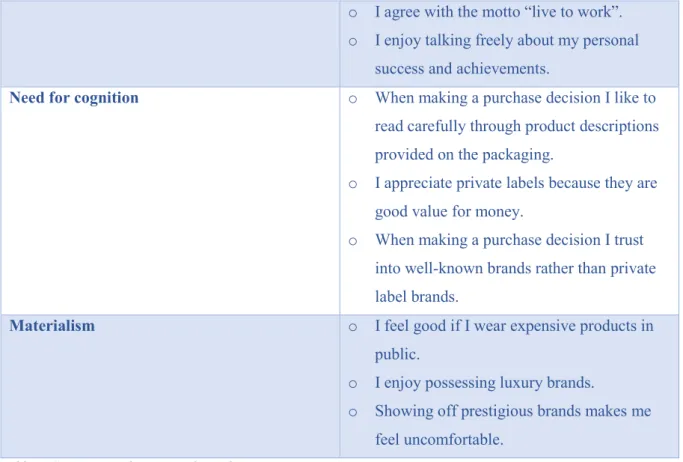
The literature review serves as the source for identifying the conceptual model including hypotheses and constructs, as stated above. The questions asking about culture-specific personality traits are measured on a four-point Likert scale anchored at 1 (“Strongly disagree”) and 4 (“Strongly agree”) without a middle option. This “forced choice” scale size was chosen to prevent that respondents chose the neutral option and instead encourage them to make a decision. The survey is designed in a way that several Likert items are attributed to the constructs to test the hypotheses. The table below presents the constructs and the belonging Likert items.
Constructs Likert Items
Long-term/short-term orientation o I would rather stick to old traditions than adapt to new ones.
o I strive for quick results rather than invest into the future.
o I usually plan far into the future (several years).
Individualism/collectivism o My personal feeling of accomplishment is more important than recognition by others. o Serving my country is more important than
following personal interests.
o I enjoy having opportunities to help other people.
Masculinity/femininity o I agree with the motto “working in order to live”.
29
o I agree with the motto “live to work”. o I enjoy talking freely about my personal
success and achievements.
Need for cognition o When making a purchase decision I like to read carefully through product descriptions provided on the packaging.
o I appreciate private labels because they are good value for money.
o When making a purchase decision I trust into well-known brands rather than private label brands.
Materialism o I feel good if I wear expensive products in public.
o I enjoy possessing luxury brands.
o Showing off prestigious brands makes me feel uncomfortable.
Table 7: Constructs and corresponding Likert items
Consumer attitudes towards cosmetics and personal care private labels
Consumer attitudes towards PLB of the cosmetics and personal care category in comparison to manufacturer brands as well as the respondents´ evaluation of importance of different attributes when buying cosmetics and personal care products is measured on two four-point Likert scales anchored at 1 (“Very bad) and 4 (“Very good) and 1 (“Not important”) and 4 (“Very important”), respectively. Both Likert scales include the same set of attributes which are shown in the table below.
Attributes o Security o Price o Brand o Effectiveness o Social Approval o Packaging and Design o Ingredients/formulas Table 8: Attributes
30 Furthermore, the survey includes an open-style questions to reveal the respondents’ awareness of PLB in the cosmetics and personal care category as well as several multiple-choice questions asking about demographics.
Population
The target population consisted of Bulgarian citizens. In order to get a representative sample of the Bulgarian population, the respondents varied in terms of demographic characteristics. Furthermore, the sample size was large enough to obtain statistically significant results. In total, 86 answers were collected.
Sampling procedure
The data was collected online with the help of the software Qualtrics and analyzed with the statistics software IMB SPSS Statistics. The chosen sampling technique was convenience sampling as participants that were easy to contact were selected. The selection took place in two ways. Firstly, participants received an online link to the survey, and secondly, through personally handing out the survey in paper format. The survey was carried out personally in the Bulgarian cities Sofia and Plovdiv.
31
4. RESULTS ANALYSIS & DISCUSSION
There is a disparity between developed and emerging markets regarding PLB development. This thesis investigated different factors including country-level market factors, marketing activities carried out by retailers as well as the influence of culture on consumer attitudes towards PLB. Main focus was cosmetics and personal care category in the emerging market Bulgaria. The results of both the qualitative expert interviews and the quantitative survey are analysed in this chapter.
4.1 EXPERT INTERVIEWS
To investigate how country-level market factors influence the development of private label brands of the cosmetics and personal care category and to answer RQ1, expert interviews have been conducted. The interview questions dealt with five topics:
• Retail structure
• Retailers´ marketing activities and brand building • Distribution system
• Socio-demographics • Legal restrictions
The findings are listed below.
4.1.1 RETAIL STRUCTURE
The first question dealt about the Bulgarian retail structure. As stated in the literature review, a well-developed retail structure is therefore a prerequisite for a successful development of PLB (Cuneo et al., 2015). Every one of the four interviewees stated that there are several retailers in Bulgaria that fall under the definition of “modern retail”. Examples of international modern retailers that were named were Metro, Kaufland, Lidl, dm and Billa while Bulgarian retailers were Fantastico, Koop and CBA.
It is important to analyse where most consumers shop, whether its traditional or modern retail, in order to measure the ratio between the market shares of modern and traditional trade (Cuneo et al., 2015). If traditional trade accounts for a substantial percentage of sales in a market, PLB growth potential may be limited. The representative of Brenntag explained that most urban
32 Bulgarians shop in modern retail, while cosmetics are mainly bought in pharmacies and drug stores. Furthermore, she stated that consumers shopping at supermarkets for cosmetics and personal care products are more interested in economical mass market. Another interviewee revealed that when taking into account the whole country, urban and rural areas, most non-urban Bulgarians shop at traditional retailers.
In line with the literature review, all interviewees agree that a well-developed retail structure including modern retailers is a prerequisite for a successful development of private labels in Bulgaria.
4.1.2 RETAILERS´ MARKETING ACTIVITIES AND BRAND BUILDING The problem in many emerging markets is, that consumers perceive risk when buying PLB because they are unfamiliar with PLB or because they distrust them (Cuneo et al., 2012). This is an important factor influencing consumers´ purchase decisions regarding PLB (Rubio et al., 2014). Interviewees were asked about the level of consumers´ familiarity with PLB in Bulgaria. According to the representative of Brenntag, Bulgarian consumers are generally familiar with private labels, however, multinational manufacturer brands are clearly preferred since many consumers distrust private labels. The other interviewees responded that consumers are generally not familiar with private labels. Concerning consumers´ familiarity with PLB, it has to be taken into account that there are differences between urban areas and rural areas with the latter being less familiar.
International retailers such as Carrefour, Lidl, and Aldi have invested into their private label image and started promoting quality and even premium private labels. Interviewees were asked if Bulgarian retailers invest into brand building. The representative of Brenntag revealed that Bulgarian retailers do not really invest in brand building for their private labels. The only marketing activities carried out for private labels are price promotions. The other interviewees confirmed that Bulgarian retailers invest less into brand building than international retailers. A lack of marketing activities may lead to unfamiliarity with PLB and perceived risk when buying them. The representative of Brenntag stated that it is true that Bulgarian consumers often perceive risk when buying private labels because of the PLB´s low quality image. Consumers´ doubts are bigger in regards of cosmetics and personal care items than food. As a consequence, local retailers like Fantastico offer PLB for food but not for cosmetics and personal care products which could be an indicator for low demand due to the consumers´ concerns regarding
33 cosmetics PLB. Two of the other interviewees confirmed that Bulgarian consumers generally perceive risk when buying private labels. One of the interviewees explained that Bulgarian consumers trust into well-advertised or traditional Bulgarian products. Only one interviewee answered that consumers generally do not perceive risk with private labels.
4.1.3 DISTRIBUTION SYSTEM
A well-developed logistic structure is crucial for retailers to access suppliers and stores in a timely and efficient manner (Cuneo et al., 2015). In regards of private labels, underdeveloped logistic structures and difficulties in finding local manufacturers that are willing and capable of producing the private label products in a good and consistent quality (Jong, 2015) pose a great risk when entering an emerging market.
Interviewees were asked about the logistic structure and distribution systems in Bulgaria. The representative of Brenntag confirmed that the logistic structure and distribution systems have an effect on private label development in Bulgaria. However, since the logistical structure in Bulgaria is already well-developed it is probable, that there are other factors influencing the country´s poor level of PLB development. One of the other interviewees stated that even though the logistics structure in Bulgaria is well-developed, old distribution systems still exist. Regarding difficulties with finding local manufacturers, the representative of Brenntag revealed, that there are many manufacturers for cosmetics and personal products which are well-known for their quality standards. Local manufacturers produce for local retailers as well as for multinational brands resulting in high export rates. Moreover, Bulgaria has a long tradition of producing cosmetics, like the Bulgarian rose. The experts interviewed in a written form confirmed that retailers, local and international ones, do not encounter difficulties in finding local manufacturers.
4.1.4 SOCIO-DEMOGRAPHICS
Past literature (Sebri and Zaccour, 2017; Glynn and Chen, 2009; Lamey et al., 2007; Ailawadi et al., 2001; Hoch, 1996) found that socio demographic factors might inhibit the development of private labels in emerging countries. The interviewees were asked if income, education, literacy rate and household size affect PLB development in the cosmetics and personal care industry. The representative of Brenntag and two other interviewees stated that rising income might be negatively correlated with private label development. The explanation given was that Bulgarian consumers prefer to spend their income on manufacturer brands which are used as
34 status symbols. On the other hand, the fourth interviewee stated that it is probable that income does not affect PLB development. A higher level of education may correlate negatively with the demand for PLB as stated by three interviewees while the other interviewee does not see a correlation. Reasons given for the negative relation were that together with rising education the income increases which in turn enables consumers to buy more expensive manufacturer brands. Household size is unlikely to have an influence according to the interviewee of Brenntag, while the other three interviewees stated that there might be a positive relation. This means that larger households prefer private labels. The rationale behind the relation is that larger families, whose budget has to be divided among more persons, prefer to save money by buying PLB.
4.1.5 LEGAL RESTRICTIONS
Legal restrictions may discourage retailers to implement and execute a private-label strategy. All interviewees agreed that there are no legal restrictions in Bulgaria, neither for local nor for international retailers, that might make it difficult to develop cosmetics and personal care PLB in Bulgaria.
The table below summarizes the results of the expert interviews. Constructs Factors negatively affecting PLB
development
Findings of the expert interviews Retail structure • Poorly developed retail structure
(Cuneo et al., 2015)
• Substantial percentage of sales attributed to traditional trade (Cuneo et al., 2015)
There are several multinational as well as national modern retailers in Bulgaria. Furthermore, most
Bulgarian consumers shop in modern retail.
Retailers´ marketing activities and brand building
• Lack of marketing activities (Rubio et al., 2014; Cuneo et al., 2012)
Cosmetics and personal care PLB are not well advertised in Bulgaria which leads to unfamiliarity and perceived risk among consumers which is an important factor influencing consumers´ purchase decisions regarding PLB.
Distribution system
• Underdeveloped logistic structures (Jong, 2015)
The logistical structure in Bulgaria is well-developed.
35
• Difficulties in finding willing and capable local manufacturers (Jong, 2015)
Retailers, local and international ones, do not encounter difficulties in finding local manufacturers. There are many local manufacturers for cosmetics and personal care products which are well-known for their quality standards and produce for local retailers as well as for
multinational brands resulting in high export rates.
Socio-demographics
• Socio demographic factors including income, education, literacy rate and household size (Sebri and Zaccour, 2017; Glynn and Chen, 2009; Lamey et al., 2007; Ailawadi et al., 2001; Hoch, 1996)
Three out of four interviewees stated that rising income might be
negatively correlated with private label development.
A higher level of education may correlate negatively with the demand for PLB as stated by three
interviewees.
There might be a positive relation between household size and PLB development meaning that larger households prefer PLB.
Legal restrictions • Legal restrictions posed by the government (Child et al., 2015).
There are no legal restrictions in Bulgaria, neither for local nor for international retailers, that might make it difficult to develop cosmetics and personal care PLB in Bulgaria. Table 9: Results of the expert interviews
36
4.2 CONSUMER SURVEY
The aim of the consumer survey was to find out how personality traits of Bulgarian consumers influence their attitude towards cosmetics and personal care private labels. At the beginning, demographic information and consumer behaviour towards cosmetics and personal care private labels are presented. Afterwards, hypotheses are analysed.
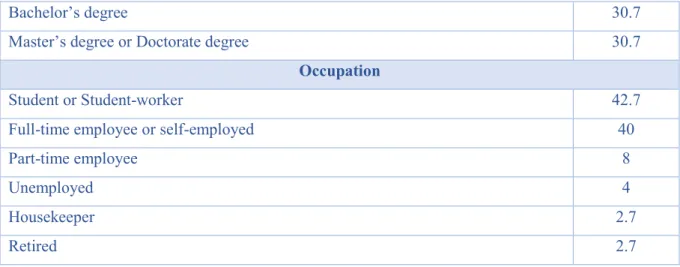
4.2.1 DESCRIPTIVE ANALYSIS: INFORMATION ABOUT RESPONDENTS In total, 86 surveys were collected from which 11 cases had to be excluded due to incompletion and invalid answers, resulting in 75 valid cases. All respondents fulfilled the prerequisite of being Bulgarian. Concerning their gender, 60% were female and 40% male. Most respondents were 44 years old or younger (78.7%), about one fifth (18.7%) was between 45 and 64 years and the rest (2.7%) were older than 65 years. The highest level of educational attainment for the majority of respondents was high school (36%), about one third (30.7%) had a bachelor´s degree and about another third (30.7%) had a master´s or doctorate degree while 2.7% attained no diploma. Approximately 40% of the respondents were students while another 40% were full-time workers or self-employed. 8% worked part-full-time, 4% was unemployed and 2.7% was retired. Table 8 summarizes the basic information in percentages.
Variables Results in % Nationality Bulgarian 100 Other 0 Gender Female 60 Male 40 Age <18 2.7 18-24 45.3 25-44 30.7 45-64 18.7 65 or more 2.7 Education
Primary school, no diploma 2.7
37
Bachelor’s degree 30.7
Master’s degree or Doctorate degree 30.7
Occupation
Student or Student-worker 42.7
Full-time employee or self-employed 40
Part-time employee 8
Unemployed 4
Housekeeper 2.7
Retired 2.7
Table 10: Basic information in percentages
4.2.2 DESCRIPTIVE ANALYSIS: ATTITUDES TOWARDS PRIVATE LABELS
Respondents were asked if they have ever bought a private label. 60% of those have bought a private label while 40% have not. However, only a few persons (20 respondents) could name cosmetics and personal care private labels. Cien (Lidl´s private label) was named nine times, Balea (dm´s private labels) eight times, Alverde (dm´s private labels) three times and Aro (Metro´s private label) two times.
The following figure demonstrates the importance of attributes when buying cosmetics and personal care products. Price indicates the lowest mean of 2.75 closely followed by packaging and design with 2.76. Effectiveness is the most important attribute with a mean of 3.84. Security has a mean of 3.77, ingredients 3.57, brand 3.11 and social approval 2.84.
38 Figure 2: Importance of attributes when buying cosmetics and personal care
Subsequently, PLB´s performance of the cosmetics and personal care category was ranked according the same attributes. The results are shown in figure 3. The total mean of cosmetics and personal care private labels´ perceived performance is only 2.26. Only price has a mean of 3.25, while the average score of the other attributes is only 2.1 (ingredients=2.15, security=2.05, brand=2.09, effectiveness=2.32, packaging and design=2.01 and social approval=1.95).
Figure 3: Performance of cosmetics and personal care private labels 0 0,5 1 1,5 2 2,5 3 3,5 4 4,5
Security Price Brand Effectiveness Social Approval
Packaging and Design
Ingredients
Importance of attributes when buying cosmetics and personal care
1=not important; 2=not really important; 3=somewhat important; 4=very important
0 0,5 1 1,5 2 2,5 3 3,5
Security Price Brand Effectiveness Social Approval
Packaging and Design
Ingredients
Performance of cosmetics and personal care private labels
39 4.2.3 DESCRIPTIVE ANALYSIS: CULTURE-SPECIFIC PERSONALITY TRAITS
The survey is designed in a way that several statements concerning culture-specific personality traits are attributed to the constructs to test the hypotheses. The following section analyses the results. The total means of the respondents´ inclination to the several constructs were obtained by coding particular variables reversely.
H01a: Bulgarian consumers are long-term oriented.
According to Hofstede's cultural dimensions theory Bulgaria scores high on the dimension of Long-term orientation which makes it a pragmatic culture. H01a was built on Hofstede´s theory and tested with the variables shown in the table below. The total arithmetic mean across the observations is 2.80 meaning that respondents “somewhat agree” to variables expressing long-term orientation. Therefore, HA1a can be rejected. Even though H01a can be accepted, their inclination to long-term orientation could potentially be higher and has to be interpreted with caution.
Variables Mean
I would rather stick to old traditions than adapt to new ones. 2.55 I strive for quick results rather than invest into the future. reverse 3.09 I usually plan far into the future (several years). 2.76
Total mean 2.80
Table 11: Descriptive Analysis: Long-term/short-term orientation H02a: Bulgarian consumers are collectivistic.
Bulgaria is considered a collectivistic society according to Hofstede (Hofstede, 1991). H02a can be accepted and HA2a be rejected since the total mean of the variables related to “Collectivism” is high (3.26).
40
Variables Mean
My personal feeling of accomplishment is more important than recognition by others. reverse
2.85 Serving my group of people is more important than following
personal interests.
3.24
I enjoy having opportunities to help other people. 3.69
Total mean 3.26
Table 12: Descriptive Analysis: Collectivism/Individualism
H03a: Bulgarian consumers have feminine cultural characteristics.
Hofstede's cultural dimensions theory describes Bulgaria as a relatively feminine society. However, H03a has to be rejected since the total arithmetic mean across the observations scores higher for masculine variables (2.93). As a consequence of this result, the alternative hypothesis HA3a is accepted (“Bulgarian consumers have masculine cultural characteristics”).
Variables Mean
I agree with the motto “working in order to live”. reverse 3.01
I agree with the motto “live to work”. 2.51
I enjoy talking freely about my personal success and achievements. 3.28
Total mean 2.93
Table 13: Descriptive Analysis: Femininity/Masculinity
H04a: Bulgarian consumers have a low need for cognition.
Literature suggests that there are cross-cultural differences in the need for cognition (Herstein et al., 2012) with consumers being less likely to purchase private labels to have a lower need for cognition (Herstein et al., 2012, Cunningham et al., 1982; Hoch, 1996). According to this rationale, H04a has been developed. Overall, the total mean of 2.62 indicates that Bulgarians have a relatively high need for cognition taking into account that the variable “When making a purchase decision I trust into well-known brands rather than private label brands.” has been coded reversely. Consequently, H04a is rejected and HA4a is accepted stating that Bulgarian consumers have a high need for cognition.