BJIR, Marília, v.1, n.2, p.256-278 Maio/Ago. 2012. Agricultural protectionism in developed countries as a State interest
Thiago Lima
Abstract: It is argued that the maintenance of protectionist agricultural policies in developed countries may occur because of strategic interests. Two interests would be 1) guaranteeing some self-sufficiency and 2) supporting industrial, technological and commercial enterprises dependent on agricultural production. Having a strong agribusiness sector guarantees some security against potential instability in international production and distribution of food and generates relevant economic and technological resources.
Keywords: Agriculture; Protectionism; State Interest.
O protecionismo agrícola dos países em desenvolvimento como interesse de Estado
Resumo: Argumenta-se que a manutenção das políticas agrícolas protecionistas em países desenvolvidos possa ocorrer por causa de interesses estratégicos. Dois interesses seriam 1) garantir alguma autossuficiência e 2) apoiar empreendimentos industriais, tecnológicos e comerciais dependentes da produção agrícola. Ter um forte setor de agronegócio confere alguma segurança contra a potencial instabilidade da produção e distribuição internacionais de alimentos e gera recursos econômicos e tecnológicos relevantes.
BJIR, Marília, v.1, n.2, p.256-278, Maio/Ago. 2012. Introduction
“It is a primary object of the policy of nations, to be able to supply themselves with subsistence from their own soils; and manufacturing nations, as far as circumstances permit, endeavor to procure, from the same source, the raw materials necessary for their own fabrics” (Alexander Hamilton, Report on Manufactures, 1971).
Hamilton’s affirmative at his famous report could have seemed quite displaced some years ago because the idea of globalization contradicts the objective of a State to suffice itself. More than that, the opening of economies and the integration via international trade – which would allow the harvesting of the efficient production benefits at the faraway corners of the planet – as well as the porosity of the borders and the retrenchment of the State’s capacity to restrict transnational fluxes – making it possible for private actors to relate practically in an unrestricted manner – would have made the argument of the American politician and intellectual irrational, ignorant.
However, at least in the food security’s field, recent events brought to the surface something that, actually, has always been in sight: certain resources are not traded according to the market because they are strategic, that is, their fluxes tend to be politically influenced. Not much effort is needed to see this; one just needs to take into account the ever-present conflicts around energy resources. To be dependent on foreign supply of certain resources may put the functioning of some economic sectors under the constant risk of raw materials shortage, or even whole societies under serious menace, as in the case of countries dependent on gas for calefaction. Oil and gas are examples of resources in which arguing in favor of self-sufficiency is not difficult. But when food is the issue, something even more fundamental to life, that argument may become more uncommon.
Buying food at international markets for domestic provision is, according to the prevailing international economic regimes, the right thing to do. For those regimes, the achievement of food security is grounded on the acquisition capacity’s principle (income, instead of production) through commerce, making sound incoherent the attempt to suffice itself in a more autonomous way. This is a concept vehemently contested by many state and non-state actors, particularly by
BJIR, Marília, v.1, n.2, p.256-278 Maio/Ago. 2012. those which face supply problems due to the international integration of agrifood chains. Hence the concept of food sovereignty as opposed to the food security.
Food crises are a grave and endemic problem in human history. How to overcome it is the ever asked question. The model advocated by the international regimes does not seem able to solve it for all countries and, perhaps for that reason, some countries seek a more independent approach from foreign supply. Hence the agricultural protectionism? Maybe yes, if we consider that States that have enough capabilities will try to be less dependent on foreign supply of strategic resources.
The usual analysis of agricultural protectionism in developed countries is that it is irrational because abundant subsidies are granted to financially inefficient producers, causing overproduction, diminishing international prices, thereby hurting developing countries' exporters and damaging the environment. Those subsidies would be maintained, according to that analysis, due to the disproportional power of interest groups and their influence over political actors with access to institutional veto points (see, for example, Browne, 1995, Sheingate, 2001, Pasour Jr. and Rucker, 2005). However, the objective here is to refresh the discussions regarding agricultural protectionism in developed countries, having the specific issue of subsidies in mind, by arguing that the maintenance of protectionist agricultural policies in developed countries may occur because of strategic interests. Two interests would be 1) guaranteeing some self-sufficiency and 2) supporting industrial, technological and commercial enterprises dependent on agricultural production. Thus, this is not a research report, but an attempt to pose different questions and hypothesis about this topic. In general, it will be argued that having a strong agribusiness sector guarantees some security against potential instability in international production and distribution of food and generates relevant economic and technological resources. Those are important features for any State that is part of a competitive and not solidarity driven international system.
To advance this reflection the paper is divided in five sections, other than this introduction. First, I stress the absence of a deep solidarity in international relations by pointing to the continuity of hunger in the 21st century, despite the technical possibility to feed the world. Second, an argument about the State interest in private production is presented. Third, I bring the concept of agroindustrial complex, which is used to understand sophisticated agricultural production and its links with other economic sectors. Fourth, the latent uncertainty derived from
BJIR, Marília, v.1, n.2, p.256-278, Maio/Ago. 2012. international relation’s nature is brought to the case as an argument in favor of domestic production. The paper is concluded with the expectation of giving a contribution to the broadening of the debate around the developed countries’ resistance in dismantling their agricultural protectionist policies.
Hunger, despite the abundance
In an article published in May/June, 2001, by Foreign Affairs, Lester R. Brown calls the attention of farmers and foreign affairs’ ministers and announces a new geopolitics of food. According to him, the recent and abrupt high of basic commodities’ prices, around 100% in the case of grains, caused mainly by the rapid raise of the demand and by the difficulty to elevate production promptly, would have unequal effects among countries. The negative effects arising from the climate change upon the fertility of some fields, the trend of water scarcity and the growing use of plants as a raw material for fuel would intensify even more the situation. In the U.S., where an average of 10% of the income is spent on food, the impact can be a rise in inflation, a discomfort for many families, an elevation in public spending and eventually a change in elective posts. In countries like India or Indonesia, the high prices for wheat or rice may mean the elimination of a daily meal for many families. In some cases, besides the grave suffering of certain communities, it is possible that the harder access to food may fuel social and political instabilities.
Food shortage is admittedly an aggravating ingredient, if not a causal one, of social and political instability. Social unrest derived from food shortages or strong price rises occurred in many countries in 2007-2008: Argentina, Saudi Arabia, Burkina-Faso, Cameroon, Egypt, Guinea, Haiti, Yemen, Indonesia, Italy, Jordan, Morocco, Mauritania, Mexico, Senegal, Uzbekistan and Zimbabwe (McMichael, 2009; Baviera e Bello, 2009). This kind of unrest is observed throughout history, as well as the continuing of the silent and resigned hunger of many populations, which make hunger a scourge bigger than wars and epidemics (Castro, 1962)
To be able to self-supply on food and raw material in a stable manner may be an important preoccupation of some States. It derives, to a large extent, of the fact of being immerse in an international system which ethics is not primarily the solidarity among peoples (Aron, 1986;
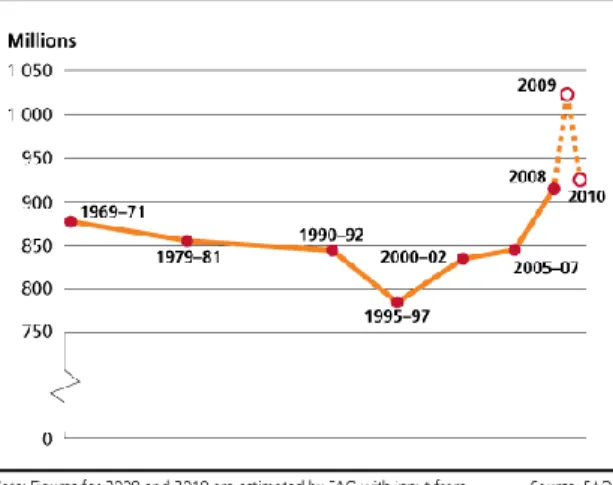
BJIR, Marília, v.1, n.2, p.256-278 Maio/Ago. 2012. Morgenthau, 2003). Evidence of that – not to talk about military conflicts – is that even with the technical possibility of producing food to the whole humanity since around mid 20th Century, hundreds of millions of persons still live in hunger, as graphic 1 shows (OECD e FAO, 2010).
Graphic 1 – Number of undernourished people in the world, 1969-1971 to 2010.
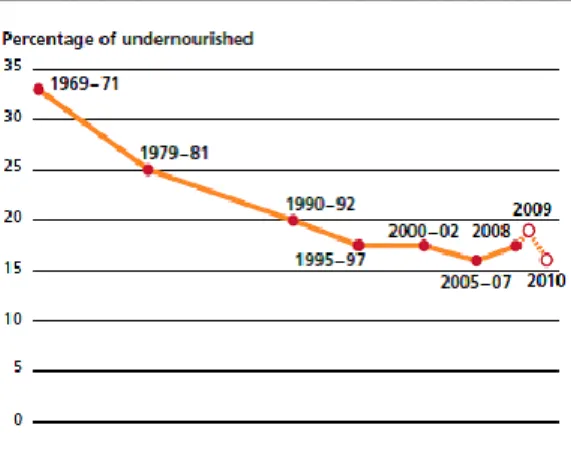
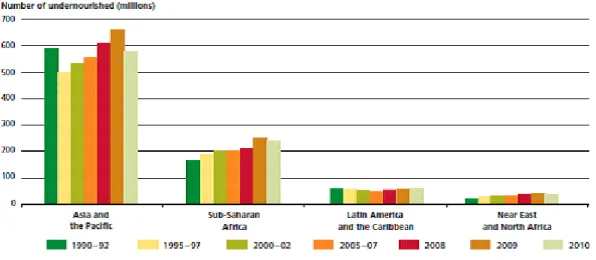
The World Food Summit of 1996, Rome, launched the diminishing of hunger worldwide by half until 2015 as a one of the UN’s Millennium Goals (Maluf, 2007). Despite modest, it is very improbable that the multilateral goal will be achieved. Actually, the opposite is observed. Graphic 2 shows that, proportionally, the quantity of malnourished people in developing countries diminished, but, nevertheless, the number of people living in hunger conditions had a brunt raise since 1995, summing up around one billion people in the 21st century. If it wasn’t for the notable advance of some countries in the past 15 years, like Brazil, China and India, the numbers would be worse. Graphics 3 and 4 point to the regional distribution of hunger.
BJIR, Marília, v.1, n.2, p.256-278, Maio/Ago. 2012. Graphic 2 – Proportion of undernourished people in developing countries, 1969-1971 to 2010.
Source: FAO, 2010
Graphic 3: Hunger distribution per region (2008).
BJIR, Marília, v.1, n.2, p.256-278 Maio/Ago. 2012. Graphic 4: Regional trends in the number of undernourished, 1990-92 to 2010.
Fonte: FAO (2010)
Graphic 3 evidences that the major part of world’s hungry people live in developing countries. It is estimated that 70% of those people live in 7 countries: Bangladesh, China, Congo, Ethiopia, India, Indonesia and Pakistan. Perhaps more intriguing is that data shows that 40% of the undernourished live in China and India, countries which are expected to have a sustainable accelerated economic growth in the years to come (FAO, 2010). If that growth is translated into income distribution to the poor, more pressure on food price can be expected, because normally an increase in poor’s income is transformed into more demand for food (Cochrane, 2003).
While many pundits like Paarlberbg (2010) argue that food insecurity in the international system’s periphery would be lessened with the integration of markets, is caused to a large extent by the integration of the agrifood chains at global level (McMichael, 2009, Vanhaute, 2010). When the chains get integrated, countries produce, supposedly, things that they do more efficiently and must acquire abroad what they can’t produce competitively. Thus, countries which do not produce basic food commodities (corn, wheat, rice, for instance) can face supply problems every time there’s not enough money to buy them, because when the tie between local production
BJIR, Marília, v.1, n.2, p.256-278, Maio/Ago. 2012. and consumption is broken, food can be channeled to the markets with bigger purchasing power – if there is no political interference.
Having the capacity to produce those products inside one’s own borders may reduce the State’s vulnerability in the volatile field of agriculture, both in terms of production and distribution. Both activities are subject to climate and pathological conditions, among others, and neither the private sector nor the governments are able to control or even mitigate, creating an element of uncertainty. There are also economic, social and political conditions that, apart from being difficult to manage, can be provoked by governments and private sector themselves. Hunger studies conclude that chronic malnutrition and famines are the result of many kinds of disasters, but always married to political action or inaction (Sen, 2000; McMichaels, 2009; Vanhaute, 2010).
In this sense, one element cannot be forgotten when analyzing the production and distribution of essential goods: the will. First, because in capitalist States the production of products and services consumed by the society is mainly relied to private enterprises. They decide if they are going to invest, hire, produce and sell. The State can influence those decisions through the institutional environment, it can create parameters to all those decisions, it can even prohibit them in some cases; but the State, in a market economy, cannot order the private actors to invest, produce, hire or sell. Since the agricultural production generally carried out by private actors, food offer also depends on their decisions.
Second, to this date it has not been possible to guarantee universal access to food at all times for a healthy life essentially for political reasons and, notably among them, due to the relations among States. The attainment of things not produced nationally must be done abroad and, to do that, resources are needed. The purchase is the most utilized way of doing it, but we can’t forget that there are other ways, say, colonialism. States that don’t have domestic production capacity, neither means to acquire abroad what they need are at mercy of foreign assistance.
However, having money doesn’t mean being always able to buy what is wanted. The others must be willing to sell and the selling must not be impeded by third parties, which are common facts in international relations. Sanctions and embargos are brought about by many reasons, and frequently with international political interests. Recently, however, a type of foreign
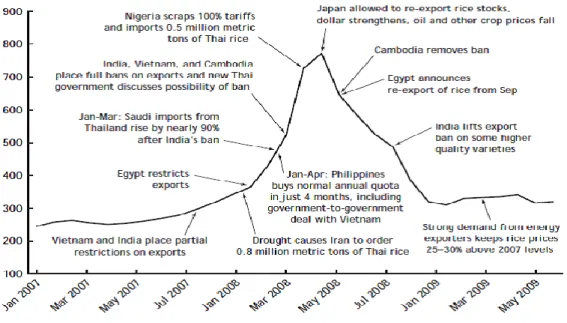
BJIR, Marília, v.1, n.2, p.256-278 Maio/Ago. 2012. sales refusal reminded the international community that no such international politics component is needed. In 2008, in the midst of a grave food scarcity crisis, Argentina, Kazakhstan, Russia and Ukraine put barriers to their exports of wheat; Cambodia, China, Egypt, India, Indonesia and Viet Nam restricted their sales of rice abroad. Those prohibitions significantly fermented trends that led to the huge high prices of that period (Headey e Fan, 2010). Figure 1 illustrates this point in the case of rice.
Figure 1: Effect of rice export restrictions on rice prices.
Source: Headey e Fan, 2010
Even though the sales haven’t been interrupted, apparently, due to political reasons, what is clear is that, at least in critical situations, States can try to solve their problems adopting measures that cause damage to other States, intentionally or not. Even though it is a very moderate statement, it stresses the argument: an anarchic international system is intimately accompanied by uncertainty due to the fact that, at the limit, each State must ensure its vital interests.
BJIR, Marília, v.1, n.2, p.256-278, Maio/Ago. 2012. If being dependent on what is produced and distributed by foreigners can be risky and demand prudence, is it possible, then, to examine the maintenance of protectionist agricultural policies from another angle, a more strategic angle? Protectionism may have the objective of maintaining an endogenous production, despite costly, for reasons that not only correspond to the simple capture of the State by private interest groups. That is, the phenomenon may have part of its explanation on international politics, particularly by the aphorism that to be dependent on fundamental resources provided from abroad is risky because production and distribution decisions cannot be influenced in many cases. But it is not only the dependence of foreign production and distribution that may make the State vulnerable. The vulnerability can happen in the domestic sphere, particularly in capitalist States, as we argue below.
State interest in private production
In capitalist States the private production is strategic. All State action is dependent on the use of resources that are, in a major part, gathered by tax revenues. There are cases in which State firms are able to give considerable income to the State, but it is improbable that a State may disregard the money from fees and taxes.
In market economy States, the state resources are obtained mainly through the charging of taxes upon private economic relations, directly or indirectly. This means that the State “has not only the authority, but also the mandate to sustain and create conditions for the accumulation”, which involve acting against “threats that cause accumulation problems, threats from competition among the accumulating units, domestic and internationally, as well as the working class. The function of creating and maintaining conditions for accumulation implies the establishing of control over destructive possibilities and events” (Carnoy, 1988: 172). In other words, not using the available state instruments to cope with threats nor to promote the strengthening of the accumulation means acting against State’s own strategic interest. This is the general compromise that – it is expected, but does not always need to be like this – the governments have to their States, which are dependent of private economic activity (Offe, 1995).
I do not bring those arguments to sustain that governments and bureaucrats are determined a priori by the interests of the capitalist class nor of private entrepreneurs. I use the
BJIR, Marília, v.1, n.2, p.256-278 Maio/Ago. 2012. assumption that it is strategic for the State to foster private actors prosperity because it is that prosperity that makes most of the State and private activities possible. Hence, despite the many regulatory, fiscal and social measures that bring the businessmen’s opposition, in the long run the fundamental objective is to make the private firm prosper, which creates a State bias toward the private producers. If private business cannot create by themselves the conditions for prosperity, building them is a strategic objective of the State.
If, on one hand, strengthening the private sectors’ capacity to generate resources is strategic to States, on the other hand this very source of power is turned into vulnerability. As investment, contracting and hiring decisions are majorly private decisions, the State is, to a high degree, dependent on entrepreneurial initiative to have goods and services produced. Despite the existence of State companies, the fact is that the State can’t supply alone all the society’s needs. In a market economy, the State should not even try to do this: it must create conditions for the private firms to do it. This is why Offe (1995) and Lindblom (1979) identify the power of entrepreneurial interests toward the State not so much in their capacity to influence political processes, but in the privileged position they have due to their prerogative of making fundamental decisions regarding production, investment, hiring and so on.
It doesn’t mean that businessmen’s mobilization is not important, nor that the other groups’ aren’t either. However, what is being argued here is that because the State is capitalist and therefore dependent on private business’ investment decisions, governments are more prone to business’ interest. In Offe e Ronge (1984: 124) words
“It is not fundamentally the agents of the accumulation process that are interested in using the State power, but, on the contrary, the agents of State power that – aiming at ensuring their own functioning capacity – obey, as their highest commandment, the imperative of constituting and consolidating a favorable economic development’”.
The argument above makes two different main points: 1) the State depends on private production to collect fiscal resources; 2) the State depends on private production activity for the production of goods and services. It is essential now to elaborate deeper on the second point for our discussion on agricultural policies, and Lindblom (1982; 1984) offers a fertile entrance to think the private activities as being of public interest. The author develops his argument from the
BJIR, Marília, v.1, n.2, p.256-278, Maio/Ago. 2012. observation that many business decisions end up affecting essential aspects of society, even in an infrastructural way.
“If we can imagine an economic-political system without currency and markets, decisions about income distribution would have to be political or governmental. In the absence of markets and wages, parts of the income would have to be distributed by some kind of public authority, maybe by rationing. Decisions about what should be produced would have to be taken by public or governmental authority. The same would apply to resource allocation through the different production’s lines, to factories’ location, to technologies to be used, to the quality of goods and services, to product innovation – in sum, in all important aspects of production and distribution. All of them would be accepted as public policy decisions” (Lindblom, 1979: 194).
To Lindblom (1979), the most important public function of the private sector is the creation of jobs. As the system is based on a market economy, private actors are responsible for the production of the major part of fundamental things – concrete, iron, wheat, for instance – and because of that the activities of those actors become of public interest, even though the large public may not perceive it.
For that reason it is the State interest that certain economic sectors are maintained operative, if possible in an efficient manner. If the private enterprises are not able to do it by themselves, the State will need to help them out or execute those tasks itself in order not to become vulnerable domestically or internationally. Agricultural production, our focus here, is certainly an enormous exponent of this way of thinking about the public role of private enterprises. After all, the abundant availability of cheap food and raw materials is trusted to non-state producers and that production can hardly be imagined without the participation of private suppliers, processors, service providers and distributors. It is in this sense that Lindblom (1984) argues the need to recognize the public character of private business.
Governments’ actions during the recent financial crisis remind us that saving some private enterprises can be a necessity. In the agriculture case it may be the same. Economic crises in agriculture are frequent and in the absence of State intervention rural producers would probably self-destruct themselves because of overproduction or they would be driven out of the market if they didn’t have support to modernize their production and to become more competitive. However, if producers do not judge the financial return over investment to be satisfactory, how
BJIR, Marília, v.1, n.2, p.256-278 Maio/Ago. 2012. come would they continue investing? One reason for state intervention can be just to incentive capital investments to continue. After all, in the absence of investment, agricultural products would become scarcer. In the absence of certain agricultural products, some food industries could be displaced or forced to change their activities due to lack of raw material. Imports can be a solution, but they would tie investment decisions at home to investment and distribution decisions abroad, which assume taking some international risks the governments may want to prevent.
This scenario can actually be much more complicated because sophisticated production is configured around agroindustrial complexes, as discussed below. At those complexes, agriculture is just one part – no doubt fundamental – of the many others that form the productive complexes.
Agroindustrial Complexes
Not only a trade that gives nothing can be useful, but a trade disadvantage may have its usefulness. I heard in the Netherlands say that whaling, generally, yields almost never what it costs, but those who work in the construction of boat masts, provide the tools, food provisions are also those who have the primary interest in this fishery. If they lose fishing, they win in the supplies (Montesquieu. O espírito das leis, chapter VI).
The way chosen by many developed and developing countries to have a large domestic disposal of food was the constitution of agricultural complexes. In this section, I’ll briefly expose the agroindustrial complex concept in order to suggest that it is the State interest to have those complexes functioning for at least two reasons: 1) to ensure a large amount of food and 2) to keep other segments dynamic. Although I take the concept of agroindustrial complex from Brazilian literature (Belik, 1992; Kageyama et al, 1990; Müller, 1989 ; Graziano da Silva, 1996), there is a wide consensus that the industrialization of significant parts of agricultural production created an enourmous production capacity (Soth, 1968; Cochrane, 1979; Hurt, 1994; Sheingate, 2001; Conkin, 2009; Burbach e Flynn, 1980; Le Heron, 1993; Coleman, Grant e Josling, 2004; Veiga, 2007). What the concept of agroindustrial complex stresses, however, is the State direction of this process.
BJIR, Marília, v.1, n.2, p.256-278, Maio/Ago. 2012. It is acknowledged that, until the 20th century, farms were productive units highly self-sufficient. Almost everything needed to grow crops and animals was obtained within their fences. Although this kind of agricultural persists in many countries, it is a model becoming obsolete in the countries where production has become sophisticated: farms became more and more dependent on industrialized inputs, specialized services, and processors and distributors to their products. This process began in the United States in first decades of the past century and was exported to other countries in the post World War II, mainly by the so called Green Revolution.
The development of science and technology allowed parts of the elementary agricultural activity, called discrete by Goodman, Sorj and Wilkinson (1990), to be converted into industrial processes of increased sophistication which are then applied as inputs to the natural processes. Discrete elements and steps are, for instance, manure, sowing and harvesting. Before being appropriated by industrial processes, those elements and steps were produced/done endogenously within the farms. However, as the scientific and technological knowledge advanced, those elements and steps became deeply dependent on industrial processes: manure is replaced by synthetic fertilizers and manual sowing and harvesting are done by automatic tractors guided by GPS. According to Kageyama et alli (1990: 114), “From the moment agriculture is industrialized on, the technical base cannot recede anymore: if the technical base recedes, so does the agricultural production”. Thus, once this model is generalized, industries have in farms important clients. Simultaneously, if farmers turn back to more rudimentary techniques they may face large capital losses, since many agricultural inputs and capital goods cannot be used in another activities. In this sense, it is important for both, farmers and industries, to ensure that the technical base evolves in a determined direction, coordinating interests. This necessity of coordination shapes the agricultural complexes by one side.
Another characteristic that changes when rural complexes are substituted by agroindustrial complexes, on the other side, is the way agricultural produce is traded: products that were mainly sold to final consumers were turned, in a large extent, into raw materials for the food industries. Thus, consumers became dependent on food industries, which are dependent on farm production, which is dependent on industrial inputs. This dependency relation also works in the opposite direction, because input suppliers have farmers as important clients, which acquire their investment capacity from the sales to food processors, which are dependent on consumption
BJIR, Marília, v.1, n.2, p.256-278 Maio/Ago. 2012. patterns. In sum, the direct relation between rural production and food consumption becomes mediated by industrial relations. Those food industries – which since the 1950s can be gigantic enterprises with large transnational operations – need a cheap, stable and uniform supply of raw materials. Hence, this is another branch of agricultural complexes that needs coordination.
Those agroindustrial relations founded on scientific and technology advancements have two important consequences. The first one is the demand for credit, because it is through financing that farmers acquires the sophisticated capital goods and inputs for the standardized production that food industries demand. The second one is the overproduction – derived from the use of those very sophisticated inputs and capital goods – that pushes down the commodities prices, making farmer’s sales unable to cover production costs.
There is where the State, the main coordinator of the agricultural complexes, plays its role in the maintenance of agricultural production. Governments use State resources to perform their expected function in a market economy, according Lindblom (1979) and Offe (1984): maintain important economic sectors viable and functioning. In fact, the perception that agroindustrial complexes needed an active State coordination, due to the failure of the price’s system in doing so, gets stronger in the first decades of the past century (Zylbersztajn: 2000).
Coordination is one of the main important themes in agroindustrial relations because of the high volatility of agriculture (Coleman, Grant e Josling, 2004; Starmer e Wise, 2007). Many types of coordination exist – cooperatives, vertical integration, contracting, futures market – but State coordination, through its authority and resources, is the one with broader and more fundamental effects. This is a major point to the notion of agroindustrial complex. Graziano da Silva (1994: 227), states that the dismantlement of rural complexes in exchange for the agroindustrial ones would demand an
“ever growing State participation in order to make specific policies to each AIC regulation. An intervention that responds to a double objective: first, the establishment of another regulation system in which the State defines the main parameters for profits of the capitals engaged in the different branches; and second, acting like arbitrator of the contradictions that internalize in those complexes, as, for instance, the limits to oligopolistic competition, the establishment for quotas (especially in the case of imports), etc.”
BJIR, Marília, v.1, n.2, p.256-278, Maio/Ago. 2012. The emergency and maintenance of agroindustrial complexes generally occur with the regulator support, as well as the inductor support, of the State. As Goodman, Sorj e Wilkinson (1990: 144-145) synthesize:
“Initially, the central objective of government’s financial intervention in agriculture was the promotion of appropriation through credit supplying. Since World War I and the interwar depression years, however, priority had to be given to an ever broader regulation of agricultural markets. When the total impact of appropriation was felt, in the post-World War II period, the overproduction capacity had become a structural phenomenon in the advanced capitalist countries. The maintenance of agricultural production and, hence, the reproduction of appropriationist capitals, is attributed to a complex group of measures, including price guarantees, deficiency payments, state purchases and storaging, agricultural insurance, commerce chambers, subsidized programs to take land out of production and subsidies and taxes for imports/exports. The State, in sum, is in charge of conciliating the conflicting effects of continued productivity increase, associated to industrial appropriation, over production and productive capacity, rural income and the rural social structures”.
The transition from one complex to the other is a major phenomenon in history because it aligned agricultural and industrial modes of production (Goodman, Sorj e Wilkinson, 1990). Since then, where production is sophisticated, it is not possible to think about agricultural activity apart from the diversified range of inputs that must be bought in the market, and without the infinitude of manufactured products that take shape after the agricultural produce leaves the farms, bringing with it economic, sociological, ecological e political impacts.
In conclusion, the notion of agroindustrial complex removes agriculture from the center of the analysis because the explanation of sophisticated agricultural production, as well as its institutional frameworks, must take into account the other segments that are interdependent with it. The notion of agroindustrial complex brings the political issue to the front, because it assumes actors that know that they are part of that complex and that seek (through negotiation, pressure, coercion, cooperation etc) to concert interests and give the conjunct a direction, particularly regarding public policies (Belik, 1992; Graziano da Silva. 1994: 232). In this process, big companies are assumed to have an upper hand among other societal interests, but the State is the process’ director.
It is necessary to have in mind Lindblom’s and Offe’s ideas regarding the State and the private production. When the State maintains some farmers artificially operating via subsidies, the State is also helping industrial interests to do their business. The State is guaranteeing that
BJIR, Marília, v.1, n.2, p.256-278 Maio/Ago. 2012. input suppliers will always have clients (farmers) and the food processors will have an interrupt flux of cheap and standardized raw material (farm produce). Plus, industrial capitals are the ones that generate most of the taxes and employments. The targeting of basically the same commodities since the beginning of the subsidies programs can be seen as a coordinating movement by the State, in which it directs farmers to grow certain commodities for a long time as an incentive to scientific and technological advancement in both, inputs to agriculture and food processing. And all of this without being too dependent on foreign supplies.
International distribution and uncertainty
Food production and distribution can be affected by many sorts of events: climatic, pathologic, market, among others, including political ones. When the matters are transnational production chains and international distribution the question is aggravated by the inexistence of a deep solidarity in international relations (Aron, 1986, Morgenthau, 2003). Therefore, to be dependent of food and agricultural inputs from abroad is something that can be problematic for any State, as it could be observed in the food export restrictions applied by many States at the end of the last decade.
The post World War II had as one of its goals the liberalization of trade and international treaties, regimes and organizations were created to sustain it. Those institutions, deeply tied to power relations, have the objective of fostering conditions that allow international cooperation to be more profound and efficient among States (see, for example, Wilkinson, 2006). Those institutions would have the goal of fostering trust among member states, encouraging them, eventually through threats, to diminish their barriers to trade so the competition among firms could take place more openly in the international sphere. The international institutions would contribute to make the international relations take place in a more firm and predictable terrain, giving more stability to buyers and sellers.
Open markets and safe routes to trade are fundamental to support the international trade liberalization of food, something essential to achieve food security under the food self-reliance principle (Maluf, 2000). This principle denotes that the best way to guarantee a food supply is by having the capacity to afford food, that is, income to buy food. It is an idea that gets strength
BJIR, Marília, v.1, n.2, p.256-278, Maio/Ago. 2012. internationally by 1980s, and that takes the focus away from food production (Maluf, 2007). Thus, the principles of economic openness and market efficiency affect, at the international level, the ways to achieve food security in many countries. It is needed to say that this movement has to do with the huge agricultural commodities export capacity of many countries, mainly the United States and the European Union. Due to the huge surplus production derived from the agricultural complexes’ mode of production, sending a significant part of goods abroad has become paramount. One of the consequences is the fight against food self-sufficiency practices (Maluf, 2000).
Nowadays, the WTO’s multilateral trade regime has the function of maintaining open markets through the member States commitment not to raise barriers to imports, except in special cases. However, it is not in the text of the main international trade regime the compromise not to restrict exports. After the food crisis of the last decade, aggravated because of the export restrictions placed by some States, this subject has been discussed by some WTO’s members, although with an explicit pessimism. Proposals driven by the EU and Egypt to add the theme to the Doha’s negotiating mandate failed in 2011 (ICTSD, 2011).
The inexistence of a rule in defense of the continuing export flux aggravates the international uncertainty regarding the operation of a food security system based on food self-reliance, even for the richer, for having money does not mean that access to provisions is guaranteed, as mentioned above. However, even admitting the creation of international rules against export restraint and that those rules would raise the predictability of State actions in times of stability, when the moment is critical, it is not rare that States set aside its international commitments and trace particular solutions to their problems, even being conscious of the negative externalities that those solutions can bring about (Aron, 1986; Morgenthau, 2003).
Hence, since supply crisis and hunger are endemic in the modern world (Sen, 2000; McMichael, 2009), to be dependent on foreign provision may make some States more vulnerable, a condition they will try to settle in many ways and within their power limits. China, for example, which has always insisted on a self-sufficiency policy, but in the past years became a net food importer, has concluded agreements with Brazil and Argentina to guarantee the canalizing of determined quantities of food, especially soy, produced in those countries to it (Maisonnave e Carazzai, 2011; Ferraz e Colombo, 2011). Besides economic agreements, some States – South
BJIR, Marília, v.1, n.2, p.256-278 Maio/Ago. 2012. Korea, China and Saudi Arabia, for example – are preparing against food vulnerability by buying and leasing land in Africa in order to produce their own supplies (Rice, 2009). The strategy of guaranteeing food supply by controlling production in other countries is, however, risky. For example,
“In 2007, as food prices were starting to rise, China signed an agreement with the Philippines to lease 2.5 million acres of land slated for food crops that would be shipped home. Once word leaked, the public outcry -- much of it from Filipino farmers – forced Manila to suspend the agreement. A similar uproar rocked Madagascar, where a South Korean firm, Daewoo Logistics, had pursued rights to more than 3 million acres of land. Word of the deal helped stoke a political furor that toppled the government and forced cancellation of the agreement. Indeed, few things are more likely to fuel insurgencies than taking land from people. Agricultural equipment is easily sabotaged. If ripe fields of grain are torched, they burn quickly” (Brown, 2011:6).
Those are examples that suggest the pertinence of examining agricultural policies through lenses that consider reasons for protectionism other than the rent-seeking relation between politicians and farmers’ lobbying groups and the economic irrationality. Staatz (1991: 18) makes the point:
“Why do so many countries ignore generally accepted theories of specialization and exchange based on comparative advantage and persist in pursuing agricultural self-sufficiency? The most likely explanation is not that policymakers are uniformly irrational but that they are rationally pursuing goals other than narrowly defined economic efficiency. Attacks by economists on self-sufficiency policies as economically ‘irrational’ are, in these cases, likely to carry little weight, as they do not address the real objective of the policies that policymakers may in fact be trying to obscure. Possible justifications for agricultural self-sufficiency policies include risk and stability considerations, protection of domestic agriculture, and pursuit of broader economic goals”.
Conclusion
Agricultural protectionism has been under strong criticism for a long time. The causes of it, however, seem to have been out of dispute in the academy. It was this paper’s objective to suggest some other ways to question the reluctance of developed countries to liberalize their agricultural sectors. In this sense, the argument was based on concerns regarding the private production and the distribution of products, especially when the purchase has to be done internationally. It was argued that the reduction of State vulnerability, albeit at a high economic
BJIR, Marília, v.1, n.2, p.256-278, Maio/Ago. 2012. cost, can be a strategic option. This is not to argue that the way it happened since the mid-twentieth century, with its focus on high productivity and subsidies, is the most correct, but to point out that support economically inefficient production in developed countries can be a result not only of the links between interest groups and legislators immersed in a political system that favors maintaining the status quo in the field of agricultural policy. Having large production capacity and, if possible, enjoy food security, is a desirable condition for any State to become less vulnerable domestically and internationally, and the agroindustrial complexes may have been to be the way chosen to do so. However, empirical research is necessary to verify the questions and hypothesis outlined above.
Recebido em maio/2012; Aprovado em agosto/2012
Bibliography
ARON, Raymond. (1986) Paz e Guerra entre as Nações. Brasília, Brasília, Ed Unb.
BAVIERA, Mara e BELLO, Walden. (2009) “Food Wars”. Monthly Review, vol. 61, nº 03, julho/agosto.
BELIK, Walter. (1992) “Agroindústria processadora e política econômica”. Tese de doutorado. Instituto de Economia, Universidade Estadual de Campinas. Campinas.
BROWN, Lester R. (2011) “The new geopolitics of food”. Foreign Policy. Maio-junho. Disponível em http://www.foreignpolicy.com/articles/2011/04/25/the_new_geopolitics_of_food, acesso em 20/08/2011.
BROWNE, William P. (1995) Cultivating Congress: constituents, issues, and interest in agricultural policymaking. Kansas: University Press of Kansas.
BURBACH, Roger e FLYNN, patrícia. (1980) Agribusiness nas Américas. Rio de Janeiro: Zahar Editores.
CARNOY, Martin. (1988) Estado e teoria política. São Paulo: Papirus.
BJIR, Marília, v.1, n.2, p.256-278 Maio/Ago. 2012. COCHRANE, Willard W. (2003) The curse of American abundance
COCHRANE, Willard W. (1979) The development of American agriculture : a historical analysis. Minneapolis: University of Minnesota Press.
COLEMAN, William, GRANT, Wyn e JOSLING, Tim. (2004) Agriculture in the new global economy. Cheltenham / Northampton: Edward Elgar.
CONKIN, Paul K. (2009) A revolution down on the farm. The transformation of American agriculture since 1929. Lexington: University Press of Kentucky.
FAO. (2011) The State of Food Insecurity in the World: Addressing food insecurity in protracted crises. FOOD AND AGRICULTURE ORGANIZATION OF THE UNITED NATIONS. Rome. FERRAZ, Lucas e COLOMBO, Sylvia. (2011) “China vai investir US$ 1,5 bi para produzir alimentos na Argentina”. Folha de S. Paulo. 3 de setembro.. Disponível em
http://www1.folha.uol.com.br/mercado/969800-china-vai-investir-us-15-bi-para-produzir-alimentos-na-argentina.shtml, acesso em 25/02/2012.
GOODMAN, David, SORJ, Bernardo e WILKINSON, John. (1990) Da lavoura às biotecnologias. Agricultura e indústria no Sistema Internacional. Rio de Janeiro: Campus.
GRAZIANO DA SILVA, José e KAGEYAMA, Angela. (1996) “Do complexo rural aos complexos agroindustriais”. Em GRAZIANO DA SILVA, José. A nova dinâmica da agricultura
brasileira. Campinas: Unicamp.
GRAZIANO DA SILVA, José. (1994) “Complejos agroindustriales y otros complejos”. Agricultura y Sociedad. nº 72, jul-set. Pp 205-240.
HEADEY, Derek e FAN, Shenggen. (2010) “Reflections on the global food crisis : how did it happen? how has it hurt? and how can we prevent the next one?” IFPRI research monograph, nº 165. International Food Policy Research Institute: Washington, D.C.
HURT, Douglas R. (1994) American agriculture: a brief history. Iowa: Iowa State
KAGEYAMA, Angela et al. (1990) O novo padrão agrícola brasileiro: do complexo rural aos complexos agroindustriais. In: DELGADO, Guilherme Costa et al. (orgs.), Agricultura e políticas públicas. Brasília, IPEA, (Série IPEA, 127).
LE HERON, Richard. (1993) Globalized agriculture: political choice. Oxford: Pergamon Press. LINDBLOM, Charles E. (1979) Política e mercados. Os sistemas políticos e econômicos do mundo. Rio de Janeiro: Zahar editores.
BJIR, Marília, v.1, n.2, p.256-278, Maio/Ago. 2012. LINDBLOM, Charles E. (1982) Market as Prison. The Journal of Politics, Vol. 44, No. 2, pp. 324-336
LINDBLOM, Charles E. (1984) “The accountability of Private Enterprise: private – no. Enterprise – yes. TINKER, Tony (ed.) Social Accounting for corporations. Private enterprise versus the public interest. Manchester: Manchester University Press.
MAISONNAVE, Fabiano e CARAZZAI, Estelita Hass. (2011) “Chineses investem na soja brasileira”. Folha de S. Paulo. 3 de abril. Disponível em http://www1.folha.uol.com.br/fsp/mercado/me0304201102.htm, acesso em 26/02/2012.
MALUF, Renato S. Jamil (2000) “O novo contexto internacional do abastecimento e da segurança alimentar”. In BELIK, Walter et al. Abastecimento e segurança alimentar: os limites da liberalização. Campinas: Unicamp.
MALUF, Renato Sérgio Jamil. (2007) Segurança Alimentar e Nutricional. Petrópolis: Vozes. McMICHAEL, Philip. (2009) The World Food Crisis in Historical Perspective. Monthly Review. MORGENTHAU, Hans. (2003) A política entre as nações. Brasília, Ed. UnB.
OECD and FAO (2010). OECD–FAO agricultural outlook 2010–2019. Disponível em www.agri-outlook.org/dataoecd/13/13/45438527.pdf Acesso em 27/04/2010.
OFFE, Claus (1995). Capitalismo desorganizado. Transformações contemporâneas do trabalho e da política. São Paulo: Brasiliense.
OFFE, Claus e RONGE, Volker. (1984). Teses sobre a fundamentação do conceito de “Estado Capitalista” e sobre a pesquisa política de orientação materialista. Em OFFE, Claus. Problemas estruturais do Estado capitalista. Rio de Janeiro: Tempo Brasileiro.
PAARLBERG, Robert (2010). Food Politics. What everyone needs to know. Oxford University Press.
PASOUR JR, E. C. e RUCKER, Randal R. (2005) Plowshares and pork barrels: the political economy of agriculture. Oakland: The Independent Institute.
RICE, Andrew. (2009) “Is there such a thing as agroimperialism?” The New York Times
Magazine, 16 de novembro. Disponível em
http://www.nytimes.com/2009/11/22/magazine/22land-t.html?pagewanted=all, acesso em 10/02/2012.
SEN, Amartya. (2000) Desenvolvimento como liberdade. São Paulo: Companhia das Letras. SHEINGATE, Adam D. (2001) The rise of the agricultural welfare state. Institutions and interest group power in the United States, France and Japan. Princeton: Princeton University Press.
BJIR, Marília, v.1, n.2, p.256-278 Maio/Ago. 2012. SOTH, Lauren. (1968) A moderna agricultura e seus problemas. São Paulo: Editora Atlas. STAATZ, John M. (2011) “Conceptual issues in analyzing the economics of agricultural and food sufficiency”. In Ruppel, Fred J. e Kellogg, Earl D. National and regional self-sufficiency goals. Implications for international agriculture. Boulder and London: Lynne Rienner Publishers.
VANHAUTE, Eric (2011). From famine to food crisis: what history can teach us about local and global subsistence crises. Journal of Peasant Studies, 38: 1, pp. 47 – 65.
VEIGA, José Eli da (2007). O desenvolvimento agrícola: Uma visão histórica. São Paulo: Edusp. ZYLBERSZTAJN, Decio (2000). “Conceitos gerais, evolução e apresentação do sistema agroindustrial”. In ZYLBERSZTAJN, Decio e NEVES, Marcos Fava (org.). Economia e gestão dos negócios agroalimentares: indústria de alimentos, indústria de insumos, produção agropecuária, distribuição. São Paulo: Pioneira.
WILKINSON, Rorden (2006). The WTO crisis and the governance of global trade. Londres e Nova Iorque: Routledge.