What is engaging content?
Influence of the social media type of message
on consumer engagement
Final Dissertation presented to Universidade Católica Portuguesa to obtain the degree of Master of Science in Marketing
by
Tiago Carvalho Almeida Ferreira Paraty
Supervised by Joana César Machado
Carla Martins
Católica Porto Business School March 2017
To my supervisors, parents, girlfriend, family & friends for all the support and guidance
Abstract
The process of communicating with consumers has changed dramatically with the rise of social media, as social networking sites have established themselves as a legitimate, direct and free-of-charge communication channel. Considering that content is fundamental to the social media sphere, as it does not depend solely on the brands to be created, it is important to understand the pertinence, significance and impact of brand page content on Facebook.
A brief look at concepts like social media, social networking sites, consumer engagement and content allowed a more congruent selection of the path chosen. By exploring the impact that seven different types of social media content have on consumer engagement regarding Facebook brand page posts, this research aims to provide relevant insights for practitioners via the identification of patterns, links and insights.
In order to achieve these goals, an online survey that encompassed real Facebook brand page posts was administered and provided interesting results. The seven types of content – seasonal, activity, corporate social responsibility, customer service, product awareness, brand awareness and reward – registered different results, proving that the type of content influences consumer engagement. Moreover, corporate social responsibility was the type of content most probable to stimulate consumer engagement, followed by reward. Besides this surprising result, an overall advantage of emotional appealing types of content over informational ones, as well as differences in both age and gender groups were registered.
Keywords: consumer engagement, message, content, social networking sites, Facebook
Table of Contents
Abstract ... v
Table of Contents ... vii
Figure and Table Index ... ix
1. Introduction ... 11
2. Literature Review ... 14
2.1 Social Media & Social Networking Sites ... 14
2.2 Brands in Social Networking Sites ... 15
2.3 Consumer Engagement ... 17
2.4 Consumer Engagement Drivers ... 20
2.5 Content ... 22
3 Research Model and Hypotheses ... 28
4 Methodology & Data Collection ... 32
5 Results ... 38
5.1 Sample Characterization ... 38
5.1.1 Demographic Profile ... 38
5.1.2 Usage of Facebook Brand Pages ... 39
5.1.3 Attitude and Familiarity regarding IKEA ... 41
5.1.4 Potential Engagement behaviors towards IKEA ... 41
5.2 Type of Content and Consumer Engagement ... 42
5.3 Moderation of Brand Attitude and Brand Familiarity ... 47
5.4 Demographic Variables and Engagement ... 48
6 Discussion ... 51
6.1 Managerial Implications... 55
6.2 Limitations & Further Research ... 57
Bibliography ... 59
Figure and Table Index
Figure 1 - Research Model ... 28
Table 1 - Facebook behavior scale, adapted from (Kabadayi & Price, 2014) .. 34
Table 2 - Brand attitude and brand familiarity scales, adapted from (Machado et al., 2012) ... 35
Table 3 - Scale used to measure consumer engagement, adapted from (Smith, 2013) ... 37
Table 4 - Respondent's gender, education and professional situation ... 39
Table 5 - Respondent's Facebook usage data. Output from SPSS ... 40
Table 6 - Brand attitude and brand familiarity means regarding IKEA ... 41
Table 7 - Potential likelihood of engagement towards IKEA. ... 42
Table 8 - Attention likelihood analysis by type of content ... 43
Table 9 - Interest likelihood analysis by type of content ... 44
Table 10 - Like likelihood analysis by type of content. ... 45
Table 11 - Comment likelihood analysis by type of content. ... 45
1. Introduction
Having an engaged consumer base is quickly becoming one of the key objectives of many marketing professionals (Dessart, Veloutsou, & Morgan-Thomas, 2015), since several researchers have noted the link between more effective brand-consumer interactions and the increase of sales (Neff, 2007), profits (Voyles, 2007), customer satisfaction (Challagalla, Venkatesh, & Kohli, 2009) and overall firm competitiveness (Kumar et al., 2010). However, we, as consumers, still think and act towards brands as if they were hotel room keys (Lindstrom, 2008), disposing them after consuming the product or using the service. Therefore, in order to achieve an engaged and loyal consumer base, something else must be done. Hence, creating some sort of relationship or attachment with the brand should be critical in order to secure the customer, promote repeat buy and, more importantly, develop fierce brand ambassadors.
Until here, this process seems precise and simple. The problem is that companies are not sure how to communicate in such way that the product, or service, in question grips our mind and heart. They can’t engage with us, consumers, authentically or even understand us, as they only focus in catching our attention through the same procedures they’ve used for years. In part, one can blame marketers or advertisers for this path that marketing communication took, as they follow a simple and straightforward reasoning that is paired with a relaxed attitude: the always-on, above-the-line, media assault has existed for several years, and it has worked until now. However, in the last few years, the way people exchange information and how individuals communicate with each other have changed significantly (Hennig-Thurau et al., 2010) due to the rise of social media services such as Facebook, Instagram, YouTube, Twitter, Yelp, Foursquare or Trip Advisor. The rise of such tools led to a significant shift in
the customer’s role in the production process, since consumers don’t settle for the traditional perspective of companies having total control over the brand development process, and are becoming increasingly eager to have their say by serving as co-creators of the products and services, enabling positive impacts on consumer relationships and purchase intention (Kim & Ko, 2012).
Despite these changes, we continue to be the same easy-appealing consumers that we once were. It doesn’t matter how hard we try to conceal it, when we hear the gasp from an unscrewing bottle cap, our rational way of acting disappears, as we consistently engage in some kind of behavior for which we have no clear-cut explanation. Companies need to discover the new “gasp” in social media so that they can strive and stand out from the overcrowded, ever-present, marketplace created, advertisement clutter as soon as possible. Otherwise they will be one more brand that probably won’t last more than three seconds on our thoughts, given that the human attention span is becoming close to resemble that of a goldfish, as Lindstrom (2008) points out.
In order to adapt, evolve and flourish in this new environment, companies have to embrace these changes and work towards fulfilling the new consumer trends within this new sphere called social media. Social media can’t function without content, as the content itself is what is shared by the company with their customers and other companies, and is even shared between consumers. Therefore, content undertakes a bigger role than ever before due to the social networking sites’ (SNS) role as an agent of change in the way how brand-related content is created, distributed and consumed. SNS conceded some power to shape brand images, that solely belonged to the advertisers, to the consumer’s online connections. Hence, the objective of this Master’s Final Assignment (MFA) is not only to (1) classify Facebook brand page posts in terms of content, so that a Facebook content typology can be developed, but also (2) to identify patterns, links and the impact of each creative strategy, or
message objective. Furthermore, this research aims to (3) understand the influence of these factors on consumer engagement, so that (4) suggestions and insights can be provided to practitioners on how to develop their social media strategy and how their current strategy is aligned with the consumer perspective
In order to accomplish these objectives, six chapters were established. The first chapter is the introduction, where the motivations to develop this research and its objectives are described. In the second chapter, a literature review on key topics such as social media, social networking sites, consumer engagement and content was developed. Afterwards, in the third chapter, the research model and subsequently formulated hypothesis are presented. In the fourth, the research methodology and the data collection procedures are explained. The fifth chapter regards the presentation of the statistical results, that are discussed during the sixth chapter, exposing the managerial implications, limitations of the research and hints for future one during this process.
2. Literature Review
2.1 Social Media & Social Networking Sites
Despite being perceived as an agent of change and potential threat to marketers, social media is an opportunity source for marketing strategists that want to place, again, the customer on top of the company’s priorities (Efthymios, 2014). Social media can substitute traditional marketing tools effectively and economically (Efthymios, 2014) and regards a group of Internet-based applications that build on the ideological and technological foundations of Web 2.0, and that allow the creation and exchange of user-generated content (Kaplan & Haenlein, 2010). Thus, social media is a general description that has sub-ramifications of online “forums” that include, among others: SNS such as Facebook, Instagram or Twitter; sharing sites that rely on creativity like YouTube, Vimeo or SoundCloud; blogs; product or service rating websites from which Yelp! or Trip Advisor stand out; Internet discussing forums like Reddit (Mangold & Faulds, 2009).
Since this research main focus is on the social network Facebook, studying SNS in depth is of great importance. SNS are widely defined as web-based services that allow individuals to construct a public, or semi-public, profile within a bounded system, articulate a list of other users with whom they share a connection, as well as, view and transverse their list of connections and those made by others within the system (Boyd & Ellison, 2008). The connection part of this definition is crucial, as SNS offer unprecedented opportunities for brands to reach their stakeholders (Tsai & Men, 2013), since they aren’t exclusively networks of consumers. Moreover, social media promotes and
empowers both consumer-brand networks and networks among brands (Gensler, Völckner, Liu-Thompkins, & Wiertz, 2013).
SNS also have an important role on the consumer’s evolution towards participation and co-creation, providing an online megaphone with which its users can publish and disseminate personal evaluations of products and services publications (Chen, Fay, & Wang, 2011) that can be read, used and discussed by a growing network of new interactions and relationships, that also participate on social movements of their own interest, besides this shared one (Hajli, 2013; Mangold & Faulds, 2009). This juxtaposition between one’s social movements and individual interests shows the raw potential that SNS have as a “many-to-many” mean of communication where liking and sharing can increase the effects of popular cohesion and message diffusion (Chang, Yu, & Lu, 2015). This scale with enhanced dissemination, on which social media can operate, is believed to create synergistic effects that make them a powerful and efficient communication tool (Chang et al., 2015).
2.2 Brands in Social Networking Sites
Fueled by the raw potential and widespread interactive nature of SNS, brands have embraced Facebook as a key marketing channel (Malhotra, Malhotra, & See, 2013). Beyond the creation of the public or semi-public profiles mentioned before, Facebook allows brands to explore certain actions and dynamics, such as creating prize competitions or thematic games, announcing new products/services or special offers, handling customer service issues or creating a direct, mass media, customer-close selling channel (Tsimonis & Dimitriadis, 2014).
Enticing advantages such as fast growth and popularity, that promote a rising viral nature (Tsimonis & Dimitriadis, 2014), product development and marketing intelligence through creativity stimulation and consumer co-creation or feedback (Rohm, Kaltcheva, & Milne, 2013), as well as the possibility to advertise and interact in a mass media distribution channel free of charge (Kirtiş & Karahan, 2011), served as stimuli to increase the time spent developing the SNS strategy. Besides these benefits, Facebook offers a wide range of other potential positive impacts such as: serving as a valuable source of information, as consumers voluntarily upload information onto brand pages, that could enhance the targeting and segmentation of the actual customers (Tsimonis & Dimitriadis, 2014) or that of potential ones (Gironda & Korgaonkar, 2014); promoting consumer engagement and interactions through a regular, direct and familiar communication channel with the users (Tsimonis & Dimitriadis, 2014) that reduces the perceived distance between them and the brand; and, finally, creating product awareness, brand awareness and brand associations via communication in a mass media channel in a more regular fashion that leads to an increase in brand equity, brand loyalty, and sales (Tsimonis & Dimitriadis, 2014).
Marketers have, consequently, started to realize that the future marketing paradigm will be based on openness, cooperation, co-creation and an honest commitment to listening and helping, rather than controlling the customer (Efthymios, 2014), as they are adopting and disseminating the use of SNS brand pages. However, according to Tsai & Men (2013), results indicate that the advantages of the SNS usage are far from being realized. In Portugal, the country that serves as a basis for this research, the majority of the companies that have a Facebook brand page don’t use a specific creative strategy approach to it, as stated by Facebook’s country manager (Público, 2015), and that needs to be addressed quickly in order to elude potential long haul negative impacts,
since a Facebook brand page perpetuates both the history and culture of the brand who owns it (Azar, Machado, Vacas-de-Carvalho, & Mendes, 2016). On the short term, brands have to be aware of the negative impacts of aggressive advertising, user privacy invasion, lack of e-commerce abilities (Pletikosa & Florian, 2013), as well as the general lack of regulation on social media communication and the excessive openness and sincerity of Facebook discussions (Schivinski & Dabrowski, 2014).
2.3
Consumer Engagement
Consumer Engagement is quickly becoming the Holy Grail of social media and, consequently, the new hot topic in strategic marketing and branding (Leckie, Nyadzayo, & Johnson, 2016) as it is used to describe the nature of the consumer’s interactive and co-creative experiences with a brand, product or service in that environment (Brodie, Hollebeek, Juric, & Ilic, 2011; Leckie et al., 2016). Every brand, fan page or organization strives to get a bigger share of customer’s attention and engagement (Hanna, Rohm, & Crittenden, 2011; Reza, Laroche, & Richard, 2014) so that they can fight against the increasing immunity and skepticism towards traditional and above-the-line commercial media (Hollebeek, Glynn, & Brodie, 2014).
Due to this recent focus on consumer engagement and social media, literature on consumer engagement is growing by the day, yet there is a lack of consensus regarding the appropriate definitions, forms or dimensions, as well as limited empirical research on its drivers and outcomes (Hollebeek, 2011; Leckie et al., 2016). Hollebeek (2011, p.790), in a perspective that takes the consumer’s side of the discussion, described customer engagement as the level of an individual customer’s motivational, brand-related and context-dependent
state of mind characterized by specific levels of cognitive, emotional and behavioral activity in direct brand interactions”. Sashi (2012, p.267) on the other hand, in a more company sided thinking process, described customer engagement as a tool that “aims to provide superior value to the customers relative to competitors by generating, disseminating and responding to intelligence regarding customer needs while seeking to build trust and commitment in relationships with customers”. However, none of these perspectives focuses on the expressions of consumer engagement or was built to define the concept of customer engagement on social media alone. Parent, Plangger, & Bal's (2011) perspective somewhat answers these “gaps”, and could serve as a complement to Hollebeek’s definition, as they consider consumer engagement the dynamic involvement of a consumer with a brand, product or service which is expressed through many forms, such as the creation of user-generated content in social media or the simple act of commenting or liking on a SNS page (Wallace, Buil, & Chernatony, 2014).
Despite the heterogeneous definitions, interpretations and views on consumer engagement, Brodie et al., (2011) notes that there are some points of parity as consumer engagement is transversally understood as a motivational construct, that captures affective, cognitive and behavioral dimensions of the consumer’s mind, with varying intensity, that involves an object (brand, product or service), a subject (consumer) and has a valence or measure (Dessart et al., 2015; Leckie et al., 2016).
Although previous studies on consumer engagement mention specific actions, such as commenting and liking on a SNS brand page or creating user-generated content on social media (Parent et al., 2011; Wallace et al., 2014), it is an engagement myopia to only consider these tangible behaviors as engagement representations in social media. Several authors have categorized and classified users regarding their social media usage patterns and,
consequently, identified user types such as lurkers (Mathwick, 2002) or spectators (Li & Bernoff, 2008) that don’t engage in visible actions and whose time in social media is spent observing other people’s conducts and contributions on online communities or brand pages (Mathwick, 2002).
Moreover, Muntinga, Moorman, & Smit's (2011) description of usage behavior on social media further acknowledges the existence of consuming-only users. According to the authors, there are three types of categories that describe consumer’s actions in social media: consuming brand-related content; contributing to brand-related content and, finally, creating brand-related content.
The first category, “consuming brand-related content”, represents the minimum-level of brand-related activeness, as it portraits users who participate without actively contributing to or creating content. This kind of consumers express their participation by viewing product ratings and reviews that others post, watching brand-related content, like videos or pictures, that other people or the companies create or just by reading comments and seeing who liked some SNS brand page post. Hence, this category can be associated with weaker actions of interest like clicking on the names of people that appear in the post, consulting the number of “Likes” obtained by a post or clicking on the post’s photo to see it in full size (Oviedo-García, Muñoz-Expósito, Castellanos-Verdugo, & Sancho-Mejías, 2014).
The other two categories, “contributing to brand-related content” and “creating brand-related content” (Muntinga et al., 2011), are connected with the previously mentioned tangible actions of engagement since people who adopt the contributing behavior interact with brand-related content that others have created through comments on posts, pictures and videos, join brand pages on SNS, rate products or engage in brand conversations.
Regarding the third category, “creating brand-related content”, it depicts people who actively produce and publish brand-related content that others consume, like uploading videos, creating weblogs or writing product reviews.
Therefore, consumer engagement is fundamental in SNS communication as it serves not only as a scope extension beyond core purchase situations, but also as a measure that the path taken and the strategy developed are the right ones. Furthermore, consumer engagement can represent the beginning and maintenance of significant, two-way, profitable relationships between brands and consumers (Tsai & Men, 2013). Leckie et al., (2016) also believes that consumer engagement promotes relational outcomes such as consumer retention, positive WOM communication and brand loyalty, via the co-creation or co-adaptation of both consumer and brand values. However, in order to do so, companies must understand what drives consumers to interact with their brand page on a SNS (Tsai & Men, 2013).
2.4
Consumer Engagement Drivers
The motivations that lead consumers to interact with brands have been studied throughout the years, concerning different distribution channels, since understanding the consumer has been of great importance to marketers for a long time. Boyd (2007; as cited in Tsai & Men, 2013), noted that the key motivation for traditional media usage presented by McQuail (1983, as cited in Tsai & Men, 2013) remains applicable to the social media context: entertainment, social integration, personal identity and information.
In a more detailed analysis, one can understand that entertainment reflects the relaxation, enjoyment and emotional relief generated by temporarily escaping our daily routine by using social media (Shao, 2009), while social
integration acknowledges the sense of belonging, the supportive peer groups and the enhanced interpersonal connections that are commonly associated with social media usage (Kaye, 2007). Personal identity describes the individual self-expression, identity management and self-fulfillment (Papacharissi, 2007). Information, on the other hand, regards the information, opinion and advice seeking as well as the information exchange (Kaye, 2007).
In order to better describe consumer motivations to engage in social media, empowerment and remuneration were added to the previous group (Muntinga et al., 2011). Remuneration encompasses the visible trend of participation in online communities to seek rewards, benefits or privileged information (Youcheng & Fesenmaier, 2003), while empowerment regards the use of social media to exert influence and enforce excellence to brands (Youcheng & Fesenmaier, 2003).
Dunne, Lawlor, & Rowley (2010) identified seven gratifications from social networking during their research within girls aged 12-14 and, therefore, part of Generation “Z”: communication, friendling, identity creation and management, entertainment, escapism, alleviation of boredom, information search and social interaction. One can argue that entertainment, escapism and alleviation of boredom can be considered in the broader category “entertainment”. Furthermore, friendling, communication and social interaction can also be included in the “social integration” category. That being said, the gratifications discovered by Dunne et al. (2010) would resemble a lot like the classification presented earlier: both have the entertainment, social interaction and personal identity components.
Azar et al. (2016) acknowledged that five key drivers may influence consumer-brand interactions on Facebook. This study is of special interest since the SNS chosen to this research is, also, Facebook. The five motivations found were social influence, trust, reward, search for information and entertainment.
Once again, the motivations are in line with the ones presented first, being that the major novelty is the inclusion of trust. According to Azar et al. (2016), this component relates to the fact that consumers perceive social media as a more reliable source of brand information when compared to market or brand-generated content (Mangold & Faulds, 2009) and that SNS evoke higher ratings for “trust on the website” and “trust in other members” when compared to other social media types (Shu & Chuang, 2011). This is quite significant since the higher the trust in a source, the higher the likelihood that the consumer will engage in opinion-giving, opinion-seeking and information exchange behaviors (Shu & Chuang, 2011).
2.5 Content
Creating the perception of popularity and likeability has long been considered fundamental for marketers, and this situation has been enhanced in social media contexts (Swani, Milne, Brown, Assaf, & Donthu, 2015). In order to address this, marketers have gone from promotionally-based only content strategies, towards brand content designed to encourage viewer’s engagement (Swani et al., 2015). This shift marked a clear approximation to the strategic approach called content marketing, that, according to the Content Marketing Institute (2015) focuses on creating and distributing valuable, relevant and consistent content to attract and retain a clearly-defined audience (Ahmad, Musa, & Harun, 2016) and, hence, help to drive engagement on social media (Ahmad et al., 2016). Besides this engagement drive, research suggests that brand content popularity affects sales, brand awareness, brand performance, brand loyalty and social media return on investment (Kumar & Mirchandani, 2012).
Characterizing message content, in order to apply it in a quantitative model, has been one of the most significant challenges in social media research (Zhang, Moe, & Schweidel, 2014), considering both the limited empirical research that examines its impact on stakeholder’s engagement on social media platforms (Bonsón, Royo, & Ratkai, 2015) and the number of distinct perspectives on content marketing (Ahmad et al., 2016). Therefore, a number of classification schemes have been developed to aid researchers and practitioners to identify various types of message strategies employed in the communication of consumer goods (Laskey, Day, & Crask, 1989).
Simon (1971, as cited in Laskey et al., 1989) developed an elaborated and exhaustive typology of message types, that has been used with some success, by classifying them in ten categories of messages: information, argument, motivation with psychological appeal, repeated assertion, command, brand familiarization, symbolic association, imitation, obligation and habit starting.
Aaker & Norris (1982, as cited in Laskey et al., 1989), proposed a simple, yet meaningful, dichotomy of generalized message types: image/ emotional/ feeling versus informational/ rational/ cognitive. Despite the meaningful dichotomy between emotional and rational, this typology does not provide enough detail to be of great practitioner value as it is intended in this research.
Frazer (1983, as cited in Laskey et al., 1989) also developed a detailed typology of creative strategies: generic, preemptive, unique selling proposition (USP), brand image, positioning, resonance and affective. However, this classification was confusing as the distinction between the preemptive and USP categories, as well as brand image and resonance, were not well defined, which resulted in a low agreement when operationalizing the research.
Vaughn (1983, as cited in Laskey et al., 1989) came up with a two-by-two matrix, commonly known as the Foot, Cone and Belding (FCB) Grid that embraces the major types of creative strategies, where one axis represents
thinking versus feeling and the other axis represents high versus low involvement. This classification stated that communication must contain both rational and emotional elements in order to be effective, opposed to what other studies found.
Laskey et al. (1989) designed a two-stage approach that combined the Aaker and Norris’ (1982) dichotomy between informational versus transformational with an adapted Frazer (1983) classification that included some of the previous components (generic, preemptive, USP and brand image), excluded others (positioning, resonance, affective) and added some new ones (comparative, hyperbole, user image and use occasion). With this approach, the authors tried to simplify the categorization process by placing the communication into one of two general categories, informational or transformational, according to the primary focus and structure of the main message. One would then proceed to classify the advertisement into one of the informational sub-categories (comparative, USP, preemptive, hyperbole or generic) or transformational sub-categories (user image, brand image, use occasion and generic).
Gao & Feng (2016) made the distinction between content strategies by classifying them in three categories: (1) brand content only; (2) brand content and brand-extended content; (3) brand content, brand-extended content and social oriented content. This classification resembles more an evolution pattern into a well-developed and carefully thought communication strategy in social media than a distinct classification since the categories include one another.
Shen and Bissell (2013) identified five types of social media content while focusing on a specific SNS vehicle, Facebook: event, product, promotion, entertainment & other. Despite being a coherent classification elaborated from the basic characteristics of post contents and viral marketing rules, the explanation provided to distinguish between categories is scarce and, therefore, creates an obstacle to the perfect application of such typology.
Coursaris, Van Osch, & Balogh (2013) proposed a seven component typology that focuses specifically on Facebook, much like Shen and Bissel (2013) did on their research. The authors identified seven components: brand awareness, corporate social responsibility, customer service, engagement, product awareness, promotional and seasonal. As one can observe, the classification shares some points of parity with the one made by Shen and Bissel (2013), however, the inclusion of the corporate social responsibility and customer service provides a more complete and contemporary overview of what is the logic behind social media message classification, justifying its choice as theoretical background for this research. The detailed explanation of each component of the typology using a total of 23 sub-categories (See Appendix 1) helps guide future researches that wish to follow this blueprint.
1. Brand awareness content are posts which build brand presence and attentiveness in the digital consumer market. 2. Corporate social responsibility content is depicted by posts that
build a brand image of being involved in supporting and strengthening the community, primarily, among socially conscious consumers.
3. Customer service content is exemplified by posts that aim to build consumer knowledge about changes regarding the product, service, industry or brand.
4. Engagement content concerns posts that build consumer connections, communities and activity through direct interaction with the brand.
5. Product awareness content, on the other hand, regards posts which build product knowledge, understanding and existence.
6. Promotional content is represented by posts that are designed to stimulate short-term purchases through monetary incentives.
7. Seasonal content is illustrated by posts that remind and inform consumers of seasonal and annual events.
In order to avoid ambiguity and ease the operationalization of this research, some changes have been made to Coursaris et al.'s (2013) terminology and, hence, to the typology itself.
The promotional component includes posts that are designed to stimulate short-term purchases through monetary incentives and includes, as sub-categories, deal (posts that include some form of instant reward such as discounts, coupons, time deals or one day specials) and chance (posts that contain incentives for consumers to make a future purchase by offering a potential reward in actions like contests, giveaways or sweepstakes). Since the term “promotion” is quite general and associated with communication as a whole, we consider that the designation “reward” fits this type of content better, since it describes directly the objective of this kind of communication.
The second change regards the engagement component, as it can be mistaken with consumer engagement, the independent variable of this research. Since this type of message content is highly relevant due to its importance in day-to-day brand communications in social media, we cannot exclude it from the analysis. Just by analyzing the sub-categories of this component - assistance (posts that include advice, do-it-yourself tips, recipes, etc), community (posts that encourage consumers to follow the brand’s other social media platforms), likes (posts that specifically point to “like” a communication or message), photos and videos (post which direct to videos or photos posted by the brand), polls (posts that request information or prompts answers from the consumer
through multiple-choice questions), questions (posts that request information or prompts answers from the consumer through fill-in-the-blank or open-ended questions), appreciation (posts that recognize and show gratitude for consumer support) and directional (posts that direct a consumer to something except liking and photos or videos) - one can understand that the utmost goal of this type of message is to create activity in the brand’s Facebook page. Hence, the new terminology used to describe this component will be “activity”. Therefore, the classification used to categorize content in this research will be an adapted one from Coursaris et al. (2013) that includes the following categories:
1. Brand awareness, 2. Product awareness,
3. Corporate social responsibility, 4. Reward,
5. Activity, 6. Seasonal
3 Research Model and Hypotheses
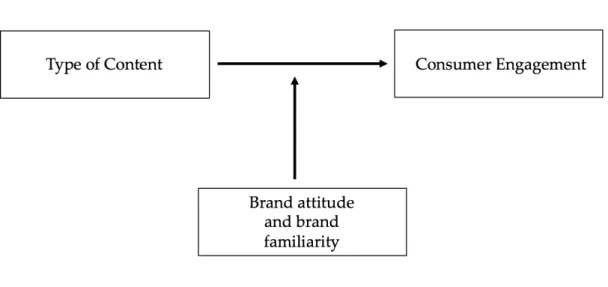
The main focus of this research, was to serve as the cornerstone in the clarification of engaging content. In order to so, it was crucial to clearly understand the relationship between the concepts of content and engagement. As the etymology suggests, engaging content is the combination of the two concepts, and introduces the potential positive influence that some type of content can have on the consumer, promoting his/her engagement towards brand-developed publications. Therefore, at first sight, the proposed framework (See Figure 1) is rather simple, as it only considers the influence of the independent variable “type of content” on the dependent variable “consumer engagement”, with the moderating factors of attitude and familiarity towards the brand. The inclusion of the moderating variables is particularly relevant, since the previous opinions, feelings and emotions consumers have regarding the brand, can affect their reactions to brand-related communications.
In order to materialize this graphic representation of the research model, and the proposed model itself, two hypotheses were developed:
H1: The type of content influences the degree of consumer engagement in
Facebook brand page posts
H2: Brand attitude and brand familiarity moderate the influence of the
type of content on consumer engagement in Facebook brand page posts
The independent variable “type of content” includes seven categories that were adapted from Coursaris et al. (2013) typology and previously identified and described in the literature review: brand awareness, product awareness, corporate social responsibility, reward, activity, seasonal and customer service.
On the other hand, “consumer engagement”, as a more complex construct, includes a set of different behaviors such as attention, interest, like, comment and share (see the methodology chapter). Therefore, “consumer engagement” will not be taken as a whole in this analysis. In order to be exhaustive, one test is carried out to analyze the impact of the type of content on each of those five engagement actions. Thus, the following hypotheses relate the type of content with the different engagement behaviors:
H1a: The type of content influences the likelihood of attention in Facebook
brand page posts
H1b: The type of content influences the likelihood of interest in Facebook
brand page posts
H1c: The type of content influences the likelihood of like in Facebook brand
H1d: The type of content influences the likelihood of comment in Facebook
brand page posts
H1e: The type of content influences the likelihood of share in Facebook
brand page posts
Besides these hypotheses strictly related with engagement and the type of content, there are other factors that could influence the degree of engagement with Facebook brand page posts, such as age, gender, brand following status and professional situation.
Investigating gender differences in social media usage has been of point of interest in the literature (Correa, Hinsley, & de Zúñiga, 2010; Doorn van et al., 2010; Rohm et al., 2013; Venkatesh, Morris, & Morris, 2000). Considering that this research is also part of such sphere, a hypothesis was articulated to recognize potential differences regarding gender:
H3: The degree of engagement with brand page posts varies accordingly to
gender
The difference between millennials and the other age cohorts has been exposed several times in the literature (Godelnik, 2017; Howe & Strauss, 2009; Prensky, 2001), with the former being considered the first digital natives (Prensky, 2001). If millennials have such advantage, a difference regarding their behavior on SNS may exist, hence, a hypothesis was formulated to acknowledge this potential difference:
H4: The degree of engagement with brand page posts varies accordingly to age
Considering that following a brand page on Facebook indicates a previous consumer-brand relationship, it can influence content’s impact on consumer engagement. By identifying themselves as followers of the brand, consumers are more likely to be interested in that brand’s communication. Therefore, to contemplate this possibility, a hypothesis was outlined:
H5: The degree of engagement with brand page posts varies accordingly to
brand following status
Being in different professional situations influences one’s behavior, as this variable may indicate disparities between consumers in time availability and stage of life. Thus, a hypothesis to encompass such distinctions was developed:
H6: The degree of engagement with brand page posts varies accordingly to
professional situation
Considering this MFA ambition to serve as a cornerstone for future research on this topic, demonstrating that the type of “content” influences “engagement” should be prioritized over the comprehension of the impact of each “content” component on engagement. Moreover, developing an overview that explores the consumer’s reaction to the components is crucial, so that potential differences in the engagement behavior can be unveiled.
4 Methodology & Data Collection
In order to operationalize the proposed model, a quantitative approach was adopted. This approach makes it possible to “regard the world as it was made up of observable and measurable facts” (Glesne & Peshkin, 1992, p.6), since it allows to collect information in the shape of numbers (Golafshani, 2003) and, hence, delimits the studied phenomena into measurable categories (Winter, 2000, as cited in Golafshani, 2003). Moreover, this kind of approach offers the possibility to analyze the collected data with statistical procedures and, thus, infer evidence for a theory from a sample of the population and generalize the results from the sample to the population itself (Cresswel, 2013, p.4; Newman & Benz, 1998, p.18).
In order to collect quantitative data, a survey was designed. Since data collected via online tools not only maximizes the response rate, but also yields comparable results to data collected on traditional surveys (Deutskens, de Ruyter, & Wetzels 2006), a self-administered online survey was conducted using Google Forms, an online, cloud-based, survey development tool. Besides maximizing the response rate and yielding comparable results, online surveys can also provide another particular benefit, as they eliminate the interviewer’s variability and interference since the questions are written and always enquired in the same way (Bryman, 2008).
The survey consisted of twenty questions divided into five sections. The first one was dedicated to the use of Facebook. The second was dedicated to the respondent’s behavior and attitude regarding Facebook’s main actions – like, comment and share. The third section aimed to disclose the respondent’s familiarity and attitude towards the brand selected to illustrate the practical part of the survey, IKEA. In the fourth section, the respondents were exposed to
fourteen different brand page posts (See Appendix 2) that were selected in order to depict the content categories adapted from Coursaris et al. (2013) typology: brand awareness, product awareness, corporate social responsibility, reward, activity, seasonal and customer service. Two posts were selected to represent each of the seven categories from IKEA Portugal brand page on Facebook, after a careful observation of every publication between November 2016 and February 2017. Before the final selection, two researchers were asked to validate the adequacy of the selected posts to represent each content type (researcher triangulation), so that the final selection featured the best examples. The posts were, then, assorted in an arbitrary order so that an unbiased analysis of the stimuli could be assured. The fifth, and final, section included the demographic data collection.
IKEA was selected to serve as the focal brand for the brand page posts that illustrate the seven content categories due to many factors. First of all, the company founded in 1943, by Ingvar Kamprad, in Älmhut, Sweden, is the world’s largest furniture retailer since 2008 (Statista, 2017) operating, as of December 2016, three hundred and eighty-nine stores in forty-eight countries (Inter IKEA Systems B.V., 2017). Despite having furniture retail as the core business, the Swedish multinational group made an effort to evolve and promote a transversal to all ages store space that includes restaurants and snack-bars, Swedish heritage supermarkets and a kid play area. Besides being a brand that is recognized by all ages, the appeal of being the brand with most “likes” on Facebook in Portugal (rankU PT, 2017) played a huge role in the decision. Moreover, IKEA represents a potentially neutral brand since it has no direct and global competitors that enjoy the same reputation, awareness or customer commitment as the Swedish giant.
In order to assess respondent behavior and attitude in terms of liking, commenting and sharing on Facebook (second section of the questionnaire), a
three-item scales adapted from Kabadayi & Price's (2014) research was used (See Table 1). The original research only considered liking and commenting, however, as sharing stills profiles as a strong action of interest and is one of Facebook’s most recognizable actions, we have decided to include sharing in Kabadayi and Price's (2014) scale, adapting the same items used to assess the behavior towards the other actions. Respondents were specifically asked about Facebook brand page publications in order to avoid any misdirection with celebrity pages, fan pages or community pages.
Type of Action Scale Element
Liking
I enjoy liking brand page posts on Facebook I regularly like brand page posts on Facebook
Liking brand page posts is something I do often while on Facebook
Commenting
I enjoy commenting brand page posts on Facebook I regularly comment brand page posts on Facebook
Commenting brand page posts is something I do often while on Facebook
Sharing
I enjoy sharing brand page posts on Facebook I regularly share brand page posts on Facebook
Sharing brand page posts is something I do often while on Facebook
Table 1 - Facebook behavior scale, adapted from (Kabadayi & Price, 2014)
It was important to analyze the attitude and familiarity towards the brand studied due to the impact that respondents’ previous opinions, interactions, feelings and emotions might have on their behavior regarding IKEA (third section of the questionnaire). Two scales from Machado, de Lencastre, de Carvalho and Costa (2012) were adapted to measure brand attitude and brand familiarity (See Table 2).
To evaluate brand attitude, we asked the respondents to classify the feelings IKEA evoked using a six-items seven-point semantic differential scale: unpleasant/ pleasant (Chaudhuri & Holbrook, 2001; Grossman & Till, 1998; J.
Kim, Allen, & Kardes, 1996; Machado et al., 2012; Samu, Krishnan, & Smith, 1999); uninteresting/ interesting (Grossman & Till, 1998; Henderson & Cote, 1998; J. Kim et al., 1996; Machado et al., 2012); unfavorable/ favorable (Machado et al., 2012; Milberg, Whan Park, & McCarthy, 1997; Park, Jun, & Shocker, 1996; Simonin & Ruth, 1998); dislike/like (Grossman & Till, 1998; Henderson & Cote, 1998; J. Kim et al., 1996; Machado et al., 2012; Milberg et al., 1997; Park et al., 1996; Pham & Avnet, 2004); bad/ good (Grossman & Till, 1998; Henderson & Cote, 1998; J. Kim et al., 1996; Machado et al., 2012; Pham & Avnet, 2004; Rodrigue & Biswas, 2004; Samu et al., 1999; Simonin & Ruth, 1998) and, finally, negative/ positive (Machado et al., 2012; Simonin & Ruth, 1998). The original scale also included another item, low quality/ good quality (Grossman & Till, 1998; Henderson & Cote, 1998; J. Kim et al., 1996; Machado et al., 2012) but this item was not considered for this research since measuring the perceived quality of the brand and its products was not the aim.
Brand familiarity was measured by using a three-item seven-point semantic differential scale: unfamiliar/ familiar; don’t recognize/ recognize well and never heard of/ have heard about it a lot (Machado et al., 2012; Rodrigue & Biswas, 2004; Simonin & Ruth, 1998).
Measurable Objective Endpoint (1) Endpoint (7)
Brand Attitude Unpleasant Uninteresting Unfavourable Dislike Bad Negative Pleasant Interesting Favourable Like Good Positive Brand Familiarity Unfamiliar Don’t Recognize Never heard of Familiar Recognize Well Have heard about it a lot
In the fourth section of the survey, respondents were shown fourteen posts representative of the previously identified content categories, in order to assess the probability of their engagement.
The adopted measure for consumer engagement should, not only, be based in the consumer-brand interactions (Oviedo-García et al., 2014), but also include the actions with which the individuals are able to interact with the stimuli that is presented to them (Oviedo-García et al., 2014). Therefore, a scale from Smith (2013) that measured the likelihood of respondents engaging in certain SNS actions (such as like, comment and share) using five-point semantic differential scale (with “very unlikely” and “very likely” as endpoints), served as the foundation for the scale adopted in this research. However, Smith's (2013) scale did not consider the invisible engagement or weak actions of interest identified in the literature review (Li & Bernoff, 2008; Mathwick, 2002; Oviedo-García et al., 2014) that are consistent with Muntinga et al.'s (2011) “consuming brand-related content” category. Hence, two other actions were added to the scale, “catching attention” and “garnering interest”, so that a more in-depth analysis could be made. The first added action illustrates the calling of an element in the publication that makes a consumer stop the feed scrolling routine to observe, in a more careful way, the post. The second action, on the other hand, intends to represent the weak actions of interest, such as clicking on the names of people or brands that are mentioned in the post, consulting the number of “likes” obtained by a post or clicking on the post’s photo to see it in full size (Oviedo-García et al., 2014), and denotes a superior level of engagement in comparison to only catching the attention of the consumer.
Therefore, in this final section, the respondents had to classify the probability of having five different behaviors: (1) catching attention; (2) garnering interest;
(3) liking the post; (4) commenting the post; (5) sharing the post using a seven-point scale running from “not probable” to “extremely probable” (See Table 3).
Introduction Measurable Actions
We now ask you to classify the probability of interacting with some Facebook brand page posts. Please classify the probability of interaction using the scale that is depicted below the post in which 1 represents “not probable” and 7 “extremely probable”
Catching your Attention Garnering your Interest
Like Comment
Share
5 Results
5.1 Sample Characterization
5.1.1 Demographic Profile
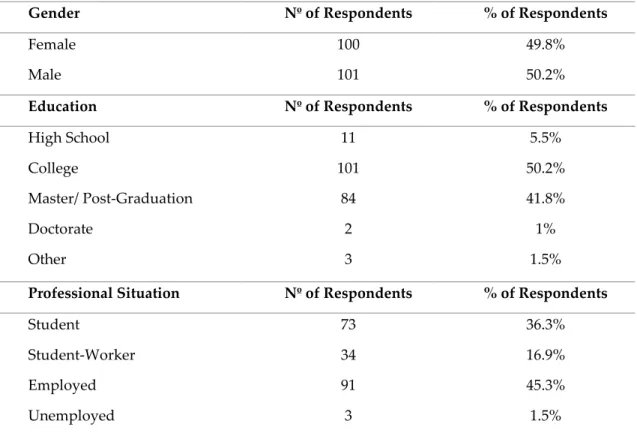
A convenience sample of 201 valid questionnaire responses was collected during the first two weeks of March 2017. In this sample, 100 respondents were female (49.8%) and 101 were male (50.2%). The respondent’s age varied between 17 and 55, with an average age of 26.75 years. Considering that the questionnaire was in Portuguese, 98% of the respondents were from Portugal (197). The remaining data was collected from only one respondent from each of the following countries: Spain, Sweden, Netherlands and Australia.
The sample had highly educated respondents, as 101 had a college degree (50.2%) and 84 had either a master’s degree or a post-graduation (41.8%). There were also two respondents who had a doctorate degree (1%), 11 who completed high school (5.5%) and three that had other, non-disclosed, level of education (1.5%). In what regards the professional situation of the respondents, there was an interesting, three-way, balance between the 91 respondents who are employed (45.3%), the 73 students (36.3%) and the 34 student-workers (16.9%). The remaining three answers account for unemployed respondents (1.5%) (See Table 4).
Gender Nº of Respondents % of Respondents Female Male 100 101 49.8% 50.2%
Education Nº of Respondents % of Respondents
High School College Master/ Post-Graduation Doctorate Other 11 101 84 2 3 5.5% 50.2% 41.8% 1% 1.5%
Professional Situation Nº of Respondents % of Respondents
Student Student-Worker Employed Unemployed 73 34 91 3 36.3% 16.9% 45.3% 1.5%
Table 4 - Respondent's gender, education and professional situation. Output from SPSS
5.1.2 Usage of Facebook Brand Pages
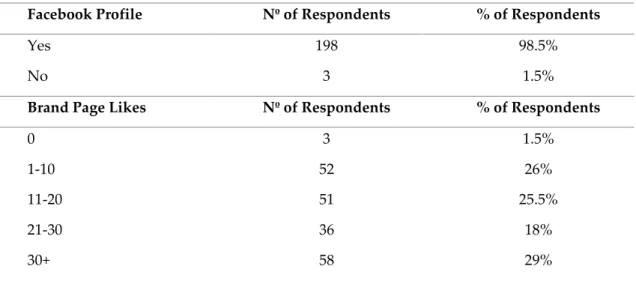
Respondents were also asked if they have a personal Facebook page and the brands they like on the mentioned SNS. 198 respondents had a Facebook profile (98.5%) as opposed to only 3 that did not (1.5%). This data, combined with the question about the approximate number of brand pages liked, helped to surface an expected, yet interesting, insight: everyone who has a Facebook profile likes at least one brand page. Considering that there are only three respondents with 0 liked brand pages (1.5%), one can assume that those answers concern the three people who do not have a Facebook profile, since they are unable to like pages on this SNS. The approximate number of brand pages liked was relatively balanced throughout the remaining 198 respondents as 52 respondents liked between 1-10 brand pages (26%), 51 liked between 11-20 brand pages (25.5%), 36 liked between 21-30 brand pages (18%) and, finally, 58
respondents disclosed that they like more than 30 brand pages (29%) (See Table 5).
Facebook Profile Nº of Respondents % of Respondents
Yes No 198 3 98.5% 1.5%
Brand Page Likes Nº of Respondents % of Respondents
0 1-10 11-20 21-30 30+ 3 52 51 36 58 1.5% 26% 25.5% 18% 29%
Table 5 - Respondent's Facebook usage data. Output from SPSS
Regarding respondent’s behavior and day-to-day patterns on Facebook, it was interesting to unveil that none of the traditional engagement actions (liking, commenting and sharing) accomplished results that could have denoted frequency and pleasantry while using such tools. “Liking” was the most common action, as it scored an average of 3.32 in a composite average of the score obtained in the three items that were adapted from Kabadayi & Price's (2014) scale. Despite not being positive per se, since 7 was the maximum possible, it holds an important advantage over either “commenting” or “sharing” that scored 1.72 and 2.13, respectively.
Despite the fact that everyone who has a Facebook profile likes at least one brand page, and that IKEA was the most followed brand in Portugal on Facebook (rankU PT, 2017), only 42 respondents followed IKEA’s brand page (20.9%) before this research’s survey, opposed to the 159 respondents who did not follow IKEA (79.1%).
5.1.3
Attitude and Familiarity regarding IKEA
The breakdown of the familiarity and attitude scales (See Table 6), further proved that IKEA fitted the brand selection criteria, exposed during the methodology chapter, since IKEA garnered substantially positive responses in both variables.
Scale Endpoint (1) Endpoint (7) Mean
Brand Attitude Unpleasant Uninteresting Unfavorable Dislike Bad Negative Pleasant Interesting Favorable Like Good Positive 5.662 5.667 5.597 5.726 5.448 5.701 Brand Familiarity Unfamiliar Don’t Recognize Never heard of Familiar Recognize Well Have heard about it a lot
6.189 6.289 6.537
Table 6 - Brand attitude and brand familiarity means regarding IKEA. Output from SPSS
5.1.4 Potential Engagement behaviors towards IKEA
Before examining the influence of content type on consumer engagement, it was important to organize each engagement action according to its probability. In order to provide such results, the likelihood of engaging in each action was calculated by obtaining the mean of each content type’s own mean (See Table 7).
These results corroborate the inclusion of invisible engagement actions, such as attention and interest, in this research. These two actions are the most likely for consumers to engage with by a considerable margin, and, therefore, should be acknowledged when developing Facebook communication. Furthermore, these particular results are aligned with those about consumer’s behaviors regarding Facebook brand page in general, presented in section 5.1.2.
5.2 Type of Content and Consumer Engagement
In order to better comprehend the extent of the relationship between content and engagement, that is centerpiece to this research, the collected data was subject to an ANOVA repeated measures analysis. The selection of ANOVA is due to the need to compare more than two means. Each test will entail the comparison of seven means, which correspond to behavior probability of the seven different types of content. Moreover, as all the respondents account for all the computed means (within-subjects analysis), thus ANOVA repeated measures was the appropriate choice. Besides this analysis, post-hoc tests were also included in the analysis in order to further understand and validate the results.
Type of Action Likelihood of Engagement
Attention Interest Liking Sharing Commenting 3.682 3.445 2.603 1.680 1.594
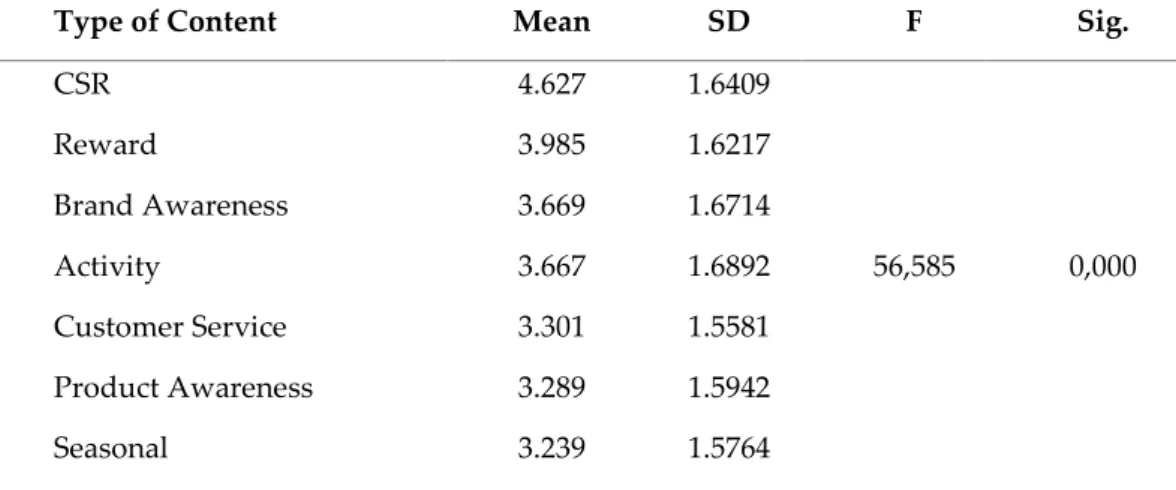
The first engagement action to be analyzed is also the least binding one: attention (See Table 8). Results from ANOVA repeated measures confirmed H1a
(F=56.59; p<=0.000). The content type which is more likely to capture the consumer’s attention is Corporate Social Responsibility (mean=4.63), followed by Reward (mean=3.99). The third position is assigned to Brand Awareness (mean=3.67) and Activity (mean=3.67), whose means are not statistically different, according to post-hoc tests (See Appendix 3). Finally, the last rank goes to Customer Service (mean=3.30), Product Awareness (mean=3.29) and Seasonal (mean=3.24). The results of post-hoc tests showed that the difference between these three types of content are not statistically different, suggesting that they have similar (low) potential to catch the attention of consumers on Facebook.
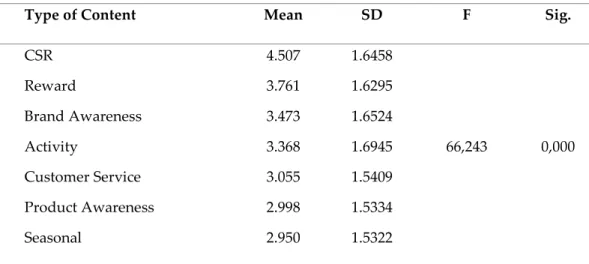
The second action to be thoroughly analyzed was interest. The results obtained via the ANOVA repeated measures analysis (See Table 9), mimic the ones obtained when dissecting attention as the results confirmed H1b (F=66,24; p<=0.00). Comparably to what happened before, corporate social responsibility (mean=4.51) was the type of content most likely to garner the consumer’s interest, followed by reward (mean=3.76). Afterwards, the third position was
Type of Content Mean SD F Sig.
CSR Reward Brand Awareness Activity Customer Service Product Awareness Seasonal 4.627 3.985 3.669 3.667 3.301 3.289 3.239 1.6409 1.6217 1.6714 1.6892 1.5581 1.5942 1.5764 56,585 0,000
occupied by brand awareness (mean=3.47) and activity (mean=3.37) whose means were not statistically different, according to post-hoc tests (See Appendix 4). Finally, the same three types of content are in the last ranking - customer service (mean=3.06), product awareness (mean=2.998) and seasonal (mean=2.95) - since their means are not statistically different too.
Type of Content Mean SD F Sig.
CSR Reward Brand Awareness Activity Customer Service Product Awareness Seasonal 4.507 3.761 3.473 3.368 3.055 2.998 2.950 1.6458 1.6295 1.6524 1.6945 1.5409 1.5334 1.5322 66,243 0,000
Table 9 - Interest likelihood analysis by type of content. Output from SPSS
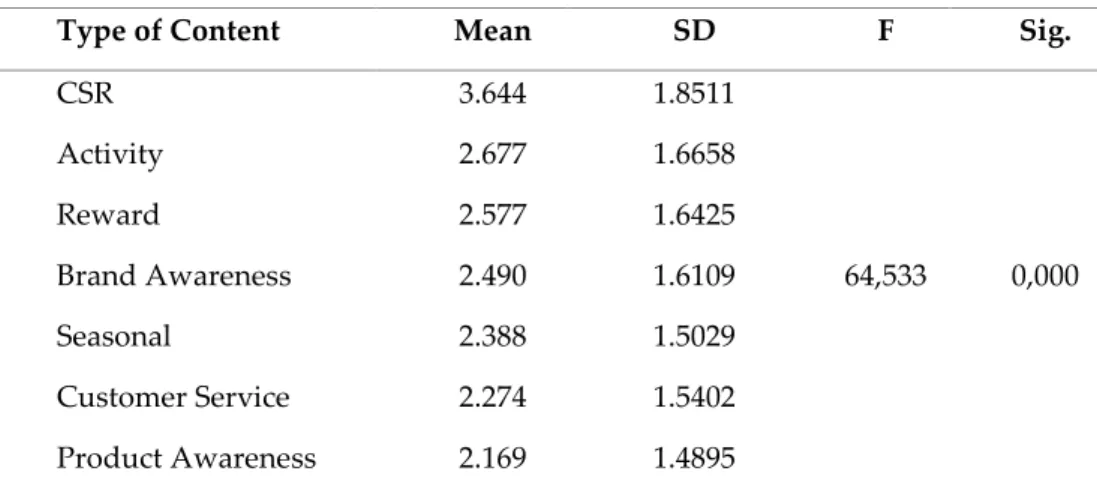
In what concerns liking, the results obtained (See Table 10) validate H1c
(F=64,533; p<=0.000). The content most likely to obtain a like from the consumer is corporate social responsibility (mean=3.64), followed by both activity (mean=2.68) and reward (2.58), since these two means were not statistically different, according to post-hoc tests (See Appendix 5). The group that appears ranked afterwards includes brand awareness (mean=2.49) and seasonal (mean=2.39). In the last position of the ranking, the dispute is only between two content types, customer service (mean=2.27) and product awareness (mean=2.17), instead of the three registered in the previous two engagement actions.
In the fourth action to be analyzed, the ANOVA repeated measures results (See Table 11) validate H1d (F=17.498; p<=0.00). The results in this action can be
divided in three groups. The first one only includes corporate social responsibility (mean=1.93), whose mean was statistically different from all the others, according to post-hoc tests (See Appendix 6). Hence, considering that their means are close, the second group encompasses reward (mean=1.64), activity (mean=1.57) and brand awareness (mean=1.54). The final group contains three content types once again, since the results from customer service (mean=1.52), seasonal (mean=1.495) and product awareness (mean=1.47) expose results that are statistically not different.
Type of Content Mean SD F Sig.
CSR Activity Reward Brand Awareness Seasonal Customer Service Product Awareness 3.644 2.677 2.577 2.490 2.388 2.274 2.169 1.8511 1.6658 1.6425 1.6109 1.5029 1.5402 1.4895 64,533 0,000
Table 10 - Like likelihood analysis by type of content. Output from SPSS
Type of Content Mean SD F Sig.
CSR Reward Activity Brand Awareness Customer Service Seasonal Product Awareness 1.933 1.642 1.567 1.537 1.515 1.495 1.470 1.3736 1.1623 1.0520 1.1412 0.9707 0.9925 0.9323 17.498 0.000
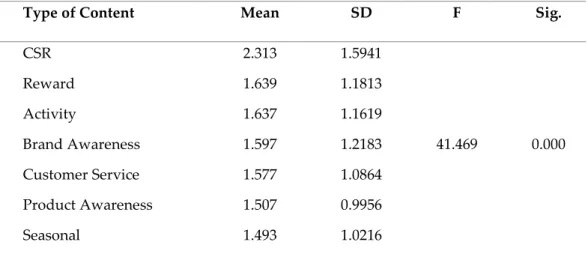
The last action to be explored was sharing, the third strong action of interest considered in this research (See Table 12). Once again, the hypothesis, H1e, is
validated by the results obtained (F=41.469; p<=0.000). The first position, similarly to what happens in the other four actions, belongs to corporate social responsibility (mean=2.31). The group that appears behind, constituted by reward (mean=1.64), activity (mean=1.64) and brand awareness (mean=1.597) does not present statistical difference between the means, according to post-hoc tests (See Appendix 7). Finally, the last group includes the least probable content types of obtain a consumer share customer service (mean=1.58), product awareness (mean=1.51) and seasonal (mean=1.49).
Type of Content Mean SD F Sig.
CSR Reward Activity Brand Awareness Customer Service Product Awareness Seasonal 2.313 1.639 1.637 1.597 1.577 1.507 1.493 1.5941 1.1813 1.1619 1.2183 1.0864 0.9956 1.0216 41.469 0.000
Table 12 - Share likelihood analysis by type of content. Output from SPSS
In an overview fashion, that aimed to sum up the individual action results, one can recognize some trends in the analysis. Without a doubt, corporate social responsibility emerged as the highlight of this analysis as it was ranked first in every action by a large margin. Reward was the content type that came in second, assuring this rank in every action except liking, where activity took its place. The third position was rather close, considering that brand awareness achieved it in the two weak actions of interest and activity surpassed brand awareness in the strong actions of interest. The last three spots remained with
the same three types of content: customer service, product awareness and seasonal. Customer service held the fifth spot most of the time (in four out of five actions) only losing it for seasonal content in liking, whereas product awareness and seasonal varied in the two last spots.
5.3 Moderation of Brand Attitude and Brand
Familiarity
As it was mentioned in the Research Model chapter, brand attitude and brand familiarity were regarded as moderating factors prior to the data analysis as earlier opinions, associations, emotions, feelings, experiences or interactions with IKEA had the potential to impact the respondent’s reaction to brand-related communications. However, results showed little variability in both variables. Both brand attitude and brand familiarity registered consistently positive ratings which hindered any existing possibility towards coherent and congruently divide the sample into two groups (positive vs negative brand attitude; high vs low familiarity). Despite being a well-recognized and generally appreciated brand were an integral part of the brand selection condition, the results superseded the original expectations. Therefore, the confirmation of H2
became impracticable due to the inexistence of enough variability of the respondent’s profile concerning both brand familiarity and brand attitude.
5.4 Demographic Variables and Engagement
Besides testing the stated hypothesis, it was of the utmost interest to provide a more detailed and specific glance on key engagement differences, such as gender, age, the respondent’s IKEA following status and professional situation. That being said, the first variable whose impact was explored was gender (See Appendix 8). In this respect, it was possible to recognize that women are more likely to engage than men, as they present higher means than men in every category. Thus, it was possible to validate H3. The mainstream difference
was registered in three of the five actions considered in this research, attention, interest and like. The only exception concerned the probability of liking seasonal content, whose difference between men and women was non-significant. On the opposite side of the significance spectrum were commenting and sharing, whose mean difference between genders was, in a general fashion, non-significant. Analogously to what happened with the significant differences, there was also an exception in the non-significant actions as sharing corporate social responsibility content was reckoned as significant. There was no significant variance conveyed in two of the seven types of content, customer service and product awareness, probably because they epitomize the most informational sector of this content typology.
In what concerns the age of the respondents, they were divided in two groups - Millennials and Non-Millennials - in order to verify if the widely regarded digital natives (Prensky, 2001) engaged with brand page posts in a distinct manner than older generations like the Baby Boomers and Generation X. Since there is an ongoing discussion that enables a clear-cut division of the age groups, for the effect of this research, the classification adopted to define Millennials was the one by Howe & Strauss (2009) that places a beginning on this generation in 1982. The results of the Independent-Samples T-Test (See