Ano 2018
SARA FILIPA
BRILHANTE PAIVA
SILVEIRA FÉLIX
MEMÓRIA ADAPTATIVA:
LONGEVIDADE E INDEPENDÊNCIA DE CODIFICAÇÃO
DO EFEITO DA ANIMACIDADE E SUA EVIDÊNCIA EM
PESSOAS COM DEMÊNCIA
(ADAPTATIVE MEMORY:
THE LONGEVITY AND ENCODING INDEPENDENCE
OF THE ANIMACY EFFECT AND ITS EVIDENCE IN
PEOPLE WITH DEMENTIA)
Ano 2018
SARA FILIPA
BRILHANTE PAIVA
SILVEIRA FÉLIX
MEMÓRIA ADAPTATIVA:
LONGEVIDADE E INDEPENDÊNCIA DE CODIFICAÇÃO
DO EFEITO DA ANIMACIDADE E SUA EVIDÊNCIA EM
PESSOAS COM DEMÊNCIA
(ADAPTATIVE MEMORY:
THE LONGEVITY AND ENCODING INDEPENDENCE
OF THE ANIMACY EFFECT AND ITS EVIDENCE IN
PEOPLE WITH DEMENTIA)
Dissertação apresentada à Universidade de Aveiro para cumprimento dos requisitos necessários à obtenção do grau de Mestre em Psicologia da Saúde e Reabilitação Neuropsicológica, realizada sob a orientação científica da Doutora Josefa das Neves Simões Pandeirada, Equiparada a Investigadora Auxiliar do Departamento de Educação e Psicologia da Universidade de Aveiro.
À Avó Popelé, ao Avô Quinzinho, À Mãe e ao Mano Salo, Por serem o meu núcleo duro.
Ao Rui, Por ser uma luz na minha vida.
o júri
Presidente Prof.ª Doutora Anabela Maria Sousa Pereira
Professora Associada com Agregação do Departamento de Educação e Psicologia da Universidade de Aveiro
Doutora Magda Catarina Gomes Saraiva
Investigadora de Pós-Doutoramento do Instituto Universitário de Lisboa, ISCTE
Prof.ª Doutora Josefa das Neves Simões Pandeirada
agradecimentos A elaboração da presente obra foi uma sinuosa caminhada, ora por montes, ora por vales. No entanto, tornou-se uma tarefa bem mais prazerosa graças ao apoio de várias pessoas, a quem sinto o dever de prestar um agradecimento muito sentido. Assim, e sem mais demoras, agradeço:
Aos participantes dos presentes estudos, sem os quais esta dissertação não existiria. Aos meus amigos, especialmente à Soraia Silva e à Luciana Correia (companheiras de armas), à Helena “Beta” Correia (por me permitir ser a Sara “Mónica”) e à Andreia e à Fátima Nunes (pela paciência e amizade).
Agradeço com carinho aos utentes do H.M.L., bem como a todos os seus profissionais de saúde e auxiliares, especialmente aos do Serviço de Psicogeriatria. Agradeço por me acolherem na equipa e terem sido como uma “terceira família” ao longo deste ano. Em especial, agradeço à Dr.ª Humbertina Maia, pela paciência e tolerância em relação à recolha de dados. Agradeço também ao Enf.º Adelson Estrela, pela lição sobre “o saber não ocupar lugar” e à Dr.ª Rosa Encarnação, por confiar e permitir a recolha dos dados clínicos.
À Dr.ª Susana Caixinha (Universidade de Aveiro) pelo empenho e paciência na elaboração do questionário online.
Aos professores da Faculdade de Letras da Universidade do Porto (FLUP), pela incansável ajuda na fase de recolha dos dados. Um agradecimento muito especial ao Professor Doutor Jorge Martins Ribeiro, pelo interesse, atenção e disponibilidade. Agradeço também à Prof.ª Doutora Carmen Ferreira, à Prof.ª Doutora Paula Pinto e ao Prof. Doutor José Teixeira, da FLUP. Agradeço à Prof.ª Doutora Paula Vagos e à Prof.ª Doutora Isabel Miguel, da Universidade Portucalense (Porto), pela disponibilidade na fase de recolha de dados. Igualmente, agradeço à Prof.ª Doutora Teresa Summavielle, do Instituto de Inovação e Investigação em Saúde do Porto, pela disponibilidade e simpatia. Aos Professores do Instituto Superior de Segurança Social do Porto, pela recetividade ao presente estudo e à recolha de dados. Agradeço nomeadamente à Prof.ª Doutora Sara Melo, à Prof.ª Doutora Idalina Machado, ao Prof. Doutor José Alberto Reis e ao Prof. Doutor Manuel Nogueira.
À Prof. Doutora Sónia Gouveia, da Universidade de Aveiro, pela colaboração aquando da análise estatística dos resultados obtidos.
Ao Professor Patrick Bonin (Université de Bourgogne, França), pela facilidade de contacto eletrónico. Ao Prof. Doutor Oscar Ribeiro (Universidade de Aveiro, Portugal) e ao Professor James Nairne (Purdue University, Estados Unidos da América), pelas reuniões e pelo importante incentivo no início do trabalho.
Naturalmente, um grande agradecimento à Prof.ª Doutora Josefa Pandeirada. Sem o seu apoio, interesse e constante disponibilidade, ora online, ora presencial, esta dissertação também não existiria.
Por fim, mas não menos importante, à minha família. À Tia Isabel e ao Tio Jorge, pelo seu acolhimento, carinho e apoio ao longo deste último ano letivo. Ao Tio Vítor, pela preocupação paternal e pela sua constante presença.
Ao Rui, meu “comparsa de crime”. Agradeço pela voz da experiência académica, pela sua tranquilidade quando tudo parece desmoronar e pelos momentos de cumplicidade.
Aos meus avós, que me acompanham nesta caminhada a passo e ritmo. Pela sua alegria de viver e pelo incansável apoio ao longo da minha vida, em especial durante o meu percurso académico.
Ao Gonçalo, o meu maninho, que será sempre o benjamim da família e o meu pequeno guerreiro. Agradeço pelo apoio à distância.
À minha mãe, que me inspira pelo seu exemplo de coragem e amor. Agradeço e reconheço todos os seus esforços, em especial durante o período atribulado que coincidiu com este percurso académico. Agradeço pela ternura, pelo incentivo persistente e pelo apoio incondicional.
Reconhecendo que este agradecimento não presta a devida homenagem a todos os mencionados, resta-me dizer, sinceramente: Bem-Hajam!
palavras-chave Memória adaptativa, Efeito da animacidade, Recordação diferida, Demência, Idosos, Instruções de codificação
resumo Distinguir itens animados de inanimados é essencial para a sobrevivência. Estudos têm demonstrado que as pessoas tendem a recordar melhor a informação relacionada com seres animados / vivos (como animais e pessoas) do que com seres inanimados / não-vivos (como objetos). A esta vantagem mnésica dá-se o nome de “efeito da animacidade”. Neste projeto realizámos três estudos que pretendem aprofundar o conhecimento sobre o efeito da animacidade. No Estudo 1 procedemos à recolha de avaliações da variável animacidade para um conjunto de 224 palavras do Português Europeu. Estes dados, obtidos de uma amostra de 72 participantes, permitiu a elaboração de uma base de dados de animacidade e a posterior seleção de estímulos para o segundo estudo. No Estudo 2, que contou com a participação de 220 participantes, investigámos se o efeito da animacidade varia consoante o intervalo de retenção (recordação imediata versus 48 horas), bem como se depende do tipo de codificação (aprendizagem intencional vs. acidental). Os resultados revelaram um efeito da animacidade significativo em ambos os intervalos de retenção e verificou-se que aquele não depende do tipo de codificação. Obtiveram-se ainda duas interações significativas entre o tipo de palavra e a codificação, bem como entre o intervalo de retenção e a codificação. Ambas as interações se deveram ao facto de o tamanho efeito (d de Cohen) ser superior na condição acidental do que na intencional. No Estudo 3 pretendemos averiguar se o efeito da animacidade se mantém em quadros patológicos de deterioração mnésica, dado a literatura ser inconsistente quanto a esta temática. Para tal, recolhemos os resultados previamente obtidos por 61 utentes com demência no item de memória da versão portuguesa do Mini-Mental State Examination. Neste item, é solicitado ao participante que retenha e recorde três palavras que variam quanto ao seu estatuto de animacidade (pera, gato e bola). Os resultados revelaram um efeito significativo da animacidade na demência. Estes estudos fornecem novas evidências sobre a independência do efeito da animacidade quanto às condições de codificação, assim como sobre a sua longevidade menésica. Os resultados sugerem que esta vantagem mnésica se mantém ao longo do desenvolvimento humano (nomeadamente em idosos) e que parece resistir mesmo quando já estão em curso processos de declínio cognitivo mais avançados (nomeadamente demência, patologia de degeneração mnésica). Adicionalmente, disponibilizamos à comunidade científica um conjunto de dados normativos de animacidade que poderão orientar as suas escolhas de material para estudos de memória, ou outras áreas nas quais a animacidade possa ser relevante. De um modo global, os nossos estudos reforçam a robustez do efeito da animacidade usando um novo conjunto de manipulações experimentais e novos grupos de participantes.
keywords Adaptative memory, Animacy effect, Delayed recall, Dementia, Old people, Encoding instructions
Abstract Distinguishing animates from inanimates is essential for survival. Studies have demonstrated that people recall better animate / living related information (such as animals or humans) over inanimate / nonliving related information (such as objects). This mnemonic advantage is called the “animacy effect”. This project includes three studies that aim to extend the findings on the animacy effect. In Study 1 we collected normative data of animacy for a large set of 224 European Portuguese words and elaborated an animacy database. These data, obtained from 72 participants, allowed us to select the stimuli to be used in the second study. Study 2, which counted with 220 participants, we investigated the longevity of the animacy effect (immediate recall versus 48 hours delayed recall), as well as its independence from encoding instructions (intentional vs. incidental learning). The animacy effect remained significant in both retention intervals and the data revealed that it is independent of encoding. However, two significant interactions were also obtained, one between type of word and encoding and the other between retention interval and encoding. Both interactions were explained by larger effect sizes (Cohen’s d) in the incidental encoding condition over the intentional learning condition. In Study 3 we explored if the animacy effect remains in pathological memory conditions, specifically in patients diagnosed with dementia, as the literature is inconsistent in such field. The study was conducted by consulting data previously collected with 61 people with dementia on the memory item of the Portuguese version of the Mini-Mental State Examination. In such item, participants are asked to retain and recall three words that vary in their animacy status (pear, cat and ball). The results revealed a significant animacy effect in a set of patients diagnosed with dementia. As a whole, these studies provide new evidence about the independence of the animacy effect from encoding instructions as well as about its longevity in memory. The present outcomes suggest that this mnemonic advantage is preserved along the human life span (namely in later life) and seems to resist to the cognitive impairment (like dementia, a disease that mainly impairs memory). Furthermore, we make available to other researchers normative data on animacy which should be helpful for those interested in studying this variable in memory or other areas in which it has proven to be important. Generally, our findings reinforce the robustness of the animacy effect through a new set of experimental manipulations and the inclusion of new groups of participants.
“Indeed, a creature incapable of distinguishing animates from inanimates would be severely impaired.” (Opfer & Gelman, 2011, p. 213)
Index
List of Figures ... I List of Tables ... II
Introduction ... 1
Study 1: Collection of Normative Data of Animacy ... 3
Method ... 4
Participants... 4
Materials. ... 4
Procedure. ... 5
Results and Discussion ... 6
Study 2: The Longevity and Encoding Independence of the Animacy Effect ... 8
Method ... 9
Participants... 9
Materials. ... 10
Procedure. ... 11
Results and Discussion ... 12
Study 3: The Animacy Effect in Dementia ... 18
Method ... 18
Participants... 18
Materials. ... 19
Procefiguredure. ... 19
Results and Discussion ... 19
General Discussion ... 22
References ... 25
Appendixes ... 31
Appendix 1 – Animacy Rating Instructions (Study 1) ... 32
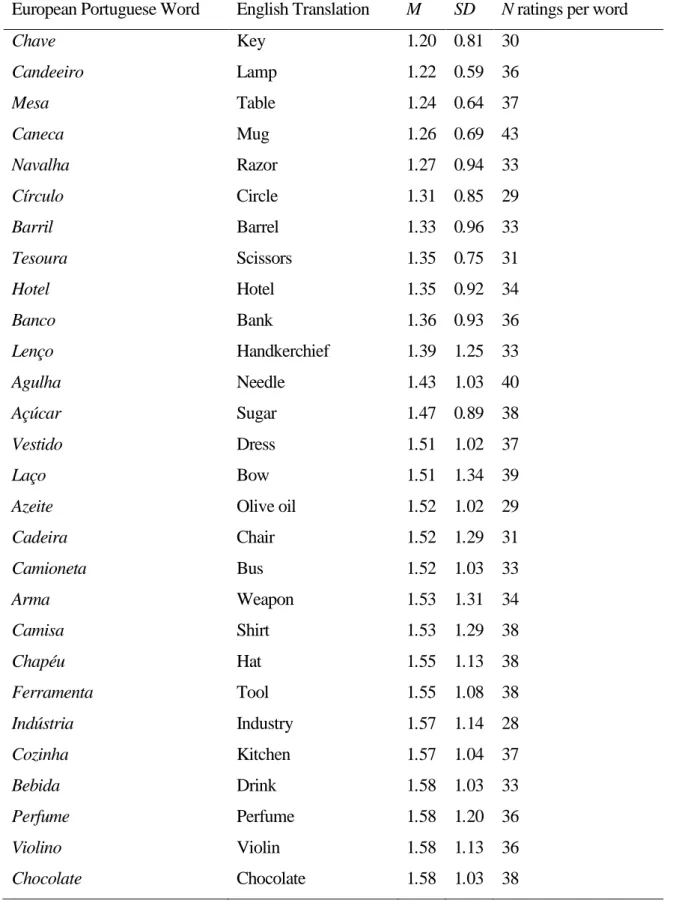
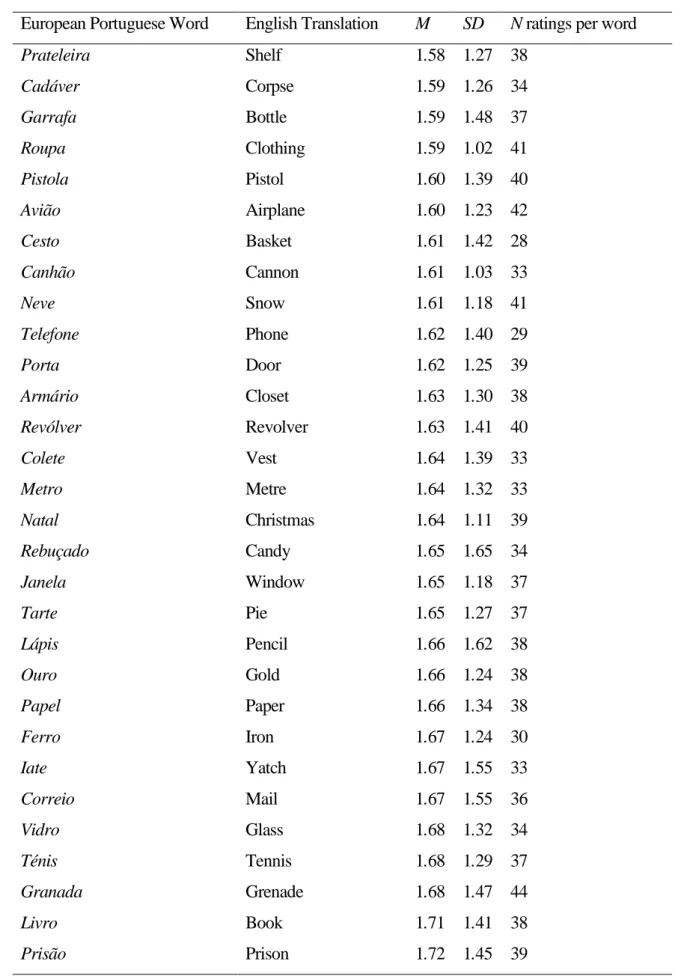
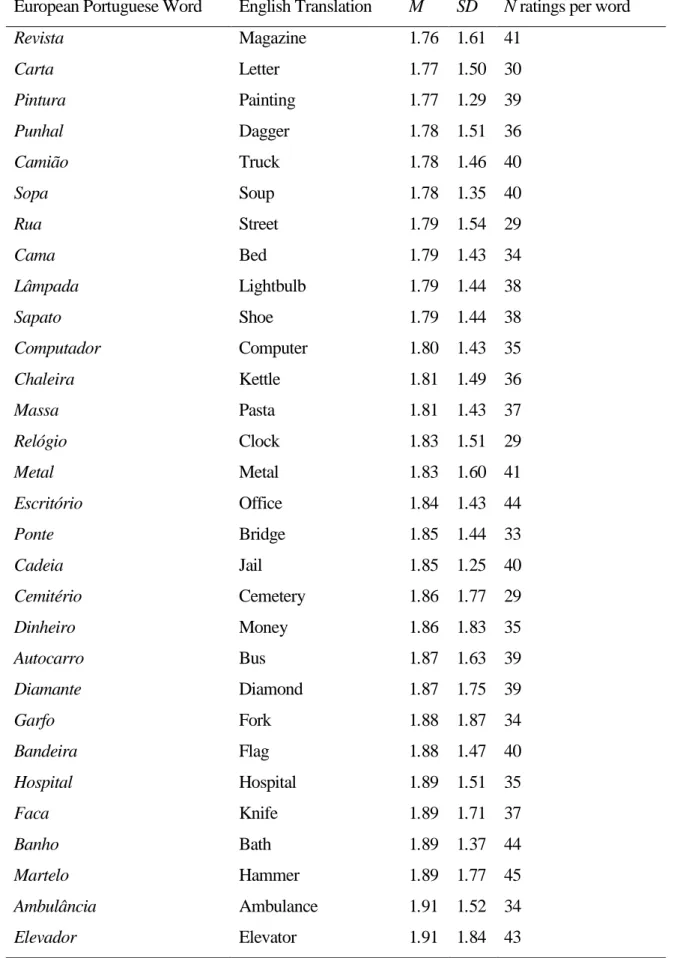
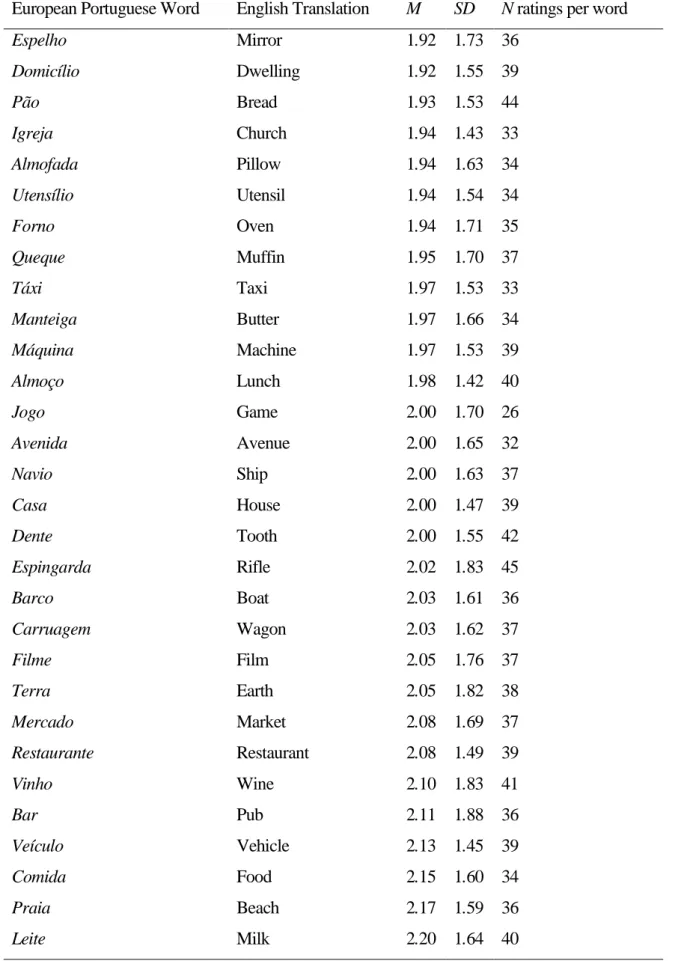
Appendix 2 – Normative Data of Animacy (Study 1)... 33
Appendix 3 – Experimental Design (Study 2) ... 41
Appendix 4 – Collection of Normative Data for Pleasantness (Pilot Study) ... 42
Appendix 5 – Animate and Inanimate Words’ Characteristics (Study 2) ... 46
Appendix 6 – Word Order Presentation (Study 2) ... 47
List of Figures
Figure 1. Mean proportion of correct recall across all conditions. Error bars represent standard errors of the mean. ... 13 Figure 2. Mean proportion of correct recall by people with dementia. Error bars represent standard
errors of the mean. ... 20 Figure 3. Schematic representation of the experimental conditions along with the number of
List of Tables
Table 1. Pearson correlations between our animacy ratings and those reported by VanArsdall (2016)
in each of the six dimensions considered in his work. ... 7
Table 2. Participants’ demographic information in each condition. ... 10
Table 3. Mean number of animate and inanimate intrusions (and standard deviations) in each of the four conditions. ... 15
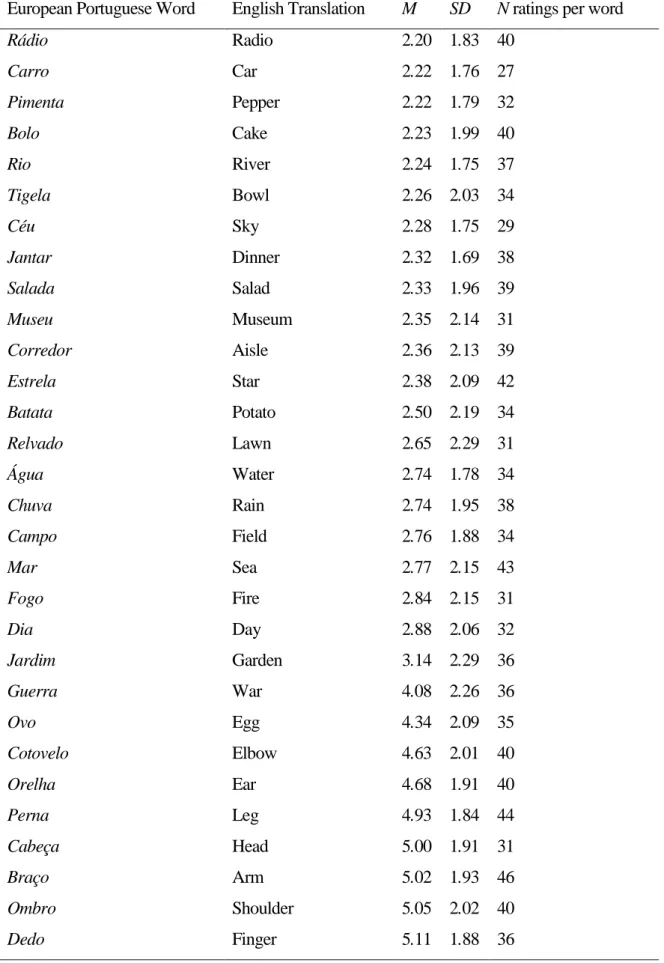
Table 4. European Portuguese normative data for animacy (Study 1). ... 33
Table 5. Normative data of pleasantness (Pilot Study). ... 44
Table 6. Matched animate and inanimate stimuli used in Study 2. ... 46
Introduction
Imagine that you went out for a quiet walk and, suddenly, you came across a snake. Probably, at a later point in time, you will remember that snake, where you saw it and you will avoid that place. This apparently intuitive behavior is explained by Evolutionary Psychology. According to the evolutionary perspective, our memory (as well as all the human form) evolved to solve adaptative problems, such as avoid predators, find food or find a sexual mate to ensure reproduction. That is, by natural selection (Darwin, 1859), our memory became tuned to fitness-relevant information to enhance survival and our chances of reproduction (Klein, Cosmides, Tooby, & Chance, 2002; Nairne, Pandeirada, Gregory, & VanArsdall, 2009). Thus, fitness-relavant information is better retained and recalled than non-fitness-relevant information (Nairne, Pandeirada, & Fernandes, 2017). This view is supported by research addressing the survival (e.g., Nairne, Thompson, & Pandeirada, 2007), the contamination (e.g., Fernandes, Pandeirada, Soares, & Nairne, 2017), the animacy (Bonin, Gelin, & Bugaiska, 2014; Nairne, VanArsdall, & Cogdill, 2017) and the reproduction effects (Pandeirada, Fernandes, Vasconcelos, & Nairne, 2017) in memory. The present work focuses on the animacy effect.
The animacy effect refers to a processing advantage of animate (living) over inanimate (nonliving) items. According to the evolutionary perspective, animate items should receive priority processing because they were (and still are) important environmental stimuli. Living beings, such as animals and humans, may be potential predators, prey, sexual mates, enemies, kin, friends and partners for social interaction, as well as other possibilities (Nairne, VanArsdall, et al., 2017; VanArsdall, Nairne, Pandeirada, & Cogdill, 2015). Note that all of these examples have a direct impact in the individual’s chances of survival and reproduction.
This processing advantage of animates also have a special status in other domains. For example, children aged two months smile to human (but not toy) faces (Brazelton, Koslowski & Main, 1974, as cited in Opfer & Gelman, 2011) and by the age of 11 months, children distinguish animate from inanimate items, in spite of the between-category similarities (e.g., birds and airplanes both have wings; Mandler & McDonough, 1993). Not to mention that four-years-old children seem to understand death (but not sleep) as the cessation of animacy (Barrett & Behne, 2005). Animacy is also important in language, as it mediates grammar rules cross-culturally (Gennari, Mirković, & Macdonald, 2012; Soares, Fraga, Comesaña, & Piñeiro, 2010) and influences speech production and processing (Hung & Schumacher, 2014; Szewczyk & Schriefers, 2011).
Animates capture faster attention and hold it longer than inanimate items (Calvillo & Hawkins, 2016; New, Cosmides, & Tooby, 2007; Yang et al., 2012) even if the inanimates are
threatening objects (such as guns or vehicles). This attentional advantage is described in the literature as the animate monitoring hypothesis (New et al., 2007). The latest work about the role of animacy in attention revealed that, in an adapted Stroop task, people took longer to name the color of animate words as compared to inanimate words (Bugaiska et al., 2018). This finding is explained by the fact that animate’s processing is prioritized, which generated more interference when processing the color of words referring to animates than to inanimates.
People also recall better animate over inanimate items. Indeed, Nairne and collaborators (2013), using regression analyses, found that animacy is one of the best predictors of recall. Yet, animacy is still an uncontrolled variable in cognitive research (Nairne et al., 2013; VanArsdall, Nairne, Pandeirada, & Blunt, 2013) and not many databases are available to allow the manipulation of this variable. As far as we know, there is only an unpublished American English animacy database: VanArsdall (2016). The main aim of VanArsdall’s work was to set the underlying factors of the animacy construct. The author presented a list of 1200 words and obtained ratings in six scales, one per each underlying factor of animacy: movement likelihood, ability to reproduce, goal-directedness, ability to think, similarity to a person and living/nonliving. Given the importance of the animacy dimension and the lack of Portuguese data that allows us to manipulate it, our first aim was to collect animacy ratings for a set of concrete words from European Portuguese.
The animacy effect is a robust phenomenon and has been reported across various laboratories. This effect has been already obtained in cued (VanArsdall et al., 2015) and free recall (Bonin, Gelin, Laroche, Méot, & Bugaiska, 2015; Nairne et al., 2013; Popp & Serra, 2015, 2018; VanArsdall, Nairne, Pandeirada, & Cogdill, 2016), recognition (Bonin et al., 2014), spatial and temporal memory (Gelin, Bonin, Méot, & Bugaiska, 2018), metamemory (Li, Jia, Li, & Li, 2016), nonwords’ processing (VanArsdall et al., 2013), and with word and picture stimuli (Bonin et al., 2014). Furthermore, the animacy effect has been obtained independently of the encoding condition, that is, incidental or intentional learning (Gelin, Bugaiska, Méot, & Bonin, 2017).
Despite all the recent interest around the animacy effect in memory, little attention has been dedicated to the longevity of the animacy effect, as these studies only employed short retention intervals between encoding and testing. Indeed, if animates’ processing is prioritized and enhances survival, it would be expected that the retention and use of such information would persist over longer periods of time and not only just a few minutes. Some authors have studied the longevity of the survival processing effect (Abel & Bäuml, 2013; D. Clark & Bruno, 2016; Raymaekers, Otgaar, & Smeets, 2013). Results revealed that more items are recalled in the survival condition (over control conditions) even after a 96 hours retention interval (D. Clark & Bruno, 2016). As the
animacy effect also has importance for survival, we would expect that people would recall more animate over inanimate words after a delay period that lasts more than just a few minutes (as it has been studied).
Another characteristic of the reported studies on animacy has to do with the participants. All of the above-cited works used young-adults. As a matter of fact, the results about the animacy effect seem to be incongruent when it is studied with healthy old people (Bugaiska, Méot, & Bonin, 2016) as well as in clinical populations (Aiello et al., 2018; Caramazza & Shelton, 1998; Lambon Ralph, Howard, Nightingale, & Ellis, 1998). Within the referred populations, some studies indicate a mnemonic and/or linguistic advantage of animate over inanimate items, whereas others report the opposite outcome. Such data inconsistency could be explained by the consideration of participants with damage in different brain areas, which motivated the proposal of specialized animate-inanimate neural pathways (Gobbini et al., 2010; Santos et al., 2010; Sha et al., 2015). However, such literature inconsistency remains to be solved.
Given all the above, in this thesis we present a series of three studies aiming to fill some gaps in the literature concerning the animacy effect. In Study 1, animacy rating data were collected from a Portuguese sample and a database containing those ratings was elaborated. This database provides researchers with a reliable and useful tool to select stimuli (words) for other experiments. In Study 2, we explored the longevity of the animacy effect with both incidental and intentional learning tasks. We predict that the animacy effect will remain even after the delay period and that, similarly to the results reported by Gelin and collaborators (2017), it will not be affected by the different encoding instructions. Finally, in Study 3 we explored the animacy effect in people with dementia. This last study relied on documented data previously collected during the cognitive assessment of patients. In this task, participants were asked to retain three words varying their degree of animacy (animate, inanimate and ambiguous). We predicted that animates would be recalled better than the inanimates, even in dementia.
Study 1: Collection of Normative Data of Animacy
Before studying animacy, one needs to know which items are considered as animate and inanimate by people. Until now, as far as we know, only VanArsdall (2016) collected normative data for the animacy of nouns. Those data are available in English and were obtained in a North American sample. The principal aim of this first study (Study 1) was to collect normative data of animacy in European Portuguese (EP). This normative data allowed us to select the stimuli (animate and inanimate words) for our Study 2.
Method
Participants.
Eighty-four participants answered to an online animacy rating survey. Twelve participants were excluded because they were not EP native speakers (n = 2) or failed the attention check items (n = 10). In total, 72 participants (72.2% female) contributed to the data here reported (Mage = 31.44; SD = 13.66; Meducation years = 15.57; SD = 2.78). Most of the participants were from the academic field (47.2% were students and 22.2% were teachers or researchers) and all of them were EP native speakers. This number of participants ensures a minimum number of 20 ratings per word (a typical measure in similar studies, cf. J. Clark & Paivio, 2004).
Materials.
We started by collecting information from norming studies that contained information on relevant variables. This resulted on an initial set of 406 words being covered by several European Portuguese word databases (Cameirão & Vicente, 2010; Marques, Fonseca, Morais, & Pinto, 2007; Soares, Comesaña, Pinheiro, Simões, & Frade, 2012; Soares, Costa, Machado, Comesaña, & Oliveira, 2017), containing different normative variables. Those databases were chosen because they contained a greater number of words than other EP databases and included variables that were controlled in other studies on animacy, such as concreteness, age of acquisition and frequency (e.g., Bonin et al., 2015; Nairne et al., 2013; VanArsdall et al., 2016). From this initial set, we selected 224 concrete words from the Minho Word Pool Database (Soares et al., 2017) which were simultaneously present in at least two other databases from the above identified; we considered as concrete all words rated above five (in a 7-point scale) in this database. Then two researchers independently pre-classified those words as animate (e.g., animals and professions), inanimate (e.g., manmade objects and vehicles) or ambiguous (e.g., body parts and plants). Based on their classification, the set of 224 words was distributed as follows: 64 animates, 139 inanimates, and 21 ambiguous. These were used in the online rating study which aimed to collect further animacy ratings. Each participant only rated a set of 112 words, ensuring that each participant would always rate the same number of animates (n = 32), inanimates (n = 70), and ambiguous (n = 10) words. The to-be-rated words were randomly selected by the program for each participant from the initial pool of 224 words.
Procedure.
After a review about animacy definitions and rating instructions, we opted to define the animacy construct as living-nonliving (following authors as Bonin et al., 2015; Nairne, VanArsdall, & Cogdill, 2017; Nairne et al., 2013). Although, other areas have adopted other definitions of animacy (e.g., agency, Gelman & Spelke, 1981; and humanity, Soares et al., 2010).
After the consent form fulfilment, participants were asked to rate 112 words (from a pool of 224 concrete nouns) in terms of animacy, through an online survey ran using the Limesurvey platform housed at the University of Aveiro1. The participants were contacted in person (students from the University of Aveiro), or via social networks. Participants were asked to rate each word using a 7-point scale ranging from totally nonliving / inanimate (label for value of 1) to totally living
/ animate (label for value of 7). Our animacy rating instructions (Appendix 1) were similar to those
used in VanArsdall (2016) and VanArsdall, Nairne, Pandeirada, & Blunt (2013). Words were presented in four groups of 28 while ensuring that a similar number of animates, inanimates and ambiguous words were presented in each of these groups. Participants were required to provide a rating for the words before being able to move on to the next page, similarly to the procedure followed by VanArsdall (2016). To ensure the reliability of the online collected data, as suggested by Rouse (2015), participants were presented two attention checks during the study and a final honesty question. The first attention check was presented at the halfway point, after two sets of 28 items (“Have you ever walked on the surface of Mars?”, participants could respond Yes or No). The second attention check was presented after the following two sets of 28 items (“What is the second word in this question: How many colors are there in the Portuguese flag?”). Only the responses from those participants who responded correctly to these attention check questions were considered valid. At the end of the study, participants were asked if they paid attention and answered honestly to the survey. They were presented with a forced choice between “Yes, keep my data”, and “No, delete my data”; if a “no” response occurred, the data were not scored. Finally, sociodemographic data (age, gender, occupation, native language and education level) was also collected. Each participant took approximately 19 minutes to complete the online survey.
Results and Discussion
Each word received, on average, 36 ratings (SD = 4.13; range = 26 – 46). The normative results per word (mean and standard deviations) are available in Appendix 2. All the 224 words are listed by animacy ratings in EP along with its English translation.
Considering our rating scale, we considered as animate those words that received classifications above five (in a 7-point scale); words receiving ratings lower than three were considered as inanimates; words rated lower than five and higher three were not considered in our analysis as these would be ambiguous with respect to animacy. Assuming these classification rules, we obtained a set of 79 animates (M = 6.29; SD = 0.55) which include all of our previously classified animates plus some of our previously classified ambiguous words. A set of 138 inanimates was obtained (M = 1.84; SD = 0.34), including all of our previously considered inanimates (one word considered by us as inanimate was, on average, classified as ambiguous by our participants, that is, rated higher than 3 and lower than 5). Participants scored other six words of our 224-word pool as ambiguous. As expected, the ratings of animates and inanimates were highly significant, t(112.97) = - 64.58, p < .001, d = - 9.11.
There was some discrepancy between our initial animacy classification and the data collected, particularly with respect to the ambiguous words. These corresponded mostly to plants and body parts which had been classified in such manner in previous studies (Nairne et al., 2013) but that our participants tended to consider more often as being animates. Such results lead us to conclude that, although the animate-inanimate distinction seems trivial (rate items as living/nonliving), it is not (Nairne, VanArsdall, et al., 2017). Then, questions such as “are smiles and blood animate entities?” or “is a slave more animate than a baby?” may arise.
According to participants’ comments about the rating task, our sample found it difficult to rate ambiguous words, like sorriso [smile]. Also, we found some language regionalisms, as in the word correio, which can be taken as posto do correio ([post office], an inanimate word) or carteiro ([postman], an animate word). The word escravo [slave] likewise led to confounding constructs, as animacy and freedom. Such information lead to the reflection about the polysemy of the animacy construct. Also, one cannot classify animate and inanimate words in a discreet way (in a binary or a trichotomous way), as it seems to be a continuous variable (cf. Sha et al., 2015).
Further analyses were made. From the 224 rated words, 177 match words from the VanArsdall's (2016) database. As shown in Table 1, Pearson correlations revealed that the animacy ratings (defined as living/nonliving) provided by our participants are highly and significantly correlated with those reported by VanArsdall’s (2016). This correlation is particularly high with the
living-nonliving scale reported by VanArsdall. The present correlations between our animacy ratings and the data reported in his database for the remaining five scales considered in his work follow a pattern quite similar to that reported in his work.
Table 1. Pearson correlations between our animacy ratings and those reported by VanArsdall
(2016) in each of the six dimensions considered in his work.
Living Repro Thought Move Person Goals
Anim a 0.96** 0.88** 0.82** 0.76** 0.73** 0.69**
Living b --- 0.93 0.83 0.73 0.74 0.70
Notes: Anim = Animacy ratings collected in the present study; Living = Living-Nonliving scale; Goals =
Goal-directedness scale; Move = Movement likelihood scale; Person = Similarity to a person scale; Repro = Ability to reproduce scale; Thought = Ability to think scale.
a Pearson correlations between the animacy ratings collected in the present study and the ratings reported by VanArsdall
(2016) in each of the six scales considered in his work.
b Pearson correlations reported as statistically significant by VanArsdall (2016) between the living-nonliving scale and
the remaining five scales considered in his work. ** p < .01
Although the animacy definition (and, consequently, animacy ratings) may vary cross-culturally (Nairne, VanArsdall, et al., 2017), our outcomes suggest that, at least between EP and English, the animacy classification is similar. Other studies also suggest this universality in the animacy conception across cultures (Atran, 1999). For example, Barrett and Behne (2005) asked German and Shuar children (the latter living in an Amazonian hunter-horticulturalist society) to decide whether animate items from photos were living, dead or sleeping and results from both groups of children were quite alike.
To discard any potential interference of other variables in the animacy ratings, further analyses were held, concerning age, years of education and gender. None of them revealed significant main effects or interactions2.
2 Comparing ratings from participants with more than 34 years-old to younger participants, no significant age effect was
obtained, F(1, 70) < 1. No gender main effect was found, indicating that male and female participants did not differ in their ratings, F(1, 70) < 1. Comparisons between participants with more vs. less than 12 years of education (the obligatory school attendance in Portugal) revealed no significant differences in mean animacy ratings, F(1, 70) < 1, nor a significant interaction, F(2, 140) < 1.The interactions between age and both gender and animacy rating were non-significant, F(2, 140) = 2.61, p = .08, η2
This is the first database presenting EP data on the variable animacy. Our results revealed high consistency with the North American results reported by VanArsdall (2016) which is consistent with the notion of a cross-cultural agreement on animacy. Importantly, this variable has been shown to be a significant predictor of recall that has been overlooked in research (Nairne et al., 2013; VanArsdall et al., 2013). Therefore, this dataset is an important resource for other researchers in allowing them to control for this mnemonic-relevant dimension as was the case in our Study 2.
Study 2: The Longevity and Encoding Independence of the Animacy Effect
According to Nairne and coworkers, animates played an important adaptative value in humankind survival (for a revision see Nairne, VanArsdall, et al., 2017). However, the longevity of this mnemonic advantage has yet received little attention. This question is particularly important especially if this mnemonic advantage is thought to contribute to survival. One might expect that animates should be preferentially retained and be usable over a long period of time (D. Clark & Bruno, 2016). Although some studies have explored the longevity of the survival processing effect (e.g., Abel & Bäuml, 2013; D. Clark & Bruno, 2016; Raymaekers et al., 2013), this issue has not yet been studied for the animacy effect.
One could also expect that animate items could be better recalled even when people are not making a special effort to memorize them (i.e., incidental learning). Although some authors have explored different encoding instructions across various animacy experiments (Gelin et al., 2017), we opted to directly compare memory performances after explicit learning with that obtained after a pleasantness rating task (our incidental learning condition). The latter appeal to the specificity of the word, rather than relying on a schematic form of processing as in Gelin and collaborators, 2017 (e.g., moving, survival and tour guide scenario).
The aim of this study (Study 2) was to investigate the influence of the retention interval (immediate versus 48 hours delay) and the nature of the learning task (intentional vs. incidental learning) in the animacy effect. In this study, roughly half of the participants performed an intentional learning task, while the other half performed an incidental learning task. In each of these conditions, half of the participants performed an immediate free-recall task (one-minute delay), and the other half a delayed free-recall task (48 hours delay period between retention and recall; Appendix 3). We expected that the animate words would be better recalled than the inanimate words (animacy effect; Nairne et al., 2013) both in the immediate and in the delayed recall condition (Raymaekers et al., 2013). We also predicted a main effect of the retention interval: performance should be better (higher recall proportion) in the immediate recall condition than in the delayed
recall condition (Clark & Bruno, 2016). Regarding the effect of encoding or the interaction between the latter and the animacy effect, the predictions are not clear. For example, in their study 3, Gelin and colleagues (2017) reported performance between an explicit learning condition and an incidental encoding to a tour guide scenario was not significant, but when words were incidentally encoded under a survival scenario, the latter produced significantly better recall than the previous two conditions. Of note, they used an incidental encoding condition based on a scenario which differs from a pleasantness rating task. In Nairne, Pandeirada, and Thompson (2008) free recall performance after a pleasantness rating task did not differ from that obtained under an intentional learning condition. Therefore, we expect to obtain no difference between these two conditions.
Method
Participants.
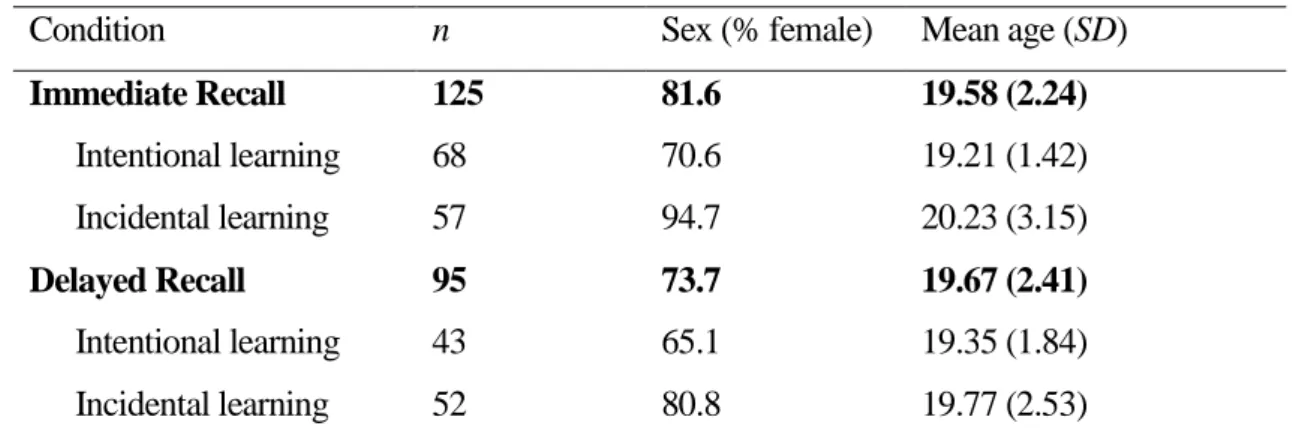
The sample size was calculated a priori using G*Power 3.1.9.2 (Faul, Erdfelder, Lang, & Buchner, 2007). With α = .05, power (1-β) = 0.95 and a medium effect size, f = 0.25, N was set as 76 participants (19 per condition). Studies focusing the animacy effect in memory have included on average 43 participants per condition (SD = 18.58). Considering that this number allows us to reach the required power and would permit a more direct comparison to previous studies, we established it as our minimum sample size. In this study a total of 220 participants were included, and the power of the test, calculated a posteriori, was of 0.99. The distribution of the total sample by condition is illustrated in Table 2. The different group sizes across conditions are due to the nature of the procedure used to collect the data and the uncertainty about participants’ exclusion, particularly in the delayed and incidental learning conditions.
A total of 367 young-adult undergraduate students consented to participate in this study. From those, 147 participants were excluded for various reasons: they did not perform the recall phase in the delayed conditions (n = 49), were not naïve in the incidental learning task or tried to memorize the words in the incidental learning tasks (n = 30), were not European Portuguese native speakers (n = 28), were aware of the duration of the retention interval in the delayed conditions (n = 26), and were older than 35 (to maintain a more homogeneous sample of young-adults) or younger than 18 years old (n = 14). The 220 participants that compose the final sample (78.2% female; Mage = 19.63; SD = 2.34) were all undergraduate students from different academic areas (Geography, Psychology,
History, Gerontology, Social Service and Occupational Therapy) and were all European Portuguese native speakers. Participants from each of these different areas participated in at least two different experimental learning conditions to prevent potential group effects in the final results. The created
subgroups were asked not to share any information with the remaining participants. All participants were naïve to the true aim of the study (the animacy manipulation). Written informed consent was obtained from all participants prior to their participation.
Table 2. Participants’ demographic information in each condition.
Condition n Sex (% female) Mean age (SD)
Immediate Recall 125 81.6 19.58 (2.24) Intentional learning 68 70.6 19.21 (1.42) Incidental learning 57 94.7 20.23 (3.15) Delayed Recall 95 73.7 19.67 (2.41) Intentional learning 43 65.1 19.35 (1.84) Incidental learning 52 80.8 19.77 (2.53)
Notes: SD = Standard deviation.
Materials.
Before selecting the stimuli (words) for this experiment, it was important to ensure that the animate and inanimate subsets of words would not differ on the pleasantness dimension – the rating task used in the incidental learning tasks. Because there are no EP databases that cover the variable of pleasantness, we conducted a pilot study in which pleasantness rating of a set of 50 words (25 animate and 25 inanimate selected from our Study 1) was collected. Those words were matched along 10 dimensions as described below. Such study also allowed us to validate the instructions for the incidental learning task. The selection of the target words took these ratings into account (see Appendixes 4 and 5).
After conducting the pilot study on pleasantness, 24 nouns (12 animate and 12 inanimate) were selected (Appendix 6). Because words vary in many other dimensions besides animacy, these two sets of words were carefully matched along 10 potentially mnemonic relevant dimensions, namely: relatedness (Landauer, Foltz, & Laham, 1998), emotional valence, arousal, dominance, written frequency (Soares et al., 2012), age of acquisition (Cameirão & Vicente, 2010; Marques et al., 2007), imageability, concreteness (Soares et al., 2017), pleasantness (our Pilot Study; Appendix 4) and number of letters, as reported in Appendix 5. The smallest p-value obtained in the comparison of the animate and inanimate words for these variables was .19 for the variable written frequency. The only exception was for the animacy dimension, t(22) = 58.97, p < .001, d = 24.07. Two additional words (an animate and an inanimate) were used in the practice trials.
Procedure.
This study had a 2 x 2 x 2 mixed design, with type of word (animate vs. inanimate) being a within-subject variable and encoding instructions (incidental vs. intentional learning) and retention interval (immediate vs. delayed) as between-subject variables. The proportion of correctly recalled words was the dependent variable.
Authorization to collect the data was obtained from the institutions (from the North and Center of Portugal) and the professors who allowed the data collection to occur during their class periods. After providing written consent authorization, participants were tested in group, in their classroom context (minimum of five and maximum of 30 participants per group). The instructions and stimuli (words) were projected on a screen. Using Microsoft PowerPoint 2016, each word was presented for five seconds (the same presentation time as in Nairne et al., 2013), with a one-second inter-trial interval (Font = Verdana; Size = 44; black uppercase letters in the center of the screen against a white background). The presentation order for all the 24 words was previously determined in a pseudo-random fashion way ensuring that each quarter of the list had three animate and three inanimate words (Appendix 6). The order of presentation remained constant across all participants. After the consent form fulfillment, all participants performed two practice trials to become familiar with the task and the presentation times (these words were not scored in recall). Then they were presented the 24 words (12 animate and 12 inanimate). In the encoding phase, about half of the participants (n = 111) was asked to memorize those words for a later free-recall task (intentional learning group) and the other half (incidental learning group, n = 109) was asked to rate the pleasantness of each word in a 5-point scale, ranging from very unpleasant (value of 1) to very
pleasant (value of 5). Their rating responses were recorded on a provided sheet of paper. All
encoding instructions are available in Appendix 7. In the pleasantness rating conditions, each word was presented simultaneously with a brief and neutral sound (click), simply to signal participants that a new word was being presented.
After the stimuli presentation, all participants completed a one-minute distractor task (a consecutive subtraction task of three units starting in number 597). About half of the participants (n = 125; immediate memory condition) then performed a free-recall task (this came as a surprise memory task for the participants from the incidental learning group). The other half (n = 95) performed a delayed recall task after a 48 hours retention interval (the delayed recall condition). Participants were not aware of the duration of the retention interval duration. A paper-and-pencil procedure was followed in all recall tasks. In the recall phase, participants were requested to recall as many words as they remembered from the learning phase and to use the entire recall period (five
minutes) for that task. After the recall task, participants from the incidental groups were asked if they suspected that they were performing a memory task and if they had made any effort to memorize the words during encoding; if they provided an affirmative response to any of these questions they were excluded as they were not complying with the incidental nature of the task. The participants from the delayed-intentional condition were asked if they had made any effort to recall the stimuli during the retention interval as this could also affect their performance (no participants were excluded for this reason). To prevent an eventual influence of time of day in performance (c.f. Loayza Hidalgo et al., 2004), the delayed recall phase took place at about the same time-of-day (± 3 hours) as the encoding phase (procedure also followed by D. Clark & Bruno, 2016). Finally, participants from the incidental group were asked to provide their informed consent after being fully debriefed about the true goals of the experiment. At the very end of the experiment, all participants provided sociodemographic data (age, gender and mother tongue), and were debriefed.
Results and Discussion
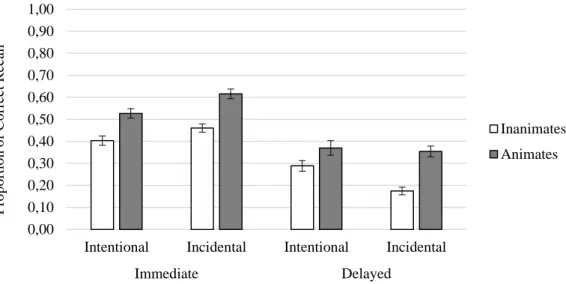
Data were analyzed using IBM SPSS Statistics 20. A mixed 3-Way ANOVA 2 x 2 x 2 was conducted including the variables type of word (within-subject variable), retention interval and encoding (between-subject variables). As presented in Figure 1, a significant main effect of type of word was obtained, denoting a higher proportion of recall of animate (M = 0.48; SD = 0.21) than inanimate words (M = 0.34; SD = 0.19), F(1, 216) = 132.07, p < .001, η2
p = .38. A sign test revealed that 154 of the 220 participants (70.0%) recalled a higher proportion of animate over inanimate words, while only 32 participants (14.5%) obtained the opposite result. These data provide further evidence of the robustness of the animacy effect initially reported by Nairne et al. (2013). A main effect of the retention interval was also obtained, F(1, 216) = 106.19, p < .001, η2p = .33. This outcome indicates that participants recalled a significantly higher proportion of words in the short (M = 0.50; SD = 0.15), than in the long retention interval (M = 0.29; SD = 0.15). Such effect is well documented in the literature since Ebbinghaus's (1885) findings about memory performance deterioration with time. The main effect of encoding failed to reach significance, F(1, 216) < 1, indicating that the proportion of correct recall did not differ significantly depending on the nature of the learning task (incidental learning: M = 0.41; SD = 0.19; intentional learning: M = 0.41; SD = 0.17). Such outcomes follow those reported by Nairne and collaborators (2008) who compared similar conditions.
Figure 1. Mean proportion of correct recall across all conditions. Error bars represent standard errors of the mean.
Regarding the interactions, both the interaction between type of word and encoding, F(1, 216) = 7.58, p = .006, η2
p = .03, as well as the interaction between retention interval and encoding, F(1, 216) = 12.07, p = .001, η2
p = .05, reached significance. Regarding the first, a follow-up paired t-test revealed a significant animacy effect independently of the instruction, that is, participants recalled significantly more animate than inanimate words in both incidental and intentional learning conditions, t(108) = 10.32, p < .001, d = 1.39 and t(110) = 6.47, p < .001, d = 0.81, respectively. However, as denoted by the statistics just reported, such interaction occurs due to the higher main effect (Cohen’s d) in the incidental condition as compared to the intentional condition. As individuals from the incidental learning tasks were asked to decide about a semantic characteristic of the presented words (deep processing), contrary to subjects from the intentional learning tasks (who just observed words in order to recall them later on), they may have elaborated more on that information, which could explain the obtained interaction (Craik & Lockhart, 1972). Regarding the second interaction found, an independent t-test demonstrated a significant main effect of the retention interval in both incidental, t(107) = 11.02, p < .001, d = 1.49, and intentional, t(109) = 4.37, p < .001, d = 0.59, learning tasks. Again, the effect size was larger in the incidental learning task. It is also worth noting the lack of a significant interaction between animacy (type of word) and retention interval, as well as the 3-way interaction, which suggest that the animacy effect is likely not influenced by the retention interval.
0,00 0,10 0,20 0,30 0,40 0,50 0,60 0,70 0,80 0,90 1,00
Intentional Incidental Intentional Incidental
Immediate Delayed P ro p o rtio n o f C o rr ec t R ec all Inanimates Animates
Further analyses were performed, focusing on pleasantness ratings, sex, intrusions and arousal3. A 2-Way mixed ANOVA was conducted to investigate possible differences on the pleasantness ratings provided by the immediate and delayed groups (between-subject factor), and for animate and inanimate words (within-subject factor). No significant main effects or interactions were found. Thus, pleasantness ratings were not influenced by the type of word nor the retention interval. So participants (from incidental learning groups and different retention intervals) rated quite similarly the animate (M = 3.43; SD = 0.39) and inanimate (M = 3.45; SD = 0.28) words. This analysis further supports the importance of the pilot study, in insuring that the pleasantness variable would not potentially influence the recall performances for the animate and inanimate words.
In an exploratory analysis, we investigated the influence of sex in the animacy effect. Some studies report that females seem to have better verbal memory than males (whom abstract processing seems to be better than female’s), as well as better verbal fluency (Herlitz, Nilsson, & Bäckman, 1997; Kimura & Clarke, 2002). Thus, a 4-Way mixed ANOVA was conducted, with type of word as the within-subject factor and retention interval, encoding and sex as between-subject factors. Although, in the current study, on average, females recalled a higher proportion of words (animate and inanimate) than male participants (M = 0.42; SD = 0.18, and M = 0.38; SD = 0.17, respectively), the effect of sex was not significant F(1, 212) < 1. The interactions involving the variable sex were also non-significant in this analysis. The remaining main effects and interactions followed the same pattern as the one showed in the 3-Way ANOVA conducted without the sex variable. Thus, sex does not seem to influence the animacy effect.
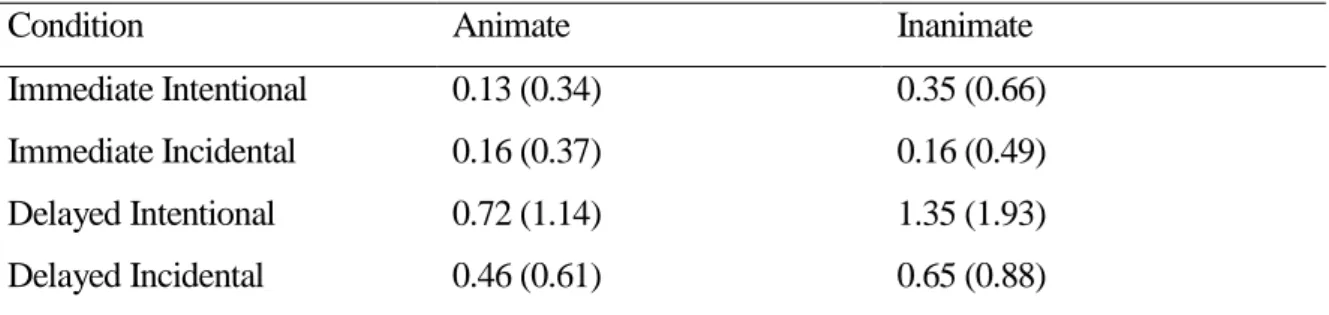
Regarding intrusions, data are shown in Table 3. Intrusions were classified as animate or inanimate by the author, according to the animacy definition proposed by Nairne et al. (2013): human and nonhuman animals were coded as animates, whereas tools, objects and plants were considered as inanimates. Words that could not be clearly classified as either animates or inanimates (e.g., correr [to run] or felicidade [happiness]) were excluded from this analysis. Only seven words
3 We also repeated our 3-Way ANOVA (type of word as the within subject factor; encoding and retention interval
as the between-subject factors) including the participants from the incidental learning conditions who suspected they were performing a memory task or reported to have memorized the words (n = 30) and the participants from the delayed conditions who were aware of the duration of the retention interval (only 15 from the 26 participants performed the recall phase and were included in this analysis). Those participants were excluded from the main analysis for the reasons mentioned in the participants’ section. The pattern of results obtained was similar to the obtained when the data from these participants had been excluded. However, in this overall analysis, the 3-way interaction reached significance, F(1, 261) = 4.79, p = .03, η2
p = .02. Thus, even including
these participants that could carry a set of potential confounding variables, the main effects of animacy and of the retention interval remained significant. The new 3-way interaction suggests that their performance differed on other levels.
were excluded for this reason (nimediate_intentional = 1; ndelayed_intentional = 2; ndelayed_incidental = 4). A 3-Way mixed ANOVA was conducted, with type of intrusion (animate vs. inanimate) as the within-subject factor and both retention interval and encoding as the between-subject factors. The pattern of results obtained from this analysis was the opposite to the one reported earlier for correct recall: a significant main effect of type of intrusion was obtained F(1, 216) = 13.87, p < .001, η2p = .06, indicating that participants made more inanimate (M = 0.57; SD = 1.13) than animate (M = 0.33;
SD = 0.68) intrusions. This pattern of intrusions is similar to that obtained by other studies (e.g.,
Gelin et al., 2017; VanArsdall et al., 2016). According to VanArsdall and collaborators (2016), such outcome strengthens the hypothesis that the animacy effect is not due to a categorical-recall strategy. Also, a significant main effect of retention interval was obtained, F(1, 216) = 38.26, p < .001, η2p = .15, indicating that participants made more intrusions in the delayed (M = 0.77; SD = 1.23) than in the immediate (M = 0.20; SD = 0.49) recall condition. The main effect of encoding also reached significance, F(1, 216) = 8.50, p = .004, η2p = .04. Interestingly, participants from the intentional encoding task committed significantly more intrusions on average (M = 0.55; SD = 1.15) comparing to the incidental encoding task (M = 0.35; SD = 0.64).
Table 3. Mean number of animate and inanimate intrusions (and standard deviations) in each of
the four conditions.
Condition Animate Inanimate
Immediate Intentional 0.13 (0.34) 0.35 (0.66)
Immediate Incidental 0.16 (0.37) 0.16 (0.49)
Delayed Intentional 0.72 (1.14) 1.35 (1.93)
Delayed Incidental 0.46 (0.61) 0.65 (0.88)
The interaction between type of intrusion and retention was also significant, F(1, 216) = 4.60,
p = .03, η2p = .02, as well as the interaction between type of intrusion and encoding, F(1, 216) = 5.51, p = .02, η2p = .03. A significant interaction between retention and encoding was also found, F(1, 216) = 4.15, p = .04, η2p = .02. The 3-way interaction did not reach significance, F(1, 216) < 1. Paired t-tests revealed a significant main effect of the retention interval, indicating that our participants made more inanimate intrusions in the delayed, t(94) = 2.69, p = .008, d = 0.37, than in the immediate recall task, t(124) = 2.22, p = .03, d = 0.27. Also, paired t-tests denoted that participants made significantly more inanimate intrusions in the intentional, t(110) = 3.33, p = .001,
d = 0.40, than in the incidental learning task, t(108) = 1.16, p = .25, d = 0.13. An independent t-test
showed a significant main effect of retention, however, the effect size was higher in the incidental,
t(75.46) = 4.50, p < .001, d = .54, than in the intentional learning task, t(48.17) = 3.83, p < .001, d =
0.52.
Finally, as doubts persist in the literature about the influence of arousal in the animacy effect (c.f. Meinhardt, Bell, Buchner, & Röer, 2018; Popp & Serra, 2015, 2018), an ANCOVA was held. None of the ANCOVA assumptions was violated, namely we confirmed the independence between arousal and recall, F(1, 23) < 1, as well as the assumption of the homogeneity of regression slopes (interaction between arousal and recall was not significant, F(1, 20) = 3.26, p = .09, η2p = .14). The arousal ratings (reported by Soares et al., 2012) of our stimuli were included as a covariable. Type of word (animate vs. inanimate) was included as the independent variable, and the number of correctly recalled words as the dependent variable. Data showed that the covariable (arousal) had no effect on recall, nor in the animacy effect, F(1, 21) = 2.18, p = .15, η2p = .09.
To the best of our knowledge, up to this point, the animacy effect was studied with short retention intervals only. Nevertheless, as claimed by Clark and Bruno (2016), the study of delayed recall periods is of major interest. In fact, animates’ processing is prioritized, as they catch attention first and for longer periods (Calvillo & Hawkins, 2016; New et al., 2007) and are recalled better than inanimates (Nairne, VanArsdall, et al., 2017; Nairne et al., 2013). If this processing advantage is considered to the adaptative, information should be retained and be usable over a relatively long period. The present data suggest that the animacy effect is still present two days after encoding, in both incidental and intentional encoding tasks. This reinforces the ultimate explanations about the animacy effect being and adaptative phenomenon.
A recent study, exploring how the encoding instructions influence the animacy effect, has shown that the animacy effect is independent of encoding (Gelin et al., 2017). In other words, the animacy effect occurs in both intentional and incidental learning tasks. Although the authors compared these two encoding conditions directly in the same experiment, their incidental learning tasks required a schematic processing, that is, the encoding instructions always referred to some kind of scenario or organized context (e.g., survival and tour guide encoding condition). In their study, participants performed significantly better only in one of their incidental (only in the survival, but not in the tour guide encoding) comparing to the intentional learning task. In our study, we used a pleasantness rating task as the incidental learning condition which is considered to activate more item-specific (instead of schematic) processing. Besides, it is also known that deciding about words’ semantic characteristics (such as pleasantness) provides deep processing of the presented stimuli
(Craik & Lockhart, 1972) and other authors have also used this incidental learning task (e.g., Nairne et al., 2008). We found a robust animacy effect in our incidental learning task, which was even larger than that obtained with the intentional learning condition. Thus, the animacy effect occurs even when people do not intentionally try to memorize them (incidental learning).
We also obtained a significant interaction between type of word (animate vs. inanimate) and encoding (intentional vs. incidental) with a larger animacy effect occurring in our incidental condition. In the case of Gelin and colleagues (2017) such interaction was also obtained. Our results suggest that encoding may influence the forgetting rate as a stronger influence of the retention interval occurred after the incidental than the intentional encoding. Moreover, the animacy effect seems to be stronger after incidental encoding than after intentional encoding. Further research is needed to fully understand the effect of type of word and encoding in the rate of forgetting.
According to the results from our ANCOVA, arousal does not seem to explain the animacy effect, a possibility that has been put forward by some authors (Meinhardt et al., 2018; Popp & Serra, 2015, 2018). Thus, although some proximate mechanisms have been suggested to be responsible for the animacy effect (as the attentional bias for animates, New et al., 2007; or the interactive imagery, Bonin et al., 2015), the mechanisms that produce the animacy advantage processing remain to be identified (Nairne, VanArsdall, et al., 2017).
This study presents some limitations. A potential caveat to this study is the different group sizes in each condition, as well as the group procedure of the data collection (that is, the possibility of participants copying others’ answers). The constant word order presentation may also be considered as a limitation. However, as we presented the same proportion of animate and inanimate words in each quarter of the word list, this limitation may be diluted in the final outcomes.
Further research is needed to test the longevity of the animacy effect. Indeed, the longevity of such mnemonic advantage will reinforce its adaptative value for the reasons presented before.
Taking all the above, the present results are consistent with the existing literature. Furthermore, this study replicated and extended the robustness of the animacy effect in memory. To our best knowledge, this was the first study addressing the longevity of the animacy effect and reinforces the ultimate explanations of this mnemonic effect as it was still reliable after a delayed retention period. The outcomes concerning the type of encoding also support the ultimate explanations for the animacy effect, as people recalled more animate over inanimate words even when they were not aware they were performing a memory task (situation that occurs daily). However, replications of our study are needed to further support these conclusions.
Study 3: The Animacy Effect in Dementia
Some studies indicate that the survival processing advantage is still observed in older people with mild cognitive impairment (Pandeirada, Pinho, & Faria, 2014). As the animacy effect also has an adaptative component, the aim of this exploratory study was to investigate if the animacy effect remains in old people with dementia, as the existing evidence is not consensual (Aiello et al., 2018; Lambon Ralph et al., 1998). To this end, we analyzed the neuropsychological assessment of patients from the Psychogeriatrics Service of the Hospital de Magalhães Lemos (Porto, Portugal). In particular, we collected data from the delayed recall task of Mini-Mental State Examination (MMSE; Folstein, Folstein, & McHugh, 1975; Portuguese version: Guerreiro et al., 1994), previously obtained by people with dementia. In this subtest, patients are asked to retain and recall three words. Importantly, these words vary in their animacy status and include an animate (gato, [cat]), an inanimate (bola, [ball]) and an ambiguous (pera, [pear]) word. Our hypothesis was that this group of people would still demonstrate an animacy recall advantage: the animate word would be better remembered than the remaining words.
Method
Participants.
Data from clinical files of 61 people diagnosed with dementia (80.3% female; Mage = 80.03; SD = 5.90; age range: 68 - 91) were collected retrospectively. They were diagnosed with different
types of dementia and in different stages (49.2% was in moderated or more advanced stages of dementia). None of them was aphasic. Their memory was impaired, according to the neuro-psychological evaluation, and most of the patients were taking medication that could affect their intellectual abilities. The inclusion criterion was to have a formal diagnosis of dementia, screened with the Portuguese version of the MMSE (Folstein, Folstein, & McHugh, 1975; Guerreiro et al., 1994). We only included people with MMSE scores below 26, that is, the Portuguese cutoff (Freitas, Simões, Alves, & Santana, 2015; MMMSE = 16.85; SD = 5.63; range = 0 - 25). The exclusion criteria were to have other psychiatric disorders reported in their clinical files, such as anxiety, depressive, personality, bipolar, psychotic or substance abuse disorders, as well as intellectual disability or other heterologous symptoms. However, the target population of the Service (and the included patients) may present some depressive symptoms, without completing all the depression criteria.
Materials.
All participants performed their neuropsychological assessment by responding to the MMSE. This test includes 30 items for the assessment of five different cognitive domains: orientation, retention, attention and calculation, delayed recall, language and ability to follow complex commands (copying). The MMSE is widely used to screen dementia disorders and its administration takes approximately 10 minutes. This test is validated for the Portuguese population, with Cronbach’s alpha varying between .46 and .83 in normal and clinical populations, respectively (Freitas, Simões, Alves, Duro, & Santana, 2012; Freitas et al., 2015; Guerreiro et al., 1994). In the recall portion, the Portuguese version includes three words: an animate (gato, [cat]), an inanimate (bola, [ball]) and an ambiguous word (pera, [pear]). The test was administrated by specialized health professionals (medics or psychologists). This data collection was approved by the Hospital de Magalhães Lemos ethics committee and it was also obtained a consent form from the Director of the Psychogeriatrics Service where the data collection was held.
Procedure.
This study had a within-subject design, with each participant being tested for all three types of words (animate vs. inanimate vs. ambiguous). Memory performance (correctly recalled words) was the dependent variable. Neuropsychological data was collected from the patient’s clinical files. In particular, we analyzed which words each patient recalled in the delayed recall subtest of the MMSE. In this task, participants were asked to memorize three words (explicit learning). Then, they performed an interference calculation task and then were asked to freely recall the previously presented words. Words were always presented in the same order (pear – cat – ball) to each participant. Sociodemographic data were also collected, namely the age at the neuropsychological evaluation date, sex and education level, as well as clinical data (humor and dementia stage).
Results and Discussion
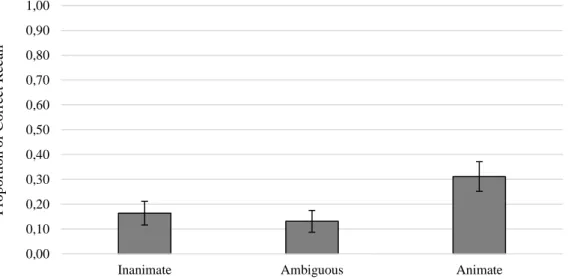
Data were analyzed using IBM SPSS Statistics 20. Animacy was the within-subject independent variable (animate vs. inanimate vs. ambiguous) and the dependent variable was set as the memory performance (each word correctly recalled was coded as one and otherwise zero, that is, this variable was dichotomous). Results are shown in Figure 2. Proportion of correctly recalled words was calculated as the quotient between the sum of all hits per word and the sample size.
As the dependent variable was dichotomous (each participant could only recall / not recall each word), a Cochran’s Q test (Cochran, 1950) was conducted. There was a significant type of
word effect, χ2(2) = 10.30, p = .006. A sign test revealed that 10 out of 61 participants (16.4%) recalled the animate but not the inanimate word, whereas only one participant presented the opposite outcome. Further pairwise comparisons were held using multiple McNemar’s tests along with Bonferronni correction (p value set for .0167). These revealed that people recalled better the animate over the inanimate (p = .01) and the ambiguous (p = .01) words. Besides, the difference in memory performance for the inanimate and ambiguous words was not significant (p = .80). As observed by Gelin and coworkers (2017), the present results suggest that inanimate non-food items are as well recalled as other inanimate items. A memory advantage for the animate was still obtained over the food-inanimate item although the latter might also be considered fitness-relevant (Nairne, 2010).
Figure 2. Mean proportion of correct recall by people with dementia. Error bars represent standard errors of the mean.
To ensure the robustness of the present analysis, a repeated measures ANOVA4 was conducted (with type of word as the within-subject factor). Similarly to the results reported from the Cochrane’s Q test, a significant main effect of type of word was obtained, F(2, 120) = 5.53, p = .005, η2p = .08. Planned paired t-tests revealed that the animate word was significantly better recalled than the ambiguous, t(60) = - 3.02, p = .004, d = - 0.77, and the inanimate words, t(60) = 2.87 p = .006, d = 0.73, respectively. The recall of inanimate and ambiguous words were not statistically
4 Although the collected data follow a Bernoulli distribution (dichotomic data which are not normally distributed), the
large sample size (N = 61) is enough to ensure a robust parametric analysis. From the central limit theorem, it is known that, for large sample sizes, sampling distribution will be normally distributed (Field, 2009; Norman, 2010). Besides, studies reveal that parametric ANOVA may provide more robust analyses than Cochrane’s Q test, even in dichotomous data (Seeger & Gabrielsson, 1968).
0,00 0,10 0,20 0,30 0,40 0,50 0,60 0,70 0,80 0,90 1,00
Inanimate Ambiguous Animate
P ro p o rtio n o f C o rr ec t R ec all