1. INTRODUCTION
Cucurbitaceae (Cucurbits) family includes around 825 species, derived from tropical and subtropical regions, includ-ing 26 species that are cultivated as vegetables. In tropical re-gions the consumption of cucurbits is very high and it has an important role in human consumption (Almeida, 2006). The main crops are pumpkins, watermelon, cucumbers and mel-ons. Pumpkins are rich in water, vitamins, antioxidants and carotene (provitamin A) that protects the body and prevents the premature aging (Caniço et al, 2005), although this is par-ticularly true if it comes from orange fruit pulp. Pumpkins are also poor in total solids (Alibas, 2007) and in calories, which means that they are adequate for low calories regimes, and they are often recommended in diets. This vegetable is also known for the properties of its seeds, that are rich in fat, protein, thia-min, niacin and various minerals (Almeida, 2006), and when crushed provide a pulp with medicinal power which acts as anti-infl ammatory, diuretic and emulsifi er that helps in fever treatment, ear pain, infl ammation of the urinary and prostate disorders (Cunha, 2003).
Pumpkin, like most vegetables, is a perishable food whose characteristics are changed with time. Therefore it becomes necessary to use conservation methods that allow preserving its properties. One of the most commonly used methods for con-servation is drying, which is considered the oldest and the most important method of food preservation (Sacilik, 2007). This process consists of removing water from the product in order to reduce the water activity and as a consequence minimize the microbiological changes (Krokida et al, 2003) or enzymatic re-actions (Harbour et al, 2009). Furthermore, it originates a con-siderable reduction in weight and volume, minimizing pack-ing, storage and transportation, as well as allowing storage of the product without refrigeration (Guiné, 2008). During drying many changes occur in the food, such as structural and chemi-cal modifi cations, that affect the fi nal product quality. Further-more, it can cause signifi cant loss of some compounds which have importance at the functional level (Maskan, 2001). Corresponding author: [email protected] ORIGINAL SCIENTIFIC PAPER
Chemical Properties of Pumpkin Dried by
Different Methods
Francisca Henriques
1, Raquel Guiné
1*, Maria João Barroca
21CI&DETS, Polytechnic Institute of Viseu, ESAV,
Quinta da Alagoa, Estrada de Nelas, Ranhados, 3500-606 Viseu, Portugal
2CERNAS-ESAV-IPC / Dep. of Chemical and Biological Engineering, ISEC-IPC,
Rua Pedro Nunes, Quinta da Nora, 3030-199 Coimbra, Portugal
Summary
The present work evaluates the effect of drying treatments such as convective air drying and freeze-drying on the chemical properties (mois-ture contents, fi bre, ash, vitamin C and sugars), antioxidant activity and phenolic compounds of pumpkin (Cucurbita maxima L.). The trials in the convective chamber were done at 40 ºC and 60 ºC, in the drying tunnel were done at 60 ºC and in the freeze dryer were done at -50 ºC.
From the results obtained it was possible to verify that all drying treatments affected the chemical composition of pumpkin in terms of fi bre, ash, vitamin C and sugars. Furthermore, the freeze drying originated products with less reduction in sugars, but with a higher degree of degrada-tion of fi bre and vitamin C. With respect to antioxidant activity and phenolic compounds it is possible to conclude that the different dried products are quite similar and do not reveal important differences when compared to the fresh product.
Key words: Pumpkin, Drying, Fibre, Ash, Vitamin C, Sugars, Antioxidant Activity, Phenolic Compounds.
1
The two most commonly employed methods for drying are conventional hot air drying and freeze drying (Vashisth et al, 2011). Nowadays, to dry agricultural products such as vegetables, the most used process is hot air drying (Sacilik, 2007). Air drying is generally favoured due to its low op-erating costs, and also because less drying time is required in comparison to freeze drying (Vashisth et al, 2011). In con-ventional air drying, high temperatures are employed that ad-versely affect the texture, colour, fl avour, and nutritional value of the products in question (Vashisth et al, 2011). However, this method allows obtaining a uniform, hygienic and attrac-tive dried product (Doymaz, 2004).
Another preservation method is freeze drying (Peñarrieta et al, 2011). This conservation technique has been increasing in the past decades, and is often used for the processing of sea-food, fruits, vegetables and meats (Lindon and Silvestre, 2008). This process involves two steps: fi rst the product is frozen and then is submitted to extreme conditions, namely very low pres-sure and temperature, so as to provide sublimation of frozen water in the vacuum. This sublimation results from the appli-cation of a vapour pressure gradient between the surrounding atmosphere and the ice inside of the product. The freeze dryer is equipped with a heating and condensation system which eliminates the water vapour formed. The elimination of most of the water by sublimation leads to the formation of a prod-uct with a highly porous strprod-ucture keeping the same size and shape of the original product (Hui, 2006). However, an im-portant loss in tissue fi rmness occurs, as a result from the high porosity (Dermesonlouoglou et al, 2008). On the other hand, freeze drying does not expose the product to high temperatures and helps preserve some product quality parameters such as colour, fl avour, nutrients, phenolics, and antioxidant activity when compared to hot air drying (Vashisth et al, 2011). Still, and since this processing involves freezing, some slight degra-dation of textural properties, colour alteration and nutritional loss also occur (Dermesonlouoglou et al, 2008), both as a con-sequence of the freezing treatment (Shahidi and Naczk, 1995)
and exposure to very low pressure (Nawirska et al, 2009). The main disadvantage of freeze drying is its high operating cost and long drying time (Vashisth et al, 2011).
Oxidation reactions are of major signifi cance in human physiology as well as the food industry. With respect to hu-man health, oxidative stress has been associated with diseases such as atherosclerosis, cancer and tissue damage in rheuma-toid arthritis while the food industry has long been concerned with problems such as rancidity and oxidative spoilage of fruits, vegetables and beverages (McDonald et al, 2004). The idea that the prejudicial effects of oxidative metabolism can be minimized through a diet rich in antioxidants has gained cred-ibility in the past decades (McDonald et al, 2004).
Polyphenols are naturally occurring substances essential in all plant materials, and particularly present in fruits, vegeta-bles, seeds and herbs, but also in plant products such as bever-ages, wines or cocoa (Aouidi et al, 2011). Phenolic compounds from natural sources have attracted great attention during the last decade, because they are potent antioxidants that play an important role in human nutrition as preventative agents against several diseases, protecting the body tissues against oxidative stress, and thus contributing to human health (Chiou et al, 2007; Aouidi et al, 2011). Antioxidants neutralise free radical reactive oxygen species that are generated endogenous-ly through aerobic metabolism (Bennett et al, 2011).
Antioxidants are compounds that inhibit or delay the oxi-dation of other molecules by inhibiting the initiation or prop-agation of oxidizing chain reactions. They can be synthetic or natural, being the synthetic used as antioxidants since the beginning of the XXth century. However, some important
re-strictions on the use of these compounds are being imposed due to their potential carcinogenicity. Therefore, the interest in natural antioxidants has increased considerably (Velioglu et al, 1998).
Many of the natural antioxidants, especially fl avonoids, are widely regarded as some of the major bioactive compounds which have been identifi ed to exhibit antioxidant activity (Mat-tila and Hellström, 2007; Thoo et al, 2010). They possess vari-ous therapeutic a wide range of biological effects, including an-tibacterial, antiviral, anti-infl ammatory, antiallergic, antihepa-totoxic, antithrombotic, antiatherogenic, anticarcinogenic, as well as vasodilatory actions and cardioprotective effects (Veli-oglu et al, 1998; Luthria, 2008; Peinado et al, 2009; Bennett et al, 2011). Furthermore, polyphenols seem to have a protective effect on brain degenerative processes (Bennett et al, 2011). Many of the biological functions, such as antimutagenicity, an-ticarcinogenicity, and antiaging, among others, originate from the antioxidant capacity (Velioglu et al, 1998).
Phenolic compounds are considered to be metabolically inert and stable (Baitha and Pandey, 2003). They exist in a phe-nolic acid form as hydroxybenzoic acid or hydroxycinnamic acid derivatives, and are usually covalently bound to insolu-ble polymers. This limits the activity of bound phenolic com-pounds as natural anti-oxidative agents and there have been attempts to liberate bound phenolic acids, for example, through heat treatment, thereby increasing the anti-oxidant activity (Choi et al, 2011).
The present work aims to compare the chemical properties such as fi bre, ash, vitamin C and sugars, antioxidant activity and phenolic compounds of pumpkin in fresh and after drying, specifi cally freeze-drying, convective air drying in tunnel and convective air drying in a chamber at different temperatures.
2. MATERIALS AND METHODS
Sample preparationThe pumpkin used in this work is Cucurbita maxima Duchesne ex Lam., var. Menina. The pumpkin was peeled and washed, and the skin and seeds were removed. The samples for drying were cut into circles with approximately 4 cm diameter and 1 cm thick.
Drying
Three different drying equipments were used: a convec-tive chamber, a drying tunnel and a freeze drier. For the con-vective air drying in the chamber, a chamber BINDER WTB (Germany) with ventilation was used. The experiments were done at constant temperatures of 40 ºC and 60 ºC. For these two trials the drying time was approximately 9 and 6 hours, respectively. The convective drying in the tunnel was done in a Tray Drier UOP-8 (Armfi eld, UK). The temperature was kept approximately constant at about 60 ºC and for this trial the dry-ing time was 4 hours. For the freeze drydry-ing experiment a Freeze Dryer TDF 5505 (Uniequip, Germany) was used. The samples were previously frozen in a conventional kitchen freezer, and then left in the freeze-drier for 96 hours at a temperature ap-proximately -50 ºC and a pressure of 0.7 Pa.
Analysis of chemical composition
Some chemical properties of the fresh and dried samples were evaluated, namely moisture content, fi bre, ashes, vitamin C and sugars (reducing, total and non reducing sugars). The moisture content was determined with a Halogen Moisture Analyser HG53 (Mettler Toledo, USA), with operating tem-perature set to 120 ºC and speed 3 (in a scale of 1 to 5, in which 1 is very fast and 5 is very slow). For the determina-tions of moisture content, the samples had a mass between 0.2 g and 0.5 g. A total of 18 measurements were made: 6 pumpkin samples were used and three determinations were performed to each sample.
For fi bre, ashes, vitamin C and sugars the samples were obtained from triturated pumpkin. Three different samples were used and in each one three analyses were made, in a total of 9 analyses per state: fresh and different dryings. Dosi Fibre method was used to determine crude fi bre. 1 g of each sample (crushed) was treated with 150 mL of an acidic solution (H2SO4 1.25 %) and then washed trice with 150 mL of distilled water. Next, the process was repeated with a basic solution (NaOH 1.25 %), and washed with 5 mL of acetone, for 3 times. Finally, samples went to muffl e and were weighed (AOAC, 2000). For ashes, the Weende method was used, and the samples (1 g) were calcinated at 550 ºC (AOAC, 2000). Vitamin C was de-termined by titration. 10 mL of an acidic solution (H2SO4 20 %) were added to 5 g of sample (crushed) followed by fi ltra-tion, adding again 10 mL of H2SO4 20 % , 1 mL of potassium iodide 10 % and 1 mL of starch solution 1 %. The titration was done with potassium iodate 0.01 N.
For the determination of sugars the Portuguese standard 1420 (NP-1420, 1987) was used, allowing the quantifcation of reducing sugars, non reducing sugars and total sugars, using the technique of Luff-Schoorl. In the case of the fresh product a sample of 10 g was used, and in the case of the dried products 5 g were used. Then, 12.5 mL of carrez I and 12.5 mL of car-rez II solutions were added to the sample with distilled water, originating the precipitation (base solution). This solution was then used to the various determinations. For reduction sugars, 25 mL of Luff-Schrool solution, 10 mL of base solution and
water were used in a total volume of 50 mL, which was boiled for 8 minutes with a condenser to avoid evaporation. Later, it was added 9 mL of potassium iodide (1 M), 20 m of H2SO4 (1 part acid + 6 parts water), 2 mL of starch paste solution and ti-trated with sodium thiosulfate solution (0.1 N). For total sugars it was used 50 mL of base solution and 3.5 mL of HCl (37 %) left on a bath at around 70 ºC for 5 minutes. After cooling the solution was neutralized with NaOH (40 g/100). The titration was like in the reducing sugars, but instead of using 10 mL of the base solution it was used 10 mL of the solution that was obtained from the determination of total sugars. The blank trial was done with the same procedure but just with 25 mL of Luff-Schrool solution and 25 mL of distilled water.
Except for the moisture content, which was expressed in fresh weight, all other results were expressed in terms of dry matter, in order to allow a direct comparison of the values for the different dried samples.
Determination of antioxidant activity and quantifi cation of phenolic compounds
The antioxidant activity and total phenolic compounds of the fresh and dried samples were assessed using a spectropho-tometer UV Mini-1240 (Shimadzu, Japan) at different absorb-encies: for antioxidant activity the absorbance was 734 nm and for phenolic compounds was 760 nm. All samples, for fresh and dried pumpkin, were obtained by crushing the product, having taken a mass of 5 grams. Subsequently, 6 extractions were performed for each sample (three with methanol and three with acetone), lasting one hour each, done with the aid of a magnetic stirrer.
The antioxidant activity was determined using the meth-od base on the capacities of different substances to neutralize the radical ABTS+ in comparison with a standard antioxidant
(Trolox) in a dose-response curve. 200 μL of the extract solu-tion were taken and 2 mL of ABTS solusolu-tion were added (this last was prepared the day before and left to stand all night). After 15 minutes the samples were used to read the corre-sponding absorbance, at 734 nm. The calibration lines were obtained with Trolox solutions at different concentrations (200 μL, 175 μL, 150 μL, 125 μL, 100 μL, 50 μL, 25 μL), and for each concentration 3 readings were made. The values of the antioxidant capacity were expressed in μmol equivalents of Trolox (TEAC) per gram.
The method used to quantify the total phenolic compounds used the Folin Ciocalteu reagent (Shahidi and Naczk, 1995). For this, 125 μL of the sample solution were used and 750 μL of distilled water plus 125 μL of Folin Ciocalteu reagent were added. After a 6 minutes pause 2 mL of sodium carbonate solu-tion were added and, after 90 minutes in the dark, the samples
absorbencies were read at 760 nm. The calibration curve was prepared using 50 mg/L, 100 mg/L, 150 mg/L, 250 mg/L, 350 mg/L, 500 mg/L solutions of gallic acid, and for each concen-tration 3 readings were performed. Total phenolic compounds were expressed in mg gallic acid equivalents (GAE) per gram.
3. STATISTICS
With the aim to evaluate if the differences between the medium values of the properties analyzed in this study were signifi cant, a statistical analysis was performed by the Tukey HSD test with a level of signifi cance of 5 % (P < 0.05). The Tukey’s HSD (Honestly Signifi cant Difference) test is a statisti-cal test to fi nd out which means are signifi cantly different from each other, and consists in a single-step multiple comparison procedure, coupled to an Analysis of Variance (ANOVA). The test identifi es if the difference between two means is greater than the standard error allowed. The software Statistica V6.1 from Satsoft was used to perform the statistical analysis.
4. RESULTS AND DISCUSSION
Table 1 presents the mean values for moisture content, crude fi bre, ash and vitamin C for pumpkin in fresh and af-ter the different drying treatments. The mean value obtained for fresh pumpkin moisture content was 90.81 %, being in the range of other values reported in literature, between 88 % and 92 % (Escobar and Buesa, 1999; Senser and Schertz, 1999; Almeida, 2006; Barroso et al, 2007; Monteiro, 2009). As to the dried samples, those dried in the chamber were dried to a fur-ther extent (around 7 %) than those in the freeze drier (11 %) and drying tunnel (15 %). The value for the fi bre of the fresh pumpkin was found to be 15.13 % (dry basis), corresponding to 1.49 % (wet basis), which is a value a little higher than that reported by Monteiro (2009), 0.76 %. However, the value stays close to the upper value of the range of values found in litera-ture, between 0.5 % and 1.3 % (wet basis) (Fennema et al, 2004; Almeida, 2006; Barroso et al, 2007). As to the effect of the different drying treatments on the fi bre contents, it was observed that freeze drying induce the highest degree of loss, corresponding to a disintegration of the polymeric fi bres. The convective air dryings induced intermediate changes in the fi -bre contents, varying with temperature and operating condi-tions (Femenia et al, 2009; Borchani et al, 2011). The mean value for the ash contents of the fresh pumpkin was 12.34 % (dry basis), corresponding to 1.13 % (wet basis), being in the range found in the literature for ash content in pumpkins: 0.3 % to 1.4 % (Ferreira and Graça, 1977; Senser and Scherz, 1999; Fennema et al, 2004; Guiné et al, 2011).
Table 1. Moisture, Fibre, Ash and Vitamin C contents of fresh and dried pumpkin.
MOISTURE (g/100g fresh weight) FIBRE(1) (g/100g dry matter) ASH(1) (g/100g dry matter) VITAMIN C(1) (mg/100g dry matter) Fresh product 90.81 (±0.43) 15.13a (±2.02) 12.34d (±1.16) 127.04a (±3.68) Drying chamber (40ºC) 7.19 (±1.98) 5.95d (±0.45) 17.90b (±0.55) 16.52b (±2.77) Drying chamber (60ºC) 7.49 (±2.04) 9.69b (±0.23) 19.41a (±0.58) 12.79c (±0.01) Tunnel drying (60ºC) 14.77 (±3.66) 8.06c (±0.57) 19.27ab (±1.40) 14.57bc (±0.28) Freeze drying 10.93 (±1.83) 1.15e (±0.13) 16.05c (±1.32) 13.74bc (±0.03)
The value encountered for the vitamin C content in the fresh pumpkin was 127.04 mg/100 g dry matter, correspond-ing to 12 mg/100 g wet product. This value is similar to other reported in literature (Maroto, 1995; Senser and Scherz, 1999). In all drying treatments, the vitamin C contents decreased dras-tically, what would be expected, taking in consideration that
this chemical compound is very much affected by temperature (Mclaughlin and Magee, 1998; Gliguem and Birlouez-Aragon, 2005; Vikram et al, 2005; Cruz et al, 2008).
Table 2 shows the mean values obtained for sugar contents (reducing, total and non reducing) for pumpkin in fresh, after air drying in the chamber and in the tunnel and after freeze-drying, expressed in dry basis. The total sugars of the fresh pumpkin were 43.78 g/100g
dry matter, corresponding to 4.02 % wet basis. This value is similar to those reposted by Senser and Scherz (1999) and by Monteiro (2009) for carbo-hydrates, 4.60 % and 4.30 % respectively. All drying treat-ments produced a signifi cant reduction in the sugar con-tents, varying from 36 % for the freeze drying to 60 % for the drying in the chamber at 60 ºC. In fact, the higher losses correspond to those treatments where the temperature was higher (60 ºC) and where the thermal degradation was more
intense (Ameur et al, 2007; Forbes et al, 2010; Lan et al, 2010). Similarly, the reducing and non reducing sugars also suffered important losses in all drying treatments. The reducing sugars content for the fresh pumpkin was 24.61 g/100 g dry matter, while the non reducing sugars was 19.47 g/100 g dry matter. In literature were found values for reducing sugars, non reducing sugars and total sugars of 26.35 g/100g dry matter, 25.12 g/100 g dry matter and 52.84 g/100g dry matter, respectively. In lit-erature were also found values for reducing and non reducing sugars, expressed in wet basis, of 2.4 % and 2.3 %, respectively (Guiné et al, 2011), which are similar to those found in the present work: 2.2 % and 1.9 % respectively for reducing and non reducing sugars.
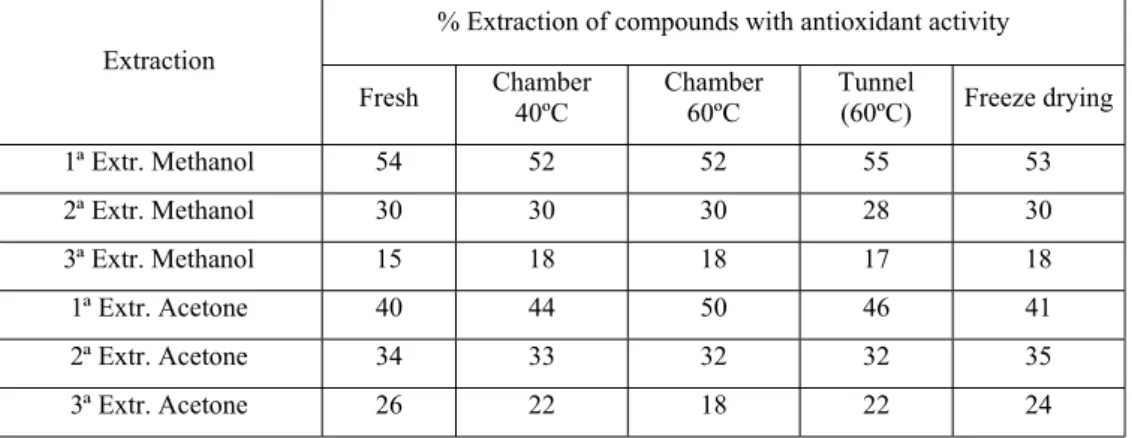
Table 3 shows the percentages of extraction of compounds with antioxidant activity obtained with extracts of methanol and acetone. Two solvents were used in order to extract a larger amount of compounds with antioxidant activity. It is possible to verify that for the methanol extractions, the effi ciency of
the successive extractions is practically equal regardless of the state of the samples (fresh or dried), meaning that the proce-dure if effi cient in all cases. The percentage of extraction in the fi rst extraction was about 52-54 % while the third extraction varied from 15 % to 18 %. With respect to the extractions with acetone, also the different samples present similar extraction
results, but in this case the extraction is less effi cient, consider-ing that in the third extraction the percentages of antioxidant compounds recovered are higher, varying from 18 to 26 %.
Equations 1 and 2 express the calibration lines that have been made to quantify the antioxidant activity in different sam-ples of pumpkin. It was necessary to have two calibration lines because measurements were made on different days. Equation
1 was used for fresh pumpkin, pumpkin dried in tunnel and freeze dried, while Equation 2 was used for the pumpkin dried in the chamber at both temperatures (40 ºC and 60 ºC):
% Inhibition = 347.0735 * Concentration (mmol/L) + 9.4071 (R² = 0.9906) /1/
% Inhibition = 362.0314 * Concentration (mmol/L) + 5.0206 (R² = 0.9958) /2/
Both calibration lines are quite similar and have relatively high R2 values, meaning that the fi t was good.
Figure 1 presents the mean values and their deviations to the values of antioxidant activity measured in extracts of meth-anol and acetone obtained for fresh pumpkin, pumpkin dried at 40 ºC, dried at 60 ºC, dried in the tunnel and freeze dried. The results show that, except for the fresh and freeze dried sam-ples, which showed equal values of antioxidant activity in both extraction solvents; in the other cases the antioxidant activity was observed to be higher in the methanol extracts. However, the results indicate that both extracts are equally rich in com-pounds with antioxidant capacity.
REDUCING SUGARS(1) (g/100g dry matter) TOTAL SUGARS(1) (g/100g dry matter) NON REDUCING SUGARS(1) (g/100g dry matter) Fresh product 24.61a (±2.94) 43.78a (±4.43) 19.47a (±4.27) Drying chamber (40ºC) 14.74b (±0.639) 19.55c (±1.33) 4.57c (±1.68) Drying chamber (60ºC) 15.31b (±0.74) 17.62c (±0.99) 1.97c (±0.57) Tunnel drying (60ºC) 15.40b (±0.58) 17.46c (±1.53) 2.72c (±0.597) Freeze drying 16.46b (±0.88) 28.02b (±1.30) 10.99b (±1.45)
Table 2. Sugar contents of fresh and dried pumpkin.
(1)Mean values in the same column with different superscripts are statistically different (P<0.05).
Table 3. Percentage of extraction of compounds with antioxidant activity in the fresh and dried pumpkin.
% Extraction of compounds with antioxidant activity Extraction Fresh Chamber 40ºC Chamber 60ºC Tunnel (60ºC) Freeze drying 1ª Extr. Methanol 54 52 52 55 53 2ª Extr. Methanol 30 30 30 28 30 3ª Extr. Methanol 15 18 18 17 18 1ª Extr. Acetone 40 44 50 46 41 2ª Extr. Acetone 34 33 32 32 35 3ª Extr. Acetone 26 22 18 22 24
As to the effect of drying on the antioxidant activity, it could be observed that drying practically does not infl uence the antioxidant capacity, at least for the methods and conditions tested in the present work. Nonetheless, the product originated from air drying in the chamber
at the higher temperature (60 ºC) showed the lowest antioxi-dant activity.
Bennett et al. (2011) stud-ied the effect of drying condi-tions on total polyphenols and antioxidant activity of different dried fruits and they observed that for sultanas the drying conditions could affect both sensory and helth-related quality attributes of grapes, whereas for all other fruits, the drying conditions did not in-duce signifi cant changes in to-tal phenols or antioxidant ac-tivity. Peñarrieta et al. (2011)
evaluated the changes in phenolic antioxidants for freeze and sun dried potato by two methodologies: ferric reduction anti-oxidant power and ABTS. The results showed that the antioxi-dant capacity appeared reduced after freeze drying if the ferric method was used, but remained the same if with the ABTS method. Peinado et al. (2009) showed that during the drying of grapes compounds of high molecular weight are formed and are partially responsible for the antioxidant activity. Catechins and procyanidins as well as polymeric
pro-cyanidins were greatly enhanced during dry-ing. Furthermore, antioxidant activity did not vary during drying although a reduction in to-tal phenolics was observed. Choi et al. (2011) studied the effect of storage and heat treatment on phenolic compounds of citrus peels, and concluded that both, long term storing and heat treatment, originated an increase in total phe-nols and bioactivity.
Table 4 shows the percentages of recov-ery of phenolic compounds obtained with dif-ferent extractions, using methanol and acetone as extraction solvents. Again two solvents were used, since there are some molecules that are more soluble in one solvent and less in another, and the use of two solvents allows extracting a higher amount of phenolic compounds. It is
possible to verify that the different samples of pumpkin (fresh and dried) presented the same patterns of extraction, corresponding to similar percentages of recovery in all three extractions, and for both solvents. In this case, the effi cien-cy of extraction is similar for both solvents.
Equation 3 presents the calibration line used for the quantifi cation of phenolic compounds, which has a high regression coeffi -cient, indicator of a good fi tting:
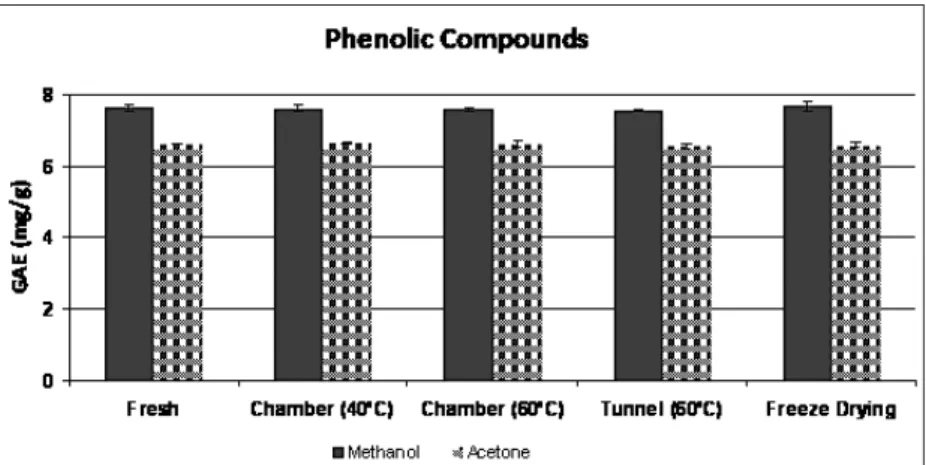
Absorbance = 2.5405 * Concentration (g/L) + 0.1193 (R² = 0.9750) /3/ In Figure 2 it is possible to observe the mean values and standard deviations for the phenolic compounds quantifi ed in the extracts of methanol and acetone obtained for fresh and various dried states of pumpkin. It may be noted that the values of phenolic compounds are always higher in the extracts of methanol than in acetone, but otherwise confi rms the utility of using two extraction solvents, because even slightly lower; the values of total phenols extracted with acetone represent a signifi cant part
of the phenolic compounds quantifi ed in the different samples. Furthermore, it is possible to verify that the drying process, regardless of the method used does not affect the amounts of phenolic compounds, being this an aspect of major importance, since it is intended that the processing will not affect the nutri-tional and funcnutri-tional properties of the product.
Vashisth et al. (2011) reported that freeze drying induced a high retention rate of the phenolic compounds relatively to Figure 1. Antioxidant activity for fresh and dried pumpkin, with methanol and acetone
extractions.
Table 4. Percentage of extraction of phenolic compounds in the fresh and dried pumpkin.
% Extraction of phenolic compounds Extraction Fresh Chamber 40ºC Chamber 60ºC Tunnel (60ºC) Freeze drying 1ª Extr. Methanol 42 42 42 42 41 2ª Extr. Methanol 34 34 34 34 34 3ª Extr. Methanol 25 24 24 24 24 1ª Extr. Acetone 46 46 45 46 46 2ª Extr. Acetone 28 28 28 28 28 3ª Extr. Acetone 26 26 27 26 26
Figure 2. Phenolic compounds for fresh and dried pumpkin, with methanol and acetone
the fresh state, when compared to hot air drying, for musca-dine pomace. Some researchers suggested that polyphenols are heat labile and that prolonged heat treatment and high tempera-tures cause irreversible chemical changes to such compounds. Furthermore, some destruction of fl avanoids and tannins may also occur. Harbourne et al. (2009) studied the effect of dry-ing methods on the phenolic constituents of herbs and freeze drying and oven or tray drying at 30 ºC did not affect the phe-nolic compounds, while if the temperature was raised to 70 ºC some reduction was observed. Rózek et al. (2010) evaluated the phenolic stability during air drying of grapes submitted to a treatment of osmotic dehydration, and found that this pre-treatment effectively protected against degradation during air drying.
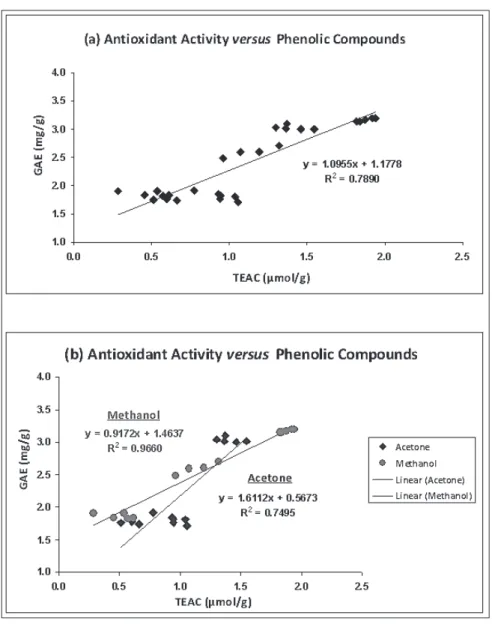
Figure 3 shows the correlations between the antioxidant activity and the amount of phenolic compounds obtained for all samples analyzed. The graph in Figure 5(a) shows all the points, considering both solvents, whereas the graph in Fig-ure 5(b) shows the regressions applied separately to the points obtained from the two solvents tested. From the graph (a), and attending the values of the regression coeffi cient (0.789), it can be observed that there is some correlation between these two variables (Equation 4), meaning that the antioxidant activity is somehow directly related to the amount of phenolic com-pounds present, as expected.
TEAC (μmol/g) = 1.0955 * GAE (mg/g) + 1.1778 (R2 = 0.7890) /4/
However, when analysing the lines in graph (b), it becomes evident that the points resulting from the methanol extracts fi t much better a stright line (Equation 5) than those from the acetone extracts (Equa-tion 6), with the value of the regression coeffi cient being respectively 0.9660 and 0.7495.
TEAC (μmol/g) = 0.9172 * GAE (mg/g) + 1.4637 (R2 = 0.9660) /5/
TEAC (μmol/g) = 1.6112 * GAE (mg/g) + 0.5673 (R2 = 0.7495) /6/
5. CONCLUSIONS
The present work evaluates the effect of different drying treatments on the chemi-cal properties, antioxidant activity and phe-nolic compounds of pumpkin, which were dried using three different methods: con-vective air drying in chamber, concon-vective air drying in tunnel and freeze-drying.
In general, the drying process induced a reduction in fi bre, ashes, sugars and vita-min C, being this component much affected by drying, with losses of up to 90 %. Freeze drying was the process that allowed obtain-ing the most similar values sugar contents as compared to the fresh pumpkin, but induced a higher degree of degradation of fi -bres and vitamin C.
The results also showed that in terms of antioxidant activity and amount of phe-nolic compounds, the differences between the fresh pumpkin and all the other states of drying are practically negligible, which means that even though some of the chemi-cal components of pumpkin have changed with drying at different conditions, the compounds of functional importance within it do not change or get lost. This allows us to conclude that it is possible to preserve the functional characteristics of pumpkin even after drying.
6. REFERENCES
Alibas I. (2007) Microwave, air and combined micro-wave-air-drying parameters of pumpkin slices. LWT- Food Science and Technology, 40, 1445-1451.
Almeida D. (2006) Manual de culturas hortícolas. Edito-rial Presença, Portugal, Lisboa, p. 111.
Ameur L. A., Mathieu O., Lalanne V., Trystram G., Birlouez-Aragon I. (2007) Comparison of the effects of su-crose and hexose on furfural formation and browning in cook-ies baked at different temperatures. Food Chemistry, 101, 1407-1416.
AOAC (2000) Offi cial methods of analysis, 17ed. Wash-ington: Association of Offi cial Analytical Chemists.
Aouidi F., Ayari S., Ferhi H., Roussos S., Hamdi M. (2011) Gamma irradiation of air-dried olive leaves: Effective decon-tamination and impact on the antioxidative properties and on phenolic compounds. Food Chemistry, 127, 1105-1113.
Baitha S. N., Pandey V. S. (2003) Silica gel chromato-graphic study of phenolic compounds in some cultivated cu-curbits. Himalayan Journal of Sciences, 1, 123-125.
Figure 3. Correlations between phenolic compounds and antioxidant activity: (a) with both
Barroso M. R., Magalhães M. J., Carnide V., Martins S. (2007) Cucurbitáceas de Trás-os-Montes. Direcção Regional de Agricultura e Pescas do Norte, Portugal, Mirandela, p. 9-17.
Bennett L. E., Jegasothy H., Konczak I., Frank D., Sudharmarajan S., Clingeleffer P. R. (2011) Total polypheno-lics and anti-oxidant properties of selected dried fruits and re-lationships to drying conditions. Journal of Functional Foods, 3, 115-124.
Borchani C., Besbes S., Masmoudi M., Blecker C., Paquot M., Attia H. (2011) Effect of drying methods on physico-chem-ical and antioxidant properties of date fi bre concentrates. Food Chemistry, 125, 1194-1201.
Caniço F., Ramalho M., Lima G., Quedas F. (2005) Estudo da evolução da textura e cor da Curcubita spp. na pós-colheita e ao longo do tempo, 7º Encontro da Química dos Alimentos, Portugal, Viseu, p. 2.
Chiou A., Karathanos V. T., Mylona A., Salta F. N., Preventi F., Andrikopoulos N. K. (2007) Currants (Vitis vin-ifera L.) content of simple phenolics and antioxidant activity. Food Chemistry, 102, 516-522.
Choi M-Y., Chai C., Park J. H., Lim J., Lee J., Kwon S. W. (2011) Effects of storage period and heat treatment on phe-nolic compound composition in dried Citrus peels (Chenpi) and discrimination of Chenpi with different storage periods through targeted metabolomic study using HPLC-DAD analy-sis. Journal of Pharmaceutical and Biomedical Analysis, 54, 638-645.
Cruz R. M. S., Vieira M. C., Silva C. L. M. (2008) Effect of heat and thermosonication treatments on water-cress (Nasturtium offi cinale) vitamin C degradation kinetics. Innovative Food Science & Emerging Technologies, 9, 483-488.
Cunha A. (2003) Plantas e Produtos Vegetais em Fitotera-pia. Fundação Calouste Gulbenkian.
Dermesonlouoglou E. K., Pourgouri S., Taoukis P. S. (2008) Kinetic study of the effect of the osmotic dehydration pre-treatment to the shelf life of frozen cucumber. Innovative Food Science and Emerging Technologies, 9, 542-549.
Doymaz I. (2004) Drying kinetics of white mulberry. Journal of Food Engineering, 61, 341–346.
Escobar J. E., Buesa H. O. L. (1999) Tablas de compos-ición de alimentos, Editorial Acribia S.A., España, Zaragoza, p. 305.
Femenia A., Sastre-Serrano G., Simal S., Garau M. C., Eim V. S., Rosselló C. (2009) Effects of air-drying temperature on the cell walls of kiwifruit processed at different stages of ripening. LWT - Food Science and Technology, 42, 106-112.
Fennema O., Hui J., Karel M. (2004) Handbook of Vegetable Preservation and Processing, Marcel Dekker, USA, New York.
Ferreira F. A. G., Graça M. E. S. (1977) Tabela de Composição dos Alimentos Portugueses, Instituto Nacional de Saúde Dr. Ricardo Jorge, Portugal, Lisboa-Porto, p.84-87.
Forbes C., Hughes D., Fox J., Ryan P., Colleran E. (2010) High-rate anaerobic degradation of 5 and 6 carbon sugars under thermophilic and mesophilic conditions. Bioresource Technology, 101, 3925-3930.
Gliguem H., Birlouez-Aragon I. (2005) Effects of sterili-zation, packaging, and storage on vitamin C degradation, pro-tein denaturation, and glycation in fortifi ed milks. Journal of Dairy Science, 88, 891-899.
Guiné R. P. F. (2008) Pear drying: Perspectives for con-vective drying and nutritional evaluation. Acta Horticulturae, 800, 1047-N.
Guiné R., Pinho S., Barroca M. J. (2011) Study of the convective drying of pumpkin (Cucurbita maxima). Food and Bioproducts Processing, 89, 422-428.
Harbourne E., Marete J. C., Jacquier D., O’Riordan. (2009) Effect of drying methods on the phenolic constituents of meadowsweet (Filipendula ulmaria) and willow (Salix alba). LWT - Food Science and Technology, 42, 1468-1473.
Hui Y. H. (2006) Handbook of Food Science, Technology and Engineering, Taylor & Francis Group, USA.
Krokida M. K., Karathanos V. T., Maroulis Z. B., Ma-rinos-Kouris D. (2003) Drying kinetics of some vegetables. Journal of Food Engineering, 59, 391-403.
Lan X., Liu P., Xia S., Jia C., Mukunzi D., Zhang X., Xia W., Tian H., Xiao Z. (2010) Temperature effect on the non-volatile compounds of Maillard reaction products derived from xylose–soybean peptide system: Further insights into thermal degradation and cross-linking. Food Chemistry, 120, 967-972.
Lindon F., Silvestre M. M. (2008) Conservação dos Ali-mentos - Princípios e Metodologias. Escolar Editora, Portugal, Lisboa, p. 95-107.
Luthria D. L. (2008) Infl uence of experimental condi-tions on the extraction of phenolic compounds from parsley (Petroselinum crispum) fl akes using a pressurized liquid ex-tractor. Food Chemistry, 107, 745-752.
Maroto J. V. (1995) Horticultura Herbacea Especial (4ª edición), Ediciones Mundi-Prensa, España, Madrid, p. 465.
Maskan M. (2001) Kinetics of color change of kiwi fruits during hot air and microwave drying. Journal of Food Engi-neering, 48, 169-175.
Mattila P., Hellström J. (2007) Phenolic acids in pota-toes, vegetables, and some of their products. Journal of Food Composition and Analysis, 20, 152-160.
McDonald S., Prenzler P. D., Antolovich M., Robards K. (2004) Phenolic content and antioxidant activity of olive ex-tracts. Food chemistry, 73, 73-84.
Mclaughlin C. P., Magee T. R. A. (1998) The effect of shrinkage during drying of potato spheres and the effect of dry-ing temperature on vitamin C retention, Food and Bioproducts Processing. 76, 138-142.
Monteiro B. A. (2009) Valor Nutricional de Partes Convencionais e não Convencionais de frutas e Hortaliças. Dissertação para obtenção do título de Mestre em Agronomia (Energia na Agricultura). Faculdade de Ciências Agronômicas da UNESP – Campus de Botucatu. Universidade Estadual Paulista, Brasil, São Paulo.
Nawirska A., Figiel A., Kucharska A. Z., Sokół-Łętowska A., Biesiada A. (2009) Drying kinetics and quality parameters of pumpkin slices dehydrated using different methods. Journal of Food Engineering, 94, 14-20.
NP-1420 (1987) Portuguese Standard: Determinação dos açúcares totais, dos açúcares redutores e dos açúcares não redutores (sacarose). Técnica de Luff-Schoorl. Processo cor-rente. DR III Série, nº 150 (CT 31).
Peinado J., Lopez de Lerma N., Moreno J., Peinado R. A. (2009) Antioxidant activity of different phenolics fractions iso-lated in must from Pedro Ximenez grapes at different stages of the off-vine drying process. Food Chemistry, 114, 1050-1055.
Peñarrieta J. M., Salluca T., Tejeda L., Alvarado J. A., Bergenstahl B. (2011) Changes in phenolic antioxidants dur-ing chuño production (traditional Andean freeze and sun-dried potato). Journal of Food Composition and Analysis, 24, 580-587.
Rózek A., García-Pérez J. V., López F., Güell C., Ferrando M. (2010) Infusion of grape phenolics into fruits and vegeta-bles by osmotic treatment: Phenolic stability during air drying. Journal of Food Engineering, 99, 142-150.
Sacilik K. (2007) Effect of drying methods on thin-layer drying characteristics of hull-less seed pumpkin (Cucurbita pepo L.). Journal of Food Engineering, 79, 23-30.
Senser F., Scherz H. (1999) Tablas de composición de ali-mentos (2nd ed), Editorial Acribia, España, Zaragoza.
Shahidi F., Naczk M. (1995) Food Phenolics, Technomic Publishing Co., Lancaster, USA, p. 340.
Thoo Y. Y., Hoa S. K., Liang J. Y., Hob C. W., Tan C. P. (2010) Effects of binary solvent extraction system, extrac-tion time and extracextrac-tion temperature on phenolic antioxidants and antioxidant capacity from mengkudu (Morinda citrifolia). Food Chemistry, 120, 290-295.
Vashisth T., Singh R. K., Pegg R. B. (2011) Effects of drying on the phenolics content and antioxidant activity of muscadine pomace. LWT - Food Science and Technology, 44, 1649-1657.
Velioglu Y. S., Mazza G., Gao L., Oomah B. D. (1998) Antioxidant Activity and Total Phenolics in Selected Fruits, Vegetables, and Grain Products. Journal of Agriculture Food Chemistry, 46, 4113-4117.
Vikram V. B., Ramesh M. N., Prapulla S. G. (2005) Thermal degradation kinetics of nutrients in orange juice heat-ed by electromagnetic and conventional methods. Journal of Food Engineering, 69, 31-40.