Gender and age differences in the sleep habits: a cross – sectional study in adolescents
Abstract
Objectives: Analyze gender and age differences in sleep habits in a sample of adolescents.
Design: A cross - sectional study
Setting: Public schools of Viseu, Portugal
Participants: Sample consisted of 7534 students, aged 11-20 years (mean age: 14.96±1.81 years;
53.6% girls).
Measurements: Data was collected using a self-administered questionnaire, answered in class
and consists of questions to assess insomnia (DSM-IV criteria), sleep patterns,
socio-demographic and daily habit variables.
Results: Mean sleep duration in this sample was 8.02±1.13 hours. Age interfered with sleep
duration that decreased with the increasing of age, from 8:45±1.14 hours among 11/12 years old
to 7:37±1.04 hours for ages ≥ 17 years old. Insomnia and symptoms of insomnia were associated
with gender and with increasing of age. Nearly 80% of students reported daytime tiredness,
66.7% sleepiness during the day; 56.1% during classes and 47.6% reported waking up with
headaches, all variables more prevalent among girls and older adolescents.
Conclusions: The sleep problems and variables related to sleep have become more frequent
among girls and with increasing age. We recommend that the promotion of sleep hygiene and
prevention of the consequences should be encouraged in adolescents and their families, especially
among the female gender and older adolescents.
Introduction
Sleep is a vital indicator of overall health and well-being. It plays a key role in the physical, behavioral, emotional and cognitive development, particularly in children and adolescents1. Regardless of
the adolescents need to sleep recommended for maintaining a good health and well-being, a high number do not accomplish the main recommendations. According to the National Sleep Foundation, the recommended sleeping hours by age groups, including children and adolescents, are: 6-13 years = 9-11 hours of sleep; = 14-17 years = 8-10 hours of sleep; 18-25 years = 7 to 9 hours of sleep2. Presently,
scientific evidence demonstrates that the sleep duration of children and adolescents has been decreasing. Research demonstrates also that approximately 45% and 85% of 6th-12th grade students report sleeping less than the recommended hours during school nights3.
Sleeping well is an essential right of the baby. It is an important period of the life cycle, considered primary in the adoption of lifestyles and behavioral patterns that determine the current and future health. The physical, cognitive, social and emotional changes that take place during adolescence can have a significant impact, not only in behavior but also in sleep patterns. Biological mechanisms such as delayed sleep phase in adolescents; social and contextual factors - such as school hours, going out at night, the transition to adulthood - are reasons that the sleep duration in adolescents is architected during these periods. An abnormal sleep duration, such as too much sleep or too little sleep - involves changes in physical and mental health, including diabetes, hypertension, hypercholesterolemia, obesity, depression, substance use, among others4-7. Unfortunately, many students have lifestyles that do not correspond to
good sleep patterns. Factors such as puberty, social behavior, educational level, gender, age and reduced parental control over sleep habits all contribute to irregular patterns and insufficient sleep8.
Scientific evidence has shown that the sleep problems and disturbances are associated with gender and age9,10. Although the evidence is not consensual, the majority states that the problems and sleep
disorders (insomnia, dissatisfaction with sleep, insufficient sleep, sleep phase delay syndrome, among others) are more frequent among females and increases with age9,11,12. A study conducted in France
revealed that 15.8% of the population presented insomnia; 19.3% women and 11.9% men13. Another
study, conducted with students of the 3rd cycle and secondary schools of the district of Viseu, Portugal, revealed that the prevalence of insomnia and other sleep problems was higher among females and adolescents aged ≥16 years14. Studies on sleep habits in adolescents have shown that adolescents have the
habit of going to bed late at night and always get up at the same time due to the school requirements and timetables (delayed sleep phase syndrome); to sleep less hours and consequently presenting excessive daytime sleepiness15-17. In contrast to gender differences, differences of ages in sleep patterns and sleep
disorders have been mentioned in scientific studies with adolescents. Girls and older adolescents go to bed later in the night, wake up earlier and, therefore, sleep fewer hours per night than boys and younger adolescents. During the period from primary school to adolescence, the bedtime delays and sleep length
decreased with the increase of age18. Another study conducted in Portugal showed that, in average, the
adolescents reported that during the week, would go to bed at 22:18±1.47 hours, would get up at 7:15±0.35 hours; with a duration of sleep, on average, 8:04±1.13 hours on weeknights17. The same study
revealed that sleep problems are more common among girls and with increasing age, especially insomnia and insufficient sleep. Girls reported going to bed later and getting up earlier; have greater feeling of sleepiness during the day17. Comparisons with other countries show similar patterns of decreased sleep
durations with increasing age among adolescents. In Germany, a study of adolescents aged 12 to 18 revealed that, in average, sleep duration during the week amounted to 04.08±0.89h; sleep duration on school days decreased from an average 8.64±0.83 h for the age category 12-13 years to 7.83±0.72 h for students above 16 years and 91.6% of all students slept less than 9.2 hours per night during the week19.
Insomnia is a condition of poor quality of sleep: such as, for example, trouble falling asleep, waking up early or feeling unrested after a full night's sleep. A study in California found that adolescent girls reported lower mean sleep duration than boys and sleep duration showed age-related trends, with decrease among the adolescent period from 8.5 hours per night at age 13 to 7.3 hours at the age of 1810.
This study aimed to analyze the sleep patterns among students aged 11-20 years (2nd and 3rd cycles and secondary public schools of the district of Viseu, Portugal) by age and gender.
Material and Methods
An observational cross-sectional study was conducted with students of publics schools of the district of Viseu, Portugal. A final sample of 7534 students (53.6% female gender), aged 11-20 years, from the 5th to the 12th grades was obtained. On average, students had 14.96±1.81 years; the majority
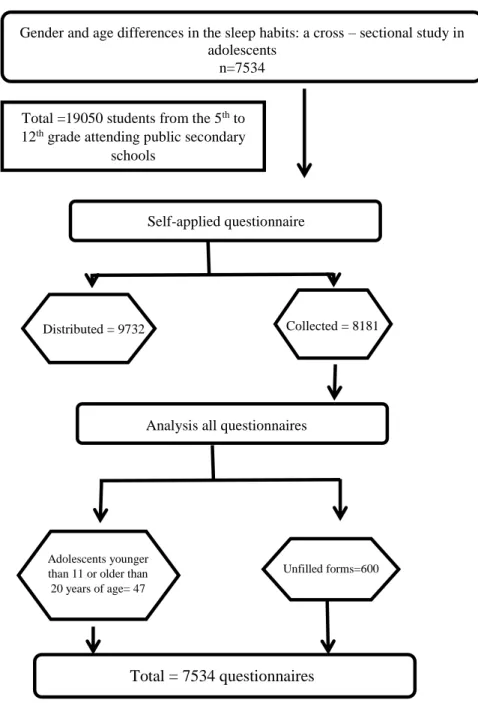
(63.6%) lived in rural areas and for assessing the parental education level, 11.8% had <4th years; 29.1% between 4-6 years; 47.4% between the 7–12 years and 11.7% of parents had a higher educational level. Students completed a self-administered questionnaire describing their sleep problems and patterns, along with sociodemographic information and daily activities. Study design (Figure 1) by self-administered questionnaire answered in the classroom.
Insomnia was assessed based on the presence of insomnia symptoms as defined by the Diagnostic and Statistical Manual of Mental Disorders IV criteria (difficulty in falling asleep, or frequent arousals with difficulty getting back to sleep, or early morning awakening and not being able to fall asleep again, or non-restoring sleep; these items refer to the previous month and with a frequency of at least three times per week) associated with daytime impairment. To assess sleep patterns questions regarding sleep duration on weeknights (bedtime and wake up time, average sleep length per night), the constancy of sleep habits and sleep onset latency were answered by the participants. A sleep length of at least 9h (≥ 9 hours) per night was considered “adequate sleep”, between 8 and 9 hours was considered “acceptable sleep” and < 8 hours “insufficient sleep”. The analysis and processing of data was accomplished using the Statistical
Package for the Social Sciences version 23 (SPSS 23.0). Prevalences were expressed in proportions, with the application of the respective 95% confidence interval (CI 95%).
Results
Overall, 20.6% (95%CI 19.3-21.7%) of the sample reported at least one insomnia symptom occurring at least three nights/week. The prevalence was higher among girls in comparison with boys (24.4% vs.15.4%, p<0.0001) and increased with age (p=0.002). Difficulty maintaining sleep at least three nights/week was the most prevalent symptom. Prevalence of difficulty initiating sleep (DIS) was 8.8%; early morning awakening (EMA) and difficulty in falling asleep again 7.7%; difficulty maintaining sleep (DMS) 15.9% and non-restorative sleep (NRS) 5.6%.
DSM-IV diagnoses insomnia disorder was found in 11.1% (95%CI 10.1-12.0%) of the sample; higher among females (14.5% vs. 6.3%; p <0.001) and increases with age (11-12 years 7.4%; 13-14 years 10.7%, 15-16 years 10.5% and ≥17 years 13.6%; p=0.004).
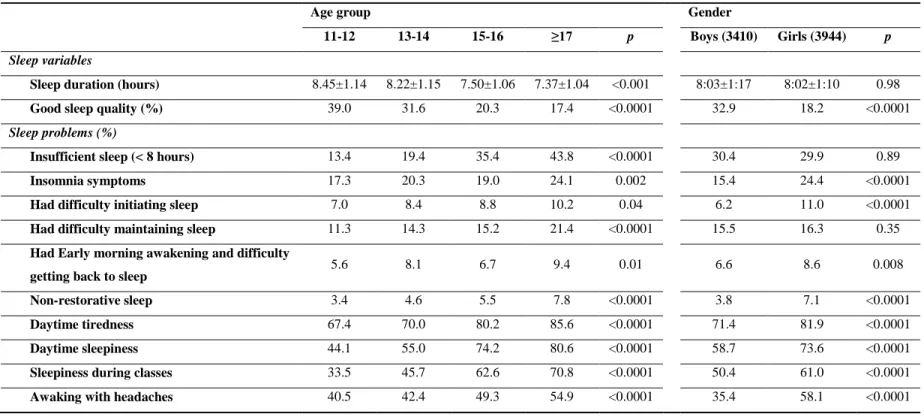
On average, the adolescents' overall sleep duration was 8.02±1.13 hours, with no differences for gender (boys 8.03±1.17 hours vs. girls 8:02±1.10 hours; p=0.98). Average sleep duration decreased across adolescence from 8:45±1.14 hours of sleep per night at age group 11-12 years; 8:22±1.15 hours at ages 13-14 years; 7:50±1.06 hours at 15-16 years and 7:37±1.04 hours at ≥ 17 years (p<0.001).
The percentage of individuals reporting short sleep duration, fewer than 8 hours per night, was 30.1%, the percentage of individuals reporting long sleep duration, longer than 9 hours per night, was 29.9% and "acceptable sleep", between 8 and 9 hours, was 39.9%.
On average adolescents take 21 minutes to fall asleep; 40.9% of adolescents reported that almost every night lies at the same time; 13.0% of adolescents reported that “almost every night” and 16.0% “every night” needed sleep more.
No gender differences in sleep duration during the weekdays were found, however, the duration of sleep decreases with age in both genders (Table 1). For sleep problems, the only difference detected among genders and that increases with age (higher among girls) was related with insomnia symptoms; difficulty initiating sleep; early-morning awakening, non-restoration sleep; daytime tiredness; sleepiness during daytime and in during classes and awaking with headaches.
Table 1 - Sleep variables and sleep problems by age group and gender, during weekdays
Age group Gender
11-12 13-14 15-16 ≥17 p Boys (3410) Girls (3944) p
Sleep variables
Sleep duration (hours) 8.45±1.14 8.22±1.15 7.50±1.06 7.37±1.04 <0.001 8:03±1:17 8:02±1:10 0.98
Good sleep quality (%) 39.0 31.6 20.3 17.4 <0.0001 32.9 18.2 <0.0001
Sleep problems (%)
Insufficient sleep (< 8 hours) 13.4 19.4 35.4 43.8 <0.0001 30.4 29.9 0.89
Insomnia symptoms 17.3 20.3 19.0 24.1 0.002 15.4 24.4 <0.0001
Had difficulty initiating sleep 7.0 8.4 8.8 10.2 0.04 6.2 11.0 <0.0001
Had difficulty maintaining sleep 11.3 14.3 15.2 21.4 <0.0001 15.5 16.3 0.35
Had Early morning awakening and difficulty
getting back to sleep 5.6 8.1 6.7 9.4 0.01 6.6 8.6 0.008
Non-restorative sleep 3.4 4.6 5.5 7.8 <0.0001 3.8 7.1 <0.0001
Daytime tiredness 67.4 70.0 80.2 85.6 <0.0001 71.4 81.9 <0.0001
Daytime sleepiness 44.1 55.0 74.2 80.6 <0.0001 58.7 73.6 <0.0001
Sleepiness during classes 33.5 45.7 62.6 70.8 <0.0001 50.4 61.0 <0.0001
Discussion
Sleep is a primary condition for the development of activities on a daily basis and is essential for the health and well-being of individuals, families and communities. Good sleep habits among children and adolescents are essential for their physical, cognitive, psychological development, and also for their quality of life and school performance. Profound changes in the sleep-wake regulation that occur in adolescence contribute to insufficient sleep, sleepiness daytime and others sleep disorders such as insomnia in adolescents with negative impacts on mood, concentration, school performance and quality of life20. Studies have shown that physiological and pathological states are affected by the circadian rhythm,
related with sleep disorders such as insomnia symptoms (difficulty falling asleep, non-restorative sleep, early morning awakening) shortened sleep duration, sleepiness, anxiety, tiredness and irritability21,22.
Therefore, bad sleeping habits lead to diverse and serious consequences in adolescent and family life. The main sleep problems have been documented as more prevalent among women and older adolescents - the women report considerably more sleep problems than men and and in adolescents increases with age.
In our study, the average sleep duration was 8 hours and the duration decreased during time, but with no significant differences between genders. Girls had more complaints related to sleep, more symptoms of insomnia, daytime tiredness, daytime and during classes sleepiness. The result is similar to those reported in other studies of school-aged children and adolescents, and most studies have reported differences between sleep duration and gender9,11,12,14,23. A study in California found that sleep duration
among adolescents decreased with age, with reductions in adolescents over the period of 8.5 hours per night at age 13, for 7.3 hours at the age of 18; males slept significantly longer than females in adolescence (7.8 versus 7.6 hours, respectively)10. In Germany, a study of adolescents aged 12 to 18, mentioned that, in
average, sleep duration during the week amounted to 8.04±0.89 h; sleep duration on school days decreased from an average 8.64±0.83 h for the age category 12-13 years to 7.83±0.72 h for students above 16 years and 91.6% of all students slept less than 9.2 hours per night during the week19. Another Spanish
study showed a difference in sleep duration between boys and girls and varied with age among the most older adolescents24. However, in other studies, the gender differences in sleep behaviors were either not
significant25 or in the opposite direction26.
The health and adolescent welfare are important concerns for companies and should be made constant efforts to reduce risk behaviors. Promote a healthy development of adolescents is an investment that all companies must implement. Adolescents spend a lot of time in school to get along with peers - constituting the school a perfect setting for promoting sleep hygiene, behaving bad sleep habits as an emerging public health problem. Childhood and adolescence are periods of the life cycle considered fundamental in adopting lifestyles and behavior patterns that affect health and currently the school curricula do not include sleep education. The integration of sleep education, at least sometime during the education cycle, will help students to adjust their sleep/wake cycles. According to the World Association
of Sleep Medicine - “Whereas, sleepiness and sleeplessness constitute a global epidemic that threatens health and quality of life; oh whereas, much can be done to prevent and treat sleepiness and sleeplessness; whereas, professional and public awareness are the firsts steps to action; we hereby DECLARE that the disorders of sleep are preventable and treatable medical conditions in every country of the world”27.
Limitations to take into account when interpreting our results include self-report data, which may be subject to recall bias; and there were other variables related to sleep that have not been studied.
Conclusions
We found significant differences between gender and age and analyzed sleep problems. There are gender differences in insomnia, insomnia symptoms, sleep quality and age differences in sleep problems (sleep duration, insomnia symptoms, daytime tiredness, headache upon awakening and sleepiness during classes and during daytime). The boys refer having better quality of sleep. The importance of sleep hygiene is observed, and most people know that the acquisition of a good night's sleep is essential for health and well-being, however, there are few individuals, especially children and adolescents, with parental control, who really do meet the recommended sleeping hours and put sleep on their daily priorities. It is necessary to promote good health habits to improve the health of adolescents. According with the slogan for World Sleep Day 2016 "Good Sleep is a Reachable Dream".
References
1. Brand S, Kirov R. Sleep and its importance in adolescence and in common adolescent somatic and psychiatric conditions. Int J Gen Med. 2011; 4:425–42.
2. Hirshkowitz M, Whiton K, Albert SM, Alessi C, Bruni O, DonCarlos L, et al. National Sleep Foundation’s sleep time duration recommendations: methodology and results summary. Sleep Health. 2015; 1:40-3. 3. Asarnow LD, McGlinchey E, Harvey AG. The effects of bedtime and sleep duration on academic and
emotional outcomes in a nationally representative sample of adolescents. J Adolesc Health. 2014; 54:350-6. 4. Cappuccio FP, D’Elia L, Strazzullo P, Miller MA. Sleep duration and all-cause mortality: a systematic
review and meta-analysis of prospective studies. Sleep. 2010; 33(5):585-92.
5. Gangwisch JE, Feskanich D, Malaspina D, Shen S, Forman JP. Sleep duration and risk for hypertension in women: results from the nurses’ health study. Am J Hypertens. 2013; 26(7):903-11.
6. Patel SR, Hu FB. Short sleep duration and weight gain: a systematic review. Obesity. 2008; 16(3):643-53. 7. McKnight-Eily LR, Eaton DK, Lowry R, Croft JB, Presley-Cantrell L, Perry GS. Relationships between
hours of sleep and health-risk behaviors in US adolescent students. Prev Med. 2011; 53(4–5):271-3. 8. Laberge L, Petit D, Simard C, Vitaro F, Tremblay RE, Montplaisir J. Development of sleep patterns in early
9. Tsai LL; Li SP. Sleep patterns in college students: gender and grade differences. J Psychosom Res. 2004; 56(2):231-7.
10. Maslowsky J, Ozer E. Developmental trends in sleep duration in adolescence and young adulthood: Evidence from a national US sample. J Adolesc Health. 2014; 54(6):691-7.
11. Silva A, Andersen ML, De Mello MT, Bittencourt LR, Peruzzo D, Tufik S. Gender and age differences in polysomnography findings and sleep complaints of patients referred to a sleep laboratory. Braz J Med Biol Res. 2008; 41(12):1067-75.
12. Ohayon MM, Sagales T. Prevalence of insomnia and sleep characteristics in the general population of Spain. Sleep Med. 2010; 11(10):1010-8.
13. Beck F1, Richard JB, Léger D. “[Insomnia and total sleep time in France: prevalence and associated socio-demographic factors in a general population survey]". Rev Neurol (Paris). 2013; 169(12):956-64.
14. Amaral MO, de Figueiredo Pereira CM, Silva Martins DI, de Serpa C do R, Sakellarides CT. Prevalence and risk factors for insomnia among Portuguese adolescents. Eur J Pediatr. 2013; 172(10):1305-11.
15. Mallampalli MP1, Carter CL. Exploring gender and gender differences in sleep health: a Society for Women's Health Research Report. J Womens Health (Larchmt). 2014; 23(7):553-62.
16. Natal CL, Lourenço TJ, Silva LA, Boscolo RA, Silva A, Tufik S, Mello MT. Gender differences in the sleep habits of 11-13 year olds. Rev Bras Psiquiatr. 2009; 31(4):358-61.
17. Amaral O, Garrido A, Pereira C, Veiga N, Serpa C, Sakellarides C. Sleep patterns and insomnia among portuguese adolescents: a cross-sectional study. Aten. Primaria. 2014; 46(Espec Cong 1):191-4.
18. Park YM, Matsumoto K, Shinkoda H, Nagashima H, Kang MJ, Seo YJ. Age and gender difference in habitual sleep-wake rhythm. Psychiatry Clin Neurosci. 2001; 55(3):201-2.
19. Loessl B, Valerius G, Kopasz M, Hornyak M, Riemann D, Voderholzer U. Are adolescents chronically sleep-deprived? An investigation of sleep habits of adolescents in the southwest of Germany. Child Care Health Dev. 2008; 34(5):549–56.
20. Owens J, Sdolescent Sleep Working Group, Committee on Adolescence. Insufficient Sleep in Adolescents and Young Adults: An Update on Causes and Consequences. Pediatrics. 2014; 134:e921-e32.
21. Ming X, Koransky R, Kang V, Buchman S, Sarris CE, Wagner GC. Sleep Insufficiency, Sleep health problems and performance in high school students. Clin Med Insights Circ Respir Pulm Med. 2011; 5:71-9. 22. Kang V, Shao J, Zhang K, Mulvey M, Ming X, Wagner GC. Sleep Deficiency and Sleep Health Problems
in Chinese AdolescentsClin Med Insights Pediatr. 2012; 6:11-17.
23. Wang G, Xu G, Liu Z, Lu N, Ma R, Zhang E. Sleep patterns and sleep disturbances among Chinese school-aged children: Prevalence and associated factors. Sleep Med. 2013; 14:45-52.
24. Ortega FB, Chillón P, Ruiz JR, Delgado M, Albers U, Alvarez-Granda JL, et al. Sleep patterns in Spanish adolescents: associations with TV watching and leisure-time physical activity. Eur J Appl Physiol. 2010; 110(3):563–73.
25. Zhang Z, Chen T, Jin X, Yan C, Shen X, Li S. Sleep Patterns, Sleep Problems and Associations with Reported Sleep Quality in Chinese School-Aged Children. Am J Public Health Res. 2013; 1(4): 93-100.
26. Biggs SN, Lushington K, James Martin A, van den Heuvel C, Declan Kennedy J. Gender, socioeconomic, and ethnic differences in sleep patterns in school-aged children. Sleep Med. 2013; 14(12):1304-9.
27. World Association of Sleep Medicine. World Sleep Day® 2016 Toolkit. Available in: http://www.sonnomed.it/wp-content/uploads/2014/02/PDF-1.pdf.
Conflict of interests
The authors declare that they have no competing interests.
Figure 1 - Study design
Gender and age differences in the sleep habits: a cross – sectional study in adolescents
n=7534
Self-applied questionnaire
Distributed = 9732
Analysis all questionnaires
Adolescents younger than 11 or older than 20 years of age= 47
Unfilled forms=600
Total = 7534 questionnaires
Collected = 8181
Total =19050 students from the 5th to
12th grade attending public secondary