Introduction
Multiple sclerosis (MS) is a chronic disease affecting young adults, particularly women in childbearing age. In Portugal, the estimated prevalence of MS is 46.3/100.000 [1,2]. In the past, women with MS were discouraged from becoming pregnant due to the possible negative effect of pregnancy on the course of the disease. In addition, the influence of the disease on the course and outcome of pregnancy (and vice versa) was also unknown for many years.
The Pregnancy in Multiple Sclerosis (PRIMS) study was the first prospective study to demon-strate a reduction in the relapse rate during preg-nancy, especially in the third trimester, and a sub-sequent increase in the first three months after de-livery [3]. Moreover, it showed that an increased relapse rate in the pre-pregnancy year and during pregnancy and a high Kurtzke’s Disability Status Scale score at the beginning of pregnancy were positively related to the occurrence of a relapse in the post-partum period [3]. Other retrospective
and prospective studies helped to reach the con-sensus that the relapse rate actually declines dur-ing pregnancy and increases in the first three months post-partum without greater future dis-ability [4-6]. Even though the most important risk factor for a relapse in the post-partum period is the number of relapses before and during pregnancy, additional risk factors, modifiable or not, need yet to be determined. Besides, as the relapse rate prior to pregnancy is nowadays decreased due to the use of immunomodulatory drugs, the relapse rate prior to pregnancy may not represent the activity of the disease [7].
MS treatment is based on immunomodulatory and immunosuppressive drugs, which have a high patient’s adequate adherence [8]. However, evi-dence of the safety of these drugs during pregnancy is still lacking [9]. The reduction in relapses during pregnancy is about the same obtained with the ex-isting drugs. Although women stop MS therapy during pregnancy, the disease is not expected to worsen [10].
Multiple sclerosis and motherhood choice:
an observational study in Portuguese women patients
Ana T. Carvalho, Andreia Veiga, Joana Morgado, Raquel Tojal, Sofia Rocha, José Vale, Maria José Sá, Ângela TimóteoNeurology Department; Centro Hospitalar Vila Nova de Gaia/Espinho; Vila Nova de Gaia (A.T. Carvalho). Neurology Department; Centro Hospitalar de Trás-os-Montes e Alto Douro; Vila Real (A. Veiga). Neurology Department; Centro Hospitalar de Lisboa Central; Lisboa (J. Morgado). Neurology Department; Hospital de Braga; Braga (S. Rocha). Neurology Department; Hospital Beatriz Ângelo; Loures (J. Vale). Neurology Department; Centro Hospitalar de São João; Porto (M.J. Sá). Neurology Department; Hospital Prof. Dr. Fernando Fonseca; Amadora, Portugal (R. Tojal, A. Timóteo). Corresponding author: Raquel Tojal MD. Neurology Department. Hospital Prof. Dr. Fernando Fonseca. IC19. 2720-276 Amadora (Portugal). E-mail:
[email protected] Note:
The first five authors contributed equally to this work. Conflicts of interest: None of the authors has any conflict of interest to disclose. Financial support of Biogen Idec. Acknowledgements: Forpoint (Instituto de Formação e Inovação na Saúde from Keypoint Group), for statistical assistance. Accepted:
01.10.14.
How to cite this paper: Carvalho AT, Veiga A, Morgado J, Tojal R, Rocha S, Vale J, et al. Multiple sclerosis and motherhood choice: an observational study in Portuguese women patients. Rev Neurol 2014; 59: 537-42. Versión española disponible en www.neurologia.com © 2014 Revista de Neurología
Introduction. Multiple sclerosis (MS) is a disabling disease occurring mainly in women of childbearing age. MS may interfere
with family planning and motherhood decision.
Aim. To study the influence of MS diagnosis and course of the disease on motherhood decision.
Patients and methods. The cohort of 35 to 45-year-old female patients diagnosed with MS for at least ten years was
selected from six Portuguese MS centers. A structured questionnaire was applied to all patients in consecutive consultation days. Clinical records were reviewed to characterize and collect information about the disease and pregnancies.
Results. One hundred women were included; mean age at MS diagnosis was 26.3 ± 5.0 years; 90% of the participants
presented with a relapsing-remitting MS; 57% had no pregnancies after the diagnosis. MS type and number of relapses were not significantly different between women with or without pregnancies after the diagnosis (p = 0.39 and p = 0.50, respectively). Seventy-seven percent of the patients did not have the intended number of pregnancies. Main reasons given were fear of future disability and the possibility of having relapses. Forty-three women considered that pregnancy might worsen MS.
Conclusion. In our population, motherhood choice was unrelated to the MS type and the number of relapses. However, a
relevant number of women had fewer pregnancies than those intended before MS diagnosis and believed that pregnancy could worsen the disease. An effort to better inform the patients should be made to minimize the impact of MS diagnosis on motherhood decision.
Concerning obstetric and neonatal characteris-tics, no major complications have been described in women with MS [9,11]. In delivery there were reports of an increase of cesarean labor and in-strumental labor (caused by a prolonged second stage) but without further complications. In neo-nates although a higher percentage of low birth weight was observed no major differences were found in Apgar scores, birth defects or birth mor-tality [9].
As a chronic and disabling disease, MS might have an impact on family planning, especially with respect to the motherhood decision of female pa-tients. However, the literature about this topic is scarce. Few descriptive studies tried to identify the main concerns of women with MS when consider-ing motherhood decision. Uncertainty about the course of MS, the effect of pregnancy on the dis-ease course and conflicting advice were some of the concerns identified [12-14]. A recently published Canadian study concluded that the most common MS-related reasons for not becoming pregnant were: symptoms interfering with parenting, fear of burdening the partner or fear of children inheriting MS [15]. There was also evidence that women needed more information about the effect of MS on pregnancy and the effect of pregnancy on the pro-gression of MS [13].
The aim of this study was to document the influ-ence of MS diagnosis and course of the disease on motherhood decision in a population of Portuguese female patients with MS, which is an issue scarcely addressed in the literature.
Patients and methods
We conducted an observational multicentre study in women with MS, involving six hospital MS cen-ters that cover a large geographic area of Portugal, in 2012. The recruitment took place in consecutive MS consultation days, during 3 months (May to July 2012).
The population of the study was selected accord-ing to the followaccord-ing inclusion criteria: age between 35 and 45 years; diagnosis of definite MS for at least 10 years according to the revised McDonald crite-ria from 2005 [16]. Women with co-morbidities im-posing additional disability, those taking chronic treatments with teratogenic potential and those who were hysterectomized were excluded from the study. All patients gave written informed consent after the approval by the Ethics Committees, Boards of the participating centres and National Commis-sion for Data Protection was obtained.
A standardized questionnaire including social and demographic data (date of birth, marital status,
Table I. Characteristics of the first pregnancy after MS diagnosis.
Total n
Woman’s age 29.6 ± 4.4 years 43
Intended pregnancy 88% (n = 38) 43
Pregnancy outcome
Childbirth 93% (n = 40)
43 Miscarriage 7% (n = 3)
Number of relapses before pregnancy (median) 2 (range: 0-35) 41 a
Number of relapses during pregnancy (median) 0 (range: 0-0) 42 a
Number of relapses after pregnancy (median) 0 (range: 0-2) 40 a
Women’s opposing to the attending physician
in terms of medication use in this period 7% (n = 3) 43
Breastfeeding 72% (n = 29) 40 a
Number of relapses during breastfeeding (median) 0 (range: 0-2) 29
a Missing data for respectively two, one and three women.
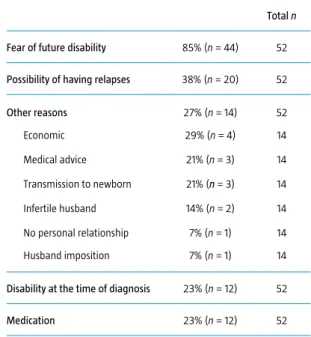
Table II. Reasons given for the decrease in the number of pregnancies
after MS diagnosis.
Total n Fear of future disability 85% (n = 44) 52 Possibility of having relapses 38% (n = 20) 52 Other reasons 27% (n = 14) 52 Economic 29% (n = 4) 14 Medical advice 21% (n = 3) 14 Transmission to newborn 21% (n = 3) 14 Infertile husband 14% (n = 2) 14 No personal relationship 7% (n = 1) 14 Husband imposition 7% (n = 1) 14 Disability at the time of diagnosis 23% (n = 12) 52 Medication 23% (n = 12) 52
educational level and employment status), medical past conditions, MS data (year of clinical onset and definite diagnosis, clinical form, prior and current treatments, number of relapses, relapses occurring during the pregnancies and progression of the dis-ease) and reproductive history (intended and actu-ally occurred pregnancies before and after MS di-agnosis, specific pregnancies data and type of deliv-ery) was applied to all patients.
From patients’ answers and clinical records, the authors retrospectively filled out electronic data-collection forms. Data were anonymously trans-ferred to the database to safeguard the privacy of the patients.
Descriptive statistics were calculated for patient data (mean ± standard deviation, minimum, medi-an, maximum for continuous variables, and percent-ages for categorical variables). Variables were com-pared using the Mann-Whitney and the Chi-square test as appropriate, and statistical significance was set at p < 0.05. Analysis was performed using SPSS software, version 15.0.
Results
Demographics and MS history
The sample was composed by 100 women with MS, evenly recruited in the participating hospitals. The mean age was 40.0 ± 3.3 years and the mean num-ber of school-attended-years was 12.0 ± 4.4. The majority of women was married (61%) and em-ployed (52%). Mean age at the time of MS diagnosis was 26.3 ± 5.0 years. Ninety percent of patients pre-sented a relapsing-remitting MS, 8% had secondary progressive course and 2% suffered from primary progressive MS. The total number of relapses the year before pregnancy was quite variable, with a median of two.
Reproductive history
At the time of MS diagnosis, 57% of women had never been pregnant and 28% had already had the intended number of children. Before MS diagnosis, 62% of women had no children, 28% had already had one child, 8% had had two children and 2% had had three children. Fifty-seven percent of the par-ticipants had no pregnancies after MS diagnosis, 31% had one pregnancy, 11% had two and one per-cent had three pregnancies. Seven perper-cent tried to get pregnant and stopped the MS medication with-out the physician’s knowledge (in most situations
the women and the physicians discussed if the medi-cation should be stopped or changed).
The characteristics of the first pregnancy after MS diagnosis are described in table I. Other preg-nancies are not presented because no relevant dif-ferences between them and the first pregnancy were observed. We perceived that 93% of the preg-nancies were well succeeded (7% had spontaneous miscarriages, which is a smaller prevalence than that of the general population). We also found that during pregnancy no relapses occurred and in the three months post-partum most of the women were relapse-free.
For the women who breastfed (72%) no additional co-morbidity, namely relapses, was observed dur-ing this period.
History of motherhood decision
Seventy-seven percent of the patients (53 out of 69 patients) reported that the number of intended pregnancies changed after MS diagnosis (28 women who had already had the intended number of preg-nancies before diagnosis and 3 who did not answer were excluded from this analysis). Among these 77% of patients, the number of intended pregnancies de-creased in 98% and inde-creased in 2% (one patient). Concerning this matter, we decided to place these women in two different groups, according to their academic qualifications: in one group women had attended school less than nine years and in the other group women had studied more than nine years. There were no significant statistical differences be-tween them (p = 0.26), both groups showing a de-crease in the number of intended pregnancies.
The main reasons presented for having fewer pregnancies than previously planned were fear of future disability and the possibility of having re-lapses (Table II).
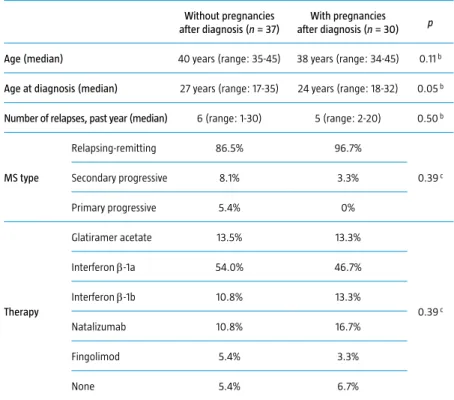
The number of relapses, MS type and therapies used were not significantly different between wom-en with or without pregnancies after MS diagnosis (Table III).
When asked about the impact of MS on preg-nancy, 81% of the patients considered that MS does not affect pregnancy; 70% thought that it does not affect childbirth; 80% believed that the disease causes no fetal malformations. Despite the fact that most considered that MS has no effect on pregnan-cy and pregnanpregnan-cy does not influence the disease course, still 43% of participants believed that preg-nancy might worsen the disease.
Among women who got pregnant after MS diag-nosis, 35% decided to delay the pregnancy due to
the disease and its possible consequences, namely due to fear of future disability.
Discussion
Motherhood decision in patients with MS is scarce-ly addressed in the literature, despite the higher fre-quency of this disease in childbearing age females. On the other hand, although in the last few years a lot of information has been gathered about MS pathophysiology and clinical course, patients still have many doubts concerning pregnancy, breast-feeding, and their impact in the disease course.
To the best of our knowledge this is the first ob-servational study that addresses the impact of MS on motherhood choice and family planning in fe-male patients, in Europe.
Our sample may be considered to be representa-tive of the female Portuguese MS population, be-cause we included MS women from different re-gions of the country, with different levels of educa-tion and distinct economic and marital status. We decided to study only female patients aged 35 to 45
years and with at least ten years of MS diagnosis, taking into account that women with that age-span would have already had the possibility to become pregnant and could also have enough years of dis-ease evolution, thus being able to have a better con-cept of the present and future burden that the dis-ease might have upon their lives.
Our study showed that a large percentage of women (77%) changed the number of intended pregnancies (decided to have fewer children) after MS diagnosis. Although not statistically significant, these results suggest important implications of the disease on motherhood decision as well as an im-pact of diagnosis in these women life planning.
The main reasons pointed out for having fewer children are the possibility of having relapses and fear of future disability. These results don’t fit those recently reported by Alwan et al who concluded that the most common MS-related reasons for not becoming pregnant are: symptoms interfering with parenting, fear of burdening the partner or fear of children inheriting MS [15]. This may be explained by epidemiological and cultural differences between Canadian and Portuguese populations. Furthermore, Alwan et al study lacked data on the subtypes of MS, disease duration and disease severity. Also, there was a broad spectrum of age of the patients included, therefore becoming a very heterogeneous group of study. However, both studies denoted a fear about the future.
Borisow et al stated that psychological factors should not be underestimated in family planning, especially in sexual contacts because factors like bladder or bowel dysfunction, inserted catheters, or fear of partner disapproval are relevant features that contribute to diminished sexual interest [14]. Although we did not study these particular issues we consider them to be of special importance.
Our results are in accordance with those previ-ously reported by Twork et al who found no differ-ences regarding demographic data between female patients having children and childless MS women, namely in what concerns academic qualifications, addressed in our study [17]. However, in opposition to our results, Twork et al also found these women to be more commonly on a relationship and unem-ployed. It has been shown that there are some dif-ferences in living conditions, quality of life and cop-ing behavior between mothers and childless women with MS, but not enough to confirm the hypothesis that a better quality of life and coping behavior would be visible in MS mothers.
Regarding MS history in the group with chil-dren, we found that the number of pregnancies
af-Table III. Comparison of having or not having pregnancies after MS diagnosis a.
Without pregnancies after diagnosis (n = 37)
With pregnancies after diagnosis (n = 30) p Age (median) 40 years (range: 35-45) 38 years (range: 34-45) 0.11 b
Age at diagnosis (median) 27 years (range: 17-35) 24 years (range: 18-32) 0.05 b
Number of relapses, past year (median) 6 (range: 1-30) 5 (range: 2-20) 0.50 b
MS type Relapsing-remitting 86.5% 96.7% 0.39 c Secondary progressive 8.1% 3.3% Primary progressive 5.4% 0% Therapy Glatiramer acetate 13.5% 13.3% 0.39 c Interferon β-1a 54.0% 46.7% Interferon β-1b 10.8% 13.3% Natalizumab 10.8% 16.7% Fingolimod 5.4% 3.3% None 5.4% 6.7%
a 28 women that already had the intended children at the time of diagnosis and 5 with not planned pregnancies
ter the diagnosis does not correlate with type of disease, number of relapses or immunomodulating therapies. Moreover, 35% of women who decided to get pregnant after MS diagnosis delayed this de-cision because of the disease itself. In this popula-tion, pregnancies and deliveries after MS diagnosis were devoid of complications and the majority of patients decided to breastfeed, in accordance to what is described in the literature.
Our study revealed that patients in general have the knowledge that MS does not influence preg-nancy, delivery and newborn development. These results are in consonance with those of Albrecht et al [18]. However, an important number of patients still believe that pregnancy is harmful to MS and worsens the prognosis of the disease. In fact, nowa-days information is easily available worldwide but this does not mean that patients are fully aware of the implications of the disease or understand the information that is being given to them.
Concerning breastfeeding, the main question in deciding whether or not to breastfeed is the fear of postpartum relapses that has been described to be higher in this period. Therefore many MS women decide not to breastfeed in order to initiate immu-nomodulating therapies to avoid postpartum re-lapses. This fact may explain why so many patients still believe that pregnancy worsens the disease. In a recent study it was concluded that exclusive breastfeeding, due to the consequent hormonal pattern that ensues, has a protective effect in de-creasing the number of relapses [7]. However, there are no guidelines regarding this subject and the op-tions should be discussed case by case.
The main limitation of our study is the possible memory bias, as not only a transversal but also a ret-rospective collection of data was done. Our sample size limits statistical analysis, but a possible explana-tion for that was our age-span inclusion criterion.
The present study discloses the need of a general effort to inform MS women in order to reduce the negative impact of MS diagnosis on reproductive issues. We believe that it is essential not to discour-age pregnancy in these patients and to accurately inform them. Risks and benefits of breastfeeding should also be discussed with the patients, as well as the concern of concomitantly resuming or not MS therapies. We also believe that prevention of
postpartum relapses poses a challenge for the fu-ture: a decrease in relapse rate in this period could increase the confidence of MS women and encour-age them to fulfill their desire to have a family. References
1. De Sá J, Paulos A. The prevalence of multiple sclerosis in the district of Santarém, Portugal. J Neurol 2006; 253: 914-8. 2. De Sá J. Epidemiología de la esclerosis múltiple en Portugal
y España. Rev Neurol 2010; 51: 387-92.
3. Confavreux C, Hutchinson M, Hours MM, Cortinovis-Tourniaire P, Moreau T. Rate of pregnancy-related relapse in multiple sclerosis. Pregnancy in Multiple Sclerosis Group. N Engl J Med 1998; 339: 285-91.
4. Vukusic S, Hutchinson M, Hours M, Moreau T, Cortinovis-Tourniaire P, Adeleine P, et al. Pregnancy and multiple sclerosis (the PRIMS study): clinical predictors of post-partum relapse. Brain. 2004; 127: 1353-60.
5. Frith JA, McLeod JG. Pregnancy and multiple sclerosis.
J Neurol Neurosurg Psychiatry 1988; 51: 495-8. 6. Roullet E, Verdier-Taillefer MH, Amarenco P, Gharbi G,
Alperovitch A, Marteau R. Pregnancy and multiple sclerosis: a longitudinal study of 125 remittent patients. J Neurol Neurosurg Psychiatry 1993; 56: 1062-5.
7. Langer-Gould A, Beaber BE. Effects of pregnancy and breastfeeding on the multiple sclerosis disease course. Clin Immunol 2013; 149: 244-50.
8. López-Mendez P, Río J, Pérez-Ricart A, Tintoré M, Sastre- Garriga J, Cardona-Pascual I, Gómez-Domingo MR, et al. Adhesión terapéutica a tratamiento inmunomodulador de pacientes con esclerosis múltiple. Rev Neurol 2013; 56: 8-12. 9. Lee M, O’Brien P. Pregnancy and multiple sclerosis. J Neurol
Neurosurg Psychiatry 2008; 79: 1308-11.
10. Tsui A, Lee M. Multiple sclerosis and pregnancy. Curr Opin Obstet Gynecol 2011; 23: 435-9.
11. Finkelsztegn A, Brooks JBB, Paschoal FM Jr, Fragoso YD. What can we really tell women with multiple sclerosis regarding their pregnancy? A systematic review and meta-analysis of the literature. BJOG 2011; 118: 790-7.
12. Smeltzer SC. Reproductive decision making in women with multiple sclerosis. J Neurosci Nurs 2002; 34: 145-57. 13. Prunty M, Sharpe L, Butow P, Fulcher G. The motherhood
choice: themes arising in the decision-making process for women with multiple sclerosis. Mult Scler 2008; 14: 701-4. 14. Borisow N, Doring A, Pfueller CF, Paul F, Dorr J, Hellwig K.
Expert recommendations to personalization of medical approaches in treatment of multiple sclerosis: an overview of family planning and pregnancy. EPMA J 2012; 3: 9. 15. Alwan S, Yee IM, Dybalski M, Guimond C, Dwosh E,
Greenwood TM, et al. Reproductive decision making after the diagnosis of multiple sclerosis. Mult Scler 2013; 19: 351-8. 16. Polman C, Reingold S, Edan G, Filippi M, Hartung HP, Kappos L,
et al. Diagnostic criteria for multiple sclerosis: 2005 revisions to the ‘McDonald Criteria’. Ann Neurol 2005; 58: 840-6. 17. Twork S, Wirtz M, Schipper S, Klewer J, Bergmann A,
Kugler J. Chronical illness and maternity: life conditions, quality of life and coping in women with multiple sclerosis. Qual Life Res 2007; 16: 1587-94.
18. Albrecht P, Fischer D, Moser A. Multiple sclerosis and pregnancy: what does the patient think? A questionnaire study. BMC Res Notes 2010; 3: 91.
Esclerosis múltiple y decisión de la maternidad: estudio observacional en pacientes portuguesas
Introducción. La esclerosis múltiple (EM) es una enfermedad incapacitante que afecta mayoritariamente a mujeres en
edad fértil. La EM puede alterar el deseo de crear una familia y concebir hijos.
Objetivo. Estudiar la influencia del diagnóstico de la EM y de su evolución sobre la decisión de ser madre.
Pacientes y métodos. Se seleccionó una cohorte integrada por pacientes de 35-45 años diagnosticadas de EM desde hacía
por lo menos 10 años que eran atendidas en seis centros portugueses. Las participantes respondieron a un cuestionario estructurado en días de consulta consecutivos. Se revisaron las historias clínicas para caracterizar y recabar información sobre la enfermedad y los embarazos.
Resultados. Participaron 100 mujeres; la media de edad en el momento del diagnóstico de la EM era de 26,3 ± 5,0 años;
el 90% de las participantes presentaba la forma remitente recurrente; el 57% de las pacientes no se habían quedado embarazadas después del diagnóstico. El tipo de EM y el número de recidivas no difirieron de manera significativa entre las mujeres que habían concebido después del diagnóstico y las que no (p = 0,39 y p = 0,50, respectivamente). El 77% no había tenido el número de hijos deseado. Los principales motivos aducidos fueron el temor a la incapacidad futura y la posibilidad de sufrir recidivas. Cuarenta y tres mujeres creían que el embarazo podía agravar la EM.
Conclusión. En la población del estudio, la decisión de ser o no ser madre no guardó relación con el tipo de EM ni con el
número de recidivas. No obstante, un número relevante de mujeres tuvieron menos embarazos de los que habían desea-do antes de ser diagnosticadas y pensaban que la gestación podía empeorar la enfermedad. Sería conveniente mejorar la información que reciben estas pacientes a fin de minimizar el impacto del diagnóstico de la EM en la decisión de ser madre.