ISSN: 2182-1054
DOI :
10.7455/ijfs/3.2.2014.a1
Copyright Notice
Authors who publish in the International Journal of Food Studies agree to the following terms:
Authors retain copyright and grant the journal right of first publication with the work simultaneously licensed under a Creative Commons Attribution License that allows others to share the work with an acknowledgement of the work's authorship and initial publication in this journal.
Authors are able to enter into separate, additional contractual arrangements for the non-exclusive distribution of the journal's published version of the work (e.g., post it to an institutional repository or publish it in a book), with an acknowledgement of its initial publication in this journal.
Authors are permitted and encouraged to post their work online (e.g., in institutional repositories or on their website) prior to and during the submission process, as it can lead to productive exchanges, as well as earlier and greater citation of published work.
PhD Competences in Food Studies
International Journal
of Food Studies
PhD Competences in Food Studies
Chelo Gonzalez-Martinez
a*, Cristina L.M. Silva
b, and Rui Costa
caFood Technology Department, Universitat Politecnica de Valencia, Camino de vera s/n, 46022, Valencia,
Spain
bCBQF - Centro de Biotecnologia e Qu´ımica Fina, Escola Superior de Biotecnologia, Centro Regional do Porto
da Universidade Cat´olica Portuguesa, Rua Dr. Ant´onio Bernardino de Almeida, 4200-072 Porto, Portugal
cInstituto Polit´ecnico de Coimbra, Escola Superior Agr´aria, Bencanta, 3040-316 Coimbra, Portugal *
Corresponding author [email protected] Tel: + 34 96 387 70 00 Fax: + 34 96 387 76 35
Received: 6 September 2013; Published online: 18 October 2014
Abstract
In European Higher Education, learning outcomes and competences have been used sometimes with different meanings and sometimes with the same meaning. But both terms have been more commonly used to refer to knowledge, understanding and abilities a student must demonstrate at the end of a learning experience. Their use is a consequence of the paradigm shift of the Bologna Process to a learner centered education environment. The definition of standards of competences (or learning outcomes) for the PhD degree is thus a need for the quality assurance of this degree. In this work, subject-specific and generic competences for the PhD in Food Science and Technology and their alignment with the European Qualifications Framework (EQF) level descriptors for quality assurance purposes have been identified.
Keywords: Third cycle studies; Skills; Generic competences; Specific competences; European Quali-fications Framework
1
Introduction
In the last few years, international trends in education have shown a shift from the tradi-tional “teacher-centered” approach to a more “student-centered” approach. While tradition-ally the focus was on what the teacher did, in recent years the focus has been on what students have learnt and can demonstrate at the end of a module or programme. To this aim, all modules and programmes in third level institutions throughout the European Higher Education Area should be (re)written in terms of learning outcomes (Kennedy, Hyland, & Ryan, 2006). In European Higher Education, learning outcomes and competences have been
used sometimes with different meanings and sometimes with the same meaning, but both terms have been more commonly used to refer to written statements of what the successful student/learner is expected to be able to do at the end of the module/course unit or qualifi-cation (Adam, 2004). These competences or outcomes are usually expressed as knowledge, skills or attitudes (Kennedy et al., 2006). In this work, the term “competence” represents a combination of attributes in terms of knowledge and its application, skills, responsibilities and attitudes.
The most common form of doctorate programme is still based largely on a supervised research project over three to five years during which
PhD competences 137
the candidate is registered at a higher education institution. All doctoral candidates are required to make an original contribution to knowledge by conducting an independent research project. More recently, there has been a greater emphasis on personal and professional development in PhD programs, which has led to increasingly structured programs that include both research and transferable skills training. Acquisition of these skills, together with evaluation of the candidate’s discipline specific research skills, is generally monitored or assessed through annual progress reviews. Whether or not the structured elements are formally assessed, examination of the research degree itself focuses on the quality of the candidate´s thesis or equivalent and his/her defence of it at the viva voce. Individual institutions specify entry requirements for doctoral degrees, this usually being a master’s degree. Related to the funding structures used by some research councils, most of the doctoral degrees are structured around a 1+3 model, with candidates completing a taught master’s programme before embarking on doctoral stud-ies. Some candidates are able to enter doctoral programs on the basis of their prior professional knowledge and experience (QAA,2011).
Doctoral training must remain clearly distinct from the first and second cycles of higher educa-tion in the Bologna Process. Quality assurance of doctoral training should be embedded in the regular research assessment of research degree awarding institutions (LERU,2007). The definition of standards of competences for the PhD is thus needed for the quality assurance of this degree. The main key characteristics of outcome-based education have been listed by Harden (2002):
• The development of clearly defined and published learning outcomes that must be achieved before the end of the programme; • The design of a curriculum, learning
strate-gies and learning opportunities to ensure the achievement of the learning outcome; • An assessment process matched to the
learn-ing outcomes and the assessment of
individ-ual students to ensure that they achieve the outcomes.
When writing learning outcomes, it is important to write them in such a way that they are capa-ble of being assessed. Clearly, it is necessary to have some form of assessment tool or technique in order to determine the extent to which learn-ing outcomes have been achieved.
The definition of competences of the PhD de-gree must take into account the future needs of the society. Universities often believe that academia is still the most valuable calling for their PhD graduates, but this is not true any-more as has been concluded in several studies carried out recently by Fiske (2011) and Cyra-noski, Gilbert, Ledford, Nayar, and Yahia (2011). In fact, few PhD graduates in science (under 6% in Germany) eventually go into full-time demic positions in Europe as the number of aca-demic positions have stagnated or declined in most European countries. Moreover, many doc-toral programmes do not adequately serve stu-dents as they are over specialized, with curric-ula fragmented and increasingly irrelevant to the world beyond academia (food industry, consul-tancy, governmental organizations, non-profit or-ganizations, research centres, consumer associa-tions . . . ). Expertise, of course, is essential to the advancement of knowledge and to society but in too many cases, specialization has led to re-search areas so narrow that they are of interest only to other people working in the same fields, subfields or sub-subfields. Additionally many re-searchers struggle to talk to colleagues in the same department, and communication across de-partments and disciplines may be very difficult (Taylor,2011).
Expanding the PhD experience and preparing holders of scientific doctorates to be successful in a range of careers should be the main goal of academia. PhD graduates must have qualities attractive not only in academia but also outside, in both manufacturing and service-oriented en-terprises, in small innovative companies, in the civil services and public administration, among others (LERU,2007). Focused seminars in areas as communication, business basic and public pol-icy would go a long way towards strengthening the capabilities of PhD students and improving IJFS October 2014 Volume 3 pages 136–144
their career prospects (Fiske, 2011). This needs the creation of new models for PhD programmes that have to be developed urgently.
The aim of this work, in the framework of the ISEKI Food 3 European project ( www.iseki-food.eu), was to develop a list of competences for a third cycle level related to Food Studies. To this aim, a study on the tuning of PhD studies has been carried out through the identification of subject and generic competences, their align-ment with the European Qualifications Frame-work level descriptors, access arrangements, su-pervision and assessment procedures.
2
Methodology
In the first phase of the study, the ISEKI Food 3 project coordinators reviewed the various stud-ies, reports and sources of information on doc-toral competences in Food Studies, both at the European and national levels. This work involved the participation of 94 institutions (mainly higher education institutions) from 30 European countries. During the course of sev-eral meetings, the Steering Committee, together with the coordinators, took the opportunity to seek clarifications and engage in discussion on the preliminary results.
After the review process and feedback received from the different meetings, the work was finally organized by taking into account seven groups of outcomes. These outcomes dealt with both the research activities and with the transferable skills (generic competences). In the last step, a final report was prepared and made available from the web pages of the project ( www.iseki-food.eu/deliverables iseki food3).
3
Results
3.1
PhD competences of Food
Studies
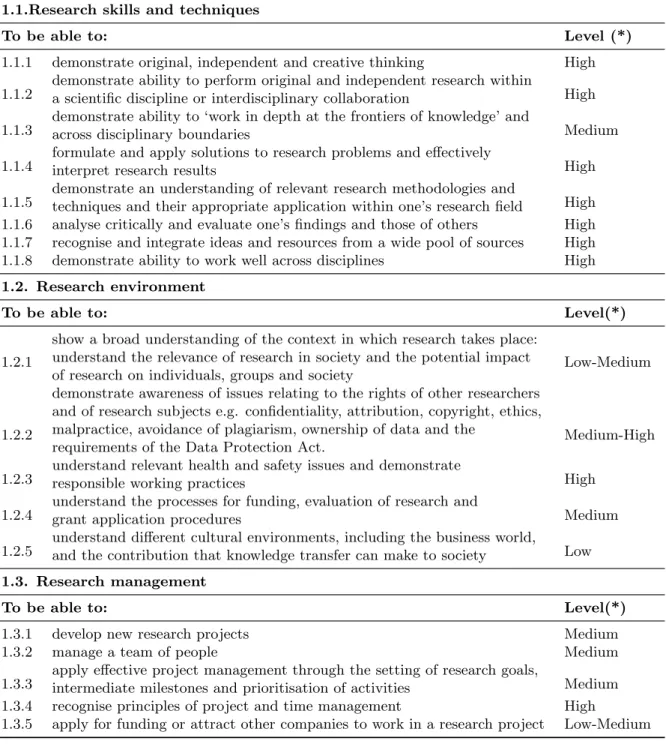
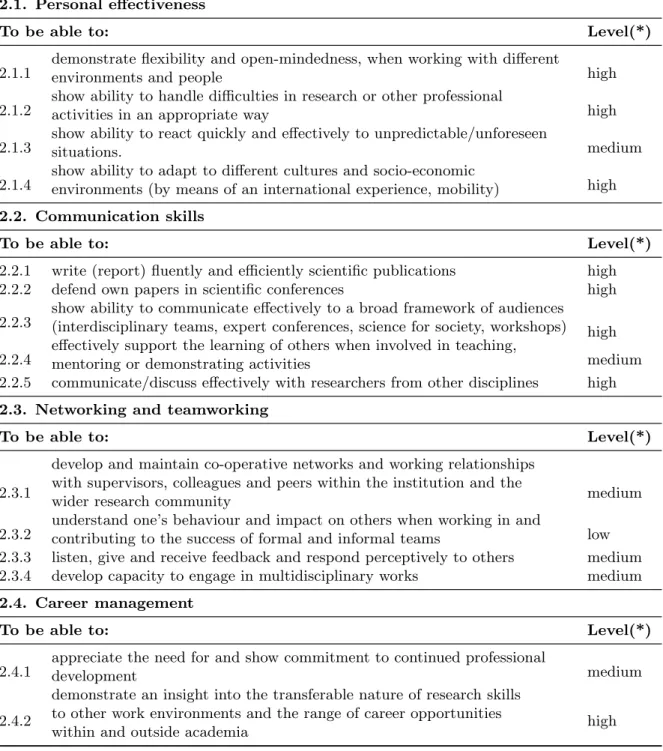
The subject-specific competences comprised research techniques, environment and manage-ment and are listed in Table 1. The generic competences comprised personal effectiveness, communication skills, networking and team working and career management and are listed
in Table2.
In food studies, the PhD student must develop subject-specific competences directly related with the topic of the studies, the core com-petences of the degree, that are characteristic of the student’s capability of working at the frontiers of science. The competences related to research environment are essential to the student’s coexistence in the research groups with which he/she is involved in order to avoid conflicts and the management of research competences assures the student’s autonomy in future research activities. The generic skills listed in Table 3 strengthen the integration in the research environment and the autonomy in future research development.
As there is always the danger of being over-ambitious when writing competences, in this document a desirable level of achievement (low, medium, high) of each outcome has been established (Tables1 and2).
Most of the competences described can be achieved and/or evaluated by measuring differ-ent items such as:
• Productivity of the PhD student in terms of number of publications of publishable qual-ity which would satisfy peer review;
• Oral presentations given in scientific con-ferences, workshops and commercial trades in both national and international events to promote the use of different languages; • Structured courses outside the lab, including
classes in management, communication and other transferable skills;
• Promoting and evaluating the participation of the PhD student in teaching activities; • Favouring the exchange and collaboration
with other labs (i.e. in other countries); • Promoting highly interdisciplinary projects; • Promoting supervisors from a range of
dis-ciplines;
• Promoting opportunity for PhD students to supervise Bachelor’s or Master’s theses;
PhD competences 139
• Promoting opportunities for PhD students to integrate project application in experi-enced teams;
• Favouring the evaluation of the progress in his/her research (together with a mentor, a professor).
3.2
Alignment of PhD
competences with the
European Qualifications
Frameworks level descriptors
The EQF is a common European reference framework which links countries’ qualifications systems together, acting as a translation device to make qualifications more readable and un-derstandable across different countries and sys-tems in Europe. The qualifications framework includes descriptors for each level of qualifica-tions (European Commission,2008).In 2005, the qualifications framework for the Eu-ropean Higher Education Area defined six de-scriptors for the third cycle (PhD; see Table
3) (Ministry of Science, Technology and Inno-vation, 2005). In 2008, the European Parlia-ment officially recommended the establishParlia-ment of the European Qualifications Framework for lifelong learning (LLL) in the EU. This frame-work presents three descriptors for the 8th level (PhD; see Table 4). (European Commission, 2008).
Any quality assurance system related to the third cycle must use these descriptors as guidelines for the evaluation of the achievements of the respec-tive programs being evaluated.
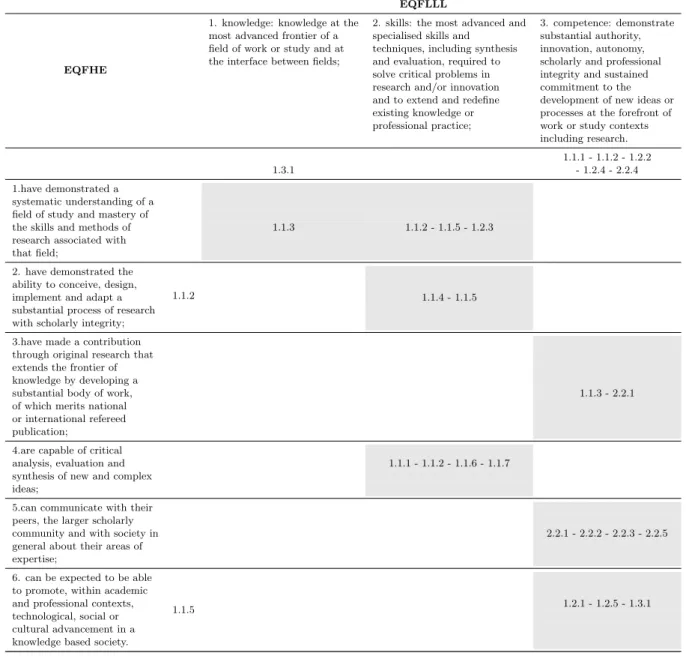
Every descriptor of both frameworks has some correspondence(s) with the PhD competences for food studies here defined (see Table5). However, some competences for food studies define topics that do not find correspondence with the descrip-tors, particularly:
1.1.8: demonstrate ability to work well across disciplines.
1.3.2, 1.3.3, 1.3.4, 1.3.5: manage a team of peo-ple, apply effective project management through the setting of research goals, intermediate mile-stones and prioritization of activities, recognise principles of project and time management,
ap-ply for funding or attract other companies to work in a research project.
2.1.1, 2.1.2, 2.1.3, 2.1.4: demonstrate flexi-bility and open-mindedness, when working with different environments and people, show ability to handle difficulties in research or other pro-fessional activities in an appropriate way, show ability to react quickly and effectively to unpre-dictable/unforeseen situations, show ability to adapt to different cultures and socio-economic environments.
2.3.1, 2.3.2, 2.3.3, 2.3.4: develop and maintain co-operative networks and working relationships with supervisors, colleagues and peers within the institution and the wider research community, understand one’s behaviour and impact on oth-ers when working in and contributing to the suc-cess of formal and informal teams, listen, give and receive feedback and respond perceptively to others, develop capacity to engage in multi-disciplinary works.
2.4.1, 2.4.2: appreciate the need for and show commitment to continued professional develop-ment, demonstrate an insight into the transfer-able nature of research skills to other work envi-ronments and the range of career opportunities within and outside academia.
These competences are almost exclusively on re-search management, personal effectiveness, net-working and team net-working and career manage-ment. The derivation of the definitions of compe-tences from the descriptors was expected, since the descriptors defined the level of every PhD study of every subject and thus are more gen-eral and define the common denominator to all knowledge areas and the minimum to distinguish the various levels of qualifications. Subject spe-cific competences are, by definition, more spespe-cific to the particular PhD it is referred to.
4
Conclusion
The results of the present work can be used in the future for Quality Assurance standards of Euro-pean PhD Food Studies, not only as a pillar to set the basis of the future PhD programs, but also to modify and to improve present PhD studies. IJFS October 2014 Volume 3 pages 136–144
Table 1: Specific competences for PhD food studies1
1.1.Research skills and techniques
To be able to: Level (*)
1.1.1 demonstrate original, independent and creative thinking High 1.1.2
demonstrate ability to perform original and independent research within
High a scientific discipline or interdisciplinary collaboration
1.1.3
demonstrate ability to ‘work in depth at the frontiers of knowledge’ and
Medium across disciplinary boundaries
1.1.4
formulate and apply solutions to research problems and effectively
High interpret research results
1.1.5
demonstrate an understanding of relevant research methodologies and
High techniques and their appropriate application within one’s research field
1.1.6 analyse critically and evaluate one’s findings and those of others High 1.1.7 recognise and integrate ideas and resources from a wide pool of sources High 1.1.8 demonstrate ability to work well across disciplines High 1.2. Research environment
To be able to: Level(*)
1.2.1
show a broad understanding of the context in which research takes place:
Low-Medium understand the relevance of research in society and the potential impact
of research on individuals, groups and society
1.2.2
demonstrate awareness of issues relating to the rights of other researchers
Medium-High and of research subjects e.g. confidentiality, attribution, copyright, ethics,
malpractice, avoidance of plagiarism, ownership of data and the requirements of the Data Protection Act.
1.2.3
understand relevant health and safety issues and demonstrate
High responsible working practices
1.2.4
understand the processes for funding, evaluation of research and
Medium grant application procedures
1.2.5
understand different cultural environments, including the business world,
Low and the contribution that knowledge transfer can make to society
1.3. Research management
To be able to: Level(*)
1.3.1 develop new research projects Medium
1.3.2 manage a team of people Medium
1.3.3
apply effective project management through the setting of research goals,
Medium intermediate milestones and prioritisation of activities
1.3.4 recognise principles of project and time management High
1.3.5 apply for funding or attract other companies to work in a research project Low-Medium (*) minimum desired level
PhD competences 141
Table 2: Generic competences (key transferable skills) for PhD food studies1
2.1. Personal effectiveness
To be able to: Level(*)
2.1.1
demonstrate flexibility and open-mindedness, when working with different
high environments and people
2.1.2 show ability to handle difficulties in research or other professionalactivities in an appropriate way high 2.1.3 show ability to react quickly and effectively to unpredictable/unforeseensituations. medium 2.1.4
show ability to adapt to different cultures and socio-economic
high environments (by means of an international experience, mobility)
2.2. Communication skills
To be able to: Level(*)
2.2.1 write (report) fluently and efficiently scientific publications high 2.2.2 defend own papers in scientific conferences high 2.2.3 show ability to communicate effectively to a broad framework of audiences
high (interdisciplinary teams, expert conferences, science for society, workshops)
2.2.4 effectively support the learning of others when involved in teaching,mentoring or demonstrating activities medium 2.2.5 communicate/discuss effectively with researchers from other disciplines high 2.3. Networking and teamworking
To be able to: Level(*)
2.3.1
develop and maintain co-operative networks and working relationships
medium with supervisors, colleagues and peers within the institution and the
wider research community
2.3.2 understand one’s behaviour and impact on others when working in andcontributing to the success of formal and informal teams low 2.3.3 listen, give and receive feedback and respond perceptively to others medium 2.3.4 develop capacity to engage in multidisciplinary works medium 2.4. Career management
To be able to: Level(*)
2.4.1
appreciate the need for and show commitment to continued professional
medium development
2.4.2
demonstrate an insight into the transferable nature of research skills
high to other work environments and the range of career opportunities
within and outside academia
(*) minimum desired level
1
proposed by ISEKI3 FOOD network
Table 3: Third cycle (PhD) descriptors of the European Qualifications Framework for the European Higher Education Area
Completion of the third cycle is awarded to students who have the following qualifications:
1. have demonstrated a systematic understanding of a field of study and mastery of the skills and methods of research associated with that field;
2. have demonstrated the ability to conceive, design, implement and adapt a substantial process of research with scholarly integrity;
3. have made a contribution through original research that extends the frontier of knowledge by developing a substantial body of work, some of which merits national or international refereed publication;
4. are capable of critical analysis, evaluation and synthesis of new and complex ideas; 5. can communicate with their peers, the larger scholarly community and with society in general about their areas of expertise;
6. can be expected to be able to promote, within academic and professional contexts, technological, social or cultural advancement in a knowledge based society.
Table 4: Level 8th (PhD) descriptors of the European Qualifications Framework for Lifelong Learning
1. knowledge: knowledge at the most advanced frontier of a field of work or study and
at the interface between fields;
2. skills: the most advanced and specialised skills and techniques, including synthesis and
evaluation, required to solve critical problems in research and/or innovation and to extend
and redefine existing knowledge or professional practice;
3. competence: demonstrate substantial authority, innovation, autonomy, scholarly and
professional integrity and sustained commitment to the development of new ideas or
processes at the forefront of work or study contexts including research.
PhD competences 143
Table 5: Relationship between LLL and EHEA descriptors (grey background) and ISEKI PhD compe-tences
EQFHE
EQFLLL
1. knowledge: knowledge at the 2. skills: the most advanced and 3. competence: demonstrate most advanced frontier of a specialised skills and substantial authority, field of work or study and at techniques, including synthesis innovation, autonomy, the interface between fields; and evaluation, required to scholarly and professional
solve critical problems in integrity and sustained research and/or innovation commitment to the and to extend and redefine development of new ideas or existing knowledge or processes at the forefront of professional practice; work or study contexts
including research. 1.1.1 - 1.1.2 - 1.2.2
1.3.1 - 1.2.4 - 2.2.4
1.have demonstrated a systematic understanding of a field of study and mastery of
the skills and methods of 1.1.3 1.1.2 - 1.1.5 - 1.2.3
research associated with that field;
2. have demonstrated the
1.1.2 ability to conceive, design,
implement and adapt a 1.1.4 - 1.1.5
substantial process of research with scholarly integrity; 3.have made a contribution through original research that extends the frontier of knowledge by developing a
substantial body of work, 1.1.3 - 2.2.1
of which merits national or international refereed publication;
4.are capable of critical
analysis, evaluation and 1.1.1 - 1.1.2 - 1.1.6 - 1.1.7
synthesis of new and complex ideas;
5.can communicate with their peers, the larger scholarly
community and with society in 2.2.1 - 2.2.2 - 2.2.3 - 2.2.5
general about their areas of expertise;
6. can be expected to be able
1.1.5 to promote, within academic
and professional contexts, 1.2.1 - 1.2.5 - 1.3.1
technological, social or cultural advancement in a knowledge based society.
References
Adam, S. (2004). Using learning outcomes. In Report for United Kingdom Bologna Sem-inar (pp. 1–2). Herriot-Watt University. Retrieved from http : / / www . ehea . info / Uploads/Seminars/04070102Adam.pdf Cyranoski, D., Gilbert, N., Ledford, H., Nayar,
A., & Yahia, M. (2011). The PHD factory. Nature, 472 (7343), 276–279.
European Commission. (2008). Education and Culture The European Qualifications Framework for Lifelong Learning (EQF). Retrieved from http : / / ec . europa . eu / education/pub/pdf/general/eqf/broch en. pdf
Fiske, P. (2011). What is a phd really worth? Na-ture, 472 (7343), 381. doi: 10.1038/nj7343-381a
Harden, R. (2002). Developments in outcome-based education. Medical Teacher, 24 (2), 117–120. doi:10.1080/01421590220120669 Kennedy, D., Hyland, A., & Ryan, N. (2006).
Writing and using learning outcomes: a practical guide. In E. Froment, J. Kohler, L. Purser, & L. Wilson (Eds.), EUA Bologna Handbook – Making Bologna Work. 2ndsupplement (C3.4-1, 1-30). Eric
Froment, J¨urgen Kohler, Lewis Purser and Lesley Wilson. Berlin: Raabe Verlag. LERU. (2007). Doctoral studies in europe:
excel-lence in researcher training. Retrieved from http://www.leru.org
Ministry of Science, Technology and Innova-tion. (2005). A framework for qualifica-tions of the european higher education area bologna working group on qualifica-tions frameworks. Retrieved from http:// www . bologna bergen2005 . no / Docs / 00 -Main doc/050218 QF EHEA.pdf
QAA. (2011). The quality assurance agency for higher education. In Doctoral degree char-acteristics. Retrieved fromwww.qaa.ac.uk Taylor, M. C. (2011). Reform the phd system or