DOCUMENTOS DE TRABALHO
WORKING PAPERS
GESTÃO
MANAGEMENT
Nº 13/2009
MASCOTS, DESIGN CHARACTERISTICS AND CHILDREN:
DOES AFFECTIVE RESPONSE MATCH WITH COGNITIVE
RESPONSE?
Ana Côrte-Real
Universidade Católica Portuguesa (Porto)
Paulo Lencastre
Mascots, design characteristics and children: Does affective response match with cognitive response?
Ana Filipa Côrte-Real
Paulo de Lencastre
Abstract
This research addresses the question of how mascots design characteristics affect children recognition and affective response of this type of brand sign. Regarding the literature, it was clear for us the important contribution in studying the short and long term recognition. It is found that the different design characteristics associated with the universal design principles (abstraction, figurativity, symmetric, asymmetric, round and angular forms) stimulated different levels of recognition and affection among the children. The study contributes to our understanding of which mascot design characteristics increase the effectiveness of non-verbal communication.
Keywords
Branding Semiotics, Brand Identity, Brand Marketing, Brand Response
INTRODUCTION
Children are seen today as a powerful and attractive market segment, not only by marketing practitioners, but also by the academy (Peacheaux & Derbaix, 1999). In the study developed by Macklin (1996), on the learning of brand names from visual cues, it was concluded that using two visual cues (figures or colours), improves the memorisation of brand names. However, no reference was made to the characteristics of those cues. The present investigation aims to produce an answer at this level. If we can consider the fact that visual cues improve brand memorisation, with this work we intend to study one of those cues, the mascot, which is considered to be one of the most important when the target segment is children (Kirkpatrick, 1952; Mizerski, 1995; Montigneaux, 2002; Keller, 1997. Marketing literature doesn’t include any systematic research about the effects of mascots on children. The most relevant discussions only enhance the importance of themascot as a crucial brand sign in children, without producing a clear and understandable group of indications to guide the marketing practitioners. The most frequent practice in marketing is the selection of mascots based on an idiosyncratic vision. For this reason, it was considered crucial, in the first stage of our investigation, to define the design characteristics of the brand mascots, to allow the empirical analysis of the attitudes children establish with each one of those design characteristics.
The aim of this study is to respond to the following research questions:
1. Do mascots always stimulate a favourable reaction in children, or does that favourable reaction depend on their design characteristics?
2. If there are different attitudes, what are the mascots design characteristics that best sustain the formation of a favourable attitude of children towards the brand mascot? MASCOT CONCEPT
Brand mascots represent a special type of sign, particularly important in the children’s segment, because they allow children to establish an emotional relationship with the brand, and simultaneously they favour their memorisation (Brée & Cegarra, 1994). According to Keller (1998), mascots are useful to create awareness, because being rich in images and colour, they catch the consumer’s attention. Beyond that, brand mascots may help the communication of key attributes of the product / organisation. In Aaker’s view (2000), if the consumers have strong feelings for a mascot, they will probably create favourable perceptions of the products or organisations associated to that mascot. Brée & Cegarra (1994) differentiate two types of mascot, advertising mascots and brand mascots. The former promote the product’s valorisation through association with the mascots they use, or they can promote the creation of the product concept, when the mascot is a user of the brand. These mascots are mainly used in the teenager / adult segments, where the symbolic function of the brand is very important. As far as the brand mascots are concerned, these can have several functions: to be the main visual expression of the brand (through a more or less anthropomorphic representation); to represent an iconic complement of the brand; and in both cases to establish an affective connection to the brand. Based on the results of their study, Brée & Cegarra (1994) stated the necessity of analysing the components that make up the mascot, the elements connected with its anatomy or its expressions, in order to study the different impacts on children. Mascot typology is indeed very diverse (Mizerski, 1995; Montigneaux, 2002; Pecheaux & Derbay, 1999), but the systematisation of typologies is still very incipient. According to Kirkpatrick (1952), the selection of a mascot can be made based on three options; one has to do with the analysis of animated beings and the selection of one with the intended associations; another one, concerning the objects that can suggest some
personality or animation; finally, to establish a real human mascot. Each one of these options can be represented in feminine mascots, masculine, asexual, expressing action, static, with humour, without humour, etc. Pecheaux & Derbaix (1999), identify two types of mascot representations: human representations which are often used in products like candies, whose symbolic foundations of the brand are supported by the adventures of the mascots and their imagination; and animal representations, usually used in products with important nutritional qualities, like breakfast cereals, given the spontaneous associations of vitality and dynamism conveyed by certain animals. Mizerski (1995) says that mascot typology is very important, considering that its influence on children can be significantly different. However, he doesn’t suggest any characterisation.
THE MODEL
Considering that the mascot is one of the most relevant brand signs in the children’s segment, it seems crucial to understand what type of attitudes children establish with the different typologies of mascots associated to different design characteristics. The model presented has the individual as the analysis unit, which determines the low number of highly explainable variables. This perspective allows the future results to be determined by variables controlled in the investigation (Annex 1)
METHOD
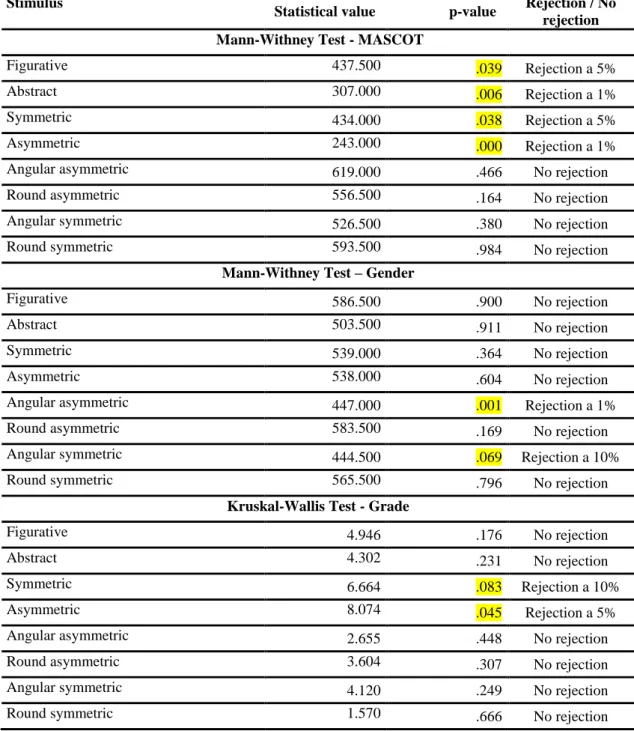
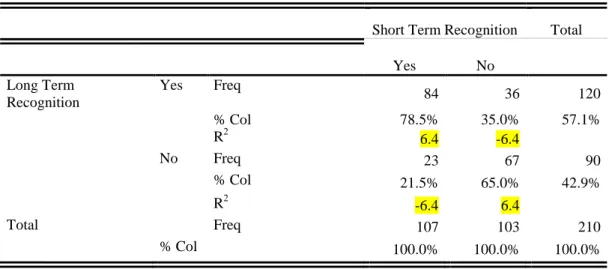
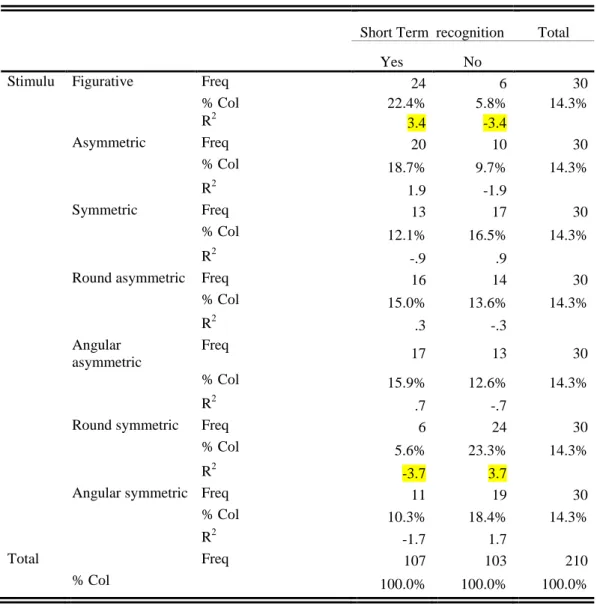
The paradigm of the investigation was predominantly positivist, intending a uniformity of relations between the form of the behaviour and its meaning, so as to allow an ppropriate operationalisation of the variables, objectivity, replicability and causality (Bryman, 1984; Erickson, 1986). In this study, we applied a frequently used method in the domain of the experimental aesthetics, where the main empirical studies on design appear. Henderson and Cote (1998), also applied this method in the study carried out on the selection and modification of logos, thus validating its use in the domain of the strategies of the brand signs. After the results had been gathered, they were analysed using univaried and bivaried descriptive statistics. To facilitate the visualisation of some of the data, Box and Whisker diagrams were used, which make it easier to see the ordinal variables being studied which tended to present higher or lower values, the differences between the groups being compared, defined by selected discrete variables and also the results of the tests of the mean differences which we expected to find particularly by the position of the median. In order to study the association between two discrete qualitative variables, chi-squared tests of independence were applied. Whenever the cross-classification tables were 2x2, we also analysed the results of Fisher’s test. To complement the results of chi-squared tests the following measures of symmetry were also calculated: Phi, Cramer’s V and contingency coefficient. As well as tables with the results of the chi-squared tests and the results of the symmetry test, annex nº 3 contains a table of cross-reference with the absolute frequency and percentages by column and also the adjusted residuals. As the scales being studied are all ordinal and not continuous, the tests of difference in medians, applied to relate two variable ordinals were always non-parametric tests, more specifically Wilcoxon tests. When the discrete qualitative variable defines two groups of individuals, we used Mann -Whitney tests, when it defines 3 or more groups, Kruskal-Wallis tests were applied.
Figurative is related to the capacity that a stimulus has to represent a shape containing a subject which is recognisable, beyond its purely visual lines. In other words, figurative is associated with representative forms. When a form contains a subject which cannot be recognised, it is considered to be non-representative or abstract (Wong, 1993). An abstract form reveals the sensitivity of the designer to the form, colour and composition of the elements of his composition, without making them explicitly recognisable. In the area of semiotics and more specifically in the Greimas and Courtés dictionary (1993), the term abstract is used in opposition to the term concrete when it is important to distinguish between a weak and a strong semic density. Semic density is related to the number of units of signification present in a stimulus: when the number of semic units is low, the sign is abstract; when the number is high, the sign is concrete. On the other hand, the term abstract is used to mean the opposite of the term figurative when we are referring to the absence or presence of signs associated with the natural world, the world of the senses: in this case, the sign is considered abstract if it does not contain any signified from the natural world to which the signified refers; if the opposite is true, the sign is said to be figurative.
Affective response
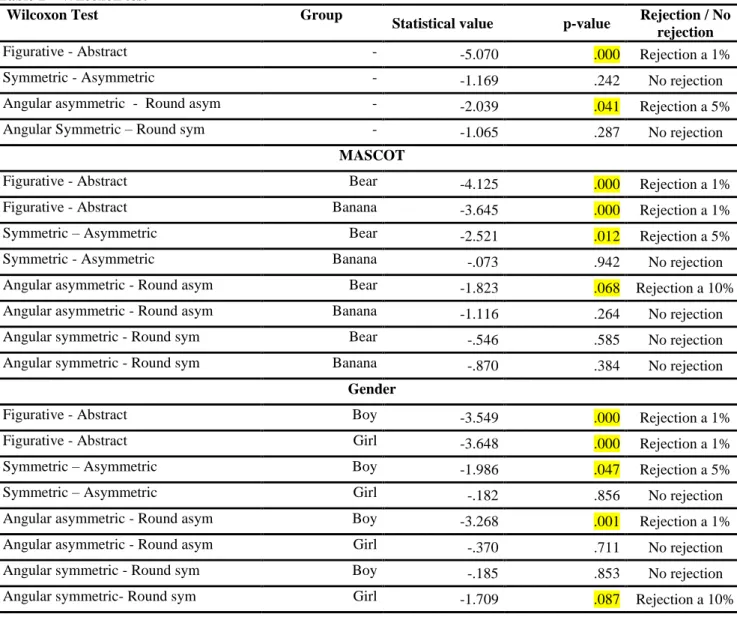
The children in our study showed a marked preference for figurative stimuli (69%), than for abstract stimuli (10%). It is of note that the percentage of children preferring abstract stimuli (10%) is practically identical to the percentage of children who show no preference for either figurative or abstract stimuli (9%). Analysis of Table 1 (Annex 3) and the Box and Whiskers diagrams allow us to conclude that figurative stimuli are preferred to abstract ones (Annex 4). Significant differences were detected between the median affectivity for a figurative stimulus and the median affectivity for an abstract stimulus (to a significance level of 1%- ns 1%): the figurative stimulus generates more affect than the abstract stimulus. (Annex 3: Tables 1-3). From the literature we know that the importance of affect in the behaviour of children led authors such as Rouen (2002) to suggest that the process of selection can generate affect in the child consumer as a result of the feelings and emotions associated to an object. Thus, the child will tend to make a choice based on emotions, with recourse to affective heuristics (Peterson et al, 1986). Consequently, and because of the above-presented results relating to the affectivity of abstract stimuli, no study of its recognition was undertaken, insofar as according to the literature cognitive response in children implies an initial affective response. These results were confirmed when we took a closer look at the data for cognitive response to figurative stimuli. There were significant results both for short-term (80%) and long-short-term (73%) recognition of figurative stimuli.
Symmetrical versus Asymmetrical
Symmetry is associated to the classical ideal, clearly associated to balanced identity, to equilibrium, to the very notion of beauty. Symmetry is order, it is harmony. According to studies in the field of psychology, symmetry triggers affect, and this is also true in the evaluation of beauty in human faces (Perez, 2004). However, asymmetry, as it implies a certain misalignment of shapes, is often able to generate agitation, dynamism, a break in the monotony of more symmetrical images. According to Perez (2004), based on Halburt, asymmetry may also be associated with constructions which favour inter-relationship with surroundings rather than a concern for the ordering of interior space.
Children demonstrate a clear preference for asymmetrical stimuli (50%) rather than symmetrical stimuli (29%). It is interesting to note that in a scale-based affective response, the differences between these two stimuli are not as significant (Annex 5) and that in fact their distribution is closer. But when we move to preference - a much more decisive response - the children’s’ choices leave no room for doubt, and asymmetrical stimuli are clearly preferred. In view of our analysis of the literature, and contrary to the previous results regarding abstract versus figurative stimuli, these results were completely unexpected,
Cognitive Response
As we have seen, asymmetrical stimuli generate higher levels of affect than symmetrical stimuli, and this is also true when we look at the cognitive response. Asymmetrical stimuli generate higher levels of recognition than symmetrical stimuli, both long and short term. In order to go further into the intriguing research results regarding symmetry versus asymmetry, we decided to cross check them with another semantic category of great importance in the field of aesthetics: rounded versus angular.
Symmetrical versus Asymmetrical: rounded versus angular
Angular shapes are associated to straight lines, to lines where precision is all-important, where as far as possible, according to Wong, (1993) all hand-drawn lines should be eliminated. In the research done by Messaris (1997), more angular shapes appear as more powerful and more dynamic, associated to high levels of potency and activity, whereas rounded shapes are associated with low levels of these characteristics. More rounded and more angular shapes are also associated with a fundamental feature of design which is the concept of proportion. According to Perez (2004) although rounded shapes do create the perception of harmony, softness and perfection, more angular shapes can, on the other hand, appear even softer.
Affective response: symmetrical and angular shapes versus symmetrical and rounded shapes): We noticed that when a child is faced with two symmetrical stimuli - one angular and the other rounded – the preference is for the round shape. Symmetry is therefore better accepted when it is round. However, it is important to note that a significant percentage of children make no difference between these two stimuli (33%) (Annex 6)
Affective response: asymmetrical and angular shapes versus asymmetrical and rounded shapes): When faced with two asymmetrical stimuli, one angular and the other rounded, the child prefers the angular one. It was clear that children prefer symmetrical stimuli when they are rounded and asymmetrical stimuli when they are angular.
Thus, there appears to be a relationship between symmetry and the rounded shape of the stimuli and asymmetry and the angular shapes of the stimuli presented. (Annex 7) Cognitive response: angular symmetry versus rounded symmetry
Based on preference analysis, we realised that symmetry is better accepted if it associated to round shapes; it is therefore interesting - and once again surprising - to observe that in terms of cognitive response, the same tendency is not found: higher levels of recognition are obtained both short and long term when the stimuli are symmetrical and angular. What is more, this tendency is reinforced with the passage of time.
Cognitive response: angular asymmetry versus rounded asymmetry: With regard to recognition of asymmetrical angular stimuli versus asymmetrical rounded stimuli, although the difference is not great in the short term, the former are better recognised than the latter (57% versus 53%). And so it can be seen that in the short term there is a relationship between affect and recognition; in other words, children prefer angular asymmetrical stimuli, which generate higher levels of recognition. Long term, this tendency is not found. Indeed, although children prefer asymmetrical stimuli when they are angular, the recognition rate is higher when the asymmetrical stimuli are rounded (60% versus 53%). Thus long-term recognition is not better for the preferred stimuli. CONCLUSIONS AND LIMITATIONS OF THE STUDY
The results reveal a strong correspondence between preference and recognition, a much stronger response to figurative stimuli than to abstract and a stronger affective and cognitive response to asymmetry than to symmetry.
Asymmetry is effective when it is angular and loses effectiveness at the affective level when it is rounded. In turn, though symmetry is ineffective when it is angular, its effectiveness increases at an affective level when it is rounded (although this is lost at a cognitive level). On one hand, at an affective level a certain tendency was seen for children to associate symmetry to rounded shapes. The round shape is associated to harmony, to smoothness, to softer more continuous shapes which in children’s minds seem to be related to symmetry which represents equilibrium. On the other hand, it was clear that this affective harmony does not generate the strongest responses at a cognitive level. It could perhaps be concluded that to some extent this represents the difference between “normality” which is liked (symmetry, roundness) and an inconsistency which is memorized (angular asymmetry).The results of this study are limited to two central issues: one related to the definition of the semantic categories and the other because of the fact that mascots were used that had no association to brands. Thus, it would be interesting to explore the interaction between the characteristics of the design and the brand, by showing them to children at the same time. The scope of this research made it impossible for us to include colour as an independent variable. Finally, the use of fictitious mascots, which was necessary in order to control the uncontrolled effects of learning in the research, may have complicated the assessment of the children when shown the stimuli. The children were only shown each mascot for a short period of time and this may have led to an incorrect assessment by the children. An interesting research path to be followed could be the evaluation of existing mascots which are typical of the design characteristics analysed in this work and to check if the results remain the same (or not) and if this alters the results.
It is obvious that not all mascots can be made to be asymmetrical just because children prefer them that way. But it must be noted that in two dimensional representation of mascots, brands could always use different design features in order to obtain the desired results over the lifetime of the mascot.
Aaker, D. A. et Joachimsthaler, E. (2000), Brand leadership. Free Press, USA.
Austin, M. J. et Reed, M. L. (1999), “Targeting children on-line: Internet advertising ethics issues,” The Journal of Consumer Marketing, 16 (6), 590-602.
Bagozzi, R. , Gopinath, M. Nyer, P. U. (1999), “The role of emotions in marketing,”
Academy of Marketing Science. Journal, 27 (2), 184-206.
Bornstein, R. (1989), “Exposure and Affect: Overview and Meta Analysis of Research, 1968-1987, “Psychological Bulletin, 106 (2), 265-89.
Brée, J. e Cegarra, J-J. (1994), “Les personnages, éléments de reconnaissance des marques par les enfants”, Revue Française du Marketing, nº 146, p. 17-35.
Bryman, A (1984), “The debate about quantitative and qualitative research: a question of method or epistemology?”, British Journal of Sociology, 35 (1), p. 75.92.
Coehen, D. (1986), “Trademark Strategy,” Journal of Marketing, 50 (April), 61-74.
Coehen, L. & Manion, L, (1994), Research Methods in Education, 4th Edition, London
Routledge.
DiFraza, J. D., Richards, J., Freeman, P., Wolf-Gillespie, Fletcher, C., Jaffe, R.D et Murray, D. (1991), “RJR Nabisco´s Cartoon Camel Promots Camel Cigarettes to Children,” Journal of the American Medical Association, 266 (22), 3149-53.
Eagly A.H et Chaiken S.(1993), The Psychology of attitudes. Forth Worth, Harcourt Brace Jovanovitch.
Erickson, F. (1986), Qualitative Methods in research on teaching, Handbook of research on teaching, Nova Iorque, Macmillan, p. 119-161.
Fischer, P., Schawartz, M. D., Richards, J. W., Goldstein, A, O. Et Rojas, T. H. (1991), “Brand logo recognition by children age 3to 6 years old, Reading,” Journal of American Medical association, 266 (22), 3148-48.
Henderson, P. W. et Cote, J. A. (1998), “Guidelines for Selecting or Modifying Logos,” Journal of Marketing, April (62), 14-30.
Jacoby, L.L et Dallas, M. (1981), “On the relationship Between Autobiographical Memory and Perceptual Learning,” Journal of Experimental Psychology, 110, 306-346. John and Mita Sujan (1990), “Children’s Use of perceptual Cues in product Categorization,” Psychology and Marketing, 7 (Winter), 227-294.
John, D. R. (1999) “Consumer Socialization of Children: A Retrospective Look at Twenty-Five Years of Research,” Journal of Consumer Research, 26 (3), 183-213. John, Dr. R. et Sujan, M. (1990), “Age differences in Product Categorization,” Journal
Kapferer, J-N. (1985), “Réflichissez au nom de votre societé”. Harvard L`Expansion, nº38, p.104-118.
Keller, K. L. (1993), “Conceptualizing, measuring, and managing customer-based brand equity”. Journal of Marketing, Vol. 57, p.1-22.
Keller, K. L. (1998), Building, measuring, and managing brand equity, Prentice Hall, USA.
Keller, K. L. (2001), “Editorial: Brand research imperatives,” Journal of Brand
Management, 9 (1), 4-6.
Kirkpatrick, C. A., (1952), “Trade Characters in Promotions Programs,” The Journal of Marketing, Vol. 17. p. 366-372.
Lencastre, P. (1997), “L`identification de la marque, un outil de stratégie marketing: le nom de la marque, le logotype et la mémorisation”. Louvain-la-Neuve, Thèse de Doctorat, Université Catholique de Louvain.
Macklin, M. (1986), “Preschoolers’ Understanding of the Informational Function of Television Advertising,” Journal of Marketing Research, Vol. 14, September , 229-239 Macklin, M. (1994), “The impact of audiovisual information on children’s product-related recall,” Journal of Consumer research, 21 (June), 154-164.
Macklin, M. (1996), “Pre-schooler learning of brand names from visual cues”, Journal of consumer Research, 23, p. 251-261.
McNeal, J. (1992), Kids as costumers: a handbook of marketing to children, New York, Lexington Books.
McNeal, J. (1998), “Taping the three Kid`s Markets”, American Demographics, 20 (4), p. 36-41.
Mcneal, J. U. et Ji, M. F. (1999), “Chinese children as consumers: an analysis of their new product information sources,” The Journal of Consumer Marketing, 16 (4),345-365.
Mizerski, R. (1995), “The Relationship Between Cartoon Trade Character Recognition and attitude Toward Product category in Young Children,” Journal of Marketing, (59), 58-70.
Montigneaux, N. (2002), Les marques parlent aux enfant, Éditions d’Organization, Paris.
Pecheaux, C. et Derbaix, C. (1999), “Children and attitude toward the brand: a new measurement scale,” Journal of Advertising Research, 39 (4), 19-27.
Pecheaux, C. et Derbaix, C. (2002), “L`attitude de l´enfant envers une nouvelle marque: de la nécessité d´une phase de fixation?,” Recherche et Applications en Marketing, 17 (3), 63-79.
Raju, P.S. et Lonial S.C. (1990), “Advertising to children: findings and implications,” Current Issues and Research in Advertising, 12 (2), 231-274.
Richard, J. P., (1990), La notion the representation et les formes de representation, in J. F. Richard, C. Bonnet et R. Ghiglione, Traité de psychologie cognitive, Vol. 2, Dunod, Paris.
Rossiter, J. R. (1975), “Visual and Verbal Memory in children`s Product Information Uitilization,” Advances in Consumer Research, 3, p. 572-576
Singh, S. et Rothschild, M. (1983), “Recognition as a measure of Learning From Television Commercials,” Journal of Marketing Research, (XX), 235-248.
Thorson, E. (1990), “Consumer Processing of Advertising,” in Current Issues and research in Advertising, Vol. 12, University of Michigan, 197-230.
Zhang, S. et Sood, S. (2002), “Deep” and “surface” cues: Brand extension evaluations by children and adults,” Journal of Consumer Research, 29 (1), 129-141.
Zuckerman et Gianino, 1981), Measuring children´s response to television advertising,
ATTACHMENTS
Annex 1 – Investigation Model
Annex 2: Stimulus
Due to mail capacity, the mascots are not all illustrate, just the figurative one, that was than manipulated on each semantic category.
Mascot Design Characteristics (A, B, C, D...) Attitude (A, B, C, D...) Affective Recognition Affective Reaction Cognitive Figurative (A) Symmetric Asymmetric Angular Round Angular Round
Annex 3
Table 1 – Wilcoxon test
Wilcoxon Test Group
Statistical value p-value Rejection / No
rejection
Figurative - Abstract - -5.070 .000 Rejection a 1%
Symmetric - Asymmetric - -1.169 .242 No rejection
Angular asymmetric - Round asym - -2.039 .041 Rejection a 5%
Angular Symmetric – Round sym - -1.065 .287 No rejection
MASCOT
Figurative - Abstract Bear -4.125 .000 Rejection a 1%
Figurative - Abstract Banana -3.645 .000 Rejection a 1%
Symmetric – Asymmetric Bear -2.521 .012 Rejection a 5%
Symmetric - Asymmetric Banana -.073 .942 No rejection
Angular asymmetric - Round asym Bear -1.823 .068 Rejection a 10% Angular asymmetric - Round asym Banana -1.116 .264 No rejection
Angular symmetric - Round sym Bear -.546 .585 No rejection
Angular symmetric - Round sym Banana -.870 .384 No rejection
Gender
Figurative - Abstract Boy -3.549 .000 Rejection a 1%
Figurative - Abstract Girl -3.648 .000 Rejection a 1%
Symmetric – Asymmetric Boy -1.986 .047 Rejection a 5%
Symmetric – Asymmetric Girl -.182 .856 No rejection
Angular asymmetric - Round asym Boy -3.268 .001 Rejection a 1% Angular asymmetric - Round asym Girl -.370 .711 No rejection
Angular symmetric - Round sym Boy -.185 .853 No rejection
Table 2 – Mann-Withney and Kruskal-Wallis Test Stimulus
Statistical value p-value Rejection / No
rejection Mann-Withney Test - MASCOT
Figurative 437.500 .039 Rejection a 5%
Abstract 307.000 .006 Rejection a 1%
Symmetric 434.000 .038 Rejection a 5%
Asymmetric 243.000 .000 Rejection a 1%
Angular asymmetric 619.000 .466 No rejection
Round asymmetric 556.500 .164 No rejection
Angular symmetric 526.500 .380 No rejection
Round symmetric 593.500 .984 No rejection
Mann-Withney Test – Gender
Figurative 586.500 .900 No rejection
Abstract 503.500 .911 No rejection
Symmetric 539.000 .364 No rejection
Asymmetric 538.000 .604 No rejection
Angular asymmetric 447.000 .001 Rejection a 1%
Round asymmetric 583.500 .169 No rejection
Angular symmetric 444.500 .069 Rejection a 10%
Round symmetric 565.500 .796 No rejection
Kruskal-Wallis Test - Grade
Figurative 4.946 .176 No rejection
Abstract 4.302 .231 No rejection
Symmetric 6.664 .083 Rejection a 10%
Asymmetric 8.074 .045 Rejection a 5%
Angular asymmetric 2.655 .448 No rejection
Round asymmetric 3.604 .307 No rejection
Angular symmetric 4.120 .249 No rejection
Table 3 – Chi-Square Independent test Statistical value p-value Fisher Test Rejection / No rejection Mascot recognition – Short term
Mascot recognition – long term 40.650 1 .000 .000 Rejection a 1%
Gender .000 1 .998 1.000 No rejection
Grade 1.895 3 .595 No rejection
Stimulus 28.201 6 .000 Rejection a 1%
Mascot recognition – long term
Gender 2.292 1 .130 .163 No rejection
Grade 8.008 3 .046 Rejection a 5%
Stimulus 10.461 6 .107 No rejection
Table 4 – Crossing of the short-term recognition of the mascot (1ª selection) with the respective long term recognition (absolute frequencies, % for column, adjusted residues)
Short Term Recognition Total
Yes No Long Term Recognition Yes Freq 84 36 120 % Col 78.5% 35.0% 57.1% R2 6.4 -6.4 No Freq 23 67 90 % Col 21.5% 65.0% 42.9% R2 -6.4 6.4 Total Freq 107 103 210 % Col 100.0% 100.0% 100.0%
Table 5 – Crossing of the short-term recognition of the mascot (1ª selection) with the design characteristics analyzed (absolute frequencies, % for column, adjusted residues)
Short Term recognition Total
Yes No
Stimulu Figurative Freq 24 6 30
% Col 22.4% 5.8% 14.3% R2 3.4 -3.4 Asymmetric Freq 20 10 30 % Col 18.7% 9.7% 14.3% R2 1.9 -1.9 Symmetric Freq 13 17 30 % Col 12.1% 16.5% 14.3% R2 -.9 .9
Round asymmetric Freq 16 14 30
% Col 15.0% 13.6% 14.3% R2 .3 -.3 Angular asymmetric Freq 17 13 30 % Col 15.9% 12.6% 14.3% R2 .7 -.7
Round symmetric Freq 6 24 30
% Col 5.6% 23.3% 14.3%
R2 -3.7 3.7
Angular symmetric Freq 11 19 30
% Col 10.3% 18.4% 14.3%
R2 -1.7 1.7
Total Freq 107 103 210
Annex 4 – Box&Whiskers Diagram Figurative-Abstract Abstract Mascot Figurative Mascot 4,0 3,5 3,0 2,5 2,0 1,5 1,0 62 Figurative- Abstract
Annex 5 – Box&Whiskers Diagram: Symmetric-Asymmetric
Asymmetric Mascot Symmetric Mascot 4,0 3,5 3,0 2,5 2,0 1,5 1,0 Symmetric - Asymmetric
Annex 6_ Box&Whiskers Diagram: Symmetric Angular-Symmetric Round
Symmetric Round Mascot Symmetric Angular Mascot
4,0 3,5 3,0 2,5 2,0 1,5 1,0 252 245
Symmetric Angular – Symmetric Round
Annex 7_ Box&Whiskers Diagram: Asymmetric Angular-Asymmetric Round
Asymmetric Round Mascot Asymmetric Angular Mascot
4,0 3,5 3,0 2,5 2,0 1,5 1,0 148 176