Higher Education Institutions
:
Towards an educational protocol
Promoting Critical Thinking in European
Higher Education Institutions:
TECHNICAL AND CATALOGING DATA Cover layout
Background image designed by Harryarts / Freepik
Date of publication
April 2019
Recommended cataloging
PROMOTING CRITICAL THINKING IN EUROPEAN HIGHER EDUCATION INSTITUTIONS: TOWARDS AN EDUCATIONAL PROTOCOL
Promoting Critical Thinking in European Higher Education Institutions: towards an educational protocol / coord. CRITHINKEDU proj. Caroline Dominguez; coaut. Jan Elen… [et al.]. - Vila Real: UTAD, 2019
ISBN: 978-989-704-375-8
I. Elen, Jan, (coaut.)
1. Pensamento crítico--Competências--Formação pedagógica--Séc. 21--[Relatório técnico] / 2. Educação--Ensino superior--Formação pedagógica--[Relatório técnico]
CDU 378.025"20"(047.3) 165.19"20"(047.3)
Recommended citation
Elen, J., Jiang, L., Huyghe, S., Evers, M., Verburgh, A., … Palaigeorgiou, G. (2019). Promoting Critical Thinking in European Higher Education Institutions: towards an educational protocol. C. Dominguez & R. Payan-Carreira (Eds.). Vila Real: UTAD.
Funding
This work is part of the ‘Critical Thinking Across the European Higher Education Curricula - CRITHINKEDU’ project, with the reference number 2016-1-PT01-KA203-022808, funded by the European Commission/EACEA, through the ERASMUS+ Programme.
Disclaimer
The European Commission support for the production of this publication does not constitute an endorsement of the contents which reflects the views only of the authors, and the Commission cannot be held responsible for any use which may be made of the information contained therein.
COORDINATORS
Catholic University of Leuven (KU Leuven), Belgium
LAI JIANG, PhD, Centre for Instructional Psychology and Educational Sciences
STEVEN HUYGHE, PhD, Advisor, Unit for Educational training and support
MARLEEN EVERS, MSc, Scientific Collaborator, Centre for Instructional Psychology
and Educational Sciences
JAN ELEN, PhD, Full Professor, Centre for Instructional Psychology and Educational Sciences
University College Leuven-Limburg (UCLL), Belgium
AN VERBURGH, PhD, Educational Quality Assurance Officer and Educational
Specialist
PARTNERS
Bucharest University of Economic Studies (ASE Bucuresti), Romania
DANIELA DUMITRU, PhD, Associate Professor, Department for Teacher Training
DRAGOS BIGU, PhD, Senior Lecturer, Department of Philosophy and Human Sciences Modern Didactics Centre (MDC), Lithuania
ASTA RAILIENĖ, PhD, Trainer and Researcher of the MDC, Associate Professor at
Mykolas Romeris University, Institute of Education and Social Work
DAIVA PENKAUSKIENĖ, PhD, Director of the MDC, Lecturer at Mykolas Romeris
University, Institute of Education and Social Work
University College Dublin (UCD), Ireland
AOIFE AHERN, PhD, Associate Professor, School of Civil Engineering
CIARAN MCNALLY, PhD, Assistant Professor, School of Civil Engineering JOHN O’SULLIVAN, PhD, Assistant Professor, School of Civil Engineering University of Economics, Prague (VŠE), Czech Republic
EVA JAROŠOVÁ, PhD, Associate Professor, Department of Managerial Psychology
and Sociology
HANA LORENCOVÁ, PhD, Assistant Professor, Department of Managerial Psychology and Sociology
University of Roma Tre (UNIROMA3), Italy
ANTONELLA POCE, PhD, Associate Professor, Department of Education
FRANCESCO AGRUSTI, PhD, Full-time Researcher, Department of Education
MARIA ROSARIA RE, Research Fellow, Department of Education
University of Santiago de Compostela (USC), Spain
BLANCA PUIG,PhD, Assistant Professor, Faculty of Education Sciences PALOMA BLANCO,PhD, Assistant Professor, Faculty of Education Sciences
INÉS MOSQUERA,MSC,Research Fellow, Faculty of Education Sciences
BEATRIZ CRUJEIRAS-PÉREZ,PhD, Assistant Professor, Faculty of Education Sciences MARÍA PILAR JIMÉNEZ-ALEIXANDRE, PhD, Full Professor, Faculty of Education
Sciences
ISABEL GARCÍA-RODEJA GAYOSO,PhD, Full Professor, Faculty of Education Sciences University of Thessaly (UTH), Greece
IOANNA V.PAPATHANASIOU, PhD, Assistant Professor, Nursing Department
KONSTANTINOS TSARAS, PhD, Assistant Professor, Nursing Department EVANGELOS C.FRADELOS, PhD, Adjunct Professor, Nursing Department University of Trás-os-Montes and Alto Douro (UTAD), Portugal
CAROLINE DOMINGUEZ, PhD, Assistant Professor, Engineering Department,
LabCIDTFF - Centre of Didactics and Technology in Education of Trainers GONÇALO CRUZ, MSc, Research Fellow, Engineering Department
HELENA SANTOS SILVA, PhD, Associate Professor, Department of Education and
Psychology, CIEE - Centre for Research and Intervention in Education
MARIA DA FELICIDADE MORAIs, PhD, Assistant Professor, Department of Letters, Arts and Communication
MARIA M. NASCIMENTO, PhD, Assistant Professor, Mathematics Department,
LabCIDTFF - Centre of Didactics and Technology in Education of Trainers
RITA PAYAN-CARREIRA, PhD, Assistant Professor with Habilitation, School of Agrarian
and Veterinary Sciences
University of Western Macedonia (UOWM), Greece
CATHERINE DIMITRIADOU, PhD, Full Professor, Department of Primary Education,
Faculty of Education
DIMITRIS PNEVMATIKOS, PhD, Full Professor, Department of Primary Education,
Faculty of Education
SOFIA AVGITIDOU, PhD, Full Professor, Department of Early Childhood Education,
Faculty of Education
GEORGE PALAIGEORGIOU, PhD, Assistant Professor, Department of Primary
CRITHINKEDU - Critical Thinking Across the European Higher Education Curricula v
Executive summary: the CRITHINKEDU educational protocol on
developing critical thinking
Critical thinking is considered to be an important goal for European Higher Education Institutions. To support the achievement of this goal, an educational protocol is proposed, which builds on all the outputs developed in the CRITHINKEDU project. That means, it builds on the reviews of the literature, the experiences with new approaches and on ample discussions in the project team.
Considerations with regard to the CRITHINKEDU educational protocol
As an introduction to the protocol a number of considerations are highlighted. These reveal the strength as well as the limitations of the current protocol.
a. The protocol is not static given; it is a construction made at a particular intersection of time and place. Any change in time and place may result in changes with respect to both its particular elements and its structure.
b. The protocol is the result of a European project in which a group of staff members of European Higher Education Institutions (HEIs) shared their scholarship.
c. The protocol is fundamental and general. It specifies a number of essentials that may guide and promote the development of critical thinking.
d. In assessing and using the protocol, the specific meaning given to critical thinking in this endeavour needs to be considered.
e. Any initiative to support critical thinking must be of high quality. This means that in the design of the initiative, the best possible ‘evidence’ is considered. Similarly, it is presumed that the development of critical thinking remains consistent with highly valued ethical principles.
An educational protocol to support the development of critical thinking
This educational protocol reflects a historically situated, operational understanding of the theoretical and empirical research on critical thinking on the one hand, and actual experiences with developing critical thinking on the other.
This report proposes
the CRITHINKEDU
educational protocol
to develop critical
thinking in European
Higher Education
Institutions.
CRITHINKEDU - Critical Thinking Across the European Higher Education Curricula vi
The educational protocol rests on two major claims:
1) students will develop their critical thinking by explicitly engaging in appropriate learning activities, and
2) becoming stronger in critical thinking requires repeated engagement in critical thinking processes.
The educational protocol has three parts: goals, conditions and supportive interventions.
Goals
In order to support the development of critical thinking, critical thinking has to be a goal of education. This is shown by:
• At the institutional level: A clear mission statement recognising critical thinking as an important goal and explaining how it can be accomplished.
• At the teaching program level: A clear description of critical thinking as an important goal of the teaching program, detailing how it can be reached. • At the course level: A clear description of critical thinking as an important
learning outcome, explaining how it can be realized.
In the above, ‘clear’ means that an explicit clarification (by referring to the relevant literature) of the meaning of critical thinking is provided. In other words, the goals are explicit and transparent; they can be read and understood by all those involved. In the above, ‘important’ means that not reaching the goal would be considered a failure. At the institutional level, it means that the institution would not be accredited unless the goal was realized. At the teaching program level, it means that a student could not graduate unless the goal is realized. At the course level it means that a student could not progress unless evidence of critical thinking is provided. In other words, considering critical thinking as an important goal implies that it is part of assessment and evaluation.
Given substantial conceptual and methodological differences between the fields and the disciplines, it is to be expected that clear descriptions of critical thinking as an important goal at the teaching program and/ or course level will vary between the fields and between the disciplines.
CRITHINKEDU - Critical Thinking Across the European Higher Education Curricula vii
Conditions
Critical thinking requires that at the institutional, the teaching program and course levels, critical thinking is continuously and congruently allowed and made possible. ‘Continuously’ implies that the development of critical thinking is not a one-shot operation. Critical thinking does not occur automatically or effortlessly. It needs continuous practice, reinforcement and support.
‘Congruently’ implies that all actions with respect to critical thinking are aligned to the goals.
Allowing critical thinking implies that critical thinking cannot have a negative consequence for the institute, its staff and its students. More specifically, it requires autonomy of the institution, the staff and the students who are enabled to think for themselves and with an authorial voice.
Making critical thinking possible implies that the resources needed for critical thinking are made available. It implies that students can flourish in an environment that is well-designed and offers them the time needed for development. It also implies that teaching programs can operate within a transparent and open structure, and institutions can work within clear legal frameworks.
Supportive interventions
Research suggests that with regard to the development of critical thinking (skills, dispositions or combinations of both), four categories of intervention (to model, to induce, to declare, to surveil) can be identified. For all supportive interventions the rule is that the support gradually withdraws.
• To model
Critical thinking development is supported when the institute (through its management structures), the teaching program (through its representatives) and the course (through its teachers) shows what it is to think critically. This can take various forms.
• To induce
Critical thinking development is supported by inducing critical thinking. This implies that open questions are raised, ill-structured tasks are provided, complex problems are discussed and/or authentic, real-world issues remain at the core. What ‘inducing’ entails and how it can be done may vary for different fields and disciplines and may be done in different ways.
CRITHINKEDU - Critical Thinking Across the European Higher Education Curricula viii
• To declare
Critical thinking development is supported by declaring or making explicit what is at stake, what strategies can be used and what criteria are to be met. Declaring can be either spoken or written, but in all the cases it is both explicit and specific. What ‘declaring’ entails and how it can be done may also vary in different fields and disciplines.
• To surveil
Critical thinking development is difficult. To increase the probability that sustained action is taken, surveillance may help. Surveillance monitors the ongoing efforts and activities, provides feedback on those efforts and activities and helps to keep the efforts and activities oriented towards the (development of) critical thinking. While differing in its concrete content and form among fields and disciplines, surveillance will always entail monitoring, feedback and orientation.
CRITHINKEDU - Critical Thinking Across the European Higher Education Curricula ix
Target audience and layout of report
The primary target audience of this report are staff members of higher education institutions with responsibility for the delivery of both undergraduate and postgraduate courses and teaching programs. Other professionals from different fields may also be interested in the report’s content, as will the research community seeking insights on current thinking with regard to the development and promotion of critical thinking.
The structure of the report should allow one to get an in-depth understanding of the educational protocol as presented in Chapter 5. The nature of an educational protocol, the ambitions of the protocol as well as the steps in its development are outlined in Chapter 1. The protocol rests on a number of theoretical perspectives and assumptions. These are presented in Chapter 2. One of the assumptions is that critical thinking can be developed when the environment for those involved is well designed. What this entails is discussed in Chapter 3. Another assumption relates to the domain-specific nature of critical thinking. Different strategies and approaches to foster critical thinking skills and/or dispositions are presented in Chapter 4. The structure of the report is such that report sections and chapters are self-contained and readers can limit themselves to read those sections and chapters that are of greatest interest to them.
The report is targeted to
university staff members
responsible for the delivery
of both undergraduate and
postgraduate courses and
teaching programs.
CRITHINKEDU - Critical Thinking Across the European Higher Education Curricula x
Table of contents
Chapter 1. Problem statement ... 12Chapter 2. Theoretical perspectives and assumptions ... 17
A definition of critical thinking ... 18
Methods to assess and develop critical thinking ... 20
The relationship between critical thinking and ‘a’ domain ... 21
Critical thinking as an organizational issue, a cultural factor ... 22
Chapter 3. Designing for critical thinking ... 25
Contextual factors that promote / inhibit critical thinking ... 25
Basic principles for designing learning environments ... 31
Chapter 4. Designing for critical thinking: a perspective from different disciplines/fields ... 36
Designing for critical thinking: findings from studies covering multiple disciplines ... 37
Designing for critical thinking in the biomedical domain ... 42
Designing for critical thinking in the STEM domain ... 51
Designing for critical thinking in social sciences and humanities ... 59
Chapter 5. The CRITHINKEDU educational protocol on supporting the development of critical thinking ... 71
Considerations with regard to the CRITHINKEDU educational protocol ... 71
An educational protocol to support the development of critical thinking ... 71
Discussion... 75
Further elaboration and validation of the CRITHINKEDU educational protocol ... 76
References ... 77
CRITHINKEDU - Critical Thinking Across the European Higher Education Curricula xi
List of tables, figures and vignettes
Table 1. Critical thinking skills and dispositions (Facione, 1990) ... 19Figure 1. A layered context for critical thinking ... 23
Figure 2. The spiderweb elaborated by van den Akker (2003) ... 28
Vignette 1 – UTAD, Portugal, Veterinary Medicine ... 45
Vignette 2 – University of Thessaly, Greece, Nursing ... 47
Vignette 3 – UTAD, Portugal, Nursing ... 48
Vignette 4 – UTAD, Portugal, Sport Science, Rehabilitation ... 50
Vignette 5 – UTAD, Portugal, Mechanical Engineering ... 54
Vignette 6 – University of Thessaly, Greece, Wood and Furniture Design and Technology ... 56
Vignette 7 – KULeuven, Belgium, Engineering Technology ... 57
Vignette 8 – University of Western Macedonia, Greece, Science Education ... 58
Vignette 9 – USC, Spain, Teacher Education ... 62
Vignette 10 – Mykolas Romeris University, Lithuania, Career Management ... 64
Vignette 11 - University Colleges Leuven-Limburg, Belgium, Office management . 66 Vignette 12 - University of Economics in Prague, Czech Republic, Management and Leadership ... 68
CRITHINKEDU - Critical Thinking Across the European Higher Education Curricula 12
Chapter 1. Problem statement
At the core of the project CRITHINKEDU is critical thinking, probably the most important educational goal of higher education as well as its most important responsibility (Paul, Elder, & Bartell, 1997; Verburgh, 2013). While the importance of the goal of Critical Thinking (CT) is quasi unanimously supported (at least in principle), there is far less consensus when it comes to three important aspects of the development of critical thinking: its definition, its assessment and approaches to foster its development (Tiruneh, Verburgh, & Elen, 2014). That absence of consensus reflects the multidimensionality, the complexity, the domain-specificity as well as the richness of critical thinking.
This report focuses on the development of critical thinking. The report is presented in the context of a specific position on critical thinking with respect to its definition, assessment and development (see Chapter 2: Theoretical perspectives and assumptions). That position rests on the results of previous activities in the CRITHINKEDU project (http://crithinkedu.utad.pt/en/crithinkedu/). Within the scope of the CRITHINKEDU project, this report targets those with responsibility for course development (e.g., university teachers), those responsible for teaching programs (e.g., Programme Boards), and those within the senior management structure of higher education institutions (e.g., (vice-)deans, (vice-)rectors). It might also be useful for all those in educational support roles (e.g., teaching assistants, members of educational support services). The report provides an overall understanding on how European Higher Education Institutions (EHEIs) foster or might foster critical thinking at different levels (course, teaching program, institution), considering both the current educational intervention studies reported in the literature, and educational practices.
Given the importance of critical thinking on the one hand and its particularities in different fields and contexts on the other, this report outlines how EHEIs may foster (the development of) critical thinking. In other words, the current report aims at consolidating (part of) the field by presenting quality guidelines for critical thinking in (European) higher education. In so doing, the report will present an ‘educational protocol’. An ‘educational protocol’ presents an operational, agreed and formally acknowledged set of rules that defines the best possible approach to address a recognized educational challenge by considering conceptual and empirical evidence at a certain moment in time and within a specific context.
This report aims at
presenting
recommendations for
critical thinking
promotion in
(European) higher
education institutions.
CRITHINKEDU - Critical Thinking Across the European Higher Education Curricula 13
All elements in this description of an educational protocol are important:
• The protocol addresses an educational challenge. From different perspectives and by different stakeholders the issue is indeed recognized to be a challenge for education. In our case, the educational challenge pertains to the development of critical thinking, an issue that has been widely recognized conceptually as well as empirically.
• It is operational: as such it specifies a series of actions to be taken when confronted with the educational challenge. In our case, a series of actions is identified that is important with respect to the development of critical thinking. • The protocol contains a set of rules that describe the relationship between
actions on the one hand, and outcomes on the other. In this case, the rules describe positive relationships between actions at the course, program and institutional levels and critical thinking. As such, the protocol presents a pedagogy of critical thinking.
• The protocol is agreed upon and formally acknowledged. This implies that (a) it is the property of a community which aims at addressing the educational challenge and, (b) a decision is made in mutual agreement about a theoretical perspective, about a terminology and about appropriate actions. That agreement is formally established in order to make it visible, transparent and hence debatable and changeable. The implication is also that a community is presupposed. It may well be the case that multiple communities might exist (which may differ with respect to the theoretical stance they take) for one particular educational challenge. In our case, the protocol is discussed within the context of the CRITHINKEDU project and presented in a variety of scholarly communities and/or higher
education institutions. It is important that in the longer term, the protocol is also acknowledged by important educational organisations and associations. We see the protocol as a ‘living’ document’ and it is our wish that through wider discussions, inspired hopefully by the experiences of others who engage with the protocol, that the protocol will continue to evolve.
• It is clear that our understanding of fundamental processes continuously evolves and that it is contextualized. As such an educational protocol may be altered given new findings and/or new insights. It is not fixed. Given the
The protocol addresses
challenges on critical
thinking education. It is
agreed among
CRITHINKEDU’s project
members and formally
acknowledged. It is
operational, contextualized,
and linked to research.
CRITHINKEDU - Critical Thinking Across the European Higher Education Curricula 14
contextualized nature of our understanding, it might also be that the educational protocol is valid in context ‘A’ but not in context ‘B’. The idea of an educational protocol invites consideration (the evidence) of the reasons for the lack of explicit cross-context validity. That in itself will help to further develop the protocol. In our case we put the European context at the core. It might be that some of the actions/interpretations will be deconstructed as highly contextualized.
• An educational protocol has a clear link with research and scholarship as it rests on conceptual and empirical evidence. The elaboration of a protocol is in itself an act of (critical thinking and) scholarship as it involves the consideration of multiple elements, the weighting of a variety of perspectives, the elaboration of meaning, the clarification of terminology and the specification of lines of action. In our case, the educational protocol is the outcome of the CRITHINKEDU project in which various steps towards the protocol were set. In elaborating an educational protocol in the CRITHINKEDU project, the following was outlined:
• Actions in the protocol are presented at three levels: the institutional level (e.g., incorporate into existing review process systems that monitor how critical thinking is embedded in the programs), the teaching program level (e.g., provide different and progressively complex activities and opportunities to foster critical thinking throughout the curriculum, ensuring that students can transfer what is learnt in one part of the curriculum to other areas) and the course level (e.g., present to students, at the beginning of the course, explicit guidelines on how assessment of critical thinking will take place).
• Actions in the protocol pertain to fostering critical thinking in general but, wherever possible, guidelines also (at the course level) pertain to specific critical thinking skills and dispositions.
• Actions in the protocol are considered to apply to all fields but wherever possible, specifications on the outlook of the guidelines in different disciplines/ professional fields are made.
A systematic approach was adopted in the elaboration of the protocol. This approach was largely iterative, involved important stakeholders and repeatedly considered the most up-to-date findings as reported in educational literature. The approach consisted of the following steps:
a) At the start of the project, Facione’s (1990) definition of critical thinking was selected as a conceptually suitable critical thinking framework for underpinning the project. The Facione (1990) model recognizes that there are several critical thinking skills and dispositions. By selecting the Facione construct of critical
CRITHINKEDU - Critical Thinking Across the European Higher Education Curricula 15
thinking, the debatable terminological framework that underpinned the protocol was also defined.
b) Next, the definition of critical thinking was validated in different professional fields (retrieved from different focus groups). The validation entailed a systematic review of the meaning of critical thinking in different professional fields: STEM, biomedical sciences, social sciences and humanities (for the full report, see: Dominguez, 2018a http://bit.ly/2sEffTH. Starting from Facione’s
theoretical framework (Facione, 1990), the outcomes of the focus groups largely confirmed previous research (Jones, 2009; Jones, 2010; Grace & Orrock, 2015; Sin, Jones & Wang, 2015). The focus groups indicated that (a) critical thinking is widely understood and interpreted as a set of interdependent skills and dispositions; (b) critical thinking is unquestionably needed in today's graduates, and (c) with respect to the importance of critical thinking skills, slight differences in their practical application across professional fields can be detected. Across the fields considered, it is clear that that the most values and sought after employees are those who hold a well-educated way of thinking, fueled by the motivation and willingness to learn and improve, anchored on a set of interdependent cognitive aspects allowing them not only to anticipate and be ready for any situation, but also to regulate and monitor their own thinking and behaviour during the process. The outcomes of the focus groups suggest that well-developed critical thinking requires strong propensity elements (e.g., dispositions) and arises from experience, lifelong learning, effort and persistence, dealing with long-term goals and development. Additionally, critical thinking is frequently associated with problem-solving and decision-making, and its application depends not only on a stand-alone ability, but also in the convergence and interconnectedness of several other skills and dispositions out of the applied framework, such as proactivity, adaptability, creativity, emotional maturity, communication and teamwork. The review (Dominguez, 2018a) revealed that while the different fields may emphasize different skills and dispositions and while the instantiation of critical thinking skills and dispositions differs across fields, there is widespread agreement on the importance of the critical thinking skills and dispositions as stipulated in the Facione’s definition.
c) A third step entailed the elaboration of general guidelines for stimulating critical thinking (for the full report including the guidelines, see: Dominguez, 2018b
http://bit.ly/2Pwtic0). The project engaged in a mixed method study to reveal
A systematic approach
was adopted in the
elaboration of the
protocol, involving
important stakeholders
and considering the
CRITHINKEDU - Critical Thinking Across the European Higher Education Curricula 16
current practices, strategies and considerations and to discuss their effectiveness. National and international research publications were reviewed and interviews were done with teachers from 9 different European countries from the four above mentioned professional fields: biomedical, STEM, social sciences and humanities. In line with previous reviews (Abrami et al., 2008; Behar-Horenstein & Niu, 2011; Tiruneh et al., 2014; Abrami et al., 2015), the following was concluded:
1. the interest in how teaching strategies may influence the development of critical thinking is increasing. However, the evidence on what teaching strategies and learning environments better support the development of students’ critical thinking is scarce;
2. critical thinking intervention studies and educational practices mainly address the development of critical thinking skills in students and seem to ignore the value of critical thinking dispositions and the importance of considerable practice, effort and long-term interventions;
3. the reported studies and practices tend to be based mostly on practices adopting an immersive critical thinking approach (Ennis, 1997). This implies that critical thinking principles are not made explicit to students, as it is assumed that critical thinking skills are acquired as part of the apprehension of subject-matter. All this notwithstanding, the current academic literature on the subject identifies the need for a clear identification and definition of critical thinking skills to be developed; 4. given the outcomes of the studies reviewed, the following aspects are
claimed to contribute to effectiveness: the use of active learning methodologies including use of real-world situations and/or workplace-based scenarios; teachers’ training, and students’ support;
5. still, the assessment of students’ progression in critical thinking remains challenging irrespective of the use of qualitative assessment methods or formal critical thinking tests.
d) Next, the preliminary guidelines, elaborated based on the reviews, were tested. The testing of the guidelines entailed their validity, transparency as well as their feasibility. During a 5-day-long-workshop the guidelines were discussed by representatives of EHEIs and their implementation was tested by actually designing learning environments in line with the guidelines (for the full report, see: Dominguez, 2018c http://bit.ly/2I8J20V). The workshop included training sessions to discuss quality teaching on critical thinking, presentations of the use of effective pedagogical methods and approaches, learning tasks, supportive exercises as well as strategies and methods for the assessment of critical thinking. The interactions revealed the role of both the institutional and the teaching program context.
CRITHINKEDU - Critical Thinking Across the European Higher Education Curricula 17
e) Finally, the protocol itself was actually elaborated by considering on the one hand the outcomes of a multinational review of the literature on interventions to promote the development of specific critical thinking skills and dispositions (rather than critical thinking in general), and on the other hand, an inventory and evaluation of teaching/learning experiences developed from actual implementations of the designed learning environments in the partners’ institutions [see (d)]. Over several iterations, different versions of the educational protocol on critical thinking were discussed within the context of the CRITHINKEDU project with representatives of EHEIs.
This report will (see Chapter 2) adopt a position with respect to a number of issues that orient the educational protocol. Following this in Chapter 3, it will be argued that in view of promoting critical thinking, the following is needed: (a) an organisational context that fosters the development of critical thinking, (b) a teaching program level that contains a good structure and courses that consistently and coherently aim at developing critical thinking, and (c) actual learning environments that are systematically designed in line with design principles which are relevant for any type of learning environment.
In Chapter 4, the field-specific findings of the literature study on specific interventions for particular critical thinking skills and/or dispositions are presented. Each of the sections in this chapter are considered to be standalone and notwithstanding the authors attempts to minimise repetition, there exists, in a number of cases, overlap between some sections of the chapter. The actual educational protocol is presented and discussed in the final chapter of the report.
CRITHINKEDU - Critical Thinking Across the European Higher Education Curricula 18
Chapter 2. Theoretical perspectives and assumptions
As previously mentioned, the field of developing critical thinking is characterized by a lack of consensus on three major and closely interrelated issues: the meaning of critical thinking, the assessment of critical thinking, and the methods to foster its development. This chapter presents an outline of our position with respect to these issues. Taking a position implies that choices were made, partially in view of advancing an educational protocol. These positions can and should be questioned and criticized based on conceptual and empirical arguments in view of strengthening the protocol.
A definition of critical thinking
Davies and Barnett (2015) have clearly argued that notwithstanding the importance of critical thinking, critical action or critical doing is even more important as it reveals the need for engaged relations with society, encompasses critical thinking and highlights an ethical position reflecting consistency in thinking and doing. Critical thinking is the focus of this project in the full understanding that extensions towards critical doing might be possible and desirable.
In line with the previous project reports, the CRITHINKEDU project follows the Facione (1990) definition of critical thinking as it represents a shared and sustained understanding of the concept. The definition is the outcome of a Delphi research study in which participants from different disciplines and professional fields participated. Facione (1990, p. 3) describes the consensus as follows:
“We understand critical thinking to be purposeful, self-regulatory judgment which results in interpretation, analysis, evaluation, and inference, as well as explanation of the evidential, conceptual, methodological, criteriological, or contextual considerations upon which that judgment is based. CT is essential as a tool of inquiry. As such, CT is a liberating force in education and a powerful resource in one's personal and civic life. While not synonymous with good thinking, CT is a pervasive and self-rectifying human phenomenon. The ideal critical thinker is habitually inquisitive, well-informed, trustful of reason, open-minded, flexible, fair-minded in evaluation, honest in facing personal biases, prudent in making judgments, willing to reconsider, clear about issues, orderly in complex matters, diligent in seeking relevant information, reasonable in the selection of criteria, focused in inquiry, and persistent in seeking results which are as precise as the subject and the circumstances of inquiry permit. Thus, educating good critical thinkers means working toward this ideal. It combines developing CT skills with nurturing those dispositions which consistently yield useful insights and which are the basis of a rational and democratic society.”
In line with its previous
reports, the CRITHINKEDU
project follows the Facione
(1990) definition of critical
thinking as being a set of
(cognitive) skills and
dispositions.
CRITHINKEDU - Critical Thinking Across the European Higher Education Curricula 19
For this report therefore, critical thinking pertains to a set of (cognitive) skills and a set of dispositions. Hence, critical thinking is not a purely cognitive activity, it also implies for instance an engagement towards sincerity and truth. For an overview of critical thinking skills and dispositions, see Table 1.
Table 1. Critical thinking skills and dispositions (Facione, 1990)
Skill Description (Facione, 1990, pp. 13-19)
Interpretation To comprehend and express the meaning or significance of a wide variety of experiences, situations, data, events, judgments, conventions, beliefs, rules, procedures, or criteria.
Analysis To identify the intended and actual inferential relationships among statements, questions, concepts, descriptions, or other forms of representation intended to express belief, judgment, experiences, reasons, information, or opinions.
Inference To identify and secure elements needed to draw reasonable conclusions; to form conjectures and hypotheses; to consider relevant information and to reduce the consequences flowing from data, statements, principles, evidence, judgments, beliefs, opinions, concepts, descriptions, questions, or other forms of representation.
Evaluation To assess the credibility of statements or other representations that are accounts or descriptions of a person’s perception, experience, situation, judgment, belief, or opinion; and to assess the logical strength of the actual or intended inferential relationships among statements, descriptions, questions, or other forms of representation.
Explanation To state and to justify that reasoning in terms of the evidential, conceptual, methodological, criteriological and contextual considerations upon which one’s results were based; and to present one’s reasoning in the form of cogent arguments.
Self-regulation Self-consciously to monitor one’s cognitive activities, the elements used in those activities, and the results educed, particularly by applying skills in analysis, and evaluation to one’s own inferential judgments with a view toward questioning, confirming, validating, or correcting either one’s reasoning or one’s results.
Disposition Description (Facione, 1990, pp. 4-6)
Truth-seeking Being eager to seek the best knowledge in a given context, courageous about asking questions, and honest and objective about pursuing inquiry even if the findings do not support one's self-interests or one's preconceived opinions. The truth-seekers remain receptive to giving serious consideration to additional facts, reasons, or perspectives even if this should necessitate changing one's mind on some issue. The truth-seekers evaluate new information and evidence.
Open-mindedness
Tolerant of divergent views and sensitive to the possibility of one's own bias. Valuing tolerance and understanding of the beliefs and lifestyles of others.
Analyticity Prizing the application of reasoning and the use of evidence to resolve problems, anticipating potential conceptual or practical difficulties, and consistently being alert to the need to intervene.
Systematicity Being organized, orderly, focused, and diligent in inquiry. Organized approaches to problem-solving and decision-making are hallmarks of a thoughtful person regardless of the problem domain being addressed. The inclination to approach problems in an orderly and focused way.
Self-confidence Trust the soundness of one's own reasoned judgments and inclination to lead others in the rational resolution of problems.
Inquisitiveness One's intellectual curiosity and one's desire for learning even when the application of the knowledge is not readily apparent.
Cognitive maturity
Approach to problems, inquiry, and decision making with a sense that some are necessarily ill-structured, some situations admit of more than one plausible option, and many times judgments must be made based on standards, contexts and evidence which preclude certainty. Making complex decisions involving multiple stakeholders, such as policy-oriented and ethical decision-making, particularly in time-pressured environments.
CRITHINKEDU - Critical Thinking Across the European Higher Education Curricula 20
Anyone engaged in critical thinking displays a variety of related skills and demonstrates the presence of an interrelated set of dispositions. At the core of critical thinking is the willingness and the ability to (a) distance oneself from the issue, problem, or phenomenon by considering different alternatives/perspectives, and (b) make a (quality, action, resolution, selection) judgement after carefully thinking through different alternatives.
That makes critical thinking different from other complex activities to which it is closely related such as problem solving, designing, or creative thinking. Essential in critical thinking is the interaction between and alignment of specific skills and dispositions in view of taking some distance and making a judgement. While some of the specific skills and /or dispositions may also play a role in problem solving, designing or creative thinking, the blends and the orientations of critical thinking are specific and unique.
Methods to assess and develop critical thinking
As critical thinking is a complex phenomenon with implied skills and dispositions, it is perhaps understandable that its assessment and development are not easy. In this respect, we can distinguish between approaches to critical thinking that are generally holistic and those that are generally analytical. Both are intrinsically suboptimal. In the more holistic approaches, students get the task to engage in critical thinking (e.g., by reading a text and offering a critique) and a holistic and often very context-specific assessment (e.g., of the critique) is made. Such a holistic assessment often lacks precision and is heavily dependent on the assessor. As Kayapinar (2014) illustrated, grading of essays by different assessors reveals poor reliability of individual assessments. The same (being suboptimal) is true for a global approach in critical thinking development. While interesting and authentic tasks can be given, the support of students is holistic and directions by teachers lack specificity. At the same time, a global approach embeds students in a culture of thinking critically and invites them to get socialized in the dispositions and skills of critical thinking by adopting a contextually appropriate critical discourse.
Analytical approaches in both assessing and developing critical thinking decompose (and try to recompose) critical thinking into specific skills and dispositions. It assumes that critical thinking is the sum of related skills and dispositions. Although analytical approaches can sometimes obscure the integrated nature of critical thinking, they can also add significant precision both to the assessment and the support that can be given. Specific skills are identified and considering the extensive scientific literature,
Among assessment
approaches to critical
thinking, we can
distinguish those which
are generally holistic
and those which are
generally analytical –
being both suboptimal.
CRITHINKEDU - Critical Thinking Across the European Higher Education Curricula 21
specific and detailed assessments can be made. Similarly, specific dispositions can be identified and programs elaborated to stimulate the development of those dispositions.
Given the suboptimality of both approaches, we suggest that a combination of both approaches might be most appropriate. Such combined approaches are advocated by the proponents of integrative or infusion approaches (Ennis, 1989). An integrative/infusion approach starts with authentic tasks but pays - either by the use of rubrics (assessment) or the use of specific scaffolds (development) - explicit attention to facets of critical thinking. In an integrative approach, the total picture remains intact while the opportunity to zoom in on particular aspects is equally created. The idea is largely borrowed from the ‘elaborative sequencing model’ as proposed by Reigeluth and Stein (1983). While integrative or infusion approaches are attractive in many settings, their implementation is far from simplistic in that they require a continuous balance between the overall and the specific as well as the integration of the different particular aspects towards the overall.
With respect to assessment, the CRITHINKEDU project claims that an optimal assessment of critical thinking implies the use of authentic critical thinking tasks that can be assessed by using ‘rubrics’ which detail within the context of the entire task how from specific perspectives (skills/dispositions), critical thinking aspects can be scored. Such competence-based assessments afford opportunities to highlight the aspects to consider and the perspectives from which those aspects can be assessed (Baartman, Bastiaens, Kirschner & van der Vleuten, 2006).
For the development of critical thinking we take the position that critical thinking might be fostered by allowing and/or inducing students to think critically. This presupposes a climate that allows for critical thinking, tasks that are open and a continuous invitation to answer ‘why’ questions. An infusion approach offers tasks that are at the core of the discipline or field while also providing explicit instruction on critical thinking: what it entails and how it can be done. This could involve: making explicit what is expected as a result, what intermediate steps can be taken, and/or what prompts might instigate thinking.
The relationship between critical thinking and ‘a’ domain
An important debate in the literature on (stimulating) critical thinking pertains to the domain-specificity and domain-generality of critical thinking (Dwyer, 2017). In some cases, critical thinking is addressed in a specific topic, the focus of which is on a number of skills that are practiced with different types of content. This is the general approach. Conversely, there is the conviction that critical thinking is domain-specific and hence fostering critical thinking cannot but be part of domain-specific courses. This has been called the immersion approach. While in the case of the general approach, transfer to domain-specific tasks is a major issue, in the case of the
CRITHINKEDU - Critical Thinking Across the European Higher Education Curricula 22
immersion approach, critical thinking does not get explicitly addressed as it gets totally embedded in teaching the subject matter. Given the outcomes of a lot of research, there seems to be some consensus that knowledge about the topic at hand is essential in view of critical thinking. Critical thinking implies the consideration of alternatives and hence knowing those alternatives. It also implies assessing evidence and hence knowing what in a domain is epistemologically considered to be evidence. In other words, having appropriate “mindware”, which refers to a knowledge structure, including rules, subject-specific knowledge, procedures, and strategies that a person can retrieve from memory in order to aid decision making is a precondition for critical thinking (Stanovich, West, & Toplak, 2016).
In addition, research has shown that addressing specific skills by making them explicit and visible may contribute to the development of critical thinking. One may not assume that any learner will spontaneously consider alternatives, compare them in a systematic way and establish how they relate to a specific problem or issue. However, these skills can be learned by modelling them, making them explicit and practicing them. That is why in this report the infusion approach is argued for. In the infusion approach, subject-matter is at the core but specific dispositions and skills relevant for critical thinking are made visible and are explicitly discussed. Given the importance of the specific field/ discipline (and the knowledge in it), it is clear that critical thinking always handles different concepts, strategies, issues or problems in different fields and disciplines. The same is true for the object of critical thinking. Depending on the nature of the object, critical thinking may take a different form. The nature of critical thinking will be different depending on whether it pertains to a concept, a theory, a phenomenon, a practice, … This mixed position recognizes the importance of domain-specific knowledge and presumes that (within the context of domain-specific tasks) critical thinking skills can be exercised and critical thinking dispositions developed. By pointing to the importance of domain-specific knowledge, the position also tries to avoid an excessive disciplinary focus which would assume that disciplines can be easily identified as fields with ‘unique’ concepts, approaches or criteria for ascertaining the validity of truth claims.
Critical thinking as an organizational issue, a cultural factor
While the actual activities of students at the course level and interactions with teachers/ lecturers play a major role, those activities are inevitably executed in a context (institutional, disciplinary, cultural) that models, induces and structures those
This report supports the
infusion approach for
critical thinking
development:
subject-matter is at the core but
specific dispositions and
skills relevant for critical
thinking are made visible
and explicitly discussed.
CRITHINKEDU - Critical Thinking Across the European Higher Education Curricula 23
activities; a context that affects the probability that these activities may occur. That context is layered and multi-dimensional.
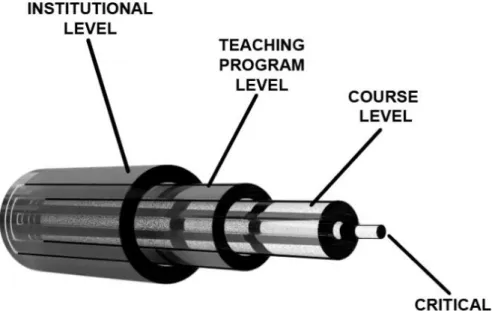
The teaching program and organizational/ institutional level can be specifically distinguished. While the focus in this report is on the course level and most guidelines will pertain to that level, guidelines at the organizational/ institutional level and teaching program level are also referred to as they may facilitate/ inhibit and support the work at the course level. This position is illustrated in Figure 1.
Figure 1. A layered context for critical thinking
At the core of Figure 1 is the course level, where critical thinking is done. Next is the teaching program level that (by building coherence over the courses) supports the development of critical thinking in the programmes. The institutional level is foundational as it enables and hampers particular activities (at the teaching program level as well as at the course level) - it sets the boundaries. More specifically, any higher education institution that aims at promoting critical thinking cannot but allow students to think critically (also about the
institution and the principles it is built upon). At the core of our position is the idea that fostering critical thinking at the course level will require a teaching program that supports those initiatives and an institution that embodies critical thinking. In other words, critical thinking where taking a distance and making a judgement is at its
Fostering critical thinking
at the course level will
require not only a teaching
program that supports it,
but also an institution that
embodies critical thinking.
CRITHINKEDU - Critical Thinking Across the European Higher Education Curricula 24
core, presupposes a democratic environment. Critical thinking fosters and requires democracy.
This also clearly reveals that the context is multidimensional and that different dimensions may be different at different levels. Whereas at the course level, the nature of the learning tasks is of prime importance including their domain-specificity as well as the support provided (e.g., making relevant critical thinking skills and dispositions explicit), at the curriculum level a concern is the coherence across different courses as well as a learning path. At the teaching programme level, a sustained idea about the nature of critical thinking and its development will help to elaborate courses and their coherence. It seems equally valuable that the different courses (a) build on each other, and (b) ensure that as a whole, the courses address different aspects of critical thinking. The dimensions at the institutional level may pertain to human resource development (selection of staff that supports critical thinking), use of resources (make sure that sufficient resources are available for providing education that fosters critical thinking and uses authentic tasks), or its mission (clear ideas about role of HE institutions to deliver critical thinking graduates as a contribution to a democratic society).
CRITHINKEDU - Critical Thinking Across the European Higher Education Curricula 25
Chapter 3. Designing for critical thinking
While promoting critical thinking amongst students is a mission of many institutions and individuals, it is also clear that given its complexity and layered nature, its prevalence or its development cannot be taken for granted. It needs deliberate attention at different levels. That deliberate attention pertains to the design for critical thinking, structuring the environment in such a way that critical thinking can flourish, making adequate curricular decisions and embedding interventions that both instigate and support learning. This section especially concerns the design for critical thinking. Previously, we indicated that this report pertains largely to the course level. That is why the largest part of this section is devoted to elements at the course level that may (in different disciplinary fields) help to foster the development of critical thinking. However, what happens at the course level is heavily context-bound. What can be done in a specific course is at least partially dependent on what is allowed by the teaching program and by the larger context of the institution (Tsui, 2000). That is why in the first part, factors at the institutional and the teaching program level that might promote or inhibit (the development of) critical thinking are presented.
As any attempt to foster the development of critical thinking implies the need for a learning environment that is powerful, in a second part, general aspects of powerful learning environments are presented.
Contextual factors that promote / inhibit critical thinking
At the institutional level, both intangible and tangible factors can be detected. Intangible factors relate to the ‘culture’ of the organizations. They pertain to the overall atmosphere and all kinds of activities that create the cultural context in which decision makers, teachers, administrators and students operate. Those intangible factors in the context are part of what is sometimes referred at as the hidden curriculum (Eisner, 1979). It is shown in the architecture of the institution, the overall layout, the decoration, the scheduling. Multiple higher education institutions for instance are characterized by a continuous interaction between two major groups of activities: research and learning. Some of these institutions separate these activities (with researchers in one part of the building(s) and teaching in other parts) whereas others try to integrate these activities in order to ensure that students are continuously confronted with research (and hence the continuous quest for new ideas, new solutions as well as the continuous need to rethink one’s options and reconstruct
Promoting critical thinking
needs deliberate attention in
designing and structuring
the learning environment,
making adequate curricular
decisions and embedding
interventions that instigate
and support learning.
CRITHINKEDU - Critical Thinking Across the European Higher Education Curricula 26
knowledge) and researchers are continuously confronted with students (and hence the need to explain, highlight and reveal the importance of doing research and the skills and dispositions that are needed to do so). It may be clear that fostering critical thinking will be easier and more sustained when the institutional culture promotes critical thinking. Such a culture may be shown in a variety of concrete actions: regular organization of debates, argumentations for decisions are communicated openly, the presence of a student journal sponsored by the institution but with full control by the students, an openness for failure, position-taking and argumentation, the possibility for students and teachers to raise their voice about what works and what does not work during official events (opening / closure of the academic year, festivities).
In general, it can be assumed that the extent to which there is ‘alignment’ between the institutional context and the ambition to foster critical thinking will facilitate or hamper the fostering of critical thinking. In a context of a very hierarchical organizational culture with students and teachers being executors of what is decided at the top, with teachers regarded to be infallible experts, the ambition to foster critical thinking will be most probably an isolated ‘academic’ exercise by a small group of people who think they know what critical thinking is and how it is to be fostered.
The organizational context is important and pervasive, yet often difficult to grasp and rather intangible. A number of more tangible aspects however can also be mentioned. It seems that fostering critical thinking will be promoted when the following elements are in place:
• critical thinking is explicitly part of the mission (statement) of the institution. The mission statement articulates that real problems and issues are complex and need to be addressed from the different perspectives hold by different groups of participants and/or stakeholders, that what counts as a good solution may depend on the perspective taken and may evolve over time;
• critical thinking is considered to be an integral part of all activities of the institution: policy, social service, teaching, learning. Critical thinking is not only regarded as an educational objective for students but an intrinsic quality of all involved in the institution;
• the institution rewards critical thinking by a promotion system that recognises critical thinking rather than focusing on numbers and simple output. This could be done by asking teachers to document clear events of critical thinking in a portfolio;
• the institution promotes critical thinking by the implementation of a quality control system that continuously looks for factors that may obstruct critical thinking and foster pure obedience and narrow thinking. An important part of the quality system is a continuously ongoing review process that monitors how critical thinking is embedded in teaching programs;
CRITHINKEDU - Critical Thinking Across the European Higher Education Curricula 27
• the institution fosters critical thinking by organizing professional development initiatives that facilitates discussion on critical thinking in the organization as well as in research, social service and teaching. Such professional development initiatives might for instance involve the establishment of communities of practice in which educators (teaching assistants and teaching support staff) are engaged in self- and peer-assessment, exchanging perspectives, perceptions and practices with respect to (fostering) critical thinking. Professional development might also take the form of sponsoring projects to foster critical thinking and/or providing institutional teams and resources to support teachers’ engagement with critical thinking.
The teaching program level constitutes the level that brings together all those with a shared responsibility to support students in their efforts to acquire a degree. An important aspect of that degree is critical thinking. At the teaching program level, a number of initiatives can be taken to increase the probability that actions at the course level will indeed contribute to achieving the ultimate goal. In general, taking these initiations presupposes a willingness to interact, to collaborate and a continuous openness for critically analysing one’s own and others instructional practices. This, is the case at the institutional level and can be promoted by providing targeted professional development (projects, communities of practice, expertise and resources that can be built upon).
Specifically, at the teaching program level, it is essential to outline and implement a curriculum that fosters critical thinking. The spider web curriculum model as introduced by van den Akker (2003) presents an
interesting heuristic for discussing at the teaching program level the development of critical thinking (see Figure 2).
At the core of the web is the rationale: the agreement at the teaching program level about what critical thinking actually means for the teaching program and why it is regarded as being important. It might be for instance, that a clear link is made to
research and/or the need for continuously elaborating new solutions for emerging problems. A basic agreement on this rationale seems essential as it ties the different curricular elements by grounding its argumentation.
The web representation clearly outlines that various curriculum elements need to be considered in full awareness that these elements are interlinked. Hence, decisions about one element affect other elements. For instance, specific decisions with respect to assessment affect the operational meaning of the aims and objectives and at least specifies the desirability of specific learning activities.
The spider web curriculum
model presents an
interesting heuristic for
discussing the
development of critical
thinking at the teaching
program level.
CRITHINKEDU - Critical Thinking Across the European Higher Education Curricula 28
Figure 2. The spiderweb elaborated by van den Akker (2003)
The model of van den Akker (2003) suggests that in addition to discussing and agreeing the rationale of a curriculum (and hence critical thinking), the following elements need also to be considered:
• Learning activities: what activities in the different courses may promote the development of critical thinking and how can it be assured that students will (be able to) engage in those activities.
• Teacher role: given the ambition to foster critical thinking, what is the role of the teacher (see the paradox of forcing students to think critically) and might this role change over the course of the curriculum (e.g., more structured at the start, more open at the end).
• Materials and resources: what materials will be used or what resources will be made available. It might be that students get learner control over materials and resources or that this is an aspect for which control is shared. Again, in the run of the curriculum this may evolve.
• Grouping: how are students grouped (by discipline / level / age) and does this grouping promote exchange in which different perspectives may thrive.
• Location: decisions are taken on the location where learning activities take place. This might be related to the learning activities. It might be for instance that a flipped approach is adopted or that, given the characteristics of the learners who need more self-regulation support, all activities are carried out in
CRITHINKEDU - Critical Thinking Across the European Higher Education Curricula 29
class. Some rooms allow for group activities whereas others induce a more frontal lecturing approach.
• Time: the development of critical thinking deserves careful build up. Hence one of the aspects relates to what happens, when, and in what course so that the different activities can mutually strengthen one another.
• Assessment: critical thinking is a complex phenomenon and, in the assessment, the particular interpretation at the teaching program level can be made. The assessment makes this very operational. That is why various authors (e.g., Biggs, 2003) have argued in favour of alignment between different curriculum elements in order to ensure for instance that in assessment, the essential aims and objectives are targeted. It might be that some elements of critical thinking are stressed more in some courses than in others. An analysis of assessment practices may help to monitor whether critical thinking is assessed as it is interpreted.
• Aims and objectives: while the rationale may highlight what critical thinking entails in the teaching program and why it is regarded as being important, the aims and objectives both at the teaching program level and the level of the specific courses specify how the ultimate aim gets achieved and how the different courses contribute to the ultimate goal.
• Content: critical thinking is not an abstract skill or empty attitude. It is about something and a major challenge relates to identify the context that will engender the intended learning activities in view of reaching the goal of critical thinking. Given that some context might be essential to understand content, agreements are needed at the teaching program level about what will be handled and when. Such discussions may also help to avoid unwanted overlap. While the spider model presents an interesting heuristic for identifying what is to be discussed, some recommendations can also be made with respect to how a fruitful discussion at teaching program level can be maintained.
The development of critical thinking is a complex process. That complexity deserves to be recognized by acknowledging that critical thinking education is an endeavour that requires the orchestration of multiple courses as to offer a meaningful educational experience with transferable and long-lasting outcomes. That orchestration requires the collaboration of all relevant partners, especially those responsible for the specific