Universidade de Aveiro 2015
Departamento de Economia, Gestão e Engenharia Industrial
CARMEM DE
JESUS ALVES
MARTINS MARQUES
FACTORES DE TOMADA DE DECISÃO DO CLIENTE,
EMOÇÕES E DIMENSÕES DA EXPERIÊNCIA
APLICADOS A UM CONTEXTO DE LAZER
CUSTOMER’S DECISION-MAKING FACTORS,
EMOTIONS AND EXPERIENCE DIMENSIONS IN A
LEISURE CONTEXT APPLICATION
iii Universidade de Aveiro 2015
Departamento de Economia, Gestão e Engenharia Industrial
CARMEM DE
JESUS ALVES
MARTINS MARQUES
FACTORES DE TOMADA DE DECISÃO DO CLIENTE,
EMOÇÕES E DIMENSÕES DA EXPERIÊNCIA
APLICADOS A UM CONTEXTO DE LAZER
CUSTOMER’S DECISION-MAKING FACTORS,
EMOTIONS AND EXPERIENCE DIMENSIONS IN A
LEISURE CONTEXT APPLICATION
Tese apresentada à Universidade de Aveiro para cumprimento dos requisitos necessários à obtenção do grau de Doutor em Marketing e Estratégia pelas Universidades do Minho, Aveiro e Beira Interior, realizada sob a orientação científica da Doutora Irina Adriana Saur Amaral, Professora Auxiliar Convidada e co-orientador Joaquim José Borges Gouveia, Professor Catedrático Aposentado do Departamento de Economia, Gestão e Engenharia Industrial, da Universidade de Aveiro
v Ao meu marido, pais e irmãs
e a todas as pessoas que directa ou indirectamente contribuíram para a minha formação enquanto pessoa, transmitindo-me valores como o bem comum, a determinação e a persistência.
Aos meus orientadores, em primeiro lugar à Professora Irina Amaral, pela dedicação demonstrada ao longo de todo o processo, pelo estabelecimento de objectivos ambiciosos que permitiram uma aprendizagem mais próxima da exigida a uma investigadora.
Ao Professor Borges Gouveia pela partilha de experiências e de conhecimento que me motivaram, desde aluna, a aprofundar os meus conhecimentos e me moldaram pessoal e profissionalmente.
vii
o júri
Presidente: Reitor da Universidade de Aveiro
Vogais: Doutor Joaquim José Borges Gouveia
Professor Catedrático, Universidade de Aveiro (coorientador)
Doutor Carlos Henrique Figueiredo e Melo de Brito
Professor Associado com Agregação, Faculdade de Economia, Universidade do Porto
Doutora Ana Maria Santos Costa Soares
Professora Auxiliar, Escola de Economia e Gestão, Universidade do Minho
Doutora Arminda Maria Finisterra do Paço
Professora Auxiliar, Universidade da Beira Interior
Doutor António Carrizo Moreira
Professor Auxiliar, Universidade de Aveiro
Doutora Irina Adriana Saur-Amaral
Professora Auxiliar Convidada, Universidade de Aveiro (orientadora)
Doutora Mafalda Cristina de Oliveira Pinto Coelho Nogueira
ix
agradecimentos Rotary Club de Ílhavo, por anualmente se disponibilizar graciosamente a
recolher fundos para instituições de solidariedade social,
No ano de 2013-2014, na pessoa do seu Presidente, Manuel João Matias, bem
como da extensa equipa de voluntários, que permitiram a recolha dos dados para o questionário, em perfeita colaboração.
TedXOPorto 2014 sobre a temática as emoções “À Flor da Pele”, na pessoa do seu licensee Norberto Amaral, pela possibilidade de recolha de inquéritos
À minha amiga Madalena Silva, pela ajuda preciosa na correcção deste documento em inglês.
À AIDA – Associação Industrial do Distrito de Aveiro, onde exerço a minha actividade profissional, por ao longo destes anos, me ter criado as condições para me dedicar ao estudo,
E aos meus colegas de trabalho, pela compreensão e disponibilidade em me ajudar, cada um dentro da sua área de saber.
xi
palavras-chave Economia da Experiência, Marketing Experiencial, Atividades de Lazer,
Experiência do Cliente, Fatores de Tomada de Decisão e Comportamento do Cliente.
resumo O objetivo desta tese é analisar as dimensões da experiência, aplicando o modelo dos autores Pine e Gilmore (1998) ao contexto de lazer sob a perspectiva do cliente, com o propósito de medir a relação entre o cliente e a experiencia do evento. Usa-se o paradigma experimental da perspectiva do marketing, tendo em consideração, por um lado, os fatores de tomada de decisão do cliente (como sejam, características do evento, a socialização e a rede de contactos) e as emoções (prazer e entusiasmo, sentidas no início do evento) como antecedentes, e por outro lado, a avaliação da experiência (com a satisfação do cliente, memória) e o comportamento do cliente (fidelização do cliente) como resultados. Usa-se o inquérito por questionário com uma amostra de 445 participantes na 5ª Maratona BTT - Rota do Bacalhau participantes, num contexto de atividade de lazer, realizada a 1 de Junho de 2014.
Os principais resultados mostram que o modelo de Pine e Gilmore (1998) também é válido para as actividades de lazer. Os fatores de tomada de decisão selecionados (características do evento, a socialização e a rede de contactos) explicam 40,4% da variação na dimensão Educação, 19,1% na dimensão Evasão, 18,6% na dimensão Entretenimento e 13,9% na dimensão Estética. Estes resultados confirmam as dimensões da experiencia proposto no Modelo de Pine e Gilmore (1998), definido em termos de nível de participção (activa / passiva) e do nível de envolvimento (mental/físico). As emoções sentidas no início do evento são de prazer e positivas.
Os resultados da avaliação da experiência pelo cliente não foram a satisfação do cliente, memória e o comportamento do cliente em termos de repetição da experiência. Em vez disso, surgiu uma nova dimensão denominada avaliação da experiência.
Os resultados mostram que todas as dimensões da experiência definidas no modelo de Pine e Gilmore (1998) explicam 43% da variação da variável avaliação da experiência. Os resultados não agrupam as dimensões segundo os eixos XX (referentes ao nível de participção activa/passiva) ou os eixos YY (referentes ao nível de envolvimento mental/físico). Em vez disso, os resultados evidenciam o contributo das dimensões de forma cruzada. Por ordem descrescente, as dimensões que mais contribuem para a explicação da avaliação da experiência são: Estética/Educação (envolvimento físico exercido de forma passiva/participação activa com estímulo mental) e o Entretenimento/Evasão (participação passiva com estímulo mental/ envolvimento físico exercido de forma activa).
xiii
keywords Experience economy, experiential marketing, hedonic experience, serious
leisure activity, customer experience, customer decision-making factors and customer behavior.
abstract The purpose of this thesis is to analyze experience dimensions, using Pine and
Gilmore’s (1998) model applied to serious leisure context, looking at customer perspective, in order to measure the connection of the customer to the experience event. We use experiential paradigm from the marketing stream and take into account, on one hand, decision-making factors (i.e. characteristics of the event, socialization and networking) and emotions (pleasure and arousal, felt at the beginning of the activity) as antecedents and, on the other hand, the assessment of experience (using customer satisfaction and memory variables) and the customer behavior (return) as output. We perform a survey with 445 valid questionnaires collected from 5th BTT Marathon - Rota do Bacalhau participants, a serious leisure activity context, which occurred on June 1st, 2014.
The main findings show that Pine and Gilmore’s (1998) model is also valid in a serious leisure activity. The participation decision-making factors selected (i.e. characteristics of event, socialization and networking) explained 40,4 per cent of the variation in Education, 19,1 per cent of the variation in Escapism, 18,6 per cent of the variation in Entertainment and 13,9 per cent of variation in Esthetics. These results confirm the experience dimensions proposed by Pine e Gilmore’s (1998) model defined according to level of active participation (active /passive) and the level of connection (absorption/immersion). Positive emotions felt at the beginning of the event are positive and from pleasure. The customer’s outcomes of experience are not customer satisfaction, memory and retour. Instead, we have a new dimension called experience assessment. The results show that all the experience dimensions defined by Pine and Gilmore’s (1998) Model explaining 43 per cent of the variation in the variable Experience Assessment. The results do not group the dimensions according to axis XX (related to the level of participation active/passive) or to axis YY (related to the level of connection absorption/immersion). Instead the results show the contribution of experience dimension in cross way. In descending order, the experience dimensions which contribute most to explain the Experience Assessment are: Esthetics/Education (i.e. physical connection in passive participation/active participation with a mental stimulus) and Entertainment/Escapism (i.e. passive participation with a mental stimulus/physical connection in an active participation).
15 TABLE OF CONTENTS 1. INTRODUCTION ... 21 1.1. Background Research ... 21 1.2. Research Purpose ... 23 1.3. Research Problem ... 24 1.4. Methodology ... 27 1.5. Report Outline ... 28 2. LITERATURE REVIEW ... 29 2.1. Introductory Remarks ... 29
2.2. Experience and Customer Experience Concepts ... 30
2.2.1. Experience Process ... 35
2.2.2. Customer Participation ... 38
2.2.3. The Effect of the Experience in Customer ... 40
2.2.4. Customer Experience Outcomes... 41
2.3. Experience Boundary – Comparative Analysis ... 42
2.3.1. Transaction Marketing vs. Experiential Marketing ... 42
2.3.2. Experience Economy vs. Co-Creation Value ... 44
2.3.3. Experience Economy vs. Experiential Marketing ... 46
2.3.4. Pine and Gilmore Model Selection: Rationale ... 50
2.4. Memorable Tourism Experience ... 51
2.4.1. Tourism Experience Understanding ... 54
2.4.2. Participation Decision-Making Factors ... 57
2.4.3. Emotions Before Experience ... 59
2.4.4. Experience Dimensions ... 60
16
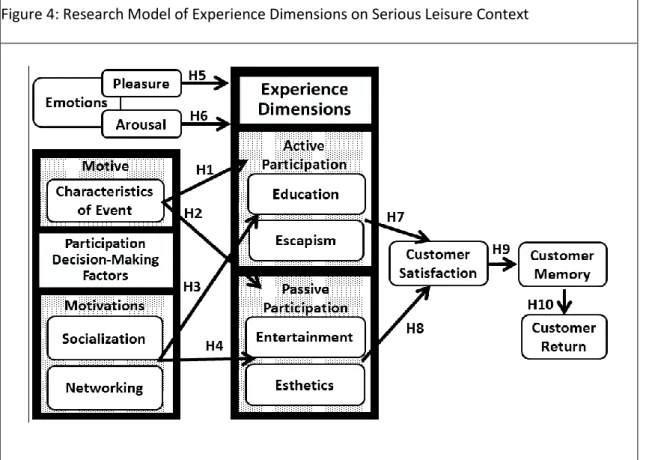
2.5. Research Model of Experience Dimensions on Serious Leisure Context ... 63
2.6. Final Considerations ... 66
3. METHODOLOGY ... 69
3.1. Introductory Remarks ... 69
3.2. Ontological and Epistemological Position ... 69
3.3. Delimitations of the Scope, Limitation and Key Assumptions and Their Rationale ... 71
3.4. Research Process ... 73
3.4.1. Need for Information / Research ... 74
3.4.2. Problem definition ... 75
3.4.3. Research Design ... 75
3.4.4. Sampling Frame ... 81
3.4.5. Data Analysis ... 82
3.5. Final Considerations ... 84
4. EMPIRICAL FINDINGS AND ANALYSIS ... 85
4.1. Introductory Remarks ... 85
4.2. Descriptive statistics ... 86
4.2.1. Participants Profile ... 86
4.2.2. Emotions ... 89
4.3. Exploratory Factory Analysis ... 91
4.3.1. Preliminary Analysis ... 91
4.3.2. Main Analysis ... 93
4.3.3. Post Analysis ... 98
4.4. Structural Equation Modeling ... 99
4.4.1. Theoretical Procedure... 99
17
4.5. Discussion and Implications ... 110
4.6. Final Considerations ... 117
5. CONCLUSIONS ... 121
5.1. Introductory Remarks ... 121
5.2. Conclusions about each research question and suggestions... 124
5.3. Conclusions about the research problem ... 127
5.4. Academic Implications ... 128
5.5. Managerial Implications ... 130
5.6. Limitations ... 131
5.7. Directions and Further Research ... 132
APPENDICES ... 153
Appendix I - Questionnaire in Portuguese ... 153
Appendix II - Questionnaire in English ... 155
Appendix III - Anti-Image Correlation ... 157
Appendix IV - Analysis of Cronbach Alpha ... 159
Appendix V – Confirmatory Factor Analysis Results ... 169
18
LIST OF TABLES
Table 1: Experience and Customer Experience Definition ... 33
Table 2: Features of Experience Concept ... 34
Table 3: Transaction Marketing vs. Experiential Marketing ... 43
Table 4: Comparative Analysis - Experience Economy vs. Co-Creation Value Similarities ... 45
Table 5: Experience Economy vs. Experiential Marketing ... 49
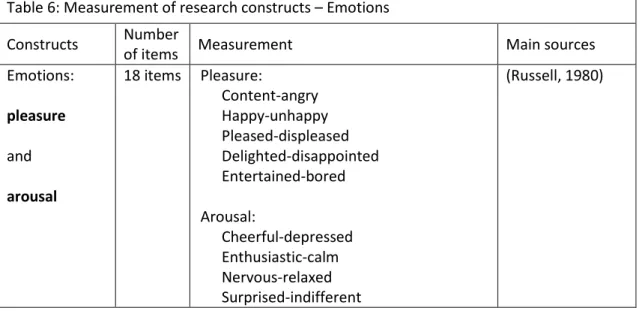
Table 6: Measurement of research constructs – Emotions ... 77
Table 7: Measurement of Research Constructs – Participation Decision-Making Factors ... 78
Table 9: Measurement of research constructs - Customer Experience Assessment ... 80
Table 11: Table Resume of Research Process Stage ... 83
Table 12: Participants’ Socio-Demographic Data ... 87
Table 13: Training Features ... 88
Table 14: Cross Tabulation between Sports Practice and Training Length ... 88
Table 15: Total Variance Explained ... 94
Table 16: Communalities ... 95
Table 17: Rotated Component Matrix ... 97
Table 18: Internal Consistency - Alpha Cronbach ... 98
Table 19: Goodness-of-fit indices used ... 102
19
TABLE OF FIGURES
Figure 2: Characteristics of Experiential Marketing, by Schmitt Model (1999) ... 48
Figure 3: The Evolution of the Memorable Tourism Experience, by Ritchie and Hudson (2009) .... 53
Figure 4: Research Model of Experience Dimensions on Serious Leisure Context ... 64
Figure 5: Research Process, according to Frazer and Lawley (2000) ... 74
Figure 6: Pleasure Emotions ... 89
Figure 7: Arousal Emotions ... 90
Figure 8: General Procedure for Factor Analysis and PCA, by Field (2013) ... 92
Figure 9: Structural Equation Modeling’s Flowchart ... 100
Figure 10: Path Diagram ... 109
21
1. INTRODUCTION 1.1. Background Research
Customer experience has been widely discussed by marketing scholars (Arnold and Reynolds, 2003; Frow and Payne, 2007; Grewal, Levy and Kumar, 2009; Verhoef, Lemon, Parasuraman, Roggeveen, Tsiros and Schlesinger, 2009) and marketing practitioners (Carbone and Haeckel, 1994; Pine and Gilmore, 1998; Poulsson and Kale, 2004; Schmitt, 1999).
Most scholars agree that the experience concept is not supposed to be applied to every service. The first examples of experience used products to create an experience for example Starbucks experience (Michelli, 2007) or coffee shop chains (Nadiri and Gunay, 2013), while most recent examples use interpretation to recreate a context and intensify the experience (Sorescu, Frambach, Singh, Rangaswamyd and Bridges, 2011). This change corresponds to a paradigm shift, from transactional marketing to experiential marketing.
While transactional marketing focused on product features and benefits, assuming that consumer behavior is rational (Schmitt, 1999), experiential marketing complemented this view (Schmitt, 1999), by adding hedonic variables, like feelings, fun and fantasy (Holbrook and Hirschman, 1982).
Aubert-Gamet and Cova (1999) argue that the postmodern interest in service settings has changed. It is less for use-value (e.g. functional) and more “linking value” (e.g. the satisfied need of community). In other words, the changings in social values like dematerialization (Mehmetoglu and Engen, 2011) and the “customer desires experience” (Pine and Gilmore, 1998) has been behind this change in economy, from goods to experience.
22
The nature and scope of tourism sector, in which leisure activity is included, is widely used to apply experience examples. Sometimes the consumer focuses on tourism purpose, other times on the intensity of the experience, relating to the experience economy that conceptualizes customer involvement and connection.
The experience economy aroused as a consequence of globalization and the need of companies remaining competitive, and led to an increased interest in the dematerialization of economic offerings (goods or services, to experience) as a consequence of the postmodern age. A new way of looking at consumption was proposed, where company´s interests no longer came first, on the contrary, customer’s interests and emotional engagement prevailed.
The literature on customer experience explores company and customer perspectives, with a focus on managerial aspects (Pikkemaat, Peters, Boksberger and Secco, 2009). Customer experience, in the management field, is studied as a natural evolution of customer participation in the service process. From the company perspective, customer participation focuses on the number and the quality of customer tasks to obtain profit. Thus, focus falls on service experience creation (Jüttner, Schaffner, Windler and Maklan, 2013), and customer experience quality (Lemke, Clark and Wilson, 2011).
In the marketing field, two opposite perspectives on the customer experience coexist. From the experience company perspective, the focus is on managerial aspects, namely determinants of customer experience, like tools and the processes necessary to create an experience (Frow and Payne, 2007; Gentile, Spiller and Noci, 2007; Payne, Storbacka and Frow, 2008; Puccinelli, Goodstein, Grewal, Price, Raghubir and Stewart, 2009; Verhoef et al., 2009). From the service
23
dominant logic (SDL) stream (Vargo and Lusch, 2004), focus falls on the building of the service experience, on the contact points and relationship with the customer (i.e. co-creation between customer and the service company). From the customer perspective, the focus is on outcomes resulting from the experience (Meyer and Schwager, 2007; Pine and Gilmore, 1998; Poulsson and Kale, 2004; Same and Larimo, 2012; Schmitt, 1999).
The outcomes resulting from customer experience are pointed out as a limitation. There is no consolidated theory on the antecedents and consequences to allow validate these results (Verhoef et al., 2009) so the difficulty is on the lack of a clear definition and nature of experience. Concepts like fun, excitement, meaning, nostalgia, identity, authenticity, hedonism, engagement are often linked to managerial and marketing literature. Experience could also be considered as dynamic, personal and unique which makes it difficult to assess (Battarbee, 2004).
Opposite opinion have Holbrook and Hirschman (1982) when defending the hedonic consumption (e.g. fantasies, feelings, and fun) particularly in leisure situations. Underpinning these ideas are the concepts of customer engagement (i.e. the level of customer participation- passive or active participation) and the form of customer connection (i.e. the level of customer connetion, absorption/intellectual or immersion/physical) (Pine and Gilmore, 1998). The hedonic variables are not used so frequently, once emotions are unstructured and difficult to measure (Shaw and Ivens, 2005). Customer experience associated to products is more usual (Verhoef et al., 2009).
1.2. Research Purpose
We position our research in the experiential research used in consumer behavior and marketing literature. Two streams of thought are key for our research.
24
Firstly, the experience economy, focused on business performance improvement (product or service differentiation via customers’ experience), which includes two new dimensions: active customer participation and immersive customer connection providing a unique and memorable experience to customer (Pine and Gilmore, 1998).
Secondly, the experiential marketing, focused on the customer as human being with rational and emotional actions, whose main purpose is to seek pleasure.
Therefore, the purpose of this thesis is to analyze experience dimensions in serious leisure context, from customer’s perspective, in order to measure the connection of the customer to the experience event. We use Pine and Gilmore’s (1998) model due to the capability of integration of these two perspectives. These authors used the experience implementation to capture customer’s attention, and above all give the possibility for customer to decide, in terms of level of participation and connection with the experience. Pine and Gilmore (1998) present five principles to achieve a memorable experience.
1.3. Research Problem
It is widely accepted that customer experience concept is an effective way to keep customer’s attention on their business (Gentile, Spiller and Noci, 2007; Grewal, Levy and Kumar, 2009; Meyer and Schwager, 2007; Shaw and Ivens, 2005).
In the late years scholars proposed questions like:
“What creates experience?” (Mehmetoglu and Engen, 2011:241);
25
“What experience do we want to create in the long-term for our customers?” (Schmitt, 1999:66);
“What are the ingredients of a commercial experience that are most likely to provide
product differentiation and competitive advantage?” (Poulsson and Kale, 2004:268);
“How can the visitor be engaged in a way that will individualize the experience, exceed
their expectations, prove memorable and lead ultimately to advocate status?” (Leighton,
2007:120);
“How are experiences remembered?” (Schmitt, 2010:77).
Customer experience still remains a challenge for researchers. Tynan and McKechnie (2009) pointed out the need of marketing practitioners to take care of the academic’s contributions in these matters, in spite of being the pioneers in this issue and achieving managerial success.
Several scholars (Carreira, Patrício, Natal Jorge, Magee and Hommes, 2013; Gentile, Spiller and Noci, 2007; Healy, Beverland, Oppewal and Sands, 2007; Petermans, Janssens and Van Cleempoel, 2013; Verhoef et al., 2009) argue that the academic focus on efficiency process (like determinants, customer experience creation and experience dimensions) and strategy (Carbone and Haeckel, 1994; Pine and Gilmore, 1998; Schmitt, 1999). From this point of view, experience itself is an output as similar to service in which customer is considered an external element.
Other scholars (Pine and Gilmore, 1998; Poulsson and Kale 2004; Pullman and Gross, 2004; Same and Larimo, 2012; Tung and Ritchie, 2011) argue that customer experience concerns the decision-making process, customer behavior and seeks to understand customer’s options. According to this point of view, customer is considered an internal element of the experience.
26
Most of the studies inquire experience as a holistic event. We consider decision-making process - as antecedents, experience dimensions - as experience itself, (Getz, 2008; Otto and Ritchie, 1996; Tung and Ritchie, 2011) and customer behavior - as output (Hosany and Witham, 2010; Mehmetoglu and Engen, 2011; Oh, Fiore and Jeoung, 2007).
Our research problem is related to the deep connection of customer with the experience. This research problem is potentially important to academics and practitioners. Our perspective also adopts the customer experience concept as a different way to deliver a service, considering the integrative approach. Academic perspective focuses the customer experience on managerial action of experience, and the standpoint is costumer “stimulus-reaction”. It means customer experience is designed to provoke (stimulus) an action on customer (reaction). The process is still centered in purchase benefits. In our perspective, the knowledge of the reason for customer participation in events (i.e. the motives and motivation factors, as antecedents) helps to design the experience and to enhance the customer experience. This way, academic’s perspective is coming closer to the practitioner’s perspective. Practitioner perspective is oriented to the principle “from stimulus to reaction”. The focus is on customer reaction considering experience holistically and rationally, in which emotional aspects of consumer behavior are also included.
In line with the above, three research questions are explored in this thesis: 1. What decision-making factors influence customer experience?
2. What specific experience dimensions (Education, Escapism, Esthetic or Entertainment) are more valued by customers, in a leisure context?
27
Two ideas are commonly accepted and justify this research, the purpose of experience concept is a distinct economic offering (Pine and Gilmore, 1998) and the customer desire to have pleasure (Holbrook and Hirschman, 1982). Recently, the notion that customers are willing to pay for experience (Mascarenhas, Kesavan and Bernacchi, 2006) increases the importance of this issue. Other factors related to outcomes, like value creation (Prahalad and Ramaswamy, 2004), customer loyalty (Haeckel, Carbone and Berry, 2003; Mascarenhas, Kesavan and Bernacchi, 2006; Reichheld, 2006) and customer satisfaction (Pullman and Gross, 2004), from company perspective are pointed out to explain the growing interest in customer experience (Jüttner et al., 2013).
Our initial assumption is that the findings from this research have potential different applications. The main reason in the integrative approach means we use the experience dimension from company perspective and the motives and motivations (as antecedents) and customer satisfaction, memory and return (as outcomes) from customer perspectives. The understanding of customer’s decision-making factors and behavior can be the starting point to future research.
1.4. Methodology
Creswell (2003) presents three different approaches to research design: qualitative, quantitative and mixed methods. Our choice is underpining the theoretical perspective of customer experience, the strategies, the data collection methods and data analysis adopted in empirical paper present in the literature review.
In this study, we selected the quantitative approach. This choice finds justifications on the purpose of the thesis’s research questions seek to obtain direct answers and the results are rigorous and objective. The survey-based questionnaire is considered the appropriate approach to collect data, and was carried out using trained personnel to obtain the information.
28
1.5. Report Outline
This report has the following parts: literature review (chapter 2), methodology (chapter 3), empirical findings and analysis (chapter 4) and conclusions (chapter 5), which we briefly describe bellow.
Chapter 2 - Literature review: presents the theoretical grounding of the research, allowing to identify research on customer experience and to develop a conceptual model of customer experience dimensions, based on previous theories and key models. Literature review falls upon decision-making factors, experience dimensions and customer outputs. The experiential marketing paradigm is reviewed.
Chapter 3 – Methodology: describes the research design used to collect data, to test the hypotheses and answer the research questions.
Chapter 4 - Empirical Findings and Analysis: presents the statistical analyses and results obtained by testing the conceptual model in a serious leisure context.
Chapter 5 – Conclusion: Three main groups of information are presented. The first one sums up the results on each research hypothesis and research problem. The second group presents academic and managerial implications, and the last one introduces the research limitations and further research suggestions.
29
2. LITERATURE REVIEW 2.1. Introductory Remarks
The importance of experience is recognized by practitioners and academics in marketing research and even so, some difficulties are identified. The first one refers to experience definition. Caru and Cova (2007) argue about the lack of solid foundation, and one reason pointed is that contributions came from marketing, management, philosophy and psychology field (Gentile, Spiller and Noci, 2007; Petermans, Janssens and Van Cleempoel, 2013). Palmer (2010) presents a critical assessment of customer experience definition in marketing field and relates it to the definition´s ambiguity. Sometimes, experience is considered as a noun other times as a verb (Ek, Larsen, Hornskov and Mansfeldt, 2008; Tynan and McKechnie, 2009). Other difficulty refers to the few academic research that has been done (Verhoef et al., 2009) to provide models to use in practice (Grewal, Levy and Kumar, 2009).
Two different, but complementary approaches, are present in the literature review - company and customer perspective. Experience economy concept, defined by Pine and Gilmore (1998), is able to join, at the same time, these two approaches in an integrative way. The core assumption of experience economy is adding value to products or services to differentiate them and guarantee economic advantage. To do this, the authors used elements controlled by the company. The experience is focused on a concrete theme, well planned excluding negative clues and including hedonic and utilitarian aspects, to appeal to customer senses (Pine and Gilmore, 1998). Underpinning these ideas is the “desire of experience” from customer, already identified by Carbone and Haeckel (1994:9). The strategy used is designing a memorable experience to engage customer in a “personal, unique and memorable experience” (Pine and Gilmore, 1998).
30
The authors give examples using theme restaurants like Hard Rock Café, Plant Hollywood or House of Blues to explain the experience strategy used to engage customer.
This chapter is structured in order to present the theoretical grounding of the research, allowing the identification of research hypothesis and develop a conceptual model of customer experience dimensions, base on these main items:
- experience concept (i.e. using company perspective) and customer experience concept (i.e. using consumer perspective), to understand the complexity of the theme;
- comparative analysis of experience from marketing perspective, to define the experience boundary and justify our position;
- memorable tourism experience, to understand this concept evolution, the decision-making factors that influence customer experience and the customer outputs pointed at literature review.
2.2. Experience and Customer Experience Concepts
Experience has been considered a topical issue in the last three decades and generally there are no recognized definitions of experiences. This issue interests academics (Arnold and Reynolds, 2003; Frow and Payne, 2007; Gentile, Spiller and Noci, 2007; Grewal, Levy and Kumar, 2009; Healy
et al., 2007; Holbrook and Hirschman, 1982; Puccinelli et al., 2009; Verhoef et al., 2009) and
practitioners (Berry, Carbone and Haeckel, 2002; Carbone and Haeckel, 1994; Meyer and Schwager, 2007; Pine and Gilmore, 1998; Poulsson and Kale, 2004; Shaw and Ivens, 2005; Schmitt, 1999).
The concepts of experience and customer experience relate to the same situation, although with different perspectives. Experience concept “refers to the process of undergoing and living through
31
an event” (Palmer, 2010:197) and customer experience is defined as “the internal and subjective response customers have to any direct or indirect contact with a company” (Meyer and Schwager,
2007: 118).
The importance of experience concept emerges from the convergence of “(1) new technology to
fuel innovative experiences, (2) a more sophisticated, affluent, and demanding consumer base, and (3) escalating competitive intensity” (Knutson, Beck, Kim and Cha, 2007:33).
The main topics that emerge from the importance of experience are personal way and experience clues (Murray, Foley and Lynch, 2010a). The experience concept brings value to service and two main differences are introduced: the consideration of the person (instead of consumer segmentation) and the use of the five senses to engage customer (Pine and Gilmore 1998). The personal way refers to the type of involvement that customer has with the experience (i.e. rational, emotional, sensorial, physical or even spiritual (Gentile, Spiller and Noci, 2007)). The last topic refers to experience clues, according to Pine and Gilmore (1998) this is the way service provider transmits a message to customer. The first three key experience-design principles, proposed by Pine and Gilmore (1998), are related to this, the exact definition of the “theme
experience”, in order to avoid negative WOM or complaints; “harmonize impressions with positive clues”, to increase customer engagement and “eliminates negative clues” which provoke
distractions from the theme.
Experience concept has different definitions adopting different aspects. In Table 1 we present some examples of experience definition, as well as the main features (as identified by Helkkula, 2011), present in each definition:
32
scope - the subjectiveness of experience;
content - use the phenomenological approach (i.e. is assumed to be specific to an individual and situation) and experiential approach (i.e. consider both utilitarian and emotional aspects);
context-specific-events, activities, encountering;
some effects on customer conditions (i.e. interaction with company, or with other customers).
Summing up, experience is “internal and subjective response” (Meyer and Schwager, 2007:118), is “a result of encountering” (Schmitt, 1999:57), is “interactions between the customer and company” (Poulsson and Kale, 2004:271). Experience, provokes effects on customer. The author Schmitt (1999) identifies the effects in terms of sensory, emotional, cognitive and behavioral while LaSalle and Britton (2003) refer a reaction. Experience results in outputs. Some internal to customer, “affects the way you feel or knowledge or skill from doing” (Same and Larimo, 2012:481), relational values (Schmitt, 1999) or memory (Pine and Gilmore, 1998), other external to customer, exchange (Day, 2000) or WOM, criticisms, advertising, news reports, reviews (Meyer and Schwager, 2007).
33 Table 1: Experience and Customer Experience Definition
Authors Definition n at u re scop e con ten t - p h en o m en o n con ten t - exp eri en tia l Con text -s p eci fic Ef fe ct s o n cu sto m er Pine and Gilmore (1999:12)
“events that engage individuals in a personal way” X X X X X X
Schmitt (1999:57)
“Experiences occur as a result of encountering,
undergoing or living through things. Experiences provide sensory, emotional, cognitive, behavioral, and relational values that replace functional values.”
X X X X X X
Day (2000)
Experience described a relationship or goods-services experiences spectrum with a
transactional exchange on one end and a collaborative exchange on the other.
---- ---- X X X X
LaSalle and Britton (2003)
The customer experience originates from a set of interactions between a customer and a product, a company, or part of its organization, which provoke a reaction.
---- ---- X ---- X X
Poulsson and Kale (2004:271)
“experience is a result of the interaction between the customer and company, and the act of co-creation between the two and the output is a memory of the encounter”
---- ---- X ---- X X
Meyer and Schwager (2007:118)
“Customer experience is the internal and
subjective response customers have to any direct or indirect contact with a company. Direct contact generally occurs in the course of purchase, use, and service and is usually initiated by the customer. Indirect contact most often involves unplanned encounters with representations of a company’s products, services, or brands and takes the form of word-of-mouth, recommendations or criticisms, advertising, news reports, reviews, and so forth.”
X X X X X X
Same and Larimo (2012:481)
“something that affects the way you feel or knowledge or skill from doing, seeing or feeling things”
X X ---- X ---- X
34
In this thesis, we adopt Pine and Gilmore’s experience definition, once it underpins important ideas. It considers an “event” as a phenomenon (i.e. one event is enough to have an experience), “engage individuals” (i.e. customer involvement during the experience), “in a personal way” corresponding to an internal and subjective response from customer. Pine and Gilmore (1998) added the feature of a successful experience, as “unique, memorable and sustainable over time”. These aspects pointed towards the customer experience results.
This definition leads us to another concept – the nature of experience. This concept is viewed holistically, it means experience encompasses all moments of customer interaction (i.e. with company, other customer, landscape environment) directly or not controlled by the company, which affect customer experience (Carreira et al., 2013; Gentile, Spiller and Noci, 2007; Healy et
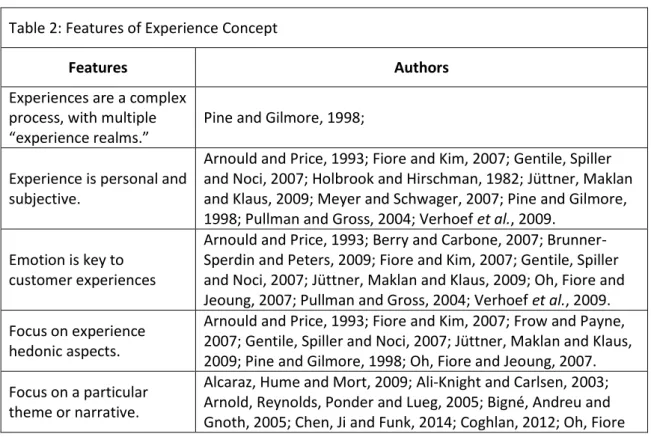
al., 2007; Verhoef et al., 2009). In Table 2, we present the features of experience concept from
literature review and adopting the Petermans, Janssens and Van Cleempoel’s (2013:3) synthesis.
Table 2: Features of Experience Concept
Features Authors
Experiences are a complex process, with multiple “experience realms.”
Pine and Gilmore, 1998;
Experience is personal and subjective.
Arnould and Price, 1993; Fiore and Kim, 2007; Gentile, Spiller and Noci, 2007; Holbrook and Hirschman, 1982; Jüttner, Maklan and Klaus, 2009; Meyer and Schwager, 2007; Pine and Gilmore, 1998; Pullman and Gross, 2004; Verhoef et al., 2009.
Emotion is key to customer experiences
Arnould and Price, 1993; Berry and Carbone, 2007; Brunner-Sperdin and Peters, 2009; Fiore and Kim, 2007; Gentile, Spiller and Noci, 2007; Jüttner, Maklan and Klaus, 2009; Oh, Fiore and Jeoung, 2007; Pullman and Gross, 2004; Verhoef et al., 2009. Focus on experience
hedonic aspects.
Arnould and Price, 1993; Fiore and Kim, 2007; Frow and Payne, 2007; Gentile, Spiller and Noci, 2007; Jüttner, Maklan and Klaus, 2009; Pine and Gilmore, 1998; Oh, Fiore and Jeoung, 2007. Focus on a particular
theme or narrative.
Alcaraz, Hume and Mort, 2009; Ali-Knight and Carlsen, 2003; Arnold, Reynolds, Ponder and Lueg, 2005; Bigné, Andreu and Gnoth, 2005; Chen, Ji and Funk, 2014; Coghlan, 2012; Oh, Fiore
35
and Jeoung, 2007; Pine and Gilmore, 1998; Pullman and Gross, 2004;
Experiences is defined a specific time and place.
Petermans, Janssens and Van Cleempoel, 2013; Pine and Gilmore, 1998; Pullman and Gross, 2004; Verhoef et al., 2009. Focus on experience
design to customers’ senses appeal.
Carbone and Haeckel, 1994; Pine and Gilmore, 1998; Pullman and Gross, 2004; Quadri-Felitti and Fiore, 2012; Schmitt, 1999. Source: Petermans, Janssens and Van Cleempoel (2013)
Tynan and McKechnie (2009:502-503), after reviewing and reassessing the experience concept from marketing literature, propose that experience should be viewed as: the process, the customer participating in the activity, the effect of the experience in customer or even the outcomes. Each of these topics is analyzed into the following subchapters in order to understand the complexity of the theme.
2.2.1. Experience Process
The experience process itself is viewed from company perspective and is similar to service attributes approach. The experience is thought in a holistically way (Payne, Storbacka and Frow, 2008) focuses on process aspects directly controlled by the company (Grewal, Levy and Kumar, 2009) and the assessment is done through quality approach (Palmer, 2010) using specific attributes (Lemke, Clark and Wilson, 2011).
The first academics have the same logic to think of experience concept as they think of service. Grewal, Levy and Kumar (2009) developed a conceptual paper in experience-centric companies’ perspective using customer experience management as the way for companies to achieve sustainable competitive advantages. The authors use macro-economic factors to explain the experience concept. In this paper, authors suggest that retailers “should understand what
36
customers have with company.” This approach is similar to supply chain management of service.
It seems that experience is an extension of service and in this process nothing changes, the purpose (i.e. economic factors), the measure (i.e. promotion, price, merchandise, supply chain and location) and the concern with service encounter (i.e. guarantee customer satisfaction) and customer participation at the end of the process.
Knutson et al. (2007) propose to develop a valid and reliable Consumer Experience Index (CEI) using customer’s buying process. The components these authors selected were: (1) expectations and perceptions of service quality, (2) the consumer’s experience with the organization, (3) value, and (4) satisfaction. The whole process is designed by the company and at the end, the assessment is based on service provider criteria.
We do not consider the academic perspectives, once customer is considered an external element of experience. The experience is thought to customer and the customer participation is required at the end of the process.
The first practitioners thought about experience concept focused on managerial aspects as the way to keep customer’s attention, (see Carbone and Haeckel, 1994 or Pine and Gilmore, 1998) and customer participation in the activity (Tynan and McKechnie, 2009). The first examples of experience are products or service customization, for example Starbucks experience (Michelli, 2007) or coffee shop chains (Nadiri and Gunay, 2013) which communicated with their customer using slogans, like Burger King “Have it your way” (Puccinelli et al., 2009: 20). Companies intend to demonstrate their respect to their customers by introducing the experience concept in Mission Statement, like Dell Computers (Verhoef et al., 2009: 31). The main purpose is improving
37
business performance by beginning the experience as the economic offering (Pine and Gilmore, 1998).
Carbone and Haeckel (1994) advise companies to rethink their business, by incorporating customer experience concept in a management way. According to Carbone and Haeckel (1994:9) “customer always gets an experience”. So it is important to add design to the business, engineering customer experience and eliminate negative clues, to ensure the desired result. The authors define experience as the “takeaway impression” resulting from the encounters of products and services of a business. Authors do not refer a specific business to apply the experience concept. The creation of customer experience is not a new concept, however the use of experience as strategy to establish and maintain customer preference connected to a company, is. The importance is the systematic approach.
Pine and Gilmore (1998) were the pioneers in the introduction of the experience economy concept in the marketing field. The authors defined experience as “intentionally use of service as
stage and goods as purpose to engage individuals.” For these authors experience corresponds to
a higher level of economic offering to improve company’s competitive advantage, not excluding any economic sector, by providing personal, unique and memorable experiences to their customers. The focus is on the interaction with the customer through the engagement of customer’s emotions. The authors define five steps to develop the experience “1) theme the
experience; 2) harmonize impressions with positive clues; 3) eliminate negative clues; 4) mix in memorabilia; and 5) engage all five senses.” The main target is following these clues in order to
38
At the same time as economy experience concept arises, Schmitt (1999) proposing other concepts the experiential marketing in opposition to traditional marketing. The main goal is providing a pleasurable experience to a customer that assumes, as a whole, rational and emotional decisions. It means that, the traditional customer decision-making process (defined with the steps: need recognition, information search, evaluation of alternatives, purchase and consumption) is no longer enough. The author proposes five different strategies: sensory experiences (sense); affective experiences (feel); creative cognitive experiences (think); physical experiences, behaviors and lifestyles (act); and social-identity experiences (relate) saved in mind the customers.
Summing up, all papers (Carbone and Haeckel, 1994; Pine and Gilmore, 1998 and Schmitt, 1999) intend to create value through experience to attract customer attention (Berry, Carbone and Haeckel, 2002:1), instead of defending the idea of “low prices and innovative products” (Grewal, Levy and Kumar, 2009). Practitioner authors adopt company perspective and defend the value formation process. We agree and adopted the practitioners’ perspective focusing our attention to customer participation, like Pine and Gilmore (1998) argue.
2.2.2. Customer Participation
Two structural ideas depend on customer participation: customer engagement (Pine and Gilmore, 1998; Pullman and Gross, 2004; Verhoef et al., 2009), and the level of customer involvement (Pine and Gilmore, 1998; Oh, Fiore and Jeoung, 2007).
The first structural idea - customer engagement - occurs, when customer perceives that experience has meaning to him/her (Same and Larimo, 2012). Although, two approaches can be
39
adopted, customer can feel experience (i.e. participates as internal element) or can contribute to experience (i.e. participates as external element).
Pine and Gilmore (1998) argue uses the company perspective, however leaves to customer the decision to participate (i.e. to be engaged) and the experience occurs in their mind (it is personal, unique). From this point of view, customer is considered as internal element of experience. Poulsson and Kale (2004) propose an operational definition of commercial experience and focus experience on "an engaging act of co-creation between a provider and a consumer” also with profit goals and customer interaction. The first impression of Poulsson and Kale’s (2004) definition is the same idea used by Pine and Gilmore’s (1998) definition, however with different words. In a second look, the perspective is opposite. Poulsson and Kale (2004:271) use the same elements of service: the customer (a subject), the experience provider (an object), and the interaction between the two (a co-creation act). This position leads authors to the need of explaining the difference between service (i.e. “is something that is done for you, ex. hair cut”) and experience (i.e. “does something to you, ex. entertain”) concepts. From this point of view, customer is considered as external element.
The second structural idea - customer involvement – depends on the meaning and importance of experience to customer, and the level of connection among the experience’s activities, could be rational, emotional, sensorial, physical and spiritual (Gentile, Spiller and Noci, 2007; Poulsson and Kale, 2004; Schmitt, 1999; Tung and Ritchie, 2011).
Considering customer as internal element of the experience (i.e. considering engagement and involvement) it is difficult to replicate the experience, once it happens in customer´s mind (Pine
40
and Gilmore, 1998). Summing up, customer participation in experience process sends us to research problem, i.e. customer is deeply connected with the experience.
2.2.3. The Effect of the Experience in Customer
“What creates experience?” was a question posed by Mehmetoglu and Engen (2011:241).
Bearing in mind a positive extraordinary experience and the creation of experience through process, Mossberg (2003) proposed the inclusion of: “1) dynamic process; 2) a strong social
dimension; 3) the integration of the components; 4) the customer involvement; 5) a process dependent on the context and associated with something new; and 6) to experience output imply satisfaction” (cited in Mehmetoglu and Engen, 2011).
Schimtt (1999) thinking about the company perspective proposes five strategies or types of experience:
Sensory experience (SENSE) engaging customer through the five senses (sight, sound, touch, taste and smell).
Affective experience (FEEL), the focus is the identification of stimuli that trigger the emotion, that company wants.
Creative cognitive experience (THINK), proposes divergent thinking from customer.
Physical experiences, behaviors and lifestyles (ACT) sometimes inspired by stars or athletes.
Social-identity experience (RELATE) be part of something, like the Harley-Davison culture.
Poulsson and Kale (2004) pointed out, from customer perspective, the need of an objective outline of sensations of experience and mention that one or more sensations (i.e. personal relevance, novelty, surprise, learning, and engagement) have to be felt by the customer to define an encounter as an experience (Poulsson and Kale, 2004). From our perspective, personal
41
relevance, novelty and surprise are antecedents to experience. Poulsson and Kale (2004) define personal relevance “as an individual's internal state of arousal, activation, and preparedness to
engage in a specific experience”. Novelty is defined “as a change in stimulus conditions from previous experience." And surprise is the element that measures the expectation’s final result. The
other two sensations, learning, and engagement, are considered by us as part as experience itself. Poulsson and Kale (2004) mention motivation, clues, response and reinforcement which imply customer to learning. The engagement sensation adopt has the same sense that Pine and Gilmore’s (1998).
The customer interaction is managed to provide customer satisfaction and to create memorable experiences (Pine and Gilmore, 1998).
2.2.4. Customer Experience Outcomes
The experience outcome refers to the result from customer’s experience. From literature review, the satisfaction concept is the most researched topic (Kozak, Bigné, González and Andreu, 2003) and the different approach focuses on different perspectives and uses different theories (Ryan, 1995). Giese and Cote (2000:1) define three general components in literature review: “1)
consumer satisfaction is a response (emotional or cognitive); 2) the response pertains to a particular focus (expectations, product, consumption experience, etc.); and 3) the response occurs at a particular time (after consumption, after choice, based on accumulated experience, etc.).”
Garg, Rahman and Kumar (2010) argue that customer experience leads to customer satisfaction, which functions as customer retention. Literature review relates the role of customer satisfaction on customer behavior is extensively explored (Kim, Suh and Eves, 2010) using word-of-mouth or
42
loyalty (Hosany and Witham, 2010; Wong, 2013). Satisfaction is an outcome measure, however, does not indicate the intention of customer return (Pullman and Gross, 2004).
Mediating customer satisfaction and customer return (i.e. repatronage intention) we include customer’s memories. This relation is less clear (Oh, Fiore and Jeoung, 2007). From Pine and Gilmore (1998) memory perspective, is remembering a particular event. Made a parallelism with Giese and Cote (2000) of satisfaction analysis, memory corresponds to a response that respected both the cognitive and affective response. Pine and Gilmore (1998) also added the memorable experience, which included the experience’s intensity.
According to this position, we adopted customer experience result as individual, and the assessment of the results is immediate as satisfaction and longitudinal as memory.
2.3. Experience Boundary – Comparative Analysis
In Introduction (chapter 1) we defend two concepts as key to this thesis, economic experience and experiential marketing, which allows us to delimit our research problem. Comparative analysis are using transactional marketing and co-creation perspectives, in order to express our point of view and understand the motives to select Pine and Gilmore’s (1998) Model.
2.3.1. Transaction Marketing vs. Experiential Marketing
The first boundary is related to customer behavior evolution from traditional to experiential marketing stream. Comparative analysis, according to Grundey (2008), is present in Table 3.
43
Transaction Marketing is thought by the company to customer and has four featured principles, which are:
Focus: is on product’s functional characteristics and superiority, it means customer looks at the product’s attributes that prove to customer to have the most benefits (e.g. functional characteristics) and superiority (e.g. the best product);
Marketing segmentation: company defines product’s attributes and compares them to competitors’ product, taking in consideration the nearest within its geographic limits;
Consumption decision-making process: customer runs seven phases to purchase the product: problem, search of information, estimation of versions, purchase, consumption, estimation of versions after purchase release of the problem and decision or utilitarian value;
Methods: focuses on the principle “stimulus-reaction”, usually the methods applied are analytical, quantitative and qualitative (i.e. verbal questionnaire).
Table 3: Transaction Marketing vs. Experiential Marketing
Attributes Transaction Marketing Experiential Marketing Focus - Oriented to product functional
characteristics and superiority
- Oriented to customer experience
Marketing segmentation
- Product segmentation, based in products’ functional characteristics - Marketing segmentation, base on geographic proximity
- Holistic experience concept
Consumption decision-making process
- Information Processing Model (i.e. consumer as a rational thinker) - Utilitarian value
- Hedonic Consumption Model (i.e. consumer as rational and emotional - Hedonistic value Methods - Focus the principle
“stimulus-reaction”
- Focus the principle
“from stimulus to reaction” Source: Grundey (2008)
Analyzing the Experiential Marketing (see Table 3) concept in the some aspects, there are different meanings:
44
Focus: is on customer engagement in a physical, mental, emotional, social and spiritual way;
Marketing segmentation: company focuses on aspects that provoke experience in customer or other values related to life style;
Consumption decision-making process: is divided into four major stages: pre-consumption (e.g. imagining the experience); consumption (e.g. involving the environmental space and the service encounter), core consumption experience (e.g. the transformation process) and the remembrance of consumption (e.g. re-live a past experience);
Methods: can be used the same methods applied in traditional marketing, however the focus is not on “stimulus” rather on “reaction” considering the individuality of consumer and emotion.
In summary, the Transaction Marketing focuses on utilitarian values, with most benefit using rational point of view of consumer and Experiential Marketing focuses on hedonistic value, using both rational and emotional aspects of consumer behavior. This aspect justifies our option for the experiential marketing paradigm stream.
2.3.2. Experience Economy vs. Co-Creation Value
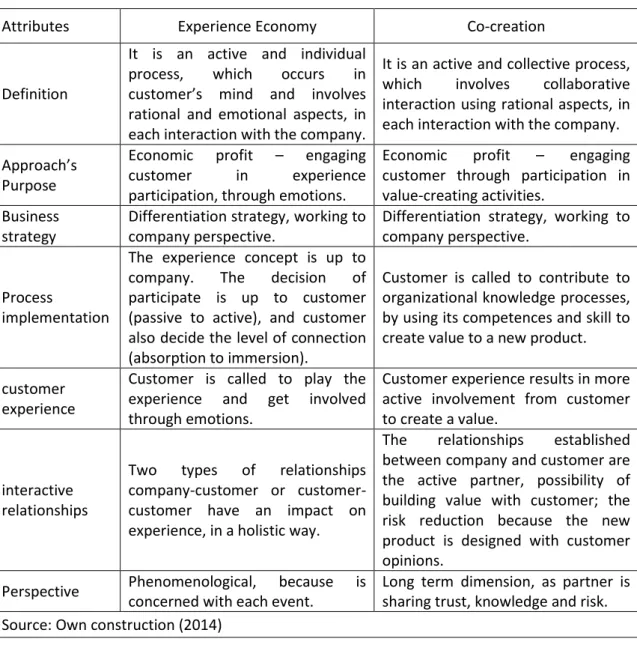
The second boundary on customer experience is between Experience Economy and Co-Creation Value. These two approaches have some similarities and strong divergences (see Table 4).
In terms of similarities, the need of companies reinventing their business based on economic advantage and profit focus on their customers (see Table 4). The main target, in both approaches, is improving companies’ business. Company adopts strategies to provide differentiation from
45
competitors, using post-modern consumer’s needs, i.e. the desire of experience and the outcome of experience is a pleasant memory to customer.
The first divergences refer to the way, experience is applied. To experience economy concept, experience is considered the fourth stage of economic offering, i.e. corresponds to adding value to service. However, customer engagement is through emotions. To co-create value, the scope is economic advantage, using the same post-modern consumer’s needs. Nevertheless, customer participates to increase organizational knowledge.
Table 4: Comparative Analysis - Experience Economy vs. Co-Creation Value Similarities
Attributes Experience Economy Co-creation
Definition
It is an active and individual process, which occurs in customer’s mind and involves rational and emotional aspects, in each interaction with the company.
It is an active and collective process, which involves collaborative interaction using rational aspects, in each interaction with the company. Approach’s
Purpose
Economic profit – engaging customer in experience participation, through emotions.
Economic profit – engaging customer through participation in value-creating activities.
Business strategy
Differentiation strategy, working to company perspective.
Differentiation strategy, working to company perspective.
Process
implementation
The experience concept is up to company. The decision of participate is up to customer (passive to active), and customer also decide the level of connection (absorption to immersion).
Customer is called to contribute to organizational knowledge processes, by using its competences and skill to create value to a new product.
customer experience
Customer is called to play the experience and get involved through emotions.
Customer experience results in more active involvement from customer to create a value.
interactive relationships
Two types of relationships company-customer or customer-customer have an impact on experience, in a holistic way.
The relationships established between company and customer are the active partner, possibility of building value with customer; the risk reduction because the new product is designed with customer opinions.
Perspective Phenomenological, because is concerned with each event.
Long term dimension, as partner is sharing trust, knowledge and risk. Source: Own construction (2014)
46
The second divergence refers to the type of service to apply experience. Pine and Gilmore (1998) defend not all services are adequate to include experience. The most appropriate are those that provide pleasure. The co-creation of value is preferably applied to service / product with a high level of competitiveness, because it captures customer’s attention more easily.
Summing up, both approaches are business strategies focusing on customer experience and providing interactive relationships. In both approaches customer is an internal element of experience, however, in experience economy, the experience occurs in customer’s mind, and in co-creation value is internal because it contributes with ideas or belongs to a team of new product development. In both approaches, companies encourage customer towards a more active involvement. In experience economy rational and emotional aspects are valued from customer and company perspective and in co-creation of value, the rational aspect is the most considered. Based on the above explanation, experience economy is the concept used in this thesis.
2.3.3. Experience Economy vs. Experiential Marketing
In 1982, Hirschman and Holbrook introduce the hedonic consumption which considers the emotional aspect of consumer instead of rational value accepted at the time. In the same year, these authors (Holbrook and Hirschman, 1982) argued that consumer behaviour focuses on symbolic, hedonic and esthetic nature of consumption (i.e. the experiential dimension of consumer) that is directly related to fantasies, feelings and fun.
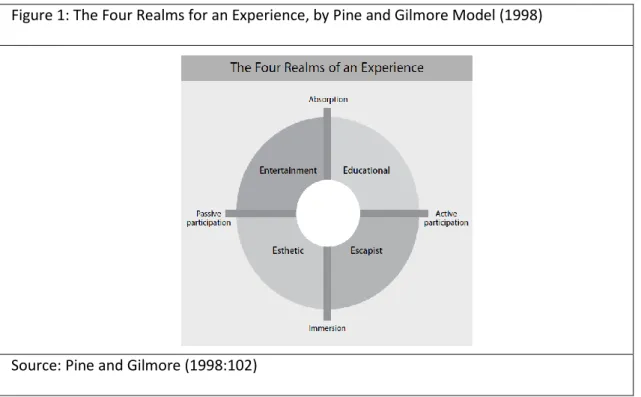
Pine and Gilmore (1998) built a model to express Experience Economy concept, with four experience dimensions education, esthetics, entertainment and escapism. This model focuses on what experience does to the customer, taking into consideration the level of customer
47
participation (active or passive) and the form of customer connection (absorption or immersion) as depicted in Figure 1 – The four Realms for an Experience, by Pine and Gilmore Model.
The authors define absorption as “a person’s attention by bringing the experience into the mind” (Pine and Gilmore, 1999:31) and the utilitarian consumption decision-making process value is considered. In the other YY axis extreme – is immersion concept which corresponds to “a physical
part of the experience itself” (Pine and Gilmore, 1999:31). The hedonic consumption is present in
this dimension. The experience outcome is memorable experience, going to the same pairs of output/consequences proposed by Holbrook and Hirschman (1982): function/fun, results/enjoyment and the purpose/pleasure.
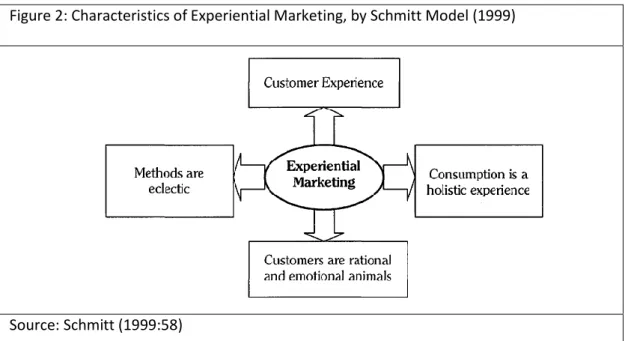
The experiential marketing concept introduces four innovations in marketing theory, presenting a model (Figure 2 – Characteristics of Experiential Marketing).
Figure 1: The Four Realms for an Experience, by Pine and Gilmore Model (1998)
48
In YY axis, the author considered the customer as element of an experience and as individual person. The first innovation considered customer as human beings with both rational and emotional aspects which purpose is achieving pleasurable experience. The second innovation
focuses on consumer experiences. The functional values present in customer decision-making
processes (need recognition, information search and evaluation of alternatives, purchase and consumption) are changing.
In XX axis, Schmitt (1999) considered the experience (as a phenomenon) and the method to use. The third aspect defines consumption as a “holistic experience” by selling dreams and statutes with a product. And the last aspect of experiential marketing concept innovation, suggests the “use of different methodologies” to measure customer experience. In traditional marketing, methodologies focus on the nature of products, consumer behavior and competitive activity in the marketplace. In this approach customer is the target, however he/she only interacts in the purchase phase.
Figure 2: Characteristics of Experiential Marketing, by Schmitt Model (1999)
49
Table 5, compares the Experience Economy and Experiential Marketing concept and respective model to highlight aspects to be used in our conceptual model.
Table 5: Experience Economy vs. Experiential Marketing
Schmitt (1999) Pine and Gilmore (1998)
Concept
EXPERIENTIAL MARKETING – customer are considered as rational and emotional human beings, who want to achieve a pleasurable experience.
EXPERIENCE ECONOMY – represents the next step of the progress of value (e.g. commodities, goods, service and experience).
Customer position to experience
Four Key Characteristics of Experiential Marketing:
1. A Focus on Customer Experiences
- “occurs as result of encountering” (e.g. customer is an external element and benefits from it.)
- “Experiences provide sensory,
emotional, cognitive, behavior, and
relational values that replace
functional values.” (and service
provider sees how customer reacts).
Experience occurs in the customer’s mind. (e.g. customer is an internal element of experience).
- Customer decides to participate active or passively and with different degrees of connection (absorption to immersion). Using Schmitt (1999) scale sensory, emotional, cognitive are present. It is not explicit the
behavioral and relational values.
Holistic experience concept
2. A Focus on Consumption as a Holistic Experience
Refers to a broad concept. The focus is not just in the isolated product, but also, socio-cultural consumption.
Holistic experience: this concept is present. The authors do not isolate each part of the dimensions. The experience is considered as a whole.
Customer choices
3. Customers are Rational and Emotional Animals
- customer engages in rational choice. - customer driven by emotions because experience is fantasy, feelings and fun.
Customers are Rational and
Emotional: these issues are present in Pine and Gilmore’s (1998) model. Customer rationality is expressed in the level of customer participation (from passive to active) and the customer emotions are expressed in the level of involvement (from absorption to immersion).
Method
4. Methods and Tools are Eclectic
Every method can be used on experiential marketing only depends on the objective.
All methods can be used to design a Memorable Experience through the engagement of the customer´s five senses.
50
Customer experience concept is the new customer-oriented approach accepted by marketing academics and practitioners, which allow companies to achieve their goals. From this comparative analysis the Experience Economy and Experiential Marketing concepts are too similar. However, the reasons for their options are different. Experience Economy because it represents a rupture of thought, i.e. the need to add value to service, and create a new economic offering. A more detailed explanation is present in the next section. The option for Experiential Marketing was made based on the rupture with traditional consumption model that it represents, helping the understanding of Pine and Gilmore’s (1998) model. However, a strong divergence is identified, the position of customer participation in the experience (i.e. as internal or external element).
2.3.4. Pine and Gilmore Model Selection: Rationale
After presenting Pine and Gilmore’s model and defining the boundaries to the research problem, we present in this topic the five reasons which led us to select Pine and Gilmore (1998).
First reason: the authors understand the changes that happen in world of business and proposed an innovative competitive advantage, through “interaction with the customer”, which they called experience. In Pine and Gilmore’s words, product and service are commodities and the experience concept is the next economic offering with its own characteristics.
Second reason: the interrelation between customer and consumer behavior approach. In 1982, Holbrook and Hirschman proposed a new approach to customer decision-making factors (emotional decision makers). These authors consider consumer as both rational and emotional. Pine and Gilmore (1998) included this perspective using the customer involvement as one axis from their model. The extremes are absorption (i.e. intellectual connection) corresponding to the