CERN-PH-EP/2013-037 2014/11/14
CMS-HIG-11-031
Search for the standard model Higgs boson decaying to
bottom quarks in pp collisions at
√
s
=
7 TeV
The CMS Collaboration
∗Abstract
A search for the standard model Higgs boson (H) decaying to bb when produced in association with weak vector bosons (V) is reported for the following modes: W(µν)H, W(eν)H, Z(µµ)H, Z(ee)H and Z(νν)H. The search is performed in a data
sample corresponding to an integrated luminosity of 4.7 fb−1, recorded by the CMS
detector in proton-proton collisions at the LHC with a center-of-mass energy of 7 TeV. No significant excess of events above the expectation from background is observed.
Upper limits on the VH production cross section times the H → bb branching
ra-tio, with respect to the expectations for a standard model Higgs boson, are derived for a Higgs boson in the mass range 110–135 GeV. In this range, the observed 95% confidence level upper limits vary from 3.4 to 7.5 times the standard model predic-tion; the corresponding expected limits vary from 2.7 to 6.7 times the standard model prediction.
Published in Physics Letters B as doi:10.1016/j.physletb.2012.02.085.
c
2014 CERN for the benefit of the CMS Collaboration. CC-BY-3.0 license
∗See Appendix A for the list of collaboration members
1
Introduction
The process by which the electroweak symmetry is broken in nature remains elusive. In the standard model (SM) [1–3] the Higgs mechanism is considered to be the explanation [4–9]. The search for the Higgs boson is currently one of the most important endeavors of experimental particle physics.
Direct searches by experiments at the Large Electron-Positron Collider (LEP) have set a 95%
confidence level (CL) lower bound on the Higgs boson mass of mH > 114.4 GeV [10]. Direct
searches at the Tevatron exclude at 95% CL the 162–166 GeV mass range [11], and the ATLAS experiment at the Large Hadron Collider (LHC) excludes, also at 95% CL, the following three
regions: mH ∈/ 145–206, 214–224, and 340–450 GeV [12–14]. Measurements of the W boson
and top quark masses at LEP and the Tevatron, combined with precision measurements of
electroweak parameters at the Z pole, provide an indirect constraint of mH < 158 GeV at 95%
CL [15]. The most likely mass for the SM Higgs boson remains near the LEP limit, where the Higgs boson decays predominantly into bb. Experiments at the Tevatron have set 95% CL upper limits on the production cross section for a Higgs boson in this low-mass region. These limits range from approximately 4 to 10 times the standard model prediction, depending on
the channels studied [16–22]. The observation of the H → bb decay is of great importance in
determining the nature of the Higgs boson.
At the LHC the main SM Higgs boson production mechanism is gluon fusion, with a cross
section of ≈17 pb for mH = 120 GeV [23–39]. However, in this production mode, the
detec-tion of the H → bb decay is considered nearly impossible due to overwhelming dijet
pro-duction expected from quantum-chromodynamic (QCD) interactions. The same holds true for the next most copious production mode, through vector-boson fusion, with a cross section of
≈1.3 pb [40–44]. Processes in which a low-mass Higgs boson is produced in association with a
vector boson [45] have cross sections of≈0.66 pb and≈0.36 pb for WH and ZH, respectively.
In this Letter a search for the standard model Higgs boson in the pp→ VH production mode
is presented, where V is either a W or a Z boson. The analysis is performed in the 110–135 GeV Higgs boson mass range, using a data sample corresponding to an integrated luminosity of
4.7 fb−1, collected in 2011 by the Compact Muon Solenoid (CMS) experiment at a
center-of-mass energy of 7 TeV. The following final states are included: W(µν)H, W(eν)H, Z(µµ)H,
Z(ee)H and Z(νν)H, all with the Higgs boson decaying to bb. Backgrounds arise from
pro-duction of W and Z bosons in association with jets (from all quark flavors), singly and pair-produced top quarks (tt), dibosons and QCD multijet processes. Simulated samples of signal and backgrounds are used to provide guidance in the optimization of the analysis as a function of the Higgs boson mass. Control regions in data are selected to adjust the simulations and es-timate the contribution of the main backgrounds in the signal region. Upper limits at the 95%
CL on the pp → VH production cross section are obtained for Higgs boson masses between
110–135 GeV. These limits are based on the observed event count and background estimate in signal-enriched regions selected using the output discriminant of a boosted-decision-tree
algo-rithm [46] (BDT analysis). As a cross-check, limits are also derived from the observed event
count in the invariant mass distribution of H→bb candidates (m(jj)analysis).
2
CMS Detector and Simulations
A detailed description of the CMS detector can be found elsewhere [47]. The momenta of charged particles are measured using a silicon pixel and strip tracker that covers the
pseudora-2 3 Triggers and Event Reconstruction
pidity is defined as η= −ln(tan(θ/2)), where θ is the polar angle of the trajectory of a particle
with respect to the direction of the counterclockwise proton beam. Surrounding the tracker are a crystal electromagnetic calorimeter (ECAL) and a brass-scintillator hadron calorimeter (HCAL), both used to measure particle energy depositions and consisting of a barrel
assem-bly and two endcaps. The ECAL and HCAL extend to a pseudorapidity range of|η| ≤ 3.0.
A steel/quartz-fiber Cherenkov forward detector (HF) extends the calorimetric coverage to
|η| ≤5.0. The outermost component of the CMS detector is the muon system consisting of gas
detectors placed in the steel return yoke to measure the momentum of muons traversing the detector.
Simulated samples of signal and backgrounds are produced using various event generators,
with the CMS detector response modeled with GEANT4 [48]. The Higgs boson signal samples
are produced usingPOWHEG[49] interfaced with theHERWIG[50] event generator. The diboson
samples are generated withPYTHIA6.4 [51]. The MADGRAPH4.4 [52] generator is used for the
W+jets, Z+jets, and tt samples. The single-top samples are produced with POWHEG and the
QCD multijet samples with PYTHIA. The default set of parton distribution functions (PDF)
used to produce these samples is CTEQ6L1 [53]. ThePYTHIA parameters for the underlying
event are set to the Z2 tune [54].
During the period in which the data for this analysis was recorded, the LHC instantaneous
luminosity reached up to 3.5×1033cm−2s−1 and the average number of pp interactions per
bunch crossing was approximately ten. Additional pp interactions overlapping with the event of interest in the same bunch crossing, denoted as pile-up events (PU), are therefore added in the simulated samples to represent the PU distribution measured in data.
3
Triggers and Event Reconstruction
3.1 Triggers
Several triggers are used to collect events consistent with the signal hypothesis in each of the five channels. For the WH channels the trigger paths consist of several single-lepton triggers with tight lepton identification. Leptons are also required to be isolated from other tracks
and calorimeter energy depositions to maintain an acceptable trigger rate. For the W(µν)H
channel, the trigger thresholds for the muon transverse momentum, pT, are in the range of 17 to
40 GeV. The higher thresholds are used for the periods of higher instantaneous luminosity. The
combined trigger efficiency is≈90% for signal events that would pass all offline requirements,
described in Section 4. For the W(eν)H channel, the electron pT threshold ranges from 17 to
30 GeV. The lower-threshold trigger paths require two jets and a minimum requirement on an online estimate of the missing transverse energy, evaluated in the high level trigger algorithm as the modulus of the negative vector sum of the transverse momenta of all reconstructed jets identified by a particle-flow algorithm [55]. These extra requirements help to maintain acceptable trigger rates during the periods of high instantaneous luminosity. The combined efficiency for these triggers for signal events that pass the final offline selection criteria is>95%.
The Z(µµ)H channel uses the same single-muon triggers as the W(µν)H channel. For the
Z(ee)H channel, dielectron triggers with lower pTthresholds (17 and 8 GeV) and tight isolation
requirements are used. These triggers are ≈99% efficient for all ZH signal events that pass
the final offline selection criteria. For the Z(νν)H channel, a combination of four triggers is
used. The first one requires missing transverse energy>150 GeV and is used for the complete
dataset. The other triggers use lower thresholds on the missing transverse energy (evaluated for these cases using all energy deposits in the calorimeter), but require the presence of jets.
One of these triggers requires missing transverse energy above 80 GeV and a central (|η| <
2.4) jet with pT above 80 GeV, and the other two require the presence of two central jets with
pT > 20 GeV and missing transverse energy thresholds of 80 and 100 GeV, depending on the
luminosity. The combined trigger efficiency for Z(νν)H signal events is≈98% with respect to
the offline event reconstruction and selection, described below.
3.2 Event reconstruction
The reconstructed interaction vertex with the largest value of ∑i pT2i, where pTi is the
trans-verse momentum of the i-th track associated to the vertex, is selected as the primary event vertex. This vertex is used as the reference vertex for all relevant objects in the event, which are reconstructed with the particle-flow algorithm. The PU interactions affect jet momentum reconstruction, missing transverse energy reconstruction, lepton isolation and b-tagging effi-ciency. To mitigate these effects, a track-based algorithm that filters all charged hadrons that do not originate from the primary interaction is used. In addition, a calorimeter-based algorithm evaluates the energy density in the calorimeter from interactions not related to the primary vertex and subtracts its contribution to reconstructed jets in the event [56].
Jets are reconstructed from particle-flow objects [55] using the anti-kT clustering algorithm [57],
as implemented in the FASTJETpackage [58, 59], using a distance parameter of 0.5. Each jet
is required to be within |η| < 2.5, to have at least two tracks associated to it, and to have
electromagnetic and hadronic energy fractions of at least 1% of the total jet energy. Jet energy corrections, as a function of pseudorapidity and transverse energy of the jet, are applied [60]. The missing transverse energy vector is calculated offline as the negative of the vectorial sum of transverse momenta of all particle-flow objects identified in the event, and the magnitude of this vector is referred to as ETmissin the rest of this Letter.
Electron reconstruction requires the matching of an energy cluster in the ECAL with a track in the silicon tracker [61]. Identification criteria based on the ECAL shower shape, track-ECAL cluster matching, and consistency with the primary vertex are imposed. Additional require-ments are imposed to remove electrons produced by photon conversions. In this analysis, electrons are considered in the pseudorapidity range|η| <2.5, excluding the 1.44< |η| <1.57
transition region between the ECAL barrel and endcap.
Muons are reconstructed using two algorithms [62]: one in which tracks in the silicon tracker are matched to signals in the muon chambers, and another in which a global track fit is per-formed seeded by signals in the muon system. The muon candidates used in the analysis are required to be reconstructed successfully by both algorithms. Further identification criteria are imposed on the muon candidates to reduce the fraction of tracks misidentified as muons. These include the number of measurements in the tracker and the muon system, the fit quality of the muon track, and its consistency with the primary vertex.
Charged leptons from W and Z boson decays are expected to be isolated from other activity in the event. For each lepton candidate, a cone is constructed around the track direction at the event vertex. The scalar sum of the transverse energy of each reconstructed particle compatible with the primary vertex and contained within the cone is calculated excluding the contribution
from the lepton candidate itself. If this sum exceeds approximately 10% of the candidate pTthe
lepton is rejected; the exact requirement depends on the lepton η, pTand flavor.
The Combined Secondary Vertex (CSV) b-tagging algorithm [63] is used to identify jets that are likely to arise from the hadronization of b quarks. This algorithm combines the information about track impact parameters and secondary vertices within jets in a likelihood discriminant
4 4 Event Selection
to provide separation of b jets from jets originating from light quarks and gluons, and also from charm quarks. Several working points for the CSV output discriminant are used in the analysis, with different efficiencies and misidentification rates for b jets. For a CSV> 0.90 requirement the efficiencies to tag b quarks, c quarks, and light quarks, are approximately 50%, 6%, and
0.15%, respectively [64]. The corresponding efficiencies for CSV > 0.244 are approximately
82%, 40%, and 12%.
All events from data and from the simulated samples are required to pass the same trigger and event reconstruction algorithms. Scale factors that account for the differences in the per-formance of these algorithms between data and simulations are computed and used in the analysis.
4
Event Selection
The background processes to VH production are vector-boson+jets, tt, single-top, dibosons (VV) and QCD multijet production. These overwhelm the signal by several orders of
magni-tude. The event selection for the BDTanalysis is based first on the kinematic reconstruction
of the vector bosons and the Higgs boson decay into two b-tagged jets. Backgrounds are then
substantially reduced by requiring a significant boost in the pT of the vector boson and the
Higgs boson [65], which can recoil away from each other with a large azimuthal opening
an-gle, ∆φ(V, H), between them. The boost requirements in the Z(``)H and WH analyses are
pT > 100 and pT > 150 GeV, respectively. The fractions of signal events that satisfy these
re-quirements are approximately 25% and 10%. For the Z(νν)H analysis the boost requirement is
pT >160 GeV.
Candidate W → `νdecays are identified by requiring the presence of a single isolated lepton
and additional missing transverse energy. Muons are required to have a pT above 20 GeV; the
corresponding value for electrons is 30 GeV. For the W(eν)H analysis, Emiss
T is required to be
greater than 35 GeV to reduce contamination from QCD multijet processes.
Candidate Z→ ``decays are reconstructed by combining isolated, oppositely charged pairs of
electrons or muons, each lepton with pT>20 GeV, and requiring the dilepton invariant mass to
satisfy 75 GeV<m`` <105 GeV. The identification of Z→ννdecays requires EmissT >160 GeV.
The high threshold is dictated by the trigger and is consistent with a significant boost in the pT
of the Z boson. The QCD multijet background is greatly reduced in this channel when requiring that the Emiss
T does not originate from mismeasured jets. To that end, a ∆φ(ETmiss, jet) > 0.5
radians requirement is applied on the azimuthal angle between the EmissT direction and the
closest jet with pT > 20 GeV and |η| < 2.5. To reduce backgrounds from tt and WZ in the
WH and Z(νν)H channels, events with additional isolated leptons, Nal, with pT > 20 GeV are
rejected.
The reconstruction of the H → bb decay is made by requiring the presence of two central
(|η| < 2.5) jets above a minimum pT threshold, and tagged by the CSV algorithm. If more
than two such jets are found in the event, the pair of jets with the highest total dijet transverse
momentum, pT(jj), is selected. After the b-tagging requirements are applied, the fraction of
H → bb candidates in signal events that contain the two b jets from the Higgs boson decay
is near 100%. The background from V+jets and dibosons is reduced significantly through b
tagging, and sub-processes where the two jets originate from genuine b quarks dominate the final selected data sample.
background under different Higgs boson mass hypotheses, the BDT is trained separately at each mass value using simulated samples for signal and background that pass the event selec-tion described above. The final set of input variables is chosen by iterative optimizaselec-tion from a larger number of potentially discriminating variables. The same set is used for all modes and for all Higgs boson mass hypotheses tested. These include the dijet invariant mass m(jj), the di-jet transverse momentum pT(jj), the separation in pseudorapidity between the two jets|∆η(jj)|,
the transverse momentum of the vector boson pT(V), the maximum and minimum CSV values
among the two jets, the azimuthal angle between the vector boson and the dijets∆φ(V, H), and
the number of additional central jets Naj. A signal region, where observed and expected events
are counted, is identified in the BDT output distribution by optimizing a figure of merit that
takes into account the level of systematic uncertainty on the expected background.
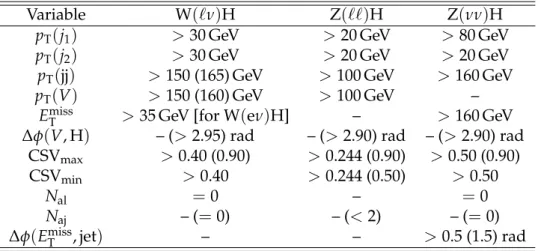
Table 1 summarizes the selection criteria used in each of the five channels for both theBDTand
the m(jj)analyses. For the cross-check m(jj)analysis more stringent requirements are imposed
on several of the variables used for the BDT selection. In addition, explicit requirements are
made on ∆φ(V, H) and on Naj. For each Higgs boson mass, mH, tested events are counted
in a 30 GeV window centered on the mean of the expected dijet mass peak. For the Z(``)H
modes the dijet mass distribution is asymmetric and the window is centered 5 GeV lower than
mH, while for the WH and Z(νν)H modes the window is centered at mH. For these modes a
higher pTboost requirement is made resulting in more collimated b jets and a mass peak more
symmetric around mH. For every channel, the m(jj)analysis was found to be about 10% less
sensitive than theBDTanalysis.
Table 1: Event selection for the BDT analysis. Where applicable, the tighter requirements for
the m(jj) analysis are listed in parenthesis. Entries marked “–” indicate that no requirement
is made for that variable. The first two lines refer to the pT threshold on the leading (j1) and
sub-leading (j2) jets. CSVmaxand CSVminare the maximum and minimum b-tag requirements
among the two jets.
Variable W(`ν)H Z(``)H Z(νν)H
pT(j1) >30 GeV >20 GeV >80 GeV
pT(j2) >30 GeV >20 GeV >20 GeV
pT(jj) >150 (165) GeV >100 GeV >160 GeV
pT(V) >150 (160) GeV >100 GeV –
EmissT >35 GeV [for W(eν)H] – >160 GeV
∆φ(V, H) – (>2.95) rad – (>2.90) rad – (>2.90) rad
CSVmax >0.40 (0.90) >0.244 (0.90) >0.50 (0.90) CSVmin >0.40 >0.244 (0.50) >0.50 Nal =0 – =0 Naj – (=0) – (<2) – (=0) ∆φ(Emiss T , jet) – – >0.5 (1.5) rad
5
Background Control Regions
Appropriate control regions that are orthogonal to the signal region are identified in data and used to adjust the Monte Carlo simulation normalization for the most important background
processes: W+jets and Z+jets (with light- and heavy-flavor jets), and tt. For each of the
6 6 Yield Uncertainties
that its composition is enriched in that specific background process. The discrepancies be-tween the expected and observed yields in the data in these control regions are used to obtain a scale factor by which the normalizations of the simulations are adjusted. For each channel, this procedure is performed simultaneously for all control regions. The background yields in the signal region from these sources are then estimated from the adjusted simulation samples. The uncertainties in the scale factor determination include a statistical uncertainty due to the finite size of the samples and an associated systematic uncertainty from the differences in the shapes of the distributions that could affect the estimate of the yields when extrapolating to the signal region. These systematic uncertainties are obtained by varying the control region selection criteria in order to select regions of phase space that are closer or further from the sig-nal region. The systematic uncertainty assigned covers the largest variation in the scale factor value found. The procedures applied in the construction of the control regions include
revers-ing the b-taggrevers-ing requirements to enhance W+jets and Z+jets with light-flavor jets, enforcing
a tighter b-tagging requirement and requiring extra jets to enhance tt, and requiring low boost in order to enhance Vbb over tt.
Consistent scale factors are found for each background process across the different channels.
For tt, V+udscg, and Zbb production the scale factors are compatible with unity within their
uncertainties (10–20%). For Wbb, the control region selected contains approximately 50% Wbb
and single-top events, with the remainder being tt and W+udscg, which are well constrained
by their own control regions. A choice is made to assign the observed excess of events in this region all to Wbb, leading to a scale factor of 2 for this background, while the estimate of single-top production is taken from the simulation. Reversing this assignment has a negligible effect on the final result of the analysis. The total uncertainty (excluding luminosity) assigned to the Wbb yield in the signal region is approximately 30%. This includes a 15% uncertainty on the extrapolation of the yield from the control region to the signal region, determined in data with the method outlined above. The systematic uncertainty assigned to the predicted yield for single-top production is 30%. The diboson background is taken from the simulation and a systematic uncertainty of 30% is assigned.
For Z(νν)H the QCD multijet background in the signal region is estimated from data using
control regions of high and low values of two uncorrelated variables with significant discrim-inating power towards such events. One is the angle between the missing energy vector and the closest jet in azimuth,∆φ(ETmiss, jet), and the other is the sum of the CSV values of the two b-tagged jets. The signal region is at high values of both discriminants, while QCD multijet events populate regions with low values of either. The method predicts a very small
contami-nation of 0.015±0.008 for these background events, which is considered to be negligible. For
all other search channels, after all selection criteria are applied, the QCD multijet backgrounds are also found to be negligible and not discussed in what follows.
6
Yield Uncertainties
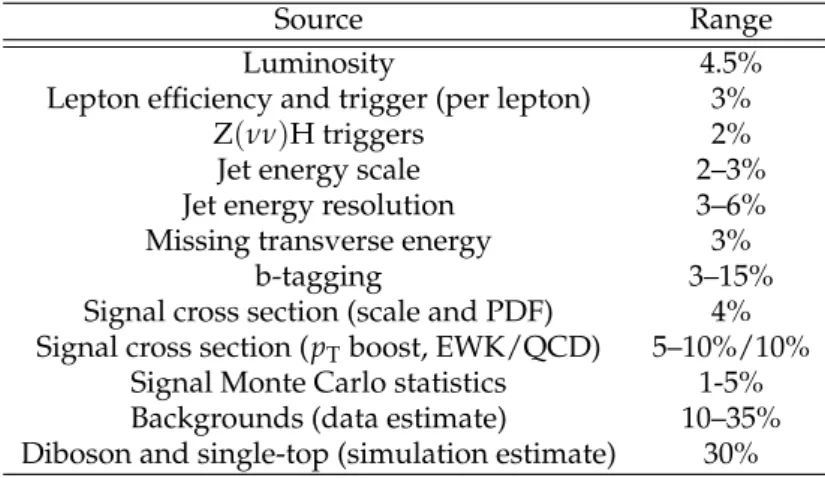
Table 2 lists the uncertainties on the expected signal and background yields that enter in the limit calculation.
The uncertainty in the CMS luminosity measurement for the dataset used in the analysis is esti-mated to be 4.5% [67]. Muon and electron trigger, reconstruction, and identification efficiencies are determined in data from samples of leptonic Z boson decays. The uncertainty on the yields due to the trigger efficiency is 2% per charged lepton and the uncertainty on the identification efficiency is also 2% per lepton. The parameters describing the Z(νν)H trigger efficiency
on the methodology to derive the efficiency. A yield uncertainty of 2% is estimated.
The jet energy scale is varied within one standard deviation as a function of jet pTand η. The
efficiency of the analysis selection is recomputed to assess the variation in yield. Depending on the process, a 2–3% yield variation is found. The effect of the uncertainty on the jet energy resolution is evaluated by smearing the jet energies according to the measured uncertainty. Depending on the process, a 3–6% variation in yields due to this effect is obtained. An
uncer-tainty of 3% is assigned to the yields of all processes in the WH and Z(νν)H modes due to the
uncertainty related to the missing transverse energy estimate.
Data-to-simulation b-tagging scale factors, measured in tt events, are applied consistently to jets in signal and background events. The measured uncertainties for the b-tagging scale factors are: 6% per b tag, 12% per charm tag and of 15% per mistagged jet (originating from gluons and light u, d, s quarks). These translate into yield uncertainties in the 3–15% range, depending on the channel and the specific process.
The total VH signal cross section has been calculated to next-to-next-to-leading (NNLO) or-der accuracy, and the total theoretical uncertainty is 4% [39], including the effect of scale and PDF variations [68–72]. This analysis is performed in the boosted regime, and thus,
poten-tial differences in the pT spectrum of the V and H between data and Monte Carlo generators
could introduce systematic effects in the signal acceptance and efficiency estimates. Calcu-lations are available that estimate the next-to-leading-order (NLO) electroweak [73–76] and NNLO QCD [77, 78] corrections to VH production in the boosted regime. The central value used for the cross section in the analysis was not adjusted for these calculations. The estimated
uncertainties from electroweak corrections for a boost of ∼150 GeV are 5% for ZH and 10%
for WH. For the QCD correction, a 10% uncertainty is estimated for both ZH and WH, which includes effects due to additional jet activity from initial- and final-state radiation. The finite size of the signal Monte Carlo samples, after all selection criteria are applied, contributes 1–5% uncertainty across all channels.
The uncertainty in the background yields that results from the estimates from data is in the 10– 35% range. For the predictions obtained solely from simulation, as described in Section 5, an uncertainty of 30% (approximately the uncertainty on the measured cross section) is assigned for single-top. For the diboson backgrounds, a 30% yield uncertainty is assumed.
7
Results
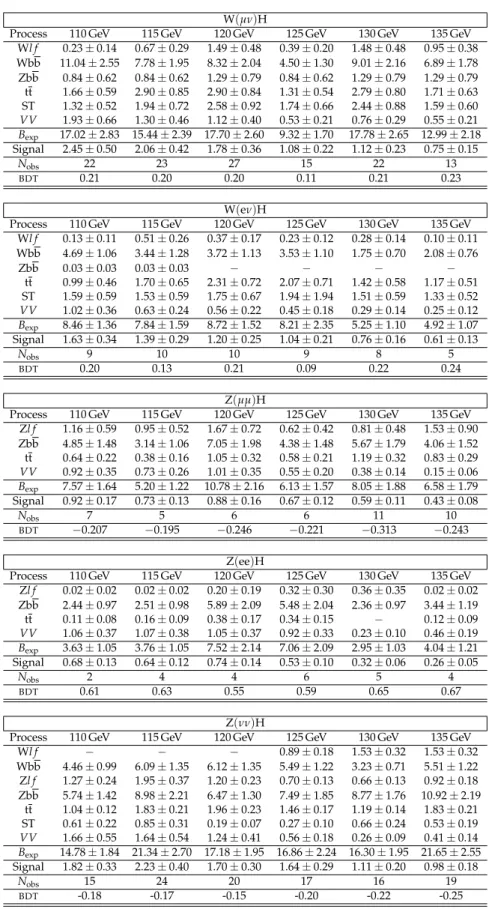
The primary physics result presented in this Letter is an upper limit on the production of a standard model Higgs boson in association with a vector boson and decaying to a bb pair. Table 3 lists, for each Higgs boson mass hypothesis considered, the expected signal and
back-ground yields in the signal region for theBDTanalysis, together with the observed number of
events. Table 3 also lists the requirements on the output of the BDTdistributions that define
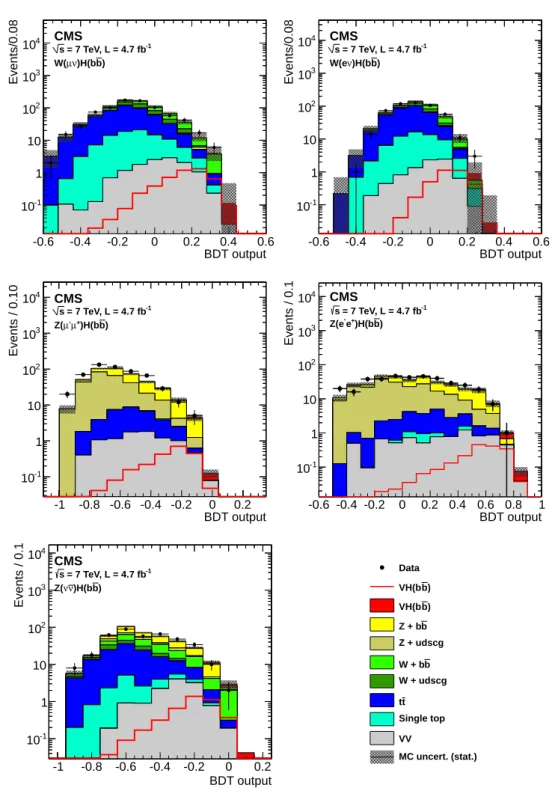
the signal region. These distributions are shown in Fig. 1 for the mH = 115 GeV case, where
data are overlaid with the predicted sample composition. The invariant dijet mass
distribu-tion, combined for all channels, for events that pass the m(jj) analysis selection is shown in
Fig. 2. The predicted number of background events are determined in data using the control regions described in Section 5, and from direct expectations from simulation for those back-grounds for which scale factors were not explicitly derived from control regions. Signal yields are determined from the simulations. The uncertainties include all sources listed in Section 6, except for luminosity. Total signal uncertainties are approximately 20%, and total background uncertainties are approximately in the 20 to 30% range.
8 7 Results BDT output -0.6 -0.4 -0.2 0 0.2 0.4 0.6 Events/0.08 -1 10 1 10 2 10 3 10 4 10 CMSs = 7 TeV, L = 4.7 fb-1 ) b )H(b ν µ W( BDT output -0.6 -0.4 -0.2 0 0.2 0.4 0.6 Events/0.08 -1 10 1 10 2 10 3 10 4 10 CMSs = 7 TeV, L = 4.7 fb-1 ) b )H(b ν W(e BDT output -1 -0.8 -0.6 -0.4 -0.2 0 0.2 Events / 0.10 -1 10 1 10 2 10 3 10 4 10 CMS -1 = 7 TeV, L = 4.7 fb s ) b )H(b + µ -µ Z( BDT output -0.6 -0.4 -0.2 0 0.2 0.4 0.6 0.8 1 Events / 0.1 -1 10 1 10 2 10 3 10 4 10 CMS -1 = 7 TeV, L = 4.7 fb s ) b )H(b + e -Z(e BDT output -1 -0.8 -0.6 -0.4 -0.2 0 0.2 Events / 0.1 -1 10 1 10 2 10 3 10 4 10 CMS -1 = 7 TeV, L = 4.7 fb s ) b )H(b ν ν Z( Data ) b VH(b ) b VH(b b Z + b Z + udscg b W + b W + udscg t t Single top VV MC uncert. (stat.)
Figure 1: Distributions of the BDT output, for mH=115 GeV, for each mode after all selection
criteria are applied. The solid histograms for the backgrounds and the signal are summed cu-mulatively. The line histogram for signal is also shown superimposed. The data is represented by points with error bars.
Table 2: Uncertainties in the signal and background yields due to the uncertainty in the sources listed. The ranges quoted are due to variations in mode, specific process, and Higgs boson mass hypothesis. See text for details.
Source Range
Luminosity 4.5%
Lepton efficiency and trigger (per lepton) 3%
Z(νν)H triggers 2%
Jet energy scale 2–3%
Jet energy resolution 3–6% Missing transverse energy 3%
b-tagging 3–15%
Signal cross section (scale and PDF) 4% Signal cross section (pTboost, EWK/QCD) 5–10%/10%
Signal Monte Carlo statistics 1-5% Backgrounds (data estimate) 10–35% Diboson and single-top (simulation estimate) 30%
No significant excess of events is observed in any channel, and the results of all channels are combined to obtain 95% CL upper limits on the Higgs boson production cross section in the
VH modes with H → bb, relative to the standard model prediction. This is done separately
for both theBDTand m(jj)analyses for assumed Higgs boson masses in the 110–135 GeV range.
The observed limits at each mass point, the median expected limits and the 1σ and 2σ bands
are calculated using the modified frequentist method CLs[79–81]. The inputs to the limit
calcu-lation include the number of observed events (Nobs), and the signal and background estimates
(Bexp), which are listed in Table 3 for the BDT analysis. The systematic and statistical
uncer-tainties on the signal and background estimates, listed in Section 6, are treated as nuisance parameters in the limit calculations, with appropriate correlations taken into account.
Table 4 summarizes, for theBDTand m(jj)analyses, the expected and observed 95% CL upper
limits on the product of the VH production cross section times the H → bb branching ratio,
with respect to the expectations for a standard model Higgs boson (σ/σSM). The expected
sensitivity of theBDTanalysis is determined to be superior and it is considered to be the main
result in this Letter. TheBDTresults are displayed in Fig. 3.
8
Summary
A search for the standard model Higgs boson decaying to bb when produced in association with weak vector bosons is reported for the following channels: W(µν)H, W(eν)H, Z(µµ)H,
Z(ee)H and Z(νν)H. The search is performed in a data sample corresponding to an integrated
luminosity of 4.7 fb−1. No significant excess of events above the expectation from background
is observed. Upper limits on the VH production cross section times the H→bb branching
ra-tio, with respect to the expectations for a standard model Higgs boson, are derived for a Higgs boson in the mass range 110–135 GeV. In this range, the observed 95% confidence level upper limits vary from 3.4 to 7.5 times the standard model prediction; the corresponding expected limits vary from 2.7 to 6.7. This Letter reports the first upper limits from the LHC in these channels.
10 8 Summary
Table 3: Predicted signal and background yields and observed number of events in data for
the signal region defined by a BDToutput value larger than the value listed. The uncertainty
quoted is the total uncertainty, excluding luminosity. Results are given separately for each
channel and Higgs boson mass hypothesis. Wl f and Zl f denote W+udscg and Z+udscg,
respectively. ST and VV denote single top and dibosons.
W(µν)H
Process 110 GeV 115 GeV 120 GeV 125 GeV 130 GeV 135 GeV Wl f 0.23 ± 0.14 0.67 ± 0.29 1.49 ± 0.48 0.39 ± 0.20 1.48 ± 0.48 0.95 ± 0.38 Wbb 11.04 ± 2.55 7.78 ± 1.95 8.32 ± 2.04 4.50 ± 1.30 9.01 ± 2.16 6.89 ± 1.78 Zbb 0.84 ± 0.62 0.84 ± 0.62 1.29 ± 0.79 0.84 ± 0.62 1.29 ± 0.79 1.29 ± 0.79 tt 1.66 ± 0.59 2.90 ± 0.85 2.90 ± 0.84 1.31 ± 0.54 2.79 ± 0.80 1.71 ± 0.63 ST 1.32 ± 0.52 1.94 ± 0.72 2.58 ± 0.92 1.74 ± 0.66 2.44 ± 0.88 1.59 ± 0.60 VV 1.93 ± 0.66 1.30 ± 0.46 1.12 ± 0.40 0.53 ± 0.21 0.76 ± 0.29 0.55 ± 0.21 Bexp 17.02 ± 2.83 15.44 ± 2.39 17.70 ± 2.60 9.32 ± 1.70 17.78 ± 2.65 12.99 ± 2.18 Signal 2.45 ± 0.50 2.06 ± 0.42 1.78 ± 0.36 1.08 ± 0.22 1.12 ± 0.23 0.75 ± 0.15 Nobs 22 23 27 15 22 13 BDT 0.21 0.20 0.20 0.11 0.21 0.23 W(eν)H
Process 110 GeV 115 GeV 120 GeV 125 GeV 130 GeV 135 GeV Wl f 0.13 ± 0.11 0.51 ± 0.26 0.37 ± 0.17 0.23 ± 0.12 0.28 ± 0.14 0.10 ± 0.11 Wbb 4.69 ± 1.06 3.44 ± 1.28 3.72 ± 1.13 3.53 ± 1.10 1.75 ± 0.70 2.08 ± 0.76 Zbb 0.03 ± 0.03 0.03 ± 0.03 − − − − tt 0.99 ± 0.46 1.70 ± 0.65 2.31 ± 0.72 2.07 ± 0.71 1.42 ± 0.58 1.17 ± 0.51 ST 1.59 ± 0.59 1.53 ± 0.59 1.75 ± 0.67 1.94 ± 1.94 1.51 ± 0.59 1.33 ± 0.52 VV 1.02 ± 0.36 0.63 ± 0.24 0.56 ± 0.22 0.45 ± 0.18 0.29 ± 0.14 0.25 ± 0.12 Bexp 8.46 ± 1.36 7.84 ± 1.59 8.72 ± 1.52 8.21 ± 2.35 5.25 ± 1.10 4.92 ± 1.07 Signal 1.63 ± 0.34 1.39 ± 0.29 1.20 ± 0.25 1.04 ± 0.21 0.76 ± 0.16 0.61 ± 0.13 Nobs 9 10 10 9 8 5 BDT 0.20 0.13 0.21 0.09 0.22 0.24 Z(µµ)H
Process 110 GeV 115 GeV 120 GeV 125 GeV 130 GeV 135 GeV Zl f 1.16 ± 0.59 0.95 ± 0.52 1.67 ± 0.72 0.62 ± 0.42 0.81 ± 0.48 1.53 ± 0.90 Zbb 4.85 ± 1.48 3.14 ± 1.06 7.05 ± 1.98 4.38 ± 1.48 5.67 ± 1.79 4.06 ± 1.52 tt 0.64 ± 0.22 0.38 ± 0.16 1.05 ± 0.32 0.58 ± 0.21 1.19 ± 0.32 0.83 ± 0.29 VV 0.92 ± 0.35 0.73 ± 0.26 1.01 ± 0.35 0.55 ± 0.20 0.38 ± 0.14 0.15 ± 0.06 Bexp 7.57 ± 1.64 5.20 ± 1.22 10.78 ± 2.16 6.13 ± 1.57 8.05 ± 1.88 6.58 ± 1.79 Signal 0.92 ± 0.17 0.73 ± 0.13 0.88 ± 0.16 0.67 ± 0.12 0.59 ± 0.11 0.43 ± 0.08 Nobs 7 5 6 6 11 10 BDT −0.207 −0.195 −0.246 −0.221 −0.313 −0.243 Z(ee)H
Process 110 GeV 115 GeV 120 GeV 125 GeV 130 GeV 135 GeV Zl f 0.02 ± 0.02 0.02 ± 0.02 0.20 ± 0.19 0.32 ± 0.30 0.36 ± 0.35 0.02 ± 0.02 Zbb 2.44 ± 0.97 2.51 ± 0.98 5.89 ± 2.09 5.48 ± 2.04 2.36 ± 0.97 3.44 ± 1.19 tt 0.11 ± 0.08 0.16 ± 0.09 0.38 ± 0.17 0.34 ± 0.15 − 0.12 ± 0.09 VV 1.06 ± 0.37 1.07 ± 0.38 1.05 ± 0.37 0.92 ± 0.33 0.23 ± 0.10 0.46 ± 0.19 Bexp 3.63 ± 1.05 3.76 ± 1.05 7.52 ± 2.14 7.06 ± 2.09 2.95 ± 1.03 4.04 ± 1.21 Signal 0.68 ± 0.13 0.64 ± 0.12 0.74 ± 0.14 0.53 ± 0.10 0.32 ± 0.06 0.26 ± 0.05 Nobs 2 4 4 6 5 4 BDT 0.61 0.63 0.55 0.59 0.65 0.67 Z(νν)H
Process 110 GeV 115 GeV 120 GeV 125 GeV 130 GeV 135 GeV Wl f − − − 0.89 ± 0.18 1.53 ± 0.32 1.53 ± 0.32 Wbb 4.46 ± 0.99 6.09 ± 1.35 6.12 ± 1.35 5.49 ± 1.22 3.23 ± 0.71 5.51 ± 1.22 Zl f 1.27 ± 0.24 1.95 ± 0.37 1.20 ± 0.23 0.70 ± 0.13 0.66 ± 0.13 0.92 ± 0.18 Zbb 5.74 ± 1.42 8.98 ± 2.21 6.47 ± 1.30 7.49 ± 1.85 8.77 ± 1.76 10.92 ± 2.19 tt 1.04 ± 0.12 1.83 ± 0.21 1.96 ± 0.23 1.46 ± 0.17 1.19 ± 0.14 1.83 ± 0.21 ST 0.61 ± 0.22 0.85 ± 0.31 0.19 ± 0.07 0.27 ± 0.10 0.66 ± 0.24 0.53 ± 0.19 VV 1.66 ± 0.55 1.64 ± 0.54 1.24 ± 0.41 0.56 ± 0.18 0.26 ± 0.09 0.41 ± 0.14 Bexp 14.78 ± 1.84 21.34 ± 2.70 17.18 ± 1.95 16.86 ± 2.24 16.30 ± 1.95 21.65 ± 2.55 Signal 1.82 ± 0.33 2.23 ± 0.40 1.70 ± 0.30 1.64 ± 0.29 1.11 ± 0.20 0.98 ± 0.18 Nobs 15 24 20 17 16 19 BDT -0.18 -0.17 -0.15 -0.20 -0.22 -0.25
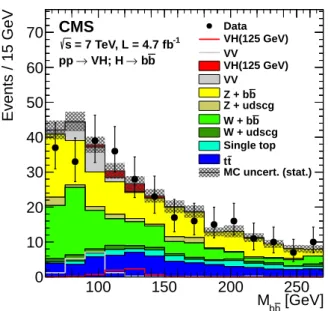
[GeV] b b M 100 150 200 250 Events / 15 GeV 0 10 20 30 40 50 60 70 DataVH(125 GeV) VV VH(125 GeV) VV b Z + b Z + udscg b W + b W + udscg Single top t t MC uncert. (stat.) CMS -1 = 7 TeV, L = 4.7 fb s b b → VH; H → pp
Figure 2: Dijet invariant mass distribution, combined for all channels, for events that pass the
m(jj)analysis selection. The solid histograms for the backgrounds and the signal are summed
cumulatively. The line histogram for signal and for VV backgrounds are also shown superim-posed. The data is represented by points with error bars.
Table 4: Expected and observed 95% CL upper limits on the product of the VH production
cross section times the H→bb branching ratio, with respect to the expectations for a standard
model Higgs boson. The primary results are those from theBDTanalysis, the m(jj)analysis is
presented as a cross check.
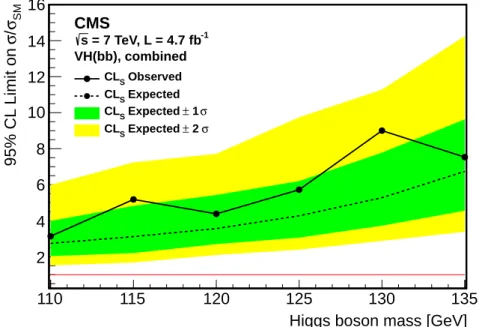
mH( GeV) 110 115 120 125 130 135 BDTExp. 2.7 3.1 3.6 4.3 5.3 6.7
BDTObs. 3.1 5.2 4.4 5.7 9.0 7.5 m(jj)Exp. 3.0 3.2 4.4 4.7 6.4 7.7 m(jj)Obs. 3.4 5.6 6.7 6.3 10.5 8.9
12 References
Higgs boson mass [GeV]
110 115 120 125 130 135 SM σ / σ 9 5 % C L L im it o n 2 4 6 8 10 12 14 16 Observed S CL Expected S CL σ 1 ± Expected S CL σ 2 ± Expected S CL CMS -1 = 7 TeV, L = 4.7 fb s VH(bb), combined
Figure 3: Expected and observed 95% CL upper limits on the product of the VH production
cross section times the H→bb branching ratio, with respect to the expectations for a standard
model Higgs boson, for theBDTanalysis.
9
Acknowledgements
We congratulate our colleagues in the CERN accelerator departments for the excellent perfor-mance of the LHC machine. We thank the technical and administrative staff at CERN and other CMS institutes, and acknowledge support from: FMSR (Austria); FNRS and FWO (Belgium); CNPq, CAPES, FAPERJ, and FAPESP (Brazil); MES (Bulgaria); CERN; CAS, MoST, and NSFC (China); COLCIENCIAS (Colombia); MSES (Croatia); RPF (Cyprus); MoER, SF0690030s09 and ERDF (Estonia); Academy of Finland, MEC, and HIP (Finland); CEA and CNRS/IN2P3 (France); BMBF, DFG, and HGF (Germany); GSRT (Greece); OTKA and NKTH (Hungary); DAE and DST (India); IPM (Iran); SFI (Ireland); INFN (Italy); NRF and WCU (Korea); LAS (Lithuania); CIN-VESTAV, CONACYT, SEP, and UASLP-FAI (Mexico); MSI (New Zealand); PAEC (Pakistan); MSHE and NSC (Poland); FCT (Portugal); JINR (Armenia, Belarus, Georgia, Ukraine, Uzbek-istan); MON, RosAtom, RAS and RFBR (Russia); MSTD (Serbia); MICINN and CPAN (Spain); Swiss Funding Agencies (Switzerland); NSC (Taipei); TUBITAK and TAEK (Turkey); STFC (United Kingdom); DOE and NSF (USA). Individuals have received support from the Marie-Curie programme and the European Research Council (European Union); the Leventis Foun-dation; the A. P. Sloan FounFoun-dation; the Alexander von Humboldt FounFoun-dation; the Belgian Fed-eral Science Policy Office; the Fonds pour la Formation `a la Recherche dans l’Industrie et dans l’Agriculture (FRIA-Belgium); the Agentschap voor Innovatie door Wetenschap en Technologie (IWT-Belgium); the Council of Science and Industrial Research, India; and the HOMING PLUS programme of Foundation for Polish Science, cofinanced from European Union, Regional De-velopment Fund.
References
[1] S. L. Glashow, “Partial Symmetries of Weak Interactions”, Nucl. Phys. 22 (1961) 579, doi:10.1016/0029-5582(61)90469-2.
[2] S. Weinberg, “A Model of Leptons”, Phys. Rev. Lett. 19 (1967) 1264, doi:10.1103/PhysRevLett.19.1264.
[3] A. Salam, “Weak and electromagnetic interactions”, in Elementary particle physics: relativistic groups and analyticity, N. Svartholm, ed., p. 367. Almquvist & Wiskell, 1968. Proceedings of the eighth Nobel symposium.
[4] F. Englert and R. Brout, “Broken symmetry and the mass of gauge vector mesons”, Phys. Rev. Lett. 13 (1964) 321, doi:10.1103/PhysRevLett.13.321.
[5] P. W. Higgs, “Broken symmetries, massless particles and gauge fields”, Phys. Lett. 12 (1964) 132, doi:10.1016/0031-9163(64)91136-9.
[6] P. W. Higgs, “Broken symmetries and the masses of gauge bosons”, Phys. Rev. Lett. 13 (1964) 508, doi:10.1103/PhysRevLett.13.508.
[7] G. S. Guralnik, C. R. Hagen, and T. W. B. Kibble, “Global conservation laws and massless particles”, Phys. Rev. Lett. 13 (1964) 585, doi:10.1103/PhysRevLett.13.585. [8] P. W. Higgs, “Spontaneous symmetry breakdown without massless bosons”, Phys. Rev.
145(1966) 1156, doi:10.1103/PhysRev.145.1156.
[9] T. W. B. Kibble, “Symmetry breaking in non-Abelian gauge theories”, Phys. Rev. 155 (1967) 1554, doi:10.1103/PhysRev.155.1554.
[10] ALEPH, DELPHI, L3, OPAL Collaborations, and the LEP Working Group for Higgs Boson Searches, “Search for the Standard Model Higgs boson at LEP”, Phys. Lett. B 565 (2003) 61, doi:10.1016/S0370-2693(03)00614-2.
[11] CDF and D0 Collaborations, “Combination of Tevatron Searches for the Standard Model Higgs Boson in the WW Decay Mode”, Phys. Rev. Lett. 104 (2010) 061802,
doi:10.1103/PhysRevLett.104.061802. A more recent, unpublished, limit is given in preprint arXiv:1103.3233.
[12] ATLAS Collaboration, “Search for the Higgs boson in the H→WW(*)→ `+
ν`−¯ν decay
channel in pp collisions at√s = 7 TeV with the ATLAS detector”, (2011).
arXiv:1112.2577. Submitted to Phys. Rev. Rev. Lett.
[13] ATLAS Collaboration, “Search for the standard model Higgs boson in the decay channel
H→ ZZ(∗) →4`with the ATLAS detector”, Phys. Lett. B 705 (2011) 435,
doi:http://dx.doi.org/10.1016/j.physletb.2011.10.034, arXiv:1109.5945.
[14] ATLAS Collaboration, “Search for a standard model Higgs boson in the
H→ ZZ→ `+`−
ν ¯νdecay channel with the ATLAS detector”, Phys. Rev. Lett. 107 (2011)
221802, doi:10.1103/PhysRevLett.107.221802, arXiv:1109.3357.
[15] ALEPH, CDF, D0, DELPHI, L3, OPAL, SLD Collaborations, the LEP Working Group, the Tevatron Electroweak Working Group, and the SLD Electroweak and Heavy flavor Group, “Precision electroweak measurements and constraints on the standard model”, (2010). arXiv:1012.2367.
[16] CDF Collaboration, “Search for a Standard Model Higgs Boson produced in W H→ `bb
in pp Collisions at√s =1.96 TeV”, Phys. Rev. Lett. 103 (2009) 101802,
14 References
[17] CDF Collaboration, “A Search for the Higgs Boson Using Neural Networks in Events
with Missing Energy and b-quark Jets in pp Collisions at√s=1.96 TeV”, Phys. Rev. Lett.
104(2010) 141801, doi:10.1103/PhysRevLett.104.141801, arXiv:0911.3935.
[18] CDF Collaboration, “Improved Search for a Higgs Boson Produced in Association with Z→l+l−in pp Collisions at√s=1.96 TeV”, Phys. Rev. Lett. 105 (2010) 251802, doi:10.1103/PhysRevLett.105.251802, arXiv:1009.3047.
[19] CDF Collaboration, “Search for the Higgs boson in the all-hadronic final state using the CDF II detector”, Phys. Rev. D 84 (2011) 052010,
doi:10.1103/PhysRevD.84.052010, arXiv:1102.0024. submitted to Phys. Rev.
D.
[20] D0 Collaboration, “Search for WH associated production in 5.3 fb−1of collisions at the
Fermilab Tevatron”, Phys. Lett. B 698 (2011), no. 1, 6,
doi:10.1016/j.physletb.2011.02.036.
[21] D0 Collaboration, “Search for the Standard Model Higgs Boson in the ZH →ννbb
Channel in 5.2 fb−1of pp Collisions at√s=1.96 TeV”, Phys. Rev. Lett. 104 (Feb, 2010) 071801, doi:10.1103/PhysRevLett.104.071801.
[22] D0 Collaboration, “Search for ZH√ →l+l−bb Production in 4.2 fb−1of pp Collisions at
s =1.96 TeV”, Phys. Rev. Lett. 105 (Dec, 2010) 251801,
doi:10.1103/PhysRevLett.105.251801.
[23] J. R. Ellis, M. K. Gaillard, and D. V. Nanopoulos, “A phenomenological profile of the Higgs boson”, Nucl. Phys. B 106 (1976) 292, doi:10.1016/0550-3213(76)90382-5. [24] H. Georgi, S. Glashow, M. Machacek, and D. V. Nanopoulos, “Higgs Bosons from Two
Gluon Annihilation in Proton Proton Collisions”, Phys. Rev. Lett. 40 (1978) 692,
doi:10.1103/PhysRevLett.40.692.
[25] A. Djouadi, M. Spira, and P. M. Zerwas, “Production of Higgs bosons in proton colliders: QCD corrections”, Phys. Lett. B 264 (1991) 440,
doi:10.1016/0370-2693(91)90375-Z.
[26] S. Dawson, “Radiative corrections to Higgs boson production”, Nucl. Phys. B 359 (1991) 283, doi:10.1016/0550-3213(91)90061-2.
[27] M. Spira et al., “Higgs boson production at the LHC”, Nucl. Phys. B 453 (1995) 17,
doi:10.1016/0550-3213(95)00379-7, arXiv:hep-ph/9504378.
[28] R. V. Harlander and W. B. Kilgore, “Next-to-next-to-leading order Higgs production at hadron colliders”, Phys. Rev. Lett. 88 (2002) 201801,
doi:10.1103/PhysRevLett.88.201801, arXiv:hep-ph/0201206.
[29] C. Anastasiou and K. Melnikov, “Higgs boson production at hadron colliders in NNLO QCD”, Nucl. Phys. B 646 (2002) 220, doi:10.1016/S0550-3213(02)00837-4, arXiv:hep-ph/0207004.
[30] V. Ravindran, J. Smith, and W. L. van Neerven, “NNLO corrections to the total cross section for Higgs boson production in hadron hadron collisions”, Nucl. Phys. B 665 (2003) 325, doi:10.1016/S0550-3213(03)00457-7, arXiv:hep-ph/0302135.
[31] S. Catani et al., “Soft-gluon resummation for Higgs boson production at hadron colliders”, JHEP 07 (2003) 028, doi:10.1088/1126-6708/2003/07/028, arXiv:hep-ph/0306211.
[32] U. Aglietti, R. Bonciani, G. Degrassi, and A. Vicini, “Two-loop light fermion contribution to Higgs production and decays”, Phys. Lett. B 595 (2004) 432,
doi:10.1016/j.physletb.2004.06.063, arXiv:hep-ph/0404071.
[33] G. Degrassi and F. Maltoni, “Two-loop electroweak corrections to Higgs production at hadron colliders”, Phys. Lett. B 600 (2004) 255,
doi:10.1016/j.physletb.2004.09.008, arXiv:hep-ph/0407249.
[34] J. Baglio and A. Djouadi, “Higgs production at the LHC”, JHEP 03 (2011) 055,
doi:10.1007/JHEP03(2011)055, arXiv:1012.0530.
[35] S. Actis et al., “NLO electroweak corrections to Higgs boson production at hadron colliders”, Phys. Lett. B 670 (2008) 12, doi:10.1016/j.physletb.2008.10.018, arXiv:0809.1301.
[36] C. Anastasiou, R. Boughezal, and F. Petriello, “Mixed QCD-electroweak corrections to Higgs boson production in gluon fusion”, JHEP 04 (2009) 003,
doi:10.1088/1126-6708/2009/04/003, arXiv:0811.3458.
[37] D. de Florian and M. Grazzini, “Higgs production through gluon fusion: updated cross sections at the Tevatron and the LHC”, Phys. Lett. B 674 (2009) 291,
doi:10.1016/j.physletb.2009.03.033, arXiv:0901.2427.
[38] A. Djouadi, J. Kalinowski, and M. Spira, “HDECAY: A program for Higgs boson decays in the standard model and its supersymmetric extension”, Comput. Phys. Commun. 108 (1998) 56, doi:10.1016/S0010-4655(97)00123-9, arXiv:hep-ph/9704448. [39] LHC Higgs Cross Section Working Group Collaboration, “Handbook of LHC Higgs
cross sections: 1. Inclusive Observables”, CERN Report CERN-2011-002, 2011.
arXiv:1101.0593.
[40] M. Ciccolini, A. Denner, and S. Dittmaier, “Strong and electroweak corrections to the production of Higgs + 2-jets via weak interactions at the LHC”, Phys. Rev. Lett. 99 (2007) 161803, doi:10.1103/PhysRevLett.99.161803, arXiv:0707.0381.
[41] M. Ciccolini, A. Denner, and S. Dittmaier, “Electroweak and QCD corrections to Higgs production via vector-boson fusion at the LHC”, Phys. Rev. D 77 (2008) 013002, doi:10.1103/PhysRevD.77.013002, arXiv:0710.4749.
[42] T. Figy, C. Oleari, and D. Zeppenfeld, “Next-to-leading order jet distributions for Higgs boson production via weak-boson fusion”, Phys. Rev. D 68 (2003) 073005,
doi:10.1103/PhysRevD.68.073005, arXiv:hep-ph/0306109.
[43] K. Arnold et al., “VBFNLO: A parton level Monte Carlo for processes with electroweak bosons”, Comput. Phys. Commun. 180 (2009) 1661,
doi:10.1016/j.cpc.2009.03.006, arXiv:0811.4559.
[44] P. Bolzoni et al., “Higgs production via vector-boson fusion at NNLO in QCD”, Phys. Rev. Lett. 105 (2010) 011801, doi:10.1103/PhysRevLett.105.011801,
16 References
[45] S. L. Glashow, D. V. Nanopoulos, and A. Yildiz, “Associated production of Higgs bosons and Z particles”, Phys. Rev. D 18 (Sep, 1978) 1724, doi:10.1103/PhysRevD.18.1724. [46] B. P. Roe, H.-J. Yang, and J. Zhu, “Boosted decision trees, a powerful event classifier”, in
Proceedings of PHYSTATO5: Statistical Problems in Particle Physics, Astrophysics and Cosmology. 2005.
[47] CMS Collaboration, “The CMS experiment at the CERN LHC”, JINST 03 (2008) S08004,
doi:10.1088/1748-0221/3/08/S08004.
[48] GEANT4 Collaboration, “GEANT4–a simulation toolkit”, Nucl. Instrum. Meth. A 506 (2003) 250, doi:10.1016/S0168-9002(03)01368-8.
[49] S. Frixione, P. Nason, and C. Oleari, “Matching NLO QCD computations with Parton Shower simulations: the POWHEG method”, JHEP 11 (2007) 070,
doi:10.1088/1126-6708/2007/11/070, arXiv:0709.2092. [50] G. Corcella et al., “HERWIG 6.1 Release Note”, (1999). arXiv:9912396.
[51] T. Sj ¨ostrand, S. Mrenna, and P. Skands, “PYTHIA 6.4 physics and manual”, JHEP 05 (2006) 026, doi:10.1088/1126-6708/2006/05/026.
[52] J. Alwall et al., “MadGraph/MadEvent v4: the new web generation”, JHEP 09 (2007) 028, doi:10.1088/1126-6708/2007/09/028.
[53] J. Pumplin et al., “New Generation of Parton Distributions with Uncertainties from Global QCD Analysis”, JHEP 02 (2002), no. 07, 012,
doi:10.1088/1126-6708/2002/07/012, arXiv:arXiv:hep-ph/0201195v3.
[54] CMS Collaboration, “Measurement of the underlying event activity at the LHC with√
s =7 TeV and comparison with√s =0.9 TeV”, JHEP (2011) 109,
doi:10.1007/JHEP09(2011)109.
[55] CMS Collaboration, “Particle–Flow Event Reconstruction in CMS and Performance for Jets, Taus, and Emiss
T ”, CMS Physics Analysis Summary CMS-PAS-PFT-09-001, 2009.
[56] M. Cacciari and G. P. Salam, “Pileup subtraction using jet areas”, Phys. Lett. B 659 (2008) 119, doi:10.1016/j.physletb.2007.09.077, arXiv:0707.1378.
[57] M. Cacciari, G. P. Salam, and G. Soyez, “The anti-ktjet clustering algorithm”, JHEP 04
(2008) 063, doi:10.1088/1126-6708/2008/04/063, arXiv:0802.1189. [58] M. Cacciari, G. P. Salam, and G. Soyez, “FastJet user manual”, (2011).
arXiv:1111.6097.
[59] M. Cacciari and G. P. Salam, “Dispelling the N3myth for the ktjet-finder”, Phys. Lett. B
641(2006) 57, doi:10.1016/j.physletb.2006.08.037,
arXiv:hep-ph/0512210.
[60] CMS Collaboration, “Determination of Jet Energy Calibration and Transverse Momentum Resolution in CMS”, JINST 06 (2011) 11002,
doi:10.1088/1748-0221/6/11/P11002.
[61] CMS Collaboration, “Electron Reconstruction and Identification at√s=7 TeV”, CMS
[62] CMS Collaboration, “Performance of muon identification in pp collisions at√s = 7 TeV”, CMS Physics Analysis Summary CMS-PAS-MUO-10-002, 2010.
[63] CMS Collaboration, “Algorithms for b Jet Identification in CMS”, CMS Physics Analysis Summary CMS-PAS-BTV-09-001, 2009.
[64] CMS Collaboration, “Measurement of the b-tagging efficiency using tt events”, CMS Physics Analysis Summary CMS-PAS-BTV-11-003, 2011.
[65] J. M. Butterworth et al., “Jet Substructure as a New Higgs-Search Channel at the Large Hadron Collider”, Phys. Rev. Lett. 100 (2008) 242001,
doi:10.1103/PhysRevLett.100.242001.
[66] A. Hoecker et al., “TMVA - toolkit for multivariate data analysis with ROOT”, (2007). arXiv:physics/0703039.
[67] CMS Collaboration, “Absolute Calibration of the CMS Luminosity Measurement: Summer 2011 Update”, CMS Physics Analysis Summary CMS-PAS-EWK-11-001, 2011. [68] M. Botje et al., “The PDF4LHC Working Group Interim Recommendations”, (2011).
arXiv:1101.0538.
[69] S. Alekhin et al., “The PDF4LHC Working Group Interim Report”, (2011). arXiv:1101.0536.
[70] H. Lai et al., “New parton distributions for collider physics”, Phys. Rev. D 82 (2010) 074024, doi:10.1103/PhysRevD.82.074024, arXiv:1007.2241.
[71] A. Martin et al., “Parton distributions for the LHC”, Eur. Phys. J. C 63 (2009) 189, doi:10.1140/epjc/s10052-009-1072-5, arXiv:0901.0002.
[72] D. Richard et al., “Impact of Heavy Quark Masses on Parton Distributions and LHC Phenomenology”. Nucl.Phys.B849:296-363,2011, 2011.
doi:10.1016/j.nuclphysb.2011.03.021.
[73] M. Ciccolini et al., “Strong and electroweak corrections to the production of Higgs+2jets via weak interactions at the LHC”, Phys. Rev. Lett. 99 (2007) 161803,
doi:10.1103/PhysRevLett.99.161803, arXiv:0707.0381.
[74] M. Ciccolini, A. Denner, and S. Dittmaier, “Electroweak and QCD corrections to Higgs production via vector-boson fusion at the LHC”, Phys. Rev. D 77 (2008) 013002,
doi:10.1103/PhysRevD.77.013002, arXiv:0710.4749.
[75] A. Denner, S. Dittmaier, S. Kallweit, and A. M ¨uck, “Electroweak corrections to Higgs-strahlung off W/Z bosons at the Tevatron and the LHC with HAWK”, (2011).
arXiv:1112.5142.
[76] M. L. Ciccolini, S. Dittmaier, and M. Kr¨amer, “Electroweak radiative corrections to associated WH and ZH production at hadron colliders”, Phys. Rev. D 68 (2003) 073003,
doi:10.1103/PhysRevD.68.073003.
[77] G. Ferrera, M. Grazzini, and F. Tramontano, “Associated WH production at hadron colliders: a fully exclusive QCD calculation at NNLO”, (2011). arXiv:1107.1164.
18 References
[78] O. Brein, A. Djouadi, and R. Harlander, “NNLO QCD corrections to the Higgs-strahlung processes at hadron colliders”, Phys. Lett. B 579 (2004) 149,
doi:10.1016/j.physletb.2003.10.112, arXiv:hep-ph/0307206.
[79] A. L. Read, “Presentation of search results: the CLs technique”, J. Phys. G: Nucl. Part. Phys. 28 (2002) 2693, doi:10.1088/0954-3899/28/10/313.
[80] T. Junk, “Confidence level computation for combining searches with small statistics”, Nucl. Instrum. Meth. A 434 (1999) 435, doi:10.1016/S0168-9002(99)00498-2. [81] ATLAS and CMS Collaborations, LHC Higgs Combination Group, “Procedure for the
LHC Higgs boson search combination in Summer 2011”, ATL-PHYS-PUB/CMS NOTE 2011-11, 2011/005, 2011.
A
The CMS Collaboration
Yerevan Physics Institute, Yerevan, Armenia
S. Chatrchyan, V. Khachatryan, A.M. Sirunyan, A. Tumasyan
Institut f ¨ur Hochenergiephysik der OeAW, Wien, Austria
W. Adam, T. Bergauer, M. Dragicevic, J. Er ¨o, C. Fabjan, M. Friedl, R. Fr ¨uhwirth, V.M. Ghete,
J. Hammer1, M. Hoch, N. H ¨ormann, J. Hrubec, M. Jeitler, W. Kiesenhofer, M. Krammer, D. Liko,
I. Mikulec, M. Pernicka†, B. Rahbaran, C. Rohringer, H. Rohringer, R. Sch ¨ofbeck, J. Strauss,
A. Taurok, F. Teischinger, P. Wagner, W. Waltenberger, G. Walzel, E. Widl, C.-E. Wulz
National Centre for Particle and High Energy Physics, Minsk, Belarus
V. Mossolov, N. Shumeiko, J. Suarez Gonzalez
Universiteit Antwerpen, Antwerpen, Belgium
S. Bansal, L. Benucci, T. Cornelis, E.A. De Wolf, X. Janssen, S. Luyckx, T. Maes, L. Mucibello, S. Ochesanu, B. Roland, R. Rougny, M. Selvaggi, H. Van Haevermaet, P. Van Mechelen, N. Van Remortel, A. Van Spilbeeck
Vrije Universiteit Brussel, Brussel, Belgium
F. Blekman, S. Blyweert, J. D’Hondt, R. Gonzalez Suarez, A. Kalogeropoulos, M. Maes, A. Olbrechts, W. Van Doninck, P. Van Mulders, G.P. Van Onsem, I. Villella
Universit´e Libre de Bruxelles, Bruxelles, Belgium
O. Charaf, B. Clerbaux, G. De Lentdecker, V. Dero, A.P.R. Gay, G.H. Hammad, T. Hreus, A. L´eonard, P.E. Marage, L. Thomas, C. Vander Velde, P. Vanlaer, J. Wickens
Ghent University, Ghent, Belgium
V. Adler, K. Beernaert, A. Cimmino, S. Costantini, G. Garcia, M. Grunewald, B. Klein, J. Lellouch, A. Marinov, J. Mccartin, A.A. Ocampo Rios, D. Ryckbosch, N. Strobbe, F. Thyssen, M. Tytgat, L. Vanelderen, P. Verwilligen, S. Walsh, E. Yazgan, N. Zaganidis
Universit´e Catholique de Louvain, Louvain-la-Neuve, Belgium
S. Basegmez, G. Bruno, L. Ceard, J. De Favereau De Jeneret, C. Delaere, T. du Pree, D. Favart,
L. Forthomme, A. Giammanco2, G. Gr´egoire, J. Hollar, V. Lemaitre, J. Liao, O. Militaru,
C. Nuttens, D. Pagano, A. Pin, K. Piotrzkowski, N. Schul
Universit´e de Mons, Mons, Belgium
N. Beliy, T. Caebergs, E. Daubie
Centro Brasileiro de Pesquisas Fisicas, Rio de Janeiro, Brazil
G.A. Alves, M. Correa Martins Junior, D. De Jesus Damiao, T. Martins, M.E. Pol, M.H.G. Souza
Universidade do Estado do Rio de Janeiro, Rio de Janeiro, Brazil
W.L. Ald´a J ´unior, W. Carvalho, A. Cust ´odio, E.M. Da Costa, C. De Oliveira Martins, S. Fonseca De Souza, D. Matos Figueiredo, L. Mundim, H. Nogima, V. Oguri, W.L. Prado Da Silva, A. Santoro, S.M. Silva Do Amaral, L. Soares Jorge, A. Sznajder
Instituto de Fisica Teorica, Universidade Estadual Paulista, Sao Paulo, Brazil
T.S. Anjos3, C.A. Bernardes3, F.A. Dias4, T.R. Fernandez Perez Tomei, E. M. Gregores3,
C. Lagana, F. Marinho, P.G. Mercadante3, S.F. Novaes, Sandra S. Padula
Institute for Nuclear Research and Nuclear Energy, Sofia, Bulgaria
V. Genchev1, P. Iaydjiev1, S. Piperov, M. Rodozov, S. Stoykova, G. Sultanov, V. Tcholakov,
20 A The CMS Collaboration
University of Sofia, Sofia, Bulgaria
A. Dimitrov, R. Hadjiiska, A. Karadzhinova, V. Kozhuharov, L. Litov, B. Pavlov, P. Petkov
Institute of High Energy Physics, Beijing, China
J.G. Bian, G.M. Chen, H.S. Chen, C.H. Jiang, D. Liang, S. Liang, X. Meng, J. Tao, J. Wang, J. Wang, X. Wang, Z. Wang, H. Xiao, M. Xu, J. Zang, Z. Zhang
State Key Lab. of Nucl. Phys. and Tech., Peking University, Beijing, China
C. Asawatangtrakuldee, Y. Ban, S. Guo, Y. Guo, W. Li, S. Liu, Y. Mao, S.J. Qian, H. Teng, S. Wang, B. Zhu, W. Zou
Universidad de Los Andes, Bogota, Colombia
A. Cabrera, B. Gomez Moreno, A.F. Osorio Oliveros, J.C. Sanabria
Technical University of Split, Split, Croatia
N. Godinovic, D. Lelas, R. Plestina5, D. Polic, I. Puljak1
University of Split, Split, Croatia
Z. Antunovic, M. Dzelalija, M. Kovac
Institute Rudjer Boskovic, Zagreb, Croatia
V. Brigljevic, S. Duric, K. Kadija, J. Luetic, S. Morovic
University of Cyprus, Nicosia, Cyprus
A. Attikis, M. Galanti, J. Mousa, C. Nicolaou, F. Ptochos, P.A. Razis
Charles University, Prague, Czech Republic
M. Finger, M. Finger Jr.
Academy of Scientific Research and Technology of the Arab Republic of Egypt, Egyptian Network of High Energy Physics, Cairo, Egypt
Y. Assran6, A. Ellithi Kamel7, S. Khalil8, M.A. Mahmoud9, A. Radi8,10
National Institute of Chemical Physics and Biophysics, Tallinn, Estonia
A. Hektor, M. Kadastik, M. M ¨untel, M. Raidal, L. Rebane, A. Tiko
Department of Physics, University of Helsinki, Helsinki, Finland
V. Azzolini, P. Eerola, G. Fedi, M. Voutilainen
Helsinki Institute of Physics, Helsinki, Finland
S. Czellar, J. H¨ark ¨onen, A. Heikkinen, V. Karim¨aki, R. Kinnunen, M.J. Kortelainen, T. Lamp´en, K. Lassila-Perini, S. Lehti, T. Lind´en, P. Luukka, T. M¨aenp¨a¨a, T. Peltola, E. Tuominen, J. Tuominiemi, E. Tuovinen, D. Ungaro, L. Wendland
Lappeenranta University of Technology, Lappeenranta, Finland
K. Banzuzi, A. Korpela, T. Tuuva
Laboratoire d’Annecy-le-Vieux de Physique des Particules, IN2P3-CNRS, Annecy-le-Vieux, France
D. Sillou
DSM/IRFU, CEA/Saclay, Gif-sur-Yvette, France
M. Besancon, S. Choudhury, M. Dejardin, D. Denegri, B. Fabbro, J.L. Faure, F. Ferri, S. Ganjour, A. Givernaud, P. Gras, G. Hamel de Monchenault, P. Jarry, E. Locci, J. Malcles, L. Millischer, J. Rander, A. Rosowsky, I. Shreyber, M. Titov
Laboratoire Leprince-Ringuet, Ecole Polytechnique, IN2P3-CNRS, Palaiseau, France
S. Baffioni, F. Beaudette, L. Benhabib, L. Bianchini, M. Bluj11, C. Broutin, P. Busson, C. Charlot, N. Daci, T. Dahms, L. Dobrzynski, S. Elgammal, R. Granier de Cassagnac, M. Haguenauer, P. Min´e, C. Mironov, C. Ochando, P. Paganini, D. Sabes, R. Salerno, Y. Sirois, C. Thiebaux, C. Veelken, A. Zabi
Institut Pluridisciplinaire Hubert Curien, Universit´e de Strasbourg, Universit´e de Haute Alsace Mulhouse, CNRS/IN2P3, Strasbourg, France
J.-L. Agram12, J. Andrea, D. Bloch, D. Bodin, J.-M. Brom, M. Cardaci, E.C. Chabert, C. Collard,
E. Conte12, F. Drouhin12, C. Ferro, J.-C. Fontaine12, D. Gel´e, U. Goerlach, P. Juillot, M. Karim12, A.-C. Le Bihan, P. Van Hove
Centre de Calcul de l’Institut National de Physique Nucleaire et de Physique des Particules (IN2P3), Villeurbanne, France
F. Fassi, D. Mercier
Universit´e de Lyon, Universit´e Claude Bernard Lyon 1, CNRS-IN2P3, Institut de Physique Nucl´eaire de Lyon, Villeurbanne, France
C. Baty, S. Beauceron, N. Beaupere, M. Bedjidian, O. Bondu, G. Boudoul, D. Boumediene,
H. Brun, J. Chasserat, R. Chierici1, D. Contardo, P. Depasse, H. El Mamouni, A. Falkiewicz,
J. Fay, S. Gascon, M. Gouzevitch, B. Ille, T. Kurca, T. Le Grand, M. Lethuillier, L. Mirabito, S. Perries, V. Sordini, S. Tosi, Y. Tschudi, P. Verdier, S. Viret
Institute of High Energy Physics and Informatization, Tbilisi State University, Tbilisi, Georgia
D. Lomidze
RWTH Aachen University, I. Physikalisches Institut, Aachen, Germany
G. Anagnostou, S. Beranek, M. Edelhoff, L. Feld, N. Heracleous, O. Hindrichs, R. Jussen, K. Klein, J. Merz, A. Ostapchuk, A. Perieanu, F. Raupach, J. Sammet, S. Schael, D. Sprenger,
H. Weber, B. Wittmer, V. Zhukov13
RWTH Aachen University, III. Physikalisches Institut A, Aachen, Germany
M. Ata, J. Caudron, E. Dietz-Laursonn, M. Erdmann, A. G ¨uth, T. Hebbeker, C. Heidemann,
K. Hoepfner, T. Klimkovich, D. Klingebiel, P. Kreuzer, D. Lanske†, J. Lingemann, C. Magass,
M. Merschmeyer, A. Meyer, M. Olschewski, P. Papacz, H. Pieta, H. Reithler, S.A. Schmitz, L. Sonnenschein, J. Steggemann, D. Teyssier, M. Weber
RWTH Aachen University, III. Physikalisches Institut B, Aachen, Germany
M. Bontenackels, V. Cherepanov, M. Davids, G. Fl ¨ugge, H. Geenen, M. Geisler, W. Haj Ahmad, F. Hoehle, B. Kargoll, T. Kress, Y. Kuessel, A. Linn, A. Nowack, L. Perchalla, O. Pooth, J. Rennefeld, P. Sauerland, A. Stahl, M.H. Zoeller
Deutsches Elektronen-Synchrotron, Hamburg, Germany
M. Aldaya Martin, W. Behrenhoff, U. Behrens, M. Bergholz14, A. Bethani, K. Borras,
A. Burgmeier, A. Cakir, L. Calligaris, A. Campbell, E. Castro, D. Dammann, G. Eckerlin,
D. Eckstein, A. Flossdorf, G. Flucke, A. Geiser, J. Hauk, H. Jung1, M. Kasemann, P. Katsas,
C. Kleinwort, H. Kluge, A. Knutsson, M. Kr¨amer, D. Kr ¨ucker, E. Kuznetsova, W. Lange,
W. Lohmann14, B. Lutz, R. Mankel, I. Marfin, M. Marienfeld, I.-A. Melzer-Pellmann,
A.B. Meyer, J. Mnich, A. Mussgiller, S. Naumann-Emme, J. Olzem, A. Petrukhin, D. Pitzl,
A. Raspereza, P.M. Ribeiro Cipriano, M. Rosin, J. Salfeld-Nebgen, R. Schmidt14, T.
22 A The CMS Collaboration
University of Hamburg, Hamburg, Germany
C. Autermann, V. Blobel, S. Bobrovskyi, J. Draeger, H. Enderle, J. Erfle, U. Gebbert, M. G ¨orner, T. Hermanns, R.S. H ¨oing, K. Kaschube, G. Kaussen, H. Kirschenmann, R. Klanner, J. Lange, B. Mura, F. Nowak, N. Pietsch, C. Sander, H. Schettler, P. Schleper, E. Schlieckau, A. Schmidt, M. Schr ¨oder, T. Schum, H. Stadie, G. Steinbr ¨uck, J. Thomsen
Institut f ¨ur Experimentelle Kernphysik, Karlsruhe, Germany
C. Barth, J. Berger, T. Chwalek, W. De Boer, A. Dierlamm, G. Dirkes, M. Feindt, J. Gruschke,
M. Guthoff1, C. Hackstein, F. Hartmann, M. Heinrich, H. Held, K.H. Hoffmann, S. Honc,
I. Katkov13, J.R. Komaragiri, T. Kuhr, D. Martschei, S. Mueller, Th. M ¨uller, M. Niegel,
A. N ¨urnberg, O. Oberst, A. Oehler, J. Ott, T. Peiffer, G. Quast, K. Rabbertz, F. Ratnikov, N. Ratnikova, M. Renz, S. R ¨ocker, C. Saout, A. Scheurer, P. Schieferdecker, F.-P. Schilling, M. Schmanau, G. Schott, H.J. Simonis, F.M. Stober, D. Troendle, J. Wagner-Kuhr, T. Weiler, M. Zeise, E.B. Ziebarth
Institute of Nuclear Physics ”Demokritos”, Aghia Paraskevi, Greece
G. Daskalakis, T. Geralis, S. Kesisoglou, A. Kyriakis, D. Loukas, I. Manolakos, A. Markou, C. Markou, C. Mavrommatis, E. Ntomari
University of Athens, Athens, Greece
L. Gouskos, T.J. Mertzimekis, A. Panagiotou, N. Saoulidou, E. Stiliaris
University of Io´annina, Io´annina, Greece
I. Evangelou, C. Foudas1, P. Kokkas, N. Manthos, I. Papadopoulos, V. Patras, F.A. Triantis
KFKI Research Institute for Particle and Nuclear Physics, Budapest, Hungary
A. Aranyi, G. Bencze, L. Boldizsar, C. Hajdu1, P. Hidas, D. Horvath15, A. Kapusi, K. Krajczar16,
F. Sikler1, V. Veszpremi, G. Vesztergombi16
Institute of Nuclear Research ATOMKI, Debrecen, Hungary
N. Beni, J. Molnar, J. Palinkas, Z. Szillasi
University of Debrecen, Debrecen, Hungary
J. Karancsi, P. Raics, Z.L. Trocsanyi, B. Ujvari
Panjab University, Chandigarh, India
S.B. Beri, V. Bhatnagar, N. Dhingra, R. Gupta, M. Jindal, M. Kaur, J.M. Kohli, M.Z. Mehta, N. Nishu, L.K. Saini, A. Sharma, A.P. Singh, J. Singh, S.P. Singh
University of Delhi, Delhi, India
S. Ahuja, B.C. Choudhary, A. Kumar, A. Kumar, S. Malhotra, M. Naimuddin, K. Ranjan, V. Sharma, R.K. Shivpuri
Saha Institute of Nuclear Physics, Kolkata, India
S. Banerjee, S. Bhattacharya, S. Dutta, B. Gomber, S. Jain, S. Jain, R. Khurana, S. Sarkar
Bhabha Atomic Research Centre, Mumbai, India
R.K. Choudhury, D. Dutta, S. Kailas, V. Kumar, A.K. Mohanty1, L.M. Pant, P. Shukla
Tata Institute of Fundamental Research - EHEP, Mumbai, India
T. Aziz, S. Ganguly, M. Guchait17, A. Gurtu18, M. Maity19, G. Majumder, K. Mazumdar,
G.B. Mohanty, B. Parida, A. Saha, K. Sudhakar, N. Wickramage
Tata Institute of Fundamental Research - HECR, Mumbai, India
Institute for Research in Fundamental Sciences (IPM), Tehran, Iran
H. Arfaei, H. Bakhshiansohi20, S.M. Etesami21, A. Fahim20, M. Hashemi, H. Hesari, A. Jafari20,
M. Khakzad, A. Mohammadi22, M. Mohammadi Najafabadi, S. Paktinat Mehdiabadi,
B. Safarzadeh23, M. Zeinali21
INFN Sezione di Baria, Universit`a di Barib, Politecnico di Baric, Bari, Italy
M. Abbresciaa,b, L. Barbonea,b, C. Calabriaa,b, S.S. Chhibraa,b, A. Colaleoa, D. Creanzaa,c, N. De Filippisa,c,1, M. De Palmaa,b, L. Fiorea, G. Iasellia,c, L. Lusitoa,b, G. Maggia,c, M. Maggia, N. Mannaa,b, B. Marangellia,b, S. Mya,c, S. Nuzzoa,b, N. Pacificoa,b, A. Pompilia,b, G. Pugliesea,c, F. Romanoa,c, G. Selvaggia,b, L. Silvestrisa, G. Singha,b, S. Tupputia,b, G. Zitoa
INFN Sezione di Bolognaa, Universit`a di Bolognab, Bologna, Italy
G. Abbiendia, A.C. Benvenutia, D. Bonacorsia, S. Braibant-Giacomellia,b, L. Brigliadoria, P. Capiluppia,b, A. Castroa,b, F.R. Cavalloa, M. Cuffiania,b, G.M. Dallavallea, F. Fabbria, A. Fanfania,b, D. Fasanellaa,1, P. Giacomellia, C. Grandia, S. Marcellinia, G. Masettia, M. Meneghellia,b, A. Montanaria, F.L. Navarriaa,b, F. Odoricia, A. Perrottaa, F. Primaveraa, A.M. Rossia,b, T. Rovellia,b, G. Sirolia,b, R. Travaglinia,b
INFN Sezione di Cataniaa, Universit`a di Cataniab, Catania, Italy
S. Albergoa,b, G. Cappelloa,b, M. Chiorbolia,b, S. Costaa,b, R. Potenzaa,b, A. Tricomia,b, C. Tuvea,b
INFN Sezione di Firenzea, Universit`a di Firenzeb, Firenze, Italy
G. Barbaglia, V. Ciullia,b, C. Civininia, R. D’Alessandroa,b, E. Focardia,b, S. Frosalia,b, E. Galloa, S. Gonzia,b, M. Meschinia, S. Paolettia, G. Sguazzonia, A. Tropianoa,1
INFN Laboratori Nazionali di Frascati, Frascati, Italy
L. Benussi, S. Bianco, S. Colafranceschi24, F. Fabbri, D. Piccolo
INFN Sezione di Genova, Genova, Italy
P. Fabbricatore, R. Musenich
INFN Sezione di Milano-Bicoccaa, Universit`a di Milano-Bicoccab, Milano, Italy
A. Benagliaa,b,1, F. De Guioa,b, L. Di Matteoa,b, S. Fiorendia,b, S. Gennaia,1, A. Ghezzia,b, S. Malvezzia, R.A. Manzonia,b, A. Martellia,b, A. Massironia,b,1, D. Menascea, L. Moronia, M. Paganonia,b, D. Pedrinia, S. Ragazzia,b, N. Redaellia, S. Salaa, T. Tabarelli de Fatisa,b
INFN Sezione di Napolia, Universit`a di Napoli ”Federico II”b, Napoli, Italy
S. Buontempoa, C.A. Carrillo Montoyaa,1, N. Cavalloa,25, A. De Cosaa,b, O. Doganguna,b,
F. Fabozzia,25, A.O.M. Iorioa,1, L. Listaa, M. Merolaa,b, P. Paoluccia
INFN Sezione di Padovaa, Universit`a di Padovab, Universit`a di Trento (Trento)c, Padova, Italy
P. Azzia, N. Bacchettaa,1, P. Bellana,b, D. Biselloa,b, A. Brancaa, R. Carlina,b, P. Checchiaa,
T. Dorigoa, U. Dossellia, F. Fanzagoa, F. Gasparinia,b, U. Gasparinia,b, A. Gozzelinoa, K. Kan-ishchev, S. Lacapraraa,26, I. Lazzizzeraa,c, M. Margonia,b, M. Mazzucatoa, A.T. Meneguzzoa,b, M. Nespoloa,1, L. Perrozzia, N. Pozzobona,b, P. Ronchesea,b, F. Simonettoa,b, E. Torassaa, M. Tosia,b,1, S. Vaninia,b, P. Zottoa,b, G. Zumerlea,b
INFN Sezione di Paviaa, Universit`a di Paviab, Pavia, Italy
U. Berzanoa, M. Gabusia,b, S.P. Rattia,b, C. Riccardia,b, P. Torrea,b, P. Vituloa,b
INFN Sezione di Perugiaa, Universit`a di Perugiab, Perugia, Italy
M. Biasinia,b, G.M. Bileia, B. Caponeria,b, L. Fan `oa,b, P. Laricciaa,b, A. Lucaronia,b,1, G. Mantovania,b, M. Menichellia, A. Nappia,b, F. Romeoa,b, A. Santocchiaa,b, S. Taronia,b,1, M. Valdataa,b