1
HASGS (Hybrid Augmented Saxophone of Gestural
Symbiosis) Generating Visual and Graphical
Feedback
Henrique Portovedo, CITAR, Portuguese Catholic University , Oporto, Portugal; Paulo Ferreira Lopes, CITAR, Portuguese Catholic University , Oporto, Portugal; Ricardo Mendes, Information Systems and Processing, University of Aveiro, Aveiro, Portugal;
Abstract
This paper discusses how an augmented instrument, HASGS in the context of interactive electronic music, motivates the generation of different graphical user interfaces taking in consideration the repertoire being composed for it. New composition aesthetics are deeply influenced by electronic materials and sonic repositories at the same time as new mediums are currently seen as possible extensions of instrumental practice. These mediums are available for creative purposes during composition and performative processes. While the aesthetics of acoustic and electronic sounds are creating mutual influences, composers and sound designers are developing new languages, new gestural attitudes, new
extended techniques, new notation methods, new performative paradigms including the creation of graphical interfaces for visual feedback. This augmented system for saxophone was motivated by the need to perform pieces with a common aesthetic that have been written using electronic environments. Those pieces shared the need for the control of external devices in order to be performed. The repertoire for
saxophone and electronics is growing in a huge scale, from pieces using stomp boxes or control pedals for different triggering or fading, to pieces requiring the manipulation of knobs. These controllers, by their nature, devices that separate sound production (synthesis) and performer gesture (control), have subsequently generated an increased interest in the study of compositional mapping strategies for computer music. From our experience, we conclude that the graphical user interface (GUI) is fundamental for the understanding of the individuality of each piece, as well as to understand the relation between the augmentation system and the piece itself. If this project started with the idea of contributing to a new performative paradigm regarding the existing repertoire, new repertoire and improvisational performance situations led to the development of a hybrid system contributing to bio-feedback incorporation in the work of art, while creating new graphical user interfaces for visual feedback.
Keywords
Saxophone, Augmented Instrument, Gestural Interaction, Live Electronics, Graphical User Interface.
2
Artist and scientists have a perpetual interest in the relationship between music and art. As technology has progresses, so too have the tools that allow the practical exploration of this relationship. Today, artists in many disparate fields occupy themselves with producing animated visual art that is correlated with music
(Bergstrom & Lotto 2009). In this paper, our interest is to examine the graphical user interface (GUI) generated by the composers and programmers for the performance of the pieces composed by themselves for HASGS. This kind of visual feedback is fundamental for the performer to understand the relation between the augmentation system and the piece itself, and/or how to control it.
The goal of user interface design is to make the user's interaction as simple and efficient as possible, in terms of accomplishing user goals. Good user interface design facilitates finishing the task at hand without drawing unnecessary attention to itself. Graphic design and typography are utilized to support its usability, influencing how the user performs certain interactions and improving the aesthetic appeal of the design; design aesthetics may enhance or detract from the ability of users to use the functions of the interface (Norman 2002). According to the ISO 9241 standard for the organization of information (arrangement, alignment, grouping, labels, location), for the display of graphical objects, and for the coding of information (abbreviation, color, size, shape, visual cues) by distinguished in seven attributes: Clarity, the information content is conveyed quickly and accurately; Discriminability, the displayed information can be distinguished accurately; Conciseness, users are not overloaded with extraneous information; Consistency: a unique design, conformity with user's expectation; Detectability: the user's attention is directed towards information required; Legibility, information is easy to read; Comprehensibility, the meaning is clearly understandable, unambiguous, interpretable, and recognizable.
Augmenting an acoustic instrument places some limitations on the designer ́s palette of feasible gestures because of those intrinsic performance gestures, and the existing mechanical interface, which have been developed over years, sometimes, centuries of acoustic practice (Thibodeau and Wanderley 2013). A fundamental question when augmenting an instrument is whether it should be playable in the existing way: to what degree, if any, will augmentation modify traditional techniques? Augmented performance can be considered enactive knowledge. The term enactiveknowledge refers to knowledge that can only be acquired and manifested through action. Examples of human activities that heavily rely on enactive knowledge include dance, painting, sports, and performing music. This concept will enable a mode of musical/visual performance different from current practice, which is likely to enhance the experience of both the performer(s) and audiences (Bergstrom & Lotto 2009), especially if the audience is receiving the visual information based on the GUI of each piece, in order to understand how the performer is controlling the electronic parameters thru the augmented system. The manipulation of HASGS is directly associated with gestural controls. The notion of gesture goes beyond this purely physical aspect in that it involves an action as a movement unit, or a chunk, which may be planned, goal directed, and perceived as a holistic entity (Buxton and Meyers 1986).Movements used to control sound in many multimedia settings differ from those used for acoustic instruments. For digital electronic instruments the link between gesture and sound is defined by the
electronic design and the programming. This opens up many possible choices for the relationship between gesture and sound, usually referred to as mapping. The
3
mapping from gesture to sound can be fairly straightforward so that, for example, a fast movement has a direct correspondence in the attack time or loudness of the sound. However, with electronically generated sounds it is also possible to make incongruent, “unrealistic” links between gesture and sound. The gestural control of electronic instruments encompasses a wide range of approaches and types of works, e.g. modifying acoustic instruments for mixed acoustic/electronics music, public interactive installations, and performances where a dancer interacts with a sound environment. For these types of performances and interactions, the
boundaries between, for instance, control and communicative gestures tend to get blurred. To give enough freedom to the performers, the design of the interaction between sound and gesture is generally not as deterministic as in performances of acoustic music
.
2. Prototyping
In our perspective, augmented instruments and systems should preserve, as much as possible, the technique that experienced musicians gain along several years of studying the acoustic instrument. The problem with augmented instruments is that they require, most of times, a new learning process of playing the instrument, some of them with a complex learning curve. Our system is prototyped in a perspective of retaining the quality of the performance practice gained over years of studying and practicing the acoustic instrument. With HASGS was our intention to integrate the control of electronic parameters organically allowing a high degree of virtuosity gained with the traditional acoustic practice (Portovedo, Ferreira Lopes and Mendes 2017).
HASGS was initially developed within a DIY approach, justifiable by the repertoire that motivated the project. It is the repertoire that has been influencing the way this system has been developing. We mention Reduced Augmentation because, from the idea of having all the features of an EWI (Electronic Wind Instrument) on an acoustic instrument, this could lead to performance technique overload, as well as making the acoustic instrument to much personal in terms of new hardware displacement. The proliferation regarding to the creation of augmented instruments in the NIME context is very big, but just a little number of them acquire recognition from the music market and players. As any musical instrument is a product of a technology of its time, augmented instruments are lacking the validation from composers and performers apart from their inventors. Due mostly to the novelty of the technology, few experimental hyper-instruments are built by artists. These artists mostly use the instruments
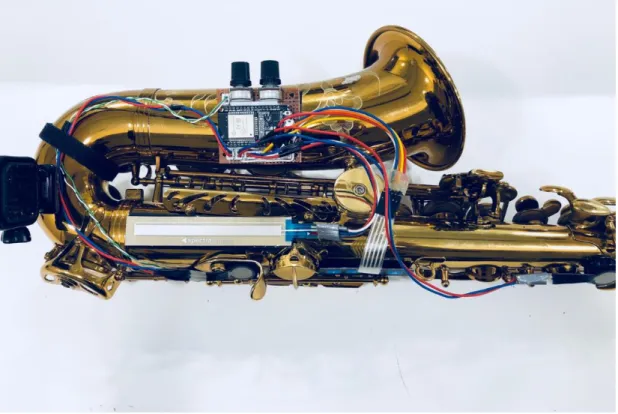
themselves. There is no standardized hyperinstrument yet for which a composer could write. It is difficult to draw the line between the composer and the performer while using such systems. The majority of performers using such instruments are concerned with improvisation, as a way of making musical expression as free as possible (Palacio Quintin 2008). In the first prototype of HASGS, we were using, attached to the saxophone one Arduino Nano board, processing and mapping the information from one ribbon sensor, one keypad, one trigger button and two pressure sensors. One of the pressure sensors was located on the saxophone mouthpiece, in order to sense the teeth pressure when blowing. Most of the sensors (ribbon, trigger, pressure) were distributed between the two thumb fingers. This proved to be very efficient once that the saxophonist doesn't use extensively these fingers in order to play the acoustic saxophone. This allowed, as well, very precise control of the parameters assigned to the sensors. The communication between the Arduino and the computer was
4
programmed through Serial Port using USB protocol. This communication sent all the MIDI commands. The computer was running a Node.js program that simulated a MIDI port and every time it received data from the USB port, it sent that data to the virtual MIDI port.
Taking in consideration that this system is still not a finalized system, but a
prototype, our third version, used here, started with the substitution of the Arduino Nano by an ESP8266 board. The communication between the sensors and the data received into the computer became wireless due to this fact. Both the computer and HASGS connect now to a Personal Hotspot created by a mobile phone API. This specification will allow much performance freedom to the performer, allowing now space for the integration of an accelerometer/gyroscope. To the previous sensors in the system were added two knobs allowing independent volume control for two parameters.
Figure 1. HASGS System
3. Repertoire
In this paper we examine some of the new pieces composed for HASGS with emphasis on pieces with contrasting performative GUI’s. These pieces resulted in different ways of using the saxophone’s sonic materials, at the same time as using the HASGS. For this reason, it’s not surprising that the visual interface of each piece has different configurations and characteristics. The evolution on notation systems and on visual programming has contributed largely for the development of extended techniques and instrumental virtuosity. Yet when acoustic instruments are played or combined in unconventional ways, the result can sometimes sound like electronic music (Roads 2015). One of the things to be considered, regarding to the new repertoire for augmented instruments, and more precisely, to this augmented saxophone system, is the presence of multiple layers of information, something that
5
still not common when writing for a monophonic instrument. This shows, as well, a different approach of programing GUIs when comparing visual interfaces of traditional electroacoustic pieces with pieces for an augmented system.
3.1 Indeciduous
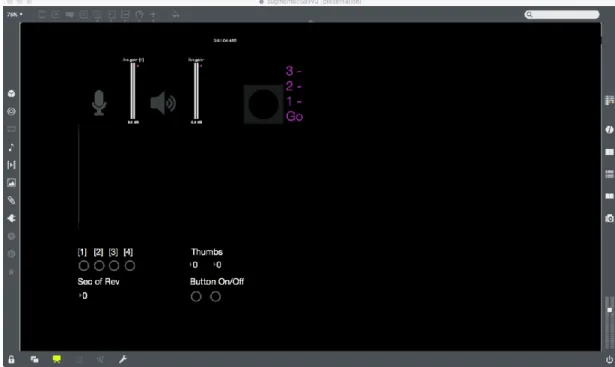
Indeciduous was composed by Stewart Engart and should to be performed as a free blues over an unrelenting drum machine. Durations notated are a suggestion as are gestures/pitches, with the exception of the pitches accented with , these notes are required and must be looped by the performer. Potentiometers on the HASGS control the sax gain (Pot1) and the overall gain of the performance (Pot2). The ribbon controller controls the time of reverb measured in seconds. The thumb pressure sensors control the size of the looping window (Pres1) and the location of that looping window (Pres2). The keypad starts the drum machine [1], stops the drum machine [2], triggers events [3], and stops looping [4]. The trigger button starts
and stops recording into the lopper. In this piece, all the controls of HASGS are
directly visible, providing a minimal but very effective visual feedback for controlling events and triggering.
Figure 2. Indeciduous, Graphical user interface.
3.2 Cicadas Memories
Composed by Nicolas Canot, Cicadas Memories is much more an improvisational process than a piece of written music. It explores a method that eventually
introduces a nonstandard musical way of thinking: the present of the live performed music is (at least partially) controlled, altered by the actualization of the past. In the case of CICADAS Memories, this means that the actual gesture of the player will alter (one minute later) the electronic sound-field used as the sonic background for the saxophone’s rhythmic patterns (also created by the keypad’s « 4 bits » layers of memory). Therefore, the performer has to develop two simultaneous ways of
6
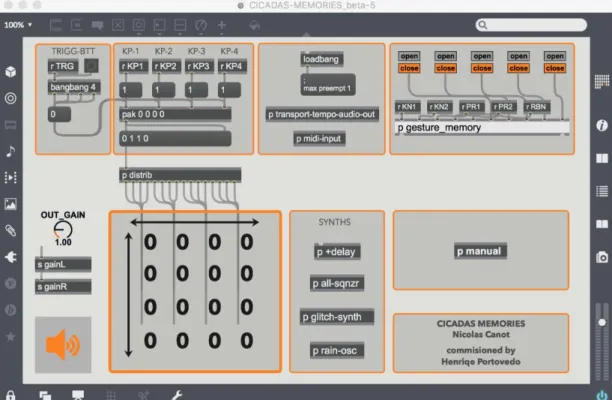
thinking (and acting) while performing: a part of his mind for the present (the patterns imposed by the software but created by the player’s past action on the keypads), another one for the future (its gestural connection to the sensors). He has to deal with two temporalities usually separated in the act of live music performance: he writes the future score and improvises on his past gestures, in the present time. CICADAS MEMORIES could be defined as a multi-temporal sensitive feedback loop. Regarding the sonic / musical context, this explores the thinking of the piece as a process (maybe under the influence of Agostino di Scipio’s thinking) rather than «written music». Cicada’s visual interface is very much obscure, once most of the sensors are not directly producing alterations or triggering events, but collecting data to define the electronic discourse of the piece.
Figure 3. Cicadas Memories, Graphical user interface.
3.3 Verisimilitude
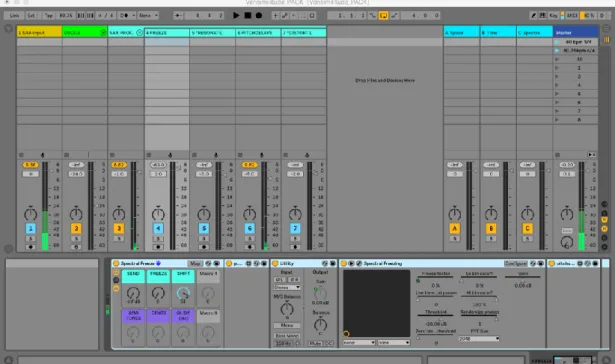
Composed by Tiago Ângelo, the setup for this piece, written for tenor saxophone and the HASGS system, uses a single speaker placed on front of the performer at the same height as the saxophone’s bell. A play of acoustic sound source and electronic (processed and generated) sound using computer music techniques is driven in three sections - A, B and C - each with its own specific processors and generators, implementing different mappings and control levels not only from the HASGS controller but also from real-time sound analysis. This performance aims to create a context where both composed and improvised elements coexist in aesthetically relevant interdependency, taking advantage of the possible synergies between a real-time composition and a hybrid acoustic-control augmented instrument. These synergies will enable a high degree of interactivity between improviser and composed response. The interaction flow is completed by the soloist’s reaction to the composed response, establishing a dialectical relationship. This GUI is based on a DAW system
7
due to the fact of the main structure is on its front layer programed on Ableton Live. This option allows to have a general vision about the output of all electronic effects and parameters. In other hand, it’s not clear the visualization of each specific control mapped to HASGS.
Figure 4. Verisimilitude, Graphical user interface.
3.4 Comprovisador
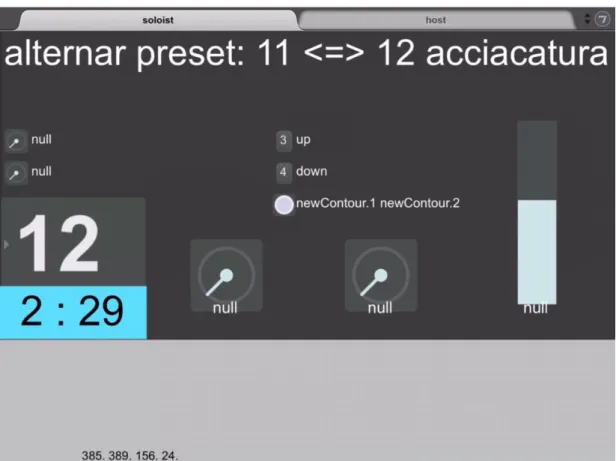
Comprovisador is a system designed by Pedro Louzeiro to enable mediated soloist-ensemble interaction using machine listening, algorithmic compositional procedures and dynamic notation, in a networked environment. In real-time, as a soloist
improvises, Comprovisador’s algorithms produce a score that is immediately sight-read by an ensemble of musicians, creating a coordinated response to the
improvisation. Interaction is mediated by a performance director through parameter manipulation. Implementation of this system requires a network of computers in order to display notation (separate parts) to each of the musicians playing in the ensemble. More so, wireless connectivity enables computers – and therefore musicians – to be far apart from each other, enabling space as a compositional element. Comprovisador consists of two applications – host and client. In the present “Comprovisação”, HASGS will be used as a musical interface with dual purpose: 1) to feed Comprovisador’s algorithms with improvised musical material (acoustic instrument) and 2) to control several of its parameters (controllers and sensors) thus, claiming some of the performance director’s mediation tasks for the benefit of interaction flow. A thoughtfully outlined performance plan is attained though presetting of algorithmic parameters and corresponding control mapping. Each preset yields different types of musical response, ranging from reactive synchronized tutti impacts to intricate micropolyphonic textures. HASGS keypad allows the soloist to navigate through Comprovisador’s presets according to the plan and subject to his momentary desire, while other HASGS controllers (such as
ribbon, trigger button, knobs, pressure and acceleration sensors) will enable him to control parameters such as dynamics, density (harmonic and instrumental), register
8
and speed, among others. Furthermore, he will be able to trigger certain algorithmic actions and transformations including capture of melodic contours and recall of previous passages. These may include passages that were generated earlier during the performance as well as pre-composed (pre-rehearsed) ones. Like Indeciduous, just HASGS controls are present as visual feedback on the user interface.
Figure 5. Comprovisador, Graphical user interface.
4. Conclusions and Future Work
Traditional music instruments and digital technology, including new interfaces for music expression, are able to influence and interact mutually creating Augmented Performance environments. The outcomes of the experience suggest as well that certain forms of continuous multi parametric mappings are beneficial to create new pieces of music, sound materials and performative environments, while visual feedback is fundamental to control and to perform this kind of works. Once each piece provides a different use of the augmented instrument, visual feedback plays a fundamental role for practicing and performing each piece into a level of conscious manipulation of HASGS leading to virtuosism.
Future work includes a profound reflection on the performative aspects of each piece, evaluating the mapping strategies of each new piece that is being written for HASGS. The notational aspect of the pieces being created will be, as well, a key aspect of this research, and how it could contribute to new interpretative paradigms. In the scope of this paper we decide to focus on the aesthetic of each piece associated with its GUI, and how it could serve as a motif of musical intention, how to influence the interpretation of each piece.
9
5. Acknowledgments
This research is supported by National Funds through FCT - Foundation for Science and Technology under the project SFRH/ BD/99388/2013. Fulbright has been associated with this project supporting the research residency at University of California Santa Barbara. We acknowledge the composers as well with pieces mentioned here, Stewart Engart Nicolas Canot, Tiago Ângelo and Pedro Louzeiro.
6. References
Bergstrom, I., & Lotto, R. (2009). Harnessing the Enactive Knowledge of Musicians to Allow the Real-Time Performance of Correlated Music and Computer Graphics. Leonardo, 42(1), 92-93.
Buxton, W., & Meyers, B. (1986). A Study in Two-Handed Input Paper presented at the Human Factors in Computing Systems.
Norman, D. A. (2002). "Emotion & Design: Attractive things work better". Interactions Magazine, ix (4). pp. 36–42.
Palacio-Quintin, C. (2008). Eight Years of Practice on the Hyper-Flute: Technology and Musical Perspectives Paper presented at the New Interfaces for Musical Expression Genova, Italy.
Portovedo, H., & Ferreira Lopes, P., & Mendes, R. (2017). Saxophone Augmentation: A hybrid augmented system of gestural symbiosis. Paper presented at the ARTECH. Thibodeau, J., & Wanderley, M. M. (2013). Trumpet Augmentation and Technological Symbiosis. Computer Music Journal, 37:3(Fall 2013), 12-25.
Roads, C. (2015). Composing Electronic Music: A New Aesthetic NY: Oxford University Press.