UNIVERSIDADE DE LISBOA FACULDADE DE CIÊNCIAS DEPARTAMENTO DE INFORMÁTICA
PREVENTING DOS ATTACKS IN MULTI-DOMAIN OPTICAL SDN
Nuno Filipe Gomes Ferreira
MESTRADO EM SEGURANÇA INFORMÁTICA
Versão pública
Dissertação orientada por:
Prof. Doutor Fernando Ramos
Agradecimentos
A realiza¸c˜ao deste trabalho teve muitos apoios e incentivos de diversas pessoas. Todos os contributos foram essenciais para o desenvolvimento e realiza¸c˜ao do mesmo. Desta forma, gostaria de agradecer e mostrar o meu apre¸co a todos os que me ajudaram e acompanharam ao longo deste percurso.
Ao professor Doutor Fernando Ramos pela orienta¸c˜ao e disponibilidade que demonstrou ao longo da realiza¸c˜ao deste projeto.
Ao meu coorientador David Silva pela disponibilidade e acompanhamento na realiza¸c˜ao da parte pr´atica deste projeto.
`
A engenheira Paula Gestal, que sempre me incentivou e me deu as condi¸c˜oes necess´arias para que conclu´ısse o mestrado.
Aos meus colegas do mestrado e da empresa onde colaboro, pela amizade e companheirismo que me proporcionaram ao longo de todo o mestrado.
Por ´ultimo, `a minha familia e amigos por todo o apoio, carinho e mo-tiva¸c˜ao que me deram ao longo do mestrado.
A todos um muito obrigado por tornarem poss´ıvel a conclus˜ao de mais uma etapa da minha vida.
Resumo
As redes tradicionais come¸cam a n˜ao ter o dinamismo necess´ario para acompanhar a evolu¸c˜ao que os servi¸cos on-line tˆem vindo a ter nos ´ultimos anos. Como forma de contornar este problema, foi proposto recentemente um novo paradigma de redes: Software Defined Networking (SDN). Enquanto nas redes tradicionais o plano de controlo se encontra junto do plano de dados, isto ´e, o equipamento de rede ´e respons´avel n˜ao s´o por encaminhar pacotes (plano de dados), mas tamb´em por decidir como encaminhar o tr´afego (plano de controlo), em SDN estas duas camadas s˜ao separadas. Em SDN ´e utilizado um controlador logicamente centralizado para controlar toda a rede. Com esta separa¸c˜ao, uma SDN traz v´arios benef´ıcios que est˜ao relacionados com a programabilidade introduzida pelo controlador e com a vis˜ao geral que este possui de toda a rede.
Para se poder beneficiar deste novo paradigma, ´e necess´ario que exista um plano de migra¸c˜ao dos v´arios tipos de redes existentes. Na arquitetura SDN, como o plano de controlo ´e implementado num controlador logica-mente centralizado, ´e necess´ario que este comunique com os equipamentos do plano de dados atrav´es de uma interface standard que abstraia os detal-hes de implementa¸c˜ao espec´ıficos do hardware dos equipamentos. Para as redes de comuta¸c˜ao de pacotes o protocolo OpenFlow fornece essa interface standard para o hardware, facilitando a sua migra¸c˜ao. No caso das redes ´opticas a passagem para o paradigma SDN n˜ao ser´a simples devido ao facto dos equipamentos ´opticos suportarem diferentes protocolos de comunica¸c˜ao e n˜ao existirem interfaces standard SDN preparadas para o seu suporte.
Para os provedores de servi¸cos de telecomunica¸c˜oes, esta evolu¸c˜ao ´e um desafio, pois requer o desenvolvimento de toda a infraestrutura para con-trolar e gerir os equipamentos ´opticos. Para estes o ideal seria manter a gest˜ao e o controlo do lado dos fornecedores de equipamentos ´opticos, e gerir e controlar os equipamentos ´opticos de diferentes fornecedores (redes ´opticas multidom´ınio) de uma forma unificada. Desta forma, v´arios provedores de servi¸cos: China Mobile, China Telecom, Verizon e organiza¸c˜oes da ind´ustria como o Open Networking Foundation (ONF) propuseram a cria¸c˜ao de uma camada de abstra¸c˜ao entre o controlador dos provedores de servi¸cos e os equipamentos ´opticos. Essa camada de abstra¸c˜ao ser´a respons´avel por con-verter a linguagem dos equipamentos ´opticos numa Application Programming Interface (API) standard SDN para comunica¸c˜ao com o controlador princi-pal. Cada vendedor de equipamentos ´opticos ser´a respons´avel por fornecer os equipamentos ´opticos e a respetiva camada de abstra¸c˜ao. Podemos con-siderar esta camada de abstra¸c˜ao como sendo um controlador de
equipa-mentos ´opticos: o controlador Original Equipment Manufacturer (OEM). Desta forma, os provedores de servi¸cos apenas ter˜ao de arranjar um contro-lador localizado na camada superior da hierarquia que seria respons´avel por orquestrar toda rede, utilizando para isso a abstra¸c˜ao fornecida pelos contro-ladores de equipamentos ´opticos. ´E de notar que o controlo e a gest˜ao dos equipamentos ´opticos n˜ao ´e feita diretamente pelo controlador dos provedores de servi¸cos, mas sim na camada de abstra¸c˜ao abaixo, ou seja, pelos contro-ladores de equipamentos ´opticos. Com esta abordagem, os provedores de servi¸cos ficam sem o controlo completo do sistema, pois ficam dependentes das opera¸c˜oes e da informa¸c˜ao que ´e dada pelos controladores de equipa-mentos ´opticos, como por exemplo informa¸c˜ao de desempenho dos servi¸cos, alarmes ou estados da rede ´optica. Neste contexto, como poder˜ao os fornece-dores de equipamentos ´opticos dar garantias de seguran¸ca aos provefornece-dores de servi¸cos? Se a disponibilidade ou a integridade do controlador dos equipa-mentos ´opticos for comprometida, poder´a haver nega¸c˜ao de servi¸co (o con-trolador de equipamentos ´opticos deixaria de processar informa¸c˜oes impor-tantes da rede ´optica, como por exemplo alarmes) ou quebras de tr´afego (desativa¸c˜ao de servi¸cos ´opticos), o que seria indesej´avel e poderia trazer avultados preju´ızos para os provedores de servi¸cos. Nesta tese a principal motiva¸c˜ao ´e de facto garantir que o controlador de equipamentos ´opticos mant´em a sua disponibilidade e integridade no processamento de todos os pedidos.
O objetivo deste trabalho ´e assim desenvolver uma solu¸c˜ao que proteja os controladores de equipamentos ´opticos de eventuais ataques de nega¸c˜ao de servi¸co. ´E de notar que mesmo havendo protec¸c˜ao nos links ´opticos, um utilizador malicioso poder´a colocar o controlador de equipamentos ´opticos indispon´ıvel, bloqueando assim o acesso `a rede ´optica por parte do provedor de servi¸cos (se houver problemas na rede ´optica, estes n˜ao ser˜ao detetados). A solu¸c˜ao que propomos para este problema ´e a implementa¸c˜ao de mecanismos de monitoriza¸c˜ao e an´alise dos pedidos ao controlador de modo a controlar o fluxo de dados `a entrada do controlador de equipamentos ´opticos e assim garantir a sua disponibilidade. Esta protec¸c˜ao ser´a feita atrav´es da utiliza¸c˜ao de uma reverse proxy e de uma firewall. Para al´em destes dois mecanismos de protec¸c˜ao, a comunica¸c˜ao entre o controlador do provedor de servi¸cos e o controlador de equipamentos ´opticos ´e feita de forma segura, de modo a garantir a integridade de todos os pedidos.
Palavras chave: Software defined networking, equipamentos ´opticos, prove-dores de servi¸cos, controlaprove-dores de equipamentos ´opticos, seguran¸ca, moni-toriza¸c˜ao, disponibilidade, integridade.
Abstract
Legacy networks do not have the necessary dynamism to follow the evo-lution online services have experienced in the past few years. In order to overcome this problem, the Software Defined Networking (SDN) paradigm was proposed. The goal of this paradigm is change the way networks are controlled. In legacy networks, the control plane and the data plane are cou-pled together in the network elements. SDN separates the control plane and the data plane through the use of a standard SDN Application Programming Interface (API) in the data plane to communicate with the logically central-ized control plane. In order to reap the benefits of SDN, a plan of migration for legacy networks should be established. For optical networks the migra-tion to SDN is not easy because optical equipments have their own protocols to communicate and there are no SDN standardized interfaces prepared to abstract these type of equipments. In order to solve this problem, tions such as China Mobile, China Telecom, Verizon and industry organiza-tions like the Open Networking Foundation (ONF) have proposed the use of an abstraction layer between the data plane and the main controller. This abstraction layer is responsible to convert the optical equipment protocols into a standard SDN Application Programming Interface (API) to commu-nicate with the main controller. The abstraction layer can be considered an optical equipment controller, the Original Equipment Manufacturer (OEM) controller. With this approach, service providers (SP) (i.e., telecommunica-tion operators) only need to have a main controller to orchestrate the whole network through the use of OEM controllers. With this solution the Service Providers (SP) are able to control the optical network with different optical equipment from multiple vendors (multi-domain networks).
The OEM controllers are responsible to execute all the operations in the Network Element (NE) (the NE is the optical equipment) that constitutes the Data Plane (DP). They also process information that comes from the NE and translate that information to the main controller. Examples include: network information and performance of services. The challenge is that if the OEM controller is compromised, the entire optical network is compromised. This is the main motivation for this project.
The objective of our work is to develop a solution that can help the Service Provider (SP) to have confidence in the NEs and respective optical network connections. To achieve this goal, the system has to guarantee the availability of the OEM controller. The integrity of the communication between the SP orchestrator and the OEM controller should also be guaranteed. The OEM controller should be always available to process notifications, be it from the
NEs or from the main controller. It should also be ensured that the integrity of all requests that are sent by the SP controller to the OEM controllers is guaranteed.
In order to solve these problems, we propose a new security mechanism for the OEM controller to protect the optical network. The solution consists in the use of a reverse proxy and a firewall to control the flow of requests to the OEM controller. The communication between the SP controller and the OEM controller is also made secure to assure the integrity of requests.
Key words: Software defined networking, optical network equipment, ser-vice providers, OEM controllers, security, monitoring, availability, integrity, Network Elements.
Contents
1 Introduction 1
1.1 Legacy optical networks . . . 1
1.1.1 Legacy optical networks versus SDN . . . 2
1.1.2 Migration of legacy optical networks to SDN . . . 4
1.2 Security in multi-domain optical SDN environments . . . 7
1.3 Goals . . . 10
1.4 Contributions . . . 10
1.5 Document outline . . . 10
2 Context and related work 12 2.1 Overview of optical networks . . . 12
2.1.1 Evolution of optical networks . . . 13
2.1.2 Optical equipment overview . . . 14
2.2 Security overview in Software Defined Networking . . . 16
2.2.1 Security analysis in SDN . . . 17
2.2.2 Security analysis in multi-domain optical SDN . . . 19
2.2.3 Enhancements and security solutions . . . 20
2.3 Summary . . . 22
3 Confidential chapter 23 4 Confidential chapter 24 5 Conclusions 25 5.1 Future Work . . . 26
List of Figures
1.1 Network Element. . . 2
1.2 Terrestrial network layer and segmentation. Figure from [8] . 3 1.3 Legacy optical networks vs SDN . . . 4
1.4 Example of Multilayer Resilience . . . 5
1.5 Multi-domain Resilience (from [23]) . . . 6
1.6 Optical network management and control in an SDN environ-ment. . . 8
1.7 Example of a possible attack to the optical network. . . 9
2.1 Muxponder aggregates several client signals into one line side signal. . . 15
2.2 Add and drop scenario from a transponder or muxponder to a filter. . . 15
2.3 ROAMD scenario with WSS . . . 16
2.4 Components in SDN. . . 17
List of acronyms
API Application Programming Interface
ASON Automatically Switched Optical Network CP Control Plane
DWDM Dense Wavelength Division Multiplexing DP Data Plane
DoS Denial-of-Service
EDM Evolving Defence Mechanism EMS Element Management System
GMPLS Generalized Multi Protocol Label Switching ICMP Internet Control Message Protocols
IM Interface Manager IP Internet Protocol MP Management Plane
NDM Network Domain Manager NE Network Element
NMS Network Management System OAMD Optical Add Drop Multiplexer OEM Original Equipment Manufacturer OIF Open Interface Forum
OLR Optical Line Repeater
ONF Open Networking Foundation
OSI Open System Interconnection
OTN Optical Transport Network
PCE Path Computation Element
ROADM Reconfigurable optical add and drop multiplexing
SDN Software Defined Networking
SLA Service Level Agreement
SLAM Service Level Agreement Manager
SP Service Provider
SPAP Service Provider Administration Portal
STRIDE Spoofing identity; Tampering with data; Repudiation;
Information disclosure; Denial of service; Elevation of privilege
TLS Transport Layer Security
WDM Wavelength Division Multiplexing
Chapter 1
Introduction
1.1
Legacy optical networks
The society depends on information access. Today, most things are con-nected, and information is accessible from almost anywhere. That brings new challenges to network management and control. To cope, networks need to be more dynamic and allow better and efficient control. Most networks are managed and controlled by Service Providers (SP) or carriers. These networks are used to provide a variety of services to their costumers [21]. Delivering these services requires guarantees of high throughput from the network, and for that reason optical networks now form the core of SP net-works.
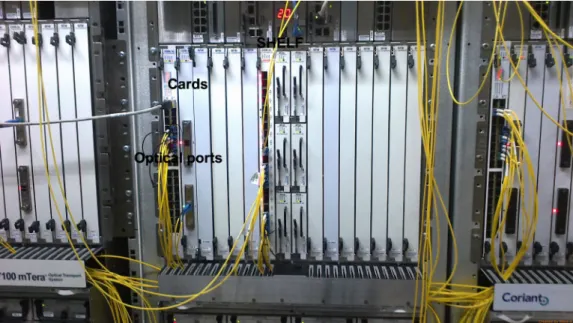
Optical networks use optical fibers, whose characteristics provide more bandwidth than copper cables and make them less susceptible to various kinds of electromagnetic interferences [21]. These networks are composed of optical equipments that are deployed in Network Elements (NE)s. Each NE consists in a group of shelfs where the optical cards are placed and interconnected. An example of an NE can be seen in Figure 1.1. In this figure it is possible to see a shelf with several cards and the optical ports of each card used to connect the fibers. NE equipment is sold by optical vendors. A SP typically uses optical equipment from multiple vendors (multivendor networks).
In Figure 1.2 we illustrate how a large terrestrial network is segmented. The SP telecommunication network is typically organized into metropolitan (metro) areas. Each of these areas are interconnected by the core network using optical fibers [8].
In optical networks, each NE is managed individually through the use of vendor-specific interfaces, and that requires highly skilled personnel to make
Figure 1.1: Network Element.
the proper configurations. This creates an increase in operational costs, since the provisioning and management of large multivendor networks be-came extremely expensive [25]. However, the income for operations has been decreasing over the last years. As such, the SP has interest in solutions that can merge optical network management and provisioning across multivendor networks in order to reduce costs, simplify management, improve provision-ing time and improve resource utilization [11]. Also, the vertical integration of these networks (the control plane and data plane are coupled together inside the network devices), reduces the flexibility, innovation and evolution of the network infrastructure [15]. A new networking paradigm that tries to solve the previous problems is Software Defined Networking (SDN).
1.1.1
Legacy optical networks versus SDN
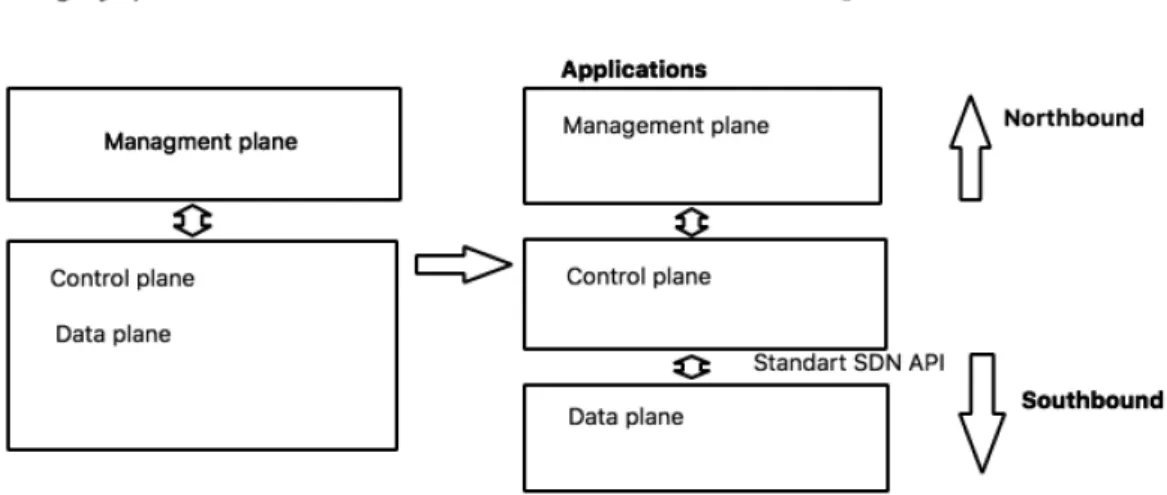
The main difference between traditional or legacy optical networks and SDN can be seen in figure 1.3. Networks are composed by a Management Plane (MP), a Control Plane (CP) and a Data Plane (DP). The MP corresponds to the function applications that are responsible to implement network manage-ment and operations logic [15]. In optical networks this plane is responsible to manage the optical equipment through the use of a Network Manage-ment System (NMS) or EleManage-ment ManageManage-ment System (EMS). The CP is the component that defines how traffic is handled. Finally, the DP corresponds
Figure 1.2: Terrestrial network layer and segmentation. Figure from [8]
to the place where the optical devices are interconnected. In legacy optical networks, the CP and DP are coupled together inside the network equipment. SDN decouples the CP and the DP. For this purpose it uses a well de-fined southbound interface to communicate with the NEs in the DP. The communication is done through the use of a standard Application Program-ming Interface (API), such as OpenFlow [15]. With this separation, the CP can be seen as the network brain of the SDN architecture. This separation brings several advantages over legacy optical networks [15]: First, the pro-grammability of applications is simplified since it provides an abstraction layer (the CP). Second, the logically centralized CP gives a global view of the network, which can be used to make effective and consistent decisions in the network. Third, applications are able to take actions from any part of the network (this includes automatic reconfigurations when necessary). Fourth, the integration of more devices in the network is simplified and more straightforward. All these advantages are very important to improve optical
Figure 1.3: Legacy optical networks vs SDN
network management and control, specially in multivendor scenarios.
1.1.2
Migration of legacy optical networks to SDN
In order to benefit from the SDN architecture, an effective migration plan from legacy optical networks is necessary. In SDN, the control plane is imple-mented in a logically centralized1controller that communicates with the data
plane through the use of a standardized interface that abstracts hardware-specific implementation details. OpenFlow is the protocol that provides a standardized interface to packet based networks. Unfortunately, it does not yet provide the same mechanisms for optical networks. The migration of optical networks to SDN is not simple [11] because in these networks the NEs have their own protocols to communicate and there are no standard-ized interfaces prepared to abstract different optical equipment. In order to benefit from the SDN capabilities in optical networks, some improvements are further needed to achieve the necessary flexibility at the photonics and electrical layers [19].
As stated above, optical networks can be managed through the use of a NMS or an EMS. These two management interfaces belong to the manage-ment plane. The EMS is used to manage each NE individually. The NMS is an application that is used to manage the optical network from a specific
1By logically centralized we mean the automation can be implemented as a distributed system [14]
optical vendor. Each optical vendor use a different NMS that is adapted to their optical equipment. In the NMS, the management requires network op-erators to design circuits (the configurations in the optical equipment should match with the hardware) and consequently drive the configuration of NEs. Another requirement that need to be fulfilled by a migration plan is, for the service providers, the optical network to be resilient in order to ensure the desired level of survivability, to fulfill the Service Level Agreement (SLA) [8]. Normally the service availability is defined within this SLA, and that means for example that an availability value of 99.999% can tolerate an outage of 5 min per year. In order to achieve this, the SPs have to use protection links in the optical layer and recovery mechanisms.
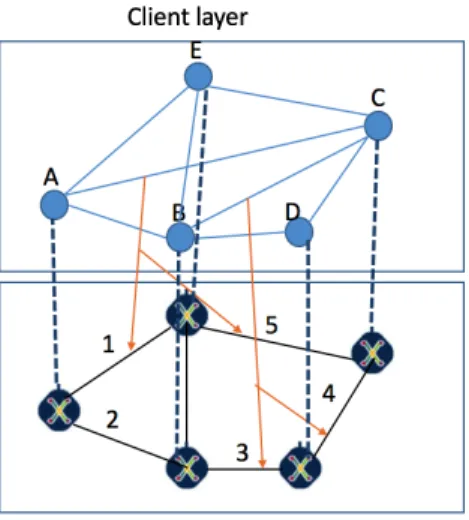
Optical resilience can be divided to two main fields: multilayer resilience and multi-domain resilience [8]. Multilayer resilience is illustrated in Figure 1.4. The idea is to take the advantage of recovery options on different tech-nology layers that compose the Open System Interconnection (OSI) model. In this figure, the NEs compose the optical layer and all traffic will flow on this layer (it represents the layer 1 of OSI model). In the upper layers, ap-pear the Client layers of the optical layer. This means if one link fails in the optical layer, for instance, the services that are running in client layer will be notified and then will change to an available connection in the optical layer. For example, if the link four in the Figure fails, the connection between B and C will change to B-E-C.
Figure 1.4: Example of Multilayer Resilience
networks more autonomous. Several operators have adopted the Automati-cally Switched Optical Network (ASON) architecture using the Generalized Multi Protocol Label Switching (GMPLS) [17] protocol as their optical trans-port control plane. The GMPLS has been standardized [17] to facilitate the automated control of multilayer networks. For this purpose, it uses rout-ing and signalrout-ing protocols to facilitate dynamic service setup, to provide capacity or to protect services through the use of recovery options on differ-ent technology layers [23]. The main problem is the compatibility of optical equipment to support this type of resilience.
The second type of optical resilience is multi-domain. Multi-domain re-silience is shown in Figure 1.5. Basically each domain is composed by equip-ment from one optical vendor (Coriant, Huawei, Alcatel..), and that makes the interoperability between domains a hard task. In this case, the objective is to provide end-to-end service resilience over multiple network domains (also called multivendor networks). Here, sharing information between domains is a critical point.
Figure 1.5: Multi-domain Resilience (from [23])
As can be observed in figure 1.5, each domain has a Original Equipment Manufacturer (OEM) controller that is used to compute end-to-end paths by standardized interfaces between layers in a specific domain. The OEM controller is only able to communicate with NEs in a specific domain. In order to have resilience in a path from Domain 1 to Domain 3, for instance it is necessary to introduce a higher controller that has global information on domains. This is the place where an SDN approach could bring benefits. With SDN it will be possible to control and manage paths that cross several domains.
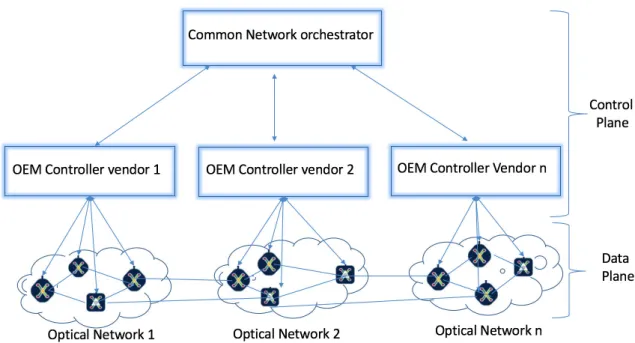
To manage and control optical paths that traverse several domains, sev-eral techniques have been proposed: [20], [5], [4]. Basically all these solutions are based on the use of an hardware abstraction layer. They use this inter-mediate layer between the NEs and the main controller (SP controller) for communication via southbound, and in the northbound a standard SDN API (Restconf, OpenFlow or other) is used to communicate with the main con-troller (in this case the SP concon-troller). With this approach, a service provider can manage and control the entire network even though optical equipment from different providers is used (each optical network vendor will use its own abstraction layer). In order to make this possible, Service Providers like China Mobile [29], China Telecom [9], Verizon [10] and industry organizations like Open Networking Foundation (ONF) [22] have proposed an architecture where the Original Equipment Manufacturer (OEM) domain controllers will manage the optical NEs within each vendor’s own domain while providing open northbound interfaces to a common network orchestrator (a parent “su-per” controller), as in Figure 1.6. In this figure it can be seen that each optical network (1,2..n) is managed through the use of a specific OEM controller. The SP controls the common network orchestrator that is used to manage and control the whole network. From the SDN point of view, the data plane is represented by the NEs in the optical network. The main diference here is the control plane. In this scenario, the control plane is composed by the OEM controllers and by the common network orchestrator. As such, the control is split between the SP controller and the OEM controllers. The SP controller will have the vision and control of the global network throw the use of OEM controllers. With this approach we achieve control and management over optical networks in a multi-domain optical SDN environment.
One of the main challenges of these networks is security. In the next section we will give a security overview of standard SDN and multi-domain optical SDN networks.
1.2
Security in multi-domain optical SDN
en-vironments
The standard SDN architecture is different from a multi-domain optical SDN environment architecture in that, the data plane equipment in the latter is not SDN compatible. As such, different techniques need to be put in place to secure this new environment.
Figure 1.6: Optical network management and control in an SDN environ-ment.
standard SDN. These surveys are adapted to the case where the equipment’s in the data plane are compatible with an SDN API. That is not the case when we have several OEM controllers managing different NEs, with a main controller orchestrating the network globally. In this case, more layers, inter-faces (with respect to the OEM controller) appear and the security analysis became more complex.
Regarding security, standard SDN brings several benefits. The separation of the control plane and data plane gives SDN an enhancement in security by means of global network visibility. Any conflicts that appear in the network can be more easily solved by the logically centralized control plane. However, this change also brings new security problems. New threats [24], [1] appear as a result of this separation. This new threats are mainly related to man-in-the-middle attacks and Denial of service (DoS) attacks.
With the additional division of control brought by using a two-tier hi-erarchy of SDN controllers, in multi-domain optical networks, new security problems may arise. For example, a man-in-the-middle attack can be per-formed to change the information that is sent from the SP controller to the OEM controller. In this case, the integrity of the request will be at risk. This problem can be solved with the use of Transport Layer Security (TLS) in the
communications between these two components. DoS attacks are also possi-ble. Basically, in this case a DoS attack can be done to the main controller, to the OEM controllers or to the optical equipment. A DoS attack to any controller can put the resilience of the entire optical network at risk.
Figure 1.7: Example of a possible attack to the optical network.
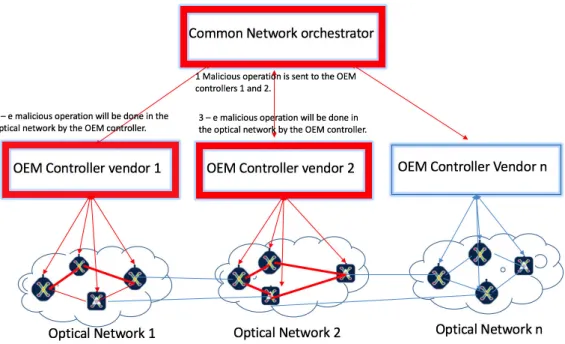
If a malicious user intercepts the traffic between the OEM controller and the common network orchestrator it will be able to make fake requests, and compromise the network. On the other hand, if the SP controller is compro-mised, then the entire network is at risk. In this case, a malicious user with access to the main controller can execute any type of requests to the OEM controllers and compromise the optical network. This can be seen in Figure 1.7. In this example, the OEM controllers 1 and 2 receive a flood of requests and execute them in the optical network. This can put the OEM controllers unavailable to the main controller, causing a Denial-of-Service (DoS) attack. In this situation, the OEM controller will have problems processing normal requests alarms, traffic problems, and other notifications from the optical network will be received with a high delay at the SP controller. The worst case will be the entire unavailability of the OEM controller. Such event can lead to interruption of services in the optical network as the common network orchestrator will not see the failures and as such, will not recover the optical
services.
The above security challenges are the motivation for this work. In order to solve the above problems it is important to ensure that all operations executed in the DP (optical equipment) by the OEM controllers are trusted (the requests from the common network orchestrator should not be compro-mised) and will not compromise the optical equipment functions. It should be also ensured that the OEM controller is always available, independently of external attacks. This is a challenge, and as such is the main motivation of this work.
1.3
Goals
The migration of legacy optical transport networks to SDN should be done without introducing new security problems. The objective of this work is to identify and solve two particular security problems that can arise from the use of optical network equipment with OEM controllers in an SDN environment. First, it should be ensured that the OEM controller is always available, and capable of processing requests without significant delays. Second, the integrity of the requests should also be guaranteed.
1.4
Contributions
This work will contribute to improve the security of service provider networks on the process of migration to SDN. This is achieved by designing and imple-menting a monitoring mechanism (reverse proxy) with well defined policies in the OEM controller to prevent DoS attacks. The use of a firewall will also be included. This solution will help SP, to protect their optical networks and make them more resilient in multivendor scenarios.
The mechanism developed in this thesis will be included in the Coriant OEM solutions and documentation, helping our customers, SPs in securing their infrastructure.
1.5
Document outline
In Chapter 2, we present basic concepts about optical networks. In addition, we make a review of the literature of security problems that affect SDN and how they can affect optical SDNs. In Chapter 3, we present the design and implementation of our security solution. This includes the design of mechanisms to protect the OEM controller against some DoS attacks and
man-in-the-middle attacks. In Chapter 4, we evaluate our solution. We end this thesis in Chapter 5, concluding it and presenting the future work.
Chapter 2
Context and related work
This chapter will start by giving an overview of optical networks. The goal is to understand how these networks work, its main challenges and how SPs typically handle them. This initial part also defines the functional and non functional requirements of these networks. Then, we present a security overview for standard SDN networks. This will include security problems, enhancements and solutions. Finally, we consider the main issues in multi-domain optical SDN environments.
2.1
Overview of optical networks
Nowadays, SPs use optical networks to deliver all type of services to their cos-tumers. These networks rely on fibers operated by optical equipment that include optical interfaces [8]. The SP needs to manage and control these networks in order to: compute new paths (when needed), identify points of failures (normally links that need to be repaired or replaced) through alarm information, analyze performance problems, among many other operations. The network management operations are divided in four sub-areas [8]: con-figuration management (install, remove optical equipment and adjust their settings); connection management (establish cross connections in the equip-ments to activate end-to-end services in the network); fault management (alarms on optical equipment to identify signal losses or other problems); performance management (information about the quality of the services in all involved optical ports). All this information is used to manage the optical services that run in the optical network. Typically, the Network Management Systems Network Management System (NMS) centralizes all the information (alarms, performance, connections, etc) for each optical service that is run-ning on the optical network. With this approach, SPs are able to see all
the optical services to quickly identify problems. Unfortunately, this is not simple to achieve in multi-domain scenarios. This is a challenge we try to address with an SDN solution.
The SP also requires optical networks to be resilient [23]. These networks transport large quantities of information, making survivability a critical fac-tor. The main goal is to guarantee availability of optical services. As such, the networks have to be designed to recover optical services automatically when failures occur. As explained in the previous chapter, resilience can be divided into multilayer and multi-domain. The focus of this work will be in multi-domain resilience, since we target the scenario of having an OEM controller in each domain (see Figure 1.5), with all domains being controller by a SP controller.
Automatic recovery is very important to guarantee the Service Level Agreements (SLA) that defines the time the overall optical network can be down (the availability of the network). Another parameter that has to be taken into account is service recovery time upon failure (the time spent to change the optical paths from a path with failures to a new path).
To achieve the desired resilience, a good planing for the network deploy-ment is required. This includes protection for the optical links in different locations. In addition, since the SP uses optical equipment from different ven-dors, it is necessary to protect their optical networks from equipment failures from every specific vendor. Diversity is key for multi-domain resilience (see Figure 1.5).
In the next subsection we present the evolution of optical networks. Then, we define the main operations of optical equipment.
2.1.1
Evolution of optical networks
Optical networks have evolved significantly in the past few years [28]. The first optical networks used a single wavelength per fiber, and were opaque: they could only transport one signal in each optical channel. Later, a new technology was introduced, capable of transporting several signals (frequen-cies) over a single fiber. This new technology, Wavelength Division Multi-plexing (WDM), offers large transmission capacities to optical fibers. The backbone core network (the network that interconnects the metro networks, see Figure 1.2) is highly based on optical links utilizing the WDM technol-ogy. More recently this technology has evolved to the Dense Wavelength Division Multiplexing (DWDM), a scheme that makes better use of spec-trum to improve the transmission capacities. These networks use predefined connections between the network nodes and pre-planned add and drop wave-length channels. To understand how this is all set up, it is important to
understand optical cards, and its main functions.
2.1.2
Optical equipment overview
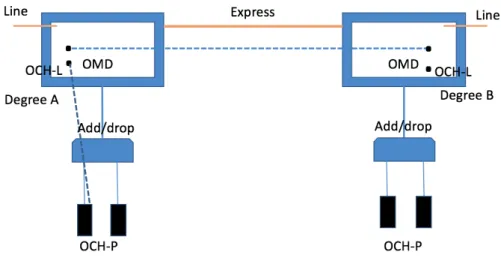
In optical networks, network equipment is composed of several cards. The cards can be divided into filters, amplifiers, transponders and muxponders. The transponders and muxponders are composed of two sides, the client and the line side. The client side is where the initial signal is injected. This signal is then encapsulated in a wavelength to be delivered in optical channel (us-ing any frequency available). The main difference between the transponder and the muxponder is in the relation between the client and line side. The muxponder can aggregate several client signals into one line (see Figure 2.1), whereas the transponder can only aggregate one. As such, with a muxponder it is possible to have several low rate signals as clients and multiplex them into a higher rate in the line, and send it to the optical channel. The line side of the transponder or muxponder can then be dropped by a filter and then amplified by an amplifier card (see Figure 2.2). In this figure we show a add and drop scenario with two degrees. Each degree can be seen as a different direction for the optical channel. First, the line side of the transponder or muxponder is connected to the Optical Multiplexer / Demultiplexer (OMD) (a filter card with the fiber connection to the muxponder or transponder) and then the signal flows to the amplifier card (Optical Add Drop Multi-plexer (OADM)). This card connects to a similar card in other location by using the optical channel (an example would be optical channel connection between two large cities). All these cards should work together in the same NE.
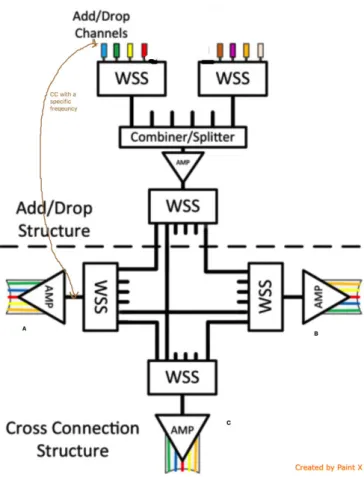
Optical networks today have to be dynamic, and can change during both planning phase or operation phase, due to traffic changes or due to link or NE failure. To address this issue, Reconfigurable optical add and drop mul-tiplexing (ROADM) and Wavelength Selective Switching (WSS) technology was added. The use of a WSS and ROADM can be seen in Figure 2.3. It allows wavelength reassignment without the need for manual intervention, but with the tradeoff of higher node complexity and cost. Basically, with the WSS it is possible to deliver the signal to any available direction in the NE, and that gives the option to create optical services in any direction. The configuration is executed by the operator via software, allowing the reconfig-uration, such as, adding new services or changing existing ones when traffic demands change.
Another recent improvement in the optical network that help operators in management and control includes the Flexi-grid. This solution adds more bandwidth to the optical channels, allowing the transport of more bandwidth
Figure 2.1: Muxponder aggregates several client signals into one line side signal.
Figure 2.2: Add and drop scenario from a transponder or muxponder to a filter.
in a single optical channel.
Another important technique is the adaptive Rate Modulation, which allows dynamically varying modulation in an errorless manner in order to maximize the throughput under momentary propagation conditions. It also reduces interferences in the network. With this technology, the number of amplifiers can be reduced, consequently reducing network costs.
The Optical Transport Network (OTN) Switch, allows multiple clients to be transparently bundled into uniform containers and sent on a single wavelength. With this technology, clients are decoupled from the transport
Figure 2.3: ROAMD scenario with WSS
interface, increasing network efficiency.
The new technologies introduced in the past few years have made opti-cal networks more flexible, allowing high degree of control in multi-domain optical environments. As a result, optical networks are changing from static point-to-point systems to mesh topologies with dynamic and diverse wave-lengths [28].
2.2
Security overview in Software Defined
Net-working
The main purpose of security is to preserve confidentiality, integrity and availability of information system resources [27]. Unfortunately, all systems have vulnerabilities which can be exploited by an attacker with the objec-tive to subvert the security policies of the system. These vulnerabilities can
arise from project, implementation, and operation [26]. SDN was not cre-ated with security as a priority, and that introduce project vulnerabilities to this paradigm. In addition, the network programability brought up by SDN brings implementation vulnerabilities (due to bad implementation of new software). Finally, if the SDN is not correctly operated, operation vul-nerabilities can also appear.
The objective of this section is to give an overview of security in SDN. The focus will be: analysis, enhancements, and solutions. This related work can be used as the basis to improve the security in our scenario, where several OEM controllers are orchestrated by a main SDN controller.
2.2.1
Security analysis in SDN
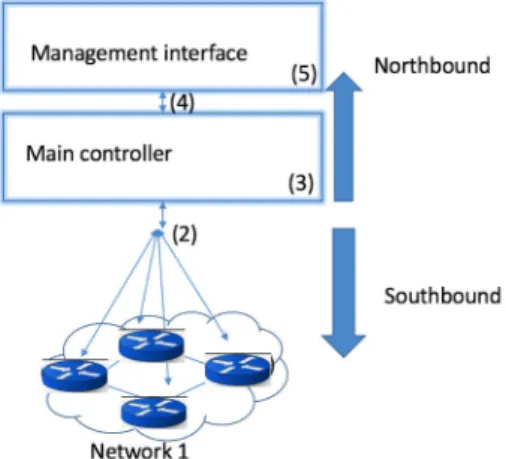
In this subsection, we give an overview of SDN security. In the literature there are some surveys about security in SDN, [24], [1], [3], and [16]. The security of SDN can be divided into five main components: CP, DP, MP, and communication between them. These components can be seen in Figure 2.4, enumerated from one to five.
Figure 2.4: Components in SDN.
Several security threats were identified in [16]. First, with forged or faked traffic flows between the NEs an attacker can make a DoS attack to the net-work by changing flows in the NEs (component 1 in Figure 2.4). Second, vulnerabilities in the NEs can be exploited. For instance, the information retrieved from the NE can be different from the information in the controller. Third, an attack on control plane communication can be used to make DoS attacks or for theft information attacks (man-in-the-middle attacks). Fourth,
attacks to vulnerabilities in the main controller could compromise the whole network. This is the most severe threat in SDN because the controller cen-tralizes the knowledge of the network. Fifth, attacks to the administrative station: these applications are used to access the control plane. If they are compromised, the controller is also compromised, and the whole network is at risk. Sixth, lack of information to make forensics analysis: it’s important to have trusted logs about all the operations in the system. Without them it will be impossible to understand the cause of problems that may occur in the network.
To solve the previous problems, the authors of [16] identified the following mechanisms for protection: replication; diversity; self-healing mechanisms; dynamic device association; trust between controllers and the NEs; trust between applications and controllers; security domains; and the use of secure components.
In [13] the authors follow a different approach for the security analysis, fo-cusing on OpenFlow, the standard protocol for SDN. They use the STRIDE method (Spoofing identity; Tampering with data; Repudiation; Information disclosure; Denial of service; Elevation of privilege) [12] with an attack tree approach. They were able to identify the following possible attacks: denial of service against the flow table; hash collision attack on the flow table; observ-ing differences in controller response times to get information (information disclosure), and cache poisoning attacks against the flow table or controller state. In [6], the authors identify new vulnerabilities in OpenFlow that are related with: man-in-the-middle attacks, switch authentication, slow table verification and others.
[2] and [7] addressed the DoS problem. The authors identify several DoS attacks types: Smurf attack, UDP flood attacks, ICMP flood attacks, Syn flood attacks, Teardrop attacks and land attacks. In SDN these attacks can be executed to the network; to the main controller; or to the management Interface.
The smurf attack is a form of DoS attack that can make an entire network unavailable or inoperable. This type of attack explores vulnerabilities in the Internet Protocol (IP) and Internet Control Message Protocols (ICMP) . For this attack, the attacker sends a large amount of ICMP broadcast messages with a spoofed source address (the victim address). By responding to the ICMP messages, the victim will leave the network unavailable.
In the UDP flood attack the attacker sends a large volume of UDP packets to the target system. This will saturate the network, and put legitimate services unavailable.
The ICMP flood attack, explores the use of echo packets to check if the remote host is alive. Basically, the agents send a large volume of ICMP
ECHO REPLY packets to the target victim. The packets request a reply from the victim and by making the reply, the victim will saturate the bandwidth of the network connection. This will make the target system unavailable.
In the SYN flood attack the victims are flooded with half open TCP connections. To establish a TCP connection between a client and a server, the client sends a SYN to the server, and the server responds with a SYN-ACK response message to the client. The connection is only finished when the client responds with the ACK message. Basically, for this attack, the final ACK message is never sent by the client, and a connection stays half open between the client and the server. The server saves the connection state in its structures, but these structures have limited resources. The system may crash or became unavailable for legitimate users.
In the Tear drop attack, the attacker sends long packets, that have to be fragmented. In addition, the attacker sends an invalid offset value into the subsequent fragments. As such, when the packet is reassembled by the victim, if the operating system is not prepared, the system may crash.
In the land attack, the IP address is modified so that the source and des-tination IPs are the same. This attack works by making the target machine reply to itself continuously.
After this brief security analysis, we will investigate which attacks are valid in a multi-domain optical SDN. This is the topic of the next subsection.
2.2.2
Security analysis in multi-domain optical SDN
To understand the security problems that can affect a multi-domain optical SDN, first it is necessary to identify the differences to standard SDN. Lets begin with its components. In Figure 2.5, we identify the potentially vul-nerable components of a multi-domain optical SDN. In this figure, we can see more vulnerable components than in standard SDN. This is due to the addition of OEM controllers between the main controller and the optical network.
In this work, the objective is the protection of the OEM controller. By assuming that the optical network is not compromised, the focus will be the vulnerable components 3 and 4, in Figure 2.5. From [16], an attack to the communication between the main controller and the OEM controller (component 4) can be used for theft information or to modify a legitimate request that will be executed in the network. In this case the integrity of requests will be broken. Another problem is related to DoS attacks. A DoS attack can be executed against the OEM controller (component 3). All the DoS attacks described in the previous subsection will be possible here.
Figure 2.5: Components in multi-domain optical SDN.
In the next subsection we present enhancements and solutions to protect the system from this type of attacks.
2.2.3
Enhancements and security solutions
The problems described in the previous sections (both for standard SDN and for multi-domain optical SDN) can be mitigated through the use of existing security solutions tailored to these settings.
For the DoS attacks several defense mechanisms have been proposed in the literature [2], [7] but, depending on the specific attack, the defense mech-anisms may need to be adapted.
To better protect the resources from a DoS attack, it is important to understand what are the main incentives for the attacker. In [30], the authors divide the motivation of the attackers into five main categories:
• Financial/economical gain: in this case attacker has a financial gain as the objective. Normally this type of attacks is the most dangerous, and hard to stop. An example for an attack with this objective is sim-ple: imagine that the SP sells to clients a high SLA. In this case, if the optical services stop working for a long time, the client will complain, and the SP may have to pay. In this scenario, the attacker could be a client that wants to receive an indemnity for breaching of the SLA. • Revenge:, in this type of attack, the attacker wants revenge for
skills. This type of attacks represents a small threat to the SP.
• Ideological belief: In this type of attacks, the attackers are motivated by their ideological beliefs. Some of the attacks can be politically mo-tivated.
• Intellectual Challenge: In this type of attacks, the attackers enjoy to experiment and learn how to launch attacks.
• Cyberwarfare: In this scenario, the attackers are working for a mil-itary or terrorist organization, and they may want to attack critical sections of another country. In this scenario, the target will be the telecommunication network of a country, that is highly dependent of the optical network.
After presenting the main motivations to execute a DoS attack it is im-portant to protect the OEM controller, to guarantee the availability of the optical network. In [31], the authors describe a new algorithm that is inspired in biological systems to implement an Evolving Defence Mechanism (EDM). This algorithm hides network information by implementing a mechanism in the controller that makes: variation of IP addresses; variation of routes; vari-ation of host responses; varivari-ation of encryption methods and varivari-ation of authentication approaches. By using random network configurations, it is possible to detect on-going attacks and change the network configurations to eliminate security threats according to the security requirements defined for the system. This algorithm can protect the system against several attack types. An example is DoS attacks. When a DoS attack is detected, a vari-ation of the IP address will invalidate the attack (since the IP used for the attack ceases to be valid).
In [30] and [18], the authors describe some generic defense mechanisms that can be used for DoS protection. In [18], the authors divide the defense mechanisms in preventive and reactive.
The preventive option has the objective of preventing the attack. The authors divide prevention mechanisms into two groups: Attack prevention and DoS prevention.
Attack prevention uses system security mechanisms and protocol security mechanisms. This can be done, for example, through the use of a firewall. When the firewall detects abnormal traffic, for example a SYN flood attack, the policies defined will block the attack.
The DoS prevention solution, is divided in resource accounting and re-source multiplication. In this case, the objective is to have enough rere-sources to enable the victim to endure attack attempts without causing denial the
service to legitimate users. The prevention of a DoS attack is hard, because the attacker can use large scale bot nets to execute the attack, the resources of the victim may not be enough to protect the system.
Another defense mechanism is the reactive approach. The objective of this mechanism is to alleviate the impact of an attack to the victim system. The strategy is to deploy ways to detect attacks through the analysis of re-source usage and behavior of the system. In this case, after an attack pattern is detected, the system will react and alleviate the attack. The attacks can be detected through the use of several mechanisms: pattern detection, anomaly detection, or third party detection. With pattern detection, specific attack behaviors are stored in a database. When an attack corresponds to a pattern in the database, the system will react to mitigate it. In the anomaly detec-tion mechanism, the states of the system are periodically compared in order to detect anomalies. The anomaly detection can be standard or trained. The standard operation uses specifications of normal behavior and is based on protocol standards or in sets of rules. In the trained specifications, the normal behavior is specified with thresholds for different parameters. In this case all communication that exceed one or more of these values are consid-ered anomalous. In third party detection, the detection is based on external messages that signals the occurrence of an attack and provide attack char-acterization.
After the attack is detected, a response strategy to the attack is nec-essary. To respond to these attacks, the authors of [18] classify reactive mechanisms as agent identification, rate-limiting, filtering and reconfigura-tion. Agent identification provides information about the machines that are executing the attack. This information will be used to alleviate the impact of the attack. Rate limit imposes a limit on a set of packets that are considered malicious. This type of defense may cause false positives. In filtering mech-anisms, after the attack is detected, all the attack stream is filtered. Finally, in a reconfiguration mechanism the topology of the system is reconfigured with either more resources, or the isolation of the attack machines.
The previous mechanisms, together, can represent a good defense to DoS attacks.
2.3
Summary
In this chapter, optical network security problems in SDN were identified, and a number of solutions were presented. This information is the basis for the design of our solution to protect the OEM controller against DoS attacks. That is the topic presented in the next chapter.
Chapter 3
Chapter 4
Chapter 5
Conclusions
Nowadays, telecommunication systems are critical infrastructures, that have to work 24/7 with little (or no) downtime. Optical network failures, in par-ticular, presents a high cost for the operators (and for society), as a single optical link failure can disrupt an enormous amount of user connections . As such, one of the key requirements of optical networks is availability. Opti-cal networks have to be designed with protection mechanisms that allow the recovery of systems after a failure, in a matter of seconds. In multi-domain scenarios, it is very important to synchronize information between network domains, in order to guarantee overall optical network availability. In this scenario, the OEM controller is responsible to abstract the optical network information between the SP controller and the optical equipment. As a con-sequence, the availability of the OEM controller is a critical point. In this work we have shown that the protection of the OEM controller against DoS attacks is possible.
Our solution to mitigate DoS attacks is composed of two techniques: re-verse proxy and firewall. The rere-verse proxy is used to control the traffic flow in the OEM controller, and the firewall is used to protect the system against some known (D)DoS attacks. The evaluation show that both ap-proaches together represent a good defense agains (D)DoS attacks, and as such guarantee availability. The use of secure communications between the OEM controller and the SP controller is important to protect the integrity of the requests.
Our proposed solution is now being deployed with the installation of Coriant OEM controller. The techniques defined in this work should be added to Nginx configuration, and the documentation be updated with an explanation of the new functionalities. The firewall rules will also be added to the documentation (hardening manual) of the OEM controller. With this work we increase the trust of our system to the SP equipment, influencing
decision makings when choosing SDN products.
5.1
Future Work
For future work, we plan to propose an analysis of a particular type of re-quests (as these can be malicious) executed be the SP controller. If a mali-cious user executes malimali-cious operations in the OEM controller, these opera-tions can weaken the optical network (by deleting services for example). As such, if the OEM controller identify that the request is malicious, the request should not be executed in the optical network.
Bibliography
[1] I. Ahmad, S. Namal, M. Ylianttila, and A. Gurtov. Security in software defined networks: A survey. Communications Surveys Tutorials, IEEE, PP(99):1–1, 2015.
[2] Bahaa Qasim M AL-Musawi. Mitigating dos/ddos attacks using ipta-bles. International Journal of Engineering & Technology, 12(3), 2012. [3] S.T. Ali, V. Sivaraman, A. Radford, and S. Jha. A survey of securing
networks using software defined networking. Reliability, IEEE Transac-tions on, 64(3):1086–1097, Sept 2015.
[4] B. Belter, A. Binczewski, K. Dombek, A. Juszczyk, L. Ogrodowczyk, D. Parniewicz, M. Stroinski, and I. Olszewski. Programmable abstrac-tion of datapath. In Software Defined Networks (EWSDN), 2014 Third European Workshop on, pages 7–12, Sept 2014.
[5] B. Belter, D. Parniewicz, L. Ogrodowczyk, A. Binczewski, M. Stroinski, V. Fuentes, J. Matias, M. Huarte, and E. Jacob. Hardware abstraction layer as an sdn-enabler for non-openflow network equipment. In Software Defined Networks (EWSDN), 2014 Third European Workshop on, pages 117–118, Sept 2014.
[6] Kevin Benton, L. Jean Camp, and Chris Small. Openflow vulnerability assessment. In Proceedings of the Second ACM SIGCOMM Workshop on Hot Topics in Software Defined Networking, HotSDN ’13, pages 151– 152, New York, NY, USA, 2013. ACM.
[7] Koushik Chatterjee. Design and development of a framework to miti-gate dos/ddos attacks using iptables firewall. International Journal of Computer Science and Telecommunications, 4(3):67–72, 2013.
[8] R.D. Doverspike and J. Yates. Optical network management and control. Proceedings of the IEEE, 100(5):1092–1104, May 2012.
[9] China Telecom Dr. Yiran Ma. Perspectives of Beyond 100G. OFC, 2014. [10] Gazettabyte. Verizon readies its metro for next-generation P-OTS.
OFC, 2014.
[11] S. Gringeri, N. Bitar, and T.J. Xia. Extending software defined net-work principles to include optical transport. Communications Magazine, IEEE, 51(3):32–40, March 2013.
[12] Shawn Hernan, Scott Lambert, Tomasz Ostwald, and Adam Shostack. Uncover security design flaws using the STRIDE approach. MSDN Mag-azine, November 2006.
[13] R. Kloti, V. Kotronis, and P. Smith. Openflow: A security analysis. In Network Protocols (ICNP), 2013 21st IEEE International Conference on, pages 1–6, Oct 2013.
[14] Teemu Koponen, Martin Casado, Natasha Gude, Jeremy Stribling, Leon Poutievski, Min Zhu, Rajiv Ramanathan, Yuichiro Iwata, Hiroaki In-oue, Takayuki Hama, and Scott Shenker. Onix: A distributed control platform for large-scale production networks. In Proceedings of the 9th USENIX Conference on Operating Systems Design and Implementation, OSDI’10, pages 351–364, Berkeley, CA, USA, 2010. USENIX Associa-tion.
[15] D. Kreutz, F. M. V. Ramos, P. E. Ver´ıssimo, C. E. Rothenberg, S. Azodolmolky, and S. Uhlig. Software-defined networking: A com-prehensive survey. Proceedings of the IEEE, 103(1):14–76, Jan 2015. [16] Diego Kreutz, Fernando M.V. Ramos, and Paulo Verissimo. Towards
secure and dependable software-defined networks. In Proceedings of the Second ACM SIGCOMM Workshop on Hot Topics in Software De-fined Networking, HotSDN ’13, pages 55–60, New York, NY, USA, 2013. ACM.
[17] E. Mannie. Generalized multi-protocol label switching (gmpls) architec-ture. RFC 3945, RFC Editor, October 2004.
[18] Jelena Mirkovic and Peter Reiher. A taxonomy of ddos attack and ddos defense mechanisms. ACM SIGCOMM Computer Communication Review, 34(2):39–53, 2004.
[19] PMC (Nasdaq:PMCS). Benefits of OTN in Transport SDN, pmc-2150738 edition, May 2015.
[20] Damian Parniewicz, Roberto Doriguzzi Corin, Lukasz Ogrodowczyk, Mehdi Rashidi Fard, Jon Matias, Matteo Gerola, Victor Fuentes, Umar Toseef, Adel Zaalouk, Bartosz Belter, Eduardo Jacob, and Kostas Pen-tikousis. Design and implementation of an openflow hardware abstrac-tion layer. In Proceedings of the 2014 ACM SIGCOMM Workshop on Distributed Cloud Computing, DCC ’14, pages 71–76, New York, NY, USA, 2014. ACM.
[21] Kumar N. Sivarajan Rajiv Ramaswami and Galen H. Sasaki. Optical Networks A pratical Perspective. Morgan Kaufman, third edition edition, 2010.
[22] Victor Lopez Ricard Vilalta. Multi-technology and Multi-domain Net-work Orchestration Use Case. CTTC, ONF, Telefonica.
[23] D.A. Schupke. Multilayer and multidomain resilience in optical net-works. Proceedings of the IEEE, 100(5):1140–1148, May 2012.
[24] S. Scott-Hayward, G. O’Callaghan, and S. Sezer. Sdn security: A sur-vey. In Future Networks and Services (SDN4FNS), 2013 IEEE SDN for, pages 1–7, Nov 2013.
[25] S. Sezer, S. Scott-Hayward, P.K. Chouhan, B. Fraser, D. Lake, J. Finnegan, N. Viljoen, M. Miller, and N. Rao. Are we ready for sdn? implementation challenges for software-defined networks. Communica-tions Magazine, IEEE, 51(7):36–43, July 2013.
[26] Miguel Pupo Correia / Paulo Jorge Sousa. Seguran¸ca no Software. FCA editores, Setembro 2010.
[27] William Stallings. Computer Security, Principles as Practice. Pearson, 2012.
[28] Ioannis Tomkos, Biswanath Mukherjee, Steven K. Korotky, Rodney S. Tucker, and Leda Lunardi. The evolution of optical networking. Pro-ceedings of the IEEE, 100(5):1017–1022, 5 2012.
[29] China Mobile Weiqiang Cheng. Use-cases for Packet Transport Network. IETF, July 2014.
[30] S. T. Zargar, J. Joshi, and D. Tipper. A survey of defense mechanisms against distributed denial of service (ddos) flooding attacks. IEEE Com-munications Surveys Tutorials, 15(4):2046–2069, Fourth 2013.
[31] Haifeng Zhou, Chunming Wu, Ming Jiang, Boyang Zhou, Wen Gao, Tingting Pan, and Min Huang. Evolving defense mechanism for future network security. Communications Magazine, IEEE, 53(4):45–51, April 2015.
![Figure 1.2: Terrestrial network layer and segmentation. Figure from [8]](https://thumb-eu.123doks.com/thumbv2/123dok_br/15454582.1028630/17.892.163.786.214.643/figure-terrestrial-network-layer-segmentation-figure.webp)
![Figure 1.5: Multi-domain Resilience (from [23])](https://thumb-eu.123doks.com/thumbv2/123dok_br/15454582.1028630/20.892.174.727.572.797/figure-multi-domain-resilience-from.webp)