Effective Communication in Agile
Teams: A Pattern Language
Daniel Ribeiro de Pinho
Mestrado Integrado em Engenharia Informática e Computação Supervisor: Ademar Manuel Teixeira de Aguiar
Language
Daniel Ribeiro de Pinho
Mestrado Integrado em Engenharia Informática e Computação
Approved in oral examination by the committee:
Chair: Prof. João Carlos Pascoal FariaExternal Examiner: Prof. Alfredo Goldman Vel Lejbman Supervisor: Prof. Ademar Manuel Teixeira de Aguiar
The Agile Manifesto states the importance and reliance agile software development methodolo-gies place on teamwork and communication between team members and stakeholders. People from vastly different roles and backgrounds work together and, as such, it is important to en-sure any information relayed between these parties does not have any errors. When this does not happen, unwanted events may occur, such as time wasted due to mistakes that happened, misun-derstandings, and a client not receiving what they expected due to the requirements gathered by the development team not being accurate. As such, it is vital to ensure the communication in place is as effective as it can be.
This work aims to address the topic of effective communication in agile contexts. It includes the background about the relevant fields, presenting a list of relevant communication skills and issues to address, as well as describing them in slight detail. A review of three methodologies - Scrum, Extreme Programming (XP) and Large Scale Scrum (LeSS) - is also presented in this document, where each methodology’s history, main characteristics, and approaches to communi-cation are detailed. A literature search of existing work is present, where one can find information about how agile methods affect communication and common practices and elements. The area of pattern theory is explored, detailing the history of patterns as a problem-solving tool and explains the key concepts. Finally, the background also provides details about pattern languages related to the topic at hand.
The key contribution was the creation of a pattern language, using a method that employs research, writing and symbolising. The resulting pattern language contains by now thirty-one patterns and proto-patterns approaching concepts regarding both the physical and digital environ-ments, the activities people partake in, the individuals themselves and how they interact with each other.
The pattern language’s validation is mainly done by surveying industry professionals using a questionnaire asking about the patterns’ implementation in their organisations. The survey results are positive, showing almost all patterns are implemented, most of which in their full capacity. In addition, the pattern language as a whole, along with five of its patterns, was presented at EuroPLoP 2020, where further feedback was received.
Keywords: agile software development, effective communication, patterns
O Manifesto para o Desenvolvimento Ágil afirma a importância e o apoio que as metodologias ágil de desenvolvimento de software colocam no trabalho em equipa e na comunicação entre os membros da equipa e stakeholders. Há pessoas com papéis e origens muito diferentes a trabalhar em conjunto e, como tal, é importante assegurar que qualquer informação transmitida entre estas partes não tenha quaisquer erros. Quando isto não acontece, podem ocorrer eventos indesejados, tais como perda de tempo devido a erros que aconteceram, mal-entendidos, e um cliente não receber o que esperava devido ao facto de os requisitos recolhidos pela equipa de desenvolvimento não serem precisos. Como tal, é vital assegurar que a comunicação em vigor seja o mais eficaz possível.
Este trabalho tem como objetivo abordar o tema da comunicação eficaz em contextos ágeis. Inclui informação sobre as áreas relevantes, apresentando uma lista de competências e assuntos de comunicação relevantes a abordar, bem como descrevendo-as com algum detalhe. Uma re-visão de três metodologias - Scrum, Extreme Programming (XP) e Large Scale Scrum (LeSS) - é também apresentada neste documento, onde a história de cada metodologia, características prin-cipais, e abordagens à comunicação são detalhadas. Está presente uma pesquisa bibliográfica do trabalho existente, onde se pode encontrar informação sobre como os métodos ágeis afectam a comunicação, bem como práticas e elementos comuns. A área da teoria dos padrões é explorada, detalhando a história dos padrões como ferramentas de resolução de problemas e explicando os conceitos-chave. Finalmente, também são fornecidos detalhes sobre linguagens de padrões rela-cionadas com o tópico em vigor.
A contribuição chave foi a criação de uma linguagem de padrões, utilizando um método que emprega a investigação, a escrita e a simbologia. A linguagem de padrões resultante contém agora trinta e um padrões e proto-padrões que abordam conceitos relativos tanto ao ambiente físico como ao digital, às actividades em que as pessoas participam, aos próprios indivíduos e à forma como interagem uns com os outros.
A validação da linguagem de padrões é feita principalmente através de inquéritos a profission-ais da indústria, utilizando um questionário que faz perguntas sobre a implementação dos padrões nas suas organizações. Os resultados do inquérito são positivos, mostrando que quase todos os padrões são implementados, a maioria dos quais na sua totalidade. Além disso, a linguagem de padrões como um todo, juntamente com cinco dos seus padrões, foi apresentada na EuroPLoP 2020, onde foi recebido mais feedback.
Keywords: desenvolvimento ágil de software, comunicação eficaz, padrões
I would like to start by thanking my parents, António and Olga, for always being there and going through hell and back just to ensure I was well and that nothing was missing. They are my heroes and make me want to always be a better man than I was before.
Many thanks to my sisters, Brígida and Joana, and my brother-in-law, Válter, for the many happy memories and for helping me appreciate the value in life. To my nieces, for being little bundles of joy who make me smile whenever I see them.
My friends and colleagues from MIEIC, thank you for helping me accept my quirks and push-ing me into a journey that made me a more confident person. The good times we shared are something I will cherish forever.
I would also like to thank one of the main entities in my life that led me to work on this topic for my dissertation: BEST Porto. Thank you for helping me come out of my shell, expand my horizons and grow even more as a person. Thank you for all the experiences, the sleepless nights, the challenges, the dinners, the meetings, the teams, and the friends I made there. You guys are another family I have away from my own, and I wouldn’t be here without all of your support.
My journey through this dissertation would not have been the same without a few special peo-ple. Guedes, Rúben, João, Barbosa, Sérgio, Rafael, Zé, and Matilde, thank you for the moments we shared grieving over the work we were doing. We’re all in this together.
I’d like to thank the industry professionals who took the time out of their schedules to par-ticipate in the dissertation validation survey. Additionally, many thanks to Elissaveta Gourova, Michael Krisper, Valentino Vrani´c, Waheedullah Khail and Ömer Uludaˇg, who provided feedback on my work leading up to and during EuroPLoP 2020. Your friendliness and insights were very valuable.
And finally, I would like to thank the one person who made all of this possible: my supervisor, Professor Ademar Aguiar. Thank you for believing in me and in this topic since day one, and for being patient and understandable when things would not go as entirely planned. I have learned so much thanks to you, and this work would not have been complete without your encouragement and guidance.
Daniel Pinho
Christopher Alexander
1 Introduction 1 1.1 Context . . . 1 1.2 Motivation . . . 2 1.3 Objectives . . . 3 1.4 Structure . . . 4 2 Background 5 2.1 Team communication . . . 5
2.1.1 The communication skill-set . . . 6
2.1.2 Overcoming team dysfunctions . . . 11
2.1.3 Effective meetings . . . 12
2.1.4 Teamwork . . . 13
2.2 Agile methodologies . . . 13
2.2.1 Scrum . . . 14
2.2.2 Extreme Programming . . . 17
2.2.3 Large Scale Scrum . . . 19
2.3 Communication within agile contexts . . . 23
2.3.1 Meetings . . . 24
2.3.2 Engineering Practices . . . 24
2.3.3 Environment . . . 25
2.3.4 Organisation . . . 25
2.3.5 Individuals and teamwork . . . 26
2.4 Pattern Theory . . . 26
2.5 Other pattern languages . . . 27
3 Proven Communication Practices for Team Communication 29 3.1 Problem . . . 29
3.2 Planned contribution . . . 29
3.3 Methodology . . . 30
4 The AgilECo Pattern Language 31 4.1 Environment patterns . . . 33
Pattern: INFORMATIONRADIATORS . . . 33
Pattern: CO-LOCATEDTEAM . . . 34
Pattern: OPENSPACE . . . 35
Pattern: INFORMALCOMMUNICATIONSPACE . . . 37
Pattern: CUBES . . . 38
Pattern: CALLS . . . 40 ix
Pattern: INSTANTMESSAGING. . . 41
Pattern: E-MAILS . . . 43
Pattern: OPENINFORMATIONTOOLSET . . . 44
4.2 Activity patterns . . . 46
Pattern: DAILYMEETINGS . . . 46
Pattern: PLANNINGMEETINGS . . . 47
Pattern: REVIEW MEETINGS . . . 48
Pattern: RETROSPECTIVEMEETINGS . . . 50
Pattern: PAIRPROGRAMMING . . . 51
Pattern: BACKLOGREFINEMENT . . . 53
Pattern: COLLABORATIVE DECISION MAKING . . . 54
4.3 People patterns . . . 56
Pattern: COACH . . . 56
Pattern: DEVELOPMENTTEAM . . . 57
Pattern: CUSTOMERS . . . 59
Pattern: MANAGEMENT . . . 60
Pattern: AD-HOCORGANISATION . . . 62
Pattern: COMMUNITIES . . . 63
Pattern: LOW-DEPTHSTRUCTURE . . . 65
Pattern: TRUST . . . 66
Pattern: HUMILITY . . . 68
Pattern: EFFECTIVELISTENING . . . 69
Pattern: NEWIDEAS . . . 71
Pattern: COMMITMENT . . . 72
Pattern: ACCOUNTABILITY. . . 74
Pattern: FEEDBACK . . . 75
Pattern: GOALSETTING . . . 77
5 Validation 79 5.1 Goals . . . 79
5.2 Methodology and design . . . 79
5.3 Results . . . 80
5.4 Threats to validity . . . 81
5.5 Additional validation . . . 82
6 Conclusions and Future Work 83 6.1 Concluding remarks . . . 83
6.2 Difficulties encountered . . . 84
6.3 Future work . . . 85
6.4 Personal reflection . . . 85
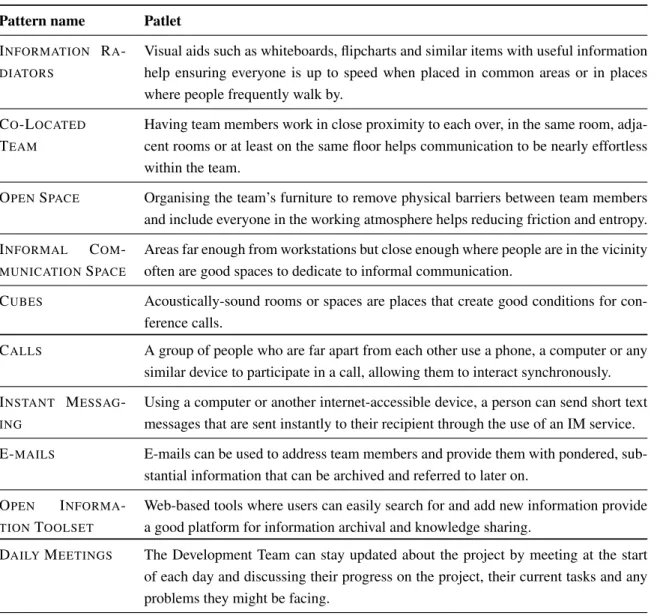
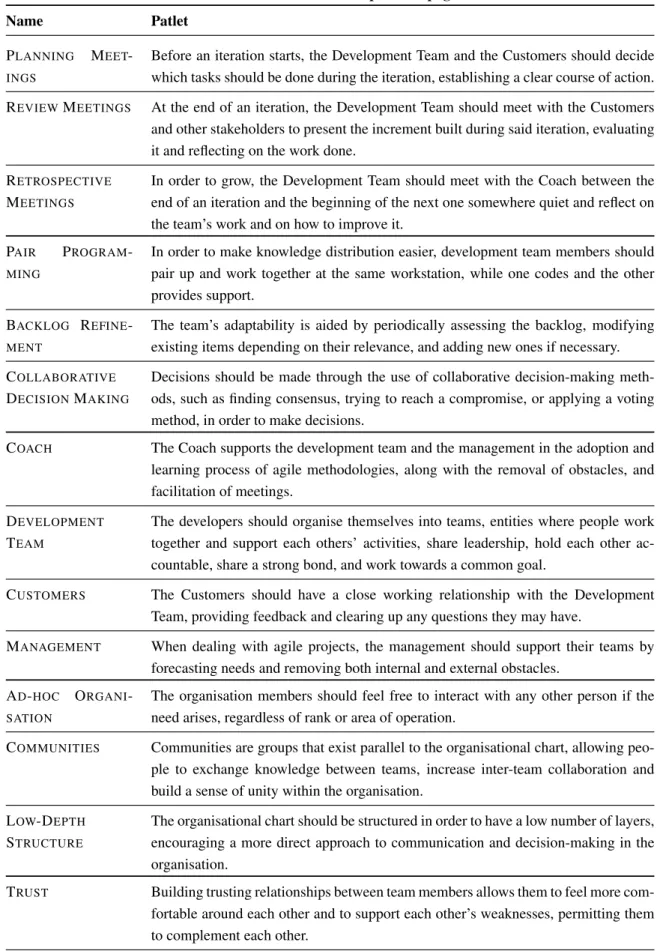
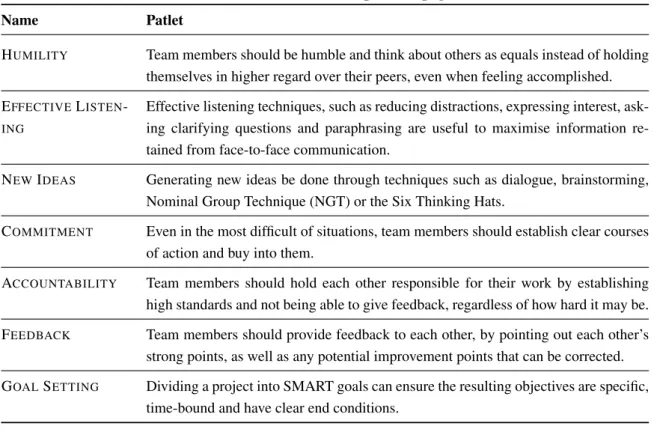
A Patlets 87
B Pattern Problem-Solution Relationships 91
C Survey Questionnaire 95
D Survey Replies 105
2.1 The Scrum Framework [63]. . . 15
2.2 The XP methodology [77]. . . 17
2.3 An overview of the Sprint in LeSS [12]. . . 20
2.4 Sprint Planning in LeSS [12]. . . 21
2.5 Review and Retrospective meetings in LeSS [12]. . . 22
4.1 An overview of the AgilECo pattern language. . . 32
5.1 Survey answer percentages. . . 81
A.1 Pattern language patlets . . . 87
B.1 Environment patterns: Physical . . . 91
B.2 Environment patterns: Digital . . . 92
B.3 Activity patterns: Meetings . . . 92
B.4 Activity patterns: Practices . . . 93
B.5 People patterns: Roles . . . 93
B.6 People patterns: Organisational Structure . . . 94
B.7 People patterns: Skills . . . 94
D.1 Survey respondents’ organisation data. . . 105
D.2 Pattern implementation according to survey respondents. . . 106
BEST Board of European Students of Technology LeSS Large Scale Scrum
PO Product Owner
PLoP Pattern Languages of Programming SM Scrum Master
XP Extreme Programming
Introduction
1.1
Context
When working in the software engineering world, one can find several paradigms and methodolo-gies to develop software, some being better suited for some situations than others. One of these paradigms is agile software development. The first agile methodologies, based on techniques, concepts and principles borrowed from lean manufacturing, appeared in the early 1990s. As the years went on, these methodologies started to mature and eventually, in 2001, several people rep-resenting different methodologies gathered in a ski lodge in Utah to attempt to find commonalities between them. This gathering resulted in the writing of the Manifesto for Agile Software Devel-opment[5], commonly and henceforth referred to as the Agile Manifesto.
The Agile Manifesto [5] mentions four values that are common in agile methodologies: valu-ing individuals and interactions, workvalu-ing software, collaboration with customers and bevalu-ing able to respond to change. These concepts are valued over ones that are more common in traditional, plan-driven methodologies: processes and tools, extensive documentation, contract negotiation and following plans. It is important to note that these concepts still have value; the prior set of ideas is simply valued more.
A set of twelve principles, which outline commonalities in agile methodologies, supports these four central values [5]:
1. Continuous delivery of working software; 2. Accept changing requirements;
3. Frequent delivery of working software;
4. Teamwork between developers and business people; 5. Support and trust motivated individuals;
6. Face-to-face communication is the most effective method to convey information; 1
7. Working software as a measure of progress; 8. Agile processes require a sustainable pace;
9. Technical and design attentiveness enhances agility; 10. Simplicity is valued;
11. The best work comes from self-organizing teams;
12. Teams regularly reflect on their work and attempt to improve.
One can find a particular focus on communication and collaboration among these principles. After all, software projects tend to be extensive undertakings, and sustainable development cannot be a solo effort. This focus can be further seen in the fourth, fifth, sixth and eleventh principles [5], which explicitly approach the interactions between different roles, their environment and team dynamics.
The different roles found in Agile projects include coaches, management/business people, developers, and clients. As one could infer, they take on vastly different responsibilities and tasks during development, and may also have different backgrounds. We can see the importance of high-quality communication between all roles, due to the diversity of people’s experiences and past, which can influence their ability to be on the same page as the project goes on.
Agile software development’s iterative nature [4][5][10] ends up relating to the concept of feedback loops. These can range from weeks to days, to hours and even to seconds. Most of these feedback loops exist due to the communication between stakeholders, for example, between developers when pair programming or between the development team and the customers when discussing the product and its requirements [42]. These feedback loops are only useful when com-munication is effective among all parties involved. When this does not happen and comcom-munication is sub-par, several unintended consequences may occur, such as misunderstandings, loss of pro-ductivity or even, for example, the delivered product not comparing to the clients’ vision due to the wrong requirements being collected.
Due to the importance of communication in Agile software development, together with the Manifesto’s importance on the team’s continuous improvement (seen in the twelfth principle), [5] one should strive to ensure the communication present within Agile contexts is effective.
1.2
Motivation
In addition to his academic studies, during his university path the author also spent time performing activities for a student non-governmental organisation he joined halfway through his degree, the Board of European Students of Technology (BEST).
BEST is a non-representative European student organisation that is present in several facul-ties and universifacul-ties across Europe, having as its mission the development of technology students everywhere. This mission is further augmented by BEST’s activities, which focus on three main
areas: education involvement, career support, and complimentary education [8]. For these activi-ties to be able to come to fruition, in addition to the Local BEST Groups (LBGs) present in each university, BEST also has in its structure a set of nine departments [9]1, dedicated to several areas ranging from corporate relations to marketing, in addition to educational content.
One of these departments of BEST is the Training Department, consisting of several members (tutors and trainers) certified by BEST as being able to provide training sessions to other members. These training sessions are delivered to members a few times per year and can focus either on soft skills, such as leadership, team dynamics, public speaking and communication, among other topics; or hard skills, which can include topics in the areas of IT and marketing, among others. The activities performed by the author during his time in the organisation, along with the training sessions he received, provided a greater of soft skills and their importance in one’s personal and professional lives.
During his university path, the author also encountered a set of subjects in which students had to develop software to external entities, emulating real industry work. During the project de-velopment present in such subjects, teams were expected to employ agile methods, incorporating concepts such as sprints, project backlogs, and sprint planning and retrospective meetings. The agile methodologies in play during these projects, just like in the industry, required proper com-munication, which would not always exist due to team members also having other academical responsibilities. This lack of consistent effective communication was a cause of frustration to the author, leading to the subject of this dissertation, as a way to develop tools that could foster effective communication in agile contexts.
1.3
Objectives
The aforementioned goal of "fostering effective communication in agile contexts" can be some-what vague when described as such. In order to address this issue and provide a higher potential for effective results, the dissertation has four objectives that all contribute to this main goal:
Objective 1: Research effective communication: This first objective stems from the desire to explore the existing literature, as well as agile methodologies’ documentation to find com-mon elements regarding communication and how these elements create an environment where communication is more effective.
Objective 2: Foster collaborative environments: Communication quality and effectiveness are influenced by the environments where the organisation people are present. Ensuring that both tangible and intangible aspects of one’s environment are compatible with collaborative interactions can help with fostering the effectiveness of one’s communication.
Objective 3: Empower developers and stakeholders: While individuals are influenced by their environment, they also affect the quality of their own communication. As such, it is impor-tant to provide individuals with tools and skills that help them get their point across when communicating and also assimilate any information they need.
Objective 4: Enhance agile communication: The previous three objectives culminate in this fourth one, which aims to implement good practices in agile environments. Communication be-tween developers and stakeholders plays a key role in agile software development, aiding them in being more effective and, in turn, helping them to able to produce higher quality software.
These objectives are intended to be achieved through the construction of a pattern language, where useful skills, roles, activities and environmental concepts are documented in the form of patterns which can be easily applied in relevant situations.
1.4
Structure
The remainder of this document is structured as follows. Chapter 2 presents the background and a literature review of relevant fields, including communication, agile methodologies, the intersection of these two fields, pattern theory, and other related work. Chapter 3 presents the main problem to be addressed, detailing the concepts of the resulting work and the methodology. Chapter 4 presents the pattern language, approaching its structure and including the patterns themselves. Chapter 5 approaches the validation of the pattern language. Chapter 6 draws conclusions from the work done, as well as outlining future work.
Background
This chapter sheds some light on the background and history of the subjects related to this work: communication, agile methodologies, and the intersection of these two fields. The information on these topics which can be found here results from a literature review of academic papers, books and, in the case of the agile methodologies, their documentation. Since the dissertation’s expected result is a pattern language (see section1.3), the field of pattern theory has also been a subject of research. Finally, to conclude this chapter, some insights on other pattern languages are presented.
2.1
Team communication
Dance [21] attempted to define the concept of communication, but reached the conclusion that this is a concept whose definition can vary wildly depending on the context. He encountered definitions that would range from verbal manifestations, to clarifications and reductions of uncertainty, to exchanges of information, to exertions of power, among other concepts. In this work, we will focus on the concept of communication as the transmission of information between two or more parties.
Effective communication is described as the type of communication where the recipient of the message being conveyed understands its meaning and is able to return that same information when prompted [49]. As such, effectiveness when communicating is of great importance in a field where projects are complex, there is a large number of people involved, a lot of uncertainty and lack of agreement, as happens in software engineering [16].
When the communication in place is not effective, several undesirable effects may happen; out of these, we find time being wasted, mistakes, and misunderstandings [49], which may end up costing more than expected to the organisation. Therefore, it is important to strive for higher effectiveness when communicating to reduce these side effects.
2.1.1 The communication skill-set
In their book, Interpersonal Communication Skills in the Workplace, McIntosh et al. [49] approach the topic of communication in the workplace, and discuss the set of skills that are noteworthy and relevant to have in a work environment. Out of those skills, the ones deemed pertinent to the issue at hand were: verbal communication, nonverbal communication, virtual communication, listening, feedback, persuasion, coming up with new ideas, overcoming barriers to communication, and dealing with causes of poor communication.
Verbal communication
Verbal communication is tightly knit with the concept of language; it is through this form of communication that words are used to convey concepts, messages and transmit knowledge [75].
Verbal communication is used simultaneously with nonverbal communication; things such as the tone of voice or cadence transmit additional information that may not be present if, for example, one were reading a transcript of what was said; these elements convey the emotions and the state of the speaker at the time of interaction [49].
Verbal communication raises the importance of semantics and the ideas people transmit in sentences [59], as a clear message is important to ensure that communication is effective.
Metaphors are also used in more informal communication, as they are a part of a person’s culture and identity. They can also be used to create additional meaning in what is being said [22]. Finally, Kerbrat-Orecchioni [38] discusses the interaction that happens when two people are engaging in verbal communication; conversations are a back-and-forth between two or more peo-ple, and the importance of listening skills comes into play during this.
Nonverbal communication
Knapp et al. [41] state that nonverbal communication is a skill that comes naturally to human beings, as we are a social species. In our daily lives, we send and receive nonverbal messages, which may or may not be intentional.
Examples of nonverbal messages include eye movement, facial expressions, physical posture and vocal behaviour. This type of messages conveys information about one’s emotions, intentions and their position regarding the environment they are located in [41].
It is also worth noting that nonverbal messages often coordinate with verbal communication; gestures can be independent from speech (e.g. a thumbs-up), or they may be coordinated with it, complementing, enhancing or moderating what is being said, or even conflicting with the message being relayed in cases of when someone is lying [41].
Virtual communication
Virtual communication is increasingly common with advances in technology, making it possible for team members to communicate in more ways aside from face-to-face communication. Addi-tionally, it allows for communication in distributed teams, which are more and more common [49]. There are several communication methods, which can be divided into two types: synchronous, which allow for real-time back-and-forth interactions, and asynchronous, which may require peo-ple to wait to receive a response. McIntosh et al. [49] mention several communication methods: intranets, e-mail, collaborative software, instant messaging, web/video conferencing, and phone conferencing.
Intranets are private web portals that are only accessible to organisation members. In these, one can find information such as a personnel directory, information about the day-to-day operations of the organisation, among other information. Some intranets may also allow for booking of meetings and/or conference rooms and communication with other organization members. Intranets are examples of asynchronous communication [49].
Organisation members often use e-mail to communicate with each other, creating asynchronous messages that the recipients receive in their inboxes. Users can send e-mails to their colleagues to collaborate work, receive memos from the organisation, attach files and Internet links to e-mail messages [49].
Instances of collaborative software provide users with a shared workspace where they can share documents, work in the same documents in real-time, and even discuss with team mem-bers. They are mostly an example of asynchronous communication but may have some semi-synchronous elements.
Instant messaging (IM) allows users to communicate with each other using messages that are sent instantly to their recipient, often being shorter in length compared to e-mails. Unlike e-mail inboxes, which have a list of every message thread received by the user, IM services show a view of people the user has interacted with and display their conversations. Despite their near-instant speed to reach their destination, the recipient may not read their messages right away, making this a method with a nature that is both synchronous and asynchronous [49].
Web/video conferencing allows for organisation members to communicate synchronously us-ing a video feed. Dependus-ing on the situation, users may also be able to conference while showcas-ing a presentation; this is useful when the person delivershowcas-ing it cannot be physically at the meetshowcas-ing. This type of conferencing usually requires an Internet connection and a camera. Larger meetings may require a conference room for them to be conducted and, as such, these rooms may require hardware to be installed to make video conferencing possible [49].
Lastly, phone conferencing functions similarly to video conferencing, with the difference that it may not require an Internet connection and only a telephone, and that there is no video [49].
Listening
Listening is a skill that goes hand in hand with verbal communication, as it deals with the in-formation receiving part of a conversation. As McIntosh et al. [49] refer, listening is not only recognizing words but truly focusing on them and making sense of the message being transmitted. This contrasts with the act of hearing, which is an automatic and effortless action performed by the brain as the ears capture sounds and filters out the irrelevant ones [80].
Effective listening brings to the workplace several benefits, such as reducing work that would need to be redone because of a poor understanding of instructions, learning more about the or-ganisation and its operations, increasing the value of the words one says when they speak, and enhancing harmony in the workplace [49].
McIntosh et al. [49] mention four big tips to improve listening and make it more effective: creating the right atmosphere, showing interest, paraphrasing, and asking clarifying questions. Reducing distractions. both external and internal, helps in creating the right atmosphere for com-municating. Ways to show interest and listen better to someone include maintaining eye contact, using appropriate facial expressions depending on what is being conveyed, being in a suitable body position, and writing notes for key important information. Paraphrasing and asking clari-fying questions drive the point home that one is paying attention and help in ensuring the right information is being delivered.
Feedback
Harms et al. [28] define feedback as "the process of evaluating and discussing the performance of both employees and managers". They declare this is done to raise any improvement points regarding the way the person receiving feedback works, as well as highlighting strong points that are to be maintained [28]. Feedback is supposed to be used as a tool to continuously improve people and help them grow.
Since feedback may deal with a person’s flaws, it is important that this feedback is done constructively to help the recipient focus on the act of improvement and not on the existence of their defects [28]. This is not always an easy task, and managers are often poorly trained to do so and are not able to provide effective coaching [44].
In order to make the task of providing feedback easier, several communication models have appeared. Examples of these include the BEAR and BET models, devised by Harms et al., [28] and the BIO model, used by Booking.com employees [56]. The BEAR and BET models are to be used together; the former, which stands for behaviour, effect, alternative, and result, is used when addressing an improvement point, while the latter, which stands for behaviour, effect, and thank you, is used to encourage positive situations [28]. Meanwhile, the BIO model stands for behaviour, impact and opportunity [56].
Good feedback allows for continuous improvement in employees and, when used as an en-couragement tool, it increases their bond to the organisation [28].
Persuasion
Persuasion is a skill that entails in creating change in the environment by affecting others’ beliefs, actions or attitudes. Contrary to what one might expect, as McIntosh et al. [49] say, this is a skill that is not only useful for leaders but throughout the entirety of the organisation, being necessary when cooperation is required.
Since persuasion aims to change people’s minds about a certain topic, it requires a solid base on which it can stand on, which is composed of three elements: trust, which comes naturally with a person’s trustworthiness; understanding the people being persuaded, so that change can be created more effectively; and building a credible case by checking one’s assumptions, having a backup plan in case something goes wrong, and being aware of alternatives [49].
The language used when attempting to persuades also matters; this language focuses on em-phasizing the benefits regarding the persuasion subject, directing the speech both to the mind and to the emotions of the recipient, using a positive and definitive approach, and using endorsements from others to create some credibility to one’s case [49].
Developing new ideas
In complex projects, it is not uncommon for one to find themself not knowing all information required for a task. In these situations, it is natural to ask for help from someone who might be more knowledgeable. When communicating with others, as McIntosh et al. [49] mention, there are techniques that help in raising new ideas, such as dialogue and brainstorming.
When using dialogue to gather new ideas, the people involved engage in a conversation dis-cussing the available information. All parties should listen to what is being said, respond accord-ingly, and seek alternatives, with each participant building off of what is being said. A person who is seeking new ideas from colleagues should listen carefully, ask questions, act impersonally, and propose ideas, asking for the other parties’ opinions on them [49].
Brainstorming is an alternative better suited to groups, as conducting dialogue with a large number of people does not allow for everyone participating equally in the discussion. The strength this method has is its ability to generate many ideas quickly. People in a brainstorming session are advised to follow four rules, as described by McIntosh et al.: "seek quantity, don’t criticize, welcome even far-out ideas, and find ways to combine and improve ideas" [49]. The main theme around brainstorming is to generate ideas using a "quantity over quality" approach and to welcome even the most far-fetched ideas, to avoid alienating participants. In case some participants are not very comfortable with speaking in a group setting, employing Nominal Group Technique (NGT) can be worthwhile: participants write down their ideas and give them to a person who is recording the session. The facilitator reads all ideas, and participants rate each idea, before delivering their ratings to the session recorder. The ideas are then ranked, and then they are discussed. We can see that when using NGT the identities of the authors are not revealed [49].
Another way of generating ideas is through the use of the Six Thinking Hats, a method for discussion facilitation created by Edward de Bono [24]. The titular hats are metaphors for attitudes
participants should adopt at that moment in the discussion, and each hat has a colour relating to a specific attitude. The white hat calls for an objective and neutral view, which contrasts with the emotion-focused red hat. The black hat provides a more cautious, pessimistic outlook, while the yellow hatis more optimistic. The green hat opens the floor to a fertile ground for idea generation, while the blue hat focuses on the management of the discussion and the use of the other "hats". Discussions using this method are structured about using each hat in a way where participants can learn the stances and feelings of other people regarding a certain topic, generate new ideas and discuss them.
Overcoming barriers to communication
When two or more people are communicating, they may encounter barriers: elements present in a situation that make it more difficult for people to understand each other. As McIntosh et al. [49] point out, this degree of misunderstanding can range from minor confusion to complete misunderstanding. They also point out eight barriers to communication: framing differences, defensiveness, physical distance, group size and status differences, internal conflict, groupthink, prejudgements, and language issues.
The first one, framing differences, stems from the notion each individual is unique and, as such, has a different worldview from anyone else. In order to overcome this, one should recognise this is happening and try to find common ground [49].
The second one, defensiveness, happens when one is feeling "under attack" during a conver-sation, and they will end up focusing on defending themselves instead of paying attention to what is being said [49].
The third barrier, physical distance, relates to the concept that the further someone is from another person, they will feel less encouraged to communicate. In order to mitigate this, team members should work in close proximity, or even in an open office [49].
The fourth barrier, group size and status differences, relates to how people feel when they are in a meeting with a large number of people or if there is someone present with a large different status than them; they might feel less confident to intervene in the meeting or even intimidated. To avoid this, meetings have only the necessary people, or any status differences should be addressed so everyone feels at ease [49].
The fifth barrier to communication, internal conflict, can be caused by cutthroat competition between professionals, personal issues, turf warfare between departments or teams, or, related to the first barrier, differences on worldviews. People who are in the middle of conflict should pause, assess the situation, try to gain control of any overwhelming emotions they might be feeling and attempt to listen, which can turn situations like these into productive discussions [49].
The sixth barrier, groupthink, relates to what happens when team members fall into a sense of a hivemind and everyone thinks about things in the same way; this is more prevalent when there is a cohesive group and they all share similar backgrounds and worldviews. This reduces innovation and the team is at risk of being caught by surprise by competitors or by the industry. Solving this requires the team to try to change perspectives every so often and to think outside the box [49].
The seventh barrier, prejudgements, exists when people interpret concepts without listening about them or receiving facts. This can be solved by introducing more facts into the conversation and raising awareness about the reality of the concept [49].
The final barrier to communication, language issues, can appear in three aspects, according to McIntosh et al [49]. These are vagueness and verbosity, jargon, and language differences. Vague-ness and verbosity refer to communication that is not precise and that imparts some information but not enough to make it clear, respectively. Jargon is defined by being a set of words members of a profession use but may be incomprehensible by outsiders. Finally, language differences relate to issues that might appear when having non-native speakers, such as trouble in conveying infor-mation and misunderstandings. These language issues are subdued by employing a clearer and simpler language to increase accessibility [49].
Mitigating causes of poor communication
McIntosh et al. [49] mention three big causes of poor communication in the workplace. The first one is change; while it is normal and common for things to change in an organisation, having to work with new people implies getting them up to speed in their new environment, as well as build trust, rapport and a business relationship. The second factor is time pressure; tight deadlines and a sense of urgency may make organisation members feel tempted to cut corners, and this applies too to communication. For example, one might overlook details when relaying important information to others, or the message recipients may not ask for details even if they seem necessary. The third cause is interpersonal conflict; people who don’t have good relationships with others may engage in practices that may even be counterproductive to the organisation, or not be attentive communicators. While conflicts are common, it is advisable for people engaged in these situations to sort their relationship out to improve productivity and increase the organisation’s results [49].
2.1.2 Overcoming team dysfunctions
In addition to these skills, Lencioni [47] discusses the dysfunctions a team may encounter and that may hinder their ability to work productively and deliver good results: absence of trust, fear of conflict, lack of commitment, avoidance of accountability, and inattention to results.
The first dysfunction, absence of trust, relates to the need for a trusting environment so a team can work off of each other. In order for trust to be created among employees, they need to be able to be vulnerable around each other; these vulnerabilities include items such as weaknesses, requiring help in a task, making mistakes, among others. This trust can be built by sharing ex-periences, showcasing credibility, fostering understanding among team members and following through tasks. A team where its elements trust each other is aware of its weak points and its elements are not afraid to ask each other for help, are more open, and take risks [47].
The second dysfunction, fear of conflict, stems from the stigma present in the professional world to avoid conflict at all costs, particularly as one climbs the corporate ladder [47]. However, doing this can have the opposite effect as one might expect; avoiding conflict may create tension
between all parties involved. Lencioni [47] mentions the existence of a good type of conflict, where discussions, instead of focusing on personal attacks, approach only ideas and concepts, ensuring that any present problems are discussed and keeping personal relationships intact. Being able to have this sort of conflict can save time in an organization, as problems are solved more quickly this way.
The third dysfunction, lack of commitment, defines this concept as being the junction between clarity and buying-in. Teams that avoid this dysfunction have clear objectives and everyone com-mits to them, even if initially opposed. Teams that suffer from this, however, suffer from ambiguity in the environment and lose time, as team members require a perfect amount of information before committing to the goal at hand since they fear failure. A team with committed members is able to move forward more easily, learn from its failures and not be afraid to change directions if it was moving in an undesired way [47].
The fourth dysfunction, avoidance of accountability, relates to the ability of team members to hold their colleagues responsible for the work they do. When accountability is present within a team, team members are fine with having difficult conversations; as such, they establish high standards and are able to identify any problems present within the work environment. If team members avoid accountability, the work quality will be poor, and deadlines may be missed [47].
The fifth and final dysfunction, inattention to results, derives from the thought that team mem-bers should focus on the overall progress of the team and not only on their own individual results. Teams that are attentive and pay attention to both types of progress (individual and collective) are able to avoid distractions, enjoy success from their endeavours and benefit from decisions that are done for the sake of the team. On the other hand, inattentive teams are not able to grow as much, cannot beat their competitors, and may lose achievement-oriented team members, as they are much more focused on themselves and not on the team [47].
2.1.3 Effective meetings
The importance of effective meetings arises when workers spend more time than necessary in meetings, which can be translated to wasted time [58]. Avoiding this over-zealousness, workers can better invest their time working towards the project in question.
In their book, Gray et al. [27] propose the 7Ps framework, which aims to improve focus and help the meeting participants to achieve results in a timely fashion. The name comes from the seven terms that constitute the aforementioned framework: purpose, which relates to the topic of the meeting and its pertinence; product, related to the outcomes and artifacts being produced from the meeting; the attending people and their roles; process, which is the agenda of the meeting; pitfalls, possible risks that may need to be addressed prior to or during the meeting; prep, tasks for the attendees to do in advance; and practical concerns, which relate to the physical logistics, such as time, date and venue.
2.1.4 Teamwork
Cohen et al. [18] define teams as assemblies of individuals who work in a coordinated fashion as not a group of people, but as a single collective unit. As such, teamwork relates to being able to work as a team.
According to Tuckman [73], a team goes through several phases in its development. In the first one, forming, team members get to know each other and discover the boundaries of their tasks and behaviours and show a relationship of dependence with their leaders. This period is also marked by excitement regarding the team and acclimatisation. The second phase, storming, is marked by conflict in the team, where team members exhibit defensive and competitive behaviour. This phase is the least productive, as team members may be resisting to the group dynamic and having noncommittal behaviours. The third phase, norming, the team overcomes the resistance felt in the previous phase. They become more cohesive, adopt new roles, and feel more at ease with sharing their opinions. The fourth phase, performing, is marked by the team seeing its structural problems solved and able to support the tasks at hand; this is aided by more flexible and functional roles. The fifth phase, adjourning, was added later on [74] and serves as a termination stage, as the team members conclude their tasks and separate [64].
Katzenbach and Smith [37] define differences between the concepts of teams and groups, as the nature of their work and the situations they are better suited for are not the same. Groups have a leader in a clear, defined role, share their purpose with the broader organisation they are a part of, run efficient meetings and measure their effectiveness through indirect means. Group members’ work and accountability are individual, and delegation is prevalent. Contrastingly, teams have shared leadership roles, derive their own purpose, partake in open-ended discussion and try to solve problems during meetings, and measure their effectiveness directly from their work. Team members share accountability and do work together.
The quality of a team’s work is related to the goals they have [37], as knowing what to do pro-vides a sense of direction and productivity [48]. Doran [25] outlines a technique to create goals, stating they should be "SMART": specific, measurable, assignable, realistic and time-bound. A goal’s specificity relates to how defined it is, requiring measurability to provide an indicator of progress, and assignability to ensure someone will perform the tasks required. Realism is impor-tant to keep in mind, as it ensures team members will not be working on a task to which there are not enough resources available. Finally, having a goal be time-bound provides a deadline and some haste to the tasks being done.
2.2
Agile methodologies
This dissertation explores in detail how communication is handled by three methodologies: Scrum, Extreme Programming (XP) and Large Scale Scrum (LeSS). Their structures and history are de-scribed in detail in this section.
2.2.1 Scrum
Scrum traces its roots back to the mid-1980s, where Takeuchi and Nonaka [71] presented a then-new methodology for product development. This methodology emphasised speed and flexibility, segmenting and specialising functions instead of using a more traditional approach where the project would move from phase to phase. This methodology was compared throughout their paper to rugby, as the whole team worked together from the beginning to the end of the project, even mentioning the word "scrum", a formation used when the players are all positioned together to gain possession of the ball when restarting play. Several concepts mentioned by Takeuchi and Nonaka in this paper include the usage of self-organising teams, multi-learning, knowledge transfer, and iterative experimentation.
In 1993, Jeff Sutherland, along with his colleagues John Scumniotales and Jeff McKenna, based themselves off of Takeuchi and Nonaka’s work and implemented Scrum for the first time at the Easel Corporation [66][67]. Later, in 1995, Sutherland and Ken Schwaber presented a pa-per [62] at the Object-Oriented Programming, Systems, Languages & Applications Conference ‘95 (OOPSLA), which detailed Scrum for the first time to the public. This paper mentioned the issues with the waterfall and spiral models and raised the need for a flexible response to unpre-dictable events. Scrum attempted to provide this flexibility with its iterative approach using sprints, empirical processes where tacit knowledge and trial and error can replace explicit process knowl-edge when the latter is missing. This early version of Scrum, along with sprints, already used some of the concepts of nowadays, such as having a backlog and doing reviews after sprints.
Scrum was later refined and developed by Schwaber and Sutherland, with them writing the Scrum Guide [69], a document outlining the main concepts, roles, practices and artifacts of the methodology. Scrum has three pillars: transparency, which encourages a common understanding of the system; inspection, which urges users to regularly evaluate themselves and their team; and adaptation, which aims to create flexibility in the face of the changing environment. Schwaber and Sutherland also outline the five values of Scrum: commitment, courage, focus, openness, and respect.
A diagram showcasing Scrum’s Sprint, meetings and artifacts can be found in figure2.1.
The Scrum Team
The Scrum Team, as defined by Schwaber and Sutherland [69], is at the core of the practice of Scrum, being composed of three elements: the Development Team, the Product Owner, and the Scrum Master.
The Development Team is composed of the individuals who, as the name suggests, develop software to deliver new increments at the end of each sprint. They are self-organising, cross-functional and are organised horizontally, sharing accountability and rejecting sub-groups and other titles for these members.
The Product Owner manages the Product Backlog, adding and ordering its items, and has as their goal maximising the value of the product being developed.
Figure 2.1: The Scrum Framework [63].
Finally, the Scrum Master aids the rest of the Scrum Team with the use of the methodology, aiding the organisation with the adoption of Scrum, coaching the Development Team in being self-organised, cross-functional and able to create high-value products, removing barriers that could hinder the Development Team’s work, coaching the Product Owner in managing the Product Backlog effectively, among other tasks.
The Sprint and other events
The iterative aspect of Scrum lies within the Sprint, a uniformly time-boxed duration of time during which an increment of the product is developed. Sprints usually last up to one month; this duration is set by the organization. During this period, the Development Team works on the product, taking care of the items present in the Sprint Backlog. These items represent the current objective, the Sprint Goal, which is established by the Product Owner and is created at the beginning of the Sprint. If the Sprint Goal becomes obsolete, either by the market changing or because the organisation changed its course of action regarding the product, the Sprint can be cancelled, although this event is uncommon. The Sprint is aided by several types of meetings: the Sprint Planning, the Daily Scrum, the Sprint Review, and the Sprint Retrospective [69].
The Sprint Planning meeting, which can last up to eight hours for a one-month Sprint, occurs before the Sprint begins. The Scrum Teams gathers and discusses what can be done during the Sprint and how it will be done. The Product Owner discusses the Sprint Goal with the rest of the team and selects items from the Project Backlog which, after being prioritised, create the Sprint Backlog [69].
During the Sprint, each day starts with a fifteen-minute Daily Scrum meeting. During this event, the Development Team inspects the work done during the previous day and determines which tasks should be done that day. Development Team members also discuss any problems they might be facing to know how to overcome them [69].
At the end of a Sprint, the Sprint Review happens to evaluate the increment developed by the Development Team and, if needed, to adjust the Product Backlog. The Scrum Team discusses what has and has not been done during that Sprint. The status of the marketplace, the Product Backlog, the timeline and the budget are also discussed during this meeting, which can last up to four hours for a one-month Sprint [69].
After the Sprint Review and before the next Sprint Planning, a Sprint Retrospective meeting takes place, where the Scrum Team inspects the quality of the workflow of the team and raises potential improvement points to be worked on during the following Sprints [69].
Scrum Artifacts
Schwaber and Sutherland [69] also point out several artifacts present in this methodology, which have already been mentioned in this section: the Product Backlog, the Sprint Backlog, and the Product Increment.
The Product Backlog exists in the context of the entire project, being a list of everything needed to be implemented across multiple Sprints. It evolves during the project, reacting to the external environment, being the only source of requirements from the stakeholders to the Development Team. As such, it features information related to functions, enhancements and fixes to be done during the project [69].
The Sprint Backlog starts as a subset of the Product Backlog, containing the items that have been chosen to be dealt with during the Sprint. It helps the Development Team keep track of progress and the Sprint Goal, being detailed enough so that the tasks are easily understandable. At the end of the Sprint, the Backlog items that were completed make up the Product Increment [69].
Communication skills handled by Scrum
Scrum approaches verbal communication and listening skills with the meetings defined in the Scrum Guide [69]. The meetings include several discussions about the project, and so these two skills come into play during meetings. Given that these meetings are time-boxed and have clear defined goals, they also fulfil the effective meetings skill.
The feedback skill is approached by one of Scrum’s pillars, inspection. This pillar encourages the Scrum Team to continuously evaluate their own work, as well as the work of others, and relay potential improvement points when pertinent [69].
The teamwork skill is embodied by the Scrum Team, as it is composed of professionals with vastly different roles, and as such they must work together in order to achieve progress [69]. The value of respect [69] is also pertinent to teamwork, as team members must respect each other and their work to succeed.
There are multiple ways that Scrum addresses barriers to communication. The pillar of trans-parency [69] reduces defensiveness, and the value of openness [69] also relates directly to the absence of barriers.
2.2.2 Extreme Programming
In March 1996, Kent Beck joined the Chrysler Comprehensive Compensation (C3) project. It was conceptualised to be a new payroll system for the organisation’s employees, and, upon arriving, Beck discovered that the project was going through difficult times and the team was far from ready to have the software go into production, despite that date being two months from then. After meeting with the CIO, the project was restarted with Beck’s involvement. The Extreme Programming (XP) methodology was developed during Beck’s time with the C3 project, as he took concepts from software engineering and applied them to an extreme degree [4][1]. The resulting method of work included user stories being implemented in three-week iterations, as well as including practices such as pair programming and testing.
XP values
At the core of XP lie five values, which complement each other: communication, simplicity, feedback, courage and respect. Communication relates to the necessity of knowledge transfer between team members and provides enhanced unity among them. Simplicity approaches the necessity to find the best solution for a task, without worrying about doing additional, unnecessary tasks. Feedback helps with continuous improvement in the team, being able to find things that could be better and work on them. Courage relates to being able to act accordingly in every situation, even if it is not pleasant. Finally, respect is necessary among all team members for all values to be effective [4][77].
Practices
XP outlines several practices that were first used in the C3 project, such as pair programming, fre-quent testing, and iterative development, as well as mentioning open space offices and continuous integration.
In pair programming, two programmers sit in front of one computer, with one actively interact-ing with it and programminteract-ing (the navigator), while their companion (the driver) thinks about the overall project, provides guidance and reviews the code being developed. This increases shared code ownership, as well as allowing for more inexperienced team members to feel more at ease with the project, learn from their more experienced peers and also helps in reducing the bus factor as not only one person is familiar with the codebase. This is additionally mitigated by the practice of changing pairs every so often, which also helps build trust within the team [77][20][78].
XP also suggests frequent testing when writing code. Testing reduces defects in the software, making it easier to debug, and reduces time spent on bug-fixing, which can be used to further develop the product. XP observes two types of tests: unit tests, which provide insight into the inner workings of the code and how its components interact with each other; and acceptance tests, which are written form the perspective of the users. It is recommended for tests in XP to be automated so that the developers can receive feedback instantly and notice any errors immediately. Testing first before writing code also makes it easier for developers to figure out their approach when developing [4][77].
Similarly to other agile methodologies, XP uses an iterative approach to development, as shown in figure 2.2. Beck [4] suggests working on a weekly cycle to have a good overview of the team’s progress over the course of the iteration. At the beginning of each iteration, the team plans their work by choosing user stories, which are ordered by the amount of value to the client they have. Then, these user stories are divided into programming tasks that are digestible by the development team, which provide a detailed view of the work to be done during the iteration. Over the course of the iteration, there are daily stand up meetings, where team members discuss what they accomplished the previous day, what they will do that day, and any hurdles that need to be overcome. This daily stand up meeting ensures the team members are all up to speed regarding the entire project.
A key productivity factor in XP is the physical distance between team members; they should be located close to each other, usually using an open space floor plan. Team members can com-municate with each other more easily, as well as making pair programming arrangements easier. The physical space also should common areas for stand up meetings, as well as including room on the walls for sketches and notes.
Another topic approached by Beck [4] is continuous deployment: code should be integrated and submitted into the repository frequently. Frequent integrations take less time than infrequent ones, compatibility issues are more easily addressed, and the product is always deployable if required. Beck also notes that the build, which ideally should last about ten minutes, should be performed synchronously by the system instead of having to trigger that event manually [77].
Communication skills handled by XP
In XP, pair programming addresses multiple skills: verbal communication and listening are re-quired so that the pair can be truly working together, coordinating their efforts at the task at hand. It also helps with feedback, as the navigator is able to provide a live code review of the driver’s work. When having issues with a certain task, pairs are encouraged to take a step back and think of new ideas to solve it, particularly if both already have different suggestions that the other one isn’t accepting. The rotation of pairs fosters teamwork amongst the developers and makes them trust each other more; this latter point relates to the dysfunction of absences of trust [4][77].
XP has other components of its identity that relate to communication skills. Its meetings, such as the Daily Standup, also have goals in mind just like Scrum [77], which make them more effec-tive, as well as requiring more verbal communication from the team. Two of XP’s values, feedback and courage [4], also relate to skills: the former is a direct correspondence with the homonymous skill, and the latter attempts to solve the fear of conflict dysfunction. Another dysfunction XP ad-dresses is the lack of accountability, mitigated by supporting shared code ownership [77]. Finally, XP encourages shared, open offices [4], which remove physical distance, a barrier to communica-tion.
2.2.3 Large Scale Scrum
Large Scale Scrum (LeSS) traces its origins to 2005, being developed by Craig Larman and Bas Vodde. The industry panorama at the turn of the century was that Agile methodologies were appropriate for small teams. However, after Larman and Vodde received requests to apply Scrum at a larger scale, they decided to develop a framework that was able to be applied to large, distributed teams and still be Agile [45]. This resulted in the creation of a methodology that was derived from Scrum and applied its basic principles while being functional and aware of the limitations faced by distributed teams.
LeSS has two variants: LeSS, which can be applied to eight teams of eight people; and LeSS Huge, which can be applied to thousands of people. They function very similarly to each other, however, in Less Huge the scope of the project is divided into Requirement Areas, each with an Area Product Owner, who works with the Product Owner [12].
Since LeSS reimplements Scrum’s principles at a larger scale, there are a few constants from Scrum that are also present in LeSS: there is only one shippable product being developed which is done through the management of one single Product Backlog. There is one Product Owner in charge of that artifact, and all teams are synchronised to the same Sprint. This ensures all devel-opment is done towards the increment, and that things are ready at the end of a Sprint. Backlogs, designing and planning the work for the coming Sprint [45][12].
Figure 2.3: An overview of the Sprint in LeSS [12].
Principles
LeSS defines ten principles at the core of its workings: LeSS is Scrum, which relates to the appli-cation of Scrum’s principles at a larger scale; Transparency, which, among other practices, urges people to work together, create trust within the team, and creating a better environment where everyone can work fearlessly; More with LeSS, which stands by the ideas of more meaningful work and team ownership of the process, without creating more roles and processes that could diminish the quality of the work done; Whole product focus, which relates to the fact that there is only one Product, one Product Owner and one Sprint, and everyone is focused towards that same goal; Customer-centric, where we see a focus on the client’s perspective in order for the develop-ment team to understand what is really required and what can be learned from the client’s reality; Continuous improvement, which urges the team to continuously inspect and evaluate their work to improve it and always seek perfection; Lean thinking, which tries to avoid creating unnecessary bloat by streamlining things such as communication practices; Systems thinking, which encour-ages people to inspect the system as a whole and see how the product in its entirety acts, instead of focusing on minute details; Empirical process control, which relates to learning from inspecting previous work, including things that did and did not work, instead of following a pre-determined set of practices that may not be appropriate in the context; and Queueing theory, which encourages people to understand how queues work in order to work more efficiently. [45][12].
Meetings in LeSS
The meetings in LeSS are mostly the same as in Scrum: at the start of each Sprint, there is a Sprint Planning. However, as shown in figure 2.4, this meeting is divided into two meetings (Sprint Planning 1 and Sprint Planning 2) to avoid having meetings with a large number of people. In Sprint Planning 1, the Product Owner meets with representatives from each Development Team, as well as Scrum Masters. In this meeting, the Product Owner lays out the Product Backlog items ordered by their priority, and the team representatives distribute items amongst themselves. The team representatives also seize this chance to clear up any doubts they might have. Afterwards,
Figure 2.4: Sprint Planning in LeSS [12].
teams divide and each one of them has a Sprint Planning 2 meeting. Each team usually has its own meeting, but two or more teams may decide to have this meeting together if the items on their Sprint Backlog are closely related. In this meeting, the teams take their Product Backlog items, discuss them and create their Sprint Backlogs, designing and planning the work for the coming Sprint [45][12].
Just like in Scrum, Daily Scrums are also present in LeSS. Every day, during this time-boxed meeting of up to fifteen minutes, the team members discuss what they did the previous day, say what they will work on that day and relay any issues to the team. Members from other Develop-ment Teams may also join other teams’ Daily Scrums as silent observers, to facilitate coordination between teams [45][12].
At the end of a Sprint, as shown in figure2.5, the Sprint Review happens. During this meeting, the teams are joined by the Product Owner and the stakeholders and/or users in a Sprint Review Bazaar, akin to a science fair. The room is divided into different areas where everyone can discuss the teams’ work. Afterwards, all parties involved gather to further discuss and provide feedback and decide how to move forward in the next Sprint [12].
The Sprint Review is followed by the Retrospective meetings. Each team has its own Team Retrospective, which is then followed by an Overall Retrospective. Team Retrospective meetings function like Sprint Retrospectives in Scrum; teams inspect their work and discuss its quality, as well as raising potential improvement points for the organization. These meetings are followed by the Overall Retrospective meeting, which includes the Product Owner, the Scrum Masters, and representatives from each team. In this meeting, the participants explore the way things are
Figure 2.5: Review and Retrospective meetings in LeSS [12].
working in the organisation, discussing topics at a scope superior to a single team’s [12].
Communication skills handled by LeSS
LeSS, a scaled approach to agile development, is often more explicit with the communication skills it employs compared to Scrum and XP. Just like in the other methodologies, meetings are time-boxed and have specific goals [45], which helps in their effectiveness. In these events, listening has some additional value, as members from other development teams may join another team’s Daily Scrum as a silent observer, which this allows for larger dissemination of information. Meetings also allow team members and stakeholders to receive feedback, such as the Sprint Review meeting. LeSS encourages informal, verbal communication, as it is deemed to be the fastest way for knowledge transfer. However, in order to keep everyone updated with the teams’ progress, the idea of communicating in code, through commits to the repository, is noteworthy; this is a form of virtual communication.
Teams in LeSS are self-organised, cross-functional and long-lived; this requires them to prac-tice teamwork among their members; this also increases trust as team membership is stable over time, which mitigates the absence of trust dysfunction. Teams are co-located, which reduces the distance between members and, in turn, helps in overcoming a barrier to dysfunction. Conflict is also important in teams; if teams learn how to deal with these situations, they will learn from the experience, as well as being better prepared for the following times. This helps with a cause of
poor communication, interpersonal conflict, and also reduces the dysfunction of fear of conflict any team members may have.
Given that teams in LeSS are cross-functional, they use Communities of Practice to foster continuous improvement and knowledge sharing regarding different areas of operation in the or-ganization. Members of a community are often committed to their participation and encouraged to review each other’s works. This deals with the dysfunctions of lack of commitment and inattention to results.
Organisational structure
Teams in LeSS, similarly to Scrum, are self-organising and cross-functional, being able to man-age their work and responsibilities on their own [69][45]. Their cross-functionality allows them to work across the entire technological stack, and focus on a single product feature, taking on a customer-centric approach to product development. In addition to this, team members are exclu-sive to one team, they work together in the same space and they tend to stay with the same team for a long time. This fosters trust and stability within the team. Team members are also expected to have conflict amongst themselves and to be able to solve that said conflict, as they are able to learn from those experiences [12].
LeSS also includes the concept of Communities of Practice (CoP), informal groups of people who gather voluntarily because they are interested in a topic, have experience or want to learn more about it. CoPs have an informal leader (the CoP coordinator) who helps with managing activities. CoPs allow for the exchange of information between teams, as members share their knowledge about the topic of the CoP with each other [45][12].
The Scrum Masters help the organisation learn about Scrum, providing continuous coaching regarding adoption. They support the Product Owner by teaching them about their role, the Prod-uct Backlog and the relationship they have with teams, customers and users. The Scrum Masters also help the teams; each Scrum Master may take upon assisting up to three teams at a time, en-couraging them to be self-organising and sharing responsibility. The Scrum Masters’ focus on the Product Owner and the teams decreases over time as their focus on the organisation and devel-opment practices increases, as the organisation needs to stay sustainable for the use of LeSS, and also keep the teams aware of modern development practices [12].
2.3
Communication within agile contexts
As described in the previous section, the three agile methodologies examined already mention some things regarding the communication skills explored in section2.1. From this, we can see that most skills were approached by all three methodologies: verbal communication, feedback, listening, effective meetings, and teamwork. The topics of removing barriers to communication and overcoming dysfunctions were also approached by all methodologies to varying degrees. It is expected that teamwork and effective meetings would be approached, as they are required for the basic functions of each methodology.
![Figure 2.1: The Scrum Framework [63].](https://thumb-eu.123doks.com/thumbv2/123dok_br/15912913.1092898/35.892.217.724.217.438/figure-the-scrum-framework.webp)
![Figure 2.2: The XP methodology [77].](https://thumb-eu.123doks.com/thumbv2/123dok_br/15912913.1092898/37.892.184.751.817.1058/figure-the-xp-methodology.webp)
![Figure 2.3: An overview of the Sprint in LeSS [12].](https://thumb-eu.123doks.com/thumbv2/123dok_br/15912913.1092898/40.892.191.659.154.353/figure-overview-sprint.webp)
![Figure 2.4: Sprint Planning in LeSS [12].](https://thumb-eu.123doks.com/thumbv2/123dok_br/15912913.1092898/41.892.230.699.173.507/figure-sprint-planning-in-less.webp)
![Figure 2.5: Review and Retrospective meetings in LeSS [12].](https://thumb-eu.123doks.com/thumbv2/123dok_br/15912913.1092898/42.892.206.641.203.529/figure-review-retrospective-meetings.webp)