1 INTRODUCTION
The construction sector is one of the major contributors for the increase of pollution and envi-ronmental degradation. The uncontrolled increase on the consumption of natural resources, the way they are used and the high emissions they arise, are impelling the study and implementa-tion of policies and procedures which ensure a sustainable future for construcimplementa-tion and sustaina-bility of the planet.
The development of building sustainability assessment and certification systems in different parts of the world is enabling the reduction of the negative impacts of the construction sector, the optimization of life-cycle costs and the development of a built environment with higher comfort patterns for occupants.
The objective of this paper is to present the work developed in order to assess and optimize the sustainability of a detached house at the design stage, through the application of a sustaina-bility assessment tool, SBToolPT-H (Martinho, 2013). A first evaluation was done, when con-ventional solutions were adopted. After this, a proposal was developed with several improve-ments in order to create a sustainable building. The presented sustainable proposal was developed taking into account the twenty-five indicators that constitute the SBToolPT-H as-sessment system (Mateus & Bragança, 2011).
Since the energy efficiency and the thermal comfort are two parameters that most influence the overall sustainability of a building, the methodology used in this research also included dy-namic thermal simulation in the optimization of the sustainability of the case study.
An economic analysis is also performed to analyse the cost/benefit related to the proposed sustainability improvement measures. Thus, this work highlights the contribution of the build-ing sustainability assessment tools in the development of more sustainable buildbuild-ings, as a
pro-Cost/benefit analysis in the implementation of sustainable
construction principles in a residential building
Sérgio Martinho
Polytechnic Institute of Castelo Branco, Castelo Branco, Portugal
Constança Rigueiro
ISISE, Polytechnic Institute of Castelo Branco, Castelo Branco, Portugal
Ricardo Mateus
C-TAC research centre, University of Minho, Department of Civil Engineering, Guimarães, Portugal
ABSTRACT: The construction sector is one of the major contributors for the increase of pollu-tion and environmental degradapollu-tion. The uncontrolled increase on the consumppollu-tion of natural resources, the way they are used and the high emissions they arise, are impelling the study and implementation of policies and procedures which ensure a sustainable future for construction and for the sustainability of the planet. The objective of this paper is to present the work devel-oped in order to assess and optimize the sustainability of a residential building at the design stage, through the application of a sustainability assessment tool, SBToolPT-H. A first evalua-tion was done, when convenevalua-tional soluevalua-tions were adopted. After this, a proposal was developed with several improvements in order to create a sustainable building that corresponds to the Por-tuguese best practices. This case study was developed taking into account the twenty-five sus-tainability indicators of the SBToolPT-H assessment system. Additionally, dynamic thermal simulation was used in order to support the optimization of the thermal performance and the in-door thermal comfort.
cess to ensure the level of efficiency of buildings in relation to the consumption of natural re-sources, environmental protection and thermal comfort.
2 THE SBTooLPT-H METHODOLOGY
The SBToolPT-H is based in the adaption of the international Sustainable Building Tool (SBTool) to the Portuguese’s environmental, societal and economy contexts. The scope of this methodology is to assess the sustainability of the existing or new and renovated buildings in the urban areas an especially in Portuguese context (Mateus & Bragança, 2010).
A variety of sustainability assessment tools is available on the construction market, and they are widely used to assess the environmental performance of building products. Therefore the majority of tools to be used on building level were developed in a bottom-up approach, i.e. the overall performance comes from summing up the contribution of building materials and com-ponents to the whole building performance. There are several LCA based tools available that were especially developed to address the building as whole. This issue is discussed, for exam-ple, in Forsberg A. & Malmborg von F. (2004).
In the Sustainable Building Tool (SBTool) the approach is to weight different criteria, con-sidering weighting factors that are fixed at the national level. Each “score” results from the comparison between the studied building and national references (conventional and best prac-tices). This scheme allows an international comparison of buildings from different countries.
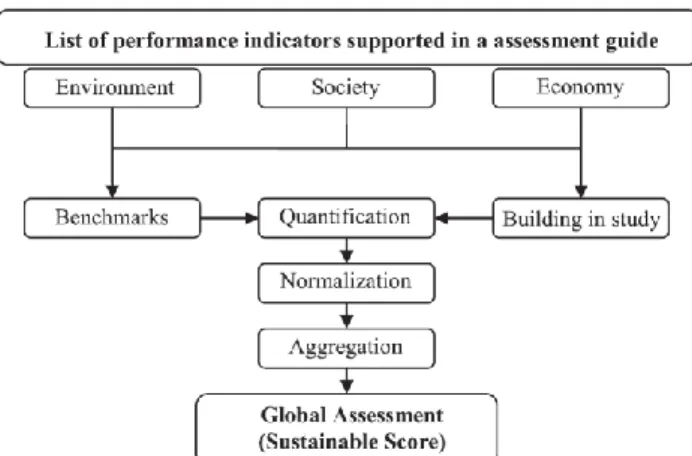
This methodology is intend to be a tool to support the building design in order that this achieves the most appropriate balance between the different sustainability dimensions, and that is at the same time practical, transparent and flexible enough to be easily adapted to different kind of building and technology (Mateus & Bragança, 2011). The framework of this methodol-ogy is presented in Figure 1 and is described in Mateus & Bragança (2011).
The methodology follows four steps: i) Quantification of performance of the building at the level of each indicator; ii) Normalization of parameters; iii) Aggregation of parameters; iv) Sus-tainable score calculation and global assessment.
Figure 1. Framework of the SBToolPT-H methodology (Mateus & Bragança, 2011).
3 PRESENTATION OF THE CASE STUDY
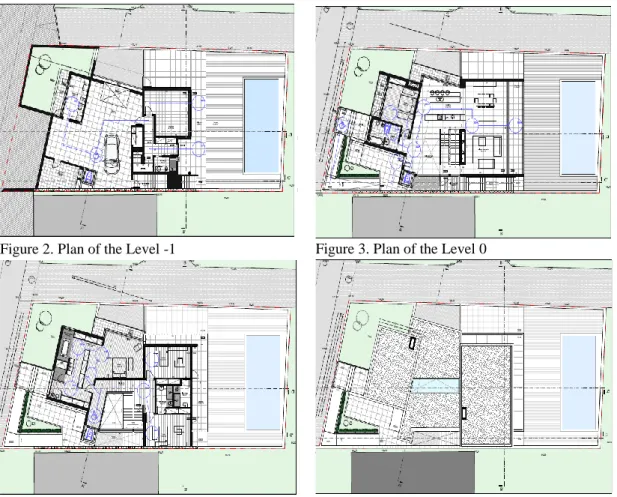
The case study is one residential building, for one family, with two floors (Level 0 and Level 1) and a floor for the garage (Level -1), giving a total construction area of 515.28 m2 and a gross footprint of 245.25 m2. The residential building is located in Casal Velho, near to the city of Pombal, in the Leiria district. The building is defined by a traditional structure, namely in rein-forced concrete and the exterior and the interior walls are made of hollow brick masonry.
The land plot has 421 m2 and is near to the urban area of Casal Velho. The buildings sur-rounding this case study are medium/low density, predominantly defined by residential de-tached buildings (for one family). The distance between the center of Castelo Velho and the city of Pombal is around 3 km. In Figure 2 to 5 are presented the plans of the building under
study.
As above mentioned, the building is designed according the traditional construction tech-niques used in Portugal: reinforced concrete for the structure (beams and columns) and 25 cm thick hollow-brick single walls in the external vertical envelope. The building uses an External Thermal Insulation Composite System (ETICS) as the basis if the thermal insulation. Interior walls are in 11cm thick hollow brick. The walls, interior and exterior, are coated with tradition-al Portland cement mortar.
Figure 2. Plan of the Level -1 Figure 3. Plan of the Level 0
Figure 4. Plan of the Level 1 Figure 5. Plan of the Level of the roof
4 ASSESSEMENT OF THE SUSTAINABILITY
The implementation of the sustainability assessment was carried our according to the evaluation guide and the assessment procedure of the SBToolPT-H methodology and follows the steps indi-cated in the Figure 1. To assess the environmental dimension the authors used an embedded life-cycle impact assessment (Bragança & Mateus, 2012). This database covers the most used building technologies for each building element (walls, floors, windows, doors, etc.). The phys-ical boundary of the SBToolPT-H methodology is the building site plus the level of integration of the building with other urban amenities (e.g. commercial areas and leisure areas). The time boundary it includes the whole life cycle, from cradle to grave.
The performance of the case study, assessed for the original solution and for the optimized solution, is measured against each category, sustainable dimension and global score (sustaina-ble score)
4.1 Original Solution
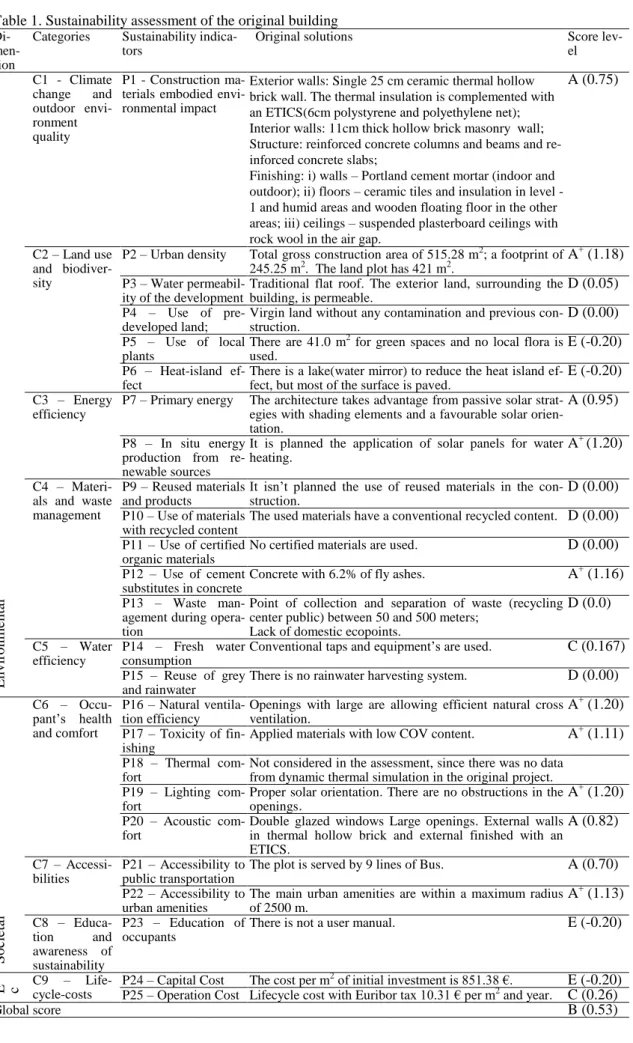
The first step is the quantification of the performance of the original building at the level of each sustainability indicator. Table 1 lists the categories and sustainability indicators and re-spective results from the application of the SBToolPT-H methodology to the original solution.
Table 1. Sustainability assessment of the original building
Di- men-sion
Categories Sustainability
indica-tors
Original solutions Score
lev-el E n v ir o n m en tal C1 - Climate change and outdoor envi-ronment quality P1 - Construction ma-terials embodied envi-ronmental impact
Exterior walls: Single 25 cm ceramic thermal hollow brick wall. The thermal insulation is complemented with an ETICS(6cm polystyrene and polyethylene net); Interior walls: 11cm thick hollow brick masonry wall; Structure: reinforced concrete columns and beams and re-inforced concrete slabs;
Finishing: i) walls – Portland cement mortar (indoor and outdoor); ii) floors – ceramic tiles and insulation in level -1 and humid areas and wooden floating floor in the other areas; iii) ceilings – suspended plasterboard ceilings with rock wool in the air gap.
A (0.75)
C2 – Land use and biodiver-sity
P2 – Urban density Total gross construction area of 515.28 m2; a footprint of
245.25 m2. The land plot has 421 m2.
A+ (1.18) P3 – Water
permeabil-ity of the development
Traditional flat roof. The exterior land, surrounding the building, is permeable.
D (0.05) P4 – Use of
pre-developed land;
Virgin land without any contamination and previous con-struction.
D (0.00) P5 – Use of local
plants
There are 41.0 m2 for green spaces and no local flora is
used.
E (-0.20) P6 – Heat-island
ef-fect
There is a lake(water mirror) to reduce the heat island ef-fect, but most of the surface is paved.
E (-0.20) C3 – Energy
efficiency
P7 – Primary energy The architecture takes advantage from passive solar
strat-egies with shading elements and a favourable solar orien-tation.
A (0.95)
P8 – In situ energy production from re-newable sources
It is planned the application of solar panels for water heating.
A+ (1.20)
C4 – Materi-als and waste management
P9 – Reused materials and products
It isn’t planned the use of reused materials in the con-struction.
D (0.00) P10 – Use of materials
with recycled content
The used materials have a conventional recycled content. D (0.00)
P11 – Use of certified organic materials
No certified materials are used. D (0.00)
P12 – Use of cement substitutes in concrete
Concrete with 6.2% of fly ashes. A+ (1.16)
P13 – Waste man-agement during opera-tion
Point of collection and separation of waste (recycling center public) between 50 and 500 meters;
Lack of domestic ecopoints.
D (0.0)
C5 – Water efficiency
P14 – Fresh water consumption
Conventional taps and equipment’s are used. C (0.167)
P15 – Reuse of grey and rainwater
There is no rainwater harvesting system. D (0.00)
S o ciet al C6 – Occu-pant’s health and comfort P16 – Natural ventila-tion efficiency
Openings with large are allowing efficient natural cross ventilation.
A+ (1.20) P17 – Toxicity of
fin-ishing
Applied materials with low COV content. A+ (1.11)
P18 – Thermal com-fort
Not considered in the assessment, since there was no data from dynamic thermal simulation in the original project. P19 – Lighting
com-fort
Proper solar orientation. There are no obstructions in the
openings.
A+ (1.20) P20 – Acoustic
com-fort
Double glazed windows Large openings. External walls in thermal hollow brick and external finished with an ETICS. A (0.82) C7 – Accessi-bilities P21 – Accessibility to public transportation
The plot is served by 9 lines of Bus. A (0.70)
P22 – Accessibility to urban amenities
The main urban amenities are within a maximum radius of 2500 m. A+ (1.13) C8 – Educa-tion and awareness of sustainability P23 – Education of occupants
There is not a user manual. E (-0.20)
E c oC9 – Life-cycle-costs n o m ic P24 – Capital Cost The cost per m
2
of initial investment is 851.38 €. E (-0.20)
P25 – Operation Cost Lifecycle cost with Euribor tax 10.31 € per m2 and year. C (0.26)
Each building element used in this case study is described. The performance of each sustainable indicator was obtained after the normalization and aggregation and is presented in Table 1.
The results obtained for the categories are: C1 - Climate change and outdoor environment quality: A (0.75); C2 – Land use and biodiversity: C (0.35); C3 – Energy efficiency: A+ (1.08); C4 – Materials and waste management: C (0.21); C5 – water efficiency: C (0.11); C6 – Occu-pant’s health and comfort: A+ (1.08); C7 – Accessibilities: A (0.90); C8 – Education and awareness: E (-0.20); C9 – Life-cycle-costs: D (0.03).
The score obtained for each dimension is: Environment: B (0.63); Society: A (0.90); Econo-my: D (0.03). These results lead to a final score of B (0.53). Analysing this results it is possible to conclude that this building is level B due to its high initial investment and due to the low per-formance at the level of the sustainability indicators in the environmental dimension.
4.2 Optimization of sustainability
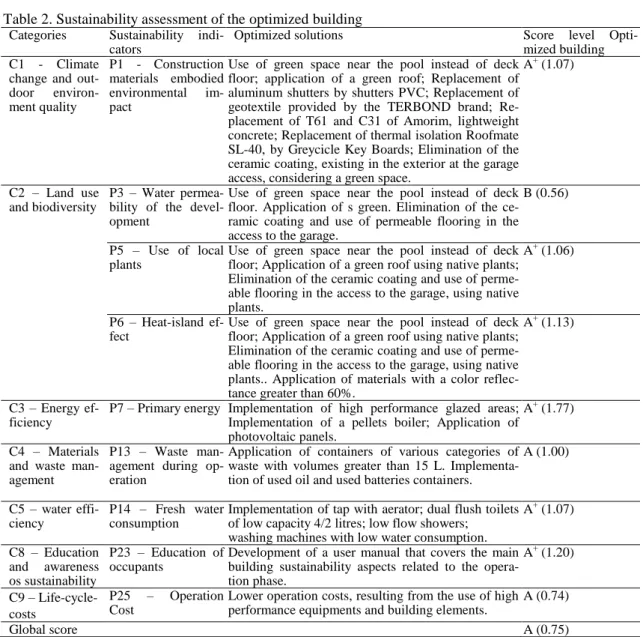
To optimize the sustainability of the building the methodology SBToolPT-H was used and the most important indicators were considered. Therefore the implemented design alternatives were bases in the purpose of improving the most unfavourable indicators. At the end it was possible to archive an overall level of sustainability of A. The implemented actions are described in Ta-ble 2.
Table 2. Sustainability assessment of the optimized building
Categories Sustainability
indi-cators
Optimized solutions Score level
Opti-mized building C1 - Climate
change and
out-door environ-ment quality P1 - Construction materials embodied environmental im-pact
Use of green space near the pool instead of deck floor; application of a green roof; Replacement of aluminum shutters by shutters PVC; Replacement of geotextile provided by the TERBOND brand; Re-placement of T61 and C31 of Amorim, lightweight concrete; Replacement of thermal isolation Roofmate SL-40, by Greycicle Key Boards; Elimination of the ceramic coating, existing in the exterior at the garage access, considering a green space.
A+ (1.07)
C2 – Land use and biodiversity
P3 – Water permea-bility of the devel-opment
Use of green space near the pool instead of deck floor. Application of s green. Elimination of the ce-ramic coating and use of permeable flooring in the access to the garage.
B (0.56)
P5 – Use of local plants
Use of green space near the pool instead of deck floor; Application of a green roof using native plants; Elimination of the ceramic coating and use of perme-able flooring in the access to the garage, using native plants.
A+ (1.06)
P6 – Heat-island ef-fect
Use of green space near the pool instead of deck floor; Application of a green roof using native plants; Elimination of the ceramic coating and use of perme-able flooring in the access to the garage, using native plants.. Application of materials with a color reflec-tance greater than 60%.
A+ (1.13)
C3 – Energy ef-ficiency
P7 – Primary energy Implementation of high performance glazed areas; Implementation of a pellets boiler; Application of photovoltaic panels.
A+ (1.77)
C4 – Materials and waste man-agement
P13 – Waste man-agement during op-eration
Application of containers of various categories of waste with volumes greater than 15 L. Implementa-tion of used oil and used batteries containers.
A (1.00)
C5 – water effi-ciency
P14 – Fresh water consumption
Implementation of tap with aerator; dual flush toilets of low capacity 4/2 litres; low flow showers; washing machines with low water consumption.
A+ (1.07) C8 – Education and awareness os sustainability P23 – Education of occupants
Development of a user manual that covers the main building sustainability aspects related to the opera-tion phase. A+ (1.20) C9 – Life-cycle-costs P25 – Operation Cost
Lower operation costs, resulting from the use of high performance equipments and building elements.
A (0.74)
The results obtained for the categories are: C1 - Climate change and outdoor: A+ (1.07); C2 – Land use and biodiversity: A+ (1.03); C3 – Energy efficiency: A+ (1.19); C4 – Materials and waste management: C (0.25); C5 – water efficiency: A (0.71); C6 – Occupant’s health and com fort: A+ (1.08); C7 – Accessibilities: A (0.90); C8 – Education and awareness: A+ (1.20); C9 – Life-cycle-costs: C (0.27). The score obtain for each dimension is: Environment: A (0.90); So-ciety: A+ (1.04); Economy: C (0.27). Due to this optimized assessment, the environmental per-formance of the building was improved to the level A and the societal perper-formance achieved the maximum level. In what respects to the economic performance, it was also improved, but due to the high initial investment a level C was obtained. These results lead to a final score of A (0.75), Table 2.
4.3 Analysis of the thermal behavior of the building
The building was analysed using the simulation tool Design Builder. The assessment was done before and after the optimization. These studies intended to analyse: the energy losses by the several materials that constitute the building envelope; the energy gains in the building; the be-haviour of the internal temperatures of the building due to the variation of the external tempera-tures along the day and year; the energy consumption of the building, for heating and cooling the indoor environment and to maintain the thermal comfort during both the heating and cool-ing seasons.
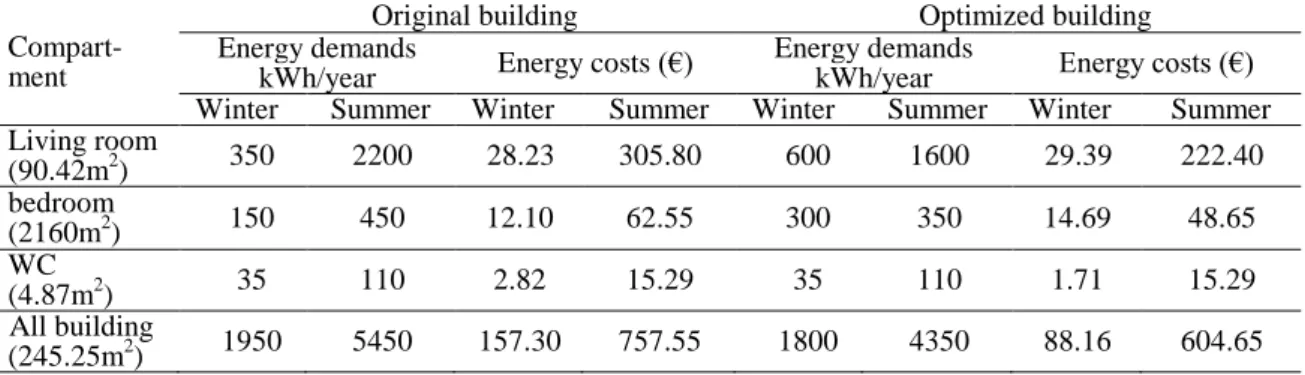
Table 3 shows that the consideration of optimized solutions in the building induced a better thermal performance and a reduction of operation costs. For the dynamic analysis of the ther-mal behaviour of the building the comfort temperatures of 18 ºC for winter and 21 ºC for the summer were considered, taking in consideration the comfort class level III of the standard EN15251:2007. To assess the energy costs the following reference costs were considered: i) pellets - 0.24 €/Kg; electricity - 0.139 €/kWh. These were the valued in the local market in No-vember 2012.
Table 3. Evaluation of the thermal behaviour of building and related operation costs
Compart-ment
Original building Optimized building Energy demands
kWh/year Energy costs (€)
Energy demands
kWh/year Energy costs (€) Winter Summer Winter Summer Winter Summer Winter Summer Living room (90.42m2) 350 2200 28.23 305.80 600 1600 29.39 222.40 bedroom (2160m2) 150 450 12.10 62.55 300 350 14.69 48.65 WC (4.87m2) 35 110 2.82 15.29 35 110 1.71 15.29 All building (245.25m2) 1950 5450 157.30 757.55 1800 4350 88.16 604.65 4.4 Economic analysis
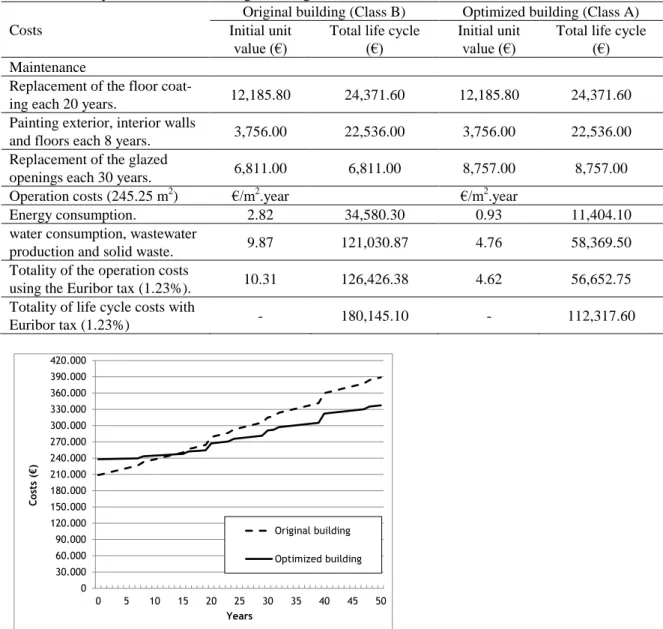
In order to get a better understanding of the developed work and the achieved classification for the building, after the analysis of sustainability and the thermal behaviour an economic analysis was developed. Table 4 represents the life cycle costs of the building for the two analysed solu-tions: the original and the optimized.
Analysing Table 4 it is possible to conclude that the implementation of the sustainable solu-tions results in a reduction of costs by 1.5 times between and the improvement of the sustaina-bility from B to A. At the end of a life cycle of 50 years the implementation of the optimized solution has a saving of 67,827.60 €. It should be noted that these analyses do not comprehend the gains from the sale of electricity to the public system, due to the production of electricity from photovoltaic panels. According to the photovoltaic panel design, the annual energy pro-duction is about 3042 kWh/year. The energy price in the subsidized regime is 0.306 €/kWh, for the first eight years and 0.165 €/kWh for the remaining seven years. After fifteen years the val-ues for sale and acquisition are equal. According to the main Portugval-uese energy supplier, in 2012 the normal energy price is 0.139 €/kWh.
From the abovementioned values it can be conclude that he use of photovoltaic panels results in a gain of 13,074.50 €, considering a period of 20 years for the life cycle of the photovoltaic panels.
The graph shown in Figure 6 reflects the evolution of total investment during the entire life cycle of the building with original solution, class B, and optimized solution, class A.
Table 4. Life cycle costs of the building attending the two solutions. Costs
Original building (Class B) Optimized building (Class A) Initial unit
value (€)
Total life cycle (€)
Initial unit value (€)
Total life cycle (€) Maintenance
Replacement of the floor
coat-ing each 20 years. 12,185.80 24,371.60 12,185.80 24,371.60 Painting exterior, interior walls
and floors each 8 years. 3,756.00 22,536.00 3,756.00 22,536.00 Replacement of the glazed
openings each 30 years. 6,811.00 6,811.00 8,757.00 8,757.00 Operation costs (245.25 m2) €/m2.year €/m2.year
Energy consumption. 2.82 34,580.30 0.93 11,404.10
water consumption, wastewater
production and solid waste. 9.87 121,030.87 4.76 58,369.50 Totality of the operation costs
using the Euribor tax (1.23%). 10.31 126,426.38 4.62 56,652.75 Totality of life cycle costs with
Euribor tax (1.23%) - 180,145.10 - 112,317.60 0 30.000 60.000 90.000 120.000 150.000 180.000 210.000 240.000 270.000 300.000 330.000 360.000 390.000 420.000 0 5 10 15 20 25 30 35 40 45 50 Costs ( € ) Years Original building Optimized building
Figure 6. Evolution of the life cycle costs of the original and optimized alternatives.
It can be seen that the initial investment of 29,285.20 € in sustainability solutions are recov-ery at the 13th year of the life cycle of the building. At the end of the life cycle the building with Class A, has a total investment of 337,330.08 €, whereas the building with Class B has 388,946.60 €, representing a total of savings of 51,616.82€.
It can be concluded that investment in sustainability measures is profitable, with a quick payback time and representing significant savings at the end of life cycle.
5 CONCLUSIONS
The work presented in this paper is aimed to assess and optimize the sustainability of a residen-tial building at the design stage, through the application of a building sustainability assessment tool, namely the SBToolPT-H. A first evaluation was done, where conventional solutions were
adopted. After this, a new proposal was developed with several improvements in order to create a sustainable building with a higher level of performance, corresponding to the Portuguese best practice (level A). An economic analysis is also performed to analyse the cost/benefit related to the proposed sustainability improvement measures.
As this paper highlights, the improvement of the sustainability of a building does not relies only in the preservation of the environment, but also in the consideration of social and econom-ic aspects. The sustainability of a building depends not only on one dimension but in the har-mony between the three dimensions of sustainability: environmental, societal and economic.
This research and the application of the methodology SBToolPT-H allowed the development of the following conclusions:
Sustainable building needs less extraction of raw materials and produces significantly lower greenhouse gases to the environment;
The consumption of water and energy are substantially smaller in sustainable building; The economic analyses demonstrate a clear cost reduction from the sustainability level B to A, which would result in significant savings in life cycle of the building.
The building with sustainable level A has a much better thermal behaviour that the building with sustainable performance class B. This classification is also reflected on the energy con-sumption necessary to maintain the building in the range of thermal comfort.
In what respects to the contribution of the methogology SBToolPT-H to the sustainable building design, it is possible to highlight that:
This methodology is a clear aid to the design of sustainable residential buildings. This framework based in the analysis twenty-five sustainability indicators covers the key points of sustainability.
It allows making improvements in the design of the residential buildings in order to ensure a better performance at the level of the three sustainability dimensions: environmental, social and economic;
It addresses the thermal comfort, giving special attention to the energy consumption and as-sociated costs to keep the building in the range comfort.
The assessment of the sustainability of a building is an advanced vision, which shows that small options can be crucial for the environment, society and economy.
This work highlights the importance of the evaluation and certification of the sustainability of the construction, as a process to ensure a level of efficiency of buildings in relation to the consumption of natural resources, environmental protection and thermal comfort.
REFERENCES
Bragança, L. & Mateus, R. 2012. Life-cycle analysis of buildings: environmental impact of building ele-ments. Edições iiSBE Portugal: Guimarães, Portugal. ISBN 978-99932-0-917-1. [ http://hdl.handle.net/1822/20481 ]
EN15251, 2007. Indoor environmental input parameters for design and assessment of energy performance of buildings addressing indoor air quality, thermal environmental, lighting and acoustics. Brussels: Eu-ropean Committee for Standardization.
Forsberg A. & Malmborg von F., 2004. Tools for environmental assessment of the built environment, Building and Environment 39, issue 2, 222-228.
Martinho S., 2013. Implementação de critérios da construção sustentável numa habitação unifamiliar -
análise de custos/benefícios – MSc thesis – Civil Engineering, Polytechnic Institute of Castelo Branco,
in Portuguese.
Mateus, R. & Bragança L., 2010. Building sustainability assessment: System SBToolPT®, Sustainable Construction A Life Cycle Approach in Engineering: Proceedings International Symposium Malta, 23-25 July 2010.” ISBN 978-99932-0-917-1. 23-25-32.
Mateus, R. & Bragança L., 2011. Sustainability assessment and rating of buildings: Developing the meth-odology SBToolPT, Building and environment, 46, 1962-1971, Elsevier.