AVALIAÇÃO DE DIFERENTES CIRCUITOS DE BOMBEAMENTO PARA DOSAGEM DE
REAGENTES EM CIRCUITOS DE FLOTAÇÃO
R. A. FONSECA1, F. C.F. OLEGARIO JÚNIOR1, H. LINO1, M.G. BERGERMAN, M.G.2* 1Vale S.A., Salobo Mine, 2University of São Paulo’s Department of Oil and Mining Engineering
[email protected]* Submitted 09/11/2017 – Accepted 15/11/2017 DOI: 10.15628/holos.2017.6525 RESUMO
As usinas de beneficiamento mineral da Vale utilizam diferentes tipos de circuitos de bombeamento, para a dosagem de reagentes na flotação. Os mais comumente utilizados são os circuitos com bombas centrífugas, bombas de diafragma e bombas peristálticas. Outras alternativas ainda podem ser utilizadas, como bombas helicoidais, dosadores de canecas e dosagem direto dos tambores de estocagem (regulagem manual). Este estudo visa avaliar tecnicamente algumas das
alternativas disponíveis no mercado e apresentar os resultados de uma avaliação industrial comparando um circuito com bomba peristáltica e um circuito com bombas centrifugas e de diafragma, todos operando em paralelo. Os resultados mostram que os três tipos de circuitos atendem as demandas operacionais de controle da dosagem de reagentes. O circuito com bombas peristálticas, no entanto, se mostrou menos complexo e de menor custo.
PALAVRAS-‐CHAVE: Flotação, Cobre, Dosagem de reagentes.
TECHNICAL EVALUATION OF REAGENT DOSING PUMPING SYSTEMS IN FLOTATION
CIRCUITS
ABSTRACT
Vale's ore processing plants use different types of pumping circuits for flotation reagent dosing. Most commonly, circuits with centrifugal pumps, diaphragm pumps, and peristaltic pumps are used. Alternative arrangements can also be used, such as helical pumps and direct dosing from reagent storage drums (with manual or automatic dosing systens). This study aims to technically evaluate some of the alternatives available in
the marketplace and present the results of an industrial evaluation comparing a peristaltic pump circuit to a circuit with centrifugal and diaphragm pumps, all operating in parallel. The results showed that the three types of circuits meet the operational requirements of reagent dosing control. However, the peristaltic pump circuit has proven to be less complex and costly.
KEYWORDS: Flotation, copper, reagent dosing.
INTRODUCTION
Vale’s copper projects currently in operation make use of two different flotation reagent dosing systems, with both being used at Sossego mill. The first one makes use of diaphragm pumps with individual flowmeters in each line. The second system uses centrifugal pumps with flow control through microprocessor valves. The latter alternative also requires individual flowmeters for each line. Figures 1 to 4 illustrate the two reagent dosing systems at Sossego mill. This mill’s flotation circuit is described in detail by Bergerman (2009), Miranda et al. (2015) and Rosa et al. (2007).
Figure 1: Dosing system with diaphragm pumps Figure 2: individual flowmeters in each line of the dosing system with diaphragm pumps
Figure 3: Dosing system with centrifugal pumps Figure 4: individual flowmeters in each line of the dosing system with centrifugal pumps
The diaphragm pump system has shown a poor operating performance at Sossego mill due to several clogging events, as well as frequent need for maintenance. At Sossego, these pumps operate with flowmeters, which could be eliminated, as this type of pump enables flow control through pulse measurement, subject to proper calibration of the pulse / flow ratio. The centrifugal pump system delivers a good performance. However, both pumping systems entail high initial investment costs, particularly due to the need for individual flowmeters in each reagent dosing line. At an approximate cost of US$ 1.850.00 each, electromagnetic flowmeters can be used for conductive fluids (like xanthate, which is dosed at 1% in water). In the case of non-‐conductive fluids (such as foaming agents), Coriolis-‐type flowmeters are required, which
raises the unit cost to approximately US$ 10,000.00. Moreover, flowmeters feature inherent operating failures, such as measurement errors or discrepant figures between the field and the control room, which are recurring events in the systems currently used, requiring frequent calibration. In the case of the centrifugal pump circuit, it is also necessary to use control valves to split the reagent flow among the various dosing points.
This study aimed at evaluating reliable, cheaper alternatives for flotation reagent dosing, such as the Watson Marlow Bredel’s peristaltic pump SPX 10.
MATERIALS AND METHODS
Vale requested the firm Watson Marlow Bredel to propose and provide a peristaltic pump for testing, designed for 20 and 50 liters/hour average and maximum flow, respectively. The lowest possible flow should also be indicated. This pump would operate with different flotation reagents, including sodium dithiophosphate, xanthate, propylene glycol, or methyl isobutyl carbinol. The selected pump was a Watson Marlow Bredel model SPX10, with an operating range from 4 to 50 L/hr.
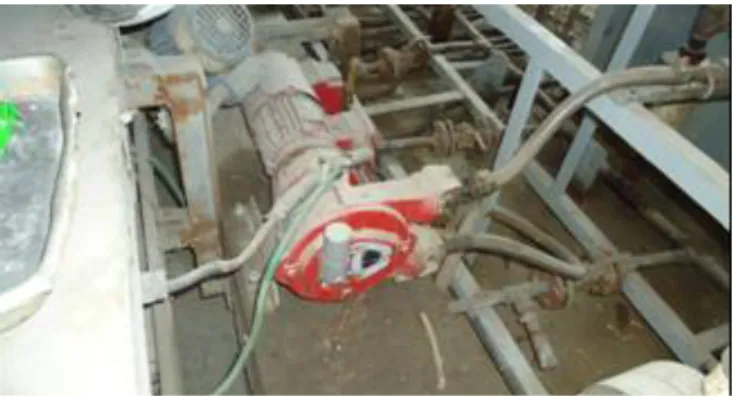
The procurement process began in May 2009 and the pump was delivered to the Sossego mill in February 2010. It was installed in the sodium dithiophosphate tank (collector) to replace pump 2401-‐BA-‐34 and started operation in March 2010. The following aspects were monitored during the operation period: mechanical availability, siphoning, pumping flow variations, and pump speed (rpm) to reagent flow ratio. Figure 5 shows the pump installed at the plant.
Figure 5: Peristaltic pump SPX10 installed for the tests
In addition, the study comprised a simplified economic assessment based on the costs of different pumps available in the marketplace and the main auxiliary devices – control valves, pressure gauges, flowmeters, and flow sensors. It was assumed that the control system would be the same for all pump options and available at the mills in the case of new projects. The costs considered the prices for the Brazilian market.
RESULTS AND DISCUSSION
Figure 6 illustrates the peristaltic pump’s monthly operating time during the test period.
Figure 6: Operating time of the peristaltic pump SPX10 during 2010
Regarding mechanical availability, there was no operating problem during the test period. The only issue was that the pump could not be operated at the flow of 4 L/hr, which was the minimum operating flow informed by the manufacturer. The pump motor was automatically switched off when the flow dropped below 10 L/hr. When asked about this trouble, the manufacturer said different gear reducer ratios could be used to achieve lower or higher flows. This point should be considered in the future for the pump operating at Sossego mill. The pump hose life was appropriate, without any signs of wear over the eight months of operational test. Figures 7 and 8 show the hose and oil condition upon the test completion in November 2010.
Figure 7: Peristaltic pump hose after 8 months of operation
Figure 8: Oil condition after 8 months of operation
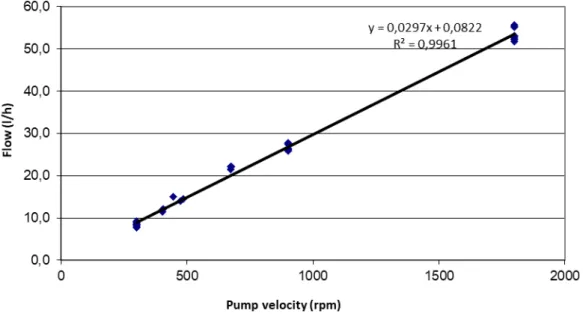
No siphoning event was recorded during the test period. Regarding the pumping flow variation and pump speed to reagent flow ratio, the test results were very good. Optimum repeatability was recorded for flow measurements over time, at the same pump speed, regardless of the hose life and operating time. In addition, optimum correlation was observed between the measured flow and the pump speed, which was confirmed by the flowmeter installed in the pump line. Figure 9 illustrates the results of field measurements carried out to
determine the flow repeatability (in this case, three samplings were conducted over 30 minutes at the same pump speed) and the pump speed to flow ratio (in this case, the flow was measured at different pump speeds several times during the test). As can be seen from Figure 9, there is an excellent correlation between measured flow and pump speed, and measurements at the same pump speed show good repeatability.
Figure 9. Results of field measurements carried out to determine the flow repeatability at the persitaltic pump
The evaluation led to the conclusion that the peristaltic pump XPS10 meets the technical and operational requirements to be used as a reagent dosing pump.
The economy of this pump was assessed by comparing it with the other dosing arrangements currently used at Sossego and also with other solutions available in the market. Table 1 shows this comparison in terms of CAPEX, based on proposals made by the main suppliers of each type of equipment in May 2017.
Table 1: CAPEX comparison among different reagent pump solutions
Equipment /
Alternative Unit price (US$)* Quantity
Total cost (US$) Dosing with diaphragm pump Dosing with centrifugal pump Dosing with peristaltic pump Dosing with a bucket dosing arrangement Dosing with helical pump Diaphragm pump 1.200,00 – 2.100,00 30** 36.000,00 -‐ -‐ Centrifugal pump 10.000,00 10*** -‐ 100.000,00 -‐ Peristaltic pump 1.700,00 – 3.500,00 30** -‐ -‐ 51.000,00 Bucket dosing 10.500,00 30** 315.000,00 Helical pump 1.050,00 30** 31.500,00 Coriolis-‐type flowmeter 10.000,00 – 20.000,00 24 24.000,00 -‐ Electromagnetic flowmeter 1.900,00 – 6.500,00 6 11.400,00 -‐ Pressure gauge 1.700,00 5 -‐ 8.500,00 -‐ Microprocessor valves 4.000,00 – 7.400,00 30 -‐ 120.000,00 -‐ Flow sensor 300,00 30 9.000,00 -‐ 9.000,00 9.000,00 9.000,00 Total 46.000,00 263.900,00 60.000,00 324.000,00 40.500,00 * The economics estimate considered the lowest price
**Considering five reagent dosing tanks with 6 pumps per line *** Considering five reagent dosing tanks with 2 pumps per line
One can see from Table 1 data that the overall costs of peristaltic, diaphragm, and helical pumps are significantly lower than the centrifugal pump cost, as they do not require flow meters and valves. The operational cost was not taken into consideration, as it is very low for all alternatives – it should also be pointed out that there are no significant differences in power consumption by the three pumps, because all of them are driven by low-‐power motors (lower than 1 hp in the case of bucket dosing and diaphragm and peristaltic pumps, and 3 hp in the case of centrifugal pumps), representing a very small percentage of the mills’ power consumption.
In the case of peristaltic pumps, the main maintenance items are oil and the hose. Based on the test conducted at Sossego plant, these two items should be replaced every eight months for each pump, which would result in a yearly cost of approximately US$ 150 per pump.
In view of the good results of the industrial test, the peristaltic pump system was installed in the Salobo plant. Figure 10 illustrates the Salobo pumping circuit, while Figures 11 to 13 show the dosing curves as a function of the pump speed. A good correlation was found for the three different pump sizes.
Figure 10. Dosing system with peristaltic pumps at Salobo plant
Figure 11. Results of field measurements carried out to determine the flow repeatability at the persitaltic pump SPX 25 from Salobo plant
Figure 12. Results of field measurements carried out to determine the flow repeatability at the persitaltic pump SPX 15 from Salobo plant
Figure 13. Results of field measurements carried out to determine the flow repeatability at the persitaltic pump SPX 10 from Salobo plant
CONCLUSIONS
The test carried out at Sossego plant with the Watson Marlow Bredel peristaltic pump SPX10 proved that it meets the flotation reagent dosing requirements for this plant. No mechanical and operational problems were detected and there was no siphoning occurrence. Controlling the reagent flow through the pump speed (rpm) has proven to be effective and very accurate.
The only major issue was the pump’s operating range. In case of low flow, it might be necessary to use a smaller pump, which would lead to the need for two types of pump for each reagent, i.e., one for low and another for high flow applications.
The economic evaluation showed that peristaltic pumps are much more advantageous from the standpoint of initial investment cost, as they do not require flowmeters.
ACKNOWLEDGMENT
The authors wish to thank Vale S.A. for the authorization to publish this paper and Watson Marlow Bredel for the support to carry out this study.
REFERENCES
Bergerman, M. G. (2009). Modelagem e simulação do circuito de moagem do Sossego Dissertação de mestrado. Universidade de São Paulo, São Paulo, Brasil.
Miranda, A., Fonseca, R., Olegario, F., Souza, M., Oliveira, G., Bergerman, M. G., & Delboni Junior, H. (2015). Avaliação da granulometria de alimentação e dos produtos da etapa rougher de
flotação da usina do Sossego. HOLOS, 7, 88-‐93, Dec. 2015. Available at:
http://dx.doi.org/10.15628/holos.2015.3655.
Rosa, M. A. N., Bergerman, M. G., Miranda, A., Oliveira, J. L., Souza, M., Batista Filho, J., & Cardoso, W. (2007). Controle operacional da usina do Sossego. VII Meeting of the southern
hemisphere on mineral technology and XXII Encontro nacional de tratamento de minérios e metalurgia extrativa. Ouro Preto, Brasil.