Repositório ISCTE-IUL
Deposited in Repositório ISCTE-IUL: 2019-01-15
Deposited version: Post-print
Peer-review status of attached file: Peer-reviewed
Citation for published item:
Kindt, S., Vansteenkiste, M., Josephy, H., Bernardes, S. F. & Goubert, L. (2019). Helping your partner with chronic pain: the importance of helping motivation, received social support, and Its timeliness. Pain Medicine. 20 (1), 77-89
Further information on publisher's website: 10.1093/pm/pny006
Publisher's copyright statement:
This is the peer reviewed version of the following article: Kindt, S., Vansteenkiste, M., Josephy, H., Bernardes, S. F. & Goubert, L. (2019). Helping your partner with chronic pain: the importance of helping motivation, received social support, and Its timeliness. Pain Medicine. 20 (1), 77-89, which has been published in final form at https://dx.doi.org/10.1093/pm/pny006. This article may be used for non-commercial purposes in accordance with the Publisher's Terms and Conditions for self-archiving.
Use policy
Creative Commons CC BY 4.0
The full-text may be used and/or reproduced, and given to third parties in any format or medium, without prior permission or charge, for personal research or study, educational, or not-for-profit purposes provided that:
• a full bibliographic reference is made to the original source • a link is made to the metadata record in the Repository • the full-text is not changed in any way
The full-text must not be sold in any format or medium without the formal permission of the copyright holders. Serviços de Informação e Documentação, Instituto Universitário de Lisboa (ISCTE-IUL)
Av. das Forças Armadas, Edifício II, 1649-026 Lisboa Portugal Phone: +(351) 217 903 024 | e-mail: [email protected]
1
Helping Your Partner with Chronic Pain: The Importance of Helping Motivation, Received Social Support and its Timeliness
Sara Kindt1*, MSc, Maarten Vansteenkiste2, PhD, Haeike Josephy3, MSc, Sonia F. Bernandes4, PhD, Liesbet Goubert1, PhD
1 Department of Experimental-Clinical and Health Psychology, Ghent University, Ghent, Belgium
2 Department of Developmental, Personality and Social Psychology, Ghent University, Ghent, Belgium
3 Department of Data Analysis, Ghent University, Ghent, Belgium
4 ISCTE-Instituto Universitário de Lisboa, CIS-IUL-Centro de Investigação e Intervenção Social, Lisbon, Portugal
*Corresponding author: Sara Kindt, Henri Dunantlaan 2, 9000 Ghent, Belgium. Tel: +32 (0)9 264 86 90, Fax: +32 (0)9 264 64 89. [email protected].
Running title: social support in chronic pain couples
Acknowledgments: We thank Oana Bocaniala, Evelyne Carmen, Nele Decoene, Lieselot
Telen and Elisabeth Verscheure for their help with data collection and the Flemish Pain League/Flemish League for Fibromyalgia Patients for their assistance with recruiting participants. This research was supported by the Fund for Scientific Research-Flanders (FWO), grant number G.0235.13N.
2
Abstract
Objective: Like all intentional acts, social support provision varies with respect to its
underlying motives. Greater autonomous or volitional motives (e.g., enjoyment, full commitment) to help individuals with chronic pain (ICPs) is associated with greater well-being benefits for the latter, as indexed by improved satisfaction of their psychological needs for autonomy, competence, and relatedness. The present study investigates the processes explaining why partners’ autonomous or volitional helping motivation yields these benefits.
Methods: 134 couples, where at least one partner had chronic pain, completed a 14-day diary.
Partners reported on their daily helping motives, whereas ICPs reported on their daily received support, timing of help, need-based experiences and pain.
Results: On days when partners provided help for volitional motives, ICPs indicated
receiving more help, which partially accounted for the effect of autonomous helping motivation on ICP need-based experiences. Timing of help moderated the effects of daily received support on ICP need-based experiences.
Conclusions: Findings highlight the importance for ICPs of receiving support in general and
the role of timing in particular, which especially matters when there is little support being received.
Keywords: chronic pain couples, self-determination theory, helping motivation, social
3
Introduction
Chronic pain is worldwide a major public health problem [1, 2], which yields considerable negative consequences, such as increased anxiety and depression [3], and an affected social and working life [4]. Also caring for others with mental or physical health problems may come with a sense of burden, distress, and burnout in family members [5, 6]. Although multiple intra-individual processes such as catastrophizing and fearful thoughts about pain [7– 9] among individuals with chronic pain (ICPs) have received substantial attention to better understand the well-being of ICPs, the critical role of interpersonal dynamics, such as partners’ motives for providing help and the offer of social support, remains relatively understudied [10]. Research has demonstrated that the motivation of partners for providing help relates to both the partner’s own as well as ICP’s functioning. That is, when partners are committed to help the ICP and enjoy doing so (i.e., are autonomously or volitionally
motivated), both the partners themselves and the ICPs report better personal functioning, as indexed by improved psychological need satisfaction and well-being [11, 12]. The key objective of the present study is then to unravel the processes explaining why partners’ volitional or autonomous helping motivation relates to these greater well-being benefits in ICPs. In particular, we investigated the role of received partner support in explaining this relationship as well as the role of the timing of ICP support.
The Role of Need Satisfaction for Individual Well-Being
According to Self-Determination Theory [SDT; 11, 12], the satisfaction of the basic psychological needs for autonomy (i.e., experiencing a sense of volition), competence (i.e., feeling effective) and relatedness (i.e., feeling connected) is essential for human growth, integrity, and well-being. When confronted with chronic pain, these psychological needs may become compromised, with reduced well-being as a consequence. Pain might be an obstacle to engage in personally meaningful activities like playing sports (i.e. autonomy frustrating), it
4 might increase feelings of incapability and even failure while doing particular daily activities or hinder successful coping (i.e. competence frustrating), and it might prevent patients from doing activities with significant others, like their partner, or even be a source of relational tension and conflict (i.e. relatedness frustrating) [15]. Depending on the degree to which these needs get satisfied or frustrated, one can reliably predict differences, both interpersonally as well intrapersonally, in well-being, (mal)adjustment, and even psychopathology [14, 16, 17].
In the context of chronic pain, past research has demonstrated that need satisfaction comes with multiple benefits and may serve as a proxy for individuals’ well-being and flourishing. For instance, at the cross-sectional level, greater satisfaction of these needs in romantic partners of ICPs was related to higher partner well-being and relationship quality and lower partner distress [11]. A subsequent diary study extended this pattern of findings by showing that daily variations in need satisfaction related positively to changes in partners’ daily positive affect, while being negatively related to changes in partners’ daily negative affect, relational conflicts, and feelings of helping exhaustion [12]. An opposite pattern emerged in the case of need frustration. Importantly, the benefits associated with daily need satisfaction were not limited to the partner, but also applied to the ICP, with daily variation in need-based experiences in ICPs being predictive for changes in ICP’s affect, relational
conflict, amount and satisfaction of received help, and perceived disability. Furthermore, there is longitudinal evidence indicating that basic need satisfaction can predict increases in life satisfaction and self-esteem and decreases in depressive, anxious, and somatic symptoms six months later in a sample of individuals with musculoskeletal chronic pain [18]. In light of the multiple benefits associated with psychological need satisfaction and the costs associated with psychological need frustration, it is critical to identify their predictors.
5
How Can Romantic Partners Nurture the Needs of ICPs?
To understand whether the received support by partners is experienced as helpful and growth-promoting, it is critical to take the motives underlying helping behavior into account. According to the Self-Determination Theory, two types of motivation, that is, autonomous and controlled, reflect qualitatively different sorts of reasons for acting, which apply to any kind of behavior, including the provision of help [13, 19]. When autonomously motivated, individuals help others because they like doing so and derive some inherent satisfaction from the act of helping itself or because they see the meaning and value of their helping behavior, either for themselves or for the recipient. In contrast, when controlled motivated, help is provided to avoid criticism and to meet with external expectations or out of feelings of guilt and pressured loyalty towards the recipient of help. That is, controlled motivated help is phenomenologically experienced as a “should”, whereas autonomously motivated help is phenomenologically experienced as a “want”, as it emanates from the person’s interests and commitments. Available research indicates that both the help provider [20–25] and the recipient of help [26], for example the ICP [12], benefit more when the help originates from autonomous or volitional (e.g. providing help out of enjoyment) instead of controlled or pressured (e.g. providing help to avoid guilt or criticism) motives.
For instance, at the cross-sectional level, greater autonomous helping motives in romantic partners to provide help to ICPs related positively with partners’ subjective wellbeing and relationship quality, while negatively relating to their distress and feelings of helping exhaustion [11]. A 14-day diary study replicated and extended this pattern of findings, thereby showing that daily variations in autonomous helping motives related to changes in daily variation in partners’ individual and relational functioning [12]. Moreover, the benefits of daily autonomous helping motivation were found to spill over to the ICP, with partners’ daily autonomous helping motives relating (in)directly to improvements in patients’ affective
6 (e.g., positive affect), relational (e.g., conflict) and help-specific (e.g., satisfaction with
received help) outcomes [12]. Importantly, these benefits occurred because ICPs reported greater satisfaction of the need for autonomy, competence and relatedness [13] on days their partners provided autonomously motivated help. That is, it was the change in ICP’s daily need-based experiences that explained why partners’ helping motives were related with ICP’s daily functioning [12]. However, to date, it is still unclear what accounts for the effects of partners’ helping motivation on ICP’s need-based experiences as such.
Present Study
The present study aims to set a new step in this systematic program of research by unravelling the mechanisms why autonomously motivated help is conducive to ICPs’ well-being, as indexed by psychological need satisfaction. The general hypothesis is that partners who are more volitionally motivated to provide help would be more responsive to patients’ expressed pain. Indeed, seeing someone in pain may elicit different behavioral responses in observers, impacting the person’s pain experience [10, 27]. That is, some partner responses may lead to pain relief and decreased suffering (e.g., provision of pain medication), while other responses may perpetuate the ICP’s pain and distress (e.g., ignoring).
Volitionally provided support would increase the likelihood that ICPs report having received pain-related social support, which refers to the experienced exchanges of
psychological and material resources in the past [28]. Several studies indicate that receiving social support predicts positive health outcomes in both nonclinical (e.g., [29, 30]) and clinical samples (e.g., [31–33]; for an overview see [28]). Furthermore, there is some indirect evidence for our claim that partners’ level of autonomous motivation may be predictive for the amount of received social support by ICPs. For instance, romantic partners who were more autonomously motivated to be and stay in the relationship were more supportive towards each other, as reported by themselves as well as their partner [34]. Congruent with
7 these findings, we hypothesized that changes in ICPs’ daily received social support, that is, partners’ social support provision as perceived by ICPs themselves, account for (i.e., mediates) the association between partners’ daily autonomous helping motives and ICPs’ daily satisfaction and frustration of their psychological needs (Hypothesis 1).
Although we propose received social support as a candidate mechanism to explain the association between partners’ helping motives and ICPs need-based experiences, it is important to note that some studies have found received social support to come with less desirable outcomes, such as negative affect among women with breast cancer [35]. A recent review [36] concluded that although the majority of studies provided evidence for the health benefits associated with social support, there are indeed mixed results documented in the literature, which is also the case for studies about pain-related social support [28], sometimes called a “double-edged sword” [37].
Whether the received support is experienced as need-satisfying and, hence, yields positive effects for ICPs’ pain experiences or alternatively is experienced as need-frustrating thereby eliciting negative effects, may in part depend on the skillfulness with which it is being provided. The skillfulness support framework, as developed by Rafaeli and Gleason [38], holds that couples can increase the benefits of support and reduce its costs by attending to issues like when (i.e. timing), what (i.e. content) and how (i.e. process). Specifically with respect to timing, support can be well-meant by the help provider, but misguided due to the wrong timing of the help such that the help is not perceived to be helpful by the recipient of help. That is, badly timed help may signal a lack of trust in the capacity to independently resolve the situation to the help recipient, thereby failing to support the ICPs’ need for
competence. Also, badly timed help may elicit irritation and create some relational distance or even cause pressure (e.g., to hurry up) in the ICP as the help provider is taking over. Hence, the second aim of the present study was to explore the potential moderating effects of timing
8 of provided help in the association between daily received social support and ICPs’ daily need satisfaction and frustration. Such an analysis allows us to gain more precise insights into the conditions under which support receipt is most beneficial (see Figure 1 for our theoretical model). We assume that timing of received support will moderate the effects of received support on ICPs’ need-based experiences, such that badly timed help will yield less benefits for the ICP (Hypothesis 2).
– Insert Figure 1 about here –
Method
Study design
The present study is part of a larger study, the “Helping Motivation Diary and Longitudinal Study” (HMDAL-Study) among ICPs and their partners, which comprises, apart from the diary assessment that is reported herein, three separate waves of questionnaire administration spread across 6 months. For the purpose of the present study, ICPs and their partners
completed daily diaries during 14 days, starting after the Time 1 (T1) questionnaire administration. This study was approved by the ethical committee of the Faculty of Psychology and Educational Sciences of Ghent University.
Study participants
Participants were couples recruited through the Flemish Pain League (FPL), an umbrella organization for ICPs, and through the Flemish League for Fibromyalgia Patients (FLFP), which is an organization specifically for individuals with fibromyalgia. This study included 134 couples, of which 93 were members of the FPL and 41 were members of the FLFP. Recruitment details are described in two other papers [12, 39]. The present paper reports secondary analyses describing the role of social support in couples coping with chronic pain. Inclusion criteria for participation of ICPs in the present study were (1) having chronic pain
9 for at least 3 months, (2) physically living together with a partner for at least one year, and (3) being sufficiently proficient in Dutch.
The majority of the ICPs were female (N = 111; 82.8%); the mean age of ICPs and their partner (81.3% males) was 51.73 years (SD = 11.17) and 53.04 years (SD = 11.57), respectively. All couples were heterosexual (except for two) and Caucasian. More than a third of the sample (38.1% of ICPs; 35.1% of partners) reported an education beyond the age of 18. Almost all couples were married or legally cohabiting (82.8%). The mean relationship
duration was 24.64 years (SD = 14.48). The majority of partners were employed (N = 90; 67.2%), while only 21.13% of ICPs (N = 28) were employed. Almost all ICPs reported pain in more than one location (M = 4.02, SD = 1.70; range 1–7), with pain in the back (89.6%), neck (74.6%), and lower extremities (62.7%) being reported most frequently. Mean pain duration was 15.55 years (SD = 12.99). On a scale from 0 to 10, ICPs reported a mean pain intensity of 6.91 (SD = 1.39) and a mean disability of 6.52 (SD = 1.96). Fifty-two partners (i.e., 39.1%) also reported pain complaints during the past three months (which is similar to other studies with chronic pain couples, e.g. Issner, Cano, Leonard, & Williams, 2012). Paired-samples t-tests showed that pain duration (M=9.89, SD=11.85), pain intensity (M=4.31, SD=1.66), and disability (M=2.64, SD=2.11) were significantly lower in partners compared to the ICPs (all ps <.05).
Data collection procedure
Members of the FPL and FLFP received an invitation letter to participate in studies about chronic pain and quality of life in our lab [for details see 16, 39]. Participants who gave their agreement to be informed about studies were contacted by telephone to (1) provide more information about the present study and (2) assess inclusion criteria. If both partners in a couple reported having chronic pain, the individual with the longest pain duration was chosen as the ICP. The informed consents and baseline questionnaires were administered via a home
10 visit. After completing the questionnaires, further explanation about the diary study was given. Participants were instructed to fill out the diary in the evening for 14 consecutive days. If there were no planned holidays, participants started filling in the diary the day after the home visit. Both partners received a link and a personal code for completing the diary online on a survey tool called LimeSurvey. When there was no computer or internet available, or when participants indicated to have no experience with computer/internet, they received a paper diary booklet. Twenty-four ICPs and 23 partners used the paper version of the diary. As a sign of appreciation, couples received a fee of 30 euros after completing the 2-week diary. To enhance completion rates we offered the opportunity to receive a text message from a researcher every evening as a reminder for completing the diary.
Out of a potential 3752 end-of-day observations (268 individuals (within 134 couples) x 14 days), a total of 3595 were complete (95.82%). Records completed after 10 am the next morning were deleted, as suggested by Nezlek (Nezlek, 2012). For the paper versions of the diary we relied on the date/time indicated by the participant. Using this criterion 3575 of the 3595 completed observations were included in the analyses (i.e., 99.44% of the completed observations, or 95.28% of the total possible observations).
Diary measures
All measures described below were collected each evening during the 14 consecutive days for both ICPs and partners, unless otherwise specified. To estimate scale reliability, a multilevel confirmatory factor analysis framework was used that enables the examination of level-specific reliabilities [42]. The within-level alpha reflects the ability of the scales to detect differences in systematic changes of persons over days. The between-level alpha reflects the ability of the scales to differentiate persons at the average daily level. Both within- and between-level alphas are reported.
11 Measures in partners
Helping motivation. To measure partners’ daily helping motivation, we selected 8 items
from the Motivation to Help Scale [26], which was adapted in a previous study for use with chronic pain couples [11]. Every evening, partners received a list of 8 reasons for helping or supporting their partner in pain. They reported on how true these motives were for helping their partner the past day on a 7-point scale ranging from “0” (not at all true) to “6” (totally true). Eight items, that is, four items assessing controlled motives (e.g., “because my partner demanded it from me” or “because I would feel guilty if I didn’t help”), and four items assessing autonomous motivation (e.g., “because I personally believe it is important to help my partner” or “because I enjoy helping my partner”). In line with previous studies, an overall index reflecting the relative degree of autonomous helping motivation was calculated by subtracting controlled motivation from autonomous motivation scores. The daily helping motivation scores ranged from -3.75 to 6.00; the higher the score, the more volitional the help that was provided. The scale was found to be reliable (within-person = .60; between-person
= .75). When partners indicated that they did not provide help during the past day, they did not complete the helping motivation items. Out of a total of 1876 days (134 partners * 14 days), only for 105 days (5.6%), scores for helping motivation were missing because partners reported they did not provide support that day.
Measures in ICPs
Received social support. To measure received social support, ICPs reported every
evening on how their partner responded when they had pain that day. We selected four items of the Dyadic Coping Inventory [43], slightly adapted them to a context of pain and made them suitable for a diary design. The items covered the three most widely known functions of social support: emotional (e.g., showing empathy, giving the opportunity for emotional expression and venting), informational (e.g. giving advice or guidance), and instrumental
12 (e.g., providing material aid) [44], namely: “My partner showed empathy and understanding to me” and “My partner listened to me and gave me the opportunity to talk about my pain” (i.e. emotional support), “My partner made specific suggestions, gave advice or information in order to address the problem” (i.e. informational support), and, finally, “My partner took over things that I would normally do” (i.e. instrumental support). We decided to include two items for emotional support because responding in an empathic way and giving your partner space to talk are two different things, both capturing a facet of emotional support. All items were rated on a 7-point scale from 0 (not at all) to 6 (extremely) and the mean score of these four items was used as a measure of received social support. The scale was reliable with within-person = .70 and between-person = .93.
Timing of received social support. Timing, as an aspect of quality of help, was measured
by means of one item: “The help/support of my partner was there at the moments I needed it.” The item was rated from 0 (totally disagree) to 6 (totally agree).
Need-based experiences. To measure daily satisfaction and frustration of the three basic
psychological needs (autonomy, competence, relatedness), we selected items of the Basic Psychological Need Satisfaction Need Frustration Scale [45]. Two items were chosen for each basic psychological need (i.e., one item for need satisfaction and one for need frustration). These items were adapted slightly to a daily relational context by starting each with “Today, in the relationship with my partner …”. Example items are: “…, I could freely take decisions” (i.e., autonomy satisfaction), “…, I felt pressured to do things that I wouldn’t choose myself” (i.e., autonomy frustration), “…, I was confident that I could do things right” (i.e.,
competence satisfaction), “…, I felt like a failure by the mistakes I made” (i.e., competence frustration), “…, I felt that (s)he cared about me” (i.e., relatedness satisfaction), and “…, I felt my partner was detached” (i.e., relatedness frustration). The items assessing need satisfaction were averaged, as were the items relating to need frustration. Subscales showed moderate to
13 good reliability, with a within-person of .66 and .56, and a between-person of .85 and .81 for ICPs’ need satisfaction and frustration, respectively.
Pain intensity. Items for pain intensity were based on the Graded Chronic Pain Scale [46]
and adapted to a daily context. Every evening, ICPs completed an item asking “On average, how much pain did you have today?” and “How intense was your worst pain today?”. Items were rated on a 7-point scale ranging from 0 (no pain) to 6 (worst imaginable pain). The two items were averaged to become a score for daily pain intensity. The scale was reliable with within-person = .89 and between-person = .94.
Data analytic strategy
A series of multilevel models was fitted using PROC MIXED in SAS 9.4 to examine same-day associations between partners’ helping motivation and ICP need satisfaction and frustration. Data were analyzed considering two different levels; a within-couple level (level 1) and a between-couple level (level 2). In preparation for data analysis, all daily predictors were centered within clusters (i.e. in this case person-mean centered) [47] to control for between-couple variation; each partners’ mean value of helping motivation was added as a predictor at Level 2. Level 2 covariates were grand-mean-centered (i.e., age).
For each outcome, a baseline model was estimated first for the purpose of calculating the intraclass correlation coefficient (ICC). Next, predictors were added to the model. To test whether the associations between partners’ helping motivation and ICPs’ needs differed depending on ICPs’ pain intensity, we performed two moderation analyses, which revealed no significant interaction effects. In our subsequent analyses we controlled for the main effect of daily pain intensity, reported by ICPs, because the need for help, and hence social support, might differ between high and low pain days. Furthermore, we conducted analyses to examine differences in the study variables in terms of ICPs’ age, sex, level of education, having
14 duration, ICP’s pain duration and presence of chronic pain in both partners. A first
multivariate analysis of covariance (MANCOVA) was performed on the prediction of ICP’s need satisfaction and frustration, partners’ relative autonomous helping motivation, and ICPs’ received social support. Age, relationship and pain duration, and relationship quality were entered as covariates and ICP’s sex, education level, presence of children and of chronic pain in both partners were entered as fixed factors. Based on these analyses, we included
relationship duration, relationship quality and age as control variables at Level 2. To examine whether partners’ daily helping motivation related to a change in need satisfaction and frustration in ICPs, we controlled for prior day levels of the outcome. The mediation analyses we conducted can be referred to as lower level mediation [49, 50]. In the absence of upper-level variation in the effect of the exposure on the mediator (the a-path) and of the mediator on the outcome (the b-path), the mediated effect is reduced to a*b. In line with other diary studies [51], we found no evidence against such homogeneous effects (i.e. the corresponding random effect variances were very small).
Results
Descriptive statistics and Preliminary Analyses
Table 1 provides within-couple (based on person-centered diary scores across days) and between-couple correlations (based on aggregated diary scores), between the variables of interest. Correlational analyses demonstrated, both on the within- and the between-level, significant positive correlations between partners’ relative autonomous helping motivation and received social support, timing of received help, ICP need satisfaction and a negative correlation with ICP need frustration. Received social support also showed significant positive correlations with timing, ICP need satisfaction, while being negative correlated with ICP need frustration. Timing was also correlated with ICP need satisfaction and frustration. ICP pain intensity was only negatively correlated with timing and need satisfaction, and
15 positively correlated with need frustration at the within-couple level. A positive correlation between pain and received social support was present at both levels.
The ICC represents the percentage of the total variance of a variable that is due to between-couple mean differences [52]. The amount of within-couple variation can be
calculated by subtracting the ICC from 1. Within-couple differences accounted for 29.59% (1-70.41) and between-couple differences accounted for 70.41% (i.e., ICC value) of the variance in partners’ helping motivation (see Table 1).
– Insert Table 1 about here – Received social support as mediator
We tested whether the associations between partners’ daily autonomous helping motivation and ICP need satisfaction and frustration were mediated by ICPs’ daily received social support. First, we examined whether partners’ daily helping motivation related to ICPs’ daily need satisfaction and frustration (c-paths; see Figure 1), while controlling for the
previous day level of need satisfaction and frustration, respectively. As a result of controlling for the corresponding outcome the day before, the observed findings address the question whether the type of helping motivation relates to a change in a particular outcome on a given day, when compared to the previous day. Second, for the a-path (see also Figure 1) we tested whether partners’ helping motivation was related to ICPs’ received social support, controlling for received social support the previous day. Third, we tested in two separate models whether daily changes in received social support (b-paths) were related to ICP need satisfaction and need frustration, respectively (see also Figure 1). In these models, we controlled for the outcome (i.e., need satisfaction or frustration) the previous day and partners’ daily helping motivation. Finally, to investigate the indirect effect (a*b) of helping motivation on changes in ICP need satisfaction and frustration through changes in received social support, we performed a Sobel test [53]. In all models, we controlled for ICP pain intensity on the
within-16 couple level and for relationship duration, relationship quality and ICP age on the between-couple level. Results of all mediation analyses are displayed in Table 2.
- Insert Table 2 about here -
Results showed that partners’ daily helping motivation was significantly related to changes in ICPs’ day-to-day need satisfaction and frustration (c-paths). Partners’ daily
helping motivation was further significantly and positively related to changes in ICPs’ day-to-day received support (a-path). Changes in ICPs’ received social support were significantly related to changes in ICPs’ daily need satisfaction and need frustration (b-paths), when controlling for partners’ daily helping motivation. Furthermore, the initial associations between partners’ helping motivation and ICP’s need satisfaction/frustration remained significant after ICPs’ received social support was included in the model (c’-path). Results showed that all indirect effects were significant, indicating that a partial mediation was present for both outcomes. Specifically, partners’ helping motivation contributed to changes in ICPs’ daily need satisfaction and frustration, partially through a respective increase and decrease in the ICPs’ received social support.
The moderating role of timing
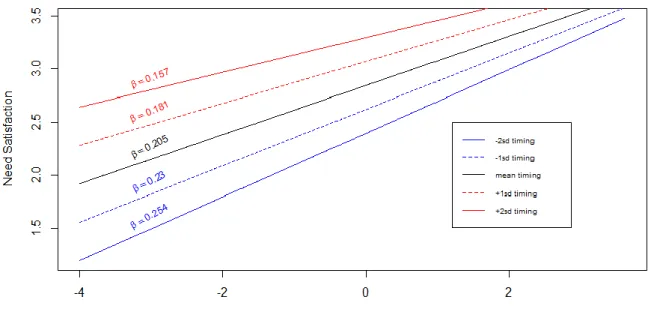
Timing of help was examined as a potential moderator in our mediation model depicted in Figure 1. The results for our c’- and a-path remained significant after adding the main effect of timing and the interaction effect of timing and received social support. Results further showed a main effect of timing on ICP need satisfaction (B=.23, SE=.06, p<.001; B=.21, SE=.04, p<.001) and ICP need frustration (B=-.29, SE=.06, p<.001; B=-.21, SE=.04, p<.001), respectively. For each outcome variable, there was a significant interaction effect between received social support and timing (B=-.03, SE=.01, p<.01; B=.05, SE=.01, p<.001), which is graphically depicted in Figures 2 and 3. To examine these interaction effects we calculated timing of the received social support scores one and two standard deviation(s)
17 above and below the mean. As can be noticed in Figure 2, the association between received social support and ICP need satisfaction was stronger for low scores on timing of received social support, that is, when the help was - relatively speaking - more badly timed. In contrast, when the provided help was well-timed, the slope is less steep suggesting that timing plays a less critical role when ICPs receive higher levels of social support. A similar pattern was found for need frustration (see Figure 3), with the association between received social support and ICP need frustration being stronger for low, compared to high, scores on timing of
received social support. Said differently, although received social support does relate
negatively to need frustration among ICPs, its critical role is even more pronounced when the help is badly timed.
- Insert Table 3 about here – - Insert Figure 2 about here –
Discussion
The present study was the first to examine whether individuals with chronic pain (ICPs) reported different levels of received daily support from their partner depending on whether their partner volitionally offered help or instead felt more pressured to do so on a given day. Furthermore, received partner support was examined as an explanatory process in the association between partners’ volitional helping motivation and ICPs’ well-being, as indexed by experiences of psychological need satisfaction and frustration. A final aim of this study was to investigate the role of the timing of received social support in understanding the broader context in which received support contributes to positive ICP outcomes.
Results showed that ICPs reported different levels of daily support from their partner depending on whether their partners provided help for autonomous or controlled reasons. This finding was consistent with our expectations, and is in line with other studies showing that greater autonomy in helping relates with higher levels of support provision [26, 34, 54, 55].
18 Our study is, to our knowledge, the first to show that volitionally providing support is related with the level of received support by the ICP. Presumably, on days when caregivers report more volitional motives to provide help, they are more psychological available for their ICPs, thereby disposing of greater levels of energy and readiness to provide help.
Furthermore, results showed that daily received social support could partially explain the well-being benefits of partners’ daily volitional helping motives, which is in line with previous studies that reported positive effects of social support [30, 31]. In a context of chronic pain, spousal support has been associated with a host of pain-related outcome
variables, including patient’s coping with and adjustment to pain as well as their experienced psychological distress [56–59]. The present study advances the field by demonstrating that on days when ICPs perceive high levels of partner support, positive changes are present in their daily well-being, as indexed by higher satisfaction and lower frustration of their basic
psychological needs. Presumably on days when partners are more autonomously motivated to provide help, their social support is of a different quality. That is, when autonomously
motivated, partners might better take the frame of reference of the ICP, thereby patiently attuning their support according to the ICP’s needs. Due to such attunement, ICPs may be allowed a greater sense of initiative in resolving issues themselves, such that also a stronger and more authentic bond may develop between the partner and the ICP, while ICPs may at the same time feel more effective in their daily functioning.
Notably, received social support could not fully explain the motivation – well-being association, as autonomous helping motivation continued to yield a direct association.
Possibly, a multi-item measure of support, thereby differentiating between the three subtypes (i.e., instrumental, emotional and informational) and including three mediators instead of a single one, may help to explain the remaining direct contribution of volitional helping
19 received social support play a distinct role herein. Future studies could measure these
different support functions more extensively1.
Because some previous studies have shown that the correlates of (pain-related) social support are not invariantly positive [28, 36], the final aim of our study was to explore whether the role of received social support on ICP outcomes differed depending on its timing. Our results indeed showed that the effect of received social support differed depending on whether help was rather well-timed or badly timed. If the offered support is badly timed, received social support becomes more important, that is, its contribution in the prediction of need-based experiences is more pronounced. Yet, an alternative interpretation is that timing is particularly important in circumstances where ICPs receive little support, presumably because it then compensates for the fewer benefits derived from receiving little help. With regard to need frustration, opposite effects were found: when ICPs reported receiving little support, they reported less need frustration in case the timing was perceived to be adequate, suggesting that good timing buffers against the costs associated with low support. The differences in daily need frustration between ICPs who receive much help and those who receive little help become almost negligible if the timing of help is good. Framed differently, when ICPs experience a lot of support, timing does not really matter because need satisfaction is already quite high (or need frustration quite low) in that situation. This finding is also in line with other models in the social support literature, for example the optimal matching model of social support [60] and the concept of perceived partner responsiveness [61], where support is considered most beneficial when it matches with the support needs of the receiver.
The findings of the current study might have clinical implications. Partners are often pressured to divide their time and energy across different sets of activities and goals [62].
1
Supplementary analyses showed similar results for emotional and informational support, whereas for instrumental support no mediation was present. Factor analyses showed that instrumental support displayed the lowest factor loading of the three subtypes. A more extensive measure of support (including different items for each subtype) is necessary to replicate these findings.
20 Providing support to your partner in pain is only one goal within a hierarchy of other goals a partner may have, for example investing time in work, education or family. This may cause partners to experience their helping task as a daunting duty, which may elicit more pressured motives (e.g. providing help to avoid guilt or criticism) [39] and consequently lower levels of ICP received support. In situations where partners feel pressured to provide help or when they have limited time, it is important that the support is present on those moments that ICPs have high support needs. This also means that giving high doses of support is not always necessary, support should be there at crucial moments. For this, it seems crucial that partners are aware of the stressors ICPs experience and the consequent support needs that may arise from it. Both partners may benefit from engaging in considerate levels of direct communication to ensure that the support provider is correctly appraising the needs of the stressed partner and, hence, is better capable of attuning the provided help according to these preferences. Also ICPs may benefit from learning to communicate their support needs towards their partner, which may be an important target point for clinical practice.
Limitations and future directions
This study has several limitations, which have implications for future research in this area. First, although we controlled for previous day levels of our outcome measures, we cannot address causality. A bidirectional relationship may be present between partners’ helping motivation and received social support. In the study of Weinstein & Ryan (2010), it was shown that experimentally induced volitional helping motivation resulted in higher levels of help; however, received help was not measured in that study. The same may be true for the association between received social support and need satisfaction/frustration; individuals low on need satisfaction in general may not interpret their partners’ helping behavior as support provision, although it was provided with good intentions. Future studies may address this by manipulating the amount of help provided in the lab and examine its effects upon ICPs’
21 subsequent need satisfaction and frustration. Furthermore, our data only include partner and ICP’s self-reports of daily behavior. To overcome this limitation, future studies may use observational methods, which would enable us to actually code partners’ helping behaviors. Another limitation is the high proportion of female ICPs in our sample. Although this proportion reflected the actual proportion of males and females with fibromyalgia in the general population [63], a more gender-balanced sample could allow us to test whether sex differences exist in this context, both in terms of mean-level differences as well as in terms of the tested model. It may for example be the case that female, compared with male, caregivers are more sensitive for the needs of others [64] and benefit more from emotional support, which suggests that the roads to need-based experiences are to a certain extent
gender-specific. Future studies could also benefit from using a more extensive measure for timing of support, to enable evaluation of scale reliability. Finally, all included couples were Caucasian, in a stable relationship, with high levels of average marital satisfaction, which limits
generalizability of the findings.
A particular strength of the study is, however, that multi-informant data were collected (i.e., data from both partner and patient). Importantly, the findings showed that the
associations between partners’ helping motivation and ICPs’ received support were present even though partners reported on their own helping motivation, whereas ICPs reported on their own perceptions of received partner support.
Conclusion
In sum, the present study provides new insights into the underlying mechanism through which partners’ helping motivation relates to the daily variation in ICP outcomes. Our findings showed that ICPs reported receiving more support from their partner when their partners reported helping because they truly wanted to or valued it, instead of feeling
22 of improved satisfaction and reduced frustration of their psychological needs for autonomy, competence and relatedness. Furthermore, when partners are not capable to provide great amounts of help, they would do well to provide the low dose of help on the right moment; indeed, well-timed help appeared to buffer against the costs associated with low social support.
References
[1] Balagué F, Mannion AF, Pellisé F, et al. Non-specific low back pain. Lancet 2012; 379: 482–91.
[2] Hoy D, Bain C, Williams G, et al. A systematic review of the global prevalence of low back pain. Arthritis and Rheumatism 2012; 64: 2028–2037.
[3] Beesdo K, Jacobi F, Hoyer J, et al. Pain associated with specific anxiety and depressive disorders in a nationally representative population sample. Social Psychiatry and Psychiatric Epidemiology 2010; 45: 89–104.
[4] Breivik H, Collett B, Ventafridda V, et al. Survey of chronic pain in Europe: Prevalence, impact on daily life, and treatment. European Journal of Pain 2006; 10: 287–333.
[5] Vitaliano PP, Zhang J, Scanlan JM. Is caregiving hazardous to one’s physical health? A meta-analysis. Psychological Bulletin 2003; 129: 946–972.
[6] Leonard MT, Cano A. Pain affects spouses too: personal experience with pain and catastrophizing as correlates of spouse distress. Pain 2006; 126: 139–46.
[7] Vlaeyen JWS, Linton SJ. Fear-avoidance and its consequences in chronic musculoskeletal pain: A state of the art. Pain 2000; 85: 317–332.
23 [8] Smeets RJEM, Vlaeyen JWS, Kester ADM, et al. Reduction of pain catastrophizing mediates the outcome of both physical and cognitive-behavioral treatment in chronic low back pain. Journal of Pain 2006; 7: 261–271.
[9] Keefe FJ, Rumble ME, Scipio CD, et al. Psychological aspects of persistent pain: current state of the science. J Pain 2004; 5: 195–211.
[10] Hadjistavropoulos T, Craig KD, Duck S, et al. A biopsychosocial formulation of pain communication. Psychological bulletin 2011; 137: 910–39.
[11] Kindt S, Vansteenkiste M, Loeys T, et al. When is helping your partner with chronic pain a burden? The relation between helping motivation and personal and relational functioning. Pain Medicine 2015; 16: 1732–1744.
[12] Kindt S, Vansteenkiste M, Loeys T, et al. Helping motivation and well-being of chronic pain couples. Pain 2016; 157: 1551–1562.
[13] Deci EL, Ryan RM. The ‘ What ’ and ‘ Why ’ of goal pursuits : Human needs and the self-determination of behavior. Psychological Inquiry 2000; 11: 227–268.
[14] Vansteenkiste M, Ryan RM. On psychological growth and vulnerability: Basic psychological need satisfaction and need frustration as a unifying principle. Journal of Psychotherapy Integration 2013; 23: 263–280.
[15] Goubert L, Trompetter H. Towards a science and practice of resilience in the face of pain. European Journal of Pain 2017; 21: 1301–1315.
[16] Stebbings J, Taylor IM, Spray CM, et al. Antecedents of perceived coach interpersonal behaviors: the coaching environment and coach psychological well- and ill-being. Journal of Sport & Exercise Psychology 2012; 34: 481–502.
24 [17] Bartholomew KJ, Ntoumanis N, Ryan RM, et al. Self-determination theory and diminished functioning: The role of interpersonal control and psychological need thwarting. Personality and Social Psychology Bulletin 2011; 37: 1459–1473.
[18] Uysal A, Ascigil E, Turunc G. Spousal autonomy support, need satisfaction, and well-being in individuals with chronic pain: A longitudinal study. Journal of Behavioral Medicine 2017; 40: 281–292.
[19] Vansteenkiste M, Lens W, Deci EL. Intrinsic versus extrinsic goal contents in self-determination theory: Another look at the quality of academic motivation. Educational Psychologist 2006; 41: 19–31.
[20] Millette V, Gagné M. Designing volunteers’ tasks to maximize motivation, satisfaction and performance: The impact of job characteristics on volunteer engagement. Motivation and Emotion 2008; 32: 11–22.
[21] Ryan RM, Connell JP, Grolnick W, et al. Perceived locus of causality and internalization : Examining reasons for acting in two domains. 1989; 57: 749–761. [22] Kim Y, Carver CS, Deci EL, et al. Adult attachment and psychological well-being in
cancer caregivers: the mediational role of spouses’ motives for caregiving. Health psychology : official journal of the Division of Health Psychology, American Psychological Association 2008; 27: S144-54.
[23] Knee CR, Patrick H, Vietor N a., et al. Self-Determination as growth motivation in romantic relationships. Personality and Social Psychology Bulletin 2002; 28: 609–619.
[24] Feeney BC, Collins NL. Motivations for caregiving in adult intimate relationships: influences on caregiving behavior and relationship functioning. Personality and social psychology bulletin 2003; 29: 950–968.
25 [25] Patrick H, Knee CR, Canevello A, et al. The role of need fulfillment in relationship functioning and well-being: a self-determination theory perspective. Journal of personality and social psychology 2007; 92: 434–57.
[26] Weinstein N, Ryan RM. When helping helps: Autonomous motivation for prosocial behavior and its influence on well-being for the helper and recipient. Journal of Personality and Social Psychology 2010; 98: 222–244.
[27] Goubert L, Vervoort T, Craig KD. Empathy and pain. In: Schmidt RF, Gebhart GF (eds) Encyclopedia of pain. Heidelberg: Springer-Verlag, 2013, pp. 1128–34.
[28] Bernardes SF, Forgeron P, Fournier K, et al. Beyond solicitousness: a comprehensive review on informal pain-related social support. PAIN 2017; 158: 2066–2076.
[29] Knoll N, Schwarzer R. Gender and age differences in social support: A study of East German migrants. In: Heart disease: Environment, stress, and gender. NATO Science Series, Series I: Life and Behavioural Sciences. Amsterdam: IOS Press, 2002, pp. 198– 210.
[30] Schwarzer R, Gutiérrez-Doña B. More spousal support for men than for women: A comparison of sources and types of support. Sex Roles 2005; 52: 523–532.
[31] Abraído-Lanza AF. Social support and psychological adjustment among Latinas with arthritis: a test of a theoretical model. Annals of behavioral medicine 2004; 27: 162–71.
[32] Beckner V, Howard I, Vella L, et al. Telephone-administered psychotherapy for depression in MS patients: moderating role of social support. Journal of behavioral medicine 2010; 33: 47–59.
26 and relationships between social support and life satisfaction in spouses of patients with stroke in the chronic phase. Patient Education and Counseling 2011; 85: e48–e52.
[34] Hadden BW, Rodriguez LM, Knee CR, et al. Relationship autonomy and support provision in romantic relationships. Motivation and Emotion 2015; 39: 359–373.
[35] Lepore SJ, Glaser DB, Roberts KJ. On the positive relation between received social support and negative affect: a test of the triage and self-esteem threat models in women with breast cancer. Psycho-Oncology 2008; 17: 1210–1215.
[36] Nurullah AS. Received and provided social support: A review of current evidence and future directions. American Journal of Health Studies 2012; 27: 173–188.
[37] Revenson TA, Schiaffino KM, Majerovitz SD, et al. Social support as a double-edged sword: The relation of positive and problematic support to depression among rheumatoid arthritis patients. Social Science and Medicine 1991; 33: 807–813.
[38] Rafaeli E, Gleason MEJ. Skilled support within intimate relationships. Journal of Family Theory & Review 2009; 1: 20–37.
[39] Kindt S, Vansteenkiste M, Cano A, et al. When is your partner willing to help you? The role of daily goal conflict and perceived gratitude. Motivation and Emotion. Epub ahead of print 12 October 2017. DOI: https://doi.org/10.1007/s11031-017-9635-5.
[40] Issner JB, Cano A, Leonard MT, et al. How do I empathize with you? Let me count the ways: Relations between facets of pain-related empathy. Journal of Pain 2012; 13: 167–175.
[41] Nezlek JB. Diary methods for social and personality psychology. SAGE. London: Sage Publications, 2012.
27 [42] Geldhof GJ, Preacher KJ, Zyphur MJ. Reliability estimation in a multilevel
confirmatory factor analysis framework. Psychological Methods 2014; 19: 72–91.
[43] Bodenmann G. Dyadisches Coping Inventar. Test Manual [Dyadic Coping Inventory. Test Manual]. Bern: Huber, 2008.
[44] Cohen S. Social relationships and health. The American psychologist 2004; 59: 676– 684.
[45] Chen B, Vansteenkiste M, Beyers W, et al. Basic psychological need satisfaction, need frustration, and need strength across four cultures. Motivation and Emotion 2015; 216– 236.
[46] Von Korff M, Ormel J, Keefe F, et al. Grading the severity of chronic pain. Pain 1992; 50: 133–149.
[47] Enders CK, Tofighi D. Centering predictor variables in cross-sectional multilevel models: A new look at an old issue. Psychological Methods 2007; 12: 121–138.
[48] Spanier G. Measuring dyadic adjustment: New scales for assessing the quality of marriage and similar dyads. Journal of Marriage and Family 1976; 38: 15–28.
[49] Bauer DJ, Preacher KJ, Gil KM. Conceptualizing and testing random indirect effects and moderated mediation in multilevel models: New procedures and recommendations. Psychological Methods 2006; 11: 142–163.
[50] Kenny DA, Korchmaros JD, Bolger N. Lower level mediation in multilevel models. Psychological methods 2003; 8: 115–128.
[51] Badr H, Laurenceau J-P, Schart L, et al. The daily impact of pain from metastatic breast cancer on spousal relationships: A dyadic electronic diary study. Pain 2010; 151:
28 644–654.
[52] Bolger N, Laurenceau J-P. Intensive longitudinal methods: An introduction to diary and experience sampling research. New York: Guildford Press, 2013.
[53] Baron RM, Kenny DA. The moderator-mediator variable distinction in social psychological research: Conceptual, strategic, and statistical considerations. Journal of Personality and Social Psychology 1986; 51: 1173–82.
[54] Gagné M. The Role of autonomy support and autonomy orientation in prosocial behavior engagement. Motivation and Emotion 2003; 27: 199–224.
[55] Bidee J, Vantilborgh T, Pepermans R, et al. Autonomous motivation stimulates volunteers’ work effort: A self-determination theory approach to volunteerism. VOLUNTAS: International Journal of Voluntary and Nonprofit Organizations 2013; 24: 32–47.
[56] Flor H, Breitenstein C, Birbaumer N, et al. A psychophysiological analysis of spouse solicitousness towards pain behaviors, spouse interaction, and pain perception. Behavior Therapy 1995; 26: 255–272.
[57] Romano JM, Jensen MP, Turner JA, et al. Chronic pain patient-partner interactions: Further support for a behavioral model of chronic pain. Behavior Therapy 2000; 31: 415–440.
[58] Turk DC, Kerns RD, Rosenberg R. Effects of marital interaction on chronic pain and disability: Examining the down side of social support. Rehabilitation Psychology 1992; 37: 259–274.
29 Comparison to controls and relationship to patient functioning. 1997; 4: 383–395.
[60] Cutrona CE. Stress and social support: in search of optimal matching. Journal of Social and Clinical Psychology Clin Psychol 1990; 9: 3–14.
[61] Reis HT, Clark MS, Holmes JG. Perceived partner responsiveness as an organizing construct in the study of intimacy and closeness. Handbook of closeness and intimacy 2004; 201–255.
[62] Riediger M, Freund AM. Interference and facilitation among personal goals: differential associations with subjective well-being and persistent goal pursuit. Personality & social psychology bulletin 2004; 30: 1511–23.
30
Figures
Figure 1. Theoretical model with received social support as mediator in the association
between partner’s helping motivation and need-satisfying and –frustrating experiences in individuals with chronic pain (ICP). Timing of help is added as moderator.
31
Figure 2. Interaction effect between received social support (RSS) and timing for daily need
satisfaction of individuals with chronic pain.
Figure 3. Interaction effect between received social support (RSS) and timing for daily need
32
Table 1. Means, Standard Deviations, ICC values, and Pearson Correlations among Study Variables
1 2 3 4 5 6 M SD ICC
1. Relative autonomous helping motivationP - .21* .29** .43** -.33** .06 2.27 1.48 70.41 2. Received social supportICP .15† - .74** .48** -.38** .22* 3.09 1.18 63.03
3. TimingICP .10*** .42† - .69** -.48** .01 4.09 1.21 58.38
4. Need satisfactionICP .10† .22† .26† - -.71** -.13 4.30 1.03 48.05
5. Need frustrationICP -.09*** -.12† -.17† -.37† - .14 1.01 .88 57.11
6. PainICP .01 .12† -.07** -.22† .21† - 3.50 .99 46.12
Note. ICP = only measured in ICPs, P = only measured in partners, M=mean, SD=standard deviation, ICC=intraclass correlation coefficient. Correlations above diagonal represent between-couple correlations. Correlations below diagonal represent within-couple, across-day correlations. The potential number of observations can reach up to 1876 (134 couples across 14 days). *p<.05
**p<.01 ***p<.001 †
33
Table 2. Multilevel Regression Analysis with Received Daily Social Support as a Mediator in the Relation between Partners’ Daily Helping Motivation and ICPs’ Daily Need-based Experiences
Effect Need Satisfaction Need Frustration
B SE 95% CI B SE 95% CI c .10*** .02 [.05; .15] -.08** .02 [-.12; -.03] a .12*** .02 [.08; .17] .12*** .02 [.08; .17] b .20*** .03 [.15; .25] -.13*** .03 [-.18; -.07] c' .07** .02 [.03; .12] -.06* .02 [.-.11; -.01] a*b .02*** .01 [.01; .04] -.02*** .00 [-.03; -.01]
Note. The c-path is the relation between helping motivation and ICP outcomes (while
controlling for the outcome the previous day). The a-path represents the association between helping motivation and received social support (while controlling for received social support the previous day); the b-path represents the association between received social support and ICP outcomes (while controlling for the outcome the previous day and helping motivation – the c’-path); and the c´-path refers to the association between helping motivation and the different ICP outcomes when the b-path is taken into account. In every model we controlled for ICP pain intensity on within-couple level and for relationship duration, relationship quality and ICP age on the between-couple level.
*p<.05 **p<.01 ***p<.001
34
Table 3. Multilevel regression analysis: Timing as a Moderator in the Association between Received Daily (top half) and Across-day (bottom half) Social Support and ICP Need-based Experiences
ICP outcomes
Daily predictor Need Satisfaction Need Frustration B SE 95% CI B SE 95% CI
Level 1 (within-couple)
Helping motivation .06* .02 [.01; .10] -.06* .02 [-.11; -.01] Outcome previous day -.02 .03 [-.07; .03] -.13*** .03 [-.18; -.08] Pain -.23*** .03 [-.28; -.17] .20*** .03 [.14; .25] RSS .23*** .06 [.11; .35] -.29*** .06 [-.40; -.16] Timing .21*** .04 [.13; .28] -.21*** .04 [-.29; -.14] RSS*timing -.03** .01 [-.05; -.01] .05*** .01 [.03; .08] Level 2 (between-couple) M helping motivation .11** .04 [.03; .20] -.08Ɨ .05 [-.17; .01] M pain -.18* .07 [-.32; -.03] .14Ɨ .08 [-.01; .29] M RSS -.08 .19 [-.44; .29] .23 .20 [-.15; .62] M timing .51*** .13 [.26; .74] -.11 .13 [-.37; .15] M RSS*timing -.00 .04 [-.08; .08] -.02 .04 [-.10; .05] Relationship quality .01* .00 [.00; .02] -.02*** .00 [-.03; -.01] Relationship duration -.00 .01 [-.02; .01] -.00 .01 [-.02; .01] age -.01 .01 [-.02; .02] .00 .01 [-.01; .02] -2 Res Log Like 3179.1 3311.1
Note. M=mean; RSS=received social support
Ɨp<.10 *p<.05 **p<.01 ***p<.001