PRESSURE ULCERS ASSESSMENT THROUGH THE PRESSURE ULCER SCALE FOR HEALING APPLICATION (PUSH) AVALIAÇÃO DAS ÚLCERAS POR PRESSÃO POR MEIO DA APLICAÇÃO DA ESCALA PRESSURE ULCER SCALE FOR HEALING
(PUSH)
AVALUACIÓN DE LAS ÚLCERAS POR PRESIÓN POR MEDIO DE LA APLICACIÓN DE LA ESCALA PRESSURE ULCER SCALE FOR HEALING (PUSH)
Stefy Letícia Pessoa Silveira1, Grazielle Roberta Freitas da Silva2, Elaine Cristina Carvalho Moura3,
Elaine Maria Leite Rangel4, Jairo Edielson Rodrigues Barbosa de Sousa5
ABSTRACT
Objective: To assess pressure ulcers(PU) with focus on the PUSH scale application. Methods:It is a prospective longitudinal
study, performed between September and October 2010, in the three Intensive Care Units (ICUs) of a hospital in Teresina city, with sample of 19 patients and 134 PUSH applications, non-probabilist by convenience. Results: it was featured by the predominance of PU in females(52,6%), aged ≥ 80years old(36,8%) and mixed color (52,6%); the main caregivers were their grown-up children (73,7%). All patients had bladder probe, bowel incontinence and bed restriction with an average of 1,18 years(±5,18). Such limitations in 73,68% were caused by the underlying disease, being that 84,2% of them were unaware. PUs prevalence was of 61,29%, from which 63,33% were in the sacral region, stage II, being that 29,6% of them were treated with AGE oil. The EFA was the predominant coverage(29.6%).There was a decline or maintenance of the scale scores.
Conclusions:The PUSH scale is useful in the wound scarring, by allowing monitoring global results and being presented as
valid to integrate protocols, in order to implement the nursing care. Descriptors: Nursing, Pressure ulcers, Measurment tools.
RESUMO
Objetivo: Avaliar úlceras por pressão (UPP) com enfoque na aplicação da escala PUSH. Método: Estudo longitudinal
prospectivo, realizado entre setembro-outubro de 2010, em três Unidades de Terapia Intensiva (UTIs) de um Hospital de Teresina, Piauí, com amostra de 19 pacientes e 134 aplicações da PUSH, não probabilística por conveniência. Resultados: caracterizou-se pelo predomínio de UPP no sexo feminino (52,6%), ≥ 80 anos (36,8%) e cor parda (52,6%); prevaleceram como cuidadores diretos os filhos (73,7%). Todos os pacientes apresentaram sonda vesical, incontinência intestinal e restrição ao leito com média de 1,18 anos (±5,18). Limitações em 73,68% dos casos causadas pela doença de base, sendo que 84,2% estavam inconscientes. A prevalência de UPPs foi 61,29%, das quais 63,33% localizadas na região sacral, grau II, sendo que 29,6% eram tratadas com óleo AGE. A EFA foi a cobertura predominante (29,6%). Houve queda ou manutenção dos escores da escala. Conclusão: A PUSH é útil na avaliação da cicatrização de feridas, permitindo monitorar resultados globais e apresentando-se válida para integrar protocolos, a fim de implementar a assistência de enfermagem. Descritores: Enfermagem, Úlceras por pressão, Instrumentos de medida.
RESUMEN
Objetivo: Avaluar úlceras por presión(UPP) con enfoque en aplicación PUSH. Método: Se realizó, entre septiembre-octubre
de 2010, estudio longitudinal prospectivo en tres Unidades de Terapia Intensiva de un Hospital, Teresina, Piauí, con muestra de 19 pacientes y 134 aplicaciones PUSH, non probabilística por conveniencia. Resultados: Predominando UPP en sexo femenino (52,6%), ≥ 80 años(36,8%) y color parda (52,6%). Prevaleció cuidadores directos-hijos(73,7%). Todos los pacientes presentaron sonda vesical, incontinencia intestinal, restricción al lecho con media de 1,18 años (± 5,18), limitaciones en 73,68% causadas por la enfermedad de base y 84,2% inconscientes. La prevalencia de UPP fue 61,29% cuyo 63,33% están localizadas en la región sacral, grado II, 29,6% tratadas con óleo AGE. Hube queda o manutención de los escores.
Conclusiones: La PUSH siendo útil en la avaluación cicatrizal de heridas, permitiendo estimar resultados globales y
presentándose válida para integrar protocolos que implementan la asistencia de enfermería. Descriptores: Enfermería, Úlceras por presión, Instrumentos de medición.
1,5 Nurses from the Federal University of Piauí. E-mails: [email protected], [email protected]. 2 Nurse. PHD in Nursing.
Adjunct Professor II from the Health Sciences Center/UFPI. E-mail: [email protected]. 3 Nurse. Master in Education.
Professor at the Undergraduate Nursing Course/UFPI-Teresina. Doctorate’s Student in Nursing from the DINTER Program /USP. E-mail: [email protected]. 4 Nurse. PHD in Fundamental Nursing from the Nursing School/EERP/USP. Adjunct Professor I at the
Nursing Department from the Health Sciences Center/UFPI. E-mail: [email protected]. RESEARCH
The development of pressure ulcers (PU) is a great problem faced in the hospital environment. Despite it has been a relevant theme of nursing studies, particularly, regarding the prevention and treatment, some studies show that the global incidence and prevalence remain high1,2, with predominance in patients admitted to Intensive Care Units (ICUs). 3
In light of this, several scales and tools were developed with the initial objective of identifying patients likely to develop PU, such as the Braden Scale. However, the emergence of ulcers might be unavoidable, especially in ICU patients, so that the staging and healing need to effectively be monitored, which is a proposal of the Pressure Ulcer Scale for Healing (PUSH). This scale was developed and validated by the Task Force from the National Pressure Ulcer Advisory Panel (NPAUP)4 and translated to be used in Brazil by Santos et al.5
There are much clinical signs for the use of validated scales, both for prevention and for treatment and follow-up of the ulcers evolution. Such signs1-6 were classified as the strongest on the subject, i.e., their results are recommended for intervention.6 The use of these scales makes the assessments more efficient, and they are useful in the validation of nursing actions.
Thus, this study had like objectives: to assess pressure ulcers through the PUSH scale in the Intensive Care Units of a private hospital in Teresina, Piauí; to trace the sociodemographic and clinical profile of these patients and to estimate the prevalence of ulcers in intensive care units.
This is a prospective longitudinal research conducted in three ICUs of a large private hospital in Teresina, Piauí, in the period from September to October 2010. Such hospital has 4 ICUs, namely:
The ICU-A, serves patients coming from the emergency department; ICU-B, of cardiac patients; ICU-C and ICU-D, which are intended for receiving patients, mainly coming from nursing stations or of the surgical center from the hospital in question. The project was duly examined and approved by the Ethics Research Committee from the Federal University of Piauí (CAAE nº 0184.0.045.000-10). The study population consisted of all patients admitted to ICUs, being that the sample consisted of 19 patients selected according to the following inclusion criteria: age greater than 18 years; any gender; admission time equal to or greater than 72 hours, average period considered by the researchers so that the patient is stabilized on the care unit and adapt itself the routine, and the nursing care actually occurs and agreement to voluntarily participate in the study, by signing the Free and Informed Consent Form. We have reached 19, with 134 assessments for 60 days.
For data collection, we used a tool to assess the sociodemographic and clinical profile of patients and the PUSH scale, Brazilian version. This scale considers three assessment parameters, namely: wound area, exudate amount and wound bed appearance. The sub-scores for these parameters, when summed, generate a score which can range from 0 to 17. Higher scores indicate worsening in the PU and lower scores indicate improvement. 5 There is no minimum or maximum indication for the application the scale; thus, we decided to apply it twice a week, in order make it possible to identify differences concerning the previous application of the PUSH scale. It is noteworthy that the patients were daily assessed from September to October, until their discharge or death, in the morning shift.
We have followed all the steps to the ulcers assessment in line with the PUSH scale. 5 The staging was based on the international classification proposed by the NPUAP. 4 And the two-dimensional (length x width), for superficial ulcers (stages I and II), and three-dimensional measurements (length x width x depth), for deep ulcers (stages III and IV), were conducted as established in the literature.5, 7,8
It is noteworthy that for the measurement of the ulcer area, we made use of measures already instituted by the hospital at stake, namely: put up sterile surgical paper over the wound, and then the assessor reproduces the same design that was produced by the contact of the exudate with the surgical degree on A4 paper, since the institution have not yet provided disposable tapes, as suggested by international standards. Next, we used the same rule, standardized and graduated in centimeters every time the lesions were measured. As recommended by the NPUAP, when applying PUSH scale, it was held to a single ulcer, for a maximum total of four lesions per patient.
For the prevalence, we have considered the formula below:
PU Prevalence =
number of patients with PU at the ICU X 100 total number of patients with PU
With the collected data, we performed the codification and development of a data dictionary, by making use of the validation process of the collected information, through double typing in Microsoft Excel application spreadsheets. Once corrected the typing mistakes, the data were exported and analyzed in the SPSS (Statistical Package for
Social Science), for calculation of absolute frequencies and percentages.
Table 1 – sociodemographic and clinical profile of patients with PU (n=19). Teresina-PI, 2010
Variable Nº % Age 20-35 01 5,30 36-50 02 10,50 51-65 05 26,30 66-80 04 21,10 81 or over 07 36,80 Gender Male 09 47,40 Female 10 52,60 Skin color White 04 21,10 Black 02 10,50 Mixed 10 52,60 Yellow 03 15,80 Cause of death Neoplasms 08 42,10
Nervous system disorders 04 21,10 Congestive heart failure 04 21,10
Others 03 15,70
Cause of bed restriction
The disease itself 14 73,68
Stroke 02 10,53 Surgical 02 10,53 Fall 01 5,26 Restriction time 0-15 days 01 5,30 16-30 days 10 52,60
Between 1 and 12 months 03 15,80
> 1 year 05 26,30
Changed level of awareness
Yes 16 84,20
No 03 15,80
Total 19 100
*MW= Minimum Wage (R$ 510,00).
There was predominance of patients aged 80 years or more, totaling 7 (36,8%). The majority – 10 - (52,6%) were female and mixed skin. The average age was 69,16 years. Also according to the Table, the clinical profile reveals that 42,1% of patients had a diagnosis of neoplasy, 21,1% equally had nervous system disorders and congestive heart failure and 15,7% had other diseases. In 100% of them we found the use of permanent bladder probes; anal incontinence and bed restriction (73,68%) had as cause of restriction the underlying disease and the cause of admission. The average time of bed restriction was 1,18 years (± 5,18), being that 52,6% of the patients were restricted to the bed between 16
and 30 days. As to the level of awareness, 84,2 were unaware.
The total prevalence of PUs in the ICUs was of 61,29%, totaling 38 ulcers. It was not identified during the data collection, when considering the ICUs in an isolate way: ICU - A = 6,45%; ICU - B = 0%; ICU - C = 19,35%; ICU - D = 35,48%.
Of the 38 identified PUs, because of four deaths (8 PUs), at the beginning of the collection, 30 PUs could be systematically assessed (19 patients), with 134 systematic assessments of the applications arising the PUSH scale.
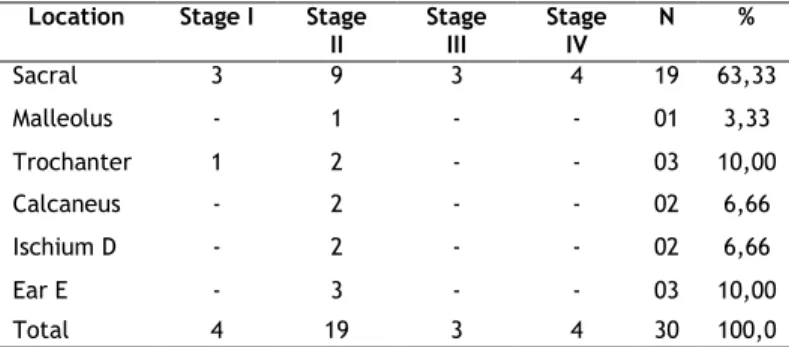
The characterization of the 30 assessed ulcers is shown in Table 2.
Table 2 – PUs Location and stages (n=30). Teresina-PI, 2010.
Location Stage I Stage
II Stage III Stage IV N %
Sacral 3 9 3 4 19 63,33 Malleolus - 1 - - 01 3,33 Trochanter 1 2 - - 03 10,00 Calcaneus - 2 - - 02 6,66 Ischium D - 2 - - 02 6,66 Ear E - 3 - - 03 10,00 Total 4 19 3 4 30 100,0
The sacral region was the most affected, being present in 63,33% (19) of the surveyed sample. In this region, all stages were found, and there was a prevalence of the stage II in 9 ulcers. In the trochanteric region we found one ulcer in stage I and two in stage II.
In the other regions only ulcers in stage II were found, one in the malleolar region (which evolved to the stage IV), two in the calcaneus and ischium and three in the ear.
The average total scores of the applications of the PUSH are presented in Graph 1. 134 reviews were conducted towards the 30 PUs, in which each individual had as average 4,4 (± 6.06) successive assessments. Because of the average and the standard deviation, the healing process from first to 11th assessment was
presented in the graph. Only 3 (4,55%) has evolved to the scarring phase during data collection (60 days).
Graph 1 - Ratio of the total average score until the 11th PUSH assessment. Teresina, PI, 2010.
When using the PUSH tool, we obtained the following scores of their Average Total Score (ATS): in the 1st assessment, ATS = 12,45 (± 2,52); 2nd assessment, ATS = 12,21 (±3,50); 3rd assessment, ATS = 11,85 (± 2,81); 4th assessment, ATS = 11,54 (± 4,05); 5th assessment, ATS = 10,11 (± 5,71); 6th assessment , ATS = 13,60 (± 1,52); 7th assessment, ATS = 13,60 (± 1,14); 8th assessment, ATS = 13,80 (± 1,10); 9th assessment ATS = 13,00 (± 1,58), 10th assessment, ATS = 13,00; 11th assessment, ATS = 13,00 (± 1,58).
Table 3 – Distribution according to the PUSH scale domains of the assessed 30 PUs in 60 days (n=134 assessments). Teresina-PI, 2010.
PUSH Domains N Average(SD)
Wound area(cm2) 0 cm2 < 0,3 cm2 0,3 – 0,6 cm2 0,7 – 1,0 cm2 1,1 – 2,0 cm2 2,1 – 3,0 cm2 3,1 – 4,0 cm2 4,1 – 8,0 cm2 8,1 – 12,0 cm2 12,1 – 24,0 cm2 >24 cm2 - - 03 - - 03 06 17 08 38 59 12,3(± 2,1) Exudate amount None Low Moderate High 21 73 30 10
Wound bed appearance
Scarred tissue Epithelialization tissue Granulation tissue Devitalized tissue(slough) Necrotic tissue 03 16 45 44 26 SD=Standard Deviation
Table below shows the PUSH scale parameters found in the 60 days of assessment. We won an average area of PU of 12,3 cm2, with standard deviation of 2,1, being that most of them were greater than 24 cm2. On average, the exudate amount found was overwhelmingly sparse. And the mostly found wound bed appearance was the granulation tissue, in 45 assessments, followed by devitalized tissue, in 44 assessments.
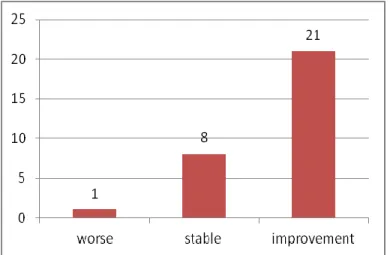
To demonstrate the scarring process, we have classified the Pus in stable, when the total PUSH score was not changed from the first to the last assessment; worsening, when this score increased from the first to the last assessment, and improvement, when the PUSH score diminished when comparing these two assessments. Thus, the classification of the PUs is distributed in the graph below.
Graph 2 - Distribution of the PUs according to the conditions of the healing process by the PUSH of the 30 PUs. Teresina, PI, 2010.
From the graph, one ulcer had worsening, eight remained stable and 21 had improvement. It is estimated that for the year 2025 there will be, in Brazil, approximately 30 million people with 60 years or over. Likewise, the proportion of people aged 80 and over also has quickly been increased. Most of the elderly population is female, which characterizes the feminization process of the old age. There was a predominance of the age group of 80 years or over, totaling
36,8%, and females (52,6%) in this study conducted in Teresina city.
Still on the characterization of the sample, the majority of patients – 10 - (52,6%) were of mixed ethnicity. The black skin is more resistant to the external aggression caused by moisture and friction. 10 So that only 2 (10,5%) of the black subjects showed PU.
All patients – 19 - (100%) made use of permanent bladder probe, had anal incontinence and were restricted to the hospital bed. Given that, it is important to note that the moisture produced by sweat, urine, feces or drainage procedures, when unchecked causes maceration of the skin, by making it more vulnerable to rupture and infection.11 Every incontinence is unfavorable for the scarring of the PU, mainly the sacral ones, which are considered the most incidents by clinical evidence, along with the ones which affect the heels.12
It was found that 10 (52.6%) patients were restricted to the hospital bed between 16 and 30 days, such a situation is considered one of the most relevant factors for the development of PU, since as well as the patient with decreased level of awareness, the motionless patient is not able to relieve the pressure of the bone prominences, thereby keeping the factors of intensity and duration of pressure.13 It is important to note that, in all surveyed ICUs, it was found ulcers, with the exception of the ICU-B, which is intended for receiving cardiac patients. In this unit, a systematized medical protocol is being experienced, known as Fast Hug. The aforementioned protocol drives the medical staff to the critical patient’s conducts, namely: nutrition, analgesia, sedation, thromboembolism prophylaxis, headboard elevation, PU prevention and glycemic control.14
The ICU-B nurses were concerned, especially with the guidance of headboard elevation (Fast Hug Protocol) concomitant to the
institutional standards for decubitus change every two hours. But, at the end of the 60 days of assessment, it should be realized that the headboard elevation did not preclude the decubitus change.
The prevalence of PU found in ICUs was of 61,29%. , when considering the ICUs in an isolate way: ICU - A = 6,45%; ICU - B = 0%; ICU - C = 19,35%; ICU - D = 35,48%. The ICU-A mainly serves patients coming from emergency rooms, ICUs C and D serve patients mainly coming from the health stations or of or of the surgical center from the hospital in question, which were highlighted as to the prevalence. Prevalence and incidence rates of PU are relevant indicators for assessing the quality of hospital services, since it involves patient and external factors; therefore, it includes the institutional conditions for the development of this disease.
Thus, we suggest specific measures to professionals working in these units in order to achieve the excellence of the nursing care, such as the use of scales, which is pointed out as essential for the care credibility.15 The sacral region was the most affected, 19 cases (63,33%), all stages were found there, being that they were equally distributed between the stages I and III, 3 (15,79%). Studies indicate that the most affected areas are, in fact, the sacral, trochanteric, ischiatic, heels and elbows.1,16
Regarding the scarring, it should be stated that, during the 60 days of data collection, just three PU cases won complete scarring. The scarring takes place in three steps17, the first, inflammatory, occurs from the moment of injury until approximately three days; in the following, granulation, between 2 and 20 days; and the final stage, which begins around 21 days after injury and might be extended for years. Nonetheless, this process is multifactorial, which is influenced by intrinsic and extrinsic factors of the patient, as well as the care management, individual aspects
of professionals and also institutional, and techniques and technologies used to the accomplishment of the curative.
The scarring time of a chronic wound might be calculated by formulas of Robnik-Sikonja et al.18 and Manios et al.19, since it has a scarring rhythm value, perimeter values and the wound area. In this model, the wound perimeter and area should be obtained from the scanned image of the wound through the use of certain software known as Mouseyes. 20 Nevertheless, in Brazil, studies of this nature are still very incipient.
Inserting some weighting coefficients according to the determining characteristics of the patient (age, area and depth in degrees and the time elapsed since the appearance of the wound), by considering the main predictors of the scarring rhythm18,19, and depending on the impacts of options for cleaning the wound, choice of stuff and additional procedures to the dressing execution, the time (number of weeks) expected for the treatment of chronic wound can range from 50% to 200% in relation to the total estimated time to the scarring.20
When analyzing of the graph that monitored the scarring process from the first assessment the eleventh one. (while we consider the average of 4,4 assessments with a standard deviation of 6,06), there was a tendency for stabilization of the PUSH average score.
There was a decline in the line of the graph 1, between the 4th and 5th assessments, moment in which, we had many discharges, deaths and healings, which is justified by the two highest values of standard deviation (± 5,71 and ± 4,05).
One of the factors that possibly contributed to an increase in scores after the 5th assessment, in our viewpoint, was the use of coverings for the chemical debridement (papain 10 and 12%) as routine in such units. Papain promotes change in the tissue type (necrosis to slough) thus decreasing the score, however,
increase the exudate amount (from absent to low, moderate or large amount) by increasing the PUSH score. But, the scarring was evident in the records, which is evidenced by the beginning of the decline of the average scores from the 8th assessment and its stabilization.
From this perspective, the most utility of the PUSH is the the wound scarring assessment in a long time period, by allowing monitoring results of the use of coverings and dressings in a wounds treatment program.11,13
The found PUs had an area considered large, with an average of 12,3 cm2 and the majority classified in the extent greater than 24 cm2 by the PUSH scale. Nonetheless, this fact cannot be analyzed only in the prism of the high complexity of care in ICUs and, perhaps, of the weakness of this clientele itself, in which the majority were elderly with neoplasy, which requires, usually, associated homecare shares.
Approximately 95% of these skin injuries are preventable, mainly by the decubitus change 1-4, even in those patients who have already developed PU, this approach minimizes the hypoxia of the surrounding tissues. No one knows for sure if that prescription efficiently works at home. It is believed that the Nursing needs to intensify its actions in health education, with a view to including the caregiver as a participant in the homecare shares. 12
On the PUSH scale5, the devitalized tissue (slough) is yellow or white color which adheres to the wound bed and is presented as strings, or thick crusts, and might be mucinous. The granulation tissue has the pink or bright red color, with a shiny aspect, wet and grainy. Referring to the exudate, we have mostly found granulation tissue followed by devitalized tissue. These findings can be explained by the extent and complexity itself of the ulcer and also from the clinical prognosis of the assessed patients.
Only one ulcer had worsening, while the majority had improvement or remained stable. Such facts seem to reflect in a good clinical practice in surveyed the units, concerning the PUs treatment. However, one cannot say if the scarring time could have been reduced, whether specialized coverings were used. The wound treatment is a complex process that requires systematic assessments and specific care, which involve from the patient's condition until the institution and professionals involved.
Many nurses reported difficulties in daily care of wounds, which are arising from the lack of experience and specific training, which confirms the possible lack of knowledge about this issue at stake.1,8,12 One cannot infer about the relationship of scarring time, the use of specific coverings in these PUs, as well as the other factors involved in the scarring. Such a reality drives us to more specific studies in view of understanding this phenomenon.
Of the 19 patients, it was found that the sociodemographic and clinical profile were similar to the ones of previous studies on this issue. It should be highlighted that the cardiac ICU did not show PU, where prevention standards are established. The headboard elevation to 30 degrees did not interfere with patients' decubitus change every two hours. The sacral region was the most affected in 19 cases (63,33%), with a average of 12.3 cm2, which is considered extensive and complex.
We have obtained 30 PUs, which were monitored for 60 days and a total of 134 PUSH applications. Each individual had an average of 4,4 (±6,06) assessments. Most had improvement or remained stable, as noted by the maintenance of the PUSH scores, which indicates ongoing scarring.
The study had limitations, such as: the limited number of patients with non-probabilistic sample; the impossibility of monitoring all PUs until the final outcome, which would be ideal, because it is a scale of scarring; the impossibility of monitoring all baths on the beds to assess the dorsal ulcers, such care shares are delegated to the whole staff and often occur in a concomitant way.
It was possible to testify the effectiveness of the PUSH scale, thus being useful in the wound scarring assessment, by allowing monitoring global results and presented itself as valid for integrating protocols, in order to implement the nursing care. Accordingly, it is suggested to apply the scale in experimental and comparative studies with the use of coverings available in the Brazilian market.
1. Medeiros ABF, Lopes CHAF, Jorge MSB. Análise da prevenção e tratamento das úlceras por pressão propostos por enfermeiros. Rev. Esc. Enferm. USP. 2009 Mar; 43(1): 223- 228. 2. Keelaghan E, Margolis D, Zhan M, Baumgarten
M. Prevalence of pressure ulcers on hospital admission among nursing home residents transferred to the hospital. NHI Public Access National Instituts of health. Wound Repair Regen. 2008 May-Jun;16(3):331-6.
3. Diccini S, Camaduro C, Iida LIS. Incidência de UP em paciente neurocirúrgico de hospital universitário. Acta Paul. enferm. 2009 Març-Abril; 22(2): 205- 209.
4. National Pressure Ulcer Advisory Panel. Conceito e classificação de úlcera por pressão: atualização da NPUAP. Revista Estima. 2007; 5 (3): 43-44.
5. Santos VLCG, Azevedo MAJ, Silva TS, Carvalho VMJ, Carvalho VF. Adaptação Transcultural do Pressure Ulcer Scale for Healing (PUSH), para a língua portuguesa. Rev. latinoam. enferm . 2005 Maio-Jun; 13(3): 13-305.
6. Linee Guida prevenzione e trattamento delle lesioni da pressione. Centro Studi EBHC dell’Azienda Ospedaliera di Bologna S.Orsola Universitaria S.Orsola-Malpighi, Febbraio 2010, 121p. [Acesso em: 14 de maio de 2012].
Disponível em:
http://www.evidencebasednursing.it/progetti /LDD/LG%20LDP%202010/LG_LDP_2010_sito.pd f.
7. Bergstrom N, Allman RM, Alvarez OM, Bennet MA, Carlson CE, Frantz RA, et al. Treatment of pressure ulcer. Clinical practice guideline. n.15. 1994; Rockville: Public Health Service, Agency for Healt Care Policy and Reserch, 1004 (AHCPR publication, n.95-0653)
8. Bryant RA, Bar BW, Beshara M, Broussard CI, Cooper DM, Dougthy DB, Frantz RA, et al. Acute and chronic wounds: nursing management. 2nd ed. Missouri: Mosby 2000. 9. Ministério da Saúde (BR). Secretaria de Atenção
Básica. Caderno de Envelhecimento e Saúde da Pessoa Idosa. Brasília (DF): MS; 2006.
10. Blanes L, Duarte IS, Calil JA. Avaliação clínica e epidemiológica das úlceras por pressão em clientes internados no Hospital São Paulo. Rev assoc Med Bras. 2004 Jan-Abril; 50(2): 182-7. 11. Smeltzer SC, Bare BG, Hilkle JL. Brunneer &
Suddarth: Tratado de Enfermagem Médico- Cirúrgica. v. 1, 11. ed. Rio de Janeiro (RJ): Guanabara Koogan, 2009.
12. Chayamiti EMPC, Caliri MHL. Úlcera por pressão em pacientes sob assistência domiciliária. Acta paul. enferm. 2010 Jan; 23(1): 29-34.
13. Jorge AS, Dantas SRPE. Abordagem Multiprofissional do Tratamento de Feridas. São Paulo (SP): Atheneu; 2005.
14. Vincent J. Give your patient a fast hug (at least) once a day. Critical Care Medicine. 2005 Jul; 33( 6):1225-1229.
15. Bork AMT. Enfermagem Baseada em Evidências. Rio de Janeiro (RJ): Guanabara Koogan, 2005.
16. Lima ACB, Guerra DM. Avaliação do custo do tratamento de úlceras por pressão em pacientes hospitalizados usando curativos industrializados. Ciênc. saúde coletiva. 2011 Jan; 16(1): 267-277.
17. Nettina S. M. Prática de Enfermagem. 8ª ed. Rio de Janeiro (RJ): Guanabara Koogan. 2007; cap. 9, p. 179-182.
18. Robnik-Sikonj M, Cukjati D, Kononenko I. Comprehensible evaluation of prognostic factors and prediction of wound healing. Artificial Intelligence in Medicine. 2003 May; 29(1): 25-38.
19. Manios A, Tosca A, Volakakis E. Computer assisted evaluation of wound healing in chronic ulcers. Computers in Biology and Medicine. 2003 Jul; 33(4): 311-317.
20. Taylor RJ. Mouseyes revisited: upgrading a computer program that aids wound measurement. Journal of Wound Care. 2002 Jun; 11(6): 213-216.
Received on: 11/06/2012 Revisions requerid: No Approved on: 18/01/2013 Published in: 01/04/2013