UNIVERSIDADE DA BEIRA INTERIOR
Engenharia
Tânia Sofia Bettencourt Amaral
Dissertação para Obtenção do Grau de Mestre em
Engenharia Aeronáutica
(Ciclo de Estudos Integrado
)
Orientador: Prof. Doutor Jorge Miguel dos Reis Silva
Co-Orientador: Prof. Doutor Pedro Vieira Gamboa
Covilhã, Outubro de 2015
Conceptual Design of the Gondola of a Hybrid Airship
Including Loading and Unloading Mechanisms
AVISO
A presente dissertação foi realizada no âmbito de um projeto de investigação
desenvolvido em colaboração entre o Instituto Superior Técnico e a
Universidade da Beira Interior e designado genericamente por URBLOG -
Dirigível para Logística Urbana. Este projeto produziu novos conceitos
aplicáveis a dirigíveis, os quais foram submetidos a processo de proteção de
invenção através de um pedido de registo de patente. A equipa de inventores é
constituída pelos seguintes elementos:
Rosário Macário, Instituto Superior Técnico;
Vasco Reis, Instituto Superior Técnico;
Jorge Silva, Universidade da Beira Interior;
Pedro Gamboa, Universidade da Beira Interior;
João Neves, Universidade da Beira Interior.
As partes da presente dissertação relevantes para efeitos do processo de
proteção de invenção estão devidamente assinaladas através de chamadas de
pé de página. As demais partes são da autoria do candidato, as quais foram
discutidas e trabalhadas com os orientadores e o grupo de investigadores e
inventores supracitados. Assim, o candidato não poderá posteriormente
reclamar individualmente a autoria de qualquer das partes.
Covilhã e UBI, 1 de Outubro de 2015
_______________________________
Dedicatory
To my mother for being the strongest woman I have ever known. Without her I could not have completed this course.
Acknowledgements
After six long, tiring and incredible years, this journey has come to an end.
To begin with, I would like to thank my family, my brother, my sister and my mother, for giving me all the support I needed these past 5 years and all the sacrifices they had to make, so I could get where I am now. I could not have done this without them.
To all my colleagues for these amazingly fun days they have given to me and for all the help on those troubled days.
To my closest friends for making this journey a little bit more unique with their special way of being.
I would also like to thank to my master’s thesis advisor, Professor Jorge Miguel dos Reis Silva, to Professor Pedro Vieira Gamboa and João Neves for their availability, competence and dedication, which made my work a lot easier.
Finally, my special thanks to all other persons I did not mention above that in some way helped me in the fulfillment of this journey.
Abstract
Transport has been a necessity to us since the early times, driving the chase for a better way of moving people, animals and goods from one location to another. The first airship flight happened in 1852, introducing airships to the world and making possible the controlled powered flight. After a series of high-profile accidents involving airships, airplanes were recognized as a safer transportation vehicle and gradually airships were directed for other applications such as advertising, sightseeing, surveillance and research. Nowadays, airships are becoming popular again, promoting their projection to fill a gap in the transport industry, in which they have advantages over other forms of transportation.
As the cargo transport demand rises, new transportation options are being considered. Airships are receiving much more attention, as nations are now reconsidering their transportation systems. It can be forecasted, that with time, higher confidence in airship operations and wider scope of their applications, airships could take over of some of the airborne cargo market, due to their obvious competitive advantages.
This work’s main goal is to develop an airship’s gondola adjustable to the user’s needs. Either transporting passengers or carrying cargo, airships make possible missions that in some other way would take a longer time to complete and would require much more resources to plan. The project also includes the conceptual design of a cargo container and corresponding loading and unloading mechanisms.
Keywords
Resumo
O transporte tem sido, desde o início dos tempos, uma necessidade para o Homem, alimentando a procura por melhores formas de mover pessoas, animais e bens de um local para outro. Em 1852, ocorreu o primeiro voo de um dirigível, apresentando-os ao mundo e possibilitando o voo motorizado e controlado. Após uma série de acidentes de destaque, envolvendo dirigíveis, os aviões foram reconhecidos como um veículo de transporte mais seguro e gradualmente os dirigíveis foram direcionados para outras aplicações, tais como publicidade, turismo, vigilância e investigação. Hoje em dia os dirigíveis estão a tornar-se novamente populares, promovendo a sua projeção para preencher uma lacuna no sector de transportes, no qual têm vantagens em relação a outros meios de transporte.
Com o aumento da procura pelo transporte de carga, novas opções de transporte estão sendo consideradas e os dirigíveis têm vindo a receber mais atenção, agora que vários países estão reavaliando os seus sistemas de transporte. Prevê-se que, com o tempo, maior confiança na operação de dirigíveis e um âmbito mais amplo para a sua aplicação, os dirigíveis poderão assumir o controlo de uma parte do mercado de transporte de carga aérea, devido às suas óbvias vantagens competitivas.
O objetivo principal deste trabalho é desenvolver a gôndola de um dirigível, ajustável às necessidades do operador. Do transporte de passageiros ao transporte de carga, os dirigíveis tornarão possíveis missões que de outra forma levariam muito mais tempo a ser cumpridas e exigiriam muitos mais recursos a serem planeadas. Este projeto inclui também o design conceptual de um contentor de carga e respetivos mecanismos carga e descarga.
Palavras-chave
Table of Contents
Dedicatory... v
Acknowledgements ... vii
Abstract... ix
Resumo ... xi
Table of Contents ... xiii
List of Figures ... xv
List of Tables ... xvii
List of Graphs ... xix
List of Acronyms ... xxi
Chapter I- Introduction ... 1
1.1. Motivation ... 1
1.2. Object and Objectives ... 2
1.3. Dissertation Structure ... 2
Chapter II- State of Art ... 3
2.1. Introduction ... 3
2.2. Transport ... 3
2.3. Airships ... 7
2.4. Loading and Unloading systems ... 11
2.4.1. Worldwide Aeros Corporation (US) ... 11
2.4.2. Augur Aeronautical Centre (RUS) ... 12
2.4.3. Hybrid Air Vehicles (UK) ... 13
2.4.4. Lockheed Martin (US) ... 13
2.4.5. Aero Vehicles Inc. (ARG) ... 14
2.4.6. Airship do Brasil Indústria Aeronáutica (BR) ... 14
2.4.7. Varialift Airships (UK) ... 15
2.5. Certification and Legislation ... 16
2.5.1. International ... 16
2.5.2. National ... 17
2.6. Conclusion ... 17
Chapter III- Loading and Unloading System’s Conception and Development ... 19
3.1. Introduction ... 19
3.2. Loading and Unloading Mechanisms ... 20
3.2.1. Design ... 20
3.2.1.1. Modules coupling mechanism ... 22
3.2.1.3. Lifting table ... 26
3.2.2. Cargo Systems’ Drawings and Structures ... 27
3.3. Container ... 30
3.3.1. Sizing and Materials ... 30
3.3.2. Drawing and Structure ... 44
3.4. Conclusion ... 48
Chapter IV- Conclusion ... 49
4.1. Dissertation Synthesis ... 49
4.2. Concluding Remarks ... 50
4.3. Prospects for Future Work ... 50
References ... 51
List of Figures
Figure 1. ULDs ... 4
Figure 2. ULD loader composed by two platforms which can be raised and lowered independently 4 Figure 3. Boeing World Air Cargo Forecast 2014-2015 ... 5
Figure 4. Airship efficiency vs conventional transport systems ... 8
Figure 5. Hybrid airship three sources of lift ... 10
Figure 6. Aeroscraft ... 12
Figure 7. The Atlant: a) transport of oversized cargo; b) unloading at a large cargo bay ... 12
Figure 8. Airlander 50 ... 13
Figure 9. LM P-791 and SkyTug ... 14
Figure 10. Aerocat R40 and R12 ... 14
Figure 11. Airship do Brasil... 15
Figure 12. ARH 50 ... 15
Figure 13. Aircraft project steps ... 19
Figure 14. Gondola’s second concept ... 21
Figure 15. Illustrative scheme of the gondola’s modular multiplicity feature ... 22
Figure 16. Coupling mechanism concept ... 23
Figure 17. Initial track beam shape and fastening. ... 23
Figure 18. Wide Flange I-beam. ... 24
Figure 19. Wide Flange I-beam to variable module fastening. ... 24
Figure 20. C Beam. ... 25
Figure 21. Examples of vinyl roll-up doors ... 26
Figure 22. Lifting table drawing dimensions. ... 27
Figure 23. Lift table concept. ... 28
Figure 24. Airship cargo doors concept views. ... 29
Figure 25. Airship cargo door dimensions. ... 29
Figure 26. Roll container ... 30
Figure 27. Euro-palette dimensions ... 31
Figure 28. Container adopted dimensions ... 31
Figure 29. Container’s base ... 31
Figure 30. Container base structure. ... 32
Figure 31. Effect of shear stresses in the base structure, without the plate contribution. .... 32
Figure 32. Frame beams loading. ... 32
Figure 33. Beam’s diagram ... 33
Figure 34. a) Beam free-body diagram; b) and c) Determination of V and M. ... 34
Figure 35. a) Shear force Diagram; b) Bending moment diagram ... 35
Figure 36. Beam’s cross section ... 37
Figure 38. Frame beam final dimensions. ... 38
Figure 39. Reinforcing beams loading. ... 39
Figure 40. Beam diagram. ... 39
Figure 41. Beam loading. ... 40
Figure 42. Beam’s free body. ... 41
Figure 43. a) Shear force Diagram; b) Bending moment diagram. ... 41
Figure 44. Beam’s cross section. ... 42
Figure 45. Reinforcing beam final dimensions. ... 43
Figure 46. Container dimensions. ... 44
Figure 47. Container concept. ... 44
Figure 48. Container concept views. ... 45
Figure 49. Lifting table – Container relative positions. ... 46
Figure 50. Cargo operations. ... 46
Figure 51. Restraining system drawing. ... 47
List of Tables
Table 1. Key operational characteristics of airships for the transport of goods ... 9 Table 2. Iterative process. ... 38 Table 3. Iterative process. ... 43
List of Graphs
List of Acronyms
ADB − Airship do Brasil ADC − Airship Design Criteria
ANAC − Autoridade Nacional da Aviação Civil (Portugal) ARG − Argentina
CG − Center of Gravity
COSH − Control-of-Static-Heaviness
CSCD − Ceiling Suspension Cargo Deployment DARPA − Defense Advanced Research Projects Agency
DOD − Office of the US Assistant Secretary of Defense for Research and Engineering EASA − European Aviation Safety Agency
FAA − Federal Aviation Administration (USA) ft − Feet (≈ 0,3048 metros)
HAV − Hybrid Air Vehicles HTA − Heavier-Than-Air
ICAO − International Civil Aviation Organization IM − Invariable Module
LEMV − Long Endurance Multi-Intelligence Vehicle LM − Lockheed Martin
LTA − Lighter-Than-Air
NASA − National Aeronautics and Space Administration nm − Nautical Miles (185200 𝑘𝑚)
RTK − Revenue Tonne-Kilometers RUS − Russia
TAR − Transport Airship Requirements ULD − Unit Load Device
VM − Variable Module
Chapter I - Introduction
1.1. Motivation
At present many of our transport systems can no longer serve our needs optimally, as they are facing problems such as traffic congestion, pollution constraints and increasing costs. With the world population continuous growth unprecedented challenges will be set to the transport system. Continued efforts should be made to improve its efficiency. Options could include developing alternative modes of transport that would mitigate several negative externalities associated with existing systems [1].
The ability to adapt airship technology for cargo transport is now becoming internationally recognized [2]. Over the past few years many projects have been proposed suggesting that technological developments in a number of fields, including materials science, engines, weather forecasting, avionics and computer assisted design [3], would enable the development for more reliable and functional airships capable of supplement or even replacing current transportation systems [4].
Even if only the achievements of the earlier period were replicated, cargo airships would be an interesting technology [2]. Twenty years before de Hindenburg disaster, a German airship transported more than 15.500 tons of cargo 3,600 miles from Bulgaria to Africa in 95 hours, landing with 64 hours of fuel remaining [5]. These records were established without the sophisticated communication equipment or navigation facilities available nowadays [2].
Comparing airships to existing transport systems, they are closer to ground vehicles from the standpoint of operational costs, but unlike them, they are not restricted by terrain obstacles and lack the need of roads and rails. In comparison with conventional fixed wing aircraft, airships are much slower but can carry the same payload for a fraction of the cost and can be designed to operate without any special infrastructure in the delivery site, as opposed to the fixed wing aircraft [6].
The market of cargo airships is emerging [2]. Not only might airships be competitive in missions currently performed by heavier-than-air (HTA) vehicles, but they can be useful in a number of unique tasks currently not performed by HTA vehicles [4].
This dissertation is the result of a project in which the University of Beira Interior and Instituto Superior Técnico joined efforts with the aim of developing a hybrid airship intended for cargo transport. One of the work tasks was to develop a gondola with an efficient load and unload mechanism with the goal of improving the airship’s performance in on-load and off-load tasks.
1.2. Object and Objectives
The object of this work is the development of a gondola suitable for different business concepts, either passenger transport, cargo transport or both. The main objective is to design a gondola equipped with a loading and unloading mechanism, which will improve the performance of an airship by avoiding operations with cargo requiring too much working time to load and unload and an unnecessary number of workers.
1.3. Dissertation Structure
This dissertation is divided into five main chapters.Chapter one covers the work introduction, presenting the motivation, the main object and objectives and the dissertation structure adopted.
In the second chapter an overview of the main topics related to the subject approached in the dissertation is made.
The third chapter describes the development of the gondola’s concept, from de project itself to the cargo container and respective materials and structure.
The fourth chapter contains a set of detailed drawings, which allows the reader a better visualization of the project final designs.
Finally, chapter five presents the thesis conclusions. In this chapter a synthesis will be made, as well as the concluding remarks and prospects for future work will be appointed.
Chapter II - State of Art
2.1. Introduction
The aim of this chapter is to introduce the reader to the main topics related to the subject the dissertation approaches. A short overview of relevant topics such as general aspects of passenger and cargo transportation, airships’ important features, types of current loading and unloading systems and a review of airships’ existing legislation is given.
2.2. Transport
Transportation has always been fundamental to economic and social activities. Composed of infrastructures, modes and terminals, transport systems are so embedded in the socio-economic life of individuals, institutions and corporations that they are often invisible to the consumer [7].
The means by which passengers and/or goods are transported is known as transport mode. Based on the medium they exploit they may be grouped into three broad categories; air, land (road, rail and pipelines) and water. Each mode with its own requirements and features is adapted to serve the specific demands of freight and passenger traffic [7].
In recent years, intermodality has been linking modes even more closely to production and distribution activities, moving towards integration. However, at the same time, passenger and freight activity is becoming increasingly separated across most modes [7].
The mode’s characteristics are described below, allowing a better understanding of the different features of the main transport vehicles used in both cases.
Air transport
Leaning on long distance mobility, air transportation is the dominant mode for transcontinental and intercontinental traveling. However, it is becoming increasingly competitive for shorter trips [8].
Air freight is mostly ideal for time sensitive, valuable or perishable freight carried over long distances [8]. Cargo compartments located in the belly-hold of passenger airplanes accommodate freight bundled into special containers or pallets called Unit Load Devices (ULD). ULD’s primary purpose is to decrease the number of units to be loaded, saving ground crews
time and effort (Figure 1). Each ULD has its own manifest so its contents can be tracked at all times [9].
Figure 1. ULDs [10][11].
Cargo loading compartments designed to accept ULDs differ between aircraft types and sometimes even within aircraft series, always depending on the manufacturer’s or the operator’s requirements. The differences can be in size, contour, size of access doors, compartment equipment floor bearing strength, restraint possibilities and positions [12]. These compartments are equipped with an airplane cargo handling system designed to restrain ULDs in the airplane. Cargo handling systems are also designed as a conveyance for ULDs, allowing them to move easily in and out of the airplane. The cargo handling system comprises various assemblies such as restraint locks, side rails, and ball and roller conveyors. In addition, some cargo handling systems like an ULD loader (Figure 2) are powered [13].
Figure 2. ULD loader composed by two platforms which can be raised and lowered independently [14].
For passenger airline companies, air freight transport provides supplementary income [7]. Some airlines like FedEx Express and UPS Airlines are dedicated exclusively to freight transport. In 2013, each one flew over ten thousand million freight ton-kilometers, being at the top of freight tons world ranking [15].
Today, air transport has become one of the safest and fastest modes of transport. Still, it is also one of the most expensive when compared with other modes. Airplanes require the majority of the times, massive infrastructures, such as an area for landing and takeoff and terminals for loading and unloading cargo and passengers, maintenance, restocking and refueling.
Despite the inexorable increase of operating cost of jet aircraft and acknowledgement of environmental problems from their operation, air cargo demand has been growing rapidly for the past three decades. According to Boeing [16], over the next 20 years the number of airplanes in the worldwide freighter fleet will increase by more than half, from the current 1,690 airplanes to 2,730 airplanes, due to the increase of world air cargo traffic by more than double (Figure 3).
Figure 3. Boeing World Air Cargo Forecast 2014-2015[16].
Road transport
Road transportation is the mode that has expanded the most for both passengers and freight over the last 50 years. Freight and passengers’ demand for more speed, endurance and flexibility pushed the growth of loading capacity and adaptation of the vehicle, resulting in an extensive spatial cover [17].
Its key feature is flexibility of route choice, which makes possible door to door service. Such service cannot be provided by any other mode of transport, making cars and trucks the mode of choice for a large number of trip purposes, leading to their market dominance for short to medium distance trips [7].
Road transportation is extremely important for both passenger and freight traffic, with an average of 90% of goods in value and more than 80% in inland freight volume carried [18], partly driven by international freight requirement for intermodal transport. Intermodal transport is
often performed by semi-trailer trucks. Smaller cargos over short distances are more frequently transported in vans.
Road freight has also downsides. Its success has given rise to a number of serious problems. Road congestion and pollution are the most alarming ones [7].
Freight traffic growth promotes the increase of road congestion and in many cities concerns are being raised about the presence of trucks. Already, restrictions are in place on truck dimensions and weights in certain parts of cities, and there are growing pressures to limiting truck access to non-daylight hours. Certain highways exclude truck traffic. These are examples of what is likely to become a growing trend; the need to separate truck from passenger vehicle traffic.
If no alternative infrastructure is introduced, such as an underground road network, road freight traffic will continue to grow significantly (40% by 2050, compared to 2014) [19].
Rail transport
Rail transport refers to the movement of passengers and cargo on guideways. It is more frequently adopted for domestic or inter-continental travel and for bulky and/or heavy goods transport.
Its strong demand is motivated mainly due to its ability to haul large quantities of cargo and people. Also, they do not add to congestion, as do happens in some other transport modes, and can offer high speeds, reaching up to 515 km/h, with the lowest energy consumption per unit load per km when compared to road transport [7].
The large initial investment for construction and the maintenance costs not only limits the number of operators and investors but also serves as barriers to delay innovation. Other downsides are inflexibility and its reduced operational utility as it is inappropriate for fragile and high value items. Additionally, the variations of the width of the rails, signaling and electrification standards in many parts of the world are factors that limit the movement of trains between different countries [7].
Maritime transport
Historically, maritime transportation has been one of the most selected modes for cargo transport. For passenger, it has a lower significance, being mainly used for short trips and pleasure cruises.
The advantage that stands out the most from all the other major advantages is the relatively low operating costs. Shipping is the most effective way to move a large amount of cheap value
freight at once over long distances, with longer deadlines. Therefore, compared with other modes, it can offer the lowest rates [7].
Shipping is also the slowest mode with speeds at sea averaging 26 km/h. Additionally, maritime transport is characterized by inflexible routes and timetables and many times by the requirement of inland transportation for door-to-door delivery. Ships are subject to high port duties or taxes. This is a result of port infrastructures being among the most expensive to build, maintain and improve and of the existence of physical barriers which represent a particular problem, and so attempts to facilitate maritime circulation are made by reducing discontinuity through the construction of channels, locks and dredging [20].
Within maritime transportation, ships can have many classifications. Container ship, tanker and dry bulk are only few of the many types of ships employed around the world. Over the years, the amount of ships and their capacity has been steadily increasing [20].
According to new estimates, maritime transport will remain one of the main modes for international freight transport in 2050. It is expected to exceed 250 trillion ton-km by 2050, as a result of the global and regional increases in population levels and economic activity [20].
2.3. Airships
An airship is defined as a “lighter-than-air” (LTA) aircraft which uses buoyancy forces as its main source of lift. These buoyant forces are produced by lifting gases contained within the airship’s envelope, such as helium and briefly hydrogen, which have a density lower than the surrounding atmosphere. Being lighter-than-air, they do not require any power to stay aloft [21]. Therefore fuel consumption is required only for forward motion [3].
All airships include a propulsive system, a directional control system and a car or gondola suspended below the airship’s main structure containing other subsystems, crew, passengers and payload [4].
Airships can differ in size, internal structure concept and its operational concept. There are three distinct types of LTA vehicles internal structure configurations; rigid, semi-rigid and non-rigid. A non-rigid airship, commonly known as “blimp”, is an inflated powered balloon, in which the cigar-shaped form and structural integrity is maintained by a small over-pressure of the lifting gas. This configuration allows significant structure weight reduction, but at the same time, does not allow high loads. Non-rigid airships are the most commonly used form of airships today because of their ease of construction and storability [6].
Rigid airships have a full internal framework that is not only intended for supporting the loads but for keeping the external shape as well. This increases vastly the structure weight, on the
expense of the potential useful load. Semi-rigid airships are basically a trade-off option between non-rigid and rigid. They have no internal frame to support their envelopes. They do have rigid objects on them that give them some backbone; achieving higher load tenability, with reasonable penalty of the additional weight [6].
In recent years many advances have been made in the field of materials allowing to build lighter, stronger and tougher semi-rigid airships, thus making them a preferred option for cargo transport projects [6].
The development of new cargo airships has now a favorite environment promoted by the rising of cargo market demand, new applicable technologies, increased importance of environmental issues and military LTA successful applications [6].
New airships can be useful in a vast assortment of tasks such as the bypass of normal interfaces between sea and land transportation, replacement of ground transportation systems in and around dense population areas or where road and rail transportation is minimal or even when natural disasters lead to the interruption of transportation corridors, airships can rescue people and transport supplies and equipment into that area [4].
Their efficiency places airships in its own niche of the market (Figure 4), somewhere between quicker but expensive and highly polluting transport modes like airplanes and helicopters and slower, less expensive but also very polluting as ships and trucks [22].
Figure 4. Airship efficiency vs conventional transport systems [21].
Airships could potentially compete well with one or more of the following characteristic:
longer lengths of haul across land/water boundaries and/or across territories with poor road or rail infrastructures;
freight premiums realized for faster delivery windows;
oversized, overweight and awkward freight or relative low density, fragile or perishable products [23].
Table (1) below highlights some operational and performance characteristics of airships against conventional modes of transportation.
Table 1. Key operational characteristics of airships for the transport of goods [22].
Operational Characteristics Airship vs Maritime Airship vs Highway Airship vs Railway Airship vs Aerial
Speed Much Faster Faster Much Faster Much Slower
Load Capacity Less Capacity Much More Capacity Less Capacity Increased Capacity
Load Adaptability Much More Flexible Less Flexible Much More Flexible More Flexible Transportation Costs Much More Expensive More Expensive Much More Expensive Much More Economic
Although cargo airships provide an efficient and effective modal option for the transportation distribution system when compared with other transport modes, there are some disadvantages and limitations with their operation [24].
The size of airship poses limitations and potential disadvantages for its utility, limiting landing and parking location options. For example, a 2 ton lift capable airship has approximate dimensions of 55 m long and 22 m wide.
Due to airship’s large size they are more susceptible to winds and precipitations [6]. Severe weather will limit the operating window for airships and affect ground handling. Still weather extremes affect all transport modes. Airship´s vulnerability to weather extremes will likely be no greater, and probably less, than for conventional air transport [3].
Although infrastructure is not required for the use of airships at points of need, for maintenance, manufacturing and long term storage huge hangars are needed. Currently, there are only eleven hangars in the world capable of holding large airships [24].
Higher mountain ranges are the only physical barrier of topography to cargo airships. While an empty airship may be able to cross a mountain range, a loaded airship might not. Airships can cross land/water boundaries without the necessity of transferring cargoes to another mode and can operate, land, and takeoff in confined spaces with minimal infrastructures. Consequently, they can serve remote road-less land masses or island archipelagoes equally well as the more developed, populated and congested, urban areas [23].
There are a few more operational problems associated with conventional airships which make them not eligible for efficient cargo transport [4]. New technologies and designs have a good chance to overcome most of the deficiencies. Modern technologies offer much improved control in various conditions and weather prediction has improved drastically [6].
A hybrid airship design introduces much more autonomous ground operation flexibility than a conventional one, along with better stability in-flight, decreased drag, as well as increased payload capability and reduced infrastructure needs [6].
Hybrid airships are aircraft that combine lighter-than-air and heavier-than-air technology of conventional aerostats and traditional fixed-wing and rotary-wing aircraft as a multi-source of lift [21]. During all airship operation, buoyant lift is generated by helium lift gas; for takeoff, landing and zero airspeed operation, vectored thrust lift is achieved by tilting vertically the engines or by dedicated rotors designed to create thrust to overcome some of the weight; in cruise flight, either the lifting body hull, wings attached to the hull or a combination between both generates aerodynamic lift (Figure 5) [4][24].
Figure 5. Hybrid airship three sources of lift[25].
Buoyancy control refers to the ability of altering vertical location. It is necessary for ascent, descent and cargo exchange. In order to maintain a constant altitude, buoyancy must be increased to compensate for any cargo loaded onto an airship or reduced to compensate for any cargo removed from an airship. The hybrid concept avoids the need for buoyancy control because the vehicle is heavier-than-air when empty [2].
Small hybrid lighter-than-air vehicles’ performance has been found to be in general superior to both conventional airships and to other transportation systems in many applications from the standpoints of energy conservation, reduced pollution and improved economy [4].
We are all aware of the hazards of current transport systems. Supposedly unsinkable ships occasionally sinking, high concentrations of land vehicles confined to narrow corridors reflected in accident statistics and the need of special attention to quality control and maintenance to make normal aircraft relatively safe. Towards current transport scenario, semi-buoyant lifting body hybrid vehicles with 20 to 40% buoyant may be inherently the safest mode of transportation ever devised by man [4].
Each mode of transport has unique logistical strengths and weaknesses and service advantages that dictate their uses. The more varied the potential uses for airships, the lower the demand-side risks [23].
The biggest obstacle to the commercialization of transport airships is the lack of business confidence [26]. Considerable uncertainties involved in the operation of the airships still exist, making it inadvisable to gamble the large sums of money required for the development of very large vehicles. However, if practical applications are found for much smaller LTA vehicles, then the lesser funds required for their development could be justified; the problems associated with airships will become more clearly understood and the experience obtained in their use would provide valuable information for deciding whether later development of large vehicles would be justified [4].
2.4. Loading and Unloading systems
This recent interest in airships has made lots of new ideas come forward in the airship industry [26]. A worldwide competition has emerged to develop a viable cargo airship [2]. No transport hybrid airship has been built for production but several manned and unmanned experimental vehicles have been flown demonstrating the potential of this technology [21].
As most airship projects are still in concept or fight tests phase, not many information about their loading and unloading systems has been released.
Some of the leading companies and their respective airship cargo transport projects are briefly described below.
2.4.1. Worldwide Aeros Corporation (US)
Founded in California in 1987, Worldwide Aeros is a LTA manufacturing company [2]. Their non-rigid airships are used globally for both military and commercial applications [27], including transport, surveillance, broadcasting and advertising [28].
Their research and development on heavy lift airship concepts dates back to 1989. In 2005, Aeros obtained contracts from DARPA and other US defense projects to develop a cargo airship [27]. Among the companies with projects for a cargo airship, Aeros is probably the firm that is furthest along [29].
The Aeroscraft (Figure 6) is a rigid airship with a variable buoyancy system [2] developed with the purpose of providing new ways of moving heavy and oversized cargo from point-of-origin to point-of-need [27].
Their solution would be capable of lifting 66 or 250 tons of cargo, depending of the model, with a range of 3,100 nm and an altitude ceiling of 12000 ft [27].
Figure 6. Aeroscraft[27].
The Aeroscraft provides a precise cargo loading and unloading system without the need for infrastructures or ground crew. Thanks to their patent-pending COSH buoyancy management system, cargo deployment system and patented ceiling suspension cargo deployment (CSCD) system, precise terrestrial or marine cargo deployment through automation of weight-balance requires only the pitot [27].
The Dragon Dream is a one-half scale demonstrator of the Aeroscraft [2], which had its first float on January 3, 2013. On July 4, it rolled out of the hanger for the first time and on September 11 the first flight of the Dragon Dream occurred [27].
2.4.2. Augur Aeronautical Centre (RUS)
Founded in 1991, the Augur Aeronautical Centre is a leading Russian company in the field of designing, producing and flying LTA vehicles. RosAeroSystems is a subsidiary of the Augur Aeronautical Centre which builds aerostats and small blimps. They have announced a new airship program, the Atlant [2].
The Atlant (Figure 7) would be capable of transporting between 12 to 16 tons and fly up to 1500 km. Its unique feature is the side opening cargo doors that form ramps to facilitate loading [2].
2.4.3. Hybrid Air Vehicles (UK)
Based at Bedford, England, HAV is the successor company of a series of corporations founded originally in 1971 and has specialized in inflatable structures (blimps), being this the direction they use in their design for a cargo airship [2].
In June 2010, the US Army commissioned HAV and Northrup Grumman to build a full-size hybrid air vehicle for surveillance purposes. The program was called the Long Endurance Multi-Intelligence Vehicle (LEMV) and had a successful test flight in August 2012. In 2013 the US Army cancelled the program [2].
From its LEMV experience, HAV has developed the Airlander 50 design (Figure 8) which would carry 50 tons and be able to perform vertical take-off, landing and hovering [2].
Figure 8. Airlander 50[31].
One significant advantage of airships is their immense size which allows them to feature a huge cargo bay, with loading ramps at each end. The payload area of the Airlander 50 is sized to take six 20-foot containers in two rows of 3 each, sitting abreast, whilst still having space for 50 passengers [2]. Hybrid Air Vehicles is also considering a modular approach to the payload module. This may include options such as under-slung loads [31]. They can build a prototype of the Airlander 50 in 2016 and fly it by the end of 2018 [32].
2.4.4. Lockheed Martin (US)
Lockheed Martin (LM) has two divisions that research airships. LM researches hybrid airships at their Skunk Works research center at Palmdale, California [2]. In 2006, they flew the P-791 hybrid airship demonstrator intended for testing and gaining experience for transition to a truly operational cargo airship, the SkyTug [6].
The SkyTug (Figure 9) is intended for the low tier of cargo airship market with 20 tons of payload [6].
Figure 9. LM P-791 and SkyTug[33][34].
2.4.5. Aero Vehicles Inc. (ARG)
Aerovehicles operates out of San Luis, Argentina. They are proposing to build the Aerocat R40 (Figure 10) that is a semi-rigid, hybrid design that will carry 40 tons. The Aerocat differs from the SkyTug and Airlander with the use of a composite nose cone and internal structure. It is envisioned with a landing system based on modified hovercraft cushions [2].
Figure 10. Aerocat R40 and R12[35].
2.4.6. Airship do Brasil Indústria Aeronáutica (BR)
The Airship do Brasil Indústria Aeronáutica Lda operates at São Paulo, Brazil. It is a national company specialized in the development, manufacture, market and operation of aircraft using LTA technology [36].
In 2013, ADB started the development of the ADB-3-30 airship project (Figure 11) and other different airships [37]. Details of the airship are sketchy [2]. ADB-3-30 has a proposed capacity of 30 tons and a cruise speed between 80 to 85 km/h [37].
Figure 11. Airship do Brasil[2].
2.4.7. Varialift Airships (UK)
Varialift Airships is a UK based airship company that has designed an all-aluminum, rigid airship, the ARH 50 (Figure 12) [2].
Figure 12. ARH 50[38][32].
This airship is totally rigid and able to carry heavy loads of 50 tons. Varialift is unique in that when on the ground it can be heavier than air and can be loaded by drive on cargo carrying trucks or vehicles through its roll-on/roll-off cargo bay deck. It also has the outsize bulky cargo crane capability [38].
The type of cargo could be trucks, large prefabricated structures, wind turbines, low density loads such as perishable agricultural produces, livestock, oil and gas piping, rigs and mineral ore transport [38].
2.5. Certification and Legislation
Soon after the disaster of the Hindenburg (1937), airships were reduced to a small number at a global level. Consequently international and national certification and legislation for the operation of this particular aircraft is until today very scarce comparatively to other types of aircraft. Moreover the concept of hybrid airship is in anywhere referred by the regulatory entities and large freight airships have never been considered, since only one has ever come close to being produced, the CargoLifter airship (1995-2002) [39].
So few airships exist worldwide, that aviation regulations for building and operating airships are either not established, or regulations designed for airplanes, helicopters and hot air balloons are improvised as an extension, creating barriers to the emergence of the airship as a competitive and useful addition to the economy [39].
The need for updated airship certifications and legislations that can manage and facilitate the initiation and growth of airship into transport operations is urgent [39]. In the following pages a review of the existing regulations used for airship transport of passenger and cargo at an international level (United States and Europe) and in the particular case of Portugal is made.
2.5.1. International
Prior to April 13, 1987, the United States had no Federal airworthiness criteria for type certification of airships. Today there are still no airship certification regulations.
The FAA has only the “Airship Design Criteria” (ADC) which gives “guidance” but not “requirements” for airship design. Being neither mandatory, nor regulatory, the ADC merely contains a list of design criteria found acceptable to the FAA Administrator for the type certification of airships. However, it is not the only criteria that may be considered acceptable by the FAA [39].
Currently administered by the European Aviation Safety Agency (EASA) is the Transport Airship Requirements (TAR), issued in March 2000. It provides the most comprehensive set of airworthiness requirements in existence for large airships to accommodate the Type Certification of airships in Europe.
The elaboration of the TAR was driven by the development and deployment of the CargoLifter in Germany. However, the regulatory authorities were unable to complete it into a comprehensive regulatory document, due to the financial collapse of the CargoLifter program in 2002. Moreover, new airship concepts such as the “hybrid airship vehicles” have been developed that the TAR was never designed to address.
Despite its limitations the TAR remains the principal reference document for both the FAA and EASA for certification of large airships.
2.5.2. National
Due to almost complete absence of airship activity in Portugal, legislation on this type of aircraft is nearly inexistent. As most of Portugal aviation regulations, the existing writing that focuses about airship is based on EASA’s regulations.
2.6. Conclusion
Transportation is an indispensable component of the economic activity and people’s lives. So as the world population continues to grow and to develop, so does the demand for safer, cleaner and more efficient transport vehicles. Nowadays, our transport systems are facing problems such as congestion, pollution and high operational costs, creating a niche that is not optimally served with current transportation means.
Airships are now returning in a big way. In 2007, there were 23 active manufacturers who had built some sort of airships and new projects are constantly being presented, motivated by technological developments [40].
Design, manufacture, safety, airworthiness and certification criteria are stringently applied on all forms of aircraft by aviation regulatory authorities all over the world. Detailed regulations for fixed wing planes, helicopters and other aircraft are available with most regulatory agencies, and are very well known. However, regulations for building and operating airships are either non-prescribed, or are improvised as an extension of regulations designed for airplanes, helicopters and hot air balloons.
Owing to the obvious need to establish safety, operational and airworthiness standards related to airships, many regulatory agencies have started developing regulations for airships.
Chapter III - Loading and Unloading System’s
Conception and Development
3.1. Introduction
Usually design begins with a need. With current transport systems facing unprecedented challenges, new options must be deliberated. Although current designs seem to meet today’s needs, future demands claim for designs that can meet their needs even better.
Conceptual design is the first of the three design major phases, followed by preliminary and detailed design. It is in conceptual design that the basic questions for the problem are answered and several solutions are generated. Each time the latest design is analyzed, new ideas and problems emerge [41].
Although the aircraft design process may not follow the exact same steps as this thesis design project, its major steps were taken as reference (Figure 13).
Figure 13. Aircraft project steps (adapted from [42]).
In the later pages a description of the development of the gondola’s concept will be made. From de project itself to the cargo container and respective materials and structure, illustrative drawings are presented to better demonstrate the conceptual design evolution. Since passenger transport is only a small portion of this thesis, the main focus will be centered on cargo transport.
3.2. Loading and Unloading Mechanisms
This project’s main goal was to design an effective gondola for mid-size payload market and thus making an airship more desirable from the standpoint of cargo and passenger transport. According to the Office of the US Assistant Secretary of Defense for Research and Engineering (DOD), there are some factors to considerer in order to design an effective gondola in the current airlift system. For example, the time to conduct ground operations such as cargo loading and unloading should be less than or equal to the time it takes current cargo platforms to conduct the same activity. Also, airships must be compatible with current material handling equipment (forklifts, k-loaders, etc.) and with current ground handling equipment [24].
So during the gondola/cargo system development a few desired requirements were kept in mind. Fast load and unload operations, light weight system, reduced necessity of ground crew and operational flexibility were the most desired.
3.2.1. Design
1One of the first steps of conceptual design is to define the operational scenario. Specifying the conditions in which the design will operate is essential for the later calculations and material selection. Considering the design as a distinct system, apart from the airship, the operational parameters ranges would be high. However, as the design to be developed will operate as an airship subsystem, it is only natural to simply consider the conditions where an airship can operate.
Operation under extreme conditions is instantly set aside. An airship operation under really low or really high temperatures, gusty winds, moderate and heavy rain, wet snow and icing conditions may sometimes not be prohibitive but will still negatively impact the airship performance.
In aeronautics all materials are selected considering specific operational parameters. As some of these parameters are similar to the parameters of this thesis design, to reduce the initial materials to considerer, the main focus was centered only on materials applied on aircraft. Aluminum, steel, titanium, magnesium and composites are the most commonly used aircraft materials.
In order to better illustrate the development of this work the following hypotheses were adopted. The gondola’s conceptual design was made considering its implementation on a hybrid
1Parte da dissertação relevante para efeitos do processo de proteção de invenção referido no Aviso no
airship of unknown dimensions with a payload of 1000 kg. Using a safety factor of 1.5 and multiplying it by the 1000 kg mass, we obtain an operational load of 1500 kg.
The concept adopted by many companies for suspended cargo haul was initially considered. However, after weighting the pros and the cons it was decided not to use this concept, since an airship when in operation is susceptible to high and gusty winds which can lead to loss of control. The suspended cargo’s weight and volume is relatively small when compared with the airship itself, yet when analyzing the combination of the weight (force) with the distance from the airship to the cargo there is the possibility of control loss due to moment induced by the suspended cargo. Set aside this concept, new ideas were proposed and new concepts were deliberated, until more adequate solutions were found.
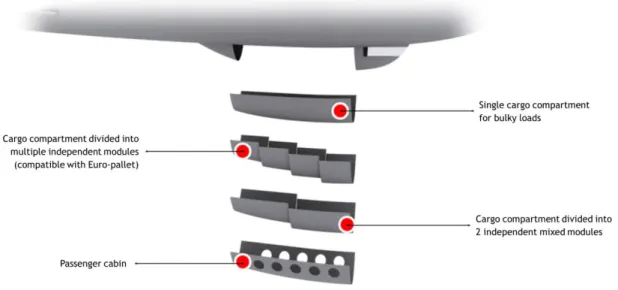
From a second solution considered, the concept illustrated in the Figure 14 below was obtained. Its main idea was to use modular containers of different sizes with the gondola’s shape, allowing various possible combinations, in order to better adapt to the transported cargo. This solution also allowed the exchange of the cargo modules for passenger modules.
Figure 14. Gondola’s second concept.
However, from the point of view of fast operations, this concept left much to be desired. Since its design raised some complexity issues regarding the load and unload mechanisms necessary for fast operations.
Nonetheless, the latter concept was not absolutely dismissed. The notion of modules stood out and was later improved. After some debate and many weighted ideas, a final concept was developed. The adopted concept is as follows.
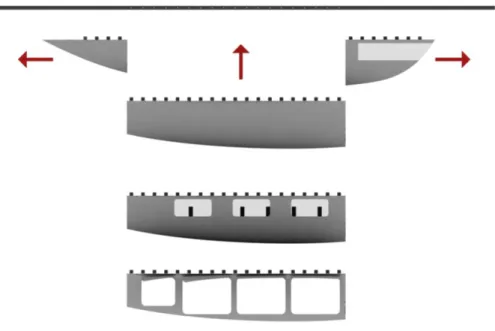
In order to optimize the solution for different business concepts, the airship’s gondola was divided into multiple modules (Figure 15). The invariable modules, front and back of the gondola are the pilot’s commands and support systems, respectively. A set of tracks secured to the airship’s main structure enables the invariable modules to move back and forward. So the distance between these is not fixed but can be changed in order to accommodate in the middle, modules of different sizes, making the transport of different sized loads possible.
Figure 15. Illustrative scheme of the gondola’s modular multiplicity feature.
These “middle” modules are the variable ones. Fixed to the airship’s structure tracks, they can be whatever the operator wants and are designed to better be adapted to the cargo. They can include passenger, cargo, refrigerated or mixed modules.
3.2.1.1. Modules coupling mechanism
The fastening of the variable modules to the airship’s main structure is done through a set of track mechanisms (Figure 16). This mechanism is compatible with both the invariable and the variable modules, ensuring a secure hold.
Throughout the track beam design several shapes were considered. In the initial shape concept (Figure 17) the invariable modules (IM) were secured to the track beam through a set of wheels which allowed the relative movement of the module along section 𝐵 (Figure 17) during the variable modules (VM) exchange. When both modules were on their final positions, they were secured to the section 𝐴 of the tracks beam with multiple screws.
Figure 16. Coupling mechanism concept.
Figure 17. Initial track beam shape and fastening.
In general, a specification that keeps showing in the majority of designs, if not all projects, is minimum cost. Beam design is no different. One thing that stands out in this concept is its unusual shape; however when considering minimum cost, an unusual shape is not a good thing. Shapes that are not regularly produced imply higher production costs. So, instead of seeking for an ideal shape, existing shapes’ performance was later analyzed.
Another issue this design featured was the hole-screw fastening method. It is unmanageable to accurately produce multiple holes at equally spaced distances, so that screws could be inserted and aligned perfectly for assembly and still habilitate the exchange of the gondola modules between airships and even between holes from modules to holes from the track beam. Matching drill holes while the parts are clamped together in the correct relative positions is the only way known to achieve sets of many holes that are exactly opposite each other [43].
The next shape analyzed was the wide flange I-beam (Figure 18). Considering the project operational scenario, in overall the I-beam has good characteristics; it is more stable than the
initial shape analyzed and it has a lower flange bending deflection partially due to lower concentrated loads. If selected, the modules fastening would proceed as follows: the invariable modules relative movement to the track beam would be allowed by a set of two rows of parallel wheels, each row of wheels would roll through each bottom flanges of the beam; the variable modules would be secured by screws and blocks of a softer material, as can be seen in Figure 19 below.
Figure 18. Wide Flange I-beam.
Figure 20. C Beam.
The C beam (Figure 20) was another shape analyzed. This was the most comparable beam to the considered initially. It also has the holes’ issue and equal concentrated loads. The securing method for this beam shape would be just the same as in the first concept.
When considering all advantages and disadvantages of all beams, it became clear that the I-beam was the most eligible for this project.
The exchange operations would go through the following steps: 1. The connections between the IMs and the VMs are released; 2. The IMs are unfastened from the airship’s main structure;
3. The front and back IMs are moved towards the airship’s nose and tail, respectively; 4. The VM is unfixed from the airship’s main structure and removed;
5. The VM replacement is then collected and fixed to the airship’s main structure; 6. The IMs are pulled back against the VM and fixed to the main structure and to the VM. The track beam’s chosen configuration allows for a fast exchange operation of the modules, since it provides the necessary support to the IM while still allowing its relative movement without having to remove it from the main structure, avoiding the need for extra equipment to fulfill this task.
On most cargo transport, containers are used mostly to gather the maximum cargo possible into one piece, so that the loading and unloading times can be drastically reduced. As the same goal is desired here, a cargo container compatible with the gondola was designed.
The mechanisms necessary for the loading and unloading of the cargo containers are as follows:
Vinyl roll-up doors: separates the interior of the gondola from de exterior, improving cargo’s safety;
Lift table: reduces the number of needed workers and facilitates the loading and unloading of cargo.
Similarly to what happens in airplane development, the reduction of the system’s weight to a minimum, was also kept in mind. Since any on-board cargo handling mechanism would reduce the airship’s operational cargo, all the larger and heavier handling equipment was kept on the ground.
3.2.1.2. Gondola’s doors
A set of two vinyl roll-up doors (Figure 21), one on either side of the gondola, was the most economical and light weight solution found. The existence of two doors in each side facilitates the access of the cargo.
For further reduction of the door system weight, a spring-loaded mechanism was chosen to assist the manual opening and closing of the door, avoiding the need for a motorized door. The door’s modular panels allow the damaged panels to be quickly and easily repaired, decreasing the cost of maintenance and repair.
Figure 21. Examples of vinyl roll-up doors[44][45].
3.2.1.3. Lifting table
The lifting table has a lifting capacity up to 1500 kg. It is responsible for the loading and unloading of the cargo container. Without it the task to load and unload in sites where a lifting table is not available is practically impossible. In order to avoid this situation, instead of the lift table several other designs were analyzed, however the other options would decrease de total available payload.
3.2.2. Cargo Systems’ Drawings and Structures
In the following pages a brief description of the cargo systems along with relevant drawings and illustrations is presented.
The scissors-like lifting platform (Figure 22) with dimensions of 1500×800 mm, has a height of 1500 mm when fully opened and 250 mm when closed.
a) Closed lifting table - Side view.
b) Fully opened lifting table – Side view.
c) Top view.
The platform surface has a number of roller belts for eased handling (Figure 23c). For example, during cargo unloading, the container can be pulled from inside the airship onto the table without major effort with the help of the rollers.
Incorporated in the lifting table is a weight scale (Figure 23. a). For loading of multiple containers into the airship it is of great importance to try to avoid high deviations of the center of gravity, so the heavier containers need to be loaded the closest to the center of gravity (CG) as possible. For this task the weight scale is essential.
a) 3D view.
b) Fully opened lifting table – Side view.
c) Top view.
d) Closed lifting table – Side view.
Airships do not require special landing areas. Most times the landing infrastructures are placed in gravel fields. This operation condition needs to be taken into account when choosing and designing all the systems’ wheels. The lifting table’s 4 wheels can be exchanged in order for them to be better adapted to the operating field condition.
Figure 24. Airship cargo doors concept views.
The cargo doors (Figure 24) were sized so that with the opening of one door only, two containers can be unloaded or loaded into the airship. The dimensions were obtained through the addition of the container side dimensions multiplied by a factor of two, and some gap distance between containers and containers-doors. With dimensions of 2580 ×1800 mm (Figure 25), the transportation of oversized cargo, outside the containers, is made possible. As long as it fits through the doors dimensions and does not reach a width larger than 1500 mm, the airship is able to transport it.
3.3. Container
In order to obtain the desirable fast operation, it was vital to design a container both capable of agglomerating some or all the cargo, be light weight, and still offer some protection to the cargo transported.
As previously seen, the first concept considered for the container was the case where the container was the gondola itself. This concept did not meet the desired specifications. Therefore, the next step was to analyze the containers the market had to offer. The ULDs (Unit Load Devices) used on commercial aviation were immediately discarded since their minimum own mass is around 50 kg and the goal was to get the maximum useful load as closest to 1500 kg as possible. Therefore, the containers contribution to the useful weight must be reduced to a bare minimum.
According to the DOD, it is more usual that cargo transport operators run out of volume before they reach their payload capacity for weight [24]. So even if 1500 kg may seem in some way lightweight, it is more probable that the weight carried inside the container never reaches that value, but achieving the maximum volume first.
After other options being considered, the conclusion was to keep the concept of the container as simple as possible, basing its design on roll containers (Figure 26).
Figure 26. Roll container [46].
3.3.1. Sizing and Materials
For the container design, the dimensions of the euro-palette were used as standard (Figure 27). Assuming a height of the gondola of 1900 mm and subtracting a margin for the container lifting
during cargo operations inside the gondola and adding some margins to the euro-palette dimensions, the container dimensions were obtained (Figure 28).
Figure 27. Euro-palette dimensions [47]. Figure 28. Container adopted dimensions.
This project goal was to obtain the maximum useful load as possible. Although it makes possible to move the cargo with the palette, it is not meant to be used commonly with the container, since a palette has an empty mass of around 25 kg, when transported along with the cargo inside the container its mass has to be subtracted from the gondola total useful load.
With the purpose of predicting the container average mass, statistic calculations were made through mass evaluation of similar volume and/or load capacity containers.
Given the container base (Figure 29) is the main structural member, it had to be designed in such a way that it could support the maximum load the gondola can carry, i.e., which corresponds to the worst-case scenario of all 1500 kg of cargo being transported in one container only.
Figure 29. Container’s base.
Figure 30. Container base structure.
For the structural analysis, the plate weight contribution to the cargo weight support was considered negligible. Nevertheless, its contribution for structural reinforcement by enhancing shear stability was taken into account (Figure 31), as it was assumed for the later calculations that the beams were subjected only to normal stresses.
Figure 31. Effect of shear stresses in the base structure, without the plate contribution.
Considering the weight is evenly distributed, calculations must be made in order to design the frame and reinforcing beams.
For the frame beams’ analysis, it was considered that only the beams with wheels attached withstand the cargo weight.
In this case, the 2 simply supported beams with a length 𝐿 = 1000 𝑚𝑚, measured between wheels, had to be designed to support a total of three vertical forces of 2452.5 N each (Figure 32). When designing a beam, it is usually needed to know how the shear forces and bending moments vary throughout the length of the beam. Of special importance is the analysis of the beam’s critical sections, where the shear force and the bending moment have their maximum. This task is made easier through the bending-moment and shear-force diagrams.
Figure 33. Beam’s diagram.
The frame beams’ analysis started with the determination of the reactions at the supports from the beam diagram of the entire beam (Figure 33). Knowing that 𝑅𝐴= 𝑅𝐵, by writing the
equation of moment equilibrium about point 𝐴 (Figure 34 a) and solving for 𝑅𝐵, the magnitude
of the reactions at the supports was found to be: 𝑅𝐵= 𝑅𝐴=
3
2𝑃 (1)
Next, considering the free body 𝐴𝐷 (Figure 34b) and writing that the sum of the vertical components and the sum of the moments about 𝐷 of the forces acting on the free body are zero, it follows: 𝑀𝐷 ↺ + = 0 ∶ (2) 𝑃 2⋅ 𝑥 + 𝑀 − 3 2𝑃 ⋅ 𝑥 2= 0 ⇔ 𝑀 = + 1 4𝑃𝑥 (2.1) +↑𝐹 𝑦= 0 ∶ (3) −𝑃 2+ 3 2𝑃 − 𝑉 = 0 ⇔ 𝑉 = + 𝑃 2 (3.1)
where 𝑥 is the distance from the free end of the beam to the cross section where 𝑉 and 𝑀 were being determined.
Both the shear and the bending moment are positive, showing that the forces from the diagram act in the directions shown.
Now, cutting the beam at point 𝐸 (Figure 34c) and considering the free body 𝐸𝐵: 𝑀𝐸 ↺+ = 0 ∶ (4) 3 2𝑃(𝐿 − 𝑥) − 𝑃(𝐿 − 𝑥) − 𝑀′= 0 ⇔ 𝑀′= 𝑃(𝐿 − 𝑥) 2 (4.1) +↑𝐹 𝑦= 0 ∶ (5) −𝑃 2+ 𝑉′+ 3 2𝑃 = 0 ⇔ 𝑉′= − 𝑃 2 (5.1)
These expressions are valid only for the part of the beam to the right of point 𝐶.
After this analysis, the shear and bending-moment diagrams could be completed (Figure 35). Between 𝐴 and 𝐶, the shear has a constant value 𝑉 = 𝑃/2, while the bending moment increases linearly from 𝑀 = 0 at 𝑥 = 0 to 𝑀 = 𝑃𝐿/4 at 𝑥 = 𝐿/2. The shear force has a constant value 𝑉 = −𝑃/2 between 𝐶 and 𝐵, while the bending moment decreases linearly from 𝑀 = 𝑃𝐿/4 at 𝑥 = 𝐿/2 to 𝑀 = 0 at 𝑥 = 𝐿.
Figure 35. a) Shear force Diagram; b) Bending moment diagram.
According to Beer and Johnston [48], the design of a beam for a given loading condition depends upon the location and magnitude of the maximum absolute value of the bending moment |𝑀|𝑚𝑎𝑥. Once the diagrams have been drawn, the value for the maximum bending
moment can be obtained through the area of the shaded rectangle in the shear force diagram. It follows that 𝑀𝑚𝑎𝑥 = 𝑃 2⋅ 𝐿 2= 1 4 𝑃𝐿 (6)
Then, substituting all the values in the Equation (6) we obtain 𝑀𝑚𝑎𝑥=
1
4⋅ 3675 ⋅ 1 = 918.8 𝑁 ⋅ 𝑚 (7) The choice of the material, the shape and the cross section dimensions must take in account that the estimated maximum normal stress 𝜎𝑚 cannot exceed the material’s allowable value
𝜎𝑎𝑙𝑙. 𝜎𝑚= |𝑀|𝑚𝑎𝑥𝑐 𝐼 ≤ 𝜎𝑚𝑎𝑥 𝐹. 𝑆. = 𝜎𝑎𝑙𝑙 (8)
where 𝑐 is the maximum distance from the neutral axis, 𝐼 is the moment of inertia, 𝐹. 𝑆. the factor of safety and 𝜎𝑎𝑙𝑙 is the allowable stress for the material chosen.
As defined in the 1930’s, in an Air Corps specification, the factor of safety used in aircraft design has usually been 1.5 [41]. A lower design factor than used in other fields mostly due to the high costs associated with structural weight. Following the same vision, a factor of safety of 1.5 was also adopted in this thesis design.
The material is selected from a table of properties of materials or from design specifications. According to Ashby [49], the best materials for a light, stiff beam are those with the highest values of E1/2/ρ.
Inside metal´s family, aluminum has been the most used in aeronautics. By analyzing graph (1) below, it can be concluded that aluminum has one of the highest values of E1/2/ρ.
Graph 1. Young’s modulus 𝐸 plotted against density 𝜌[49].
The graph’s black line of constant E1/2/ρ allows the selection of materials for minimum
![Figure 2. ULD loader composed by two platforms which can be raised and lowered independently [14].](https://thumb-eu.123doks.com/thumbv2/123dok_br/18128557.870225/26.892.134.749.716.943/figure-uld-loader-composed-platforms-raised-lowered-independently.webp)
![Figure 4. Airship efficiency vs conventional transport systems [21].](https://thumb-eu.123doks.com/thumbv2/123dok_br/18128557.870225/30.892.218.648.683.966/figure-airship-efficiency-vs-conventional-transport-systems.webp)
![Table 1. Key operational characteristics of airships for the transport of goods [22]](https://thumb-eu.123doks.com/thumbv2/123dok_br/18128557.870225/31.892.128.797.349.507/table-key-operational-characteristics-airships-transport-goods.webp)
![Figure 7. The Atlant: a) transport of oversized cargo; b) unloading at a large cargo bay [30].](https://thumb-eu.123doks.com/thumbv2/123dok_br/18128557.870225/34.892.121.745.865.1086/figure-atlant-transport-oversized-cargo-unloading-large-cargo.webp)
![Figure 8. Airlander 50 [31].](https://thumb-eu.123doks.com/thumbv2/123dok_br/18128557.870225/35.892.168.756.546.739/figure-airlander.webp)
![Figure 9. LM P-791 and SkyTug [33][34].](https://thumb-eu.123doks.com/thumbv2/123dok_br/18128557.870225/36.892.116.742.174.342/figure-lm-p-and-skytug.webp)
![Figure 11. Airship do Brasil [2].](https://thumb-eu.123doks.com/thumbv2/123dok_br/18128557.870225/37.892.235.681.101.307/figure-airship-do-brasil.webp)
![Figure 13. Aircraft project steps (adapted from [42]).](https://thumb-eu.123doks.com/thumbv2/123dok_br/18128557.870225/41.892.201.718.627.894/figure-aircraft-project-steps-adapted-from.webp)