Artificial Intelligence Applied to Marketing Management
– Trends and Projections According to Specialists
Maria Eugénia Gorjão Bertrand de Sousa Barriga
Dissertation submitted as partial requirement for the conferral of Master in Management
Supervisor:
Professor José Pedro da Cunha Catalão Dionísio
Associate Professor, ISCTE Business School, Department of Marketing, Operations and Management
2
Acknowledgments
First, I would like to express my sincere gratitude to my supervisor Professor Pedro Dionísio, not only for the opportunity to partake in this project, but mostly for the exceptional guidance, availability, rigor, knowledge transmission and support that were pivotal in the course of this dissertation.
To my Dad, for showing me every day that will always be there for me. To my Mom, for always believing in me. To my sister Beatriz and to my brothers Eduardo and Filipe for being the best in the world. To Filipa for supporting me in everything and helping me whenever I need it. To my Avó Xipi for always being my example.
To my Friends, without whom this dissertation would never have been carried out. I thank them for the motivation, strength, support and especially their Friendship. Special thanks to my friends Margarida Coutinho, Rita Fiúza, Beatriz Costa and Inês Folhas, and to my cousin and friend Constança.
To João Maria, for everything.
Finally, I would like to thank my second home in the last five years, which will always be remembered and very missed.
3
Resumo
A Gestão de Marketing é uma das áreas que tem vindo progressivamente a integrar sistemas de inteligência artificial, e a cadência do desenvolvimento de softwares inteligentes com grande utilidade para parece não abrandam. Na verdade, o crescimento e o grau de sofisticação dos sistemas tecnológicos prometem aumentar cada vez mais, o que promete afetar a vários níveis as operações e até a definição de estratégias de marketing e de gestão.
Na tentativa de avaliar e medir os impactos da inteligência artificial nos departamentos de marketing no curto/médio prazo, procedeu-se à realização de um Delphi. Para isso reuniu-se um painel de 21 especialistas na área do marketing e da inteligência artificial (13 portugueses e 8 internacionais), ao qual foi colocada uma série de afirmações para que fossem avaliadas numa escala de Likert, comentadas e debatidas. Neste caso tratou-se de um Real Time Delphi uma vez que o estudo foi realizado recorrendo a uma plataforma online, o que permitiu que todos comentários ficassem imediatamente disponíveis e visíveis a todos os participantes.
Com este estudo, de cariz marcadamente exploratório, concluiu-se que as áreas que se esperam vir a ser auxiliadas por sistemas inteligentes em maior medida – ou seja, as áreas que assistirão à automatização de um maior número de operações – são o reconhecimento do cliente, segmentação de mercado, previsão de vendas e comunicação programática. Por outro lado, os temas que mais controvérsia geraram entre os especialistas – sendo pouco seguro retirar ilações – referem-se à operação autónoma de ajustes e desenvolvimentos de websites, bem como à adoção de sistemas inteligentes para servirem de apoio à tomada de decisões estratégicas e de planeamento.
Palavras-chave: Inteligência Artificial aplicada ao Marketing; Machine Learning; Delphi em Tempo Real; Tendências de Marketing.
4
Abstract
Marketing Management is one of the areas that has been progressively integrating artificial intelligence systems, and the pace of the development of intelligent software that is very useful for marketing seems not to slow down. In fact, the growth and sophistication of technological systems promise to increase even more, which will inevitably affect operations as well as management and planning.
In an attempt to assess and measure the expected impacts of AI on marketing departments in the short / medium term, a Delphi was carried out. Thereby, a panel of 21 marketing specialists (13 Portuguese and 8 international) was gathered, which was asked to evaluate on a Likert scale a series of statements, and to comment and debate among them. In this case it was a Real Time Delphi since the study was conducted using an online platform, which allowed all comments to be immediately available and visible to all participants. With this exploratory study, it was possible to conclude that the areas that are expected to be helped by intelligent systems to a greater extent – this is, the areas that will assist the automation of more operations - are customer recognition , market segmentation, sales forecasting and programmatic communication. On the other hand, the two most controversial statements among experts - thus risky to draw lessons - were statements regarding the autonomous operation of website adjustments and developments, as well as the adoption of intelligent systems to support strategic and strategic decision-making.
Key words: Artificial Intelligence Applied to Marketing; Machine Learning; Real-Time Delphi; Marketing Trends
5
Index
1. INTRODUCTION ... 10
1.1. Actuality and Trends of Artificial Intelligence in Marketing ... 10
1.2. Objectives and Research Problem ... 11
1.3. Structure ... 12
2. LITERATURE REVIEW ... 14
2.1. Artificial Intelligence – Concept ... 14
2.1.1. AI Initial Definition ... 14
2.1.2. Two Main Approaches to Artificial Intelligence ... 15
2.1.3. Ethics and Risks Considerations ... 16
2.2. The Emergence of Artificial Intelligence in the Marketing Field ... 19
2.2.1. Data Explosion ... 19
2.2.2. Need for Cost Reduction and Profitability Increase ... 20
2.3. Changes in Consumer Behavior ... 20
2.3.1. Development of Uploads Internet ... 21
2.3.2. Increased Weighting in Purchase ... 21
2.4. Artificial Intelligence – Impacts on Marketing ... 22
2.4.1. Market Research ... 22
2.4.2. Market Segmentation ... 23
2.4.3. Sales Forecast ... 24
2.4.4. Product and Services Innovation ... 25
2.4.5. Pricing ... 26
2.4.6. Advertising ... 27
6 2.4.8. Store Experience ... 29 2.4.9. E-Commerce ... 30 2.4.10. Credit Risk ... 31 2.4.11. Customer Service ... 32 2.4.12. Customer Retention ... 32
3. METHODOLOGY ... 34
3.1. Delphi Method ... 343.2. Real-time Delphi Method ... 35
3.3. Research Platform E-Delphi ... 36
3.4. Exploratory Interviews and Questions ... 38
3.5. Research Statements... 39
3.6. Sample and Survey Process ... 43
4. ANALYSIS OF RESULTS ... 44
4.1. Impact of AI on Customer Recognition ... 44
4.2. Impact of AI on Market Segmentation ... 47
4.3. Impact of AI on Sales Forecast ... 48
4.4. Impact of AI on Price Management ... 50
4.5. Impact of AI on Communication Management ... 53
4.5.1. Programmatic Advertising ... 53
4.5.2. Websites Development ... 55
4.6. Impact of AI on Internet of Things ... 57
4.7. Impact of AI on Customer Service ... 59
7
4.7.2. Channeling Adjusting - Towards Chatbots or Human Responses ... 61
4.7.3. Ethical Considerations of Chatbots ... 62
4.7.4. Chatbots Credibility ... 64
4.8. Impact of AI on Offline Businesses ... 67
4.9. Impact of AI on Labor ... 68
4.9.1. Marketing and Sales Teams ... 68
4.9.2. Strategy and Planning... 69
4.10. Impact of AI on Privacy and Data Policy ... 72
4.11. Impact of AI on Ethics and Society ... 74
4.11.1. Changes in Society ... 74 4.11.2. AI Systems Regulation ... 76
5. CONCLUSION ... 79
5.1. Summary of Results ... 79 5.2. Theoretical Implications ... 82 5.3. Managerial Implications ... 83 5.4. Research Limitations ... 845.5. Suggestions for Future Research ... 84
6. REFERENCES ... 86
7. ANNEX ... 93
8
Index of Figures
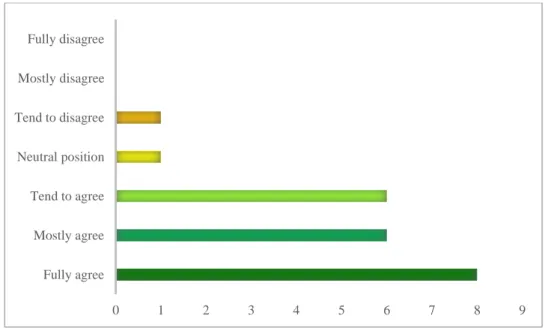
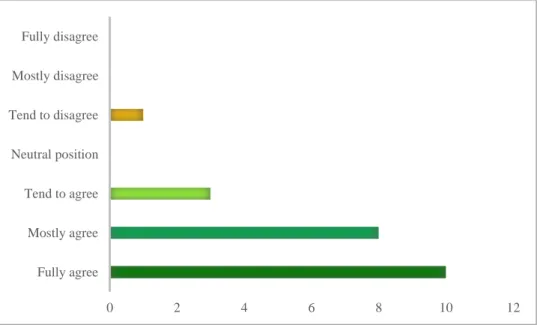
Figure 1: Real Time Delphi Diagram ... 36 Figure 2: Example of a question, as seen in Delphi platform ... 37 Figure 3: Specialists Agreement on Statement 1 – Regarding the Impact of AI on Customer Recognit ... 45 Figure 4: Specialists Agreement on Statement 3 - Regarding the Impact of AI in Market Segmentation ... 47 Figure 5: Specialists Agreement on Statement 3 – Regarding de Impact of AI on Sales Forecast ... 49 Figure 6: Specialists Agreement on Statement 4 – Regarding de Impact of AI on Price Management ... 51 Figure 7: Specialists Agreement on Statement 5 – Regarding de Impact of AI on Programmatic Advertising ... 53 Figure 8: Specialists Agreement on Statement 6 – Regarding de Impact of AI on Websites Development. ... 55 Figure 9: Specialists Agreement on Statement 7 – Regarding de Impact of AI on the Development of Internet of Things ... 57 Figure 10: Specialists Agreement on Statement 8 – Regarding de Impact of AI on Natural Language Processing ... 59 Figure 11: Specialists Agreement on Statement 9 – Regarding de Impact of AI on Chatbots vs Human Responses ... 61 Figure 12: Specialists Agreement on Statement 10 – Regarding de Impact of AI on Ethical Considerations of Chatbots ... 63 Figure 13: Specialists Agreement on Statement 11 – Regarding de Impact of AI on Chatbots Credibility ... 65 Figure 14: Specialists Agreement on Statement 12 – Regarding de Impact of AI on Offline Businesses ... 67 Figure 15: Specialists Agreement on Statement 13 – Regarding de Impact of AI on Marketing and Sales Teams ... 68 Figure 16: Specialists Agreement on Statement 14 – Regarding de Impact of AI on Strategy and Planning ... 70 Figure 17: Specialists Agreement on Statement 15 – Regarding de Impact of AI on Privacy and Data Policy... 73
9
Figure 18: Specialists Agreement on Statement 16 – Regarding de Impact of AI on the Expected Changes in Society ... 75 Figure 19: Specialists Agreement on Statement 17 – Regarding de Impact of AI on AI Systems Regulation ... 77
10
1. Introduction
This first chapter aims to frame and present the study carried out following this dissertation.
To better understand the topic of research, the chapter is divided in 3 sub-chapters – first, the current context of trends regarding artificial intelligence (AI) applications in the marketing field will be introduced, followed by the definition of the research problem and presentation of the main objectives, and, finally, the general structure of this dissertation.
1.1. Actuality and Trends of Artificial Intelligence in Marketing
Increasingly, information technology and artificial intelligence play a core role in the development of companies’ activities, integrating the root structure of many businesses. Gartner (2017) predicts that by 2020 AI will be a top five investment priority for more than 30 percent of companies. According to Pettey & Meulen (2018), it is expected that AI business value will reach $3.9 trillion by 2022 – that is three times higher than in 2018 ($1,2 trillion).
Customer recognition is not yet mastered by most companies. An IBM Watson study (2017) showed that 81% of companies claim to have a holistic knowledge of their consumers, when only 37% of consumers claim that their favorite brands know them and understand their needs. Therefore, catching customers insights though AI is one of the main trends of Marketing on the upcoming years.
In addition, personalization of products and services is an unavoidable trend as, according to Salesforce Fourth Annual State of Marketing, 65% of B2B buyers say they will switch suppliers if the company does not attempt to customize communication (Davis J., 2017). The same article suggests another trend line, which has to do with improving the customer experience as a differentiating factor. In fact, 68% of marketers say it is part of their companies' marketing strategy to push actions that promote customer experience, as the greater the willingness to assist the customer with their buying hurdles, the greater the probability of generating a conversion. Chatbots are a great example of how technology is evolving and being applied to CRM to improve the ease of shopping.
11 Another trend that, even though not specific to any business area, will change several aspects and functions, is the expectation that in the upcoming years there will be a progressive elimination of repetitive tasks due to technology.
Partly related to this theme, the morality of AI is one of the most controversial topics of the present and coming years, not only with regard to labor changes, but also with data protection policies. The main concern is to determine to what extent technology and intelligent algorithms should rush into consumers' personal lives to improve costumer knowledge.
1.2. Objectives and Research Problem
In order to better structure the purpose of this dissertation, this sub-chapter begins by presenting the general objectives of the study, then proceeding to the formulation of the research problem, and then to the presentation of the research questions to which we seek to answer.
Overall, the main objectives of the study are:
• Explore developments and changes in the different fields of marketing regarding the adoption of intelligent systems and automation of functions, in the short to medium term.
• Understand what kind of functions are most likely to be automated in the short / medium term, considering the functionalities available and vulgarization of intelligent systems.
• Prospect if AI will be useful for decision-making, and what to expect regarding the level of sophistication of AI and machine learning algorithms.
• Explore ethical foundations and bring insights of the impact of AI on roles and society at large.
Thus, we can briefly define the research problem as follows:
What will be the impacts of the development and implementation of artificial intelligence systems on marketing department activity?
12 In view of the development and solution of the research problem, we tried to answer the following research questions:
• Which innovative AI systems have been designed? Which have already been implemented in pioneer companies? Will there be widespread adoption of these systems among companies?
• Considering each area of marketing individually, what changes are expected? • What benefits does it bring to companies? And what damage / downsides? • Which labor functions can be easily replaced?
• What are the key challenges of implementing AI systems for businesses? And for society?
1.3. Structure
This dissertation is divided into five chapters. To introduce the them, we find this first chapter that aims to provide a brief overview of AI's current role in marketing, present the main trends and define the objectives and main questions to which the study intends to answer.
The second chapter is reserved for the literature review necessary to get to know the subject of artificial intelligence at the service of marketing. Here we can find the reasons for its emergence and increasing development, as well as the changes it has caused to consumer behavior. The last subchapter intends to address each field of marketing individually, explaining to what extent they are becoming supported by AI systems. The third chapter covers all the study methodology - first we present the Delphi method, as well as the variant we used, Real Time Delphi, and a brief explanation of the chosen platform (edelphi.org). Still in this chapter we present the questions made in the exploratory interviews to find the most pertinent statements for the panel to analyze and comment.
Then, we find the fourth chapter - the most exhaustive of this thesis – that covers the answers’ analysis, and comments the experts wrote regarding the 17 questions.
13 The dissertation ends with the fifth and concluding chapter, which presents the summary of the results, the implications the study has for knowledge and management, the limitations of the study and suggestions for future research.
14
2. Literature Review
To better understand the contents applied, we begin by reviewing the most relevant subjects and trends found throughout the exploratory study. Thus, literature review comprises a brief overview of Artificial Intelligence (AI) definition, approaches, main features and ethical considerations. Then, it is presented a reflection on how the explosion of data we have assisted in the last years and the increasing need of optimization and profit increase were two main reasons that led to the emergency if AI in marketing. Besides, we consider the changes in consumer behavior - the share of content through online channels, and the increased weighting in purchase - were also triggers that made organizations redesign their marketing strategies.
Finally, we will go through the various marketing fields to survey the current state of technological development and show some example of pioneering companies to implement innovative intelligent systems.
2.1. Artificial Intelligence – Concept
The definition of AI is not a consensual subject among scientific community. Therefore, to better define the concept, we start by presenting its first definition, then the main approaches and, finally, the issue of risks and ethical considerations.
2.1.1. AI Initial Definition
According to Pan Y. (2016), the first formally draft definition of Artificial Intelligence was established in 1956, at Dartmouth College, by a group of university professors - J. McCarth, M. L. Minsky, H. Simon and A. Newell - along with C. E. Shannon, N. Rochester, and other scholars. They defined AI as “the ability of machines to understand,
think, and learn in a similar way to human beings, indicating the possibility of using computers to simulate human intelligence”. Since then, AI has been in great expansion
15 for several research areas such as pattern recognition, automatic translation, physical/mechanical theorem proving, robotics, intelligent control and machine learning.
2.1.2. Two Main Approaches to Artificial Intelligence
There are two research paradigms in AI in which the concept of AI lies in. Both these theories try to explain the path to machine learning by reproducing the human brain learning process, although they diverge radically in their attempts to reproduce this process of understanding and thinking through the usage of machine.
The first approach focused on formalizing the process of thinking into symbols, rules and world representations. This defends intelligence should be measured against an ideal
performance indicator, called rationality (Russel & Norvig, 2010) which defines the
ability for playing the “correct thing”.
Following this model, a machine could be able to think rationally, and/or to act rationally.
Thinking rationally refers to reasoning processes thought premises that lead to inferences
– the operation of the mind was governed by “laws of thought” lies in logical processes. On the other hand, some situations recall an immediate intervention, and Acting
Rationally may be needed without the thinking process. For example, if somebody jabs a
finger into a needle, it might not be recommendable to spend some time carefully deliberating weather or not to recoil it. In humans, these mechanisms are called reflexes; some are innate, other are recorded after an experience. In a robot life-journey, there could be some information that should be taught to give an automatic and immediate response, whether it is for machine integrity defense, or to assure its correct functionality. For example, it would be advantageous for a computer to interrupt the download of a program if it recognizes a pattern of system modifications that are known to be harmful for the hardware; and it should be done automatically, since downloads are often done in seconds.
On the other hand, there was the idea that simple logical operation approach - even if combined with some trigger-response mechanisms – might be too simplistic and inflexible to solve real human problems. In fact, the growing knowledge of human brain
16 highlighted the role of stochastic and parallelized information processing (Hassabis, Kumaran, Summerfield & Botvinick, 2017).
Thus, the second approach to AI was more directly inspired by neuroscience rather than cognitive psychology (Rumelhart & McLelland, 1986), and it evaluates the performance of a machine according to its fidelity to human performance – thinking and acting humanly.
One of the scientists who gave the first steps toward a better understanding of this model was Alan Turing, that in 1950 proposed the first operational test for identifying intelligence in machines. A computer would pass the Turing Test if a human interrogator, after posing some written questions, cannot tell if the written answers were given by a human or a computer. For a computer to fulfill the given task, it would have to possess several capabilities: Natural language processing – to communicate successfully in a given language; Knowledge representation – to memorize what it knows, hears or experiences; Automated reasoning – to use the stored information to develop conclusions and formulate responses; and Machine learning – to adapt new circumstances, detect patterns and make inferences. As we may notice, it takes much more than a simple one-way logic system to perform the given tasks (Sharkey, 2012).
In 1986, the concept of Parallel Distributed Process (PDP), proposed by Rumelhart & McLelland, arose, emphasizing that human cognition and behavior result from dynamic process, in which parallel computations combine simple units to collectively implement sophisticated calculations. This suggested that the exercise of thinking was not a one-division logical job performed in the most symbolical data structures, but a skew of cross-related neural networks distributed across different units.
2.1.3. Ethics and Risks Considerations
The fast-passed development of artificial intelligence has been raising questions and worries, not only within the scientific community, but also among general world citizens. We all assist to the emergence of a wide variety of computerized systems able to perform tasks as successfully as human operators, and it becomes easy to find examples of robots that even manage to overcome human performance – either in speed, accuracy or multitasking-capability.
17 However, AI-based technology has reached great technological achievements, such as self-driving cars, automatic medical diagnosis systems, facial recognition, at the same time as it promises to bring social and economic growth, safety improvements, well-being and medical development.
Engineers and robotic scientists deal with ethical considerations about what projects should or should not be done, how robots should or should not act, and how they should be handled. In fact, AI creations seem to pose some questions that might be harmful to humans, directly or indirectly, for example: people might lose their jobs to automation, and their sense of being unique; AI systems could be used towards undesirable ends, there might exist doubts in responsibility attribution if some task is performed unsuccessfully, and, through a more dramatic and pessimist light, machines may take over the world and dictate the end of human race.
However, the other sides of AI ethics should be considered – can AI positively impact the world and human living? Is it dangerous to humankind or is it just the lack of common understanding – and the low-level explainability – about AI and machine learning that is bringing insecurity to individuals?
Considering one of the mentioned ways AI can threat human well-being – the replacement of workers for automatic devices – we can look at the consumer credit business. Credit card applications, charge approvals and fraud detection are now done by computerized systems, and it is true that thousands of workers could be hired to do the same tasks. However, if we took away AI these jobs would not exist because the cost of labor would not be an acceptable cost to the transaction. In fact, information technology has created more jobs than it has eliminated (Russel & Norvig, 2010).
It is true that putting technology in the wrong hands may cause harm, but with machine learning we have the added problem that the wrong hands may belong to machines their selves. For years we have been seeing science fiction stories of robots taking over the world, such as Frankenstein (1818), The Terminator (1984) or even Matrix (1999). Robots were exciting because they represented the unknown – like ghosts or witches. Now, AI does not belong to imaginary anymore, and the actual technology is programming real robots.
18 Isaac Asimov (1942), a science fiction writer, was the first to address the need to regulate AI creations, with the three laws of robotics (Barthelmess & Furbach, 2014):
1. A robot may not injure a human being or, through inaction, allow a human being
to come to harm.
2. A robot must obey orders given to it by human beings, except where such orders
would conflict with the First Law.
3. A robot must protect its own existence as long as such protection does not conflict
with the First or Second Law
Other regulating models were created to regulate AI Ethics, such as the ART Principals proposed by Dignum (2017). This model advocates a robotic designing should obey to three principles:
1. Accountability – the purpose of the invention should be clarified to partners, users and other with whom the system interacts;
2. Responsibility –refers to the role of people themselves, and to the capability of AI systems to answer for their decision and identify errors or unexpected results; 3. Transparency – there must exist the need to describe, inspect and reproduce the
mechanisms through which AI systems make decisions and learn to adapt to their environment, and to the governance of the data used or created.
Increasingly, intelligent machines will be part of human life in a wide variety of forms. It is important to take in consideration that AI is meant to be useful to humankind and not harmful, and that AI development should respect and address societal values and morals. Along with representing a risk to Humanity, AI brings an enormous potential to improve the lives of many, personally, professionally, medically, financially and, it could even be a tool to help assuring human rights to all. However, how this will be realized, depends on us.
19
2.2. The Emergence of Artificial Intelligence in the Marketing Field
In recent years, we have witnessed a technological revolution in companies. Most of the business units delegate part of their activities and tasks to AIs, and marketing did not escape this trend. The proliferation of data derived from purchasing information systems, the primacy of social networks in consumers' lives, and the need to reduce costs and increase profitability are among the main reasons for the entry of AI into marketing departments.
2.2.1. Data Explosion
Purchasing information systems, both in physical stores and online, allow capturing customer purchase data per item, following purchase patterns, and making buying proposals based on past actions.
Therefore, data became an incomparable asset that for defining strategy (Koetsier, 2018). However, given the size of the markets, it is not feasible for companies to work on this data individually.
According to Omnicore Agency (2019), in 2018, Facebook reached 2,32 billion monthly active users, while Instagram got to 1 billion, and Twitter make it to 321 million. Most members of these communities write comments, react to the contents, and share posts of other personal profiles or brand pages, generating millions of interactions per day. For example, on Facebook, every minute there are 317.000 status updates, 147.000 photos uploaded and 54.000 shared links.
Thus, social networks are a great source of information for marketing as it is important to know the opinions that customers and potential customers hold regarding new products, customer service or general performance.
Since it is not viable for brand managers to follow all these footprints and define consumer profiles and customer satisfaction levels, moreover with disperse information, there was the need for technological help to structure and treat the raw online data.
20 2.2.2. Need for Cost Reduction and Profitability Increase
The opening of markets to international competition increases the pressure on costs reduction and leads companies to try to operate with lower expenses (Amaravadi, Samaddar & Dutta, 1995).
Indeed, several activities developed by human workers are somehow routines, in a sense that can be broken down into a series of repeated simple tasks that are relatively predictable (Ford, M., 2013). Since these jobs can easily be handled by machines, we have been watching several workstations getting occupied by AI devices – for example, chatbots.
Besides that, the AI also promotes sales by better matching production to the demand (Morgan, ElSobki & Osman, 2013). Through systems like Demand Side Management (DSM), applied to energy systems (Palensky, 2011), or other personalized algorithms that, throughout regressions, comparisons to previous weeks or months and pattern recognition systems, bring predictive insights about future sales.
Concluding, it is possible to understand how AI assists companies to reach their economic and financial goals – by cutting costs and increasing sales, profit grows and profitability increases.
2.3. Changes in Consumer Behavior
The great change of the last 20 years in consumer behavior results from the growth in its power – with the generalization of internet and mobile devices, everyone can create content, comment, share, complain and give opinions in social media, forums and specialized websites.
Another tendency we discuss in this topic is the effects of the recently overcome economic crisis, that prompted demand for products and services at a lower cost, which had an impact on the development of marketing strategies.
21 2.3.1. Development of Uploads Internet
Thousands of content uploads are made every day on online platforms. On social media, a considerable part of the contents generated refers to brands and products performance – from comments, to compliments, complaints or just explanations of a huge variety of brands are uploaded in social networks. These contents are then seen by page followers, that may react to the posts, comment and share them, creating an online word-of-mouth that companies are not able to delete and can hardly control.
Even the world’s largest encyclopedia is created by volunteers and users. Wikipedia is a collaborative, universal and multilingual project established on the internet, with the propose of providing free, objective and verifiable content that everyone can edit and improve. This illustrates the willingness of citizens to participate in the generation of contents, and the trust users have among themselves without knowing each other.
In purchasing processes, this trust between consumers is also verified, being common to search for information in online forums, blogs and pages of social networks to assist buying decisions.
2.3.2. Increased Weighting in Purchase
During recession, most consumers were forced to cut back on their spending. The decrease in monthly budget, coupled with the generalized rise in prices, has led to an increased rationalization of consumption, that is, a greater weighting of personal needs and expectations regarding a certain product or service (Mansoor & Jalal, 2011).
At the same time there was a great development in information technology, that became available for most people in developed countries. Along with this, it began to appear several websites specialized in price comparisons (Kannan & Kopalle, 2001). Even a simple search for a product in Google delivers automatically adds that immediately show online stores and respective prices.
22 Currently, the process of price comparison is often done in-store – through mobile devices it is easy to access to different websites to get information about products, compare features and prices. The easy and quick comparison of prices within competitors represents a major alert for sellers since they must monitor prices, value propositions, customer engagement and behavior of competitors, to adapt whenever at risk of getting dropped-behind. To follow market different offers, price managers started calling upon price bots (Kannan & Kopalle, 2001) – AI systems that automatically deliver prices of many different online stores.
2.4. Artificial Intelligence – Impacts on Marketing
In this context, arising from the technological evolution and the shift in the behavioral patterns of the consumers, it is possible to verify that the AI may have a significant impact on the operations inherent in the marketing activities. This chapter presents the main areas in which AI has been applied and how it facilitates the work through the automation and increase the efficiency of actions and thus promote the attainment of objectives.
2.4.1. Market Research
Information technologies and AI have been playing an increasingly important and revolutionary role in market research. The previously discussed data explosion brings an immense quantity of information, that may serve as “raw material” to be collected, treated and analyzed, such as social media user-generated contents, websites search history, blogs and opinion forums (Zeng, Chen, Lusch & Li, 2010).
However, it is not possible to take advantage of this amount of information resorting only to human labor. Even if possible, it would certainly not be viable, since it would take too many workers, too much time and costs to analyze this explosively growing, widely available and gigantic body of data.
The need for intelligent and powerful tools to uncover useful information, transforming raw data into market knowledge, led to the creation of data mining (Han J., 2011). Also
23 known as knowledge discovery from data, data mining refers to the science of extracting useful knowledge, patterns and trends from huge data repositories.
Data mining techniques have been applied to industry, medicine, science, government, engineering, and market research could not disregard this great technological appliance. For example, considering a search engine software, such as Google, which receives hundreds of millions searches every day, and each search represents a topic of interest, doubt or curiosity. Some patterns found in user search queries can disclose valuable information, that could not be obtained by reading individual data, and this can help marketers identifying market tendencies.
For example, if in a given week, we identify a great number of searches on a recently launched smartphone specific model, we can predict an increase in purchase of this same model. Unless, for example, the searches are in the sense of diagnosing a problem of that smartphone. If so, we realize that many users have detected a flaw in the device, and it is likely that sales will slow down, possibly triggering a flood of complaints and a scandal that tarnishes the brand's reputation. In any of the cases, it is important for the company to be aware of those facts, so it can anticipate events and define strategies.
Besides, AI have enabled the emergence of tools to handle many other tasks, such as processing open-ended data, proactive community management, managing surveys (including spotting fraudulent responses), analyzing texts and passive data (ex: social media), automated reporting, among other functionalities that can become extremely useful to market researchers.
2.4.2. Market Segmentation
An important and useful data mining method is clustering – organizing items by groups (clusters) based on degrees of similarity, resulting in high homogeneity within clusters, and high heterogeneity between each group. (Chiu, Chen, Kuo & Ku 2009).
Marketers understood the potential of cluster analysis applied to market segmentation. By grouping clients with shared characteristics, it is possible to create products, services, brands, service levels and communication strategies personalized to address that public
24 needs and wants. Throughout clustering analysis, segmentation does not have to be done by subjective guesses of marketing specialists, nor by expensive and hard to validate market researches.
For example, if a supermarket has a loyalty card, then it has access to a shopping habits data base. By performing a cluster analysis, market analysts may stop speculating on market size, segments extents and features, or customers’ needs and desires. Intelligent algorithmic systems perform profiles discrimination and sorts individuals into groups with common tastes, interests, priorities, buying power, sensitivity to discounts and price changes, by analyzing purchase histories. Then, dynamic market segments can be sized and prioritized, and different strategies can be followed to reach them.
Another current practice is the orientation towards the most profitable segments. Adobe
Target is one of many tools designed to do that – it analyzes best clients using a software
that finds out what they have in common, so users can know their target. It aggregates customer data from online and offline sources, including web and app analytics, databases of customer relationship management, and data warehouse systems. Then, machine-learning algorithms determine which variables are most predictive, eliminating irrelevant data (Sterne, 2018).
2.4.3. Sales Forecast
Sales forecasting plays a core role in business strategy. Traditional forecast is generally performed with statistical methods, such as regression or moving average, yet these techniques have proved to be weak and ineffective. In fact, it is known that sales variability cannot be estimated by taking in consideration only the previous sales since these may vary widely due to internal and external factors (Kuo, Chi & Kao, 2002). Lately, artificial neural networks (ANN) have been applied in sales forecasting as they manage to filter great volumes of data history in real time, being useful to monitor trends and recognize patterns. Besides, AI systems, relying on algorithms that consider multiple factors, allow companies to target prospects, realize sales opportunities and develop more accurate sales forecasts. In fact, the adoption of AI is expected to grow 139% over the next three years (Fatemi F., 2018).
25 A study was conducted in an IT company to compare the degrees of accuracy of traditional sales forecast techniques and the ones based on ANN. The forecast, performed following 3 different models – Exponential Smoothing, Autoregressive Integrated
Moving Average (ARIMA) and an ANN system –, showed that the model based on ANN
had a greater accuracy in predicting future sales (Sobreiro, Martinho & Pratas, 2018). Although the results need further research to be applied in broader contexts, it was verified that AI can provide a reliable instrument to support decision process by managers.
2.4.4. Product and Services Innovation
Innovation, the development and market launch of new products and services, is one of the most important issues in business research. By creating new products, innovation transforms existing markets and creates new ones (Hauser, Tellis, Griffin, & McAlister 2013).
The success of innovation relies on customers’ acceptance, and, consequently, on customers preferences and needs. However, individual needs and tastes vary greatly from person to person, so it would be great managing to design customized products and services for each customer.
Therefore, providing customers with individually tailored brand experiences is a powerful marketing strategy to improve customer satisfaction by addressing specific needs and providing unique and personalized solutions (Kwon & Kim, 2012).
Advancements in information technology and artificial intelligence have enabled marketers to deploy more effective real-time and prolonged customer experience personalization tactics.
For example, Starbucks uses AI to recognize customers’ mobile devices to have access to their ordering history, which enables baristas to make successful serving recommendations. In the music industry, the american music streaming service Pandora that uses algorithms to generate personalized playlists for each of its millions of users
26 according to their preferences in songs, artists and musical genres (Wilson & Daugherty, 2018).
2.4.5. Pricing
Recent advancements in AI technology has enabled the development of tools to track buying trends and create pricing strategies based on algorithms that adjust prices automatically, according to multiple factors.
In a market with heterogeneous tastes and different product valuations, companies may increase their profits by playing price differentiation (Wolk & Ebling, 2010). Operationalizing this requires a deep knowledge of consumer behaviors and buying patterns, in order to charge the maximum price each costumer is willing to pay, enabling the extraction of additional consumer surplus.
There are three degrees of price differentiation (Tian, Qin & Liu, 2018): i) Personalized
pricing – selling de same product at different prices to each buyer according to individual
willingness to pay (e.g.: flight tickets); ii) Product versioning – creating a product line of slightly different products for the purpose of price differentiation (e.g.: premium versions); and iii) Group pricing – segmenting the market and offering the same price for each segment (e.g.: students discounts).
Dynamic pricing is a type of price discrimination that works on pricing products and services at the optimum price point, reviewing it often. With AI it is possible to find a customer’s data patterns, which are unveiled by considering a variety of sources, such as loyalty cards and browser tracking systems, that are posteriorly analyzed using algorithms that cross that information with other factors such as competitors’ pricing, consumer behavior, location, time of day, and seasonality to determine how much customers are willing to pay and how responsive they might be to special offers.
For example, a bank may use a pricing system to adapt deposit rate offers by observing customer’s checking account activity. The algorithm, detecting flows between the bank and a secondary savings bank, can consider the nature of the customer’s relationship with the bank, the expected revenues and the rate at the competing secondary bank to make an
27 attractive rate offer. By personalizing promotional offers in this way, the bank is able to get a higher rate of response from promotions.
On the other hand, some companies are taking advantage of great amounts of new data sources to improve the effectiveness of their pricing algorithms.
According Forbes Magazine (Ke W., 2018), Amazon's Privacy Notice page, suggests the retail giant collects and analyzes everything from purchase histories and products viewed or searched for to reviews, wish lists and duration of visits to certain pages. This huge pool of data on its customers’ shopping habits can help Amazon better understand what shoppers are looking for, what they buy and what prices they are willing to pay.
Increasingly, managers are recognizing that a dynamic pricing strategy, supported by big data and AI, can help them creating a pricing advantage over competitors. In fact, this yield management has been practiced in businesses such as hotels or airlines for several years. Nevertheless, it is important to consider companies’ overall strategy to assure that AI-powered pricing is aligned, and also to improve internal capabilities in data science to ensure the accuracy of predictive algorithms and avoid being over-taken by competitors.
2.4.6. Advertising
Nowadays, a significant part of advertisement campaigns is developed online. Along with e-shopping customer journey, artificial intelligence has helped advertising to take great steps, notably with regard to the customization of the campaigns. By aligning the content marketing strategy with data collected from customer searches and previous buying decisions, it is possible to optimize and deliver the most relevant contents to each customer.
A pertinent and easy to verify example happens when we search for a product in Google, and we can see that it immediately delivers suggestions of online stores that sell that specific product, normally shown in a special shopping box integrated into regular results. This system is called Google Shopping, and it delivers results whenever a shopping match is found, within the entities who bought this service from Google. Later, when navigating though different websites, especially social media, we will probably find adverts to that
28 same product. Despite not being too expensive to companies to apply, this data-based mechanism is extremely efficient because it adverts the exact products each person is looking for.
In 2018, Saatchi & Saatchi LA trained IBM’s supercomputer, Watson, to write thousands of ads for Toyota’s Mirai. First, Saatchi LA wrote 50 scripts based on location, behavioral insights and occupation data that explained the car’s features to set up a structure for the campaign. The scripts were then used to train Watson so it could whip up thousands of pieces of copy that sounded like they were written by humans (Johnson L., 2017).
2.4.7. Store Location
Choosing a location in retail is a strategic decision with great impact in business success. Resident populations’ age and buying power, pedestrian and automotive traffic flow, distance from competition stores and proximity to non-competitors magnet-stores are factors that contribute to store performance and must be considered (Karadeniz, M., 2009).
Location selection has conventionally been settled using systematic steps, such as checklists that enclose the different factors but disregard the relation between the decision factors globally.
Kuo J., Chi S. and Kao S. developed, in 2002, a decision-support system for location of a convenience store that comprised four components: 1) hierarchical structure development through fuzzy analytics and artificial neural network, 2) weights determination, 3) data collection, 4) decision making. This method considers multiple factors such as i) competition – hypermarkets, supermarkets and other convenient stores; ii) magnets – hospitals, hotels, restaurants, schools, banks, etc; iii) convenience facilities – parking, sidewalk width, road width, pedestrian walk proximity; iv) availability – crowd, stations, bus stops, traffic flow; v) store characteristics – visibility, front area, front width, door width; and vi) population characteristics – community size, income/consumption, population growth rate, population density.
29 This study confirmed that data manipulation procedures, allied with ANN methods permits notable advances in predicting the most convenient store location, contributing to greater success in business expansions. Perhaps, in the future, AI and machine learning frames could be developed to assist companies in internationalization decision-making.
2.4.8. Store Experience
Luminous panels with vibrant colors are not enough to get consumers’ attention – they are getting savvier, more demanding and harder to impress (Begley, Fox, Lunawat & MacKenzie, 2018). Therefore, retailer points started to invite AI to selling points, taking store experience to a new level – from automatic service and interactive mobile apps, to augmented reality or smart mirrors and shelves, AI is taking big steps in bringing innovative systems to a wide variety of stores.
Several brands are already taking advantage of these technological innovations:
• Sephora makes it easier to find the perfect makeup without applying any product. Color IQ scans a customer’s face and provides personalized recommendations for foundation and concealer shades, while Lip IQ does the same to help find the perfect shade of lipstick (in www.sephora.com/color-iq).
• Lowe’s, the american construction materials brand store, noticed customers had a hard time finding items and created Lowebot, an autonomous retail service robot designed to find products in multiple languages and help customers effectively navigate the store (in www.lowesinnovationlabs.com/lowebot).
• Convenience store 7-Eleven has been applying facial recognition in its 11.000 stores across Asia. The used system combines the technology with behavioral analytics to “identify loyalty members, analyze in-store traffic, monitor product levels, suggest products to customers, and even measure the emotions of customers as they walk around” (Chan, 2018).
• In South Korea, the International Finance Center Mall uses facial recognition into its information kiosks. Customers’ age and gender are identified by cameras, so an intelligent system can personalize interactive advertisements accordingly.
30 Exciting environments supported by AI are beneficial for attracting customers, improving notoriety and increase sales. However, technology can help retailers in other ways, such as reducing costs, avoiding stock breaches, and increasing the efficiency of operations. An article published by Mckinsey & Company (2018) estimates that in a near future several tasks will be automated. Soon, most part of the core merchandising responsibilities at leading retailers could be almost entirely automated, such as merchandising planning and inventory, replenishment, and markdowns. This will have a positive impact in store-experience – on one side, shopkeeper will be free enough to provide a closer customer service – and – on the other side, and AI should drive processes more efficiently, avoiding, for example, stock disruptions.
2.4.9. E-Commerce
According to Statista website, in 2018, online sales represented 11,9% of total retail sales worldwide. Technological advances allow this number to grow every year, and AI has an import role in helping companies to meet customers’ expectations, that value personalized experiences more than ever, efficient operations and fast answers to their needs (Enache M., 2018). In fact, there are several applications of AI that can benefit online stores.
For example, automated order and inventory management – by applying deep learning algorithms to forecast demand and shipping maps, it optimizes operations and drive sales efficiency. Plus, automated warehouses are equipped with robots that store and prepare orders 24/7. These perform a perfect inventory accounting and makes sure to warn the operation manager, if stock falls below the expected sales for the period before replenishment (Vincent, J., 2018).
Intelligent Image Search is technology that came to revolutionize web search world.
Search engines are used to handle keywork searches, but AI makes it is easier to search by considering images. As customers examine product images on e-commerce sites, AI will examine its online path. By analyzing which images are opened, how long they are looked-at and related behaviors, AI can identify what that particular customer is looking for. A prime example of intelligent image searches is Pinterest. Then, e-commerce platforms adapted the same AI image search technology to get benefits such as increased sales, suggested close-matches that satisfy the customer, intelligent analysis of customer likes and dislikes and targeted email engagement based on image search history.
31 When our online shopping is ready, we often see recommended products showing. This recommendation engines work with big data treatment systems, that extracts insights about customer’s purchase history, performed searches, and even general lifestyle can affect purchasing choices. Often, customers are interested in the suggested products which encourages them to return to the site and results in greater sales and improved customer experience. For example, Amazon reports that upselling and cross-selling is responsible for 35% of its total annual revenue (Cohn, C, 2015).__________________ __________________________
2.4.10. Credit Risk
For certain businesses, access to credit is a key aspect for prospects to become clients. Sectors such as real estate, automobile or even home appliances depend directly on banks' willingness to lend capital, or on the part of the selling companies themselves to defer revenue to a future moment, adjusting payment conditions. On the other hand, on corporations’ side - banks or retail agents - the decision to lend or not to lend must be taken carefully, to avoid impairment losses and poor general results.
Several lenders are slowly taking advantage of predictive power of AI-based systems. In 2017, McKinsey released a report showing that machine learning may reduce credit losses by up to 10 per cent, while expecting credit decision times to fall by 25 to 50 per cent (Portilla, Vazquez, Harreis, Pancaldi, Rowshankish & Samandari, 2017).
According to Intel AI Academy (2018), AI scoring models resort to big data, including customers’ credit history and buying profile, and works it with a wide variety of algorithmic and deep-learning mechanisms to improve credit decisions. Besides the significant reduction of costs by dismissing part of the human labor, these systems bring greater effectiveness through the continuously running combination of variables and predicting variables interactions.
For example, the american bank JPMorgan Chase introduced COIN, a contract intelligence platform that, resorts to machine learning to review about 12.000 annual commercial credit agreements in seconds (Galeon, 2017).
32 2.4.11. Customer Service
Customer service is of critical importance to a business because it is key to keep client’s satisfaction levels and improve their loyalty. However, it is not easy for companies to provide personalized attention to customers, even when these actively try to contact organizations for support on product/service technical features.
To address this situation, automation of customer support has been registering a great development, being one of the most used AI applications in businesses. According to research by Oracle (2016), 78% businesses have either already jumped on the AI trend or are planning to adopt AI to better serve customers by 2020. In fact, according to Solomon (2018), customers are increasingly comfortable with automated services, as long as it is well designed.
An AI tool widely used for customer service is chatbots – computer programs designed to simulate conversations with human users over the Internet, providing the opportunity to engage with customers on a constant basis and rapidly respond to issues (Atwell & Shawar, 2007).
Chatbots help buyers searching for the right item, checking product availability, comparing multiple products and helping them to make the payment. Plus, it also helps organizations to connect customers with the appropriate service personnel in case of any complaints or queries. This tool is an effective and low-cost way of providing customer service since it creates a valuable CRM solution by adding a personal touch to the relationship between AI and customers, even without employing human workers. Amazon, Google, IBM, Microsoft, Oracle an Apple are some of companies that successfully implemented conversational computing platforms, that are designed to recognize patterns in consumers questions and comments, through voice and chat interactions (Koplowitz & Facemire, 2018)
2.4.12. Customer Retention
Managers strive to balance acquisition and retention efforts to maximize revenues and lifetime customer value. According to Reichheld (2001), increasing customer retention rates by 5% increases profits by 25% to 95% However, several companies fail to address
33 products and services to customers’ specific needs, which makes it difficult to promote engagement and keep customers loyal.
A research by Salesforce (2016) found that, by 2020, 57% of B2B customers will switch brands if a supplier company do not actively anticipate their needs. AI is key to enable managers to respond to market dynamics in real time, and address consumers’ needs and preferences effectively and efficiently.
Noticing churn signs in advance is an important customer retention strategy. For example, having a CRM (customer relationship management) system that automatically sends emails if a customer does not make any purchase a certain period. Or, relying on a more sophisticated technology, it is possible to detect if a customer uses a search engine trying to get information about a competitors’ product. In that case, AI system can decide on which messages should be delivered to prevent churn.
Besides, CMR systems can perform other automatic tasks to improve customer loyalty such as targeting customers with special offers based on data mining, reward the most profitable customers, or deliver personalized follow-up messages (Kulbyte, 2019).
34
3. Methodology
The subject of the present dissertation can be considered complex, recent and is still in constant development. We are dealing with an exploratory study on the impacts that AI has on marketing, so we sought to resort to experts in the field, positioned at the forefront of all developments in the area. Their opinion, although exploratory, intuitive and only verifiable a posteriori, has a considerable probability of being valid and correct.
To perform an exploratory study of a constantly evolving reality it is mostly required a qualitative analysis, as the main objective is to gather in-depth opinions and insights on the topic and to answer the research questions presented in chapter 1.2.
To fulfill the proposal, a Delphi study was carried out, in this case a Real Time Delphi - a study that allows to gather a panel of participants on an online platform and pose them questions so they can answer and simultaneously interact with each other. The goal is for them to reach consensus on the issue, although this does not always happen.
3.1. Delphi Method
In the early 1960’s, Olaf Helmer, Nicholas Rescher, Norman Dalkey, and other scholars developed Delphi technique, at the RAND Corporation, the “think tank” in Santa Mónica, California (Gordon, 1994). According to Hallowell & Gambatese (2010), the Delphi method is a systematic and interactive research procedure that seeks to obtain judgment by a panel of specialists on a given topic.
Therefore, before the execution of a Delphi test, the facilitator has to choose the experts. Regarding this topic, Adler & Ziglio (1996) defend there are four guidelines that should be transversal to any Delphi study – i) knowledge and experience with the issues under investigation; ii) capacity and willingness to participate; iii) sufficient time to participate in the Delphi; and, iv) effective communication skills.
After selecting all the elements of the panel, these are invited to participate in two or more rounds of structed surveys. After each round, the mediator reveals to the participants the inputs and opinions of the other experts, so that, in the subsequent round, participants can reflect on the responses of others and feel encouraged to review their previous responses.
35 Finally, the method concludes when the predefined number of rounds and/or the achievement of consensus is met. Afterwards the information taken should be statistically aggregated and analyzed to deliver the results.
Dalkey, N. (1963) argue that the main objective of Delphi is to “obtain the most reliable consensus of opinion of a group of experts [...] by a series of intensive questionnaires interspersed with controlled opinion feedback”.
Commonly, the Delphi technique is based on three principles: (1) anonymity; (2) controlled feedback of the information and knowledge contributions; and (3) statistical treatment of the group responses (Çipi, Llaci & Ferreira, 2013)
The Delphi method is appropriate as a research system when there is incomplete knowledge about a problem or phenomenon (Skulmoski, Hartman & Krahn, 2007). Hence, the technique suites especially well when the main goal is to promote a better understanding of problems, opportunities, solutions, or to develop forecasts. Although reaching consensus is not necessarily the central objective of the study, by decreasing the variability of responses, it is possible to get nearer to the most correct judgement on an exploratory subject.
3.2. Real-time Delphi Method
The conventional Delphi method presents some weaknesses, such as the long duration of the survey, the lack of real-time acknowledgment of results and the difficulty in tracking progress over time, which often led to experts drop-out. Besides that, the mediator tasks were complex, demanding and time-consuming (Gnatzy, Warth, Gracht, & Darkow, 2011).
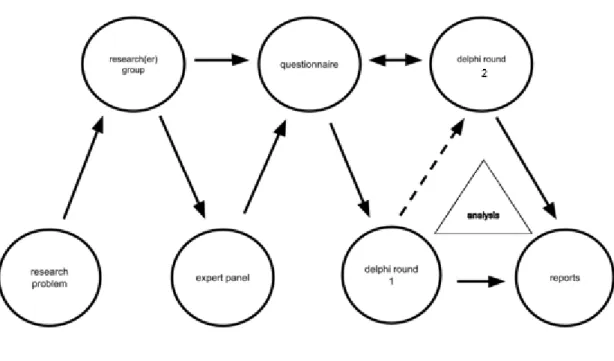
Gordon & Peace (2006) developed an online approach to execute a Delphi survey that leaves out the sequential and fixed-duration rounds. Instead, as soon as each participant submits a response, it has access to the answers of the remaining panel. Thereby, the duration of each “round” and the complete Delphi test is shorted, and the respondents perceive a greater motivation to answer and a greater engagement with the test since the “reward” – average group results and respective comments on the questions – is
36 immediate. Besides that, this online technique promotes a greater conversation and exchange of judgements among the specialists, which leads to more accurate results. In the figure below you can see the scheme of what was done following Real Time Delphi. As can be seen, after the questionnaire was formulated, the first round was held. Please note that comment viewing and analysis can be performed in real time as all interactions are automatically available. At the end of the last round it is possible to make the final results analysis.
Figure 1: Real Time Delphi Diagram
3.3. Research Platform E-Delphi
One of the first steps in conducting this study was to search for a platform for performing the Real Time Delphi that would meet the required attributes: 1) allow the whole panel to see, in real time – not just the answers of each participant – but also the comments they had written; 2) it should be possible to perform more than one round; 3) free or at a symbolic cost and possibility to subscribe for only 3 months.
At the end of the research, we considered between two platforms - E-delphi, and Welphi. After an in-depth comparative analysis of both, we had to exclude the Welphi platform,
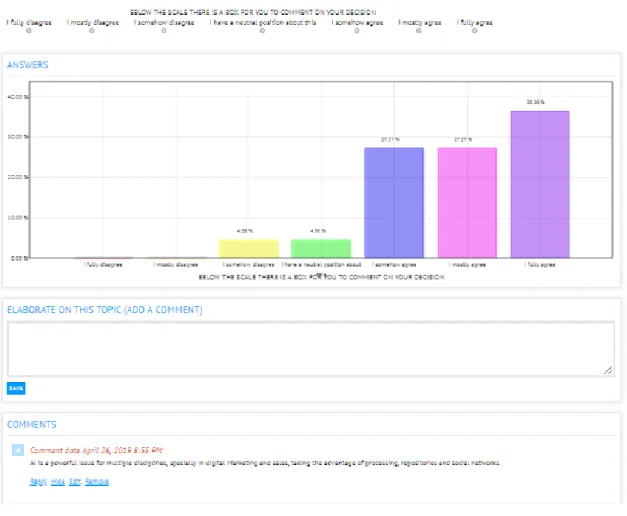
37 as, despite being graphically more appealing, it did not give due emphasis to the commenting action. For the molds we have set for the study we carry out, the experts comments are probably even more important than the score they attribute to the agreement scale in each statement - and in the case of this platform, this functionality came as a side action and did not have an effective call-to-action.
The E-delphi platform only had the drawback that it was slightly less attractive in terms of design, but functionally matched perfectly the objectives of the study. In the figure below it is possible to see an example of a question as it is seen on the Delphi platform.
38
3.4. Exploratory Interviews and Questions
In an attempt to develop the most relevant research questions and to conduct the Delphi method as effectively as possible, we began by conducting exploratory interviews with subject experts. It was possible to interview four experts, which had cumulative knowledge about marketing, artificial intelligence and data science.
Ten questions were placed to the interviewees to guide the discussion: 1 – In the company you work for, what the areas in which AI is applied?
2 – What are the major questions posed to the AI activity applied to Marketing in 2019 in Portugal?
3 – Which areas of application of AI in Marketing are expected to register a greater development within 5 years?
4 – What are the main obstacles on the part of customers to the adoption of AI in Marketing nowadays?
5 – Who are the decision makers to adopt AI in business marketing in Portugal today? And internationally?
6 – What new business functions are emerging? Which companies had already implemented them?
7 – What would you like to know about the opinion of a group of national and international experts on the evolution of AI in marketing in the next 5 years?
8 – Who are the key international players in the development of AI solutions applied to marketing? And at the national level?
9 – What are the most common AI solutions at the moment? 10 – What are the investment values (price) for standard solutions?
39 The answers were distinct among the interviewees, but a few insights about the current state of artificial intelligence application in marketing emerged, and so did ideas on the future applications to be explored in the Delphi study – a) in a near future (5 years), several marketing areas are expected to be severely impacted by AI development, such as segmentation, sales forecast, personalization and automatic content creation; b) the main obstacles to AI systems adoption are the perceived value of the investment and the internal resources to know how to follow the project; c) The main deciders on the task of implementing AI systems are general managers and marketing directors. IT department often participate in the strategic decision, but only to advise and never to decide; d) new jobs are arising and gaining popularity – data scientist, data analyst, machine learning engineer and analytic translator are increasingly popular functions among companies of several sectors; e) the interviewees mentioned that the main issues they would like to see answered by a panel of experts concerned, on the one hand, issues directly related to the business and marketing strategy – how will the impact of AI in various marketing areas, reorganization of the work, what tasks will actually be performed by intelligent robots, if AI will be able to have creativity and participate in strategy, which solutions might be implemented for automatic marketing processes (segmentation, customer service, pricing, communication) - and, on the other hand, a strong interest in exploring ethical issues - for example, if a company uses chatbots, it should notify the interlocutor that it is interacting with a smart robot, whether or not it is ethically correct to carry out sentiment analyzes and dynamic prices, or if practices are too invasive.
3.5. Research Statements
Given the broad spectrum of AI's utilities for marketing, a very exhaustive study was carried out, which included the themes proposed by the interviewed experts as well as other issues that were considered relevant. Thus, several marketing topics were covered throughout this study, which consisted of 17 sentences, that were meant to be evaluated in an agreement scale (from 1- fully disagree to 7- fully agree) and commented by each participant.
One of the most relevant topics for marketing is the issue of customer recognition, and how AI can be a facilitating tool in this process. Thus, the first research statement is: S1