André Nunes Gomes Alves
Licenciado em Engenharia InformáticaHealing replicas in a software component
replication system
Dissertação para obtenção do Grau de Mestre em Engenharia Informática
Orientador :
Nuno Manuel Ribeiro Preguiça, Prof. Auxiliar,
Universidade Nova de Lisboa
:
Presidente: Doutor João Baptista da Silva Araújo Junior
Arguente: Doutor Carlos Baquero Moreno
iii
Healing replicas in a software component replication system
Copyright cAndré Nunes Gomes Alves, Faculdade de Ciências e Tecnologia, Universi-dade Nova de Lisboa
Acknowledgements
I wish to thank those that have been present since the beginning of the course, as without acknowledging them this work would not be complete.
I would like to express my deepest gratitude to my supervisor, Professor Nuno Preguiça, for the opportunity given, for caring, and for all the guidance given.
I would like to acknowledge my colleges for being there in the bad times, and for making good times happen. A special thanks goes to Fábio, Pedro, and João, for all the patience and caring shown, for all the time spent together, and for all the discussions that enlightened me.
Abstract
Replication is a key technique for improving performance, availability and fault-tolerance of systems. Replicated systems exist in different settings – from large geo-replicated cloud systems, to geo-replicated databases running in multi-core machines. One feature that it is often important is a mechanism to verify that replica contents continue in-sync, despite any problem that may occur – e.g. silent bugs that corrupt service state.
Traditional techniques for summarizing service state require that the internal service state is exactly the same after executing the same set of operation. However, for many ap-plications this does not occur, especially if operations are allowed to execute in different orders or if different implementations are used in different replicas.
In this work we propose a new approach for summarizing and recovering the state of a replicated service. Our approach is based on a novel data structure, Scalable Counting Bloom Filter. This data structure combines the ideas in Counting Bloom Filters and Scal-able Bloom Filters to create a Bloom Filter variant that allow both delete operation and the size of the structure to grow, thus adapting to size of any service state.
We propose an approach to use this data structure to summarize the state of a repli-cated service, while allowing concurrent operations to execute. We further propose a strategy to recover replicas in a replicated system and describe how to implement our proposed solution in two in-memory databases: H2 and HSQL. The results of evaluation show that our approach can compute the same summary when executing the same set of operation in both databases, thus allowing our solution to be used in diverse replica-tion scenarios. Results also show that addireplica-tional work on performance optimizareplica-tion is necessary to make our solution practical.
Resumo
A replicação é uma técnica fundamental para o melhoramento da performance, dispo-nibilidade e tolerância a faltas de sistemas. Os sistemas replicados variam na sua imple-mentação – desde sistemas geo-replicados nacloud, a bases de dados replicadas correndo em máquina multi-core. Uma característica que muitas vezes é importante possuírem é um mecanismo para verificar que o conteúdo de uma réplica continua sincronizado, mesmo na presença de faltas.
As técnicas tradicionais para sumarizar o estado de um serviço requerem que o seu estado interno seja exatamente o mesmo após este ter executado o mesmo bloco de ope-rações. Porém para muitas aplicações tal não acontece, particularmente no caso em que as operações pode ser executadas em diferentes ordens, ou quando replicas correm dife-rentes implementações.
Neste trabalho é proposta uma nova abordagem para sumarizar e recuperar o estado de um serviço replicado. Esta abordagem baseia-se numa nova estrutura de dados, Sca-lable Counting Bloom Filter que combina as ideas presentes nos Counting Bloom Filters e nos Scalable Bloom Filters, suportando operações de remoção e capacidade de esca-lar conforme as necessidades do serviço. Propõe-se o uso da estrutura para sumarizar o estado de um serviço replicado e uma estratégia para a recuperação de replicas para serviços replicados, sendo descrita a forma como esta solução é implementada em duas bases de dados: H2 e HSQL. Os resultados da avaliação mostram que esta abordagem é capaz de gerar o mesmo sumário de estado quando são executados os mesmos blocos de operações, permitindo que esta solução seja usada em diversos cenários de replicação. Contudo, a solução requer optimizações para que seja aplicável.
Contents
Contents xiii
List of Figures xv
List of Tables xvii
1 Introduction 1
1.1 Context . . . 1
1.2 Motivation . . . 2
1.3 Implemented Solution . . . 2
1.4 Main Contributions . . . 5
1.5 Organization . . . 5
2 Related Work 7 2.1 Key Concepts . . . 7
2.1.1 State Machine . . . 7
2.1.2 State Machine Replication . . . 7
2.1.3 Dependability . . . 8
2.1.4 Fault-tolerance . . . 8
2.2 Techniques . . . 9
2.2.1 Proactive Recovery . . . 9
2.2.2 Design Diversity . . . 9
2.2.3 Speculative Execution . . . 10
2.3 Systems . . . 11
2.3.1 Systems for improved performance . . . 11
2.3.2 Systems for improved fault tolerance . . . 15
2.4 Examples of replicated services . . . 21
xiv CONTENTS
3 Summarizing State Service 25
3.1 Scalable Counting Bloom Filter . . . 25
3.1.1 Bloom Filter . . . 25
3.1.2 Counting Bloom Filters . . . 29
3.1.3 Scalable Bloom Filters . . . 33
3.1.4 Scalable Counting Bloom Filter . . . 36
3.2 Summary of Filters . . . 38
3.2.1 Merkle Tree . . . 39
3.2.2 Scalable Counting Bloom Filter Summarization . . . 40
4 Summarizing Replicated Service State 43 4.1 Summarization in the presence of non-sequential operations . . . 44
5 State Recovery 49 5.1 State Recovery for Speculative Replicated Services . . . 50
5.2 State Recovery for Design Diversity-Based Replicated Services . . . 52
6 Prototype: implementation and evaluation 55 6.1 Implementation . . . 55
6.1.1 State Summarization . . . 56
6.1.2 State Recovery . . . 59
6.2 Evaluation . . . 64
6.2.1 Methodology . . . 64
6.2.2 Results . . . 66
7 Conclusion 73 7.1 Future Work . . . 74
List of Figures
1.1 MacroDB Architecture . . . 3
2.1 A possible deployment of Multimed . . . 11
2.2 Eve’s architecture . . . 13
2.3 BASE functions overview . . . 17
2.4 Frost Overview . . . 18
2.5 Example of a Respec execution . . . 20
3.1 Example of elements sharing positions in a Bloom Filter. . . 27
3.2 Comparison between two Bloom Filters of different lengths . . . 29
3.3 Comparision between Bloom Filter and Counting Bloom Filter . . . 29
3.4 Overview of a Merkle Tree . . . 39
3.5 Merkle Tree insert operation . . . 40
3.6 State Summarization for a Scalable Counting Bloom Filter using a Merkle Tree. . . 41
6.1 Serialized Scalable Counting Bloom Filter’s Format . . . 61
6.2 Test #2 - State Summarization Overhead Results . . . 67
6.3 Test #3 - Filter Exportation Results . . . 68
6.4 Test #3 - Filter Importation Results . . . 70
6.5 Test #3 - Database Exportation Results . . . 71
List of Tables
1
Introduction
1.1
Context
Moore’s law states that transistor density on integrated circuits doubles about every two years [1, 2]. Until relatively recently, this implied a relation between the amount of tran-sistors in a chip and the processor’s performance. That’s because the additional transis-tors were mainly used to boost processor frequency and increase fast local memory. All this evolution was transparent to the software and the faster the hardware, the faster the software would run.
However, beginning around the middle of last decade, increasing clock frequency started to hit a wall. As a result, as it was still possible to increase the number of tran-sistors in a chip, chipmakers start producing processors with multiple cores [3]. This changed the computational paradigm. From the perspective of the application these were no longer seen as a single processor, but instead as complete independent processors.
1. INTRODUCTION 1.2. Motivation
1.2
Motivation
In distributed systems, replication has been used to improve performance of systems. RepComp tries to explore a similar replication approach to improve the performance of applications running in multi-core systems without requiring application to be rewrit-ten. The intuition is that in single threaded applications, by keeping multiple replicas of a given component, it might be possible to use the implementation with best performance to run each operation more efficiently. In applications that have multiple threads, relying on multiple replicas can improve performance by decreasing the contention among mul-tiple threads, as concurrent operations would run without any interaction in different replicas.
An alternative to multi-threading is to use state machine replication, more specifically component replication [4], treating multi-core processors as distributed systems. Thus allowing for single-threaded applications to exploit multi-core processor performance without being rewritten.
Although component replication allows for applications to exploit the benefits of run-ning on multi-core processors, it also introduces a problem that needs addressing.
The problem with this technique is that in order for applications to be able to have improved throughput, with correct semantics, it is necessary to keep replicas synchro-nized. To this end, the system must include a replication algorithm to control the access to the replicas and their update.
One important issue that arises is to guarantee that all replicas are kept consistent. The replication algorithm must guarantee this property. In some cases, the execution of operations in a given replica may be slow and the replica become stale (when compared to others). In the presence of bugs, the state of a replica may become incorrect. To guar-antee that the system continues working correctly, it is necessary to detect and repair this situation. This work focus on these problems in the context of RepComp project.
1.3
Implemented Solution
The RepComp project aims at exploring software component replication to improve per-formance and fault-tolerance of applications running in multi-core machines. The main idea is to replace software components used by the application with macro-components that include several replica of the same component specification — each replica may have the same or a different implementation of the same interface (e.g., a set macro-component may be composed by a replica implemented with a tree and other replica implemented with a hashtable).
MacroDB [5], an example of a Macro-Component [4], is a system aimed to improve
DBMSs - specifically in-memory DBMSs - performance on multi-core processor plat-forms.
1. INTRODUCTION 1.3. Implemented Solution
Manager
Primary
Replica Secondary Replicas
MacroDB
Client Client Client Client
Figure 1.1: MacroDB Architecture (Figure taken from [5])
and the underlayingDBMSs. It is based on the master/slave architecture (Figure 1.1). All replicas have a copy of the master’s database. The master node is responsible for all coordination efforts, being in charge of processing all update transactions and prop-agating any modifications to the database — after committing them — to all the slave nodes, shielding slave replicas from being affected by an aborted transaction on its side. Therefore ensuring that they will not go into an inconsistent state when a client aborts a transaction.
Contrary to what happens with update transactions, read transactions always run at one of the slaves as a way to improve the throughput of the system. Running read transactions in the slave replicas reduces contention among update and read-only trans-actions, thus improving the performance of read-only and update transactions. Yet before routing a read operation to a slave, the system has to guarantee that the slave is up-to-date. This is done by having acounterin each replica that is incremented when a commit occurs. So, when a read transaction arrives, only replicas that have the same counter value are eligible to run the operation. Electing a suitable candidate can go even further, in addition to thecounterhaving to correspond in value with the master’scounter, it may also be applied one of three election algorithms:
• Round-Robin, replicas form a circular queue and for each election we cycle through the queue;
• Directly assigning a slave replica to be used for a given client;
• Selecting the most lightly loaded replica.
1. INTRODUCTION 1.3. Implemented Solution
The goal of this work is to add fault-tolerance and healing of software component replicas to MacroDB. We now discuss the key ideas that were explored to achieve this goal.
If we assume a byzantine fault model for software components, to detect faults it is necessary to run operations in more than one node and compare the results before returning the final result to the client. In the context of RepComp, support for detecting these faults have been developed. In this case, it is obvious that the state of a replica has become incorrect. However, a replica may fail silently by getting internally corrupted before returning incorrect results.
This challenge is approached by creating a state summarization for the replica, in the context of this work, we implemented an abstraction of the internal state for the types of replicas used:H2 DatabaseandHSQL Database.
The main idea here is to use Scalable Counting Bloom Filters to achieve the state summarization. Integrating this structure with the databases we generate a token that represents the internal state of the database that can be used by the replicated service to identify divergent replicas by comparing theirtokens.
Having a way for the internal state of the replica to be acquired is the first step in the process of adding support for fault-tolerance. After a replica has been marked as faulty, the system has to trigger the recovering process for the replica.
This process of recovering a replica is done by repairing the state of the replica, which is done by replacing its state with the one from a known correct replica, hence the need for the existence of mechanisms that allow a replica’s state to be exported, and to provide a way for a faulty-replica to import a correct state.
Given that the state summarizationtokenfor both databases is based on the contents of the that database’s tables, updating the state of the recovering replica can be done by recreating those tables in the replica, which is done by recreating the data contained in the tables. Similarly to what was done for exporting and importing the state summarization
token, exporting the contents of the database is done by running specific functions already offered by the both databases’ interfaces.
These functions allow for the contents of the database, more concretely the tables and their respective data, to be exported to a file. The resulting file contains all the database’s schema, and all of the tables’ data in the form of sql inserts statements. The state of the replica can then be brought up-to-date by parsing and executing the operations contained in the aforementioned file. Both databases provide functions that do this, these functions receive a file with sql statements, and executes them.
1. INTRODUCTION 1.4. Main Contributions
Scalable Counting Bloom Filter from a known correct replica. The replicated service has one of the correct replicas export its filter, and passes it to the recovering replica. Upon receiving this filter, the recovering replica replaces its filter with the imported filter, and the process of recovering the replica ends, as it as successfully been recovered.
1.4
Main Contributions
This works makes the following contributions:
• State summarization for H2;
• State summarization for HSQL;
• State recovery for H2;
• State recovery for HSQL.
1.5
Organization
2
Related Work
2.1
Key Concepts
We start by introducing some base general concepts before analyzing the current related work.
2.1.1 State Machine
As defined by Fred B. Schneider: "Astate machineconsists ofstate variables, which encode its state, andcommands, which transform its state. Each command is implemented by a deterministic program; execution of the command is atomic with respect to other com-mands and modifies the state variables and/or produces some output. A client of the state machine makes a request to execute a command. The request names a state machine, names the command to be performed, and contains any information needed by the com-mand. Output from request processing can be to an actuator (e.g., in a process-control system), to some other peripheral device (e.g., a disk or terminal), or clients awaiting responses from prior requests" [6].
2.1.2 State Machine Replication
State machine replication is the replication of astate machine. There are a couple of pro-prieties that the system must guarantee before state machine replication can be applied:
2. RELATEDWORK 2.1. Key Concepts
• Sequential execution. Before attempting to execute any further operation, the replica needs to finish executing the current operation.
A system can implement state machine replication by executing the same sequence of operations in all replicas. In this work, state machine replication is applied to the realm of multi-core processors, allowing for an improved performance [7, 4] and/or fault-tolerance [8, 9]. However, the solutions proposed in this thesis could be used in any context where state machine replication can be used and even in more general contexts that use replicated state.
2.1.3 Dependability
"Dependability is an integrative concept that encompasses the following attributes: avail-ability: readiness for correct service; reliavail-ability: continuity of correct service; safety: ab-sence of catastrophic consequences on the user(s) and the environment; confidentiality: absence of unauthorized disclosure of information; integrity: absence of improper system state alterations; maintainability; ability to undergo repairs and modifications" [10].
In the context of this work, a system is considered to be dependable — provides de-pendability — if despite any faults, it continues behaving as expected.
2.1.4 Fault-tolerance
Fault-tolerance is one of several ways to attain dependability. Its purpose is to preserve the correct service operation despite any active fault.
The fault-tolerance mechanism is composed by two components:
• Error detection. Identifying when an error happens, in order to act upon.
• Error recovery. Recovery involves correcting the state of a faulty component. This consists in reverting its state to a previously correct state and bringing its state up-to-date.
Throughout this work we’ll consider a replica to be faulty if it manifests one of the following types of failure:
• Byzantine failuresare arbitrary faults that occur during the execution. These faults encompass both omission failures and commission failures. This type of failure is hard to detect due to the lack of manifestation, the components affected by these failures can keep executing normally while the system can not really mark them as faulty.
• Fail-stop failureswill halt the replica’s execution process instead of performing an erroneous state transformation that will be visible to other replicas [11].
2. RELATEDWORK 2.2. Techniques
2.2
Techniques
This section introduces some basic techniques used in the systems discussed later.
2.2.1 Proactive Recovery
Proactive Recovery [12] provides improved dependability by taking preventative mea-sures against possible faulty replicas. Independently of their state, replicas are periodi-cally recovered, avoiding replicas to go into incoherent states. This is done because there is anecdotal evidence that there is a correlation between the length of time a replica is running and the probability that it will fail [13]. The longer the replica runs, the higher the probability of it failing.
When a replica undergoes the recovering process, it is rebooted and restarted. Usu-ally, the replica is initialized with an out-of-date correct state previously stored. Next, the replica is brought up-to-date, by having its state replaced with the correct state of the system. The correct state of the system can be determined by a majority vote among all replicas. This is done by comparing the states of all replicas. The correct state is then transfered to the new replica, which proceed executing as a system replica. After this last step, the replica’s state is considered correct.
2.2.2 Design Diversity
Design diversity [9] is a technique to achieve fault tolerance [14]. The belief here is that having replicas yielding non-coincident errors will ease the job of detecting failures, as this will avoid that replicas coincidently fail in the same operation. Ensuring that when replicas fail they do so with different errors allows the system to identify faulty replicas.
Another advantage of this system is that the aforementioned property not only en-sures that errors are detected, but also that most of the implementations will be able to survive that execution.
There are two variants of design diversity: diverse design diversity, and non-diverse design diversity.
In the former type of design diversity each replica runs a different implementation of a common specification. This approach has the advantage of providing better fail-ure diversity, because each implementation is independently developed and will have tolerance for different errors. Because of this, it is also harder to integrate, as each imple-mentation may have its own way of presenting its internal state.
2. RELATEDWORK 2.2. Techniques
2.2.3 Speculative Execution
Speculative execution is a general technique used to hide latency [15]. Rather than wait-ing for the results of a slow operation to arrive, the system may opt to work with a spec-ulated result — the result that it is expected to come from the previous operation — thus improving the performance of the system by avoiding the time consumed waiting for results.
The way speculation works is the following: on a replicated service an application instead of waiting for a result of an operation to arrive, speculates what should be the outcome of that operation. When the application creates a speculative result, it saves its current state — by creating acheckpoint— and continues the execution process using that result.
When finally the response arrives, if the speculated result does not match it, the ap-plication needs to abort all operations for which that result was used, and needs to be recovered. This involves performing a rollback to the last availablecheckpoint, ensuring correctness of state before being brought up-to-date. Then, the application uses the cor-rect result to re-execute all the affected operations.
If the result received matches the speculated one, the application can discard the check-pointcreated at the beginning of execution, and continue its execution process.
Speculative execution should only be used when the time wasted creating the check-pointis smaller than the time that the system would have to wait for the correct result to arrive, and only when it is possible for the system to estimate the result of an operation. Otherwise speculative execution would be useless for the system, wasting its resources by creating unneededcheckpointsor by triggering recovery processes.
A byzantine fault-tolerant system’s client can improve its response time by applying speculative execution after receiving the first result, as in the normal case all replicas are correct and the first result equals the result that is obtained in the consensus process.
One thing that needs to be avoided is the externalization of speculative results, en-suring that the state associated with a speculative result is never committed, because by externalizing the result of a speculative execution, the system would not be able to revert the effect of that result.
An associated concept is the boundary of speculation. This boundary is what allows the system to control the repercussions of a bad speculation, by limiting the number of operations that are affected by a miscalculated result.
2. RELATEDWORK 2.3. Systems
take place. This also implies that the number ofcheckpointsthat will be created is greater and the number of state verifications that take place will also be greater, thus restricting the throughput of the system.
2.3
Systems
This section presents related work. Although our focus is on systems that rely on repli-cation in systems with multiple cores, we also present other relevant works. We start by presenting systems that try to improve performance and later those that focus on fault-tolerance.
2.3.1 Systems for improved performance
The following systems were developed for improving performance. The first, Multimed [16], provides improved performance by treating multi-core processors as a distributed sys-tem. The second, Eve [17], provides support for multi-threading in state machine repli-cation systems. Lastly, Macro-Component [5, 18], exploits the performance differences of various components, providing the best performance for all operations.
2.3.1.1 Multimed
2. RELATEDWORK 2.3. Systems
Multimed [16] is a database system, based on Ganymed [19], for multi-core comput-ers.
Database management systems seem to not be able to take full advantage of multi-core processors, thus being unable to improve their performance solely by running on these processors. Multimed addresses this problem by exploiting the master/slave ar-chitecture (Figure 2.1). It divides the multi-core processor into several partitions — each containing at least one core — and then assigns one replica to each partition. One of the replicas acts as the master while the others are treated as slaves (satellites).
Another important aspect of this architecture is that satellites can either keep a full copy of the master’s database or a partial copy. Having a full copy of the database has the advantage of reliving Multimed from having to keep records for the data kept at each of the satellites, but also incurs in higher synchronization costs, as updates are more frequent and the volume of data that they contain is larger.
To ensure synchronization between replicas, all write operations are only done at the master replica. This replica then propagates the changes to all of the satellites. This means that satellites are not always kept up-to-date, as modifications committed at the master have first to arrive and then be committed.
When the master commits changes to the database, these are propagated to all satel-lites — or to a fraction of satelsatel-lites, in the case of partial replication — as a collection of rows. The satellites enqueue these updates, and apply them in the same order they were committed at the master. Multimed enforces snapshot isolation [20].
Contrary to what happens with write operations, this allows Multimed to redirect read operations to any of the satellites, where read-only transactions can execute with-out coordination with other satellites. This allows the load to be distributed among all database replicas. The dispatcher has the responsibility of routing operations. When a read-only query arrives it is routed to the most lightly loaded satellite capable of running the query, thus improving the throughput of theDBMS by balancing the workload. If no suitable candidate is found, thedispatcher can take one of two actions: i) wait for a suitable candidate to appear; or ii) elect the master replica to run the query.
This works even if the satellite is not synchronized with the master’s state, because it has a queue of the modifications pending to be applied, and only has to commit those that guarantee that its state corresponds to the master’s state at the moment the operation was received.
The distributed approach taken by Multimed is based on the intuition that its better to have various DBMS engines using all the available resources than to have a single engine using all resources. Given its distributed nature, Multimed allowsDBMSs to ex-ploit multi-core processors, giving these systems improved performance. This system is similar to MacroDB [5], as both cases exploit the performance aspect that replication by having each of their replicas running aDBMS.
2. RELATEDWORK 2.3. Systems
durably committed by the master.
2.3.1.2 Eve
Figure 2.2: Eve’s architecture (Figure taken from [17])
The main goal of Eve [17] is to improve the performance of systems running state machine replication protocols on multi-core machines. The main idea is to change the way traditional state machine replication operates. Instead of agreeing on the order of execution, the system agrees on the output of execution. Having only to agree on the correctness of the results, the system can exploit the multi-threading capabilities of the multi-core processors. This allows the system to scale with the available number of cores, resulting in an overall improvement in performance. The architecture of this system is illustrated in Figure 2.2.
There are three proprieties that need to exist in order for Eve to accomplish its goal:
• Divergence is uncommon: the most common scenario at the end of executing an operation should be that replicas have converged;
• Efficient state comparison: there needs to exist an efficient mechanism to identify the state of a replica;
• Efficient replica repair: repairing a faulty replica should be done in the most effi-cient way possible.
2. RELATEDWORK 2.3. Systems
will conflict by reading its configuration file. This file can be something as simple as a list of transactions used in the application, stating the tables they access and the type of operation that it is performed (read/write). Each replica can exploit multi-threading for the execution of abatch-parallelrequest.
After executing abatch-parallelrequest, the results and the state of the replica are com-pared with the ones obtained by the other replicas. Instead of comparing the result and state itself — as this would entail sending the whole result and state — only a token rep-resenting the replica’s state is sent. This token is the root-leaf of themerkle treeused by the replica to store its objects. Using amerkle treeto generate a representation of the replica’s state is challenging. For this to work the system must devise a way to ensure that each replica constructs its tree deterministically.
Eve overcomes this challenge by having each replica construct its tree only at the end of execution, before generating the token. The intuition here is that replicas that executed correctly should have the same objects to add to the tree, and by postponing the creation of the tree until the very last moment, they will construct the same tree.
If the state of the replicas is different — i.e., the tokens did not match — this means that some of the replicas have diverged. To identify which replicas diverged the system runs a consensus algorithm with the collected tokens. If there are enough equal tokens, that means that this token corresponds to the correct result. All replicas whose state yield a different token are considered to have diverged, and need to be repaired.
Repairing a faulty replica involves undoing the operation that caused divergence, and bringing the replica to the correct state. A rollback is performed to undo the results of the operation, leaving the replica in a correct but out-of-date state. The rollback process is done by having the pointers of themerkle treepoint to the original object. This ensures that the replica is in a previously correct state. The last step involves bringing the replica up-to-date. This is done by sequentially re-executing the batch that caused divergence, in order to guarantee progress.
Some of the techniques used in Eve were applied in this thesis, namely the techniques related to state summarization. The state summarization process implemented in our prototype makes use of the efficient way that the merkle tree has for performing state summarization. Although the merkle treeis not used in the same manner that it is used in Eve to achieve state summarization of the replica, it still proved to be advantageous to integrate this structure in the implemented state summarization process, as it provides a more efficient way for state summarization, in our case, for summarizing the state of the structure used to achieve this, as described in subsequent chapters.
2.3.1.3 Macro-Component
2. RELATEDWORK 2.3. Systems
includes several replicas of the same specification, typically with different implementa-tions.
The intuition behind Macro-Component is that no single implementation of a soft-ware specification yields the best results for every operation — i.e., a component that has the fastest results for some operations may have the slower results for other operations. This creates a dilemma for the programmer, forcing him to choose the component that is the best fit for his application, thus sacrificing performance for some of the operations. This decision must be made by taking into account the expected workload for the appli-cation. The problem is that it is not always possible to know what will be the workload, as many applications vary their workload type throughout execution, and making the correct choice in these types of scenarios is impossible. Macro-Component removes this decision from the design processes, allowing the programmer to use the fastest method for any given operation.
For providing better fault-tolerance, Macro-Component can explore different compo-nent implementations to mask compocompo-nent bugs.
When a method is called on a Macro-Component, one of two paths is taken: i) if the method is expected to return results, a synchronous invocation model is used, con-currently calling the same method on all replicas — when configured to improve per-formance, the first result obtained is returned to the application; when configured to improve fault-tolerance, the result is returned after being confirmed by more than one replica; ii) in the case of the method not yielding any results, tt is known that the result will be ignored by the application, an asynchronous invocation model is used, concur-rently executing this method alongside the application’s thread, further improving the throughput over standard components.
One limiting factor is the need for replica consistency. Although necessary, it neg-atively affects the system’s performance, as synchronization will reduce the amount of parallelism that can take place. Macro-Component uses a variant of the master-slave scheme, that uses a master-rotating process. After executing a write operation, the cur-rent master is demoted to slave, and the first slave to complete all pending synchroniza-tion operasynchroniza-tions is elected as the new master. During this time, read operasynchroniza-tions are routed to the former-master. This forces a total execution order for write operations in all repli-cas, thus guaranteeing that they converge.
Macro-Component shows that replacing standard components with their Macro-Component siblings, yields improvements in performance, as this approach exploits the performance differences offered by the various implementations. The system includes no mechanism for recovering replicas, which is the focus of this Msc work.
2.3.2 Systems for improved fault tolerance
2. RELATEDWORK 2.3. Systems
software specification, which will guarantee failure diversity. The second, BASE [8], uses abstraction to provide an improve byzantine fault tolerant system. The third, Frost [21], forces replicas to have complementary schedules in order for the application to be able to evade data-race bugs. Lastly, Respec [22], uses speculative execution and external deter-minism, to provide online deterministic replay for multi-core processors, which allows the system to improve its dependability.
2.3.2.1 N-Version Programming
N-Version programming [9] (NVP) is a technique that aims to improve a system’s fault tolerance mechanisms, thus improving dependability.
The main idea behind NVP is to force replicas to have non-coincident failures (failure diversity), allowing the system to detect faulty replicas by comparing their outputs of execution.
This is achieved by running N implementations of a given software specification. Running various implementations of the same specification guarantees that any errors that occur will be as diverse as possible. Having replicas yielding non-coincident errors allows the system to detect faulty replicas, that are then to be recovered.
The system works as follows: the results of each execution are sent to a decision algorithm which, by consensus, derives the correct output of execution. The criteria used to elect the correct result can be adjusted, favoring throughput or dependability. The larger the number of replicas that have to agree on the output of execution the slower the decision process, but gives the system better dependability. The lower the number, the higher the throughput of the system, at the cost of risking using incorrect results in future executions.
Afterwards, the correct result can be used to derive which replicas went inconsistent during execution. Replicas that yield incorrect results, are considered to be faulty, and need to be repaired.
2. RELATEDWORK 2.3. Systems execute propose_value/check_value get_obj/put_obj shutdown/restart Client BASE Client BASE Replica Conf. Wrapper Original Implementation invoke BASE Protocol modify
Figure 2.3: BASE functions overview (Figure taken from [8])
2.3.2.2 BASE
BASE [8] is a distributed replication system designed with the objective of providing improved fault-tolerance, focusing mainly in byzantine faults. This system uses oppor-tunistic N-version programming to achieve those goals.
This system combines abstraction with a byzantine fault tolerance (BFT) library to improve the system’s ability to mask software errors. The original PBFT library [23] has limited use, as it requires that all replicas run the same implementation of a software specification and that they update their state deterministically. Therefore, it can not tol-erate errors that cause all replicas to fail concurrently.
BASE solves this problems by implementing mechanisms that allow replicas to run different implementations or non-deterministic implementations. The main concepts be-hind this system are theabstract specification, theabstract functionand theconformance wrap-per. Theabstract specificationspecifies theabstract stateand the behavior of each operation, describing how these operations affect the state of the replica. Theconformance wrapperis the component that ensures that each implementation behaves accordingly to theabstract specification. Finally, theabstract function is the component that allows to map from the concrete state of each implementation to theabstract state, and vice-versa by implement-ing one of the inverse functions of theabstract function, thus allowing for a replica to be recovered. Figure 2.3 shows an overview of BASE’s functions.
2. RELATEDWORK 2.3. Systems
are transversal to all implementations, therefor providing the needed basis for creating anabstract statethat can be used by any implementation.
In this thesis, the idea of having anabstract statethat could be used for summarizing the internal state of a replica — independently of its implementation — was used. This allowed for different replicas to run different database implementations, while still pro-viding a way for comparing the internal state of two different implementations in order to determine possible state divergences that might have occurred during operation. Ad-ditionally, the technique used to recover replicas used by BASE — proactive recovery — is also used in the implemented prototype. Recovering a replica that was deemed to be faulty is done by rebooting the replica, leaving the replica in a correct but out-of-date state, and then using the correct state of any of the other replicas to bring the recovering replica up-to-date. 2.3.2.3 Frost [Ep 0] [Ep 1] [Ep 2] A CPU 0 B CPU 1 . . .. Epoch-parallel execution Thread-parallel execution CPU 5 [Ep 1] T I M E CPU 2 [Ep 0] CPU 3 [Ep 0] CPU 4 [Ep 1] A B A B A B A B ckpt 1 ckpt 2 ckpt 0 . . . . . ...
Figure 2.4: Frost Overview (Figure taken from [21])
Table 2.1: Frost Plan of Action (Adapted from [21]) Epoch Results Survival Strategy
A-AA Commit A F-FF Rollback A-AB/A-BA Rollback A-AF/A-FA Commit A
F-FA/F-AF Commit A A-BB Commit B A-BC Commit B or C F-AA Commit A F-AB I Commit A or B A-BF/A-FB Rollback
A-FF Rollback
2. RELATEDWORK 2.3. Systems
Data races are a common source for bugs in multi-threaded applications, creating the need for mechanisms that are able to deal with such bugs. Frost [21] is a system that aims at finding concurrency bugs in multi-threaded applications. The idea behind Frost is to force the execution of complementary schedules.
Using complementary schedules tries to ensures that at least one of the replicas avoids the bug, by running the instructions that lead to that bug in a different order.
Frost achieves this by running each thread on its own processor, and with epoch-parallelexecution — dividing the program execution in time-slices (epochs), and having each replica (epoch-parallel replica) run theseepochsconcurrently (see Figure 2.4).
This initial approach requires threads to run in a non-preemptively manner, making this solution only suitable for single-core processors, as this architecture allows Frost to control the schedule used by the replicas.
In order to apply the same ideas to the realm of multi-core processors, Frost uses a third replica. The third replica runs its threads in parallel (thread-parallel replica), which allows Frost to identify points during execution where system calls and synchronization events take place, and speculatively createcheckpoints. The checkpointsare then used to divide the execution in synchronization-free regions (epochs), thus guaranteeing that only a data-race can take place during anepoch.
The fault-tolerance mechanism works in two phases. In the first phase, Frost starts by checking if the replicas experiencedself-evident failures. If they do not show signs of
self-evidentfailures, it looks for signs of failure by comparing their state at the end of the
epoch, and the results yielded during thatepoch.
After identifying that a race took place (i.e., a replica failed) and in order to survive ex-ecution, Frost chooses the survival strategy that is most likely to have at least one replica survive.
This is done by analyzing the results of theepochs, and depending on the results yield by replicas it chooses the plan of action. As shown in Table 2.1, Frost may choose to perform a rollback, or to commit the results from a correct replica.
It decides to commit a result if all replicas converged, or if the combination of results allows for a correct result to be identified. If aepoch-parallelreplica is chosen to be commit-ted, all subsequentepochsgenerated by thethread-parallelreplica are invalid, and need to be discarded. Then, the system starts newthread-parallelandepoch-parallelreplicas using the committed state.
The rollback process occurs when no correct result can be identified. In this case, Frost may choose to generate additional replicas to further study theepochthat led to a divergence. The additional replicas are started from thecheckpointcreated at the begging of theepoch, and their results will allow Frost to choose which replica to commit.
2. RELATEDWORK 2.3. Systems
Frost’s approach to data-race bug detection and survival can be applied to MacroDB [5]. This would allow for theDBMSs used by MacroDB to have more relaxed locking mecha-nisms, while maintaining correctness of execution. By integrating the ideas behind Frost in the development of MacroDB’s fault-tolerance mechanism, the system would be ca-pable of detecting and surviving data-race bugs, thus further improving its resilience to failures. 2.3.2.4 Respec Start Checkpoint A lock(q) unlock(q) lock(q) unlock(q)
Checkpoint B
A lock(q) unlock(q) lock(q) unlock(q) SysRead X Log X Multi-threaded fork
Recorded Process Replayed Process
E p o ch 1 E p o ch 1 ’
O’ == O B’==B? Delete Checkpoint A
Checkpoint C SysWriteO
Log O
C’==C? Commit O, Delete B
Log X ReadLogX E p o ch 2 E p o ch 2 ’
Figure 2.5: Example of a Respec execution (Figure taken from [22])
Respec [22] aims to improve the performance of online replay on multi-core proces-sors. Deterministic replay is used to record and reproduce the execution of a program. In the online variant of deterministic replay, both recorded and replayed processes run concurrently. This allows the system to improve its dependability, as the recorded pro-cess can be used as a backup when the replayed propro-cess fails. The idea behind Respec is to reduce the overhead added to the system by using speculative logging (it only logs information that is needed to ensure deterministic replay), and externally deterministic replay — which relives the system from having to constantly ensure that the processes’ state match during execution, only having to converge at the end of execution.
2. RELATEDWORK 2.4. Examples of replicated services
as it does not have to lock waiting for results in order to continue execution.
During anepoch, theRecorded Processlogs its system calls. When theReplayed Process
reaches a point during execution where a system call is made, instead of executing it, it emulates the system call using the logs created by the Recorded Process. This works because theRecorded Processexecutes ahead of theReplayed Process, as it does not have to perform checks during eachepoch.
Respec detects divergences — mis-speculations of race-free regions — in two ways. The first involves comparing the arguments passed to the system calls and the resulting output, allowing for an early recovery of theReplayed Process. The second method used by Respec to detect divergences is to analyze the state of the processes’ at the end of the
epoch, triggering the recovery process if they do not match.
The recovering process involves rolling back both processes to the beginning of the
epoch, leaving them in the same correct state. Then, Respec optimistically re-executes the problematic region, and performs the same checks as before. On repeated failure, in order to guarantee execution progress, Respec switches to the uniprocessor execution model — executing one thread at a time until both processes reach a system call. After this, the processes’ state match and parallel execution can resume.
State machine replication systems can exploit the concepts behind Respec to improve their resilience to software errors. The replayed process can be used as a primary replica, and the recorded process as a secondary replica. Then the error detection process used in Respec, can be used as an efficient way to keep the state of both replicas synchronized. In the advent of a primary failure, the secondary replica can takeover the execution while the system recovers the faulty replica.
2.4
Examples of replicated services
This section discusses the challenges posed to integrate n-version programming with state machine replication in database systems. Although the used techniques are a refine-ment of the techniques presented earlier, this work is particularly relevant to our work as we will address the problem of healing replicas in MacroDB [5], a macro-component system that replicates in-memory database systems.
2.4.1 Off-The-Shelf SQL Database Servers
The poor dependability shown in off-the-shelf (OTS) SQL database servers [24, 25] is due to the fact that they assume that only two kinds of errors can occur: fail-stop, and
2. RELATEDWORK 2.4. Examples of replicated services
One possible solution for improving dependability in OTS SQL database servers is to use active replication. Active replication consists in comparing the results throughout execution, in order to determine if some error took place. Comparing the results of each execution will determine the plan of action, if one replica shows a result that is inconsis-tent with the results obtained by the other replicas, we can assume that the replica has failed, and needs to be recovered. Recovering a faulty replica can be done by copying the state of a correct replica over the state of the faulty replica. But this approach will only work if the majority of replicas executed correctly, allowing the consensus decision algorithm to infer what is the correct result. In the case of a majority of replicas failing with the same incorrect result — thus misleading the decision algorithm into taking for correct an incorrect result — all the other replicas (including the replicas that had the cor-rect result) will be forced to converge to the state of a faulty replica. From this point on, the system state is incorrect, and all operations will yield incorrect results.
This means that the former solution is not enough to guarantee better dependability. The system needs to ensure that when replicas fail, they fail with errors as diverse as pos-sible. Failure diversity, more specifically design diversity, will ensure this property [9], avoiding replicas to have coincident failures. There are two types of design diversity: non-diverse, and diverse. The former is achieved by using evolving versions of the same database product, has the advantage of being easier to integrate, but will not yield any significant advantage to the detection non-self-evident/non-crash failures, as versions of the same product will almost likely have coincident errors. The latter, consists in using different database products, and improves greatly the detection of non-self-evident/non-crash failures, but it is harder to integrate.
Applying diverse design diversity is more challenging for three main reasons:
• product-specific SQL dialects: each database may have its own implementation;
• missing/proprietary features: each database product may offer features that are not present in the others;
• replica consistency among all implementations.
It is possible to overcome the first challenge by doing on-the-fly translations of SQL statements. The second can be partly solved in two distinct ways: i) using only the com-mon subset of features; or ii) trying to emulate some of the missing features (e.g., by rephrasing SQL statements). The third problem — replica consistency — can be solved by applying the divide-and-conquer methodology, dividing the problem in two smaller ones: detection, and recovery.
2. RELATEDWORK 2.4. Examples of replicated services
The second problem — recovery — is done in two steps. The first step is to undo the operation that left the replica inconsistent, rolling back the transaction to the last available checkpoint. The second step is to bring the replica to a consistent state, this can be done by either re-executing the transaction — hoping that the new result is correct — or by copying over the database contents of one of the correct replicas, thus ensuring that the replica’s state is now consistent.
3
Summarizing State Service
This chapter explains how to achieve the summarization of state for a service. The first section presents the Scalable Counting Bloom Filter and all the process that took place to create this structure. The final section explains how to perform state summarization for the Scalable Bloom Filter itself, which is crucial for the use of this structure to be able to efficiently summarize the state of a service.
3.1
Scalable Counting Bloom Filter
The goal for this section is to detail how the Scalable Counting Bloom Filter can be used as a state summarization tool for a service.
3.1.1 Bloom Filter
The Bloom filter is a probabilistic data structure used to store a set of elements in a effi-cient way. The intuition behind this structure is that it is only needed to store a represen-tation of elements that are added, in order to be able to execute membership operations. This representation can be smaller than the size of the element, making this structure efficient.
3. SUMMARIZINGSTATESERVICE 3.1. Scalable Counting Bloom Filter
not present in the filter.
Depending on the desired false-probability rate set in the filter, the number of posi-tions used in a the array to store the representation of an element varies. The larger the array and the lower the false-probability rate, more positions will be used to represent an element.
Although the false-probability rate can be controlled, there is another problem asso-ciated with the Bloom Filter’s approach to store elements. As elements are added to the filter, the positions in the array of bits start to be all set to 1, which will have an impact in the false-probability rate. In the extreme case where all of the bits get set to 1, checking for membership of any element will result in the filter claiming that the element is belongs to the set, when it does not. As we will later see, this is a problem related with the fact that the Bloom Filter can not expand beyond its initial size.
ρ= (1−e−k(n+0.5)/(m−1))k (3.1)
The probability of a false-positive — when the Bloom Filter falsely claims to have an element, when in fact it has not — is given by the formula shown in Equation 3.1. This equation gives the false-probabilityρfor a Bloom Filter of lengthm, that hasnelements, and that useskhash functions. This formula is only applicable for scenarios in which it is assumed that the aforementioned variables do not tend to infinity. In such case a more complex formula to calculate the false-positive probabilityρhas to be used, which will not be discussed.
The Bloom Filter offers the following operations: i) inserting elements; and ii) search-ing for elements (checksearch-ing if an element belongs to the set).
Insert Operation
Data:xis the object key to insert into the Bloom filter
Function:insert(x)
forj: 1...kdo
i←hj(x);
ifBi == 0then
/* Bloom filter had zero bit at position i */
Bi←1;
end end
Algorithm 1:Bloom Filter insert function
3. SUMMARIZINGSTATESERVICE 3.1. Scalable Counting Bloom Filter
Then the representation of element x is stored in the Bloom Filter by accessing its array of bits at each of theipositions and changing the corresponding values to one if they were set to zero. This effectively stores elementx’s representation in the array, thus successfully completing the insert operation for that element.
Search Operation
The search operation is similar to the insert operation, as shown by Algorithm 2. When checking if elementx belongs to the set, khashes are generating by passing elementx throughkhash functionshj(wherej ∈1...k). The resultingkhashes are then translated to the i positions that represent the element in the array of bits. The values of these ipositions are then checked to see if they have been set to 1. If all positions are to 1, elementxis considered to be present in the Bloom Filter with a false-probability rate ofρ. A false-positive occurs when the positions that correspond to elementx’s representation have all been set to 1 by the other members of the set, thus wrongly indicating to the filter thatxis a member.
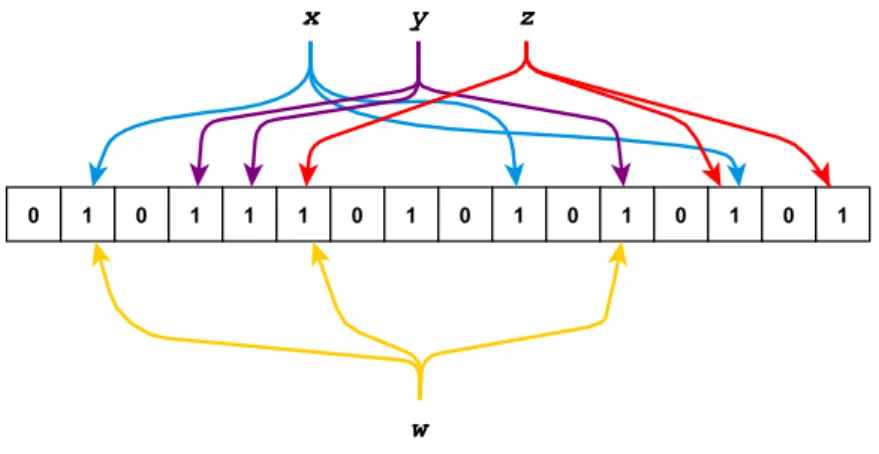
Figure 3.1 exemplifies a case of a false-positive. Here we see a Bloom Filter that has elementsx,y, andz. But when checking ifwalso belongs to the filter, the Bloom Filter will falsely claim to containwdue to the fact that the positions that result from the translation of running w through the k hash functions overlap the presentations of the elements present in the filter.
Thus, despite wnot being present, given that all of the positions that correspond to w’s representation are all set to 1, the filter would wrongly claim thatwwas a member of the set.
Figure 3.1: Example of elements sharing positions in a Bloom Filter.
3. SUMMARIZINGSTATESERVICE 3.1. Scalable Counting Bloom Filter
Data:xis the object key for which membership is tested.
Function:search(x)
m←true; j←1;
whilem== true andj≤kdo
i←hj(x);
ifBi == 0then
m←f alse;
end
j←j+1;
end
returnm;
Algorithm 2:Bloom Filter search function
The fact that positions of the array of bits are shared amongst elements still have their values set to one, which does not convey any information about how many elements are sharing a given position, restricts the types of operations supported, as removing an element from the Bloom Filter is not possible. If an element was to be removed, given that it might have positions shared with other elements, it would negatively impact the filter’s ability to operate correctly, as the removal of that element would lead to all of the positions that were used to represent the element in the array be set to zero. This means that the remaining elements that share some of those positions would be also removed from the Bloom Filter, as their representation in the array would also be affected, thus the filter would wrongly claim that those elements are not present, when they are.
Another draw-back of the Bloom Filter is its un-scalable nature. The fact that the length of the filter has to be set prior to its use — during the initialization process — as-sociated with the relation that exists between the hash functionhj and the length of the filter, restricts its growth. This is due to the fact that the structure only stores a represen-tation of the elements and not the elements themselves, restricting the filter’s length from being modified as the elements that were used to populate the array of bits are no longer present, thus they can not be used to populate a filter of bigger size.
Figure 3.2 depicts the possible representation of the same elementxin filters of dif-ferent sizes. Both filters have elementx’s representation stored. In the filter with length 8 — left side — this representation is achieved by the bits of the array at positions 1,4 and 7. In the filter of length 10 — right side — the element’s representation is performed by setting the bits at positions 2, 6 and 8. As we can see filter’s with different lengths gen-erate different representations for the same elements. Despite both filters using 3 bits to storex’s representation, we can see that the bits used by both filters vary, which justifies the inability of the Bloom Filter expand beyond its initial size, as there is no information stored about the elements themselves, but only a representation.
3. SUMMARIZINGSTATESERVICE 3.1. Scalable Counting Bloom Filter
Figure 3.2: Comparison between two Bloom Filters of different lengths
that elementxwas already present in the filter. Ifxwas tested for membership after the expansion of the filter, the filter would claim that the element was not present, as all of the hashes generated by the hash functionhj would be translated to different positions, thus when checking the values of those positions, given that they are not all set to 1, the filter would have no way of knowing thatxwas present.
This problem can not be solved by converting the old representations to the new fil-ter’s length, as the filter has no knowledge about the elements that were added. The filter’s only function is to store elements’ representations, which negates the idea of con-verting old element representations into new ones.
3.1.2 Counting Bloom Filters
Figure 3.3: Comparision between Bloom Filter and Counting Bloom Filter
Counting Bloom Filters were proposed as a solution for one of the inherent problems of the Bloom Filter: its inability to support element removal [26].
3. SUMMARIZINGSTATESERVICE 3.1. Scalable Counting Bloom Filter
zero and one. This enables the Counting Bloom Filter to keep track of how many elements are sharing any given position, which is the basis for adding support for element removal. The intuition behind this is that by providing the means for each position to vary between 0 andn(wherenis the biggest value that can be represented by the position), removing an element can be achieved simply by decrementing the values that correspond to the element to be removed. This approach has no impact in the remaining elements that have some positions shared with the removed element because their representation in the structure still remains.
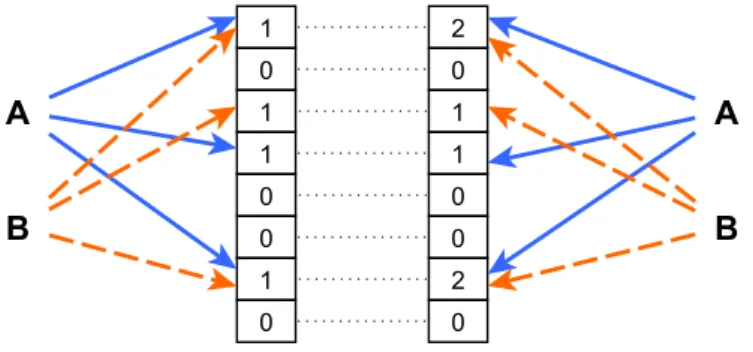
Figure 3.3 exemplifies the core difference between these two structures. On the left side we see how a Bloom Filter would store elementsAandB, and on the right side we see how a Counting Bloom Filter would store the same exact elements. The difference that can be seen is that positions that are shared between A andB are represented in different ways in both structures. While the Bloom Filter does not make any distinction between a position that is shared between elements from one that is not, the values are either 0 or 1. However, for this same scenario the Counting Bloom Filter distinguishes positions that are shared from those that are not. Those positions that are shared between AandB are set to 2, while the other positions that are storing these element’s represen-tations are set to 1.
Typically this is achieved by replacing theBitSetthat is used in the Bloom Filter with another structure — byte array — or by using blocks of bits in the BitSet as a single position, which allows for each position to vary between 0 andn. When using the former approach, each position is only limited by the numbers that can be represented with a single byte. Since a position has two possible states, them being the position is being used to represent elements or it is not. This means that the minimum value that we will need to support is 0. This means that the byte array will be supporting un-signed integers, which implies that the maximum value for each position is also the maximum integer value that can be represented with a single byte: 255. By having each of the positions in the array vary between 0 and 255, this means that at most 255 elements can be sharing a single position.
Although the aforementioned approach is able to successfully reach the goal of en-abling the Counting Bloom Filter to support element removal, supporting 255 values for each position seems excessive. The scenarios that would have a single position being shared by such a large number of element’s representations are so small that supporting that wide range of values would be wasteful. It has been hypothesized by some authors that using 4 bits — half a byte — to represent a single position was enough [27], as this allows for each position to be shared by 15 different elements. Additionally, if collisions start to be too frequent this means that the filter is becoming full, and by allowing further elements to be inserted the filter will no longer respect the false-positive probability.
3. SUMMARIZINGSTATESERVICE 3.1. Scalable Counting Bloom Filter
Insert Operation
Algorithm 3 depicts the logic behind this operation. Comparable to the insert operation of the Bloom Filter, when inserting an elementxin the Counting Bloom Filterkhashes are generated. This is done by running elementx through a hash function hj (where j∈1...k). Thekhashes resulting from that operation are then translated to the positions in the byte array that will be used to store elementx’s representation.
For each iposition in the byte array, its new value B′
i is set to be the old valueBi plus one, which means that each position that corresponds to elementx’s representation is increased by one.
Data:xis the object key to insert into the Counting Bloom filter
Function:insert(x)
forj: 1...kdo
i←hj(x);
/* Verify that incrementing the position’s value does
not result in an overflow */
ifBi<14then
B′
i←Bi+ 1;
end end
Algorithm 3:Counting Bloom Filter insert function
Search Operation
The search operation in the Counting Bloom Filter is identical to the one of the Bloom Filter, as depicted in Algorithm 4.
Data:xis the object key for which membership is tested.
Function:search(x)
m←true; j←1;
whilem== true andj ≤kdo
i←hj(x);
ifBi== 0then
m←f alse;
end
j←j+1;
end
returnm;
Algorithm 4:Counting Bloom Filter search function
3. SUMMARIZINGSTATESERVICE 3.1. Scalable Counting Bloom Filter
The Counting Bloom Filter accesses each iposition, and verifies if the valueBi differs from 0.
If allBi values are verified to be greater than 0, elementxis considered to a member of the set (with a false-probability rate of ρ), thus it is present in the Counting Bloom Filter and the operation returns true. However, if any of the valuesBi is 0, this means that element x is not contained in the set, therefore not be present in the filter, which immediately ends the search operation and the function returnsf alse.
Removal Operation
Removing an element from the Counting Bloom Filter is based around the same logic used in the previous operations, where first a representation of the element to be removed has to be created and then an operation involving the representation and the byte array takes place.
Data:xis the object key for the element to be removed.
Function:remove(x)
/* Check that element x is member */
ifsearch(x)==truethen forj: 1...kdo
i←hj(x);
B′
i ←Bi−1;
end end
Algorithm 5:Counting Bloom Filter remove function
The Algorithm 5 shows the logic behind the operation. Assuming the elementx, that is to be removed, belongs to the set, the process that follows takes place. Firstly,khashes are generated by running elementxthrough the hash functionhj(wherej∈1...k). Then, thesekhashes are transformed into elementx’s presentation, which is achieved by trans-lating each of thekhashes to theipositions of the byte array have the element’s repre-sentation stored. Removing this reprerepre-sentation from the byte array is done by setting the new valueB′
i to be the old valueBi minus 1, meaning that eachiposition is decreased by 1.
Then, after successfully removing elementx’s representation from the byte array, the element itself has been removed from the Counting Bloom Filter, as all knowledge of that element has been erased from the structure.
3. SUMMARIZINGSTATESERVICE 3.1. Scalable Counting Bloom Filter
wrongly erased when removing theghostelement.
By modifying the traditional Bloom Filter, Counting Bloom Filters add support for ele-ment removal. Although support for eleele-ment removal is added, which was one of the original Bloom Filter’s limitations, one limitation is still present: the filter can not grow beyond its original length. This problem is the problem covered in the next sections by both scalable versions of the Bloom Filter.
3.1.3 Scalable Bloom Filters
Although the modification previously described remove one of the original limitations of the Bloom Filter — no support for element removal — the problem of having a fixed length filter still remains to be addressed. The objective of the Scalable Bloom Filter is to overcome said limitation, enabling the filter to grow when needed.
The idea behind this structure is to have not one structure that is used to store ele-ments’ representations but many. The intuition here is that by having a bucket of Bloom Filters by adding more Bloom Filters to the bucket, more elements can be stored in the structure.
This is achieved by creating an additional sub-filter whenever the filter becomes full, and performing further insert operations in this newly created sub-filter.
ρ= 1− l−1
Y
i=0
(1−ρ0ri) (3.2)
Another core difference between this filter and the Bloom Filter is the way that the false-probability rateρis calculated. In the scalable version of the Bloom Filter, the false-probability rate has to take into account the fact there are many sub-filters, therefore it needs to take into account the false-probability rate of those sub-filters when calculating ρfor the Scalable Bloom Filter. When a new sub-filter is created, in order to maintain the same false-positive for the filter, the false-positive rate for the sub-filter has to be adjusted in order for the false-positive rate of the filter to tend to the desired rate. The Equation 3.2 gives the compounded false-probability rate for the scalable version of the Bloom Filter, wherelis the number of sub-filters,rthe tightening ratio andρ0the false-probability rate of the first sub-filter [28].
![Figure 1.1: MacroDB Architecture (Figure taken from [5])](https://thumb-eu.123doks.com/thumbv2/123dok_br/16534320.736468/21.892.348.586.129.296/figure-macrodb-architecture-figure-taken-from.webp)
![Figure 2.1: A possible deployment of Multimed (Figure taken from [16])](https://thumb-eu.123doks.com/thumbv2/123dok_br/16534320.736468/29.892.277.658.670.1098/figure-possible-deployment-multimed-figure-taken.webp)
![Figure 2.2: Eve’s architecture (Figure taken from [17])](https://thumb-eu.123doks.com/thumbv2/123dok_br/16534320.736468/31.892.349.583.232.561/figure-eve-s-architecture-figure-taken-from.webp)
![Figure 2.3: BASE functions overview (Figure taken from [8])](https://thumb-eu.123doks.com/thumbv2/123dok_br/16534320.736468/35.892.252.685.126.335/figure-base-functions-overview-figure-taken.webp)
![Table 2.1: Frost Plan of Action (Adapted from [21]) Epoch Results Survival Strategy](https://thumb-eu.123doks.com/thumbv2/123dok_br/16534320.736468/36.892.264.602.772.1044/table-frost-action-adapted-epoch-results-survival-strategy.webp)
![Figure 2.5: Example of a Respec execution (Figure taken from [22])](https://thumb-eu.123doks.com/thumbv2/123dok_br/16534320.736468/38.892.258.587.357.666/figure-example-respec-execution-figure-taken.webp)