Printed version ISSN 0001-3765 / Online version ISSN 1678-2690 http://dx.doi.org/10.1590/0001-3765201820170629
www.scielo.br/aabc | www.fb.com/aabcjournal
Saturniid moths (Lepidoptera: Bombycoidea) from an Atlantic
Rain Forest fragment in southeastern Brazil
FABIANO F. ALBERTONI1
, CARLOS G.C. MIELKE2
and MARCELO DUARTE1
1
Programa de Pós-Graduação em Sistemática, Taxonomia Animal e Biodiversidade, Museu de Zoologia da Universidade de São Paulo, Avenida Nazaré, 481, 04263-000 São Paulo, SP, Brazil
2
Avenida dos Pioneiros, 1494, 84145-000 Carambeí, PR, Brazil
Manuscript received on August 11, 2017; accepted for publication on January 15, 2018
ABSTRACT
The light-attracted silk moths (Lepidoptera: Saturniidae) of the Boraceia Biological Station in the municipality of Salesópolis, state of São Paulo, southeastern Brazil have been sampled over more than
seven decades (1942-2013). A total of 6,288 individuals (including a gynandromorph) belonging to five subfamilies, 46 genera and 133 species were identified. Hemileucinae was the most abundant and
species-rich subfamily, followed by Ceratocampinae, Arsenurinae, Saturniinae, and Oxyteninae. Hylesia Hübner, Automeris Hübner, and Dirphiopsis Bouvier (Hemileucinae) were the dominant genera in abundance and
species richness. Only Automeris illustris (Walker), Gamelia remissoides Lemaire, and Hidripa paranensis (Bouvier) (Hemileucinae) were recorded in all months of sampling. Hylesia metapyrrha (Walker) was the most abundant saturniid species recorded at the station, with 375 specimens, followed by Hylesia oratex
Dyar with 265 specimens, Dirphia muscosa Schaus with 261 specimens (all Hemileucinae); Copaxa canella Walker (Saturniinae) with 232 specimens, and Lonomia cf. obliqua Walker (Hemileucinae)
with 106 specimens. Fifteen additional species were each represented by more than 100 specimens. The importance of the Boraceia Biological Station to the maintenance of the saturniid moth diversity in the Atlantic Forest is discussed.
Key words: conservation, inventory, neotropical, phenology, research promotion, silk moths.
Correspondence to: Marcelo Duarte E-mail: [email protected]
INTRODUCTION
Moths and butterflies are important organisms in tropical ecosystems because they interact widely with the vegetation and local fauna (Gilbert 1984, Miller 1993, Bonebrake et al. 2010, Johnson et al. 2017, Goldstein 2017). Their feeding habits, great diversity, ease of sampling, and the relatively well known taxonomy of some groups, such as
Saturniidae, make them potentially important organisms for use in monitoring the biological diversity in different communities (Brown and Freitas 1999, 2000a, b, Basset et al. 2017, Mitter et al. 2017).
Ludiinae, Oxyteninae, Salassinae, and Saturniinae (Minet 1994, Regier et al. 2008, van Nieukerken et al. 2011). Of these, five are represented in
the Brazilian fauna (Lemaire and Minet 1998, Duarte et al. 2012): the most speciose subfamily, Hemileucinae, consists of 630 species in 51 genera; the cosmopolitan Saturniinae is represented by 480 species in 59 genera; Ceratocampinae has 170 species in 27 genera; and the Neotropical endemic Arsenurinae and Oxyteninae are represented by 60
species in 10 genera and 35 species in three genera, respectively (Lemaire and Minet 1998). More than one-third of the species estimated for Saturniidae
occur in the Neotropics (Lemaire and Minet 1998, Duarte et al. 2012). In Brazil, approximately 500 species have been recorded (Camargo et al.
2017). Recently, over 500 saturniid species from the Neotropics were described by Brechlin and Meister in the journal Entomo-Satsphingia, which
would add many species to the family, despite these authors’ dubious method of splitting previous available names into cryptic groups (Nässig et al.
2010, St. Laurent et al. 2015).
Adult saturniid moths are mostly nocturnal, except for males of several species in Saturniinae, Hemileucinae, Agliinae, and Ceratocampinae (e.g., Anisota spp., see also Lemaire and Minet 1998). The females of Heliconisa Walker, 1855
are essentially diurnal, as well as the females of
Ithomisa Oberthür, 1881, which fly at the end of
the day and also at night. The mouthparts of these insects are inchoate and they do not feed during
their short 5–12-day adult life (Janzen 1984). Strong sexual dimorphism is observed in species of Ceratocampinae, Hemileucinae, and Oxyteninae; females can weigh more than twice as much as males, usually bear filiform antennae (pectinate in males), and are larger with more rounded wings
than in males (Janzen 1984).
BRAZILIAN INVENTORIES OF SATURNIIDAE
The southern states of Brazil, Rio Grande do Sul, Santa Catarina, and Paraná, have partially inventoried their saturniid fauna. After approximately a decade of investigations in Rio Grande do Sul, 113 species in four subfamilies were recorded: Hemileucinae (61 species, 54%), Ceratocampinae (30, 27%), Arsenurinae (12, 11%), and Saturniinae (10, 9%) (Nunes et al. 2004, Specht et al. 2005a, b, Prestes et al. 2009). Although we have some efforts of sampling in Rio Grande do Sul, mainly focusing on groups of medical importance, there is still a need for long-term and systematic inventories to know the composition and distribution of the saturniids in different vegetation formations (e.g., grasslands, dense ombrophilous and seasonal deciduous forests, Araucaria forest) in this region of Brazil (see also vegetation map of Buriol et al. 2007).
To determine the Santa Catarina saturniid fauna, Siewert et al. (2010) used data from six important Brazilian lepidopteran collections, as well as geographic distributions provided by Lemaire (1978, 1980, 1988, 2002). They recorded a total of 149 species in 50 genera, including 90 (60%) species of Hemileucinae, 32 (21%) of Ceratocampinae, 16 (11%) of Arsenurinae, and 11 (7%) of Saturniinae. We can state that the saturniid fauna of Santa Catarina is still poorly sampled. Only eight municipalities in the entire state have been sampled to date (see the map in Siewert et al. 2010), and it is necessary to intensify sampling efforts in the main vegetation formations in the state (e.g., deciduous, dense ombrophilous, and subtropical ombrophilous forests).
and northeastern São Paulo and northern Paraná (Filardi et al. 2007). The Cerrado borders three other biomes and is considered a world biodiversity hotspot (Myers et al. 2000). Although extensive efforts have been made to sample saturniids in the Brazilian Cerrado, these moths remain little known in some states that still contain remnants (strongly threatened by human action) of this biome.
In addition, as part of an extensive entomological catalog, Zikán and Zikán (1968) listed the lepidopteran (not all suborders) fauna from the Itatiaia region, which included the family Saturniidae (Saturnioidea in Zikán and Zikán 1968). This region is located between the states of Rio de Janeiro and Minas Gerais and varies widely in altitude, from approximately 500 m to more than 2,400 m (Zikán and Zikán 1940). Zikán and Zikán (1968) listed 125 species from 33 genera: Hemileucinae, 70 species (56%); Ceratocampinae, 33 (26%); Arsenurinae, 7 (6%); Saturniinae, 12 (10%); and Oxyteninae, 3 (3%), with 28 undetermined species, totaling 153 species. However, their determinations should be revised with the current nomenclature, in order to develop an accurate survey.
As we can see, the Brazilian Saturniidae are still unsatisfactorily understood with respect to species distribution, taxonomy, and biological information (e.g., Albertoni and Duarte 2015), although some knowledge is available for species with medical or economic value (Lemaire 2002, Specht et al. 2008). Undeniably, faunal inventories are vital to understanding and monitoring local biodiversity (Silveira et al. 2010). Saturniid moths were efficiently attracted at night via light trap, and we report herein a species list from long-term survey data (more than 70 years) collected in a strategically located fragment of Atlantic Rain Forest (Boraceia Biological Station) in the state of São Paulo, southeastern Brazil.
The main objective of developing this list of species is to increase the knowledge and eight localities in Paraná, Marinoni and Dutra
(1991) sampled different groups of Lepidoptera with malaise and light traps (modified from the “Luiz de Queiroz” model light trap; see Silveira Neto and Silveira 1969). The saturniids were studied by Marinoni et al. (1997), resulting in the identification of 83 species distributed as follows: Hemileucinae (38 species, 46% of all species sampled), Ceratocampinae (25, 30%), Arsenurinae (10, 12%), Saturniinae (9, 11%), and Oxyteninae (1, 1%). More recently, Santos et al. (2015) sampled the community of Saturniidae in a montane mixed ombrophilous forest in the eastern part of the state (Vossoroca, Tijucas do Sul, 25o50’08.93”S, 49o02’55.20”W, elevation 880 m). They used black and mercury-vapor mixed bulbs, and identified 86 species of saturniids: Hemileucinae (56 species, 65% of all species sampled), Ceratocampinae (17, 20%), Arsenurinae (5, 6%), Saturniinae (7, 8%), and Oxyteninae (1, 1%). We believe that a greater collecting effort in poorly sampled localities in Paraná will expand the list of species currently recorded from the nine localities sampled to date.
understanding of Brazilian biodiversity, allowing eventual amplification of the predictive capacity of lepidopteran fauna responses to global changes, particularly changes in land use and land cover and climate changes. The large extent of the reserve within which the Boraceia Biological Station is located, and because it contains mostly primary forest, two rare characteristics in fragments of Atlantic Rain Forest, make the biological station highly important for studies of the biodiversity of this biome. The importance of standardized local biological inventories and studies of community composition is evident, as in the case of the present study.
Longino and Colwell (1997) emphasized the importance of biological inventories for conservation purposes, since they allow descriptions and characterizations of communities in terms of species richness, abundance and complementarity with other communities. Obtaining such information is important, for example, in setting priorities for monitoring and conservation actions. The Saturniidae, which is usually prominent among the lepidopteran fauna due to the diversity and ecological importance of its members, and is commonly among the best-studied moth families in a given locality (Santos et al. 2015), has been the target of a number of previous inventories in Brazil.
MATERIALS AND METHODS
STUDY AREA
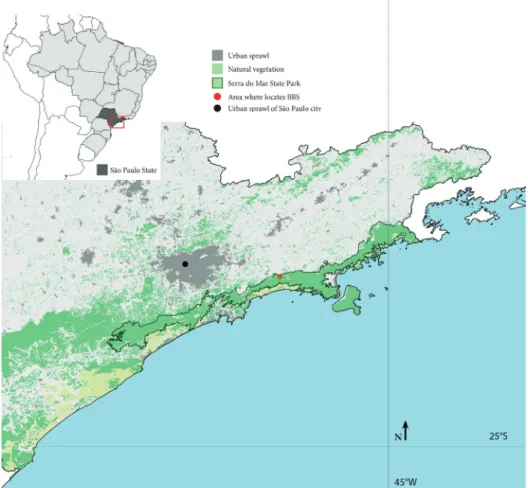
The survey of saturniid moths was conducted at the Boraceia Biological Station (BBS) (23º39′S, 45º53′W, elevation 850 m), located in the municipality of Salesópolis, state of São Paulo, in southeastern Brazil. The Biological Station is managed by the Museu de Zoologia of the Universidade de São Paulo (MZSP) and has an area of 96 ha. The station is located within the largest fragment of Brazilian Atlantic Rain Forest,
which includes several parks and other types of conservation units (Travassos Filho and Camargo 1958, Custodio Filho 1989) (Figure 1). The climate is wet tropical, Cfa in Köppen’s classification (Köppen 1948). Measurements from 1925 to 1944 identified Boraceia as one of the most humid regions in Brazil, with a mean annual rainfall of 3,058 mm (Setzer 1946).
MOTH SAMPLING
Sampling of saturniid moths in the BBS started in 1942, with the entomologist Romualdo Ferreira D’Almeida. A few years later, the entomologists Lauro Travassos, Lauro Travassos Filho, Ernesto Xavier Rabello, and several associates continued the series, with extensive collections spanning decades (Travassos Filho and Camargo 1958). A recent inventory was conducted by the senior author, over 13 consecutive months in 2012 and 2013 (see also Table I).
SPECIES IDENTIFICATION AND DATA ANALYSES
Previous identifications of the specimens deposited in the MZSP collection were verified, and nomenclature was checked using Lemaire (1978, 1980, 1988, 2002). To update previous reports, we used Mielke et al. (2005), Wolfe (2005), Specht et al. (2006), and Brechlin and Meister (2011). In addition to this literature, we used the content and associated data available in the member-restricted area of the website http://www.silkmoths.bizland. com/indexos.htm. To obtain more precise identification of specimens, 63 males of several morphospecies were dissected and data concerning the genitals were compared with literature and/ or with that from previously extracted organs. Dissections were conducted as follows: the abdomen was cut at segments IV–V and placed
in a boiling 10% KOH solution for approximately 10 min. The tegument and internal contents were removed, the abdomen was placed in chlorazol black solution for approximately 1 min, and the genitals were separated from the abdomen. All parts were preserved in a container with glycerin, labeled, and given a unique code.
Most moths were pinned and dried, but a few were identified and placed in entomological envelopes, on which the sample origin and species identification were annotated.
RESULTS AND DISCUSSION
TABLE I
Months and years with records of Saturniidae (Lepidoptera) from the Boraceia Biological Station, São Paulo, Brazil.
Years Jan Feb Mar Apr May Jun Jul Aug Sep Oct Nov Dec
1942 X X X X X
1943 X
1946 X
1947 X X X
1948 X X X X X X X X X X X X
1949 X X X X X X X X X X X X
1950 X X X X X
1951 X X
1952 X X X X
1953 X
1954 X X X X X X X
1956 X X
1957 X X X X X
1958 X X X X
1959 X X X X X X
1960 X
1961 X
1962 X X X X X X X X
1963 X X X X
1964 X X X X X
1965 X X X X X X X X X X X X
1966 X X X X X X X X X X X
1967 X X X X X X X X X
1968 X X X X X X X X X X
1969 X X X X X
1970 X
1983 X
1985 X X
1987 X
1989 X
1991 X
1995 X
1997 X
1999 X
2000 X X X
2001 X X X X X
2002 X X
2003 X
2004 X X
2008 X
2010 X
2012 X X X X X X X X X X X
2013 X X X X
Total* 13 16 15 16 8 10 11 13 20 24 17 13
*
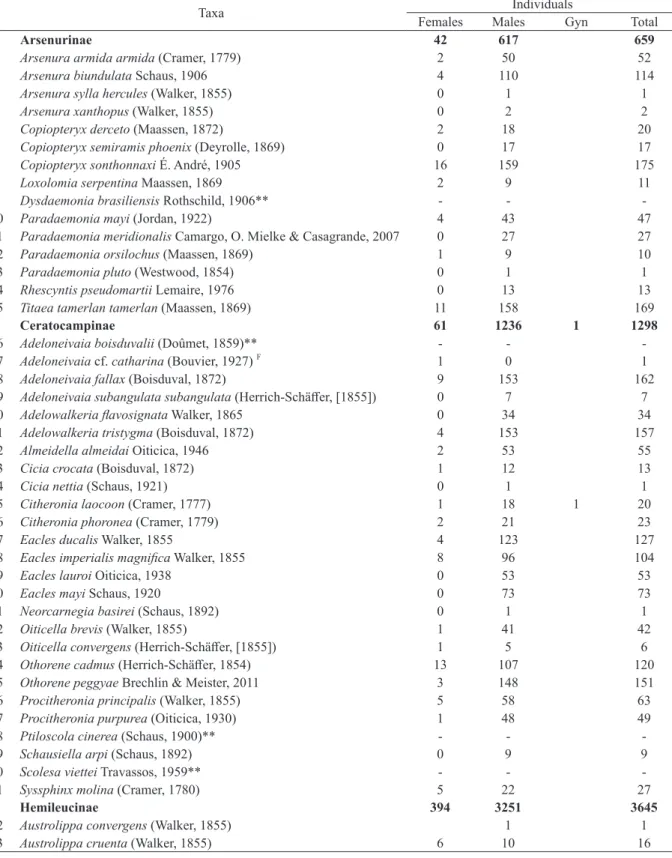
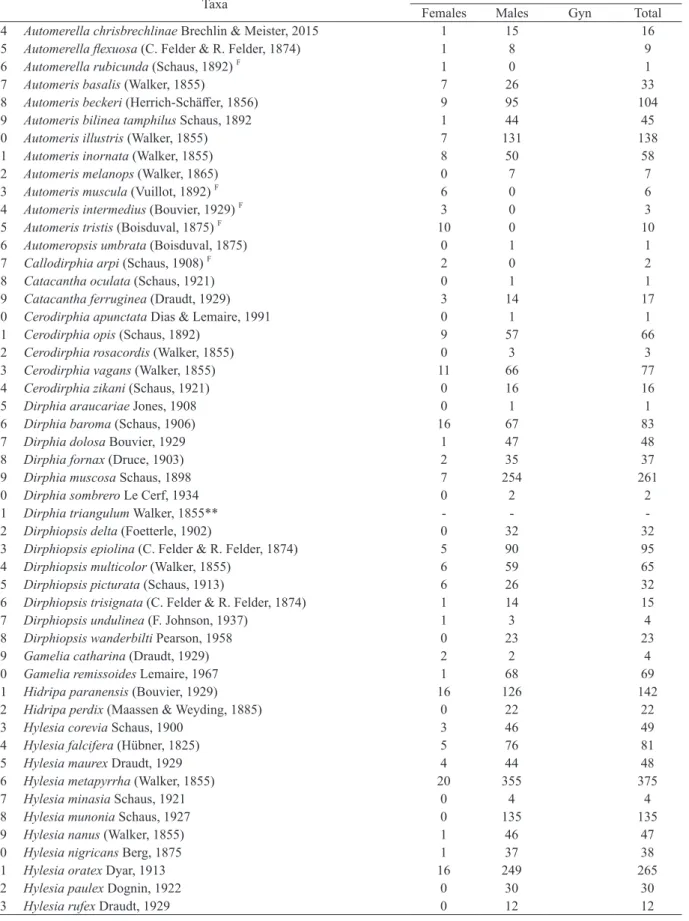
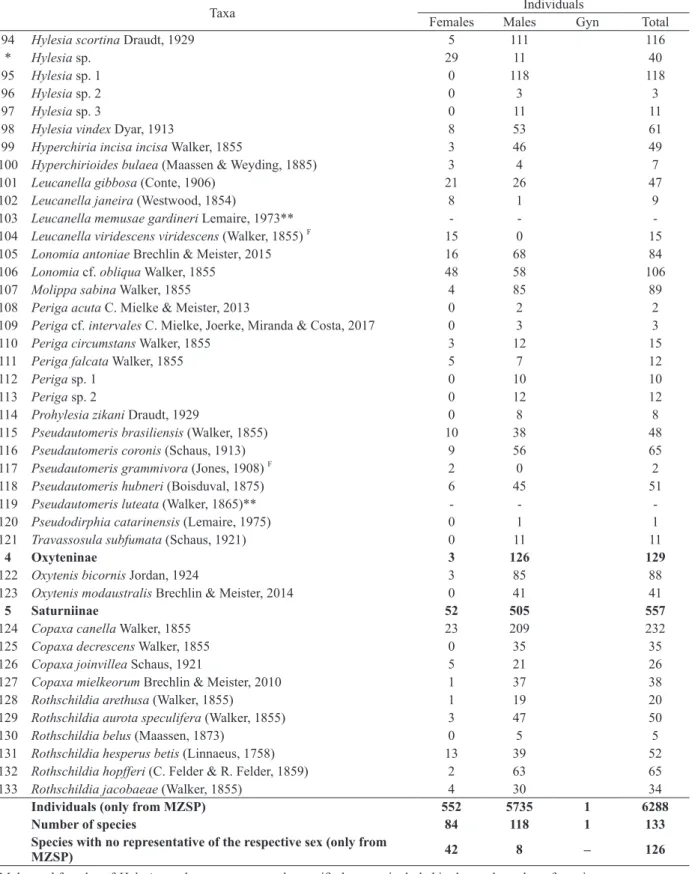
94% of the specimens examined were identified to the species level, and consisted of 43 genera and 126 species. The greatest abundance and number of species were observed for Hemileucinae, with 3,645 specimens (58%) of 77 species (61.1%), followed by Ceratocampinae with 1,298 specimens (20.6%) of 23 species (18.4%), Arsenurinae with 659 specimens (10.5%) of 14 species (11.2%), Saturniinae with 557 specimens (8.9%) of 10 species (7.9%), and Oxyteninae with 129 specimens (2.1%) of two species (1.6%) (Tables II and III). Besides the species deposited at MZSP, Miranda et al. (2015) recorded seven other species (one Arsenurinae, three Ceratocampinae, and three Hemileucinae, also listed in Table III) belonging to three genera from the BBS and apparently deposited only in the Entomological Collection of the Oswaldo Cruz Institute. Therefore, a total of 46 genera and 133 species are recorded from this biological station.
The distribution of the saturniid species among subfamilies in the BBS follows the pattern in most South American surveys (Ecuador: Racheli and Racheli 2005, 2006, Brazil: Marinoni et al. 1997, Camargo and Becker 1999, Nunes et al. 2004, Prestes et al. 2009, Siewert et al. 2010). Hemileucinae is the most speciose subfamily, followed by Ceratocampinae, Arsenurinae, Saturniinae, and Oxyteniinae (not infrequently, surveys do not include this subfamily because it has been raised to family rank). Worldwide, Hemileucinae is the subfamily with the largest number of species; Saturniinae, the only subfamily distributed worldwide, is next in species richness. However, although this pattern has also been observed in the Brazilian Cerrado, Camargo and Becker (1999) demonstrated that, as a percentage, Ceratocampinae and Arsenurinae together amount to almost the same proportion as Hemileucinae in this biome (48.2% Hemileucinae vs. 47.0%
Ceratocampinae plus Arsenurinae). They explained this importance of Ceratocampinae and Arsenurinae
in the Cerrado by the biology of these moths. It seems that the caterpillars, which bury in the soil to pupate, have higher survival in environments with a pronounced dry season.
The most abundant genera with the most species in the BBS belonged to the subfamily Hemileucinae. The genus Hylesia Hübner, [1820]
was represented by 1,433 specimens in 17 species, including Hylesia sp. 1, sp. 2, and sp. 3. The next most speciose genera were Automeris Hübner,
[1819] (Hemileucinae) with 404 specimens from nine species, and Dirphiopsis Bouvier, 1928 with 266 specimens from seven species. Dirphia Hübner,
[1819], with six species, was the second most abundant genus with 432 specimens. Rothschildia
Grote, 1897 (Saturniinae) was the only genus not belonging to Hemileucinae to be represented by six species, with 226 specimens.
The genus Hylesia is usually markedly dominant in surveys of Saturniidae in Brazil. In Paraná and Rio Grande do Sul, for example, 14 (16.3% of all species) and nine (8%) species of this genus were recorded, respectively. For BBS, 17 species (13.5% of all species) were recorded, including three morphospecies, in addition to a set of 40 specimens identified only at the genus level.
Hylesia is among the genera with the most
TABLE II
Number of species and individuals of all genera in each subfamily of Saturniidae, collected from the Boraceia Biological Station between 1942 and 2013. Gyn= Gynandromorph.
Subfamilies /Genera Species number Individuals
Female Male Gyn Total
1 Arsenurinae 15 42 617 659
1 Arsenura 4 6 163 169
2 Copiopteryx 3 18 194 212
3 Dysdaemonia** 1 – – –
4 Loxolomia 1 2 9 11
5 Paradaemonia 4 5 80 85
6 Rhescyntis 1 0 13 13
7 Titaea 1 11 158 169
2 Ceratocampinae 26 61 1236 1 1298
8 Adeloneivaia 4 10 160 170
9 Adelowalkeria 2 4 187 191
10 Almeidella 1 2 53 55
11 Cicia 2 1 13 14
12 Citheronia 2 3 39 1 43
13 Eacles 4 12 345 357
14 Neorcarnegia 1 0 1 1
15 Oiticella 2 2 46 48
16 Othorene 2 16 255 271
17 Procitheronia 2 6 106 112
18 Ptiloscola** 1 – – –
19 Schausiella 1 0 9 9
20 Scolesa** 1 – – –
21 Syssphinx 1 5 22 27
3 Hemileucinae 80 394 3251 3645
22 Austrolippa 2 6 11 17
23 Automerella 3 3 23 26
24 Automeris 9 51 353 404
25 Automeropsis 1 0 1 1
26 Callodirphia 1 2 0 2
27 Catacantha 2 3 15 18
28 Cerodirphia 5 20 143 163
29 Dirphia 7 26 406 432
30 Dirphiopsis 7 19 247 266
31 Gamelia 2 3 70 73
32 Hidripa 2 16 148 164
33 Hylesia 16 92 1341 1433
34 Hyperchiria 1 3 46 49
35 Hyperchirioides 1 3 4 7
36 Leucanella 4 44 27 71
37 Lonomia 2 64 126 190
38 Molippa 1 4 85 89
39 Periga 6 8 46 54
40 Prohylesia 1 0 8 8
41 Pseudautomeris 5 27 139 166
42 Pseudodirphia 1 0 1 1
43 Travassosula 1 0 11 11
4 Oxyteninae 2 3 126 129
44 Oxytenis 2 3 126 129
5 Saturniinae 10 52 505 557
45 Copaxa 4 29 302 331
46 Rothschildia 6 23 203 226
Total 133 552 5735 1 6288
TABLE III
Species of Saturniidae (Lepidoptera) collected between 1942 and 2013 from the Boraceia Biological Station, São Paulo, Brazil. Voucher material is deposited in the MZSP collection or was listed by Miranda et al. (2015). Gyn =
Gynandromorph.
Taxa Individuals
Females Males Gyn Total
1 Arsenurinae 42 617 659
1 Arsenura armida armida (Cramer, 1779) 2 50 52
2 Arsenura biundulata Schaus, 1906 4 110 114
3 Arsenura syllahercules (Walker, 1855) 0 1 1
4 Arsenura xanthopus (Walker, 1855) 0 2 2
5 Copiopteryx derceto (Maassen, 1872) 2 18 20
6 Copiopteryx semiramis phoenix (Deyrolle, 1869) 0 17 17
7 Copiopteryx sonthonnaxi É. André, 1905 16 159 175
8 Loxolomia serpentina Maassen, 1869 2 9 11
9 Dysdaemonia brasiliensis Rothschild, 1906** - -
-10 Paradaemonia mayi (Jordan, 1922) 4 43 47
11 Paradaemonia meridionalis Camargo, O. Mielke & Casagrande, 2007 0 27 27
12 Paradaemonia orsilochus (Maassen, 1869) 1 9 10
13 Paradaemonia pluto (Westwood, 1854) 0 1 1
14 Rhescyntis pseudomartii Lemaire, 1976 0 13 13
15 Titaea tamerlan tamerlan (Maassen, 1869) 11 158 169
2 Ceratocampinae 61 1236 1 1298
16 Adeloneivaia boisduvalii (Doûmet, 1859)** - -
-17 Adeloneivaia cf. catharina (Bouvier, 1927) F
1 0 1
18 Adeloneivaia fallax (Boisduval, 1872) 9 153 162
19 Adeloneivaia subangulatasubangulata (Herrich-Schäffer, [1855]) 0 7 7
20 Adelowalkeria flavosignata Walker, 1865 0 34 34
21 Adelowalkeria tristygma (Boisduval, 1872) 4 153 157
22 Almeidella almeidai Oiticica, 1946 2 53 55
23 Cicia crocata (Boisduval, 1872) 1 12 13
24 Cicia nettia (Schaus, 1921) 0 1 1
25 Citheronia laocoon (Cramer, 1777) 1 18 1 20
26 Citheronia phoronea (Cramer, 1779) 2 21 23
27 Eacles ducalis Walker, 1855 4 123 127
28 Eacles imperialis magnifica Walker, 1855 8 96 104
29 Eacles lauroi Oiticica, 1938 0 53 53
30 Eacles mayi Schaus, 1920 0 73 73
31 Neorcarnegia basirei (Schaus, 1892) 0 1 1
32 Oiticella brevis (Walker, 1855) 1 41 42
33 Oiticella convergens (Herrich-Schäffer, [1855]) 1 5 6
34 Othorene cadmus (Herrich-Schäffer, 1854) 13 107 120
35 Othorene peggyae Brechlin & Meister, 2011 3 148 151
36 Procitheronia principalis (Walker, 1855) 5 58 63
37 Procitheronia purpurea (Oiticica, 1930) 1 48 49
38 Ptiloscola cinerea (Schaus, 1900)** - -
-39 Schausiella arpi (Schaus, 1892) 0 9 9
40 Scolesa viettei Travassos, 1959** - -
-41 Syssphinx molina (Cramer, 1780) 5 22 27
3 Hemileucinae 394 3251 3645
42 Austrolippa convergens (Walker, 1855) 1 1
Taxa Individuals
Females Males Gyn Total
44 Automerella chrisbrechlinae Brechlin & Meister, 2015 1 15 16
45 Automerella flexuosa (C. Felder & R. Felder, 1874) 1 8 9
46 Automerellarubicunda (Schaus, 1892) F
1 0 1
47 Automerisbasalis (Walker, 1855) 7 26 33
48 Automerisbeckeri (Herrich-Schäffer, 1856) 9 95 104
49 Automerisbilineatamphilus Schaus, 1892 1 44 45
50 Automerisillustris (Walker, 1855) 7 131 138
51 Automerisinornata (Walker, 1855) 8 50 58
52 Automeris melanops (Walker, 1865) 0 7 7
53 Automeris muscula (Vuillot, 1892) F
6 0 6
54 Automeris intermedius (Bouvier, 1929) F
3 0 3
55 Automeris tristis (Boisduval, 1875) F
10 0 10
56 Automeropsis umbrata (Boisduval, 1875) 0 1 1
57 Callodirphia arpi (Schaus, 1908) F
2 0 2
58 Catacanthaoculata (Schaus, 1921) 0 1 1
59 Catacantha ferruginea (Draudt, 1929) 3 14 17
60 Cerodirphia apunctata Dias & Lemaire, 1991 0 1 1
61 Cerodirphia opis (Schaus, 1892) 9 57 66
62 Cerodirphia rosacordis (Walker, 1855) 0 3 3
63 Cerodirphia vagans (Walker, 1855) 11 66 77
64 Cerodirphia zikani (Schaus, 1921) 0 16 16
65 Dirphia araucariae Jones, 1908 0 1 1
66 Dirphia baroma (Schaus, 1906) 16 67 83
67 Dirphia dolosa Bouvier, 1929 1 47 48
68 Dirphia fornax (Druce, 1903) 2 35 37
69 Dirphia muscosa Schaus, 1898 7 254 261
70 Dirphia sombrero Le Cerf, 1934 0 2 2
71 Dirphia triangulum Walker, 1855** - -
-72 Dirphiopsis delta (Foetterle, 1902) 0 32 32
73 Dirphiopsis epiolina (C. Felder & R. Felder, 1874) 5 90 95
74 Dirphiopsis multicolor (Walker, 1855) 6 59 65
75 Dirphiopsis picturata (Schaus, 1913) 6 26 32
76 Dirphiopsis trisignata (C. Felder & R. Felder, 1874) 1 14 15
77 Dirphiopsis undulinea (F. Johnson, 1937) 1 3 4
78 Dirphiopsis wanderbilti Pearson, 1958 0 23 23
79 Gamelia catharina (Draudt, 1929) 2 2 4
80 Gamelia remissoides Lemaire, 1967 1 68 69
81 Hidripa paranensis (Bouvier, 1929) 16 126 142
82 Hidripa perdix (Maassen & Weyding, 1885) 0 22 22
83 Hylesia corevia Schaus, 1900 3 46 49
84 Hylesia falcifera (Hübner, 1825) 5 76 81
85 Hylesia maurex Draudt, 1929 4 44 48
86 Hylesia metapyrrha (Walker, 1855) 20 355 375
87 Hylesia minasia Schaus, 1921 0 4 4
88 Hylesia munonia Schaus, 1927 0 135 135
89 Hylesia nanus (Walker, 1855) 1 46 47
90 Hylesia nigricans Berg, 1875 1 37 38
91 Hylesia oratex Dyar, 1913 16 249 265
92 Hylesia paulex Dognin, 1922 0 30 30
93 Hylesia rufex Draudt, 1929 0 12 12
Taxa Individuals
Females Males Gyn Total
94 Hylesiascortina Draudt, 1929 5 111 116
* Hylesia sp. 29 11 40
95 Hylesia sp. 1 0 118 118
96 Hylesia sp. 2 0 3 3
97 Hylesia sp. 3 0 11 11
98 Hylesiavindex Dyar, 1913 8 53 61
99 Hyperchiriaincisaincisa Walker, 1855 3 46 49
100 Hyperchirioidesbulaea (Maassen & Weyding, 1885) 3 4 7
101 Leucanellagibbosa (Conte, 1906) 21 26 47
102 Leucanellajaneira (Westwood, 1854) 8 1 9
103 Leucanella memusae gardineri Lemaire, 1973** - -
-104 Leucanellaviridescens viridescens (Walker, 1855) F
15 0 15
105 Lonomiaantoniae Brechlin & Meister, 2015 16 68 84
106 Lonomia cf. obliqua Walker, 1855 48 58 106
107 Molippasabina Walker, 1855 4 85 89
108 Perigaacuta C. Mielke & Meister, 2013 0 2 2
109 Periga cf. intervales C. Mielke, Joerke, Miranda & Costa, 2017 0 3 3
110 Perigacircumstans Walker, 1855 3 12 15
111 Perigafalcata Walker, 1855 5 7 12
112 Periga sp. 1 0 10 10
113 Periga sp. 2 0 12 12
114 Prohylesia zikani Draudt, 1929 0 8 8
115 Pseudautomeris brasiliensis (Walker, 1855) 10 38 48
116 Pseudautomeris coronis (Schaus, 1913) 9 56 65
117 Pseudautomeris grammivora (Jones, 1908) F 2 0 2
118 Pseudautomeris hubneri (Boisduval, 1875) 6 45 51
119 Pseudautomeris luteata (Walker, 1865)** - -
-120 Pseudodirphia catarinensis (Lemaire, 1975) 0 1 1
121 Travassosula subfumata (Schaus, 1921) 0 11 11
4 Oxyteninae 3 126 129
122 Oxytenis bicornis Jordan, 1924 3 85 88
123 Oxytenis modaustralis Brechlin & Meister, 2014 0 41 41
5 Saturniinae 52 505 557
124 Copaxa canella Walker, 1855 23 209 232
125 Copaxa decrescens Walker, 1855 0 35 35
126 Copaxa joinvillea Schaus, 1921 5 21 26
127 Copaxa mielkeorum Brechlin & Meister, 2010 1 37 38
128 Rothschildia arethusa (Walker, 1855) 1 19 20
129 Rothschildia aurotaspeculifera (Walker, 1855) 3 47 50
130 Rothschildia belus (Maassen, 1873) 0 5 5
131 Rothschildia hesperusbetis (Linnaeus, 1758) 13 39 52
132 Rothschildia hopfferi (C. Felder & R. Felder, 1859) 2 63 65
133 Rothschildia jacobaeae (Walker, 1855) 4 30 34
Individuals (only from MZSP) 552 5735 1 6288
Number of species 84 118 1 133
Species with no representative of the respective sex (only from
MZSP) 42 8 – 126
* Males and females of Hylesia sp. that were not morphospecified are not included in the total number of species.
** Species listed by Miranda et al. (2015). F
Species represented only by female individuals.
for the subgeneric categorization of the traditional taxonomy and for the systematics and use of this knowledge to elucidate the relationships among species or groups of species (R. Dell’Erba and M. Duarte, unpublished data).
Among the saturniid species of the BBS deposited in the MZSP Lepidoptera Collection, 12 are represented by singletons: two species of Arsenurinae, Arsenura sylla hercules (Walker, 1855) and Paradaemonia pluto (Westwood, 1854); three of Ceratocampinae, Adeloneivaia cf.
catharina (Bouvier, 1927), Cicia nettia (Schaus,
1921), and Neorcarnegia basirei (Schaus, 1892); and seven of Hemileucinae, Austrolippa
convergens (Walker, 1855), Automerellarubicunda
(Schaus, 1892), Automeropsis umbrata (Boisduval, 1875), Catacantha oculata (Schaus, 1921),
Cerodirphia apunctata Dias & Lemaire, 1991,
Dirphia araucaria Jones, 1908, and Pseudodirphia
catarinensis (Lemaire, 1975).
Hylesia metapyrrha (Walker, 1855) was the
most abundant saturniid species recorded in the BBS, with 375 specimens, followed by Hylesia
oratex Dyar, 1913 with 265 specimens; Dirphia
muscosa Schaus, 1898 with 261 specimens (all
Hemileucinae); Copaxa canella Walker, 1855 (Saturniinae) with 232 specimens; and Lonomia
cf. obliqua Walker, 1855 (Hemileucinae) with
106 specimens. In addition, 15 other species were represented by more than 100 specimens in the MZSP Collection (Table III). Only Automeris
illustris (Walker, 1855), Gamelia remissoides
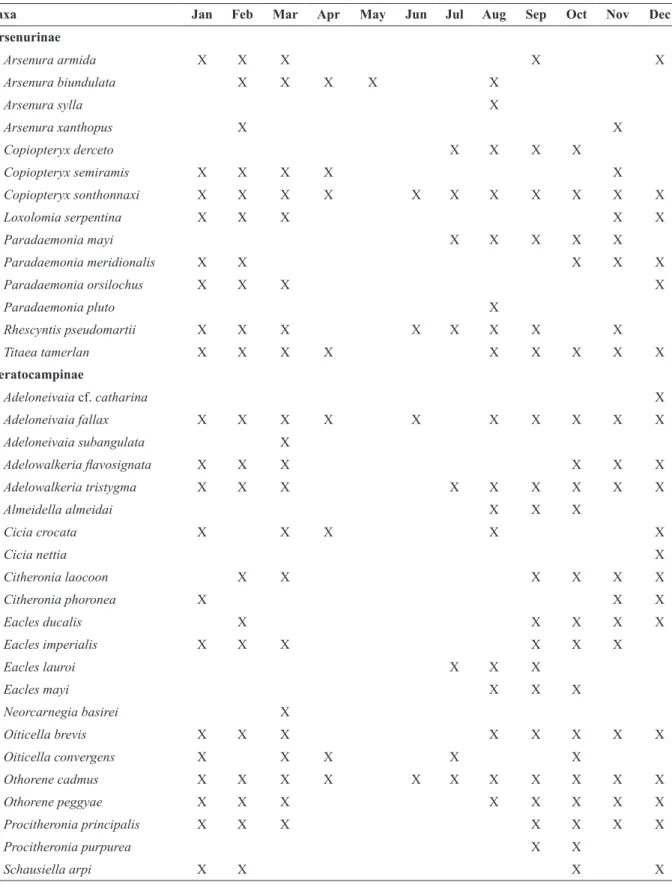
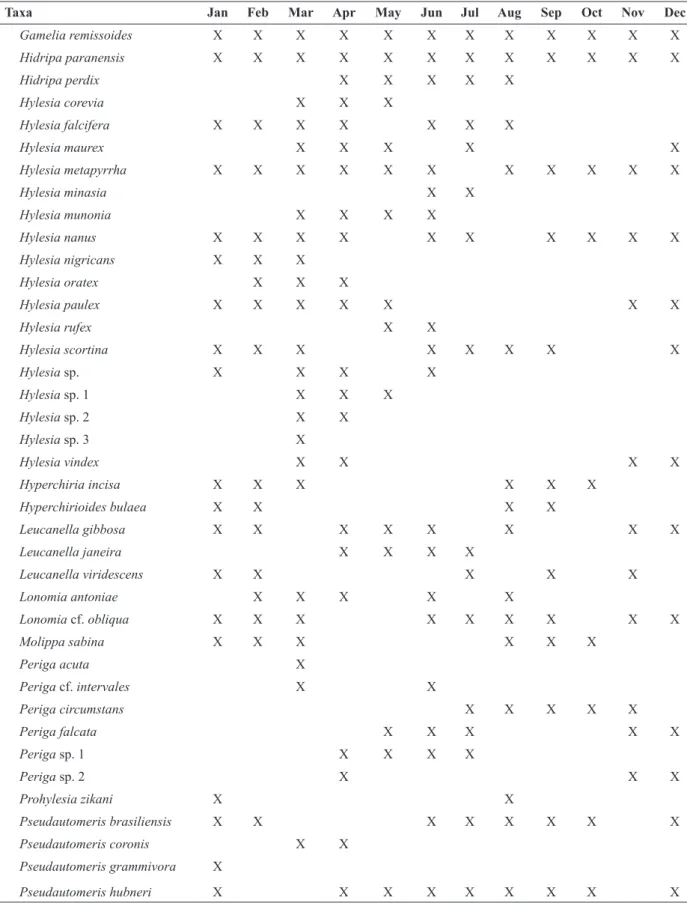
Lemaire, 1967, and Hidripa paranensis (Bouvier, 1929) (Hemileucinae) were recorded in all months of sampling (Table IV). Five other species appear to be constant in the BBS, although they have not been recorded in one month throughout the period of sampling (Table IV): Arsenurinae: Copiopteryx
sonthonnaxi É. André, 1905; Ceratocampinae:
Othorene cadmus (Herrich-Schäffer, [1855]);
Hemileucinae: H. metapyrrha; Oxyteninae:
Oxytenis bicornis Jordan, 1924; and Saturniinae:
Copaxa canella.
CONCLUSIONS
The number of species among the subfamilies of Saturniidae recorded from the Boraceia Biological Station followed a similar pattern to that observed in most inventories conducted in Brazil and other countries of South America. Although the number of species increased sporadically with an increasing number of samples at a given location, collections from different altitudes or phytophysiognomies of the matrix region may greatly increase the species number. In total, 133 saturniid species were recorded, with no endemism to the BBS.
We found it prudent not to compare statistically our results on species richness with other surveys, because clearly the sampling efforts were not the same, and also because the phytophysiognomies are quite different from those in the BBS. The collection of Saturniidae from the BBS deposited in the MZSP is the result of more than 70 years of sampling accumulation, and thus it is not perfectly suitable for such comparisons. However, the number of species (133 species) recorded in the present study was obtained in a single sampling site (see details in the Materials and Methods section), and is comparatively high in relation to the number of species inventoried for the Brazilian Cerrado biome (202 species), the Itatiaia region (125 species), and Rio Grande do Sul (113 species), Santa Catarina (149 species), and Paraná (131 species).
TABLE IV
Phenology of the species of Saturniidae recorded between 1942 and 2013 from the Boraceia Biological Station, Salesópolis, São Paulo, Brazil (based on the material deposited in the MZSP).
Taxa Jan Feb Mar Apr May Jun Jul Aug Sep Oct Nov Dec
Arsenurinae
Arsenura armida X X X X X
Arsenura biundulata X X X X X
Arsenura sylla X
Arsenura xanthopus X X
Copiopteryx derceto X X X X
Copiopteryx semiramis X X X X X
Copiopteryx sonthonnaxi X X X X X X X X X X X
Loxolomia serpentina X X X X X
Paradaemonia mayi X X X X X
Paradaemonia meridionalis X X X X X
Paradaemonia orsilochus X X X X
Paradaemonia pluto X
Rhescyntis pseudomartii X X X X X X X X
Titaea tamerlan X X X X X X X X X
Ceratocampinae
Adeloneivaia cf. catharina X
Adeloneivaia fallax X X X X X X X X X X
Adeloneivaia subangulata X
Adelowalkeria flavosignata X X X X X X
Adelowalkeria tristygma X X X X X X X X X
Almeidella almeidai X X X
Cicia crocata X X X X X
Cicia nettia X
Citheronia laocoon X X X X X X
Citheronia phoronea X X X
Eacles ducalis X X X X X
Eacles imperialis X X X X X X
Eacles lauroi X X X
Eacles mayi X X X
Neorcarnegia basirei X
Oiticella brevis X X X X X X X X
Oiticella convergens X X X X X
Othorene cadmus X X X X X X X X X X X
Othorene peggyae X X X X X X X X
Procitheronia principalis X X X X X X X
Procitheronia purpurea X X
Taxa Jan Feb Mar Apr May Jun Jul Aug Sep Oct Nov Dec
Syssphinx molina X X X X X X X
Hemileucinae
Austrolippa convergens X
Austrolippa cruenta X X X X X X X
Automerella chrisbrechlinae X X X X
Automerella flexuosa X X
Automerella rubicunda X
Automeris basalis X X X X
Automeris beckeri X X X X
Automeris bilinea X X X X X X X X
Automeris illustris X X X X X X X X X X X X
Automeris inornata X X X
Automeris melanops X X X
Automeris muscula X X X X
Automeris intermedius X X X
Automeris tristis X X X X X
Automeropsis umbrata X
Callodirphia arpi X X
Catacantha oculata X
Catacantha ferruginea X X X X X X
Cerodirphia apunctata X
Cerodirphia opis X X X X X X X
Cerodirphia rosacordis X X
Cerodirphia vagans X X X X X X X X X X
Cerodirphia zikani X X
Dirphia araucariae X
Dirphia baroma X X X X X
Dirphia dolosa X X X X
Dirphia fornax X X X X
Dirphia muscosa X X X X X X X X X X
Dirphia sombrero X X
Dirphiopsis delta X X X X
Dirphiopsis epiolina X X X X X
Dirphiopsis multicolor X X X X X X X X X X
Dirphiopsis picturata X X X X
Dirphiopsis trisignata X X X
Dirphiopsis undulinea X X
Dirphiopsis wanderbilti X X X X X
Gamelia catharina X X X
TABLE IV (continuation)
Taxa Jan Feb Mar Apr May Jun Jul Aug Sep Oct Nov Dec
Gamelia remissoides X X X X X X X X X X X X
Hidripa paranensis X X X X X X X X X X X X
Hidripa perdix X X X X X
Hylesia corevia X X X
Hylesia falcifera X X X X X X X
Hylesia maurex X X X X X
Hylesia metapyrrha X X X X X X X X X X X
Hylesia minasia X X
Hylesia munonia X X X X
Hylesia nanus X X X X X X X X X X
Hylesia nigricans X X X
Hylesia oratex X X X
Hylesia paulex X X X X X X X
Hylesia rufex X X
Hylesia scortina X X X X X X X X
Hylesia sp. X X X X
Hylesia sp. 1 X X X
Hylesia sp. 2 X X
Hylesia sp. 3 X
Hylesia vindex X X X X
Hyperchiria incisa X X X X X X
Hyperchirioides bulaea X X X X
Leucanella gibbosa X X X X X X X X
Leucanella janeira X X X X
Leucanella viridescens X X X X X
Lonomia antoniae X X X X X
Lonomia cf. obliqua X X X X X X X X X
Molippa sabina X X X X X X
Periga acuta X
Periga cf. intervales X X
Periga circumstans X X X X X
Periga falcata X X X X X
Periga sp. 1 X X X X
Periga sp. 2 X X X
Prohylesia zikani X X
Pseudautomeris brasiliensis X X X X X X X X
Pseudautomeris coronis X X
Pseudautomeris grammivora X
Taxa Jan Feb Mar Apr May Jun Jul Aug Sep Oct Nov Dec
Pseudodirphia catarinensis X
Travassosula subfumata X X X X
Oxyteninae
Oxytenis bicornis X X X X X X X X X X X
Oxytenis modaustralis X X X X X X X X
Saturniinae
Copaxa canella X X X X X X X X X X X
Copaxa decrescens X X X X X X
Copaxa joinvillea X X X X X
Copaxa mielkeorum X X X X
Rothschildia arethusa X X X X X X X
Rothschildia aurota X X X X X X X X
Rothschildia belus X X X X
Rothschildia hesperus X X X X X X
Rothschildia hopfferi X X X X X X X X
Rothschildia jacobaeae X X X X X X X X X
TABLE IV (continuation)
biodiversity of the Atlantic Rain Forest (Chiquetto-Machado et al. 2018). It is no coincidence that more than 70 years ago, in the early 1940, José Pinto da Fonseca, then head of the Entomology Division of the Biological Institute (São Paulo, SP), made several references to the importance of the BBS for knowledge of the local fauna and of its surroundings (Travassos Filho and Camargo 1958).
ACKNOWLEDGMENTS
This contribution is part of the project “Systematics, Bionomy and Evolution of Neotropical Lepidoptera” supported by the Fundação de Amparo à Pesquisa do Estado de São Paulo(FAPESP) (grant number 2002/13898-0, 2016/50384-8), Conselho Nacional de Desenvolvimento Científico e Tecnológico (CNPq) (grant number 563332/2010-7), and Pró-Reitoria de Pesquisa da Universidade de São Paulo (Projeto 1). We are grateful to the Fundação de Amparo à Pesquisa do Estado de São Paulo (FAPESP) for a scholarship awarded to the
senior author (grant number 2012/02441-1). MD is also grateful to Conselho Nacional de Desenvolvimento Científico e Tecnológico (grants 305905/2012-0, 311083/2015-3). We thank two anonymous reviewers for their critical reading, and Janet W. Reid for her review and corrections of the manuscript. Thanks to Renato de Oliveira e Silva, technician of the Lepidoptera Lab (Museu de Zoologia da USP), for his support in the curatorial activities of the collection.
REFERENCES
ALBERTONI FF AND DUARTE M. 2015. Immature stages of Adeloneivaia fallax (Lepidoptera: Saturniidae). Fla Entomol 98: 178-185.
BASSET Y ET AL. 2017. The Saturniidae of Barro Colorado Island, Panama: a model taxon for studying the long-term effects of climate change? Ecol Evol, p. 1-14.
BONEBRAKE TC, PONISIO LC, BOGGS CL AND
EHRLICH PR. 2010. More than just indicators: A review
of tropical butterfly ecology and conservation. Biol Conserv 143: 1831-1841.
BRECHLIN R AND MEISTER F. 2011. Fünfzig neue
BROWN JR KS AND FREITAS AVL. 1999. Lepidoptera. In: Brandão CRF and Cancello EM (Eds), Biodiversidade do Estado de São Paulo, Brasil: Síntese do conhecimento ao final do século XX. Vol. 5. Invertebrados Terrestres, São Paulo: FAPESP, p. 225-243.
BROWN JR KS AND FREITAS AVL. 2000a. Diversidade de Lepidoptera em Santa Teresa, Espírito Santo. Boletim do Museu de Biologia Mello Leitão 11/12: 71-116.
BROWN JR KS AND FREITAS AVL. 2000b. Atlantic Forest butterflies: indicators for landscape conservation. Biotropica 32: 934-956.
BURIOL GA, ESTEFANEL V, CHAGAS AC AND EBERHARDT D. 2007. Clima e vegetação natural do
Estado do Rio Grande do Sul segundo o diagrama climático de Walter e Lieth. Ciênc Florest 17: 91-100.
CAMARGO AJA AND BECKER V. 1999. Saturniidae (Lepidoptera) from the Brazilian Cerrado: composition and biogeographic relationships. Biotropica 31: 696-705. CAMARGO AJA, DUARTE M, MIELKE CGC AND
SANTOS FL. 2017. Saturniidae. In: Catálogo Taxonômico da Fauna do Brasil. PNUD. Disponível em: http://fauna. jbrj. gov.br/fauna/faunadobrasil/2727.
CHIQUETO-MACHADO PI, AMORIM FW AND DUARTE
M. 2018. Long-term stability of the hawkmoth fauna (Lepidoptera, Sphingidae) in a protected area of Brazilian Atlantic Rain Forest. J Insect Conserv 22(2): 277-286.
CUSTODIO FILHO A. 1989. Flora da Estação Biológica de
Boracéia – Listagem de espécies. Rev Inst Flor 1: 161-199. DUARTE M, CARLIN LF AND MARCONATO G. 2008.
Light-attracted hawkmoths (Lepidoptera: Sphingidae) of Boracéia, municipality of Salesópolis, state of São Paulo, Brazil. Check List 4: 123-136.
DUARTE M, MARCONATO G, SPECHT A AND
CASAGRANDE MM. 2012. Lepidoptera. In: Rafael JA, Melo GAR, Carvalho CJB, Casari S and Constantin R (Eds), Insetos do Brasil: Diversidade e Taxonomia,
Ribeirão Preto: Holos Editora, p. 625-682.
FILARDI FLR, GARCIA FCP, CARVALHO-OKANO RM
AND RODRIGUES IMC. 2007. Padrões de distribuição geográfica de espécies arbóreas de Leguminosae ocorrentes no cerrado. Rev Bras Biociências 5: 1116-1118. GILBERT LE. 1984. The biology of butterfly communities.
In: Vane-Wright RI and Ackery PR (Eds), The biology of butterflies, London: Academic Press, p. 41-54.
GOLDSTEIN PZ. 2017. Diversity and significance of Lepidoptera: a phylogenetic perspective. In: Foottit RG
and Adler PH (Eds), Insect Biodiversity: Science and
Society, Volume 1, Oxford: J Wiley & Sons, p. 463-495. IBGE - INSTITUTO BRASILEIRO DE GEOGRAFIA E
ESTATÍSTICA. 2004. Vegetação Brasileira – 1: 5000000. Disponível em: ftp://geoftp.ibge.gov.br/informacoes_ ambientais/vegetacao/mapas/brasil/biomas.pdf.
JANZEN DH. 1984. Two ways to be a tropical big moth: Santa
Rosa saturniids and sphingids. Oxford Surv Evol Biol 1: 85-140.
JOHNSON SD, MORÉ M, AMORIM FW, HABER WA,
FRANKIE GW, STANLEY DA, COCUCCI AA AND RAGUSO RA. 2017. The long and the short of it: a global analysis of hawkmoth pollination niches and interaction networks. Funct Ecol 31: 101-115.
KÖPPEN W. 1948. Climatologia: con un estudio de los climas de la tierra, Mexico DF: Fondo de Cultura Econômica, 478 p.
LEMAIRE C. 1978. Les Attacidae américains. The Attacidae of America (=Saturniidae). Attacinae, Neuilly-sur-Seine, Édition C. Lemaire, 238 p.
LEMAIRE C. 1980. Les Attacidae américains. The Attacidae of America (= Saturniidae). Arsenurinae, Neuilly-sur-Seine: Édition C. Lemaire, 199 p.
LEMAIRE C. 1988. Les Saturniidae américains. The Saturniidae of America. Los Saturnidos Americanos (= Anttacidae). Ceratocampinae, San José: Museo Nacional de Costa Rica, 480 p.
LEMAIRE C. 2002. The Saturniidae of America –
Hemileucinae, Keltern, Germany: Goecke & Evers, 688 p.
LEMAIRE C AND MINET J. 1998. The Bombycoidea
and their relatives. In: Kristensen NP (Ed), Handbuch der Zoologie/Handbook of Zoology. Band/volume IV
Arthropoda: Insecta. Lepidoptera, Moths and Butterflies. Evolution, Systematics and Biogeography, Berlin and New York: Walter de Gruyter 1: 321-353.
LONGINO JT AND COLWELL RK. 1997. Biodiversity assessment using structured inventory: capturing the ant fauna of a tropical rain forest. Ecol Appl 7: 1263-1277. MARINONI RC AND DUTRA RRC. 1991. Levantamento
da fauna entomológica do estado do Paraná. Introdução. Situações climática e florística de oito pontos de coleta. Dados faunísticos de agosto de 1986 a julho de 1987. Rev Bras Zool 8: 31-73.
MARINONI RC, DUTRA RRC AND CASAGRANDE MM. 1997. Levantamento da fauna entomológica do Paraná. III. Saturniidae (Lepidoptera). Rev Bras Zool 14: 473-495.
MIELKE CGC, NAUMANN S AND BROSCH U. 2005.
Notes on Neotropical Saturniidae: Descriptions of the females of Citheronia volcan, Adeloneivaia minuta, Kentroleuca novaholandensis, Gamelia remissoides, and
Arsenura thomsoni thomsoni (Lepidoptera: Saturniidae). Nachr entomol Ver Apollo 26: 177-180.
MILLER JC. 1993. Insect natural history, multi-species interactions and biodiversity in ecosystems. Biodivers Conserv 2: 233-241.
MIRANDA AV, SILVA MA, MIELKE CGC, CERRI D, FELIX M AND COSTA J. 2015. The Saturniidae (Lepidoptera) deposited in the Entomological Collection of the Oswaldo Cruz Institute, Oswaldo Cruz Foundation, Rio de Janeiro, Brazil, with geographic and taxonomic notes. Nachr entomol Ver Apollo 36: 136-147.
MITTER C, DAVIS DR AND CUMMINGS MP. 2017. Phylogeny and evolution of Lepidoptera. Annu Rev Entomol 62: 265-283.
MYERS N, MITTERMEIER RA, MITTERMEIER CG, FONSECA GAB AND KENT J. 2000. Biodiversity hotspots for conservation priorities. Nature 403: 853-858.
NÄSSIG WA, KITCHING IJ, PEIGLER RS AND
TREADAWAY CG. 2010. The group of Cricula elaezia: Comments on synonyms and priority questions, with illustrations of barcode similarity trees, distribution maps, a revised checklist and a formerly unknown female (Lepidoptera: Saturniidae). Nachr entomol Ver Apollo 31: 145-161.
NUNES FG, PRESTES AS AND CORSEUIL E. 2004. Mariposas do gênero Rothschildia (Lepidoptera, Saturniidae) registradas para o Rio Grande do Sul. Biociências 12: 31-36.
PRESTES AS, NUNES FG AND CORSEUIL E. 2009. Arsenurinae and Ceratocampinae (Saturniidae) of Rio Grande do Sul, Brazil. J Lepid Soc 63: 214-232.
RACHELI L AND RACHELI T. 2005. An update checklist of the Saturniidae of Ecuador. Part I: Hemileucinae (Lepidoptera: Saturniidae). SHILAP Revta Lepid 33:
203-223.
RACHELI L AND RACHELI T. 2006. An update checklist
of the Saturniidae of Ecuador. Part II: Arsenurinae, Ceratocampinae, Saturniinae (Lepidoptera: Saturniidae).
SHILAP Revta Lepid 34: 197-211.
REGIER JC, GRANT MC, MITTER C, COOK CP, PEIGLER RS AND ROUGERIE R. 2008. Phylogenetic relationships of wild silkmoths (Lepidoptera: Saturniidae) inferred from
four protein‐coding nuclear genes. Syst Entomol 33:
219-228.
SANTOS FL, CASAGRANDE MM AND MIELKE
OHH. 2015. Saturniidae and Sphingidae (Lepidoptera,
Bombycoidea) assemblage in Vossoroca, Tijucas do Sul, Paraná, Brazil. An Acad Bras Cienc 87: 843-860.
SCHLICK-STEINER BC, STEINER FM, SEIFERN B, STAUFFER C, CHRISTIAN E AND CROZIER RH.
2010. Integrative taxonomy: a multisource approach to exploring biodiversity. Annu Rev Entomol 55: 421-438. SETZER J. 1946. Contribuição para o estudo do clima do
Estado de São Paulo. Boletim do Departamento de Estradas e Rodagens do Estado de São Paulo 9/11: 1-239.
SIEWERT RR, SILVA EJE AND MIELKE CGC. 2010. Saturniidae from Santa Catarina state, Brazil, with taxonomic notes (Lepidoptera). Nachr entomol Ver Apollo 30: 215-220.
SILVEIRA LF, BEISIEGEL BM, CURCIO FF, VALDUJO
PH, DIXO M, VERDADE VK, MATTOX GMT AND CUNNINGHAM PTM. 2010. What use do fauna
inventories serve? Estudos Avançados 24: 173-207. SILVEIRA NETO S AND SILVEIRA AC. 1969. Armadilha
luminosa, modelo “Luiz de Queiroz”. O Solo 61: 19-21.
SPECHT A, CORSEUIL E AND ABELLA HB. 2008.
Lepidópteros de importância médica. Principais espécies ocorrentes no Rio Grande do Sul. Pelotas: Editora USEB, 220 p.
SPECHT A, CORSEUIL E AND FORMENTINI AC. 2005a.
Lepidópteros de importância médica ocorrentes no Rio Grande do Sul – Aididae e Limacodidae. Biociências 13: 89-94.
SPECHT A, CORSEUIL E AND FORMENTINI AC. 2005b.
Lepidópteros de importância médica ocorrentes no Rio
Grande do Sul – Saturniidae – Hemileucinae. Biociências
13: 149-162.
SPECHT A, FORMENTINI AC AND CORSEUIL E. 2006.
Biologia de Hylesia nigricans (Berg) (Lepidoptera,
Saturniidae, Hemileucinae). Rev Bras Entomol 23:
248-255.
ST. LAURENT RA, MIELKE CGC AND NAUMANN S. 2015. Notes on the genus Eacles Hübner, [1819] in Brazil
with descriptions of the females of Eacles bertrandi
Lemaire, 1981 and Eacles mayi Schaus, 1920 (Lepidoptera: Saturniidae, Ceratocampinae). Nachr entomol Ver Apollo 36: 196-207.
TRAVASSOS FILHO L AND CAMARGO HFA. 1958. A
Estação Biológica de Boracéia. Arq Zool 11: 1-21. VAN NIEUKERKEN EJ ET AL. 2011. Order Lepidoptera
Linnaeus. In: Zhang ZQ (Ed), Animal biodiversity: An outline of higher level classification and survey of taxonomic richness. Zootaxa 3148: 1-237.
WHEELER QD. 2008. Undisciplined thinking: morphology and Hennig’s unfinished revolution. Syst Entomol 33: 2-7.
WOLFE KL. 2005. A resurrection of Copaxa canella flavobrunnea Bouvier, 1930 and elevation to species status, with illustration of the early stages (Lepidoptera: Saturniidae). Nachr entomol Ver Apollo 26: 31-33. ZIKÁN JF AND ZIKÁN W. 1940. Introdução à inseto-fauna
do Itatiaia e da Mantiqueira. Rodriguésia 4: 155-165. ZIKÁN JF AND ZIKÁN W. 1968. Inseto-fauna do Itatiaia