Hypoxia-induced hyperpermeability of rat glomerular
endothelial cells involves HIF-2
a
mediated changes
in the expression of occludin and ZO-1
Peng-Li Luo, Yan-Jun Wang, Yan-Yan Yang and Jia-Jia Yang
Department of Nephrology, Affiliated Hospital of Qinghai University, Xining, China
Abstract
This study aimed to investigate the role of hypoxia-inducible factor-2a(HIF-2a) in the expression of tight junction proteins and permeability alterations in rat glomerular endothelial cells (rGENCs) under hypoxia conditions. The expression level of HIF-2a
and tight junction proteins (occludin and ZO-1) in rGENCs were examined following 5% oxygen density exposure at different treatment times. HIF-2alentivirus transfection was used to knockdown HIF-2aexpression. Cells were divided into four groups: 1) control group (rGENCs were cultured under normal oxygen conditions), 2) hypoxia group (rGENCs were cultured under hypoxic conditions), 3) negative control group (rGENCs were infected with HIF-2a lentivirus negative control vectors and cultured under hypoxic conditions), and 4) Len group (rGENCs were transfected with HIF-2alentivirus and cultured under hypoxic conditions). The hypoxia, negative control, and Len groups were kept in a hypoxic chamber (5% O2, 5% CO2, and 90%
N2) for 24 h and the total content of occludin and ZO-1, and the permeability of rGENCs were assessed. With increasing hypoxia
time, the expression of HIF-2agradually increased, while the expression of occludin decreased, with a significant difference between groups. ZO-1 expression gradually decreased under hypoxia conditions, but the difference between the 24 and 48 h groups was not significant. The permeability of cells increased following 24-h exposure to hypoxia compared to the control group (Po0.01). The knockdown of HIF-2a expression significantly increased occludin and ZO-1 content compared with
hypoxia and negative control groups (Po0.01), while permeability was reduced (Po0.01). Hypoxia increased HIF-2acontent,
inducing permeability of rGENCs through the reduced expression of occludin and ZO-1. Key words: Hypoxia; HIF-2a; Rat glomerular endothelial cells; Tight junction; Permeability
Introduction
The kidney is sensitive to changes in oxygen delivery. Hence, this makes the kidney prone to hypoxia injury. Protein-uria studies have demonstrated the existence of a correla-tion with high altitude and hypoxia. For example, acute hypoxia causes a 2 to 3-fold increase in urinary protein excretion (1). Chronic hypoxia also increases the excre-tion of proteinuria. Five percent of Tibetans were found to have microalbuminuria (2) and 6/27 (22%) of chronic moun-tain sickness patients had proteinuria41 g/24 h, which occurs to natives and long-time residents of altitudes above 2500 m because of hypoxia (3). The mechanism of hypoxia-induced proteinuria remains unclear. From a patho-physiologic point of view, the presence of protein in the urine reflects a size-selective dysfunction of the glomerular barrier and is often associated with hemodynamic, hyper-tension, diabetes, or glomerulopathy.
The glomerular barrier comprises the single glomerular capillary lined by the glomerular endothelial cells, the
glomerular basement membrane, and the specialized epithelial cells, that is, podocytes that cover the basement membrane on the side facing the urinary space. The barrier allows for high filtration rates of water, non-restricted passage of small and middle-sized molecules, and almost total restriction of serum albumin and larger proteins. Perturbation of the components of the barrier can result in the clinical endpoints of proteinuria.
However, the molecular mechanisms that lead to proteinuria are poorly understood. One possibility is that it is due to abnormal endothelial function. There is now con-siderable evidence to suggest that contraction of endo-thelial cells may change intercellular cleft size by endoendo-thelial tight junction modulation (4), and that transcellular holes influencefluid and macromolecular movement across the vascular wall (5).
The tight junction (TJ) between cells is important for maintaining capillary permeability. The intercellular gap is
Correspondence: Peng-Li Luo:<[email protected]>
increased when the TJ is damaged by various causes, which may lead to the increase in vascular permeability (6). The disruption of the TJ between glomerular endothelial cells (GENCs) may induce capillary hyperpermeability, proteinuria, inflammatory cell infiltration, and progression of kidney disease (7,8). However, little is known about the modulation of TJ and the mechanisms underlying these changes in a hypoxia environment.
Hypoxia-inducible factor (HIF), a basic helix-loop-helix transcription factor composed of an oxygen-sensitive a subunit and a constitutively expressed b subunit, is an important regulatory factor that allows individual cells to adapt to hypoxia (9). Under normoxic conditions, the HIF-ais hydroxylated by specific prolyl hydroxylase (PHD) and is rapidly degraded via the ubiquitin-proteasomal system. In hypoxia, PHD-mediated hydroxylation is inhibited, and HIF-aescapes degradation and dimerizes with HIF-b to drive the transcription of target genes that control a variety of adaptive responses to hypoxia (10,11). HIF-1ais expressed weakly in the outer cortex and strongly in some tubular and collecting duct epithelial cells. HIF-2a was localized to glomeruli with dense staining in the nuclei of podocytes and microvascular endothelial cells (9). In one report, mice with HIF-2a deficiency in endothelial cells presented increased vessel permeability, although without involvement of tight junction proteins (12). This indicates that HIF-2amay interfere in normal permeability of blood vessels, although the precise mechanisms in each dif-ferent condition remain unclear.
To further investigate the mechanisms of cell hyper-permeability induced by hypoxia, we analyzed the effects of hypoxia on TJ proteins in rat glomerular endothelial cells (rGENCs), as well as the role of HIF-2ain the under-lying mechanism of barrier regulation.
Material and Methods
Chemicals and antibodies
Antibodies to HIF-2a, occludin, and zonula occludens (ZO-1) were purchased from Invitrogen Life Technologies (USA) and GAPDH was purchased from Proteintech Group Inc. (USA). Millicell-ERS was purchased from Millipore (USA). Lipofectamine 2000, 293T cells and Opti-MEM I reduced Serum Media were purchased from Invitrogen.
Cell culture
rGENCs were purchased from ATCC (USA). rGENCs cultures were established and characterized, as previously described (13). Briefly, rGENCs were grown in RPMI-1640 medium (Gibco-BRL, USA) supplemented with 10% fetal bovine serum (Gibco-BRL) and 10% NuSerum (Sigma-Aldrich, USA) in a cell incubator at 37°C under 5% CO2. When cells reached 70–80% confluence, the cultures were transferred into an automatically controlled Multi Gas Incubator (YCPHOSPHO- 50S, BaiDianTech, China), in which the oxygen levels (5% O2, 5% CO2, and 90% N2)
and temperature (37°C) were maintained for various incu-bation durations (6, 12, 24, and 48 h). The control group was exposed to a normal environment (20.9% O2). Then, HIF-2a lentivirus transfection was used to knock down HIF-2aexpression in rGENCs. These cells were divided into four groups: 1) control group (rGENCs were cultured under normal oxygen conditions); 2) hypoxia group (rGENCs were cultured under hypoxic conditions); 3) negative control group (rGENCs were infected with HIF-2a lenti-virus negative control vectors and cultured under hypoxic conditions); and 4) Len group (rGENCs were transfected with HIF-2a lentivirus and cultured under hypoxic condi-tions). The hypoxia, negative control, and Len control groups were kept in a hypoxic chamber (5% O2, 5% CO2, and 90% N2) for 24 h, then the total content of occludin and ZO-1 and the permeability of rGENCs were assessed.
Lentiviral vector construction and transfection
The lentivirus vector system and plasmids (pLP1/pLP2/ VSVG) used to silence HIF-2a expression in rGENCs were purchased from Shanghai BIOSH Company (China). One shRNA sequence target of mRNAHIF-2a (Rattus norvegicus, NM-023090.1) from 1237 to 1257 bp gene was synthesized, annealed, and ligated into the pGMLV-SC5 vector with BamH I/EcoR I sites. A scrambled shRNA was used as a negative control. The recombinant lentivirus was packaged by transfecting the shRNA plasmids and lentiviral packaging vectors into 293T cells, according to manufacturer’s instructions of Lipofectamine 2000 (Invitrogen). At 48 h after transfection, lentivirus particles were harvested from the culture medium. rGENCs were seeded into 6-well plates and cultured for 24 h, the supernatant was discarded and 200mL/well of virus suspension was added to medium containing polybrene (concentration is 5mg/mL). Following 12 h of cell culture, puromycin (0.5mg/mL) was added to the medium and stable clones were maintained in 1mg/mL puromycin until distinct colonies appeared large enough for colony picking. The colony cells were selected and cultured in culture bottle with DMEM containing 10% FBS for sub-sequent experiments. Knockdown efficiency was determined by western blot analysis after infection.
Western blot analysis
quantified by Quantity One 2.0 software (Bio-Rad, USA). The experiment was repeated 3 times.
Transendothelial electrical resistance (TEER)
The electrical resistance across the confluent cell monolayer was measured using the Millicell-ERS system (Millipore), according to manufacturer’s instructions. Briefly, cells were grown to post-confluence on transwell filters (Corning Costar Inc., USA) and treated according to protocol. The shorter electrode was placed within the Millicell culture plate insert and the longer electrode was placed in the outer well. The resistance of the culture or cell-free plate (blank) was measured from three different equidistant points across the inner and outer wells until a stable value was measured each time. The resistance of the blank was subtracted from that measured with endothelial cells (net resistance). The TEER unit area (KOcm2) was calculated by multiplying the net resistance by the area of the culture plate insert.
Statistical analysis
All experiments were repeated at least three times. Data are reported as means±SD. Statistical analysis was carried out using SPSS 16.0 software (SPSS Inc., USA). One-way ANOVA was used to detect the differences among groups. Po0.05 was considered statistically significant.
Results
Efficiency assessment of lentiviral vector transfection in rGENCs
Puromycin was used on the selected monoclonal cell population after lentiviral particle transfection. Cell proliferation
and survival could be observed through the display of enhanced green fluorescent particles using afluorescent microscope. The distinct colonies were formed at 10 days after screening by puromycin. The expression of HIF-2a was detected by western blot, and results confirmed that the expression level of HIF-2awas restrained (Figure 1). This indicated that the transfection condition was set stably. Cells were successfully transfected and were stored for follow-up experiments.
Influence of hypoxia on the expression of HIF-2a,
occludin, and ZO-1
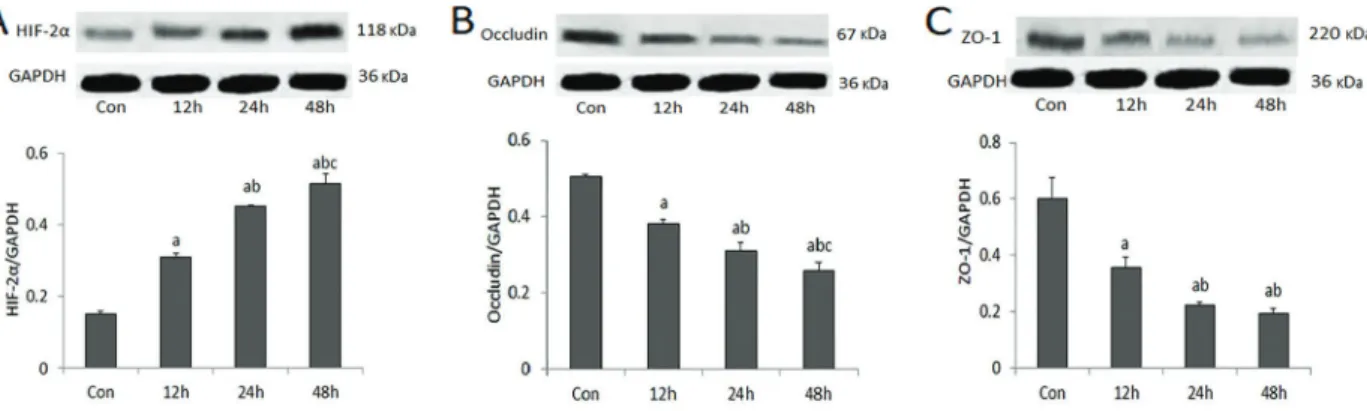
In order to examine the effect of treatment duration, cells were exposed to hypoxia for 12, 24, and 48 hours. Results revealed that the expression of HIF-2awas signifi -cantly higher (Po0.01), and the expression of occludin and ZO-1 significantly lower (Po0.01) compared to the control group. With the elongation of hypoxia time, the expression of HIF-2a gradually increased (Figure 2A) while the expression of occludin (Figure 2B) decreased. The expression of ZO-1 also gradually decreased under hypoxia conditions, the differences being statistically significant, except for comparison between 24 and 48 h (Figure 2C).
Influence of HIF-2aon the expression of occludin
and ZO-1
HIF-2a-shRNA, the expression of occludin increased sig-nificantly in rGENCs under hypoxia conditions, compared to the hypoxia and negative control groups (Figure 3B, Po0.01). The data are reported in Table 1. The expression
of ZO-1 under hypoxia conditions also increased in rGENCs after infection with HIF-2a-shRNA, compared to the hypoxia and negative control groups (Figure 3C, Po0.01)
Table 1.Expression of HIF-2a, occludin, and ZO-1 in different groups.
Group Con Hyp group Neg con group Len group
HIF-2a 0.13±0.02 0.46±0.08a 0.54±0.06a 0.14±0.02bc
Occludin 0.47±0.04 0.13±0.02a 0.17±0.02a 0.43±0.04bc
ZO-1 0.57±0.06 0.22±0.03a 0.31±0.02a 0.52±0.03bc
Data are reported as means±SD. Con: control group; Hyp: hypoxia group; Neg con: Negative control group; Len: HIF-2alentivirus transfected group.aPo0.01 compared with control group;bPo0.01 com-pared with hypoxia group;cPo0.01 compared with Neg con group (ANOVA).
Figure 2.Influence of hypoxia on the expression of HIF-2a, occludin, and ZO-1.A,with the elongation of hypoxia time, the expression of HIF-2agradually increased andB, occludin gradually decreased.C,Expression of ZO-1 also gradually decreased under hypoxia conditions, the differences being statistically significant, except for comparison between 24 and 48 h. Data are reported as means±SD.
aP
o0.01 compared with control group;bPo0.01 compared with 12 h;cPo0.01 compared with 24 h (ANOVA). Con: control group.
Figure 3.A,Hypoxia led to HIF-2aincrease in cells, except in cells transfected with HIF-2a-shRNA.B,After infection with HIF-2a -shRNA, the expression of occludin significantly increased in rat glomerular endothelial cells (rGENCs).C, The expression of ZO-1 under hypoxia conditions also increased. Data are reported as means±SD. Con: control group, rGENCs were cultured under 20.9% O2(n=3);
Hyp: hypoxia group, rGENCs were cultured under 5% O2(n=3); Neg con: negative control group, rGENCs were infected with HIF-2a
Influence of HIF-2aon the permeability of rGENCs After 24 h of exposure to hypoxia, rGENCs exhibited a significant decrease in TEER compared to the control group (Po0.01). This indicated that the permeability of rGENCs was elevated after exposure to hypoxia. After infection with HIF-2a-shRNA, TEER became significantly higher compared to the hypoxia and negative control groups under hypoxia conditions (Po0.01). The difference between the hypoxia and negative control groups was not sig-nificant (P40.05) (Figure 4).
Discussion
Hypoxia is one of the most common causes of vascular hyperpermeability (14–16). Following hypoxic exposure, the vascular permeability of the brain revealed a two-fold increase in fluorescence intensity, which is indicative of significant vascular leakage (17). Some studies have found that the integrity of the blood-brain barrier in rats is disrupted and permeability increased in hypoxic condi-tions, and the TJ proteins occludin and ZO-1 down-regulation or derangement may be responsible for these changes (18,19).
TJ is the most apical structure within the intercellular cleft, creating a paracellular barrier that is essential for survival of complex organisms. Integral TJ proteins are linked to each other as well as to the cytoskeleton by cytoplasmic adaptor proteins, such as ZO and occludin that provide the material foundation to restrict vascular permeability to molecules, allowing them to either diffuse across cell membranes or be carried across the mem-branes by specific membrane transporters (20–22). TJ proteins are dysregulated or can be genetically defective in numerous diseases, which may lead to three effects: i) impaired paracellular transport causing magnesium loss
in the kidney, ii) increased paracellular transport of solutes and water causing leak-flux diarrhea, and iii) increased permeability to large molecules (23). A large body of evi-dence suggests that occludin and ZO-1 are the major components of endothelial TJ; changes in the localization, expression or phosphorylation of occludin/ZO-1 can lead to changes in TJ dysfunction and contribute to hyperper-meability. The rat brain endothelial cell line RBE4 expo-sure to hypoxia rapidly induced TJ disruption mainly through delocalization and increased tyrosine phosphorylation of occludin and ZO-1 with blood-brain barrier impairment (24). Chao et al. reported that high glucose (30 mM) sig-nificantly increased paracellular permeability and attenuated expression of ZO-1 and occludin in HUVECs by enhanc-ing amyloid precursor protein expression with increased amyloid beta-peptide production (25). This suggests that TJ proteins, such as occluding and ZO-1, play an impor-tant role in maintaining ideal vascular permeability and this regulation may be affected by hypoxia. In this study, we found that the expression of occludin and ZO-1 gradually decreased with the elongation of hypoxia time, meanwhile cell permeability was increased after 24-h exposure to hypoxia, both being significantly different compared to the control group.
This suggests that the hyperpermeability of cells under hypoxic conditions may be related to the reduction in occludin and ZO-1. A variety of occludin and ZO-1 expres-sion patterns can occur under hypoxia conditions, such as the reduction of both in endothelial cells (19,26,27), no expression changes in bone marrow (28) and brain endo-thelial cells after treatment for six hours by hypoxia (29), or a significant reduction in occludin expression, and no change in ZO-1 expression levels (30). It was speculated that experimental environment (in vivoorin vitro), culturing conditions, cell type, exposure time, and stimulus condi-tions are involved in this process. However, the protein occludin plays a crucial role in keeping the normal func-tion of TJ and its downregulafunc-tion is enough to cause the dysfunction of TJ (31,32).
Hypoxia-inducible factors (HIFs) are ubiquitous master regulators of such hypoxic adaptation. HIF is a hetero-dimer composed ofa-subunit andb-subunit. HIF-ais regu-lated by oxygen-dependent proteolysis. Most cell types express HIF-1a, while HIF-2a shows a more restricted pattern of expression. In the kidney, HIF-1ais expressed in tubules, while HIF-2a is confined to endothelial and interstitial cells (33). HIF-2a was localized in glomeruli endothelial cells and podocytes in kidneys (9). Mice with HIF-2adeficiency in endothelial cells developed normally, but displayed a variety of phenotypes, including increased vessel permeability and aberrant endothelial cell ultra-structure (12). Some studies indicated that endothelial HIF-2a play a protective role against ischemia of the kidney. In a previous study, mice were more susceptible to renal ischemia-reperfusion injury such as elevated blood urea nitrogen when HIF-2aexpression was approximately Figure 4.Influence of HIF-2aon the permeability of rat glomerular
endothelial cells. Data are reported as means±SD (ANOVA). Con: control group; Hyp: hypoxia group; Neg con: Negative control group; Len: HIF-2alentivirus transfected group.aPo0.01 compared with control group;bP
o0.01 compared with hypoxia group;cP
one-half that of wild-type mice, whereas HIF-1a expres-sion was equivalent (28). Inactivation of endothelial HIF-2a, but not endothelial HIF-1a, resulted in increased expression of renal injury markers and inflammatory cell infiltration in the post-ischemic kidney (34). Those results indicated that HIF-2aplays an important role in maintain-ing the normal permeability of blood vessels and protect-ing from ischemic renal damage. In our study, we found that the expression of HIF-2aincreased gradually with the elongation of hypoxia time while occludin and ZO-1 expres-sion decreased with the hyperpermeability of cells. After knockdown of HIF-2aexpression, the content of occludin and ZO-1 was upregulated, and the permeability of cells
decreased at the same time. Therefore, we hypothesized that HIF-2a may have affected the permeability of endothelial cells through the regulation of occludin and ZO-1.
In conclusion, our results suggest that hypoxia could promote the increase of HIF-2a content, which could induce increased permeability of rGENCs through reduc-tion of the expression of occludin and ZO-1.
Acknowledgment
This study was supported by Natural Science Founda-tion of China (Grant No. 81460151).
References
1. Pines A. High altitude acclimatization and proteinuria in East Africa.Br J Dis Chest1978; 72: 196–198, doi: 10.1016/ 0007-0971(78)90041-4.
2. Chen W, Liu Q, Wang H, Chen W, Johnson RJ, Dong X, et al. Prevalence and risk factors of chronic kidney disease: a population study in the Tibetan population.Nephrol Dial Transplant2011; 26: 1592–1599, doi: 10.1093/ndt/gfq608. 3. Jefferson JA, Escudero E, Hurtado ME, Kelly JP, Swenson
ER, Wener M H, et al. Hyperuricemia, hypertension, and proteinuria associated with high-altitude polycythemia.Am J Kidney Dis2002; 39: 1135–1142, doi: 10.1053/ajkd.2002. 33380.
4. Blum MS, Toninelli E, Anderson JM, Balda MS, Zhou J, O’Donnell L, et al. Cytoskeletal rearrangement mediates human microvascular endothelial tight junction modulation by cytokines.Am J Physiol1997; 273: H286–H294. 5. Michel CC. Transport of macromolecules through
micro-vascular walls. Cardiovasc Res 1996; 32: 644–653, doi: 10.1016/S0008-6363(96)00064-8.
6. Liang GH, Weber CR. Molecular aspects of tight junc-tion barrier funcjunc-tion.Curr Opin Pharmacol2014; 19: 84–89, doi: 10.1016/j.coph.2014.07.017.
7. Balkovetz DF. Tight junction claudins and the kidney in sickness and in health.Biochim Biophys Acta2009; 1788: 858–863, doi: 10.1016/j.bbamem.2008.07.004.
8. Edelblum KL, Turner JR. The tight junction in inflammatory disease: communication breakdown.Curr Opin Pharmacol 2009; 9: 715–720, doi: 10.1016/j.coph.2009.06.022. 9. Gunaratnam L, Bonventre JV. HIF in kidney disease and
development. Journal of the American Society of Nephrology. J Am Soc Nephrol2009; 20: 1877–1887, doi: 10.1681/ASN. 2008070804.
10. Ivan M, Kondo K, Yang H, Kim W, Valiando J, Ohh M, et al. HIFalpha targeted for VHL-mediated destruction by proline hydroxylation: implications for O2 sensing.Science2001; 292: 464–468, doi: 10.1126/science.1059817.
11. Jaakkola P, Mole DR, Tian YM, Wilson MI, Gielbert J, Gaskell SJ, et al. Targeting of HIF-alpha to the von Hippel-Lindau ubiquitylation complex by O2-regulated prolyl hydro-xylation.Science2001; 292: 468–472, doi: 10.1126/science. 1059796.
12. Skuli N, Liu L, Runge A, Wang T, Yuan L, Patel S, et al. Endothelial deletion of hypoxia-inducible factor-2alpha
(HIF-2alpha) alters vascular function and tumor angio-genesis.Blood2009; 114: 469–477, doi: 10.1182/blood-2008-12-193581.
13. Peng H, Wang C, Ye ZC, Chen YR, Zhang J, Chen ZJ, et al. How increased VEGF induces glomerular hyperpermeabil-ity: a potential signaling pathway of Rac1 activation.Acta Diabetol2010; 47: 57–63, doi: 10.1007/s00592-009-0121-8. 14. Gavrilovskaya IN, Gorbunova EE, Mackow ER. Hypoxia induces permeability and giant cell responses of Andes virus-infected pulmonary endothelial cells by activating the mTOR-S6K signaling pathway. J Virol 2013; 87: 12999– 13008, doi: 10.1128/JVI.02103-13.
15. Zhu H, Wang Z, Xing Y, Gao Y, Ma T, Lou L, et al. Baicalin reduces the permeability of the blood-brain barrier during hypoxia in vitro by increasing the expression of tight junction proteins in brain microvascular endothelial cells.J Ethnophar-macol2012; 141: 714–720, doi: 10.1016/j.jep.2011.08.063. 16. Liu T, Guevara OE, Warburton RR, Hill NS, Gaestel M,
Kayyali US. Modulation of HSP27 alters hypoxia-induced endothelial permeability and related signaling pathways. J Cell Physiol2009; 220: 600–610, doi: 10.1002/jcp.21773. 17. Fischer S, Wobben M, Marti HH, Renz D, Schaper W. Hypoxia-induced hyperpermeability in brain microvessel endothelial cells involves VEGF-mediated changes in the expression of zonula occludens-1.Microvasc Res2002; 63: 70–80, doi: 10.1006/mvre.2001.2367.
18. Kaur C, Ling EA. Blood brain barrier in hypoxic-ischemic conditions.Curr Neurovasc Res2008; 5: 71–81, doi: 10.2174/ 156720208783565645.
19. Hao L, Guo X, Zou C, Zhou H, Tian H, Zhang Y. Hyperbaric oxygen preconditioning ameliorates blood-brain barrier damage induced by hypoxia through modulation of tight junction proteins in an in vitro model.Croat Med J2016; 57: 51–57, doi: 10.3325/cmj.2016.57.51.
20. González-Mariscal L, Tapia R, Chamorro D. Crosstalk of tight junction components with signaling pathways.Biochim Biophys Acta2008; 1778: 729–756, doi: 10.1016/j.bbamem.2007.08.018. 21. Anderson JM, Van Itallie CM. Physiology and function of the tight junction. Cold Spring Harb Perspect Biol 2009; 1: a002584, doi: 10.1101/cshperspect.a002584.
23. Krug SM, Schulzke JD, Fromm M. Tight junction, selective permeability, and related diseases.Semin Cell Dev Biol 2014; 36: 166–176, doi: 10.1016/j.semcdb. 2014.09.002.
24. Engelhardt S, Al-Ahmad AJ, Gassmann M, Ogunshola OO. Hypoxia selectively disrupts brain microvascular endothelial tight junction complexes through a hypoxia-inducible factor-1 (HIF-factor-1) dependent mechanism.J Cell Physiol2014; 229: 1096–1105, doi: 10.1002/jcp.24544.
25. Chao AC, Lee TC, Juo SH, Yang DI. Hyperglycemia Increases the Production of Amyloid Beta-Peptide Leading to Decreased Endothelial Tight Junction. CNS Neurosci Ther2016; 22: 291–297, doi: 10.1111/cns.12503.
26. Won S, Sayeed I, Peterson BL, Wali B, Kahn JS, Stein DG. Vitamin D prevents hypoxia/reoxygenation-induced blood-brain barrier disruption via vitamin D receptor-mediated NF-kB signaling pathways.PLoS One2015; 10: e0122821, doi: 10.1371/journal.pone.0122821.
27. Ma X, Zhang H, Pan Q, Zhao Y, Chen J, Zhao B.Hypoxia/ aglycemia-induced endothelial barrier dysfunction and tight junction protein downregulation can be ameliorated by citicoline.PLoS One2013; 8: e82604, doi: 10.1371/journal. pone.0082604.
28. Brown RC, Mark KS, Egleton RD, Huber JD, Burroughs AR, Davis TP. Protection against hypoxia-induced increase in blood-brain barrier permeability: role of tight junction proteins
and NFkappaB.J Cell Sci2003; 116: 693–700, doi: 10.1242/ jcs.00264.
29. Brown RC, Davis TP. Hypoxia/aglycemia alters expression of occludin and actin in brain endothelial cells. Biochem Biophys Res Commun2005; 327: 1114–1123, doi: 10.1016/ j.bbrc.2004.12.123.
30. Bauer AT, Burgers HF, Rabie T, Marti HH. Matrix metallo-proteinase-9 mediates hypoxia-induced vascular leakage in the brain via tight junction rearrangement. Journal of cerebral bloodflow and metabolism. J Cereb Blood Flow Metab2010; 30: 837–848, doi: 10.1038/jcbfm.2009.248. 31. Persidsky Y, Ramirez S H, Haorah J, Kanmogne GD.
Blood-brain barrier: structural components and function under physiologic and pathologic conditions.J Neuroimmune Phar-macol2006; 1: 223–236, doi: 10.1007/s11481-006-9025-3. 32. Tavelin S, Hashimoto K, Malkinson J, Lazorova L, Toth I,
Artursson P. A new principle for tight junction modulation based on occludin peptides. Mol Pharmacol 2003; 64: 1530–1540, doi: 10.1124/mol.64.6.1530.
33. Nangaku M, Inagi R, Miyata T, Fujita T. Hypoxia and hypoxia-inducible factor in renal disease. Nephron Exp Nephrol2008; 110: e1–7, doi: 10.1159/000148256. 34. Kapitsinou PP, Sano H, Michael M, Kobayashi H, Davidoff