http://dx.doi.org/10.1590/s2175-97902018000117218
Article
*Correspondence: R. M. da Gama. Departmento de Farmácia, Faculdade de Ciências Farmacêuticas, Universidade de São Paulo. Avenida Prof. Lineu Prestes, N° 580, Bl. 13/15, Conjunto das Químicas, Cidade Universitária, 05508-900 São Paulo, SP, Brasil. E-mail: [email protected]
Influence of different cosmetic vehicles in mechanical and physical
properties of hair treated with oxidative hair dyes
Elaine Cabral Serrão
1, Robson Miranda da Gama
1,2,3*, Michelli Ferrera Dario
1, Simone Aparecida
da França-Stefoni
1, Valcinir Bedin
4, André Rolim Baby
1, Maria Valéria Robles Velasco
11Department of Pharmacy, School of Pharmaceutical Sciences, University of São Paulo, São Paulo, SP, Brazil, 2School of Pharmaceutical Sciences. Faculty Medicine ABC, Santo André, SP, Brazil, 3School of Pharmacy, Santo Amaro
University, São Paulo, SP, Brazil, 4BWS Graduate Institute of São Paulo, São Paulo, SP, Brazil
Hair care products play a significant role in the cosmetic market and aim at improving hair brightness, breakage resistance, and color change. In this study, we analyzed the possibility of the formulation of oxidative dyes in different vehicles impacting the hair’s both mechanical and physical properties. Light brown and light blond dyes were prepared using eight different vehicles. Among these, four vehicles were emulsifying agents and four gelling agents. Each formulation was applied to two types of virgin Caucasian hair (light blond and dark brown). Physical, chemical, and organoleptic properties of each formulation were assessed, as well as changes in hair parameters after oxidative dyeing, such as staining intensity, brightness, and breaking strength. The parameters of color and brightness differed in some formulations, but the hair type also responded differently. Brightness parameter was increased in dark brown hair colored with both dyes, whereas light blond hair showed the opposite result. Regarding the breaking strength, there were no significant differences between the two kinds of tresses. Cosmetic formulations should adjust the consumer desired effects (e.g. color change) in order to present minimal drawbacks (e.g. decrease of hair brightness and strength). Thus, the study of different vehicles is important when establishing the best oxidative dye formulation.
Keywords: Hair dyes/analyse. Cosmetic technique/utilization. Hair/chemistry. Hair color. Hair/strength. Hair/bright.
INTRODUCTION
Hair dyes are widely used by both women and men for numerous reasons, such as dyeing and camouflage of gray hair in order to follow the trend of hair coloring fashion and to express their own personality (Harrison,
Sinclair, 2003; França et al., 2015). Hair dyes can be
classified according to color durability after the application on hair tresses by using the following types: temporary, semi-permanent, and permanent (França et al., 2015).
Data on hair anatomy and physiology is critical when studying the mechanisms of hair care cosmetics. The hair fiber can be divided into two components: root and shaft. The hair shaft contains three main structures: cuticle, cortex, and medulla. The cuticle is the outermost
layer and its role is to protect the hair shaft against environmental and chemical damages. Surface properties (e.g. brightness and resistance to combing) are influenced by the cuticle scales orientation. The cortex is located
below the cuticle and confers tensile strength and elasticity to the hair fiber due to its crystallized α-keratin fibrils organization. The medulla, another component of
the hair fiber, may or may not be present and its role is not clearly defined (Velasco et al., 2009; Alessandrini,
Piraccini, 2016; Robbins, 2002).
2008; Liu et al., 2005). The function of the melanin
granules is to effectively absorb light and to protect against damage hair, dark hair containing significantly more melanin than light hair.
Permanent oxidative hair dyes consist of highly
reactive molecules which react in a strong alkaline/oxidant medium opening the cuticle, penetrating the hair, and originating colored polymers into the cortex (Shansky, 2007; França et al., 2015).
Permanent oxidative hair dye in fiber causes the
formation of indo-dyes and forms colorless precursors
with low molecular weight (p-aminophenol and p-phenylenediamine). This occurs by oxidation with
hydrogen peroxide under alkaline conditions. At this point, the precursors react with the couplers as m-aminophenols
(m-aminophenol, 4-amino-2-hydroxytoluene and
2,4-diaminophenoxyethanol) and m-diamines (resorcinol)
which react to each other in strongly alkaline/oxidizing environment, yielding colored polymers (Corbett, 1984; Shansky, 2007).
During this process, alterations in the hair structure occur, potentially affecting its manageability, shine, and breaking strength (Gama et al, 2010). The formulation
components may also have an influence on these factors. Besides the pigmentation components, the correct choice of the vehicles during a hair dye formulation
is important to obtain a stable and efficient product.
Emulsions and gels are ubiquitous vehicles in cosmetic formulations. (Buchmann, 2001). An emulsion is a
dispersion of two or more immiscible liquids that, with the use of an amphiphilic component (emulsifier), can form homogeneous substances. Emulsions have cleansing action, ease of application, and the ability to apply both water-soluble and oil-soluble ingredients at the same
time (Kostansek, 2012). A gel consists of a dispersed system containing one gelling agent interpenetrated by
a liquid, usually water or an aqueous-alcoholic mixture (Cai, Gupta, 2012). Thus, this study evaluates the impact of several emulsion or gel-based oxidative hair dyes formulations on physical and mechanical hair properties.
MATERIAL AND METHODS
Hair dyes formulations preparation
Eight hair dye formulations were prepared, four based on emulsion oil in water (O/A) vehicles and four on aqueous gel vehicles. Qualitative composition of
emulsion formulations comprised anionic surfactant [Cetearyl Alcohol (and) Sodium Lauryl Sulfate (and)
Sodium Cetearyl Sulfate (LanetteTM N – LAN); Cetearyl
Alcohol (and) Dicetyl Phosphate (and) Ceteth-10
Phosphate (CrodafosTM CES – CRO)]; or nonionic
self-emulsifying wax [: Cetearyl Alcohol (and) Polysorbate 60 (Polawax NFTM – POL); Cetearyl Alcohol (and)
Ceteareth-20 (CosmowaxTM J – COS)]. The other
ingredients of the formulations were: Cetearyl alcohol, caprylic/capric triglyceride, butylhydroxytoluene (BHT), water, propylene glycol and preservative
blend (Phenoxyethanol (and) methylparaben (and) ethylparaben (and) butylparaben (and) propylparaben
(and) isobutylparaben). Qualitative composition of gel
formulations differed from the others only by the gelling
agent and comprised anionic [Carbomer (CarbopolTM
980– CAR); Ammonium Acryloyldimethyltaurate (and)
VP Copolymer (AristoflexTM AVC – ARI)]; or nonionic
gels [Hydroxyethylcellulose (NatrosolTM – NAT) or
Sclerotium gum (AmigelTM – AMI)]. The components
used in all formulations comprised triethanolamine, water (aqua); propylene glycol and preservative
blend (Phenoxyethanol (and) methylparaben (and) ethylparaben (and) butylparaben (and) propylparaben
(and) Isobutylparaben).
Each emulsion or gel formulation was used to prepare two hair dyes colors (light blond and light brown), resulting in 16 formulations. The dyes were produced with pigments and other excipients obtained from Les Colorants Wackherr (LCWTM, Brazil). Qualitative
composition of the Light brown dye formulation was:
m-aminophenol (MAP), p-phenylenediamine (PPD), 2,4-diaminophenoxyethanol (2,4-DAPE), resorcinol (RCN), t-butyl hydroquinone (TBQ), erythorbic acid, tetrasodium EDTA, sodium metabisulfite, ammonium
hydroxide. For the Light blond dye, the formulation
was composed of p-aminophenol (PAP), 4-amino-2-hydroxytoluene (AHT), resorcinol (RCN), sodium
metabisulfite, tetrasodium EDTA, t-butyl hydroquinone
(TBQ), erythorbic acid, ammonium hydroxide.
Preparation of oxidative hair dyes
Emulsion formulations LAN, CRO, POL, and COS
were prepared by mixing the oily (O) and aqueous phases (A) in different steel beakers. Both phases were warmed
to 70.0±5.0°C on heating plates, and the oily phase was
added to the aqueous phase until obtaining a homogenous
emulsion by stirring (Kostansek, 2012). Each base was
used to prepare both Light brown and Light blond hair
dyes, resulting in eight emulsion-based formulations. Concerning the gel formulations, each type of gelling agent has a particular way to be prepared. CAR and NAT
after warming water up to 70.0±5.0°C, the gelling agent
slowly dispersed while the mix is continuously stirred, avoiding forming clumps. After that, the other excipients were added slowly until the formulation is complete (Cai, Gupta, 2012). The pH of a CAR formulation was adjusted
to 6.5-7.0. AMI gel preparations also required warmed
water in the range of 60.0 ± 5.0°C, but the neutralization
was not necessary. ARI gels were prepared with slowly
addition of this gelling agent to the water phase (room temperature, non-warmed water required) and the system was stirred until to obtain a homogeneous system (Cai, Gupta, 2012). Each gelling agent was used to prepare both
Light brown and Light blond hair dyes, resulting in eight
gel-based formulations.
Organoleptic characteristics of formulations
Appearance, color, and odor 48 hours after preparation was assessed in comparison to time 0 (just after preparation). Furthermore, it was possible to verify if there was phase separation, and presence or absence of lumps, which allowed the primary product analysis (Brasil, 2008).
pH
The pH determination was performed in QuimisTM
pHmeter using undiluted samples (Brasil, 2008).
Viscosity evaluation
Viscosity determination (ViscoStar MarteTM
Fungilab) was performed at room temperature (22.0 ± 5.0ºC) using the following parameters: nonionic emulsions (POL and COS) with Spindle TR 10, rotation 50 rpm;
anionic emulsions (LAN and CRO) with Spindle TR10, rotation 100 rpm; gels (anionic CAR, ARI and, nonionic NAT and, AMI) with Spindle R5, rotation 100 rpm. The measurements were registered in mPa.s-1 (miliPascal for
second) after 1 min rotation (Brasil, 2008).
Tresses preparation
Caucasian virgin light blond and dark brown hair tresses (length: 20.0 cm; weight: approximately 2.0 g) were purchased from Bella HairTM (Brazil). Each hair tress
was first washed for 30 s with 15.0% (w/v) sodium lauryl sulfate to remove impurities. All tresses were rinsed with warm (37.0 ± 5.0 ºC), distilled water in a constant flow of 240.0 mL min-1 for 1 min. Next, they were dried at room
temperature (22.0 ± 1.0 ºC) and relative humidity (RH 60
± 5%) for 12 h before performing further analysis (Gama
et al, 2009; Gama et al, 2011).
Application of hair dye
When considering the hair dye treatment, 1.5 g of each dye formulation plus 1.5 g of emulsion commercial (LBSTM) containing 20.0% (v/v) hydrogen peroxide was
applied to the tresses (Gama et al, 2009; Gama et al, 2011).
After 40 minutes, the samples were washed as previously described. The samples were classified into four groups:
Group I - Dark brown hair treated with light brown dye;
Group II - Dark brown hair treated with light blond dye;
Group III - Light blond hair treated with light brown dye;
Group IV - Light blond hair treated with light blond dye.
Mechanical properties
From each group, five fibers measuring 10.0 cm each were used for mechanical properties tests. First, using a
micrometer MitutoyoTM, the diameter was measured in
three points (root, middle portion and tip) and the mean value was used later to calculate the hair fiber total area (Dario et al., 2013). The analysis of breaking strength
was performed in Texturometer TAXT2 AnalyzerTM
model, operating at clutch speed traction of 300 mm/min, distance of 80 mm, 25.0 kg load and sensitivity of 0.49 N. Due to the load applied, the hair fiber stretches and elongates approximately 2.0% of its initial length (elastic property).Next, the fiber stretches rapidly about 25.0 to 30.0% of the length, as a result of moderate load increase (plastics property). Thus, if the applied force is a constant value, the fiber stretches in proportion to the load until the fracture occurs (Velasco et al., 2009; Woodruff, 2002). The
lower values related to breaking strength represent more
damaged cortex.
Color changes
The perception of color is very subjective, and, therefore, it is important to use analytical methods to allow discrete measurements to be taken. One model existing
to measure color is developed and proposed in 1976 by Commision Internationale L’Eclairage, CIELAB or
CIE L* a* b*. Such model measures color on three main axes clearly linear human perception (Gulrajani, 2010).
Standard L*, a*, b* measurements were collected where L* that represents the brightness (with positive values
standing for clearer and negative values meaning darker),
a* defines the color-coordinated green–red (being positive
of green), b* defines the color-coordinated blue–yellow
(with shades of yellow presented by positive numbers and shades of blue by negative) (Dario et al., 2013; Gulrajani, 2010; Nogueira et al., 2004).
Color measurements were performed by the Hunter
Miniscan LabsTM XE Plus (CIELAB – Universal Software
v. 4.01) using the middle portion regions of the tresses and five replicates. Hunter L-a-b parameters were measured.
The equipment provides the color parameters based on three vectors: L*, a* and b* (Dario et al., 2013; Nogueira et al., 2004).
Statistical analysis
Possible significant differences in the results were analyzed by one-way ANOVA and the differences between treatments were identified by Tukey’s test (α = 0.05).
RESULTS AND DISCUSSION
Physical-chemical and organoleptic changes in emulsion and gel-based hair dye formulations
Changes in consistency and appearance of the
formulations after addition of pigments and ammonium
hydroxide are described at Table I and II. The Light blond dye provided light purple color to the emulsions
(LAN, CRO, POL, and COS); slightly yellow for most gels (CAR, ARI, and AMI), and a brownish color to the NAT-base. This can be explained by the reaction between precursor (p-aminophenol) and couplers (resorcinol and
4-amino-2-hydroxytoluene) presented on the light blond dye. When these components react, a light purple color is
developed. However, when no reaction occurs, no purple but slightly yellow to brown color is achieved, as seen in our gel dyes (Brown, Corbett, 1979; Corbett, 1984). Meanwhile, the Light brown dye provided a brownish
color to the emulsions (LAN, CRO, POL, and COS) and to the NAT-base gel and a slightly yellowish color to the others gel formulations (CAR, ARI, and AMI). Again, this color was developed due to the reaction between precursor (p-phenylenediamine) and couplers (m-aminophenol,
resorcinol, and 2,4-diaminophenoxyethanol), resulting in a slightly yellow to brownish color, depending of oxidative reaction (Corbett, 1973; Corbett, 1984).
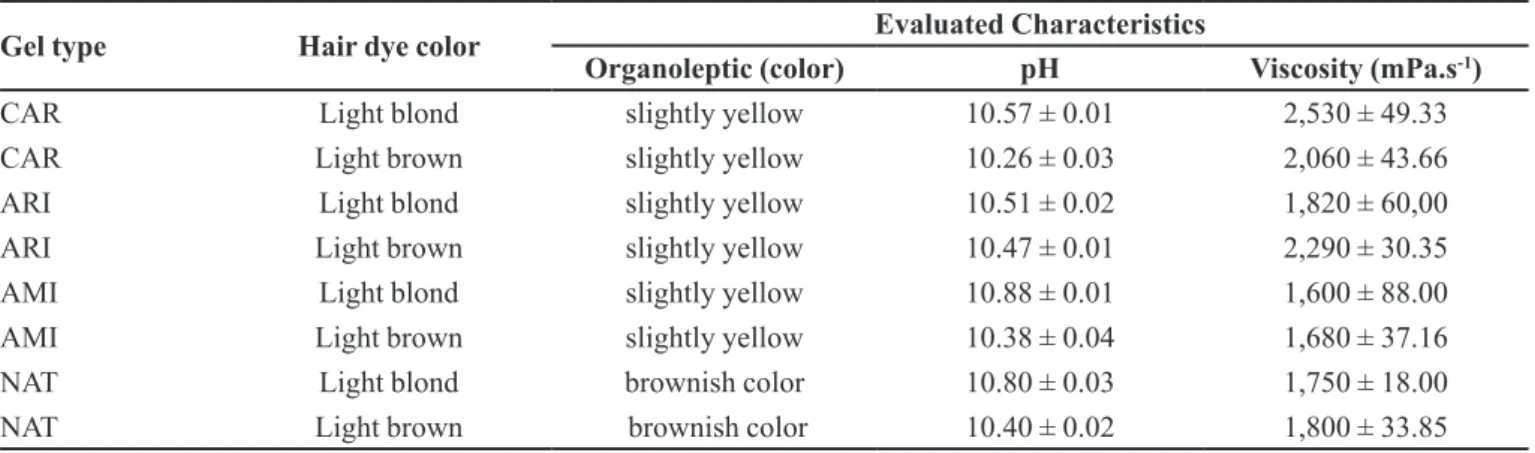
Besides color characteristics, Tables I and II show physical-chemical characteristics (pH and viscosity) for
emulsion and gel dye formulations. All formulations
presented pH range between 10.2 and 11.2, expected values for hair dyes. According to Corbett (1984), highly alkaline formulations (pH range 9.0 - 12.0) open the cuticle cells, allowing penetration of the oxidative dye into the hair cortex. There, the compounds react, forming a pigment with high molar mass (Shansky, 2007). Moreover, the hair dye viscosity should be controlled, because it can affect the product handling and efficacy: the formulation should adhere to the hair surface, but also does not drip on your clothes. All formulations showed a viscosity between 400 and 4,000 mPa.s-1, in line with expected values (Hoch
et al., 1985).
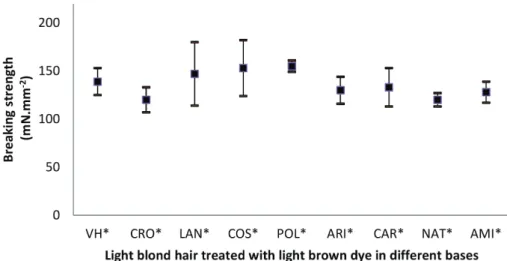
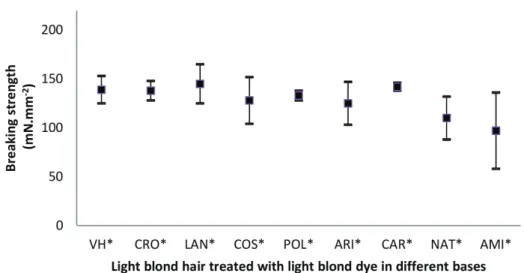
Breaking strength
Figures 1-4 show the breaking strength data for virgin Caucasian hair samples (light blond or dark brown hair), without (VH) or with treatment with oxidative hair
TABLE I - Physic-chemical and organoleptic characteristics of different hair dye color emulsions types
Emulsion type Hair dye color Evaluated Characteristics
Organoleptic (color) pH Viscosity (mPa.s-1)
LAN Light blond light purple color 11.07 ± 0.07 2,200 ± 80.13
LAN Light brown brownish color 10.46 ± 0.01 1,900 ± 102.32
CRO Light blond light purple color 11.20 ± 0.01 2,000± 66.09
CRO Light brown brownish color 10.40 ± 0.01 2,800 ± 87.60
POL Light blond light purple color 10.88 ± 0.01 1,800 ± 106.06
POL Light brown brownish color 10.71 ± 0.09 2,900 ± 47.16
COS Light blond light purple color 11.18 ± 0.01 3,200 ± 55.47
COS Light brown brownish color 10.55 ± 0.01 2,900 ± 85.33
Legend:CRO:Cetearyl Alcohol (and) Dicetyl Phosphate (and) Ceteth-10 Phosphate/CrodafosTM CES; LAN:Cetearyl Alcohol (and) Sodium Lauryl Sulfate (and) Sodium Cetearyl Sulfate/ Lanette NTM; COS:Cetearyl Alcohol (and) Ceteareth-20/ Cosmowax
dye (light brown or light blond color) in different vehicles (CRO, LAN, COS, POL, ARI, CAR, NAT, and AMI).
Figure 1 represents Group I Caucasian dark brown virgin
hair and samples treated with light brown oxidative hair
dyes, Figure 2 represents Group II Caucasian dark brown
virgin hair and samples treated with light blond oxidative hair dyes. Figure 3 represents Group III Caucasian light
blond virgin hair and samples treated light brown oxidative hair dyes. Figure 4 represents Group IV Caucasian light
blond virgin hair and samples treated with light blond oxidative hair dyes. The results demonstrated there was no statistical difference among all treatments.
Our study contradicts the findings presented by Nogueira, Nakano, Joekes (2004), in which the oxidative
process (bleaching) changed in the breaking strength value. Although Robbins, Crawford (1991) confirmed that hair dye damages the cuticle layer, there was no traceable change while measuring tensile properties.
Color changes
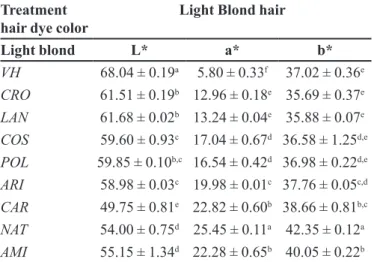
Tables III-VI show the Color and Brightness
parameters data for virgin Caucasian hair samples (light blond or dark brown hair), without (VH) or with treatment with oxidative hair dye light or brown color in vehicles different.
According to the results of Table III, in relation to the brightness parameter (L*) from dark brown hair treated
TABLE II - Physic-chemical and organoleptic characteristics of different hair dye color gels types
Gel type Hair dye color Evaluated Characteristics
Organoleptic (color) pH Viscosity (mPa.s-1)
CAR Light blond slightly yellow 10.57 ± 0.01 2,530 ± 49.33
CAR Light brown slightly yellow 10.26 ± 0.03 2,060 ± 43.66
ARI Light blond slightly yellow 10.51 ± 0.02 1,820 ± 60,00
ARI Light brown slightly yellow 10.47 ± 0.01 2,290 ± 30.35
AMI Light blond slightly yellow 10.88 ± 0.01 1,600 ± 88.00
AMI Light brown slightly yellow 10.38 ± 0.04 1,680 ± 37.16
NAT Light blond brownish color 10.80 ± 0.03 1,750 ± 18.00
NAT Light brown brownish color 10.40 ± 0.02 1,800 ± 33.85
Legend:ARI: Ammonium Acryloyldimethyltaurate (and) VP Copolymer/ Aristoflex avcTM; CAR: Carbomer/CarbopolTM 980; NAT: Hydroxyethylcellulose /NatrosolTM; AMI: Sclerotium gum/ AmigelTM
FIGURE 1 - Breaking strength for Caucasian dark brown virgin hair and samples treated with light brown oxidative hair dyes. Results categorized with equal symbols (*) mean the data didn’t present as statistically and significantly different for α = 5, p < 0.05, n = 5.
VH: Virgin Hair; CRO:Cetearyl Alcohol (and) Dicetyl Phosphate (and) Ceteth-10 Phosphate/CrodafosTM CES; LAN:Cetearyl
Alcohol (and) Sodium Lauryl Sulfate (and) Sodium Cetearyl Sulfate/ Lanette NTM; COS:Cetearyl Alcohol (and) Ceteareth-20/ Cosmowax JTM; POL: Cetearyl Alcohol (and) Polysorbate 60/Polawax NFTM; ARI: Ammonium Acryloyldimethyltaurate (and) VP
Copolymer/Aristoflex avcTM; CAR: Carbomer/CarbopolTM 980; NAT: Hydroxyethylcellulose/NatrosolTM HHR; AMI: Sclerotium
with light brown dye, it is possible to infer that light brown dyes formulated with emulsions CRO, COS, and, POL
presented statistically significant increase in luminosity values. In relation to virgin hair tress, among the gels dyes
formulations, CAR and AMI showed the same result.
That said, regarding to red-green color parameter (a*),
emulsion and gels dye formulations revealed increased
negative values. In other words, it is statistically higher
red color intensity when compared to virgin hair samples. All the samples showed positive values in the coordinate yellow-blue color (b*), that means yellow color values.
When compared with virgin hair, all treated samples revealed statistically decrease in yellow-color intensity.
In conformity with the results showed in Table IV, in relation to the brightness parameter (L*) from dark brown
hair treated with light blond dye, there was a statically
FIGURE 2 - Breaking strength for Caucasian dark brown virgin hair and samples treated with light blond oxidative hair dyes. Results categorized with equal symbols (*) mean they didn’t present as statistically and significantly different, for α = 5, p < 0.05, n = 5.
VH: Virgin Hair; CRO:Cetearyl Alcohol (and) Dicetyl Phosphate (and) Ceteth-10 Phosphate/CrodafosTM CES; LAN:Cetearyl
Alcohol (and) Sodium Lauryl Sulfate (and) Sodium Cetearyl Sulfate/Lanette NTM; COS:Cetearyl Alcohol (and) Ceteareth-20/ Cosmowax JTM; POL: Cetearyl Alcohol (and) Polysorbate 60/ Polawax NFTM; ARI: Ammonium Acryloyldimethyltaurate (and) VP
Copolymer/Aristoflex avcTM; CAR: Carbomer/CarbopolTM 980; NAT: Hydroxyethylcellulose/NatrosolTM HHR; AMI: Sclerotium
gum/AmigelTM.
FIGURE 3 - Breaking strength for Caucasian light blond virgin hair and samples treated with light brown oxidative hair dyes. Results categorized with equal symbols (*) mean they didn’t present as statistically and significantly different, for α = 5, p < 0.05, n = 5.
VH: Virgin Hair; CRO:Cetearyl Alcohol (and) Dicetyl Phosphate (and) Ceteth-10 Phosphate/CrodafosTM CES; LAN:Cetearyl
Alcohol (and) Sodium Lauryl Sulfate (and) Sodium Cetearyl Sulfate/ Lanette NTM; COS:Cetearyl Alcohol (and) Ceteareth-20/ Cosmowax JTM; POL: Cetearyl Alcohol (and) Polysorbate 60/ Polawax NFTM; ARI: Ammonium Acryloyldimethyltaurate (and) VP
Copolymer/Aristoflex avcTM; CAR: Carbomer/CarbopolTM 980; NAT: Hydroxyethylcellulose/NatrosolTM HHR; AMI: Sclerotium
FIGURE 4 - Breaking strength for Caucasian light blond virgin hair and samples treated with light blond oxidative hair dyes. Results categorized with equal symbols (*) didn’t present as statistically and significantly different, for α = 5, p < 0.05, n = 5.
VH: Virgin Hair; CRO:Cetearyl Alcohol (and) Dicetyl Phosphate (and) Ceteth-10 Phosphate/CrodafosTM CES; LAN:Cetearyl
Alcohol (and) Sodium Lauryl Sulfate (and) Sodium Cetearyl Sulfate/Lanette NTM; COS:Cetearyl Alcohol (and) Ceteareth-20/ Cosmowax JTM; POL: Cetearyl Alcohol (and) Polysorbate 60/Polawax NFTM; ARI: Ammonium Acryloyldimethyltaurate (and) VP
Copolymer/Aristoflex avcTM; CAR: Carbomer/CarbopolTM 980; NAT: Hydroxyethylcellulose/NatrosolTM HHR; AMI: Sclerotium
gum/AmigelTM.
TABLE III - Color and Brightness parameter for Caucasian dark brown virgin hair and samples treated with light brown oxidative hair dyes
Treatment
hair dye color Dark brown hair
Light brown L* a* b*
VH 15.15 ± 0.32c –0.48 ± 0.13a 5.39 ± 0.19a
CRO 16.37 ± 0.49a –1.42 ± 0.11b,c 4.78 ± 0.22b
LAN 15.56 ± 0.18b,c –1.14 ± 0.34b 4.60 ± 0.15b,c
COS 16.76 ± 0.11a –1.46 ± 0.17b,c 4.65 ± 0.21b,c
POL 16.42 ± 0.11a –1.37 ± 0.12b,c 4.55 ± 0.19b,c
ARI 15.45 ± 0.19c –1.64 ± 0.07c 4.14 ± 0.23c
CAR 16.20 ± 0.19a –1.35 ± 0.16b,c 4.47 ± 0.12b,c
NAT 15.26 ± 0.07c –1.49 ± 0.14b,c 4.67 ± 0.23b,c
AMI 16.27 ± 0.15a –1.82 ± 0.10c 4.31 ± 0.12b,c
Results categorized with different letters presents as statistically and significantly different for α = 5, p < 0.05, n = 5. L*: brightness parameter; a*: parameter of color in the red-green coordinate; b*: parameter color of yellow-blue coordinate. VH: Virgin
Hair; CRO:Cetearyl Alcohol (and) Dicetyl Phosphate (and)
Ceteth-10 Phosphate/CrodafosTM CES; LAN:Cetearyl Alcohol (and) Sodium Lauryl Sulfate (and) Sodium Cetearyl Sulfate/
Lanette NTM; COS:Cetearyl Alcohol (and) Ceteareth-20/
Cosmowax JTM; POL: Cetearyl Alcohol (and) Polysorbate 60/ Polawax NFTM;ARI: Ammonium Acryloyldimethyltaurate (and)
VP Copolymer/Aristoflex avcTM; CAR: Carbomer/CarbopolTM 980; NAT: Hydroxyethylcellulose /NatrosolTM; AMI: Sclerotium
gum/AmigelTM.
TABLE IV - Color and Brightness parameter for Caucasian dark brown virgin hair and samples treated with light blond oxidative hair dyes
Treatment
hair dye color Dark brown hair
Light blond L* a* b*
VH 15.15 ± 0.32e –0.48 ± 0.13f 5.39 ± 0.19e
CRO 19.93 ± 0.13b,c 3.96 ± 0.37c 9.59 ± 0.43c
LAN 18.77 ± 0.52d 3.67 ± 0.03c,d 9.95 ± 0.09b,c
COS 20.51 ± 0.13ª,b 4.02 ± 0.10c 9.68 ± 0.38c
POL 19.98 ± 0.15b,c 3.89 ± 0.14c 9.77 ± 0.27b,c
ARI 18.88 ± 0.16d 2.79 ± 0.10e 8.68 ± 0.27d
CAR 18.55 ± 0.11d 3.22 ± 0.13e 8.31 ± 0.19d
NAT 19.59 ± 0.07c 4.56 ± 0.13b 10.52 ± 0.27b
AMI 20.68 ± 0.11ª 5.92 ± 0.07a 11.69 ± 0.25a
Results categorized with different letters presents as statistically and significantly different for α = 5, p < 0.05, n = 5. L*: brightness parameter; a*: parameter of color in the red-green coordinate; b*: parameter color of yellow-blue coordinate. VH: Virgin
Hair; CRO:Cetearyl Alcohol (and) Dicetyl Phosphate (and)
Ceteth-10 Phosphate/CrodafosTM CES; LAN:Cetearyl Alcohol (and) Sodium Lauryl Sulfate (and) Sodium Cetearyl Sulfate/
Lanette NTM; COS:Cetearyl Alcohol (and) Ceteareth-20/
Cosmowax JTM; POL: Cetearyl Alcohol (and) Polysorbate 60/ Polawax NFTM; ARI: Ammonium Acryloyldimethyltaurate (and)
VP Copolymer/Aristoflex avcTM; CAR: Carbomer/CarbopolTM 980; NAT: Hydroxyethylcellulose /NatrosolTM; AMI: Sclerotium
increase of brightness in all samples. Hair treated with
COS and AMI showed as non-statically different among
each other and they represent the highest values achieved. All samples presented a statistic increase in the red-green color parameter (a*) changing from red color (negative)
in the virgin hair tresses to green (positive) values in dyed tresses. The treated hair also showed a statistic increase in coordinating the yellow-blue color (b*).
Light blond hair treated with light brown dye presented (Table V) that the brightness parameter (L*)
decreased in all samples, when compared with the virgin hair. The greater decrease was observed with COS and
CAR. When considering the red-green color parameter
(a*), the virgin hair showed positive value, which means
green in the coordinate. Also, in this matter, all treated samples presented negatives values (red color) and there are no statistic differences among them. All treated samples also revealed yellow-blue parameter (b*),
which decreased when compared to the non-treated hair. However, it presented no statistic differences among them.
Considering the brightness parameter (L*) from
light blond hair treated with light blond dye (Table VI), a brightness decrease was observed when compared to the virgin hair. Regarding to red-green color parameter (a*), all samples revealed red-color intensity increase
when compared to the hair without treatment (virgin) and the highest increase was observed among the gels formulations. When considering the yellow-blue color (b*) parameter, there was no statistic difference between
virgin hair and samples treated with emulsion based formulations. However, samples treated with any gel formulation presented an increase in these parameters, which led to a higher yellow color intensity.
Considering the results presented in Table III-VI, concerning hair brightness and color changes after a dyeing process, it was observed that the cosmetic vehicle and, also, the hair type which the formulation is applied on can influence data related to this parameter.
These results can be explained by chemical compounds found in hair dyes. According Gama et al. TABLE V - Color and Brightness parameter for Caucasian light
blond virgin hair and samples treated with light brown oxidative hair dyes
Treatment
hair dye color Light Blond hair
Light brown L* a* b*
VH 68.04 ± 0.19a 5.80 ± 0.33a 37.02 ± 0.36a
CRO 16.50 ± 0.19c,d –0.72 ± 0.15b 5.89 ± 0.37b
LAN 17.39 ± 0.10b –0.98 ± 0.16b 5.13 ± 0.08b
COS 16.00 ± 0.13d,e –0.93 ± 0.15b 5.40 ± 0.29b
POL 16.21 ± 0.13c,d –0.95 ± 0.17b 5.45 ± 0.18b
ARI 17.50 ± 0.07b –0.86 ± 0.06b 5.74 ± 0.09b
CAR 15.50 ± 0.32e –0.70 ± 0.21b 5.66 ± 0.40b
NAT 16.30 ± 0.32c,d –0.80 ± 0.20b 5.23 ± 0.25b
AMI 16.72 ± 0.20c –0.70 ± 0.10b 5.80 ± 0.27b
Results categorized with different letters presents as statistically and significantly different for α = 5, p < 0.05, n = 5. L*: brightness parameter; a*: parameter of color in the red-green coordinate; b*: parameter color of yellow-blue coordinate. VH: Virgin
Hair; CRO:Cetearyl Alcohol (and) Dicetyl Phosphate (and)
Ceteth-10 Phosphate/CrodafosTM CES; LAN:Cetearyl Alcohol (and) Sodium Lauryl Sulfate (and) Sodium Cetearyl Sulfate/
Lanette NTM; COS:Cetearyl Alcohol (and) Ceteareth-20/
Cosmowax JTM; POL: Cetearyl Alcohol (and) Polysorbate 60/ Polawax NFTM; ARI: Ammonium Acryloyldimethyltaurate (and)
VP Copolymer/Aristoflex avcTM; CAR: Carbomer/CarbopolTM 980; NAT: Hydroxyethylcellulose /NatrosolTM; AMI: Sclerotium
gum/AmigelTM.
TABLE VI - Color and Brightness parameter for Caucasian light blond virgin hair and samples treated with light blond oxidative hair dyes
Treatment hair dye color
Light Blond hair
Light blond L* a* b*
VH 68.04 ± 0.19a 5.80 ± 0.33f 37.02 ± 0.36e
CRO 61.51 ± 0.19b 12.96 ± 0.18e 35.69 ± 0.37e
LAN 61.68 ± 0.02b 13.24 ± 0.04e 35.88 ± 0.07e
COS 59.60 ± 0.93c 17.04 ± 0.67d 36.58 ± 1.25d,e
POL 59.85 ± 0.10b,c 16.54 ± 0.42d 36.98 ± 0.22d,e
ARI 58.98 ± 0.03c 19.98 ± 0.01c 37.76 ± 0.05c,d
CAR 49.75 ± 0.81e 22.82 ± 0.60b 38.66 ± 0.81b,c
NAT 54.00 ± 0.75d 25.45 ± 0.11a 42.35 ± 0.12a
AMI 55.15 ± 1.34d 22.28 ± 0.65b 40.05 ± 0.22b
Results categorized with different letters presents as statistically and significantly different, for α = 5, p < 0.05, n = 5. L*: brightness parameter; a*: parameter of color in the red-green coordinate; b*: parameter color of yellow-blue coordinate.
VH: Virgin Hair; CRO:Cetearyl Alcohol (and) Dicetyl
Phosphate (and) Ceteth-10 Phosphate/CrodafosTM CES;
LAN:Cetearyl Alcohol (and) Sodium Lauryl Sulfate (and) Sodium Cetearyl Sulfate/ Lanette NTM; COS:Cetearyl Alcohol (and) Ceteareth-20/ Cosmowax JTM; POL: Cetearyl Alcohol (and) Polysorbate 60/Polawax NFTM; ARI: Ammonium Acryloyldimethyltaurate (and) VP Copolymer/Aristoflex avcTM; CAR: Carbomer/CarbopolTM 980; NAT: Hydroxyethylcellulose
(2009) the final color of a hair dye is obtained after the reaction between the precursor and the couplers in a strong alkaline and oxidant medium. In this study, the alkalinizing agent applied was ammonium hydroxide. It is important to stress that, according to the same study carried out
by Gama et al. (2009), the light brown dye had a lower
percentage of ammonium hydroxide than the light blond dye and this fact is confirmed by the results of Table I and II, where the pH values were slightly higher for light blond dye than light brown dye.
The high percentage of ammonium hydroxide in the light blond dye and the presence of the precursor (p-aminophenol) and couplers (resorcinol and
4-amino-2-hydroxytoluene) causes them to react and it occurs the development of light purple color, but when it isn’t completed the final color is slightly yellow to brown color (Brown, Corbett, 1979; Corbett, 1984). These could explain the increased positive values for Brightness (L*);
red-green color (a*) and yellow-blue color (b*) for virgin
dark brown hair, after all treatments with this hair dye (Table IV), possibly by oxidation of melanin. Meanwhile, for virgin light blond hair the results after treatments (Table VI) were negatives values for L*; positives value for a* and the most varied results for b*.
When we analyzed the results of hair color of the light brown dye (Table III and V) as previously mentioned, this product was composed of precursor (p-phenylenediamine) and couplers (m-aminophenol;
resorcinol and 2,4-diaminophenoxyethanol) and the result of reaction of them was the brownish color (Corbett, 1973; Corbett, 1984), that could explain the increased negative values for Brightness (L*); red-green color (a*) and
yellow-blue color (b*) for virgin dark brown hair, and also for virgin
light blond hair after all treatments with this hair dye. The results presented (Table III and V) for gel formulations provide color and brightness alterations in the same way as emulsion formulation, presenting similar differences between the two types of vehicles, in the Caucasian light blond hair or Caucasian light brown hair after treated with light brown oxidative hair dye. However, the Caucasian light blond hair or Caucasian light brown hair after treated with light blond oxidative hair dye, the results showed (Table IV and VI) that gel formulations provide color and brightness alteration in a different form that emulsion. For this part, a possible explanation considers that the gel formulation had a lower viscosity than emulsions (Table I and II). Also, the higher viscosity would contribute for more contact between the product and hair fiber. In addition, the modification degree in this parameter is better than among nonionic vehicles both in emulsion than in the gel.
CONCLUSIONS
During the coloring processing of hair, the dye
formulations provide excessive cuticle opening, and it may
cause, besides color change, modification in the parameters such as brightness and hair strength. Because of this, it is important to study the possible effects that may occur to the hair fiber, before to choose the formulation vehicle.
Regarding the resistance to breaking, an increasing tendency was observed in the breaking strength in treated hair tresses. However, the statistical treatment showed no significant differences between the tresses, indicating that the cuticle damage which allows oxidative dye penetration in the cortex did not affect the tensile human hair properties.
Concerning the hair brightness after a dyeing process, it was observed that not only the cosmetic vehicle but also the hair type influenced in this parameter. All dark brown virgin hair samples had brightness increase after the treatments with any formulation, whereas blond hair presented the opposite behavior. This behavior may be caused by different hair dyes composition and melanin types. In addition, the modification degree in this parameter was more noticeable among nonionic vehicles, in both emulsions (PolawaxTM, CosmowaxTM) and gels
vehicle (NatrosolTM, AmigelTM). The use of different
cosmetic forms as a vehicle for hair dye increases the possibilities to use this kind of product, and, specifically, for the dark brown virgin hair, the results were similar for both the emulsion and gel.
REFERENCES
Alessandrini A, Piraccini BM. Essential of hair care cosmetics.
Cosmetics. 2016;3(4):34.
Brasil. Agência Nacional de Vigilância Sanitária. Guia de
controle de qualidade de produtos cosméticos. 2.ed. Brasília: Anvisa; 2008. p.27-32.
Brown KC, Corbett JF. The role of meta difunctional benzene derivates in oxidative hair dyeing. II. Reactions with p-aminophenols. J Soc Cosmet Chem. 1979;30(2):191-211.
Buchmann S. Main cosmetics vehicles. In: Barel AO, Paye M, Maibach HI. Handbook of cosmetic science and technology. New York: Informa Healthcare; 2001. p. 145-70.
Cai W, Gupta RB. Hydrogels. In: Kirk-Othmer. Chemical technology of cosmetics. New Jersey: John Wiley; 2012.
E. C. Serrão, R. M. Gama, M. F. Dario, S. A. França-Stefoni, V. Bedin, A. R. Baby, M. V. R. Velasco
Corbett JF. Chemistry of hair colorant processes – science as an aid to formulation and development. J Soc Cosmet Chem. 1984;35(3):297-310.
Corbett JF. The role of meta difunctional benzene derivates in oxidative hair dyeing. II. Reactions with p-diamines. J Soc
Cosmet Chem. 1973;24(2):103-34.
Dario MF, Pahl R, Castro JR, Lima FS, Kaneko TM, Pinto CASO, Baby AR, Velasco MVR. Efficacy of Punica granatum L. hydroalcoholic extract on properties of dyed hair exposed to UVA
radiation. J Photochem Photobiol B: Biol. 2013;120(3):142-7.
França SA, Dario MF, Esteves VB, Baby AR, Velasco MVR.
Types of hair dye and their mechanisms of action. Cosmetics. 2015;2:110-26.
Gama RM, Balogh TS, França S, Sá-Dias TC, Bedin V, Consiglieri VO, Kaneko TM, Baby AR, Velasco MVR. Evaluation of hair damage treated with oxidative hair dye under influence of conditioners agents. In: 26th Congress IFSCC, 2010, Buenos Aires. Book of abstracts: 26th Congress IFSCC. Buenos
Aires: AAQC, 2010. p. 378-9.
Gama RM, Balogh TS, França S, Sá-Dias TC, Bedin V, Baby
AR, Velasco MVR. Thermal analysis of hair treated with
oxidative hair dye under influence of conditioners agents. J
Therm Anal Calorim. 2011;106(3):399-405.
Gama RM, Balogh TS, França S, Sá-Dias TC, Bedin V, Consiglieri VO, Kaneko TM, Baby AR, Velasco MVR. Evaluation of hair damage after treatments with light brown and light blond permanent dyes: hair protein loss determination. Braz J Pharm Sci. 2009;45(suppl.1):39.
Gulrajani ML. Colour measurement: principles, advances and
industrial applications.London: Woodhead Publishing, 2010.
310 p.
Harrison S, Sinclair R. Hair colouring, permanent styling and
hair structure. J Cosmet Dermatol. 2003;2(3/4):180-5.
Hoch D, Konrad E, Pasquier G, Mager H. Oxidative hair dye based on a low-viscosity carrier material. USA Patent US4,725,282 A. Wella Aktiengesellschaft; 1985.
Kostansek E. Emulsions. In: Kirk-Othmer. Chemical Technology of Cosmetics. New Jersey: John Wiley; 2012. p. 551-74.
Liu Y, Hong L, Wakamatsu K, Ito S, Adhyaru B, Cheng C, Bowers CR, Simon JD. Comparison of structural and chemical properties of black and red human hair melanosomes. Photochem Photobiol. 2005;81(1):135-44.
Nogueira ACS, Nakano AK, Joekes I. Impairment of hair mechanical properties by sun exposure and bleaching treatments. J Cosm Sci. 2004;55(4):533-7.
Nogueira ACS, Scanavez C, Carnelos C, Gaspari A, Joekes I. Hair color changes caused by dyeing and thermal treatments. J Cosm Sci. 2004;55(4):437-47.
Robbins CR, Crawford RJ. Cuticle damage and the tensile properties of human hair. J Soc Cosmet Chem.
1991;42(1):49-58.
Robbins, CR. Chemical and physical behavior of human hair. v. 4. New York: Springer; 2002. p. 25-30.
Shansky A. A controllable progressive hair dye process. Cosmet Toil. 2007;122(1):67-72.
Tobin DJ. Human hair pigmentation – biological aspects. Int J Cosm Sci. 2008;30(2):233-57.
Velasco MVR, Sá-Dias TC, Freitas AZ, Vieira Junior ND, Pinto CASO, Kaneko TM, Baby AR. Hair fiber characteristics and methods to evaluate hair physical and mechanical properties. Braz J Pharm Sci. 2009;45(1):153-62.
Woodruff J. Improving hair strength. Cosmet Toil. 2002;117(3):33-6.
Received for publication on 20th April 2017