Actas de Bioquímica
Vascular Wall and Endothelium
Editores
J. Martins e Silva
Carlota Saldanha
II
“Actas de Bioquímica” is primarily concerned with the publication of complete transcripts of the lectures, con-ferences and other studies presented in Advanced Post--Graduate Courses or in Scientifi c Symposia organized partly or entirely, by the Institute of Biochemistry, Faculty of Medicine, University of Lisbon. Original or review
arti-cles and other scientifi c contributions in the fi elds of Basic and Pathological Biochemistry may also be included.
Subscription Information
Subscription price is $25.00 (twenty fi ve US dollars) or €25,00 (twenty fi ve euros) per volume. An additional charge of €5,00 (fi ve US dollars) per volume is requested for post delivery outside Portugal. Payment should accompany all orders. Correspon-dence concerning subscription should be addressed to the mailing address above.
ISBN: 972-590-076-6
Editors
J. Martins e Silva Carlota Saldanha
Editorial Offi ce
Institute of Chemical Biopathology, Faculty of Medicine, University of Lisbon
Av. Prof. Egas Moniz Lisboa – Portugal
Mailing Address
IV
VASCULAR WALL AND ENDOTHELIUM
LISBON (PORTUGAL), SEPTEMBER 14, 2007
Directors
Prof. Doutor João Martins e Silva (IMM) Prof. Doutora Carlota Saldanha (FML, IMM)
Prof. Doutor J.F. Stoltz (FMHP)
Speakers
Jean-François Stoltz (Fac. Med., Univ. Nancy) António Duarte (FMV, UTL)
João Barata (IMM, FML) Adélia Sequeira (IST, UTL)
Sérgio Dias (IPOFG, IGC) Carlota Saldanha (FML, IMM)
João Martins e Silva (IMM)
Executive Secretary
Ana Santos Silva-Herdade (FML, IMM) Vanda Vitorino de Almeida (FML, IMM)
Scientifi c Sponsors
Instituto de Medicina Molecular (IMM)
Sociedade Portuguesa de Hemorreologia e Microcirculação (SPHM)
Patronage
V
VASCULAR WALL AND ENDOTHELIUM
Proceedings of the Symposium on Vascular Wall and Endothelium (7th Advanced Course on Applied Biochemistry)
Held in Lisbon, September 14, 2007.
Organized by the Institute of Biopatologia Química, Faculdade de Medicina, and Unidade de Biopatologia Vascular do Instituto de Medicina Molecular,
Universidade de Lisboa
Editors
J. Martins e Silva Carlota Saldanha
Published by
VI
Copyrigh@ 2007 by Instituto Biopatologia Química, Faculdade de Medicina da Universidade de Lisboa. All rights reserved.
Printed in Portugal
VII ÍNDICE
LECTURES
Introduction to endothelial cells mechanobiology ... 1
Kadi A, Decot V, Muller S, Menu P, Ouyan T, Traore M, Bensoussan D, Stoltz JF
The role of Dll4 in the regulation of arteriogenesis and angiogenesis ... 15
Alexandre Trindade, António Duarte
Leukemia cells and the bone marrow endothelium ... 25
João T Barata
Computational hemorheology: progress in blood coagulation modelling ... 31
Adélia Sequeira, Tomáš Bodnár
Mechanisms that regulate cell turnover or transformation in the bone marrow
microenvironment ... 43
Catarina Osório, Ana Sofi a Cachaço, Sergio Dias
Non -neuronal cholinergic mechanisms in red blood cell... 49
C Saldanha
POSTERS
Angiogenesis in breast carcinomas with different expression profiles ... 59
Nair Lopes, Bárbara Sousa, Daniella Vieira, Fernanda Milanezi, Fernando Schmitt
Erythrocyte damage/aging/removal are enhanced in both mother and fetus,
in preeclampsia ... 63
VIII
Endothelial function in newborn infants from preeclamptic pregnancies ... 69
Cristina Catarino, Irene Rebelo, Luís Belo, Susana Rocha, Elisabeth Bayer Castro, Belmiro Patrício, Alexandre Quintanilha, Alice Santos -Silva
Altered erythrocyte membrane band 3 profile in chronic renal failure patients
under haemodialysis ... 73
Elísio Costa, Susana Rocha, Petronila Rocha -Pereira, Elisabeth Castro, Flávio Reis, Frederico Teixeira, Vasco Miranda, Maria do Sameiro Faria, Alfredo Loureiro, Alexandre Quintanilha, Luís Belo, Alice Santos -Silva
Fibrinolytic activity and vascular access in chronic renal failure patients
under haemodialysis ... 79
Elísio Costa, Susana Rocha, Petronila Rocha-Pereira, Elisabeth Castro, Flávio Reis, Frederico Teixeira, Vasco Miranda, Maria do Sameiro Faria, Alfredo Loureiro, Alexandre Quintanilha, Luís Belo, Alice Santos-Silva
Effects of Acetylcholine on NO translocation in abnormal and manipulated
red blood cells ... 83
FA Carvalho, JP Almeida, J Guerra, J Ducla Soares, JA Albino, C Moreira, JM Braz Nogueira, AV Maria, H Luz Rodrigues, L Caeiro, JM Ferro, J Martins e Silva, C Saldanha
Identification of the linkage between g proteins and erythrocyte protein band 3 ... 89
FA Carvalho, J Martins e Silva, C Saldanha
Oxidative stress, endothelial dysfunction and vascular disease on obesity
and penile erectile dysfunction ... 95
FA Carvalho, J Martin-Martins, S do Vale, J Martins e Silva, C Saldanha
Kdr – a nuclear signalling protein ... 101
Inês Domingues, Helena Pina, Zhenping Zhu, Yan Wu, Sérgio Dias, Susana Constantino Rosa Santos
Vasculature activation and tumor re-growth after radiotherapy ... 105
Inês Sofi a Vala, Antonieta Ferreira, Isabel Monteiro Grillo, Susana Constantino Rosa Santos
The modulation of cyclic nucleotide levels and PKC activity
by acetylcholinesterase effectors in human erythrocytes ... 111
JP Almeida, FA Carvalho, J Martins-Silva, C Saldanha
Signaling transduction pathways implicated in NO production in endothelial
cells treated with a selective β1-adrenergic receptor antagonist ... 115
IX
Hemorheologic parameters in animal models of hyper and hypocholesterolemia
and hypertension ... 119
AS Silva-Herdade, C Saldanha
Haemorheological changes during recombinant human erythropoietin therapy
in a rat model of renal failure induced by partial nephrectomy ... 125
Elísio Costa, Flávio Reis, Petronila Rocha-Pereira, Sofi a Baptista, André Dias,
Susana Rocha, Elisabeth Castro, Vasco Miranda, Maria Sameiro Faria, Alfredo Loureiro, Edite Teixeira de Lemos, Belmiro Parada, Arnaldo Figueiredo, Alexandre Quintanilha, Frederico Teixeira, Luís Belo, Alice Santos-Silva
Advances in Computational Hemorheology ... 131
Adélia Sequeira, Abdel Monim Artoli, Euripides Sellountos, João Janela
Coupling multiscale fluid-structure interaction models for blood flow simulations .... 137
Alexandra Moura
Shear-thinning dependent mechanisms of leukocyte recruitment to the endothelial wall ... 143
AM Artoli, A Sequeira, AS Silva-Herdade, C Saldanha
79
Actas Bioq. 2008, 9: 79-82
FIBRINOLYTIC ACTIVITY AND VASCULAR ACCESS IN CHRONIC
RENAL FAILURE PATIENTS UNDER HAEMODIALYSIS
Elísio Costa
1,2,3, Susana Rocha
1,2, Petronila Rocha-Pereira
4, Elisabeth Castro
1,2,
Flávio Reis
5, Frederico Teixeira
5, Vasco Miranda
6, Maria do Sameiro Faria
6,
Alfredo Loureiro
7, Alexandre Quintanilha
2,8, Luís Belo
1,2, Alice Santos-Silva
1,21 Faculdade Farmácia, Serviço de Bioquímica, Universidade do Porto;
2 Instituto Biologia Molecular e Celular, Universidade do Porto;
3 Escola Superior de Saúde, Instituto Politécnico de Bragança;
4 Centro Investigação Ciências Saúde, Universidade Beira Interior, Covilhã;
5 Instituto de Farmacologia e Terapêutica Experimental, Faculdade Medicina, Universidade Coimbra;
6 FMC, Dinefro – Diálises e Nefrologia, SA.;
7 Uninefro – Sociedade Prestadora de cuidados Médicos e de Diálise, SA.
8 Instituto Ciências Biomédicas Abel Salazar, Universidade do Porto.
ABSTRACT
Our aim was to study the relationship between fibrinolytic activity and the type of vascular access in haemodialysis patients. We measured the circulating antigen levels of plasminogen activator in-hibitor type-1 (PAI-1), tissue plasminogen activator (tPA) and D-dimers. This study was performed in 50 CRF patients under regular haemodialysis, 11 with central venous dialysis catheter and 39 with AV-fistula, and in 25 healthy controls.
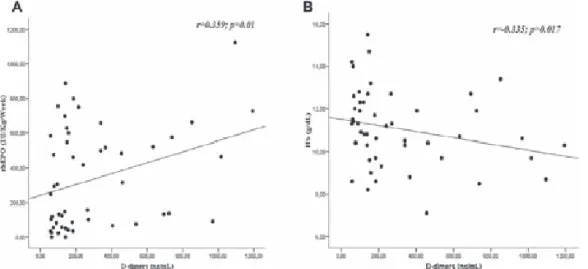
Compared with controls, CRF patients presented significantly lower levels of tPA and with higher levels of D-dimers. In CRF patients, the levels of D-dimers correlated positively and significantly (r=0.359, p=0.01) with rhEPO doses (rhEPO/Kg/week) and negatively with haemoglobin levels (r=-0.335, p=0.017). When comparing the two groups of CRF patients, we found that those with central venous catheter vascular access presented a statistical significant rise in D-dimer and tPA plasma levels. No difference was found between the two groups of patients concerning the plasma levels PAI-1.
Our results showed an altered haemostasis in CRF patients, as suggested by the rise in D-dimer, an index of fibrin turnover and intravascular thrombogenesis. The increased levels of D-dimer and tPA in CRF patients, particularly in those using central venous dialysis catheters, led us to propose a relationship between the type of vascular access chosen for the haemodialysis procedure, and the risk of thrombogenesis. It seems reasonable to assume that these patients present an increased risk for cardiovascular disease events.
80
INTRODUCTION
Cardiovascular disease events are the main cause of death in chronic renal failure (CRF) patients. Disturbances in coagulation and fibrinolysis have been reported in patients with chronic uremia, and are known to contribute to the pathogenesis of car-diovascular diseases. However, studies about co-agulation and fibrinolysis in CRF patients under regular hemodialysis have yielded conflicting re-sults. Some studies reported a suppressed fibrinoly-sis and others an increased fibrinolyfibrinoly-sis1-3. These
controversial results may be related to the type of vascular access (central venous dialysis catheter or AV-fistula) chosen for the haemodialysis procedure, and may associate a different risk of thrombosis3-5.
Our aim was to study the relationship between fibrinolytic activity and the type of vascular access in haemodialysis patients.
MATERIALS AND METHODS
Subjects
We studied 50 CRF patients under regular haemodialysis (32 males, 18 females; mean age 64.5 ± 15.4), 11 with Central Venous Dialysis Catheter and 39 with AV-Fistula.
CRF patients were under therapeutic haemo-dialysis three times per week, for 3 to 5 h, for a median period of time of 36 months. All patients used the high-flux polysulfone FX-class dialysers of Fresenius, 25 with FX60, 23 with FX80 and 2 with FX100 dialyser type.
The causes of renal failure in patient’s population were as follows: diabetic nephropathy (n=16), chro nic glomerulonephritis (n=6), polycystic kidney disease (n=5), hypertensive nephrosclerosis (n=3), obstructive nephropathy (n=3), pyelonephritis associated with neurogenic bladder (n=1), nephrolithiasis (n=1), chronic interstitial nephritis (n=1), Alport syndrome (n=1), renal vascular disease due to polyarteritis (n=1) and chronic renal failure of uncertain aetiology (n=12).
Patients with autoimmune disease, malignancy, hae-matological disorders, and acute or chronic infection were excluded. All patients gave their informed con-sent to participate in this study.
The control group included 25 healthy volun-teers presenting normal haematological and bio-chemical values, with no history of renal or in-flammatory diseases, and, as far as possible, age and gender matched with CRF patients.
Assays
Plasma levels of plasminogen activator in-hibitor type-1 (PAI-1), tissue plasminogen activa-tor (tPA) and D-dimers were evaluated by enzyme immunoassays (TintElize PAI-1, TintElize tPA and TintElize D-dimer, Biopool-Trinity Biotech Company, respectively).
Data analysis
For statistical analysis, we used the Statistical Package for Social Sciences, version 14.0. Kolmo-gorov Smirnov statistics were used to evaluate sample normality distribution. Comparisons between groups were performed using Kruskal-Wallis test and Mann-Whitney U (data with a non-Gaussian distribution) or Student’s t-test (data with a Gaussian distribution). Spearman´s rank correlation coefficient was used to evaluate relationships between sets of data. Significance was accepted at p less than 0.05.
RESULTS
com-81
paring the two groups of CRF patients, we found that those with central venous catheter vascular access presented a statistical significant rise in
D-dimer and tPA plasma levels. No difference was found between the two groups of patients concern-ing the plasma levels PAI-1 (Fig.3).
Fig. 3 – CRF patients with Central Venous Catheter as vascular access presented a statistical significant rise in D-dimers (A) and tPA (B) plasma levels, when compared with those using AV-Fistula as vascular access. No difference was found between the two groups of patients concerning the plasma levels of PAI-1 (C).
Fig. 1 – Compared with controls, CRF patients presented significantly higher levels of D-dimers (A) and lower levels of PAI-1 (B). No difference between these two groups was found for tPA levels (C).
82
DISCUSSION
Our results showed an altered haemostasis in CRF patients, as suggested by the rise in D-dimer, an index of fibrin turnover and intravascular thrombogenesis. The increased levels of D-dimer and tPA in CRF patients, particularly in those using central venous dialysis catheters, led us to propose a relationship between the type of vascular access chosen for the haemodialysis procedure, and the risk of thrombogenesis. It seems reasonable to assume that these patients may present an in-creased risk for cardiovascular disease events.
ACKNOWLEDGEMENTS
We are very grateful to FMC, Dinefro – Diá-lises e Nefrologia, SA and Uninefro – Sociedade Prestadora de Cuidados Médicos e de Diálise, SA, and to their nurses for the technical support. This study was supported by a PhD grant (SFRH/ BD/27688/2006) attributed to E. Costa by FCT and FSE.
BIBLIOGRAPHY
1. GVERIC D, HERRERA B, PETZOLD A, LAWRENCE DA, CUZN -ER ML. Impaired fibrinolysis in multiple sclerosis: a role for tissue plasminogen activator inhibitors. Brain 2003; 126:1590-1598.
2. MEZZANO D, TAGLE R, PAIS E, PANES O, PEREZ M, DOWNEY P, MUNOZ B, ARANDA E, BARJA P, THAMBO S, GONZALEZ F, MEZZANO S, PEREIRA J. Endothelial cell markers in chron-ic uremia: relationship with hemostatchron-ic defects and sever-ity of renal failure. Thromb Res 1997; 88:465-472. 3. LO DS, RABBAT CG, CLASE CM. Thromboembolism and
anticoagulant management in hemodialysis patients: a practical guide to clinical management. Thromb Res 2006; 118:385-395.
4. YU A, EGBERG N, JACOBSON SH. Haemostatic complica-tions in haemodialysis patients: effect of type of vascu-lar access and dialysis filter. Scand J Clin Lab Invest 2003; 63:127-134.