PORTUGUESE JOURNAL OF MANAGEMENT STUDIES, VOL. XIV, NO. 3, 2009
School of Economics and Management TECHNICAL UNIVERSITY OF liSBON
BUSINESS-TO-BUSINESS RELATIONSHIP QUALITY
Armando Luis Vieira
Department of Economics, Management, and Industrial Engineering, University of Aveiro, Portugal
Abstract
Relationship quality (RQ) is increasingly seen as a key factor of competitive advantage, replacing service quality and customer satisfaction as a source of superior performance. Despite the crucial role that relationship managers play in building business-to-business (B2B) relationships, little research has looked at the antecedents of RQ from an interpersonal perspective. In order to respond to the numerous calls for clarification, for there is still some ambiguity around this topic, this study aims to provide a better understanding of the nature and determinants of RQ. A combination of a literature review and the results of a series of interviews with relationship managers of hotels operating in Portugal and their counterparts in corporate clients informed the development of a model, which was subsequently tested using LISREL. Findings highlighted the association between the presence of designated client managers and high quality business relationships, and suggested directions to improve the performance of organisations in building 828 RQ.
Key words: B2B Relationships; Relationship Managers; Relationship Marketing; Relationship Quality.
1.
INTRODUCTION
Several scholars and managers suggest that, in contexts where good qual-ity relationships matter, relationship qualqual-ity (RQ) is replacing service qualqual-ity and customer satisfaction as a key source of superior performance (Palmatier et al., 2006; Rauyruen and Miller, 2007). After a period of time characterised by a focus on more 'impersonal' relationships, based on technological advances, researchers and managers are re-acknowledging that the source of competitive advantage is
Correspondence Address: Armando Luis Vieira - University of Aveiro - DEGEI, Campus Universi-tario de Santiago, 2810-193 Aveiro, Portugal. E-mail: [email protected]
PORTUGUESE JOURNAL OF MANAGEMENT STUDIES, VOL. XIV, NO. 3, 2009
closely related to the quality of long-term relationships between partners (Palmatier et al., 2006; Palmer, 2002). However, .in spite of a growing body of literature on RQ, there continues to be ambiguity about its nature and determinants, in part at least because of its context dependence, and calls for clarification are still numer-ous (e.g. Huntley, 2006; Ivens and Pardo, 2007; Rauyruen and Miller, 2007). Relationships develop at different levels, e.g. structural, economical, and social (Holmlund and Tornroos, 1997). Social bonds between relationship managers and clients can be a powerful tool to augment the core product/service (Price and Arnould, 1999), and their influence on customer satisfaction with company representatives and perceived value is stronger than that of economic resources (Haytko, 2004). Indeed, frequently, relationship managers are the primary, if not the sole, contact point for the buyer and have a significant influence on the level of service quality delivered (Crosby et al., 1990). It has further been argued that the success or failure of relationships depends on the way relationship managers act, as well as on the strength of the social bonds between them and their cus-tomers (Gummesson, 1994). In spite of this, very little research has looked at the antecedents of people-based inter-organisational RQ (Bolton et al., 2003). Using a multi-method study of the relationships between hotels and their corporate clients, this research explores the nature, dimensions and determinants of RQ in an inter-organisational context. Following this introduction, a theoretical overview and a conceptual framework are outlined. After a description of the adopted methodology included in section 3, section 4 reports on the results of the empirical analysis, and conclusions and limitations are presented in the last section.
2. THEORETICAL OVERVIEW AND CONCEPTUAL FRAMEWORK
The concept of RQ was presented to marketing practitioners and research-ers in 1985 by Evert Gummesson, in the context of an Ericsson Quality program (Gummesson, 1987, 2002). In the last two decades, RQ became one of the pillars of relationship marketing (RM) (Gummesson 2002), whose aims are to identify and establish, maintain and enhance, and when necessary terminate relationships with business partners, so that the objectives regarding economic and other variables of all parties are met (Gronroos, 2001). There has been con-siderable discussion about the nature and determinants of RQ and while there is not yet consensus, there is general agreement that RQ is a higher-order construct comprising several different, though related dimensions (Crosby et al., 1990; Ivens, 2004; Kumar et al., 1995; Roberts et al., 2003; Woo and Ennew, 2004). In addition, previous studies demonstrate agreement on the constructs that can be viewed as building blocks of RQ, but no consensus on the way they connect in a causal sense.
PORTUGUESE JOURNAL OF MANAGEMENT STUDIES, VOL. XIV, NO. 3, 2009
For the purpose of this study, RQ is defined as 'the joint cognitive evaluation of business interactions by key individuals in the dyad, comparatively with poten-tial alternative interactions' (Holmlund 2001, p.15). The proposed determinants and dimensions of RQ were identified and conceptualised by combining literature on RQ with the results of a multiple case study investigating the relationships between hotels operating in Portugal and their corporate clients (for a detailed description of the model development process, see Vieira et al., 2008a). In this context, the model and hypotheses outlined in Figure 1 were proposed. This ex-tends existing models by introducing customer orientation as both a direct and an indirect antecedent of RQ, and relational net benefits as an indirect antecedent, while continuing to recognise the importance of commitment, communication, (with both direct and indirect proposed impacts on RQ), and mutual goals as a direct antecedent of RQ.
FIGURE 1
Proposed Model of People-Based Inter-Organisational RQ.
Although there are studies in this area advocating a different composition of the RQ set of dimensions, for example, trust satisfaction and commitment (e.g. Vieira et al. 2008b), the context and approach of the present study resulted in the conceptualisation of RQ as a high-order construct composed of two dimensions, trust and satisfaction.
PORTUGUESE JOURNAL OF MANAGEMENT STUDIES, VOL. XIV, NO. 3, 2009
Trust, the ability to rely on the salesperson's behaviour so that the expectations
of the buyer will be met (Crosby et al., 1990), and satisfaction, the assurance, perceived by the buyer, regarding the 'salesperson's future performance because the level of past performance has been consistently satisfactory' (Crosby et al., 1990, p. 70), were viewed as equally important dimensions of RQ, without a casual relationship between them. This is in line with numerous studies identified in the literature on modelling the central construct of interest in the present investigation (Bejou et al., 1996; Boles et al., 2000; Hewett et al., 2002; Parsons, 2002).
Commitment can be defined as the parties' consistent motivation to maintain
a relationship (Dwyer et al., 1987). According to Berry and Parasuraman (1991), successful relationships depend on mutual commitment between the service pro-vider and the consumer, while Parsons (2002, p. 7) argues that 'commitment among partners is seen as essential for each party achieving its goals and maintaining relationships'. A client's representative suggested that the perception of commit-ment might help to bring together perspectives that at the beginning seemed to be distant: 'There are situations where, if we feel that the client manager is really willing to work together with us, we tend to be more flexible and try to make our proposals compatible with their proposals'. This is in line with Anderson and Narus (1990), who suggested that parties work together towards the achievement of mutual goals when they are committed to cooperate, and with Morgan and Hunt (1994), who found significant associations between commitment and acquiescence, propensity to leave- in this case a negative association, as Bansal et al., (2004) also suggested,- and cooperation. This apparent association between commitment and mutuality of goals seems to find an echo among client managers as well. For example, a hotel representative stated: 'the more the dedication towards the part-nership, the sooner we find common grounds to do business'. Also, Moorman et al. ( 1992) suggest that parties that are committed to a relationship may tend to adopt a behaviour that leads them to resolve potential differences and to remain coherent to their commitment.
Moreover, while Roberts et al. (2003) suggest that commitment to overcome problems inherent to relationships is necessary for a relationship to last, Dwyer et al., (1987) advocate that commitment corresponds to the highest status of relationship bonding. Considering, finally, that commitment acts as a precursor of trust (Lawler and Yoon, 1993) and satisfaction (Molm, 1991), and represents a strong signal of the parties' perception of the quality of the relationship (Gundlach et al., 1995), the following hypotheses are suggested:
H1: The higher the level of commitment, the higher the level of RQ.
H2: The higher the level of commitment, the higher the level of mutuality of goals.
PORTUGUESE JOURNAL OF MANAGEMENT STUDIES, VOL. XIV, NO. 3, 2009
The concept of mutual goals has been defined as degree to which parties
share goals that can only be achieved through joint action and the maintenance of the relationship (Wilson, 1995). The existence of mutual goals offers the right conditions for both parties to benefit from participating in a relationship (McQuiston, 2001). Efforts towards mutuality of goals emerge as soon both partners realise that they have more to gain by behaving cooperatively rather than opportunisti-cally (Bowen et al., 1989). Hotel relationship managers seem to correspond to this idea: 'of course we try to persuade our clients that our offer is the best, but we don't want to push negotiations so hard that it could seem like we were trying to take advantage of them. Rather we use some flexibility- the bottom line is that we don't want to lose our best clients'. Another client manager said: 'Although we aren't that much empowered by our administration, we can always use a degree of flexibility in order for both parties to be satisfied after closing the deal'.
The above described scenario seems to point to an association between goal congruence and satisfaction, one of the dimensions of RQ. Taking also into ac-count that trust is enhanced when channel partners have similar goals (Anderson and Weitz, 1989), and that mutual goals may also enhance satisfaction with both the relationship and the performance of the seller (Wilson, 1995), the following hypothesis is suggested:
H3: The higher the level of mutuality of goals, the higher the level of RQ.
Communication, the client manager's ability to use unique combinations of
code, content, and communication rules to communicate effectively (Williams and Spiro, 1985), has been considered the most basic activity during the exchange within a customer-salesperson dyad, essential to the interaction established between the individuals involved (Williams et al., 1990). The communication flow between pro-viders and clients is a crucial aspect in relationships (Perrien and Ricard, 1995). In addition, it has been suggested that business performance depends on buyer-seller interaction viewed as the level of relational communication (Miles et al., 1990).
In the context of the present study, several pieces of empirical evidence that emerged from interviews pointed to the influence that communication efforts seem to have on the level of commitment between parties. In the words of a client's representative, 'the more we appreciate our account manager's communication skills, the more we feel motivated to strive for the success of the relationship'. In addition, as another firm's representative put it, ' ... when we sense that there is a friendly and open communication between us, we feel kind of obligated to contribute to maintain the best relationship possible'. These perceptions seem to be seconded by the hotel's side: 'We search for empathy between the two parties, behaviour breeds behaviour';' ... we try to create an interpersonal interaction as good as pos-sible, hoping to strengthen the interpersonal bonding as much as possible'.
PoRTUGUESE JOURNAL OF MANAGEMENT STUDIES, VOL. XIV, NO. 3, 2009
Moreover, effective communication between parties enhances trust, one of the dimensions of RQ, particularly within channel dyads (Anderson and Weitz, 1989, 1992; Anderson and Narus, 1990; Morgan and Hunt, 1994), and it has been found to be an antecedent of RQ in previous research (Kumar et al., 1995). Thus, the following hypotheses are posited:
H4: The higher the level of the client manager's communication efforts, the higher the level of RQ.
H5: The higher the level of the client manager's communication efforts, the higher the level of commitment.
Customer orientation,
the degree to which salespeople adopt behaviours aiming at increasing the customer's satisfaction (Dorsch et al., 1998), plays an important role in service organisations, due to the absence of tangible cues with which to evaluate the offering (Kelley, 1992). To have a customer-oriented sell-ing behaviour is often cited as a prerequisite for the practice of RM (Bejou et al., 1998; Saxe and Weitz, 1982).Highly customer-oriented relationship managers adopt actions that lead to long-term satisfaction, and avoid opportunistic behaviours that sacrifice customer interest in favour of an immediate sale or a short-term goal (Kelley, 1992; Saxe and Weitz, 1982). Opportunistic behaviour is inversely related to the quality of relationships (Dorsch et al., 1998). One of the hotel relationship managers said: 'We cannot force clients to do business with us. What we can do is to show them what's in it for them'. Consistently, one of his clients warned: 'What we have with our account manager is informative dialogue, rather than any kind of pressure from either side- that's what we expect from him ... had he taken the wrong attitude, and I guess our motivation to do business with them would disappear'. Another firm's representative commented: 'If we are to commit ourselves to the relationship and do our best to improve it, we must at the same time feel that on the other side there is somebody who understands our needs'. The hotel side corroborated these opinions, as illustrated by the following passages, extracted from answers to different questions: 'Clients like to feel that when they pose a question we are really concerned about it and make our best efforts to solve the problem'; and ' ... that there's someone on the other side of the phone( ... ) for them to turn to in case some doubt comes up'. This apparent link between customer orientation and commitment has been already suggested, e.g. by Baker et al., (1999), who found empirical support for the link between perceived seller market orientation and buyer commitment.
Moreover, in marketing relationships a high customer-oriented selling cor-responds to switching from the 'us vs. them' to the 'we' approach (Hewett et al., 2002). That is, apparently customer orientation is closely related to the existence
PORTUGUESE JOURNAL OF MANAGEMENT STUDIES, VOL. XIV, NO. 3, 2009
of mutuality of goals. Individual goals produce norms of competitive behaviour, whereas mutual interests create behaviour that enhances the well-being of the relationship as a whole (Heide and John, 1992). As one client's representative put it: 'things only work well when they take our interests into consideration, not just their own. That's why we always take the first step and show them that we consider their interests as well'. On the other side, a client manager revealed: 'I've been in this business long enough to learn the strategy to make them happy, while simultaneously realising my commercial objectives. It's this simple: first I get them to talk to me, what do they really want, what can I do to give them what they want, then I look at my 'toolbox' - meaning, the array of services we offer- and I decide what's best for everybody, hoping that they'll agree with me. This technique rarely fails, even if it takes some negotiation here and there'.
In this context, it is argued that customer orientation probably influences RQ, both directly, in line with previous conceptualisations (Bejou et al., 1996; Wray et al., 1994), and indirectly, through mutuality of goals and commitment:
H6: The higher the level of the client manager's customer orientation, the
higher the level of mutuality of goals.
H7: The higher the level of the client manager's customer orientation, the higher the level of RQ.
H8: The higher the level of the client manager's customer orientation, the higher the level of commitment.
Relational net benefits, defined by Dwyer et al., (1987) as the parties'
ex-pected relationship benefits, extend beyond just immediate economic benefits and range from social benefits, which arise from social bonds (Hennig-Thurau et al., 2002) to the advantages accruing from the will to cooperate in the achievement of mutual goals (McQuiston, 2001). Partners stay in relationships as long as there are expectations of receiving the promised benefits (Morgan and Hunt, 1994). The motivation to maintain and strengthen a relationship may also come from the feel-ing of dependence associated with specific investments, relational or otherwise, made in the relationship that may also be interpreted as mobility barriers (Allen and Meyer, 1990; Donney and Cannon, 1997; Geyskens et al., 1996; Han et al., 1993; Palmatier et al., 2006). For the purpose of this paper, which is concerned with the relational dimensions and determinants of RQ, out of the referred invest-ments, the most important are the relational ones, e.g. time, emotional effort, or self-disclosures, also referred to as intrinsic investments (e.g. Rusbult, 1983).
To quote a client's representative, who explained how expected relational net benefits may influence the parties' behaviour, 'sometimes when we feel that we could gain from having a contract with a certain hotel, we don't mind being flexible in turning our business objectives more compatible with the hotel's
PORTUGUESE JOURNAL OF MANAGEMENT STUDIES, VOL. XIV, NO. 3, 2009
ness objectives'. This draws our attention to how the interaction and the sharing process that occurs between the parties affect the relationship. In most situations, partners need to work together on a systematic basis and not act opportunistically, otherwise the long term success of the relationship could be in danger (Carsten and Kumar, 2005). This is consistent with Ulaga and Eggert (2006), who suggest that the existence of social bonds, resulting from the development of interpersonal ties, is associated with a better understanding of each partner's goals. According to McQuiston (2001), the definition of the benefits each partner is willing to offer to the other partner, as well as the sacrifices it is willing to accept, and the way they are converted into common practices and goals, determine whether or not parties are likely to take advantage of participating in the relationship. This suggests an apparent link between the concepts depicted by the constructs relational value and mutual goals. The following quotations reflect the aspects that surfaced in the interviews. 'Sometimes we feel that we invested so much in working with a certain hotel group, that we feel we cannot afford not to be flexible and make all efforts possible to bring together both sides' expectations', said one of the representatives of the corporate clients. On the other side, a hotel representative stated: 'The more we are aware of the benefits we can expect from working with a certain client, the more we are willing to understand the other their perspectives in doing business with us, as long as they make an effort to understand ours'.
Moreover, it has been suggested that, when a certain provider is considered to be important for the client, the latter will make the effort to maintain the rela-tionship (Frazier, 1983; Walker et al., 1977). For example, Anderson and Weitz ( 1992) found empirical evidence for the association between relationship-specific investments and commitment. In addition to this, and according to Sheth ( 1994), in most B2B interactions, particularly when benefits outweigh risks, to maintain a long-term relationship is advantageous for both parties, which is consistent with the idea that, the more the relational net rewards, the more the commitment to maintain a relationship (Rusbult, 1983). Furthermore, commitment increases when firms perceive both that they can receive superior benefits from their partnerships (Morgan a.nd Hunt, 1994), and that the alternatives to their current relationships are relatively poor (Rusbult, 1983). As a client's representative stressed: 'The more we expect to gain from engaging in a partnership, the more the effort we put in that partnership, the more the motivation to stick to that partner'. On the other side, the correspondent client manager said: 'When we spot a good prospect, I mean, a potentially profitable client, we use as many resources - be it people, time, etc. - as we can for the relationship to work, and make everything possible to maintain and improve it'.
The preceding discussion seems to suggest that, from the interviewees' perspective, the bottom line is that they decide on the degree of commitment to the relationship according to their perception of the level of expected net benefits
PoRTUGUESE JOURNAL OF MANAGEMENT STUDIES, VOL. XIV, NO. 3, 2009
(Anderson and Weitz, 1992; Rusbult, 1983). This is also in line with Dwyer et al. ( 1987, p. 15), who suggested that discrete transactions may evolve into more durable interactions, which, in turn, might be associated with 'shared goals, plan-ning, and commitment to the relationship'. Therefore, it is expected that:
H9: The higher the level of relational net benefits, the higher the level of mutuality of goals.
H10: The higher the level of relational net benefits, the higher the level of commitment.
3.
METHODOLOGY
The model was proposed and tested with corporate clients in the specific set-ting of the Portuguese hotel industry- a context characterised by recurring interac-tion between the parties and service customisainterac-tion. The hotel business in Portugal has reached a stage of maturity, where a relatively large portion of the business is controlled by a relatively ·small number of supplier-firms with no significant differ-ences in the offers, and differentiation is achieved through enhancing the quality of the relationships with partners. Based on data provided by DGT (Direcc;ao Geral do Turismo) (2006), the Portuguese authority for tourism, approximately 80% of the business is controlled by less than 14% of the suppliers- the 'big play-ers', typically hotel chains/groups. This results in serious difficulties in relation to market penetration, particularly in the corporate segment, given that the number of customer-firms is relatively limited, as suggested in the literature (e.g. Harker and Egan 2006), and corroborated by the specific reality of the Portuguese hotel sector. Considering, in addition, that in the hotel industry the profitability of sup-pliers more oriented to the corporate segment tends to be relatively higher (Yelkur and DaCosta 2001) and that the corporate segment represents around 20% of the Portuguese market, we have a scenario that gives an idea of the extremely high intensity of the competition in this segment. This is particularly critical when we take into account that, on the demand side, the number of medium to large-sized firms (i.e. those most likely to constitute the typical hotel corporate client) is rather limited. An additional sign of the importance attributed to the corporate segment is the way in which the 'big players' approach the market. One of the tactics used by the 'Top-10' hotel chains (accounting for nearly 72% of the hotels owned by the 'big players') is to designate client managers to proactively manage portfolios of clients, which is also a way to cope with the above-mentioned highly intense competition, in an attempt to achieve differentiation and gain competitive advantage. This study's research context is, therefore, suitable for assessing RQ, given that services are predominant and the relationship between firms is mainly
PORTUGUESE JOURNAL OF MANAGEMENT STUDIES, VOL. XIV, NO. 3, 2009
characterised by an ongoing interpersonal interaction between the individuals representing the two sides of the dyad- the corporate client and the hotel.
After developing the model through a combination of a literature review and supporting qualitative work with the participation eight hotels operating in Portugal and their counterparts in twenty-three corporate clients (reported in the previous section), a cross-sectional field survey was implemented, employing a self-administered questionnaire. Measures of latent constructs were adapted from existing measurement scales and pre-tested (see Appendix for a summary of measurement items, and Vieira (2008) for measurement details). Respondents-corporate clients - were asked to evaluate their relationship with their key contact in the hotel. Questionnaires were distributed via the client managers but returned directly to the researcher. A total of 2,329 questionnaires were distributed and 1,002 responses were received, yielding a final sample comprising 948 cases, with 54 incomplete (that is, the response rate was around 40. 7%).
The analysis consisted of two stages. The final sample was randomly split into the calibration sample (N = 474) and the validation sample (N = 474). Within model calibration, the two-step approach suggested by Anderson and Gerbing (1988) was followed. The evaluation of the measurement model used factor analy-sis, both exploratory (EFA) and confirmatory (CFA). Subsequently, the structural model (with composites created according to a partial aggregation approach) was evaluated on the calibration sample and re-evaluated on the validation sample.
4. EMPIRICAL ANALYSIS
In the calibration phase, EFA was used for initial measure purification, followed by CFA to test for unidimensionality of the latent constructs. The overall model fit statistics (LISREL) were within or close to the generally accepted thresholds for good fit. Residual analysis suggested no major threats to unidimensionality, given the nonsignificant number of absolute values above 2.58 (Joreskorg and Sorbom, 2001) and modification indices above 5.0 (Anderson and Gerbing, 1988). Fur-thermore, items loaded strongly and significantly on unique factors, lending thereby support to the unidimensionality of each construct. In addition, assessments of convergent and discriminant validity, as well as reliability were undertaken and the measurement model was found to be acceptable overall.
In examining the structural model, all estimated paths were in accordance with hypothesised relationships. All but one of the parameter estimates - the one corresponding to the link between relational net benefits and mutual goals (H9) - were significant at p< .05 or better. The majority of significant paths were reasonable in terms of strength, but one gives cause for concern: the direct link between communication and RQ was below .20, the threshold for a path to be
PORTUGUESE JOURNAL OF MANAGEMENT STUDIES, VOL. XIV, NO. 3, 2009
considered practically meaningful (Echambadi et al., 2006). Finally, the squared multiple correlations for the structural equations ranged from .30 to .45.
The model's goodness of fit indices are within thresholds: r} = 40.16 (p=.028), df=25,
x
2/df=l.61, RMSEA=.036, GFI =.98, AGFI= .96, NNFI=.99,CFI=.99. This suggests that the constructs customer orientation, communication, and commitment exert both direct and indirect effects on RQ, whereas mutual goals exerts only a direct, and relational net benefits only an indirect effect on RQ. In principle, these results provide evidence that the proposed conceptual framework is supported by the data, and confirms the nomological validity of the constructs comprising the model. These suppositions are also to be put to test within the process of cross-validation.
TABLE 1
Results for Structural Model Assessment - Validation Sample
Path Path Estimate SE t-value Rz Hyp. Result
COMMITMENT -?R. QUALITY P1, .32 .052 6.26 Hl Supported
M. GOALS-?R. QUALITY pl2 .21 .054 3.87 H, Supported
COMMUNICATION-?R. QUALITY Yn .12 .046 2.62 H • Supported
C. ORIENTATION-?R. QUALITY y12 .43 .100 4.18 H7 Supported
.36
COMMITMENT -?M. GOALS p23 .21 .055 3.73 Hz Supported
C. ORIENTATION-?M. GOALS y22 .53 .110 4.96 H6 Supported
R. NET BENEFITS-?M. GOALS Yz, .07 .060 1.18 Hg Not Supp.
.23
COMMUNICATION-?COMMITMENT Y,1 .26 .050 5.55 Hs Supported
C. ORIENTATION-?COMMITMENT Y,z .43 .100 4.28 HB Supported
R. NET BENEFITS-?COMMITMENT y, .20 .060 3.46 HlO Supported
.31
Using the validation sample, all paths were also in accordance with hypoth-esised relationships. All parameter estimates were significant at p< .05 or better (except the path for H9 see Table 1). In terms of the strength of path estimates, customer orientation is the strongest determinant of RQ, followed by commitment. As with the calibration sample, the association between relational net benefits and mutual goals was nonsignificant. The cross-validation results also reiterate the concerns about the role of communication, particularly regarding its direct asso-ciation with RQ, and raises stability issues in relation to the construct of relational net benefits. The squared multiple correlations for the structural equations were respectable, though slightly lower than those of the calibration sample. This might
PORTUGUESE JOURNAL OF MANAGEMENT STUDIES, VOL. XIV, NO. 3, 2009
have to do with the complexity of the construct of central interest in the present study (Palmatier et al., 2006; Walter et al., 2003), or even a symptom that there might be other antecedents of RQ, which could improve the explanatory power of the model.
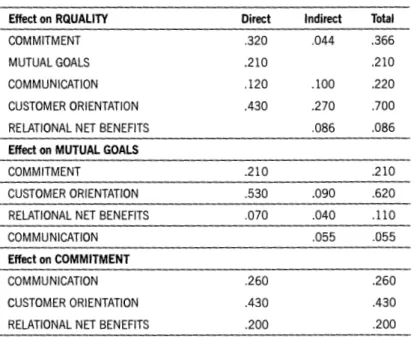
Table 2 presents the aggregate of both direct and indirect effects exerted by both exogenous and endogenous latent variables.
TABLE 2
Decomposition of Structural Effects - Validation Sample
Effect on RQUALITY Direct Indirect Total
COMMITMENT .320 .044 .366
MUTUAL GOALS .210 .210
COMMUNICATION .120 .100 .220
CUSTOMER ORIENTATION .430 .270 .700
RELATIONAL NET BENEFITS .086 .086
Effect on MUTUAL GOALS
COMMITMENT .210 .210
CUSTOMER ORIENTATION .530 .090 .620
RELATIONAL NET BENEFITS .070 .040 .110
COMMUNICATION .055 .055
Effect on COMMITMENT
COMMUNICATION .260 .260
CUSTOMER ORIENTATION .430 .430
RELATIONAL NET BENEFITS .200 .200
Overall, these results indicate that model stability does not appear to be a serious concern, with the final version of the model performing well when tested on the validation sample. The values of the chi-square statistic and the power of the test, taken together, provide strong evidence that there are no serious discrep-ancies between the hypothesised model and the data.
6. CONCLUSIONS
The results of the assessment of the structural model indicated that the pro-posed RQ model had a good fit and that the amount of variance in the endogenous variables explained by the respective proposed determinants was acceptable. All but one of the associations hypothesised were supported, resulting in a scenario where the variables customer orientation, communication, and commitment exerted
PORTUGUESE JOURNAL OF MANAGEMENT STUDIES, VOL. XIV, NO. 3, 2009
both direct and indirect effects on RQ, mutual goals exerted direct effects only, and relational value indirect effects only. Customer orientation, modelled as an exogenous construct, emerged as the most important determinant, with relatively strong direct and indirect effects, not only on RQ, the central endogenous construct in the model, but also on the other endogenous latent variables, commitment and mutual goals. Commitment exhibited the second best performance, namely regarding its direct association with RQ. Findings also highlighted the importance of both dimensions of RQ, trust and satisfaction. Overall, taking into account the foregoing results, it is perceived that there is a high probability that the model is correct for the population of interest. In addition, considering that the analysis was carried out in a B2B services market in which the relationship between the partners in the dyad is mainly based on person-to-person interactions between key individuals representing firms, a research setting that provides a suitable environ-ment for RM and RQ, which is the result of RM efforts (Palmatier et al., 2006), it is perceived that there are strong reasons to believe that the constructs tend to work as depicted in the model proposed and tested in this study.
This research suggests important insights for both practitioners and re-searchers. Researchers have been focusing on key factors such as commitment, satisfaction and trust. This study suggests an additional building block, customer orientation, with both direct and mediated effects on RQ. The emphasis on cus-tomer orientation calls the attention of managers for a managerial aspect that is as much obvious and critical as it is often neglected: the need to work alongside clients, towards mutual beneficial relationships. If the relational perspective of marketing implies that relationship managers evolve from a selling approach to a counselling approach as the literature suggests (Crosby 1989), then several ad-ditional implications arise. First and foremost, a relationship manager has to be someone who is perceived by clients as being trustworthy and able to satisfy the buyers' needs. In effect, it has been shown that employees that are the 'face' of the organisation and establish the link between client and firm can be dangerously harmful to both parties if not managed appropriately (e.g. Crosby, 1989). In this context, firms should be extremely careful in terms of whom to designate as client managers, as well as how to train, motivate and compensate this special kind of contact personnel or 'part-time' marketers. In sum, by looking at the connections in the model, in addition to the constructs themselves, it is possible to apprehend how client managers can enhance their customer orientation, inspire commitment in their clients and promote goal congruity, thereby concurring to improve the qual-ity of the relationships with their partners, which is reflected by the levels of trust and satisfaction. In terms of theoretical contributions, is believed that this study extended the knowledge on RQ and its key constructs by testing a RQ model in a research setting that corresponds to an appropriate habitat for RM and RQ. It is perceived that the combination of both calibration and validation procedures
PORTUGUESE JOURNAL OF MANAGEMENT STUDIES, VOL. XIV, NO. 3, 2009
tributed decisively, not only to differentiate this study from previous approaches to modelling RQ, but, more importantly, to enhance the understanding of the nature, determinants and dimensions of RQ. Therefore, it is expected that these results will spark researchers interested in increasing the body of knowledge on RQ and that this model can be replicated in different 828 service settings.
These findings must be viewed with some limitations such as the context specific and cross-sectional nature of this investigation. Indeed, dynamic reali-ties, as marketing relationships are, call for dynamic approaches, as RQ models should be. This suggests that an assessment of the model in different contexts and, ideally, from a longitudinal perspective, represents a crucial avenue for future research. Moreover, while a single organisation study, at a single point in time, may provide a richer knowledge of the phenomena under analysis, and the chosen research setting matches the characteristics of an appropriate habitat for RM and RQ, further validations in different settings are suggested for future investigations. This could be helpful, for example to assess the context dependence of the RQ construct. Another interesting opportunity for research would be to investigate RQ in the broader network of relationships in which buyer-seller interactions are embedded, bearing in mind, in addition, that contributions to enhance RQ may come not only from the external interaction environment, but also from the internal interaction environment (e.g. co-workers support, supervisors support, etc.). The portions of the variance that remain unexplained also constitute an opportunity for future research. In addition, previous research did not assess empirically RQ at different levels, and this is a theme that should be addressed in future inves-tigations. In this respect, the present study is a starting point; it addresses the social level, due to its prevalence, and it adopts an approach in line with previous suggestions that research in the area of RM should begin with a small number of fundamental issues and then move on to integrate these into broader conceptions (8agozzi, 1995; Price and Arnauld, 1999). To offer more or less intricate relational programs or schemes without an understanding of what RQ is and is not might be counterproductive.
Constructs Customer Orientation
Communication
Relational Net Benefits
Mutual Goals
Commitment
Relationship Quality Trust
Satisfaction
PORTUGUESE JOURNAL OF MANAGEMENT STUDIES, VOL. XIV, NO. 3, 2009
APPENDIX
Summary of Measurement Items
Questionnaire Items Adapted from Saxe and Weitz (1982)
Client manager tries to achieve his/her goals by satisfying us Our client manager has our best interest in mind
Our client manager tries to get us to discuss our needs with him/her Our client manager recommends suitable solutions for us Our client manager tries to find best services for us Our client manager answers our questions correctly
Our client manager tries to match the hotel's solutions with our problems
Adapted from Williams and Spiro (1985)
Our client manager genuinely enjoys helping us Our client manager is easy to communicate with Our client manager likes to help clients Our client manager is a cooperative person
Adapted from Rusbult (1983)
This relationship is extremely rewarding
This relationship is extremely costly (Reverse Coded) We like this partner very much
We have high consideration for this partner
Adapted from McQuiston (2001)
We share a joint vision with our client manager of what is necessary for mutual success We know with certainty what our client manager expects of us
We work proactively with our client manager to establish annual goals Overall, our goals are compatible with the goals of our client manager
Adapted from Bansal eta/. (2004)
Even if it were to our advantage, we do not feel it would be right to leave our client manager now
This client manager deserves our loyalty
We would feel guilty if we left our client manager now
We would not leave this client manager right now because we have a sense of obligation to him
Adapted from Crosby et a/. (1990)
Our client manager can be relied upon to keep his/her promises
There are times when we find our client manager to be a bit insincere (Reverse Coded) We find it necessary to be cautious in dealing with our client manager (Reverse Coded) Our client manager is trustworthy
We are satisfied with the performance of our client manager We are pleased with the performance of our client manager We have a favourable opinion on our client manager's performance
PORTUGUESE JOURNAL OF MANAGEMENT STUDIES, VOL. XIV, NO. 3, 2009
References
Allen, N.J. and J.P. Meyer (1990). The Measurement and Antecedents of Affective, Continuance and Normative Commitment to the Organization, Journal of Occupational Psychology, 63, 1-18. Anderson, E., and Weitz, B. (1989). Determinants of Continuity in Conventional Industrial Channel
Dyads, Marketing Science, 8 (Fall), 310-323.
Anderson, E., and Weitz, B. (1992). The Use of Pledges to Build and Sustain Commitment in Dis-tribution Channels, Journal of Marketing Research, 29 (February), 18-34.
Anderson, J. C., and Gerbing, D. W. (1988). Structural Equation Modeling in Practice: A Review and Recommended Two-Step Approach, Psychological Bulletin, 103 (3), 411-423. Anderson, J. C., and Narus, J. A. (1990). A Model of Distributor Firm and Manufacturer Firm
Work-ing Partnerships, Journal of MarketWork-ing, 54 (Jannuary), 42-58.
Bagozzi, R.P. (1995). Reflections on Relationship Marketing in Consumer Markets, Journal of the Academy of Marketing Science, 23 (4), 272-277.
Baker, T.L., P.M. Simpson, and J.A. Siguaw (1999). The Impact of Suppliers' Perceptions of Resel-ler Market Orientation on Key Relationship Constructs, Journal of the Academy of Marketing Science, 27 (Winter), 50-57.
Bansal, Harvir S., P. Gregory Irving, and Shirley F. Taylor (2004). A Three-Component Model of Customer Commitment to Service Providers, Journal of the Academy of Marketing Science, 32 (3), 234-250.
Bejou, D., Ennew, C. T., and Palmer, A. (1998). Trust, Ethics and Relationship Satisfaction, Inter-national Journal of Bank Marketing, 16 (4), 170-175.
Bejou, D., Wray, B., and Ingram, T. (1996). Determinants of Relationship Quality: An Artificial Neural Network Analysis, Journal of Business Research, 36, 137-143.
Berry, L., and Parasuraman, A. (1991 ). Marketing Services. New York: The Free Press.
Boles, J. S., Johnson, J., and Barksdale, H. C. (2000). How Salespeople Build Quality Relation-ships: A Replication and Extension, Journal of Business Research, 48, 75-81.
Bolton, R., Smith, A., and Wagner, J. (2003). Striking the Right Balance: Designing Service to En-hance Business-to-Business Relationships, Journal of Service Research, 5 (4), 271-291. Bowen, D., C. Sieh, and B. Schneider (1989). "A Framework for Analyzing Customer Service
Orien-tations in Manufacturing," Academy of Management Review, 14 (1), 75-95.
Carsten, D. and N. Kumar (2005). "Do Suppliers Benefit from Collaborative Relationships with Large Retailers? An Empirical Investigation of Efficient Consumer Response Adoption," Jour-nal of Marketing, 69 (July), 80-94.
Crosby, L. (1989). "Building and Maintaining Quality in the Service Relationship," in Quality in Services, S. Brown and E. Gummesson, Eds. Lexington, MA: Lexington Books.
Crosby, L., Evans, K., and Cowles, D. (1990). Relationship Quality in Services Selling: An Interper-sonal Influence Perspective, Journal of Marketing, 54 (July), 68-81.
DGT (2006), Estrutura Organizacional dos Grupos Econ6micos em Portugal: Alojamento e Distri-buic;ao. Direc~ao-Geral do Turismo.
Donney, P. and J. Cannon (1997). "An Examination of the Nature of Trust in Buyer-Seller Relation-ships," Journal of Marketing, 61 (April), 35-51.
Dorsch, M., Swanson, S., and Kelley, S. (1998). The Role of Relationship Quality in the Stratifica-tion of Vendors as Perceived by Customers, Journal of the Academy of Marketing Science, 26 (2), 128-142.
Dwyer, P., Schurr, H., and Oh, S. (1987). Developing Buyer-Seller Relationships, Journal of Market-ing, 51 (April), 11-27.
Echambadi, R., B. Campbell, and R. Agarwal (2006). "Encouraging Best Practice in Quantitative Management Research: An Incomplete List of Opportunities," Journal of Management Stud-ies, 43 (8), 1801-20.
Frazier, G. (1983). "lnterorganizational Exchange Behaviour in Marketing Channels: A Broadened Perspective," Journal of Marketing, 47 (Fall), 68-78.
PORTUGUESE JOURNAL OF MANAGEMENT STUDIES, VOL. XIV, NO. 3, 2009
Geyskens, 1., J. Steenkamp, L. Sheer, and N. Kumar (1996). "The Effects of Trust and Interde-pendence on Relationship Commitment: A Trans-Atlantic Study," International Journal of Research in Marketing, 13 (4}, 303-317.
Gronroos, C. (2001). Service Management and Marketing: A Customer Relationship Management Approach (2nd ed.). Chichester: John Wiley & Sons.
Gummesson, E. (1987). The New Marketing: Developing Long-Term Interactive Relationships, Long Range Planning, 20 (4), 10-20.
Gummesson, E. (1994). Is Relationship Marketing Operational? Proceedings of the 23rd EMAC Conference, Maastricht.
Gummesson, E. (2002). Relationship Marketing in the New Economy, Journal of Relationship Marketing, 1 (1}, 37-57.
Gundlach, G., R. Achrol, and J. Mentzer (1995). "The Structure of Commitment in Exchange," Journal of Marketing, 59 (January), 78-92.
Han, S., D. Wilson, and T. Dant (1993). "Buyer-Supplier Relationships Today," Industrial Market-ing Management, 22, 331-338.
Harker, M. and J. Egan (2006). "The Past, Present and Future of Relationship Marketing," Journal of Marketing Management, 22, 215-242.
Haytko, D. (2004). Firm-to-Firm and Interpersonal Relationships: Perspectives from Advertising Agen-cy Account Managers, Journal of the Academy of Marketing Science, 32 (3), 312-328. Heide, J. and G. John (1992). "Do Norms Matter in a Marketing Relationship?", Journal of
Market-ing, 56, 32-44.
Hennig-Thurau, T., Gwinner, K., and Gremler, D. (2002). Understanding Relationship Marketing Outcomes: An Integration of Relational Benefits and Relationship Quality, Journal of Service Research, 4 (3), 230-247.
Hewett, K., Money, R., and Sharma, S. (2002). An Exploration of the Moderating Role of Buyer Corporate Culture in Industrial Buyer-Seller Relationships, Journal of the Academy of Market-ing Science, 30 (3), 229-239.
Holmlund, M. (2001). "The D&D Model: Dimensions and Domains of Relationship Quality Percep-tions," The Service Industries Journal, 1 (3), 13-36.
Holmlund, M., and Tornroos, J.-A. (1997). What are relationships in business networks? Manage-ment Decision, 35 (4}, 304-309.
Huntley, J. (2006). "Conceptualization and measurement of relationship quality: linking relationship quality to actual sales and recommendation intention," Industrial Marketing Management, 35, 703-714.
Ivens, B. S. (2004). How relevant are different forms of relational behavior? An empirical test based on Macneil's exchange framework, Journal of Business and Industrial Marketing, 19 (5}, 300-309. Ivens, B.S. and C. Pardo (2007). "Are key account relationships different? Empirical results on sup-plier strategies and customer reactions," Industrial Marketing Management, 36, 470-82. Jiireskorg, K., and Siirbom, D. (2001). LISREL 8: User's Reference Guide. Lincolnwood: Scientific
Software International, Inc.
Kelley, S. (1992). "Developing Customer Orientation Among Service Employees," Journal of the Academy of Marketing Science, 20 (Winter), 27-36.
Kumar, N., Scheer, L., and Steenkamp, J. (1995). The Effects of Supplier Fairness on Vulnerable Resellers. Journal of Marketing Research, 32 (February), 54-65.
Lawler, E., and Yoon, J. (1993). Power and the Emergence of Commitment Behavior in Negotiated Exchange. American Sociological Review, 58 (August), 465-481.
McQuiston, D. H. (2001). A Conceptual Model for Building and Maintaining Relationships between Manufacturers' Representatives and Their Principals. Industrial Marketing Management, 30, 165-181.
Miles, M., D. Arnold, and H. Nash (1990). "Adaptive Communication: The Adaptation of the Seller's Interpersonal Style to the Stage of the Dyad's Relationship and the Buyer's Communication Style," Journal of Personal Selling and Sales Management, 10 (February), 21-27.
PORTUGUESE JOURNAL OF MANAGEMENT STUDIES, VOL. XIV, NO. 3, 2009
Molm, L. (1991). Affect and Social Change: Satisfaction in Power-Dependence Relationships, American Sociological Review, 56, 475-493.
Moorman, C., Zaltman, G., and Deshpande, R. (1992). Relationships Between Providers and Users of Market Research: The Dynamics of Trust Within and Between Organizations, Journal of Marketing Research, XXIX (August), 314-328.
Morgan, R., and Hunt, S. (1994). The Commitment-Trust Theory of Relationship Marketing, Journal of Marketing, 58, 20-38.
Palmatier, R. W., Dant, R. P., Grewal, D., and Evans, K. R. (2006). Factors Influencing the Effective-ness of Relationship Marketing: A Meta-Analysis, Journal of Marketing, 70 (4), 136-153. Palmer, A. (2002). "The Evolution of an Idea: An Environmental Explanation of Relationship
Mar-keting," Journal of Relationship Marketing, 1 (1), 79-94.
Parsons, A. (2002). What Determines Buyer-Seller Relationship Quality? An Investigation from the Buyer's Perspective, The Journal of Supply Chain Management (Spring), 4-12.
Perrien, J., and Ricard, L. (1995). The Meaning of a Marketing Relationship: A Pilot Study. Indus-trial Marketing Management, 24 (1), 37-43.
Price, L., and Arnauld, E. (1999). Commercial Friendships: Service Provider-Client Relationships in Context, Journal of Marketing, 63 (4), 38-56.
Rauyruen, P., and Miller, K. (2007). Relationship Quality as a Predictor of B2B Customer Loyalty, Journal of Business Research, 60, 21-31.
Roberts, K., Varki, S., and Brodie, R. (2003). Measuring the Quality of Relationships in Consumer Services: An Empirical Study, European Journal of Marketing, 37 (1/2), 169-196.
Rusbult, C. ( 1983). A Longitudinal Test of the Investment Model: The Development (and Deteriora-tion) of Satisfaction and Commitment in Heterosexual Involvements, Journal of Personality and Social Psychology, 45 (July), 101-117.
Saxe, R., and Weitz, B. (1982). The SOCO Scale: A Measure of the Customer Orientation of Sales-people, Journal of Marketing Research, 19 (August), 343-351.
Sheth, J. (1994). "Relationship Marketing: A Customer Perspective," Proceedings of the 2nd An-nual Relationship Management Conference, June, 1-7.
Ulaga, W. and A. Eggert (2006a). "Relationship value and relationship quality: Broadening the nomological network of business-to-business relationships," European Journal of Marketing, 40 (3/4), 311-327.
Vieira, A.L., C. T. Ennew, and H. Winklhofer (2008a). Modelling Inter-Organisational Relationship Quality from a Dyadic Perspective: An Empirical Contribution. European Union of Tourist Of-ficers 2008 Conference, The University of Nottingham, Nottingham, England, UK, September 24-25.
Vieira, A.L., H. Winklhofer, and C. T. Ennew (2008b). Relationship Quality: Literature Review and Research Agenda, Journal of Customer Behaviour, 7 (4), 269-291.
Walker, 0., G. Churchill, and N. Ford (1977). "Motivation and Performance in Industrial Selling: Present Knowledge and Needed Research," Journal of Marketing Research, 14 (May), 156-168.
Walter, A., Muller, T., Helfert, G., and Ritter, T. (2003). Functions of industrial supplier relationships and their impact on relationship quality, Industrial Marketing Management, 32, 159-169. Williams, K., and Spiro, R. (1985). Communication Style in the Salesperson-Customer Dyad,
Jour-nal of Marketing Research, 22 (November), 434-442.
Williams, K., R. Spiro, and L. Fine (1990). "The Customer-Salesperson Dyad: An Interaction/Com-munication Mpdel and Review," Journal of Personal Selling and Sales Management, 10 (Summer), 29-43.
Wilson, D. (1995). An Integrated Model of Buyer-Seller Relationships, Journal of the Academy of Marketing Science, 23 (4), 335-345.
Woo, K., and Ennew, C. T. (2004). Business-to-Business Relationship Quality: An IMP Interaction-Based Conceptualisation and Measurement, European Journal of Marketing, 38 (9/10), 1252-1271.
PORTUGUESE JOURNAL OF MANAGEMENT STUDIES, VOL. XIV, NO. 3, 2009
Wray, B., Palmer, A., and Bejou, D. (1994). Using Neural Network Analysis to Evaluate Buyer-Seller Relationships, European Journal of Marketing, 28 (10), 32-48.
Yelkur, R. and M. DaCosta (2001). "Differential Pricing and Segmentation on the Internet: The Case of Hotels," Management Decision, 39 (4), 252-261.
Resumo
A qualidade da relac;:ao (QR) e crescentemente vista como um factor chave de vantagem competi-tiva, substituindo a qualidade de servic;:o e a satisfac;:ao do cliente como fonte de desempenho superior. Apesar do papel crucial dos gestores de relac;:oes na construc;:ao de relac;:oes de neg6cio em mercados
business-to-business (B28), e diminuta a investigac;:ao dedicada aos determinantes da QR sob uma per-spectiva interpessoal. No sentido de responder aos inumeros pedidos de clarificac;:ao, dada a ambiguidade acerca do tema, este estudo visa proporcionar uma melhor compreensao da natureza e determinantes da QR. Com base numa combinac;:ao de revisao de literatura com resultados de uma serie de entrevistas com gestores de relac;:oes de hoteis que operam em Portugal e os seus hom61ogos em clientes empresas foi desenvolvido um modelo, que foi subsequentemente testado com recurso ao LISREL. Os resultados sublinham a associac;:ao entre a presenc;:a de gestores de relac;:oes formal mente designados e relac;:oes de neg6cio de elevada qualidade, bern como fornecem sugestoes para a melhoria do desempenho das orga-nizac;:6es no desenvolvimento da QR em mercados 828.
Palavras-chave: Gestores de Relac;:oes; Marketing Relacional; Qualidade da Relac;:ao; Relac;:6es de