Repositório ISCTE-IUL
Deposited in Repositório ISCTE-IUL:
2018-07-20Deposited version:
Post-printPeer-review status of attached file:
Peer-reviewedCitation for published item:
Fernandes, S. M. & Coutinho, C. (2017). Key performance indicators for improving a CRM implementation. In 23rd International Conference on Engineering, Technology and Innovation, ICE/ITMC 2017. (pp. 1401-1406). Funchal: IEEE.
Further information on publisher's website:
10.1109/ICE.2017.8280046Publisher's copyright statement:
This is the peer reviewed version of the following article: Fernandes, S. M. & Coutinho, C. (2017). Key performance indicators for improving a CRM implementation. In 23rd International Conference on Engineering, Technology and Innovation, ICE/ITMC 2017. (pp. 1401-1406). Funchal: IEEE., which has been published in final form at https://dx.doi.org/10.1109/ICE.2017.8280046. This article may be used for non-commercial purposes in accordance with the Publisher's Terms and Conditions for self-archiving.
Use policy
Creative Commons CC BY 4.0
The full-text may be used and/or reproduced, and given to third parties in any format or medium, without prior permission or charge, for personal research or study, educational, or not-for-profit purposes provided that:
• a full bibliographic reference is made to the original source • a link is made to the metadata record in the Repository • the full-text is not changed in any way
The full-text must not be sold in any format or medium without the formal permission of the copyright holders.
Serviços de Informação e Documentação, Instituto Universitário de Lisboa (ISCTE-IUL) Av. das Forças Armadas, Edifício II, 1649-026 Lisboa Portugal
Phone: +(351) 217 903 024 | e-mail: [email protected] https://repositorio.iscte-iul.pt
Key Performance Indicators for improving a CRM
Implementation
Sara Maio Fernandes
Instituto Universitário de Lisboa (ISCTE-IUL) Lisboa, Portugal
Carlos Coutinho
Instituto Universitário de Lisboa (ISCTE-IUL), ISTAR-IUL / Caixa Mágica Software
Lisboa, Portugal [email protected]
Abstract—This document analyses the main pros and cons
factors in the implementation and configuration of instances of a Customer Relationship Management tool (CRM) in a company, with the purpose of understanding if the establishment of key performance indicators (KPIs) could help achieving a higher success rate in its implantation on a new business.
Keywords—CRM, Salesforce, KPIs Improvement.
I. INTRODUCTION
The management of information systems in the modern companies is performed by a set of applications that cover the various business areas concerned. From this set, there are a few that have become very popular for aggregating a large quantity of heterogeneous information, such as Enterprise Resource Planning (ERP) or Customer Relationship Management (CRM) tools. These applications are able to receive and consolidate a large volume of knowledge, helping businesses to become more efficient and effective. However, the implementation of these complex systems tends to be cumbersome and often includes mistakes and wrong configurations that result in a bad and inefficient management of the information system. Particularly when dealing with CRMs it is essential to perform a correct specification of the information system as this can have a strong impact on the customer related processes, causing loss of business.
This is an introductory work, with the purpose of responding to the following research question: "Can the analysis and definition of KPIs benefit the outcome of a CRM implementation?".
The research that supports the development of this paper is based on the experience acquired throughout the implementation and follow-up of several CRM projects, more precisely using the CRM Salesforce solution, in several companies. Based on the aforementioned experience it was possible to conclude that the success of this type of projects is likely to rest on a set of metrics that may help both consultants and customers to achieve their final objective in a more efficient way.
Some recurrent problems which can be found on this type of projects are the delays of the projects’ conclusion, often derived from delays on the intermediary phases. These are commonly due to less than adequate requirements that lead to changes
which could change even the basis of the project, leading to wasted time, money and resources. These insufficient requirements can also lead to the customers’ dissatisfaction with the final result.
This paper aims to help not only the consultant, but also the customer to overcome these difficulties, allowing the project’s final result to be more favourable to both parties, leading to an excellent final product.
II. LITERATURE REVIEW
A. CRM
A consensus has not been reached regarding the definition of what a CRM is. According to Scott Fletcher, a CRM is “a set of ideas and enterprise business processes, which have a direct impact on addressing, contact and customer retention, in the areas of marketing, sales and service” [1]. On the other hand, Schneiderman [2] states that: “the CRM is not only technology and information system, but also a business strategy focused on understanding our customers and based on anticipating the needs of current and future customers of the company”.
Österle [3] defines CRM “as an alternative to increase turnover and profits of the company through the coordinated integration of all business contacts with its suppliers, business partners and customers”, while Storbacka claims that “CRM is an interactive process aimed at achieving the optimum balance between corporate investments and meeting customer needs. Optimum balance is determined by the maximum gain of both parties” [4]. And according to Lawrence Handen, “CRM is the process of addressing, maintaining and further developing relationships with profitable customers” [5].
A CRM is also regarded as the most important method for obtaining and maintaining strategic advantages, particularly on saturated markets [6]. CRMs are developed with the purpose of maximizing value, whether for customers or companies, both increase their joint benefits as their individual simultaneously [7]. Due to the rising need of resources in today’s information systems, cloud computing has become a new way to provide IT (Information Technology) services, thus, generating new business opportunities to IT companies and enabling the customers to reduce costs and increase the quality of their services [6].
Nowadays most businesses will favour hiring companies that provide cloud computing services rather than investing in a standard and traditional IT infrastructure. The main services these businesses request are processing power, storage and business applications. Hence, the most common model to be applied here is Software as a Service (SaaS) [6].
There are numerous advantages about hiring an outside provider to deal with a company’s cloud computing, such as no longer needing to invest in hardware, software, infrastructures, or maintaining the software and centralized solutions [6].
A CRM is not only an IS (Information System) but also a business tool and a marketing strategy. It provides information about what a customer needs, its shopping behaviour, allowing a stronger customer/company bonding [6]. CRM allows a complete vision of the customer. This definition matches the one used by Payne and Frow [6], in which the strategic integration of the IT marketing and its relationships is a long-term relationship with the customers and the interested parties. When using a CRM, the communication and actions with the customer become deliberate and consistent. The purpose of the management of the relationship with the customer is solely to present a (virtual) facet of the company [8].
It is possible to define a customer’s worth to a company, which comprises both its immediate value but also the advantages this customer/company relationship may bring in the future [9].
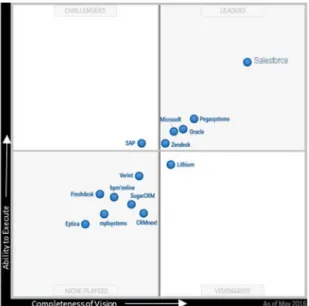
Analysing Fig. 1, it is clear to understand that, according to Gartner [10], the CRM that stands out the rest is Salesforce. B. Cloud Computing
António Miguel Ferreira defines Cloud Computing as being “a concept and not a technology, which is causing a revolution in the way people and companies use the resources made available by IT” [11]. Still according to António Miguel Ferreira, “the definition of Cloud rests on five essential characteristics, three service models and four implementation models” [11].
Fig. 1. Gartner board of CRM providers (May, 2016) showing Salesforce to standout clearly when facing the competition
The NIST (National Institute of Standards and Technology), a North-American governmental organization that promotes regulations, defines Cloud as “a model that allows ubiquitous access, convenient and by request, through the network, to a set of shared computing resources (networks, server, storage, applications, services, etc.), which can rapidly become provisioned or available, with the minimum effort and without interaction with the supplier” [11].
With IaaS (Infrastructure as a Service), an infrastructure is assured by a provider, therefore the customer does not need to worry about the costs required to create and maintain it [9], it is provided as a commodity service.
With PaaS (Platform as a Service) a provider not only supplies a platform, where the application is being executed, but also the resources that support the life cycle of creating a new application [9].
SaaS (Software as a Service) is the most common model of Cloud Computing, and is the ASP’s (Application Service Provider) successor. In this model, the customer does not buy software; instead it hires these services from a provider. This provider supplies the application and all necessary infrastructure. Given that the most common payment method for this type of services is a subscription, the customer never invests on applications, infrastructures or maintenances. A great example, known and used by many daily, is the common e-mail services [9].
C. Cloud-based CRM
Traditionally, all CRM systems were internal applications, that is, all of them were installed and executed on servers inside of an organization. The new CRM systems are Cloud-based, which means the application as well as the data are all kept on the CRM’s provider servers on a data centre, which is accessible using an internet browser [12].
Cloud CRM, also known as SaaS CRM, online CRM or Web CRM, has many technical and monetary advantages [12]:
• A local server is not required to execute a CRM system, therefore, there is no investment cost on infrastructure, on server software and on maintenance;
• Updates, backups and maintenance are guaranteed by the Cloud supplier;
• Users can access the system from anywhere through the internet, e.g., home, office or smartphone;
• Monthly payments instead of up front reduce the financial risk of these projects and improve the cash flow in the organization.
A CRM is fundamental to a company’s relationship with its customers; therefore, it requires great care when allocating this resource to an external services company.
In order to reduce the processing time of the different sets of data from the customer it is necessary to use new concepts, such as Big Data. Most of the data from these customers is considered sensitive due to the amount of confidential data and its
importance, thus making it unviable to use third party clouds given that it means placing those types of data in someone else’s hands.
D. Salesforce and Competition
According to the magic quadrant by Gartner (Fig. 1), none of the current suppliers of CRM services fulfils every need of its customers in the numerous industries. In Gartner’s magic quadrant, each supplier’s position reflects the rise in demand for cloud applications that help the companies enhance its relationships with its costumer through several channels.
According to Gartner, it is expected that up until 2017 around 50% of the organizations adopt a SaaS CRM to support its business processes. With the creation of new data centres in Asia and Europe and the creation of new CRM applications, SaaS will become the main tool to gather new customers regardless of its geography or process complexity.
This magic quadrant analyses the market of applications geared towards customer support regardless of the channel used for the effect. It takes into account a wide range of customer support applications with Customer Engagement Centres (CEC) which can have less than 20 agents (small centres), up until 50 agents (medium) or be large centres which often have more than 20,000 agents.
At its core, Customer Engagement centres have a system of case management and problem solving. These systems require an ability to create, split, federate, join, assign and escalate cases. The functionalities evaluated in this Magic Quadrant include those for knowledge-enabled service resolution, social media/community management and offer management. Also evaluated are interaction assistance tools and service analytics dashboards. Ideally, these applications should have tools for both agents and customers, designed on a common platform. For this study, the following resources were considered:
• Case management, problem solving, service resolution;
• Knowledge management;
• Web and mobile channels support; • Real time decision making support;
• Adaptable mechanism for the creation of business rules;
• Enterprise feedback management.
According to Gartner’s study, in 2016 a greater emphasis was placed on the following:
• Agent guidance and nurturing; • IoT (Internet of Things) connection; • Global instances of the system;
• Industry specific workflow and functionality;
• Mobile chat support;
• Native mobile support for the vendor's customer service and support business applications;
• Real-time and predictive analytics to identify the reasons for calls and its resolution;
• Scalable system based on a cloud model; • Social media management;
• Suggesting steps for the agent to take;
• Support for both self-service and assisted service across different types of device.
The most common requirements made by Gartner’s customers are reflected in this magic quadrant with the following weightings:
• Case management, problem solving, service management: 15%;
• Knowledge management solution: 15%; • Real-time decision making support: 10%; • Collaborative Online communities support: 10%; • Integrated email, chat (including chat in external
mobile applications), collaborative tools: 10%; • Multisource search optimization: 10%;
• Social media management and communities monitoring: 5%;
• Full support of customers that use mobile devices (such as mobile messages support, chat and content): 5%; • Rule engine of adaptable business: 5%;
• Support libraries of video and video-chat with costumers that use Web and mobile devices: 5%; • Business feedback management: 5%;
• Costumer predictive analysis: 5%;
• Offer selling capacity/management: No weighting, but considered a good additional feature;
• Virtual costumer assistant/proactive capacity of the intelligent agent: No weighting, but considered a good additional feature.
The variables that most affected this study were the presence durability of the supplier in the market and its actual growth. A supplier with stagnated sales or inefficient marketing can concern potential buyers [10].
In the leader’s quadrant, there are: Salesforce, Pegasystems, Oracle, Microsoft and Zendesk.
1. Salesforce
Salesforce has five Cloud business applications: Selling Cloud, Services Cloud, Marketing Cloud, Communal Cloud and
Analysis Cloud – besides the Applications Cloud and IoT Cloud. Gartner estimates that 40% of Salesforce’s new revenue came from Services Cloud in 2015, projecting Salesforce is the CEC main supplier, measured by sales volume. Nevertheless, Salesforce is not leader in complex B2C (Business-to-Consumer) services centres. Salesforce has a dominant presence in key-markets, that is, it has appeared as a main supplier of B2B (Business-to-Business) costumer service lists and supports solutions that are, as stated by Gartner, six times bigger than its nearest competitor.
Examples of such strengths include [10]:
• To B2B costumer service operations, especially those with established Salesforce presence in the sales department, Services Cloud is a frequently chosen service in United States, Western Europe, Japan, Australia and New Zealand;
• Salesforce’s vast influence on the market attracted a global list of key-systems integrators and more than 600 complementary software providers;
• Salesforce’s Communal Cloud product for internal collaboration and e-commerce is becoming a differentiating product, as well as its new analysis capabilities. The adoption of this product is frequently the first step on a much more complex implementation. Consequently, Communal Cloud is a good starting point to learn Salesforce stronger and weaker points in general;
• Salesforce is a clear leader in this market (Fig. 1). However, we can also list numerous examples for cautions to be taken into account:
• Corporate users are expressing astonishment with the level of effort necessary to achieve a solution with work flows and the case resources they need;
• The advanced costumer service organizations can be frustrated by the lack of Salesforce’s master data management functionality and by the simple nature of its panels and reports for KPIs;
• Costumers have expressed concern with the high prices practiced by Salesforce;
• Salesforce offers a limited capability to create and offer support to a global class of B2C CEC products (e.g., one that requires integrations and continuous support of telephone switches, e-mail exchange and real time back-end processing systems).
2. Pegasystems
The Pegasystems offer is used in environments where there are frequent changes on complex costumer service processes. Its business is dedicated to commitment with the costumers and process optimization. Pegasystems’ SaaS revenue, despite being
only 5% of its total revenue, grew by over 75% in 2015. A set of strengths can be listed for this solution such as [10]:
• The system can be scaled to meet extremely big implementations, and Pegasystems has referenced costumers that meet this kind of implementations of case management;
• Pegasystems’ costumer service range of products includes a customer service desktop, mobile field sales and field service, employee and costumer’s portals, outbound marketing, chat, email and co-browsing. The overall package received the best cost-to-value rating of any solution assessed for suppliers in the Leaders quadrant (Fig. 1);
• Pegasystems offers industry-specific best practices for the insurance, health and financial services sectors, as well as prebuilt models that accelerate its adoption. Many users compliment the capacity to build, view and audit processes and the use of the Pegasystems's direct capture of objectives methodology, whereby a team can design a business process and integrate the result at the right point in the application. This also makes support practices easy to change.
In the same way, we can also list some cons and cautions to take when using this solution:
• Reference costumers did not give high scores to the key functionalities of Pegasystems and to its capacity of integration with social network, mobile customer service applications, communities or in-line support on websites and mobile applications;
• Bearing in mind that companies in areas like insurance, welfare, and financial services are drawn to products with a decision-making approach and rule engine to solve complexity, many traditionally IT-oriented companies do not favour software coding environments based on Pegasystems models for CEC’s;
• The learning curve of the configuration and personalization of Pegasystems is the longest comparing to other similar products.
3. Oracle Service Cloud
The Oracle service cloud has, amongst other components, a customer service product, acquired as a part of the purchase of RightNow Technologies. Oracle recently renewed its commitment with the CRM application sector by raising the investment on R&D (Research and Development), which will benefit both potential and existing customers. Also for Oracle Service Cloud, a set of pros can be raised, such as [10]:
• The Oracle Service Cloud has plenty of good complementary applications such as field services, mobile customer service, analysis, co-browsing, policy automation, chat, e-mail and knowledge management; • The Oracle Service Cloud, available as a subscription
and does not require a high effort from the IT team. The Oracle’s professional services team get positive feedback for their implementation and consulting on business processes;
• The Oracle Service Cloud has a strong global presence. Moreover, Oracle’s vast base of customers, and its many technologies and applications transversal to all areas of a company, making this offer an attractive one when the offer matches the customer’s needs.
On the other hand, also some cautions apply to this solution, such as:
• Model customers found a series of tactical challenges with Oracle Service Cloud. They have identified problems when updating to recent versions, some performance problems, personalization tools that are hard to use, the needs of a Microsoft.NET customer and the complex licensing taxes;
• The focus of Oracle’s products is not the out-of-box industry processes, such as multi-organizational structures, multiple support teams and many business processes tied to legacy systems and distributed support systems on areas like hospitality, health insurance and banking;
• Some existent and future users of Oracle Service Cloud do not see any evidence that the company is committed to the development of an ISV (Independent Software Vendor) ecosystem to develop the perfect integration with other Oracle’s business applications.
4. Microsoft Dynamics CRM
The companies that chose to deepen their competencies on Microsoft’s business applications are the targets of Microsoft’s Dynamics CRM service. According to Gartner, this product is the second most requested application for customer service agent desktops. The Microsoft Dynamics CRM 2016, although without any reference customers, shows significant improvements on online resources and integration with other Microsoft programs. It is one of the cheapest products of its class. Some strengths can be listed for this product, which include [10]:
• Microsoft Dynamics CRM 2016 combines sales, services and marketing capabilities and integrates well with other Microsoft programs, such as Office, SharePoint and Exchange;
• Microsoft has as solid financial position and a commitment to its line of CRM products, global data centres, sales, marketing and customer service. Likewise, it has access to many development resources and global implementation partners;
• Integration between Microsoft Dynamics 2016 and Azure Services is highly relevant.
Likewise, some drawbacks could be raised:
• Microsoft Dynamics CRM 2016 is not yet developed for specific industries, owning only a small number of partners that have created templates that can be used between companies and be easily updated;
• Some customers have reported a series of problems related with projects, ranging from a lack of workflow capabilities to performance issues during the development of pilot-projects, to difficulties while personalizing the interface and updating to the Cloud from on-premises versions;
• Microsoft’s bad reputation to attract ISV partners is a problem to customers that wish to correct the functionalities problems.
5. Zendesk
This company has grown to support 70,000 customers worldwide, of which 80% have small implementations with less than 20 users. During 2015 and 2016, Gartner has analysed Zendesk cases with 100 to 250 users. Zendesk’s product has SaaS (Software as a Service) signature model based on Cloud and has as its main target to support midsized companies. Zendesk has many product packages; however, on Gartner’s study it was only the Enterprise package that was analysed. Also for this company, a set of advantages can be listed [10]:
• Zendesk offers an intuitive interface for users. It is simple to configure and its responsive design allows website, mobile applications and CECs implementations;
• The inclusion of analysis, satisfaction prediction and advanced voice capabilities, as well as better diagnostic and testing tools, monitoring and security and reports improve the Zendesk product;
• SaaS architecture allows the Zendesk product to be implemented in the majority of the world’s principal markets.
On the other hand, some cons for Zendesk include:
• Zendesk product received low scores by referenced costumers on the integration with social networks, business feedback management, advanced knowledge management and email’s work flow management; • Configuring complex processes with the Zendesk
product is hard. It is also hard to create complex support teams – routing and scaling rules are a challenging task – and offer support to various organizations;
• Companies that require business process changes should know that Gartner did not detect a significant tendency to the major system integrators and CRM consultants to build Zendesk practices.
E. CMMI
In order to be able to introduce new methodologies to the case in point, a study of the current KPIs enhancement methodologies is needed. It may be useful especially to be used methodologies already exiting in this specific case of implementation of a CRM.
The first methodology that was considered was the Capability and Maturity Model Integration (CMMI) [16], which is a collection of good practices developed in order to help companies improve their processes. These models are developed by working parties made up by members of the industry, of the government and of the Software Engineering Institute (SEI). The CMMI model for development (CMMI-DEV) outlines guidelines for the development of products and services.
The CMMI-DEV model proposes guidelines to follow in order to implement a CMMI in a developing organization. The model’s best practices are centred in quality products and services development activities in order to satisfy the customer’s needs. This model is a combination of the best growth practices of the government and industry and incorporates the work of the developing organizations in order to adapt the CMMI to their products and services development.
All practices of the CMMI-DEV model focus on the company’s activities. Developing requirements, technical solutions, products integrations, verifications and validations are the five process' areas of focus, which concentrate on specific practices of development [16].
In order to help organizations, develop and maintain their products and services, the SEI has found several aspects in which a company can focus on in order to improve their business. Every CMMI model stems from the CMMI framework. This framework contains objective practices that are used to develop new CMMI models that belong in the CMMI constellation.
Every CMMI model includes 16 main process areas. These areas cover basic concepts that are fundamental to the improvement of processes in acquisition, development and services. Some of the material used in some of these areas is similar in every constellation while the other materials may be adjusted in order to focus on a specific area.
III. CONCLUSION
After analysing the projects and the state of the art, this article supports the theory, responding to the research question initially formulated, that the investigation of indicators is reasonable in order to improve the implementation of a CRM. It is expected that the takeaway from this investigation provides sufficient indicators that when implemented in the building and management of a CRM project can produce better results than the ones stated initially.
One of the expected result is that intensive requirements gathering with different stakeholders is a mandatory step for the all process. Define the scope based on the requirements previous gather it´s a crucial step for the success of the project. Both Client and Consultant should agree with the scope defined in
order to avoid further problems that may jeopardize the project. Having the right people involved is a key point for success, the contribution that different stakeholders can give it´s important to design a solution that support every customer need. Also, due to the fact that when the end user feels that is part of the project helps a lot embracing the final solution.
BIBLIOGRAPHIC REFERENCES
[1] V. Kumar, W. J. Reinartz, “Customer Relationship Management-A Databased Approach”, John Willey and Sons Inc., USA, 2006.
[2] N. Schneiderman, A. Yih, “The Emerging Face of Customer Relationship Management”, Wedbush Morgan Securities. 2001
[3] H. Österle, A. Muther, “Electronic Customer Care – Neue Wege zum Kunden”, Wirtschaftinformatik 40, 1998.
[4] K. Storbacka, “Řízení vztahů se zákazníky”, Praha: Grada Publishing, 2002.
[5] S. A. Brown, “CRM: A Strategic Imperative in the World of E-business”, John Willey and Sons Inc., USA, 2000.
[6] A. Payne and P. Frow, “A strategic framework for customer relationship management”, Journal of Marketing, vol. 69, no. 4, 2005, pp. 167–176. [7] W. Boulding, R. Staelin, M. Ehret and W. Johnston, “A Customer
Relationship Management Roadmap: What Is Known, Potential Pitfalls, and Where to Go”, Journal of Marketing, vol. 69, no. 4, 2005, pp. 155-166.
[8] V. Kumar and W. Reinartz, “Customer Relationship Management: Concept, Strategy, and Tools”, 2nd ed. 2012 edition, New York: Springer, 2012.
[9] J. Němeček, L. Vaňková, “CRM and Cloud Computing”, proceedings in AICT’11 Proceedings of the 2nd International Conference on Applied Informatics and Computing Theory. 2011. p. 255-259.
[10] Gartner Report on CRM, https://www.gartner.com/doc/reprints?id=1-32AEZIA&ct=160331&st=sb
[11] A.Ferreira, “Introdução ao Cloud Computing”, Lisboa, Portugal: FCA, 2015
[12] https://www.reallysimplesystems.com/faq/crm-definition/
[13] A. McAfee and E. Brynjolfsson, “Big data: the management revolution”, Harvard business review, vol. 90, no. 10, 2012, p. 60.
[14] R. Schmidt, M. Möhring, S. Maier, J. Pietsch, and R.-C. Härting, “Big Data as Strategic Enabler - Insights from Central European Enterprises”, in Business Information Systems (BIS), W. Abramowicz and A. Kokkinaki, Eds. Springer International Publishing, 2014, pp. 50–60. [15] M. AlZain, E. Pardede, B. Soh, J. Thom, and others, “cloud computing
security: from single to multiclouds”, in 45th Hawaii International Conference on System Sciences, 2012, pp. 5490–5499.
[16] CMMI Product Team, “CMMI for Services Version 1.3”, Carnegie-Mellon University, 2010