Repositório ISCTE-IUL
Deposited in Repositório ISCTE-IUL:
2019-05-22
Deposited version:
Post-print
Peer-review status of attached file:
Peer-reviewed
Citation for published item:
Oliveira, J., Azevedo, G. & Silva, M. J. (2019). Institutional and economic determinants of corporate social responsibility disclosure by banks: institutional perspectives. Meditari Accountancy Research. 27 (2), 196-227
Further information on publisher's website:
10.1108/MEDAR-01-2018-0259
Publisher's copyright statement:
This is the peer reviewed version of the following article: Oliveira, J., Azevedo, G. & Silva, M. J. (2019). Institutional and economic determinants of corporate social responsibility disclosure by banks: institutional perspectives. Meditari Accountancy Research. 27 (2), 196-227, which has been published in final form at https://dx.doi.org/10.1108/MEDAR-01-2018-0259. This article may be used for non-commercial purposes in accordance with the Publisher's Terms and Conditions for
self-archiving.
Use policy
Creative Commons CC BY 4.0
The full-text may be used and/or reproduced, and given to third parties in any format or medium, without prior permission or charge, for personal research or study, educational, or not-for-profit purposes provided that:
• a full bibliographic reference is made to the original source • a link is made to the metadata record in the Repository • the full-text is not changed in any way
The full-text must not be sold in any format or medium without the formal permission of the copyright holders.
Serviços de Informação e Documentação, Instituto Universitário de Lisboa (ISCTE-IUL) Av. das Forças Armadas, Edifício II, 1649-026 Lisboa Portugal
Phone: +(351) 217 903 024 | e-mail: [email protected] https://repositorio.iscte-iul.pt
1
Institutional and Economic Determinants of Corporate Social
Responsibility Disclosure by Banks: Institutional Perspectives
Abstract
Purpose: This article explores the firm’s and country-level institutional forces that
determine bank’s CSR reporting diversity, during the recent global financial crisis (2005-2011).
Design/methodology/approach: Drawn on the New Institutional Sociology, it
combines Campbell’s (2007) institutional theory with Dillard’s et al. (2004) model of organizational dynamic change. Specifically, the present article assesses if economic and institutional conditions explain CSR disclosure strategies of thirty listed and unlisted banks from six countries in the context of the recent 2007/2008 Global Financial Crisis. The annual reports and social responsibility reports of the largest banks in Canada, UK, France, Italy, Spain and Portugal were content analyzed.
Findings: Results suggest that economic factors do not influence CSR disclosure.
Institutional factors associated with the legal environment, industry self-regulation, and the organization’s commitments in maintaining a dialogue with relevant stakeholders are crucial elements in explaining CSR reporting. Consistent with the Dillard’s et al. (2004) model, CSR disclosure by banks not only stem from institutional legitimacy processes, but also from strategic ones.
Practical implications: Findings highlight the importance of CSR regulation to
properly monitor manager’s opportunistic use of CSR information and regulate the assurance activities (regarding standards, profession, or even the scope of assurance) to guarantee the proper credibility of CSR information.
Originality/Value: The study delivers two major contributions. First, it extends and
modifies the model used by Chih et al. (2010). Second, drawn on the new institutional sociology, this study develops a theoretical framework that combines the multilevel model of the dynamic process of institutionalization, transposition, and deinstitutionalization of organizational practices developed by Dillard et al. (2004) with the Campbell’s (2007) theoretical framework of socially responsible behavior. This theoretical framework incorporates a more inclusive social context, aligned with a more comprehensive sociology-based institutional theory (Dillard et al., 2004; Campbell, 2007), which has never been used in the CSR reporting literature hitherto.
2 Keywords: Corporate Social Responsibility Disclosure; Institutional theory; Banking
industry; institutional legitimacy; strategic legitimacy; financial crisis
3
1. Introduction
The present study investigates a particular aspect of corporate social responsibility (CSR) reporting: CSR disclosure by banks from Canada, the United Kingdom, France, Italy, Spain, and Portugal over the period of 2005-2011, exploring the firm’s and country-level institutional forces that determine bank’s CSR reporting diversity, during a period of financial crisis.
This research objective is motivated by three main aspects. First, recent studies have examined and found that country-level characteristics (such as investor protection, democracy, government effectiveness, regulatory quality, press freedom, and commitment to CSR) influence CSR reporting and mediate share prices (De Villiers and Marques, 2016) and CSR reporting influences firm’s value (Cahan et al., 2016). However, these studies are focused on the largest non-finance European firms and the World’s largest listed firms. As far as we know, the present study is the first one exploring the influence of country-level characteristics on CSR reporting by banks.
Second, prior literature on the interaction between financial crises and CSR disclosure is scant and the few studies are focused on non-finance companies (Ghazali and Weetman, 2006; Mia and Al-Mamun, 2011; Lungu et al., 2011; Pinto and De Villiers, 2012; García-Benau et al., 2013; Dias et al., 2016; Bouslah et al., 2018;). Thus, it is necessary to analyze other dimensions through the introduction of new industries (such as banking) and different countries (Mia and Al-Mamun, 2011). Moreover, it is crucial to properly assess the evolution of CSR reporting over time and discover other factors explaining the dynamics of its disclosure, beyond the simple mechanical effects of banks’ contextual factors (Jizi et al., 2014).
4
Finally, the literature indicates that in periods of crisis CSR reporting dynamics is diverse, namely among non-financial organizations (Ghazali and Weetman, 2006; Haron et al., 2006; Karaibrahimoglu, 2010; Rowe, 2010; Giannarakis and Theotakas, 2011; Lungu et al., 2011; Mia and Al-Mamun, 2011; Pinto and De Villiers, 2012; Silva et al., 2016; Dias et al., 2016). This CSR reporting diversity is puzzling for two main reasons: a) first, if it is certain that during periods of crisis organizations retract their socially responsible behavior (Pinto and De Villiers, 2012), it is also true that there is a higher demand for social projects; b) second, the 2007/2008 global financial crisis (GFC) has shaken the confidence levels in the financial sector, exposed managers’ unethical and irresponsible behavior, and triggered the public interest in the social and ethical performance of organizations (Pinto and De Villiers, 2012). But, some of the economic benefits of CSR reporting include lowering the firm’s cost of capital and analyst forecast errors (Dahliwal et al., 2011, 2012), helps analysts in forecasting future financial performance more accurately (Muslu et al., 2017), enhances earnings persistence and cash-flow predictability (García-Sánchez and García-Meca, 2017), is value relevant (Cahan et al., 2016), and informative to investors (Villiers and Marques, 2016). Consequently, the incentives regarding the choice of a specific level of CSR reporting by banks during the recent GFC is a valid and relevant research question. We attempt to answer this question by examining which forces interact and determine CSR reporting by banks in the period of the recent GFC.
More specifically, the present study investigates the extent to which institutional pressures – at the economic and political level, organizational field level and organizational level (Dillard et al., 2004; Campbell, 2007) – explain variations in CSR disclosure by banks from Canada, United Kingdom, France, Italy, Spain, and
5
Portugal over the period of 2005-2011. We choose this set of countries for several reasons: a) it encapsulates a diversity of economic impacts derived from the recent GFC, including countries extensively affected (such as United Kingdom) and those less affected (such as Canada) (World Bank, 2014; Freeland, 2010); b) they also incorporate different cultural aspects associated with Common-law (Canada and UK) and Code-Law (France, Italy, Spain and Portugal) legal systems (La Porta et al., 1998); c) and, finally, they present different institutional context the may be important drivers of CSR reporting policies.
Drawn on the new institutional sociology, this study develops a theoretical framework that combines the multilevel model of the dynamic process of institutionalization, transposition, and deinstitutionalization of organizational practices developed by Dillard et al. (2004) with the Campbell’s (2007) theoretical framework of socially responsible behavior. This theoretical framework incorporates a more inclusive social context, aligned with a more comprehensive sociology-based institutional theory (Dillard et al., 2004; Campbell, 2007), which has never been used in the CSR reporting literature hitherto.
Besides, it will allow us to obtain an insightful knowledge able to respond to the several research gaps identified previously, bringing several contributions to CSR reporting literature. First, it analyzes the CSR disclosures over a period of time that incorporates the recent GFC effects in a poorly researched industry (Mia and Al-Mamun, 2011), and therefore, extends the study of Jizi et al. (2014) by investigating a larger sample in terms of countries and time period, incorporating countries more and less affected by the recent GFC.
Second, in a recent exploratory study, Silva et al. (2016) using the sociological framework of Giddens (1990) intertwined with the new institutional theory of
6
DiMaggio and Powell (1983) found that CSR reporting by banks increased over time and varied across countries. They concluded that the three forms of institutional pressure (coercive, normative and mimetic) promote CSR reporting. The present study extends Silva et al. (2016) work particularly in two aspects: a) uses a different theoretical framework that incorporates not only institutional legitimacy but also strategic legitimacy as relevant forces of banks’ CSR reporting dynamics; b) and investigates whether the variation in CSR disclosures is justified by the joint effects of institutional variables (legal system, banking system robustness, legal enforcement mechanisms) and the mechanical effects of contextual variables of banks (size, profitability, leverage, solvency), using an effects-of-causes approach.
Third, based on institutional theory, Campbell (2007) suggests that the relationship between organizational economic conditions and socially responsible behavior are mediated by several institutional factors. This theoretical argument is focused on: a) the set of political and economic institutional forces operating outside the organization; and b) the substantive aspect of corporate social responsibility that corresponds to the “minimum behavioral standard with respect to the corporation’s relationship to its stakeholders, below which corporate behavior becomes socially irresponsible” (Campbell, 2007, p. 951). Chih et al. (2010), through the analysis of data from 2003-2005, concluded that Campbell’s (2007) theoretical propositions are empirically valid for banks that belong to the Dow Jones Sustainability World Index. The present study extends Chih et al. (2010) work because it uses a different research setting: CSR reporting by banks during the recent GFC. It also extends and modifies both Chih et al. (2010) and Campbell’s (2007) work because: a) it adopts a different proxy for socially responsible behavior: CSR reporting; and b) considers strategic legitimacy as another determinant of CSR reporting. Thus, it contends that not only
7
institutional pressures are important factors of socially responsible behavior, but also organizational resistance and proactivity to change the institutional status quo as a function of self-interest (Dillard et al., 2004). A theoretical framework that integrates these two visions is helpful to understand how institutional power flows along the three hierarchical levels (macro organizational level, organizational field level, and organizational level) and how it influences the evaluation criteria of organizational legitimacy when institutional pressures occur. This allow us to capture an insightful explanation of the diversity and dynamics of CSR reporting by banks in the context of a financial crisis.
Main findings suggest that economic factors do not influence CSR disclosure. Only institutional factors associated with the legal environment, industry self-regulation, and organizational commitment in an institutionalized dialogue with relevant stakeholders are crucial elements in explaining CSR disclosures by banks. Bank’s CSR reporting stem not only from institutional legitimacy processes, but also from strategic ones, basically to achieve some benefits: recover corporate reputation, confidence from stakeholders and restore the credibility of the financial system as a whole. These findings highlight some important implications for practice associated with the need to promote CSR regulation to properly monitor manager’s opportunistic use of CSR information and regulate the assurance activities (regarding standards, profession, or even the scope of assurance) to guarantee the proper credibility of CSR information.
In the following sections we present the literature review, the theoretical framework and hypotheses. Next, we explain the research methodology and results. We finalize with the conclusions, limitations, and suggestions for further studies.
8
2. Literature Review
Although the majority of CSR studies have excluded the banking sector (Kiliç et al., 2015) research on this industry has been increasing and focus on the nature and content of CSR disclosures (Coupland, 2006; Barako and Brown, 2008; Branco and Rodrigues, 2006, 2008; Khan et al., 2009; Ruiviejo and Morales, 2016; Silva et al., 2016; Islam and Kokubo, 2018), the internal organizational factors effects, namely, size, leverage, and profitability on CSR disclosures (Barako and Brown, 2008; Branco and Rodrigues, 2008; Khan et al., 2011; Chakroun et al., 2017; Khalil and O’sullivan, 2017), the CSR effect on the market value or performance of banks (Carnevale et al., 2012; Wu and Shen, 2013), earnings quality (García-Sánchez and García-Meca, 2017), the relationship between CSR reputation and economic performance (Forcadell and Aracil, 2017; Dell’Atti et al., 2017), and on the corporate governance effects on CSR by banks (Barako and Brown, 2008; Menassa, 2010; Khan, 2010; Farook et al., 2011; Kiliç et al., 2015; Kiliç, 2016; Jizi et al.,2014; Sharif and Rashid, 2014). Appendix 1 shows a summary of the main explanatory variables of CSR disclosure by banks.
Another research area examine the interaction of economic and financial crises with CSR disclosure (Ghazali and Weetman, 2006; Haron et al., 2006; Mia and Al-Mamun, 2011; Lungu et al., 2011; Pinto and De Villiers, 2012, García-Benaú et al., 2013, Karaibrahimoglu, 2010; Giannarakis and Theotakas, 2011; Dias et al., 2016). However, this literature focus on non-financial companies and findings are contradictory and indicative of CSR reporting diversity (Silva et al., 2016).
From an institutional theory perspective there are two opposing arguments that might provide an explanation for CSR reporting diversity in periods of financial crisis. According to the new institutional economy, the retraction of socially responsible behaviors can be explained by reasons of elimination of competitive disadvantages,
9
reduction of unnecessary expenses (Waddock and Graves, 1997), management of profitability and shareholder wealth (Preston and O'Bannon, 1997), and therefore less CSR reporting. On the other hand, according to the new institutional sociology, the development of socially responsible behaviors, through the involvement in social projects (Margolis et al., 2007), improves the relationship with relevant stakeholders (Freeman, 1984), resulting in a better long-term financial performance (McGuire et al., 1990), and consequently in better and more transparent CSR reporting. The present study builds on this later theoretical perspective. Based on Campbell’s (2007) theoretical framework of socially responsible behavior it contends that the way banks communicate CSR information to their stakeholders depends on the economic and institutional context in which they operate.
Campbell’s (2007, p. 950) work only examines the “imperatives that encourage firms to act in socially responsible ways or not”, under the argument that institutions influence organizations by either constraining (through rules, impositions or sanctions) or enabling (through normative mechanisms) their behaviors. More specifically, it focuses only on the institutional forces operating outside the organization, consistent with ‘convergent’ change behaviors – organizational conformity to institutional pressures (DiMaggio and Powell, 1983).
However, Riaz (2009) documents two particular aspects of banks’ institutional context, nearly before the recent GFC : a) financial institutions (such as – Central Banks and other supervisory entities) have power over organizations (such as banks) and consequently legitimate them; and b) these organizations, through their success, also legitimate financial institutions. This ‘reverse legitimacy’ granted the credibility of the financial system as a whole. But some organizations with budgets far beyond those of several countries had a huge power over institutions which they tried to influence, shape
10
and manipulate in the pursuit of their own strategic legitimacy interests. In other words, “while organizational success in the aggregate reverse-legitimates institutions, this is no guarantee of organization conformance to all pressures [from institutions] (…), they can further manipulate the legitimacy-granting process through strategies that help avoid institutional pressures” (Riaz, 2009, p. 30). This highlights two important conclusions. First, since legitimacy “flows both ways” (Riaz, 2009, p. 29), institutional and strategic legitimacy arguments need to be considered when studying banks’ CSR reporting. Second, not only institutionalization but also deinstitutionalization processes are prone to influence banks’ CSR reporting, basically in the context of crises (such as the recent GFC) if decoupling strategies adopted by those powerful and relevant organizations are detected. Consequently, in the banking industry the explanations of CSR reporting diversity, basically in periods of a financial crisis, go far beyond the mere ‘convergent’ change processes.
If it is certain that prior research has forgotten to assess the influence of the institutional environment on CSR reporting by banks, the few existing studies focus only on the ‘convergent’ change through isomorphic processes (Silva et al., 2016). They neglect the factors of organizational efficiency. The present study tries to fill this void by examining if both the processes of ‘convergent’ change, resistance to change – ‘divergent’ change – and the dynamics of organizational processes are relevant aspects of the institutional environment that may have influenced bank’s CSR reporting diversity.
Drawn on the theoretical framework that combines the multilevel model of the dynamic process of institutionalization, transposition, and deinstitutionalization of organizational practices developed by Dillard et al. (2004) with Campbell’s (2007) theoretical framework of socially responsible behavior, the present study examines
11
bank’s CSR reporting diversity through the lens of institutionalization/deinstitutionalization (convergent/divergent) processes, incorporating macro and micro aspects, as well as economic factors (economic efficiency) and institutional factors. It contends that the relationship between the economic conditions and bank’s CSR reporting diversity is mediated by institutional factors (Campbell, 2007) that act at different levels: economic and political level, organizational field level, and organizational level (Dillard et al., 2004). This theoretical framework establishes how institutional power is distributed hierarchically and how the institutional dynamics flows over the three different levels of social systems. It also shows how these economic and political institutions affect and legitimize organizational behavior through forces from the external environment (convergent change) and how they are influenced by organization’s strategic responses to institutional pressures. As far as we know a theoretical framework such as this one has never been used in bank’s CSR reporting literature.
Campbell (2007) proposes eight propositions to explain socially responsible behavior. Appendix 2 presents these propositions and the interconnection with Dillard’s et al. (2004) model of organizational dynamic change associated with the institutionalization/deinstitutionalization process.
2.2.Hypothesis Development
Economic and political levelCampbell (2007) refers that in environments with too much and too little competition managers tend to act more opportunistically and therefore, they are less likely to act in socially responsible ways.
12
likely to engage in socially irresponsible practices. Therefore, their disclosure level will be lower in such a way that potential socially irresponsible behaviors – inhibitors of a good reputation – cannot be perceived by their stakeholders. On the other hand, environments with too little competition (e.g. monopoly), since managers exert power and institutional control over the operational resources they do not need to legitimize themselves before stakeholders and, therefore, restrict their CSR disclosure levels. According to Proposition 2 of Campbell’s (2007):
Hypothesis 1a: A very high level of competition in the banking industry is
associated negatively with CSR disclosure by banks.
Hypothesis 1b: A too little level of competition in the banking industry is
associated positively with CSR disclosure by banks.
The economic environment also influences socially responsible behaviors (Campbell, 2007). Recessive economic environments (e.g., high inflation, low productivity growth, weak consumer confidence, and low growth Gross Domestic Product (GDP)) determine the resources available to organizations. According to slack resources theory (Waddock and Graves, 1997), less profitable companies have fewer resources to spare in social responsibility activities and apply these resources in initiatives that maximize profits in the short-term. Therefore, in recessive economic environments, companies will be less likely to behave in socially responsible ways. In this environment, CSR reporting process can also be understood in the light of social psychology, in which socially irresponsible behaviors are associated with the adoption of impression management strategies: “the process by which people control the impressions others form of them” (Leary and Kowalsky, 1990, p. 34).
13
The literature has indicated that these IM strategies can take the form of syntactical manipulation, rhetorical manipulation, attribution of organizational outcomes, thematic manipulation, selectivity, visual/presentation effects, and performance comparisons (Brennan et al., 2009; Merkl-Davies and Brennan, 2007, 2011). In a financial reporting context, these communication strategies are considered pervasive since positive information is exaggerated, negative information underplayed (Brennan et al., 2009; Guillamón-Saorín et al., 2012), and incorporate an opportunist and misleading effect (Guillamón-Saorín and Martinez-López, 2013). Therefore, investors in more sophisticated markets penalize the adoption of impression management strategies (Guillamón-Saorín et al., 2017) and one way to limit its adoption is stronger corporate governance structures (García-Osma and Guillamón-Saorín, 2011). In a CSR reporting context, the adoption of impression management strategies increases analysts forecast dispersion and lowers forecasting accuracy (Muslu et al., 2018). However, the incentives to adopt impression management strategies in CSR reports are greater because information is voluntary, less regulated, and less audited (Barkemeyer et al., 2014). Besides, they are influenced by the economic environment (Leary and Kowalsky, 1990). In recessive economic environments (such as those associated with the recent GFC) the motivation to engage in this kind of communication strategies is greater because resources are scarce, but the value of the desired goals (e.g., the maximization of profits in the short-term) is greater. Consequently, the likelihood of managers acting in socially irresponsible ways is greater. At the CSR reporting level, from a social psychology perspective, such behaviors correspond to a lower level of disclosure, less verbosity and, therefore, shorter messages with less cognitive complexity (Oliveira et al., 2016), because “liars tell less complex stories (…) lying is
14
associated with less detail, thus resulting in shorter communication” (Merkl-Davies et al., 2011, p. 323). So, according to Campbell’s (2007) Proposition 1:
Hypothesis 2: The economic environment is associated positively with the
disclosure of CSR by banks.
The legal and regulatory environment also influences socially responsible behavior (Campbell, 2007). Regarding the banking sector, the deregulation policies initiated in the 1980s and 1990s in the United States of America and later on disseminated to other countries allowed the occurrence of socially irresponsible behaviors associated with the promotion of high risk projects with high returns, but at expenses of the main source of banks’ liquidity: deposits (European Central Bank, 2006; Gulamhussen and Guerreiro, 2009). In the aftermath of the recent GFC such high-risk projects have hampered banks’ solvency, promoted distrust in the financial system, and a liquidity crisis. To avoid these social costs, legal and regulatory environment needs to limit the level of risk assumed by banks, to align the interests of banks and their stakeholders, to maximize information able to reducing transaction costs, and to promote a credible and robust financial system (Ekanayake et al., 2009). According to the Financial Stability Forum (2008) some of the recent GFC causes are associated with the lack of transparency of information and weak regulation that allows effective market discipline (stakeholder protection and improved transparency of information). Consequently, a better legal environment and more robust banking regulation are the key to improving market discipline mechanisms (Bliss and Flannery, 2002; Oliveira et al., 2013).
Legal environments that protect investors restrict socially irresponsible behaviors, as investors are empowered to impose a set of behaviors, conducts and values in managers, under the penalty of being replaced (Leuz et al., 2003). In a more
15
robust legal environment, investors have the power to establish contracts that limit managers’ opportunistic behavior (e.g., the socially irresponsible), as well as to require greater information flows.
Additionally, Campbell (2007) refers that it is crucial the existence of robust legal enforcement mechanisms, and supervisory bodies (e.g., central banks) to monitor organizational behavior. Thus, according to Campbell’s (2007) Proposition 3:
Hypothesis 3: The legal environment is associated positively with CSR
disclosure by banks.
Organizational field Level
Campbell (2007) suggests that institutional factors associated with: a) a system of
well-organized and effective industrial self-regulation; b) a monitoring by private, independent organizations, social movements organizations, institutional investors and the press; c) institutionalized normative calls to adopt socially responsible behavior; and d) the participation of organizations in institutionalized dialogue with employees, community groups, trade or industrial associations and unions, are more likely to develop socially responsible behaviors.
Industry regulation is not always established by the State. In some industries (such as the banking industry – for example the Basel Accords), there is self-regulation mechanisms that ensure appropriate practices, aligned with institutional pressures exerted by institutions located at the economic and political level (convergent change), as well as proposals by the most relevant organizations at the organizational level, seeking to promote the institutionalization of innovative organizational practices and structures (divergent change) in the pursuit of their own strategic interests. Martin
16
(2003) suggests that the most effective way to facilitate the adoption of certain behaviors is through peer pressure, because: a) in a neoliberal perspective, the State delegates this regulation into the industry; b) it is preferable to control the regulation process, rather than to be subject to a set of rules imposed by the State which hinder the aims organizations intend to achieve; c) or still, because corporations fear that State regulation is not enough to protect the industry’s interests (Campbell, 2007). However, effective industry self-regulation depends on how the industry is organized and how the State supports self-regulation processes. According to Campbell's (2007) Proposition 4:
Hypothesis 4: The organization level and effective sector self-regulation is
associated positively with CSR disclosure by banks.
Bliss and Flannery (2002) refer that given the complexity of the banking business model one of the crucial elements of banking supervision is market discipline. Market discipline involves two distinct components: a) ‘market monitoring’ – the capacity of investors rigorously assess changes in the organization’s economic, financial and social condition; and (b) ‘market influence’ – managers’ ability to react to those assessments. Negative signals from ‘market monitoring’ indicate that investors may want management to make organizational changes. Positive signals generally do not suggest that these changes are desired. These monitoring mechanisms signal deviant behaviors in relation to practices, values, imposed by the hierarchically higher institutional levels and put pressure on those organizations most exposed to this kind of scrutiny: those with greater public visibility (Branco and Rodrigues, 2008; Oliveira et al., 2013). This information is crucial to supervisory agencies in reducing market excessive exposure to bank’s risk, through the establishment of financial safety net policies (such as ‘deposit guarantee mechanisms’) or through the imposition of minimum solvency requirements
17
(Oliveira et al., 2013).
Bliss and Flannery (2002) argue that market signals are not enough to ensure proper ‘market monitoring’ as there is asymmetric information, costly monitoring, principal-agent problems, and conflicts of interest among the several stakeholders. As a response to institutional pressures exerted by these relevant stakeholders and reduced adverse assessments from ‘market monitoring’, managers tend to satisfy stakeholders’ expectations, adopting socially responsible behaviors. They share a part of the asymmetric information they possess, making financial reporting more transparent (Sabaté and Puente, 2003).
Regarding the ‘market monitoring’, Campbell (2007) mentions that press also plays a relevant role. It serves as a ‘watchdog’, namely, regarding the most publicly visible organizations. Thus, managers will allocate more resources to manage the relationship between the organization and the media. According to Campbell’s (2007) Proposition 5:
Hypothesis 5: Monitoring by the relevant stakeholders is associated positively
with CSR disclosure by banks.
In addition to the various pressures exerted by institutions on organizations, institutional theory admits that a set of values, behaviors, and mental/cognitive frames can be rooted through normative isomorphism mechanisms (DiMaggio and Powell, 1983), namely through business school curricula or through practices suggested by professional organizations, trade associations, industry or unions. These cognitive frames determine how managers run their companies and, therefore, promote socially responsible behaviors. According to Campbell’s (2007) propositions 6 and 7:
18
trade associations, industry and unions in which banks take part of are associated positively with CSR disclosure by banks.
Organizational level
The CSR literature suggest positive, negative and neutral associations between CSR and financial performance. In this regard, Simpson and Kohers (2002) report that a negative relation is consistent with the neoclassical economic argument that CSR initiatives allow costs to occur that reduce company profits and value. It is also consistent with the hypothesis of manager’s opportunistic behavior. Managers of companies with higher financial performance do not invest in CSR because they want to maximize short-term profit and their own compensation. Neutral relations (Chih et al., 2010) are based on the argument that the situation of the organization and society is so complex that there is no simple and direct relationship between CSR and financial performance.
On the other hand, some CSR studies suggest a statistically significant positive association between financial performance and CSR disclosure (Wallace and Naser, 1995; Hossain, 2000; Branco e Rodrigues, 2008; Sharif and Rashid, 2014; Jizi et al., 2014). The theoretical reasoning remains on the slack resources theory (Waddock and Graves, 1997). Managers of organizations with better levels of financial performance can more easily affect resources to foster socially responsible behaviors either through social responsibility initiatives or social responsibility initiatives, as well as through its disclosure (Lim et al., 2007). Thus, according to Campbell’s (2007) Proposition 1:
Hypothesis 7: The financial performance level of banks is associated positively
with the CSR disclosure by banks.
19
institutionalized dialogue with their stakeholders, both benefit from this dialogue and organizations tend to behave in a socially responsible way. However, Campbell (2007) states that legal institutions (for example, the State) are particularly important in facilitating this sort of dialogue. This is reflected in regulation and legislation, as discussed and suggested in hypothesis 3 (Campbell’s (2007) Proposition 3).
Additionally, Campbell (2007, p. 948) mentions that “a systematic treatment of these firm-level factors is beyond the scope” of his analysis. However, his institutional theory allows the consideration of some organizational level characteristics that influence socially responsible behavior. One of these factors is the organizational financial performance (Proposition 1). The other one does not depends on legal institutions (Proposition 8), but facilitates the credibility of the organization’s dialogue process with its stakeholders: the assurance of sustainability reports and the adoption of sustainability reporting standards. For Deegan et al. (2006) and Simnett et al. (2009) these two factors are crucial communication mechanisms capable of promoting stakeholders’ credibility and trust in both organizational reputation and CSR information. Moreover, CSR reporting prepared under GRI guidelines is informative to investors (De Villers and Marques, 2016), and both expected and unexpected portions of CSR reporting promote firm value (Cahan et al., 2016). Thus, according to Campbell’s (2007) Proposition 8:
Hypothesis 8: Organizational commitment in an institutionalized dialogue with
stakeholders is associated positively with CSR disclosure by banks.
3. Methodology
3.1. Sample20
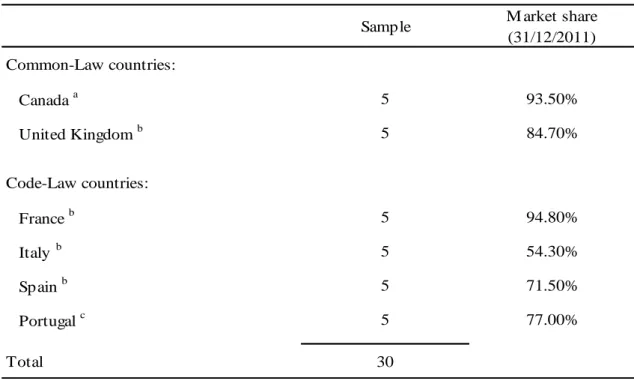
five largest banks from six countries: Canada, United Kingdom, France, Italy, Spain and Portugal. In each country, we selected 5 banks based on the size measured by the total assets reported at 31 December, 2011. The sample comprise a total of 30 banks, listed and unlisted on a regulated Stock Exchange market. We exclude all financial institutions founded after 2005. Table 1 presents the sample.
(insert Table 1 here)
To reduce sampling bias we select the most representative banks in each country in terms of market share. In each country’s subsample bank’s market share exceeds 70 percent, with an exception for Italian banks. We exclude the biggest Italian bank (Sanpaolo IMI), because in 2007 was merged with Intesa bank, and a new bank was created (Intesa Sanpaolo SpA). We use the following rankings to select the Canadian, British, French, Spanish and Italian banks: World’s 50 Biggest Banks 2012[1]
, Top Banks in UK[2], 50 Biggest Banks[3], and the list of Italian Major Banks[4].We also use
the ranking World’s 50 Safest Banks-2011 to choose the fifth French bank, which is considered the second safest bank in the world: Caisse des Depôts et Consignations. We select the five Portuguese banks from the Financial and Stability report issue by the Portuguese Central Bank.
The present study intends to assess the banks’ CSR reporting dynamics during the recent GFC. To avoid sampling bias, we choose a set of countries with a diversity of economic impacts derived from the recent GFC. Consequently, we establish the following decision rules:
Inclusion of different cultural, economic and institutional contexts per country:
Common-law / Code-law (La Porta et al., 1998);
Inclusion of countries with different levels of impact of the recent GFC in the banking sector;
21
Inclusion of a country that has been considered the least affected by the recent GFC: Canada[5] (Freeland, 2010);
Inclusion of a country that has been considerably affected by the recent GFC in the banking system: United Kingdom[6] (World Bank, 2014);
Inclusion of countries of the Code-law legal system that have been considered as the ones that disclose more CSR information (IE-School of Communication, 2010) and with different economic impacts derived from the recent GCF.
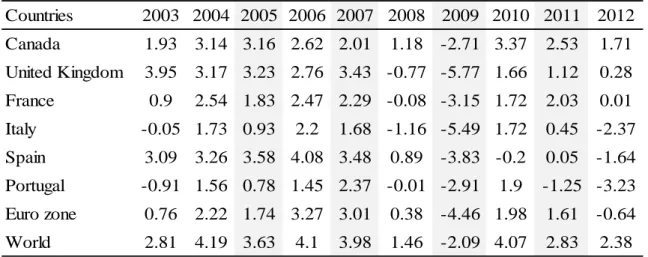
In a second stage, we select the period of analysis according to the evolution of gross domestic product (GDP) per country, as presented in table 2. This data highlights four relevant periods: 2005 (the period before the crisis), 2007 (the beginning of the crisis), 2009 (the peak of the crisis), and 2011 (the post-crisis year).
(insert table 2 here)
According to World Bank (2014) and Eurostat (2014), the recent GFC started in mid-2007, with more intense effects in 2009. But, from 2011 onwards economies started to feel a positive improvement in its symptoms. Consequently, the present study covers a four years period (2005, 2007, 2009, and 2011), because we consider this is the appropriate time-frame to capture the impact of the recent GFC on bank’s CSR reporting diversity in periods of crisis. Table 2 shows a new recessionary cycle in the Euro zone after 2012. This cycle is associated with a sovereign debt crisis in several European countries. This crisis is related to the recent CFG of 2007/2008 (Lane, 2012) and some European economies such as Portugal had to be intervened by the International Monetary Fund. However, its effects on banks’ CSR reporting are not the subject of the present study.
22
120 observations.
3.2.Dependent Variable
We collect the bank’s annual reports (N=120) and their individualized CSR reports (N=101) from websites of the sampled banks. We use content analysis to codify and extract from these documents information on five CSR categories (Community Involvement Disclosure, Environmental Disclosure, Human Resources Disclosure, Customer Disclosure, and Product and Service Disclosure) that are commonly used in prior literature[7] (Gray et al., 1995; Gray et al., 2001; Branco e Rodrigues, 2006;
El-Bannany, 2007; Mia e Al-Mamun, 2011; Silva et al., 2016).
Then, we construct a CSR disclosure index for a company j in year t:is: CSRDjt = , 0 ≤ CSRDjt ≤ 1 (1)
where njt is the maximum number of items for company j in year t (njt = 35) and xij assumes the value 1 if the item is disclosed and 0, otherwise.
3.3.Independent Variables
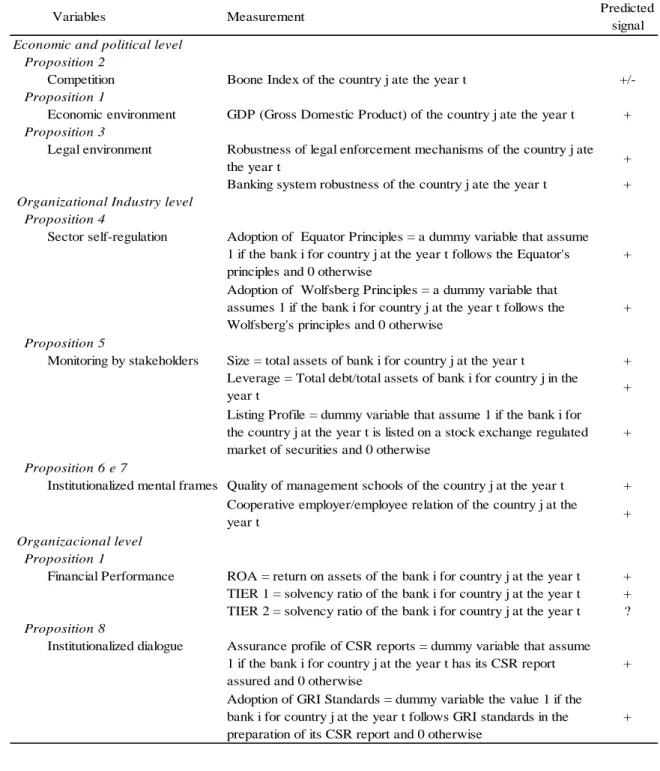
The independent variables and predicted signals are described in Table 3. (Insert table 3 here)
The variable ‘competition’ is evaluated by the Boone index extracted from the Global Financial Development Database (World Bank, 2013). The Boone index is a measure of the level of competition based on yields-efficiency of the banking market. It is calculated as the elasticity of yields relative to marginal costs. An increase in the Boone index implies deterioration in bank’s competition and, therefore, less competition.
23
real terms, extracted from the World Development Indicator (World Bank, 2014). Chih
et al. (2010) use three variables to evaluate the economic environment: inflation rate,
industrial production index and consumer confidence index. In a preliminary analysis we included the inflation rate. However, due to problems of collinearity we removed it from the analysis.[8]
The variable ‘legal environment’ is evaluated by the proxies ‘robustness of the legal enforcement mechanisms’ and ‘banking system robustness’. LaPorta (1998) measures the ‘robustness of the legal enforcement mechanisms’ by the average value of four indicators: ‘judicial system efficiency’, ‘rule of law’, ‘control of corruption’, and ‘legal system efficiency’.[9]
We extract the ‘rule of law’ and ‘control of corruption’ indicators from the Worldwide Governance Indicators Database (World Bank, 2015). We extract the ‘judicial system efficiency’ and ‘legal system efficiency’ indicators from The Global Competitiveness Index Historical Database 2005-2014 (World Economic Forum, 2014). The ‘rule of law’ reflects the perception of the agents in the trust of the society’s rules and, in particular, in the quality of enforcing contracts, property rights, police and the courts, as well as the probability of crime and violence (World Bank, 2015). The ‘control of corruption’ reflects the perception of the extent to which public power is exerted in the private interest, including the various forms of corruption, as well as the power of elites and private interests in influencing State activity (World Bank, 2015). The ‘judicial system efficiency’ reflects the impartiality of the judicial system over the influence exerted by the political, business and private classes (World Economic Forum, 2014). The ‘legal system efficiency’ reflects the speed with which each country’s legal framework allows companies to resolve disputes and challenge the legality of government actions/regulations (World Economic Forum, 2014). Following Chih et al. (2010), initially we consider another set of variables, such as: ‘investor
24
protection level’, ‘shareholder rights’, ‘legal system origin of each country’ (Common law/Code law). However, due to collinearity problems we removed them from the analysis.
We extract the ‘banking system robustness’ indicator from The Global Competitiveness Index Historical Database 2005-2014 (World Economic Forum, 2014).[10]
The variable ‘industry self-regulation’ is evaluated by two dummies: ‘adoption of Equator Principles’ and ‘adoption of Wolfsberg Principles’ (Chih et al., 2010). The Equator Principles seek to ensure that financial projects are developed in socially responsible ways and reflect robust environmental management practices. The standards issued by the Wolfsberg Group aim to regulate the practice of combating financial crime, money laundering and financing of terrorist activities.
The variable ‘monitoring by stakeholders’ is evaluated by three proxies: ‘size’, ‘leverage’ and ‘listing profile’. Prior literature frequently use these proxies to assess bank’s public visibility (Hamid, 2004; El-Bannany, 2007; Branco and Rodrigues, 2008, 2006; Oliveira et al., 2011, 2013; Jizi et al., 2014; Sharid and Rashid, 2014). Most publicly visible banks tend to be more exposed to influence, scrutiny and monitoring by the relevant stakeholders (employees, investors, depositors, supervisory entities) and are subject to comply with tighter regulatory requirements (Reverte, 2009; Jizi et al., 2014). The variable ‘institutionalized mental frames’ is evaluated through two proxies: ‘quality of management schools’ and by the index of ‘cooperative employer-employee relation’ (Chih et al. 2010). Both indicators range from 1 to 7 (with higher scores meaning higher quality/cooperation) and were extract them from The Global Competitiveness Index Historical Database 2005-2014 (World Economic Forum, 2014).
25
assets’ ratio (Aupperle et al., 1985), solvency ratio ‘TIER 1’, and solvency ratio ‘TIER 2’ (Hamid, 2004; El-Bannany, 2007; Chih et al., 2010; Jizi et al., 2014; Sharif and Rashid, 2014; Oliveira et al., 2011).
The variable ‘institutionalized dialogue’ was evaluated by two dummies: ‘assurance profile of CSR reports’ and ‘adoption of GRI standards’, because prior literature documents that companies use the assurance of CSR reports to enhance the credibility of CSR information and build corporate reputation even over periods of financial crisis (Simnett et al., 2009; Kolk and Perego, 2010). They also follow GRI guidelines because they know that investors consider that CSR reports prepared under these guidelines are more informative (De Villiers and Marques, 2016).
3.4. Econometric Model
To test whether factors associated with economic and political level (EPL), organizational industry level (OIL), organizational level (OL) affect the bank’s CSR reporting we estimate the following multivariate OLS regression relating our scores to the strength of institutional and economic variables:
CSRDijt =
α
0 +Ʃ
α
k EPLkijt +Ʃ
α
n OILnijt +Ʃ
α
m OLmijt +Ʃ
α
p CVpt+
ijt (2)Control variables (CV) include dummies to control time fixed-effects and therefore reduce potential problems associated with endogeneity.
3.5. Self-selection: the decision to implement CSR
The present study focuses on the rhetorical aspects of CSR, rather than on its substantive action. However, it is underpinned on the argument that if CSR reporting does not diverge from the substantive action of CSR, they both can be considered as
26
socially responsible corporate behavior (Campbell, 2007). Firms considered as CSR leaders are rewarded by investors (Lourenço et al., 2012). Consequently, to continue benefiting from this CSR reputation they have incentives to be more accountable and transparent regarding their CSR activities, achievements, challenges, opportunities, and goals. Thus, a stronger commitment to implement CSR activities is inherently linked to a higher CSR transparency, accountability and disclosure (Gray, 2001, 2007).
Although institutions operating outside the organization are important predispositions that affect socially responsible behaviors, they are not the only conditions that determine these behaviors (De Villiers and Marques, 2016). It is likely that the decision to implement CSR and manage its disclosure is jointly determined. In fact it is also likely that the decision to implement CSR is not random as this decision could be made based on expectations of impact on future financial performance, stakeholders relations or even other firm’s specific unobservable variables such as culture and values. In the extreme, we can argue that banks operating in countries with lower predisposition to CSR, can decide to implement CSR practices and CSR reporting either to achieve a status of an accountable bank or to manipulate stakeholders’ perception of bank’s reputation, or even to benefit the economic incentives derived from unexpected CSR disclosures (Cahan et al., 2016).
To avoid this potential self-selection problem when running Equation (2), in a first step, we control for the association between institutional/economic factors and bank’s commitment to CSR. We therefore perform the Heckman (1979) procedure to calculate the inverse Mills ratio that is then used as an additional regressor (Lambda) in Equation (2). This method corrects for potential sample self-selection bias, and the selection model includes all the determinants used in Equation (2) (with an exception for the variable “assurance profile of CSR reports”) to estimate an indicator variable for
27
the bank’s commitment to CSR coded as 1 if the bank declares it follows the GRI standard in the preparation of CSR standalone reports and 0 otherwise.
4.Empirical Results
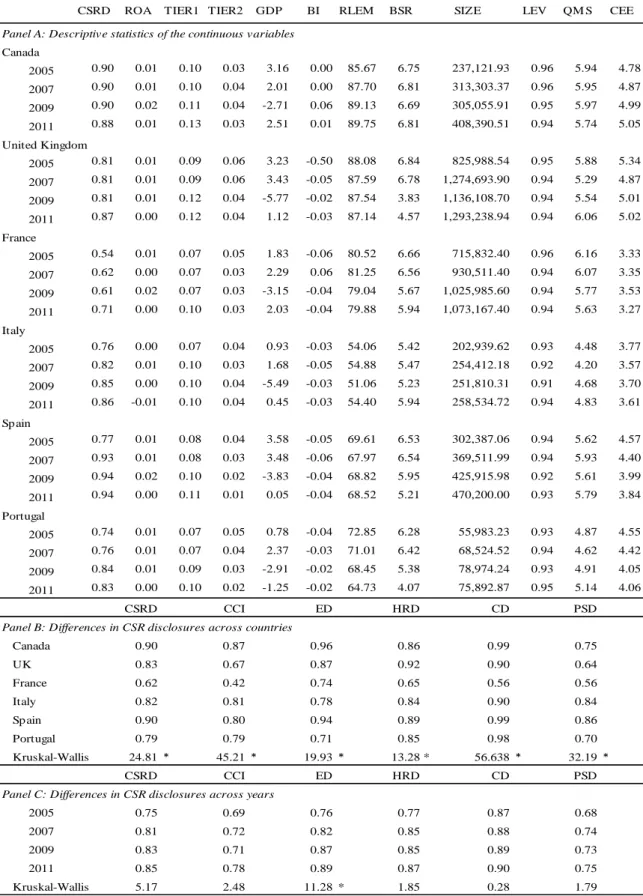
4.1.Descriptive AnalysisTable 4 presents the descriptive statistics for the continuous variables. Although the GDP have decreased up to 2009 in all countries, as a consequence of the recent GFC, on average the CSR disclosure have been increasing over time (Table 4, Panel A). To build confidence in the financial system, banks have used CSRD to ensure the communication with their stakeholders, minimizing social and reputational risks, and increasing the satisfaction of stakeholder expectations. Table 4 (Panel B) indicates that to this end they have invested more on ‘customer’ disclosure (Canada = 0.99; Italy = 0.90; Spain = 0.99; Portugal = 0.98). More specifically, in this category disclosures have increased on the following topics: customer’s relationships, improvements in customer service, and customer satisfaction, claims, and warranties. Between 2005 and 2011, additional results from the content analysis show also a substantial increase in disclosures on ’products and services’ (namely, regarding product safety, quality assurance for product (ISO)/product related activities) and on ‘human resources’ (regarding employee training in organization's ethical issue and anticorruption policies).
(insert table 4 here)
Table 4 (Panel B) documents that CSRD is significantly different across countries. Additional tests (Mann-Whitney U) show that these differences are located only between France and the other countries.[11] The country with the most robust legal
enforcement mechanisms and robust banking systems is Canada. And the countries with the less robust legal enforcement mechanisms and the less robust banking systems are
28
Portugal, Spain, and Italy (Table 4, Panel A). However, CSRD by the Portuguese, Spanish and Italian banks is significantly higher than French banks but not significantly different from Canadian banks. This seems to cast some doubts on the potential influence of country’s legal environment on CSR disclosure, which contradicts prior research (De Villiers and Marques, 2016). However, further multivariate analysis is needed. Results also seem to indicate some sort of mimetic behavior from Portuguese, Spanish, and Italian banks in relation to Canadian banks. It is interesting to notice that in the aftermath of the recent GFC, several Portuguese, Spanish and Italian banks were nationalized and recapitalized. To deal with this climate of uncertainty and reestablish the confidence levels of the stakeholders in the financial system and the consequent minimization of their reputational risk, banks can adopt the internal structures or procedures of other banks that they perceive to be more successful, credible, and legitimate (DiMaggio and Powell, 1983).
Table 4 (Panel C) documents an increase of CSRD between 2005 and 2011. However, differences are not statistically significant. The only exception is in ‘environmental’ disclosure. The different regulatory context may explain this difference. Among these countries, between 2005-2011, CSRD is essentially voluntary, with very few exceptions: ‘environmental’ disclosures (Canada, UK, France), ‘social’ disclosures (France), and ‘community involvement’ disclosures (Canada) (KPMG, 2013).
Table 4 (Panel A) also shows that the highest quality management schools are located in Canada, France and Spain. In turn, both Canada and United Kingdom have the best indicators of cooperative employer-employee relationship.
Table 5 (Panel A) shows that Canadian banks usually do not assure their CSR reports but they followthe GRI standards. Canadian banking system is considered the
29
most sound in the World (World Economic Forum, 2008). Besides, during the recent GFC Canadian banks have been able to maintain solid capital adequacy ratios (PWC, 2009). Thus, unlike banks in other countries, Canadian banks do not need to spend resources in assurance activities, because the banking system is already legitimized.
Analyzing the sample in global terms, over the 4 years, Table 5 (Panel B) indicates a progressive increase in the assurance of CSR reports (N in 2015 = 10; N in 2011 = 13) and in the adoption of GRI standards (N in 2015 = 16; N in 2011 = 23). These results are consistent with previous literature (García-Benau et al., 2013). Overall, during the recent GFC banks have invested in assurance activities, potentially to try building/restoring their corporate reputation, through issuing a credible CSR report (Simnet et al., 2009). Moreover, to pursue this goal they also decided to follow credible guidelines (GRI standards), because they are considered value relevant by investors (Villiers and Marques, 2016). Therefore, consistent with Campbell (2007), these results seem to indicate a progressive commitment to establish an institutionalized dialogue between the organization and its stakeholders.
(insert table 5)
4.2.Bivariate Analysis
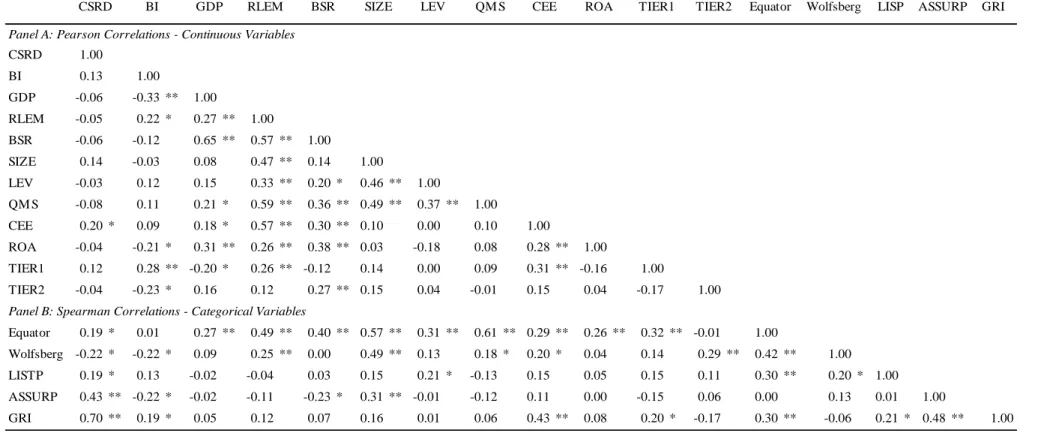
Table 6 indicates the Pearson and Spearman correlation matrix among the variables included in the model.
(insert table 6 here)
Findings show statistically significant positive correlations between CSRD and the ‘assurance profile of CSR report’ value<0.01); ‘adoption of GRI standards’ (p-value<0.01); ‘cooperative employer-employee relation’ (p-value<0.05) and the ‘listing profile’ (p-value<0.05). These results seem to corroborate hypotheses 5, 6 and 8. Results also show a statistically significant positive/negative correlation (p-value<0.05)
30
between CSRD and ‘adoption of Equator Principles’ and CSRD and ‘adoption of Wolfsberg Principles’, respectively. These results do not allow corroborating hypothesis 4.
The correlation matrix also shows very low levels of correlation among the independent variables indicating the non-existence of multicollinearity problems.
4.3.Multivariate Analysis
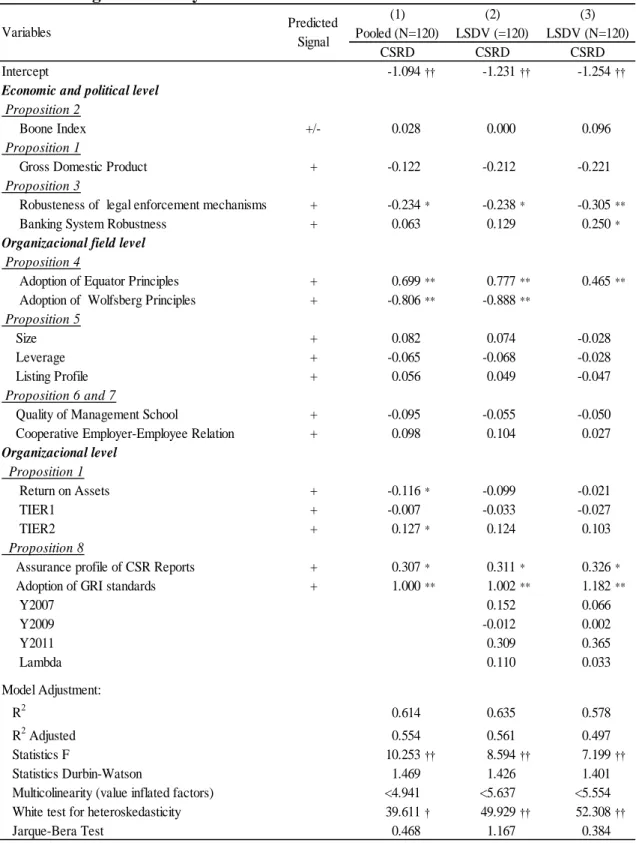
To test hypotheses we estimate a pooled multiple linear regression model using the least squares method. Since we are using balanced panel data, we also assess the presence of fixed effects and random effects. Consistent with Cooke (1998) we use a normalization procedure in all continuous variables because both the dependent and independent variables do not follow a normal distribution,12 which can have relevant consequences
in the inferences about the variables used in the regression model. We also assess the other assumptions of the model such as outliers, autocorrelation, multicollinearity, heteroscedasticity and normal distribution of residuals. Table 7 shows the results of the regression analysis.
(insert table 7 here)
Table 7 shows that the pooled regression model (Model 1) is valid in global terms. In general, the regression is statistically significant to explain CSR disclosure (F=10.253; p-value<0.01). The model has a good explanatory power (adjusted R2=55.4%). However, since we are using panel data, in order to analyze if the OLS
model for pooled data is appropriate, the hypothesis of the presence of fixed effects is evaluated through the F statistic (F=3.584; p-value<0.01). The hypothesis of the existence of random effects is also assessed through the Breusch-Pagan LM statistic (LM=14.132; p-value<0.01). These results suggest that the OLS model for pooled data
31
is not appropriate because they validate either the hypothesis of fixed effects or the existence of random effects. The Hausman statistic (H=30.583; p-value<0.01) indicates that the fixed-effects hypothesis is valid.
To control for country effects, our model incorporates a set of variables that captures the different economic and institutional characteristics of each country. To control time effects, we use the Least Square Dummy Variable (LSDV) model and include 3 dummy variables: Year 2007, Year 2009, and Year 2011. The selection of this model is based on Gujarati’s (2003, p. 642) argument that “both the LSDV model and the fixed effects model can be used interchangeably”. Therefore, the analysis of results will be based on data from the LSDV model (Model 2).
Table 7 shows that the LSDV regression model (Model 2) is valid globally and it is statistically significant to explain CSRD (F=8.594; p-value<0.01). The explanatory power (assessed by adjusted R2) of the independent variables in the variation of CSR
disclosures is 56.10%.
At the economic and political environment level, table 7 (Model 2) shows that CSR disclosure is associated negatively with the ‘robustness of legal enforcement mechanisms’ (p-value<0.01) suggesting that H3 hypothesis is not supported. Banks operating in institutional contexts, in which legal environments have less robust legal enforcement mechanisms, tend to disclose more CSR information. This result seems to contradict De Villiers and Marques (2016) findings. They found that firms are more predisposed to disclose more CSR information in countries with higher levels of democracy, more effective government services, and higher quality regulations. However, their findings are valid for non-finance firms.
At the organizational field level, table 7 (Model 2) shows that CSRD is associated positively with the ‘adoption of Equator Principles’ (p-value<0.01)
32
suggesting that H4 hypothesis is supported. According to Campbell’s (2007) institutional theory industry self-regulation influences positively CSR disclosure. However, results also show that CSR disclosure is associated negatively with the ‘adoption of Wolsfberg Principles’ (p-value<0.01), which suggests that H4 hypothesis is not supported. It is importance to notice that Wolfsberg Principles is exclusively associated with regulation of practices to combat financial crimes. On the other hand, Equator Principles regulates management practices of social and environmental risk by banks (Chih et al., 2010).
At the organizational level, table 7 (Model 2) shows that CSRD is associated positively with the ‘assurance profile of CSR reports’ (p-value<0.05) and with the ‘adoption of GRI standards’ (p-value<0.01). These results support the H8 hypothesis. Managers know that assurance activities help building corporate reputation and enhance the credibility of their CSR reports, basically in periods of financial distress (Simnet et al., 2009; García-Benaú et al., 2013). On the other hand, prior research has demonstrated that CSR information and CSR reports prepared according GRI guidelines are value relevant to investors (Cahan et al., 2016; De Villiers and Marques, 2016). According to Campbell’s (2007) institutional theory, banks that assure and follow GRI standards in the preparation of their CSR reports disclose more CSR information. By adopting these strategies, they commit themselves in maintaining an institutionalized dialogue with their stakeholders, promoting the credibility of the organization, building trust among stakeholders, and managing corporate reputation (Simnet et al., 2009).
Table 7 (Model 2) shows that CSRD is not statistically associated (p-value>0.05) with the ‘Boone index’ and the ‘GDP’. The hypotheses H1a, H1b, and H2 are not supported. That is, neither the competition level nor the economic recessive environment influences CSRD by banks.
33
Table 7 (Model 2) also indicates that CSRD is not statistically associated (p-value>0.05) with the ‘Return on assets’, ‘TIER1’, and ‘TIER2’. Hypothesis H7 is not supported. The financial performance level of banks does not influence CSRD.
In addition, results also show that CSRD is not statistically associated (p-value > 0.05) with ‘size’, ‘leverage’, and ‘listing profile’, as well as with ‘institutionalized mental frames’, measured by the ‘quality of management schools’ and by ‘cooperative employer-employee relation’. This indicates that the hypotheses H5 and H6 are not supported. Monitoring by relevant stakeholders and institutionalized mental frames do not influence CSRD policies during the recent GFC.
Moreover, results of Model 2 show a negative relationship between CSRD and the ‘adoption of Wolfsberg Principles’. Unlike Equator Principles working group, Wolfsberg Principles working group develops procedures to combat financial crimes. Thus, findings of Model 2 were retested after the exclusion of this variable (Model 3). Findings indicate that the institutional factors that influence CSRD by banks are: a) legal environment (banks based in countries with less robust legal enforcement mechanisms – Portugal, Spain, Italy – but with more robust banking systems – Canada – are the ones that disclose more CSR information – hypothesis H3 is supported); b) industry self-regulation (banks adopting Equator’s Principles are the ones that disclose more CSR – hypothesis H4 is supported); c) organizational commitment in maintaining an institutionalized dialogue with the stakeholders (the banks that have assured their sustainability reports and have adopted the GRI standards, are the ones that disclose more CSR information – hypothesis H8 is supported).
Finally, Table 7 shows that self-selection does not appear to be a significant concern, because Lambda of the Mills ratio is not statistically significant (p-value>0.05).
34
5.Conclusions
Consistent with Campbell’s (2007) institutional theory and Dillard’s et al. (2004) model of organizational dynamic change, we sought to examine if bank’s CSRD dynamics during the recent GFC is explained by the joint interaction of country-level and firm’s economic and institutional conditions.
In general, we find evidence that the macroeconomic environment and the bank’s economic conditions do not impact on CSRD. Results also indicate that market monitoring and country’s institutionalized frames are not important institutional forces in pressuring bank’s CSR reporting. Only institutional forces acting at three different levels influence bank’s CSR reporting: political level (the country’s legal environment), organizational field level (the industry self-regulation), and the organizational level (the bank’s commitment in an institutionalized dialogue with stakeholders). Consistent with Dillard et al. (2004), these findings corroborate our argument that in periods of financial distress not only institutional pressures are important factors of bank’s CSR reporting dynamics, but also organizational resistance and proactivity to change the institutionalized status quo as a function of self-interest.
More specifically, we find that banks from countries with more robust banking systems (such as Canada) disclose more CSR information. Since 1999, Canada has some mandatory disclosure requirements related to environmental matters and involvement with the community (KPMG, 2013). However, contrary to what was expected, those banks operating in countries with less robust legal enforcement mechanisms (such as Portugal, Spain, and Italy) also disclose more CSR information. Preliminary results show that CSR reporting between these two groups of countries does not significantly differ. Two main reasons may explain this unexpected finding. In
35
the aftermath of the recent GFC some Portuguese, Spanish, and Italian banks were nationalized and recapitalized. To manage this environmental uncertainty they tried to voluntarily conform to social norms and institutionalized CSR practices followed by those banks considered more successful, credible and legitimate (DiMaggio and Powell, 1983). However, this mimetic behavior not only assure institutional conformity but also strategic legitimacy because these unexpected portions of CSR disclosure play a significant role in firm valuation, basically for listed banks in countries with weaker legal enforcement mechanisms (Cahan et al., 2016).
We also find that industry self-regulation (assessed by the ‘adoption of Equator Principles’) is positively associated with CSR reporting. The participation of banks in working groups that promote self-regulation in the banking industry is not only crucial to align banks with institutional pressures from the political level (convergent change), but also to promote the institutionalization of innovative organizational practices and structures (divergent changes) in the pursuit of bank’s strategic interests such as the control of regulation processes.
Finally, we find that banks with higher levels of CSR reporting are those that assure their CSR standalone reports and follow GRI guidelines. These two organizational mechanisms are crucial in maintaining a constant dialogue with relevant stakeholders to retrieve specific benefits: recover corporate reputation, confidence from stakeholders and restore the credibility of the financial system as a whole.
Overall, findings indicate that bank’s CSR disclosures stem not only from institutional legitimacy processes, but also from strategic ones. These findings present two major challenges essentially to regulators. First, if CSR reporting is considered informative to investors (Cahan et al., 2016; De Villiers and Marques, 2016) and banks use CSR reporting to pursue strategic legitimacy goals, then regulators may need to
36
consider the implementation of CSR regulation to monitor these self-interest behaviors. Second, if assurance of CSR reports is used with a strategic legitimacy purpose, regulators may need to consider the regulation of these activities (regarding standards, profession, or even the scope of assurance) in order to guarantee the proper credibility of CSR information.
This paper presents some limitations associated with sample size and instrument of data collection of the dependent variable (content analysis). Future studies may include larger samples, including a larger set of countries. In addition, other variables at organizational level, associated with internal and external corporate governance mechanisms, should also be included in order to ascertain their joint effects with the other economic and institutional factors already studied.