______________________________________________________________________________________________________ 1 Graduating in Agricultural and Environmental Engineering, Federal University of the São Francisco Valley - UNIVASF, Juazeiro, Bahia, Brazil. 2 Professor, Doctor in Plant Biology, University of the São Francisco Valley - UNIVASF, Juazeiro, Bahia, Brazil.
3 Graduating in Agricultural and Environmental Engineering, Federal University of the São Francisco Valley - UNIVASF, Juazeiro, Bahia, Brazil. 4 Graduating in Agricultural and Environmental Engineering, Federal University of the São Francisco Valley - UNIVASF, Juazeiro, Bahia, Brazil. 5 Graduating in Agricultural and Environmental Engineering, Federal University of the São Francisco Valley - UNIVASF, Juazeiro, Bahia, Brazil. 184 | Rev. Geama, Recife – 3 (4): 184-190. Out-Dez 2017. | Online version ISSN: 2447-0740 | http://www.geama.ufrpe.br
Article
________________________________________________________________________________________________ Ciências Ambientais Environmental Sciences
Soil Salinization and its Effects on Morpho-Physiological
Characteristics of Sugarcane Varieties
Herbert C. O. Targino1, José A. B. da Silva 2, Edson P. da Silva 3, Magno do N. Amorim 4& Tales X. Seabra5
* Corresponding Author: [email protected] [email protected] [email protected] [email protected] [email protected] Received: June 13, 2017 Todos autores contribuíram de forma igualitária Accepted: July 23, 2017
Published: October, 2017
ABSTRACT
Brazil is one of the world’s largest sugarcane producers, and its cultivation has extreme economic importance. The Sub-Mid São Francisco Valley region presents high sugarcane yield indexes, but this region also has areas with high salinity levels. Thus, the objective of this study was to evaluate the effects of salinity on the growth and development of commercial varieties of sugarcane. The experiment was conducted in a nursery, located in the Federal University of the São Francisco Valley, Juazeiro, in the state of Bahia, Brazil. Three commercial varieties of sugarcane—VAT-90212, RB-92579, and SP-791011—were cultivated under two types of soil from areas owned by the agroindustry Agrovale. One of the soils had electrical conductivity (EC) of 4.6 dS.m -1 (saline), and the other had EC of 1.5 dS.m -1 (non-saline). Morphological parameters determining the plant growth and development, leaf chlorophyll content, and gas exchange were evaluated. The results presented that the salinity decreased the morphological parameters of all the evaluated sugarcane varieties. A similar result was found for photosynthetic activity and chlorophyll content.
Keywords: Saccharum officinarum, Electrical Conductivity, Gas exchange
Introduction
The soils that compose the Semiarid region of Brazil are generally shallow, rich in minerals, and easily weathered. This fact—combined with the region's high evapotranspiration rates and low precipitation—promotes both precipitation and accumulation of salts on the soil’s surface (WILLADINO et al., 2011). Under natural conditions, soils present salt concentrations that vary according to pedogenetic characteristics, climatic factors, and anthropic action. Soils under high salinity conditions—which occur in semiarid regions—are a limiting factor for plant growth and productivity; this causes negative impacts on agriculture (QADIR et al., 2007). Salinity may compromise the soil quality— increase its density—aeration, and water and nutrient availability to plants. Moreover, these
conditions prevent root growth by affecting its formation, therefore, hindering the crop’s establishment (CARVALHO Et al., 2006; SOARES et al., 2008).
Currently, Brazil is one of the world's largest producers of sugarcane and its derivatives, such as ethanol and bagasse; the recent advances in the conversion of sugarcane and molasses into biofuels have increasingly strengthened the Brazilian energy matrix (BALDANI et al., 2002). In the Sub-Mid São Francisco Valley, specifically in Juazeiro in Bahia, sugarcane has presented a relevant performance in comparison to other crop areas in Brazil due to the use of irrigation technologies in its production systems (SILVA Et al., 2012).
The semiarid region of Brazil presents water deficit and poorly distributed rainfall (SOUSA et al., 2011) combined with high evaporation rates, causing a lower salt leaching along the soil profile
185 | Rev. Geama, Recife – 3 (4): 184-190. Out-Dez 2017. | Online version ISSN: 2447-0740 | http://www.geama.ufrpe.br where the salt concentration increases. High salt
concentrations in the soil reduce its water potential, which causes toxic effects on plants, resulting in functional disorders such as metabolism changes and injuries in various plant organs; also restricting, for example, the CO2 assimilation and reducing chlorophyll content, and consequently, affecting the photosynthetic activity (SILVA et al., 2003; SILVA et al., 2010).
Thus, the objective of this study was to evaluate the morphological and physiological aspects of the growth and development of sugarcane varieties in saline soil of the Sub-Mid São Francisco Valley in Brazil.
Material and Methods
The experiment was conducted in a nursery located in the Federal University of the São Francisco Valley (UNIVASF), in Juazeiro, in the state of Bahia (BA), Brazil (09°25'00"S, 40°30'00"W and altitude of 371 m). The region has a BSwh climate (hot climate of caatinga) according to the Köppen classification, with summer rains and well-defined dry periods in winter.
The experimental design was completely randomized in a 2×3 factorial arrangement. Each treatment consisted of 10 replications for each sugarcane variety: VAT-90212, RB-92579, and SP-791011. These varieties were made available by the Agrovale company, which is an agroindustry located in Juazeiro, BA.
The soils used were collected from layer 0-40 cm in saline and non-saline areas of Agrovale.
For the implementation of the experiment, seedlings of the sugarcane varieties were prepared. About 3 to 4 buds were removed from the stalks; these buds were standardized according to diameter, length, and vigor, and then 60 buds were selected per variety. These buds were individually seeded—at 6 cm from the surface—in black polyethylene bags (12×21 cm) filled with the substrate Plant Max Hortaliças HA®.
After the emergence, 20 plants of each sugarcane variety were selected for transplanting. The selection of seedlings was carried out according to the uniform pattern of the characteristics: plant length, and leaf uniformity regarding size and color. Ten young plants of each variety were transplanted into saline soil and 10 into
non-saline soil in vessels of 12 liters (Implast, ref. 1003) with a spacing of 1×1 m. The substrate used was composed of the soils collected, without any addition of other compounds. Measurements to determine parameters such as leaf number and stem length and diameter were performed monthly in a period of 6 months to evaluate growth and development of the plants.
The photosynthetic activity data were collected from the selected leaves according to uniform characteristics: color, age, and size. Measurements were performed monthly at the field, from hour to hour, in the interval from 10:00 a.m. to 12:00 p.m. The portable infrared radiation photosynthesis analyzer Li 6400 (LiCor Inc.,. Lincoln, NE, USA) was used to determine the following variables: photosynthetically active radiation (PAR), net assimilation rate of CO2 (A), leaf transpiration rate (E), internal CO2 concentration (Ci), stomatal conductance (gs), and leaf surface temperature (Tl).
One leaf of each plant was selected to quantify its chlorophyll content while taking into account the uniformity criteria. The chlorophyll A and B readings were carried out in each leaf by using a chlorophyllometer model ClorofiLOG-CFL 1030.
The results were subjected to analysis of variance, and the treatment means were compared by the Tukey's test at 5% probability by using the statistical program ASSISTAT (SILVA; AZEVEDO, 2002).
Results and Discussion
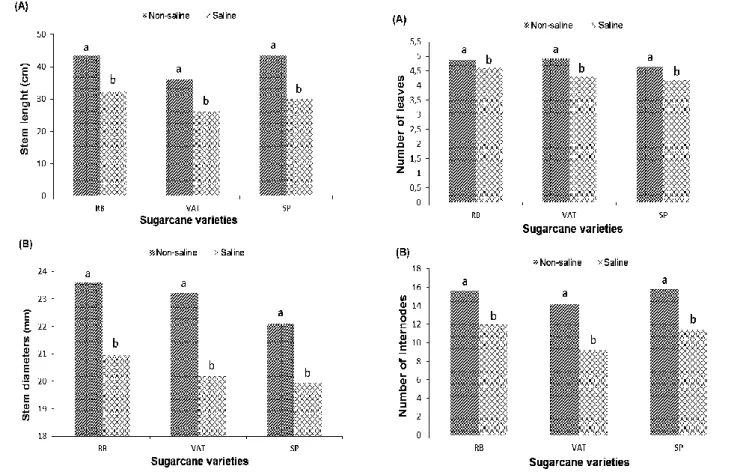
The results of the morphological parameters stem length and diameter are shown in Figure 1. The deleterious effects of salinity caused a decrease in stem length and diameter, which are two of the main parameters connected to good productivity of sugarcane because the stem contains the main product for processing.
The salinity of the soil may have caused a decrease in the plant’s ability to absorb water; as a result, the morphological formation, and development of physiological and biochemical processes are limited. This hinders the full development of cells and tissues, which affects stomatal opening, CO2 absorption, and sugar production.
186 | Rev. Geama, Recife – 3 (4): 184-190. Out-Dez 2017. | Online version ISSN: 2447-0740 | http://www.geama.ufrpe.br Figure 1: Stem length (A) and diameter (B) of
sugarcane varieties—VAT-90212, RB-92579, and SP-791011—grown in different soil types (saline and non-saline). Means followed by the same letters— uppercase for varieties and lowercase for soil types—in the columns did not differ by the Tukey's test at 5% probability.
The soil salinity caused an inhibition on the plant’s ability to produce an adequate number of leaves and internodes (Figure 2) when compared to those grown in non-saline soils.
The soil salinity significantly affected the growth and development of the three sugarcane varieties evaluated. The plants grown in non-saline soil presented results significantly higher than those grown in saline soil. The results showed the negative effect of soil salinity on plant morphology—the three sugarcane varieties grown in this type of soil had the lowest morphological development.
In general, excess salt in the root zone affects the plant’s growth and development due to the greater external osmotic effect on the roots and the restriction of water flow from the soil to the plants (RHOADES et al., 2000). According to Raven et al. (2007), solutes in greater concentration and the soil matric suction in the root region causes the water absorption to have a higher energetic cost for the root cells. Therefore, when plants are subjected to high salinity levels, their morphological growth and development is affected because they must use more energy to regularize the transport of solutes from the roots to the shoot at the expense of other metabolic functions.
Figure 2: Number of leaves (A) and number of internodes (B) of sugarcane varieties—VAT-90212, RB-92579, and SP-791011—grown in different soil types (saline and non-saline). Means followed by the same letters—uppercase for varieties and lowercase for soil types—in the columns did not differ by the Tukey's test at 5% probability.
The analyses of chlorophyll A and B contents presented significant differences depending on the two types of soil. Plants grown in saline soil had less chlorophyll content, but when compared to each other, both soils presented a similarity between the means of the evaluated varieties (Figure 3).
Figure 3: Chlorophyll A and B contents of sugarcane varieties—VAT-90212, RB-92579, and SP-791011— grown in different soil types (saline and non-saline). Means followed by the same letters—uppercase for varieties and lowercase for soil types—in the columns did not differ by the Tukey's test at 5% probability.
187 | Rev. Geama, Recife – 3 (4): 184-190. Out-Dez 2017. | Online version ISSN: 2447-0740 | http://www.geama.ufrpe.br The three sugarcane varieties subjected to saline
soil were sensitive to high salt levels in the soil, and presented lower leaf chlorophyll contents compared to those grown in non-saline soil. Lima et al. (2004) performed a similar study using different rice cultivars and found significant differences in the chlorophyll A and B contents of plants subjected to salinized soils. These results can be explained by the salt accumulation in the plant’s root structure, which limit the absorption of other nutrients, such as nitrogen or magnesium, that are important for chlorophyll synthesis. Another possibility may be based on the inactivation and reduction of the activity of some enzymes participating in the synthesis route of chlorophyll A and B due to the salts.
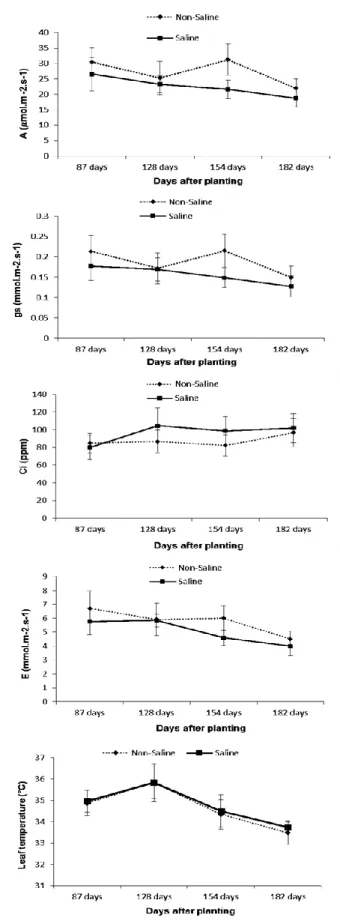
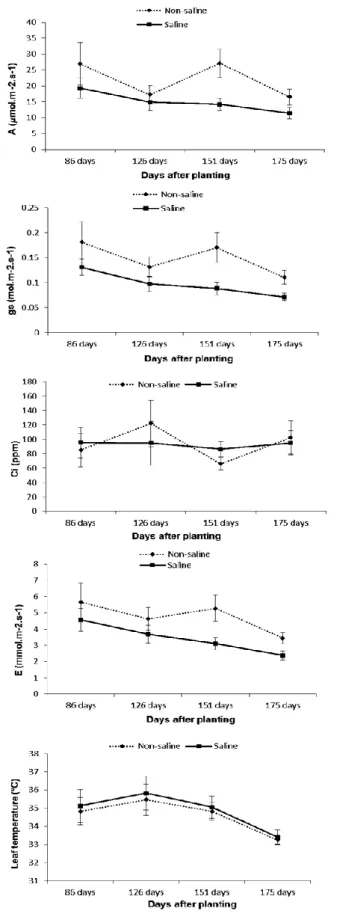
The gas exchange was analyzed by using the photosynthetic parameters in the leaves of the three evaluated sugarcane varieties. They presented a decrease in their photosynthetic potential, and decreased stomatal conductance for the varieties grown in saline soils (Figures 4, 5, and 6).
The lowest maximum CO2 assimilation was found in the plants subjected to salinized soil due to their lower stomatal conductance. The leaf transpiration and leaf temperatures were also low. Similar results were found by Silva et al. (2011) regarding the decrease in the stomatal conductance, and consequently, the decrease of the other photosynthetic parameters.
This reduced photosynthetic rate in plants grown in saline soil is directly connected to the effects caused by the salts in the soil and plants after its absorption. Thus, it is possible to highlight the low CO2 availability for the sugar production, low efficiency of the photochemical phase of photosynthesis, and low energetic ability to accomplish several reactions (ATP production)— among them are those required for the photosynthesis process.
Moreover, the water becomes less available since high saline levels cause negative cellular osmotic effects on the roots’ ability to absorb water. As a result, the stomata closes to conserve water inside the cells. This explains the low stomatal conductance (gs) found in plants subjected to saline soil. Consequently, the intercellular CO2 concentration (Ci) and the leaf transpiration rate (E) decreases, causing an increase in leaf temperature. According to Heuer (1997), decreases in photosynthesis due to salinity can also occur due to the decreased stomatal conductance, consequently, causing inhibition of the photosynthetic carbon fixation activity, which is necessary for the photosynthesis process.
Presence of salts in the soil solution increases the water retention forces via osmosis and, therefore, increases the magnitude of water shortage in the plant. The limitation of water availability causes less stomatal opening and less availability of photosynthetic CO2.
Figure 4: Analysis of the determinant parameters of the photosynthetic activity: maximum CO2 assimilation (A), stomatal conductance (gs), internal CO2 concentration (Ci), leaf transpiration (E) and leaf temperature (Tl) of the sugarcane variety RB-92579 subjected to different soil salinity conditions.
188 | Rev. Geama, Recife – 3 (4): 184-190. Out-Dez 2017. | Online version ISSN: 2447-0740 | http://www.geama.ufrpe.br Figure 5: Analysis of the determinant parameters of
the photosynthetic activity: maximum CO2 assimilation (A), stomatal conductance (gs), internal CO2 concentration (Ci), leaf transpiration (E) and leaf temperature (Tl) of the sugarcane variety SP-791011 subjected to different soil salinity conditions.
Figure 6: Analysis of the determinant parameters of the photosynthetic activity: maximum CO2 assimilation (A), stomatal conductance (gs), internal CO2 concentration (Ci), leaf transpiration (E) and leaf temperature (Tl) of the sugarcane variety VAT-90212 subjected to different soil salinity conditions.
189 | Rev. Geama, Recife – 3 (4): 184-190. Out-Dez 2017. | Online version ISSN: 2447-0740 | http://www.geama.ufrpe.br Part of the energy required for plant growth and
development, and for the photochemical and biochemical phases of photosynthesis, is intended for the transport of solutes. This will cause disturbances in the electron transport chain and, consequently, a change in the production of carbohydrates—essential sources for the plant metabolism—which compromises the entire plant cycle.
The culm fresh weight production was highest in the plants grown in non-saline soil (Figure 7).
This result is directly connected to the decrease of gas exchange in the leaf at the expense of the plant’s decreased water absorption ability.
Similar results were found by Chiconato (2016), who evaluated sugarcane crops under severe salinity concentrations, and reported a decrease in their production due to the decreased photosynthetic activity of these plants.
Figure 7 - Culm fresh weight production (g.plant-1) of the sugarcane varieties VAT-90212, RB-92579, and SP-791011 subjected to saline and non-saline soils. Means followed by the same letters in the columns did not differ by the Tukey's test at 5% probability.
Conclusions
The sugarcane varieties VAT-90212, RB-92579, and SP-791011 were sensitive to soil salinity. The morphological (stem length and diameter, number of leaves, and number of internodes) and physiological parameters (chlorophyll A and B contents) of these varieties decreased in saline soils. This results drastically affected their leaf and stem development, and consequently, their productivity. None of the sugarcane varieties evaluated presented resistance to saline soils.
References
BALDANI, J. I.; REIS, V. M.; BALDANI, V. L. D.; DOBEREINER, J. A brief story of nitrogen fixation in sugarcane – reasons for success in Brazil. Functional Plant Biology, Collingwood, v. 29, p. 417-423, jan. 2002.
CHICONATO, D. A. Estresse salino em plantas jovens de cana-de-açúcar : respostas bioquímicas e fisiológicas. Tese (doutorado) - Universidade Estadual Paulista, Faculdade de Ciências Agrárias e Veterinárias, Jaboticabal, 2016.
HEUER, B. Photosynthetic carbon metabolism of crops under salt stress. In: Pessarakli, M. (ed.). Handbook of Photosynthesis. New York: Marcel Dekker, 1997. p.887-896.
LIMA, M. G. S.; LOPES, N. F.; BACARIN, M. A.; MENDES, C. R. Efeito do estresse salino sobre a concentração de pigmentos e prolina em folhas de arroz. Bragantia, Campinas, v. 63, n. 3, p. 335-340, 2004.
QADIR, M.; OSTER, J. D.; SCHUBERT, S.; NOBLE, A. D.; SAHRAWAT, K. L. Phytoremediation of sodic and saline-sodic soils. Advances in Agronomy. Department of Plant and Soil Sciences at the University of Delaware at Newark, USA. v. 96 p.197-247, 2007.
RAVEN, P. H.; EVERT, R. F.; EICHHORN, S. E. Biologia Vegetal, Editora Guanabara Koogan, Rio de Janeiro, 2007, 7a. ed. 830 p.
RHOADES, J. D.; KANDIAH, A.; MASHALI, A. M. Uso de águas salinas para produção agrícola. Estudos da FAO - Irrigação e Drenagem, Campina Grande, v. 48. 117p, 2000.
SILVA, F. A. S.; AZEVEDO, C. A. V. Versão do programa computacional Assistat para o sistema operacional Windows. Revista Brasileira de Produtos Agroindustriais, Campina Grande, v. 4, n. 01, p. 71-78, 2002.
SOARES, F. A. L.; CARNEIRO, P. T.; GOMES, E. M.; GHEYI, H. R.; FERNANDES, P. D. Crescimento e produção do maracujazeiro amarelo sob irrigação suplementar com águas salinas. Revista Brasileira de Ciências Agrárias, Recife, v. 03, n. 02, p. 151-156, 2008.
SILVA, E. N.; RÍBEIRO, R. V.; FERREIRA-SILVA, S. L.; VIÉGAS, R. A.; SILVEIRA, J. A. G. Comparative effects of salinity and water stress on photosynthesis, water relationsand growth of Jatropha curcas plants. Journal of Arid Environments, v. 74, p. 1130 – 1137, 2010.
SILVA, T. G. F.; MOURA, M. S. B.; ZOLNIER, S.; SOARES, J. M.; VIEIRA, V. J. S.; GOMES JÚNIOR, W. Demanda hídrica e eficiência do uso de água da cana-de-açúcar irrigada no semiárido brasileiro. Revista Brasileira de Engenharia Agrícola e Ambiental, Campina Grande, v.15, n.12, p.1257–1265, 2011. SILVA, E. N. DA; RIBEIRO, R. V.; FERREIRA-SILVA, S. L.;
190 | Rev. Geama, Recife – 3 (4): 184-190. Out-Dez 2017. | Online version ISSN: 2447-0740 | http://www.geama.ufrpe.br damages on the photosynthesis of physic nut
young plants. Scientia Agricola, São Paulo, n. 68, v. 1, p. 62-68, 2011.
SOUSA, A. E. C.; GHEYI, H. R.; CORREIA, K. G.; SOARES, F. A. L.; NOBRE, R. G. Crescimento e consumo hídrico de pinhão manso sob estresse salino e doses de fósforo. Revista Ciência Agronômica, Fortaleza, v. 42, n. 2, p. 310-318, 2011. WILLANDINO, L., ALVES, R. O. F., ARCANJO, E. S. J.; GOUVEIA, A. N., RANGEL, T. C. Estresse salino em duas variedades de cana-de-açúcar: enzimas do sistema antioxidativo e fluorescência da clorofila. Revista Ciência Agronômica, Fortaleza, v. 42, n. 2, p. 417-422, 2011