Change in Corporate Governance and Tunnelling Behaviour of
Controlling Shareholders: The Case of Chinese Listed Companies
After the Share Reform
LIU Shuhan
Thesis submitted as partial requirement for the conferral of
Doctor of Management
Supervisor:
Professor José Paulo Esperança, Full Professor, ISCTE University Institute of Lisbon
Co-supervisor:
Professor SHAO Yunfei, Professor, University of Electronic Science and Technology of China, School of Management and Economics
- Spine –
Change in Corporate Governance and Tu
nnelli
ng Behaviour of Controlli
ng Shareholders:
The Cas
e of
Chinese Listed Co
mpanies After the Share Ref
orm
Change in Corporate Governance and Tunnelling Behaviour of
Controlling Shareholders: The Case of Chinese Listed
Companies After the Share Reform
LIU Shuhan
Thesis submitted as partial requirement for the conferral of
Doctor of Management
Supervisor:
Professor José Paulo Esperança, Full Professor, ISCTE University Institute of Lisbon
Co-supervisor:
Professor SHAO Yunfei, Professor, University of Electronic Science and Technology of China, School of Management and Economics
Declaration
I declare that this thesis does not incorporate without acknowledgement any material previously submitted for a degree or diploma in any university and that to the best of my knowledge it does not contain any material previously published or written by another person except where due reference is made in the text.
Signed Date _________________ Name: _____________ 作者申明 本人郑重申明:除了论文致谢中明确说明并致以谢意的部分外,所呈交的论文不 包含任何他人或作者本人已用于获得任何教育机构的学位和证书而使用过的材 料。同时尽我所知,除了文中特别加以标注引用的内容外,本论文不包含任何其 他个人或集体已经发表或撰写的成果作品。 作者签名: 日期: 姓名(拼音)
Based on a review of the background of non-tradable share reform and on the relevant documents on the tunnelling behaviour of majority shareholders and corporate governance, this thesis first undertakes a comparative analysis of governance mechanisms that restrain the tunnelling activities of Chinese listed companies before and after the share reform. Second, by using related transactions as the proxy variables of tunnelling, we could judge the changes in tunnelling activities before and after the share reform through the analysis of the relationships among absolute scale, relative scale and structural changes in related transactions and the share reform. Third, an empirical test was conducted to determine whether the tunnelling behaviour of related transactions decreased after the share reform. Results showed that the tunnelling effect of related transactions weakened after the share reform. The tunnelling effect of related transactions with controllable shareholders was not different from that of other related transactions as a whole. Finally, from the empirical research on the joint effect of share reform and corporate governance on tunnelling behaviour, we found that ownership counterbalance, institutional shareholding and independent directors did not have an effective function in restricting related transactions after the share reform. The share reform had a significantly adverse effect on related transactions by forming either total assets or total debt. This thesis appreciates the positive results of the share reform. As for tunnelling behaviour, more system defects may have to be eliminated, so we propose several countermeasures.
Keywords: Non-tradable Share Reform; Corporate Governance; Tunnelling; Related Transactions
Esta tese baseia-se na revisão do quadro legal da reforma das acções não transaccionáveis e em estudos relevantes sobre o comportamento de “tunnelling” por parte de accionistas maioritários. É feito um estudo comparativo dos mecanismos de governação que limitam as actividades de “tunnelling” por parte das empresas chinesas cotadas, antes e depois da reforma. Em segundo lugar usam-se as transacções relacionadas como estimativa para o “tunneling”, avaliando as mudanças de comportamento após a reforma, através da análise das relações entre dimensão absoluta, dimensão relativa e e mudanças estruturais em transacções relacionadas. Em terceiro lugar foi feito um teste empírico para determinar se o comportamento de “tunnelling” das transacções relacionadas decrescia após a reforma. Os resultados confirmam um decréscimo da actividade de “tunnelling” após a reforma. O efeito das transacções relacionadas por parte de accionistas com posição de controlo não diferia de outras transacções relacionadas. Finalmente, o estudo empírico do efeito conjunto da reforma legal e da governação empresarial sobre o comportamento de “tunnelling” permitiu concluir que o equilíbrio da propriedade, os investidores institucionais e os directores independentes não tiveram um papel significativo na restrição de transacções relacionadas após a reforma. A reforma teve um efeito adverso significativo nas transacções relacionadas através da formação de activos totais ou da dívida total. Este estudo regista os resultados positivos da reforma do quadro legal das acções. Para controlar o fenómeno de “tunnelling”, é necessário eliminar mais deficiências do sistema, pelo que se propõe um conjunto de contra medidas.
Chave: Reforma de acções não transaccionáveis; Governação empresarial; “Tunnelling”; Transacções relacionadas.
I would like to thank my Portuguese tutors Professor Jose Paulo Esperança and Professor Ivo Nuno Pereira. Although they have busy schedules, they found time to provide the guidance and assistance I needed. Professor Esperança spent a considerable amount of time and effort in guiding me through the entire course from framework to model construction, even with regard to the formatting of references, and the standardisation and uniformity of language. His thorough revision of my thesis was encouraging. I am fortunate to have met such excellent and responsible tutors who have made my studies one of my most memorable experiences.
I am also grateful to my Chinese tutors Professor Zeng Yong, Professor Shao Yunfei and Dr. Shen Yuqing. Professor Zeng Yong led me to the mysterious field of Corporate Finance and helped me to gain in-depth knowledge of Chinese listed companies. They provided me a considerable amount of guidance by encouraging me to finish my tasks on schedule and by helping me to communicate successfully with my foreign tutors. I was impressed by their caring and practical attitude, from which I benefitted significantly.
I also thank my supervisors and colleagues at Everbright Securities Wealth Management Center, particularly General Manager Chen Liming, who understood my situation in facing the challenges of work and study. His kindness contributed to the completion of my thesis.
My gratitude also goes to Professor Virginia, Professor Xiao Wen, Associate Professor Sun Ping and my teacher Chen Yang from the DBA Project Team who overcame numerous difficulties in the advanced-level Sino-foreign education. Their hard work ensured the progress and success of my project.
The students from the DBA Project Team, especially Jiao Jinsong, Yang Yongsheng, Zhang Yunhai and Guo Dong, provided me with invaluable assistance even though they had plenty of work to do.
Finally, I thank my parents and my family, whose persistent support and encouragement served as my impetus to overcome various challenges, concentrate on my studies and research and, ultimately, finish my thesis.
Chapter 1: Introduction ...1
1.1 Research Background...1
1.2 Research Contents and Structure...4
1.3 Major Research Method ...6
1.3.1 Comparative Analysis ...6
1.3.2 Quantity Analysis ...7
1.3.3 Data Sources...7
1.3.4 Research Hypotheses and Model Construction...7
1.4 Contributions of this Thesis ...11
Chapter 2: Literature Review ...13
2.1 Tunnelling...13
2.1.1 Origins of Tunnelling ...13
2.1.2 Forms and Measurements of Tunnelling...15
2.1.3 Tunnelling Control System...16
2.2 Non-tradable Share Reform ...24
2.3 Review of Research Status ...25
Chapter 3: Institutional Background and Relevant Theories ...27
3.1 Institutional Background ...27
3.1.1 Concept of Equity Division...27
3.1.2 Occurrence of Equity Division...27
3.1.3 Historical Origins of the Institutional Arrangement of Equity Division...28
3.1.4 Institutional Demand for Non-tradable Share Reform...36
3.1.5 Historical Evolution of Non-Tradable Share Reform ...43
3.2 Relevant Theories...45
3.2.1 Theories of Property Rights, Ownership and Control Rights ...45
3.2.2Principal–Agent Theory - Theoretical Origin of the Tunnelling Behaviour of Majority Shareholders ...48
Chapter 4: Tunnelling Behaviour Governance Changes of Chinese Listed Companies Before and After the Share Reform...53
After the Share Reform ...53
4.1.2 The Implementation of Tunnelling Behaviour Laws and Regulations Before and After the Share Reform ...57
4.2 The Change of Market for Corporate Control...58
4.3 Changes of Ownership Structure...61
4.3.1 Changes of Ownership Structure after Stock Market Reform ...61
4.3.2 Change in Ownership Concentration Before and After the Share Reform ...63
4.4 Changes on Institutional Investors ...64
4.4.1 Development of Chinese Institutional Investors ...64
4.4.2 Development of Chinese Institutional Investors Before and After the Share Reform...65
4.5 Changes in Board Governance Before and After the Share Reform...66
4.5.1 Changes in Structure of the Board of Directors ...66
4.5.2 Changes in Independent Director Participation ...68
4.6 Chapter Conclusion ...70
Chapter 5: Changes in Related Transactions of Chinese Listed Companies Before and After the Share Reform...71
5.1 Implications of Related transactions ...71
5.1.1 Concept and Classification of Related transactions ...71
5.1.2 Properties of Related transactions ...73
5.2 Related Transaction Scale Changes...75
5.2.1 Absolute Scale Changes ...75
5.2.2 Relative Scale Changes ...78
5.3 Related Transaction Structure Changes...79
5.4 Assets, Liabilities and Net Asset Changes Formed by Related Transactions after the Share Reform...82
5.5 Chapter Conclusion ...85
Chapter 6: Empirical Research on the Impact of Share Reform on Tunnelling...87
6.1 Research Hypothesis ...87
6.2 Models, Variable Definition and Specification ...89
6.3 Sample Selection and Data Sources ...92
6.4 Empirical Results and Analysis...92
6.5.1 Empirical Test on Related Transactions between Majority Shareholders and
Listed Company ...96
6.5.2 Comparison between Tunnelling Functions of Related Transactions with Large Shareholders and of Other Related Transactions ...98
6.6 Chapter Conclusion ...102
Chapter 7: Empirical Research on Joint Effect of Share Reform and Corporate Governance on Tunnelling ...103
7.1 Research Hypotheses...103
7.2 Model, Definition of Variables and Illustration...105
7.3 Sample Choice and Data Resources...106
7.4 Empirical Results and Analysis...106
7.5 Further Analysis ...109
7.6 Chapter Conclusion ...110
Chapter 8: Conclusions ...113
8.1 Main Conclusions of this Thesis ...113
8.2 Policies and suggestions...115
8.2.1 Corporate Governance Improvement ...115
8.2.2 Enhancing Accounting Regulation on Related transactions ...118
8.2.3 Standardising the Behaviour of Majority Shareholders ...119
8.3 Limitations of the Thesis...123
8.4 Further Research ...124
Bibliography...127
Table 4- 1 Violations of listed companies from 2004 to 2010... 58
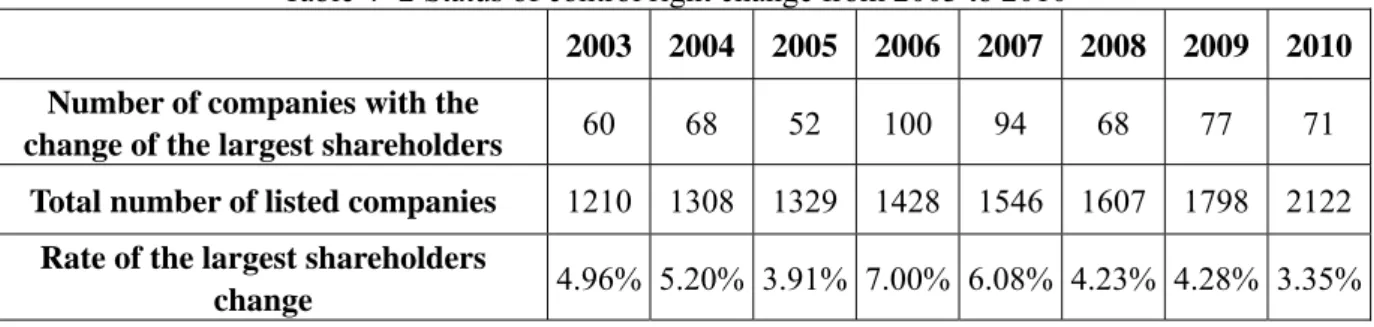
Table 4- 2 Status of control right change from 2003 to 2010... 59
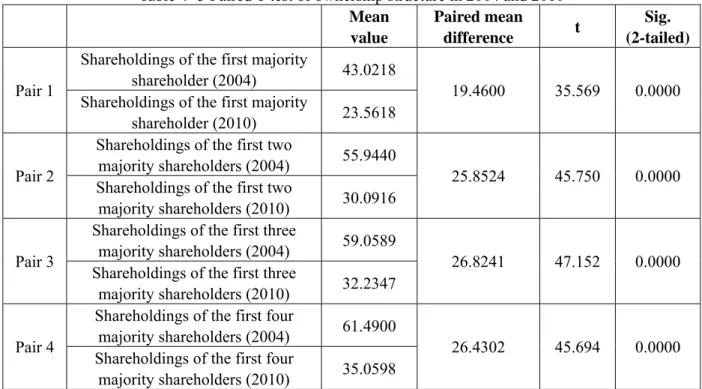
Table 4- 3 Paired T-test of ownership structure in 2004 and 2010... 62
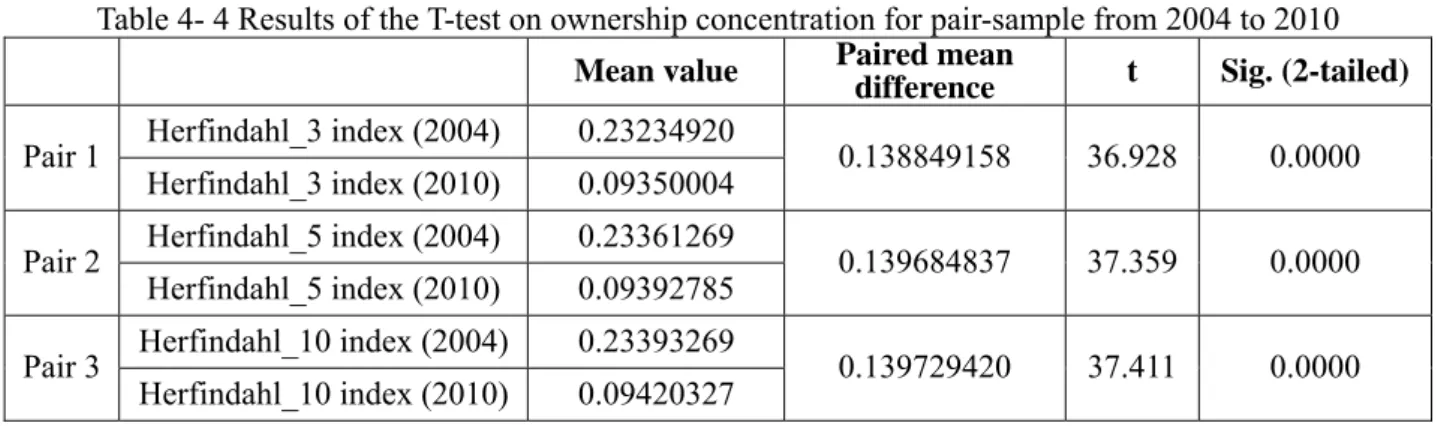
Table 4- 4 Results of the T-test on ownership concentration for pair-sample from 2004 to 2010 ... 63
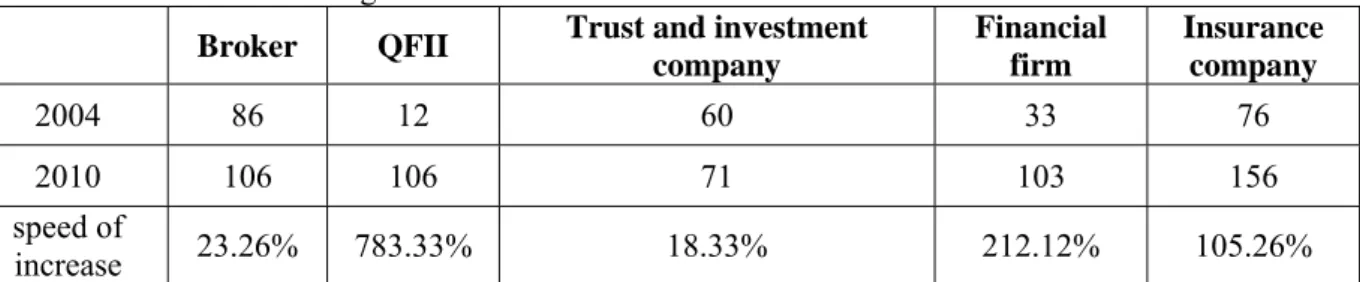
Table 4- 5 Changes in the number of institutional investors from 2004 to 2010... 65
Table 4- 6 Average Share Proportion of Institutional Investors 2004–2010 (Unit: %)... 66
Table 4- 7 Proposals independently made by independent directors (2004 to 2010)... 69
Table 5- 1 2004 to 2010 connected transaction absolute scale, Unit: hundred million yuan.... 75
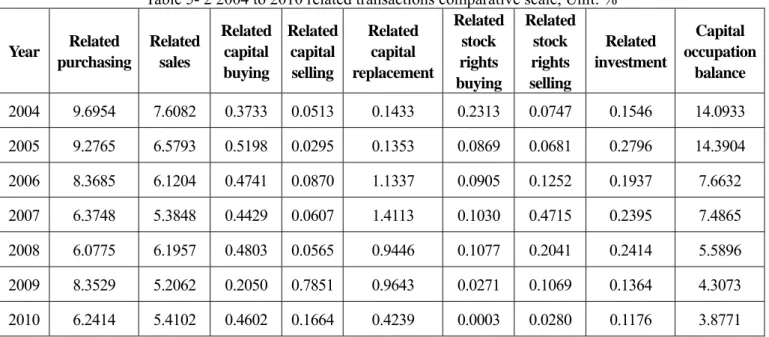
Table 5- 2 2004 to 2010 related transactions comparative scale, Unit: %... 78
Table 5- 3 2004 to 2010 related transactions structures, Unit: %... 79
Table 5- 4 Total assets, liabilities and net assets formed by related transactions from 2004 to 2010... 83
Table 5- 5 Total assets, liabilities and net assets formed by related transactions from 2004 to 2010... 84
Table 6- 1 Definition and specification of variables... 91
Table 6- 2 Descriptive statistics of variables... 93
Table 6- 3 Regression results... 95
Table 6- 4 Regression results of controllable shareholders’ tunnelling effect changes... 97
Table 6-5 Regression results of comparison between tunnelling functions of related transactions with majority shareholders and other related transactions... 100
Table 7- 1 Regression Results... 108
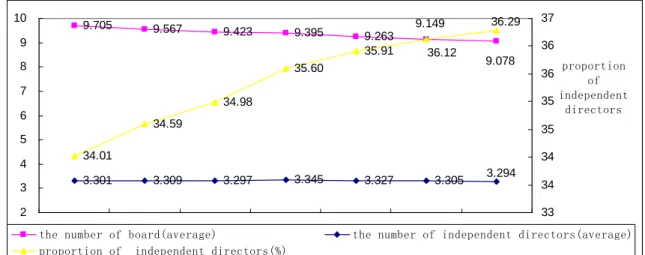
Figure 4- 1 Changes in the shareholding ratios of majority shareholders from 2004 to 2010. 63 Figure 4- 2 Changes in board structure from 2004 to 2010... 67 Figure 4- 3 Absenteeism rate of independent directors (2004 to 2010)... 68
Chapter 1: Introduction
1.1 Research Background
Non-tradable shares refer to the shares initially held by the founder of a company, which cannot be considered in the market as ordinary shares held by regular investors. The formation of this phenomenon is rooted in the political and economic background of China, and it influences the development and operation of the Chinese stock markets.
In December 1990, the Shanghai Security Exchange (SSE) was founded, which symbolised the return of the stock market after 40 years of absence in China. When the stock market was initially born in the country, its scope was extremely limited; only eight stocks were being traded in the SSE and five stocks in the Shenzhen Security Exchange (SZSE), which was founded in September 1991. The Chinese stock market has several distinct characteristics. In 1992, China began to change its economic model from the planned format to a market economy. During the transformation, the hidden side of state-owned companies was exposed, resulting in a significant decline in corporate performance. The companies were trapped in difficult situations. Fortunately, the capitalist element entered the market and became the effective medicine for enhancing the efficiency of state-owned companies. Under the strict supervision and approval of relevant departments, state-owned companies became the major components of listed companies. Influenced by the concepts related to a planned economy, the state-owned economy was considered to take the leading position in the entire economy and to set the major guidelines for the development of the Chinese stock market. Thus, companies not owned by the government could hardly be qualified to go public. Furthermore, to ensure that the state-owned companies would not lose their national character in the stock exchanges, the shares owned by start-up companies (mainly state-owned agencies) could not be traded in the stock market. Such shares are now referred to as non-tradable shares. This situation created a division between tradable and non-tradable shares in the Chinese stock market. Before the share reform, non-tradable shares accounted for two-thirds of the total amount of shares. Only one-third of the total shares could be traded.
For a long time, the stock rights division was regarded as the original cause of numerous homeomorphisms, such as related transactions, hunger for capital raising, interest
manipulation and insider dealing, which are against the principles of fairness, justice and openness. The stock rights division was regarded as a solution to the problems related to the corporate governance, management and market trading of listed companies (Wu, 2004). Wu summarised the eight problems of stock rights division as the institutional foundation of hunger for fundraising among Chinese listed companies and the reason for low efficient investment, diminishing performance, continued related transactions and frequent insider dealing. Wu (2006) refined the aforementioned eight problems into three parts that seriously held back the development of the Chinese capital market. Wu (2006) summarised the three major hazards as the conflict between tradable shareholders and non-tradable shareholders, the failure of the capital market’s pricing function and the obstacles to the development of the Chinese capital market into an effective mechanism to assess and encourage the growth of companies.
As a result of stock rights division, wide segmentation is observed between tradable and non-tradable shareholders. The former can gain income through capital gains and dividends, whereas the latter can only gain dividends. In the earlier development period of the Chinese stock market, the listed state-owned companies did not run efficiently while they were still in the initial period of transformation. During this period, the dividends were not extremely high, a situation that motivated the controlling shareholders to invade the interests of other shareholders through tunnelling activities. The highly concentrated share structure was convenient for shareholders who controlled the company. In the late 20th century, the predicament of state-owned companies further strengthened the motivation of their controlling shareholders to obtain private benefits for controlling rights. During this period, the legal system of the Chinese stock market lagged behind, the supervision was powerless and the internal corporate governance had various problems. Tunnelling behaviour in the stock market was prevalent under these conditions. Tunnelling is regarded as a drawback for long-term investors. However, the situation has not improved significantly since then. Tunnelling behaviour decreases the motivation to improve corporate performance and boost investor enthusiasm, as well as limits the development of the stock market. The supervision agency of the Chinese stock market attempted to change this situation. In April 2005, it launched a reform with Sanyi Heavy Industry, Tsinghua Tongfang and Zijiang Enterprise as the pilot companies. The agency unveiled a share reform plan of paying compensation ratio by non-tradable shares to tradable shares, with the agreement that the tradable shareholders pay the compensation ratio and the non-tradable shareholders could obtain the rights of trade.
Thereafter, the share reform was conducted in Shanghai and among the SZSE agencies. Although a number of companies could not complete the reform process and the non-tradable shares did not achieve full circulation, on the whole, the share reform was completed by 2007. Can the share reform solve all of the problems related to the governance of Chinese listed companies? The reform allows only non-tradable shares to circulate in the stock market, but whether non-tradable shares circulate depends to a certain extent on share price and change trend. Constraints also exist in the circulation period and amount of non-tradable shares, such as the provision of Article 27, ‘Listed companies non-tradable share reform management’, which prescribes that original non-tradable shares should not be transacted or transferred within 12 months from the implementation date of the share reform. After the expiration of this provision, the proportion of selling amount of original non-tradable shareholders, which have over 5% of the total shares of listed companies, should not exceed 5% in 12 months and should be no more than 10% in 24 months. In 2007, stricter limitations were imposed on state-owned share deduction in listed companies’ state-owned share transfer management as released by stated-owned asset management committees. Therefore, the share reform is a gradual, rather than an instant, process. At the same time, other governance mechanisms also changed before and after the share reform—certain changes were brought by the reform and others were brought by related laws and regulations. A fair recognition of the effects brought by share reform requires overall analysis. Thus, to choose the perspective and obtain the conclusions, the changes of shareholding structure, market for corporate control and board of directors before and after the share reform must be clarified. The relationship between these mechanisms and the reform must also be examined to provide a reference for future research on non-tradable share reform.
According to the analysis of the stock rights division after the share reform, majority shareholders pay more attention to stock price (Wu, 2004). Tunnelling behaviour influences stock price negatively. Majority shareholders have to balance the profits made by tunnelling and the loss from stock price reduction; thus, the tunnelling behaviour will decrease significantly among listed companies. If we measure tunnelling activities in terms of related transactions, the transaction deals should be decreased or, more accurately, the tunnelling behaviour in related transactions should be reduced. Thus, after the share reform, can any changes be observed in the related transactions of the listed companies? If there is any change, has the quality or structure changed? Do the related transactions indicate tunnelling behaviour or normal fair trade? Are such changes caused by an exogenous governance mechanism such
as share reform or others? All these questions have to be further tested empirically.
1.2 Research Contents and Structure
This thesis takes the Chinese non-tradable reform as the research background. Based on the non-tradable share reform, the implementation of the system as the research background before and after the corporate governance reform and the change in tunnelling behaviour of majority shareholders (with related transactions as the proxy variable), we conduct a comparative analysis based on joint corporate governance factors and an empirical test on the influence of the other majority shareholders. Given that the increase after the interests of other majority shareholders are realised and equity transfer is carried out, the majority shareholders pay added attention to the share price and the connected transaction can be used as the proxy variable for tunnelling in the empirical test. If related transactions still have a tunnelling effect, reform can be pursued further to influence related transactions and to test whether tunnelling behaviour has changed among the majority shareholders.
The order of the chapters and the specific contents of each chapter are as follows:
Chapter 1 is the introduction. It includes the research background of this thesis, identifies the research problems, proposes research frameworks and contents and introduces research methods. Empirical research data resources, mode design and variables are explained in detail.
Chapter 2 provides the literature review. It includes a summary and commentary on related literature about the governance of tunnelling behaviour and the reform on non-tradable shares.
Chapter 3 provides the institutional background and relevant theories. In this chapter, the institutional demand for non-tradable share reform is analysed based on the historical origin of equity division to explain the reform process. Moreover, corporate control theory and principal–agent theory are used to analyse the reason for the occurrence of tunnelling activities.
Chapter 4 presents the governance mechanism changes to control the tunnelling behaviour of Chinese listed companies before and after the share reform. Comparative analysis is conducted in this chapter based on the following aspects: laws and regulations, market for corporate control, shareholding structure, institutional investors and board of directors. Share reform is an independent external governance mechanism that works
alongside other mechanisms. Therefore, a better evaluation of its functions and effects can be made only if the roles and changes of each aforementioned aspect are clarified.
Chapter 5 describes the changes in the related transactions of Chinese listed companies before and after the share reform. The literature analysis shows that related transactions are the key means of tunnelling behaviour among majority shareholders. Therefore, this chapter arrives at a conclusion about tunnelling behaviour changes before and after the share reform by analysing the relationships among absolute scale, relative scale and structural changes of related transactions, including related purchasing, related sales, related assets business, related stock rights business, related investment and funds occupation and share reform. At the same time, based on the assets, liability and net assets index formed by all related transactions and trading-related transactions, and comprehensively reflecting the occupation relationship between majority shareholders and listed companies from listed companies’ capital occupation, listed companies account for the capital and capital net occupation of related parties.
Chapter 6 discusses the empirical test of influences on tunnelling behaviour by the share reform. The test is divided into two steps. The first step is to inspect whether related transactions still indicate tunnelling behaviour after the share reform. We also inspect the tunnelling changes in the related transactions formed between listed companies and majority shareholders before and after the share reform, and compare the tunnelling effects with other related transactions. The second step is to inspect the influence of share reform on related transactions, that is, to inspect related transaction changes before and after the reform, and to ascertain whether the changes in each year are obvious.
Chapter 7 is the empirical test of joint influences on tunnelling behaviour by share reform and corporate governance. In the previous chapter, the empirical evidence of the effect of related transactions on firm returns indicates that related transactions still have tunnelling behaviour after the share reform. Therefore, this chapter uses related transactions as the proxy variable for tunnelling behaviour to investigate the joint influence of share reform and corporate governance on the tunnelling behaviour of majority shareholders.
Chapter 8 provides the conclusion. This chapter briefly summarises the main research findings, puts forward corresponding policy recommendations and points out the limitations and future research directions.
1.3 Major Research Method
This thesis employs various econometric approaches, mainly empirical and normative research, to examine whether the reform of non-tradable shares affects corporate governance and the tunnelling behaviour of majority shareholders. On the one hand, this thesis uses the property, ownership and control theory and the principal–agent theory to analyse the causes of the tunnelling problem. On the other hand, this thesis explores the historical origin of the non-tradable share reform from three aspects, namely, economic system, securities market and investment environment. It then focuses on the problems of related transactions and majority shareholders’ tunnelling behaviour caused by equity division, and finally analyses why the non-tradable share reform is needed. Based on the analysis of theories and institutional background, this thesis assimilates the findings of related domestic and foreign studies, considers the current situation of the external governance environment and internal governance mechanism before and after the share reform, proposes the research hypotheses, builds empirical models, uses Eviews to analyse the data and, finally, provides useful explanations for the empirical results.
1.3.1 Comparative Analysis
The influence of share reform on majority shareholders can be understood by comparing the tunnelling behaviour before and after the share reform. In this thesis, the related transactions are chosen to be the proxy variable for tunnelling behaviour. In general, the operating scale and profits of Chinese listed companies are increasing, a situation that provides resources for related transactions. The changes in absolute scale of related transactions do not necessarily reflect the deterioration of tunnelling behaviour. We can compare the comparative scale and trade structure of related transactions to obtain an accurate analysis of changes in the tunnelling behaviour.
Countless management mechanisms have been applied to tunnelling behaviour. Although changes were made before and after the share reform, we cannot simply consider them as the effects of the reform because they may be the effects of other mechanisms. Therefore, in this thesis, we compare the changes of management mechanisms of tunnelling behaviour to identify whether behaviour changes are caused by the share reform.
1.3.2 Quantity Analysis
No matter how a company manages itself, or whether the share reform happened or not, the tunnelling behaviour of listed companies will always exist. This thesis is not designed to analyse whether tunnelling behaviour existed before or after the share reform, but focuses instead on its changing trend, which should be understood accurately.
To a certain extent, measuring tunnelling is difficult. By taking related transactions as the representative of tunnelling behaviour, this thesis will comparatively and quantitatively analyse the structural and scale changes of tunnelling behaviour. In this study, descriptive statistics and quantity modeling demonstrations are important methods to analyse quantity.
1.3.3 Data Sources
Our sample consists of companies listed in the Shanghai and Shenzhen stock markets. To conduct a comparison over time, the time range of the sample is from 2004 to 2010. Sample companies must have finished equity division between 2005 and 2007. Besides institutional shareholding data sourced from the Wind database, the data of related transactions are collected from the China Securities Market and Accounting Research (CSMAR) database and the rest of the data are collected from the Taiwan Economic Journal (TEJ) database.
When analysing the absolute size, relative size and structural change of related transactions, the used data on related purchases, related sales, related asset business, related equity trading, related investment and related capital occupation are generated from the file ‘related transactions information’ in CSMAR. The data on asset, debts and net assets caused by related transactions are generated from the file ‘capital operation information in related transactions’ in CSMAR, which combines corresponding items based on the properties of capital items.
1.3.4 Research Hypotheses and Model Construction 1.3.4.1 Main Research Hypotheses
Through the analysis of institutional background, we can determine that related transactions inevitably exist in most listed Chinese companies due to state-owned enterprise reform, peeling, blind listing and so on. Moreover, if corporate governance is imperfect, the tunnelling behaviour of controlling shareholders cannot be restrained beforehand, or afterwards, they need not pay any cost for their tunnelling activities or the gain they obtained
from such activities is far more than the cost. Therefore, these majority shareholders have the conditions and motivations to conduct tunnelling activities. Empirical evidence from Liu et al. (2004), Chen and Wang (2005) and Jiang et al. (2009) also indicate that the related transactions of Chinese listed companies are mostly characterised by tunnelling behaviour. Therefore, the research hypothesis 1 in this thesis states that before the share reform, the related transactions of listed companies are characterised as tunnelling behaviour, i.e. the related transactions should be negatively correlated with company performance.
Before the share reform, non-tradable shares could only obtain dividends, but not capital gains. After the share reform, the non-tradable shares of majority shareholders obtained circulating rights. The incentives of majority shareholders become not only the dividends, but also capital gains. Capital gains are determined by the change of stock prices. Thus, when majority shareholders want to implement tunnelling behaviour, they must consider that company performance may be affected and stock price may decrease, which lead to possible loss in capital gains. Considering this, the tunnelling behaviour of majority shareholders will be reduced. Liao and Zhang (2008) and Liu et al. (2010) demonstrate that the entire circulation of shares helps to reduce tunnelling behaviour. Therefore, the research hypothesis 2 in this thesis states that after the share reform, the tunnelling function of the related transactions of listed companies is weaker than before the share reform.
Liu et al. (2003) assert that after the share reform, controlling shareholders can earn income from their property via equity transfer. However, if the rate of return on new investment is low, controlling shareholders will prefer to decrease the sale price of equity and to quickly obtain more benefits from the listed companies. Huang (2006) suggests that even if the entire circulation of shares is enforced, under the circumstance that equity is highly decentralised, the majority shareholders of tradable shares still have significant motivation to embezzle the resources of listed companies. Therefore, after the share reform, tunnelling behaviour will still exist. Thus, the research hypothesis 3 in this thesis states that after the share reform, the related transactions of listed companies will still reflect the tunnelling behaviour.
1.3.4.2 The Idea of Model Construction
Most domestic studies directly use related transactions as the proxy variable. Various measures are used for related transactions; some use other receivables (Jiang and Yue, 2005; Ye et al., 2007), some use the net amount of related party receivables and related party
payables (Hou et al., 2008). Wang and Xiao (2005) classify the data into two categories. In the first classification, the assets of the listed company are occupied by other companies, which means they are generated as ‘assets’ in the balance sheet of this company and are used as the measure of the listed company’s capital occupation degree by related party. In the second classification, the listed company takes over the other companies’ assets, which means they are generated as ‘debt’ in its balance sheet and are used to measure the degree of the listed company’s use of other companies’ capital. Finally, the difference between these two measures is defined as the net amount of the listed company’s capital occupation by related party.
Several studies employ the effect of related transactions on performance to measure the tunnelling function. Yang (2010) uses the sum of related transactions product marketing, labour relations, asset equity trading, fund transfer and providing and receiving guarantee to measure the transaction degree of the listed company with the related party, examine the effect of related transactions on performance and further explore whether related transactions support tunnelling behaviour in the listed company.
After the share reform, the behaviour mode of majority shareholders is no longer limited to transferring the internal profits of the listed company, but becomes the trade-off between obtaining capital gains from the external market and transferring internal profits. Therefore, this thesis first builds models to examine the effect of related transactions on performance and to explore the property of related transactions. If the related transactions are found to affect performance negatively, the tunnelling function exists. A higher degree of tunnelling implies serious tunnelling activities. By contrast, if the related transactions affect performance positively, then the support function exists. If the related transactions indeed show a tunnelling function, the influence of corporate governance and share reform on the related transactions can also be examined. Therefore, this thesis conducts two types of analyses. First, the empirical study on the effect of share reform on tunnelling behaviour in Chapter 6 focuses on the effect of related transactions on performance, where the measure of related transactions is constructed following the approach of Wang and Xiao (2005). The assets (including accounts receivable, notes receivable, other receivables and prepayments), debts (including accounts payable, notes payable, other payables and advance receivables) and net assets generated by related transactions are also used in this analysis. Second, since empirical evidence in this thesis suggests that related transactions negatively affect performance, the study on the joint effect of share reform and corporate governance on tunnelling behaviour in
Chapter 7 directly use related transactions as the proxy variable for tunnelling. 1.3.4.3 Basic Model and Related Variables
To test research hypotheses 1, 2 and 3, we construct the following model:
1 2 3 4
5 6 7 2 5 8 9
adj
ROE a RPT IFREF RPT IFREF INSHOLDER
INDDR FIRST TOP SOE LEV
10SIZE 11PB (1-1) ROEadj is the net profit after tax divided by equity, minus the median for the industry. is the intercept. The definition of RPT, which represents related transactions, is based on the work of Wang and Xiao (2005)①
. IFREF is a dummy variable that is equal to one if the company has finished share reform and is zero otherwise. RPT*IFREF is the intersection item of related transactions and the dummy variable of share reform. It is intended to test the edge effect compared with the period before the share reform as the related transactions results in an increase of performance after the share reform. The remaining variables are the controlling variables that represent corporate governance and firm characteristics. Extensive research shows that these variables have a significant effect on company performance and the tunnelling behaviours of majority shareholders ( Xiao and Wang, 2005; Li, 2007, Xia and Fang, 2005; Chen et al., 2001; Pagano and Roll, 1998; Bennedsen and Wolfenzon, 2000; Li et al., 2004; Ma et al., 2005; Ye et al., 2007). In the following analysis, this thesis also builds Model (1-2) to compare the tunnelling functions of the related transactions with majority shareholders and other related transactions. On the basis of Model (1-1), the related transactions (RPT) are further divided into the related transactions with majority shareholders (represented by DRPT) and the related transactions with other related parties (represented by RPT- DRPT).
① Following the work of Wang and Xiao (2005), we divided the data into two types to better indicate the
conditions of a company’s occupied assets. One is that the assets of listed companies are occupied by other companies and form the assets in the company’s balance sheet, including affiliate deposits, short-term investments, accounts receivable, notes receivable, prepayment, other receivables, dividends receivable, interest receivable, other long-term assets and bond investment. The sum of these items (recorded as RP_AST) reflects the extent of the listed company’s assets occupied by the affiliate party. The second type results from the listed company’s occupation of another company’s assets and forms liabilities in a company’s balance sheet, including related party short-term loans, accounts payable, notes payable, deposit received, other payables, wages payable, accrued expenses, dividends payable, maturity of long-term liabilities, long-term payable and long-term loan. The sum of these items (recorded as RP_LIAB) reflects the extent to which listed companies have occupied the assets of affiliated companies. The balance between the listed company’s assets occupied by affiliates and the affiliate’s assets occupied by the company is defined as the net amount of the listed company’s assets occupied by affiliates (recorded as RP-NET). We also apply relative comparison by using RP_AST, RP_LIAB and
1 2 3 1
2 4 5
( )
( )
adj
ROE DRPT RPT DRPT IFREF DRPT IFREF
RPT DRPT IFREF INSHOLDER INDDR
6FIRST 7TOP2 5 8SOE 9LEV 10SIZE 11PB
(1-2)
1.4 Contributions of this Thesis
Based on the theoretical analysis and multilevel empirical tests, the contents of this thesis remedy several defects in existing literature, which mainly include the following four points.
Firstly, different from previous studies that mainly analyse the motivation of majority shareholders from the perspective of internal governance structure, this thesis considers the change in external governance environment (i.e. share reform) and investigates the change in tunnelling behaviour from the perspectives of both internal governance structure and external governance environment. This thesis also examines the interaction mechanism from the aspect of internal and external governance factors affecting the motivations of majority shareholders, and thus further enriches domestic and foreign studies on corporate governance and investor protection.
Secondly, since the reform of non-tradable shares is a special issue that only exists in China due to the unique feature of Chinese capital markets, no existing foreign studies can be found on the same subject. Meanwhile, most domestic research on the tunnelling behaviour of majority shareholders only analysed the ongoing period of share reform. However, the effect of the share reform is time-lagged, so this thesis extends the sample and horizon of the empirical analysis to further examine the topic.
Thirdly, for the choice of measures of related transactions, this thesis employs the occupied capital of the listed company, i.e. the capital that the listed company occupies in other companies, and the net capital occupation to achieve a comprehensive analysis, as well as considers both the functions of tunnelling and support. In addition to the total assets, total debts and net assets generated by related transactions, the assets, debts and net assets generated only by related transactions of trading activity are examined.
Finally, in analysing the tunnelling behaviour of majority shareholders, strictly speaking, we should use the related transactions of listed companies with majority shareholders (including other companies controlled by majority shareholders), not all related transactions, to remove the effect of related parties like other shareholders. In this thesis, both the entire related transactions and the related transactions with majority shareholders are used in our
analysis, and the results of related transactions with majority shareholders are compared with those of other related transactions.
Chapter 2: Literature Review
2.1 Tunnelling
Tunnelling behaviour (Johnson et al., 2000), also referred to as stolen behaviour (Diankov et al., 2008), refers to the action by which controlling shareholders transfer the properties or profits of listed companies and support tender guarantees for shareholder loans with a favourable price. This thesis only studies property transfer action as the favourable price for shareholders.
2.1.1 Origins of Tunnelling
As the literature shows, tunnelling behaviour is generally acknowledged as an agency problem under the control of majority shareholders. This behaviour mainly originates from asymmetric information, predicament in the group action of minority shareholders and defects in corporate governance.
Research on the agency problem of companies dates back to Adam Smith (1776). However, the issue attracted real and full attention with Berle and Means (1932), who studied the agency problem caused by dispersed ownership under the background of separation of ownership and control in American companies. The early research on the agency problem conducted by Jensen and Mekling (1976) concentrates on the interest conflict between shareholders and managers. However, subsequent research finds that dispersed ownership is not a global condition, whereas shareholder concentration is more common, even in the US (Shleifer and Vishny, 1986; La Porta et al., 1999; Claessens et al., 2000; Faccio et al., 2001). Centralised shareholding grants substantial controlling power to majority shareholders and facilitates their infringement on the benefits of other stakeholders. The situation becomes severe if a company is under weak investor protection (Shleifer and Vishny, 1997).
The controlling authority of majority shareholders originates from the ownership ratio they hold, which can help to solve the supervision problem of shareholders and the agency problem between shareholders and managers (Jensen and Mekling, 1976). However, as their stake increases, the majority shareholders act on behalf of minority shareholders and themselves, thus strengthening the supervision of managers while also protecting their own
interest. Consequently, the agency relationship between majority and minority shareholders emerges. La Porta et al. (1999) and Claessens et al. (2000) point out that through cross holdings, pyramid ownership structure and dual stockholdings, the majority shareholders strengthen their control and cause the separation of control and cash flow rights. Consequently, the majority shareholders undertake partial costs in exercising control over the company on behalf of all shareholders. They also directly obtain benefits from unfair related transactions, which in turn become the incentive for tunnelling and infringes on the interests of minority shareholders (Claessens et al., 2002; La Porta et al., 2002). Faccio et al. (2001) note that the prominent agency problem of listed companies in regions from Western Europe and East Asia was tunnelling activities, specifically, the infringement of minority shareholders’ interests by majority shareholders.
According to the incomplete contract theory proposed by Grossman and Hart (1986) and Hart and Moore (1990), in the interest conflicts between majority and minority shareholders, the former can occupy minority shareholders’ interests via asymmetric information. This factor is one of the theoretical prerequisites to tunnelling formation.
Interest conflict definitely exists in the principal–agent relationship (Jensen and Mekling, 1976), and one way to reduce loss is to pay for supervision cost. However, the supervision of minority shareholders over majority shareholders is a type of group action. According to the classical theory on group action as explained by Olson (1980), in most cases, the asymmetry between costs and benefits of group action of numerous minority shareholders make free riding behaviour a rational choice for minority shareholders, and thus create opportunities for tunnelling by majority shareholders.
Tunnelling is a property issue. Barzel (1997) states that property rights are a function of the protection of people making a direct effort while others attempt their expropriation and the framework of limited protection provided by the government. In the conflict of interest between majority and minority shareholders, the government protection cited by Barzel (1997) may be interpreted as the benefit protection offered to minority shareholders by corporate governance. The principal–agent relationship provides conditions for the occupation of majority shareholders, from which minority shareholders cannot protect themselves. Thus, corporate governance becomes the last line of defense for the protection of minority shareholders. La Porta et al. (1999) and Shleifer and Vishny (1997) show that insufficient legal protection for investors or the protection of minority shareholders by other corporate governance mechanisms was a major reason for tunnelling activities.
2.1.2 Forms and Measurements of Tunnelling
According to Shieifer and Vishny (1997), the tunnelling behaviour of majority shareholders involves the issuance of special dividends and the unfair related transactions that infringe on the interests of minority shareholders. Johnson et al. (2000) divide the practice of tunnelling into two types: operational and financial. The former involves diverting resources and unfair related transactions while the latter involves equity dilution, insider dealing and creeping acquisitions. In a study of the tunnelling activities of listed companies in Western Europe and East Asia, Faccio et al. (2001) discover that to ensure sufficient tunnelling resources, majority shareholders tunnel the company and implement a lower dividend policy to increase their controllable resources. Jian and Wong (2004) find that when listed companies in the Chinese mainland have sufficient cash flow, majority shareholders tend to tunnel the assets out of the company via generous commercial credits and other credit resources. Barelay et al. (2007) point out that controlling the discount ratio of private issue is also an effective tunnelling activity.
Numerous forms of tunnelling activities exist, all of which can be measured by direct and indirect methods (Cheung et al., 2006). International studies on tunnelling mainly adopt indirect measurement methods, for example, the separation of control and cash flow rights, and the premium of large stock rights deals. The reason may be that investor protection is comparatively better in Euro-American countries where tunneling is not so common and where researchers encounter difficulties in finding clear evidence and a representative sample.
In the research on China, both types of measurement were used. For example, the cases that adopt indirect methods include Shi (2003), who estimates control value by the price difference between control dealings and small-scale equity dealing; Ye (2003), who adopts the price difference of dealing between controlling and non-controlling shares; Zhao et al. (2004), who estimate the premium of control transfer price in proportion to net assets; as well as Tang and Jiang (2002) and Xu et al. (2006), who evaluate tunnelling behaviour based on the premium of large shares dealing to net assets.
Many scholars also employ the direct measurement method. Li et al. (2004) and Ma et al. (2005) adopt assets occupation; Zheng (2005), Feng et al. (2005), Ye et al. (2007) and Gao and Song (2007) investigate tunnelling in guarantees; Liu et al. (2004) examine tunnelling in related transactions through case studies of the Wuliangye Group; Huang and Yin (2008), Zhu et al. (2008) and Chen (2009) investigate tunnelling in private issue; and Deng and Zeng
(2005) and Gu et al. (2006) examine the tunnelling activities and dividend policy. Regardless of the method adopted to measure tunnelling behaviour, the general conclusion about the Chinese market is that a greater number of domestic listed companies flexibly adopt one or several ways to conduct tunnelling activities.
We use related transactions to measure tunnelling behaviour in this thesis, while other studies use receivables, other receivables or net amount. Jiang and Yue (2005), Ye et al. (2007) and Luo and Tang (2005) choose other receivables as the capital occupation index of majority shareholders. Huang (2006) use the net amount between receivables and payables of related transactions. Hou et al. (2008) employ the net amount between other receivables and other payables, generated by the related transactions of majority shareholders, as majority shareholders capital occupation variables. Li et al. (2004) use net capital occupation between majority shareholders and listed company as capital occupation. Receivables, prepayment and other receivables should be considered when majority shareholders occupy the capital of listed companies; receivables, prepayment and other receivables should be considered when listed companies occupy the capital of majority shareholders. The difference between them is the net occupancy. Based on statistical analysis, the capital accumulation of majority shareholders is divided into operating capital occupancy generated from operating activities and non-operating capital occupancy generated from non-operating activities.
Wang and Xiao (2005) divide the data into two categories to better illustrate the conditions of capital occupation. One category refers to the assets formed in the balance sheet of the capital of listed companies that are occupied by other companies divided by the company’s total assets at the end of the year as the index of occupancy degree by related parties. The second category is the liabilities formed in the balance sheet of listed companies that occupy other companies’ capital divided by the company’s total assets at the end of the year as the index of occupancy degree by the listed companies. Finally, we define the balance between the capital that related parties occupy in the listed company and the capital that the listed company occupies in the related party as the occupancy net amount occupied by the related party. Comprehensive measurements are conducted on the listed company’s occupied capital, the listed company occupying another company’s capital and the net capital occupancy.
2.1.3 Tunnelling Control System
deals mostly with the regulation of conflict between owners and managers. Research on the conflict between majority and minority shareholders is scarce and mostly focused on legal governance and ownership structure (Jiang, 2004). The findings on the resolution of conflict between shareholders and managers highlight the conflict between majority and minority shareholders. In fact, the governance mechanism to solve the conflict between shareholders and managers helps to control the tunnelling. Research shows that to control tunnelling behaviour, a corporate governance system should provide the conditions to perform monitoring activities, including shareholder activism, ownership structure, board of directors, market of control rights and investors’ legal protection.
2.1.3.1 Shareholder Activism
Two methods are employed to conduct the monitoring activity: positive behaviour and negative surrender (Vives, 2000). The former means that shareholders conduct monitoring activity to examine the behaviours and decisions of managers. Blair (1995) considers shareholder activism as a specific statement through which investors remain positive and active in monitoring performance to manage the company efficiently.
Institutional investors were previously passive shareholders who adapted the feet ballot, a Wall Street principle, to be involved in corporate management. Although they own a comparatively larger share and can have stronger impact on management than retail investors, their influence was used ineffectively. After the 1990s, most institutions gave up ‘vote with their feet’ . When the stock-owned company encountered problems, institutional investors began to participate in and improve the corporate management voluntarily and actively. This situation marked the beginning of a new time in which shareholders were involved in management, represented by institutional investors (Li, 2008).
The management effectiveness of institutional investors is a subject of debate among scholars. Huddart (1993), Maug (1998) and Noe (2002), among others, believe in the hypothesis of effective supervision. They hold the idea that institutional investors can restrain and partially solve the agency problem by supervising and controlling the business. However, Coffee (1991), Barnard (1992) and Webb (2003) uphold the hypothesis of negative supervision. They predict that company value is negatively correlated with the shareholding ratio of institutional investors based on the hypothesis of interest conflict and negative supervision. Pound (1988) maintains that supervision from institutional investors is null and void. Although questions remain about the empirical examination of institutional investor supervision, most positive evaluations are provided in terms of the positive behaviour of
shareholders.
Scholars in China have carried out empirical research on the managerial function of Chinese institutional investors. Represented by Li (2008), most researchers argue that with the development of the Chinese domestic stock market and the greater power and scale of institutional investors, these investors actively participate in the reform of listed companies as well as successfully improve management efficiency and perceived organisational performance of these firms.
2.1.3.2 Ownership Structure
The managerial function of the ownership structure is mainly concerned with the influences on management by the shareholding ratio of the largest shareholder and the ownership concentration.
The influence on tunnelling behaviours by shareholding ratio of the majority shareholders is paradoxical. On one hand, the controlling power of majority shareholders originates from the shareholding ratio. The increase of shareholding ratio enhances the power to control a company and creates opportunities to invade the interests of other shareholders (Burkart et al., 1997; Rajan, 1992), a phenomenon called the entrenchment effect. Morck et al. (1988) and Claessens et al. (2002) provide empirical evidence of such a phenomenon. Faccio et al. (2000) find that except for England and Ireland, ownership is concentrated in Western Europe. Among 5,232 listed companies, 44.29% are controlled by families. Under the circumstances, majority shareholders infringing on the rights of minority shareholders is a common principal–agent problem. In a study of eight listed Asian companies, Lemmon and Lins (2003) find that infringement on the rights of minority shareholders by majority shareholders was significantly more serious during the Asian financial crisis, especially when the control rights were larger than the cash flow rights.
Meanwhile, the increase of shareholding ratio may weaken the motives towards tunnelling behaviour, a phenomenon called the alignment effect. According to the classical analysis by Jensen and Meckling (1976), the higher the ownership an entrepreneur takes, the larger the loss of potential value, which means that sharing revenue loss goes with the shareholding ratio. This case is true when the functioning persons are shareholders instead of entrepreneurs. Thus, the higher the shareholding ratio, the less the tunnelling behaviour. Based on the alignment effect, Gomes (1999) supports the idea that a high shareholding ratio can be regarded as a promise by dominant stockholders to external investors to give up
private benefits in favour of controlling power.
The influence of tunnelling activities on ownership concentration is a paradoxical issue. The decrease of ownership concentration, especially the existence of other principal shareholders, helps to monitor the largest shareholder. The existence of other majority shareholders function as supervision and counterbalance, which effectively restrict entrenchment behaviour (Henrik and Mattias, 2001). Meanwhile, shareholders may collude with one another to gain mutual benefits. Regardless of the relationship among majority shareholders, the cost of seeking the private interest of controlling shareholders will rise, and it can play a positive function in restraining tunnelling behaviour.
Several studies support the opinion that the decrease of ownership concentration helps to restrain tunnelling behaviour. Among these studies are the scale-model investigations conducted by Bloch and Hege (2001); an examination of the effects of second largest shareholders’ shareholding ratio in Western European countries and in Germany by Faccio et al. (2001) and Gugler and Yurtoglu (2003); a study on the Italian national majority shareholders alliance by Volpin (2002) and an empirical study on the relationship of majority shareholders with firm value by Maury and Pajuste (2005).
In China, scholars have investigated the direct relationship between equity ownership structures (particularly in proportion to majority shareholders) and tunnelling behaviour. According to related transactions of Chinese listed companies from 2000 to 2003 (Li et al., 2004), the funds of listed companies occupied by shareholders and the proportion of the first majority shareholder indicate a rise-and-drop in a nonlinear relationship. The former is strictly negatively related to the proportion of other shareholders. Empirical studies on the related transactions of Chinese listed companies from 1999 to 2001 (Yu and Xia, 2004) demonstrate that the related transactions of companies with controlling shareholders are significantly higher than those of companies without controlling shareholders. Chen and Wang (2005) find that related transactions are significantly positively correlated with ownership concentration. Liu and He (2004) discover that the higher the shareholding ratio, the greater the possibility for majority shareholders to seek private benefits by tunnelling. However, Liu et al. (2010) propose the opposite conclusion. Based on mathematical model testing, they support the idea that the higher the shareholding ratio, the weaker the tunnelling behaviour will be.
In summary, the existing studies demonstrate that (1) the higher the shareholding ratio, the more powerful the tunnelling behaviour will be; (2) tunnelling behaviour enlarges the sharing revenue loss, so the problem remains that of the former against the latter; and (3) in
theory, as long as the shareholding ratio is not 100%, tunnelling behaviour brings positive profit. Thus, this thesis analyses the shareholding ratio of the largest shareholder and the change in ownership concentration.
2.1.3.3 Board of Directors
The board of directors can perform the monitoring duty directly because it represents the most fundamental supervision mechanism (Jensen, 1993). However, members of the board of directors are frequently considered as ‘puppets’ who have limited knowledge of company operations, and it has been said that ‘the board always knows the least and the latest’ (Monks, 2006). Therefore, the board has been suspected of inefficient monitoring. Nevertheless, a large number of studies are concerned about its governance functions.
Generally speaking, a large-scale board may facilitate corporate performance. However, recent research has shown a different opinion. From the theoretical perspective, Lipton and Lorsch (1992) argue that the size of a board should be limited to eight or nine members, and no more than 10. If a board has over 10 members, the cost of coordination outweighs the benefits, and the board may become less efficient and easily controlled. Jensen (1993) believes it impossible for a board to function well if it has more than seven or eight members.
Fama (1980), Fama and Jensen (1983) and Byrd and Hickman (1992) believe that external directors perform better than internal directors in supervision. Specific regulations are designed especially for external directors in certain countries and regions. For example, the Sarbanes–Oxley Act (2002) states that a listed company must have a board of supervisors that consist of independent directors. Similarly, the New York Stock Exchange adopted the Act and stated that the auditors and compensation board in a listed company should be appointed by independent directors. Similar regulations exist for listed companies in China.
Numerous empirical studies confirm the aforementioned opinions. For example, Weisbach (1988), Borokhovich et al. (1996), Huson et al. (2001) and Fields and Key (2003) find that external directors have a crucial function in mutual supervision and consultation.
However, other studies saw the possibility that the existence of external directors would hold back corporate performance, or that the former has nothing to do with the latter. Agrawal and Knoeber (1996) discover that the relationship between the external director system and Tobin’s Q, which reflects corporation performance, is negative. Daily and Doalton (1993) show that the companies with good performance are less dependent on their boards. Johnson et al. (1996) demonstrate that in various aspects, no relationship exists between the
independent directors and corporate performance. Dalton et al. (1998) and Bhagat and Black (1999) argue that the relationship between the features of the board and the company performance is irrelevant. Based on these studies, we can infer that external directors have limited authority to improve their monitoring ability.
Except for the two opposing views mentioned, several experts believe that the relationship between the independent board system and company performance is complicated and cannot be described as merely a positive or negative correlation. Through an empirical study of 266 large companies in America between 1970 and 1980, Baysinger and Butler (1985) find that the relationship between the independence of the board and corporate financial performance indicates a fixed decline in the sample companies. However, no fixed linear relationship is observed between the two. Barnhart and Rosenstein (1998) use Tobin’s Q to evaluate company performance based on a sample of 5,000 companies on the Standard & Poor’s index. The result of their study provides weak evidence to indicate a linear relationship between the independent external board and corporate performance.
2.1.3.4 Market of Control Rights
The market of control rights to resolve the conflict between shareholders and managers has been studied extensively by Western scholars (Jensent and Rebuck, 1983; Shleifer and Vishny, 1997). These scholars believe that the market for control rights brings pressure, which holds back managerial opportunism, and that the agent cost is reduced accordingly.
Control rights transfer refers to the transfer of rights between different controlling shareholders. When corporate performance suffers due to poor management, other competitive companies can obtain control rights in capital markets through mergers when the share price falls. When a merger is successful, the managers of the merged company will lose reputation and even face the risk of unemployment. An effective and vigorous market provides the platform for control rights transfer as well as brings enormous pressure and constraints to the current management, thereby reducing the agency cost faced by companies.
In addition, for Chinese listed companies, one benefit of control transfer is that it alleviates the agency problems of state holding corporations. One feature of state-owned stock rights is that no single individual is responsible for supervising listed companies. Although people suppose that government officials should play this role, these officials do not have a residual claim to listed companies, and the motives of requiring them to supervise listed companies is obviously insufficient. Control rights transfer can provide a clearer definition
and transfer of property to parties that have the authority to supervise management. The second benefit is that it helps to improve the performance of listed companies. The government ensures that letting other companies take over listed companies is a more feasible way than bankruptcy or providing subsidy to poorly performing listed companies. Control rights transfer can motivate a new owner to inject high-quality assets, choose an excellent management team and provide effective management ideas to improve performance. Wang and Wong (2003) report that listed companies that perform poorly before the control rights transfer and provide control rights to private enterprises have worse profitability before the control transfer. Boycko (2006) argues that the transfer of ownership and control to private entities is an effective option for state-owned enterprises. Based on the study of 262 control transfer samples from 1996 to 2000, Xu (2005) finds that only the transfer with compensation to private enterprises indicates profitability and improved performance. Profitability mainly results from cost saving and the reduction in the number of employees, Profitability mainly results from cost saving and the reduction in the number of employees, but the poorer the performance of listed companies, the greater the possibility of listed companies to transfer to private enterprises. Therefore, under market pressure for corporate control rights, the managers and majority shareholders of listed companies restrain their own tunnelling behaviour. Lu (2010) states that share reform and more relaxed merger and acquisition rules can motivate the Chinese market to work towards corporate control rights, which will consequently enhance enterprise governance and value.
However, Shleifer and Vishny (1988) and Holmstrom and Kaplan (2001) doubt the governance function of the control rights market. After examining the literature on control rights, they conclude that the return for most shareholders of acquiring companies is significantly negative.
But Shleifer and Vishny (1998), Holmstrom and Kaplan (2001) doubted about governance functions of market for corporate control. For example Holmstrom and Kaplan (2001) found that most shareholders earning of acquiring companies were negative based on the conclusion of American market for corporate control research literature.
2.1.3.5 Legal Protection of Investors
La Porta et al. (2000) suggest that, in a number of countries, controlling shareholders commonly exploit minority shareholders. This tunnelling behaviour should be controlled through a corporate governance mechanism, the core of which is the legal protection system.