768
INTRODUCTION
www.scielo.br/rsbmt Revista da Sociedade Brasileira de Medicina Tropical 45(6):768-769, Nov-Dec, 2012
Case Report
Address to: Dr. Gesmar Rodrigues Silva Segundo. Ambulatório de Alergia e Imunologia/ HC/UFU. Av. Pará 1720, Campus Umuarama, 38400-920 Uberlândia, MG, Brasil.
Phone/Fax: 55 34 3236-6299; Mobile: 55 34 9979-0809
e-mail: [email protected]
Received in 19/12/2011
Accepted in 30/03/2012
Common variable immunodeiciency and
isosporiasis: irst report case
Gisele Barbosa e Silva
[1], Karla Pereira Fernandes
[1]and Gesmar Rodrigues Silva Segundo
[1],[2][1]. Ambulatório de Alergia e Imunologia, Hospital de Clínicas, Universidade Federal de Uberlândia, Uberlândia, MG. [2]. Faculdade de Medicina, Universidade Federal de Uberlândia, Uberlândia, MG.
ABSTRACT
We report a severe case of diarrhea in a 62-year-old female HIV-negaive paient from whom Giardia lamblia and Isospora belli were isolated. Because unusual and opportunisic infecions should be considered as criteria for further analysis of immunological status, laboratory invesigaions led to a diagnosis of common variable immunodeiciency (CVID). This is the irst reported case of isosporiasis in a paient with CVID and illustrates the importance of being aware of a possible link, paricularly in relaion to primary immunodeiciency.
Keywords: Isosporiasis. Primary immunodeiciency. Common variable immunodeiciency.
Isosporiasis is a parasiic disease caused by the protozoa Isospora belli and Isospora natalensis (Family, Eimeriidae; Order, Eucoccidiida; Suborder, Eimeriorina; Class, Sporozoa; Subclass, Coccidia; Phylum, Apicomplexa), the various species of which infect humans, nonhuman primates and other vertebrates (cats, dogs, foxes and pigs). Isospora belli has an anthroponoic life cycle and is transmited through food or water contaminated with human feces; it is, therefore, not a zoonosis1.
Infecion of immunocompetent individuals by the coccidia results in self-limiing acute diarrhea, and has a reported prevalence ranging between 14 and 13.1% in paients with diarrhea2. Infecion of immunocompromised
individuals causes severe prolonged or chronic diarrhea with simultaneous elimination of infectious microbes that represent a public health problem3. The prevalence of isosporiasis in patients suffering from
human immunodeiciency virus/acquired immunodeiciency syndrome (HIV/AIDS) is variable, reflecting the frequency of the parasite in different countries; it is considered an AIDS-defining illnesses4.
Common variable immunodeiciency (CVID) is the most frequent symptomaic primary immunodeiciency, characterized by recurrent bacterial infecions, hypogammaglobulinemia, and impaired anibody responses. Common variable immunodeiciency paients usually present with recurrent respiratory infections and an increased incidence of autoimmune, gastrointesinal, lymphoproliferaive, and granulomatous diseases4. Although CIVD is classiied as an anibody
deiciency, a signiicant number of studies have ideniied alteraions in the phenotype and funcion of T cell subpopulaions5.
Case RepORT
The patient was a 62-year-old Caucasian female presenting with a 12 month history of diarrhea. She reported watery diarrhea with mucus, but without blood or purulent secreions, which was
associated with loss of appeite, abdominal pain, and intermitent fever. The paient lost approximately 20kg in body weight during this period. She also reported a history of recurrent infecions, including several episodes of acute rhinosinusiis over 7 years, which resulted in a sinusotomy at 59 years-of-age. At age 48, she presented with a pneumopathy and was treated for tuberculosis for 6 months. At age 50, she also presented with an acute pneumonia treated with anibioics at home.
The paient was admited to hospital for treatment and further invesigaions. During hospitalizaion, we conirmed that she was sufering from malabsorpive diarrhea and steatorrhea. Examinaion of her stools was performed, along with a colonoscopy and an endoscopy of the esophagus, stomach and duodenum. Anatomopathological analysis of a duodenal biopsy revealed the presence of Giardia lamblia and parasitological examinaion of the stool samples ideniied Isospora belli oocysts. The isosporiasis was treated with trimethoprim-sulfamethoxazole (800mg i.v. for 10 days, followed by 400mg orally for 20 days), and the giardiasis was treated with metronidazole for 14 days, resuling in a rapid improvement of the diarrhea.
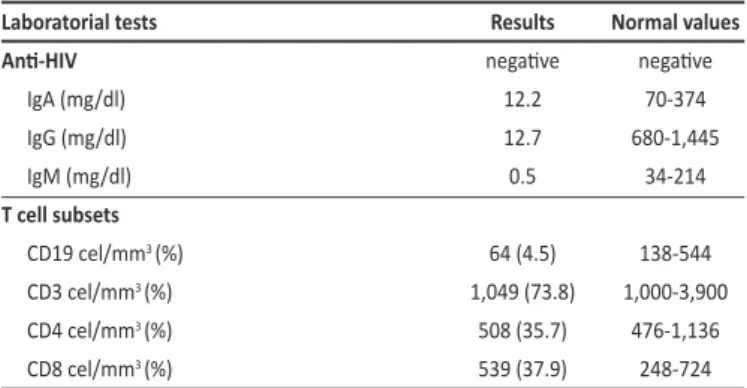
An immunodeiciency was suspected because of the Isospora infection; however, HIV tests were negative. Therefore, further evaluation of the immune system was performed, including measurement of immunoglobulin dosage and lymphocyte subset analysis. The results revealed a marked reducion in B lymphocyte numbers and immunoglobulins (Table 1). A negaive values of IgG against rubella and hepaiis B was found ater vaccines.
TABLE 1 -Laboratorial tests to paient´s immunologic screen.
Laboratorial tests Results Normal values
Ani-HIV negaive negaive
IgA (mg/dl) 12.2 70-374
IgG (mg/dl) 12.7 680-1,445
IgM (mg/dl) 0.5 34-214
T cell subsets
CD19 cel/mm3 (%) 64 (4.5) 138-544
CD3 cel/mm3 (%) 1,049 (73.8) 1,000-3,900
CD4 cel/mm3 (%) 508 (35.7) 476-1,136
CD8 cel/mm3 (%) 539 (37.9) 248-724
769 Silva GB et al - Common variable immunodeiciency and isosporiasis
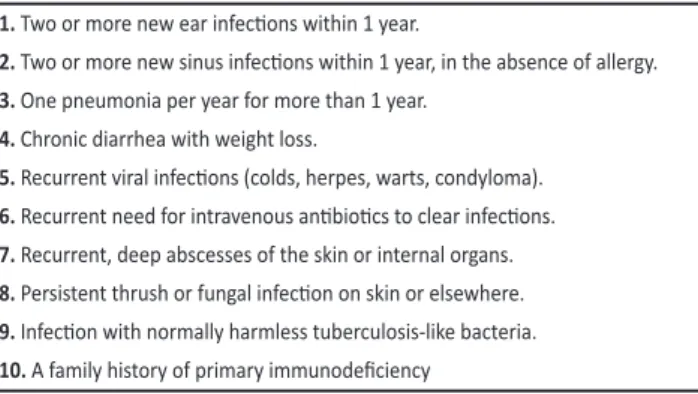
TABLE 2 - Ten warning signs for primary immunodeiciency in adults. 1. Two or more new ear infecions within 1 year.
2. Two or more new sinus infecions within 1 year, in the absence of allergy.
3. One pneumonia per year for more than 1 year.
4. Chronic diarrhea with weight loss.
5. Recurrent viral infecions (colds, herpes, warts, condyloma).
6. Recurrent need for intravenous anibioics to clear infecions.
7. Recurrent, deep abscesses of the skin or internal organs.
8. Persistent thrush or fungal infecion on skin or elsewhere.
9. Infecion with normally harmless tuberculosis-like bacteria.
10. A family history of primary immunodeiciency
ReFeReNCes
aBsTRaCT IN pORTUgUese
Imunodeiciência comum variável e isosporíase:
primeiro relato de caso
Trata-se de relato de caso de uma paciente de 62 anos, sexo feminino, HIV negaivo apresentando um quadro grave de diarréia, sendo isolados
Giardia lamblia e Isospora belli. Infecções incomuns e oportunistas devem ser consideradas como um sinal para alerta para que se analise o sistema imunológico. O diagnósico de imunodeiciência de comum variável foi realizado após invesigação. Este é o primeiro caso relatado de isosporíase em pacientes com imunodeiciência comum variável e mostra a importância de estar alerta tambem em relação a imunodeficiências primárias.
Palavras-chaves: Isosporiase. Imunodeiciência primária. Imunodeiciência comum variável.
1. Infección por Isospora belli en pacientes con infección por VIH. Presentación de dos casos y revisión de la literatura. Rev Chil Infect 2010; 27:219-227.
2. Junod C. Isospora belli coccidiosis in immunocompetent subjects (a study of 40 cases seen in Paris). Bull Soc Pathol Exot Filiales 1988; 81:317-325.
3. Cardoso LV, Galisteu KJ, Schiesari Júnior A, Chahla LA, Canille RM, Belloto MV, et al. Enteric parasites in HIV-1/AIDS-infected paients from a Northwestern São Paulo reference unit in the highly acive aniretroviral therapy era. Rev Soc Bras Med Trop 2011, 44:665-669. 4. Oliveira-Silva MB, Oliveira LR, Resende JC, Peghini BC, Ramirez LE, Lages-Silva E, et al. Seasonal profile and level of CD4+ lymphocytes in the occurrence of cryptosporidiosis and cystoisosporidiosis in HIV/AIDS paients in the Triângulo Mineiro region, Brazil. Rev Soc Bras Med Trop 2007; 40:512-515.
5. Cunningham-Rundles C, Bodian C. Common variable immunodeiciency: clinical and immunological features of 248 paients. Clin Immunol 1999; 92:34-48. 6. Cunningham-Rundles C. Common variable immunodeiciency. Curr Allergy Asthma
Rep 2001; 1:421-429.
7. Conley ME, Notarangelo LD, Etzioni A. Diagnosic Criteria for Primary Immunodeiciencies. Clin Immunol 1999; 93:190-197.
8. Melo KM, Carvalho KI, Bruno FR, Ndhlovu LC, Ballan WM, et al. A Decreased Frequency of Regulatory T Cells in Paients with Common Variable Immunodeiciency. PLoS ONE 2009; 4:e6269.
9. Ten warning signs for primary immunodeiciency in adults[internet]. [Cited in Dec 2011]. Available from: www.info4pid.com/.
10. Torres J, Fortuna J, Trigo E, Lopes AM, Campos MJ, Ferreira MR. Diarreia num doente com imunodeiciência comum variável. J Port Gastrenterol 2007; 14:199-203. 11. Daniels JA, Lederman HM, Maitra A, Montgomery EA. Gastrointesinal tract
pathology in patients with common variable immunodeficiency (CVID): a clinicopathologic study and review. Am J Surg Pathol 2007; 31:1800-1812. 12. Kobata CH, Neves MC, Dutenhefner SE, Silva FS, Bianchi Junior PF, Kanshiro EH.
Manifestação intesinal rara em pacientes com imunodeiciência comum variável e estrongiloidíase: relato de caso. Rev Med (São Paulo) 2000; 79:73-80.
Normal levels of albumin associated with low levels of immunoglobulin are characterisic of hypogammaglobulinemia. A diagnosis of CVID was suggested and treatment with intravenous immunoglobulin (IVIg) was iniiated. Ater 5 months of IVIg treatment (one treatment per month), the patient regained normal bowel funcion and gained 17kg in weight.
DIsCUssION
Common variable immunodeiciency (CVID) is characterized by a primary deiciency in anibodies and diagnosis is conirmed by a reducion in serum immunoglobulin G (IgG), immunoglobulin A (IgA) and/or immunoglobulin M (IgM) levels (less than two standard deviaions of the reference level for age) and poor responses to vaccinaion with polysaccharide (Streptococcus pneumoniae and Haemophilus influenzae) and protein (tetanus and diphtheria) anigens6. Other causes of hypogammaglobulinemia must be excluded,
including drugs that induce immunodeiciency, gastrointesinal or renal loss of immunoglobulins, and other primary anibody deiciencies5,6.
The basic defect in CIVD is the inability of B lymphocytes to differentiate into plasma cells capable of producing the various immunoglobulin isotypes. Defective B cell development results in abnormal humoral immune responses that result in hypogammaglobulinemia, which manifests clinically as an increased suscepibility to infecion7. Paients with CVID oten develop acute
sinopulmonary infecions that can lead to chronic inlammaion of the airways, such as chronic sinusiis and bronchiectasias4,5.
Over the last 20 years, various facets of the cellular and immunological dysfuncions present in CVID have been described; for example, abnormaliies in B cell populaions, a low frequency of naive CD4 T cells, and an increase in cellular acivaion. Other immunological defects include a reducion in the absolute number of natural killer cells and defects in dendriic cell funcion8. Around 30% of CVID paients
develop autoimmune diseases associated with abnormaliies in Treg cells, paricularly hemolyic anemia and idiopathic thrombocytopenic purpura, autoimmune thyroidiis, inlammatory intesinal diseases, pernicious anemia, Sjögren's syndrome, autoimmune hepatitis, primary biliary cirrhosis, and vasculiis4.
Chronic diarrhea in adults is considered a warning sign for immunodeiciency as described by the Primary Immune Foundaion and the Jeffrey Modell Foundation9, and screening for Primary
Immunodeiciency should be performed in paients with one of the signs listed in Table 2. Paients with CIVD usually present with chronic diarrhea, someimes as a consequence of an intesinal inlammatory disease; however, the presence of infecious agents should sill be invesigated in these paients. Several papers describe chronic diarrhea in CVID paients associated with diferent pathogens such as Giardia,
Cryptosporidium, Cytomegalovirus and Strongyloides5,10-12; however,
there are no reports of diarrhea associated with isosporiasis in CVID paients.