Workers’ health in Brazil:
graduate research
ABSTRACT
OBJECTIVE: To study trends of dissertation and thesis production in workers’ health in Brazil.
METHODS: Observation units were dissertations and theses developed by Brazilian researchers in national and foreign graduate programs. Theses and dissertations were identified in previously compiled works, LILACS and Capes database. Search keywords were workers’ health, ergonomics, occupational hygiene, toxicology, and occupational health.
RESULTS: There were identified 1,025 documents. Of them, seven were published before 1970, 31 were published in 1970s, 121 in 1980s, 533 in 1990s, and 333 between 2000 and 2004. An exponential growth of studies during the study period was observed with a corresponding factor approximately equal to 4 in each decade. The majority of studies addresses major public health issues like musculoskeletal diseases, mental health, and occupational risks for health workers. It was noticeable the small number of studies on unemployment, occupational cancer, and primary sector and construction industry workers, known as a risk group for fatal work-related injuries.
CONCLUSIONS: The growth of public and collective health graduate programs was a major factor for increasing research on workers’ health in Brazil in recent years. Despite increasing academic studies in this area of knowledge there are some persisting gaps persist that need to be narrowed in the near future.
KEYW O RD S: O ccupational health. Review literature. Education, graduate. Research. Academic dissertations.
Vilma Sousa Santana
Programa Integrado em Saúde Ambiental e do Trabalhador. Instituto de Saúde Coletiva. Universidade Federal da Bahia. Salvador, BA, Brasil
Correspondence: Vilma Sousa Santana
Instituto de Saúde Coletiva - UFBA Campus Universitário do Canela Rua Augusto Vianna, s/n 2º andar 40110-040 Salvador, BA, Brasil E-mail: [email protected]
INTRODUCTION
The relationship between work and sickness is recog-nized as important part of human life and culture. The use of means for preventing work-related inju-ries has been described as early as in the Bible, in Deuteronomy XXII:8: where window sills are recom-mended when building up constructions to prevent falls. However, when addressing the knowledge on workers’ health is impossible not to mention the Ramazzini’s seminal work70 developed from the end of the 17th century and beginning of the 18th cen-tury, which constitutes a valuable piece on occupa-tional diseases, and first suggested the inclusion of specific questions on occupation into the clinical history, anticipating approaches to prevent and treat diseases, such as musculoskeletal conditions, still prevalent. However, the prevention of work-related injuries and other health problems became known only after the emergence of the social medicine para-digm in the 19th century, which allowed the recogni-tion of working condirecogni-tions as a major determinant of life conditions,75 an association masterly illustrated by Engels in his study on the daily life of workers in England.30 Knowledge on this subject has flourished in the 20th century, not only driven by the scientific development of medicine and public health but also by the advances of the so-called technology fields such as safety engineering, occupational hygiene, toxicology and ergonomics. It leaded to the occupa-tional health model creation in consonance with pub-lic and collective health paradigm.
The first descriptions and documentations of work-ers’ health conditions in Brazil date from the 19th century33 but only much later it was a matter of re-search in medical schools. Former theses on occupa-tional medicine in academic settings were developed in the old forensic medicine chairs, whose scientific interests included studies of occupational risks, work conditions and injuries. However, theses and disser-tations focusing major national workers’ health prob-lems flourished only after the exponential growth of graduate programs in Brazil in 1990s. Few studies have addressed the academic production such as the list published by Mendes,58 and the Mendes & Waissman’s57 review study on occupational health history in Brazil. Kirchoff,43 in her doctoral thesis, outlined the evolution of the scientific production on workers’ health but her data was limited to the period between 1990 and 1994. So far, little is known on the quantitative evolution and contents of thesis and dissertation developed on workers’ health. The present study aims a further understanding of the path-way of Brazilian researchers’ academic production in workers’ health up to 2004.
M ETH O D S
The scope of the present study was the academic pro-duction in workers’ health focusing on theses and dissertations developed by Brazilian researchers in Brazilian and foreign academic institutions. Docu-ments were selected from several literature sources, such as the catalogue of theses and dissertations reg-istered from 1950 to 2002 by Mendes.57,58 This au-thor has searched references of them in private files, libraries and records from academic and health re-search institutions across the country. He was helped by researchers and graduate professors who provided him with lists of theses and dissertations references from each graduate program in the field of collective health, toxicology, ergonomics and engineering in Brazil. In addition, a search was carried out in the LILACS database (Latin American and Caribbean Literature on Health Sciences) and the Coordenação
de Aperfeiçoamento de Pessoal de Nível Superior
(Capes - Coordination for the Improvement of Higher Education Personnel) thesis catalogue for the period between 2003 and 2004. As the query on 2005 data showed a small number of entries, suggestive of in-complete data update, the end of the study period was thus defined as the year 2004. Although the list of theses and dissertations published by Mendes58 is limited to citation data, the analysis of the contents was possible since the abstracts were made available. The subject of each thesis and dissertation was iden-tified by its title and abstract and classified in groups to facilitate the analysis. Given the large amount of material available, detailed examination was limited to the most common research subjects or to subjects representing historical landmarks of trends and inno-vations. Duplicated references were manually identi-fied and excluded. Some references not related to workers’ health were also excluded.
RESU LTS AN D D ISCU SSIO N
re-mained throughout the following decade (n=533) and apparently remains unchanged during the present decade, although only part of the data were available as for the first five years (n=333). This sustained in-crement reflects the growth of graduate programs in collective health and the increasing interest of most graduate students on workers’ health. Formal research groups registered in the Conselho Nacional de
Desenvolvimento Científico e Tecnológico (CNPq -National Council for Scientific and Technological Development) also show an increase of main stream research on workers’ health from 2000 to 2004. Be-sides the positive impact of graduate courses, well established research programs and high qualified fac-ulties and researchers are also key elements to under-stand the increasing amount and quality of theses and dissertations on this subject-matter.
Historical background
The history of knowledge on the relations between work and health can be appreciated through theses and dissertations, especially in those periods when re-search studies were rarely published in journals. Mendes & Waissman57 (2003), in their pioneer litera-ture review on the historical background of work-re-lated diseases in Brazil, reported that the earliest the-ses showed negative results. In the author’s words “there was not found any case of illness in this factory that could be described as peculiar,”59 despite the plausible presence of occupational exposures in the studied in-dustry of cigars and sniff tobacco factories in the city of Rio de Janeiro. Another study36 investigated the health status of workers and residents in a neighboring area of an animal-fat processing plant that produce candles and soap because it was hypothetised that health problems could possibly arise from the fetid odor released, which was consistent with the miasma theory, popular at that time. It should be highlighted the advanced perspective underlying this study by tak-ing into consideration the simultaneous occupational and environmental impact of a given industry. How-ever, as in the previous study, no evidence of occupa-tional diseases was found.
These mentioned studies have introduced in Brazil the discussion on the relationship between living and working conditions, assimilating ideas that were un-der debate in Europe at that time, and that gave origin to the social medicine. In Brazil, consolidated aboli-tionist movements were the expression of major hu-manistic aspirations in Latin America, and some stud-ies sought to depict life conditions of enslaved black populations including their working conditions.33
Mendes & Waissman57 (2003)recognized the key role
of Júlio Afrânio Peixoto in establishing the founda-tions of the knowledge on workers’ health when he took office at the chair of forensic medicine in both medical and law schools in Rio de Janeiro in the be-ginning of last century. From his dedication to studies of occupational risks and related accidents and dis-eases, many publications were released. It was also re-ported that, in 1922, Leonídio Ribeiro wrote his asso-ciate professor thesis on hernia and work-related inju-ries, as part of studies on forensic medicine developed in Rio de Janeiro. A similar process occurred in São Paulo, where, also as part of academic activities of the chair of forensic medicine, important compendiuns such as “Tratado sobre acidentes de trabalho” (The work-related injuries), were developed by Afrânio Peixoto, Flamínio Fávero, and Leonídio Ribeiro.67
Later, in 1934, the first reports of inspections in work-places whose reports started to be presented in na-tional and internana-tional meetings, and published in journals such as the Boletim do Departamento
Nacional de Pesquisa Mineral (DNPM - Bulletin of the National Department of Mineral Research) by the Brazilian Ministry of Mines and Energy.15 Physicians working for the Brazilian Ministry of Labor were also involved in pioneer studies on workers’ health as well as investigators of Oswaldo Cruz Institute Division of Industrial Hygiene in the 1940s.33
In their review, Mendes & Waissman57 (2003) ac-knowledged a DNPM’s study as one of the first epide-miological studies on workers’ health in Brazil. Ap-proximately 1,009 gold miner workers were exam-ined and prevalences of silicosis of 11.82% and of tuberculosis of 8.7% were estimated. The author could make a causal occupational inference comparing populations with similar socioeconomic status.15 The observed association between silicosis and tubercu-losis, previously described by LaDou,46 had a great impact in Brazil and was widely disseminated in sci-entific meetings at that time.
Maeno & Carmo50 (2005) reviewed historical aspects of workers’ protection policies in Brazil and under-lined the critical role of some authors like Bernardo Bedrikow. In 1950s, in partnership with the Serviço
of a preventive orientation, and a poor facilities infra-structure as well. In 1950s, occupational medicine was introduced in medical school programs57 and there were major scientific meetings in this field of study that certainly had stimulated former observational studies developed as academic theses.
Thematic analysis of theses and dissertations
The oldest thesis identified in the present study was developed by Mocellin62 (1951), submitted to the Faculdade de Medicina do Paraná (State of Paraná School of Medicine), and addressed prevention of occupational noise-induced hearing loss. From 1950 to the 1970s most theses dealt with infectious dis-eases, such as leptospirosis in sewage workers,51 tu-berculosis associated to work-related risks and occu-pational diseases developed to the Faculdade de
Direito do Vale do Paraíba (Law School) in 1966;20 and the study on the prevalence of toxoplasmosis according to occupational groups.38 A dissertation presented to the Faculdade de Saúde Pública da
Universidade de São Paulo (FSP-USP)39 compared urine coproporphyrin in battery workers of factories covered by preventive actions and those who had not. This is one of the first scientific approaches for evaluating workers’ health programs.
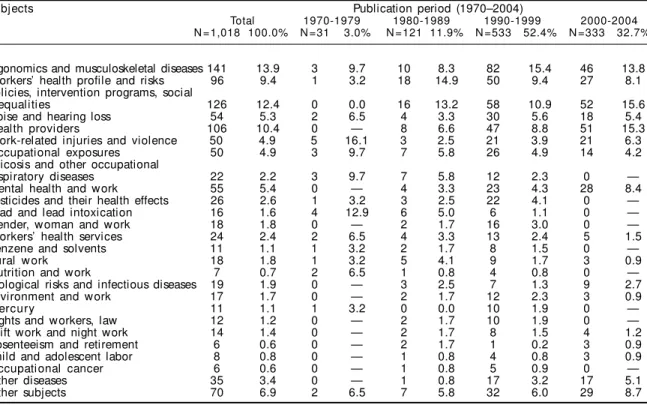
The Table shows the distribution of theses and disser-tations by conclusion period from 1970 to 2004. In 1970s, work-related injuries was the most common
subject studied (n=5, 16.1%), focusing themes as in-juries in small size firms,56 and naval construction.28 From dissertations developed abroad, one described occupational injury cases recorded in Brasil18 and was submitted at the University of London in 1977; a second one focused on the sociological conception of work-related injuries and was submitted at École
des Hautes Études en Sciences Sociales in Paris in 1978.29 Unlike the preceding period, concern about work-related infectious diseases was seen in only one thesis on Chagas’ disease in rural workers that was submitted at the Faculdade de Medicina da
Universidade Federal de Minas Gerais (UFMG).32
The pioneer role of the FSP-USP became evident as it accounted for one third of the dissertation and theses concluded in occupational health in the 1970s (n=10), extensive to the USP overall (n=17, 55%). The participation of the Coordenação dos Programas
de Pós-Graduação em Engenharia da Universidade Federal do Rio de Janeiro (COPPE - Federal Univer-sity of Rio de Janeiro Coordination of Graduate Pro-grams in Engineering) was also noticeable for con-tributing with three dissertations, all of them cover-ing subjects related to ergonomics.60,83,88 The Faculdade de Medicina da Unviersidade Federal da Bahia (UFBA), also contributed expressively with two dissertations on lead poisoning.23,85
The researchers’ concern about non-industrial work-ers such as garbage workwork-ers,81 and drivers,19 has
be-Table - Distribution of theses and dissertations on workers’ health in Brazil between 1970 and 2004 by subject and publication period.
Subjects Publication period (1970–2004)
Total 1970-1979 1980-1989 1990-1999 2000-2004 N =1,018 100.0% N =31 3.0% N =121 11.9% N =533 52.4% N =333 32.7%
Ergonomics and musculoskeletal diseases 141 13.9 3 9.7 10 8.3 82 15.4 46 13.8
Workers’ health profile and risks 96 9.4 1 3.2 18 14.9 50 9.4 27 8.1
Policies, intervention programs, social
inequalities 126 12.4 0 0.0 16 13.2 58 10.9 52 15.6
Noise and hearing loss 54 5.3 2 6.5 4 3.3 30 5.6 18 5.4
Health providers 106 10.4 0 — 8 6.6 47 8.8 51 15.3
Work-related injuries and violence 50 4.9 5 16.1 3 2.5 21 3.9 21 6.3
Occupational exposures 50 4.9 3 9.7 7 5.8 26 4.9 14 4.2
Silicosis and other occupational
respiratory diseases 22 2.2 3 9.7 7 5.8 12 2.3 0 —
Mental health and work 55 5.4 0 — 4 3.3 23 4.3 28 8.4
Pesticides and their health effects 26 2.6 1 3.2 3 2.5 22 4.1 0 —
Lead and lead intoxication 16 1.6 4 12.9 6 5.0 6 1.1 0 —
Gender, woman and work 18 1.8 0 — 2 1.7 16 3.0 0 —
Workers’ health services 24 2.4 2 6.5 4 3.3 13 2.4 5 1.5
Benzene and solvents 11 1.1 1 3.2 2 1.7 8 1.5 0 —
Rural work 18 1.8 1 3.2 5 4.1 9 1.7 3 0.9
Nutrition and work 7 0.7 2 6.5 1 0.8 4 0.8 0 —
Biological risks and infectious diseases 19 1.9 0 — 3 2.5 7 1.3 9 2.7
Environment and work 17 1.7 0 — 2 1.7 12 2.3 3 0.9
M ercury 11 1.1 1 3.2 0 0.0 10 1.9 0 —
Rights and workers, law 12 1.2 0 — 2 1.7 10 1.9 0 —
Shift work and night work 14 1.4 0 — 2 1.7 8 1.5 4 1.2
Absenteeism and retirement 6 0.6 0 — 2 1.7 1 0.2 3 0.9
Child and adolescent labor 8 0.8 0 — 1 0.8 4 0.8 3 0.9
Occupational cancer 6 0.6 0 — 1 0.8 5 0.9 0 —
Other diseases 35 3.4 0 — 1 0.8 17 3.2 17 5.1
come evident as well as their interests about health problems now recognized of great magnitude and rel-evance such as silicosis and exposures to chemicals, either metals like mercury and lead, or organic com-pounds such as pentachlorophenol, benzene and DDT. The influence of the French school of sociology of work is evident in Dwyer’s29 (1978) thesis on the so-cial concept of work-related injuries.
In the 1980s there was a four-time increase in the number of theses and dissertations (121) compared to the previous decade (Table). Whereas in the 1970s most studies were of epidemiological or quantitative nature, in 1980s studies started to deal with theoreti-cal issues or the social or polititheoreti-cal contextualization and integration of research themes (n=16; 13.2%). This approach is exemplified by Possas68 (1980), Goldbaum37 (1981), Murolo Filho64 (1981), Costa27 (1982), Lacaz44 (1983), Fachini31 (1986) and Sevá Filho78 (1988) dissertations and theses, among oth-ers. A few qualitative studies on workers’ perception17,24 and the first studies on gender, work and health1,47 were also conducted during this decade. A disserta-tion addressed child labor in agriculture in the state of São Paulo5 anticipating a subject-matter that be-came a priority only in the first years of this new millennium. In addition, the first study on occupa-tional health care was developed in this period. Early studies were developed at nursing schools6,84 and mainly addressed nurse’s practice and training in oc-cupational health. The first dissertation34 addressing health care workers was developed at that time, a sub-ject that became the most studied in theses and dis-sertations focusing one single professional group in the 1980s (n=8) and 1990s (n=47), and accounted for 18% of all thesis and dissertation concluded in the present decade. Teachers was also a subject of study in 1980s though still limited to nursing teachers.54
It can also be noted that, differently from the 1970s when most studies focused on one specific disease, injury or a particular group of workers in a firm, the scope of workers’ health changed in the 1980s and evolved to large analytical categories, such as absen-teeism or even social inequalities, sometimes using sophisticated epidemiological analysis as seen in the Rummel76 (1987) study. Rummel addressed the healthy worker effect as an evidence of social exclu-sion, earlier regarded as only a methodological arti-fact. Also, in this same decade, theses and disserta-tions on workers’ health were developed in schools not related to the health field, such as the Faculdade
de Arquitetura e Urbanismo (School of Architecture and Urbanism)40,53 and Instituto de Geociências (In-stitute of Geosciences) at the Universidade Estadual
de Campinas (Unicamp).78
The number of dissertations and theses continues its exponential growth. In the 1990s, it reached a total of 533, 18 times the number seen in the two previous decades. In 1991, a dissertation highlighted the un-derreporting of work-related injuries,11 followed by several studies on the information systems or even the nurse’s perception of reasons for occupational diseases and accidents underreporting.65 Following the path-way opened in the previous decade, studies on trans-missible diseases and work have gained a macrosocial dimension when dealing with, for instance, the rela-tionship between malaria and the process of land use in Rondônia,16 or the so-called enhanced chemical accidents.35 There were also several studies on the in-volvement of workers’ organizations, such as unions, in workers’ health.4,42,45,55,74,82,90 It can also be noted in-creased number of studies on work-related chronic con-ditions, such as mental diseases, arterial hypertension, cardiovascular risks, musculoskeletal symptoms and diseases, and in the embryo development characteris-tics from pregnant workers. Rehabilitation of injured workers, still a challenge in occupational health in Brazil and worldwide, was taken as the subject of a dissertation.86 Studies on health providers were also increasing, especially those focusing on nursing prac-tice, mostly carried out in nursing schools but also in graduate programs in collective health. Several aspects have been explored: job turnover,6 biological and chemical risks, work-related injuries, musculoskeletal symptoms,2 hepatitis B,12 but mainly stress and psy-chiatric disorders,52,61,72 among others.
Between 2000 and 2004, a total of 360 theses and dissertations was found, lower than expected given the trend of previous decades. This can indicate a delay in the update of databases utilized in this study or terminological changes in the classification. In general, study contents follow the same trend seen earlier. The great focus of research was health care workers s, especially nurses common diseases, such as mental health problems, musculoskeletal symp-toms and diseases, ergonomics, biological and chemi-cal risks and needle stick-related injuries. Based on few studies developed in the past decade, research on technology advances, computerized work and work management7,10,13,41,63 as well as environment-based management systems have multiplied.3,87
violence,21,49 an approach influenced by the increas-ing violence and itsimpact into workers’ daily life, that leads this issue to be recognized as a public health priority. Among other social aspects scarcely explored in previous decades, a thesis dealing with racism and racial discrimination in workers’ health was identified. Preliminary studies, however, had addressed jobs where Black prevails such as housekeeping and construc-tion.25 In addition, it could be noted studies focusing on management systems of workers’ health integrated to environment services following recent recommen-dations by the International Work Organization and the World Health Organization.69,73
Besides the identified exponential growth, some time trends of contents could be noted throughout the study period: there was an absolute and relative in-crease of theses and dissertations on musculoskeletal diseases (around 50%), mental diseases (100%), es-pecially among health care workers (72%, data else-where), and other conditions or outcomes such as obesity, fatigue, aging, and vocal disorders, among others, rarely described in former decades. It is worth mentioning the decreased absolute and relative fre-quencies of theses and dissertations on injuries and silicosis, which are severe common occupational health outcomes. Noise and hearing loss, which have been addressed since 1950s when the first thesis was developed, remained the focus of studies at a stable proportion in spite of being a common disabling prob-lem, especially in the manufacturing industries.
It can also be noted that in the present decade there is a better regional distribution of theses and disser-tations throughout Brazil with increased propor-tional participation of Midwestern, Northern and Northeastern states and consequently an increased number of institutions developing research projects. Also most publications have been developed in public institutions.
FIN AL CO M M EN TS
In Brazil, the scientific knowledge in workers’ health resulting from graduate theses and dissertations has started shyly in 1950s as part of the infectious dis-ease research stream. It has geometrically grown in the following decades mostly driven by the develop-ment of graduate programs, showing during the fol-lowing decade an exponential increase by a factor of four. First concentrated in the Southern and Southern regions, from 1990s it has spread to the Northeastern, Northern and Midwestern regions, including almost all Brazilian states.
Besides their growth and spread to all regions of
Bra-zil, the variety and groundbreaking subjects addressed by theses and dissertations on workers’ health are re-markable as well as their approach to problems known to have significant public health impact. It is worth noticing that, besides more traditional aspects, the aca-demic activity, from its very beginning, focused on themes of little visibility in the scientific literature such as occupational risks in small size firms,56 gar-bage workers,81 prostitution22 and child labor.5 Also, in the 1980s, studies have been conducted on occupa-tion and reproductive effects focusing women work,47 and social participation in the health management and policies.66 In the following decades, the Brazilian graduate studies covered a variety of subjects, always aware of problems regarded as public health priority. There appear to be differences in the priorities addressed by theses and dissertations and abstracts presented in scientific meetings, according to the review of Rego et al72 (2005). These authors found that the most com-mon research issues were work-related diseases and injuries, and most frequently they comprised descrip-tive studies dealing with specific conditions such as intoxications, cumulative trauma and mental disorders. The occupational categories most often studied were health, education and agriculture.71
inter-ventions, which seems to reflect some degree of hope-lessness and skepticism in regard to the role of preven-tion, that may contribute to the pessimistic viewpoint pervading activities such as the training of workers’ health professionals. One recognized successful policy in the field of workers’ health is the prohibition of child and adolescent labor in high-risk occupations,* a subject not yet sufficiently addressed in recent the-ses and dissertations.
One limitation of the present study was the fact that it was mostly based on existing lists of theses and disser-tations57,58 since it was not possible to carry out a com-prehensive search and using a rigorous methodologi-cal approach to ensure the coverageof all eligible docu-ments. Moreover, it was not possible to consider all keywords indicated in each thesis or dissertation, there-fore the themes were classified and categorized by the author. The Capes database did not always provided complete information, especially the identification of the institution responsible for the study.
Since most scientific knowledge generated on work-ers’ health is not published by indexed journals or made easily accessible, this study, besides the under-standing of general research trends allows for an
en-*International Labour Organization. O fim do trabalho infantil: um objetivo ao nosso alcance. (2006 ILO annual report - in Portuguese). Available from htpp://www.oitbrasil.org.br/download/relatorio_global2006.pdf [access in 2006 Jul 10]
hanced dissemination of this important research prod-ucts. It is possible that the scientific knowledge on determinants of occupational diseases and work con-ditions has contributed to the declining trends of fatal work-related injuries and several occupational diseases almost worldwide.26 In Brazil, despite the large number of academic studies on workers’ health, it is remark-able that only recently, research has become well ap-praised and applied as evidence in the decision mak-ing processes of institutions engaged in policy devel-opment and program management. Greater integration between researchers and policy makers and managers is further needed in order to allow the use of knowl-edge for more appropriate action to improve the work-place and workers’ environment health.
ACKN O W LED GM EN TS
The author thanks Dr. René Mendes, a retired tenured professor of Departamento de Medicina Preventiva e Social da Faculdade de Medicina da Universidade Federal de Minas Gerais, and chairman of the Asso-ciação Nacional de Medicina do Trabalho (National Association of Occupational Medicine), for making available the abstract of theses and dissertations from his personal collection.
REFEREN CES
1. Aguiar WM. Condições de trabalho feminino e transtornos mentais: um estudo de prevalência [dissertação de mestrado]. Salvador: Faculdade de Medicina da UFBA; 1986.
2. Alexandre NMC. Contribuição ao estudo das cervicodorsolombalgias em profissionais de enferma-gem [tese de doutorado]. Ribeirão Preto: Escola de Enfermagem, Universidade de São Paulo; 1993. 3. Almeida GES. Pra que somar se a gente pode dividir?
Abordagens integradoras em saúde, trabalho e ambiente [dissertação de mestrado]. Rio de Janeiro: Escola Nacional de Saúde Pública, Fiocruz; 2000. 4. Almeida RB. O trabalhador e o processo
saúde-doença: a mediação político pedagógica da CIPA [dissertação de mestrado]. Minas Gerais: Faculdade de Educação, Universidade Federal de Minas Gerais; 1992.
5. Antuniassi MHR. O trabalho mirim na agricultura paulista [tese de doutorado]. São Paulo: Faculdade de Filosofia, Ciências Humanas e Letras da Universidade de São Paulo; 1981.
6. Anselmi MLA. A rotatividade dos trabalhadores de enfermagem nos hospitais de Ribeirão Preto [disserta-ção de mestrado]. São Paulo: Escola de Enfermagem, Universidade de São Paulo; 1993.
7. Aquino JD. Sistemas de gestão da qualidade, de meio ambiente e de segurança e saúde no trabalho: um estudo para o setor químico brasileiro [tese de doutorado]. São Paulo: Faculdade de Saúde Pública, Universidade do Estado de São Paulo; 2003. 8. Araújo AJS. Paradoxos da modernização:
terceirização e segurança em refinaria de petróleo [tese de doutorado]. Rio de Janeiro: Escola Nacional de Saúde Pública, Fiocruz; 2001.
9. Araújo ME. Estudo da prevalência das manifestações bucais decorrentes de agentes químicos no processo de galvanoplastia: sua importância para a área da saúde bucal do trabalhador [tese de doutorado]. São Paulo: Faculdade de Odontologia, Universidade de São Paulo; 1998.
11. Baez-Garcia MA. Subnotificação de acidentes do trabalho em pacientes atendidos no Hospital Univer-sitário Antônio Pedro, Niterói [dissertação de mestrado]. São Paulo: Faculdade de Saúde Pública, Universidade de São Paulo; 1991.
12. Baldy JLS. Hepatite B em 250 dentistas do Norte do Paraná: prevalência da infecção, medidas preventi-vas adotadas e resposta imune, 135 suscetíveis à vacina recombinante belga administrada em pequenas doses (2mcg) por via intradérmica [tese de doutorado]. Belo Horizonte: Faculdade de Medicina, Universidade Federal de Minas Gerais; 1995. 13. Barreiros D. Gestão da segurança e saúde no
trabalho: estudo de um modelo sistêmico para as organizações do setor mineral. São Paulo: Departa-mento de Engenharia de Minas e Petróleo da Escola Politécnica da Universidade de São Paulo; 2002. 14. Bedrikow B, Correia PC, Redondo SF. Inquérito
preliminar de higiene industrial no município de S. Paulo. SESI, 1952. In: Maeno M, Carmo JC. Saúde do Trabalhador no SUS – aprender com o passado, trabalhar o presente, construir o futuro. São Paulo: Ed Hucitec; 2005.
15. Brasil. Departamento Nacional de Produção Mineral. Higiene das minas de ouro – silicose e outras doenças dos mineiros de Passagem. Rio de Janeiro; 1942. [Boletim da Divisão de Fomento da Produção Mineral, n. 53]
16. Bretas GS. Determinação da malária no processo de ocupação da fronteira agrícola [dissertação de mestrado]. Rio de Janeiro: Escola Nacional de Saúde Pública, Fiocruz; 1990.
17. Brito JC. Revelações do corpo: o trabalho de um estaleiro [dissertação de mestrado]. Rio de Janeiro: Universidade Federal do Rio de Janeiro; 1985. 18. Câmara VM. A descriptive study of the current state of
reported working accidents in Brazil [master paper]. London: University of London; 1977.
19. Campana CL. Contribuição para o estudo de alguns dos riscos a que está submetida uma classe de motoristas profissionais [tese de doutorado]. Ribeirão Preto: Faculdade de Farmácia e Odontologia da Universidade de São Paulo; 1974.
20. Campos O. Contribuição ao estudo infortunístico da tuberculose pulmonar e da bronquite crônica [tese de livre-docência]. São José dos Campos: Faculdade de Direito do Vale da Paraíba; 1966.
21. Carneiro SAM. Trabalho e violência: relação de proximidade, violência a trabalhadores durante jornada de trabalho na Zona Norte de São Paulo em 1998 [dissertação de mestrado]. São Paulo: Faculdade de Saúde Pública, Universidade de São Paulo; 2000. 22. Carolino EMP. Subsídios para o estudo dos problemas
de saúde mental numa população de prostitutas [dissertação de mestrado]. São Paulo: Escola de Enfermagem da Universidade de São Paulo; 1980.
23. Carvalho FM. Intoxicação por chumbo e cádmio entre pescadores do rio Subaé e de Guaibim (área de controle). [dissertação de mestrado]. Salvador: Faculdade de Medicina da Universidade Federal da Bahia; 1978.
24. Carvalho MCRG. O trabalho e a sombra: investiga-ção de aspectos perceptivos e simbólicos com máquinas na linha de montagem [tese de doutorado]. São Paulo: Instituto de Psicologia da Universidade de São Paulo; 1989.
25. Chaves FM. Vidas negras que se esvaem: experiênci-as de saúde dos funcionários escolares em situação de trabalho [tese de doutorado]. Rio de Janeiro: Escola Nacional de Saúde Pública, Fiocruz; 2004. 26. Coggon D. Occupational medicine at a turning point.
Occup Environ Med. 2005;62:281-3.
27. Costa EA. Trabalhadores migrando: um estudo sobre fome e migração [dissertação de mestrado]. Salva-dor: Faculdade de Medicina da UFBA; 1982. 28. Dela Coleta JA. Estudo de variáveis organizacionais e
psicológicas relacionadas a acidentes de trabalho em uma indústria da construção naval [dissertação de mestrado]. Rio de Janeiro: Fundação Getúlio Vargas, Universidade Federal do Rio de Janeiro; 1975. 29. Dwyer T. Une conception sociologique des accidents
du travail. Paris: L’ École des Hautes Études em Sciences Sociales; 1978.
30. Engels F. A Situação da classe trabalhadora na Inglaterra. 2a ed. São Paulo: Global; 1985.
31. Facchini LA. Processo de trabajo, cambio tecnológico y desgaste obrero [tesis maestria]. Xochimilco: Universidad Autonoma del México; 1986.
32. Faria CAF. Condições de saúde e doença de trabalha-dores rurais no município de Luz MG, com especial atenção a prevalência e morbidade da moléstia de Chagas [tese de doutorado]. Belo Horizonte: Faculda-de Faculda-de Medicina da UniversidaFaculda-de FeFaculda-deral Faculda-de Minas Gerais; 1978.
33. Fausto B. Trabalho urbano e conflito social: 1890-1920. Rio de Janeiro: Difel; 1977.
34. Franco AR. Estudo preliminar das repercussões do processo de trabalho sobre a saúde dos trabalhadores de um hospital geral [tese de doutorado] Ribeirão Preto: Faculdade de Medicina da Universidade de São Paulo; 1981.
35. Freitas CM. Acidentes químicos ampliados – incorpo-rando a dimensão social nas análises de riscos [tese de doutorado]. Rio de Janeiro: Escola Nacional de Saúde Pública, Fiocruz; 1996.
37. Goldbaum M. Saúde e trabalho: a doença de Chagas no setor industrial [tese de doutorado]. São Paulo: Faculdade de Saúde Pública, Universidade de São Paulo; 1981.
38. Gomes COM. Contribuição para a epidemiologia da toxoplasmose: investigação em profissões no Distrito – Sede de Sorocaba [tese de doutorado]. Sorocaba: Faculdade de Medicina da Pontifícia Universidade Católica; 1969.
39. Gomes JR. Determinação semiquantitativa da coproporfirina urinária: sua variabilidade em função de medidas de higiene e segurança em fábricas de acumuladores elétricos [dissertação de mestrado]. São Paulo: Faculdade de Saúde Pública da Universi-dade de São Paulo; 1969.
40. Gomes Filho J. Desenho industrial: metodologia para o projeto de postos de trabalho elevados em equipa-mentos industriais de movimentação de cargas [dissertação de mestrado]. São Paulo: Faculdade de Arquitetura e Urbanismo, Universidade de São Paulo; 1988.
41. Hall J. Gestão da segurança total na construção civil: um instrumento de otimização estratégica de produção civil com o objetivo de obtenção de vantagens competitivas – sub-setor: edificações [dissertação de mestrado]. Niterói: Universidade Federal Fluminense; 2001.
42. Hennington EA. Saúde e trabalho: considerações sobre as mudanças na legislação acidentária brasileira e sua influência sobre a classe trabalhadora [dissertação de mestrado]. Campinas: Faculdade de Ciências Médicas, Universidade de Campinas; 1996. 43. Kirchhof ALC. Tendências temáticas sobre a relação
trabalho e saúde: a contribuição dos estudos acadê-micos brasileiros (1990-1994) [tese de doutorado]. Florianópolis: Programa de Pós-Graduação em Enfermagem, Universidade Federal de Santa Catarina; 1997.
44. Lacaz FAC. Saúde no Trabalho [dissertação de mestrado]. São Paulo: Faculdade de Medicina da Universidade de São Paulo; 1983.
45. Lacaz FAC. Saúde do Trabalhador: um estudo sobre as formações discursivas da academia dos serviços e do movimento sindical [tese de doutorado]. Campinas: Faculdade de ciências médicas; 1996.
46. LaDou J. History. In: LaDou J, editor. Occupational Health & Safety. 2nd ed. Itasca: National Safety
Council; 1994.
47. Lima MCF. Ocupação feminina e comportamento reprodutivo [dissertação de mestrado]. São Paulo: Faculdade de Saúde Pública, Universidade de São Paulo; 1981.
48. Lima C. Exposição ocupacional a névoas ácidas e alterações da saúde bucal [tese de doutorado]. Salvador: Instituto de Saúde Coletiva, Universidade Federal da Bahia; 2001.
49. Machado JMH. Violência no trabalho e na cidade: epidemiologia da mortalidade por acidentes de trabalho registrada no município do Rio de Janeiro em 1987 e 1988 [dissertação de mestrado]. Rio de Janeiro: Escola Nacional de Saúde Pública, Fiocruz; 1991.
50. Maeno M, Carmo JC. Saúde do Trabalhador no SUS – aprender com o passado, trabalhar o presente, construir o futuro. São Paulo: Hucitec; 2005. 51. Magaldi C. Contribuição à epidemiologia das
leptopiroses: investigação em trabalhadores da rede de esgotos da cidade de São Paulo [tese de doutora-do]. São Paulo: Faculdade de Medicina, Universidade de São Paulo; 1962.
52. Marziale MHP. Estudo da fadiga mental de enfermei-ras atuantes em instituição hospitalar com esquema de trabalhos de turnos alternantes [dissertação de mestrado]. Ribeirão Preto: Faculdade de Filosofia e Ciências Humanas; 1990.
53. Mattos UAO. Segurança e projeto de edificações têxteis [tese de doutorado]. São Paulo: Faculdade de Arquitetura e Urbanismo, Universidade de São Paulo; 1988.
54. Mauro MYC. Fadiga e o trabalho docente de enfer-magem. [tese de doutorado] Rio de Janeiro: Escola de Enfermagem Anna Nery da Universidade Federal do Rio de Janeiro; 1977.
55. Medina MG. Sindicalismo e saúde: um estudo das políticas de saúde dos sindicatos da Bahia [disserta-ção de mestrado]. Salvador: Faculdade de Medicina, Universidade Federal da Bahia; 1992.
56. Mendes R. Importância das pequenas empresas industriais no problema de acidentes de trabalho [dissertação de mestrado]. São Paulo: Faculdade de Saúde Pública, Universidade de São Paulo; 1975. 57. Mendes R, Waissman W. Aspectos históricos da
patologia do trabalho. In: Mendes R. Patologia do trabalho. 2ª ed. São Paulo: Atheneu; 2003. vol. 1. p. 3-46.
58. Mendes R. Produção científica brasileira sobre saúde e trabalho, publicada na forma de dissertações de mestrado e teses de doutorado, 1950-2002. Parte 1. Bibliografia em ordem cronológica e alfabética. Rev Bras Med Trab. 2003;1:87-118.
59. Mendonça JNG. Das fábricas de charuto e rapé da capital e seus arrabaldes Rio de Janeiro [Tese]. Rio de Janeiro: Faculdade de Medicina do Rio de Janeiro; 1850.
60. Menezes JB Uma proposta de metodologia para arranjos e dimensionamento de estações de trabalho [dissertação de mestrado]. Rio de Janeiro: Coorde-nação de Programas de Pós-graduação em Engenha-ria da Universidade Federal do Rio de Janeiro; 1976. 61. Miranda AF. Estresse ocupacional: inimigo invisível
62. Mocellin L. Profilaxia dos traumatismos sonoros na surdez profissional [tese de livre-docência]. Curitiba: Faculdade de Medicina da Universidade do Paraná; 1951.
63. Moreira MMS. A inserção de tecnologias de gestão no mundo do trabalho e o estado mental do sujeito trabalhador: estudo de caso numa empresa do setor metal mecânico [dissertação de mestrado]. Belo Horizonte: Centro Federal de Educação Tecnológica de Minas Gerais; 2000.
64. Murolo Filho R. O sistema de produção e as condi-ções de vida e trabalho na lavoura canavieira, o caso de Campos, RJ [dissertação de mestrado]. Rio de Janeiro: Coordenação de Programas de Pós-gradua-ção em Engenharia da Universidade Federal do Rio de Janeiro; 1981.
65. Napoleão AA. Causas de sub-notificação de acidentes do trabalho: visão dos trabalhadores de enfermagem de um hospital do interior paulista [dissertação de mestrado]. Ribeirão Preto: Escola de Enfermagem da Universidade de São Paulo; 1999.
66. Oliveira MT. Aspectos da informatização da socieda-de brasileira. Trabalho, saúsocieda-de e controle social – o caso do setor bancário. Rio de Janeiro: Vozes; 1986. 67. Peixoto A, Fávero F, Ribeiro L. Acidentes de trabalho.
Rio de Janeiro: Guanabara-Weissman-Koogan; 1934. 68. Possas CA. Saúde, medicina e trabalho no Brasil
[dissertação de mestrado]. Campinas: Instituto de Filosofia e Ciências Humanas da Universidade de Campinas; 1980.
69. Prazeres M Clima organizacional: determinação dos níveis de satisfação dos servidores de uma unidade de saúde do município de Florianópolis [dissertação de mestrado]. Florianópolis: Universidade Federal de Santa Catarina; 2003.
70. Ramazzini B. De morbis artificum diatriba, 1700. In: Raimundo Estrela R, tradutor. São Paulo: Fundacentro; 2000.
71. Rego M, Mendonça ACO, Sá AC, Lopes, DMC, Moura FP, Alcântara TQ. Saúde dos trabalhadores nos congressos brasileiros de epidemiologia. Rev Baiana Saúde Pública. 2005;29:69-79.
72. Rego MPCMA. Trabalho hospitalar e saúde mental: o caso de um hospital geral e público no município do Rio de Janeiro [dissertação de mestrado]. Rio de Janeiro: Instituto de Medicina Social, Universidade do Estado do Rio de Janeiro; 1992.
73. Reis ALPP. Gestão do trabalho e estresse ocupacional: estudo em uma organização de serviços [dissertação de mestrado]. Salvador: Faculdade de Administração, Universidade Federal da Bahia; 2004.
74. Repullo Jr R. Atuação sindical da proteção da saúde dos trabalhadores [dissertação de mestrado]. São Paulo: Faculdade de Saúde Pública, Universidade de São Paulo; 1997.
75. Rosen G. Da polícia médica à medicina social: ensaios sobre a história da assistência médica. Rio de Janeiro: Graal; 1979.
76. Rummel D. Indicadores de mortalidade por categoria ocupacional e nível social, Estado de São Paulo, 1980-1982 [dissertação de mestrado]. São Paulo: Faculdade de Saúde Pública, Universidade de São Paulo; 1987.
77. Sampaio MR. O processo de qualificação real e o perfil de acidentabilidade entre trabalhadores efetivos e terceirizados: o caso dos pedreiros refratistas de uma indústria de aço. [dissertação de mestrado] Belo Horizonte: Escola de Engenharia, Universidade Federal de Minas Gerais; 2000. 78. Sevá Filho AO. No limite dos riscos e da dominação:
a politização dos investimentos industriais de grande porte [dissertação de mestrado]. Campinas: Instituto de Geociências da Universidade de Campinas; 1988. 79. Silva CAL. Exposição ocupacional a névoas ácidas e
alterações salivares [dissertação de mestrado]. Salvador: Instituto de Saúde Coletiva, Universidade Federal da Bahia; 2002.
80. Silva DRAD. Percepção de condições de saúde bucal em adultos trabalhadores [dissertação de mestrado]. São Paulo: Universidade de São Paulo; 2000.
81. Silva EP. Condições de saúde ocupacional dos lixeiros de São Paulo [dissertação de mestrado]. São Paulo, Faculdade de Saúde Pública da Universidade de São Paulo; 1973.
82. Silveira AM. Negociando a lei: saúde nos acordos coletivos de trabalho [dissertação de mestrado]. Belo Horizonte: Faculdade de Ciências Humanas, Universidade Federal de Minas Gerais; 1996. 83. Siqueira CAA Um estudo antropométrico de
trabalha-dores brasileiros [dissertação de mestrado] Rio de Janeiro: Coordenação de Programas de Pós-gradua-ção em Engenharia da Universidade Federal do Rio de Janeiro; 1976.
84. Sousa MSB. Enfermagem do trabalho: um estudo exploratório em empresas na cidade de Belém [dissertação de mestrado]. Rio de Janeiro: Escola de Enfermagem Anna Nery da Universidade Federal do Rio de Janeiro; 1980.
85. Spínola AG Variáveis epidemiológicas no controle do saturnismo [dissertação de mestrado] Salvador: Faculdade de Medicina da Universidade Federal da Bahia; 1975.
86. Struffaldi MCB. Reabilitação profissional: característi-cas, conhecimentos e opiniões de trabalhadores acidentados [tese de doutorado]. São Paulo: Faculda-de Faculda-de SaúFaculda-de Pública, UniversidaFaculda-de Faculda-de São Pau-lo;1994.
88. Ureta LHH. Análise ergonômica de um sistema ergonômico homem-máquina [dissertação de mestrado] Rio de Janeiro: Coordenação de Programas de Pós-graduação em Engenharia da Universidade Federal do Rio de Janeiro; 1974.
89. Vianna MIP. Exposição ocupacional a névoas ácidas e alterações da saúde bucal [tese de doutorado]. Salvador: Instituto de Saúde Coletiva, Universidade Federal da Bahia; 2001.