http://dx.doi.org/10.1590/0037-8682-0300-2015
Major Article
INTRODUCTION
Corresponding author: Dra. Lúcia Maria C. Galvão. e-mail: [email protected]
Received 29 August 2015 Accepted 28 January 2016
Characteristics of Triatomine infestation and
natural
Trypanosoma cruzi
infection in
the State of Rio Grande do Norte, Brazil
Andressa Noronha Barbosa-Silva
[1],[2], Antonia Cláudia Jácome da Câmara
[1],[3],
Kiev Martins
[1],
Daniela Ferreira Nunes
[2], Pedro Igor Câmara de Oliveira
[1],
Paulo Roberto Medeiros de Azevedo
[4], Egler Chiari
[2]and Lúcia Maria da Cunha Galvão
[1],[2][1]. Programa de Pós-Graduação em Ciências Farmacêuticas, Centro de Ciências da Saúde, Universidade Federal do Rio Grande do Norte, Natal, Rio Grande do Norte, Brasil. [2]. Programa de Pós-Graduação em Parasitologia, Departamento de Parasitologia, Instituto de Ciências Biológicas, Universidade Federal de Minas Gerais, Belo Horizonte, Minas Gerais, Brasil. [3]. Departamento de Análises Clínicas e Toxicológicas, Centro de Ciências da Saúde, Universidade Federal do Rio Grande do Norte, Natal, Rio Grande do Norte, Brasil. [ 4]. Departamento de Estatística, Centro de Ciências Exatas e da Terra, Universidade Federal do Rio Grande do Norte, Natal, Rio Grande do Norte, Brasil.
ABSTRACT
Introduction: Natural and artifi cial ecotope infestation by the kissing bug triatomines and their colonization and infection by Trypanosoma cruzi, the Chagas disease agent, were evaluated in nine municipalities of the State of Rio Grande do Norte, Brazil. Methods: Following identifi cation, triatomine intestinal contents were analyzed by direct microscopic examination, xenoculture, and polymerase chain reaction (PCR) for parasite detection. Trypanosoma cruzi isolates were genotyped using three different markers. Results: Of 842 triatomines captured, 65% were Triatoma brasiliensis, 17.8% Triatoma pseudomaculata, 12.5% Panstrongylus lutzi, and 4.7% Rhodnius nasutus. Triatoma brasiliensis and P. lutzi adults were found in the intradomicile. T. brasiliensis, T. pseudomaculata, and R. nasutus nymphs and adults were found in the peridomicile and wild environment. Intradomiciliary and
peridomiciliary infestation indexes were 5.6% and 33.7%, respectively. In the peridomicile, chicken coops were the most infested ecotope. The T. cruzi triatomine infection rate was 30.2%, of which PCR detected 29%. P. lutzi (78.1%), T. brasiliensis (24.5%), and T. pseudomaculata (22.7%) were the most infected species. TcII and III genotypes were detected in T. brasiliensis and TcIII in P. lutzi. Conclusions: T. brasiliensis was found in all environments and most ecotopes with high T. cruzi infection rates. High
infection rates were also detected in T. pseudomaculata and P. lutzi, suggesting their role in the interchange between the wild and
peridomestic transmission cycles. The combination of PCR, microscopic examination, and xenoculture contributed to improving
T. cruzi infection evaluation in triatomine bugs. The TcII and TcIII genotypes were predominant in the study area.
Keywords:Trypanosoma cruzi. Triatominae natural infection. PCR. Xenoculture. Direct microscopic examination.
Trypanosoma cruzi is the etiological agent of Chagas
disease, and its main vectors belong to the genera Panstrongylus, Rhodnius, and Triatoma. Among these blood-sucking
reduviid bugs of the subfamily Triatominae, 70 of the over 148 Triatominae species described(1) are naturally infected by T. cruzi(2). Infection is maintained primarily within three overlapping cycles: domiciliary, peridomiciliary, and sylvatic(3). Vector transmission remains the most important route of parasite to human transmission owing to the natural distribution of T. cruzi in the triatomine species adapted to domestic or
peridomestic environments; this adaptation to human dwellings strongly determines human infection rates(4).
The Brazilian Northeast, one of the poorest and most underdeveloped regions within Brazil, is considered the most important region therein for American trypanosomiasis, where native species like Triatoma brasiliensis Neiva, 1911, Triatoma pseudomaculata Corrêa and Espínola, 1964, Panstrongylus lutzi Neiva & Pinto, 1926, and Rhodnius nasutus Stal, 1859 are widespread(5) (6). Triatoma brasiliensis is distributed in nine
Northeast states, Tocantins, and Minas Gerais(7). Considered the
main vector of T. cruzi in the Northeastern semiarid regions, it
METHODS
thereby increasing its colonization rate in several states(5) (18);
such native triatomines that sporadically invade or reinvade human dwellings further complicate vector control consolidation(18).
Triatomines can be infected with several flagellates and
T. cruzi infection level evaluation in wild, peridomiciliary, and
domiciliary environments has relevance for control programs aimed at reducing human infections(19) (20). Trypanosoma cruzi has been
detected in the excreta or intestinal contents of triatomines by direct microscopic examination (DME)(19) (21), necessitating the ability to
distinguish this protozoan from other trypanosomatids. Although DME is reliable and relatively inexpensive, disadvantages related to sensitivity, specifi city(22) (23) (24), and poor performance on dead
insects(25) exist. Xenoculture is used for quality control to confi rm negative intestinal content results ascertained by DME, whereas positive cultures allow for T. cruzi strain isolation(26) pursuant to e.g. genetic studies. For detecting T. cruzi in reduviid bug feces or urine and mammalian blood samples, polymerase chain reaction (PCR) is generally superior (21) (22) (27) and can also genotype T. cruzi
using different targets.
Such methodology has increased the rate of positivity of infection in fi eld studies, which is especially important in areas where there is scarce information on vector infection following control and surveillance programs. A recent seroepidemiological survey showed high seroprevalence for municipalities in the west and central mesoregions of the State of Rio Grande do Norte (RN)(28), and genotyping studies identified T. cruzi
I (TcI) in T. brasiliensis and TcIII (formerly called TcIIc) in armadillos(29), TcI and TcII in humans, TcII and TcIII in T. brasiliensis, and TcIII in P. lutzi(15).
The purpose of this study was to evaluate the occurrence of triatomine infestation of natural and artifi cial ecotopes, and the colonization and T. cruzi infection in triatomines collected from different environments in the west and central mesoregions of the State RN, Brazil. Diagnostic method efficacy and reproducibility were evaluated and the T. cruzi populations isolated from positive triatomines were genotyped to establish their genetic groups.
Study area
State of Rio Grande do Norte, located in northeastern Brazil, is divided into 167 municipalities distributed in four mesoregions: West, Central, Agreste, and East. About 90% of the territory represents arid and semiarid climates, where the predominant biome is the Caatinga, characterized as containing thorny shrubs, irregular structure, and partially uncovered soil. This study was conducted in the municipalities of Apodi, Caraúbas, Governador Dix-Sept Rosado, Lucrécia, Mossoró,
Severiano Melo, São Miguel, Caicó, and Serra Negra do
Norte in the West and Central mesoregions (Figure 1), which were selected in reference to the seroepidemiological survey conducted between 2007 and 2009(28).
Triatomine collection and identifi cation
Triatomines were captured in rural areas of the nine municipalities in intradomicile, peridomicile, and wild environments from March 2009 to August 2012. The intradomiciliary environment was surveyed in 250 domiciliary units (DU) together with 187 artificial structures in the peridomicile such as chicken coops (n = 110), corrals (n = 25), pigsties (n = 2), piles of tiles (n = 44), old stone fence structures (n = 2), and dry carnauba palm tree (Copernicia prunifera)
straw (n = 4). Entomological indicators were used to calculate the colonization and species peridomiciliary and domiciliary infestation indices(30).
Wild environment captures were performed in Apodi, Caraúbas, and Serra Negra do Norte in rock outcrops (n = 9),
stone fences (n = 2), bird’s nests (n = 5), and carnauba palm trees (n = 16), the latter as previously described(31).
In Serra Negra do Norte, wild triatomines capture was
conducted at the Seridó Ecological Station (ESEC-Seridó)/
Instituto Chico Mendes de Conservação da Biodiversidade
(ICMBio), created by Decree 87222 of 05/31/1982, Law 6902 04.27.1982 as a Conservation Unit. Some adult insects were captured in station lodgings and were classifi ed as an undefi ned ecotope. Insects were captured both day and night by the principal author with the assistance of the respective Municipal Health Secretariat technicians via manual searches using tweezers and a fl ashlight in all environments and without the use of insect dislodging substances, and were individually identifi ed as described(32).
Natural infection of triatomine bugs
Direct microscopic examination. Collected triatomines were examined individually and their intestinal content was removed under aseptic conditions and placed in a well of a 24-well plate containing 500µL sterile saline solution. After homogenization, 5µL suspension was used to identify trypanosomatid forms via DME at 400× magnifi cation(26) and
smear stained by Giemsa (1,000×).
Xenoculture. Approximately 250µL intestinal content
suspension was seeded in 15mL tubes containing liver infusion tryptose culture medium(33) plus McNeal Novy Niccole or blood agar and incubated at 28°C. Aliquots were examined after 15, 30, and 60 days by DME (400×)(26).
PCR with species-specific primers. Deoxyribonucleic acid (DNA) was extracted via phenol-chloroform(34) using
200µL diluted insect intestinal content solution (v/v) in 0.2M guanidine-HCl 6M/ethylenediaminetetraacetic acid (EDTA)(35)
maintained for 5-7 days at room temperature and stored at 4ºC until DNA extraction. PCR amplifi cations were performed in duplicate, as described(34), using specifi c primers to identify T. cruzi(36). PCR assays were performed in a DNA clean chamber to avoid contamination and positive and negative controls were used to monitor each step.
RESULTS
FIGURE 1 - Map of the State of Rio Grande do Norte highlighting the West and Central mesoregions. The study area showing the surveyed municipalities is shown in dark grey.
as described(37). As positive controls, Trypanosoma cruzi cell cultures of the Colombian strains (T. cruzi I), JG (T. cruzi II), and T. rangeli were used.
Trypanosoma cruzi isolates for genotyping
Cultured parasite genomic DNA obtained using phenol-chloroform was used as PCR assay templates(38). Trypanosoma cruzi isolates were typed using three different parasite genomic sequences as reported(39), with the 24Sα ribosomal (rRNA) gene D7 domain(40), mitochondrial cytochrome oxidase subunit 2 gene (COII)(41), and the spliced leader genes intergenic region(42) as
markers for six discrete typing units (DTUs)(43), using T. cruzi
reference strains(15) (44) (45) and clones(46) (47) as DTU controls. All PCR products were analyzed by 6% polyacrylamide gel electrophoresis and visualized by silver staining(48).
Statistical analysis
To quantify the concordance between the results of different methods, generalized Kappa (hatk) coeffi cients were estimated
and an approximate 95% confi dence interval (CI95%) for k [lower confi dence limit (LCL) and upper confi dence limit (UCL)](49)
was calculated and classifi ed accordingly(50).
Table 1 shows that were captured 842 triatomines including T. brasiliensis (65%), T. pseudomaculata (17.8%), P. lutzi
(12.5%), and R. nasutus (4.7%). T. brasiliensis was predominant
TABLE 1 - Number of triatomine bugs captured in different environments in the west and central mesoregions in nine municipalities in the State of Rio Grande do Norte, Brazil (2009-2012).
Triatomine species
Triatoma Triatoma Panstrongylus Rhodnius
brasiliensis pseudomaculata lutzi nasutus Total
Municipalities
n % n % n % n % n %
Central mesoregion
Caicó 23 4.3 0 0.0 0 0.0 1 2.5 24 2.9
Serra Negra do Norte 127 23.2 38 25.3 102 97.1 0 0.0 267 31.8
West mesoregion
Apodi 35 6.4 20 13.3 0 0.0 21 52.5 76 9.0
Caraúbas 303 55.4 65 43.4 3 2.9 18 45.0 389 46.2
Governador Dix-Sept 50 9.2 0 0.0 0 0.0 0 0.0 50 5.9
Rosado
Lucrécia 0 0.0 7 4.7 0 0.0 0 0.0 7 0.8
Mossoró 4 0.7 0 0.0 0 0.0 0 0.0 4 0.5
São Miguel 1 0.1 12 8.0 0 0.0 0 0.0 13 1.5
Severiano Melo 4 0.7 8 5.3 0 0.0 0 0.0 12 1.4
Total 547 65.0 150 17.8 105 12.5 40 4.7 842 100.0
Environments Wild
nymphs 89 42.0 16 27.5 0 0.0 6 33.3 111 28.5
adults 123 58.0 42 72.5 102 100.0 12 66.7 279 71.5
Peridomicile
nymphs 200 61.9 54 58.6 0 0.0 9 40.9 263 60.2
adults 123 30.1 38 41.4 0 0.0 13 59.1 174 39.8
Intradomicile
nymphs 0 0.0 0 0.0 0 0.0 0 0.0 0 0.0
adults 12 100.0 0 0.0 3 100.0 0 0.0 15 100.0
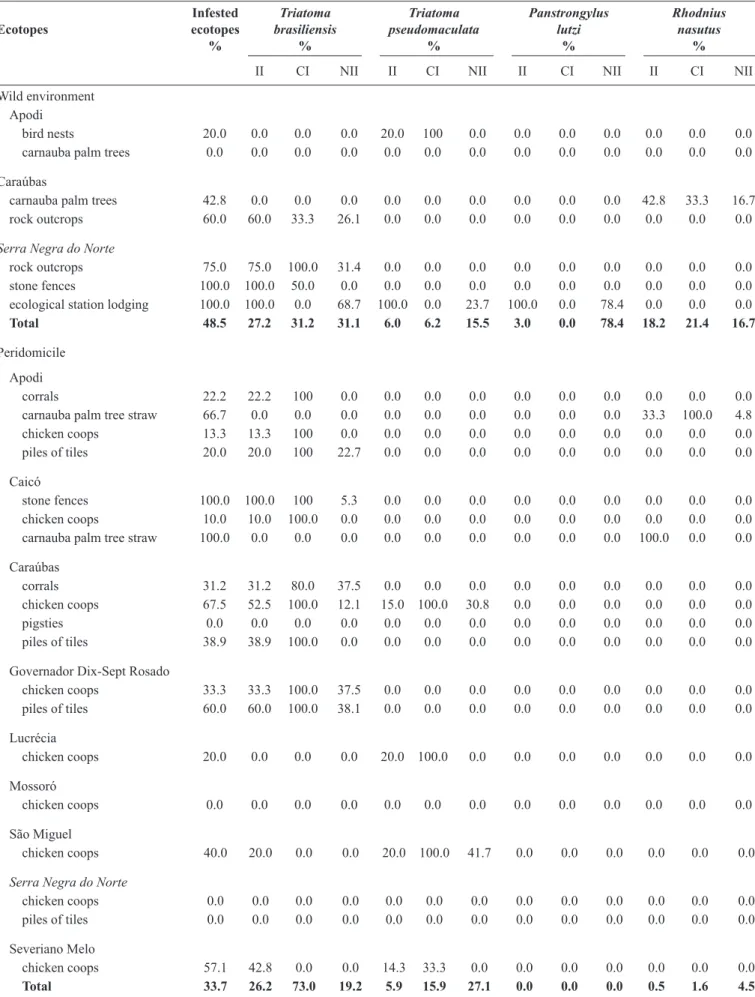
In the wild, 48.5% (16/33) of the ecotopes were infested by triatomines. High infestation was observed in stone fences (100%) and rock outcrops (75%) in Serra Negra do Norte
in comparison with other ecotopes. In the peridomicile, the infestation index was 33.7% (63/187) with T. brasiliensis and T. pseudomaculata at indices at 26.2% (49/187) and 5.9%
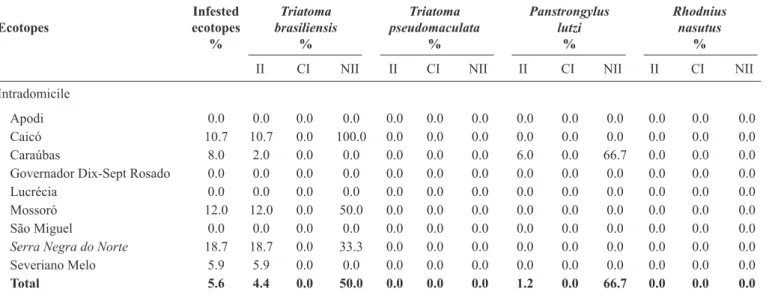
(11/187), respectively, primarily in chicken coops. The intradomicile infestation index was 5.6% (14/250). Table 2 shows the colonization index of each ecotope by triatomine species.
All the insects were examined; 30.2% exhibited T. cruzi infection, with P. lutzidemonstrating the highest rates (78.1%). The highest
infection rate was detected by PCR (29%), detecting T. cruzi infection in most P. lutzi (69.5%) and T. brasiliensis (24.3%) specimens
(Figure 2A). Kappa evinced no agreement between T. cruzi detection methods for T. brasiliensis [hat k = −0.0112; CI95% = (−0.0596;
0.0372)], T. pseudomaculata [hat k = 0.0036; CI95% = (−0.0888;
0.0960)], P. lutzi [hat k = 0.0690; CI95% = (−0.0414; 0.1794)], and R. nasutus (hat k = 0.1652; CI95% = (−0.0137; 0.3441)]. The global
infection index was 0.12 [CI95% = (0.0773; 0.1553)] indicating slight methodological agreement, but signifi cantly different from zero as excluded by the CI.
Figure 2B shows that the highest infected specimen rate (53.3%) occurred in the intradomicile [primarily P. lutzi
(66.7%)], followed by the wild environment (40.5%) and peridomicile (20.1%) [primarily P. lutzi and T. pseudomaculata
(78.4% and 27.2%, respectively)].
In the wild, T. brasiliensis presented high infection indices in Serra Negra do Norte (31.4%) and Caraúbas (26.1%) rock outcrops. T. cruzi infection was also detected in R. nasutus in carnauba palm trees. In the peridomicile, T. brasiliensis presented high infection indexes in piles of tiles (38.1%) and corrals (37.5%) in Governador Dix Sept Rosado and Caraúbas, respectively, and T. pseudomaculata in chicken coops (30.8%) in Caraúbas (Table 2).
Intestinal contents of all infected triatomines and 100 uninfected specimens were submitted to multiplex PCR using primers for T. rangeli and produced no overlapping data, thus
confi rming that T. cruzi-specifi c amplifi cation.
Trypanosoma cruzi DTUs were identified in 15 samples
TABLE 2 - Entomological indicators observed in the ecotopes of different environments in the municipalities of the State of Rio Grande do Norte.
Infested Triatoma Triatoma Panstrongylus Rhodnius
Ecotopes ecotopes brasiliensis pseudomaculata lutzi nasutus
% % % % %
II CI NII II CI NII II CI NII II CI NII
Wild environment
Apodi
bird nests 20.0 0.0 0.0 0.0 20.0 100 0.0 0.0 0.0 0.0 0.0 0.0 0.0
carnauba palm trees 0.0 0.0 0.0 0.0 0.0 0.0 0.0 0.0 0.0 0.0 0.0 0.0 0.0
Caraúbas
carnauba palm trees 42.8 0.0 0.0 0.0 0.0 0.0 0.0 0.0 0.0 0.0 42.8 33.3 16.7
rock outcrops 60.0 60.0 33.3 26.1 0.0 0.0 0.0 0.0 0.0 0.0 0.0 0.0 0.0
Serra Negra do Norte
rock outcrops 75.0 75.0 100.0 31.4 0.0 0.0 0.0 0.0 0.0 0.0 0.0 0.0 0.0
stone fences 100.0 100.0 50.0 0.0 0.0 0.0 0.0 0.0 0.0 0.0 0.0 0.0 0.0
ecological station lodging 100.0 100.0 0.0 68.7 100.0 0.0 23.7 100.0 0.0 78.4 0.0 0.0 0.0
Total 48.5 27.2 31.2 31.1 6.0 6.2 15.5 3.0 0.0 78.4 18.2 21.4 16.7
Peridomicile
Apodi
corrals 22.2 22.2 100 0.0 0.0 0.0 0.0 0.0 0.0 0.0 0.0 0.0 0.0
carnauba palm tree straw 66.7 0.0 0.0 0.0 0.0 0.0 0.0 0.0 0.0 0.0 33.3 100.0 4.8
chicken coops 13.3 13.3 100 0.0 0.0 0.0 0.0 0.0 0.0 0.0 0.0 0.0 0.0
piles of tiles 20.0 20.0 100 22.7 0.0 0.0 0.0 0.0 0.0 0.0 0.0 0.0 0.0
Caicó
stone fences 100.0 100.0 100 5.3 0.0 0.0 0.0 0.0 0.0 0.0 0.0 0.0 0.0
chicken coops 10.0 10.0 100.0 0.0 0.0 0.0 0.0 0.0 0.0 0.0 0.0 0.0 0.0
carnauba palm tree straw 100.0 0.0 0.0 0.0 0.0 0.0 0.0 0.0 0.0 0.0 100.0 0.0 0.0
Caraúbas
corrals 31.2 31.2 80.0 37.5 0.0 0.0 0.0 0.0 0.0 0.0 0.0 0.0 0.0
chicken coops 67.5 52.5 100.0 12.1 15.0 100.0 30.8 0.0 0.0 0.0 0.0 0.0 0.0
pigsties 0.0 0.0 0.0 0.0 0.0 0.0 0.0 0.0 0.0 0.0 0.0 0.0 0.0
piles of tiles 38.9 38.9 100.0 0.0 0.0 0.0 0.0 0.0 0.0 0.0 0.0 0.0 0.0
Governador Dix-Sept Rosado
chicken coops 33.3 33.3 100.0 37.5 0.0 0.0 0.0 0.0 0.0 0.0 0.0 0.0 0.0
piles of tiles 60.0 60.0 100.0 38.1 0.0 0.0 0.0 0.0 0.0 0.0 0.0 0.0 0.0
Lucrécia
chicken coops 20.0 0.0 0.0 0.0 20.0 100.0 0.0 0.0 0.0 0.0 0.0 0.0 0.0
Mossoró
chicken coops 0.0 0.0 0.0 0.0 0.0 0.0 0.0 0.0 0.0 0.0 0.0 0.0 0.0
São Miguel
chicken coops 40.0 20.0 0.0 0.0 20.0 100.0 41.7 0.0 0.0 0.0 0.0 0.0 0.0
Serra Negra do Norte
chicken coops 0.0 0.0 0.0 0.0 0.0 0.0 0.0 0.0 0.0 0.0 0.0 0.0 0.0
piles of tiles 0.0 0.0 0.0 0.0 0.0 0.0 0.0 0.0 0.0 0.0 0.0 0.0 0.0
Severiano Melo
chicken coops 57.1 42.8 0.0 0.0 14.3 33.3 0.0 0.0 0.0 0.0 0.0 0.0 0.0
Total 33.7 26.2 73.0 19.2 5.9 15.9 27.1 0.0 0.0 0.0 0.5 1.6 4.5
TABLE 2 - Continuation.
Infested Triatoma Triatoma Panstrongylus Rhodnius
Ecotopes ecotopes brasiliensis pseudomaculata lutzi nasutus
% % % % %
II CI NII II CI NII II CI NII II CI NII
Intradomicile
Apodi 0.0 0.0 0.0 0.0 0.0 0.0 0.0 0.0 0.0 0.0 0.0 0.0 0.0
Caicó 10.7 10.7 0.0 100.0 0.0 0.0 0.0 0.0 0.0 0.0 0.0 0.0 0.0
Caraúbas 8.0 2.0 0.0 0.0 0.0 0.0 0.0 6.0 0.0 66.7 0.0 0.0 0.0
Governador Dix-Sept Rosado 0.0 0.0 0.0 0.0 0.0 0.0 0.0 0.0 0.0 0.0 0.0 0.0 0.0
Lucrécia 0.0 0.0 0.0 0.0 0.0 0.0 0.0 0.0 0.0 0.0 0.0 0.0 0.0
Mossoró 12.0 12.0 0.0 50.0 0.0 0.0 0.0 0.0 0.0 0.0 0.0 0.0 0.0
São Miguel 0.0 0.0 0.0 0.0 0.0 0.0 0.0 0.0 0.0 0.0 0.0 0.0 0.0
Serra Negra do Norte 18.7 18.7 0.0 33.3 0.0 0.0 0.0 0.0 0.0 0.0 0.0 0.0 0.0
Severiano Melo 5.9 5.9 0.0 0.0 0.0 0.0 0.0 0.0 0.0 0.0 0.0 0.0 0.0
Total 5.6 4.4 0.0 50.0 0.0 0.0 0.0 1.2 0.0 66.7 0.0 0.0 0.0
II: infestation index; CI: colonization index; NII: natural infection index.
T. brasiliensis T. pdeudomaculata P. lutzi
R. nasutus Global infection index
R. nasutus Total infection species
T. brasiliensis T. pseudomaculata P. lutzi
Direct microscopic examination Xenoculture
Total infected specimens PCR
Wild
Wild Peridomicile
Peridomicile Domicile
Domicile Direct microscopic examination Xenoculture
Total infected specimens PCR
0.7% (1/150)
0.7% (1/150)
22.7% (34/150)
35.2% (37/105)
69.5% (73/105) 1.5% (8/547)
0.4% (2/547)
24.3% (133/547)
24.5% (134/547)
2.5% (1/40)
0.0% (0/40)
10.0% (4/40)
10.0% (4/40)
50.0% (6/12) 31.1% (66/212)
19.2% (62/323)
0.0% (0/0) 53.3% (8/15)
66.7% (2/2) 0.0% (0/0)
16.7% (3/18) 40.5% (158/390)
78.4% (80/102) 15.5% (9/58)
4.5% (1/22) 20.1% (88/437)
0.0% (0/0) 27.2% (25/92)
5.6% (47/842)
2.0% (17/842)
29.0% (244/842)
30.2% (254/842) 22.7% (34/150)
13.3% (14/105)
78.1% (82/105)
0 20 40 60 80 100 0 20 40 60 80 100 0 20 40 60 80 100
0 20 40 60 80 100 0 20 40 60 80 100
0 20 40 60 80 100 0 20 40 60 80 100 0 20 40 60 80 100
0 20 40 60 80 100 0 20 40 60 80 100
FIGURE 2 - Rate of natural infection of triatomine species by Trypanosoma cruzi as determined using different methods and in three distinct environments.A) Infection rate of triatomine species by detection method and global infection index. B) Infection rate of triatomines in different capture environments and total number of infected specimens. T. brasiliensis: Triatoma brasiliensis; T. pseudomaculata: Triatoma pseudomaculata;
P.lutzi: Panstrongylus lutzi; R.nasutus: Rhodnius nasutus; PCR: polymerase chain reaction.
A
TABLE 3 - Geographical origin, development stage, environment, and genetic typing of Trypanosoma cruzi stocks from triatomine species.
Trypanosoma cruzi stocks Triatomine species Stage Environment DTU Municipality
RN01 Triatoma brasiliensis nymph peridomiciliary TcII Caicó
RN02 Triatoma brasiliensis adult wild TcIII Serra Negra do Norte
RN03 Triatoma brasiliensis adult wild TcII Serra Negra do Norte
RN04 Triatoma brasiliensis nymph wild TcIII Serra Negra do Norte
RN05 Triatoma brasiliensis nymph wild TcIII Serra Negra do Norte
RN06 Triatoma brasiliensis nymph wild TcII Serra Negra do Norte
RN07 Panstrongylus lutzi adult wild TcIII Serra Negra do Norte
RN08 Panstrongylus lutzi adult wild TcIII Serra Negra do Norte
RN09 Panstrongylus lutzi adult wild TcIII Serra Negra do Norte
RN10 Panstrongylus lutzi adult wild TcIII Serra Negra do Norte
RN11 Panstrongylus lutzi adult wild TcIII Serra Negra do Norte
RN12 Panstrongylus lutzi adult wild TcIII Serra Negra do Norte
RN18 Panstrongylus lutzi adult intradomiciliary TcIII Caraúbas
RN19 Panstrongylus lutzi adult intradomiciliary TcIII Caraúbas
RN213 Panstrongylus lutzi adult wild TcIII Serra Negra do Norte
RN812 Panstrongylus lutzi adult wild TcIII Serra Negra do Norte
Col1.7G2*(47) human - - TcI
-JG*(44) human - - TcII
-RN19*(15) human - - TcIII
-AM64*(45) human - - TcIV
-3253* human - - TcV
-CL Brener*(46) Triatoma infestans - - TcVI
-DTU: discrete typing units: TcI, TcII, TcIII, TcIV, TcV and TcVI.*T. cruzi strains and clones used as reference; 3253: Lages-Silva et al. (unpublished data).
DISCUSSION
This general assessment of triatomine occurrence demonstrated that the species T. brasiliensis, T. pseudomaculata, P. lutzi, and R. nasutus continue to exist in artifi cial environments
in RN State municipalities, where they have been registered since the 1950s(7) (8) (14) (15) (51) (52) and where high seroprevalence
of human T. cruzi infection has been estimated(28). The presence of other triatomine species has also been reported(5) (7) (8) (52), but
these were not found in this study.
Triatoma brasiliensis and Triatoma pseudomaculata were
found in most municipalities as expected, being the main species caught in the semiarid RN region. R. nasutus was captured only in Apodi, Caraúbas, and Caicó municipalities and P. lutzi was found only in Serra Negra do Norte and in Caraúbas, as described(51). In agreement with our studies, T. brasiliensis was the most frequently
identifi ed species, followed by T. pseudomaculata and R. nasutus, as observed in several studies(9) (53).
We identified T. brasiliensis in the wild environment,
peridomicile, and intradomicile with high T. cruzi infection rates. This species has been reported as semi-domestic, since it is an autochthonous species capable of colonizing domiciles and the peridomicile(12). It is highly dispersed and frequent owing
to its eurytopic characteristics, is not hygrophilous, is able to withstand very high temperatures, and thus is acclimatized to the vast expanse of the Northeastern region(13).
Despite the absence of intradomicile colonies, frequent adult T. brasiliensis invasions occur because of the proximity of the wild environment with DUs. Residential lighting attracts these insects(54), potentially explaining their localized capture.
Peridomicile colonization was observed by T. brasiliensis and T. pseudomaculata nymphs, most frequently in chicken coops
around rural dwellings in this state(55). The epidemiological
profi le similarities among the municipalities studied suggest the need for interventions to prevent parasite transmission in this environment to domestic animals and humans.
Degradation of the natural wild vector habitat allows the bugs to move close to human habitations; such coexistence increases the probability of human infection(56). In the wild, T. brasiliensis was mainly found colonizing rocky outcrops and stone fences. Its occurrence in Northeastern Brazil is associated with rock formation distribution(6). However, this species can
also be found in shrubby cacti co-occupied by native rodents in Ceará(57).
Triatoma pseudomaculata is widely distributed in the wild
and is considered to be diffi cult to control(5). T. pseudomaculata
is primarily associated with Caatinga and areas of the Cerrado in Brazil(58), and is an arboricolous species(59). Here, the natural habitat of T. pseudomaculata was identifi ed as bird’s nests,
corroborating previous fi ndings(32).
In the study area, the natural R. nasutus habitat was the
Carnauba palm, considered the major ecotope of this species(9) (60).
Colonization foci were observed in the peridomicile in dry carnauba straw used by the rural population to manufacture household items in Apodi. This can be explained by the proximity of palm trees with DUs that attract insects as previously described or by passive insect transport by residents living in carnauba extraction areas, where storing dry leaves in the peridomicile is common. In the State of Ceará, R. nasutus has been frequently
found colonizing the peridomicile owing to the use of carnauba straw for chicken coop roof construction and household goods manufacture(9) (61).
Panstrongylus lutzi was the most infected species in the
intradomicile and wild environment. The former is worrying because of the T. cruzi transmission risk to domestic animals
and humans and potential introduction of a new parasite genetic group into the transmission cycles, since this area is currently exclusively infected with DTU III(15). P. lutzi has restricted
distribution in areas of the semiarid northeast although it has wide geographical distribution and a high T. cruzi infection rate in the State of Pernambuco. Its domiciliation has occurred in the States of Ceará and Pernambuco(62) (63). P. lutzi is found in hollow Auxemma oncocalyx trunksin Ceará(64) and in armadillo burrows in the semiarid Caatinga in Bahia(59). However, the P. lutzi natural habitat was not identifi ed despite extensive
searching in the wild environment of the Seridó Ecological Station where most specimens were captured; thus, further studies are required(15) (51).
Currently, vector transmission is considered residual by a few native and peridomestic species such as T. brasiliensis and T. pseudomaculata. There is also a risk of progressive domiciliation of certain species previously considered sylvatic such as P. lutzi and the possibility of human infection
directly related to the parasite enzootic cycle(62). P. lutzi holds
relevance toward maintaining the peridomestic and domestic T. cruzi transmission cycles, the risk of invasion and eventual colonization therein, and the consequent parasite transmission to domestic animals and humans. These results highlight the
increasing epidemiological importance of P. lutzi and indicate the continuing necessity of maintaining epidemiological surveillance against T. cruzi transmission in the study area.
Here, we reported a slight agreement among T. cruzi
detection methods used to evaluate infection in triatomines, and the importance of its association to fi eld studies. T. cruzi
infection varied among triatomine species according to method with PCR showing high positivity whereas detection by DME in intestinal contents was low. However, higher infection rates were reported with fl agellates morphologically similar to T. cruzi in Pernambuco(63), and similar or higher triatomine infection rates have been reported between methods(19) (23) (24) (25). High PCR
positivity in relation to DME has been previously observed, indicating its utility for epidemiological studies(19) (23) (24) (65). PCR can also directly detect T. cruzi vector infection thus improving
triatomine evaluation and should be used to assess infection rates in dead insects(25) owing to its higher relative degree of precision. Thus, PCR represents the best tool for parasite detection, confi rming the majority of infections ascertained by DME and xenoculture. However, these remain useful as the combination of methods can contribute to monitoring T. cruzi in triatomines and enhance confi dence regarding triatomine positivity.
The Trypanosomacruzi DTUs identifi ed in 15 isolates from
triatomine bugs were TcII and TcIII in T. brasiliensis and TcIII in P. lutzi. Previous fi ndings showed these DTUs circulating
in these species in the semiarid zone of RN(15) (17) and highlight
the need to understand T. cruzi population distribution in this
area. Naturally heterogeneous T. cruzi populations involving TcI, TcII, and TcIII circulate among humans and triatomines in three different municipalities without domicile colonization(17),
and high genetic similarities exist among T. cruzi populations circulating in different hosts, localities, and environments(16).
TcII was detected in the peridomicile in Caicó and in the wild in Serra Negra do Norte, indicating its participation in sylvatic and peridomestic cycles. The original primary host of TcII appears to be primates. Whereas its ecological niche has yet to be determined, isolates have been described from opossums in the Atlantic forest and from sylvatic primates, suggesting that such primates might be the primary original mammalian host(66). TcII
has also been isolated from the armadillo Euphractus sexcintus
in the Paraguayan Chaco(67). This DTU has been shown as the
primary cause of severe acute and chronic Chagas disease in the Atlantic Forest and central region of Brazil and represents the etiological disease agent in São Felipe in the State of Bahia, where the domestic vector is P. megistus(67).
TcIII was isolated from T. brasiliensis in the wild environment and from P. lutzi captured in the domiciliary and
wild environments of two different localities. TcIII is a poorly understood T. cruzi genetic group predominantly identifi ed
among wild cycles of parasite transmission infecting terrestrial mammals and triatomine vectors, but is also a potentially important emergent human disease agent(68). A few triatomine
species have been described in sylvatic TcIII transmission such as Panstrongylus geniculatus Latreille, 1811, and Triatoma rubrovaria Blanchard, 1843, both mainly sylvatic vectors
in a broad range of terrestrial mammals and its transmission may occur inside triatomine-infested burrows by both vectorial and oral routes(29) (70). Overlapping geographic areas of TcIII and TcI isolates occur across South America, with shared wild mammals and vectors in terrestrial ecotopes(29). TcIII in
domestic transmission cycles, while intermittent(68), implies
a role as a human disease agent. Furthermore, TcIII may be under-reported in both domestic and sylvatic transmission cycles because some typing methodologies fail to distinguish between TcIV and TcIII(71). The TcII and TcIII identifi ed in this
study corroborate previous fi ndings and reinforce the need for constant epidemiological surveillance of T. brasiliensis and P. lutzi to prevent TcIII spread to the domestic cycle(15).
TcI was not detected in triatomines in the studied area. However, most studies conducted in northeastern Brazil have isolated this DTU from T. brasiliensis and T. pseudomaculata, with most naturally infected T. brasiliensis isolates being TcI(72). TcI has also been identifi ed in T. pseudomaculata and R. nasutus in the peridomicile and natural environments of
fi ve State of Ceará peri-urban and urban localities(73). Therein,
high TcI and TcII infection rates were detected in peridomestic
T. brasiliensis and T. pseudomaculata, respectively(74). TcI has been most frequently identifi ed in triatomines of the State of Mato Grosso do Sul(75). The majority of isolates from humans, reservoirs, and vectors from Amazonia correspond to TcI(29) and it has been detected in humans from State of RN(15) (16),
with recent isolates from patients with various clinical forms of Chagas disease(17). T. cruzi genotypes isolated from triatomines
can vary according to vector-specifi c physiology and ecological habitat(43), highlighting the necessary to accurately identify TcI
in triatomines.
Our results suggest that combining methodologies contributed to increased parasite detection and to identifying infection foci to precisely determine triatomine distribution. Despite low parasite detection via xenoculture and DME, these methods allow the isolation of T. cruzi for further study. Owing
to high peridomestic ecotope infestation and high T. brasiliensis and T. pseudomaculataT. cruzi infection, we recommend
effi cient entomological surveillance programs to detect possible colonization. This study contributes to our knowledge of
T. cruzi diagnosis and identifi cation in fi eld-collected triatomines,
further demonstrating that T. cruzi II and III predominate in the
study area and, with future research, are essential for vector control and human infection prevention.
ACKNOWLEDGMENTS
The authors declare that there is no confl ict of interest.
CONFLICT OF INTEREST
FINANCIAL SUPPORT
REFERENCES
The authors would like to thank the Secretariat of State for Public Health of Rio Grande do Norte, represented by the health authorities and agents of the Municipal Secretaries of the West and Central mesoregions for their indispensable support of the survey fi eld activities. The authors are also grateful to Adalberto Antonio Varela-Freire MSc (in memoriam) and Philip S.P. Badiz
for critical reading and revision of the manuscript.
This work was supported by research grants from the
Conselho Nacional de Desenvolvimento Científi co e Tecnológico
MCT/CNPq number 472251/2010-4 (EC); MCTI/CNPq/MS-SCTIE-Decit number 404056/2012-1 (LMCG); Programa Nacional de Incentivo à Parasitologia Básica/CAPES number
23038.005288/2011-48 (ACJC); research fellowships from the CNPq (LMCG and EC), and a scholarship from CAPES (ANBS).
1. Galvão C, Paula AS. Sistemática e evolução dos vetores. In: Galvão
C, editor. Vetores da doença de Chagas. Curitiba (PR): Sociedade
Brasileira de Zoologia 2015. p. 26-31.
2. Zeledón R, Rabinovich JE. Chagas’ disease: an ecological
appraisal with special emphasis on its insect vectors. Annu Rev
Entomol 1981; 26:101-133.
3. Deane LM. Animal reservoirs of Trypanosoma cruzi in Brazil. Rev Bras Malariol D Trop 1964; 16:27-48.
4. Coura JR, Borges-Pereira J. Chagas disease: 100 years after its
discovery. A systemic review. Acta Trop 2010; 115:5-13.
5. Dias JCP, Machado EMM, Fernandes AL, Vinhaes MC. General
situation and perspectives of Chagas disease in Northeastern
region, Brazil. Cad Saude Publica 2000; 16:13-34.
6. Gurgel-Gonçalves R, Galvão C, Costa J, Peterson AT. Geographic
distribution of Chagas disease vectors in Brazil based on ecological niche modeling. J Trop Med 2012; 2012:705326.
7. Silveira AC, Feitosa VR, Borges R. Distribuição de triatomíneos
capturados no ambiente domiciliar, no período de 1975/1983, no
Brasil. Rev Bras Malariol D Trop 1984; 36:15-312.
8. Costa J, Almeida CE, Dotson EM, Lins A, Vinhaes M, Silveira
AC, et al. The epidemiologic importance of Triatoma brasiliensis
as a Chagas disease vector in Brazil: a revision of domiciliary captures during 1993-1999. Mem Inst Oswaldo Cruz 2003; 98:
443-449.
9. Sarquis O, Borges-Pereira J, Mac Cord JR, Gomes TF, Cabello PH,
Lima MM. Epidemiology of Chagas disease in Jaguaruana, Ceará,
Brazil. I. Presence of triatomines and index of Trypanosoma cruzi
infection in four localities of a rural area. Mem Inst Oswaldo Cruz
2004; 99:263-270.
10. Almeida CE, Pacheco RS, Haag K, Dupas S, Dotson EM, Costa
J. Inferring from the Cyt B gene the Triatoma brasiliensis Neiva,
1911 (Hemiptera: Reduviidae: Triatominae) genetic structure and domiciliary infestation in the state of Paraíba, Brazil. Am J Trop
Med Hyg2008; 78:791-802.
11. Carbajal de la Fuente AL, Dias-Lima A, Lopes CM, Emperaire L,
Walter A, Ferreira A, et al. Behavioral plasticity of Triatominae related to habitat selection in Northeast Brazil. J Med Entomol
2008; 45:14-19.
13. Alencar JE. História natural da doença de Chagas no Estado do Ceará, Imprensa Universitária, Fortaleza, CE, p. 341, 1987. 14. Silveira AC, Vinhaes MC. Chagas disease: the epidemiological
and control aspects. Rev Soc Bras Med Trop 1998; 31:15-60. 15. Câmara ACJ, Varela-Freire AA, Valadares HMS, Macedo AM,
D’Ávila DA, Machado CR, et al. Genetic analyses of Trypanosoma cruzi isolates from naturally infected triatomines and humans in
northeastern Brazil. Acta Trop 2010; 115:205-211.
16. Câmara ACJ, Lages-Silva E, Sampaio GHF, D’Ávila DA, Chiari E, Galvão LMC. Homogeneity of Trypanosoma cruzi I, II, and
III populations and the overlap of wild and domestic transmission
cycles by Triatoma brasiliensis in northeastern Brazil. Parasitol Res 2013; 112:1543-1550.
17. Martins K, Andrade CM, Barbosa-Silva AN, Nascimento GB,
Chiari E, Galvão LMC, et al. Trypanosoma cruzi III causing the
indeterminate form of Chagas disease in a semi-arid region of
Brazil. Int J Infect Dis 2015; 39:68-75.
18. Silveira AC. New challenges and the future of control. Rev Soc
Bras Med Trop 2011; 44 (supl 2):122-124.
19. Shikanai-Yasuda MA, Ochs DE, Tolezano JE, Kirchhoff LV. Use of
the polymerase chain reaction for detecting Trypanosoma cruzi in triatomine vectors. Trans R Soc Trop Med Hyg 1996; 90:649-651. 20. Botto-Mahan C, Ortiz S, Rozas M, Cattan PE, Solari A. DNA
evidence of Trypanosoma cruzi in Chilean wild vector Mepraia spinolai (Hemiptera: Reduviidae). Mem Inst Oswaldo Cruz 2005;
100:237-239.
21. Moser DR, Kirchhoff LV, Donelson JE. Detection of Trypanosoma cruzi by DNA amplification using the polymerase chain reaction.
J Clin Microbiol 1989; 27:1477-1482.
22. Russomando G, Rojas AA, Almiron M, Figueredo A, Ferreira ME,
Morita K. Trypanosoma cruzi: polymerase chain reaction-based
detection in dried feces of Triatoma infestans. Exp Parasitol 1996; 83:62-66.
23. Braz LMA, Raiz-Jr R, Amato-Neto V, Alárcon RS, Gakyia
E, Okay TS. The detection of Trypanosoma cruzi in Triatoma infestans: comparison of a PCR-based assay with microscopical
examination. Ann Trop Med Parasitol 2007; 101:461-465. 24. Pizarro JC, Lucero DE, Stevens L. PCR reveals signifi cantly
higher rates of Trypanosoma cruzi infection than microscopy
in the Chagas vector, Triatoma infestans: High rates found in
Chuquisaca, Bolivia. BMC Infect Dis 2007; 7:66-73.
25. Dorn PL, Engelke D, Rodas A, Rosales R, Melgar S, Brahney B, et al. Utility of the polymerase chain reaction in detection of Trypanosoma cruzi in Guatemalan Chagas’ disease vectors. Am J
Trop Med Hyg 1999; 60:740-745.
26. Bronfen E, Rocha FSA, Machado GBN, Perillo MM, Romanha AJ,
Chiari E. Isolation of Trypanosoma cruzi samples by xenodiagnosis
and hemoculture from patients with chronic Chagas’ disease. Mem Inst Oswaldo Cruz 1989; 84:237-240.
27. Breniére SF, Bosseno MF, Revollo S, Rivera MT, Carlier Y, Tibayrenc M. Directidentifi cation of Trypanosoma cruzi natural
clones in vectors and mammalian hosts by polymerase chain reaction amplifi cation. Am J Trop Med Hyg 1992; 46:335-341.
28. Brito CRN, Sampaio GHF, Câmara ACJ, Nunes DF, Azevedo
PRM, Chiari E, et al. Seroepidemiology of Trypanosoma cruzi
infection in the semiarid rural zone of the State of Rio Grande do
Norte, Brazil. Rev Soc Bras Med Trop 2012; 45:346-352.
29. Marcili A, Lima L, Valente VC, Valente SA, Batista JS, Junqueira
ACV, et al. Comparative phylogeography of Trypanosoma cruzi
TCIIc: New hosts, association with terrestrial ecotopes, and spatial
clustering. Infect Genet Evol 2009; 9:1265-1274.
30. World Health Organization (WHO). Control of Chagas’ Disease.
Technical Report Series 811. Genebra: WHO; 1991.
31. Diotaiuti L, Dias JCP. Occurrence and biology of Rhodnius neglectus
Lent, 1954 in palm trees of suburban areas of Belo Horizonte, Minas
Gerais. Mem Inst Oswaldo Cruz 1984; 79:293-301.
32. Carcavallo RU, Rodríguez MEF, Salvatella R, Curto de Casas
SI, Sherlock IS, Galvão C, et al. Habitats and related fauna.
In: Carcavallo RU, Galindéz-Girón I, Jurberg J, Lent H, editors.
Atlas of Chagas Disease Vectors in the Americas. Vol II Rio de Janeiro (RJ): FIOCRUZ; 1998. p. 561-600.
33. Camargo EP. Growth and differentiation in Trypanosoma cruzi. I - Origin of metacyclic trypanosomes in liquid media. Rev Inst Med Trop 1964; 6:93-100.
34. Gomes ML, Macedo AM, Vago AR, Pena SDJ, Galvão LMC,
Chiari E. Trypanosoma cruzi: optimization of polymerase chain
reaction for detection in human blood. Exp Parasitol 1998;
88:28-33.
35. Ávila HA, Sigman DS, Cohen LM, Millikan RC, Simpson L.
Polymerase chain reaction amplifi cation of Trypanosoma cruzi
kinetoplast minicircle DNA isolated from whole blood lysates: diagnosis of chronic Chagas’ disease. Mol Biochem Parasitol 1991;
48:211-222.
36. Degrave W, Fragoso SP, Britto C, Van Heuverswyn H, Kidane GZ,
Cardoso MAB, et al. Peculiar sequence organization of kinetoplast
DNA minicircles from Trypanosoma cruzi. Mol Biochem Parasitol
1988; 27:63-70.
37. Souto RP, Vargas N, Zingales B. Trypanosoma rangeli: discrimination from Trypanosoma cruzi based on a variable
domain from the large subunit ribosomal RNA gene. Exp Parasitol
1999; 91:306-314.
38. Macedo AM, Martins MS, Chiari E, Pena SDJ. DNA fi ngerprinting of Trypanosoma cruzi: a new tool for characterization of strains
and clones. Mol Biochem Parasitol 1992; 55:147-153.
39. D’Ávila DA, Macedo AM, Valadares HMS, Gontijo ED, Castro
AM, Machado CR, et al. Probing population dynamics of
Trypanosoma cruzi during progression of the chronic phase in
chagasic patients. J Clin Microbiol 2009; 47:1718-1725.
40. Souto RP, Zingales B. Sensitive detection and strain classifi cation of Trypanosoma cruzi by amplifi cation of a ribosomal RNA
sequence. Mol Biochem Parasitol 1993; 62:45-52.
41. Freitas JM, Augusto-Pinto L, Pimenta JR, Bastos-Rodrigues L, Gonçalves VF, Teixeira SMR, et al. Ancestral genomes, sex,
and the population structure of Trypanosoma cruzi. PLOS Pathog
2006; 2:e24.
42. Burgos JM, Altcheh J, Bisio M, Duffy T, Valadares HMS,
Seidenstein ME, et al. Direct molecular profi ling of minicircle
signatures and lineages of Trypanosoma cruzi bloodstream
populations causing congenital Chagas disease. Int J Parasitol
2007; 37:1319-1327.
43. Zingales B, Andrade SG, Briones MRS, Campbell DA, Chiari
E, Fernandes O, et al. A new consensus for Trypanosoma cruzi
intraspecifi c nomenclature: second revision meeting recommends TcI to TcVI. Mem Inst Oswaldo Cruz 2009; 104:1051-1054.
44. Lages-Silva E, Crema E, Ramírez LE, Macedo AM, Pena SDJ,
Chiari E. Relationship between Trypanosoma cruzi and human
chagasic megaesophagus: blood and tissue parasitism. Am J Trop
Med Hyg 2001; 65:435-441.
45. Monteiro WM, Magalhães LKC, de Sá ARN, Gomes ML, Toledo MJO, Borges L, et al. Trypanosoma cruzi IV causing outbreaks of
acute Chagas disease and infections by different haplotypes in the
46. Zingales B, Pereira MES, Oliveira RP, Almeida KA, Umezawa ES, Souto RP, et al. Trypanosoma cruzi genome project: biological
characteristics and molecular typing of clone CL Brener.
Acta Trop 1997; 68:159-173.
47. Federici EE, Abelmann WH, Neva FA. Chronic and progressive
myocarditis and myositis in C3H mice infected with Trypanosoma cruzi. Am J Trop Med Hyg 1964; 13:272-280.
48. Santos FR, Pena SDJ, Epplen JT. Genetic and population study of a
Y-linked tetranucleotide repeat DNA polymorphism with a simple non-isotopic technique. Hum Gene 1993; 90:655-656.
49. Fleiss JL, Levin B, Paik MC. Statistical Methods for Rates and Proportions. 3rd ed. Hoboken: Wiley; 2003.
50. Landis JR, Koch GG. The measurement of observer agreement for categorical data. Biometrics 1977; 33:159-174.
51. Lucena DT. Doença de Chagas no Nordeste. Rev Bras Malariol D Trop 1959; 11:675-696.
52. Castro-Filho J, Silveira AC. Distribuição da Doença de Chagas no Brasil. Rev Bras Malariol D Trop 1979; 31:85-89.
53. Coutinho CFS, Souza-Santos R, Teixeira NFD, Georg I, Gomes TF, Boia MN, et al. An entomoepidemiological investigation of
Chagas disease in the state of Ceará, Northeast Region of Brazil.
Cad Saude Publica, 2014; 30:785-793.
54. Freitas SPC, Freitas ALC, Prazeres SM, Gonçalves TCM. Infl uence
of anthropic habits in the dispersion of Triatoma pseudomaculata
Corrêa & Espínola, 1964 through Mimosa tenuifl ora (Willdenow) (Mimosaceae) in the State of Ceará, Brazil. Cad Saude Publica
2004; 20:333-336.
55. Valença-Barbosa C, Lima MM, Sarquis O, Bezerra CM,
Franch-Abad F. Modeling disease vector occurrence when detection is imperfect II: Drivers of site-occupancy by synanthropic Triatoma brasiliensis in the Brazilian Northeast. PLoS Negl Trop Dis 2014a;
8:e2861.
56. Toledo MJO, Kühl JB, Silva SV, Gasperi V, Araújo SM.
Biogeography, origin, and distribution of triatominae domiciliarity
in Brazil. Rev Saude Publica 1997; 3:197-203.
57. Valença-Barbosa C, Lima MM, Sarquis O, Bezerra CM,
Abad-Franch F. Short report: A common Caatinga cactus, Pilosocereus gounellei, is an important ecotope of wild Triatoma brasiliensis
population in the Jaguaribe Valley of Northeastern Brazil. Am J
Trop Med Hyg 2014b; 90:1059-1062.
58. Carbajal de la Fuente AL, Porcasi X, Noireau F, Diotaiuti L,
Gorla DE. The association between the geographic distribution
of Triatoma pseudomaculata and Triatoma wygodzinskyi
(Hemiptera: Reduviidae) with environmental variables recorded
by remote sensors. Infect Genet Evol 2009; 9:54-61.
59. Dias-Lima AG, Menezes D, Sherlock I, Noireau F. Wild habitat and related fauna of Panstrongylus lutzi (Reduviidae, Triatominae).
J Med Entomol 2003; 40:989-990.
60. Lima MM, Coutinho CFS, Gomes TF, Oliveira TG, Duarte R,
Borges-Pereira J, et al. Risk presented by Copernicia prunifera
palm trees in the Rhodnius nasutus distribution in a Chagas
disease-endemic area of the Brazilian northeast. Am J Trop Med
Hyg 2008; 79:750-754.
61. Sarquis O, Sposina R, Oliveira TG, Mac Cord JR, Cabello PH, Borges-Pereira J, et al. Aspects of peridomiciliary ecotopes in rural
areas of Northeastern Brazil associated to triatomine (Hemiptera, Reduviidae) infestation, vectors of Chagas disease. Mem Inst Oswaldo Cruz 2006; 101:143-147.
62. Silveira AC, Dias JCP. The control of vectorial transmission. Rev Soc Bras Med Trop 2011; 44:52-63.
63. Silva MBA, Barreto AVMS, Silva HA, Galvão C, Rocha D, Jurberg J, et al. Synanthropic triatomines (Hemiptera, Reduviidae)
in the State of Pernambuco, Brazil: geographical distribution and
natural Trypanosoma infection rates between 2006 and 2007.
Rev Soc Bras Med Trop 2012; 45:60-65.
64. Garcia MHHM, Souza L, Souza RCM, Paula AS, Borges EC, Barbosa SE, et al. Occurrence and variability of Panstrongylus lutzi in the State of Ceará, Brazil. Rev Soc Bras Med Trop 2005;
38:410-415.
65. Cominetti MC, Almeida RFC, Gonçalves GMA, Andreotti R. Monitoring Trypanosoma cruzi infection in triatomines using PCR in Mato Grosso do Sul, Brazil. Rev Soc Bras Med Trop 2013; 46:277-280.
66. Lisboa CV, Mangia RH, De Lima NRC, Martins A, Dietz
J, Baker AJ, et al. Distinct patterns of Trypanosoma cruzi
infection in Leontopithecus rosalia in distinct Atlantic coastal rainforest fragments in Rio de Janeiro - Brazil. Parasitology 2004; 129:703-711.
67. Miles MA, Llewellyn MS, Lewis MD, Yeo M, Baleela R, Fitzpatrick
S, et al. The molecular epidemiology and phylogeography of
Trypanosoma cruzi and parallel research on Leishmania: looking
back and to the future. Parasitology 2009; 136:1509-1528.
68. Llewellyn MS, Lewis MD, Acosta N, Yeo M, Carrasco HJ, Segovia M, et al. Trypanosoma cruzi IIc: phylogenetic and phylogeographic
insights from sequence and microsatellite analysis and potential impact on emergent Chagas’disease. PLoS Negl Trop Dis 2009;
3:e510.
69. Gaunt M, Miles M. The ecotopes and evolution of triatomine
bugs (Triatominae) and their associated trypanosomes. Mem Inst Oswaldo Cruz 2000; 95:557-565.
70. Yeo M, Acosta N, Llewellyn M, Sánchez H, Adamson S, Miles
GA, et al. Origins of Chagas disease: Didelphis species are natural
host of Trypanosoma cruzi I and armadillos hosts of Trypanosoma cruzi II, including hybrids. Int J Parasitol 2005; 35:225-233.
71. Fernandes O, Souto RP, Castro JA, Pereira JB, Fernandes NC, Junqueira ACV, et al. Brazilian isolates of Trypanosoma cruzi
from humans and triatomines classifi ed into two lineages using
mini-exon and ribosomal RNA sequences. Am J Trop Med Hyg 1998; 58:807-811.
72. Pacheco RS, Brito CMM, Sarquis O, Pires MQ, Borges-Pereira J,
Lima MM. Genetic heterogeneity in Trypanosoma cruzi strains
from naturally infected triatomine vectors in northeastern Brazil: epidemiological implications. Biochem Genet 2005; 43:519-530.
73. Brito CMM, Lima MM, Sarquis O, Pires MQ, Coutinho CFS,
Duarte R, et al. Genetic polymorphism in Trypanosoma cruzi I
isolated from Brazilian Northeast triatomines revealed by low-stringency single specifi c primer-polymerase chain reaction.
Parasitol Res 2008; 103:1111-1117.
74. Gumiel M, da Mota FF, Rizzo VS, Sarquis O, de Castro DP,
Lima MM, et al. Characterization of the microbiota in the guts of
Triatoma brasiliensis and Triatoma pseudomaculata infected by
Trypanosoma cruzi in natural conditions using culture independent
methods. Parasit Vectors 2015; 8:245.
75. Cominetti MC, Csordas BG, Cunha RC, Andreotti R. Geographical distribution of Trypanosoma cruzi in triatomine vectors in the