○ ○ ○ ○ ○ ○ ○ ○ ○ ○ ○ ○ A BST RAC T○ ○ ○ ○ ○ ○ ○
C
a
se
R
ep
or
t
○ ○ ○ ○ ○ ○ ○ ○ ○ ○IN T RO D U C T IO N○ ○ ○ ○ ○ ○ ○ ○ ○ ○
Described originally by Philippe Gaucher in 1882, Gaucher’s disease is the most pre-valent of storage disorders. T his autosomal recessive disease is caused by a defective gene located in the short arm of chromosome 1, responsible for coding the beta-glucosidase enzyme, essential in the hydrolysis of gluco-sylceramide in glucose and ceramide. T he accumulation of glucosylceramide in the lyso-somes of the reticuloendothelial system pro-duces a heterogeneous clinical picture with neurological involvement, liver and spleen enlargement, hematological disorders and bone lesions. It affects 1:40,000 to 1:60,000 individuals in the US and occurs 30 times more frequently among the Ashkenazi Jews. Its real incidence in Brazil is unknown. It is classified into three types according to the degree of neurological involvement, but only patients with type I reach reproductive age. T he diagnosis is based on biochemical assays of enzyme activity or on liver, spleen or bone marrow biopsies, which reveal typical “Gaucher’s cells” (large, pale histiocytes with a peripheral nucleus). T here is still some controversy about the reciprocal effects of Gaucher’s disease and pregnancy. We present the course and outcome of two pregnancies in a patient with Gaucher’s disease who developed heart failure due to the disease.
○ ○ ○ ○ ○ ○ ○ ○ ○ ○ ○ ○CASE R EPO RT○ ○ ○ ○ ○ ○ ○ ○
T he patient, a 23-year-old black Catholic, presented at the hospital in the 14th week of her first pregnancy. She had had a history of
• M aria Regina Torloni
• Kátia Franco
• N elson Sass
Gaucher’s disease with
myocardial involvement
in pregnancy
The Dr. Mário de Moraes Altenfeder Hospital Maternity School (Maternity
School of Vila
Nova Cachoeirinha), São Paulo, Brazil.
CO N TEX T: Described o rig inally in 1 8 8 2 , G aucher’s disease is the mo st prevalent o f sto rage diso rders. This auto so mal recessive disease is caused by a defective g ene respo nsible fo r co ding the beta-g luco sidase enzyme, essential in the hydro lysis o f g luco sylceramide in g luco se and ceramide. The accumulatio n o f g luco sylceramide in the lyso so me s o f the re tic ulo e ndo the lia l syste m pro duces a hetero g eneo us clinical picture with ne uro lo g ic a l invo lve me nt, live r a nd sp le e n enlarg ement, hemato lo g ical diso rders and bo ne lesio ns.
CASE REPO RT: Two preg nancies o f a patient with G aucher’s disease are presented. The patient, who had been asympto matic fo llo wing earlier splenecto my, develo ped co ng estive heart failure due to myo cardial invo lvement at the beg inning o f he r first p re g na nc y, a nd re sp o nd e d to c o nse rva tive tre a tme nt. In sp ite o f this c o mp lic a tio n a nd a lso c hro nic a ne mia , he p a to me g a ly a nd a sc ite s d ue to p o rta l hypertensio n, the patient had two successful preg nancies with g o o d perinatal results. N o hemo rrhag ic co mplicatio ns were o bserved.
KEY W O RDS: G a uc he r’ s d ise a se . Pre g na nc y. Myo cardial invo lvement. Heart failure.
anemia, liver and spleen enlargement and urinary tract infections since early childhood, having been diagnosed with Gaucher’s disease following a liver biopsy when she was 12. She underwent splenectomy at the age of 17 and thereafter abandoned follow-ups, since she was apparently doing well.
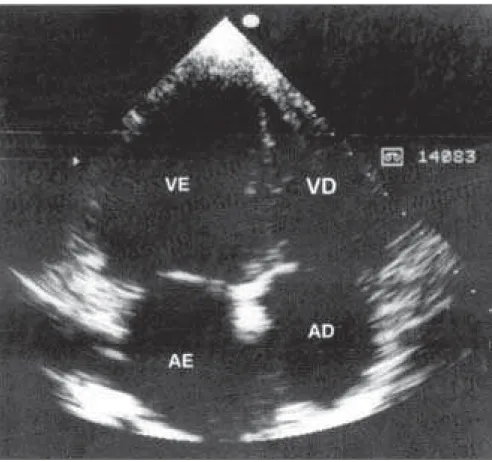
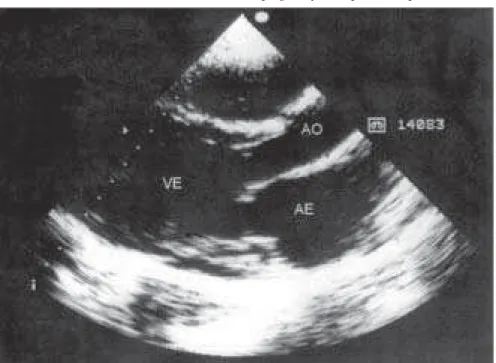
On admission she was dyspneic, pale (hemoglobin of 9.5 g/dl), with a hard non-tender liver edge palpable 20 cm below the costal margin, jugular distention and lower limb edema. On the chest X-ray there was a global cardiomegaly and pulmonary congestion. Echocardiography revealed a dilated myocardium with moderate mitral and tricuspid regurgitation (Figures 1, 2 and 3). She responded well to digoxin, diuretics and iron supplements, being discharged to prenatal care. She was again admitted in her 28th week for fetal evaluation due to the aged aspect of the placenta on ultrasound (grade III). She had weekly cardiotocography, Doppler and ultrasound examinations (all normal) and maintained chronic anemia (9 g/dl) with normal platelet counts. She had an episode of urinary infection that required a prolonged course of antibiotics. Spontaneous labor occurred at 40 weeks, and she underwent cesarean section due to fetal distress. Bleeding was normal and the postpartum period was uneventful, with the patient being discharged on the 5th day, still on digoxin and diuretics. T he newborn weighed 2580g, had normal Apgar scores (8 and 9) and was discharged with the mother.
The patient presented again when she was 30, in the 20th week of her second pregnancy, asymptomatic albeit using digoxin since the first
São Paulo M edical Journal - Revista Paulista de M edicina
9 1
pregnancy. She was pale (hemoglobin 7.5 g/ dl) and her liver was enlarged (15 cm below the costal margin) and non-tender. She was followed up as an outpatient throughout pregnancy and maintained platelet counts of between 120,000 and 180,000/mm3, with chronic anemia that did not require transfusion. Maternal ascites was detected on the 39th week during ultrasound and the fetus presented hydramnios and increased resistance of the umbilical artery. She underwent cesarean section and tubal ligation with no complications during or after surgery. The newborn weighed 3050g, had Apgar scores of 9 and 10 and did well until discharge with his mother on the 3rd postpartum day. Pathology reports on the placentas revealed single umbilical arteries in both pregnancies and no Gaucher cells.
○ ○ ○ ○ ○ ○ ○ ○ ○ ○ ○ ○ D ISC U SSIO N○ ○ ○ ○ ○ ○ ○ ○
Until 1 9 6 0 the few case reports of Gaucher’s disease in pregnancy suggested that these women tended to be sterile, had more miscarriages and neonatal deaths and were exposed to a greater risk of maternal death. Based on these papers and on the fear of transmission of the disease to their children, these patients were advised not get pregnant and offered therapeutic abortions and sterilization.1 In the following thirty years a series of publications presented good maternal and perinatal results, indicating that pregnancy did not exacerbate Gaucher’s disease.2
T he vast majority of pregnancies go well but occasionally, severe hemorrhagic complications may occur during labor and delivery due to thrombocytopenia. T hese complications are rare in patients undergoing splenectomy before pregnancy, but it is recommended that all women with Gaucher’s disease be carefully monitored (hemogram and coagulogram) during pregnancy. Chronic moderate normocytic anemia is frequent during pregnancy and is usually attributed to splenic sequestration of red blood cells or Gaucher’s cells involvement in bone marrow. Some3 recommend treatment of anemia and thrombocytopenia with steroids due to their myelogenic effect.
Hepatomegaly is a common finding during pregnancy and is presumably due to hepatic infiltration by Gaucher’s cells and ensuing fibrosis and compression of sinusoid vessels, which can also lead to portal hypertension and ascites, a sign that we observed in this patient’s 2nd pregnancy.
Myocardial infiltration by Gaucher’s cells can result in contractile impairment,
Figure 1. Two-dimensional echocardiogram in the 4-chamber view, showing general dilatation.
Figure 2. Echocardiogram showing mitral regurgitation.
São Paulo M edical Journal - Revista Paulista de M edicina
9 2
1. Teton JB, Treadwell NC. Gaucher’s disease in pregnancy. Am J
Obstet Gynecol 1957;74:1363-6.
2. Fasouliotis SJ, Ezra Y, Schenker JG. Gaucher’s disease and
pregnancy. Am J Perinatol 1998;15(5):311-8.
○ ○ ○ ○ ○ ○ ○ ○ ○ ○ ○ ○ ○ ○ ○ ○ ○ ○ ○ ○ ○ ○ ○ ○ ○ ○ ○ ○ ○ ○ ○ ○ ○ ○ ○ ○ ○ ○ ○ ○ ○ ○ ○ ○ ○ ○ ○ ○ ○ ○ ○ ○ ○ ○ ○ ○ R EFER EN C ES○ ○ ○ ○ ○ ○ ○ ○
3. Decker B, McWhorter LA. Gaucher’s disease and pregnancy:
two case reports, including observations on the effects of adrenal steroids. Ann Intern Med 1956;44:1219-30.
4. Platzker Y, Fisman E, Pines A, Kellerman JJ. Unusual echocardiographic
pattern in Gaucher’s disease. Cardiology 1985;72:144-6.
5. Elstein D, Grisrau SG, Rabinowitz R, Kanai R, Abrahamov A,
Zimran A. Use of enzyme replacement therapy for Gaucher’s disease during pregnancy. Am J Obstet Gynecol 1997;177:1509-12.
CONT EXTO: Descrita originalmente em 1882, a doença de Gaucher é a mais prevalente das doenças de depósito. Esta doença autos-sômica recessiva é causada por um defeito no gene que codifica a enzima beta-gluco-cerebrosidase, essencial na hidrólise de glucosilceramida em glicose e ceramida. O acúmulo da glucosilceramida dentro dos lisossomos das células do sistema retículo-endotelial produz um quadro clínico variá-vel caracterizado por déficit neurológico, hepatosplenomegalia, anomalias hemato-lógicas e lesões ósseas.
○ ○ ○ ○ ○ ○ ○ ○ ○ ○ ○ ○ ○ ○ ○ ○ ○ ○ ○ ○ ○ ○ ○ ○ ○ ○ ○ ○ ○ ○ ○ ○ ○ ○ ○ ○R ESU M O○ ○ ○ ○ ○ ○
M a ria Regina Torloni, M D, PhD. Dr. Mário de Mo raes Altenfeder Ho spital Maternity Scho o l (Maternity Scho o l o f Vila N o va Cacho eirinha), São Paulo , Braz il
Ká tia Fra nco, M D. Dr. Má rio d e Mo ra e s Alte nfe d e r Ho spital Maternity Scho o l (MaternityScho o l o f Vila N o va Cacho eirinha), São Paulo , Braz il
N elson Sa ss, M D, PhD. Dr. Mário de Mo raes Altenfeder Ho spital Maternity Scho o l (MaternityScho o l o f Vila N o va Cacho eirinha), São Paulo , Braz il
Sources of funding: N o ne
Conflict of interest: N o ne
Da te of first subm ission: 1 7 O cto ber 2 0 0 1
La st received: 4 January 2 0 0 2
Accepted: 1 5 February 2 0 0 2
Address for correspondence
Maria Reg ina To rlo ni
Maternidade Esco la de Vila N o va Cacho eirinha Av. Deputado Emílio Carlo s, 3 1 0 0
São Paulo / SP- Braz il - CEP 0 2 7 2 0 -2 0 0 Tel. (+5 5 1 1 ) 3 8 5 9 -4 1 2 2 , ext. 1 9 3 E-mail: g ineco lo g ia@ terra.co m.br
CO PYRIG HT© 2 0 0 2 , Asso ciação Paulista de Medicina ○ ○ Pu b l i sh i n g i n f o r m a t i o n○ ○ ○ ○ ○ ○ ○ ○ ○ ○ ○ ○ ○ ○ ○ ○ ○ ○
RELATO DO CASO: As duas gestações de uma paciente com doença de Gaucher são descritas. A gestante, assintomática desde sua esple-nectomia, apresentou insuficiência cardíaca por miocardiopatia no início de sua primeira gravi-dez, respondendo ao tratamento conservador. Apesar desta complicação, da anemia crônica, de hepatomegalia e ascite decorrente de hiper-tensão portal, a paciente evoluiu bem em duas gestações e o resultado perinatal foi bom. Não observamos complicações hemorrágicas. PALAVRAS CHAVE: Doença de Gaucher.
Gravi-dez. Miocardiopatia. Insuficiência cardíaca.
particularly of the left ventricle. O n reviewing national and international literature we found a few cases of heart
involvement in Gaucher’s disease in adults4 and were unable to find any cases related to pregnancy. Our patient responded to
con-ventional treatment with diuretics and di-gitalis, but remained chronically dependent on the medication. A new treatment option has emerged recently with enzyme repla-cement therapy using alglucerase and imi-glucerase, which are drugs obtained from placental extraction and recombinant DNA technology. T he effects on adults and chil-dren are promising, with regression of spleen and liver enlargement. Good results were observed in a study on a few patients (6 cases) treated with enzyme replacement therapy during pregnancy.5 Unfortunately, the high cost of these drugs limit their use in developing countries.
Using conservative symptomatic treat-ment we had good maternal and perinatal results in the two pregnancies of our patient with Gaucher’s disease. O ur results are in agreement with and confirm similar findings published in the literature over the last few decades. We have reported the first case of Gaucher’s disease with myocardial invol-vement in pregnancy. T he heart failure res-ponded well to conventional (digoxin and diuretics) treatment.
Figure 3. Echocardiogram showing outlet of left ventricle with dilated chambers.