31
Universidade de São PauloFaculdade de Saúde Pública
VO LU M E 31
N Ú M ERO 4
AGO STO 1997
Revista de Saúde Pública
J O
U
R
N
A
L
O
F
P
U
B
L
I
C
H
E
A
L
T
H
© Copyright Faculdade de Saúde Pública da USP. Proibida a reprodução mesmo que parcial sem a devida autorização do Editor Científico. Proibida a utilização de matérias para fins comerciais. All rights reserved.
DOYLE, Eva I., Factors affecting nutrition behavior among middle-class adolescents in urban area of Northen
region of Brazil. Rev. Saúde Pública, 31 (4): 342-50, 1997.
p. 342-50
Factors affecting nutrition behavior among
middle-class adolescents in urban area of
N orthern region of Brazil
Preferências nutricionais entre adolescentes da
classe média de M anaus, AM (Brazil)
Eva I. D oyle and Robert H . L. Feldman
Correspondence to: Eva I. Doyle - P.O. Box 425499. Denton, TX 76204-5499. E-mail: [email protected]
Received on 8.10.1996. Approved on 20.5.1997.
Factors affecting nutrition behavior among
middle-class adolescents in urban area of
N orthern region of Brazil
Preferências nutricionais entre adolescentes da
classe média de M anaus, AM (Brazil)
Eva I. D oyle and Robert H . L. Feldman
Department of H ealth Studies. Texas Woman’s U niversity. Denton, Texas (E.I.D.0.), Department of Health Education. U niversity of M aryland. USA (R.H .L.F.)
Abstract
Introduction Brazil has been called a nation in nutrition transitional because of recent increases in the prevalence of obesity and related chronic diseases. With overweight condi-tions already prevalent among middle-income populacondi-tions, there exists a need to identify factors that influence nutrition behavior within this group.
Objective To address this subject, a research study was implemented among middle-class adolescents attending a large private secondary school in Manaus, Amazonas, Brazil. The study determined the availability and accessibility of snack foods as well as subjects’ attitudes and preferences towards, and the influence of family and friends on healthy (high-nutrient density) snack choices.
Methods The 4-stage process included: (a) a nutrition expert focus group discussion that reported local nutrition problems in general and factors related to adolescent nutrition, (b) an adolescent pilot survey (n=63) that solicited information about snacking preferences and habits as well as resources for nutrition infor-mation and snack money; (c) a survey of various area food market sources to determine the availability and accessibility of high nutrient density snacks; and (d) a follow-up adolescent survey (n=55) that measured snack food preferences and perceptions about their cost and availability.
Results Results included the finding that, although affordable high nutrient density snacks were available, preferences for low nutrient density snacks prevailed. The adolescents were reportedly more likely to be influenced by and obtain nutrition information from family members than friends.
Conclusion From study results it is apparent that a focus on food availability will not auto-matically result in proper nutritional practices among adolescents. This fact and the parental influence detected are evidence of a need to involve adolescents and their parents in nutrition education campaigns to improve adolescent snack food choices.
Resumo
Introdução O Brasil tem sido considerado um País em transição nutricional em razão dos recentes aumentos na prevalência de obesidade e doenças crônicas na classe média, sendo importante identificar os fatores que influenciam as preferências nutricionais desse grupo. Foi realizado estudo com estudantes de classe média de um colégio secundário, particular, em Manaus, AM, Brasil. Com o objetivo de determinar a disponibilidade e a acessibilidade das merendas e analisar as atitudes e preferências dos estudantes e a influência de vários fatores na escolha de merendas nutritivas.
Métodos O estudo incluiu quatros fases: (a) discusão em um grupo de especialistas em nutrição sobre a disponibilidade e acessibilidade das merendas em Manaus; (b) inquérito junto a um grupo dos adolescentes (n=63) sobre suas preferências e hábitos nutricionais; (c) inquérito junto a supermercados selecionado para identificar a disponibilidade e acessibilidade das merendas preferidas; (d) um grupo acompanhado de uma subamostra dos adolescentes (n=55) para identificar a preferências e atitudes sobre o custo e disponibilidade das merendas.
Resultados Foi constatado que os estudantes possuíam condições financeiras para comprar merendas e que as merendas nutritivas não custam mais do que as não nutritivas. A preferência dos adolescentes foi por merendas não nutritivas. Os fatores que, principalmente, influenciam na escolha originam-se da família e da televisão.
Conclusão As implicações para futuras pesquisas e programas nutricionais são discutidos, recomendando-se campanha de educação nutricional para famílias, visto a importância desta na escolha de merendas entre esses adolescentes.
Nutrição do adolescente, fisiologia. Classe social. Preferências alimentares.
IN TRO D U CTIO N
Malnutrition has historically been a primary health risk factor in Brazil8, 14, 18. Efforts to alleviate
the problem have predominantly targeted low-in-come groups with government food production and supplement programs as well as employee and school lunch programs6, 8, 14, 17, 18. Yet, it was recently
noted that Brazil is “rapidly shifting from the prob-lem of dietary deficit to one of dietary excess”13.
Obesity is now prevalent among Brazil’s middle-income group and is rapidly increasing among the poor13, 20.
Monteiro et al.13 attribute this “nutrition
transiti-on” to economic and lifestyle shifts that have occurr-ed in Brazil over the last three decades. An increase in the 1980s of two-income families15 contributed to
an emerging Brazilian middle class, the group in which obesity is presently most prevalent13. Obesity
is also more prevalent among urban than rural popula-tions20, a phenomenon that is probably influenced by
differences in economic status. Yet income can no longer be considered the sole contributing factor in that the greatest increase in obesity over the past two decades was among low-income women13. And, at
high income levels, men were found to be at greater
risk of obesity than women and younger men experi-enced a more rapid increase than older men20. These
findings suggest that factors other than income also contribute to obesity.
The Brazilian transition pattern mimics that of other developing countries where improved govern-ment efforts toward education, food supplies, sani-tation and health services typically result in reduced infectious disease-related morbidity/mortality rates and increased proportions of deaths due to chronic diseases4, 16, 19, 21. Although infectious disease
preva-lence continues in Brazil; immunization, total life expectancy, and chronic diseases have significantly increased4, 19. Chronic disease increases are
com-monly associated with obesity, high-fat/low-fiber eat-ing patterns and sedentary lifestyles20, 21, 24 and, where
obesity is concerned, Brazil is no exception13. A call
has arisen for closer assessment of the factors lead-ing to overweight conditions13, 20. And, because the
condition is most prevalent among the middle class and begins among younger age cohorts9, 13, 20, 22, 23, 25
nutritional habits developed during childhood and adolescence are often carried into adulthood1, 22.
Youth-induced obesity is often related to adult-onset diseases7. Thus research involving this group may
be the best place to start.
Rev. Saúde Pública, 31 (4), 1997 343
A first step in developing nutrition intervention strategies that will halt the diet-obesity-chronic dis-ease pattern is to identify factors that influence eat-ing patterns among those at greatest potential risk, middle-class adolescents. A clear understanding of all factors that contribute to obesity requires a care-ful analysis of related attitudes, beliefs, and behav-iors prevalent in the targeted population; the avail-ability and accessibility of needed resources and in-formation; and the nature and extent of influence exerted by sociocultural, economic, political and physical environments11.
It has been found that teenagers habitually snack on the same high-fat snacks over time with little re-gard for health-related nutrient needs25. The primary
motivator in snack choices appears to be taste with high salt content serving as a major taste factor25.
Due to nurtitional needs for body development, nutri-tion experts do not generally recommend putting ado-lescents on low-fat, calorie-restricted diets25. In fact,
peer pressure about appearance and body size some-times motivates adolescents to self-restrict needed nutrients, a practice which can lead to negative health consequences2, 7, 9, 12. Thus, many nutrition educators
recommend that appropriate snacking, rather than caloric restriction be the focus of adolescent nutri-tion educanutri-tion25.
Two important nutritional components commonly lacking in the adolescent diet are fiber and calcium while an excess of sodium and saturated fat is com-monly evident7, 25. Therefore, an appropriate dietary
change would be to replace frequently preferred high-fat/high-sodium snacks (e.g., chips, candy, and sodas) with high-fiber (e.g., cut raw vegetables, fruit, and popcorn) and low-fat/high-calcium (e.g., low-fat fro-zen yogurts, milk and cheese) snack choices3, 7, 25.
While this replacement strategy appears to be simple, the challenge of nutrition education and di-etary change among adolescents is great. The pur-pose of this study was to identify factors that influ-ence food choices of middle-class adolescents for whom income was not a major barrier to nutrient intake. Study results provided guidelines for future nutrition education among potentially obesity-prone populations in Brazil.
M ATERIAL AN D M ETH O D
In societies where food is readily available, frequent intake of high-fat/low-fiber snacks is commonly associated with obesity. For this reason, methods used in this study were designed to determine the availability and accessibi-lity of snack foods as well as subjects’ attitudes and
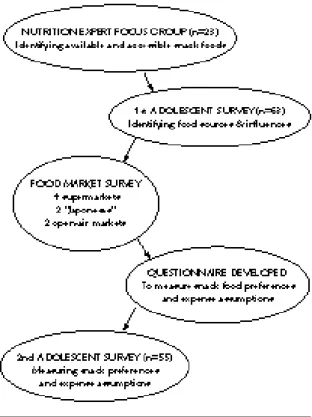
prefe-rences toward and the influence of family and friends on healthy (high-nutrient density) snack choices. Figure 1 il-lustrates the study procedures. The results of the nutrition expert focus group and the food market source compari-sons are described in the methods section as part of an ex-planation of the research process. Findings derived from the adolescent food sources and influences survey (N=63) and snack preferences and expense assumptions survey (N=55) are described within the results section.
Figure 1 - Study procedures.
The translation of all written research materials into Portuguese was tested utilizing the technique of back-translation5, 10. In this process one bilingual person
translated the researcher’s original English version of the material into Portuguese. A second translator, with no as-sistance from the original English version, then translated the resulting Portuguese version back into English. Dis-crepancies between the two English versions were dis-cussed and the process continued until cultural equiva-lency (equivaequiva-lency in meaning rather than words or phrases) was established.
Choosing a Sample Population
Rev. Saúde Pública, 31 (4), 1997 345
Factors affecting nutrition behavior among adolescents D oyle, E.I. & Feldman, R.H .L.
approximately 20% of students enrolled were able to pay full tuition and could be considered representative of higher income families. Another 20% were on full schol-arship indicating some economic need for financial sup-port. The remaining 60% were on various levels of partial loan and/or scholarship programs. School officials con-sidered all students enrolled as representatives of families for whom income would not be a major nutrition barrier. Verification of this perception as well as consideration of other factors regarding food availability and accessibility were in order. Methods related to the research of these factors are described below.
D etermining Food Availability and Accessibility
Nutrition Expert Focus Group
To determine the availability and accessibility of snack foods in the Manaus area, the researcher first met with members of the “Associação de Nutricionistas do Amazonas”, the state association of nutrition experts based in the city (Figure 1). Local nutrition problems in general and factors related to adolescent nutrition were discussed. The group explained that, because many food products were imported into Manaus from other regions, fluctuations in the shipping industry affected food cost (accessibility) and availability. It was suggested that find-ing readily available and affordable high nutrient den-sity snacks in Manaus would be a challenge. A list of such items was generated and market sources identified. Three common Manaus food sources were named: large in-door supermarkets, open-air fruit and vegetable mar-kets, and small neighborhood grocery outlets commonly referred to as “Japonesas”. It was clearly evident that close scrutiny of the targeted adolescent group’s com-mon food sources and the availability and accessibility of food snacks from those sources would be critical to understanding adolescents’ snacking preferences and the beliefs that influenced them.
First Adolescent Survey (N=63): Snack Food Sources and Influences
The next step was to identify specific snack food sources common to the targeted adolescent group. Information about their snacking habits and who influenced them was also needed. To accomplish this, a survey of 63 eleventh grad-ers enrolled in the targeted school was implemented. The students were first asked to respond individually to a writ-ten survey that asked: (a) what were their most favorite and frequently chosen snacks and beverages; (b) under what circumstances and with whom did they snack most often; and (c) what/who was the source of most of their nutri-tion-related information and money for snacks.
In the first section of the survey, the students were asked to list their favorite and most frequently consumed snack foods and beverages. The availability and accessibi-lity of these items from designated food sources would be the subject of further study. The second section of the
written survey contained 7 items measuring the students’ perceptions of snacking-related influence from selected individuals and groups (see Table 1 for items). In this section, the respondent was asked to complete each state-ment (e.g., “When it comes to influencing my snack food choices, my mother is:”) by circling one of three pos-sible statement endings (not important, important, very important).
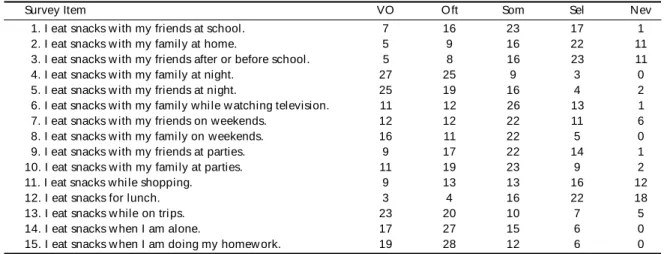
In the third section of the survey, 15 items identified where, when and with whom the students most often snacked (see Table 2). For each item, a statement was provided (e.g., “I eat snacks with my friends at school.”) and the respondent was asked to circle one of five pos-sible response choices (very often, often, sometimes, seldom or never).
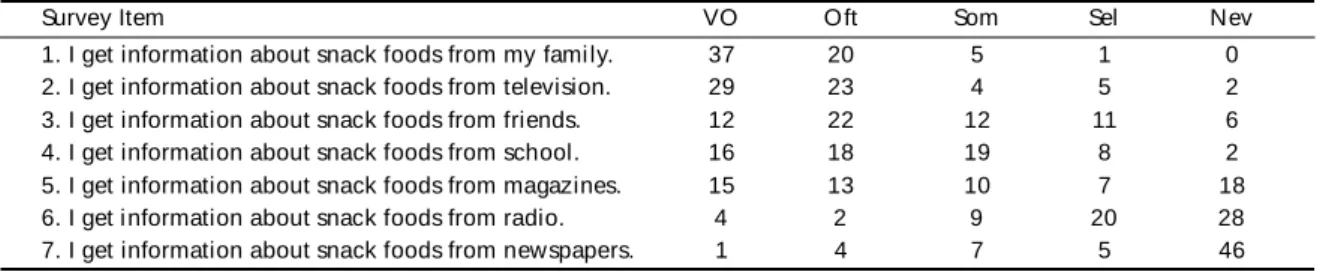
Six survey items (see Table 3) helped identify com-mon sources of snacking information. As with the previ-ous survey section, statements were provided (e.g., “I get information about snack foods from my family.”) for which one of five response choices was possible (very often, of-ten, sometimes, seldom or never).
Three survey items asked respondents to indicate how frequently they had money to buy snacks and how fre-quently they and their parents paid for their snacks. Those items included the statements “I have money to buy snacks.”, “My snack money comes from my parents.” and “I use my own money to buy snacks.”. Each statement was followed by the response choices of “very often, of-ten, some times, seldom and never”. Following comple-tion of the survey, the researcher involved respondents in open discussion about their snacking habits and sources of information for further clarification of common snack food sources. The next research step would involve a closer look at these sources and what they offered.
Food M arket Comparison
A random selection of four Manaus supermarkets, two open-air fruit and vegetable markets and two Japo-nesas were visited within a one-week period to note avail-able high- and low-density food snacks. Because the adolescents indicated that the bulk of food shopping occurred in supermarkets, a greater number of these were included in the study.
Second Adolescent Survey (n=55): Snack Preferences and Expense Assumptions
A 44-item snack food preference scale (Cronbach al-pha=.84) was administered to a different subsample of adolescents (n=55) enrolled in the targeted school. Scale content was based upon previously described results from the nutrition expert focus group, 63-student survey and food market comparison. In each of the 44 items, a high and a low nutrient density food snack were paired with equivalencies considered regarding price (accessibility), availability and, where possible, snack type (e.g., packag-ing, flavor, need for refrigeration, large versus small-bite pieces). In each item, the respondent was asked to state a preference for either the high or low density food snack or mark a neutral response (“I like them both the same.”). Fully-written responses were used in the 3-point mul-tiple choice scale to facilitate ease of comprehension. To avoid possible response order bias, half of the items (ran-domly selected) presented the food choice of high nutri-ent density first (response ‘a’). For these items, the food choice of low nutrient density was response ‘c’. Response ‘b’ contained a neutral response for all items. An example follows:
I like:
(a) bananas better than banana cream cookies. (b) them both the same.
(c) banana cream cookies better than bananas
In the remaining half of scale items the order was re-versed so that response ‘a’ presented the low nutrient den-sity food choice, ‘b’ the neutral response, and ‘c’ the high nutrient density food choice:
I like:
(a) soft drinks better than natural fruit juices. (b) them both the same.
(c) natural fruit juices better than soft drinks.
Items were placed in random order so that no more than three items with the same response format (e.g. high nutrient density choice first) appeared consecutively. When the scale was complete and a culturally equivalent trans-lation developed, a second version with the same food pairings was created but with response choice orders for each item reversed (i.e., items that listed the high-nutrient density item first now listed the low nutrient density item first and vice versa). Other samples of the 44 food pair-ings include milk and coffee, apples and candy bars, or-ange soda and oror-ange juice, frozen yogurt and ice cream, carrot sticks and french fries.
On the 44-item snack food preference scale, each res-pondent was assigned 2 points for each item in which the high nutrient density food choice preference was selected and 1 point for each “I like them both the same” response. (This neutral response scoring decision was based on the assumption that an equal liking of the two choices ren-dered a high nutrient density choice more likely than did a clear preference for the low nutrient density snack.) Zero
points were awarded for a low nutrient density preference. The possible response score range was 0-88 with a score of 0-28 representing a low score (low nutrient density pref-erence), 29-57 representing a medium score, and 58-88 a high score (high nutrient density preference).
Assumptions about Expense
The previous discussion with the pilot survey of 63 adolescents revealed that assumptions about snack food costs could strongly affect snack food choices in an envi-ronment where imported foods sometimes affected avail-ability and accessibility. One concern was that mistaken assumptions about snack food prices could affect snack food preferences. For this reason, a second 20-item ex-pense assumption scale (Cronbach alpha=.80) was devel-oped to accompany the 44-item snack food preference scale. This second scale measured beliefs about cost equivalency among randomly selected high- and low- den-sity snack food pairings used in the 44-item snack food preference scale. For each item, the respondent was asked to indicate whether he/she believed the high nutrient den-sity snack food was more expensive than the low nutrient density snack food, the reverse was true, or they cost about the same (e.g., I think that: (a) frozen yogurt is more ex-pensive than ice cream, (b) ice cream is are more expen-sive than frozen yogurt, (c) they cost about the same.)
Because all pairings were deemed in previous research to be comparably priced, the only correct answer for each item was “(c) they cost about the same”. However, a greater barrier to appropriate snack choices would exist if the mistaken assumption about price differences deemed high nutrient density snacks to be more expensive. Thus, care-ful scrutiny of the direction of mistaken assumptions would also be important.
RESU LTS
As described above, the study methods involved a 4-step process (nutrition expert focus group, adoles-cent snack food sources and influences survey, food source comparison survey, adolescent attitude and food preference survey). The results of the nutrition expert focus group and the food market source com-parisons were described in the methods section as part of an explanation of the research process. Des-cribed here are the results of the two adolescent sur-veys used to identify sources and influences (first survey, N=63) and snack preferences and expense assumptions (second survey, N=55).
Snack Sources and Influences Survey Results
Rev. Saúde Pública, 31 (4), 1997 347
Factors affecting nutrition behavior among adolescents D oyle, E.I. & Feldman, R.H .L.
nutrient density snack listed was fruit. Every res-pondent named soft drinks as a favorite beverage and a large percentage listed “sucos”, fruit juices com-monly mixed with large amounts of sugar.
Table 1 contains response frequencies regarding the level of influence the adolescents believed to be exerted upon their snacking choices by various peo-ple. Responses indicated that mothers in particular (very important + important=78%) family members in general (65%) and fathers (64%) exerted a greater degree of influence upon student food snack choices than other individuals and groups. Friends in gen-eral (37%) and best friends (35%) were the second most influential. Nutrition teachers (13%) and teach-ers in general (8%) were deemed the least influen-tial regarding snack food choices.
As indicated in Table 2, respondents reported snacking most frequently at night, when doing home-work, and while traveling. Although 44% reportedly snacked with their friends at night, responses indi-cated a greater tendency to snack with family (at night, while at parties, on weekends and while watch-ing T.V.) than with friends. The two most commonly
Figure 2 - Preferred snacks/drinks: percentage of frequencies (n=63).
Table 2 - Snacking habi ts: frequency of where, when and with whom they snack (N=63).*
Survey Item VO Oft Som Sel Nev
1. I eat snacks w ith my friends at school. 7 16 23 17 1
2. I eat snacks w ith my famil y at home. 5 9 16 22 11
3. I eat snacks w ith my friends after or before school. 5 8 16 23 11
4. I eat snacks w ith my fami ly at night. 27 25 9 3 0
5. I eat snacks w ith my friends at night. 25 19 16 4 2
6. I eat snacks wi th my famil y whi le w atching television. 11 12 26 13 1
7. I eat snacks w ith my friends on weekends. 12 12 22 11 6
8. I eat snacks w ith my fami ly on weekends. 16 11 22 5 0
9. I eat snacks w ith my friends at parties. 9 17 22 14 1
10. I eat snacks w ith my fami ly at parties. 11 19 23 9 2
11. I eat snacks whi le shopping. 9 13 13 16 12
12. I eat snacks for lunch. 3 4 16 22 18
13. I eat snacks w hile on tri ps. 23 20 10 7 5
14. I eat snacks w hen I am alone. 17 27 15 6 0
15. I eat snacks w hen I am doing my homew ork. 19 28 12 6 0
* VO: Very Often, Oft: Often, Som: Some times, Sel: Seldom, N ev: N ever
Table 1 - Snacking habi ts: importance of i nfluencers for snack choi ces (N =63).*
Survey Item VI Imp NI
1. When it comes to infi uencing my snack food choices, 40 9 14
my mother is:.
2. When it comes to infi uencing my snack food choices, 32 9 22
my family i n general is:.
3. When it comes to infl uencing my snack food choices, 30 10 23
my father i s:.
4. When it comes to infl uencing my snack food choices, 8 15 40
my friends in general are:
5. When it comes to infl uencing my snack food choices, 5 17 41
my best friend is:.
6. When it comes to infl uencing my snack food choices, 0 8 55
my teachers in general are:
7. When it comes to infl uencing my snack food choices, 3 2 58
my nutri tion teachers are:
cited sources for nutrition information (Table 3) were family (very often or often for 91% of respondents) and television (83%). Friends (54%), school (54%) and magazines (44%) were also named. Radio (10%) and newspapers (8%) appeared to be the least com-mon source for nutrition information. Responses indi-cated that 82% often or very often had money avail-able to buy snacks. Snacks were more commonly bought by the students’ parents (100% said often or very often) than by the students themselves (45% sometimes, 10% seldom, 45% never).
In the focus group discussion conducted follow-ing survey completion, the adolescents’ oral respon-ses supported written answers in that parents and family were named as the primary sources of snack-ing information, buyers of snacks, and influencers of student snacking choices. The students named the same three food snack sources (supermarkets, open-air fruit and vegetable markets, and local “Japone-sas”) as did members of the nutrition expert group. When asked to identify the source most frequently shopped, students agreed that all three were consis-tently used but the large super markets provided the greatest bulk of food snack purchases.
Snack Preferences and Expense Assumptions: Survey Results
On the 44-item snack preference scale the group’s (N=55) mean score was 50.0 (sd=9.46), a score that fell within the medium score range (n=45). No individual respondent scored within the low score range that would have indicated a gen-eral preference for low nutrient density snacks. Only 10 respondents scored in the high score range that indicated a general preference for the high nutrient density snack choices.
No statistically significant associations were found between assumed expense and snack preference. It was noted, however, that respondents were most likely to deem the high nutrient density choices more expen-sive (56% of total responses), somewhat likely to
be-lieve the low-nutrient density snacks cost more (32%) and least likely to assume that paired high and low nutrient density snacks were cost equivalent (12%).
D ISCU SSIO N
The school administrator’s perceptions regard-ing the students’ financial abilities were confirmed in the pilot study. As predicted, respondents indicated that money to buy snacks was frequently available from their parents, their primary monetary source. In addition, despite perceptions to the contrary among nutritionists and students, high nutrient-density snacks, comparably priced to popular low-nutrient density snacks, were available in the area.
Misperceptions among professionals could serve as critical barriers to nutrition program policies and educational content and, among the adolescents, would weaken motivation to seek high nutrient-density snack choices. For these reasons, nutrition education efforts should begin with a survey of avail-able and accessible foods followed by efforts to edu-cate the public about their low-cost existence.
The adolescents indicated that their families were their primary sources of nutrition information and mothers in particular had the greatest influence upon their snack choices. This would seem logical because the subjects were more likely to snack at home with the family than elsewhere with friends, and because parents were named as the primary source for snack money. These findings suggest that adolescent nutri-tion educanutri-tion programs would probably be more effective with an added educational component that targets parents.
In the first adolescent survey, respondents tasted their favorites snacks and beverages. Of the five snacks most frequently listed, only one (fruit) would be considered a low-fat/high fiber high nutri-ent-density snack. And, while almost a third of res-pondents (29%) listed, bottled mineral water as one of their favorites, the overwhelming majority showed a clear preference for carbonated soft drinks (100%)
Table 3 - Sources for nutrition informati on (N=63)*
Survey Item VO Oft Som Sel Nev
1. I get information about snack foods from my fami ly. 37 20 5 1 0
2. I get information about snack foods from television. 29 23 4 5 2
3. I get information about snack foods from friends. 12 22 12 11 6
4. I get information about snack foods from school. 16 18 19 8 2
5. I get information about snack foods from magazines. 15 13 10 7 18
6. I get i nformation about snack foods from radio. 4 2 9 20 28
7. I get information about snack foods from newspapers. 1 4 7 5 46
Rev. Saúde Pública, 31 (4), 1997 349
Factors affecting nutrition behavior among adolescents D oyle, E.I. & Feldman, R.H .L.
and fruit juices with high-sugar content (89%). This preference for low nutrient-density snacks was mirrored in the second study and emphasizes a need for innovative, appealing approaches to introducing high-nutrient density snacks.
An additional study finding was the emergence of procedures that may be critical to ongoing research regarding nutrition behavior. As the study progressed, it became evident that perceptions as well as real food costs exert equally critical influences upon nutrition behavior. Thus, education efforts that address these perceptions may be an important component of effec-tive nutrition intervention programs. Secondly, this study suggests that it is unwise to assume that peer pressure is the most powerful predictor of adoles-cent behavior. Close scrutiny of the strengths of fam-ily and peer persuasion should be an integral part of any study that seeks to measure adolescent decision-making and its antecedents.
From study results one can conclude, that, all other things being equal, this Brazilian adolescent group is just as likely to choose a low as a high nu-trient density snack food. This supports the argument that providing adequate income alone will not nec-essarily result in proper nutritional practices8. Other
behavior-influencing factors should be addressed when designing nutrition education programs.
The study also demonstrates a need for prelimi-nary assessment activities prior to the design and im-plementation of a nutrition education intervention. These efforts should identify locally available low-cost, high nutrient-density snack alternatives and the psychosocial factors that influence the use of these snacks (e.g., perceptions about cost/availability, influ-ences from family/friends). Subsequent nutrition edu-cation programs should then be tailored to introduce available high-nutrient density snacks in an attractive,
appealing manner. Further research is needed to de-termine factors that affect snack choice appeal. Some suggestions include exploring the impact of taste, packaging and ease of use as well as potential ben-efits related to energy potential, weight management and other health-related factors. Influential factors verified through research could then be applied to ad-vertising available high-nutrient density snacks through school poster campaigns, snack coupon distri-butions and taste-test events.
It may also be concluded from this study that in-fluences upon adolescent snacking behavior may dif-fer from some other aspects of adolescent behavior in that parents appear to exert greater influence than peers upon food snack preferences and are more likely to serve as a nutrition information source than peers or teachers. This suggests a need to involve parents and families in nutrition education campaigns rather than only target individual students in the secondary school classroom. The efficacy of various inclusion methods must first be verified through research. However, pos-sibilities include the creation of a health-related news-letter sent home to parents that contains nutrition edu-cation information; the offer of free evening classes for parents interested in learning about healthy meal planning, bargain shopping, cooking and weight man-agement; the creation of a weight management sup-port group for parents that includes proper weight loss strategies, nutrition education and how to help fami-lies maintain a nutritionally balanced diet.
These findings do not diminish the need to con-sider income when developing nutrition interventions. It does, however, provide guidelines for nutrition edu-cation and research that go beyond financial consid-erations. And, in doing so, it provides one further step towards the critical effort needed to reduce the on-slaught of obesity-related chronic disease in Brazil.
REFEREN CES
1. ALLENSWORTH, D. Cardiovascular objectives for youth in Health People 2000: update on the status of risk factors. J.
Health Educ., 27:S24-S26, 1996.
2. ALLEN, K M.; THOMBS, D. L. ;MAHONEY, C. A.; DANIEL, E. L. Relationships between expectancies and adolescent dieting behaviors. J. Sch. Health, 63:176-81, 1993.
3. Are you eating right? Con. Rep. Health, Oct:644-55, 1992.
4. ARRENDONDO, A.; LOCKETT, L. Y.; DE ICAZA, E. Cost of diseases in Brazil: breast cancer, enteritis, cardiac valve disease and bronchopneumonia. Rev. Saúde Pública, 29:349-54, 1995.
5. BRISLIN, R. W. The wording and translation of research instruments. In: field methods in cross-cultural research. Beverly Hills, Sage Publications, 1986. p.137-64.
6. CAMPINO, A. C. The feasibility of a food-coupon programme in Brazil. Food & Nutr. Bull.,13:210-19, 1991.
7. CENTERS FOR DISEASE CONTROL AND PREVEN-TION. Guidelines for school health programs to promote lifelong healthy eating. J. Sch. Health, 67:9-26, 1997.
8. DALL’ACQUA, F. M. Economic adjustment and nutrition policies: evaluation of a school-lunch programme in Brazil.
9. FELTS, M.; TAVASSO, D.; CHENIER, T.; DUNN, P. Adolescents’ perceptions of relative weight and self-reported weight loss activities. J. Sch. Health, 62:372-5, 1992.
10. FELDMAN, R. H. L. & HOLLANDER, R. B. Issues in cross-cultural and international health education research.
Health Educ., 14:11-15, 1983.
11. GREEN, L. W. & KREUTER, M. W. Health promotion
planning: an education and environmental approach. 2nd
ed. Mountain View, Mayfield Publishing Company, 1991.
12. GUINN, B.; SEMPER. T.; JOURENSEN, L.; SKAGGS, S. Body image perception in female Mexican-American adolescents. J. Sch. Health, 67:112-5, 1997.
13. MONTEIRO, C. A.; MONDINI, L.; MEDEIROS DE SOUZA, A. L.; POPKIN, B. M. The nutrition transition in
Brazil. Eur. J. Clin. Nutr., 49:105-13, 1995.
14. MUSGROVE, P. Do nutrition programs make a difference: the case of Brazil. Int. J. Health Serv., 20:691-715, 1990.
15. OMETTO, A. M. H.; FURTUOSO, M. C. O.; VIEIRA DA SILVA, M. Economia brasileira na década oitenta e seus reflexos nas condições de vida da população. Rev. Saúde
Pública, 29:403-14, 1995.
16. POPKIN, B. M.; KEYOU, G.; ZHAI, F.; GUO, X.; MA, H.; ZOHOORI, N. The nutrition transition in China: a cross-section analysis. Eur. J. Clin. Nutr., 47:333-46, 1993.
17. SAMPAIO, Y. PROAB - a food-price subsidy programme in low-income urban areas of Recife, Brazil: It’s impact on
food consumption, nutrition status, and low birth weight.
Food Nutr. Bull., 13:220-9, 1991.
18. SAMPAIO, Y. & CAMPINO, A. C. Food and nutrition interventions in Brazil Food Nutr. Bull., 13:190-201, 1991.
19. SHAH, V. P. Trends in health, nutrition, and socieconomic status in Nigeria, India, and Brazil (1960-1990). J. Trop.
Ped., 39:118-27, 1993.
20. SICHIERI, R.; COITINHO, D. C.; LEAO, M. M.; RECINE, E.; EVERHART, J. E. High temporal, geographic and income variation in body mass index among adults in Brazil. Amer. J. Public Health, 84:793-8, 1994.
21. STAMLER, J. Epidemic obesity in the United States. Arch.
Intern. Med., 153:1040-4, 1993.
22. STOLLEY, M. R; FITZGIBBON, M. L. Effects of an obesity prevention program on the eating behavior of African-American mothers and daughters. J. Health Educ.
Behav. 24:152-64, 1997.
23. TAUBERT, K A.; MOLLER, J. H.; WASHINGTON, R L. The current status of children’s cardiovascular health. J.
Health Educ., 27:S12-S23, 1996.
24. US-Department of Health and Human Services (DHHS).
Surgeon general’s report on nutrition and health.
Washing-ton, DC Public Health Service, 1988.
25. WEINSTOCK, C. P. The ‘grazing’ of America: a guide to
health snacking. Rockville, Food and Drug Administration,