Risk management in providing specialized care for people living with AIDS
* Extracted from the thesis “Coordenação do cuidado às pessoas vivendo com HIV/aids: desaios no contexto da assistência ambulatorial especializada”, Universidade Federal da Paraíba, 2015.
1 Universidade Federal da Paraíba,
Programa de Pós-Graduação em Enfermagem, João Pessoa, PB, Brazil.
2 Faculdade Brasileira de Ensino, Pesquisa
e Extensão, João Pessoa, PB, Brazil.
3 Universidade Federal da Paraíba,
João Pessoa, PB, Brazil.
4 Universidade de São Paulo, Escola de
Enfermagem de Ribeirão Preto, Departamento de Enfermagem Materno Infantil e Saúde Pública, Ribeirão Preto, SP, Brazil.
5 Universidade Federal da Paraíba, Departamento
de Enfermagem Clinica, João Pessoa, PB, Brazil.
Received: 06/03/2016 Approved: 08/17/2016
ORIGINAL ARTICLE DOI: http://dx.doi.org/10.1590/S0080-623420160000600018
Corresponding author:
Oriana Deyze Correia Paiva Leadebal Universidade Federal da Paraíba Cidade Universitária
CEP 58051-900 – João Pessoa, PB, Brazil [email protected]
ABSTRACT
Objective: Analyzing the provision of actions related to managing clinical risk in managing specialized care for people living with AIDS. Method: A cross-sectional study carried out in a reference outpatient clinic in Paraíba, with a sample of 150 adults with AIDS. Data were collected through primary and secondary sources using a structured questionnaire, analyzed using descriptive statistics, multiple correspondence analysis and logistic regression model to determine the association between “providing care” and “clinical risk.” Results: Actions with satisfactory provision express a biological care focus; the dimensions that most contributed to a satisfactory assessment of care provision were “clinical and laboratory evaluations” and “prevention and self-care incentivization”; 45.3% of participants were categorized into high clinical risk, 34% into average clinical risk, and 20.7% into low clinical risk; a positive association between providing care and clinical risk was found. Conclusion: he need to use risk classiication technologies to direct the planning of local care provision became evident considering its requirements, and thus qualifying the care provided in these areas.
DESCRIPTORS
Acquired Immunodeiciency Syndrome; Ambulatory Care; Chronic Disease; Risk Factors; Secondary Prevention; Public Health Nursing.
Risk management in providing specialized
care for people living with AIDS*
Manejo de risco na gestão do cuidado especializado a pessoas vivendo com aids
Manejo del riesgo en la gestión del cuidado especializado a personas viviendo con sida
Oriana Deyze Correia Paiva Leadebal1, Leidyanny Barbosa de Medeiros1, Kalline Silva de Morais2, João Agnaldo do
Nascimento3, Aline Aparecida Monroe4, Jordana de Almeida Nogueira5
How to cite this article:
Leadebal ODCP, Medeiros LB, Morais KS, Nascimento JA, Monroe AA, Nogueira JA
INTRODUCTION
AIDS, due to its speciic biological characteristics and its biopsychosocial implications inherent to living with the infec-tion/illness/treatment, generates various health care demands whose resolutions require multidisciplinary care at diferent network services. hese demands require care planning actions based on responsive care models to its chronicity(1-2).
Since the implementation of Antiretroviral therapy (ART), global evidence on variations in mortality patterns associated to its aggravation gave prominence to some comorbidities with the potential capability to generate losses in the survival of people undergoing treatment(3-5).
Furthermore, although the underlying mechanisms are not precisely understood, the pathogenic potential of HIV to increase the risk of diseases not associated with immuno-suppression is assumed(6). hese aspects corroborate the
relevance of the preventive approach of undesirable clinical outcomes in caring for infected people and undergoing spe-ciic treatment, so that there is proper management of in-fection in order to improve the health status, quality of life, and to reduce the mortality associated with HIV/AIDS(7).
In addition to the phenomena described, the targets es-tablished worldwide toward infection control over the next two decades(8) require eforts in the care management area,
in addition to drug therapy. In the context of specialized care, actions aimed at identiication and intervention of vulnerabilities are necessary; vulnerabilities to conditions which result in clinical instability and acute exacerbations triggered by viral pathogenesis, and also toxic efects of medications which have potential to compromise the clini-cal condition of the people undergoing treatment(9).
hus, it is clear that on the list of actions for managing in-fection, the investigation of the severity of HIV/AIDS should not only consider the clinical complexity of the disease itself and its repercussion on the person's quality of life, but also the risks of occurring events which can induce exacerbation(1). Such
risks in this study are considered "clinical risks," with the po-tential to inluence the planning of care provision actions and the mobilization of resources and more efective technologies.
Care management logic(10) based on risk stratiication
en-ables organized measurement of actions and resources (clini-cal, human, inancial) according to unique and diferentiated patterns. hus, for lower risk chronic conditions, supported self-care technologies would be employed with a focus on pri-mary care services, while higher risk conditions would require a greater concentration of specialized care(1).
Among the programmatic factors associated with manag-ing the risk of morbid events, the followmanag-ing can be highlight-ed: access to information, resources and technologies for the prevention/early diagnosis/treatment of opportunistic infec-tions; access to tests and antiretroviral drugs/therapy (ART); addressing the biopsychosocial repercussions of diagnosis/ illness/treatment; and strengthening social support networks aimed at improving the quality of life for people under super-vision/undergoing treatment(2,11).
herefore, this study aimed to analyze the provision of actions related to clinical risk management in providing spe-cialized care for people living with AIDS.
he study is justiied by the importance of the care
provided in Specialized Healthcare Services (SHS) for identi-ication and early intervention of the risk of unwanted clinical outcomes (clinical risk) with the potential to compromise the quality of life of people infected and undergoing ART treat-ment. his study is also anchored in the potential for classify-ing risk as an organizational element for providclassify-ing care and as a guiding element for care management(1).
METHOD
A cross-sectional investigative study developed from July 2011 to July 2012 at a specialized outpatient facility for care of people living with HIV/AIDS (PLWHA), integrated into a reference unit in Paraiba for the treatment of infectious and parasitic diseases located in João Pessoa/Brazil. his unit has infrastructure for outpatient clinical care and inpatient beds and an intensive care unit.
he study population consisted of 1,260 people over the age of 18 years, living/residing in the state, and reported be-tween 1980 and 2011 in the Notiiable Diseases Information System (SINAN). Using a sample calculation for inite popu-lations, 5% signiicance level, sampling error (d) of 0.08, 95% conidence level, P equal to 0.50, expression n = Z2.p.q.N/
d2(N – 1) + Z2.p.q, and correction for a potential loss of 10%,
the sample size was determined as being 150 users of the SHS. Inclusion criteria considered for the sample was the use of ART for more than 6 months, and as exclusion criteria being under the age of 18, being pregnant or in a situation of liberty deprivation due to speciicities of the clinical management of these populations and organization of the local care network. In order to ensure that users of the service participated in the study, thus avoiding information bias, sampling acces-sibility was used with recruitment of participants occurring during routine consultations at the clinic. Data collection was initiated after clariication regarding the research and Clear and Informed Consent Forms were signed, primarily through structured interviews and subsequent consulting of patient re-cords to obtain clinical data.
In order to achieve the objectives proposed by the study, the structured questionnaire included sociodemographic and clinical variables (T-CD4 positive/CD8 positive lymphocyte count and quantiication of viral load), with the possibility of dichotomous or multiple answers, as well as variables for evaluating the provision of care, conceptually supported in the dimension of available services(12). For the latter, there were
possibilities of Likert interval responses with values between 1 and 5, ascendingly representing the condition of agreement with the statements.
he instrument was initially used in a pilot study with 10 participants, submitted to content validation by a group of Operational Studies in HIV/AIDS of the Escola de Enfermagem de Ribeirão Preto, and reliability analysis using Cronbach alpha coeicient (= 0.789), whose value allowed us to airm its internal consistency. It was also found that the removal of each item composing the instrument did not strongly alter the value of this measure, displaying a balanced contribution of each variable in its structuring.
Risk management in providing specialized care for people living with AIDS
diseases, quantity of chronic diseases and quantity of clinical manifestations. he allocation of these indicators considered the respective laboratory parameters and clinical predictors of prognosis, response to ART, magnitude of major opportunis-tic conditions and clinical complications(11). Lower values (1)
were assigned to positive parameters, while higher values (3) were assigned to negative parameters. Next, the categorized risk variable (sum of the ive variable indicators) was calcu-lated, with values ranging from 5 to 14, considering 5 = lower risk, 6 = medium risk, and high risk was > 6.
Data were analyzed using Statistica software 9.0 from STATSOFT, adopting 5% conidence levels for all proce-dures. Descriptive statistics presenting frequency were used to sociodemographically characterize the participants.
For analyzing care provision we considered the participant’s satisfaction for each variable that was expressed on a scale of 1 to 5, where average values of satisfaction were veriied. hese variables were then categorized into ive dimensions according to content similarity. For the set of variables for each dimension, the sum score of all the answers from all the participants was determined, making a raw satisfaction score, which was trans-formed into percentage (scale from 0 to 100) using the equa-tion: score % = (score – minimum score) x 100/ (maximum score – minimum score), and used to resolve possible biases arising from diferences in the variable composition of each dimension. Next, average percentage of user satisfaction, their standard de-viations and conidence intervals at 95% were calculated.
In order to explain the inluence of the care provision dimensions (independent variables) on the determination of provision scores (dichotomized dependent variable), logistic regression was used, in which the general test for invalida-tion of the parameters presented desirable p-value (< 0.05) for its application and R2 Nagelkerke (= 0.98) very close to 1.
he Hosmer-Lemeshow test (p-value> 0.05) accepted the hypothesis of adequacy of the data to the model, reaching 99.9% success in the classiication matrix.
Correlation analysis was also used to explain the associa-tion between provision scores (independent variable) and cat-egorized clinical risk (dependent variable), which presented greater explanatory power in dimension 1 (it presented 92.1% of total inertia, which was 100%).
his is part of a study approved in October 2010 by the Ethics Committee of the Universidade Federal da Paraíba – UFPB, protocol No. 612/10.
RESULTS
he socio-demographic proile of the participants showed a predominance of males (58.0%), aged 40-59 years (48.7%), brown color (58.7%), single (54.7%), heterosexual (68.5%), with primary education levels (53.3%), retired and pensioners (42.0%), living in their own home (62.0%).
Regarding the clinical risk classiication, 45.3% (68) of the users were included in the category of high risk (> 6); 34% (68) in the average risk category (risk = 6); and 20.7% (31) in the low risk category (risk = 5).
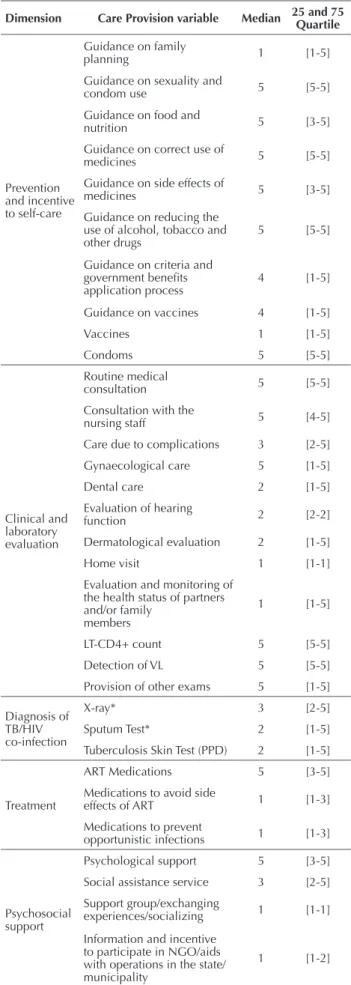
For analysis of care provision related to risk management, the variables were categorized into ive dimensions according to median values of the satisfaction scale (Table 1).
In the dimension Prevention and incentive to self-care,
Table 1 – Dimensions of care provision according to the catego-rization of variables – Paraíba, Brazil, 2012.
Dimension Care Provision variable Median 25 and 75 Quartile
Prevention and incentive to self-care
Guidance on family
planning 1 [1-5] Guidance on sexuality and
condom use 5 [5-5] Guidance on food and
nutrition 5 [3-5] Guidance on correct use of
medicines 5 [5-5] Guidance on side effects of
medicines 5 [3-5] Guidance on reducing the
use of alcohol, tobacco and
other drugs 5 [5-5] Guidance on criteria and
government beneits
application process 4 [1-5] Guidance on vaccines 4 [1-5] Vaccines 1 [1-5] Condoms 5 [5-5]
Clinical and laboratory evaluation
Routine medical
consultation 5 [5-5] Consultation with the
nursing staff 5 [4-5] Care due to complications 3 [2-5] Gynaecological care 5 [1-5] Dental care 2 [1-5] Evaluation of hearing
function 2 [2-2] Dermatological evaluation 2 [1-5] Home visit 1 [1-1] Evaluation and monitoring of
the health status of partners and/or family
members
1 [1-5]
LT-CD4+ count 5 [5-5] Detection of VL 5 [5-5] Provision of other exams 5 [1-5] Diagnosis of
TB/HIV co-infection
X-ray* 3 [2-5] Sputum Test* 2 [1-5] Tuberculosis Skin Test (PPD) 2 [1-5]
Treatment
ART Medications 5 [3-5] Medications to avoid side
effects of ART 1 [1-3] Medications to prevent
opportunistic infections 1 [1-3]
Psychosocial support
Psychological support 5 [3-5] Social assistance service 3 [2-5] Support group/exchanging
experiences/socializing 1 [1-1] Information and incentive
to participate in NGO/aids with operations in the state/ municipality
1 [1-2]
Leadebal ODCP, Medeiros LB, Morais KS, Nascimento JA, Monroe AA, Nogueira JA
Table 2 – Mean percentages value, standard deviation and confi-dence interval of user satisfaction regarding the dimensions of care provision – Paraíba, Brazil, 2012.
Dimension of care provision Mean SD CI at 95%
Prevention and incentive to
self-care 69.57 18.96 66.48 a 72.66 Clinical and laboratory
evaluation 54.29 15.18 51.73 a 56.84 Diagnosis of TB/HIV
co-infection 44.72 31.62 39.62 a 49.82 Treatment 42.57 26.77 38.21 a 46.94
Psychosocial support 39.50 22.49 36.00 a 43.31
satisfactory assessment (median = 5) can be highlighted with the provision of condoms and corresponding indica-tors for health promotion guidelines. On the other hand, the supply of vaccines and guidance on family planning (in situations where applicable) were negatively evaluated.
In the dimensionClinical and laboratory evaluation, provision was satisfactory for the variables of medical care, nursing care, gynaecological care and laboratory tests. he variables related to the provision of home visits, dermato-logical evaluation, evaluation of hearing function, dental care and care due to complications were assessed as regular or unsatisfactory.
All the variables in the dimension Diagnosis of TB/HIV co-infection were assessed as unsatisfactory (median = 1) or regular (median = 2), while in the Psychosocial support di-mension only the provision of psychological support was assessed as satisfactory (median = 5).
In the dimension Treatment, unsatisfactory assessments were assigned to the provision of medication, both to avoid/ reduce side efects of ART and to prevent opportunistic in-fections (median = 1). It is noteworthy that 16.0% (24) of users admitted feeling a need of using medications due to side efects, however they claimed that those were never ofered.
Regarding the mean values of user satisfaction percent-age according to the dimensions of care provision (Table 2), it was found that, none of the dimensions reached an aver-age percentaver-age satisfaction of 70% on a scale from 0 to 100, and that the psychosocial support dimension had the lowest average satisfaction.
he coeicients produced by logistic regression and used
to express the contribution of the dimensions in determin-ing the provision scores presented numerical values that, despite not having statistical signiicance, suggest that the dimensions that most contributed to satisfactory care pro-vision were: clinical and laboratory evaluation (coeicient = 10.600) and prevention and incentive to self-care (coef-icient = 8.919). On the other hand, the dimensions that most contributed to the unsatisfactory assessment of care provision were: treatment (coeicient = 2.528), psychosocial support (coeicient = 2.825) and diagnosis of TB/HIV co-infection (coeicient = 2.910).
In the association map (Figure 1) produced by multiple
correspondence analysis and using dimension 1 as reference (92.1% of the total inertia), it was observed that due to prox-imity of where they are located, the levels of Unsatisfactory provision of care and High Risk are associated, as well as the levels of Satisfactory provision of care and Low Risk. Similarly, the levels of Average Provision of care and Average Risk are also associated. Complementarily, the Somers' d association measure presents a negative value (-0.062), reinforcing the understanding that Provision of care and Risk are going in opposite directions.
DISCUSSION
Considering that 45.3% and 34% of participants were respectively classiied as high and medium clinical risk, user satisfaction regarding the provision of actions in the dimen-sion clinical and laboratory evaluations (54.29%) indicates the need to increase the service capacity beyond doctors, nurses and laboratory care.
he importance of monitoring immunologic status, as well as of medical and nursing consultations as strategic interventions for guiding subsequent conduct cannot be disregarded. It is known that clinical monitoring allows for identifying and the appropriate management of particular needs of the users; also, LT-CD4+/CD8 counts and VL en-able detection of cases which are more prone to manifesta-tions of disease symptoms, opportunistic infecmanifesta-tions and use a greater number of medications(13-14). However, the results
in question justify the need for a multidisciplinary approach for the risk management of exacerbations and other events that may lead to death.
he classiication of risk observed higher scores (scale ≥ 6) and their variable components indicate that these cases need more attention. It is known that the minimum skills required from SHS teams, weaknesses in the provision of home visits and evaluation/monitoring of the health sta-tus of partners and/or family members require investments
Figure 1 – Diagram of associations between risk and care provi-sion – Paraíba, Brazil, 2012.
Unsatisfactory 0.6
0.4
0.2
0,0000
- 0.4
- 0.6 - 0.8 Dimension 2 - 0.2
- 0.6
- 0.8
- 0.4 - 0.2 0.0000 0.2 0.4 0.6
High
Average Regular
Low Satisfactory
Dimension 1
Risk management in providing specialized care for people living with AIDS
in the extension of actions to family contexts. Service im-provements include the development of a clinic that recog-nizes the individual and their family as a system, seeking the necessary social support in this core for better understand-ing of the person's health status, and a consequent reduction in deleterious efects of the disease(15).
Another weakness of the service in this dimension in-volved the ability of responsiveness to already-present exac-erbations, observed from regular satisfaction to care provi-sion due to complications, an important gap to minimize adverse outcomes related to infection, associated diseases and the side efects of ART(16). It is noteworthy that
op-portunistic infections are recognized in international and national scenarios in diferent proportions as causes of hos-pitalization and death among people with HIV/AIDS, even after the introduction of ART(4,7).
Considering that the status of being HIV-infected generates some responsibilities to the individuals in caring for their own health, developing skills for self-protection is essential for changes to the life routine (involving sexual practice, diet and physical activity). Greater politicization and socialization of the population is also essential, in view of the physical hardship and psychosocial efects of having the infection and illness(17-18).
In this context, the dimension of prevention and incen-tive to self-care was well evaluated by the users (69.57%), signaling the provision of inputs and basic guidelines for the empowerment of users to adopt healthier lifestyle practices, preventing complications associated with immunosuppres-sion and treatment. Satisfactory proviimmunosuppres-sion of condoms is an important input in the prevention of complications resulting from unprotected sexual contact, it encourages the exercise of sexuality in a responsible and safe manner, and prevents infection of seronegative partners, vertical transmission, and exposure to other sexually transmitted diseases(19-20).
Regarding healthcare professionals intervening in guid-ing users toward behavior changes in relation to their health and performing an educational role, they also stimulate a proactive approach on health management, being a funda-mental behavior in the management of chronic conditions(1).
However, an asymmetry between guidelines on vaccines and the unsatisfactory provision of this important input for preventing opportunistic infections was observed, in view of the existence of special schemes that meet the speciicities of this population regarding immunogenicity and the risks of using live attenuated agents(11).
It is worth mentioning that the dimensions that most contributed to the unsatisfactory assessment of the provi-sion were: Treatment, Psychosocial support and Diagnosis of TB/HIV co-infection. Although provision of ART medica-tion was satisfactorily assessed, treatment complexity (ex-tended time, number of doses and drugs, changes in lifestyle and side efects) contradicts the beneits in various propor-tions, creating adherence challenges to confront that require collaborative performance between users and medical staf in the micro-spaces of care provision. hus, implementa-tion of attenimplementa-tion models directed to the person and which subsidize their co-responsibility in creating improvements
for their health is necessary(1).
In this sense, not only is the provision of appropriate guidance essential, but also monitoring and controlling side efects in order to prevent failures in compliance which can lead to clinical complications. herefore, the negative as-sessment of the provision of medication to prevent/reduce these efects (where a need in 16% of the participants was observed), is an important gap in the preventive approach of adherence barriers to ART. Nevertheless, the unsatisfac-tory assessment of the provision of drugs to prevent op-portunistic diseases reairms the fragility of assistance in the treatment dimension, considering that the occurrence of these diseases impact morbidity and mortality, and generate damage to the quality of life of PLWHA(21).
AIDS chronicity and the diversity of its efects require professional assistance that enhances monitoring of psy-chosocial aspects in order for services to fully meet care demands(15). However, only the provision of psychological
support was assessed positively in the dimension of psy-chosocial support. his fact indicates an important resource of care, as HIV status and treatment refer to psychological problems of varying severity that could impact the immune condition, adherence and quality of life(22).
It is known that living with an infection is character-ized by coping with daily challenges that involve a set of constructed meanings and confronted in social life. It is also recognized that the participation of the family nucleus on the psychological well-being of HIV-positive individuals to enhance their self-esteem, self-conidence and self-image is fundamental to face adversities inherent in the diagnosis, living with the infection and the lifestyle changes necessary for efective treatment(23-24).
Hence the relevance of the support group and other col-lective activities, despite the existence of an ideal physical space for its realization in the unit, is contrary to the reality of other SHS(25), thus constituting a weakness of the service
in the psychosocial support dimension.
Considering the historical role of civil society in confront-ing AIDS and its wide dissemination in defendconfront-ing the rights of people living with HIV, it is important to consider that non-governmental spaces have been gaining prominence for the social reintegration of these people and for the promo-tion of alternatives to reduce their vulnerability to illness(26).
herefore, understanding the characteristics of social support and family interactions of users, as well as understanding and intervening in the availability of social apparatus with the po-tential to contribute to treatment(18) are actions that deserve to
be valued by the service. his fragility in care provision can be understood as a remnant of the technical healthcare modali-ties of a curative nature which are supported by health care in the Brazilian system, collecting failures in the care of chronic conditions such as HIV/AIDS.
Considering that tuberculosis (TB) is the opportunistic disease with the greatest impact on morbidity and mortality due to AIDS in Brazil and in the world(27), priority actions
for the prevention of infection among PLWHA include verifying the presence of suggestive symptoms at every doc-tor appointment and providing diagnostic tests(11).
Leadebal ODCP, Medeiros LB, Morais KS, Nascimento JA, Monroe AA, Nogueira JA
of TB, bacilloscopy associated with sensitivity tests of
Mycobacterium tuberculosis isolates enables knowledge of the sensitivity proile of the bacteria to the drugs used to treat infection, thereby assisting in the implementation of more efective treatments, considering that drug resistance is higher in this group. Tuberculosis Skin Test is important for diagnosing latent infection in PLWHA asymptomatic for TB, especially after immune reconstitution. X-rays, in addition to contributing to the diferential diagnosis of other infections, can assist in excluding active TB when associated with a clinical and bacteriological examination; a necessary intervention prior to indicating treatment for latent infection to prevent induction of drug resistance(11).
he unsatisfactory assessment of the provision of these tests is a matter of concern in view of preventing complica-tions and mortality of the service users, and it is an indica-tion of weak performance in face of achieving global goals for AIDS control and related diseases.
he three provision dimensions with the lowest rates of satisfaction corroborate the observation that, despite advances in the treatment of HIV/AIDS, gaps in care are primarily focused on support to living with the infection and the psychosocial care needs, which in turn have reper-cussions on the ability of autonomy for self-care(2,20).
A study developed in southeastern Brazil signaled weaknesses in the provision of specialized service actions in meeting needs that were not related to clinical man-agement and drug treatment, including those related to diagnosing and managing opportunistic infections, with TB being among them(2). Such a fact demonstrates that in
diferent socioeconomic and programmatic realities, there are similar weaknesses in care management in the context of specialized services.
he measure of association between risk and provision suggests that in reality, service users with greater clinical risk might not be given priority for the provision of actions to meet their needs. his aspect deserves attention because when provision planning does not consider people whose health conditions require special attention according to the stratiication of their risk, eforts and resources are invested in unnecessary, misguided and inefective interventions(1).
CONCLUSION
It was observed that the provision of actions prioritized by the clinic is consistent with important programmatic guidelines for controlling/managing HIV/AIDS, such as providing condoms and antiretroviral medication, monitor-ing immunological status, providmonitor-ing routine consultations and guidelines for self-care, with emphasis on attention to clinical needs, strong performance of the professional care and appreciation of psychological aspects.
Considering that a large percentage of users were situ-ated in high and medium risk categories and the inluence that the provision has on the risk score, it is suggested that initiatives for improving the service encompass providing activities related to ART side efects; prevention/early di-agnosis/treatment of opportunistic infections, such as TB; extending care actions to the families; enhancing social re-sources in the care provision; and identiication/interven-tion of potential problems or those already installed, being of a social nature.
We emphasize the importance of developing/using technologies to systematize professional practice and en-hance the provision of outpatient actions on the identiied needs. In this perspective, risk classiication of the users deserves to be valued as a technology in the management of specialized care. Nurses, being one of the members of the multidisciplinary team that have care as the object of their work, can be instrumental and induce the practical applicability of this technology towards promoting care aligned to local demands, contributing to the improvement of healthcare management in the outpatient clinic and in the health care network.
he non-inclusion of individuals with an infection di-agnosis (HIV) in the sample is recognized as a weakness of the study, given that the notiication of HIV and treatment establishment as a prevention strategy occurred subsequent to its development. herefore, the results may incite evalu-ation of the discussed aspects, considering the speciicities/ care needs of people with HIV, on the focus under analysis, so as to contribute to the discussion and health care plan-ning of PLWHA for the production of universal, equal and efective care.
RESUMO
Objetivo: Analisar a oferta de ações relacionadas ao manejo de risco clínico na gestão do cuidado especializado a pessoas vivendo com aids. Método: Estudo transversal realizado em ambulatório de referência na Paraíba, com amostra de 150 adultos com aids. Os dados foram coletados por meio de fontes primárias e secundárias utilizando-se de formulário estruturado, e analisados através de estatística descritiva, análise de correspondência múltipla e modelo de regressão logística para averiguar a associação entre “oferta” e “risco clínico”.
Resultados: As ações de oferta satisfatória expressam foco biologicista do cuidado; as dimensões que mais contribuíram para o julgamento satisfatório da oferta foram “avaliação clínica e laboratorial” e “prevenção e estímulo ao autocuidado”; 45,3% dos participantes foram categorizados em risco clínico alto, 34% em risco clínico médio, e 20,7% em risco clínico baixo; e veriicou-se associação positiva entre oferta e risco clínico. Conclusão: Ficou evidente a necessidade da utilização de tecnologias de classiicação de risco para direcionar o planejamento da oferta local, considerando-se as necessidades, e assim qualiicar o cuidado produzido nestes espaços.
DESCRITORES
Risk management in providing specialized care for people living with AIDS
RESUMEN
Objetivo: Analizar la oferta de acciones relacionadas con el manejo de riesgo clínico en la gestión del cuidado especializado a personas viviendo con SIDA. Método: Estudio transversal realizado en ambulatorio de referencia en el Estado de Paraíba, con muestra de 150 adultos con SIDA. Los datos fueron recolectados por medio de fuentes primarias y secundarias utilizándose formulario estructurado y analizados mediante estadística descriptiva, análisis de correspondencia múltiple y modelo de regresión logística para averiguar la asociación entre “oferta” y “riesgo clínico”. Resultados: Las acciones de oferta satisfactoria expresan enfoque biologicista del cuidado; las dimensiones que más contribuyeron al juicio satisfactorio de la oferta fueron “evaluación clínica y de laboratorio” y “prevención y estímulo al autocuidado”; el 45,3% de los participantes fueron categorizados en riesgo clínico alto, el 34% en riesgo clínico medio y el 20,7% en riesgo clínico bajo; y se veriicó asociación positiva entre oferta y riesgo clínico. Conclusión: Resultó evidente la necesidad de la utilización de tecnologías de clasiicación de riesgo para dirigir la planiicación de la oferta local, considerándose las necesidades, y así caliicar el cuidado producido en esos espacios.
DESCRIPTORES
Síndrome de Inmunodeiciência Adquirida; Atención Ambulatoria; Enfermedad Crónica; Factores de Riesgo; Prevención Secundaria; Enfermería en Salud Pública.
REFERENCES
1. Mendes EV. As redes de atenção à saúde. Brasília: OPAS; 2011.
2. Figueiredo LA, Lopes LM, Magnabosco GT, Andrade RLP, Faria MF, Goulart VC, et al. Provision of health care actions and services for the management of HIV/Aids from the users perspective. Rev Esc Enferm USP. 2014;48(6):1024-31.
3. Granich R, Gupta S, Hersh B, Williams B, Montaner J, Young B, et al. Trends in AIDS deaths, new infections and ART coverage in the top 30 countries with the highest AIDS mortality burden: 1990-2013. PloS One [Internet]. 2015 [cited 2016 Apr 28];10(7):e0131353. Available from: http://www.ncbi.nlm.nih.gov/pmc/articles/PMC4493077/
4. Nunes AA, Caliani LS, Nunes MS, Silva AS, Mello LM. Proile analysis of patients with HIV/AIDS hospitalized after the introduction of
antiretroviral therapy. Ciênc Saúde Coletiva [Internet]. 2015 [cited 2016 Apr 29];20(10):3191-8. Available from: http://www.scielo.br/pdf/ csc/v20n10/en_1413-8123-csc-20-10-3191.pdf
5. Domingues C-SB, Waldman EA. Causes of death among people living with AIDS in the pre-and post-HAART eras in the city of São Paulo, Brazil. PloS One [Internet]. 2014 [cited 2016 Apr 27];9(12):e114661. Available from: http://www.ncbi.nlm.nih.gov/pmc/articles/ PMC4263674/
6. Freiberg MS, Bebu I, Tracy R, So-Armah K, Okulicz J, Ganesan A, et al. D-Dimer levels before HIV seroconversion remain elevated even after viral suppression and are associated with an increased risk of non-AIDS events. PLoS One [Internet]. 2016 [cited 2016 Apr 28];11(4):e0152588. Available from: http://www.ncbi.nlm.nih.gov/pmc/articles/PMC4835105/
7. Righetto RC, Reis RK, Reinato LAF, Gir E. Comorbidities and co-infections in people living with HIV/AIDS. Rev Rene. 2014;15(6):942-8. 8. Joint United Nations Program on HIV/AIDS (UNAIDS). Global report: UNAIDS report on the Global AIDS epidemic 2013 [Internet].
Geneva: UNAIDS; 2013 [cited 2015 May 18]. Available from: http://www.unaids.org/sites/default/iles/media_asset/UNAIDS_Global_
Report_2013_en_1.pdf
9. Boulware DR, Hullsiek KH, Puronen CE, Rupert A, Baker JV, French MA, et al. Higher levels of CRP, D-dimer, IL-6, and hyaluronic acid before initiation of Antiretroviral Therapy (ART) are associated with increased risk of AIDS or death. J Infect Dis [Internet]. 2011 [cited 2015 May 20];203(11):1637-46. Available from: http://www.ncbi.nlm.nih.gov/pmc/articles/PMC3096784/
10. Cecilio LCO. Apontamentos teórico-conceituais sobre processos avaliativos considerando as múltiplas dimensões da gestão do cuidado em saúde. Interface. 2011;15(37):589-99.
11. Brasil. Ministério da Saúde; Secretaria de Vigilância em Saúde, Departamento de DST, Aids e Hepatites Virais. Protocolo clínico e diretrizes terapêuticas para manejo da infecção pelo HIV em adultos. Brasília: MS; 2013.
12. Starield B. Atenção primária: equilíbrio entre necessidades de saúde, serviços e tecnologia. Brasília: Ministério da Saúde; 2002.
13. Mermin J, Ekwaru JP, Were W, Degerman R, Bunnell R, Kaharuza F, et al. Utility of routine viral load, CD4 cell count, and clinical monitoring among adults with HIV receiving antiretroviral therapy in Uganda: randomised trial. BMJ [Internet]. 2011[cited 2015 Dec 27];343:d6792. Available from: https://www.ncbi.nlm.nih.gov/pmc/articles/PMC3213241/ 14. Geocze L, Mucci S, De Marco MA, Nogueira-Martins LA, Citero VA. Quality of life and adherence to HAART in HIV-infected patients. Rev
Saúde Pública [Internet]. 2010 [cited 2015 Feb 05];44(4):743-9. Available from: http://www.scielo.br/pdf/rsp/v44n4/en_19.pdf
15. Bekele T, Rourke SB, Tucker R, Greene S, Sobota M, Koornstra J, et al. Direct and indirect effects of perceived social support on
health-related quality of life in persons living with HIV/AIDS. AIDS Care. 2013;25(3):337-46.
16. Lopes LM, Magnabosco GT, Andrade RLDP, Ponce MAZ, Wysocki AD, Ravanholi GM, et al. Coordenação da assistência prestada às
pessoas que vivem com HIV/AIDS em um município do Estado de São Paulo, Brasil. Cad Saúde Pública. 2014;30(11):2283-97.
17. Lima ICV, Galvão MTG, Paiva SS, Brito DMS. Ações de promoção da saúde em serviço de assistência ambulatorial especializada em HIV/Aids. Ciênc Cuid Saúde [Internet]. 2011 [citado 2015 mar. 20];10(3):556-63. Disponível em: http://periodicos.uem.br/ojs/index.php/ CiencCuidSaude/article/view/13193/pdf
18. Caixeta CRCB, Morraye M, Villela WV, Rocha SMM. Social support for people living with AIDS [abstract]. J Nurs UFPE On Line [Internet]. 2011[cited 2015 Apr 2];5(8):1920-30. Available from: http://www.revista.ufpe.br/revistaenfermagem/index.php/revista/article/ viewArticle/1866
19. Reis RK, Santos CBD, Dantas RAS, Gir E. Qualidade de vida, aspectos sociodemográicos e de sexualidade de pessoas vivendo com HIV/AIDS.
Leadebal ODCP, Medeiros LB, Morais KS, Nascimento JA, Monroe AA, Nogueira JA
20. Sun W, Wu M, Qu P, Lu S, Wang L. Quality of life of people living with HIV/AIDS under the new epidemic characteristics in China and the associated factors. PLoS One [Internet]. 2013 [cited 2015 Sep 12];8(5):e64562. Available from: http://www.ncbi.nlm.nih.gov/pmc/ articles/PMC3669301/
21. Brum JWA, Conceição AS, Gonçalves FVC, Maximiano LHS, Diniz LBMPV, Pereira MN, et al. Parasitoses oportunistas em pacientes com
o vírus da imunodeiciência humana. Rev Bras Clin Med [Internet]. 2013 [citado 2015 mar. 20];11(3):280-8. Disponível em: http://iles.
bvs.br/upload/S/1679-1010/2013/v11n3/a3755.pdf
22. Eller LS, Kirksey KM, Nicholas PK, Corless IB, Holzemer WL, Wantland DJ, et al. A randomized controlled trial of an HIV/AIDS Symptom Management Manual for depressive symptoms. AIDS Care [Internet]. 2013 [cited 2016 June 10];25(4):391-9. Available from: http://www. ncbi.nlm.nih.gov/pmc/articles/PMC3561506/
23. Gomes AMT, Oliveira DCD, Santos ÉID, Santo CCE, Valois BRG, Pontes APMD. As facetas do convívio com o HIV: formas de relações sociais e representações sociais da AIDS para pessoas soropositivas hospitalizadas. Esc Anna Nery [Internet]. 2012 [citado 2015 mar. 25];16(1):111-20. Disponível em: http://www.scielo.br/pdf/ean/v16n1/v16n1a15.pdf
24. Silva LMS, Tavares JSC. The family’s role as a support network for people living with HIV/AIDS: a review of Brazilian research into the theme. Ciênc Saúde Coletiva [Internet]. 2015 [cited 2015 Mar 2];20(4):1109-18. Available from: http://www.scielo.br/pdf/csc/v20n4/1413-8123-csc-20-04-01109.pdf
25. Borges MJL, Sampaio AS, Gurgel IGD. Trabalho em equipe e interdisciplinaridade: desaios para a efetivação da integralidade na assistência
ambulatorial às pessoas vivendo com HIV/Aids em Pernambuco. Ciênc Saúde Coletiva [Internet]. 2012 [citado 2016 abr. 28];17 (1):147-56. Disponível em: http://www.scielo.br/pdf/csc/v17n1/a17v17n1.pdf
26. Greco DB. Trinta anos de enfrentamento à epidemia da Aids no Brasil, 1985-2015. Ciênc Saúde Coletiva [Internet]. 2016 [citado 2016 jun. 13];21(5):1553-64. Disponível em: http://www.scielo.br/pdf/csc/v21n5/1413-8123-csc-21-05-1553.pdf
27. Grinsztejn B, Luz PM, Pacheco AG, Santos DVG, Velasque L, Moreira RI, et al. Changing Mortality proile among HIV-infected patients in