Alzira Maria d'Avila Nery GuimarãesI
Heloísa BettiolII Luiz de SouzaII Ricardo Q GurgelIII
Maria Luiza Dória AlmeidaIII Eleonora Ramos de Oliveira RibeiroIV
Marcelo Z GoldaniV Marco Antônio BarbieriII
I Departamento de Enfermagem. Universidade Federal de Sergipe. Aracaju, SE, Brasil
II Departamento de Puericultura e Pediatria. Faculdade de Medicina de Ribeirão Preto. Universidade de São Paulo. Ribeirão Preto, SP, Brasil
III Núcleo de Pós-Graduação em Medicina. Universidade Federal de Sergipe. Aracaju, SE, Brasil
IV Departamento de Medicina. Universidade Federal de Sergipe. Aracaju, SE, Brasil V Departamento de Pediatria e Puericultura.
Faculdade de Medicina. Universidade Federal do Rio Grande do Sul. Porto Alegre, RS, Brasil
Correspondence:
Alzira Maria d'Avila Nery Guimarães Av. Deputado Sílvio Teixeira, 1235 Apto 502A Jardins
49025-100 Aracaju, SE, Brasil E-mail: [email protected] Received: 1/27/2011 Approved: 7/26/2012
Article available from: www.scielo.br/rsp
Is adolescent pregnancy a risk
factor for low birth weight?
Gravidez na adolescência é fator de
risco para o baixo peso ao nascer?
ABSTRACT
OBJECTIVE: The objective of this study was to evaluate whether adolescent pregnancy is a risk factor for low birth weight (LBW) babies.
METHODS:This was a cross-sectional study of mothers and their newborns from a birth cohort in Aracaju, Northeastern Brazil. Data were collected consecutively from March to July 2005. Information collected included socioeconomic, biological and reproductive aspects of the mothers, using a standardized questionnaire. The impact of early pregnancy on birth weight was evaluated by multiple logistic regression.
RESULTS: We studied 4,746 pairs of mothers and their babies. Of these, 20.6% were adolescents (< 20 years of age). Adolescent mothers had worse socioeconomic and reproductive conditions and perinatal outcomes when compared to other age groups. Having no prenatal care and smoking during pregnancy were the risk factors associated with low birth weight. Adolescent pregnancy, when linked to marital status “without partner”, was associated with an increased proportion of low birth weight babies.
CONCLUSIONS: Adolescence was a risk factor for LBW only for mothers without partners. Smoking during pregnancy and lack of prenatal care were considered to be independent risk factors for LBW.
Adolescence is chronologically defi ned by the World Health Organization (WHO) as the period from ten to 19 years old. It is characterized by profound and exten-sive changes in physical and psychological aspects, with individual, family, and social repercussions.16
Brazil is in a phase of demographic transition, char-acterized by a signifi cant reduction in the fecundity rate associated with a corresponding dislocation of reproduction to older age ranges, especially in areas of greater development, similar to what has occurred in central, industrialized countries.3 In Pelotas, Southern
Brazil, there was an increase in the proportion of mothers at the extremes of reproductive life (< 20 years or ≥ 34 years) over a period of two decades (1982, 1993 and 2004). The percentage of adolescent mothers in 2004 was higher than in the two previous cohorts.19
Low birth weight (LBW, birth weight < 2,500 g) is particularly important among the problems associ-ated with increased perinatal mortality and morbidity when the outcome of pregnancy is evaluated. It is also the most important independent indicator of infant
RESUMO
OBJETIVO: Avaliar a gravidez na adolescência como fator de risco para baixo peso ao nascer.
MÉTODOS: Estudo transversal incluído numa coorte de puérperas e seus respectivos recém-nascidos, nas quatro maternidades de Aracaju, SE, de março a julho de 2005. Os dados foram coletados consecutivamente durante quatro meses. Variáveis sociais, biológicas e assistenciais foram obtidas por meio de questionário padronizado. Foi realizada regressão logística múltipla, com controle de fatores de confusão e de modifi cação.
RESULTADOS: Foram estudados 4.746 pares de mães/recém-nascidos. Dessas, 20,6% eram adolescentes (< 20 anos). As mães adolescentes apresentaram piores condições socioeconômicas, reprodutivas e resultados perinatais mais adversos, quando comparadas com outros grupos etários. Foram identifi cados como fatores de risco associados ao baixo peso ao nascer a ausência de assistência no pré-natal e tabagismo na gestação. Identifi cou-se interação da idade materna com a situação conjugal: mães adolescentes sem companheiro tiveram maiores proporções de baixo peso ao nascer.
CONCLUSÕES: A adolescência mostrou-se fator de risco para baixo peso ao nascer entre as mães sem companheiro. Tabagismo durante a gestação e ausência de assistência pré-natal associam-se ao baixo peso ao nascer.
DESCRITORES: Gravidez na Adolescência. Recém-Nascido de Baixo Peso. Cuidado Pré-Natal. Fatores de Risco. Fatores Socioeconômicos. Estudos Transversais.
INTRODUCTION
a Ministério da Saúde. Sistema de Informações sobre Nascidos Vivos – SINASC. Brasília (DF); 1990 [cited 2008 Jan 24]. Available from: http:// www.datasus.gov.br
morbidity-mortality.2 The LBW rate represented about
8% of all live births in Brazil in 2005,a as opposed to
a mean 4 to 5% rate of all live births in developed countries.12
Higher percentages of LBW are observed in children of adolescent mothers, as was the case in the city of São Luís, Northeastern Brazil, 1997/98, with 13.2% and 11.7% rates among mothers < 18 and 18 to 19
years old, respectively.21 The incidence of LBW
among adolescents is more than double that in adult women, and neonatal mortality (zero to 28 days) is approximately three times higher, increasing the risk of morbidity-mortality during the fi rst year of life.2
According to Strobino et al,22 three different hypotheses
b Instituto Brasileiro de Geografi a e Estatística. Censos Demográfi cos e Contagem Populacional IBGE. Estimativas preliminares dos totais populacionais, estratifi cadas por idade e sexo pelo MS/SE/Datasus. Brasília; 2009.
c Ministério da Saúde. Secretaria de Atenção à Saúde. Pré-natal e puerpério: atenção qualifi cada e humanizada. Manual Técnico. Brasília (DF); 2005.
Despite the relevance of this topic, there are no recent studies in the literature investigating the effect of demographic transition on the outcome of pregnancy among adolescent mothers, especially in less developed areas of Brazil.
This study aimed to evaluate if adolescent pregnancy is a risk factor for LBW.
METHODS
A cross-sectional study conducted from 3/8/2005 to 7/15/2005 at the four maternity hospitals of the munici-pality of the city Aracaju, Northeastern Brazil, on women residing in the metropolitan region of Aracaju (Greater Aracaju) who participated in a birth cohort of hospital deliveries of singleton babies.
The metropolitan area of Aracaju comprises four municipalities: Aracaju, capital of the state of Sergipe, Barra dos Coqueiros, Nossa Senhora do Socorro, and São Cristóvão. These municipalities together had a population of approximately 730,000 inhabitants in 2005, 491,127 concentrated in the capital.b
The births due to occur in 2005 in Aracaju, were estimated at 13,521 children. This number was projected based on the numbers of 2004, according to the Coordination of Health Information, State Health Secretariat of Sergipe. We study approximately ⅓ of all live births in a consecutive manner over a period of four months in 2005, considering a sample of 4,510 children/mothers.
We used a standardized questionnaire containing 114 open and closed questions divided into eight blocks: identifi cation, data concerning the mother and father of the newborn, data regarding pregnancy, data regarding infant deaths, and obstetrical history.
Multiple births (53), stillbirths (74), incorrect data and refusals (0.2%) were excluded. Details of the methodology used are available in a previous publication.9
The following variables were collected: maternal age (< 18, 18 to 19, 20 to 34 and ≥ 35 years old), area of origin (urban and rural), self-reported skin color (white; non-white), maternal marital status (with; without a partner), maternal remunerated activity (yes; no), family income in minimum wages (< 3 and ≥ 3 minimum wages – MW), parity, corresponding to all previous pregnancies and including the current one (1, 2, 3 to 4 and ≥ 5), smoking during pregnancy (yes; no), weekly frequency of use of alcoholic beverages during pregnancy (none, < 2 and ≥ 2 units/week), category of
prenatal care (public and private), category of hospi-talization (public; private), type of delivery (vaginal; cesarean), and low birth weight of the infant (yes; no), considered to be the weight measured immediately after birth, with an approximation of 50 g.
In the evaluation of maternal schooling, it was considered that, at the youngest age detected in the sample (13 years), the adequate number of years of study would be six years. Thus, this variable was categorized as < 6 and ≥ 6 years of study.
Gestational age (GA) was evaluated based on the date of last menstrual period (DLMP) provided by the mother. When the mother did not remember the day but remem-bered the month, day 15 of that month was standardized for the calculations. When the day and month of last menstrual period were unknown, the Capurro score was used for GA calculation (evaluated by the pediatrician who cared for the child). The duration of gestation was considered in complete weeks: ≤ 32, 33 to 36 and ≥ 37.
An Index for the Evaluation of Prenatal Care was constructed using as reference the Adequacy of Prenatal Care Utilization (APNCU)16but considering
the guidelines of the Ministry of Health of Brazil. These guidelines recommend a minimum of six prenatal visits for low risk pregnancies for a term pregnancy, or a smaller number of visits according to GA: fi ve for 33-36 weeks, four for 29-32 weeks, three for 24-28 weeks, and two for < 24 weeks.c Prenatal care
was considered adequate when based on the criteria described or inadequate when it was not based on these criteria, adjusted for GA, or absent (no prenatal care).
The Chi-square test was used to compare proportions between the general characteristics of the sample, with the level of signifi cance set at 0.05. Multiple logistic regression was used to calculate the odds ratios and 95% confi dence interval for low birth weight, with the vari-ables entered in the model being those that had obtained a Chi-square value of p < 0.25. The variables with p < 0.05 remained in the fi nal adjusted model. The duration of gestation was entered in this model as a numerical vari-able. Interactions were studied by analyzing the effect of each variable on each level of the other.
RESULTS
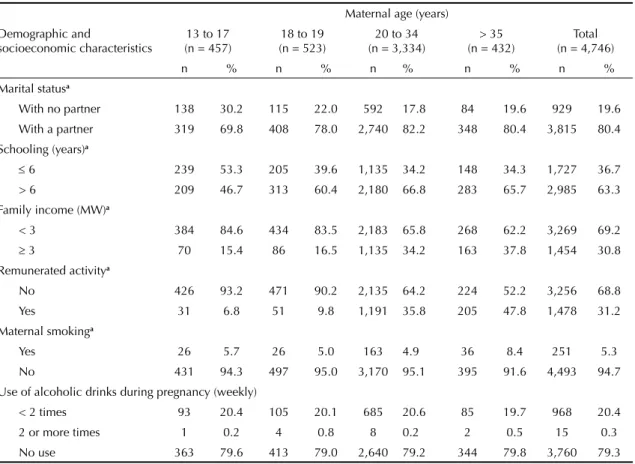
Of the 4,746 mother-child pairs included, 20.6% involved adolescent mothers, 9.6% of them being mothers < 18 years and 11% mothers aged 18 to 19 years. The mean (SD, standard deviation) age of adolescent mothers was 17.3 (SD 1.43 years). Almost all of these mothers (92.1%) were from the urban area and 88.7% self-reported their color as non-white.
A greater proportion of adolescent mothers had no partner and had low schooling, especially those younger than 18 years compared to the remaining age groups. Remunerated activity was almost six times less frequent
among adolescents than among older mothers (≥ 35
years). A family income ≥ 3 MW and smoking during pregnancy were less frequent among adolescents than among the other age groups. There was no difference between age ranges regarding the consumption of alcoholic beverages (Table 1).
About 1.5% of the women studied reported receiving no prenatal care; this proportion among adolescent mothers was twice that for the other mothers. Similarly, adoles-cent mothers presented a higher rate of inadequate prenatal care. Low birth weight occurred in 7.2% of
births and the rate was about two times higher among adolescents < 18 years than among mothers of the other age groups, and was approximately 30% higher among adolescents aged 18 and 19 years. Preterm births were also more frequent among adolescents than among mothers aged 20 to 34 years. Adolescents more frequently received care during delivery at the Brazilian Unifi ed Health System (SUS) and had lower rates of cesarean delivery, i.e., about half the rate observed for the remaining women (Table 2).
Unadjusted analysis (Table 3) showed that maternal age, adequacy of prenatal care, family income, marital status, maternal schooling, smoking during pregnancy, alcohol intake during pregnancy, prenatal category and preterm birth were statistically signifi cant factors for infant LBW (p < 0.05).
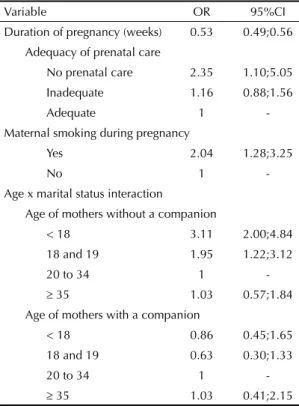
Persisting risk factors for LBW after adjusting for confounding factors (Table 4) were: mothers who did not receive prenatal care (OR 2.35; 95%CI 1.10;5.05) and smoking during pregnancy (OR 2.04; 95%CI 1.28;3.25). Each week of increased gestational age represented a 47% reduction of the risk of LBW (OR 0.53; 95%CI 0.49;0.56). There was interaction between maternal age and marital status, with the
Table 1. Demographic, socioeconomic and behavioral characteristics according to maternal age range. Aracaju, Northeastern Brazil, 2005.
Demographic and
socioeconomic characteristics
Maternal age (years) 13 to 17
(n = 457)
18 to 19 (n = 523)
20 to 34 (n = 3,334)
> 35 (n = 432)
Total (n = 4,746)
n % n % n % n % n %
Marital statusa
With no partner 138 30.2 115 22.0 592 17.8 84 19.6 929 19.6 With a partner 319 69.8 408 78.0 2,740 82.2 348 80.4 3,815 80.4
Schooling (years)a
6 239 53.3 205 39.6 1,135 34.2 148 34.3 1,727 36.7 > 6 209 46.7 313 60.4 2,180 66.8 283 65.7 2,985 63.3 Family income (MW)a
< 3 384 84.6 434 83.5 2,183 65.8 268 62.2 3,269 69.2
3 70 15.4 86 16.5 1,135 34.2 163 37.8 1,454 30.8 Remunerated activitya
No 426 93.2 471 90.2 2,135 64.2 224 52.2 3,256 68.8 Yes 31 6.8 51 9.8 1,191 35.8 205 47.8 1,478 31.2
Maternal smokinga
Yes 26 5.7 26 5.0 163 4.9 36 8.4 251 5.3 No 431 94.3 497 95.0 3,170 95.1 395 91.6 4,493 94.7 Use of alcoholic drinks during pregnancy (weekly)
< 2 times 93 20.4 105 20.1 685 20.6 85 19.7 968 20.4 2 or more times 1 0.2 4 0.8 8 0.2 2 0.5 15 0.3 No use 363 79.6 413 79.0 2,640 79.2 344 79.8 3,760 79.3 a p < 0.05 (Chi-square test)
chance of mothers < 18 years with no partner having LBW babies being about three times (OR 3.11; 95%CI 2.00;4.84) that of mothers aged 20 to 24 years old. If the adolescent was 18 or 19 years, this ratio was reduced approximately two-fold (OR 1.95; 95%CI 1.22;3.12). There was no association of maternal age with LBW among the mothers who reported living with a partner. There was no interaction between maternal age and the remaining variables in the adjusted model.
DISCUSSION
The LBW rate observed in Aracaju was similar to that observed in the city of Ribeirão Preto, Southeastern Brazil, almost 30 years before the present study (1978/79), and also similar to that observed in the city of São Luís, Northeastern Brazil, almost ten years before (1997/98).20 The present study shows that pregnancy
during adolescence is still associated with unfavorable outcomes such as LBW, but this outcome was linked to social vulnerability since it was only observed among adolescents without a partner. Shorter gestational age, absence of prenatal care and smoking during pregnancy also had an independent effect on LBW rates in Aracaju.
The percentage of deliveries among adolescent mothers in Greater Aracaju was 20.6%, a lower rate than that
reported for Brazil as a whole:c 25.4% for 2005. A
greater proportion (29.4%) was detected in the munici-pality of the city of São Luís,21 also a capital city in the
Brazilian Northeastern, in a population study conducted in 1997/1998. The rates observed in Brazil are higher than those of developed countries even when consid-ering the types of investigation, the population struc-tures, the behavioral patterns and the year of the study. In the United States, there has been a 24.0% reduction in the rate of pregnancies among women aged ten to 19 years since 1990, with a rate of 8.7% being reached between 1995 and 2000.8
The occurrence of unfavorable outcomes among adolescent mothers is attributed to biological imma-turity, especially regarding low weight21 and preterm
birth.7 Recent data from the United Kingdom indicate
that the rate of small for gestational age babies born to adolescent mothers who were still growing did not differ from that of adult women and that these mothers gave birth to heavier babies and to a greater proportion of large for gestational age babies.10 The
authors attributed this fi nding to the greater weight gain and higher IGF-1 (insulin-like growth factor) levels among growing pregnant women even after controlling for confounding factors. However, data on healthy adolescents from developed countries cannot be extrapolated to developing countries where poverty, Table 2. Characteristics of prenatal care and delivery, duration of pregnancy and low birth weight according to maternal age range. Aracaju, Northeastern Brazil, 2005.
Characteristics
Maternal age < 18
(n = 457)
18 and 19 (n = 523)
20 to 34 (n = 3,334)
> 35 (n = 432)
Total (n = 4,746)
n % n % n % n % n %
Adequacy of prenatal carea
No prenatal care 15 3.4 15 3.0 38 1.2 7 1.7 75 1.5 Inadequate 210 47.8 198 39.0 955 30.0 102 24.3 1,465 32.2 Adequate 214 48.8 294 56.0 2,194 68.8 310 74.0 3,012 66.3
Duration of gestation (weeks)a
32 10 2.2 7 1.3 37 1.1 7 1.6 61 1.3
33 to 36 42 9.2 39 7.5 179 5.4 30 6.9 290 6.1
37 382 83.6 456 87.2 2,945 88.3 378 87.6 4,161 87.7 No information 23 5.0 21 4.0 173 5.2 17 3.9 234 4.9 Type of hospitala
Public 431 94.5 491 94.4 2,789 83.8 330 76.6 4,041 85.3 Private 25 5.5 29 5.6 540 16.2 101 23.4 695 14.7 Type of deliverya
Vaginal 373 81.6 430 82.2 2,194 65.8 250 57.9 3,247 68.4 Cesarean 84 18.4 93 17.8 1,139 34.2 182 42.1 1,498 31.6 Low birth weighta
Yes 61 13.4 47 9.0 201 6.0 31 7.2 340 7.2
Table 3. Distribution of liveborns with and without low weight according to the demographic, reproductive, prenatal care and delivery variables. Aracaju, Northeastern Brazil, 2005.
Variable Low weight No low weight Total pa
n % n %
Maternal age (years)
< 18 61 13.4 394 86.6 455
18 and 19 47 9.0 474 91.0 521 < 0.001 20 to 34 201 6.1 3,122 93.9 3,323
> 35 31 7.2 400 92.8 431
Adequacy of prenatal care
No prenatal care 20 26.7 55 73.3 75 < 0.001 Inadequate 116 7.9 1,345 92.1 1,461
Adequate 186 6.2 2,818 93.8 3,004
Skin color
Non-white 287 7.1 3,765 92.9 4,052 0.480
White 53 7.8 623 92.2 676
Family income (minimum wages)
<1 55 9.8 508 90.2 563 0.024
1 < 3 190 7.0 2,508 93.0 2,698
3 91 6.3 1,355 93.7 1,446
Marital status
No companion 135 14.7 786 85.3 921 < 0.001 With a companion 205 5.4 3,602 94.6 3,807
Maternal schooling (years)
6 145 8.4 1,577 91.6 1,722 0.010 > 6 191 6.4 2,783 93.6 2,974
Smoking during pregnancy
Yes 35 14.0 215 86.0 250 < 0.001
No 305 6.8 4,173 93.2 4,478
Use of alcohol during pregnancy
Yes 90 9.2 886 90.8 976 0.0006
No 250 6.7 3,502 93.3 3,752
Type of delivery
Vaginal 241 7.5 2,994 92.5 3,235 0.270 Cesarean 98 6.6 1,396 93.4 1,494
Prenatal category
No prenatal care 20 27.4 55 72.6 75 < 0.001 SUS (public) 251 7.0 3,345 93.0 3,596
Private 68 6.5 985 93.5 1,053
Category of hospitalization
SUS 298 7.4 3,731 92.6 4,029 0.216
Private 42 6.1 649 93.9 691
Preterm birth
Yes 159 45.8 178 54.2 347 < 0.001
No 166 4.0 3,988 96.0 4,154
Total 340 7.2 4,390 92.8 4,730
The total differs in each variable due to imprecise information about the characteristic analyzed SUS: Brazilian Unifi ed Health System
low educational level and limited access to health care result in signifi cant differences for adolescents, with different challenges to their health.
The adolescent mothers in the present study, especially those < 18 years, had higher proportions of more unfavorable socioeconomic indicators, showing that the adolescent group was not homogeneous and that younger mothers may be more exposed to risks.15 These
mothers were from families of lower income and were less involved in remunerated activities. They had less access to adequate prenatal care, fewer admissions to private hospital institutions and a lower frequency of cesarean sections, as also demonstrated by Papamicheal et al,17 facts that may be related to an underprivileged
social situation.
Almeida et al1 pointed out a very close relationship
between inadequacy of prenatal care and low family income and low schooling. The inadequacy or absence of prenatal care may occur in the adolescent group due to the diffi culty of these young women in identifying and accepting their pregnancy, in addition to specifi c diffi culties related to health services such as restricted access and prejudice. In Finland, Raatikainen et al18
observed that inadequate prenatal care was associated with behavioral risk factors such as maternal single status, low educational level, young age, as well as smoking and alcohol consumption during pregnancy.
Studies conducted in Brazil have underscored the heterogeneity of the group of adolescent mothers. Although biological immaturity can be considered to be a factor predisposing them to unfavorable pregnancy outcomes,4,7,21 differences in the frequency of these
outcomes are observed when socioeconomic factors are considered. In the city of Ribeirão Preto, Southeastern Brazil, adolescent mothers from the underprivileged class had greater proportions of unfavorable outcomes than mothers of the upper social class and the latter, in turn, had proportions of these outcomes similar to those of adult mothers.6 In the present study, living
without a partner represented a risk factor for LBW for the adolescents and an even greater risk for younger mothers, probably due to the socioeconomic and psychological peculiarities faced by adolescent preg-nant girls during this period of life. Results similar to these were reported by Kilsztajn et al13 in a study
conducted in the state of São Paulo, Southeastern Brazil, in which mothers < 20 years were found to be categories of risk for LBW and prematurity.
Other social and economic factors such as family income, maternal schooling, marital status and cate-gory of prenatal care were initially found to be signifi -cantly associated with LBW in unadjusted analysis. However, after adjustment, the category of prenatal care and the modifying effect of marital situation on maternal age regarding LBW continued to be associ-ated with this outcome.
The prevalence of maternal smoking during preg-nancy was similar to that observed in the 1997/98 birth cohort of São Luís,21 Northeastern Brazil, and
lower than that observed in the city of Ribeirão Preto, Southeastern Brazil, in 19947 and in Pelotas in 2004.20
The adolescent mothers of Aracaju smoked less than the mothers aged 35 years and over. Smoking was an independent factor for LBW, as also observed in a study that compared the fi ndings for the cohorts of the city of São Luís, in 1997/98, and of the city of Ribeirão Preto, in 1994.21
Alcohol is teratogenic and its effects include miscarriage, restricted growth, birth defects, and mental retardation.11
In Germany,5 14% of the mothers consumed alcoholic
beverages during pregnancy, 1% on a regular basis. In the present study, the behavior of the adolescents regarding alcohol consumption during pregnancy was similar to that of mothers of the other age ranges. In unadjusted analysis, alcohol intake during pregnancy, without considering quantity, was a risk factor for LBW; however, this association did not persist after adjustment for confounding variables. The low prevalence of alcohol consumption and the small amount consumed (0.3% of the mothers who reported alcohol intake two or more time per week) may possibly explain in part the lack of association of this consumption with LBW.
Table 4. Adjusted odds ratio(OR) and 95% confi dence intervals (95%CI) for low birth weight. Aracaju, Northeastern Brazil, 2005.
Variable OR 95%CI Duration of pregnancy (weeks) 0.53 0.49;0.56
Adequacy of prenatal care
No prenatal care 2.35 1.10;5.05 Inadequate 1.16 0.88;1.56
Adequate 1
-Maternal smoking during pregnancy
Yes 2.04 1.28;3.25
No 1
-Age x marital status interaction
Age of mothers without a companion
< 18 3.11 2.00;4.84 18 and 19 1.95 1.22;3.12
20 to 34 1
- 35 1.03 0.57;1.84 Age of mothers with a companion
< 18 0.86 0.45;1.65 18 and 19 0.63 0.30;1.33
20 to 34 1
Although the coverage of prenatal care has increased signifi cantly in Brazil over the last few years, its effec-tiveness in preventing unfavorable pregnancy outcomes is questioned. Most of the prenatal care provided is inadequate according to the parameters of the Ministry of Health of Brazil, as well as unequal, since patients in less favorable conditions end up receiving inferior prenatal care in terms of both quality and quantity. Adolescent mothers were the group with the highest proportion of lack of care and lack of adequate prenatal care. The absence of prenatal care was associated with LBW even after adjusting for the remaining confounding variables, proving to be a risk factor for this outcome independent of other conditions, including maternal age.
This is a population-based epidemiological study involving a representative sample of pregnant women residing in Aracaju, which consists of more than ⅓ of the population of Sergipe. This state is located in a poor region of the country where few similar studies have been conducted, the present one being the second. Few studies of this nature take into account plausible
interactions between independent variables in the determination of outcome. In the present study it was possible to identify the modifying effect of marital status according to maternal age on LBW, showing that mothers were at higher risk for this outcome only when they had no partner, confi rming the social characteristic of this association.
A limitation of the study was the lack of inclusion of variables that might be associated with LBW, such as calorie consumption and weight gain during pregnancy.
1. Almeida SD, Barros MB. Equity and access to health care for pregnant women in Campinas (SP) Brazil. Rev Panam Salud Publica. 2005;17(1):15-25. DOI:10.1590/S1020-49892005000100003
2. Amaya J, Borrero C, Ucrós S. Estudio analítico del resultado del embarazo en adolescentes y mujeres de 20 a 29 años en Bogotá. Rev Colomb Obstet Ginecol.
2005;56(3):216-24.
3. Aquino EML, Heiborn ML, Knauth D, Bozon M, Almeida MC, Araújo J, et al. Adolescência e reprodução no Brasil: a heterogeneidade dos perfi s sociais. Cad Saude Publica. 2003;19(Suppl 2):377-88. DOI:10.1590/S0102-311X2003000800019
4. Barros FC, Bhutta ZA, Batra M, Hansen TN, Victora CG, Rubens CE, et al. Global report on preterm birth and stillbirth (3 of 7): evidence for effectiveness of interventions. BMC Pregnancy Childbirth. 2010;10(Suppl 1):S3. DOI:10.1186/1471-2393-10-S1-S3
5. Berqmann KE, Bergmann RL, Ellert U,
Dudenhausen JW. Perinatale Einfl ussfaktoren auf die spätere Gesundheit. Bundesgesundheitsblatt Gesundheitsforschung Gesundheitsschutz. 2007;50(5-6):670-6. DOI:10.1007/s00103-007-0228-4
6. Bettiol H, Barbieri MA, Gomes UA, Wen LY, Reis PM, Chiaratti TM, et al. Atenção médica à gestação e ao parto de mães adolescentes.
Cad Saude Publica.1992;8(4):404-13. DOI:0.1590/S0102-311X1992000400006
7. Bettiol H, Rona RJ, Chinn S, Goldani M, Barbieri MA. Factors associated with preterm births in southeast Brazil: a comparison of two birth cohorts born 15 years apart. Paediatr Perinat Epidemiol. 2000;14(1):30-8. DOI:10.1046/j.1365-3016.2000.00222.x
8. Chen XK, Wen SW, Fleming N, Demissie K, Rhoads GG, Walker M. Teenage pregnancy and adverse birth outcomes: a large population based retrospective cohort study. Int J Epidemiol. 2007;36(2):368-73. DOI:10.1093/ije/dyl284
9. Gurgel RQ, Nery AMAG, Almeida MLD, Oliveira ERR, Lima DDF, Bettiol H, et al. Características das gestações, partos e recém nascidos da região metropolitana de Aracaju, Sergipe, Brasil. Rev Bras de Saude Matern Infant. 2009;9(2):167-77. DOI:10.1590/S1519-38292009000200006
10. Jones R, Cederberg H, Wheeler S, Poston L, Hutchinson C, Seed P, et al. Relationship between maternal growth, infant birthweight and nutrient partitioning in teenage pregnancies. BJOG. 2010;117(2):200-11. DOI:10.1111/j.1471-0528.2009.02371.x
11. Keegan J, Parva M, Finnegan M, Gerson A, Belden M. Addiction in pregnancy. J Addict Dis. 2010;29(2):175-91.DOI:10.1080/10550881003684723
12. United States. Agency for International Development. Child Health Research Project. Reducing perinatal and neonatal mortality. Report of a meeting, Baltimore, Maryland, May 10-12, 1999. Child Health Res Proj Spec Rep. 1999;3(1):1-48.
13. Kilsztajn S, Rossbach A, Nunes CMS, Sugahara GTL. Prenatal care, low birth weight and prematurity in São Paulo State, Brazil 2000.
Rev Saude Publica. 2003;37(3):303-10. DOI:10.1590/S0034-89102003000300007
14. Kotelchuck M. Evaluation of the Kessner adequacy of prenatal care index and proposed adequacy of prenatal care utilization index. Am J Public Health.
1994;84(9):1414-9. DOI:10.2105/AJPH.84.9.1414
15. Ganesh-Kumar S, Harsha-Kumar, HN, Jayaram, S, Kotian MS. Determinants of low birth weight: a case control study in a District Hospital in Karnataka. Indian J Pediatr. 2010;77(1):87-9. DOI:10.1007/s12098-009-0269-9
16. Organização Mundial da Saúde. El embarazo y el aborto em la adolescência. Genebra; 1975. (Informe Tecnico, 583).
17. Papamicheal E, Pillai R, Yoong W. Children having children: outcome of extreme teenage pregnancies (13-15 years). Acta Obstet Gynecol Scand. 2009;88(11):1284-7. DOI:10.3109/00016340903229427
18. Raatikainen K, Heiskanen N, Seppo H. Under-attending free antenatal care is associated with adverse pregnancy outcomes. BMC Public Health. 2007;7:268. DOI:10.1186/1471-2458-7-268
19. Santos IS, Barros AJD, Matijasevich A, Tomasi E, Medeiros RS, Domingues MR, et al. Mothers and their pregnancies: a comparison of three population-based cohorts in Southern Brazil.
Cad Saude Publica. 2008;24(Suppl 3):S381-9. DOI:10.1590/S0102-311X2008001500003
20. Silva AA.M, Bettiol H, Barbieri MA, Brito LGO, Pereira MM, Aragão VMF, et al. Which factors could explain the low birth weight paradox?
Rev Saude Publica. 2006;40(4):648-55. DOI:10.1590/S0034-89102006000500014
21. Simões VMF, Silva AAM, Bettiol H, Lamy Filho F, Tonial SR, Gomide ME. Características da gravidez na adolescência em São Luis, Maranhão.
Rev Saude Publica. 2003;37(5):559-65. DOI:10.1590/S0034-89102003000500003
22. Strobino DM, Ensminger ME, Kim YJ, Nanda J. Mechanisms for maternal age differences in birth weight. Am J Epidemiol. 1995;142(5):504-14.
REFERENCES