Emergency Preparedness and Disaster Relief Program Pan American Health Organization
Washington, D.C., 2001
Department of Emergency and Humanitarian Action Sustainable Development and Healthy Environments World Health Organization
Humanitarian Supply
Management and Logistics
Cover photographs: PAHO/WHO
PAHO Library Cataloguing in Publication Data:
Pan American Health Organization
Humanitarian supply management in logistics in the health sector Washington, D.C.: PAHO, © 2001
189 p.
ISBN 92 75 12375 6
I. Title
1. DISASTERS
2. DISASTER PLANNING
3. DISASTER EMERGENCIES
4. EQUIPMENT AND SUPPLIES
5. INTERNATIONAL ASSISTANCE
LC HV553.P187 2001
© Pan American Health Organization, 2001
A joint publication of the Emergency Preparedness and Disaster Relief Coordination Program of the Pan American Health Organization (PAHO) and the Department of Emergency and Humanitarian Action of the World Health Organization (WHO).
The views expressed, the recommendations formulated, and the designations employed in this publication do not necessarily reflect the current policies or opin-ions of PAHO or WHO or of its Member States.
The Pan American Health Organization and the World Health Organization welcome requests for permission to reproduce or translate, in part or in full this publication. Applications and inquiries should be addressed to the Emergency Preparedness and Disaster Relief Coordination Program, Pan American Health Organization, 525 Twenty-third Street, N.W., Washington, D.C. 20037, USA; fax: (202) 775-4578; e-mail: [email protected].
Acknowledgements...vii
Preface ...ix
Introduction...xi
Chapter 1 – The Context...1
Disasters – General Aspects ...1
Main Effects of Disasters ...3
Chapter 2 – Logistics...9
Logistics and Emergencies...9
Logistics Planning and Preparedness...9
Supply Chain Logistics ...13
Chapter 3 – Assessing Logistical and Supply Needs...15
The Importance of Needs Assessment ...15
Assessment of Local Capacity...17
Factors That May Restrict or Facilitate Relief Efforts ...18
Social, Environmental and Cultural Features of the Affected Population and Region...19
Chapter 4 – Coordination...21
Coordination Structures ...21
Cooperation Agreements ...24
Requests for Humanitarian Assistance ...25
Annex...30
Chapter 5 – Key Characteristics of Emergency Supplies...35
What Are Emergency Supplies? ...35
Categories ...35
Human Resources ...37
The Standardization of Emergency Supplies ...37
Hazardous Materials...38
Specialized Materials...39
Annex ...40
Chapter 6 – Procurement...43
Sources and Procurement of Emergency Supplies ...43
Requisitions ...45
Sending Supplies ...46
iii
CONTENTS
Annexes ...52
Chapter 7 – Receiving Supplies...55
Arrival of Supplies ...55
Receiving International Shipments ...56
Receiving Local Shipments ...62
Annexes ...64
Chapter 8 – Record-Keeping, Control, and Monitoring of Supplies...69
Arrival and Recording of Supplies...69
Control, Monitoring, and Follow-up Systems ...71
Dealing with Non-Priority Items and Other Supplies ...76
Annex...78
Chapter 9 – Storage...83
Types of Warehouse ...83
The Choice of Storage Site...84
Estimating Storage Needs and Capacity...85
Alternative Storage Sites ...89
Staff Required ...89
Equipment and Material Required in the Warehouse...90
Warehouse Sectors...91
Storage and Internal Distribution of the Supplies...94
Procedures for Arrival and Dispatch ...96
Control and Monitoring Systems ...98
Occupational Health and Safety in the Warehouse ...99
Maintenance and Sanitation Measures ...100
Hazardous Materials ...101
Annexes ...105
Chapter 10 – Transport...109
Types of Transport and Their Characteristics ...109
Determining the Type of Transport Needed...114
Vehicle Control...115
Transporting Supplies...119
The Transport of Hazardous Materials ...120
Convoys or Caravans ...121
Management of Air Operations ...124
Annexes ...127 Humanitarian Supply Management and Logistics in the Health Sector
Chapter 11 – Distribution...131
Key Principles...131
Responsibilities and Criteria for Distribution ...132
Distribution Systems ...133
Monitoring and Control ...137
Annexes ...139
Chapter 12 – Managing Medical Supplies...143
Selection ...143
Programming Acquisitions...146
Reception and Evaluation of Acquisitions...147
Donations ...147
Storage Systems...150
Controlling and Monitoring Products in the Storage Centers ...153
Distribution ...154
Discarding Pharmaceutical Products ...155
Annexes ...156
Chapter 13 – Transparency and Information in Emergency Supply Management...159
Transparency...159
Information ...159
Chapter 14 – Telecommunications...163
The Communication Strategy ...163
Telecommunications Systems ...164
Basic Procedures...167
Chapter 15 – The Application of New Technologies to Emergency Logistics...169
Bar Codes ...170
AMS Laser Cards ...172
Radio Frequency Identification Tags and Labels ...173
References...175
v
T
he Pan American Health Organization, Regional Office for the Americas of the World Health Organization (PAHO/WHO) would like to express their special gratitude to the chief author of this handbook, Gerardo Quirós Cuadra, an expert on the subject and a fre-quent collaborator of FUNDESUMA. We would also like to thank the out-standing support provided by FUNDESUMA and the technical contribu-tions it has made to the handbook.Other especially significant contributions came from Dr. María Margarita Restrepo, of the Faculty of Chemistry and Pharmacy of the University of Antioquia, Medellín; Gérard Gómez of the Latin American Emergency Relief Office of Médecins sans Frontières; Dr. Edgardo Acosta Nassar, Jerónimo Venegas and Víctor Martínez of FUNDESUMA; Glauco Quesada of the German Red Cross; Alvaro Montero, consultant for USAID/OFDA and FUNDESUMA; John Price II of the U.S. Defense Logistics Agency; and Sandra Salazar Vindas. Their suggestions, recom-mendations, documentary contributions and conceptual support have made it possible to offer a more comprehensive approach to the subjects covered in the book.
The first draft of this work was widely disseminated among logistics and supply management organizations and experts around the world. Hundreds of comments were received and taken into account in the final version of the text. We wish to recognize all those individuals who, in a personal capacity or in the name of the organizations they work for, made valuable suggestions and comments that have enriched this effort. They include Katarina Toll, Isabelle Demuyser-Boucher, Gerhard Putnam-Cramer, and Hans Zimmerman of the U.N. Office for the Coordination of Humanitarian Affairs (OCHA); Rod McKinnon, of Emergency Management Australia; Gregorio Gutiérrez, Project Impact, the Dominican Republic; Luis Campos Cerda and Luis Felipe Puelma Calvo, Emergency and Disaster Program of Maule, Chile; G. Kipor, All-Russian Center for Disaster Medicine; Sonja Nieuwejaar of the U.S. Federal Emergency Management Agency (FEMA); Alfonso Vaca Perilla of Colombia’s Civil Defense; Luis Wintergest Toledo of Mexico’s Civil Protection Agency; Javier Olaya of the Colombian Red Cross; Steven De Vrient of PAHO/WHO Nicaragua; the Nicaraguan Red Cross; Alessandro Loretti of WHO; Martin E. Silverstein of the Uniformed Services University of Sciences; Peter Manfield of Cambridge University; Judith
Acknowledgements
Thimke of the World Food Program; Róger Barrios Chica of the Universidad Nacional Autónoma of León, Nicaragua; José Gómez Moncada; Tony Joe; Raúl Talavera Benavente and Vicente Bruneti. Many others enriched this text with their commentaries and recommen-dations. To all of them, our thanks.
Humanitarian Supply Management and Logistics in the Health Sector
E
mergencies and disasters place exceptional demands on the logis-tical and organizational skills of the affected country. This chal-lenge is felt with particular intensity in the health sector, where deficiencies in the flow of supplies may have dire consequences. The problem does not merely lie in the procurement of emergency goods and equipment. Special attention must also be paid to the management of those supplies already at hand or in the pipeline. Supplies may be piling up at the central level while acute shortages are painfully evident at the emergency site. Unsolicited—and often inappropriate—donations also compete for storage and transport facilities that may be in short supply. Humanitarian personnel may be unfamiliar with standard accounting and stock-control procedures. Alternatively, these procedures may be overlooked under the pressure of the emergency. Accountability and a thorough paper trail are likely to fail at exactly the moment when the mass media are most eager to find evidence of misappropriation of external assistance, and thus perpetuate the myth of local incompetence or, worse still, corruption.Since the publication in 1983 of PAHO’s handbook, Medical Supply Management after Natural Disasters, and particularly over the last decade, considerable progress has been made worldwide toward the effective management of humanitarian supplies, proper accountability, and greater transparency. The development by the Pan American Health Organization of the SUMA emergency supply management methodology has helped to place the effective and accountable control of the supply chain high on the list of priorities of both governments and nongovern-mental organizations.
This handbook aims to present the most basic concepts of humanitarian supply management and logistics. Although the handling of medical and pharmaceutical supplies is given special attention, the logistics principles described here have multisectoral applications, not only in emergency situations, but also in the day-to-day operations that must be a part of disaster prevention and preparedness.
ix
Humanitarian Supply Management and Logistics in the Health Sector
x
Throughout this manual, a basic premise is maintained: that disaster management is primarily a national responsibility. While the massive inflow of donations may occasionally exceed the capacity of the affect-ed country to absorb them, the most effective and appropriate response by the international community and humanitarian organizations is to contribute to capacity building at the national level. This manual is directed at those who are locally responsible for managing the flow of supplies and ensuring the timely delivery of emergency supplies to dis-aster victims—from civil protection experts to custom officers, and from ministry of health and social security professionals to the dedicated vol-unteers of humanitarian organizations.
It is our hope that this publication will contribute to greater effective-ness and accountability in the process of providing humanitarian assis-tance to the victims of disasters, and therefore to more equitable access to health by the affected population.
Dr. Claude de Ville de Goyet
Chief, Program on Emergency Preparedness and Disaster Relief,
xi
P
rocurement, storage, mobilization, distribution—these and other aspects of providing material assistance to people affected by dis-asters, and the handling of those supplies employed by relief organizations in their aid operations, require an organizational structure to ensure the efficient management and utilization of resources that in emergency situations, almost by definition, tend to be limited.This structure is provided by logistics, the art or strategy of achieving practical objectives as promptly and methodically as possible while mak-ing the most effective use of available resources.
Two basic premises are addressed in this handbook:
1. Humanitarian supply logistics cannot be improvised at the time of the emergency. Countries and organizations must see it as a corner-stone of emergency planning and preparedness efforts. Employing resources appropriately, and being able to secure those that are not at hand, depends on first identifying their availability and location, as well as the sources for obtaining them. All those activities demanded by logistical deployment during an emergency—the mechanisms for standardizing the various processes and all the nec-essary documents for recording information and controlling, moni-toring and following up on the flow of supplies—must be prepared, understood, and tested in advance.
2. The various stages in the flow of supplies from their point of origin to the moment they reach their recipients—whether they be the organizations managing the emergency or the actual beneficiaries of the assistance—are a chain made up of very close links. How any one of these links is managed invariably affects the others. Supply man-agement must therefore be the focus of an integral approach that looks at all the links in the sequence and never loses sight of their interdependence. This is known as supply chain logistics.
This handbook is intended as a guide to certain basic aspects of emer-gency supply logistics and as reference material for all those involved in
the management of humanitarian supplies. It describes a series of proce-dures for the correct handling of supplies at each of the stages of the logistics chain. Some of these procedures reflect the standards of inter-national organizations involved in disaster response. Many others, how-ever, are the distillation of concrete experiences by those in the field. While no guidelines can be universally applicable, the techniques and procedures proposed here should be of some value in almost all circum-stances involving emergency operations.
The manual is aimed at all those who work in emergency management, whether government officials or members of nongovernmental organi-zations; the procedures outlined should be applicable in both cases. The content has been organized in such a way that those who are already experts in the field can use it as reference material, while those who wish to learn about the subject will find a systematic presentation of the most relevant aspects of the logistics of managing humanitarian supplies. This is a new contribution by the Pan American Health Organization and the World Health Organization to national efforts to strengthen opera-tional capacity, particularly in those aspects related to the management of humanitarian assistance. It expands and updates information in PAHO/WHO’s Scientific Publication Medical Supply Management after Natural Disasters(1983).
Humanitarian Supply Management and Logistics in the Health Sector
1
T
he purpose of this chapter is to provide a general context for the most common scenarios that would call for an intervention by humanitarian organizations, as well as for those recurring condi-tions in which these organizacondi-tions must act to meet the needs of the vic-tims of disasters.Disasters – General Aspects
The term “disaster” is usually applied to a breakdown in the normal functioning of a community that has a significant adverse impact on people, their works, and their environment, overwhelming local response capacity. This situation may be the result of a natural event—say, a hur-ricane or earthquake—or it may be the result of human activity.
Some organizations make a distinction between “disasters”—the result of natural phenomena—and “complex emergencies” that are the product of armed conflicts or large-scale violence and often lead to massive dis-placements of people, famine, and outflows of refugees. Examples would include the Balkan crisis, the Ethiopian, Somali and Sudanese famines, the genocide in Rwanda and the violence in East Timor.
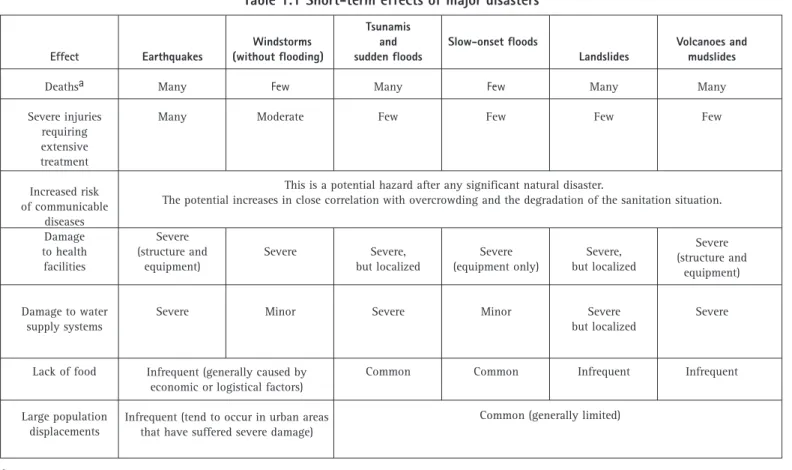
Each disaster is unique—its effects not only have to do with the type of natural or man-made phenomenon, but also with the economic, health, and social conditions of the area. However, there are common features, and identifying them can help improve the management of humanitari-an assisthumanitari-ance humanitari-and the use of resources. The following aspects should be taken into account when considering the nature of a disaster (see also Table 1.1):
1. There is a correlation between the type of disaster and its impact on health, particularly the occurrence of injuries. For instance,
earth-Chapter 1
The Context
1quakes cause many traumas that demand medical attention, while floods tend to produce relatively few injuries;
2. Some of a disaster’s effects do not have an immediate impact on public health, but pose a potential threat. Population displacements and environmental changes may increase the risk of a spread in communicable diseases. In general, though, epidemics are not
caused by natural disasters;
3. Immediate and potential health hazards in the aftermath of a disas-ter seldom madisas-terialize simultaneously; they tend to strike at differ-ent times, and with variable intensity within the affected area. Thus, injuries tend to happen at the time and place of the impact, demand-ing immediate medical attention, while the risk of an increase in communicable diseases evolves more slowly and reaches maximum intensity with overcrowding and breakdowns in hygiene;
4. After a disaster, the need for food, clothing, shelter, and primary health care is rarely absolute; even the displaced often have the resources to satisfy some of their own basic needs. Moreover, it is common for the victims of a disaster to recover quickly from the ini-tial shock and participate spontaneously in search and rescue efforts and other relief initiatives, such as the storage and distribution of emergency supplies;
5. Wars and civil conflicts generate a particular set of health problems and operational obstacles. Overcoming them requires dealing with many political, social, ethnic and geographical issues.
Effective humanitarian relief management is based on anticipating prob-lems and identifying them as they arise, and providing specific supplies at the right time where they are most needed.
Humanitarian Supply Management and Logistics in the Health Sector
Main Effects of Disasters
The various effects of disasters on the population and its surroundings generate different kinds of needs and require different approaches to meet those needs. It is therefore important to have a general sense of what these effects are, and which systems are most commonly affected. However, experience shows that the effects in question cannot be taken as absolutes, since the impact and form a disaster takes depends on the specifics of the affected region. Bearing this in mind, the following is an overview of some basic characteristics of these effects.
Social Reactions
The behavior of disaster victims rarely explodes into general panic or sinks into stunned apathy. After the initial shock, people tend to start acting positively to meet well-defined personal goals, leading to an increase in individual activities that, in spite of being spontaneous, quickly self-organize into collective endeavors. Earthquake survivors, for instance, are usually the first to engage in search and rescue efforts, often within minutes of the impact; in a matter of hours, self-organized groups have already assigned themselves specific tasks that play a key role in relief and recovery.
It is only in exceptional circumstances that actively antisocial behavior such as looting takes place. However, sometimes individuals’ sponta-neous reactions, while perfectly rational from the point of view of self-interest, can prove detrimental to the community as a whole, as when public utility employees do not show up at the workplace until they have taken steps to ensure the safety of their family and possessions.
Since rumors abound after a disaster, especially concerning epidemics, the authorities may face tremendous pressure to adopt emergency meas-ures, such as massive vaccination campaigns against typhoid or cholera, without there being solid public health evidence for doing so. Moreover, many people are reluctant to apply the measures considered necessary by the authorities.
After an early warning has been issued concerning a major risk, and even after a disaster has actually taken place, many are reluctant to be
evacuated, although their homes may no longer be safe or, quite simply, may no longer exist.
Communicable Diseases
Natural disasters do not cause massive outbreaks of infectious diseases, although in some circumstances they may increase the odds of their spreading. In the short term, the increase in morbidity is frequently the result of fecal contamination of drinking water and food, causing gas-trointestinal diseases.
The risk of epidemic outbreaks of communicable diseases is proportion-al to the density and displacement of the population, since these factors degrade living conditions and substantially increase the demand for drinking water and food, which tend to be scarce in such circumstances. In the immediate aftermath of a disaster, the risk of contamination grows—as in the case of refugee camps—as existing sanitation services such as water supply and sewerage systems break down and it becomes impossible to maintain or restore public health programs.
In the case of complex disasters, malnutrition, overcrowding, and the lack of basic sanitary conditions are frequent. In such circumstances, outbreaks of cholera and other diseases have occurred.
Population Displacements
When large population displacements take place, whether spontaneous or organized, humanitarian assistance becomes crucial—and urgent. People tend to flock to urban areas, where public services do not have the capability to handle sudden, very large increases in the population served, leading to increased mortality and morbidity rates. If the disas-ter destroys most homes in a given area, large local “migrations” may take place within the same urban environment, as victims look for shel-ter in the homes of relatives and friends.
In situations in which large numbers of the population flee their homes due to war or other forms of violence, and the threat to life is imminent, organized reactions are much less likely, since the chief priority of the
Humanitarian Supply Management and Logistics in the Health Sector
victims is to get away from the danger as quickly as possible. In these cases, the timely intervention of international aid organizations can still make the difference between life and death. Even so, these agencies may find among these populations attitudes of mutual assistance and organ-ized response that can maximize the effectiveness of the intervention.
Exposure to the Elements
Health hazards associated with exposure to the elements are not com-mon in temperate zones, even after a disaster, as long as the displaced are kept in dry places where they can remain sheltered from the wind and cold. However, in other climates with significant extremes in tem-perature, whether too hot or too cold, proper shelter can be vital. Hence, the need to provide emergency shelter should not be seen as a given, but depends instead, to a large extent, on local circumstances.
Food and Nutrition
Food shortages in the aftermath of a disaster are generally due to two causes. The first is the destruction of food stocks in the affected area, which combines with personal losses to reduce the immediate availabil-ity or affordabilavailabil-ity of food. The second is disorganized distribution sys-tems, which may contribute to shortages even if there is no absolute scarcity of food.
After an earthquake, lack of food is rarely severe enough to cause mal-nutrition. River floods and unusually high tides causing coastal flooding may affect food stocks and ruin crops, as well as interfering with distri-bution. Efficient food distribution may be a key need in the short term, but large-scale imports or donations of food are seldom needed. One crucial exception must be mentioned. In the case of mass displace-ments of people, the victims do not carry much in the way of provisions, if they carry anything at all. All too frequently, supplies in the popula-tion centers that play host to them are insufficient and are quickly depleted.
Water Supply and Sewerage
Water supply and sewage systems are especially vulnerable to natural disasters. The interruption of such services leads to severe health risks. These systems are widely distributed, often poorly maintained or in dis-repair even before a disaster strikes, and exposed to a variety of hazards. Deficiencies in the quantity and quality of drinking water, or the safe disposal of fecal and other human waste, bring about a degradation of sanitary services, which in turn contributes to creating favorable condi-tions for the spread of water-borne diseases.
Mental Health
In the immediate aftermath of a disaster, anxiety, neurosis and depres-sion are not a major public health issue, and can generally be handled temporarily by other members of rural or traditional communities with-out external support. Confounding expectations, it is relief workers who may comprise a high-risk group. Whenever possible, all efforts must be made to preserve the social structure of families and communities. Likewise, the indiscriminate use of sedatives or tranquilizers during the relief stage of the disaster must be vigorously discouraged.
In the industrialized or urbanized areas of developing countries, a sig-nificant increase in mental health problems often accompanies the long-term rehabilitation and reconstruction phase. Treatment must be pro-vided.
Special reference must be made to the traumas that are the result of con-tact with the horrors of armed confrontation and other forms of extreme violence. The violent death, disappearance, or injury of relatives and friends aggravates the trauma, which generally calls for protracted ther-apy.
Damage to Infrastructure
Natural disasters frequently cause severe damage to key facilities, affect-ing the health of those sectors of the community that depend on the services provided. In the case of hospitals and health centers whose
Humanitarian Supply Management and Logistics in the Health Sector
structure is unsafe, natural disasters put its occupants at risk and limit institutional capacity to provide services to the victims. The 1985 Mexico City earthquake triggered the collapse of 13 hospitals. In three of them alone, 866 people died, including 100 hospital staffers; some 6,000 beds were lost. In 1998, Hurricane Mitch damaged or destroyed the water sup-ply systems of 23 hospitals in Honduras and affected 123 health centers. The disasters set off by the El Niño phenomenon in Peru between 1997 and 1998 affected almost 10% of the country’s health services.
These destructive effects also have an impact on infrastructure, equip-ment, and other useful resources for managing the arrival, storage, and distribution of emergency supplies.
Humanitarian Supply Management and Logistics in the Health Sector 8 Effect Deathsa Severe injuries requiring extensive treatment Increased risk of communicable diseases Damage to health facilities
Damage to water supply systems
Lack of food
Large population displacements Earthquakes Many Many Severe (structure and equipment) Severe Windstorms (without flooding) Few Moderate Severe Minor Tsunamis and sudden floods Many Few Severe, but localized Severe Common Slow-onset floods Few Few Severe (equipment only) Minor Common Landslides Many Few Severe, but localized Severe but localized Infrequent Volcanoes and mudslides Many Few Severe (structure and equipment) Severe Infrequent
Common (generally limited) Infrequent (generally caused by
economic or logistical factors)
Infrequent (tend to occur in urban areas that have suffered severe damage)
This is a potential hazard after any significant natural disaster.
The potential increases in close correlation with overcrowding and the degradation of the sanitation situation.
a Including potential lethal effects in the absence of prevention measures.
Logistics and Emergencies
A
lthough the word "logistics" applied originally to the military procedures for the procurement, maintenance, and transporta-tion of materiel, facilities, and personnel, it now has practical applications in civilian life. It generally refers to a system whose parts interact smoothly to help reach a goal promptly and effectively thanks to the optimized use of resources. While this is an immensely produc-tive approach, its downside is that the failure of even one of the com-ponents can affect the final result.Many commercial enterprises have a logistics department that coordi-nates, through a logical and sequential series of steps, all aspects relat-ed to procurement, transport, maintenance, stock management, and the flow of both material and intangible inputs—broadly speaking, all activ-ities considered auxiliary to the production and marketing process. In emergency relief operations, logistics are required to support the organization and implementation of response operations in order to ensure their timeliness and efficiency. Mobilizing the staff, equipment and goods of humanitarian assistance organizations, the evacuation of the injured or the resettlement of those directly affected by the disaster, requires a logistics system to maximize effectiveness.
Logistics Planning and Preparedness
2It is beyond the scope of this section to explain in detail how to devel-op an emergency response logistics plan. However, it is feasible to pro-vide a few guidelines for developing such a plan, as well as to under-score the importance of planning as a key component of any disaster reduction effort.
Chapter 2
Logistics
9
Logistical activities have to be planned, since adequate preparations are essential to a smooth operation. It is indispensable to renounce the com-monly held notion that transport and other arrangements can be impro-vised, depending on circumstances “in the field” when disaster strikes. Planning is both necessary and practical, since it is generally possible to foresee the types of disasters that may affect a given location and the needs that such disasters will be likely to engender.
In fact, logistics should be an active component of any national emer-gency response plan, as well as of the individual plans of disaster response organizations and key institutions such as schools and health establishments. Logistics must be closely linked to all other operational activities in the context of responding to a given emergency.
The Plan
Planning and anticipation are vital to an effective logistical system. The plan must be based, first of all, on a good working knowledge of the geo-graphical, social, political and physical characteristics of the area where the operations are to take place. Such a plan must not only be well thought out in advance, so that it can run smoothly—it must, above all, be clearly understood and accepted by all stakeholders in any future relief operation.
The plan must provide clear answers to the following questions: ◆ Which tasks must be carried out? How do they relate to all the other
activities, and what are the correct sequences for carrying them out? ◆ Who will be responsible for performing such tasks? (Rather than individuals, what must be identified here are organizations or departments.)
◆ Who will be in charge of the overall coordination of the logistical system?
◆ What resources are needed? How, when, and where can they be pro-cured?
◆ What alternative actions can be implemented if the system is some-how disrupted?
Humanitarian Supply Management and Logistics in the Health Sector
Preparedness
After these questions have been answered satisfactorily, we must draw up a list of preparatory activities. The more time and effort we invest in such activities, the greater the return in terms of our knowledge of the theater of operations, our weaknesses and those of our partners, eventu-al needs, and eventu-alternative solutions depending on different scenarios. These activities, which are described below, can be broken down by national regions, depending on the size of the country, beginning with those areas most at risk from natural disasters. Alternatively, organiza-tions may decide on which geographical areas they will focus their attention.
Preparedness must also be based on the vulnerability and resource assessments normally carried out to develop a national or regional emergency response plan. We must never forget that logistics has to be a key component of any such plan.
Preparatory activities must include the following:
◆ Assessing the vulnerability of key infrastructure—The goal is to iden-tify the strengths and weaknesses of public works and strategic structures of the country or region—highways, water supply systems, schools, hospitals—as well as alternative actions that may be required should the infrastructure collapse. Specific actions would include:
▲ Systematically mapping and evaluating national transport infrastructure (ports, airports, highways, railroads, and water-ways), taking into account the capacity and potential weak-nesses of strategic routes, possible bottlenecks (bridges, ferries), availability of communication resources, and risks to the infra-structure in the event of an emergency. It is essential to deter-mine the vulnerability of ports and airports to natural disasters. We must consider, for instance, the exposure of hangars and warehouses, or loading and fueling equipment, to the impact of a hurricane or an earthquake;
▲ Analyzing the historical meteorological records of the country or region to determine the impact that severe weather might have on the capacity of the transport system at different times of the year;
▲ Regularly monitoring major new construction or changes to existing structures that might cause bottlenecks or the tempo-rary need for rerouting, e.g., changes in a bridge’s weight or width restrictions, the closure of a route due to road repairs, and so on.
◆ Determining the availability of strategic resources for logistical sup-port—These resources are constantly changing, so they must be reviewed frequently to keep the information as up-to-date as possi-ble. The review must also involve the private sector, the public sec-tor, and national and international nongovernmental organizations.
▲ Taking stock at the national level of the location and sources of key supplies—including drugs and medical supplies, food, cloth-ing, fuel, and rescue equipment. This inventory must also deter-mine how long it would take for critical supplies to be delivered to their required destinations;
▲ Analyzing the capacity of the transport system for moving peo-ple and supplies—assessing in detail the country’s transport capacity, such as the size of fleets, their type and capacity, loca-tion, costs, and availability;
▲ Assessing potential sites for logistic bases, supply distribution centers, and fuel distribution points—including public and pri-vate facilities, large storage complexes, factories, and other facilities that might be adapted to these purposes;
▲ Assessing the availability of spare parts and repair services—
including private and public repair shops;
▲ Determining the capacity of ports and airports to handle
emer-gency supplies under different scenarios:
Ports: Examining the capacity of port facilities to handle the arrival, storage, and flow of consignments, including repackag-ing and distribution. Reviewrepackag-ing with the port authorities the various procedures and formalities for the arrival of emergency consignments, and so on.
Airports: Determining their capacity, which types of aircraft can land, which services are offered, availability of machinery and Humanitarian Supply Management and Logistics in the Health Sector
equipment for unloading and loading, whether fuel supplies are available, and so on.
Other transport options: Determining alternative routes and options, such as waterways, in the event of an emergency. ◆ Reviewing government policies, plans, and preparations—It is very
important for international agencies and nongovernmental organi-zations to know the government’s emergency response policies and plans. Since government disaster response agencies are the ones entrusted with coordinating relief efforts, it is crucial for the organ-izations that take part in these efforts to establish solid links with the local or national agencies. The contacts can also be used to negotiate mutual cooperation agreements for emergency situations, such as providing tax-exempt status to humanitarian supplies, pri-ority treatment at customs, and so on.
All the information compiled and the activities carried out at the plan-ning and preparation stage should serve as the basis for the development of the logistics plan, which must spell out procedures, responsibilities, and timetables for implementation.
Supply Chain Logistics
This handbook will focus on supply chain logicstics in emergency situ-ations, the purpose of which is to "deliver the right supplies, in good condition and the quantities requested, in the right places and at the time they are needed”.3 The links in this logistics chain are not necessarily sequential or linear; indeed, they are often carried out in parallel. However, they must not be considered as separate activities but inte-grally, due to their complex interrelationships.
Although a general coordinator must keep track of all the threads, no one could expect a single individual to micromanage the entire process. Accordingly, someone should be responsible for procurement, transport, storage, and distribution, as outlined below.
Procurement
The purpose of the procurement process is to make sure that the organ-izations involved in relief management have the resources needed to
Chapter 2: Logistics 13
meet identified needs. This in turn requires identifying the sources of those goods and services and the way in which they will be acquired. Transport
Transport is the means whereby supplies reach the places where they are needed. A transport strategy must not only take into account the means of transport but also the actual possibilities of getting supplies from point A to B, as well as alternatives for the prompt, safe delivery of relief assistance.
Storage
The purpose of storage is to protect the emergency supplies in an organ-ized, systematic fashion until they can be delivered to their ultimate recipients. It must also take into account reserve supplies, or stockpiles, for future or unforeseen needs.
Distribution
The chief goal of the logistics chain in relief operations is delivering aid to the people affected by a disaster, or at least to the organizations entrusted with managing emergency supplies, in a way that is propor-tional to existing needs, fair, and properly controlled to prevent abuses or waste.
Putting it all Together
It is important to underscore the fact that all of the above components are closely linked. The failure or ineffective functioning of any of the links in the chain will affect overall performance. For instance, if the transport of a load of supplies has been organized correctly, but upon arrival it turns out that no provisions were made for storage, the effi-ciency of the transport effort will have been to no avail. Alternatively, if there are enough resources to cover the needs of an affected area, but no transport to take them where they are needed, the success of the other efforts will be, for all practical purposes, moot, because they were not properly synchronized with the transport component. One missing link is all that is needed for the chain to break.
Humanitarian Supply Management and Logistics in the Health Sector
The Importance of Needs Assessment
A
ssessing logistical and supply needs is crucial to determine as accurately as possible:◆ The needs of the population after a disaster; ◆ Available local capacity and resources;
◆ Complementary capabilities and resources required for meeting those needs.
Such assessments should be fully integrated into the general needs-assessment process that is carried out in a disaster area to determine the type and severity of the damage and the most urgent intervention prior-ities. The quality of this assessment is very important, since requests for supplies will be based on the disaster situation as identified on the ground.
It should be emphasized that the need for accurate assessments should not lead to paralysis. While assessments are the tool that enables relief man-agers to identify the affected sectors and the nature of the damage, and to quantify and qualify more precisely the type of assistance required, there is no need for them to be completed before the most pressing relief actions are undertaken.
Needs assessments should make it possible to answer the following ques-tions:
◆ What are the needs?
a . What are the needs of the population? b . What are the operational needs?
Chapter 3
Assessing Logistical and Supply Needs
415
◆ What is available capacity?
a . What is the capacity of the local infrastructure?
b . What resources (including human and information resources) are available locally?
◆ What factors may hinder or facilitate relief efforts?
◆ What are the social, cultural and environmental characteristics of the potential disaster area that may have a bearing on the effectiveness of the relief efforts?
It is important to determine not just the needs of the affected population, but also of the organizations in charge of providing relief assistance. Some of the key questions that need to be answered are the following: ◆ What is needed?
◆ How much is needed?
◆ When is it needed? (Is it urgent?) ◆ Where is it needed?
We also know that disasters are dynamic, changing processes. Accordingly, an assessment of this sort must not only help us to identify the current situation, but also to foresee likely needs in the future. Needs of the Population
As we have seen, it is important not to stereotype disasters, since the needs they generate depend not only on the kind of event but also on the socioeconomic and other characteristics of the affected region or country. Nevertheless, experience shows that some aspects of everyday life are more likely to be affected by disasters, making it possible to foresee the most probable needs for survival.
Such aspects include the following:
◆ Health care: Most catastrophic events tend to affect public health to a greater or lesser extent, generating additional or urgent needs in this area.
◆ Availability of water:It is common for drinking water supply sys-tems to suffer damage or fail to function.
Humanitarian Supply Management and Logistics in the Health Sector
◆ Availability of food:Not all events lead to dwindling stocks of food, but people who have lost their homes or belongings will likely require some temporary support in this regard.
◆ Shelter:The impact of a disaster might force people to look for tem-porary shelter until they resolve their housing situation.
◆ Sanitation:The generally sudden disruptions of the everyday func-tioning of a community, as well as the displacement or temporary resettlement of the victims, can cause environmental degradation and imperil health due to a rise in unsanitary conditions.
Bearing in mind which kind of disaster we are facing, we can come to preliminary conclusions on what type of assistance will most likely be necessary, and launch an appropriate response in the field until more thorough assessments reveal to us in greater detail the needs that must be met.
Operational Needs
All too often, local organizations involved in emergency response do not have the resources to respond effectively to a disaster. It is therefore important to determine what resources an organization has (or is lacking), and what is required for relief operations to be carried out effectively. If logistical planning and preparations have taken place before the event, this will make it easier to determine which resources are available—and which are lacking and must be procured elsewhere. (See also the section on Logistics Planning and Preparedness in Chapter 2.)
Assessment of Local Capacity
By local capacity we mean not only the physical resources available at the site of an emergency, but any factors that may help emergency sup-ply management, such as local knowledge of the terrain or weather pat-terns, or social capital in the form of community organizations, formal and informal communications channels, and the like.
Local Infrastructure Capacity
Since disasters tend to affect lifelines, including roads and infrastructure in general, it is essential to carry out a quick inventory of their
ity and operational capacity for the mobilization and reception of incom-ing supplies.
From the point of view of infrastructure, the following issues must be dealt with:
◆ The state of roads, waterways, and other transport infrastructure needed to guarantee the arrival of emergency supplies in the region or country that has been affected. Are there any restrictions on their effective use, such as the threat of landslides blocking access to a town, or a landing strip that may be unavailable in the event of flooding? Are any changes being contemplated, such as the digging of a tunnel? Is maintenance so deficient that the infrastructure is becoming increasingly vulnerable to the impact of an earthquake or hurricane?
◆ The existence and availability of supply storage facilities; ◆ The existence and availability of means of transport;
◆ The state and capacity of points of arrival (airports, ports, borders, and so on). Are there any restrictions on their use? Are changes in the works, such as the expansion of a runway? Is maintenance a problem?
Local Availability of Resources
One can frequently find the necessary supplies locally, or at least not far from the emergency zone. Part of our assessment, then, must involve identifying the existence and location of such resources. Attention should not be paid only to commercially available goods that need to be pur-chased; there may also be public, and even private, resources that can eventually be put to use in relief efforts. This applies to resources for the affected population as well those required by relief organizations.
Factors That May Restrict or Facilitate Relief Efforts
Many factors may hinder or, alternatively, facilitate relief efforts. For instance, during a complex emergency, or in particular political contexts, national authorities may restrict humanitarian operations and supplies. A government may ban foreign-based relief organizations from entering the
Humanitarian Supply Management and Logistics in the Health Sector
disaster or conflict area, or even the country itself. Another may put for-ward religious, political, or health reasons for preventing the arrival of a given product or material.
On the other hand, some governments may adopt exceptional measures to facilitate the efforts of relief organizations and the arrival of humani-tarian assistance into the country or the area where operations are underway. This would include offering priority treatment at customs, lowering or eliminating tariffs and taxes, or making government facilities available to humanitarian operations.
The assessment report must mention the existence of any such measures, since they will have an impact on the supplies that may or may not be used and the movement of relief teams. Restrictions may have to be cir-cumvented, while favorable measures should be maximized.
Other Relevant Issues
Any other information that may affect supply availability, transport and distribution should also be recorded to assist in decision-making—weather forecasts, other events related to the event causing the emergency, or safe-ty and securisafe-ty considerations that must be taken into account regarding the movement and positioning of supplies.
Social, Environmental and Cultural Features of the
Affected Population and Region
In order to provide the most appropriate and effective assistance to the affected population, it is imperative to identify and understand their social and cultural customs, as well as environmental characteristics of the area they occupy.
This information must be taken into account when making decisions about the type of supplies needed, how they can best be distributed, and how they are likely to be used—in the case of clothing, housing, or house-hold items—or consumed, when it comes to water, food, and drink. The following are essential tasks:
◆ Identifying the population’s dietary habits, including the types of food they will not consume for religious, cultural, or traditional
sons, the kitchen utensils they use for cooking, and any other rele-vant information that can help determine what kind of assistance to offer and what kind to avoid;
◆ Identifying local and regional producers before asking for food assis-tance or negotiating the acquisition of food in other regions; ◆ Finding out what type of clothes are used, and which ones are not
worn due to cultural or environmental reasons;
◆ Identifying the most common types of housing and construction materials, including the cultural or environmental reasons, if any, for such buildings and building practices;
◆ Collecting information about the needs and type of assistance con-sidered a priority by the community itself;
◆ Identifying ethnic or cultural minorities and their specific needs, in order to prevent any form of exclusion.
Once again, a proper assessment will help to guide the decisions needed to provide appropriate and effective assistance. Defining the need for spe-cific supplies must be done as part of the overall assessment of the emer-gency.
Humanitarian Supply Management and Logistics in the Health Sector
T
he actors who intervene in relief operations are diverse, with dif-ferent mandates and working methods. Although they all share the desire to help, lack of coordination is common in emergency situations. Disputes between organizations, or the unwillingness to share information and work side by side, can delay the provision of care to disaster victims, lead to duplication of efforts, and waste valuable resources.To prevent this predicament, and to maximize available resources and expertise, relief efforts should be launched in a spirit of coordination. This will be possible to the extent that participating organizations know each other, share information, identify and acknowledge their respective strengths, and explore ways of collaborating and supporting each other.
Coordination Structures
The Actors5
Minor emergencies are generally handled by specialized national or local agencies, perhaps with the collaboration of international organizations present in the country. However, when an event is catastrophic, other sectors of the nation and the international community must often mobi-lize to provide relief. The increase in the arrival of emergency supplies and response personnel places an extra burden on the efforts to coordi-nate relief on the ground. It is crucial to establish effective working rela-tionships with the following stakeholders (see also Annex 4.1):
◆ The local population: The residents of the affected area are the first to engage in search and rescue operations, and often among the first to share vital supplies such as food and water with victims of the disaster.
◆ Neighboring communities or regions: It is also common for neigh-boring communities or even countries to respond quickly with dona-tions and the sending of volunteers.
Chapter 4
Coordination
21
◆ The national and local governments: A significant adverse event generally prompts the intervention, not only of the national disaster response agency, but of other government bodies as well.
◆ Foreign governments: The governments of other nations intervene through their embassies and their bilateral cooperation agencies. This assistance, which occurs between the two governments, may include financial and in-kind donations, the financing of rehabilita-tion and reconstrucrehabilita-tion projects, or the sending of consultants and experts. (See Annex 4.1.)
◆ Multilateral agencies: These are mostly intergovernmental agencies, such as those of the United Nations, whose mandate includes disas-ter reduction or humanitarian assistance. Generally, their support focuses on technical assistance related to their own field of expert-ise, sending consultants and experts, or supporting the allocation of resources to help the affected country in rehabilitation and recon-struction efforts. (See Annex 4.1.)
◆ Nongovernmental organizations (NGOs): National and international, religious or social, their capabilities, experience and resources cover a wide spectrum. Some international NGOs specialize in emergency management, and their skills and resources are tailored for disaster situations. (See Annex 4.1.)
◆ The private sector: National or transnational in scope, for-profit cor-porations can get involved at different levels, from donations to pro-viding specialized services in areas such as transportation, ware-house rentals, or the sale or in-kind donation of equipment, food and drugs.
◆ Specialized institutions: These can provide highly valuable technical assistance in areas such as vulnerability assessments and risk reduc-tion, needs assessment, and more concrete efforts such as water purification or medical supply management.
◆ Military institutions: A country’s armed forces have the experience and equipment to support logistical operations. They have their own means of transport, including sophisticated aircraft such as helicop-ters, highly flexible and deployable human resources, and essential skills in crucial fields such as rapid road repair and bridge construc-Humanitarian Supply Management and Logistics in the Health Sector
tion. When the armed forces are taking active part in a conflict, however, their invovement in relief operations must be closely reviewed and might not be advisable for security reasons.
Coordination Mechanisms
It must be borne in mind that most countries have a national focal point—a National Emergency Commission, Civil Defense or Civil Protection—in charge of disaster response. It is generally a permanent structure, with its own budget and organizational structure. At times, however, governments establish temporary, ad hoc structures to respond to a particular disaster which will, at some point, transfer responsibility for their activities to permanent government agencies. Regardless of the arrangement involved, it makes sense, in order to discourage the dupli-cation of efforts, to try to channel all emergency assistance through such structures.
The tasks of coordinating relief efforts must be viewed from a cross-sec-toral, inter-institutional, and interdisciplinary perspective. They should also, obviously, start long before an emergency takes place, and be rein-forced during a catastrophic event. Some of the key activities during these two crucial stages in the coordination process are the following:
During the Preparedness Phase
◆ Determine who is supposed to do what in the context of humanitar-ian intervention: which national, international, governmental, non-profit organizations are present in the country, and what are their specialties and fields of action;
◆ Carry out frequent meetings and coordination activities to decide and even rehearse what is to be done before, during, and after an emergency;
◆ Develop joint plans and seek collaborative agreements with the var-ious organizations for the stages before, during, and after an emer-gency;
may be) of resources and contacts that would prove useful in the event of an emergency, and keep the inventories up to date; ◆ Exchange information about resources that may be useful in the
event of an emergency, whether the resources are in the hands of participating organizations or come from another source.
During the Response Phase
◆ Carry out joint assessments of the situation in the field. This can be extremely useful, since it allows for an interdisciplinary view of the emergency and makes it easier to identify areas for inter-agency col-laboration;
◆ Maintain close and permanent contact between the various organi-zations involved;
◆ Share among the organizations the results of any assessments and findings with a view to finding fields of action where the strengths of the various organizations can complement each other;
◆ Share information about the activities undertaken and planned by each organization, to prevent duplication of efforts;
◆ Promote the exchange of resources among the organizations, as well as the development and implementation of cooperation agreements; ◆ In emergency situations that require a complex response, establish specialized working groups with representatives from all relevant organizations. Examples include a water and sanitation group, or a medical assistance group.
Cooperation Agreements
Disaster response organizations’ primary goal is to provide relief to those in need. Depending on its nature and history, each organization tends to specialize, to a greater or lesser extent, in a given work area. It is also evident that no agency, on its own, can handle all the logistical prob-lems attending a natural catastrophe.
Humanitarian Supply Management and Logistics in the Health Sector
The way in which international donors transfer resources for humani-tarian assistance has led to the emergence of many new relief organiza-tions and the entrance of existing instituorganiza-tions into this field, resulting in intense competition among these organizations for external resources. In spite of this competition, it is essential to develop mutual support and cooperation agreements, so that humanitarian assistance can be deliv-ered promptly and relief efforts can complement each other. These agreements must be both specific and feasible, so as not to create false expectations.
Requests for Humanitarian Assistance
Calls on the International Community
When the impact of a disaster is such that it overwhelms national response capacity, a call for help soon goes out to the international com-munity. This is the responsibility of the national government, and the requests for assistance are usually channeled by embassies and the coun-try offices of the various UN bodies. The crucial point, again, is not to make such requests until needs have been assessed and it is clear that they cannot be met with local resources. Only then can international sol-idarity provide emergency relief that is truly useful.
As part of disaster preparedness efforts, the foreign ministries of some countries—regrettably few—have issued guidelines to their diplomatic representatives abroad in the event of a disaster. These guidelines are meant to help the diplomats inform the authorities, potential donors, and the public about the impact of the event, the needs of the victims, and the type of assistance that would prove most valuable in the circum-stances, based on official reports issued by those responsible for disaster response.
Ideally, this should help to identify and screen aid offers, reducing the number of inappropriate donations and helping to make sure that useful supplies arrive when and where they are most needed.
Similarly, the country offices of international organizations may call on headquarters or other counterparts in the region to provide humanitari-an assisthumanitari-ance. Normally, these orghumanitari-anizations have their own procedures
for mobilizing aid. It goes without saying that when calling for dona-tions, they should apply the same criteria outlined above.
Information Exchange and Coordination with International Organizations
International organizations, whether they have a country office or send delegations when a disaster occurs, are excellent vehicles for identifying sources of appropriate assistance, procuring the aid and channeling it to the victims. It is therefore vital to establish mechanisms to keep them informed of the evolution of the situation in the field of operations and the needs as they are identified.
Instructions for Donors
Guiding potential donors, not just about the type of assistance needed, but also about the most appropriate way to make it reach its destination, is extremely important. International organizations with ample experi-ence in disaster relief claim that there are some supplies and forms of assistance that should never be the subject of an open, massive appeal:6 ◆ Used clothing and footwear: Generally, needs of this sort are met locally. In any case, for reasons of hygiene and convenience, it is best to obtain such items locally;
◆ Pharmaceutical products: The arrival of drugs of every sort in all kinds of presentations, quantities, and packaging only serves to dis-tract already overstretched human and logistical resources, since the drugs need to be classified, labeled and, often, discarded or destroyed;
◆ Food: The sending of food of any sort should not be encouraged, at least not as a given. In the event that food should be needed, donors should be advised to send non-perishable goods that can be adapt-ed to local consumption patterns and correctly labeladapt-ed;
◆ Blood and blood derivatives: Once again, local donations are usual-ly enough to satisfy local needs. Moreover, the arrival of such prod-Humanitarian Supply Management and Logistics in the Health Sector
26
ucts from abroad causes more difficulties than benefits, from the health and logistical point of view;
◆ Medical and paramedical personnel: Generally, national health serv-ices can cope with the need for medical care during an emergency. Should additional human resources be needed, it is always better for them to come from another part of the country than from abroad; ◆ Other specialized personnel: Generally, national relief organizations
have enough staff to meet the basic requirements of an emergency. Any need for specialized assistance should be handled directly through the relevant organizations, to prevent a rush of unneeded "experts";
◆ Field hospitals: These are not recommended; by the time they have been set up and are ready to operate, local health services and facil-ities will probably have been restored;
◆ Medical equipment, new or old: Medical equipment is rarely needed or, if necessary, it is generally highly specific, to be dealt with by asking specialized organizations, not by broadcasting a general appeal;
◆ Tents: New trends in disaster response discourage their use. Should they be needed, it is always better to exhaust the possibilities of local procurement, preventing the technical difficulties and cost of having them sent in from abroad.
It should be stressed that in very specific cases it might be necessary to request some material or aid of the kind listed above. However, these cases should be addressed by asking a specialized institution and pro-viding all the specifications of the supplies needed. Such items should not be included in lists used for general appeals.
The best approach is to ask the national and international community only for those supplies and assistance that will be unquestionably useful as determined by an assessment of real needs.
Whenever possible, cash donations are preferable since they can be used to purchase supplies and services locally, saving the time and resources required for shipping and storing supplies.
Another key consideration is how supplies are sent. Guidelines for donors should take into account the following:
◆ Consignments should be sorted by product before they are dis-patched. Donors must be asked not to mix different products in the same package;
◆ Consignments should be classified in advance, and packed accord-ing to standard categories (see section on Categories in Chapter 5); ◆ Consignments should be labeled and identified, ideally in the local
language, or else in a language that can be easily understood or translated at the disaster site;
◆ Consignments should display the expiry dates of the products sent. Products with limited shelf life should not be sent if they will expire in less than one year or, in very special circumstances, six months at the shortest.
The task of making international and national donors aware of the need for appropriate donations requires a permanent information and educa-tion effort as part of each country’s overall disaster preparedness strate-gy. The goal is to ensure that generosity goes beyond good intentions alone, and is of actual benefit to disaster victims.
Following Up on Offers of Assistance
Many governments and international organizations have become aware of the need for more targeted donations, and will not send any consign-ments until they have been notified of the needs that must be met. However, they might still offer assistance that could be useful later on, but not immediately.
When an offer of this sort is made, an answer should be sent immedi-ately to the donor and a system must be in place to record such offers and follow up on them when they are finally needed.
This approach also allows some time for evaluation and consultation when the offer includes unusual supplies whose usefulness is not imme-diately apparent. In such cases, specialized national organizations should be consulted.
Humanitarian Supply Management and Logistics in the Health Sector
One of the most awkward diplomatic tasks is to refuse an offer of aid outright. Sometimes, after consultations have been made, local decision-makers may determine that the supplies offered would be useless, drain-ing energy and resources away from the distribution of more effective assistance. Recipient countries should feel free to reject, with all due courtesy, such offers and to provide guidance to potential donors about the types of assistance that would be more appropriate in the circum-stances.
In practice, every donation has a cost for the recipient since financial and human resources are required for storing the supplies, transporting them, and all too frequently discarding those that are in poor condition or are otherwise unusable.
Annex 4.1
30
International Organizations
that Intervene in Emergencies
7Any country can be a potential donor of humanitarian aid to another nation affected by a disaster or emergency. Bilateral assistance, from government to government, is probably the most significant overall source of foreign assistance, whether it involves human resources, humanitarian supplies, or both.
In order to show the great variety of international organizations work-ing in the field of humanitarian aid, this annex lists some of the best-known among them. The list does not in any way pretend to be com-prehensive, and it leaves out many dedicated organizations with ample experience in providing emergency assistance.
1. United Nations Agencies
United Nations Development Program (UNDP)
The United Nations Development Program (UNDP) promotes and sup-ports disaster preparedness activities in member countries. In disaster sit-uations, the UNDP Country Office can help governments in areas such as channeling international assistance requests. The Country Office may also coordinate a Disaster Management Team (UN-DMT) comprising rep-resentatives of the various United Nations agencies, whose goal is to provide effective and coordinated assistance to governments in the wake of a disaster and during subsequent recovery and reconstruction efforts. Web site: http://www.UNDP.org
United Nations Office for the Coordination of Humanitarian Affairs (OCHA)
The United Nations Office for the Coordination of Humanitarian Affairs (OCHA), which in 1998 replaced the Department of Humanitarian Affairs, coordinates the response of the U.N. system to humanitarian emergencies. Its mission, in collaboration with other national and inter-national actors, is to mobilize and coordinate effective humanitarian actions aimed at relieving human suffering in disasters and emergencies. An advocate for the rights of disaster victims and other affected groups, it also promotes prevention and preparedness, and encourages sustain-able solutions to the problems posed by natural or manmade hazards. Web site: http://www.reliefweb.int/ocha_ol
7 More complete listings of disaster-related organizations can be found at http://www.reliefweb.int,
United Nations Disaster Assessment and Coordination (UNDAC) teams are groups of professionals who can be convened by the United Nations under the coordination of OCHA, at the request of an affected country, to carry out rapid assessment of priority needs and support the national authorities and the United Nations Resident Coordinator in the coordi-nation of intercoordi-national relief aid on the ground. These teams are appointed and funded by U.N. member governments and by OCHA, UNDP and operational humanitarian United Nations agencies such as WFP, UNICEF and WHO. Web site: http://www.reliefweb.int/undac World Food Program (WFP)
The World Food Program (WFP) provides and coordinates food assis-tance and is frequently assigned the coordination of general logistics in large-scale emergencies. Its “Food for Work” program provides tempo-rary livelihoods to the affected population during the rehabilitation and reconstruction stage. Web site: http://www.wfp.org
United Nations High Commissioner for Refugees (UNHCR)
The mission of the United Nations High Commissioner for Refugees (UNHCR) is to protect refugees and search for sustainable solutions to their problems. It coordinates all assistance to refugees. Web site: http://www.unhcr.ch
United Nations Children’s Fund (UNICEF)
The main concerns of the United Nations Children’s Fund (UNICEF) are the health, education and welfare of women and children in developing countries. It has mechanisms in place to cover their needs during emer-gencies, including food, water, sanitation, health care, and social ser-vices. Web site: http://www.UNICEF.org
World Health Organization (WHO)
The World Health Organization (WHO) is in charge of coordinating international health action. The Pan American Health Organization (PAHO) and other regional WHO offices act as focal points for national health authorities and donors when disasters strike. WHO can provide technical cooperation aimed at assessing health needs, coordinating international health assistance, managing the stocks and distribution of supplies, carrying out epidemiological surveillance, establishing meas-ures for disease control, assessing environmental health, managing health services, and estimating the costs of assistance projects. WHO also promotes the implementation and use of the SUMA system for humani-tarian supply management. Web sites: http://www.who.org and http://www.paho.org