Revista Gaúcha
de Enfermagem
Translation and adaptation of “Perception
of Severity of Chronic Illness” to the
Brazilian culture for adolescents
Tradução e adaptação do “Perception of Severity of Chronic Illness” à cultura brasileira em adolescentes
Traducción y adaptación del “Perception of Severity of Chronic Illness” a la cultura brasileña en adolescentes
How to cite this article: Lopes IM, Apolinario PP, Lima MHM. Translation and adaptation of “Perception of Severity of Chronic Illness” to the Brazilian culture for adolescents. Rev Gaúcha Enferm. 2017 Mar;38(1):e59770. doi: http://dx.doi.org/10.1590/1983-1447.2017.01.59770.
doi: http://dx.doi.org/10.1590/1983-1447.2017.01.59770
a Universidade Estadual de Campinas (UNICAMP),
Fa-culdade de Enfermagem. Campinas, São Paulo, Brasil.
Isabel de Moraes Lopesa Priscila Peruzzo Apolinarioa Maria Helena de Melo Limaa
ABSTRACT
Objective: To translate, adapt, and evaluate the applicability of the “Perception of Severity of Chronic Illness” questionnaire to the Brazilian culture for diabetic adolescents.
Methods: This is a methodological study consisting of the stages of translation, synthesis of translations, back translation, review by an expert committee, and pre-test. The expert judges evaluated semantic, idiomatic, conceptual, and cultural equivalences. The judges’ concordance was quantified using the Content Validity Index.
Results: The translation and back translation were performed successfully. After the synthesised translation was reviewed by the committee, the items were altered to ensure equivalence between the original and translated instrument. After the pre-test, some statements were reformulated to make them clearer and easier to understand. The preliminary data of the instrument’s reliability calculated using Cronbach’s alpha was 0.66.
Conclusion: The Brazilian version of the instrument Perception of Severity of Chronic Illness proved satisfactory in terms of the trans-lation, cultural adaptation, and practicality, and it was considered an easily applicable and viable tool for clinical practice. Keywords: Chronic disease. Diabetes mellitus. Validation studies. Translating. Adolescent.
RESUMO
Objetivo: Traduzir, adaptar e avaliar a aplicabilidade do instrumento “Perception of Severity of Chronic Illness” para a cultura brasileira em adolescentes diabéticos.
Métodos: Estudo metodológico que seguiu etapas de tradução, síntese das traduções, retrotradução, avaliação por comitê de juízes e pré-teste. Os juízes avaliaram as equivalências semânticas, idiomáticas, conceituais e culturais. A concordância entre juízes foi quan-tificada pelo Índice de Validade de Conteúdo.
Resultados: As etapas de tradução e retrotradução foram bem-sucedidas. Após avaliação da versão síntese pelo comitê, foram feitas alterações no instrumento para assegurar equivalência entre versão original e traduzida. Após o pré-teste, algumas questões foram reformuladas visando torná-las mais claras e de fácil compreensão. O dado preliminar de confiabilidade pelo coeficiente alfa de Cronbach foi de 0,66.
Conclusão: A versão brasileira do Perception of Severity of Chronic Illness mostrou resultados satisfatórios quanto à tradução, adapta-ção cultural e praticabilidade, sendo considerado um instrumento de fácil aplicaadapta-ção e viável na prática clínica.
Palavras-chave: Doença crônica. Diabetes mellitus. Estudos de validação. Tradução. Adolescente.
RESUMEN
Objetivo: Traducir, adaptar y evaluar la aplicabilidad del instrumento “Perception of Severity of Chronic Illness” a la cultura brasileña en adolescentes diabéticos.
Métodos: Estudio metodológico que siguió los pasos de traducción, síntesis de las traducciones, retrotraducción, evaluación por comité de expertos y pretest. Los jueces evaluaron equivalencias semántica, idiomática, conceptual y cultural. El acuerdo entre jueces se cuantificó por Índice de Validez de Contenido.
Resultados: Etapas de traducción y retrotraducción fueron realizadas con éxito. Después de la versión síntesis de evaluación por el co-mité, se hicieron cambios en los ítems para garantizar equivalencia entre instrumento original y traducido. Después del pretest, se re-formularon algunas preguntas para hacerlas más comprensibles. Análisis de confiabilidad por el coeficiente de alfa Cronbach fue 0,66. Conclusión: La versión brasileña del “Perception of Severity of Chronic Illness” mostró resultados satisfactorios para traducción, adap-tación cultural y practicabilidad, considerándose una herramienta fácil de usar y viable para la práctica clínica.
INTRODUCTION
Diabetes mellitus (DM) is one of today’s most signif-icant public health issues, and the fourth cause of death worldwide with a higher incidence in developing
coun-tries(1). Diabetes Mellitus (DM) is a chronic disease that, in
the long term, reduces the quality of life, the ability to work and the life expectancy of sufferers, resulting in significant
physical and psychological impacts for patients(2) and high
costs for the public healthcare system(3). This complex
con-dition calls for the management, monitoring, and appro-priate measurement of patients adherence to drug and non-drug therapy(4).
The difficulty of patients in adhering to DM treatment is a worldwide problem that is recognised as being the main obstacle in the prevention of acute and chronic complications. Research has shown that adherence to treatment prescribed in the clinical practice, which in-cludes diet and exercise recommendations, monitoring blood glucose, and glycaemic control, can be improved by changing patient perception of the disease and treat-ment of DM(5).
The patients’ self-perceptions of DM are beliefs regard-ing the cause, nature, and maintenance of disease, and may influence the choices of healthcare and proposed treatments, as well as the relationship that patients’ have
with themselves and with the people they live with(6).
In this respect, adolescents, children, and adults have dif-ferent beliefs and perceptions, and manage their health problems in particular ways.
Adolescence involves a transition between childhood and adulthood with all the related biological and psycho-social changes, which can be challenging for adolescents diabetes, their families, and the healthcare team. This stage among individuals with DM is often associated with the deterioration of metabolic control due to physiological and psychosocial factors, generating countless damage to diabetic adolescents(7).
Consequently, measuring and understanding the per-ceptions of adolescent diabetic patients of the disease can help predict health behaviours and identify critical factors of adaptation to the disease, as well as support interven-tions to modify or consider the specific cognition of these
patients to achieve better health outcomes(6, 8). The
instru-ment Perception of Severity of Chronic Illness (PSCI)(9) was
created to assess the perception of the severity of chron-ic disease in adolescents with diabetes or cystchron-ic fibrosis. The PSCI was developed with the help of experts (psy-chiatrists, psychologists, and specialists) in behavioural
science(9). This simple and short questionnaire with
Likert-type answers is used in clinical practices to assess objective and psychosocial aspects related to chronic disease.
In the Brazilian culture, literature reveals a significant gap in relation to the use of instruments to assess how adoles-cent diabetic patients perceive the severity of this chronic disease. Given the importance of objectively assessing the perception of DM in Brazilian diabetic adolescents, and the recommendations found in literature to culturally adapt in-strument that are not available and validated in the desired content(10), the aim of this paper was to translate, adapt, and assess the applicability of the instrument Perception of
Severity of Chronic Illness – PSCI(9) to the Brazilian culture
for diabetic adolescents.
METHODS
This is a methodological study based on the investi-gation of methods to obtain, organise, and analyse data with the aim of building and validating research
instru-ments and techniques(11). The purpose of the questionnaire
adapted for use in Brazil was to assess the gravity of the perception of adolescents’ in relation to their health, and,
consequently, to chronic disease(9).
The instrument consists of 14 statements that cover: (i) the perception of body image (items 1, 2, and 4); (ii) the perceived severity of the disease, including evolution of the disease and life expectancy (items 3, 8, and 9); (iii) the effects of chronic disease on physical activity and so-cial life (items 5, 6, and 13); (iv) academic achievement, vocation, and future planning (items 7, 10, and 12); (v) re-productive potential (item 11); and (vi) relationship with parents (item 14)(9).
The 14 questions were based on an extensive literature review and consultations with experts. It is a brief instru-ment with stateinstru-ments in a Likert-type scale, designed to be self-responded with scores from 1 to 5 points, ranging from “strongly disagree” to “totally agree”. Score 1 denotes the lowest perceived severity of the illness, while score 5 refers to the highest perceived severity, with a maximum score of 70. There is a balance between the negative and positive statements, and the vocabulary used in the
instru-ment is easy to understand(9).
The cultural adaptation was based on widely used
rec-ommendations in international literature(10). It consists of
After obtaining the authorisation of the author of the instrument to adapt the PSCI, we initiated the translation to Brazilian Portuguese to accurately convey the context of the original to the Brazilian reality. According to the
methodological recommendations(10), we selected two
independent translators who are fluent in English and are native speakers of Brazilian Portuguese.
One of the translators was informed of the purpose of the study to ensure cultural and idiomatic equivalence, resulting in the first translation (T1). The other translator translated the instrument without this knowledge (T2) to ensure the extraction of unexpected meaning from the original instrument. The researchers involved in the proj-ect compared the versions translated into Portuguese (T1 and T2) and subsequently prepared a consensual version in Brazilian Portuguese, named T1, 2.
Then, the back translation was initiated, which con-sisted in translating the consensual version (T1, 2) back to the source language (English). This procedure was used to verify whether the Portuguese version adequately cor-responds to the English version, guaranteeing the quali-ty of the cultural adaptation of the instrument. The back translation was completed by two independent trans-lators who are native speakers of English. They had no knowledge of the objectives, the subject matter, or the original instrument. Each translator produced an English version (RT1 and RT2).
Subsequently, a committee of experts was formed to check the validity of the content of the synthesis version of the PSCI items, and to obtain the version for the
pre-test(12). The five judges who participated in this
commit-tee were a linguistics professor, a professor of nursing and specialist in diabetes, a professor of nursing, and a master of nursing, both of which have experience in the cross-cultural adaptation of scales; the authors of this study participated as methodologists.
The items of the instrument were assessed to obtain the semantic, idiomatic, cultural, and conceptual equiva-lences. The semantic equivalence refers to the meaning of words (vocabulary, grammar); the idiomatic equivalence refers to idioms and colloquialisms; the experimental equivalence covers situations that are consistent with the cultural context; and the conceptual equivalence refers to
the explored concept(12).
The original version, the translated versions (T1 and T2), the synthesis of the Portuguese translations (T1, 2), and the back translations (RT1 and RT2) were used to support the assessment of the instrument items. The purpose of this process is to ensure that the final translation preserves the
meanings of the original English version, that the situations specified in the items actually evaluate the perception of the severity of chronic disease in adolescents, and to anal-yse whether the items are culturally relevant to the target population of this study(10).
The evaluation of the committee of judges served to identify cultural issues and suggest changes and sub-stitutions to make the instrument easier to understand. A second committee was composed of two methodolo-gists and the person responsible for the translation syn-thesis to adapt the instrument and ensure conformity be-tween the suggestions and the original instrument.
The Content Validity Index (CVI) was used to veri-fy the concordance ratio between the judges who took part in this step. This index is used to analyse each item individually and, subsequently, the instrument as a whole. The correlation between the evaluators for each item of the instrument was measured using a Likert-type scale with scores from one to four (1 = not equivalent; 2 = impos-sible to assess equivalence without reviewing the item; 3 = equivalent, but requires minor changes, and 4 = absolutely equivalent). The items that scored “1” or “2” were reviewed
or eliminated(12). The CVI for each item was calculated by
dividing the number of responses “3” or “4” by the total
number of responses(12-13). Literature recommends that for
a committee of five judges, all the judges must agree for the decision to be representative(13).
After validating the content, the pre-test was con-ducted with the adapted version of the PSCI on a sample
of 30 adolescents (10 to 19 years)(14) with DM type 1 or
2. The participants were informed of the purpose of the scale and its evaluation to ensure they understood the items and words, and clarified any queries as they com-pleted the instrument. The study was conducted at a di-abetes mellitus outpatient unit in a teaching hospital in the state of São Paulo, Brazil. All the subjects who were under the age of 18 and not accompanied by a respon-sible adult were excluded. The pre-test was conducted according to the service routine, between February and March 2015, before the nursing or medical appointments. Sociodemographic and clinical data were also obtained to characterise the patients.
The applicability of the Brazilian version of the PSCI has been investigated using a previously prepared and
validated questionnaire(15) to determine whether the
had interpreting each statement and detect terms that were difficult to understand.
The pre-test data were subjected to descriptive analy-sis using the Statistical Package for Social Sciences (SPSS). The internal consistency of the instrument was analysed
using Cronbach’s alpha(16). This coefficient ranges from 0 to
1, where values greater than 0.7 indicate reliability among
the measurements(16). The analyses were completed
us-ing SPSS software, version 9.4. This study observed
Reso-lution #466/12 of the national health council(17), and was
approved by the research ethics committee of the local university (CAAE: 30803814.2.0000.5404/ Opinion: 729.509) on 13 July 2014. All the diabetic adolescents who agreed to participate in the study and their guardians signed two copies of an informed consent statement.
This article was extracted from the final course work “Tradução e adaptação transcultural do instrumento ‘Percep-tion of Severity of Chronic Illness”, presented to the Facul-dade de Enfermagem da UniversiFacul-dade Estadual de Campi-nas, CampiCampi-nas, SP, Brazil(18).
RESULTS
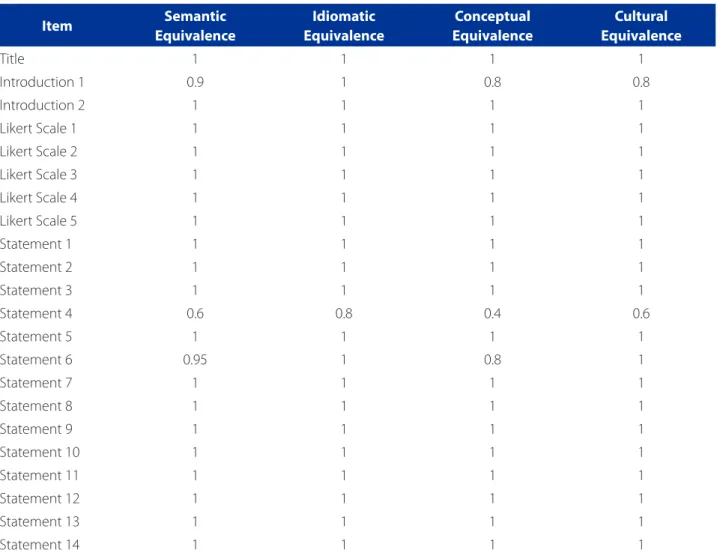
The steps of translation, synthesis, and back translation were carried out satisfactorily. Subsequently, the semantic, idiomatic, conceptual, and cultural equivalences of each item of the PSCI were evaluated by the committee of judg-es. In this step, the CVI was calculated for each item in the synthesis version of the scale. Table 1 shows the agreement ratio of the experts.
In this evaluation stage, the items “Title”, “Likert scale 2”, “Likert scale 4”, and “Statement 1” obtained 100% concor-dance in all the equivalences and were kept unchanged. The CVI of the items “Introduction 2”, “Likert scale 1”, “Likert scale 3”, and “Likert scale 5”, and statements 2, 3, 5, 7, 8, 9, 10, 11, 12, 13, and 14 obtained 100% concordance; how-ever minor changes were made to these items according to the judges’ suggestions to achieve better idiomatic and conceptual equivalences. The changes were the following:
”Likert 1” and “Likert 5”: the word “completely” was
re-placed by “totally”;
”Likert 3”: the word “uncertain” was deleted,
maintain-ing only the expression “not sure”;
Statement 2: “I’m not shorter than people my age” was
altered to “I don’t think I am shorter than people my age, that is, I think I am taller or the same height”;
Statements 3, 5, 6, 7, 8, 9, 10, 11, 12, 13, and 14: the
term “my health condition” was replaced with “my health status”;
Statement 7: the expression “the career I would like”
was replaced with “the profession I choose”;
Statement 8: the expression “indicates that I will live”
was replaced with “doesn’t stop me from living”;
Statement 9: the words “indicates” and “physical
lems” were replaced with “shows” and “health prob-lems”, respectively;
Statement 11: the expression “won’t” was replaced
with “isn’t going to”;
Statement 13: the term “restrict” was replaced with
the word “affect”.
To ensure adaptation to the conceptual equivalence, that is, guarantee that the situations depicted or portrayed in the items truly assess the perception of the adolescents on the severity of their chronic disease, the following changed were made:
Statement 8: the phrase “indicates that I will live” was
replaced with “doesn’t stop me from living”, to clari-fy that this item refers to perception rather than to a clinical observation;
Statement 12: the phrase “indicates that I’m not doing
so well at school” was replaced with “doesn’t let me do so well at school”.
Only the items “Introduction 1”, “Statement 4”, and “Statement 6” did not show 100% concordance in the CVI. “Introduction 1” had an 80% concordance in the idiomatic and cultural equivalences, and a 100% concordance in the other equivalences; “Statement 4” obtained 80% in the se-mantic equivalence, 40% in the idiomatic equivalence, and 60% in the conceptual and cultural equivalences, while “Statement 6” obtained 80% in the conceptual equivalence and 100% in the other equivalences. These items were dis-cussed among the members of the committee until they reached a consensus to define the pre-test version.
To ensure a better idiomatic equivalence, that is, adapt the translated item in terms of the idiomatic and colloquial expressions, the following changes were made to the instrument:
“Introduction 1”: the terms “indicate” and “affirmations” were replaced with “mark” and “statements”, respectively;
Statement 6: the verb “would like” was replaced with
the verb “I like”.
To ensure adaptation to the conceptual equivalence, that is, guarantee that the situations depicted or portrayed in the items truly assess the perception of the adolescents on the severity of their chronic disease, the following changed were made:
Statement 4: the phrase “I’m not” was replaced
self-perception. The order of the sentences was also changed to improve cohesion and coherence. In addition, after the pre-test stage, the sugges-tions of the study subjects were considered and the phrase “not so much because of puberty” was replaced with “not because of the phase of adoles-cence (puberty)”;
The pre-test was applied to a sample of 30 subjects composed of adolescent diabetic patients of both sexes, with a predominance of girls (65.52%). The average age of the subjects was 13.76 years old (standard deviation = 2.46). In all, 96.55% of the subjects were diagnosed with Diabetes Mellitus type 1 (DM1), with an average diagno-sis time of 7.05 years (standard deviation = 4 years). All the subjects were being treated with insulin therapy and fol-low-up in primary and secondary school.
In this stage, the participants reported some specific difficulties. These difficulties were:
In Statement 4, “I don’t think I’m as well developed
as people my age and it’s not so much because of puberty”, they stated that the term “puberty” was dif-ficult to understand, and the expression “it’s not so much because of puberty”, was confusing.
Reading or interpretation errors were perceived
in statements 2 (33.33%), 5 (20%), 7 (13.33%), 11 (13.33%), and 13 (10%). In all, the word that seemed to cause the reading or interpretation error was “no”. In some statements, the candidates stated they had not read the word “no” in the items. In other in-stances, even after reading the word “no”, the sub-jects said they had not understood the statement and suggested removing the word and putting the
Item Semantic
Equivalence
Idiomatic Equivalence
Conceptual Equivalence
Cultural Equivalence
Title 1 1 1 1
Introduction 1 0.9 1 0.8 0.8
Introduction 2 1 1 1 1
Likert Scale 1 1 1 1 1
Likert Scale 2 1 1 1 1
Likert Scale 3 1 1 1 1
Likert Scale 4 1 1 1 1
Likert Scale 5 1 1 1 1
Statement 1 1 1 1 1
Statement 2 1 1 1 1
Statement 3 1 1 1 1
Statement 4 0.6 0.8 0.4 0.6
Statement 5 1 1 1 1
Statement 6 0.95 1 0.8 1
Statement 7 1 1 1 1
Statement 8 1 1 1 1
Statement 9 1 1 1 1
Statement 10 1 1 1 1
Statement 11 1 1 1 1
Statement 12 1 1 1 1
Statement 13 1 1 1 1
Statement 14 1 1 1 1
Table 1 – Content Validity index (CVI) obtained by the committee of experts referent to the semantic, idiomatic, conceptual, and cultural equivalences of the Brazilian version of the Perception of Severity of Chronic Illness – PSCI. Campinas, SP, 2015
Items Synthesis version
Perception of Severity of Chronic Illness (PSCI)
Brazilian Version after Pre-Test
Perception of Severity of Chronic Illness (PSCI)
Title Perception of Severity of Chronic Illness (PSCI) Perception of Severity of Chronic Illness (PSCI)
Introduction 1 Indicate your answers for the following
affirmations using the scale described below.
Mark your answers to the statements using the scale described below.
Introduction 2 There are no right or wrong answers, because
everyone is entitled to their own opinions.
There are no right or wrong answers, everyone is entitled to their own opinions.
Likert 1 Completely disagree Totally disagree
Likert 2 Disagree Disagree
Likert 3 Uncertain (not sure) Not sure
Likert 4 Agree Agree
Likert 5 Completely agree Totally agree
Statement 1 I look different from people my age. I look different from people my age.
Statement 2 I’m not shorter than people my age. I DON’T think I am shorter than people my age,
that is, I think I am taller or the same height.
Statement 3 My health condition is not very serious. My health status is NOT very serious.
Statement 4 I’m not as well developed (not so much
because of puberty) as the people my age.
I do NOT think I am as well developed as people my age, and it’s not because of the phase of adolescence (puberty).
Statement 5 My health condition doesn’t stop me from
being as active as I’d like.
My health does NOT stop me from being as
active (a) as I’d like.
Statement 6 My health condition prevents me from
practicing the sports that I would like.
My health prevents me from practicing the sports that I like.
Statement 7 My health condition is not going to stop me
from pursuing the career that I would like.
My health will NOT stop me from pursing the
profession I choose.
Statement 8 My health condition indicates that I will live as
much as other people my age.
My health does NOT stop me from living as
much as other people my age.
Statement 9 My health condition indicates that my physical
problems will get worse over the years.
My health status shows that my health problems will get worse over the years.
Statement 10 My health condition indicates that I have a lot
to expect from my future.
My health status indicates that I have a lot to expect from my future.
Statement 11 My health condition won’t stop me from
having children.
My health status is NOT going to stop me from
having children.
Statement 12 My health condition indicates that I’m not
doing so well at school as I could.
My health status does NOT allow me to do so
well at school as I could.
Statement 13 My health condition does not restrict my social
life. My health status does NOT affect my social life.
Statement 14 My health condition has affected my
relationship with my parents.
My health status has affected my relationship with my parents.
Chart 1 – Presentation of the synthesis version subjected to content validity and final version of Perception of Severity of Chronic Illness – PSCI, translated and adapted to Brazilian Portuguese. Campinas, SP, 2015
phrase in the affirmative. To address the difficulties encountered by the adolescents, the word “no” in the referred items was typed in bold uppercase let-ters in the final instrument.
Chart 1 shows the synthesis version evaluated by the committee of experts and the final version obtained af-ter the translation and adaptation of the PSCI to Brazilian Portuguese.
Regarding the practicality of the Brazilian Portuguese version of the PSCI evaluated in the pre-test phase (n = 30), the results show that 93.33% of participants agreed that the questionnaire instructions were easy to understand, 86.66% reported that they had no difficulties marking the answers of the questionnaire, and 96.66% reported they understood the questions of the questionnaire. The aver-age time needed to complete the questionnaire was 3.49 (standard deviation = 1.12) minutes.
Reliability
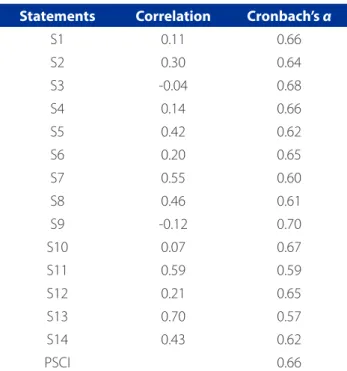
The internal consistency of the scale was verified us-ing Cronbach’s alpha with a sample of 29 subjects, one of which was missing and subsequently excluded. Cronbach’s alpha coefficient for the instrument (n = 29) was 0.66. Table 2 shows the reliability of each statement.
DISCUSSION
The aim of this study was to translate and adapt the PSCI to Brazilian Portuguese, and assess its applicability for diabetic adolescents in outpatient follow-up at a university hospital in the interior of São Paulo, Brazil.
The steps of translation, back translation, and synthesis of the PSCI were successful. In this process, the language must be culturally and conceptually adapted to the popu-lation of interest, while maintaining the goal of the original instrument. The percentage of concordance of the com-mittee of experts was 95% of the statements with a CVI of 1.00, which is recommended in international literature for
committees composed of five judges(12-13). The face-to-face
meeting between the members of the committee enabled extended discussion of all the items until concordance of the translation was reached to facilitate understanding of the instrument.
The Brazilian version of the PSCI was submitted to a pre-test to maintain the meaning of the original ver-sion, improve understanding, and detect errors and/or problems during application of the instrument that was
being adapted(10, 19). The results of the pre-test stage of
the Brazilian version of the PSCI showed that, despite the changes made in the content validation stage ac-cording to the recommendation of the committee of judges, the instrument was not easily understood by the diabetic adolescents in follow-up at the university hospital. This observation led to minor changes to bet-ter adapt the instrument.
Regarding these changes, 30% of the subjects – during the pre-test – noted that statement 4 was diffi-cult to understand, and more than half stated they did not know the meaning of the term “puberty”, which was mainly associated with “adolescence” or “something to do with adolescence”. Although the term “puberty” is not conceptually synonymous with “adolescence”, it co-incides with this period in the normal development of sexual maturity. Consequently, in the Brazilian version of the PSCI, the term “puberty” was replaced with “phase of adolescence (puberty)”.
Regarding the usability of the instrument, although
the vast majority believed it was easy to understand,
completed the instrument within the average time (3.5 minutes), and did not have major difficulties, some inter-pretation problems were detected in relation to the word “no”. Therefore, we decided to highlight the term to avoid
Statements Correlation Cronbach’s α
S1 0.11 0.66
S2 0.30 0.64
S3 -0.04 0.68
S4 0.14 0.66
S5 0.42 0.62
S6 0.20 0.65
S7 0.55 0.60
S8 0.46 0.61
S9 -0.12 0.70
S10 0.07 0.67
S11 0.59 0.59
S12 0.21 0.65
S13 0.70 0.57
S14 0.43 0.62
PSCI 0.66
Table 2 – Cronbach’s alpha coefficient for each item of the questionnaire Perception of Severity of Chronic Illness – PSCI. Campinas, SP, 2015
interfering with the balance between the positive and negative statements(9).
In the test stage of the study, which sought pre-liminary reliability data of the PSCI, the internal consis-tency values of the instrument were below the desir-able value (0.66), which may be related to respondents’ reported difficulties in understanding the statements, considering that the calculation of this index involves the correlations between the items of the instrument. When the items are correlated, the answers follow the same direction. If, in some items, the subjects answer in a contradictory manner, a lower correlation and, con-sequently, a low alpha value are expected(16). Another possibility is that the instrument does not specifically target diabetic adolescents, but also adolescents with cystic fibrosis(9).
One of the biggest challenges of the treatment of DM is patient adherence to treatment. Among the process-es of diabetprocess-es care, it is important to consider the fac-tors that hinder certain attitudes required for treatment, such as the perceptions and conceptions of the disease
itself(20). In this regard, the present study provides the first
questionnaire that assesses the perception of severity of the chronic disease DM among adolescents for use in the clinical practice and nursing research to create new ther-apy plans and strategic approaches that improve patient adherence to treatment.
CONCLUSION
The adaptation of the Brazilian version of the PSCI to Portuguese was a rigorous process that observed the recommendations of international literature. The adapt-ed version was consideradapt-ed adequate in terms of its se-mantic, idiomatic, cultural, and conceptual equivalence, and proved practicable in relation to the average com-pletion time.
However, so far, the obtained results were insufficient to confirm the reliability of the adapted version. We sug-gest new studies with patients suffering from chronic conditions, such as cystic fibrosis, and other populations of adolescents with diversified sociodemographic charac-teristics in treatment for diabetes mellitus.
FINAL CONSIDERATIONS
The limitations of this study are the non-validation of the measurement properties of the Brazilian version of the PSCI, and the absence of studies on the translation
and validation of the PSCI in other cultures, which limits analysis of the methodological process.
REFERENCES
1. Shaw JE, Sicree RA, Zimmet PZ. Global estimates of the prevalence of diabetes for 2010 and 2030. Diabetes Res Clin Pract. 2010;87(1):4-14.
2. Hlatky MA, Chung SC, Escobedo J, Hillegass WB, Melsop K, Rogers W,et al. The effect of obesity on quality of life in patients with diabetes and coronary artery disease. Am Heart J. 2010;159(2):292-300.
3. International Diabetes Federation (BE). IDF Diabetes Atlas. 6th ed. Brussels: International Diabetes Federation; 2013 [cited 2015 Oct 28]. Available from: http://www.diabetesatlas.org/component/attachments/?task=download& id=76.
4. Costa JA, Balga RSM, Alfenas RCG, Cotta RMM. Health promotion and diabetes: discussing the accession and the motivation of diabetic individuals health pro-gram participants. Cienc Saude Coletiva. 2011;16(3):2001-9.
5. Broadbent E, Donkin L, Stroh JC. Illness and treatment perceptions are associ-ated with adherence to medications, diet, and exercise in diabetic patients. Dia-betes Care. 2011;34(2):338-40.
6. Gibbons CJ, Kennig C, Conventry PA, Bee P, Bundy C, Fisher L, et al. Develop-ment of a multimorbidity illness perceptions scale (MULTIPleS). Plos One. 2013;8(12):1-12.
7. International Diabetes Federation (BE). Global IDF/ISPAD Guideline for diabetes in childhood and adolescence. Brussels; 2011 [cited 2015 Oct 28]. Available from: http://www.idf.org/sites/default/files/Diabetes-in-Childhood-and-Ado-lescence-Guidelines.pdf.
8. Kaptein JB, Bijsterbosch J, Scharloo M, Hampson SE, Kroon HM, Kloppen-burg M. Using the common sense model of illness perceptions to examine osteoarthritis change: a 6-year longitudinal study. Health Psychology. 2010;29(1):56-64.
9. Leung SS, Steinbeck KS, Morris SL, Kohn MR, Towns SJ, Bennett DL. Chronic ill-ness perception in adolescence: implication for the doctor-patient relationship. J Paediatr Child Health. 1997;33(2):107-12.
10. Beaton D, Bombardier C, Guillemin F, Ferraz MB. Recommendations for the cross-cultural adaptation of the DASH QuickDASH outcome measures. Toronto: Institute for Work & Health; 2007 [cited 2015 Oct 28]. Available from: http:// www.dash.iwh.on.ca/sites/dash/files/downloads/cross_cultural_adapta-tion_2007.pdf.
11. Polit DF, Beck CT. Fundamentos de pesquisa em enfermagem: avaliação de evi-dências para a prática de enfermagem. 7. ed. Porto Alegre: Artmed; 2011. 12. Alexandre NMC, Coluci MZO. Validade de conteúdo nos processos de
cons-trução e adaptação de instrumentos de medidas. Cienc Saude Coletiva. 2011;16(7):3061-8.
13. Polit DF, Beck CT. The content validity index: are you sure you know what’s be-ing reported? critique and recomendations. Res Nurs Health. 2006;29(5):489-97.
14. World Health Organization (CH) [Internet]. Geneva: WHO, c2015- [cited 2015 Jul 02]. Adolescent development; [about 2 screens]. Available from: http:// www.who.int/maternal_child_adolescent/topics/adolescence/dev/en/. 15. Coluci MZO, Alexandre NMC. Development of a questionnaire to evaluate the
usability of assessment instruments. Rev Enferm UERJ. 2009;17(3):378-82. 16. Hair F, Hult GTM, Ringle CM, Sarstedt M. A primer on partial least squares
17. Brasil. Conselho Nacional de Saúde. Resolução n° 466, de 12 de dezembro de 2012. Diretrizes e normas regulamentadoras de pesquisas envolvendo seres humanos. Diário Oficial da União [da] República Federativa do Brasil. 2013 jun 13;150(112 Seção 1):59-62.
18. Lopes IM, Apolinario PP, Lima MHM. Tradução e adaptação transcultural do instrumento “Perception of Severity of Chronic Illness” [monografia]. Campinas: Faculdade de Enfermagem, UNICAMP; 2015.
19. Acquadro C, Conway K, Hareendran A, Aaronson N, European Regulatory Issues and Quality of Life Assessment (ERIQA) Group. Literature review of methods to translate health-related quality of life questionnaires for use in multinational clinical trials. Value Health. 2008;11(3):509-21.
20. Pontieri FM, Bachion MM. Crenças de pacientes diabéticos acerca da terapia nutricional e sua influência na adesão ao tratamento. Ciênc Saúde Coletiva. 2010;15(1):151-60.
Corresponding author: Maria Helena de Melo Lima E-mail: [email protected]