ABSTRACT
BACKGROUND AND OBJECTIVES: Shoulder pain limits
patients’ ability to perform daily life activities, as well as to carry out professional activities. his study aimed at evaluating the re-lationship between pain intensity, incapacity and medical image indings of patients with shoulder pain.
METHODS: his was an observational analytical study with 54 patients with possible shoulder injury. Participants have an-swered an incapacity questionnaire, a pain intensity scale and then were submitted to image exams. Incapacity, pain intensity and image diagnosis were correlated, in addition to comparing pain intensity and level of incapacity among participants with and without medical image abnormalities.
RESULTS:Mean pain intensity was 7.4±2.52. here has been a high degree of incapacity (mean of 57.2%). Image indings have shown abnormalities in 59.3% of reports. here has been no correlation between image indings and pain intensity, as well as there has also been no correlation between image indings and incapacity. here has been high correlation between pain intensi-ty and incapaciintensi-ty (Rho=0.67; p<0.001). Pain intensiintensi-ty and inca-pacity were not diferent between participants with and without some type of abnormality at image exams.
CONCLUSION:Patients with shoulder complaints may have limitations to perform daily activities and pain, even with nega-tive image indings.
Keywords:Deicit evaluation, Medical exams, Physical evalua-tion, Radiography, Shoulder pain.
Pain intensity and functional limitation are not related with medical
image findings in patients with shoulder pain*
A intensidade da dor e a limitação funcional não estão relacionadas com os achados em
imagens de pacientes com dor no ombro
Francine Aparecida Coelho de Oliveira1, Renato Santos de Almeida2, Wagner Teixeira dos Santos3, Leandro Alberto Calazans
Nogueira4
*Received from University Center Augusto Motta, Rio de Janeiro, RJ, Brazil.
1. Santa Helena Clinic, Cruzeiro, SP, Brazil.
2. Teaching Hospital Gafrée e Guinle, Rio de Janeiro, RJ, Brazil.
3. Municipal Rehabilitation Center of Rio de Janeiro, Rio de Janeiro, RJ, Brazil. 4. University Center Augusto Motta, Federal Institute of Education, Science and Technology of Rio de Janeiro, Rio de Janeiro, RJ, Brazil.
Submitted in May 30, 2014.
Accepted for publication in August 25, 2014. Conlict of interests: none.
Correspondence to:
Leandro Alberto Calazans Nogueira
Avenida Alfredo Balthazar da Silveira, 419 - bloco 01/aptº2308 22790-710 Rio de Janeiro, RJ, Brasil.
E-mail: [email protected]
© Sociedade Brasileira para o Estudo da Dor
RESUMO
JUSTIFICATIVA E OBJETIVOS: O quadro doloroso do
ombro limita o paciente de realizar suas tarefas diárias, as-sim como de realizar atividades dentro da sua jornada de trabalho. O objetivo deste estudo foi avaliar a relação entre a intensidade da dor, a incapacidade e os achados no exame de imagem de pacientes com dor no ombro.
MÉTODOS: Foi realizado um estudo observacional analíti-co em 54 pacientes analíti-com possível lesão de ombro. Os partici-pantes responderamum questionário de incapacidade, uma escala de intensidade de dor e em seguida foram submetidos ao exame de imagem. Foi realizada a análise de correlação entre a incapacidade, a intensidade de dor e o diagnóstico por imagem, além da comparação da intensidade da dor e do nível de incapacidade entre os participantes com e sem anormalidade no exame de imagem.
RESULTADOS: A intensidade de dor média encontrada foi de 7,4±2,52. Houve alto grau de incapacidade (média de 57,2%). Nos exames de imagem analisados foram encon-tradas anormalidades em 59,3% dos laudos. Não houve correlação entre os achados na imagem e a intensidade de dor, assim como não houve correlação entre os achados na imagem e a incapacidade. Observou-se alta correlação entre intensidade de dor e o nível de incapacidade (Rho=0,67; p<0,001). A intensidade de dor e incapacidade não foram diferentes entre os participantes com ou sem algum tipo de anormalidade nos exames de imagem.
CONCLUSÃO: Pacientes com queixas na região do ombro podem apresentar limitações nas atividades de vida diária e presença de dor, mesmo sem achados no exame de imagem.
Descritores: Avaliação da deficiência, Dor de ombro, Exame físico, Exames médicos, Radiografia.
INTRODUCION
Complaints of upper extremity pain and incapacity are common reports in orthopedics. It is estimated that ap-proximately 20% of general population have upper ex-tremity chronic pain1, among them shoulder impairment.
rotator cuff tendinopathy, impingement syndrome, acro-mioclavicular joint disorder and adhesive capsulitis3.
With the introduction of ultrasound using high resolution transducers, X-rays digitalization, modern computerized tomography and magnetic resonance imaging, the diag-nostic capacity of the shoulder and other musculoskeletal system areas exams was widely expanded. Nevertheless, correlation among image findings, pain and alterations at physical evaluation is controversial4.
Physical shoulder evaluation has similar incapacity pat-terns regardless of clinical diagnosis. Decreased move-ment amplitude for shoulder elevation is a frequent find-ing in some conditions such as: impfind-ingement syndrome, rotator cuff tendinopathy, bursitis and adhesive capsu-litis. In general, limited shoulder elevation is associated to limitations of daily life activities. A study5 has found
more than 70% of the sample with problems to sleep comfortably on the affected shoulder, wash the back at the shoulder opposite to the affected one, raise 3.6kg and throw a ball over the head.
Shoulder pain limits common daily activities such as car-rying out professional tasks. Considering this association, this study aimed at evaluating the relationship between pain intensity and incapacity, and image findings of pa-tients with shoulder pain.
METHODS
This was a transversal, observational and analytical study with 54 patients with possible shoulder injury, carried out in the imaging clinic Dr. Niazi Dias Rubez. Participants were approached at the time of the imaging exam, regard-less of being X-ray or ultrasound. Inclusion criteria were having a request for shoulder imaging exam, aged above 18 years, regardless of gender. Exclusion criteria were non-collaborative patients, with some cognitive deficit or with previous shoulder surgery.
Participants agreeing to participate were asked to answer an incapacity questionnaire and a pain intensity scale. Data were collected while patients were waiting for the im-aging exam. After filling the incapacity questionnaire and the pain scale, patients were submitted to regular exam. Upper extremity incapacity was measured with the short version of the self-applicable Disabilities of the Arm, Shoulder and Hand (DASH) questionnaire. This question-naire was originally developed in English and was called DASH Questionnaire. DASH was developed by Hudak, Amadio and Bombardier6 with the aim of measuring
physi-cal incapacity and upper limbs (UULL) symptoms in a het-erogeneous population. Orfale et al.7 have translated and
adapted DASH for Brazilian Portuguese. Variables were analyzed by modules proposed by DASH.
DASH questionnaire short version has 19 questions (scored one to five). QuickDash scores were calculated as follows: [(sum of answers / n) - 1] x 25, being n the complete number of answers. Score obtained quantifies
the degree of UULL physical incapacity. The higher the result, the higher the incapacity. Score is considered excel-lent (>20 points), good (20 to 39 points), regular (40 to 60 points) and poor (>60 points). Psychometric properties of the Brazilian questionnaire short version were evaluated by Puga et al.8 and its use is recommended for patients with
shoulder pain.
Pain intensity was evaluated by the pain numerical scale. Pain numerical scale has scores from zero (no pain) to 10 (worst imaginable pain). Patients were oriented to identify the number best representing their pain intensity in previ-ous week.
Imaging exams were X-rays and ultrasound. Radiographs were performed by a single technician in the positions: corrected anteroposterior (AP) and scapula profile in a digital device (SHIMADZU MEDICAL). Such incidences were chosen for clearly depicting structures involving such joint. According to Turtelli9, the corrected AP incidence
is performed in anteroposterior, with 30o rotation of
pa-tients to the side of the examined shoulder. This is made to correct glenoid anteversion and humerus retroversion tangent to joint in AP. The scapula profile or Y incidence, tunnel or outlet incidence, was performed with the patient straight with the shoulder to be examined posteriorly ro-tated in 10o, enough to dissociate the contralateral
shoul-der. Central radius focused on the achromium inclined 20o
caudally.
Ultrasound exam was performed by a single experienced physician who was not previously notified or the use of reports, in positions: elbow flexion at 90o to evaluate
tendon of the long head of biceps, external rotation to evaluate subscapular tendon, external rotation with arm extension (asking patients to put the back of the hand on their back) to evaluate supraspinal tendon, abduction with the hand on waist to evaluate infraspinal tendon, internal rotation with horizontal abduction (hand on opposite shoulder) to evaluate the acromioclavicular joint. Bursae were observed in neutral position, as well as in abduction and aduction.
As from imaging exams reports analysis, participants were classified in three groups: group 1 with preserved ana-tomical structure (normal), group 2 with impingement syndrome signs (bursitis, tendinopathy) or group 3 with degeneration signs.
Statistical analysis
Data distribution was analyzed by the Shapiro-Wilk test. Correlation between incapacity and pain intensity and im-aging diagnosis was analyzed by the Pearson or Spearman correlation coefficient, according to data distribution na-ture. Correlation above 0.90 was considered as very high, (0.70-0.89) high, (0.50-0.69) moderate, (0.30-0.49) low, and below 0.29 as discrete10. Sample was divided according
Mann-Whit-ney T and U tests, according to data distribution nature. Significance level was 0.05 for all statistical tests. Statisti-cal analysis was carried out with the StatistiStatisti-cal Package for Social Sciences (SPSS – version 17).
All participants have signed the Free and Informed Con-sent Term (FICT). This study was carried out in compli-ance with resolution 466/12 of the National Health Coun-cil and with the Declaration of Helsinki of 1975.
This study was approved under number CAAE 14939213. 2.0000.5258/2013.
RESULTS
Mean pain intensity was 7.4±2.52. Most frequent pain in-tensity (13 patients) was the highest score (score 10) and the second most frequent score was 5, corresponding to 8 patients. There has been high degree of incapacity (mean of 57.2%) measured by the QuickDASH questionnaire. Most answers were scored as moderate or severe difficulty. Pain intensity, incapacity and imaging exam reports char-acteristics are shown in table 1.
Table 1. Pain intensity, incapacity and imaging exam report cha-racteristics of patients with possible shoulder injury (n=54)
Characteristics Values
Incapacity (QuickDash) (mean±SD) 57.2±22.2
Pain intensity (mean±SD) 7.4±2.5
Diagnosis
Normal absolute value (%) 22 (40.7)
Subacromial impingement signs absolute value (%)
28 (51.9)
Degeneration signs absolute value (%) 4 (7.4)
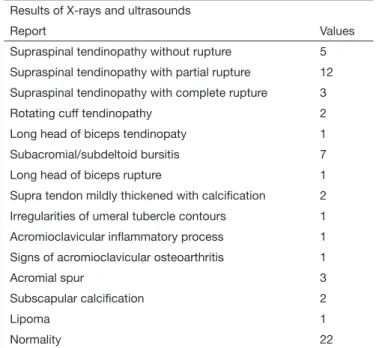
Abnormalities were found in 32 (59.3%) of reports of analyzed imaging exams. In 25 reports some type of tendinopathy was found and in 7 subjects image was compatible with bursitis, the two latter characterizing impingement syndrome, which supposedly is the major complain, tendinopathy and/or bursitis. Distribution of diagnoses found in imaging exams is shown in table 2. Correlation analysis has shown no correlation between imaging findings and pain intensity (Rho=0.19; p=0.89). There has also been no correlation between imaging findings and incapacity (Rho=0.07; p=0.61). The only statistically significant correlation classified as high correlation was observed between pain intensity and incapacity level (Rho=0.67; p<0.001) (Figure 1).
Pain intensity and incapacity results were not significantly different among participants having or not some type of alteration at imaging exams. Figures 2 and 3 show the comparison between pain intensity mean and incapacity mean, respectively, in groups with normal and abnormal images.
Table 2. Distribution of diagnoses found in imaging exames of pa-tients with possible shoulder injury (n=54)
Results of X-rays and ultrasounds
Report Values
Supraspinal tendinopathy without rupture 5
Supraspinal tendinopathy with partial rupture 12
Supraspinal tendinopathy with complete rupture 3
Rotating cuff tendinopathy 2
Long head of biceps tendinopaty 1
Subacromial/subdeltoid bursitis 7
Long head of biceps rupture 1
Supra tendon mildly thickened with calciication 2
Irregularities of umeral tubercle contours 1
Acromioclavicular inlammatory process 1
Signs of acromioclavicular osteoarthritis 1
Acromial spur 3
Subscapular calciication 2
Lipoma 1
Normality 22
Figure 1. Correlation between pain intensity and incapacity in patients with possible shoulder injury (n=54)
Incapacity
Pain intensity
10 9 8 7 6 5 4 3 2 1 0
0 20 40 60 80 100
Figure 2. Comparison of pain intensity in groups with normal ima-ge and imaima-ge with injury in patients with possible shoulder injury (n=54)
Image with injury 10
8
6
4
2
0
DISCUSSION
Patients with shoulder complaints who were referred to imaging exams and were evaluated in this study had high pain intensity, high level of incapacity and different im-aging exam findings. Pain intensity was highly correlated to incapacity level. Although several patients had imaging exam findings, anatomical injury was not related to pain intensity or to incapacity level.
Rotator cuff injuries may be related to the aging process since it is more likely to find MRI abnormalities in the as-ymptomatic elderly population as compared to youngsters with painful shoulder without such injuries11. According to
Zorzetto et al.12 approximately 60% of shoulder alterations
are related to rotator cuff injuries. However, only 10% of rotator cuff injuries may have morphological changes which may be tendon retraction, muscle atrophy and in-filtrations13.
The comparison of pain intensity and incapacity level among patients with and without imaging injuries has shown no difference in such characteristics between groups. A previous study using MRI in patients with shoulder in-juries has shown that although tendinopathy and bursitis findings were frequent, their contribution to symptoms was low. Analyzing the function, the same authors have found results similar to those presented here and have ob-served that daily life activities were not affected even in cases of complete or incomplete rotator cuff rupture11.
Hodges and Tucker14 have reviewed the influence of pain
in the performance of activities with movement and have described that painful stimulation leads to changes in mus-cle behavior, in movement patterns, in addition to decreas-ing movement speed and other repercussions in central and peripheral nervous systems. So, the presence of pain should better explain incapacities of patients as compared to imaging findings.
Literature reports confirm our findings and point to the fact that tissue injury not always reflects the functional condition to perform dynamic tasks. That is, the sever-ity of structural degeneration of joints and soft tissues is
not directly related to the level of functional alteration in most patients with musculoskeletal injuries. One should also stress that complementary exams, in many cases, are not relevant and “false positive” radiological findings are increasingly common15.
Finding association between symptoms and images is a challenging and critical task for clinical decision-making. There are reports of high prevalence of rotator cuff injuries in asymptomatic populations16-18. So, the misuse of images
without clinical data may greatly decrease treatment effec-tiveness and lead professionals to make inadequate thera-peutic choices11.
Due to discrepancies between presence of pain and inca-pacity and imaging exams findings, in the last decades, outcomes such as health-related quality of life, functional capacity, pain scales and patients satisfaction have been used as evaluation tools. For allowing the analysis of health status and disease manifestations in the life of individu-als according to their own perspective, such evaluations complement clinical and objective data, such as movement amplitude, muscle strength and complementary exams19.
It is known that imaging exams results depend on exam-iner’s skills to perform the technique and lack of report ac-curacy may cooperate for some differences in results found in our study. The relationship between pain intensity and incapacity, which was the major finding of this study, may suffer interference of other factors, such as age, gender, oc-cupation, physical activity level, movement pattern. Fur-ther studies should control such factors to more accurately analyze the relationship found here. In addition, studies with MRI and a larger number of participants should also be carried out to confirm the findings of this study.
CONCLUSION
Patients with shoulder complaints may have limitations for daily life activities and the presence of pain, even without imaging findings. Pain intensity and incapacity level are not related to imaging findings.
REFERENCES
1. Gummesson C, Atroshi I, Ekdahl C, Johnsson R, Ornstein E. Chronic upper ex-tremity pain and co-occurring symptoms in a general population. Arthritis Rheum. 2003;49(5):697-702.
2. Bergenudd H, Lindgärde F, Nilsson B, Petersson CJ. Shoulder pain in middle age. A study of prevalence and relation to occupational work load and psychosocial factors. ClinOrthopRelat Res. 1988;(231):234-8.
3. Ostör AJ, Richards CA, Prevost AT, Speed CA, Hazleman BL. Diagnosis and relation to general health of shoulder disorders presenting to primary care. Rheumatology. 2005;44(6):800-5.
4. Maeda EY, Helfenstein Jr M, Ascencio JE, Feldman D. O ombro em uma linha de produção: estudo clínico e ultrassonográico. Rev Bras Reumatol. 2009;49(4):375-86. 5. Largacha M, Parsons IM 4th, Campbell B, Titelman RM, Smith KL, Matsen F
3rd. Deicits in shoulder function and general health associated with sixteen common shoulder diagnoses: a study of 2674 patients. J Shoulder Elbow Surg. 2006;15(1):30-9.
6. Hudak PL, Amadio PC, Bombardier C. Development of an upper extremity outco-me outco-measure: the DASH (disabilities of the arm, shoulder and hand) [corrected]. he Upper Extremity Collaborative Group (UECG).Am J Ind Med. 1996;29(6):602-8. 7. Orfale AG, Araújo PM, Ferraz MB, Natour J. Translation into Brazilian Portuguese,
cultural adaptation and evaluation of the reliability of the Disabilities of the Arm,
Figure 3. Comparison of incapacity in groups with normal image and image with injury in patients with possible shoulder injury (n=54)
Image with injury 100
90 80 70 60 50 40 30 20 10 0
Shoulder and Hand Questionnaire. Braz JMedBiolRes.2005;38(2):293-302. 8. Puga VO, Lopes AD, Shiwa SR, Alouche SR, Costa LO. Clinimetric testing supports
the use of 5 questionnaires adapted into Brazilian Portuguese for patients with shoul-der disorshoul-ders. J OrthopSportsPhysher. 2013;43(6):404-13.
9. Turtelli CM. Avaliação do ombro doloroso pela radiologia convencional. Radiol Bras. 2001;34(4):241-6.
10. McDowell I. Measuring health: a guide to rating scales and questionnaires. 3rded. New
York: Press OU; 2006. 10-54p.
11. Krief OP, Huguet D. Shoulder pain and disability: comparison with MR indings. AJR Am JRoentgenol. 2006;186(5):1234-9.
12. Zorzetto AA, Urban LA, Liu CB, Prevedello L, Zapparoli M, Vitola ML, et al. A ecograia no diagnóstico das lesões músculo-tendinosas do ombro. Radiol Bras. 2003;36(4):237-42.
13. Shahabpour M, Kichouh M, Laridon E, Gielen JL, De Mey J. he efectiveness of diagnostic imaging methods for the assessment of soft tissue and articular disorders of
the shoulder and elbow.EurJRadiol. 2008;65(2):194-200.
14. Hodges PW, Tucker K. Moving diferently in pain: a new theory to explain the adap-tation to pain. Pain. 2011;152(3 Suppl):S90-8.
15. Flynn TW, Smith B, Chou R. Appropriate use of diagnostic imaging in low back pain: a reminder that unnecessary imaging may do as much harm as good. JOrthopSports-Physher. 2011;41(11):838-46.
16. Sher JS, Uribe JW, Posada A, Murphy BJ, Zlatkin MB. Abnormal indings on magnetic resonance images of asymptomatic shoulders. J Bone Joint Surg Am. 1995;77(1):10-5. 17. Needell SD, Zlatkin MB, Sher JS, Murphy BJ, Uribe JW. MR imaging of the rotator
cuf: peritendinous and bone abnormalities in an asymptomatic population. AJR Am JRoentgenol. 1996;166(4):863-7.
18. Tempelhof S, Rupp S, Seil R. Age-related prevalence of rotator cuf tears in asympto-matic shoulders. J Shoulder Elbow Surg. 1999;8(4):296-9.