(Teleostei: Haemulidae) in Ceará state, Northeastern Brazil
Shinozaki-Mendes, RA.
a*, Santander-Neto, J.
b, Silva, JRF.
cand Hazin, FHV.
baUnidade Acadêmica de Serra Talhada, Laboratório de Biologia Pesqueira, Universidade Federal Rural de
Pernambuco – UFRPE, Fazenda Saco, s/n, CP 063, CEP 56900-000, Serra Talhada, PE, Brazil
bLaboratório de Oceanografia Pesqueira, Departamento de Pesca e Aquicultura, Universidade Federal Rural de
Pernambuco – UFRPE, Av. Dom Manuel de Medeiros, s/n, Dois Irmãos, CEP 52171-900, Recife, PE, Brazil
cLaboratório de Histologia, Departamento de Biologia, Universidade Federal do Ceará – UFC,
Av. Mister Hull, s/n, Bloco 909, Pici, CEP 60455-760, Fortaleza, CE, Brazil
*e-mail: [email protected]
Received March 6, 2012 – Accepted July 10, 2012 – Distributed May 31, 2013 (With 2 figures)
Abstract
The Haemulon plumieri is a typical reef-associated and tropical species found in warm and temperate waters of the
Western Atlantic. Due to the large fishing effort directed to H. plumieri, the knowledge about its reproductive biology is
essential for correct stock management and conservation. The aim of this study was to characterise reproductive biology with a focus on its seasonal variation of gonadal maturation stages, first maturation size and fecundity. Specimens were monthly collected and a total of119 females and 136 maleswere analysed. The reproductive cycle of Haemulon plumieri is seasonal, with higher activity between March and May. Size at first maturity (L50) was estimated at 16.86
and 18.55 cm for females and males, respectively. The total fecundity ranged between 17,816 and 120,333 mature oocytes per female and relative fecundity was 235 ± 63 oocyte.g–1 whereas batch fecundity varied between 20 and
25% from total fecundity. Since the species is widely caught, we suggest a closed season from March to May and to establish a minimum catch size of 18.5 cm for both sexes, since there is no evident sexual dimorphism.
Keywords: reproduction, fecundity, reef fish.
Biologia reprodutiva de
Haemulon plumieri
(Teleostei: Haemulidae) no Nordeste do Brasil
Resumo
O Haemulon plumieri é uma espécie tropical, associada aos recifes, encontrada em águas quentes e temperadas do
Atlântico Oeste. Em razão do grande esforço de pesca direcionado para a captura desta espécie, o conhecimento acerca da biologia reprodutiva é essencial para um correto manejo e a sua preservação. O objetivo do presente estudo foi caracterizar a biologia reprodutiva com um foco na variação sazonal dos estágios de maturação, no tamanho de primeira maturação e na fecundidade. Espécimens foram mensalmente coletados e um total de 119 fêmeas e 136 machos foi analisado. O ciclo reprodutivo de Haemulon plumieri é sazonal, com maior atividade entre os meses de
março e maio. O tamanho de primeira maturação (L50) foi estimado em 16,86 cm para as fêmeas e 18,55 cm para os machos. A fecundidade total variou de 17.816 a 120.333 oócitos maturos por fêmeas e a fecundidade relativa foi 235 ± 63 oócitos.g–1, enquanto que a fecundidade parcial variou entre 20 e 25% da fecundidade total. Uma vez que a
espécieé amplamente capturada, sugere-se que seja definido um período de defeso de março a maio e que se estabeleça um tamanho mínimo de captura de 18,5 cm, para ambos os sexos, já que não há dimorfismo sexual evidente.
Palavras-chave: reprodução, fecundidade, peixe recifal.
1. Introduction
The family Haemulidae is represented by 17 genera and about 150 species worldwide (Tavera et al., 2012). The
Genus Haemulon is represented by 16 species, of which
14 occur in Brazil (Rocha and Rosa, 1999), in Venezuela (Palazón-Fernandez et al., 2007), as well as in Central America (Bussing and López, 2010).
The Haemulon plumieri (Lacépede, 1801), popularly
In Ceará, Brazil, Haemulidae is the family of fishes most caught by the artisanal fishery in number of individuals (21% of total), with H. plumieri being responsible for
about 10%, also in number, of all fishes landed in the state (Silva, 2004).
In spite of the great ecological and economic importance of this species, only a few studies on its population dynamics have been carried out. Darcy (1983) conducted research of biological data from H. plumieri in the western North
Atlantic, and Silva and Murphy (2001) wrote a status summary of H. plumieri in the east coast of Florida, USA.
Among the most recent works, Murie and Parkin (2005) and Araújo and Martins (2007) studied age and growth of the species in the Gulf of Mexico and in southeastern Brazil, respectively. Only Palazón-Fernandes (2007) studied its reproductive biology in Margarita Island, Venezuela and Alves and Aragão (1973) described the maturation of the species in northeastern Brazil. Thus, there are many gaps to be filled and further studies to be made.
The knowledge about the reproductive biology of exploited species is fundamental for the correct stock
management and conservation. Among the essential
information, we can mention the first maturation size, which can be used as a minimum size of capture; the reproductive period, which can be used to determine closed seasons and all the study can be the basis to any effort of rearing that will be directed to this species.
In this context, the aim of this study was to characterise the reproductive biology of H. plumieri from northeastern
Brazil, with a focus on its seasonal variation of gonadal maturation stages, first maturation size and fecundity.
2. Material and Methods
Specimens of H. plumieri were monthly collected
between January 2006 and August 2007, off the state of Ceará, at distances from the shore ranging from 5 to 45 miles (03° 00’ S to 03° 45’ S and 038° 05’ W to 039° 00’ W)
using line and baited hook.
Animals were initially immobilised by thermal shock
at –5 °C and measured to obtain the total length (LT), fork length (LF) and total weight (WT). They were dissected for
the collection of the reproductive tract, then all viscera were removed and the eviscerated weight (WE) was recorded.
The classes of LF were defined using the formula proposed by Vazzoler (1996) in which the number of classes (K) is 1+3.222Log(n), where n is the total number
of individuals, and the class size is the range of LF divided
by K. The class size was approximately that of the closest whole number. Monthly differences in the length-frequency distribution (classes of LF) of males and females were
evaluated using the chi-square test (p < 0.05).
A fragment in the middle region of the gonads was collected from all specimens. These fragments underwent the traditional histological routine and stained by Hematoxylin-Eosin, Alcian Blue/ Periodic acid Schiff and Gomori’s Trichrome (for details, see Shinozaki-Mendes et al., 2013).
The identification of sex was made after microscopic examination of the gonads, based on the germ cells observed.
The scale proposed by Shinozaki-Mendes et al. (2013) was used to analyse maturation and gonad development, including the following stages for females: immature, maturing, ripe, partially spawning, spawning and resting and for males: immature, maturing, ripe and spent.
The “w” statistical test, which compares the values of
β0 and β1 from the equation, based on maximum likelihood and uses the chi-squared distribution (Zar, 1984), was used to determine whether there were statistically significant differences (p < 0.05) between male and female relationships
of LF × WE; WE × WT and LF × LT.
The spawning season was evaluated through the relative frequency of the gonadal maturation stages and through monthly values of the gonadal index (GI), which was calculated using the following formula adapted from Schaeffer and Orange (1956): GI = (WE × 104).(LFθ)–1,
Where “θ” is the coefficient of allometry of the relationship
LF × WE. This analysis included only adult females.
Total fecundity was estimated from 30 gonads at mature stage, following the gravimetric method proposed by Murua et al. (2003), in which a sample of oocytes (approximately 1 g) of a known weight are counted and extrapolated to the whole weight of the gonads (the pair). For the relative fecundity, it was established the relation between the total fecundity per weight (in g, ± standard deviation) and also the relation between total fecundity and
the LF and WT. In the analysis of batch fecundity, it was
estimated the ratio between the numbers of hydrated and mature oocytes in a histological cross section of individuals which had no post-ovulatory follicles (Vazzoler, 1996).
The sizes (FL) of first gonadal maturation (L50) and maximum maturity size (L99), sizes at which 50% and 99% of individuals are able to reproduce, respectively, were estimated through the following model:
Mf
=
(1 e
+
(β +β0 1 LF ))
−1 (Mendes, 1999), where Mf is the fraction of individuals able to reproduce.3. Results
3.1. Morphometric and sex ratios
A total of 255 specimens of H. plumieri were analysed;
119 were females and 136 males, resulting in a sex ratio of 1:1.14, a value statistically equal to 1:1 (p = 0.2986). The
monthly sex ratio was different only in March (p = 0.0035), when females were more numerous (Table 1).
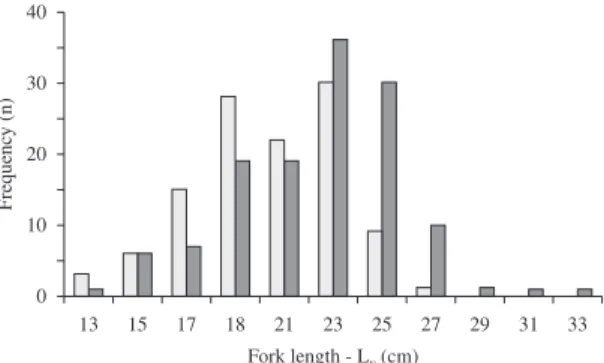
Male fork length ranged from 13.7 cm to 34.3 cm, with a higher proportion of individuals (78.5%) between 19.0 and 27.0 cm. Females showed smaller amplitude, ranging from 13.5 to 27.7 cm, with a mode (70.2%) situated between 19.0 and 25.0 cm (Figure 1).
The sex ratio between males and females by LF classes
showed statistical differences only between 25├ 27 and 27├ 29 cm (p < 0.001), with males being more abundant
than females, in both cases (Figure 1).
The ratios LF × WE, LF × WT, WE × WT and LF × LT
(p ≥ 0.05), and thus the sexes were analysed collectively. The
LF × WE ratio was potential: WE= 0.019LF2,997 (R2 =98.61%),
as well as the ratio LF x WT: WT= 0.023LF2.973 (R2 =98.25%). The ratio WE × WT and LF × LT showed a linear trend with best fit equation equal to WT =1.093WE –3.070 (R2 =99.64%)
and LT =1.139LF –0.268 (R2 =98.93%), respectively.
3.2. Reproductive cycle and gonadal indices
Although there were occurrences of maturing females throughout the year, the frequency of mature individuals was higher in March, April and May (Figure 2). It is still possible to observe mature females in a smaller percentage of individuals between July and August and December and January. Females at the “spawning” stage were more frequent in the months following those of higher occurrence of mature females, i.e. between June and August and January (Figure 2). The cycle of female reproduction may, based on the above, be classified as seasonal. The male reproductive cycle, unlike that of females, did not show a clear seasonal variation; specimens in all maturation stages having been found throughout the year (Figure 2).
Monthly mean gonadal indices (GI) of females showed the highest values between March and May, reaching a peak in April, August and December (Figure 2). The monthly mean GI of males exhibited much lower values than females (Figure 2), with very close peaks in April, July and August, and November. As in the distribution of maturational stages, there was no clear seasonal variation.
3.3. Size at first maturity and fecundity
The relationship between the proportions of individuals able to reproduce by length class indicate that females mature with lengths inferior to those of males, with L50
values (size at 1st maturity) equal to 16.86 and the males
with 18.55 cm (Table 2). The maximum size at maturation, in which almost all individuals reached maturity (L99) was equal to 23.23 and 24.49 cm for females and males, respectively, indicating a wide range of size for maturation.
Fecundity values varied between 17,816 and 120,333 mature oocytes per female. Total fecundity had the highest values in March and April, 67,809 ± 17,222 oocytes per
female, probably because it was the greatest reproductive activity cycle of the year. The lowest fecundity value, in contrast, was obtained during January and February, with an average of 42,583 ± 12,920 oocytes/female.
The mean relative fecundity was 235 ± 63 oocyte.g–1.
Fecundity did not show a direct correlation with the length or weight of individuals, a tendency to its increase or decrease
according to these variables not having been observed.
The fecundity per batch, i.e., percentage of hydrated oocytes among mature oocytes ranged between 20 and 25%, indicating that this is the portion of oocytes released per spawning. The batch of hydrated oocytes ranged between 10,702 and 14,683 with an average of 13,977 oocytes.
4. Discussion
The annual average sex ratio, equal to 1:1, is related to reproductive tactic, indicating a high probability of reproductive success (Shinozaki-Mendes et al., 2007). Billings and Munro (1974) when studying reef fishes in the Caribbean, found a predominance of females of H. plumieri,
although they have not carried out statistical analysis. The highest female proportion in March may be associated to small reproductive migrations to places characterised by the presence of rocks that serve as protection and shelter for mature females. Appeldoorn et al. (2009), analysing the Haemulidae family, highlight that they perform movements on the order of 100-300 m, and that this is an important mechanism for transferring nutrients and organic matter
across habitat boundaries.
Despite the H. plumieri not presenting a remarkable
sexual dimorphism, it was noticed that males from the population studied here show greater sizes than those of females. The highest relative frequency of females in classes with smaller size and the opposite occurring in
Table 1. Month distribution of females and males of H. plumieri, sampled on the coast of Ceará, between January 2006 and August 2007, and the Chi-square test value. * indicates statistical differences.
Month Female (n) Male (n) total x2 value
Jan. 14 23 37 2.19
Feb. 18 24 42 0.86
Mar. 14 5 19 4.26*
Apr. 10 8 18 0.22
May 8 6 14 0.29
June 9 10 19 0.05
July 8 6 14 0.29
Aug. 9 9 18 0.00
Sept. 7 13 20 1.80
Oct. 7 15 22 2.91
Nov. 7 8 15 0.07
Dec. 8 9 17 0.06
Total 119 136 255 1.13
classes with a bigger size seems to be a pattern to the specie. Araújo and Martins (2007) reported a greater abundance of H. plumieri females in classes inferior to 31 cm, while
males were prevalent in classes above this value. Palazón-Fernandez (2007) also reports that H. plumieri males are
larger and heavier than females. This feature is possibly related to the fact that females channel part of their energy for gonadal development, which features large increase in volume with maturity.
Ximenes and Menezes (1985) when studying H. plumieri
in the same region, found LF very close to those found in this study, indicating that after nearly 25 years, there was a slight increase. Frota et al. (2004) and Potts and Manooch (2001) studying H. plumieri in central Brazilian Coast and
in Florida (USA), respectively, also found a size range very similar to that presented here.
Values of θ close to isometry indicate proportionality in weight gain and increase in length for the species. Ximenes and Menezes (1985) and Frota et al. (2004) when relating the total weight versus fork length for H. plumieri, also
found a θ close to isometry. Araújo and Martins (2007) correlating total weight versus total length in turn, found the same tendency for this specie. Potts and Manooch (2001)
found a negative alometry that can be explained by the fact that the curve was skewed by smaller individuals of
H. plumieri not representing well the largest ones.
There was no significant relationship between gonad size and specimen size, but also between the gonad size and gonadal development stage. This feature can be associated to the partial spawning once the ovary can vary the volume according to the number of spawns.
The gonadal indices coupled with the distribution of maturational stages suggest that females reproduce almost all year round with more activity between March and May. Reproductive activity of H. plumieri in Venezuela
showed peaks of mature individuals in March, although it has occurred throughout the year (Palazón-Fernandez, 2007). A similar result was also found by Darcy (1983) on the bank of Campeche, where mature individuals were more abundant in April and May. In addition, Moe Junior (1966) in Florida also mentions the presence of mature females in May and June without occurrence however in July, indicating predominance of reproductive activity in spring (northern hemisphere). Compared with this study, there seems to be a synchrony on the year cycle, although this cycle corresponds to the autumn (rainy season) in the
Table 2. Equation of the ratio LF x Mf, R2 value, L50 and L99 values for males and females of H. plumieri, caught on the coast
of Ceará, between January 2006 and August 2007.
Equation R2 value L
50 (cm) L99 (cm)
Female Mf=(1+e12.1619+(–0.7214FL))–1 R2= 94.18% 16.858 23.228
Male Mf=(1+e–14.3508+(0.7735FL))–1 R2= 89.12% 18.554 24.495
Figure 2. Monthly distribution of gonadal maturation stages (in %) and gonad index (± confidence interval) of females and
southern hemisphere. The trigger to start or to increase the reproductive period in coral reef ecosystems can be directly related to environmental factors, such as temperature and ocean currents varying greatly from place-to-place (Munday et al., 2009).
Alves and Aragão (1973) mention that the smallest female at maturity had 11 cm and while the smallest male had 12 cm. However, these values do not correspond to the first maturity size (L50). Darcy (1983) found an L50 quite
similar to the present study. Billings and Munro (1974) and Palazón-Fernandez (2007) in turn, reported bigger first maturation size in Jamaica and Venezuela. The high values at first maturity (L50) found in Venezuela can be explained by the fact that the author did not use the “resting” stage in its rating scale, which can lead to erroneous classification of “resting” individuals as “immature” ones. Considering the size at first maturity found in this study, less than 10% of males and females are juveniles. This is an indication that the fishery acts predominantly on the adult stock, and this is favourable for maintaining the H. plumieri stocks.
Brown-Peterson et al. (2001) highlight that Gonadal indices should not be used for comparing or indexing maturity stages, particularly in multiple spawning fish. This concern is relevant, and, for this reason, we emphasize the importance of microscopic analysis for comparison. Since the changes were similar both in GI and seasonal variation of maturation stages, it can be stated that the
results are reliable.
Concerning H. plumieri fecundity, García-Cagide (1987)
reported higher fecundity in Cuba whereas Gaut and Munro (1983) and Palazón-Fernandez (2007) reported a minimum value close to the one found here, and the maximum value quite variable. On the one hand, the different fecundity rates can be explained by variables which were taken in consideration (e.g. age), while, on the other hand, it may be due to errors resulting from extrapolation of values obtained in an aliquot for the whole gonad. Billings and Munro (1974) found an average fecundity similar to the present study. Although a change in the fecundity value found by several authors was observed, it is worth remarking
that H. plumieri produces a high number of small eggs
without investment in brood care after spawning. Although part of reproductive biology of H. plumieri
was elucidated in this study, there must be a permanent monitoring of landing craft fleet to guarantee the maintenance of fish stock. H. plumieri is classified as “not evaluated” in
the IUCN red list (IUCN, 2011). Thus, to ensure correct management, it is important to evaluate the perspective of developing research on age, growth, recruitment, mortality and so on, which is essential for proper resource management. We recommend a closed season from March to May and the setting of a minimum catch size of 18.5 cm for both sexes, since there is no sexual dimorphism.
References
ALVES, MIM. and ARAGÃO, LP., 1973. Maturação sexual da
biquara, Haemulon plumieri Lacépède (Pisces: Pomadasyidae). Arquivos de Ciências do Mar, vol. 13, no. 2, p. 69-76.
APPELDOORN, RS., AGUILAR-PERERA, A., BOUWMEESTER, BLK., DENNIS, GD., HILL, RL., MERTEN, W., RECKSIEK, CW. and WILLIAMS, SL., 2009. Movement of fishes (Grunts: Haemulidae) across the coral reef seascape: A review of scales, patterns and processes. Caribbean Journal of Science, vol. 45, p. 304-316.
ARAÚJO, JN. and MARTINS, AS., 2007. Age, growth and mortality of white grunt (Haemulon plumieri) from the central coast of Brazil. Scientia Marina, vol. 71, no. 4, p. 793-800.
BILLINGS, V. and MUNRO, JL., 1974. The biology, ecology and bionomics of Caribean reef fishes. Ve. Pomadasyidae (grunts). Univ. West Indies. Sci. Rep. ODA/UWI Fish 3. 128 p. BROWN-PETERSON, NJ., OVERSTREET, RM., LOTZ, JM., FRANKS, JS. and BURNS, KM., 2001. Reproductive biology of cobia, Rachycentron canadum, from coastal waters of the southern
United States. Fishery Bulletin, vol. 99, p. 15-28.
BUSSING, WA. and LÓPEZ, MI., 2010. Marine fishes of the Caribbean coast of Lowers Central America. An illustrated guide. International Journal of Tropical Biology and Conservation,
vol. 58, p. 1-207.
DARCY, G., 1983. Synopsis of biological data on the grunts Haemulon plumieri (Pisces: Haemlidae). FAO fisheries Synopsis,
n. 133. 37 p.
FROTA, LO., COSTA, PAS. and BRAGA, AC., 2004. Length-weight relationships of marine fishes from the central Brazilian
Coast. NAGA Worldfish Center Quartely, vol. 27, no. 1-2, p. 20-26. GARCÍA-CAGIDE, A., 1987. Características de la reproducción del ronco arará, Haemulon plumieri (Lacépede), en la región oriental del Golfo de Batabanó, Cuba. Revista de Investigaciones Marinas, vol. 8, no. 3, p 39-55.
GARCIA-JÚNIOR, J., MENDES, LF., SAMPAIO, CLS. and LINS, JE., 2010. Biodiversidade marinha da bacia potiguar:
ictiofauna. Rio de Janeiro: Museu Nacional. 2010. 195 p. GAUT, VC. and MUNRO, JL., 1983. The biology, ecology and bionomics of the grunts, Pomadasyidae. In: MUNRO, JL. (Ed.). ICLARM studies and reviews 7. Caribbean Coral Reef Fishery Resources. Manila: International Center for Living and Aquatic Resourses Management. p. 110-141.
International Union for Conservation of Nature - IUCN, 2011. IUCN Red List of Threatened Species. version 2011.2.
MENDES, PP., 1999. Estatística aplicada à Aqüicultura. Recife: Ed. Bargaço. 265 p.
MOE JUNIOR, MA., 1966. Tagging fishes in Florida offshore waters. Florida Biard Conserv. Mar. Lab., Tech. Ser. 49. 40 p.
MUNDAY, PL., LEIS, JM., LOUGH, JM., PARIS, CB., KINGSFORD, MJ., BERUMEN, ML. and LAMBRECHTS, J., 2009. Climate change and coral reef connectivity. Coral Reefs,
vol. 28, p. 379-395. http://dx.doi.org/10.1007/s00338-008-0461-9 MURIE, DJ. and PARKYN, DC., 2005. Age and growth of white
grunt (Haemulon plumieri): a comparison of two populations along the west coast of Florida. Bulletin of Marine Science,
vol. 76, no.1, p 73-93.
PALAZÓN-FERNÁNDEZ, J., 2007. Reproduction of the white
grunt, Haemulon plumieri (Lacépede, 1802) (Pisces: Haemulidae) from Margarita Island, Venezuela. Scientia Marina, vol. 71, no. 3, p. 429-440. http://dx.doi.org/10.3989/scimar.2007.71n3429
POTTS, JC. and MANOOCH, CS., 2001. Differences in age and growth of white grunt from North Carolina and South Carolina compared with southeast Florida. Bulletin of Marine Science, vol. 68, no. 1, p 1-12.
ROCHA, LA. and ROSA, IL., 1999. New Species of Haemulon (Teleostei: Haemulidae) from the Northesastern Brasilian Coast. Copeia, vol. 199, p. 447-453.
SCHAEFFER, MB. and ORANGE, CJ., 1956. Studies of the sexual development and spawning of yellowfin tuna (Neothunnus macropterus) and skipjack (Katsuwonus pelamis) in the three areas of the Eastern Pacific Ocean, by examination of gonads. Inter-American Tropical Tuna Commission Special Report,
vol. 1, p. 281-302.
SHINOZAKI-MENDES, RA., HAZIN, FHV., OLIVEIRA, PG. and CARVALHO, FC., 2007. Reproductive biology of the squirrelfish, Holocentrus adscensionis (Osbeck, 1765), caught off the coast of Pernambuco, Brazil. Scientia Marina, vol. 71, no. 4, p. 715-722.
SHINOZAKI-MENDES, RA., SANTANDER-NETO, J., SILVA, JRF., HAZIN, FHV., 2013. Gonad maturation of Haemulon plumieri (Teleostei: Haemulidae) in Northeastern Brazil. Brazilian Journal of Biology. In press.
SILVA, JA. and MURPHY, MD., 2001. A Summary of the Status of White Grunt Haemulon plumieri from the East Coast of Florida. Florida Marine Research Institute. 18 p.
SILVA, SMMC., 2004. Caracterização da pesca artesanal na costa do estado do Ceara. São Paulo: Universidade Federal de São Carlos. 261 p. Tese de Doutorado em Ecologia e Recursos Naturais.
TAVERA, JJ., ACERO, A., BALART, FB. and BERNARDI, G. 2012. Molecular phylogeny of grunts (Teleostei, Haemulidae), with an emphasis on the ecology, evolution, and speciation history of New World species. BMC Evolutionary Biology, vol. 12, p. 57. http://dx.doi.org/10.1186/1471-2148-12-57
VAZZOLER, AEAM., 1996. Biologia da reprodução de peixes teleósteos: teoria e pratica. Maringá: EDUEM. 96 p.
XIMENES, MOCE. and MENEZES, MF., 1985. Estudo biométrico
da biquara, Haemulon plumieri (Lacépède), no Ceará (Brasil). Arquivos de Ciências do Mar, vol. 24, p. 45-52.