ABSTRACT
Objective: To describe the frequency of popular myths about and features of asthma treatment in children and adolescents in an urban area in southern Brazil. Methods: The parents or legal guardians of public school students (8-16 years of age) completed a speciic questionnaire regarding their understanding of asthma, asthma control, and treatment characteristics. The sample included parents or legal guardians of students with asthma (n = 127) and healthy controls (n = 124). Results: The study involved 251 parents or legal guardians, of whom 127 (68.5%) were the mothers and 130 (51.8%) were White. The mean age of these participants was 38.47 ± 12.07 years. Of the participants in the asthma and control groups, 37 (29.1%) and 26 (21.0%), respectively, reported being afraid of using asthma medications, whereas 61 (48%) and 56 (45.2%), respectively, believed that using a metered dose inhaler can lead to drug dependence. However, only 17 (13.4%) and 17 (13.7%) of the participants in the asthma and control groups, respectively, reported being afraid of using oral corticosteroids. In the asthma group, 55 students (43.3%) were diagnosed with uncontrolled asthma, only 41 (32.3%) had a prescription or written treatment plan, and 38 (29.9%) used asthma medications regularly. Conclusions: Popular myths about asthma treatment were common in our sample, as were uncontrolled asthma and inappropriate asthma management. Further studies in this ield should be conducted in other developing countries, as should evaluations of pediatric asthma treatment programs in public health systems.
Keywords: Asthma/therapy; Asthma/prevention & control; Child health.
Asthma treatment in children and
adolescents in an urban area in southern
Brazil: popular myths and features
Cristian Roncada1, Suelen Goecks de Oliveira1, Simone Falcão Cidade1,
Joseane Guimarães Rafael1, Beatriz Sebben Ojeda1, Beatriz Regina Lara dos Santos1, Andréia da Silva Gustavo1, Paulo Márcio Pitrez1
Correspondence to:
Cristian Roncada. Instituto de Pesquisas Biomédicas, Laboratório de Respirologia Pediátrica, Avenida Ipiranga, 6681, prédio 60, 2º andar, CEP 90619-900, Partenon, Porto Alegre, RS, Brasil.
Tel./Fax: 55 51 3320-3000, extension 2213. E-mail: [email protected]
Financial support: This investigator-initiated study received inancial support from the Coordenação de Aperfeiçoamento de Pessoal de Nível Superior (CAPES, Ofice for the Advancement of Higher Education), the Fundação de Amparo à Pesquisa do Estado do Rio Grande do Sul (FAPERGS, Foundation for the Support of Research in the State of Rio Grande do Sul), the Brazilian Conselho Nacional de Desenvolvimento Cientíico e Tecnológico (CNPq, National Council for Scientiic and Technological Development), and Novartis Brazil.
INTRODUCTION
Asthma is the most common chronic disease in children. (1) In the last two decades, International Study
of Asthma and Allergies in Childhood (ISAAC) studies have shown the impact and importance of asthma worldwide, asthma being a childhood disease that can affect 15-25% of schoolchildren in many different countries.(2,3) In addition, although there are drugs that
are effective in controlling the disease in most patients, studies have shown that many children with asthma
have uncontrolled disease. (4) Environmental control
measures, medication use, psychological support, and health education for patients and their families should be aimed at achieving asthma control. In addition, continued treatment adherence is required.(1) Therefore,
a major clinical and public health challenge is to achieve disease control in children with asthma, asthma control
resulting in signiicant improvement in the quality of life
of such patients.
Independently of patient age or disease severity, treatment adherence is essential to maintain asthma
control. Factors contributing to treatment nonadherence are many and complex, including socioeconomic status and physician-patient relationship, as well as cultural, psychological, and individual factors, together with factors associated with patient understanding of asthma treatment.(5,6) Patients should understand asthma and its
treatment and have a written treatment plan to be used in case of disease exacerbation. The optimal treatment for asthma is that which results in asthma control and stable disease with the lowest possible dose of medication (inhaled corticosteroids).(1)
Parents or caregivers are responsible for disease management in children and adolescents with asthma. Parental knowledge of asthma, aggravating factors (and how to identify them), triggering factors (and how to control them), and asthma medications (and
how to use them correctly) can inluence treatment
adherence and symptom management. Misinformation and, in particular, popular myths can lead to treatment nonadherence and, consequently, an increase in the number of hospitalizations and emergency room visits,
1. Pontifícia Universidade Católica do Rio Grande do Sul – PUCRS – Porto Alegre
(RS) Brasil.
Submitted: 13 July 2015.
Accepted: 3 November 2015.
which result in high costs to health care systems and society (direct and indirect costs).(7)
Among the various factors contributing to a poor understanding of and a belief in popular myths about asthma treatment are the lack of effective asthma education programs and the lack of training of health professionals in managing the disease. Therefore, from a geographic and cultural standpoint, it is necessary to determine the level of understanding of asthma (and the popular myths about the disease) in each distinct population in order to inform educational programs aimed at increasing adherence to treatment and the correct use of medications, resulting in a better prognosis, improved quality of life, and increased life expectancy.(8)
Although clinical trial results and international guidelines suggest that asthma control can be achieved, there is
a signiicant gap between therapeutic goals and the
level of asthma control in “real life”.(1) Therefore, it is
necessary to identify the most common myths about the management of asthma in children and adolescents in sociogeographically distinct populations.(9) To date,
there have been no published studies evaluating the frequency of popular myths about asthma among parents or legal guardians of children and adolescents with the disease. Data on popular myths about asthma treatment in children and adolescents can aid in developing educational strategies and dispelling myths that can hinder the management of the disease. In this context, the objective of the present study was to evaluate the prevalence of myths about asthma and asthma treatment among parents of children and adolescents with the disease, as well as to describe the features of asthma treatment and the level of asthma control in children and adolescents in an urban area in southern Brazil.
METHODS
This was a cross-sectional, descriptive, analytical study conducted between February and December of 2013 and evaluating public school students (8-16 years of age) in the city of Porto Alegre, Brazil, the primary objective of which was to determine the impact of asthma in children and adolescents in an urban area in southern Brazil. Data collection was divided into three phases: 1) characterization and prevalence of asthma; 2) asthma phenotypes; and 3) myths and truths about asthma treatment.
The public schools and schoolchildren in the present study were randomly selected. A total of seven public schools were selected in Porto Alegre. The sample size was calculated on the basis of the ISAAC studies,(2,3) with a conidence interval of at least 95% and a sampling
error of up to 5%. A total of 2,500 schoolchildren were required for phase 1 of the study. For phases 2 and 3, 576 schoolchildren (288 schoolchildren with asthma and 288 healthy schoolchildren; 1:1) were required. This article discusses popular myths about asthma treatment in southern Brazil, i.e., data collected in phase 3 of the study, from parents of public school children in Porto Alegre. Schoolchildren with asthma and healthy
controls were characterized in phase 1 of the study, during which asthma prevalence and socioeconomic status were analyzed and the schoolchildren and their
parents or legal guardians were generally classiied
(in terms of gender, age, race/ethnicity, level of education, gestational age at birth, presence of other chronic diseases, and physical or cognitive limitations,
among others). The Brazilian Economic Classiication
Criterion questionnaire(10) was used in order to stratify
the participants by socioeconomic class (from A to E), class A being the highest and class E the lowest. The ISAAC questions and criteria were used in order to classify asthma,(11) consisting of four central questions
regarding symptoms and physician-diagnosed asthma ever, as well as symptoms and asthma medication use in the last 12 months. Race/ethnicity was self-reported as White (Caucasian), Black (African), Brown (Mulatto), Red (Indigenous), or Yellow (Asian). The exclusion criteria for schoolchildren were as follows: having a chronic disease other than asthma; having been born
prematurely; and having cognitive/motor deicits that
could affect the study outcomes.
In phase 3 of the study, the level of asthma control was assessed by the Global Initiative for Asthma (GINA) asthma control questions.(1) The participating parents
or legal guardians completed two questionnaires, which were aimed at identifying myths and truths about asthma treatment: a clinical questionnaire consisting of questions regarding health status and adherence to asthma treatment; and a questionnaire consisting of
speciic questions regarding myths and truths about
asthma treatment, which was developed by our research group and consists of six yes/no questions, respondents
being asked to explain their afirmative answers (Chart
1). The latter questionnaire was completed not only by the parents/legal guardians of the schoolchildren with asthma but also by those of the children who were healthy. This was due to the fact that, in phase 2 of the study, parents/legal guardians of healthy controls were found to have direct or indirect contact with asthma patients; that is, they themselves or a relative had asthma. The questions regarding the treatment of asthma were answered only by the parents/legal guardians of children and adolescents with asthma.
The present study was approved by the local research ethics committee (Protocol no. 73585/12) and the Porto Alegre Municipal Department of Health Research Ethics Committee (Protocol no. 793/12). The parents or legal guardians of the participating schoolchildren gave written informed consent. For statistical analysis, descriptive and categorical variables were expressed as absolute and relative frequencies. Continuous variables were expressed as mean and standard deviation. The chi-square test was used in order to compare the two
groups, the level of signiicance being set at p < 0.05.
RESULTS
being estimated at 20.4% (511/2,500). Of the 576 schoolchildren required for phase 3, 251 (127 children with asthma and 124 controls) participated in that phase (participation rate, 43.58%). The mean age of the participants was 10.36 ± 2.05 years, and 134 (53.4%) were female. Of the 251 parents or legal guardians who participated in the study, 127 (68.5%) were the mothers. In addition, 181 (72.1%) belonged to socioeconomic class C, and 130 (51.8%) were White. Furthermore, 51 (20.31%) reported that the mothers had been diagnosed with asthma. Of those 51 mothers, 41 (32.28%) were in the asthma group and 10 (8.00%) were in the control group. Also in phase 3 of the study, 60 children/adolescents (52.6%) were found to have uncontrolled asthma on the basis of the GINA criteria for asthma control. Figure 1 shows
a detailed lowchart of patient participation in each
phase of the study.
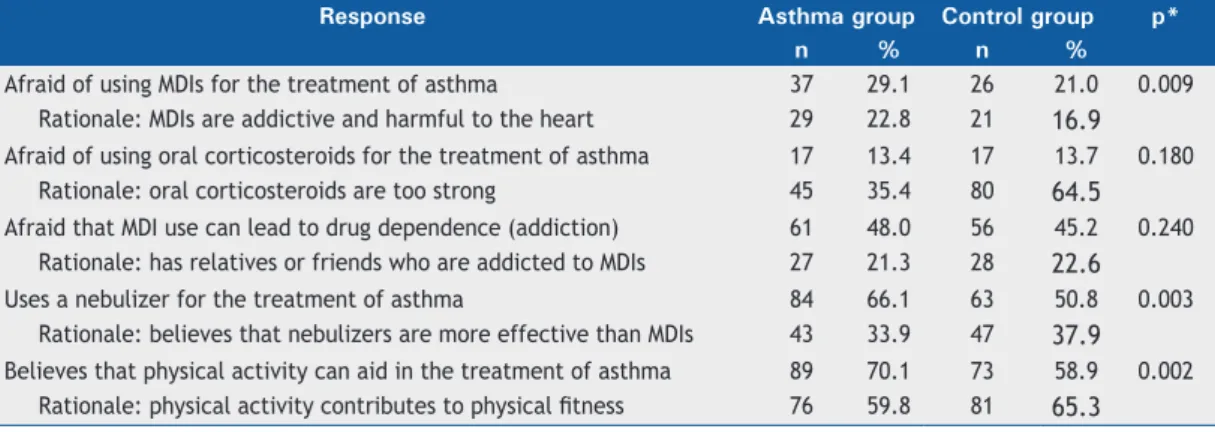
For the evaluation of parental understanding of myths about asthma in children and adolescents, parents or legal guardians in the asthma and control groups were interviewed. Of the participants in the asthma and control groups, 37 (29.1%) and 26 (21.0%), respectively, reported being afraid of using metered dose inhalers (MDIs) for the treatment of asthma in their children. In addition, 61 (48.0%) and 56 (45.2%), respectively, believed that using an MDI can lead to addiction (drug dependence). Furthermore, 17 (13.4%) and 17 (13.7%), respectively, reported being afraid of using oral corticosteroids for the treatment of asthma in their children. Moreover, 84 (66.1%) and 63 (50.8%), respectively, reported regular nebulizer use for the treatment of asthma in their children. Finally, 38 (29.1%) and 51 (41.7%), respectively, believed that physical activity is harmful to the health of asthma patients and should not be prescribed as an adjunct in the treatment of asthma. These results are shown in Table 1.
For the evaluation of parental understanding of asthma treatment, only the parents or legal guardians in the asthma group answered the pertinent questions; 67 (52.8%) reported that their children had had a medical consultation or emergency room visit for asthma in the last 12 months, and 9 (23.7%) reported that their children had visited “witch doctors or faith healers” in that period. Only 41 (32.3%) had a prescription or written treatment plan, and 38 (29.9%) used asthma medications regularly. Of those, 28 (72.4%)
admitted to forgetting to use their asthma medications regularly, 37 (97.4%) used medications provided free of charge by the public health care system, and only 9 (23.7%) used their bronchodilators with a spacer. In addition, 52 (40.9%) reported having used inhaled corticosteroids in the last 12 months, whereas 57 (44.9%) reported having used oral corticosteroids in that period. Furthermore, 69 (54.3%) reported nebulizer use. With regard to physical activity, 17 (13.4%) of the schoolchildren used asthma medications before engaging in physical activity.
Figure 2 shows the results of our analysis of the association of myths and truths about asthma with the treatment of the disease, the questions having been answered by the parents or legal guardians in the asthma group. In the last 12 months, there were no associations between being afraid of using an MDI and using an MDI (29.1% vs. 40.9%; p = 0.782); between being afraid of using oral corticosteroids and using oral corticosteroids (13.4% vs. 44.9%; p = 0.249); between considering nebulizer use better than MDI use (66.1% vs. 54.3%; p = 0.741); or between considering physical activity an adjunct in the treatment of asthma and using asthma medications before engaging in physical activity (70.1% vs. 13.4%; p = 0.519).
Chart 1. Questionnaire regarding myths and truths about asthma.
Questions Yesa No
1. Are you afraid of using a “puffer/spray”b for the treatment of asthma in your child?
2. Are you afraid of using inhaled corticosteroids for the treatment of asthma in your child?
3. Do you believe that the use of a “puffer/spray” for the treatment of asthma can lead to addiction? 4. Do you use a nebulizer for the treatment of asthma in your child?
5. Do you believe that nebulizers are more effective than “puffers/sprays” for the treatment of asthma in your child?
6. Do you believe that physical activity can aid in the treatment of asthma in your child? aIf the answer is yes, please explain why. bPuffer/spray = metered dose inhaler.
Phase 1 2,500 schoolchildren 1,211 males (48.6%) Mean age, 11.42 ± 2.32 years
Prevalence of asthma 511 schoolchildren (20.4%)
Phase 2 605 schoolchildren
280 males (47.3%) Mean age, 11.01 ± 2.28 years
Phase 3 251 schoolchildren
117 males (46.6%) Mean age, 10.36 ± 2.05 years Asthma group
290 schoolchildren (47.9%)
Control group 315 schoolchildren (52.1%)
Asthma group 127 schoolchildren (50.6%)
Control group 124 schoolchildren (49.4%)
Table 2 shows a comparison between the schoolchil-dren with controlled asthma (n = 54) and those with uncontrolled asthma (n = 60) regarding myths about asthma, asthma treatment, medical monitoring, and asthma attacks, no differences being found between myths about asthma treatment and the treatment of asthma in the last 12 months, the exception being MDI use (30.2% vs. 55.0%, respectively; p = 0.008). With regard to asthma exacerbations in the last 12 months, a comparison between the schoolchildren with uncontrolled asthma and those with controlled asthma showed that medical consultations for asthma symptoms (wheezing, dyspnea, or cough) had been more common in the former than in the latter (66.7% vs. 45.3%; p = 0.023), as had wheezing during or after physical activity (71.2% vs. 41.5%; p = 0.002) and wheezing at rest without having engaged in physical activity (61.7% vs. 35.8%; p = 0.006).
DISCUSSION
Our results show that, in the city of Porto Alegre, many parents of children and adolescents with asthma believe in popular myths about the treatment of asthma. In addition, most admitted that they do not adhere to the prescribed treatment. A minority of the schoolchildren had a prescription or written treatment plan, and less than one third used prophylaxis; however,
most of the parents or legal guardians reported that they were not afraid of using oral corticosteroids for the treatment of asthma in their children. In a population in which the prevalence of asthma is high (20.4% of the children/adolescents studied had asthma) and nearly half have uncontrolled asthma, the aforementioned
indings reveal a bleak outlook for public health, and
this requires changes in government strategies for asthma programs.
Parental knowledge of asthma in children and ado-lescents appears to be poor, particularly in developing countries. In a study conducted in southern Brazil,
Zhang et al.(12) showed that over 90% of parents
of asthma patients lack knowledge of the disease. This is a worrisome scenario in developing countries and requires further studies. In the present study, the number of parents or legal guardians of asthma
patients who believed that MDI use can be signiicantly
harmful to health was higher than that of those of healthy controls, and nearly half (48%) believed that
“the puffer is addictive”, with no signiicant difference
in comparison with the control group. Many of the parents or legal guardians in the asthma group reported being afraid of using asthma medications in their children. In contrast, a minority (13%) of parents or legal guardians in the asthma and control groups reported being afraid of using oral corticosteroids for
Table 1. Participant responses regarding myths and truths about the treatment of asthma, by group (asthma group, n = 127; control group, n = 124).
Response Asthma group Control group p*
n % n %
Afraid of using MDIs for the treatment of asthma 37 29.1 26 21.0 0.009
Rationale: MDIs are addictive and harmful to the heart 29 22.8 21 16.9
Afraid of using oral corticosteroids for the treatment of asthma 17 13.4 17 13.7 0.180
Rationale: oral corticosteroids are too strong 45 35.4 80 64.5
Afraid that MDI use can lead to drug dependence (addiction) 61 48.0 56 45.2 0.240
Rationale: has relatives or friends who are addicted to MDIs 27 21.3 28 22.6
Uses a nebulizer for the treatment of asthma 84 66.1 63 50.8 0.003
Rationale: believes that nebulizers are more effective than MDIs 43 33.9 47 37.9
Believes that physical activity can aid in the treatment of asthma 89 70.1 73 58.9 0.002
Rationale: physical activity contributes to physical itness 76 59.8 81 65.3
MDI: metered dose inhaler (puffer/spray). *Chi-square test.
29.1%
40.9%
13.4%
44.9%
66.1%
54.3%
70.1%
13.4%
0% 10% 20% 30% 40% 50% 60% 70% 80% Afraid of using bronchodilators
Used a broncodilatador in the last 12 months
Afraid of using oral corticosteroids
Used oral corticosteroids in the last 12 months
Believes that nebulizers are better than BDs
Used a nebulizer in the last 12 months
Believes that physical activity (PA) can aid in the treatment of asthma
Used asthma medications before engaging in PA in the last 12months
Figure 2. Asthma treatment characteristics in the patients studied.
the treatment of asthma in their children, nearly half of the children and adolescents with asthma having used oral corticosteroids in the last 12 months. Currently, oral corticosteroids are reserved for patients with severe exacerbations. Increased oral corticosteroid use appears to be associated with long-term changes in bone mineral density in children and adolescents.(13)
According to the 2014 revision of the GINA guidelines,
short-acting β2 agonists are safe for use in adults and children/adolescents and oral corticosteroids should be reserved for acute episodes of severe or complicated asthma, in which there is an incomplete response or worsening of symptoms after the use of short-term
β2 agonists.
(1)
Another interesting inding of our study is that the
vast majority of the parents or legal guardians in the asthma group reported that nebulizer use made them
feel more conident and active in treating asthma.
In addition, many reported feeling safer because treatment with nebulizers is more “natural”, i.e., not as harmful to the health of children and adolescents as is treatment with bronchodilators. Zhang et al.(12)
found that nonspecialists in children and adolescents with asthma prescribe nebulizers more often than they do other asthma medication delivery devices. Despite the technical ease of use of nebulizers, 80.6% of the parents were found to use them incorrectly at home, errors including nebulizer use during sleep and incorrect mask placement. For nearly two decades, nebulizers
have not been the devices of choice for delivering inhaled asthma therapy to children and adolescents, regardless of their age.(14) Therefore, the use of MDIs
with a spacer should be encouraged, and parents and patients should receive ongoing training in how to use MDIs correctly.
Most of our sample received their asthma
med-ications free of charge. This inding could suggest
that government provision of free medications is not enough to maintain population health. Effective public policies for the education, diagnosis, and monitoring of children and adolescents with asthma, together with a structured program for training not only health professionals but also patients and their parents or legal guardians, contribute to demystifying asthma treatment; myths and misconceptions are likely to have a negative impact on patient adherence to treatment, which is essential for improving patient quality of life.
Our results regarding asthma treatment in children and adolescents are not encouraging. As shown in Figure 2, only one third of the children and adolescents with asthma in the present study used prophylaxis or had a prescription or written treatment plan, nearly half had used oral corticosteroids at least once in the last 12 months, and three quarters of all parents or legal guardians admitted to forgetting to administer asthma medications to their children on a regular basis. No
signiicant associations were found between popular
myths about asthma treatment and the treatments
Table 2. Comparison of myths about asthma, asthma treatment, medical monitoring, and asthma exacerbations between the groups of patients with controlled asthma (n = 54) and uncontrolled asthma (n = 60).
Variable Controlled
asthma
Uncontrolled asthma
p*
n % n %
Myths and truths about asthma
Is afraid of using MDIs for the treatment of asthma 17 31.5 17 28.3 0.715
Believes that MDI use for the treatment of asthma can lead to addiction 29 53.7 28 46.7 0.409
Is afraid of using oral corticosteroids for the treatment of asthma 5 9.3 9 15.0 0.395
Uses a nebulizer for the treatment of asthma 42 77.8 38 63.3 0.094
Believes that nebulizers are more effective than MDIs for the treatment of asthma
22 40.7 19 31.7 0.316
Believes that physical activity can aid in the treatment of asthma 37 68.5 48 80.0 0.169
Asthma treatment in the last 12 months
The student uses asthma medications regularly 15 31.9 21 36.2 0.647
The student received MDI-delivered medications for the treatment of asthma 16 30.2 33 55.0 0.008
The student received oral corticosteroids for the treatment of asthma 22 41.5 32 53.3 0.211
The student received nebulizer-delivered inhaled medications for the treatment of asthma
26 49.1 40 66.7 0.059
The student used asthma medications before engaging in physical activity 5 9.4 12 20.0 0.119
Medical monitoring and asthma attacks in the last 12 months
The student is followed at an outpatient clinic or public health care clinic for asthma
8 16.3 17 28.8 0.127
The student has a written treatment plan or prescription for asthma attacks 19 40.4 19 32.2 0.383
The student had a consultation for asthma (wheezing, dyspnea, or cough) 24 45.3 40 66.7 0.023
The student had wheezing during or after physical activity 22 41.5 42 71.2 0.002
The student had wheezing at rest, without having engaged in physical activity 19 35.8 37 61.7 0.006
used. After the asthma group was divided into the controlled asthma group and the uncontrolled asthma group, no differences were found between popular myths and the treatments used, the exception being MDI use in the last 12 months: children and adolescents with uncontrolled asthma used MDIs more often than did those with controlled asthma. In addition, medical visits for asthma symptoms and asthma symptoms at
rest or during physical activity were signiicantly more
common in the uncontrolled asthma group than in the controlled asthma group (Table 2).
In a recent study conducted in Saudi Arabia,(15) the
level of knowledge of asthma among parents of children with the disease was compared with the prevalence
of controlled and uncontrolled asthma, and signiicant
differences were found between the two groups regarding prolonged MDI use, the rationale being that MDIs can affect or harm the heart and should be administered only in the period between asthma attacks. The study found substantial gaps in knowledge among parents of children with asthma, including a lack of understanding of the disease, misconceptions regarding inhalers for the delivery of asthma medications, and misconceptions regarding asthma medication use.
The aforementioned indings are consistent with ours,
given that most of the parents or legal guardians in the present study reported being afraid of using MDIs prophylactically, believing that MDIs can cause heart problems and using MDI-delivered medication as rescue medication in children and adolescents with uncontrolled asthma (Table 2).
Most of our sample received their asthma medications free of charge. This is an indirect datum suggesting that government provision of free medications is not enough to maintain population health. Effective public policies for the education, diagnosis, and monitoring of children and adolescents with asthma, together with a structured program for training not only health professionals but also patients and their parents or legal guardians, contribute to demystifying asthma
treatment; myths and misconceptions are likely to have a negative impact on patient adherence to treatment, which is essential for improving patient quality of life.
One limitation of our study is that there was a large loss to follow-up in phase 3; of the 605 schoolchildren who participated in phase 2, only 251 participated in phase 3. This was due to the fact that the schoolchildren were tested at primary health care clinics when they were not at school, and the presence of parents or legal guardians was required. However, for personal or professional reasons, the parents or legal guardians were often unable to accompany their children to the clinics. This bias might have selected, during that phase of the study, patients with disease that is more severe; however, the internal validity of the study is not affected if it is accepted that children and adolescents with disease that is more severe could have been selected for inclusion in the study sample. However, given the lack of published data on popular myths about asthma, which are highly prevalent in developing countries, the results of the present study are important and might lead to further studies, aimed at informing public programs for the management of asthma in children and adolescents.
In conclusion, our study shows that popular myths about asthma are common in the families of children and adolescents with asthma in a city in southern Brazil. Some of these myths can have a negative impact on the treatment and quality of life of these patients. Therefore, the lack of association between popular myths about asthma and the use of asthma medications in the present study indicates the need for studies involving larger samples. The continued development of asthma education programs for patients and the general population can serve as a strategy for gaining a deeper understanding of childhood asthma and improving asthma control in many countries, having a positive impact on public health.
REFERENCES
1. Global Initiative for Asthma [homepage on the Internet]. Bethesda:
Global Strategy for Asthma Management and Prevention 2014; c2014 [cited 2015 Oct 1]. Available from: http://www.ginasthma.org/ documents/4
2. Asher M, Weiland S. The International Study of Asthma and Allergies in Childhood (ISAAC). ISAAC Steering Committee. Clin Exp Allergy. 1998;28 Suppl 5:52-66; discussion 90-1. http://dx.doi.org/10.1046/ j.1365-2222.1998.028s5052.x
3. Asher MI, Montefort S, Björkstén B, Lai CK, Strachan DP, Weiland
SK, et al. Worldwide time trends in the prevalence of symptoms of asthma, allergic rhinoconjunctivitis, and eczema in childhood: ISAAC Phases One and Three repeat multicountry cross-sectional surveys. Lancet. 2006;368(9537):733-43. Erratum in Lancet. 2007 Sep 29;370(9593):1128.
4. Carroll WD, Wildhaber J, Brand PL. Parent misperception of control in childhood/adolescent asthma: the Room to Breathe survey. Eur Resp J. 2012;39(1):90-6. http://dx.doi.org/10.1183/09031936.00048911
5. Klok T, Kaptein AA, Duiverman EJ, Brand PL. It’s the adherence, stupid (that determines asthma control in preschool children). Eur Resp J. 2014;43(3):783-91. http://dx.doi.org/10.1183/09031936.00054613
6. Bourdin A, Halimi L, Vachier I, Paganin F, Lamouroux A, Gouitaa M, et
al. Adherence in severe asthma. Clin Exp Allergy. 2012;42(11):1566-74. http://dx.doi.org/10.1111/j.1365-2222.2012.04018.x
7. Lougheed MD, Lemière C, Dell SD, Ducharme FM, FitzGerald JM, Leigh R, et al. Canadian Thoracic Society Asthma Management Continuum--2010 Consensus Summary for children six years of age and over, and adults. Can Resp J. 2010;17(1):15-24.
8. O’Laughlen MC, Rance K, Rovnyak V, Hollen PJ, Cabana MD.
National Asthma Education Prevention Program: survey of nurse practitioners’ knowledge, attitudes, and behaviors. J Ped Health Care. 2013;27(2):e17-24. http://dx.doi.org/10.1016/j.pedhc.2011.07.005
9. Martínez-Gimeno A. Onions, myths, beliefs, fashion and reality in asthma. Allergol Immunopathol (Madr). 2009;37(6):309-13. http:// dx.doi.org/10.1016/j.aller.2009.10.004
10. Associação Brasileira de Empresas de Pesquisa--ABEP. [homepage on the Internet]. São Paulo: ABEP [cited 2015 Oct 1]. Critério de Classiicação Econômica Brasil. Available from: http://www.abep. org/criterioBrasil.aspx
(ISAAC). Pediatr Allergy Immunol. 1997;8(4):161-76. http:// dx.doi.org/10.1111/j.1399-3038.1997.tb00156.x
12. Zhang L, Costa MG, Ávila LH, Bonfanti T, Ferruzzi EH. Asthma related
knowledge among parents of asthmatic children at the moment of admission to a specialized service [Article in Portuguese]. Rev Assoc Med Bras. 2005;51(6):342-7. http://dx.doi.org/10.1590/S0104-42302005000600018
13. Donatti TL, Koch VH, Takayama L, Pereira RM. Effects of glucocorticoids
on growth and bone mineralization. J Pediatr (Rio J). 2011;87(1):4-12. http://dx.doi.org/10.1590/S0021-75572011000100002
14. O’Callaghan C, Barry PW. How to choose delivery devices for
asthma. Arch Dis Child. 2000;82(3):185-7. http://dx.doi.org/10.1136/ adc.82.3.185
15. BinSaeed AA. Caregiver knowledge and its relationship to asthma