R
E
V
IS
Ã
O
R
E
V
IE
W
This article was originally published by Environ Health Perspect 117:508– 514 (2009).doi:10.1289/ ehp.0800084 available via http://dx.doi.org/ [Online 10 December 2008] and is part of the scientific collaboration between Cien Saude Colet and EHP. 1 EcoChemistry Team, University of York/CSL, Sand Hutton, York, YO41 1LZ, UK.
[email protected] 2 Central Science Laboratory.
3 Environment Agency. 4 Met Office Hadley Centre. 5 Lancaster University. 6 Plymouth Marine Laboratory.
7 London School of Hygiene and Tropical Medicine. 8 Health Protection Agency. 9 Cranfield University. 10 York St. John University. 11 Natural England. 12 Agriculture and Agri-Food Canada.
13 University of Warwick. 14 Centre for Ecology and Hydrology.
Impacts of climate change on indirect human
exposure to pathogens and chemicals from agriculture
Impactos das mudanças climáticas sobre a exposição humana
indireta a elementos patogênicos e químicos da agricultura
Resumo É provável que a mudança climática afete a natureza, destino e transporte de elementos patogênicos/químicos no ambiente . Avaliamos as implicações das mudanças climáticas em mudan-ças na exposição humana a elementos patogêni-cos/químicos nos sistemas agrícolas no Reino Unido e discutimos os efeitos sobre os impactos à saúde, usando a contribuição de especialistas e literatu-ra; efeitos à saúde da exposição a elementos pato-gênicos/químicos provenientes da agricultura; in-trodução de elementos químicos/patogênicos e ca-minhos de exposição humana a elementos patogê-nicos/químicos nos sistemas agrícolas. Definimos a base de evidência para efeitos de saúde de ele-mentos químicos/patogênicos no ambiente agrí-cola; determ inam os as possíveis im plicações da mudança climática na introdução de elementos químicos/patogênicos nos sistemas agrícolas; e ex-ploramos os efeitos da mudança climática no trans-porte ambiental e destino de diversos contaminan-tes. Consolidamos dados para avaliar as implica-ções das mudanças climáticas em relação à exposi-ção humana indireta a elementos patogênicos/quí-micos nos sistemas agrícolas e recomendamos fu-turas pesquisas e mudanças políticas para admi-nistrar aumentos adversos nos riscos.
Palavras-chave Agricultura, Mudança climáti-ca, Impacto ambiental, riscos de saúde, nutrientes, patogenias
Abstract Climate change is likely to affect the
nature of pathogens/ chemicals in the environ-ment and their fate and transport. We assess the im plications of clim ate change for changes in human exposures to pathogens/chemicals in ag-ricultural systems in the UK and discuss the ef-fects on health impacts, using expert input and literature on climate change; health effects from exposure to pathogens/chem icals arising from agriculture; inputs of chemicals/pathogens to ag-ricultural systems; and human exposure pathways for pathogens/chemicals in agricultural systems. We established the evidence base for health effects of chemicals/pathogens in the agricultural envi-ronment; determined the potential implications of climate change on chemical/ pathogen inputs in agricultural systems; and explored the effects of climate change on environmental transport and fate of various contaminants. We merged data to assess the implications of climate change in terms of indirect human exposure to pathogens/chemi-cals in agricultural systems, and defined recom-mendations on future research and policy chang-es to manage adverse increaschang-es in risks.
Key words Agriculture, Climate change, Envi-ronmental fate, Health risks, Nutrients, Patho-gens
Leonard Levy 9
Gordon Nichols 8
Simon Parsons 9
Laura Potts 10
David Stone 11
Edward Topp 12
David Turley 2
Kerry Walsh 3
Elizabeth Wellington 13
Richard Williams 14
Alistair Boxall 1,2
Anthony Hardy 2
Sabine Beulke 2
Tatiana Boucard 3
Laura Burgin 4
Peter Falloon 4
Philip Haygarth 5
Thomas Hutchinson 6
Sari Kovats 7
B
o
x
al
Introduction
Weather and climate factors are known to affect the transmission of water- and vector-borne in-fectious diseases as well as the transport of chem-icals around the environment. Climate change may therefore have important impacts on the dispersion of pathogens and chemicals in the environment. In addition, changes in climate are likely to affect the types of pathogens occurring as well as the amounts and types of chemical used for a range of scenarios. Future risks of patho-gens and chemicals could therefore be very dif-ferent than today, so it is important that we be-gin to assess the implications of climate change for changes in human exposures to pathogens and chemicals and the subsequent health impacts in the near term and in the future. Therefore, in this review, we discuss how health risks might change by exploring the current scientific evidence for health effects resulting from environmental exposure to pathogens and chem icals arising from agriculture; the potential impacts of climate change on the inputs of chemicals and patho-gens to agricultural systems; and the potential impacts of climate change on human exposure pathways to pathogens and chemicals in agricul-tural systems. Finally, we provide recommenda-tions on approaches to mitigate any adverse in-creases in health risks.
In this review we focus on the U.K. agricul-tural environment, but some of the conclusions are applicable and relevant to other countries in temperate areas as well as sectors other than ag-riculture. We focus on environmental routes of exposure, and do not consider occupational ex-posure pathways or direct application of chemi-cals to food animals.
Effects of agricultural chemicals and pathogens on human health
Humans may be exposed to agriculturally de-rived chemicals and pathogens in the environ-ment (i.e., air, soil, water, sedienviron-ment) by a number of routes, including the consumption of crops that have been treated with pesticides or have taken up contaminants from soils; livestock that have accum ulated contam inants through the food chain; fish exposed to contaminants in the aquatic environment; and groundwater and
sur-face waters used for drinking water. Exposure may also occur via the inhalation of particulates or volatiles, or from direct contact with water bodies or agricultural soils (e.g., during recre-ation). The importance of each exposure path-way will depend on the pathogen or chemical type ( Table 1). The m ain environm ental pathways from the farm to the wider population will be from consum ption of contam inated drinking waters and food. In the United Kingdom, vector, aerial, and direct contact pathways are currently of less importance to the general population.
Evidence for adverse human health effects from agricultural contaminants comes from epi-demiologic studies (occupational and general pop-ulation studies), case and outbreak reports, and toxicologic assessments. Attributing health effects in the general population to specific agricultural contaminants is often difficult because multiple chemicals and pathogens are in the environment, with multiple routes whereby they may reach hu-mans. Some naturally occurring chemicals are also harmful (e.g., mycotoxins, microcystin), which further complicates the picture.
Although often inconclusive, several studies have associated different health outcomes with exposure to chemicals from agriculture. For ex-ample, Parkinson’s disease has been linked with exposure to pesticides1, and studies have suggest-ed that repeatsuggest-ed exposure to low levels of organ-ophosphates may result in biochemical effects in agricultural farmworkers2, as well as enhanced risks of certain cancers, such as leukemias or lym-phoma. Studies in North America have associat-ed chlorphenoxy herbicide exposure with circula-tory and respiracircula-tory malformation, congenital ab-n orm alities, u rogeab-n ital aab-n d m u scu loskeletal anomalies, and changes in the male:female sex ratio of offspring3.
Outbreaks of waterborne disease from the contam ination of water supplies with anim al waste (often associated with water treatment fail-ures) remain an important public health
prob-lem4. Cryptosporidium transmission in humans
has been linked to areas where manure is being applied to land5. There is also good evidence that heavy rainfall increases the risk of sporadic cases
of Cryptosporidium in England6,7. Exposure to
Mycobacterium avium in agricultural systems has
e C o le tiv a, 1 5 (3 ):7 4 3 -7 5 6 , 2 0 1 0
Table 1. Potential exposure routes and health effects of chemical and biological contaminants associated with agricultural activities.
Contam inant type
Chemicals
Heavy metals (e.g., cadmium) Dioxin s Mycotoxins (e.g., aflatoxins, ochratoxins) Nitrate Polychlorinated biphenyls Pesticides Pharmaceuticals Phycotoxins (e.g., microcystins)
Plant toxins (e.g., glycoalkaloids, anisatin)
Veterinary medicines
Ozon e
Bacteria and viruses
Cryptosporidium Giardia Cam pylobacte Salm onella Plasm odium Borrelia Other Pollen
Abbreviations: A, air; C, conclusive evidence linking health end point to environmental exposure; DW, drinking water; F, food; I, inconclusive evidence linking health end point to environmental exposure; L, limited evidence linking health end point to environmental exposure; Med, medium; NA, not applicable; RW, recreational water contact; V, vector borne. We have attempted, based on the available literature, to indicate the level of evidence that suggests that environmental exposure could cause the identified effect(s); we also indicate the level of control (e.g., through regulatory monitoring of food and water residues, water treatment, and requirements for risk assessment) in the United Kingdom.
a Deportes et al.9; b Goldman and Koduru10; c Huwe11; d Hawkes and Ruel12; e Cantor13; f Fawell and Nieuwenhuijsen14; g Boffetta and Nyberg15;
h Dolk and Vrijheid16; i Joffe17; j Donald et al.18; k Stillerman et al.3; l Kinney et al.19; m van Egmond20; n Boxall et al.21; o Boxall et al.22; p Hamscher et al.23; q van den Berg et al.24; r Githecko et al.25; s Beggs and Bambrick26; t Shea et al.27.
Potential exposure routes F F F DW F
DW, F, A
DW, F DW, RW, F
F
DW, F, A
A DW, RW DW, RW F F V V A Level of knowledge of exposure High High Med High High High Low Med Low Low Med Med Med Med Med High Med Med
Health effects associated with exposure
Renal and hepatic toxicity
Reproductive effects,
carcinogenicity, immunotoxicity, endocrine disruption, neurologic effects, chloracne
Stunting of growth, liver cancers, aflatoxicosis, estrogenic effects
Methemoglobinemia, bladder, stomach, and prostrate cancers, non-Hodgkin lymphoma Reproductive effects, congenital abnormalities
Reduced eye–hand coordination, effects on cognitive abilities, developmental toxicity, estrogenic effects, antiandrogenic effects, congenital abnormalities, reduced stamina, birth malformations, cryptorchidism in male children, pregnancy loss, Parkinson’s disease Estrogenic effects, carcinogenicity Paralysis, gastrointestinal illness, amnesia, neurotoxicity, liver damage
Liver cancers, cirrhosis
Selection of antimicrobial resistance Asthma Self-limiting diarrhea Gastrointestinal illness Gastrointestinal illness Gastrointestinal illness Malaria Lyme disease Allergies, asthma Level of evidence I I C I L I L C I L I C C C C C C C Degree of control in the UK High High High High High High Low High Low Low Low High High Med High N A High Low References a b,c d e,f,g
b, h, i
b, f, h, j, k
B
o
x
al
Agricultural chemicals may also indirectly af-fect human health via other, often unanticipated pathways. Examples include dispersal of biotox-in s biotox-in to coastal com m un ities resultbiotox-in g from harmful algal blooms triggered by inputs of ni-trates from agriculture28-30 and the agricultural use and environmental occurrence of antibiotics that may facilitate the selection of antibiotic resistance in microbes in the soil and water environments21.
Effects of climate change
on chemical and pathogen inputs
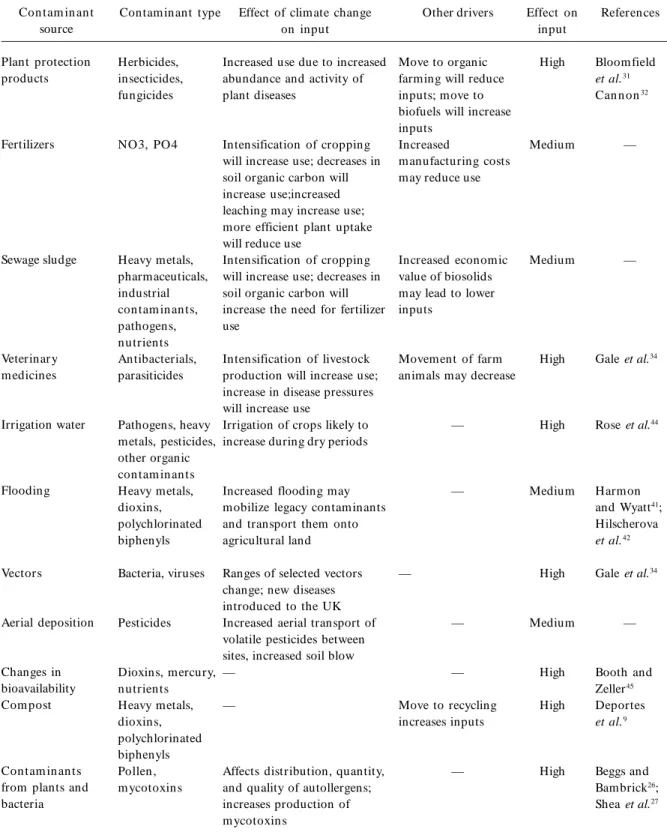
Climate change is also likely to change the inputs of chemicals and biological contaminants to ag-ricultural systems and may also affect their chem-ical form (Table 2). Changes in the abundance and seasonal activity of agricultural pests and diseases are predicted31-36. In addition, there may be direct effects on the effectiveness of pesticides37. A significant increase in the use of pesticides is therefore likely, and other biocides in the future and more effective pesticides may be required in some instances (Table 2).
Climate change may also increase the pro-duction of mycotoxins in agricultural systems38 as well as affect the timing of exposure, distribu-tion, quantity, and quality of aeroallergens26,27. Warming temperatures may also promote the production of ozone, which worsens asthma27.
Climate change may entail changes in farm-ing practice. For example, livestock populations increasingly subjected to thermal stress and wa-terlogged pastures may lead to increased indoor housing of animals. This may result in an en-hanced need to store and dispose of manures. Higher temperatures may facilitate the introduc-tion of new pathogens, vectors, or hosts39, lead-ing to increased use of biocides and veterinary medicines40. Workers may be in more frequent contact with livestock in such intensive regimes, so transmission of zoonotic diseases may increase. Changes in contaminant transport pathways may also affect contaminant inputs to agricul-tural systems. Flood events can transport patho-gens, dioxins, heavy metals, cyanide, and hydro-carbons from a contaminated area to a non -con-taminated one41,42. Climate change is likely to in-crease frequency of heavy precipitation events, so transport of historical contam inants from previously undisturbed sediments may occur. This could have implications for residue levels in food crops and food animals43. Because irriga-tion demands may increase because of warmer
and drier summers, water of poorer quality (in-cluding partially treated waste-water) may be applied to crops, resulting in additional contam-inant loadings to crops44. Changes in tempera-ture and precipitation could also increase aerial inputs of volatile and dust-associated contami-nants. Finally, changes in bioavailability may oc-cur, with less bioavailable forms of contaminant being converted to more bioavailable forms. For example, Booth and Zeller45 suggested that in-creases in temperature could enhance the methy-lation rate of mercury.
Alongside climate-change-driven changes in chemical and pathogen inputs, other drivers are also likely to affect the contaminants in agricul-tural systems. For example, the use of compost-ing for treatment of municipal waste is increas-ing, with a portion of the resulting compost being used in agriculture. This is likely to increase load-ings of microbes, heavy metals, and persistent organic pollutants in agricultural land9. Increases in the costs of synthetic chemicals and a move toward organic farming will result in a reduction in the amounts of agrochemicals and fertilizers applied in agriculture in the United Kingdom.
Impacts of climate change on transport, fate, and exposure
Both transport pathways and fate processes for chemicals and pathogens will likely be affected by changes in climate conditions, and this will affect the exposure level. The significance of a particu-lar pathway or process depends on the underly-ing properties (e.g., hydrophobicity, solubility, volatility) and form of the contaminant (partic-ulate, particle associated, dissolved; Figure 1).
Transport to water bodies
Transport of contaminants from agricultur-al land to water bodies (ditches, rivers, lakes, groundwater) is well understood and depends on the soil properties and the intensity of water flow46. Several studies have indicated that trans-port of contaminants to water bodies will in-crease with extreme precipitation events47,48.
e C
o
le
tiv
a, 1
5
(3
):7
4
3
-7
5
6
, 2
0
1
0
events as the infiltration capacity of the soil is ex-ceeded. In addition, drier summers may lead to longer periods of very high soil moisture deficits,
which may lead to increased hydrophobicity of soil surfaces and increased runoff during more intense summer rainfall. A secondary effect of dry
Table 2. Impacts of climate change on the inputs of chemicals and pathogens to agricultural systems.
Con tam in an t source
Plant protection products
Fertilizers
Sewage sludge
Veterinar y m edicines
Irrigation water
Flooding
Vectors
Aerial deposition
Changes in bioavailability Com post
Con tam in an ts from plants and bacteria
We developed the assessment of effects on input based on our current knowledge.
Contam inant type
Herbicides, insecticides, fungicides
NO3, PO4
Heavy metals, pharmaceuticals, industrial con tam in an ts, pathogens, nutrients Antibacterials, parasiticides
Pathogens, heavy metals, pesticides, other organic con tam in an ts Heavy metals, dioxins, polychlorinated biphenyls
Bacteria, viruses
Pesticides
Dioxins, mercury, nutrients Heavy metals, dioxins, polychlorinated biphenyls Pollen , m ycotoxins
Effect of climate change on input
Increased use due to increased abundance and activity of plant diseases
Intensification of cropping will increase use; decreases in soil organic carbon will increase use;increased leaching may increase use; more efficient plant uptake will reduce use
Intensification of cropping will increase use; decreases in soil organic carbon will increase the need for fertilizer use
Intensification of livestock production will increase use; increase in disease pressures will increase use
Irrigation of crops likely to increase during dry periods
Increased flooding may mobilize legacy contaminants and transport them onto agricultural land
Ranges of selected vectors change; new diseases introduced to the UK Increased aerial transport of volatile pesticides between sites, increased soil blow —
—
Affects distribution, quantity, and quality of autollergens; increases production of m ycotoxins
Other drivers
Move to organic farming will reduce inputs; move to biofuels will increase inputs
Increased
manufacturing costs may reduce use
Increased economic value of biosolids may lead to lower inputs
Movement of farm animals may decrease
—
—
—
—
—
Move to recycling increases inputs
—
Effect on input
High
Medium
Medium
High
High
Medium
High
Medium
High
High
High
References
Bloom field
et al.31 Can n on32
—
—
Gale et al.34
Rose et al.44
Harmon and Wyatt41; Hilscherova
et al.42
Gale et al.34
—
Booth and Zeller45 Deportes
et al.9
B
o
x
al
summers may be an increase in soil shrinkage cracks, which may result in a more extensive and better connected macropore system.
Matrix flow is the most important route for tran sport of dissolved con tam in an ts such as group 1 and 2 elements, nitrates, dissolved or-ganic carbon, reactive phosphorus, and hydro-philic pesticides46. This pathway may be influ-enced under climate change, but to a lesser extent than the pathways described above. Matrix flow may increase with wetter winters, resulting in higher soil moistures and hydraulic conductivi-ties. In the summer, soil moistures may be lower and hydraulic conductivities reduced. These low-er summlow-er soil moistures may be offset by in-creased irrigation, thus restoring the matrix flow route temporarily, especially if the irrigation is poorly targeted.
Flood events have already been demonstrat-ed to enhance the contamination of water bodies by pesticides49. Flood immersion is likely to in-crease and aid the dispersion of agricultural
chem-icals after immersion in floodwater. This path-way has perhaps not received as much attention in this context as those described above.
Changes in precipitation levels and patterns will also affect river flows, changing both annual totals and seasonal patterns of flow50. For rivers draining impermeable catchments, flow may de-cline rapidly when runoff decreases and effluent discharges are likely to make up a higher propor-tion of river flow. Rivers where flow is sustained by natural groundwater inflows are less sensitive to changes in runoff, although prolonged drought and depletion of groundwater may result in de-creased flows that may persist even after new rain-fall. Low flows may threaten effluent dilution, resulting in greater pathogen loading. However, low flows may also result in an increased amount of time between discharge and abstraction, al-lowing more time for pathogen and chemical decay to occur.
Models exist that account for some of these flow pathways but not necessarily for all contam-inant types. Most field - or catchment-based wa-ter-quality models for agricultural systems ac-count for vertical and horizontal matrix flow of dissolved contaminants, and some have been de-signed or modified to account for macropore flow51,52. Models also exist for surface runoff and sediment transport53,54.
Transport to the air compartment
Contaminants may be transported in the at-mosphere via spray drift during the application process, volatilization and dispersion from treat-ed surfaces (e.g., plants and soils), and wind-blown dust particles from soil surfaces. Typically, a portion of a sprayed-pesticide is transported away from the target area by spray drift. The ex-tent of the spray drift depends on weather condi-tions, such as wind speed. Because the impacts of clim ate change on wind speed are uncertain, whether loss through spray drift will increase is not clear, nor is how the significance of this loss route will change relative to surface runoff or drain-age. As more information becomes available on wind-speed changes, the impacts might be mod-eled using mechanistic models such as the pro-gram for Drift Evaluation for Field Sprayers by Computer Simulation55 that consider wind speed and atmospheric stability.
Volatile organic and inorganic contaminants (e.g., methane, nitrous oxide, ammonia, sulfides) can be transported from agricultural fields via a combination of volatilization and dispersion31.
Figure 1. Predicted impacts of climate change on major
environmental pathways for human exposure to pathogens and chemicals from agriculture. Letters indicate which contaminant classes are likely to be transported via an individual pathway: P, particulate (e.g., bacteria, viruses, spores, engineered
e C
o
le
tiv
a, 1
5
(3
):7
4
3
-7
5
6
, 2
0
1
0
The extent of the transport depends on the sur-face temperature, air temperature, and wind speed, all of which are predicted to change as a result of climate change. Dust can be released into the at-mosphere during soil tilling and crop harvesting and is an important transport pathway for par-ticulate and particle-associated contaminants, such as bacteria, fungal and bacterial spores, ste-roids, pesticides, and polycyclic aromatic hydro-carbons56. Soil dust has already been linked to human health impacts57. The predicted hotter drier summers could lead to increased drying of soils and an increase in surface dust and hence increased transfer into the environment58. Trans-port of dust can be predicted using empirical models59 through to more complex models that link m eteorologic m odels with dust em ission models60. Under drier conditions, bioaerosols such as fungal spores and endotoxins are likely to be more of a problem than today61-63.
Transport into food items
Uptake of chemicals from soil into plants de-pends on the physico-chemical properties of the contaminant and the nature of the soil64,65. Al-though warmer climates can enhance evapotrans-piration and uptake, these changes will probably be offset by the effects of increased concentra-tions of carbon dioxide that could reduce the ac-tivity of plant stomata and reduce plant tran-spiration. The bioavailability of chemical contam-inants to crops may also increase with the pre-dicted decline in soil organic carbon content in the future66. Selected contaminants (e.g., mercu-ry) may also be converted from a less bioavail-able form to a more bioavailbioavail-able form due to temperature increases45. However, overall, the ef-fect of climate change on plant uptake of chemi-cal contaminants is likely to be small. Current regulatory models to simulate chemical fate and transport incorporate very simple routines to de-scribe plant uptake and interception. These are probably inappropriate for estimating the im-pacts of climate change on human exposure from plant residues.
Vector transport
Climate change may be accompanied by an increase in the abundance and variety of vectors an d h ost r eser voir s for h u m an an d an im al pathogens. Pathways of transmission within and between populations of wildlife, livestock, and humans will potentially be enhanced67. For
ex-ample, for mosquitoes, warmer temperatures will increase populations, lifespan, geographic distri-bution, rates of multiplication, feeding on hu-mans, and inoculation rates and shorten the pe-riod between infection and infectivity68. Water-related extreme weather events could also affect human–mosquito interactions, potentially in-creasing hum an contact and the incidence of malaria. Alongside this, increases in tick popula-tions may occur, which might affect the incidence of Lyme disease35,69. However, histories of many diseases reveal that climate change is not the prin-cipal determinant of incidence and that human activities and their impact on local ecology have generally been more significant70. The potential changes in exposure may in fact be offset by hu-man strategies to avoid temperature increases (e.g., indoor living and air conditioning)70.
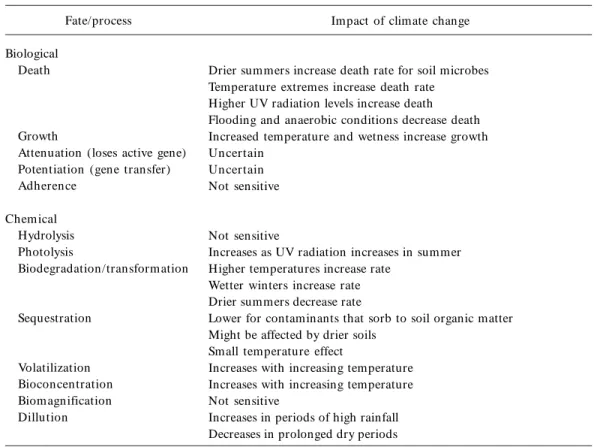
Effects on fate processes
con-B
o
x
al
sidered in isolation because different climate-sen-sitive factors may have conflicting effects on hu-man exposure.
Predicted impacts
in terms of public exposure
Based on the evidence above, both the inputs to and fate and transport of chemicals and patho-gens in agricultural systems will change in re-sponse to changes in climate. Therefore, we dis-cuss the implications of climate change on changes in exposure to three classes of contam inants (plant protection products, bacterial pathogens, and nutrients); the potential impacts of these contaminants on human health; and potential management options to ameliorate any identi-fied increase in risk.
Plant protection products
The use of pesticides will likely increase under climate change conditions as crop diseases
be-come more prevalent, and as a result, loadings of pesticides in the environment will also increase. Amounts of pesticide applied to food items will therefore increase. The transport of particle-as-sociated pesticides into water bodies will likely increase significantly, and there will be a moder-ate increase in the transport of hydrophilic and volatile pesticides. Complex interactions between fate processes could also affect exposures. Under scenarios with drier summers, water bodies will likely have less water, so contaminants will be less diluted. Therefore, it is likely that, with a few ex-ceptions (e.g., non-persistent substances where exposure may decrease because of increased deg-radation), concentrations in air and water will likely increase significantly. Human exposure via aerial transport (spray drift, volatilization, and transport on dust particles), drinking water, and food (from direct pesticide application onto a food item or irrigation of crops with contami-nated water) is therefore likely to increase. The risks of human health effects may therefore be greater than today. Although a number of health effects have been associated with agriculture (e.g.,
Table 3. Effects of climate change on fate processes for biological and chemical contaminants.
Fate/process
Biological Death
Growth
Attenuation (loses active gene) Potentiation (gene transfer) Adherence
Chem ical Hydrolysis Photolysis
Biodegradation/transformation
Sequestration
Volatilization Bioconcentration Biomagnification Dillution
Impact of climate change
Drier summers increase death rate for soil microbes Temperature extremes increase death rate
Higher UV radiation levels increase death Flooding and anaerobic conditions decrease death Increased temperature and wetness increase growth Un certain
Un certain Not sensitive
Not sensitive
Increases as UV radiation increases in summer Higher temperatures increase rate
Wetter winters increase rate Drier summers decrease rate
Lower for contaminants that sorb to soil organic matter Might be affected by drier soils
Small temperature effect
Increases with increasing temperature Increases with increasing temperature Not sensitive
Increases in periods of high rainfall Decreases in prolonged dry periods
e C
o
le
tiv
a, 1
5
(3
):7
4
3
-7
5
6
, 2
0
1
0
Parkinson’s disease, other neurologic effects, and leukemia), the link to pesticide exposure is often unclear and heavily debated, so it is not possible to determine the impacts, if any, of these expo-sure changes on health. However, the expoexpo-sure changes are manageable if policy makers antici-pate and plan for them. On the regulatory side, policy makers should refine regulatory risk as-sessment tools to consider “new” transport routes and climate/soil/use scenarios and to apply these to new and existing pesticides to determine chang-es in risk. In the event that changchang-es in risks are considered unacceptable, a number of mitigation options exist to reduce exposure that could be adopted. Possible on-farm solutions include in-creased tillage or incorporation (plowing) to re-duce transport via macropores or overland flow, and improved management of field hydrology. More rigorous technological solutions could also be applied for cleaning up contaminated water, although this will result in increased costs to the consum er. Decision m akers m ust ensure that policies, strategies, and measures are robust to climate scenarios as well as the socio-economic scenarios such as the predicted increase in the U.K. population level to 71 million by 203173. The conclusions from this case study can also be ap-plied to other agricultural contaminants such as substances applied in animal manures (e.g., vet-erinary medicines) or sewage sludge (e.g., hu-man pharmaceutical and heavy metals).
Nutrients
Climate change and other drivers are likely to reduce the use of nutrient inputs in agriculture, but it is possible that intensification of agricul-ture in some areas will result in localized increas-es. Accompanying the climate effect, the overall projection is that fertilizer use will additionally decrease due to increased production costs and pressures to meet environmental targets such as those of the Water Framework Directive74. The tran sport of particle an d particle-associated phosphorus and ammonium to surface waters is likely to increase because of increased drain flow, overland flow, and flood immersion. Trans-port of dissolved phosphorus and nitrate is pre-dicted to increase moderately. Despite the pro-jected overall reductions in sources, the long-term exposure of water bodies is likely to worsen with the enhancement of pathways that will be able to take advantage of a generally large nutrient res-ervoir that exists in agricultural soils. These in-creases in exposure are likely to promote blooms
of cyanobacteria, which may lead to the develop-ment of toxins (e.g., the liver toxin microcystin). This process will be further exacerbated by warm-er tempwarm-eratures in the spring and summwarm-er. Dis-eases associated with nitrate exposure may also become more of an issue. Potential on-farm mit-igation options include technologies to improve fertilizer use and efficiency and increase tillage and incorporation. At a policy level, catchment-sen-sitive farming technologies should be encouraged.
Microbial pathogens
Agricultural intensification is likely to result in increased disease pressures and greater use of an-tibiotics and disinfectants, which in turn could result in the selection of more antibiotic-resistant pathogens. For example, hot, dry summers may demand indoor housing of livestock, with impli-cations for disease spread and increased need for veterinary medicines and disinfectants, which could increase selection for antibiotic-resistant bacteria. The abundance of vectors and secondary hosts (reservoirs) is likely to increase, and changes in climate conditions may well result in the appear-ance of “emerging” or “new” pathogens. Irriga-tion of food crops is likely to increase, possibly using poor-quality waters, which is likely to in-crease the occurrence of microbial contaminants in crop systems. Transport via preferential flow and runoff are likely to increase substantially, and flooding will increase mobility of microbial patho-gens around the landscape. Therefore, environ-mental levels of microbial pathogens are likely to increase significantly, which may result in in-creased incidence of existing diseases and occur-rence of new diseases. For waterborne pathogens, existing drinking water treatment and monitor-ing approaches will likely prevent human expo-sure, but exposure to pathogens in food items may well increase. It may be possible to mitigate these changes through increased tillage or incor-poration, treatment of manure before applica-tion (or a move toward using manure as an ener-gy source), and improved biosecurity practices.
Conclusions and recommendations
B
o
x
al
to human health could therefore increase signif-icantly. These increases predicted in the U.K. ag-ricultural environment can, however, be managed for the most part through targeted research and policy changes.
The sources of chemicals and pathogens of agricultural origin are likely to vary in the future because of climate and non-climate factors. The potential for source variance arising from be-havioral responses (e.g., intensification of man-agement and altered patterns of chemical and ma-nure use) will also be a compounding factor af-fecting the contaminant sources. Climate change is anticipated to fuel increased use of pesticides and biocides as farming practices intensify. In-tensification may also lead to increased levels of occupational contact, increasing potential for zoonoses. Extreme weather events will mobilize contaminants from soils and fecal matter, po-tentially increasing their bioavailability.
Climate change will also affect the fate and transport of pathogens and chemical contami-nants in agricultural systems. Increases in tem-perature and changes in moisture content are like-ly to reduce the persistence of chem icals and pathogens, whereas changes in hydrologic char-acteristics are likely to increase the potential for contaminants to be transported to water sup-plies. Models are available for predicting the ef-fect of climate change on many selected path-ways and processes, although models for certain transport routes (e.g., flood immersion and dust transport) may need developing or transferring from other sectors.
Overall, we anticipate that climate change will result in an increase in risks of pathogens and chemicals from agriculture to human health. As the current links between agricultural exposure and human health are unclear, it is not possible to estimate the magnitude of these changes or to conclude whether these increases in exposure are acceptable or unacceptable in terms of health end points. For chemicals, we believe that it is possi-ble to m an age m an y of th ese risk in creases through better regulation, monitoring, and the development of a long-term research program. It is more difficult to predict the inputs and be-havior of biological contaminants, so these may be more difficult to control than chemical sub-stances. There are many major knowledge gaps and uncertainties, and we advocate that future work focuses on the following:
.
The development of targeted surveillance schemes for presence and health effects of patho-gens and chemicals arising from agriculture. Thiscould include generation of quantitative micro-bial data in the environment (including noncul-turable m icroorganism s), inform ation on the presence and transport of antibiotic resistance genes, and data on occurrence of algal blooms and associate toxins.
.
The developm ent of future scenarios of land-use, social, technological, and econom ic change in order to assess how inputs of chemi-cals and pathogens may change into the future. Given the potential contribution of imported food as a source of disease burden and issues of traceability back to food processing, imported goods should also be considered..
Generation of experimental data sets and models for exposure pathways (e.g., flood im-mersion, dust transport in air, post-application volatilization) that as yet have not been studied in any detail. Models for some of these exposure pathways already exist in other sectors, and these may be easily adapted to the agricultural sys-tems. This work should include the development of an improved understanding of the uncertain-ties and limitations of climate scenario data for future agricultural contaminant fate..
Refinement of regulatory models and pro-cedures in light of new knowledge and existing risk assessments for contaminants need to be regularly updated.This work should involve U.K. government departments and monitoring agencies (e.g., the Health Protection Agency, the Environment Agen-cy, and Research Councils). A suggested timeline for these recommendations is provided in Figure 2.
2008 2010 2020 2030 2040 2050
Future scen arios
Experim ental studies
Model developm en t
Identification of key risks
Developm ent of m itigation
Surveillan ce m ethods
Surveillance of health and the environment
Im plem entation of m itigation m easures
X X X X X
X X X X X
X X X X X
X X X X X
X
XX
X X
X X X X X
Figure 2. Possible time lines and strategy for research, surveillance, and risk mitigation for the predicted increases in human exposure to biological and chemical contaminants from agriculture.
X
XX
X X
e C
o
le
tiv
a, 1
5
(3
):7
4
3
-7
5
6
, 2
0
1
0
Acknowledgements
The developm en t of this article was fu n ded through a U.K. Department for Environment, Food an d Rural Affairs in teragen cy research project and the Joint Environment and Human Health Programme, which is supported by the U.K. Natural Environment Research Council, the Department for Environment and Rural Affairs, the Environment Agency, the Ministry of Defence, the Biotechnology and Biological Sciences Re-search Council, the Wellcome Trust, the Engineer-ing and Physical Sciences Research Council, the Economic and Social Research Council, the Med-ical Research Council, and the Health Protection Agency. The authors declare they have no com-peting financial interests.
B
o
x
al
References
Asch er io A, Ch en V, Weisskop f MG, O’Reilly E, M cCu llo u gh M L, Calle EE, Sch war zsch ild M A, Thun MJ. Pesticide exposure and risk of Parkinson
disease. Ann N eurol 2006; 60(2):197–203.
Lopez O, Hernandez AF, Rodrigo L, Gil F, Pena G, Serrano JL, Villanueva E, Pla A. Changes in antiox-idant enzymes in humans with long-term exposure
to pesticides. Toxicol Lett 2007; 171(3):146–153.
Stillerman KP, Mattison DR, Giudice LC, Woodruff TJ. Environm ental exposure and adverse
pregnan-cy ou tcom es: a review of th e scien ce. Reprod Sci
2008; 15(7):631–650.
Crowther J, Kay D, Wyer MD. Faecalindicator con-centrations in waters draining lowland pastoral catch-m en ts in the UK: relation ships with lan d use an d
farming practices. Water Res 2002; 36(7):1725–1734.
Lake I, Harrison F, Chalmers R, Bentham G, Nichols G, Hunter PR, Kovats RS, Grundy C. Case control study of environmental and social factors influencing
cryptosporidiosis. Eur J Epidemiol 2007; 22:805–811.
Lake I, Bentham G, Kovats RS, Nichols G. Effects of
weather and river flow on cr yptosporidiosis. Water
Health 2005; 3(4):469–474.
Lake I, Nichols G, Bentham G, Har rison F, Hunter PR, Kovats RS. Cr yptosporidiosis decline after
reg-ulation, England and Wales, 1989–2005. Em erg
In-fect Dis 2007; 13(4):623–625.
Pickup RW, Rhodes G, Ar n ott S, Sidi-Boum edin e K, Bull TJ, Weightm an A, Hurley M, Herm
on-Tay-lor J. Mycobacterium avium subsp. paratuberculosis
in the catchment area and water of the River Taff in South Wales, Un ited Kin gdom , an d its p oten tial relation ship to clusterin g of Crohn’s disease cases
in the city of Cardiff. Appl Environ Microbiol 2005;
71(4):2130–2139.
Depor tes I, Ben oit-Guyod J-L, Zm irou D. Hazard to m an an d the en viron m en t posed by the use of
u r ban waste com post: a r eview. Sci Total Environ
1995; 175:197–222.
Goldman LR, Koduru S. Chemicals in the environ-ment and the developenviron-mental toxicity to children: a
public health and policy perspective. Environ Health
Perspect 2000; 108(suppl 3):443–448.
H uwe JK. Dioxin s in food: a m odern agricultural
perspective. J Agric Food Chem 2002; 50:1739–1750.
H awkes C, Ruel M. The links between agriculture and health: an intersectoral opportunity to improve
the health and livelihoods of the poor. Bull W HO
2006; 84(12):984–990.
Cantor KP. Drinking water and cancer. Cancer Causes
Control 1997; 8(3):292–308.
Fawell J, N ieu wen h u ijsen MJ. Con t am in an t s in
drinking water. Br Med Bull 2003; 68:199–208.
Boffetta P, Nyberg F. Contribution of environmental
factors to cancer risk. Br Med Bull 2003; 68:71–94.
Dolk H, Vrijheid M. The im pact of environm ental
pollution on congenital abnormalities. Br Med Bull
2003; 68:25–45.
Joffe M. In fertility an d en viron m en tal pollutan ts.
Br Med Bull 2003; 68:47–70.
Donald DB, Cessna AJ, Sverko E, Glozier NE. Pes-ticides in su r face dr in kin g-water su pplies of th e
Northern Great Plains. Environ Health Perspect 2007;
115:1183–1191.
1.
2.
3.
4.
5.
6.
7.
8.
9.
10.
11.
12.
13.
14.
15.
16.
17.
18.
Kinney CA, Furlong ET, Zaugg SD, Burkhardt MR, Werner SL, Cahill JD, Jorgensen GR. Sur vey of or-ganic wastewater contaminants in biosolids destined
for lan d ap p licat io n . Environ Sci Techn ol 2006;
40(23):7207–7215.
van Egm on d H . Natural toxin s: risks, regulation s
and the analytical situation in Europe. Anal Bioanal
Chem 2004; 378:1152–1160.
Boxall ABA, Kolpin D, Halling SØrensen B, Tolls J. Are veterin ary m edicin es cau sin g en viron m en tal
risks? Environ. Sci Technol 2003; 37(15):286A–294A.
Boxall ABA, Johnson P, Smith EJ, Sinclair CJ, Stutt E, Levy L. Uptake of veterinary m edicines from soils
into plants. J Agr Food Chem 2006; 54(6):2288–2297.
Hamscher G, Pawelzick H, Sczesny S, Nau H, Har-tung J. Antibiotics in dust originating from a pig-fatten in g farm : a n ew source of health hazard for
farmers? Environ Health Perspect 2003; 111:1590–1594.
van den Berg H, von Hilderbrand A, Ragunathan V, Das PK. Reducing vector-borne disease by
empow-ering farmers in integrated vector management. Bull
W HO 2007; 85(7):561–566.
Githecko AK, Lin dsay SW, Con falon eir i UE, Patz JA. Clim ate ch an ge an d vector-born e diseases: a
regional analysis. Bull W HO 2000; 78(9):1136–1147.
Beggs PJ, Bambrick HJ. Is the global rise of asthma an early im pact of anthropogenic clim ate change?
Environ Health Perspect 2005; 113:915–919.
Shea KM, Truckner RT, Weber RW, Peden DB.
Cli-m at e ch an ge an d aller gic d isease. J A llergy Clin
Im m un 2008; 122(3):443–453.
Codd GA, Morrison L, Metcalf J. Cyan obacterial
toxins: risk management for health protection.
Tox-icol Appl Pharmacol 2005; 203:264–272.
Fleming LE, Broad K, Clement A, DeWailly E, Elm-ir S, Knap A, Pomponi SA, Smith S, Solo Gabriele H , Walsh P. Ocean s an d hu m an health: em ergin g
public health risks in the marine environment. Mar
Pollut Bull 2006; 53(10–12):545–560.
Kir kpatr ick B, Flem in g LE, Backer LC, Bean JA, Tam er R, Kir kp at r ick G, Kan e T, Wan n er A, Dalpr a D, Reich A, Baden DG. Environ m en tal ex-posures to Florida red tides: effects on em ergency
room respiratory diagn oses adm ission s. Harm ful
Algae 2006; 5(5):526–533.
Bloom field JP, William s RJ, Gooddy DC, Cape JN, Guha P. Impacts of climate change on the fate and behaviour of pesticides in surface and groundwater
- a UK perspective. Sci Total Environ 2006;
369:163-177.
Cannon RJC. 1998. The im plications for predicted climate change on insect pests in the UK, with em-phasis on non-indigenous species. Glob Chang Biol 4:785–796.
Food and Agriculture Organization. 2008. Clim ate Related Tr an sbou n d ar y Pests an d Diseases. FAO Report H LC/08/BAK/R. Rom e:Food an d Agricu l-ture Organization.
Gale P, Adkin A, Snar y E, Cheung S, Wooldridge M.
Climate Change and Animal Health. Veterinary Lab-oratory Agency, Final Report to DEFRA. Lon don :
DEFRA; 2007.
19.
20.
21.
22.
23.
24.
25.
26.
27.
28.
29.
30.
31.
32.
33.
e C
o
le
tiv
a, 1
5
(3
):7
4
3
-7
5
6
, 2
0
1
0
Haines A, McMichael AJ, Epstein PR. Environment an d health: 2. Global clim ate chan ge an d health.
CMAJ 2000; 163(6):729–734.
Patterson DT. Weeds in a chan gin g clim ate. Weed
Sci 1995; 43:685–701.
Patter son DT, Westbrook JK, Joyce RJV, Lin gr en
PD, Rogasik J. Weed s, in sects an d d iseases. Clim
Change 2004; 43:711–727.
Slingo JM, Challinor AJ, H oskins BJ, Wheeler TR.
Introduction: food crops in a changing climate.
Phi-los Trans R Soc Lond B Biol Sci 2005; 360:1983–1989.
Harrus S, Baneth G. Drivers for emergence and re-em ergence of vector-borne protozoal and bacterial
diseases. Int J Parasitol 2005; 35(11–12):1309–1318.
Kemper N. Veterinary antibiotics in the aquatic and
terrestrial environment. Ecol Indic 2008; 8(1):1–13.
Harmon SM, Wyatt DE. Evaluation of post Katrina flooded soils for contam inants and toxicity to the
soil invertebrates Eisenia fetida and Caenorhabditis
elegans. Chem osphere 2008; 70(10):1857–1864.
Hilscherova K, Dusek L, Kubik V, Cupr P, Hofman J, Klanova J, Holoubek I. Redistribution of organic pollutants in river sedim ents and alluvial soils
re-lated to major floods. J Soil Sed 2007; 7(3):167–177.
Casteel MJ, Sobsey MD, Mueller JP. Fecal contam -ination of agricultural soils before and after
hurri-can e-associated floodin g in North Carolin a. J
En-viron Sci Health A 2006; 41(2):173–184.
Rose JB, Epstein PR, Lipp EK, Sherm an BH , Ber-n ard SM, Patz JA. Clim ate variability aBer-n d chaBer-n ge in the United States: potential impacts on water and foodborne diseases caused by microbiologic agents.
Environ Health Perspect 2001; 109(Suppl 2):211–221.
Booth S, Zeller D. Mercury, food webs, and marine m am m als: im plications of diet and clim ate change
for hu m an health. Environ Health Perspect 2005;
113:521–526.
Haygarth PM, Heathwaite AL, Jarvis SC, Harrod TR. H ydrological factors for phosphorus transfer from
agricultural soils. Adv Agron 2000; 69:153–178.
Curriero FC, Patz JA, Rose JB, Lele S. The associa-tion between extreme precipitaassocia-tion and waterborne disease outbreaks in the United States, 1948–1994.
Am J Public Health 2001; 91(8):1194–1199.
Kistemann T, Classen T, Koch C, Dagendorf F, Fis-ched er R, Gebel J, Vacata V, Exn er M. Micr obial load of drinking water reservoir tributaries during
extreme rainfall and runoff. Appl Environ Microbiol
2002; 68(5):2188–2197.
Don ald DB, Hu n ter FG, Sver ko E, H ill BD, Syr i-giannis J. Mobilization of pesticides on an
agricul-tural landscape flooded by a torrential storm.
Envi-ron Toxicol Chem 2005; 24(1):2–10.
Falloon PD, Betts RA. The impact of climate change
on global river flow in HadGEM1 simulations.
At-mos Sci Lett 2006; 7:62–68.
Borah MJ, Kalita PK. Development and evaluation
of a macropore flow component for LEACHM. Trans
Am Soc Agric Eng 1999; 42(1):65–78.
Jar vis NJ, Hollis JM, Nicholls PH , Mayr T, Evan s SP. MACRO -DB: a decision -su ppor t tool for
as-sessing pesticide fate and mobility in soils. Environ
Modell Softw 1997; 12(2–3):251–265.
Arnold JG, Srinivasan R, Muttiah RS, Williams JR. Large area hydrologic m odeling and assessm ent—
par t 1: m odel developm en t. J Am Wat Res Assoc
1998; 34(1):73–89.
Ma QL, Hollan d PT, Jam es TK, McNaughton DE, Rahm an A. Persistence and leaching of the herbi-cides acetochlor and terbuthylazine in an allophanic soil: comparisons of field results with PRZM-3
pre-dictions. Pest Manag Sci 2000; 56(2):159–167.
Holterm an H J, Van De Zan de JC, Porskam p H AJ, H uijsm ans JFM. Modelling spray drift from boom
sprayers. Com put Electron Agric 1997; 19:1–22.
Rogge WF, Medeiros PM, Sim on eit BRT. Organ ic m arker com poun ds in surface soils of crop fields from the San Joaquin Valley fugitive dust char
ac-terization study. Atmos Environ 2007; 41:8183–8204.
Smith JL, Lee K. Soil as a source of dust and
impli-cations for human health. Adv Agron 2003; 80:1–32.
Zobeck TM, Van Pelt RS. Wind-induced dust gen-eration an d tran sport m echan ics on bare
agricul-tural fields. J Hazard Mater 2006; 132(1):26–38.
Saxton K, Chandler D, Stetler L, Lamb B, Claiborn C, Lee B-H. Wind erosion and fugitive dust fluxes
on agricultural lands in the Pacific Northwest. Trans
Am Soc Agric Eng 2000; 43:623–630.
Sun dr am I, Claibor n C, Stran d T, Lam b B, Chan -dler D, Saxton K. Nu m er ical m odelin g of win d-blown dust in the Pacific Northwest with improved
m eteorology and dust em ission m odels. J Geophys
Res Atm os 2004; 109:1–12.
Ad h ikar i A, Repo n en T, Lee SA, Gr in sh p u n SA. Assessment of human exposure to airborne fungi in agricultural confinem ents: personal inhalable sam
-plin g versus station ary sam -plin g. Ann Agric
Envi-ron Med 2004; 11(2):269–277.
Dutkiewicz J, Kr ysin’ska-Traczyk E, Skórska C, Sit-kowska J, Prazÿm o Z, Urban owicz B. Exposure of agricu ltu ral workers to airborn e m icroorgan ism s and endotoxin during handling of various
vegeta-ble products. Aerobiologia 2000; 16(2):193–198.
Pillai SD, Ricke SC. Bio aerosols from m u n icip al an d an ial wastes: backgroun d an d con tem pory
is-sues. Can J Microbiol 2002; 48 (8):681–696.
Briggs GG, Bromilow RH, Evans AA. Relationships between lipophilicity and root uptake and
translo-cation of n on -ion ised chem icals by barley. Pestic
Sci 1982; 13(5):495–504.
Burken JG, Schnoor JL. Predictive relationships for uptake of organ ic con tam in an ts by hybrid poplar
trees. Environ Sci Technol 1998; 32(21):3379–3385.
Bellamy PH, Loveland PJ, Bradley RI, Lark RM, Kirk GJD. Car bon losses from all soils across En glan d
and Wales 1978–2003. Nature 2005; 437:245–248.
Sutherst RW. Global chan ge an d hu m an vu ln
era-bility to vector-born e diseases. Clin M icrobiol Rev
2004; 17(1):136.
Chin T, Welsby PD. Malaria in the UK: past, present
and future. Postgrad Med J 2004; 80:663–666.
Ebi K, Mills DM, Sm ith JB, Gram bsch A. Clim ate chan ge an d hu m an health im pacts in the Un ited States: an update on the results of the US national
assessment. Environ Health Perspect 2006; 114:1318–
1324.
35.
36.
37.
38.
39.
40.
41.
42.
43.
44.
45.
46.
47.
48.
49.
50.
51.
52.
53.
54.
55.
56.
57.
58.
59.
60.
61.
62.
63.
64.
65.
66.
67.
68.
B
o
x
al
Reiter P. Clim ate change and m osquito-borne
dis-ease. Environ Health Perspect 2001; 109(Suppl 1):141–
161.
Falloon PP, Sm ith P, Bradley RI, Milne R, Tom linson R, Viner D, Livermore M, Brown T. RothCUK -a dyn-amic modelling system for estim-ating ch-anges in soil C from m ineral soils at 1-km resolution in
the UK. Soil Use Manag 2006; 22:274–288.
Smith JU, Smith P, Wattenbach M, Zaehle S, Hied-er Hied-er R, Jo n es RJA, M o n t an ar ella L, Ro u n sevell MDA, Regin ster I, Ewer t F. Projected ch an ges in m in er al soil car bon of Eu r op ean cr op lan d s an d
gr asslan d s, 1990–2080. Glob Chan g Biol 2005;
11:2141–2152.
Office of National Statistics. 2007. National Projec-tions: UK Population to Rise to 65m by 2016. [ac-cessed 2008 Ju n 8 ]. Available from : h ttp:/ / www. statistics.gov.uk/cci/nugget.asp?id= 1352
European Communities. Directive 200/60/EC of the European Parliament of the Council of 23 October 2000 establishing a fram ework for com m unity
ac-tion in the field of water policy. Off J Eur Commun
2000; 327:1–72.
Received 11 August 2008 Accepted 10 Decem ber 2008
70.
71.
72.
73.