AR
TICLE
1 Departamento de Ciências Sociais, Escola Nacional de Saúde Pública, Fiocruz. R. Leopoldo Bulhões 1480, Manguinhos. 21041-210 Rio de Janeiro RJ Brasil. [email protected]
Equity Promotion Policies in Health for vulnerable groups:
the role of the Ministry of Health
Abstract This article aims to analyze Equity Promotion Policies in Health implemented by the Ministry of Health for vulnerable groups, through the Department of Strategy and Participative Management based on race, ethnicity, gender and lifestyle markers. The three structural elements of these policies are identified as: participatory management, transversality and awareness / pro-fessional qualifications. In carrying out research for this article, different documental sources were used including: policies, videos, conferences and minutes from council meetings as well as in-formation from health committees. The results showed positive aspects and shortcomings in the implementation process of these policies. Also, they revealed that there are permanent tensions between equality policies and equity policies which pose challenges to guaranteeing the right to health of these populations. Finally, it can be reaf-firmed that only in democratic societies can these rights be recognized and guaranteed.
Key words Equity, Health Policy evaluation
Sandra Aparecida Venâncio de Siqueira 1
Eliane Hollanda 1
Siq
ue
ir
a SA
Introduction
The Process of Brazilian Sanitary Reform has been defined as one of the main structural ele-ments in the Brazilian National Health System (SUS) in relation to the notion of equity. This principle is being used quite often in academic works and documents on health care without conceptual accuracy. It is synonymously used as a term that refers to equality as used in the Con-stitution and the Organic Law on Health1.
In a 2006 article Braveman2 did some research
into the various concepts of equity/inequity in health that were produced by different authors since the beginning of the 1990s. A standard of convergence was identified with the notion that the short comings of the health service are pro-duced based on multiple determinations and it signals the importance of the debate to incorpo-rate ethical elements contained in the social val-ues including references to human rights. In the field of equity in health, spotlighted is the idea of non-discrimination. It was initially thought of as a way to overcome discrimination based on race/ ethnicity with the assumption that non-discrim-ination has been incorporating differences found in social life relating to: religion, gender and sex-uality, which generate new equity policies.
One of the concepts with reference to the theme of equity in health is that where possible, “it means that everyone has the just opportunity to reach their full and complete health potential”. What has been incorporated into the discussion is the notion that equity means, “trying to reduce the avoidable disparities in the state of health amongst groups with different levels of social privileges”. Finally, it is affirmed that the discus-sions on the equities in health reveal systematic disparities amongst social groups with “levels of advantages/disadvantages based on wealth, pow-er and prestige”2.
The starting point for thinking of equity as going beyond a principle of social justice is a sig-nal that the shortcomings in health care go be-yond the different social positions of the people in an economic hierarchy, reaching other deter-minations.
The policies for the Promotion of Equity in Brazil are the result of simultaneous processes: on the one hand the development of social move-ments in the last fifty years and the consolidation of the democratic process that was followed un-til the end of the military governments. On the other hand, the effort expended by the Federal Government to ensure human rights and to
guarantee universal access to goods and services for vulnerable groups.
The complaints of these groups are quite old and obtained a lot of visibility from the 1980s in the last century. What has been observed over time is that their demands have obtained new vigor due the emerging questions. By way of an example, the AIDS epidemic and the fight for access to medications as well as the complaints on quota policies, all are fruits of discussions on social justice. The question of the construction of identities based on various types of belonging to (territory, ethnic group, beliefs and style of life, amongst others) have all been highlighted in the last three decades3,4.
There is a consensus that the fight of these groups for rights gained momentum with re-de-mocratization of the country and the Federal Constitution of 1988. An important advance-ment in this direction was the approval by the Government of Fernando Henrique Cardoso of the National Plan on Human Rights (PNDHs) in the country. This provided the objective for the creation of a culture and value for human rights until then, had been non-existence in the country.
The I PNHD was marked by a more universal perspective of the rights centered on the defense of civil rights. It was noted that the II PNHD, de-veloped at the end of 2002 and it represented an inflexion in relation to the past on incorporating the right to identity oneself with specific social groups who have been historical downtrodden namely: afro-descendants, indigenous Indians, gypsies and those of different sexual orientations, as one important aspect. The III PNHD, devel-oped in 2009, reaffirmed the guarantee of rights in an unequal context5.
The proposed actions in the Plans were de-bated at the National Conferences on Health and other international conferences that all demand-ed improvements in the quality of life and rights for these groups in different countries.
In the Lula administration, the fight for the materialization of these rights gained greater vis-ibility being the impetus for state intervention5.
In the proposal was the cycle of economic de-velopment expressed in the Pluriannual Plan for 2004-2007 which included: diversity, social in-clusion and access to goods and services that are constituted next to the widening of democracy. All are important aspects of the designed matrix6.
aúd
e C
ole
tiv
a,
22(5):1397-1406,
2017
of Ministry connected directly to the Presidency of the Republic. They are: The Special Secretary for the Promotion of Racial Equality (SEPPIR), the Special Secretary for Human Rights (SEDH) and the Special Secretary for Policies for Women (SPM). Their mission was to develop measures with the view to guaranteeing human rights and the promotion of equality7.
This debate and its demands can be brought into the area of health through primary health care policies directed at specific groups: the black population, Kilombolas and gypsies, the Lesbian, Gay, Bi-sexual and Transsexual popula-tion (LGBT), the homeless, those that live in the country away from the big cities8.
In relation to the weight of each specific part of the integrated and different health policies de-signed for each one of the vulnerable groups, the Ministry of Health has brought them all together under the umbrella name of the Policies of Equi-ty. The Secretary for Strategic and Participatory Management, which is an organ of the Ministry responsible for the coordination of these policies, set out three fundamental pillars for the struc-turing of its actions: i) the transversality of the actions, ii) training/qualifications as fundamen-tal elements for the success of the policy as a way to combat prejudice towards these social groups with an impact on their health and iii) participa-tive management.
The purpose of this work is, based on an analysis of the structured pillars of the policy, to fully understanding how the Ministry of Health has been using is institutional capacity to pro-mote equitable policies and how has it organized itself to implement these measures in an organic way. In this way, this work is different from those that focus on analyzing the development of these policies for specific vulnerable groups and this will shed some light on the groups of measures taken in the search to identify the implementa-tion trajectories and common elements.
At the outset, the structuring of the work be-gan with an interview carried out with the Co-ordinator of the Department for Strategic and Participatory Management at the Secretary for Participative Management - SGEP - from the Ministry of Health. The information obtained was used in the formulation for designing the research. This work was developed through an analysis of official documents which included the text from the policies for vulnerable popu-lations, videos, management reports from the SGEP and weekly ones aimed at discussions on the varies policies and their dissemination. In
this way, the minutes from the National Health Council (CNS) and the Tripartite Inter-Man-agement Commission (CIT) were analyzed from 2006 when the first discussions on the equitable policies took place until 2016. Documents that provided additional information with respect to the policies in the ambit of health and human rights were also analyzed.
Equitable Policies in Health: the trajectory towards incorporation
It is in the context described above that the Policies for Integral Health Care for Vulnerable Groups, were created. Further on in the study, these policies were grouped in what the MS called the Policies for the Promotion of Equity in Health. The integral nature of their dimensions in health practices obliges one to think on the rela-tions of the production in health as being differ-ent to what we are. There is also a difference in relation to potential for creativity and the exercise of alterity. This being the case, the relation with other policies moves to being measures perceived in different ways which cuts across these relations and can interfere in the access and quality of the care given.
With this perspective of the formulation of equitable policies inside of the proposed in-stitutional arrangement for the social policies, two challenges exist for the Ministry of Health: i) Structuring public policies that are of a trans-versal nature in administrative structures marked by sector changes and ii) Incorporating actions for vulnerable groups which are often marked by the overlay of vulnerabilities in the sector policies regarding universal cuts9,10.
To increase the scope of social participation and construct consensus in the formulation of policies for Integral Health Care aimed at vulner-able groups, the MS proposed the creation of the Technical Committees and the carrying out of Seminaries and Conferences.
The Technical Committees in health are assis-tant bodies to the ministries in the formulation of these policies. They are made up of techni-cians, specialists and social movements. Coordi-nation of these Committees is the responsibility of the SGEP. The Seminaries and Conferences aim to widen the discussions with others govern-mental sectors (intra e inter-sectoral) and social movements. Throughout this period, the MS or-ganized various events.
Siq
ue
ir
a SA
to the different equitable policies until their offi-cial publication. In health, once formulated, the policies are presented to the CNS for discussions and approval. These were the most important bodies in relation to participative management in health connected to the Ministry of Health which have constitutive members being manag-ers, technicians and users.
Next is the agreed policy at the CIT11. This
Commission is made up of managers from the three spheres of the Federal Government (Min-istry of Health): the state (the National Council
for the State Secretaries in Health -CONASS) and the municipality (the National Council for the Municipal Secretaries in Health - CONASEMS). Their role is to develop and set out the respon-sibilities of each body in the execution of these policies and the financing mechanism without implementation being impossible. It falls to the SGEP as the coordinator of the equitable policies to act as a mediator in the process.
It is possible to understand that the time be-tween development and approval through the different bodies (technical and political) was
dis-Chart 1. Time and various bodies covered by the different equitable policies until their promulgation.
Vulnerable group
Foundation for
reform Main elements
Establishment of technical committeess
Approval by national health council
Approval
by cit Year of decree
Black population
agreement signed between Ministry of Health and SEPPIR in 2003
Recognition of racism and fight against institutional racism
Year of 2004 Year of 2006 Year of 2008
Year of 2011 (Decree 992 of 13 May)
LGBT population
Brazil without Homophobia Program from President’s Office (2003)
Discrimination on account of sexual orientation and gender identity
Year of 2004 Year of 2009 Year of 2011
Year of2011 (Decree 2826 of 6 November)
Homeless population
National intersectoral policy for the homeless. Established on the basis of the National Movement for Homeless People. The Ministry of Health develops specific activities for this policy.
Exasperation with violence and denial of rights for this population
Year of 2009 Year 2009 to discuss actions
Year of 2011
Year of 2009 establishment of Technical Council (Decree MS/ GM n° 3.305 of 24 December)
People living in countryside, forests, water areas
Recognition of the different way in which this population lives and Works; reduction of risks and hazards to health resulting from working with agricultural technology
Year of 2005 (Earth group)
Year of 2008 Year of 2011
_
Gipsy population
_ _ _ _ _ Year of 2011
approval of decree GM/ MS 940 which frees gypsy population of obligation to present proof of domicile in order to register at SUS
aúd
e C
ole
tiv
a,
22(5):1397-1406,
2017
tinctive for each one of the policies. The longest deadline for discussions between one phase and another reveals the construction of a consensus and the creation of basic conditions through the Government making official the policy demands time, objective conditions and discussions. The decision processes are bolstered by standards and rules (both formal and informal) as well as conventional or accepted attitudes. They serve as a resource or limitation, in being made official. The relationship between the factors, the polit-ical agents and the administrations determine the speed or the slowness of the implementation processes12.
In relation to the equitable policies, some fac-tors can explain the delays. Amongst them is the capacity of the Federal Government to fully un-derstand and appreciate the sub-national levels for the importance of the incorporation of the policies for universal and integral assistance. An-other factor refers to the objective conditions of the three spheres of Government agreeing on the responsibilities and financing for the implemen-tation of the policies in the states. Finally, what is highlighted is the level of organization of the social movements in pressuring the government officials for the implementation of the policies.
In the Ministry of Health, the SGEP is the sec-retary designated to articulate the policies of the promotion of equity with health policies. This means not dealing with the creation of a policy that does not incorporate equity but takes into account the individual nature of the groups in the ambit of the policies, programs and actions in a universal way.
In order to reduce the costs of articulation and operations of the policy for SGEP to act in the three distinct groups, it was necessary to: i) bring together the managers to obtain an agreement on attributes and to define support strategies with sub-national entities in the implementation of these policies, ii) design with the inter-sectoral bodies and participate in joint actions based on the transversal nature of the policies and iii) give more visibility to the social movements who voice the popular demands.
These actions in turn are articulated in a giv-en comprehgiv-ension of strategic and participative management where a retro type of supply takes place between discussions and decisions that are taken.
Participative Management in policies that promote equity
In democratic countries, the incorporation of the subject to whom the policies are aimed in the process of defining the policy path, is a common practice13. In Brazil, the 1988 Federal
Constitu-tion defined social participaConstitu-tion as one of the organizational elements of SUS. Since then the various councils and forums were created to ma-terialize this principle.
To put into operation the equity policies the two popular participatory bodies are important based on their contributory capacity in the devel-opment and enhancement of the measures. This concerns the Inter-Sectoral Health Commissions in the ambit of the National Health Council and the Technical Committees for Health at federal and state levels.
The Inter-Sectoral Health Commissions are bodies that provide assistance to the CNS in the execution of public policies and they set out to articulate policies and programs. They are made of technicians from the Ministry of Health and other ministries involved in the implementation of policies through representatives of health pro-fessionals and social movements as well as service providers14.
The existence of the commissions is set out in the law. Some are permanent in nature and oth-ers are temporary and are created when the CNS identifies the need to discuss ways of analyzing in depth certain themes that will help in their mak-ing decisions. Takmak-ing into account the role of the CNS, the commissions are created and defined and their nature is the subject of intense debate in the Council.
The Commissions can be subject to changes aimed at discussing and facing inherent problems in relation to populations and themes or they can cover more wider themes that can be worked on in a transversal and integral way15.
One clue concerning the difficulties in the choice can be found in the meeting discussions at the CNS on the need to reformulate the Com-missions which took place in 2016.
On this occasion, there were twenty-six In-ter-Sectoral Commissions that were created and each one had 22 members. Amongst them, one commission was required to discuss the health of the black and LGBT populations.
Siq
ue
ir
a SA
themes would be discussed in their spaces. With this change, the equitable policies would switch to being dealt with by just one commission. In the view of some councilors, this change could be useful in order to provide greater visibility to the issues that stem from multiple vulnerabilities which was made difficult by thematic fragmenta-tion. On the other hand, other councilors feared that the specific and important issues would end up disappearing owing to the magnitude of the issues to be dealt with. Finally, the reduction in the number of Commissions was approved10.
This change gave the social movements the challenge of changing their representatives since the characteristics of participation in this type of forum, aside for the militancy, required special-izing in the theme. The widening of the presence of the militants in the state apparatus in the Lula and Dilma governments brought a greater gamut of interest than that which was seen in previous governments16.
Other participation mechanisms are through the Technical Committees for Health. With the approval of the policies for the Promotion of Eq-uity, the committees created in the federal ambit were restructured and changed to fulfilling the role of assisting the SGEP in the implementation and monitoring of these policies. Its composition was also changed to incorporate new actors that would provide support to these new duties.
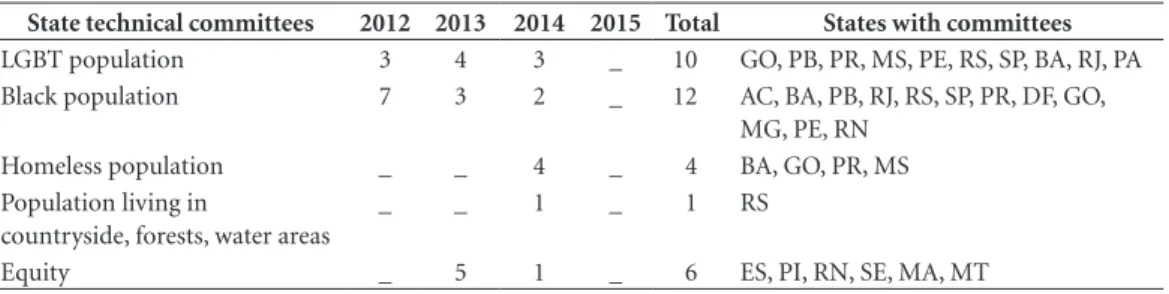
However, in order for the policies to be devel-oped at sub-national spheres, one of the strate-gies that was designed for the implementation of the equity policy was the creation of committees for each group in the vulnerable population. It fell to the SGEP to support the states in the feder-ation in the implementfeder-ation of the State Techni-cal Committees. Table 1 shows the development and progress in the creation of these committees in the states of the Brazilian federation.
Initially it can be understood that there is no uniformed behavior from the states in relation to the creation of these committees although in 74% of the states, it is possible to observe the presence of about one council aimed at having discussions on these policies. Differences between political forces that act in the ambit of each specific policy as well the different levels of organization of the social movements in each state, can be important variables for explaining these differences.
The capacity of inducement shared with the other actors in the area of health, can also go to-wards explaining this progression. According to the SGEP Management Report (2015), the part-nership with CONASS and CONASEMS was fundamental so that each state created its com-mittees. Such a fact owes itself to the leadership of these Councilors and its immense capability in having dialogues with the Health Secretaries and predicting difficulties in implementations through also occupying the role of health secre-taries.
The recognition by the managers of the need to face the inequities can be perceived by the adoption of Equity Committees that were con-centrated in just one committee for the manage-ment of various policies concerning equity. These were created as a way to deal with the insufficient number of professionals at the sub-national lev-els, to respond to the challenge of implementing multiple policies, programs and measures.
In an analogous way, people from the coun-tryside, forests and regions dominated by water, proposed the use of the space in the Health Ref-erence Centers for Workers (CEREST), which exists in the states where there already is intense participation, as a unit for discussions on policy in order to avoid the duplication of efforts.
Aside from the creation, effective participa-tion of the social movements in these
Commit-Table 1. Timeline of establishment of Technical Committees for vulnerable groups in Brazilian states - 2012 - 2015.
State technical committees 2012 2013 2014 2015 Total States with committees
LGBT population 3 4 3 _ 10 GO, PB, PR, MS, PE, RS, SP, BA, RJ, PA Black population 7 3 2 _ 12 AC, BA, PB, RJ, RS, SP, PR, DF, GO,
MG, PE, RN Homeless population _ _ 4 _ 4 BA, GO, PR, MS Population living in
countryside, forests, water areas
_ _ 1 _ 1 RS
Equity _ 5 1 _ 6 ES, PI, RN, SE, MA, MT
aúd
e C
ole
tiv
a,
22(5):1397-1406,
2017
tees is a challenge for the implementation of pub-lic popub-licies in the country for these populations. The research on the basic information from the states17, saw the collection of information on the
existing and operational Human Rights Com-mittees in relation to vulnerable populations. In spite of some of them having been created many years ago, the data showed that these Committees did not have meetings in the last twelve months. This may indicate that they have not left the drawing board or they were demobilized.
The transversal nature of the policies
This transversal nature came about as guide-lines from the Federal Government in the con-text of drafting the PPA 2004-2007 in an effort to overcome the Brazilian bureaucratic model that had been dominant beforehand6.
The transversal term is being used to devel-op and form the organization of public policies that go up against the departmental bureaucratic divisions in ministries and secretaries. Heralded as inter-departmental actions and the creation of horizontal forums for dialogue and the taking of decisions, its success depends on the articulation of developed actions in various sector bodies at federation levels18.
What is observed are the policies aimed at minorities with the incorporation of these guide-lines and this comes about when there is an un-derstanding of the established arrangements by the Brazilian State with the view to changing sec-tors. This showed its inability to offer services for these social groups6.
Although desirable, the adoption of this transversal nature puts on the organizations for public policies the need for changes in the or-ganization of work processes which go through the carrying out of work in networks and in en-vironments where there is trust and reciprocity between the different actors. This is: through the recognition by the actors of the interdepen-dence of their actions, through coordination in networks and through raising awareness in and training managers to act in accordance with this perspective of the organization of work18.
In addition to this, the horizontal nature of the relations and the large number of actors who are involved in the implementation of these pol-icies, can widen the veto points to actions which increases the costs for the coordination team in ensuring the proposed changes19.
In the policies concerning the Promotion of Equity in Health, the SGEP has partnerships with various bodies from the Ministry of Health to discuss and make feasible the necessary ac-tions for the execution of policies based on the demands of the social movements. At the same time, it promotes and participates in the initia-tives of other Ministries to publish, raise aware-ness of and construct consensus around issues to be dealt with in an inter-sectoral way.
As a strategy for providing greater visibility on policy and strengthening the possibilities for integration in a highly complex structure, what was mooted between the Federal Government and the social movements was the adoption of a measure being a structural mark for each equi-table policy. Examples are: the adoption of social names for transvestites and transsexuals in public services, the combating of institutional racism, the acceptance of living styles for populations living in countryside and regions dominated by water as well as the recognition of the nomadic nature of gypsies. In the specific health ambit, we can cite: the transsexual process, the incorporation of the variable color/race and the social name on the SUS card, attention being given to sickle cell dis-ease, the exemption of the proof of residency for gypsies20, the recognition of the role of the
sha-mans (benzedeiras) and midwives in health care. The success of the implementation of policies being transversal in nature has a tendency to be greater where there already exists a trajectory of work with developed characteristics in the same molds in which the manager performs the role of mediator in the development of these actions. Another aspect that influences the results of these efforts, consists in the level of involvement of the managers. The managers responsible for coordi-nating this transversal nature, in general, tend to have a greater level of value and commitment to these actions and they assume the behavior of re-affirming the importance of these policies in all available spaces. In turn, the managers of the other federal programs, where these actions constitute part of their attributes or those that historically present difficulty with the works involved with teams in multiple profiles, tend not to participate in the tasks of sharing the coordination task21.
Siq
ue
ir
a SA
Raising awareness and qualifications of the health professionals
The principle of equity is planted where there is the presence of vulnerable groups and where vulnerability is known based on the places where is can be identified and due to differences in peo-ple. In this sense, thinking on the lines of identity always means thinking of what something is, but what something is only makes sense when a ref-erence is made to that which it is not. “Therefore, identity always refers to the construction of dif-ference”21.
Raising awareness and qualifying profes-sionals to develop new approaches in attending to vulnerable groups constitutes a theme that is difficult to face in the institutional plan. Not only in the point of view of the organization that takes actions but above everything, because institu-tionally speaking there are reasons why dealing with theoretical questions is crucial. One of them is to establish a distinction between the restric-tive idea of tolerance of diversity and the idea of recognizing and respecting differences. Another reason is to comprehend the character of the tool of political fights concerning multiculturalism that is the basis of many discussions on issues re-lated to identity22.
The issues relating to identity are directly re-lated to the idea of equity. One recurrent affir-mation in the area of health is that equity means, “dealing unequally with the unequal” or even that the inequities are “unacceptable disparities”. This means that universal policies that promote equality are not sufficient to promote equity. The effect of social justice, in this case, occurs in a non-universal way contrary to the assumption of the treatment of the individuals or groups con-sidering the questions of identity relating to sex, gender and color amongst other characteristics.
It is not pacific, however, to accept the theo-retical plan that public policies ought to be pro-moted with equity and thus relinquishing the idea of equality23.
Santos23 brought to light the idea of an
“emancipatory multiculturalism” that recognizes a permanent tension between policies of equality and policies on differences. The policy of differ-ence emerged from the field of the fights and re-sistance of populations that go through different levels of discrimination. It defends the idea that the policy of difference does not deal with the is-sue of redistribution but it does deal with recog-nition. Here the meaning is not about a collision between equality and difference but it does cover
“the objectives of social-economic redistribution and the recognition of cultural differences”.
One of the main challenges in the implemen-tation of the policies of equity concern cultural nature derived from historical prejudice in society in relation to vulnerable populations. This being the case, the MS recognizes that the implementa-tion of these policies requires a change in viewing the population in relation to those being users24.
It is known that education plays an import-ant role in changing values and behaviors in populations. In spite of this task transcending the acts of the Ministry of Health, SGEP works in partnerships, in taking actions aimed at raising awareness and qualifying professionals to act in accordance with the policies of equity.
In order to disseminate the policy, obtain a broader consensus, recognize demands and evaluate actions executed concerning the SGEP policy in conjunction with other bodies from the Ministry and the Special Secretaries, seminaries are carried out with managers, health profession-als and social movements25.
The strategy is being used in a general way by the Federal Government for the implementation of social policies as a way of widening interac-tions and the influence of the social movements on the State13.
Another strategy used to train professionals en masse was the offer of distance learning mod-ules through the SUS Open University (UNA-SUS) and the Valuing Professionals in Primary Health Care Programs (PROVAB). The modules for the policies of equity for the LGBT26, black
and rural populations were developed in 2015. With these initiatives, the Ministry intended to reach approximately 50 thousand professionals27.
Analysis that was carried out showed that in spite of the efforts, if the institutional fragilities were not overcome and the structural deficien-cies were not tackled, there is a risk of the above becoming constituted through provoking nega-tive outcomes being permanently placed in the policies27,28.
Conclusions
The idea that the process of implementation cre-ates the policy29, contrary to traditional thinking
that the policy defines the process of implemen-tation, adjusts itself well to the analysis of the policies of equity that has been presented here.
aúd
e C
ole
tiv
a,
22(5):1397-1406,
2017
the policies which developed upon: electing the management, dealing with the transversal nature of the actions and tackling the awareness and training of the professionals and the social move-ments as lines of forces for their work. These are defined as support and the accompaniment of the mechanisms of social participation. On pro-viding visibility and articulating solutions for the historical demands jointly with the movements that represent the vulnerable populations, what is produced in an interaction that is political and virtuous where implementation ends through the creation of a policy.
However, this interaction is not exempt from problems. It was not possible to reach, up until the given moment, the adequate universality and the functioning of the technical committees in health in the states. This was one of the main goals set out in the policy for the target populations. Here, it is worth taking in account some considerations in order to give value to the results. In the first place, the processes of implementation are long and take a while to reach the stage of maturity. Some authors believe that policies need to be developed for a period of about ten year before being evaluated30. In addition to being long, these
processes involve many actors and disputes of a political and ideological nature inside move-ments and amongst managers that reverberate in the construction of policies that have been men-tioned. Secondly, is it possible to note that the capacity of inducement from the MS in any sit-uation, is limited for two reasons: the complexity of the objective of the policy and the budgetary limitations and human resources which end up restricting access for vulnerable groups to their right for health care. It is worth highlighting that any policy aimed at specific groups disputes for resources with an innumerable number of initia-tives of policies of a universal nature.
It is also worth noting that there is still a need to articulate the ideas of equity and differences without allowing the policies to display tenden-cies of being homogenized in relation to the differences in the search for a distribution stan-dard for goods and services which overlays the needs of minority groups whose characteristics make difficult their fitting squarely in the poli-cies of equality. Multiculturalism in this sense is a theoretical pillar so that what is surpassed is the idea of tolerance of diversity, in direction towards ideas of recognition and respect for differences.
The SGEP, while being an actor that incorpo-rates in the ambit of its policies of equity, prac-tices and educational processes, has the power
and potential to articulate as well as formulate inter-sectoral actions in tandem with the Minis-try of Education. This articulation would mean the incorporation, in the ambit of the curricu-lum reform projects, central categories for the comprehension of processes that make certain populations more vulnerable, particularly those that are allocated the condition of being different based on their hegemonic identity.
In the ambit of health, there is a need for widening their participation in a permanent and educational way through measures that put the work of health care at the heart of the problem as well as problems of knowledge particularly for those that help to understand how work relations can help to improve actions and the quality of care given to the vulnerable populations.
In the field of educational actions that are continuous and incorporated in the policies, whenever it is possible and necessary, the diver-sity of the themes is the basis of the construction of differences.
Finally, developing initiatives on qualifica-tions for workers in SUS and for social control in conjunction with strategic actions on the policies for primary health care for vulnerable popula-tions, is needed.
In the ambit of the educational theories, a reading of the critical theories on education can contribute to valuing the group of categories such as: identity and differences, alterity, subjec-tivity, culture, meaning, discourse, representa-tion and multiculturalism.
Lastly, what can be highlighted is that al-though the architecture of the policies directed towards vulnerable groups has been similar, the development of the measures has had a develop-ment time that differs when impledevelop-mented. The consequences of these policies have greatly varied with respect to the incorporation of the greater power for making decisions on the part of the vulnerable groups.
Collaborations
Siq
ue
ir
a SA
References
1. Paim JS, Silva LMV. Universalidade, integralidade e equidade no SUS. BIS, Bol. Inst. Saúde (Impr.) 2010; 12(2):109-114.
2. Braveman P. Health disparities and health equity.
An-nual Rev Public Health 2006; 27:167-194
3. Gohn MG. Teorias dos movimentos sociais. paradigmas
clássicos e contemporâneos. 11ª ed. São Paulo: Edições
Loyola; 2014.
4. Alonso A. As teorias dos movimentos sociais. Lua Nova
2009; 76:49-86.
5. Gonzáles RS. Dossiê os anos Lula. A política de Pro-moção de Direitos Humanos no governo Lula. Revista
Debates 2010; 4(2):107-135.
6. Brasil. Ministério do Planejamento e Gestão (MPG).
Plano Plurianual 2004-2007. Brasil: MPG; 2004.
7. Ciconello A. Os avanços e contradições da Política de Direitos Humanos no Governo Lula. Paula M, or-ganizador. “Nunca antes na história desse país”...?: um
balanço das políticas do governo Lula. Rio de Janeiro:
Fundação Heinrich Böll; 2011. p. 76-98.
8. Brasil. Ministério da Saúde (MS). Secretaria de Gestão Estratégica e Participativa. Departamento de Apoio à Gestão Participativa. Políticas de promoção da equidade em saúde. Brasília: MS; 2013.
9. Costa AM. Promoção de Equidade em saúde para a população negra. Boletim do Instituto de Saúde 2011; 13(2):100-106.
10. Choo HY, Ferree MM. Practicing intersectionality in sociological research: a critical analysis of inclusions interactions and institutions in the study of inequali-ties. Socialogical Theory 2010; 28(2):129-149. 11. Brasil. Ministério da Saúde (MS). SGEP. Atas de
Re-uniões da CIT. [2016 jun 29]. Disponível em: http:// www.saude.gov.br
12. Howlett M, Goetz KH. Introduction: time, tempo-rality and timescapes in administration and policy.
International Review of Administrative Sciences 2014;
80(3):477-492.
13. Avritzer L. Sociedade Civil, Instituições Participativas e Representação: Da Autorização à Legitimidade da Ação. DADOS 2007; 50(3):443-464.
14. Brasil. Ministério da Saúde (MS). SGEP. Relatório de Gestão 2015. Conselho Nacional de Saúde. Ata da 281ª Reunião. Brasília: MS; 2016.
15. Brasil. Conselho Nacional de Saúde. Atas de reuniões do Conselho. [2016 jun 29]. Disponível em: http:// www.conselho.saúde.gov.br
16. Abers R, Serafim L, Tabagiba L. Repertórios de Intera-ção Estado-Sociedade em um Estado Heterogêneo: A Experiência na Era Lula. Dados 2014; 57(2):325-357. 17. Instituto Brasileiro de Geografia e Estatística (IBGE).
Pesquisa de Informações Básicas Estaduais. Rio de Janei-ro: IBGE; 2014.
18. Instituto de Pesquisa Econômica Aplicada (IPEA). Avanços e Desafios da Tranversalidade nas políticas públicas federais voltadas para as minorias. In: IPEA.
Brasil em desenvolvimento: Estado, planejamento e políticas públicas. Brasília: IPEA; 2009. V.3. p. 779-797.
19. Peters G. Managing horizontal government. The politics
of coordination. Ottawa: Canadian Centre for
Manage-ment DevelopManage-ment; 1998. (Research Paper No. 21). 20. Almeida MG, Barbosa DRM, Pedrosa JIS. Trilha da
Iniquidade: Saúde de Povos Ciganos e Políticas Públi-cas no Brasil. Revista Eletrônica Gestão & Saúde 2013; 4(3):1116-1129.
21. Woodward K. Identidade e Diferença: uma introdução teórica e conceitual. In: Silva T, organizadores. Iden-tidade e diferença: a perspectiva dos estudos culturais. Petrópolis: Editora Vozes; 2011. p. 7-72.
22. Martucelli D. As contradições políticas do multicultu-ralismo. Revista Brasileira de Educação 1996; 2(Maio/ Jun/Jul/Ago).
23. Santos BS. Dilemas de nosso tempo: Globalização, Multiculturalismo e Conhecimento. Currículo sem Fronteiras 2003; 3(2):5-23.
24. Brasil. Ministério da Saúde (MS). Secretaria de Gestão Estratégica e Participativa. Departamento de Apoio à Gestão Participativa. Relatório do I Seminário Nacional
de Saúde LGBT Brasília 24 a 26 de novembro de 2013.
Brasília: MS; 2015.
25. Brasil. Ministério da Saúde (MS). Secretaria de Gestão Estratégica e Participativa. Departamento de Apoio à Gestão Participativa. Relatórios de Gestão 2012 a 2015. Brasília: MS; 2015.
26. Brasil. Ministério da Saúde (MS). Secretaria de Políti-cas para as Mulheres. Atenção Integral à Saúde de Mu-lheres Lésbicas e Bissexuais. Relatório da Oficina Aten-ção à Saúde de Mulheres Lésbicas e Bissexuais. Brasília: MS; 2014.
27. Cruz ICF. Que falta faz uma área técnica de saúde da população negra no Ministério da Saúde. Revista ABPN 2013; 5(9):163-171.
28. Pereira CF. Notas sobre a trajetória das políticas públi-cas de direitos humanos LGBT no Brasil. RIDH 2016; 4(1):115-137.
29. Majone G, Wildavsky AL. La implementación como evolución. In: Pressman JL, Wildavsky A, organizado-res. Implementación: como grandes expectativas
conce-bidas en Washington se frustran in Oakland. México:
Fondo de Cultura Econômica; 1998. p. 263-277. 30. Sabatier PA. An advocacy coalition framework of
pol-icy change and the role of polpol-icy-oriented learning therein. Policy Sciences 1988; 21:129-168.
Article submitted 20/06/2016 Approved 12/09/2016