ISSN online: 1807-1775
DOI: 10.4301/S1807-17752015000300006
___________________________________________________________________________________________
Manuscript first received/Recebido em: 10/06/2015 Manuscript accepted/Aprovado em: 11/11/2015 Address for correspondence / Endereço para correspondência
Kendra L. Smith, 411 N. Central Avenue, Mail Code 3520, Phooenix, Arizona 85224. (602) 496-0202 College of Public Service and Community Solutions, Arizona State University, USA E-mail [email protected]
Isabel Ramos, University of Minho, ALGORITMI, Portugal E-mail [email protected]
Kevin C. Desouza, College of Public Service and Community Solutions, Arizona State University, USA E-mail [email protected]
Published by/ Publicado por: TECSI FEA USP – 2015 All rights reserved.
ECONOMIC RESILIENCE AND CROWDSOURCING
PLATFORMS
Kendra L. Smith
College of Public Service and Community Solutions, Arizona State University, Arizona, USA
Isabel Ramos
University of Minho, ALGORITMI, Minho, Portugal
Kevin C. Desouza
College of Public Service and Community Solutions, Arizona State University, Arizona, USA
______________________________________________________________________
ABSTRACT
The increased interdependence and complexity of modern societies have increased the need to involve all members of a community into solving problems. In times of great uncertainty, when communities face threats of different kinds and magnitudes, the traditional top-down approach where government provides solely for community wellbeing is no longer plausible. Crowdsourcing has emerged as an effective means of empowering communities with the potential to engage individuals in innovation, self-organization activities, informal learning, mutual support, and political action that can all lead to resilience. However, there remains limited resource on the topic. In this paper, we outline the various forms of crowdsourcing, economic and community resilience, crowdsourcing and economic resilience, and a case study of the Nepal earthquake. his article presents an exploratory perspective on the link can be found between crowdsourcing and economic resilience. It introduces and describes a framework that can be used to study the impact of crowdsourcing initiatives for economic resilience by future research. An initial a set of indicators to be used to measure the change in the level of resilience is presented.
JISTEM, Brazil Vol. 12, No. 3, Sept/Dec., 2015 pp.595-626 www.jistem.fea.usp.br
1. INTRODUCTION
Global financial and economic crises have had debilitating effects on the various regions of the world, profoundly affecting the ability of national and local governments to meet the pressing needs of local communities. Many countries are facing stark economic realities such as national debt, financial instability, and even the threat of bankruptcy that has severe impacts on communities. As a result, communities lacking economic resilience are left to cope with the burden of fulfilling their basic needs. Facing constraints on government’s ability to provide relief, communities are turning to crowdsourcing to find solutions.
Crowdsourcing is the process of sourcing ideas, services, and content from the public in order to benefit from large groups’ collective intelligence. Collective intelligence, or the wisdom of crowds, is the intelligence derived from collaboration amongst peers. This peer-to-peer (P2P) process allows groups to use their collective talent and skills to create bottom-up solutions. Additionally, it allows groups to go beyond the ‘usual suspects’ of problem solving such as employees and people who ordinarily have control.
During moments of economic normalcy, organizations are looking to move away from the processes that have led them to fragility and seeking innovative approaches to sustainable problem solving. Many looked to the power of P2P technology-enabled networks to create their own solutions. For instance, in 2009 and 2010, Iceland began a process of crowdsourcing a new draft of their constitution. This was done because of a financial crisis the country experienced in 2008, which revealed weaknesses in the document and the ineptitude of political officials. The government undertook a process where 950 randomly sampled citizens gathered to discuss principles and values they would like to see in their constitution. Following this, 25 constitutional drafters came together in order to develop a document that was then presented to social media to open the feedback process from the public. The constitution was approved by two-third of the voters but failed in the Parliament. If this constitution had passed, it would have been the first crowdsourced, transparently written constitution in the world (Landemore, 2014, July 31).
In a world where many governance decisions are made by a select few, crowdsourcing is viewed as an opportunity to improve communities by using
communities’ best assets: their citizens. Citizens’ ideas and creativity enable more
possibilities and expand the concepts of transparency and accountability. Citizens have signaled through various movements around the world that they are not content with just participating in periodic elections. They want to enrich their community and society by sharing their views, knowledge, and experience to create better outcomes. In many cases, citizens are not waiting to do this with government officials.
JISTEM, Brazil Vol. 12, No. 3, Sept/Dec., 2015 pp. 595-626 www.jistem.fea.usp.br
EuroZone leaders held a series of meetings about the debt crisis, Thom Feeney, a British man, started a crowdsourcing campaign to help Greece raise the money to pay its €1.1 billion debt. The site was so popular that it crashed momentarily. It raised €1 million in three days, €1.8 million in seven days (Grant, 2015, July 6).
Citizens are crowdsourcing in times of disaster. We are regularly seeing natural and man-made disasters that encumber many of government’s resources. When this happens, there are gaps in the response and recovery of communities. As a result, citizens and nonprofit groups are crowdsourcing, and leading their own efforts, to aid a community through such tasks as information gathering, tracking of changes in the environment, working the information in a meaningful way and transmitting it to a central coordination entity, and working toward the restoration of normality. For instance, following the 2010 earthquake that devastated the Haitian capital Port au Prince, 650 volunteers created digital maps of roads that were and were not operable on the online mapping service OpenStreetMap (Chan, 2012, November 23). The maps were helpful with delivering health services, food, search and rescue, and transportation.
In other cases, government seeks the wisdom of crowds as a tool to increase capacity and resilience. For instance, the White House Innovation for Disaster Response and Recovery Initiative entered into a partnership agreement with the home-sharing app service Airbnb to work with cities before, during, and after disasters. Airbnb will pool individuals who will commit to opening their homes to individuals displaced in times of emergency. In 2012 during Hurricane Sandy, 1,400 individuals opened their homes to victims (Tam, 2014, July 29). In the U.S. and in other countries, cities contract with Waze, a crowdsourced mapping application to understand issues such as traffic flows, potholes, pedestrian traffic, closures, and accidents to improve congestion and provide drivers with alternatives.
Although crowdsourcing has been popularized by technology, the concept is not new. In 1775, the French Academy of Sciences crowdsourced the development of a process that could produce sodium carbonate (soda ash), a key ingredient to paper, glass, and soap, from cheaper materials. In 1714, the British government sought an accurate method for determining longitude to lessen naval accidents on the high seas. A marine chronometer was submitted and won the contest. Seafarers use updated forms of the technology today.
Further, citizen engagement is not new. Before technology, citizens traditionally immersed themselves in a community life through parent/teacher associations, social clubs, neighborhood groups, and the like to focus on issues important to them. Today, technology has enabled greater connectivity to the global community, increased access to people and information, and greater personalized interactions. Innovative communities have found ways to merge older forms of engagement with technology. In Berlin, crowdsourcing platform Jovoto created an upcycling, open design competition to repurpose a 120 year-old defunct steel railway bridge for a civic project (Mairs, 2015, August 18).
JISTEM, Brazil Vol. 12, No. 3, Sept/Dec., 2015 pp.595-626 www.jistem.fea.usp.br
various forms of crowdsourcing, economic and community resilience, crowdsourcing and economic resilience, and the case of the Nepal earthquake is presented as a way to provide first evidence for the theoretical claims. This paper also introduces and describes a framework that can be used to study the impact of crowdsourcing initiatives for economic resilience and develops a set of indicators to be used to measure the change in the level of resilience. This framework was derived from a literature review covering the topics of technology-enabled crowdsourcing, community resilience, and crowdsourcing to build community resilience. The article ends by presenting evidence on how the dimensions of the proposed framework can be used to study the use of crowdsourcing for crisis / disaster situations.
2. CROWDSOURCING: INSIGHTS FROM THE LITERATURE
Crowdsourcing is the act of outsourcing a task or a function performed within the organization to an undefined and large group of people in the form of an open call. The task can be performed collaboratively (peer-production) or individually. According to Jeff Howe (2006), Web technologies have allowed the emergence of many initiatives that permit the average individual to market high-value intellectual property produced independently or in collaboration with others in whom she/he recognizes talent.
Utilization of Crowdsourcing in the 21st Century
Crowdsourcing enables organizations to access a large number of creative individuals capable of producing a wide variety of unique intellectual goods that can then be subject to mass production in industrial sectors as diverse as textile, furniture, telecommunications, IT, food industries among many others. The spread of sophisticated technology available at low prices, ranging from tablets, video cameras, mobile phones to sophisticated software, made it possible for non-professionals to express their talent in the production of intellectual goods that can be acquired by organizations at low cost and be integrated in their production or innovation processes (Schenk and Guittard, 2011). Since these intellectual goods can be produced and offered in large quantities, organizations are able to select from a broad range, thus accessing a wide pool of skills and knowledge.
JISTEM, Brazil Vol. 12, No. 3, Sept/Dec., 2015 pp. 595-626 www.jistem.fea.usp.br
challenge that is being answered (Schröder and Hölzle, 2010). The mechanisms for the creation of online reputation, coupled with opportunities to interact online, help to create bonds of trust between the members of the crowd, which are essential for the formation of spontaneous or suggested small teams for solving the most complex challenges.
When choosing to undertake crowdsourcing as a form of citizen engagement, organizations must be cognizant of their drawbacks. First, challenges presented must not request things that groups cannot reasonably produce. The open call must be written clearly with defined expectations (e.g. type of submission accepted, criteria), a transparent process (e.g. how are winners chosen, who owns intellectual rights), and the
challenge feasibility in terms of the crowd’s resources and skills. If users feel that there
is not enough information provided, they are likely to spend their time expressing their discontent than working on the challenge. For instance, German dishwashing liquid soap company Pril held a crowdsourced competition for the design of its label in 2011. The company received over 50,000 submissions that were discussed and rated. The competition stated that two out of the top 10 designs (that the public voted on) would be
selected. However, scared of ‘weird’ designs, the company weeded out certain designs
using the rationale that some voters manipulated the voting process. There was discontent within the online community for the apparent disregard of the voters´ choice.
Second, if the organization turned to crowdsourcing due to lack of internal knowledge, it may face serious difficulties in properly assessing the quality and relevance of the contributions that are presented as well as in their integration in internal processes. Organizations must find a unique blend of evaluators that can adequately assess the varying aspects (i.e. idea, feasibility, sustainability, and adoptability) of the submissions. Third, issues of intellectual property ownership can be a sharp point of contention between developers and challenge creators. Intellectual property must be properly valued and rewarded in order to stimulate the high quality of participation and the development of trust.
Crowdsourcing Classifications
The growing popularity and uses of crowdsourcing justify the creation of a classification of its various models. This classification facilitates the understanding of the phenomenon and the prediction of how crowdsourcing will evolve in the coming years. Table 1 presents the categorization adopted in this paper and helps to highlight the complexity of practices generally referred to as crowdsourcing.
Category Description Examples
Crowd wisdom Technology-enabled
crowdsourcing initiatives to solve innovation challenges or complex problems.
Innocentive (www.innocentive.com)
Chaordix (www.chaordix.com)
NineSigma (www.ninesigma.com)
Crowd creation
Technology-enabled
crowdsourcing initiatives to
produce marketable
intellectual goods.
Threadless (www.threadless.com)
99designs (99designs.com)
Naming Force
JISTEM, Brazil Vol. 12, No. 3, Sept/Dec., 2015 pp.595-626 www.jistem.fea.usp.br
Crowd review Technology-enabled
crowdsourcing initiatives to promote knowledge sharing
and combination for
decision making.
Peer-to-Patent (www.peertopatent.org/)
IdeaScale (www.ideascale.com/)
Consensus Point
(www.consensuspoint.com/)
Crowd funding Technology-enabled
crowdsourcing initiatives to support the raising of funds for projects, businesses, or initiatives through the collective effort of many.
Kiva (www.kiva.org)
GrowVC (www.growvc.com)
Indiegogo (http://www.indiegogo.com/
Crowd democracy
Technology-enabled
crowdsourcing initiatives to promote open government.
Patient Opinion
(www.patientopinion.org.uk)
Open Ministry
(www.openministry.info)
Data.gov.sg (www.data.gov.sg/)
Citizen science Technology-enabled
crowdsourcing initiatives to promote involvement of non-scientists in research projects.
Citizen Science Alliance
(http://www.citizensciencealliance.org/)
PatientsLikeMe
(www.patientslikeme.com)
CornellLab of Ornithology
(www.birds.cornell.edu/citsci)
Citizen journalism
Technology-enabled
crowdsourcing initiatives for sharing and aggregation of content of journalistic value.
CNN iReport (ireport.cnn.com)
Demotix (www.demotix.com)
AllVoices (www.allvoices.com)
Crowdsourcing
for crisis
response
Technology-enabled
crowdsourcing initiatives
for involvement of
individuals in disaster/crisis response and recovery.
Social Media for Emergency
Management (www.sm4em.org)
Humanitarian Tracker
(www.humanitariantracker.org)
HealthMap (www.healthmap.org)
Table 1: Crowdsourcing categories
JISTEM, Brazil Vol. 12, No. 3, Sept/Dec., 2015 pp. 595-626 www.jistem.fea.usp.br
supported the resolution of thousands of challenges and paid millions of dollars in rewards.
Organizations and government agencies put innovation challenges on the InnoCentive platform indicating the reward to be given to the winning solution. The organization pays a fixed fee to InnoCentive which depends on the type of challenge. After a period defined in the challenge itself, incoming solutions are evaluated and the best is awarded and the intellectual property rights are transferred to the organization that provided the challenge, which should be able to internalize the solution in a successful innovation. The InnoCentive supports the protection and transfer of intellectual property.
In Pakistan, programmers participated in a “Civic Hackathon” facilitated by Code for Pakistan. Programmers used open data to develop apps that would aid their fellow citizens in areas where the Pakistani government was faltering such as crime, terrorism, chronic power outages, and a poor economy. For instance, one group created
the “NoKunda,” app that allows residents to report illegal electricity connections on
public power lines. Other apps allow residents to report bribing, help arrange carpooling connections, and gather reports on diseases daily for quicker NGO and government response (Stockman, 2015, March 27).
The crowd creation model aims to create value by consumers themselves. The value creation can be sponsored or autonomous (Zwass, 2010). In sponsored value creation, the crowd executes co-creation activities defined and coordinated by an organization interested in the mass production of intellectual goods such as the design of t-shirts and furniture. Instead of using their own web platforms, mass producers may use intermediaries whose function is to ensure the existence of a crowd with the right skills and motivation to provide high quality contributions (Geiger et al., 2011; Howe, 2008). For instance, iStock by Getty Images is a crowdsourced, royalty-free stock images and media sight that allows anyone to upload images for others to purchase. The site is one of the most successful and profitable crowdsourced sites in the world.
In the case of autonomous creation of value, the crowd produces marketable intellectual goods in voluntary activities. The goods produced are made available to those who may want to consume them, possibly through proprietary platforms of organizations that benefit economically from the activity of co-creation, particularly through the advertising opportunities that online traffic creates. Wikipedia and Youtube are examples of autonomous creation of value placed in the commons.
Threadless (threadless.com) is an example of sponsored value creation. It is an online t-shirt company that crowdsources the design process for shirts it sells online through an ongoing open call for new designs and allowing registered members on the site to rate the design submissions on a five-point scale. The best rated designs are then used to produce t-shirts that are sold on the site. Designers who see their designs approved for production are rewarded in cash and in Threadless gift certificates. Shirts are sold online and shipped internationally. On the site, anyone can sign up for free with a valid e-mail address and become a member of the Threadless community. Community members can participate in the various functions available, including submitting designs, voting on designs, and shop. A very active blog forum is also available for members to chat about t-shirts or any other topic.
JISTEM, Brazil Vol. 12, No. 3, Sept/Dec., 2015 pp.595-626 www.jistem.fea.usp.br
their knowledge and skills to develop an output that is more sophisticated than what could be created by each member individually. Alternatively, the crowdsourcing initiative may have been designed to access the preferences of a large number of people or to execute decision tasks faster.
The challenge in this type of crowdsourcing is to engage crowd members in constructive interactions to produce something of very high value to the initiative and those accessing it. In the case of ranking or quick choice, the challenge is to deliver the adequate incentives to keep the crowd contributing. Action Alexandria is a crowd review site that allows residents of Alexandria, Virginia, to visit an online platform where they can respond to challenges, submit ideas, debate solutions, share stories, and build relationships.
Other sites also seek crowd review such as Threadless, described above as an example of crowd creation, also implements crowd review strategies by allowing community members to rate t-shirt designs. Wikipedia also applies crowd review strategies by allowing registered members validate, comment and change submitted articles.
Crowdfunding can be defined as the process by which entrepreneurs and nonprofits raise money on the web for their projects, businesses, or initiatives through the collective effort of many people who network and pool their money together to support the projects they find meaningful (Burtch et al, 2011; Burkett, 2011). Crowdfunding allows for individuals having difficulty accessing the usual financing resources to obtain the money needed to begin small projects or businesses. Since proposers present their idea in an open way, they can grasp the acceptance their project/business/initiative will have on the target market or community.
Following the earthquake in Nepal, crowdfunding campaigns began immediately. Crowdfunding sites such as GoFundMe, GlobalGiving, Razoo, Indiegogo, and CrowdRise received over $20 million in donates over 60 days from different segments of the international community. For instance, GlobalGiving pulled funds large from international nonprofits. GoFundMe and CrowdRise largely collected donations for individuals (Thorpe, 2015, June 11).
KIVA (kiva.org) is a non-profit organization that crowdfunds entrepreneurial loans to third-world countries through microfinance intermediaries called Field Partners. Through its web-based platform, KIVA allows for lenders in developed countries to lend money to developing world entrepreneurs. A microfinance institution may become a Field Partner by following specific requirements defined by KIVA. Borrowers submit their project or goal in life that requires funding. Field Partners across five continents choose the local borrowers that are eligible for loans based on information about the project KIVA uploads to its website. Then lenders all over the world choose their favorite projects and personal stories and lend in increments of $25 to the largest amount that is the entire requested loan.
Upon repayment of the loan, KIVA collects the funds and then transfers the funds to the respective Field Planner in the form of KIVA credits. The Field Partner may withdraw their funds via PayPal or relend to another entrepreneur. KIVA is entirely supported by grants, loans, and donations from users and corporations. Field Partners charge their borrowers high interest to cover the risk of unpaid loans.
JISTEM, Brazil Vol. 12, No. 3, Sept/Dec., 2015 pp. 595-626 www.jistem.fea.usp.br
citizens to influence political and government decisions, therefore promoting open government. Crowd democracy initiatives can fall into three categories (Linders, 2012):
1) Citizen crowdsourcing. These initiatives allow citizens to contribute to improving the efficacy and responsiveness of governments. Citizens provide information and other contributions in accordance with specific requests, comment or rate possibilities, and help run government services.
2) Open data platforms. The government provides public information for citizens to develop automated ways to analyze data according to objectives relevant to their decision-making, productivity, and well-being.
3) Self-organized crowdsourcing. These initiatives are developed and managed by citizens to allow citizen-to-citizen co-creation, eventually presenting a substitute for traditional government responsibilities. In this type of initiative, the tasks in outsourcing to the crowd are defined by the citizens themselves. The government can be informed of the results and provide support.
Open Ministry (open-ministry.org) is a Finnish crowdsourcing initiative, non-profit and non-aligned, that crowdsources the way laws are draft. The support is provided in three major ways: (1) ideation and development in which the initial concept is refined into a clear proposition. The platform supports open discussion of the proposal so the proposal can be refined and the language be framed in a way that is acceptable to the parliament; (2) campaigning the proposal in order to obtain at least 50 000 supporters so the law proposals can be passed to the parliament. Citizens can vote on the proposals that are available online; and (3) helping to get the support of influential people from the cultural, corporate and academic sectors to help the lobbying process required to shape politicians thinking and voting once the proposal goes to parliament.
The initiative aims at becoming an important instrument of participatory democracy by helping citizens have an impact on the laws that will regulate their lives. In Egypt during the Arab Spring, crowd democracy was in place in physical and digital form. Global protest movements saw thousands protest the dysfunctional Egyptian government as well as a digital movement that broadcast the grievances on social media site like Twitter, Facebook, and Youtube. As a result, both movements led to a 30-year dictatorship being toppled.
Citizen science is crowdsourced scientific research. Non-scientists are called to collaborate on research projects, providing information or participating in the analysis of research information (Cohn, 2008; Wiggins and Crowston, 2011). In this participatory format, volunteers take active roles in the research process, allowing them to have a closer contact with the scientific community and the usually large-scale problems addressed. The active participation of volunteers allows for the development of critical analysis skills and also for a better understanding of the scientific process.
JISTEM, Brazil Vol. 12, No. 3, Sept/Dec., 2015 pp.595-626 www.jistem.fea.usp.br
about environmental data across the state with plans to share the information with the state or federal government (Pidot, 2015, May 11).
The Citizen Science Alliance is an example of an initiative that promotes
“collaboration of scientists, software developers and educators who collectively
develop, manage and utilise internet-based citizen science projects in order to further science itself, and the public understanding of both science and of the scientific
process.” (citizensciencealliance.org). This platform hosts a number of projects in
different scientific fields and advises researchers. Projects may be sent for assessment and, if approved, they are launched online. The platform makes available the necessary functionality to gather and aggregate contributions and other collaborative research tasks as well. Scientists provide the initial research challenge and then they help validating contributions from non-scientists. The platform may include tutorials to support the learning required to rigorously execute the task. Some of the results are then published in papers co-authored by scientists and major contributors. The platform aims to advance science and the public understanding of both science and the scientific process.
Web technologies enable the sharing and aggregation of content around areas of interest to specific communities. These same features allow bringing journalistic activity closer of final consumers. Armed with the talent and the proper tools, individuals can become amateur journalists, producing their own journalistic material and sharing it with those in the world who may have an interest. This democratization of journalism comes with different labels, including participatory journalism (Nguyen, 2006), grassroots journalism (Gilmor, 2004), networked journalism (Van der Haak et al., 2012) and citizen journalism (Bowman and Willis, 2003; Mythen, 2010).
AllVoices (allvoices.com) is a citizen journalism platform that aims at forming a global community of professional and non professional journalists interested in sharing news, videos, images and opinions about events and people. It aims at providing global and local coverage by combining the received contributions with related articles aggregated from mainstream news sources. AllVoices assigns a credibility rating to each news report. The platform has been visited by 3 million unique visitors worldwide.
Crowdsourcing for crisis response refers to the involvement of individuals in response to disasters and crises by performing tasks delivered through web platforms. These initiatives may result from an effort of self-organization by the affected communities; instead, they might have been created by organizations involved in relief operations (Tapia et al, 2011; Vivacqua and Borges, 2010; Gao et al, 2011). In the case of self-organization, the use of social media such as blogs, wikis, microblogging and online social networks offer an inexpensive and effective way to disseminate information and collect ideas to solve problems. Volunteers find an easy way to participate in the relief efforts given their previous experience with those technologies; they also feel empowered to influence the technological infrastructure available and the support it gives.
JISTEM, Brazil Vol. 12, No. 3, Sept/Dec., 2015 pp. 595-626 www.jistem.fea.usp.br
The Singapore Red Cross developed an innovative blood donation crowdsourcing campaign aimed at youth. The app alerts a potential blood donor of low stock level in real-time and prompts users to donate by providing information and locations of blood banks and blood drives. Users can track and post their donations and they are even able to see the number of lives their donation helped to save along with the information of their peers (Singapore Red Cross Society, 2012).
3. CROWDSOURCING’S CONNECTION TO ECONOMIC AND
COMMUNITY RESILIENCE
The rise of crowdsourcing has important connections to economic and community resilience. To begin, resilience is a highly sought after, desirable goal of cities and communities. The concept of resilience lies in the ability of individuals, environments, or systems to respond to shocks and changes while continuing to operate and/or improve under the stress of the challenge. Resilience is the optimum place for a system to be because it means that the system will be able to survive and withstand pressures. However, resilience is extremely challenging to attain because of the complexity and interdependence between systems within a community, which makes them complex adaptive systems (CAS).
Resilience and Complex Adaptive Systems
Communities are complex adaptive systems because they are populated by natural and artificial systems; adaptive because they are dynamic in their ability to adapt and evolve through changing environments. The interdependence between components within a system creates opportunities for one component of the system to affect another. Walby (2007) suggests a way to look at the connection between systems is by considering each interlinked system as a medium for another system. That is, systems have mutual impact, where inputs and outputs flow through one another.
Economic resilience and vulnerability play a critical role in the wellness and overall resilience of a community. A community’s economic system consists of industries that are connected through the exchange of products, transactions, and employment (Desouza and Smith, 2014). Vulnerability is the economic system’s proneness to external shocks such as the weakening of a strategic industry (i.e. Detroit and the automobile industry, Pittsburgh and the steel industry), poor planning, and economic openness (i.e. productivity reduction, state subsidies). For resilience, communities should be able to sense changes, make proactive interventions, have alternative resources in place if needed, and the ability to recover from crises.
JISTEM, Brazil Vol. 12, No. 3, Sept/Dec., 2015 pp.595-626 www.jistem.fea.usp.br
crises occur even though there were signals because there was not a proper trigger for action.
For resilience to occur, communities must pay attention to signals and trigger interventions and behaviors that prevent destructive or disruptive occurrences. Interventions and behaviors should be new and innovative and carry the potential to adequately confront challenges, prevent crises, and enhance resilience. Crowdsourcing has emerged as a tool for open innovation (Schenk and Guittard, 2011; Marjanovic et al., 2012), diverse modes of idea development (Lee et al., 2015), and cost and time-effectiveness (Brabham, 2008; Vukovic and Bartolini, 2010) that can help solve difficult challenges.
Crowdsourcing as an Innovative Approach to Resilience
Crowdsourcing creates an opportunity for the formation of social networks of skill, experience, and knowledge diversity. This opportunity decreases barriers to idea generation such as a lack of internal inertia, industry sameness, and shared assumptions across industries. However, the most important way that crowdsourcing impacts economic and community resilience is through the opening of communication and connectivity amongst individuals who would ordinarily not have access to one another. 25 years ago, the connectivity we experience through social media and the Internet was non-existent; people were largely relegated to telephone conversations and writing letters to people in which they already had some acquaintance. Epstein (2015) asserts that the opening of communication lines has become a precondition to enhancing cooperation amongst previously unconnected persons.
Connectedness brought on by Internet and technology create a higher level of productivity (also referred to as social productivity) where individuals and groups are using social media, Web 2.0 technologies, and other forms of communication to work more effectively and efficiently. This aids resilience because it creates new avenues through which citizens can create new ideas and solutions for problems. The opportunity of crowdfunding to finance a community initiative or crowd wisdom that develops an ideas or information that modifies community behaviors grow as more people engage. Consider the astounding crowdsourced effort Wikipedia, a repository of information where anyone can create, edit, and update information pages at anytime. Wikipedia has become the world’s largest encyclopedia and has essentially changed the way people research information; it also lowers the cost of acquiring knowledge and the speed in which people can acquire new information.
JISTEM, Brazil Vol. 12, No. 3, Sept/Dec., 2015 pp. 595-626 www.jistem.fea.usp.br
Further, trends in urbanization are creating megacities (i.e. cities with populations of 10 million) quicker than previously expected. The growth of these megacities—megacities that are majority located in the developing world—increases city fragility and instability because of the drain on natural resources, the volume of families living in poverty, poor governments, and more. Desouza (2014) argues for frugal innovations, a development process that emphasizes reducing the cost and complexity of product production by assessing the markets needs and people’s ability pay, in developing markets. Crowdsourcing has been applied to frugal innovation as an opportunity to pull ideas to find ways to make cheaper, affordable, quality products. In 2011, the Bill and Melinda Gates Foundation created the Reinventing the Toilet Challenge that awarded $100 thousand dollars to design a toilet that can safely dispose of human waste without a septic system or an outside water source, for five cents per day. The winners created an electrochemical reactor that is powered by the sun and breaks down water and waste into fertilizer and hydrogen.
If taken to market, the winning toilet design has the potential to eliminate serious issues happening in urbanized areas, which could boost resilience. In India, Finance Minister Arun Jaitley set a public goal to end open defecation by 2019. This goal is a challenging one because out of the one billion people in the world that does not have toilets, India accounts for around 600 million. Toilet installation in India could improve communities’ resilience in various subsystems. For instance, toilet installation would improve hygiene, which would increase health because many preventable diseases (e.g. encephalitis, enteropathy, diarrhea) would be eliminated. Health care costs could decrease because the malnutrition of pregnant women, newborns, and children caused by repeated diarrhea or intestinal worm infections would be limited (WHO, 2008).
Understanding Resilience
The drive resilience, communities must enhance their ability to adapt and leverage their complexity to work positively for them. There are two many components that support resilience: resource robustness and adaptive capacity (Longstaff et al., 2010). These two components are essential for resilience because they help community’s absorb disturbance and maintain its essential functions. This happens when a community has both the resources available and the ability to adapt in a manner that ensures functionality during and after the disturbance (Longstaff et al., 2010). Important to this process is harnessing the assets of a specific community to enhance resilience.
Resource robustness is associated with the measure of the effectiveness of the association between resource performance, diversity, and redundancy. Resources are organized as “objects, conditions, characteristics, and energies that people value” (Norris et al., 2008). Individuals can value resources differently. The concept of robustness centers on the ability to withstand the effects of shocks or disruptions due the structural, system, and technological properties (Adgers, 2000). According to Anderies et al. (2013), robustness explicitly links system dynamics to performance measures. Robustness depends on the effectiveness of this association to provide critical functions under a variety of conditions.
JISTEM, Brazil Vol. 12, No. 3, Sept/Dec., 2015 pp.595-626 www.jistem.fea.usp.br
Crowdsourcing assists with this through activities that develop or strengthen the performance of local public infrastructures, social services, services for water and energy supply, social networking, leadership, ethical values, and others. For instance, government platforms that seek to engage citizens in participatory democracy and crowd creation efforts aid with enhancing the performance of social networks and services.
An attribute key to performance robustness is redundancy. Redundancy is a system property that creates conditions where a failure in a key system will be immediately substituted by a backup (redundant) element. When a community has several resources to perform the same activity or function, it is said that there is redundancy of resources. The existence of redundant resources is important to ensure the implementation of an activity or function in case of failure of the unit in use. For instance, redundancy in a technical capacity could include back-up communications systems in case of a natural disaster. Socially, redundancy could include alternative shelters for disaster victims when their homes are destroyed.
However, redundancy has associated costs that the community must support. Having two systems can be costly, especially when considering physical infrastructure. Crowdsourcing offers an alternative to this because many of crowdsourced efforts are low cost and dispersed across large groups. For instance, the aforementioned partnership between the White House and Airbnb to provide emergency housing in cases of disaster emergency is a cost-efficient way to provide temporary shelter for victims. Previously, government would have to transport shelter equipment from wherever they were available which took time and cost money. Further, the redundancy of housing for disaster victims’ aid in the recovery following a disruption exists because there is likely to be fewer instances of violence and illness. In the months following the earthquake in Haiti, more than 25% of the population was displaced for longer than a year and living in tents or displacement camps that lacked lights, doors, food, and adequate security. As a result, girls and women were regularly raped or subject to exchange sex for basic necessities such as food (Torgan, 2012, October 18). Additionally, due to the living conditions, over 9,000 Haitian’s were killed and 700,000 infected by Cholera that is believed to have been brought in to the country by aid workers from South Asia and contracted through infected water supplies (Editorial Board, 2015, August 12). Associated with redundancy of resources is diversity.
JISTEM, Brazil Vol. 12, No. 3, Sept/Dec., 2015 pp. 595-626 www.jistem.fea.usp.br
Res
o
u
rc
e
Ro
b
u
stn
es
s
Community Resilience
is a function of
Resource Performance
Resource Redundancy
Resource Diversity
Institutional Memory and
Innovative Learning
Connectedness
A
d
a
p
ti
v
e
C
a
p
a
ci
ty
Figure 1: Aspects of Community Resilience (adopted from (Longstaff et al., 2010))
Another element of resilience is adaptive capacity; this reflects the learning aspect of system behavior (Carpenter et al., 2001). The adaptive capacity of a community “is the ability of individuals and groups to: 1) store and remember experience, 2) use that memory and experience to learn, innovate, and reorganize resources in order to adapt to changing environmental demands, and 3) connect with others inside and outside the community to communicate experiences and lessons learned, self-organize or reorganize in the absence of direction, or to obtain resources from outside sources.” (Longstaff et al., 2010, p. 7).
With time, a community develops and shares experience in solving common challenges and defining common futures. Culture, shared practices, meaning structures, and informational resources form the institutional memory. The accumulated institutional memory guides the creation of novel adaptations to environmental changes and the solution of problems. This collective ability is called innovative learning, a concept that emphasizes the learning that results from innovation efforts. The concept is also useful to emphasize that learning to deal with a crisis and a disaster may be highly dependent on their actual happening, when community members are most motivated for the effort of finding the required solutions and rethinking structures and the value of the available resources.
JISTEM, Brazil Vol. 12, No. 3, Sept/Dec., 2015 pp.595-626 www.jistem.fea.usp.br
platform was developed to allow anyone to report what was going on in the streets. Ushahidi has been used in several other crises and the open source nature of the software allows it to be used and modified. Learning from past incidents and adapting Ushahidi to meet his needs, student Kpetermeni Siakor was able to dispatch Liberian emergency units by phone from his residence in Ghana to Ebola cases in Liberia (900 miles away) by using information volunteers entered into Ushahidi. Before Ushahidi, this type of work would have taken five or more days to report the Ebola cases the government (Rutsch, 2015, March 25).
Further, to foster effective learning, spreading knowledge and information is important to ensuring the integration of new experiences in the institutional memory. This requires the existence of trusted communication channels. Leadership is crucial to ensure the trust and guidance required for innovative learning that occurs in the process of creating solutions, tools, and meaning structures. Innovative learning also serves the community as way to anticipate future opportunities and hazards. For instance, evidence of climate change suggests future global peril if climate change isn’t curtailed. The MIT Climate CoLab is a platform for citizen scientist to create, analyze, and discuss proposals to address global climate change on a continued basis. The continuous connectedness helps to sustain institutional memory.
Connectedness also helps to create social and organizational networks of community members with ties to resources, internal systems, and the environment. The degree of connectedness defines the community’s ability to create and apply knowledge when facing challenging events as well as to take collective action to ensure its sustainability. Communities need to nurture tight and loose connections to be resilient since the former ensures quick responses and the latter ensures innovative responses. For this reason, more and more communities are not only creating one-off competitions or challenges but also having platforms that are open and encourage citizen dialogue for regular connections. This can be as simple as having a Facebook page where members can post information and comment or a dedicated platform for community members.
4. CROWDSOURCING FOR ECONOMIC RESILIENCE
As stated above, the term crowdsourcing encompasses currently a wide variety of web platforms focused on creating value for the market, support innovation, create complex information resources, empower citizens, and support the recovery efforts in disasters/crises. Studies focusing the role of crowdsourcing in strengthening the economic resilience of communities are almost inexistent. An analysis of papers published between 2010 and 2014 shows that studies have mainly addressed the role of crowdsourcing and social media in strengthening the resilience of communities in times of severe crises, mostly after natural disasters.
The resilience of a community is a collective and distributed capacity that needs to be developed over time and before being tested. After a crisis, and when a community begins to thrive in new conditions, this capability must be recalibrated for new threats and opportunities. The analysis of literature performed shows a very limited number of studies that focus simultaneously on crowdsourcing and on the consolidation of resilience outside the context of crisis/disaster situations.
JISTEM, Brazil Vol. 12, No. 3, Sept/Dec., 2015 pp. 595-626 www.jistem.fea.usp.br
communicate with each other, the information received and processed does not arrive in the same way to all organizations on the ground and redundant information may create more confusion than help. Furthermore, the information received may not be as up to date as necessary, either because it comes from a geo-referenced location that is not in the right place of the need (the issuer moved before sending it) or the information concerning an event is received with some time delay resulting in potential changes in the context, which render the rescue effort less effective.
Often, it is not easy to distinguish genuine information from the one that is sent with dubious or fraudulent intentions, which may endanger the success of the assistance to the population. Even though all information received is genuine, timely, and properly located, processing mechanisms may be required to make a first interpretation and automatic aggregation of large amounts of information in order to make its use feasible.
Moreover, in certain types of disasters, the disclosure of situations of vulnerability may constitute a threat to a situation already very fragile. Most platforms that collect geo-referenced and visual information also make this information available in real time to any user who registers on the platform. This can bring increased security risks to populations.
This paper proposes a framework to understand the role that crowdsourcing in its various forms can have in developing, strengthening, and adjusting the resilience of communities. The rationale for this proposal is to recognize crowdsourcing as a new tool available to communities for strengthening the robustness of critical resources and improving the adaptive capacity of the community.
5. CROWDSOURCING FOR COMMUNITY RESILIENCE: A FRAMEWORK TO GUIDE FUTURE RESEARCH
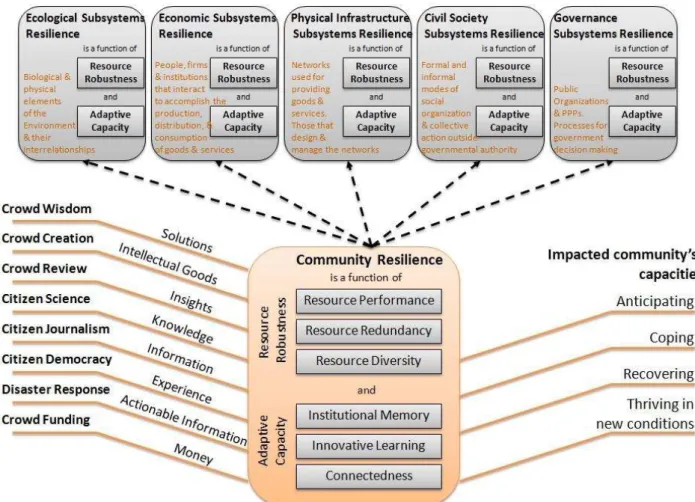
The various crowdsourcing models produce specific outcomes that can contribute to resource robustness and enhanced adaptive capacity. Each model provides specific resources to communities such as solutions to innovation challenges, intellectual goods with commercial value, insights supporting effective decision-making processes (individual and collective), knowledge to support scientific enquiry, information about aspects of the community’s life, individual experience relevant for public policy-makers and transparency of government processes, support to disaster management efforts in the form of actionable information, and project financing. To aid future research, a framework was developed to clearly outline the model functions and their outputs to understand how resilience is being strengthened in communities.
JISTEM, Brazil Vol. 12, No. 3, Sept/Dec., 2015 pp.595-626 www.jistem.fea.usp.br
Figure 2: Crowdsourcing for community resilience
The framework accepts the framework of community resilience in Longstaff et al. (2010) that depicts it as a function of resource robustness and adaptive capacity. In their work, the authors conceptualize community resilience as resource robustness and adaptive capacity in the following subsystems: ecological, economic, physical infrastructure, civil society, and governance subsystems. The breakdown of community resilience into these five dimensions is only a theoretical exercise aimed at making it easier to address particular aspects that can be changed to produce impacts on the overall resilience capacity. Although separate, the framework acknowledges the intricate connections between the five subsystems.
Adaptive Capacity
Crowdsourcing initiatives support a community’s adaptive capacity through the creation of opportunity, new information and products to moderate potential damages or hardship, and make or take advantage of opportunity, and cope with consequences in any circumstance (IPCC, 2007). Particularly, social networks, meaningful participation, and collective action create the importance. Through social networks, relationships between individuals, community, and institutions are established to facilitate the flow of resources (Adger et al., 2009). Ensor and Berger (2009) proposed that the social connections within marginalized groups help develop adaptive capacity.
JISTEM, Brazil Vol. 12, No. 3, Sept/Dec., 2015 pp. 595-626 www.jistem.fea.usp.br
ordinarily happen in one group (Berkes, 2009). For instance, the Smithsonian Institute created the Smithsonian Digital Volunteers: Transcription Center that allows Smithsonian employees and volunteers to work together to transcribe historical documents into searchable and machine-readable documents. The project works in three stages: transcription by one group of crowdsourcers, review by another set, and final approval by Smithsonian trained staff or volunteers. They emphasize collaboration in order to create high-quality transcriptions because it is through collaboration that people increase their skills and knowledge, being able to contribute more.
Social learning also requires meaningful participation. Meaningful participation is the act of conferring, pondering, exchanging views, consideration, reflection, negotiation, and persuasion (NRC, 1996). The engagement of groups that are actively seeking the same solution along with reasonable, well-thought out reasons why the developed solution should be accepted coupled with deliberation that parses out details such as feasibility and logic assists with boosting resilience by allowing the best ideas to flourish. For instance, U.S. Challenge.gov competitions are facilitated by a federal agency that places a call for submissions from the public. Traditionally, industry experts and leaders judge the submissions to ensure that the best and most fitting idea is selected.
Collective action amongst members of crowdsouring enables new connections in the community that help facilitate change and increasing resources (IPCC, 2007). Tompkins and Adger (2004) found that collective action creates new lines of communication within a community and assisted with increasing government influence. Ireland and Phillips (2011) found that stakeholder agency and collective action were important components of adaptive capacity in communities. The value hinges on how much people could accomplish while working together.
Resource Robustness
Crowdsourcing strengthens resource robustness through increasing the effectiveness of resource performance, diversity, and redundancy. Resource performance is subject to environmental, economic, and social conditions that can weaken a community’s performance. Crowdsourcing can help strengthen resource performance by adding layers of anticipation, coping, recovering, and thriving, even in situations of fluctuation. For instance, following Hurricane Sandy in New York and New Jersey, a crowdsourced relief effort was started called Occupy Sandy. Occupy Sandy infused a diverse set of resources that aided the effected community through several mechanism such as crowdfunding, disaster response, citizen journalism, and crowd wisdom through multiple venues. Occupy Sandy’s online component utilized social networking sites Facebook and Twitter to communicate to the masses. They also used Amazon.com wedding registries to create wish lists for individuals nationally and internationally to purchase goods and supplies. Other registries were created for local businesses in the affected areas. In addition to the online component, they had distribution sites at two churches, a ride share program to get aid into affected areas, and provided 24-hour support through the first winter after Hurricane Sandy (Grohsgal, 2013; Rizzi, 2013, April 26).
JISTEM, Brazil Vol. 12, No. 3, Sept/Dec., 2015 pp.595-626 www.jistem.fea.usp.br
2014, June 8). This situation is not unique; according to the British Property Federation, public investments needed into projects such as parks, playgrounds, and sporting venues averages about £500 billion and what is available is nowhere near that amount; as a result, governments are likely to need public support to help pay for local needs (BPF, 2011). Looking to crowdfunding to move in when government cannot manage is an important form of redundancy that increases robustness.
Further, the diversity of resources adds to redundancy and performance because of the active elements in the system. Diversity can increase new resources and knowledge combinations; thus, enhancing creativity, learning, and innovation (Sampson, 2007). However, Cui and O’Connor (2012) note that new resources and knowledge combinations cannot be experienced if resources are not shared. Resources not shared can be a result of coordination and transaction issues. When information is shared, the impact strengthens the resilience of the system.
Resilience Subsystems
The subsystem approach considers the following five systems as core elements to community functioning: ecological, economic, civil, governance, and physical infrastructure. These subsystems represent interdependent, complex aspects of community life, each owning attributes and characteristics that contribute to community resilience.
The ecological subsystem encompasses the environment of the community and all of the living organisms, both human and otherwise that share interdependent existence. The natural resources of the community such as minerals, soil, and forest are important aspects of the ecological subsystems. Knowledge of a community’s ecological system is necessary for resilience because it contributes to knowing the strengths and weakness of the environment, which aids in the anticipation, coping, recovery, and thriving of the community during and after disruption. This subsystem can aid community resilience through its adaptive capacity to changes.
For instance, the Farmers Business Network is a crowdsourced service for farmers that allows farmers to share information about agriculture such as different soils, seed varieties, and planting methods. This additional information aids resilience because of knowledge capital that farmers can tap into when changes occur in their resources. Further, understanding dependence on specific regions for goods or services is relevant institutional knowledge to prepare for resource robustness and anticipate a disruption by inviting other producers into the local market to create redundancies. For instance, in many towns and cities, water is culled from one source. However, if something were to damage that water source, acquiring another water supply within days is likely to become difficult and cause problems.
JISTEM, Brazil Vol. 12, No. 3, Sept/Dec., 2015 pp. 595-626 www.jistem.fea.usp.br
support which is likely to speed up the process rather than alone and the strong possibility of setbacks.
Man-made infrastructure such as the roads, communication network, and water systems are the physical foundation of community. The physical infrastructure of a community is rife with complexities due to variations in regulation, infrastructure age, and control of infrastructure. Additionally, the capacity to adapt might be consistent in some of the components while some are inconsistent or unknown. For instance, a
community’s electrical system might have an updated adaptive capacity that prevents
overloading during disasters while the water system might not be equipped with any capacity to mitigate risk. Further, redundancy might not be feasible due to private ownership of infrastructure and cost.
The civil society subsystem is organized as the social and collective action of the community, outside of government. Hallmarks of the civil society subsystem are efforts to enhance quality of life through civic engagement, faith-based organizations, and nonprofits. Longstaff et al. (2010) note that diversity and redundancy are critical to resilience in this subsystem. The volume of options for the community, especially during disasters can be a matter of life and death some. Whereas, if a disaster strikes and destroys a community clinic, a church facility or school equipped with a generator and basic medical supplies could assist in recovery. Further, the adaptive capacity of the civil society to create solutions through collective action, institutional memory, and social networks are essential for resilience.
The governance subsystem encompasses the administrative functions of the government through the political, legislative, and administrative systems. Typically, this subsystem is where decisions are made. Resource diversity or redundancies are not prevalent within the governance system. However, they do have adaptive capacity to change when necessary. With crowdsourcing, governance systems are slow to be changed; however, many are attempting to change to increase their capacity, become more transparent, and engage citizens. A California assemblyman crowdsourced the drafting of legislation through Wikispaces. Citizens could create an account, make changes to the bill, send suggestions, and supervise their own work (Heaton, 2014, March 8).
The framework depicted in figure 2 is useful as theoretical tool to conceptualize the relation between crowdsourcing and community resilience. It implies some key indicators that can be used in case studies to determine the actual impact of crowdsourcing initiatives on the resilience of a community, prior, during, and after a crisis situation. To assess the resilience of a community, this paper proposes that indicators related to adaptive capacity and resource robustness be measured for resilience. Indicators associated to these capacities will also be useful to measure the variation introduced to them by interventions designed to increase a community’s resilience or by adaptations implemented as a consequence of disruptive events faced by the community.
JISTEM, Brazil Vol. 12, No. 3, Sept/Dec., 2015 pp.595-626 www.jistem.fea.usp.br
only after the occurrence of a disruptive event, when the community can test, in practice, the robustness of its resources and its collective ability to adapt (Cutter et al., 2008; Frankenberger and Nelson, 2013).
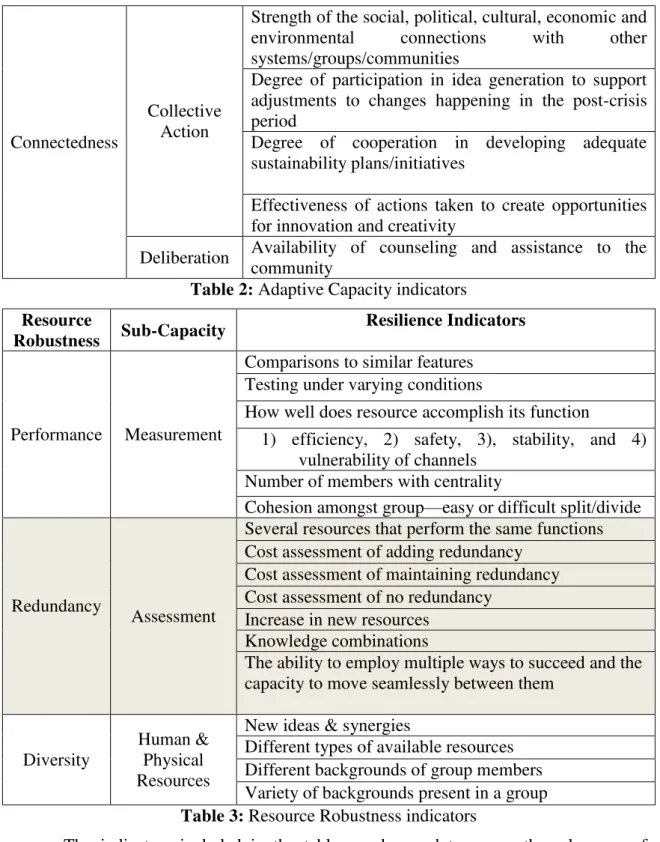
Table 2 and 3 below systematize indicators found in the literature for each of the capabilities to be measured. These indicators assume resilience as a process unfolding overtime and focus the effectiveness and performance of taken actions. They are illustrative rather than exhaustive; the intention is to provide an initial list that can be extended and/or refined in future studies of the impact of crowdsourcing models on the economic resilience of communities.
Adaptive
Capacity Sub-Capacity
Resilience Indicators
Institutional Memory
Social Networks
Effectiveness of actions to promote the sharing of knowledge about past disrupting events and present vulnerabilities.
Degree of participation in the implementation, conservation and recuperation of key resources. Effectiveness of actions to promote the sharing of knowledge about past disrupting events and present vulnerabilities.
Degree of participation in initiatives defined to improve the services considered relevant to a community’s resilience towards threatening events. Effectiveness of available infrastructures and platforms for information sharing.
Degree of participation in initiatives to reduce risks and prevent disrupting events.
Social Learning
Degree of knowledge sharing for problem solving Degree of experienced stored
Degree of knowledge spreading
Volume and quality of trusted communication channels
Innovative Learning
Meaningful Participation
Level of social cohesion.
Level of democratic and civic participation
Degree of participation in efforts to reduce potential losses
Degree of participation in the relief efforts Equity of resource distribution
Deliberation
Volume and quality of novel adaptions Environmental changes
JISTEM, Brazil Vol. 12, No. 3, Sept/Dec., 2015 pp. 595-626 www.jistem.fea.usp.br
Connectedness
Collective Action
Strength of the social, political, cultural, economic and
environmental connections with other
systems/groups/communities
Degree of participation in idea generation to support adjustments to changes happening in the post-crisis period
Degree of cooperation in developing adequate sustainability plans/initiatives
Effectiveness of actions taken to create opportunities for innovation and creativity
Deliberation Availability of counseling and assistance to the community
Table 2: Adaptive Capacity indicators
Resource
Robustness Sub-Capacity
Resilience Indicators
Performance Measurement
Comparisons to similar features Testing under varying conditions
How well does resource accomplish its function
1) efficiency, 2) safety, 3), stability, and 4) vulnerability of channels
Number of members with centrality
Cohesion amongst group—easy or difficult split/divide
Redundancy
Assessment
Several resources that perform the same functions Cost assessment of adding redundancy
Cost assessment of maintaining redundancy Cost assessment of no redundancy
Increase in new resources Knowledge combinations
The ability to employ multiple ways to succeed and the capacity to move seamlessly between them
Diversity
Human & Physical Resources
New ideas & synergies
Different types of available resources Different backgrounds of group members Variety of backgrounds present in a group
Table 3: Resource Robustness indicators
JISTEM, Brazil Vol. 12, No. 3, Sept/Dec., 2015 pp.595-626 www.jistem.fea.usp.br
stability of the ecological, physical infrastructure, civil society and governance subsystems.
Their contribution should translate into better resilience capabilities and should be detected in resilience measurements. Therefore, researching the impact of crowdsourcing on the resilience of communities requires longitudinal studies. An alternative to a longitudinal study would be the performing of specific measurements before, during and after a crisis that can be anticipated but not avoided, as long as crowdsourcing is used as an important instrument for crisis management. Such a study does not exist. The literature on the use of crowdsourcing for community resilience focuses primarily on its use in disaster situations and approaches it within the perspective of social media use. For the most, the various models are not addressed and therefore, the various categories of outputs are often packaged under the idea of information provided by the crowd to support the stages of crisis response and recovery. The next section presents a review of this literature in the period between 2010 and 2014. It uses the dimensions to structure the analysis of the published research.
6. CROWDSOURCING FOR COMMUNITY RESILIENCE: THE CASE OF NEPAL
In this section, the paper describes the use of crowdsourcing to support the coping and recovery efforts in Nepal, after a massive earthquake. This description aims at illustrating the relevance of the framework in Figure 2 to understand the role of crowdsourcing for community resilience.
A 7.8-magnitude earthquake hit Nepal’s capital Kathmandu and its surrounding areas on 25 April 2015. More than 8,500 people lost their lives and more than 17,000 were injured (Rueters, 2015, May 17; CNN, 2015, May 10). A second major earthquake followed on 12 May 2015 of 7.3-magnitude, southeast of Kodari. It caused at least 125 deaths and more than 2,500 injured people as well as mass panic (Shrestha, 2015, May 14). Many buildings were destroyed, Nepal's historic sites were severely damaged, and many roads were impassable. The population sought shelter in open spaces like stadiums and fields, either because they lost their home or because they feared that a new earthquake might harm them if they were in a home.
In this extreme situation, the priority was to save as many lives as possible and provide survivors the minimum resources needed to address the immediate difficulties and gradually return to a normal situation. Crowdsourcing emerged as an adequate strategy to help in these efforts.
Years prior to the earthquake in Nepal, Nama Raj Budhathoki, who was studying open mapping, saw it being heavily utilized during the 2010 earthquake in Haiti. He began an OpenStreetMap community called the Kathmandu Living Labs (KLL) of 7 to 100 volunteers who mapped roads, buildings, schools, and hospitals daily. As a result, he had the most detailed, open source map of the Kathmandu Valley in the country. During the first days of the earthquake, KLL was able to respond with ground zero data, which aided rescue and response efforts; this was notable and critical service that was provided to the Nepal Red Cross and the Nepalese army. Following the earthquake, his team expanded to 2,400 mappers both local and international (Sinha, 2015, May 1). His mappers also use other sources for data such as DigitalGlobe.