Women, men and mathematics
: a reading of data from
the national index of Functional Literacy
Maria Celeste Reis Fernandes de Souza Universidade do Vale do Rio Doce
Maria da Conceição Ferreira Reis Fonseca Universidade Federal de Minas Gerais
Abstract
The purpose of this article is to discuss the differences observed between women and men in some of the daily mathematical practices made necessary by the demand and opportunities of a society based on the dynamics and criteria of written culture. We take for our analysis the results published in the fourth edition of the research entitled National Index of Functional Literacy (INAF), carried out in 2004, which evaluated the conditions and efficiency of the Brazilian young and adult populations in mobilizing mathematical skills to carry out daily tasks, and in which the results obtained by the male population were regarded as significantly superior to those achieved by the female population. Based on a reflection grounded in a Foucauldian perspective, we seek to understand these results as articulated to a discursive field marked by a mathematical rationality of Cartesian matrix. Analyzing under such perspective the mechanisms that contribute to degrade women’s performance in comparison with men’s in assessments of this kind – concerned as they are with the ability to give answers regarded as adequate in the execution of daily tasks regarded as relevant – our attention is focused on identifying another instance of production of inequalities between men and women, represented here by the valuation (in social life and in the assessments) of certain manners of conceiving and reacting to daily demands. As educators we are interested in unveiling the production of inequalities, so as to deconstruct certain discourses that favor them, and in bringing about other perspectives of analysis and pedagogical action.
Keywords
Gender – Mathematical literacy – Inequality.
Contact
The backdrop against which this study is developed is that of the results from the 4th National Index of Functional Literacy — INAF — (20041), a research conducted by the Paulo
Montenegro Institute in association with the NGO Ação Educativa. It was the fourth study in a series that covered in 2001, 2003 and 2005 the conditions and practices mobilized in reading and writing skills of the young and adult Brazilian population, and in 2002 and 2004 investigated the conditions and practices mobilized in mathematical skills as applied in daily situations.
The results published by INAF 2004 highlight the difference in performance between women and men in their use of mathematical skills when carrying out the daily tasks that were contemplated in that assessment, thereby repeating a situation also present in the 2002 edition of INAF. Our purpose in this article is to cast a look upon these differences as expressed in the results displayed by women and men, and to propose that the discourse about these differences produces truths about women and men that create situations of inequality in social practices.
The edition of INAF under focus here was based on a national sample of 2002 youngsters and adults whose ages varied between 15 and 64 years, representative of the Brazilian population in this age group regarding level of schooling, ethnicity, gender, economic situation, size and type of town of residence, and region of the country, among other criteria deemed relevant by the researches that proposed the research methodology in terms of possible influences on the level of functional literacy presented by the people interviewed.
The objective of the INAF studies is to draw a yearly2 profile of the young and adult
Brazilian population with regard to their ability to answer to the demands of a literate society. Under this perspective, the design of the research considered the need to investigate the conditions and the efficiency displayed by this
population in mobilizing mathematical skills for daily tasks, taking into account that such aspects were essential for the production of responses in the dynamics of a society governed by criteria and practices of the written culture.
The phrase mathematical literacy in the perspective used by INAF comprises the mathematical skills needed by people for their inclusion in a society characterized by ever more complex practices referenced to a graphocentric culture. Here, the term literacy can be to some extent identified with the term letramento as described by Magda Soares (2001): the effective use of reading and writing in social practices.
In this context, the phrase mathematical literacy refers to people´s ability to mobilize knowledges associated to the quantification, ordering, and orientation, and also to their relations, operations, and representations “applied to the solution of problems similar to those routinely faced by the majority of the Brazilian population” (INAF, 2004, p. 5).
According to the results of the study 2% of youngsters and adults in Brazil can be considered as illiterate in mathematics, that is, people who do not have simple mathematical skills “such as reading the price of a product, an advertisement, or writing down a telephone number given by someone” (INAF, 2004, p. 8). The study also distinguishes three levels of mathematical literacy, going from the more elementary mathematical skills, such as reading numbers of daily use in specific contexts (calendars, prices or products, schedules and others), up to the adoption of strategies of problem solving involving a series of operations or proportional calculations, and the reading of graphs and tables.
The reflection proposed here was
1. The 4th INAF was the last issue of INAF that investigate exclusively the functional mathematical skills of the Brazilian population. In 2006 an assessment of the first five issues was published. From the 2007 study only the first results were published, see www.ipm.org.br.
prompted by the analyses of the distribution of the population across the various levels of mathematical literacy as presented in the documents containing the results of INAF 2004. Taking as a reference the performance of people in the test to compose the profile of functional literacy in the sample and in the various subgroups that the data about the interviewees allow to form one can see that women displayed worse results in comparison to men:
The distribution of population across the levels of mathematical literacy is also influenced by gender (even after controlling for the years of schooling of interviewees). The fraction of male population that reaches mathematical literacy level 3 is significantly larger than the percentage of women at this level (65% of men against 49% of women, counted among those with more than 11 years of schooling). (INAF, 2004, p. 12)
The persistence of the difference in performance between men and women across all levels of schooling, and even more if we consider that in Brazilian society during the last years there has been an increase in the access of women to schooling, and of their insertion in the work market, including professions previously regarded as masculine, seems to indicate an uncomfortable relationship of women with mathematics, and a supposedly higher male aptitude towards this discipline.
In a attempt to problematize the observation of the persistence (Dal’Igna, 2007; Andrade; Franco; Carvalho, 2003; Souza, 2008) of the difference in performance between women and men in performing tasks that involve mobilizing mathematical skills, we set out to sketch a different reading of this data, both those available on the research website3
and those of restricted access available to researchers involved in their conception and analysis. These results refer to the performance
of men and women in the test and in each of the questions that composed it, and to the data obtained through their answers to the questionnaire that involved the mathematical practices effectively experienced by the interviewees or their assessment of the conditions under which they performed those practices.
In this article we shall discuss especially the data referring to the calculation skills mobilized in the solution of daily problems. Considering the amplitude of their use by women and men in social practices, we sought specifically data referring to the performance of the interviewees in questions of the test that required the carrying out of “calculations”, to the interviewers’ notes about the procedures used in the solution of those questions, and also to those there were produced from the answers to the questionnaire about practices of calculation in dealing with different situations of daily life.
The objective of this article is to propose a way of looking at these results, understood by us within a discourse field in which several discourses circulate which, under a Foucauldian perspective, constitute power-knowledge relations, producing the objects about which they talk (Foucault, 2005) that is, the relations between women, men and mathematics. The intentions of the test as reflecting a socially valued mathematical discourse, the statements of men and women about their mathematical knowledge, the assessment of the performance of women and men in the tests, and our own discourse when proposing an interpretation of these results are themselves constituents of this discourse field.
The purpose in this exercise of analysis — which a study such as that of INAF has the merit to instigate — is of denaturalizing these discourses, recognizing in them cultural marks the need to be problematized in such a way that, understanding the differences produced,
we are able to face the inequalities they establish.
The discourse of INAF
The INAF study has as its purpose to evaluate the conditions of mobilization of mathematical skills of the Brazilian population in the context of social practices. It adopts therefore a concept of functional literacy according to which people need to make use of certain mathematical abilities to meet the demands of social life. Around this conception, INAF has as its parameter the identification of some demands of society that will impact the purposes and conceptions of the instruments uses in the assessment. Thus, when defining that it will evaluate the fulfillment of such and such demands of a given society, and seeking to investigate the conditions of production and the efficiency of peoples’ responses to them, INAF puts in motion discourses that bring forth a whole series of values with respect to mathematics and its role in society which, by their term presuppose the adoption of certain values regarding society and its demands. These values show up in the selection of mathematical skills to be socially valued. To be tested, this selection follows a given rationality and way of organizing and managing the relationships between people and with society. The methodology used by INAF, however, makes it possible to compare not just the
performance of people and groups at the tasks that comprise the test, but also to contrast the analyses of these results with information about these people’s access to material and cultural goods, and about their social practices as declared in their answers to the questionnaire. Based on this information the following table was produced comparing the evaluation men and women make of their own performance in carrying out daily activities.
In the analyses made of the statements of women and men about their own performance in these practices, the report on the study observes that women are more frequently involved in domestic activities related to reading numbers,
[…] such as writing down a shopping list, checking the sell by date of products, comparing prices before buying, looking for offers in flyers, and reading directions for use of a medicine. (INAF, 2004, p. 13)
On the other hand men declared to have more need and ability to perform “control” activities related to checking
When presenting the data on the calculation practices that the people interviewed alleged to use to deal with daily situations, the document also shows a tendency of women to opt for approximate calculations:
Women need to concern themselves more often with domestic tasks (domestic budgeting, estimating food prices, helping children with their homework, making food, giving medicines, diluting a cleaning product), situations, however, at which they would rather perform the necessary calculations by approximation. (INAF, 2004, p. 13)
We identify in the formulation of these results and in the very conception of the questions and items of the test a discourse that feeds on the perspective through which mathematics is conceived in western society. A science that, founded on a “rationalism” of Cartesian matrix, proposes to be the prime field of rationality and control. This manner of conceiving quantitative, metric, order or orientation relationships is, for example, assumed by the educational project of the school institution and, to some extent, echoes this perspective as adopted by this society that attributes higher value to specific forms of mathematizing (in lieu of others) and, consequently, also values more the individuals, groups and institutions that adopt them and master them. Actually, although the practices are often distinct, the values put forward in the various spheres of this society are the same and, in this sense, they also permeate the selection criteria for the tasks and evaluation of performance adopted by the INAF study.
Therefore, it should not come as a surprise that men do better at the tasks of the test, which privileges activities associated to control (as an objective or method), since the tasks primarily performed by men in social life are control activities that, precisely because they
are socially acknowledge, were the ones chosen for the test. The results reflect, and denounce, a situation of inequality between women and men in a society that values this inequality established.
In the context of the discussion about groups in situations of disadvantage with respect to reading and writing in school practices Soares (2006) draws upon the theory of the Matthew Effect4 which, according to the
author, can help to enhance the understanding of several phenomena in the field of Education, clarifying for example,
[…] the cumulative benefits that receive those who were schooled in private schools that cater for the upper classes, and the also cumulative disadvantages imposed on those that attended public schools that cater for the lower classes; it also clarifies the different results of pupils from different social origins in national assessments; the varying results between First World and Third World students in international assessments; the cumulative advantages that privilege children with access to early childhood education, and the also cumulative disadvantages that penalize pupils with no access to it; it still clarifies the results of entrance examinations to higher education in which students who had privileged conditions of basic schooling succeed, in contrast to candidates who had precarious conditions of basic schooling, onto which disadvantages have accumulated […]. (p. 67-68).
As the author suggests in her test, the list above could be long, always pointing to a situation in which a difference reveals a disadvantage, and not a deficiency. The Matthew Effect, in the sense we want to use it
in this text, suggests a look upon the differences in results between men and women not as the latter’s deficiency with respect to the former in the use of mathematics: since the test values mathematical practices to which men have more access, women already are in a situation of disadvantage.
Soares (2001) also warns that in assessments that purport to measure practices of letramento of a population by sampling, as is the case of the INAF assessment, the indivi-dual and social dimensions of these practices stand out, in other words, not just people’s individual mathematical skills in the exercise of social practices are thereby evaluated, but also the mobilization of this skills by social groups highlighted in the sample.
Therefore, beyond the uneven use women and men make of mathematics in these practices, one has to look at them in a differentiated way, understanding how society overrates the mathematical skills related to practices of social control (exercised more often by men) in relation to those mathematical skills required in social practices of preparation (which are more mobilized by women). It is I this sense that we identify in these results repercussions of the Matthew Effect.
The discourse of inequality between men and women in practices that require mathematical skills is also embedded in the assessments of INAF and reproduces the values of a society whose demands the individual must fulfill. This intention – to evaluate if people and groups are capable of fulfilling the demands of society – places women and men unequally, because its very conception has to attribute higher value to the practices and knowledges identified with a supposedly masculine reasoning, since these are associated to social practices that, in this society, are more frequently performed by man.
Such discourse still has to be problematized under the perspective of the essentiality and universality that from it can be conferred to the “masculine” and to the
“feminine”. Echoing the way this society has signified “man and woman”, an analyses of the test results and of the information obtained from the responses to the questionnaire should not be taken as “universal”. By disregarding the heterogeneity of mathematical practices and the multiplicity of lifestyles of the people interviewed as, for example, their larger or smaller involvement with the tasks related to domestic work — unpaid and much more often performed by women —, professional indicators, religious practices, differences of income for women and men and for the different groups of women and men, and the impacts of these differences to the practices, we run the risk of shadowing important issues to the approach of gender differences in mathematical practices which, like reading and writing practices of men and women, as emphasized by Amelia Artes (2007), must be understood as social and cul-tural practices articulated to the lifestyles of the different people and groups.
Discourses like these are the ones that gender studies aligned with a post-structuralist approach compel us to deconstruct. Not by the mere questioning of the instruments of assessment which, in the present case and because they intend to evaluate the levels of fulfillment of social demands, perhaps propose indeed to echo the values of society, but by the denaturalization of the valuation criteria of the society and of the essentiality that one could, in echoing these values, attribute to “women”, “men”, and “mathematics”. This process of denaturalization needs to be assumed by those who are committed to weaving less unequal relations.
The discourses of women and men
[…] required abilities of reading and writing numbers and other mathematical representations of frequent social use (graphs, tables, scales, etc) and also the analysis or solution of problems involving simple arithmetic operations (sum, subtraction, multiplication and division), proportional reading, percentage calculations, time, mass, length and area measures. (Fonseca, 2004, p.15)
The questionnaire, made of fifty seven questions and twelve information about the interviewee, had as its purpose to give indicators to the profile of the people interviewed, of their socio-cultural and economic situation, and of the social uses they make of mathematics. It asked about
[…] opportunities and demands for the use of concepts, procedures and media more closely related to mathematical skills, and also questions about the judgment made by the interviewee about his/her own abilities of reading numbers and performing calculations. (Fonseca, 2004, p.15)
Our proposal is of pausing to reflect about the judgments that women and men make about their own abilities of number reading and calculations, paying attention to the ways in which these judgments, marked by relations of power-knowledge, are incorporated into their statements, characterizing them as “dependent of”, in the case of women, or “su-perior to”, in the case of men.
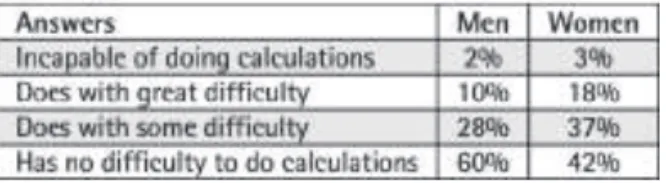
In this sense, we organized in the tables that we shall discuss below the questions selected from the interviews that relate to the judgment made about the interviewees’ abilities and attitudes related to the act of calculating, as well as to the type of mathematical tasks more frequently used when fulfilling their daily needs. Table 2 presents the answers given by men and women to the question: Generally speaking, who do you evaluate your ability in
calculations?
From the answers given by the interviewees to the question above, we draw attention to the evaluation made by women about their own ability with calculations. For most of them (58%), the act of making calculations represents always a difficulty, when not an absolute impossibility. The opposite occurs with the male population, in which 60% state that they have no difficulties to perform calculations.
The assessments made by men and women about their practices also show up in the answers given to the question: When you need to make brief calculations, which of these attitudes you take? The answers are collected in the table below:
child to move from concrete reasoning to abstract reasoning, and therefore tolerated in small children, but always discouraged. Women declare, however, to resort significantly more than men to this socially unrecognized stratagem: 14% against 6%. The calculations in writing, which are strongly connected to the school, are more used by women (18% against 14% of men) who, as shown by INAF and by other studies, who have extended their period at school , going beyond the male population in this respect. We must also draw attention to the fact that “calculations on the paper” are more easily subjected to control, not only by those who carry them out, but also by the other. The guarantee of getting it legitimately right through the use of an “infallible” instrument might also explain why women (13%) use electronic calculators more often than men (10%) to perform brief calculations. Submitting to the authority of the other also influences the disposition to “ask the other to perform the calculation”, a solution that women use more than men (5% against 2%). Also worthy of attention are the answers presented in the table below, which were given to the question: When you need to perform large calculations which of these attitudes do you take?
From the total number of interviewees, 4% of men declare to count “on their fingers or some other material” and 4% of women also stated to perform the calculation on this manner. The electronic calculator is equally used by men and women in terms of the frequency of use. It is worth noting here that “large calculations” are less performed “by head”, although men still use this strategy more often than women (10% against 6%), and also
the substantial increase in the number of people that ask somebody else to perform the calculation for them, with women still resorting more often than men to this solution (17% against 9%).
The analysis of the answers to these three questions shows that: women declare more their difficulties in carrying out mathematical calculations; they are more willing to ask for help with mathematical calculations; and they rely more often on support material to perform calculations. We should reflect on the conditions that allow or trigger the establishment of certain feeling of incapacity to perform the operations or of insecurity, bringing about the choice of asking for help or resorting to instruments even for small calculations; or still the type of distributions of tasks that determines that one gives up a task or an activity in favor of somebody else with higher skill or authority.
This evaluation of men and women and their conditions to perform mathematical calculations is repeated in the results obtained by them at the test. Men perform more often certain types of calculations and use strategies that are valued in a society governed by rationality. The questions proposed and the manners of reasoning valued in the INAF test will consequently favor a better performance by men because they privilege those capable of performing certain types of activities, which involves the use of mathematics as precision and control — socially valued and traditionally performed by men in this society.
We could therefore say that the very matrix of the test would favor the masculine condition because it fulfils demands of a society that requires and values a given mode of using knowledge, procedures and mathematical criteria which are more frequently mobilized by men within the context of this same society.
embodied in their practices and in the power relations that permeate these daily practices by showing that masculinities and femininities do not refer to biological differences, but are so-cial constructs. Neither do they refer to ideas, “but also to institutions, structures, and daily practices, as well as to the rituals and to everything that constitutes the social relations.” (Scott, 1998, p.115). The inequalities are thus socially constructed and circulate as discourses in the social practices that place women and men in relations of unequal power.
The answers of women and men to these questions and to others of the questionnaire invite us to pay attention to the incorporation of the discourses about the difficulty in calculations, the lack of need to perform them, asking for help, the legitimization or otherwise of the use of estimates and approximation in carrying out the calculations instead of mathematical exactness. What we see in these answers is a submission of women to the discourse that circulates in our society, which is aired by the questionnaire: mathematics as the domain of rationality and therefore of the masculine.
Foucault (1996) invites us to think about the conditions for the emergence of a discourse that
[…] defines the gestures, the behaviors, the circunstances, and the hole set of signs that must attend the discourse; that fixes, in short, the supposed or imposed efficacy of the words, their effect upon those to whom they are directed, the limits of their value of coercion. (p. 39)
It is therefore under these conditions of emergence and their effect on the women and men that use it that this discourse, circulated by the instruments of INAF and identified in the answers themselves of the interviewees, “deter-mines simultaneously for the subjects that speak singular properties and pre-established roles” Foucault, 1996, p. 39), marking them
and defining social positions.
Constructing other discourses
Putting in evidence the discourses that circulate helps us to denaturalize the relations established by them. However, “it is much more productive to examine how things work, and to sketch alternatives so that they may wok and happen in another way” (Veiga-Neto, 2004, p. 22). It is under this perspective that our effort should be understood: as an attempt, by examining the discourse produced by these instruments and by the results of this indicator, of looking at how things work and to sketch alternatives for the production of other discourses about the relation of women and men to mathematics.
As a first invitation we could think about the conditions that allow the identification of social groups that compose the sample used in the study. The INAF report presents data related to their socio-cultural, economic, ethnic, age, geographic, and many other conditions; what interests us here, however, is to consider the information referring to level of schooling contrasted with gender.
mathematical calculations, why the difficulty in carrying out these operations in daily tasks persists?
In a study on the state of the art about researches that discuss the relationships between gender and mathematics in several countries, Valero (1998) shows the lack of work under this perspective in Brazil, despite the fact that discussions about these relationships have already been a concern in other societies. This preoccupation is driven by women’s choices of professional careers and by the different performances of men and women in assessments that aims at measuring the performance of male and female students, such as those of the Program for International Student Assessment (PISA) proposed by the Organization for Economic Co-operation and Development — OECD, which evaluated High School students in reading (2000), Mathematics (2003), and Sciences (2006). In 2003, 250,000 fifteen years old students were evaluated in mathematics in Brazil. In this assessment, girls averaged 248 points, and boys scored 365 points. In all 41 countries investigated, with the single exception of Iceland, the performance in Mathematics of young men is superior to that of young ladies (Ferreira, 2004).
Reflecting on the academic researches that investigate the relations between mathematics and gender, Ernest (2003) disagrees with the way in which these relations are investigated, since in their vast majority they have concentrated in asking about the biological differences between the sexes or about differences in performance without considering that gender relations are socially constructed and show up in various ways in social relationships and in the different social groups. We are thus prompted to propose in the present analysis gender as an analytic category (Scott, 1990). Accepting this proposition means to understand that in these practices, permeated as they are by power relations and by the production of knowledges,
women and men take on the position of subjects (Foucault 2005) of the discourses produced in our days about masculinities and femininities, thereby constituting mathematical practices specific to each gender.
If we think about the statements of women and men in response to the INAF questionnaire, it seems natural to attribute differences in results in the test the performance of roles, which are also different because women and men play different roles in society, predetermined by it, which end up naturalizing the discourses about feminine difficulties and masculine propensities with respect to mathematics. This way of thinking directs the analysis “to the individuals and to the interpersonal relationships” (Louro, 1997, p.24), failing to examine under this perspective the multiple forms that masculinities and femininities can assume, and
[…] the complex power networks that (through institutions, discourses, codes, practices, and symbols …) constitute hierarchies between genders. (p.24)
Therefore reading results under this perspective favors the discourse, which we have to deconstruct here, of the naturalization of these roles: if women and men play different roles and, therefore, act in different ways, they tend to present mathematical results that are also different. The discourse of the differences between sexes, read under the point of view of inequality, is thereby strengthened, stimulating the submission of women and the construction of truths about women and mathematics that engender interdictions about them.
Another discourse that has to be deconstructed is the one that emphasizes the cognitive perspective and proposes to analyze the results of people’s performance, both in the school context and in assessments of functional literacy, through concepts of mathematical competence or of talent for mathematics.
truths about women in a society like ours whose social arrangements have historically favored men in many ways: women are worse than men at mathematics, therefore less skilful, less able for some activities in the social and work worlds, more dependent, less autonomous.
This discourse becomes dangerous for women because of the impossibilities it deter-mines, by the truths it institutes, by the pathologization of difference, for the idea that women lack something (a lack of reason), and that it is necessary somehow to help them to overcome this deficiency, teaching them to be less dependent. Since “reason has to be seen as a possession of ‘man’, there will always exist an attempt to prove that the Other is synonymous with lack” (Walkerdine, 2004, p.121).
In this sense, we problematize the approaches that build their analysis based on an assumed feminine mathematical deficiency. Such approaches construct the discourse of lack, producing the naturalization of the feminine lack of reason, whilst instituting as a truth the need for women to “possess and nurture the same reason they are accused of not having” (Walkerdine, 1995, p.214).
According to Walkerdine (1995), these explanations need to be understood within a wilder picture as the production of knowledges, in which the production of scientific ideas about oppressed and exploited people play an important role, ideas that are central to the regulation of these people:
[…] I want to question the ideas about the supposed deficiency of some groups regarding certain intellectual abilities, and to examine how these ideas have become not just part of the form in which we have thought the thought , but also of the way in which this knowledge constitutes a cen-tral component of aspects of governments (in the Foucauldian sense). (p.208)
Indeed, these ideas raise questions about the power attributed to mathematics as the
holder of a rationality to which everybody must be conducted. Thus, the truths produced about the relation of women and men to mathematics and that, to some extent, circulate in the school and institutional discourses, in tests and assessments, produce truths understood in the theoretical perspective proposed by Foucault (1979) as of “this world”. To him:
[…] each society has its regime of truth, its general policy of truth: that is, the types of discourse it acknowledges and puts to work as true; the mechanisms and the instances that allow the distinction between true statements and false, the way some of them are recognized; the techniques and the procedures that are valued to obtain the truth; the statute of those who have the duty of saying what functions as true. (p. 12)
Under this perspective, truth, power and knowledge intertwine and the discourses produced about women, men and mathematics creates a Regime of Truth, since truth is “tied to systems of power that produce it and support it, and to effects of the power that it induces and that reproduce it” (Foucault, 1979, p. 14).
There is a tendency to interpret the differences in performance of men and women in tests of functional mathematics by considering daily mathematical practices. Let us look at the mathematical practices that can be drawn from the answers to the questions of the questionnaire presented in table one, which inquired about their own assessment of their need and competence to carry out some activities that make use of mathematical knowledge.
these activities in a position of inferiority with respect to those performed more often by men, such as making calculations for the payment of services and products and balancing bank accounts. In this sense, planning activities involved in tasks such as preparing food or the act of caring for someone would be less sophisticated, precise, or decisive than controlling expenses, checking accounts, balan-ces etc. (more sophisticated, more elaborate, more precise, more objective).
There is therefore in these practices a discourse production of mathematics as proper to the masculine, by establishing as standard of measure the mathematics of Cartesian matrix and by devaluing the mathematical practices exercised more frequently by women, which make use of procedures and criteria not always identified with the values of this hegemonic mathematics of school-bound, standardized procedures where the exactness and control are valued in lieu of other forms of mathematizing such as the approximate thinking and the forecast in the domestic context, naturalized as proper to the feminine, under the equation of maternity plus performance of domestic activities (Walkerdine, 2003).
Problematizing this discursive production makes itself necessary, since this vision of mathematics, prevalent in social life, here included the school space, promotes the inequality between men and women, on the basis of its language, codes, rituals, texts used, the silences of women with respect to this mathematics, and the masculine overrating of the use of Cartesian rationality. It is necessary to ask, under the perspective proposed by Walkerdine (2004):
[…] how our ideas of “real mathematics” and of mathematical truth are incorporated in the “truth” about the human subject used in the regulation of the social? The “truth” of reason and reasoning, of the world as a book written in the language of mathematics, is transformed into important
aspects of the regimes of truths historically situated (p.112).
Drawing from Foucault’s thinking, the author proposes to overcome the discussion about the mathematical performance of boys and girls, highlighting as object of analysis the discursive practices, in which the truth about a possible lack of rationality in women is produced. In these practices what is considered as the “true mathematical reasoning” is located “historically and socially, and intimately associated with the production and regulation of a certain type of citizen” (Walkerdine, 1995, p.220). In this sense, the mathematics of Cartesian matrix, the parameter for social practices that take place in society and constitute it, marks the relations between women, man, and mathematics. In these relations, mathematical practices are produced as adequate or not to them.
Walkerdine (1995) related the mathematical rationality of Cartesian matrix with the fantasy of masculinity that promotes the exclusion of women based on a discourse in which power and control are inscribed. As femininity is seen as the opposite of masculine rationality, the power of rationality and the mathematical thinking intertwine in the cultural definition of masculinity that seeks to be constantly reaffirmed and proved by the exclusion of women.
To the author, the domain of reason that governs the teaching of mathematics produces the fantasy of a power through which the mathematicians and those who master it “play of God” (Walkerdine, 1988). This fantasy of power, and the perspective of a natural cognitive development, unconditioned by culture, give birth to a discourse about the universal validity that ignores the person, suppressing it as a person of a gender and a class, ignoring the forms in which oppression is experienced and inequality is established:
inflicted upon me) and how we ended up accepting it, believing that we could be good manual workers, good secretaries, research assistants, but never great thinkers or geniuses…. I am therefore claiming that the problem does not lie in femininity, but in the way in which these fictions, fears and fantasies were introduced into the stories told about girls and women, and in the way there were used to regulate us. (Walkerdine, 2004, p. 215)
It is within this group of theoretical discussions, referenced to gender studies, that we believe to be possible to cast a different look upon the results of the INAF studies and of other similarly oriented researches, seeking to understand that the relations established by women and men toward mathematics are not relations in which exists a fixed polarity of domination of men over women, since power is not “a privilege that someone has (and transmits) or which no one can appropriates” (Louro, 1997, p.38); but this power, as a bundle of relations that is not fixed to one point, but that circulate in the social practices and produces knowledges about women and men that become “constructed truths” in this world, and that promotes unequal relations between them, thereby reinforcing social arrangements that favor men and limit the action of women.
Final considerations
Our purpose in this article was to analyze and to propose possible reading of the results presented by the INAF research with respect to the differences in performance between women and men at the mathematical test, and between the responses given by men and women to the items of the questionnaire. We have tried to problematize discourses that encourage ways of conceiving mathematics and gender relations that are established in these discourses and by these discourses. What drove us to cast a look upon these results, analyzing
these differences, was the need to problematize them, since the differences in the relations between men and women and mathematics have been seen throughout social spaces (and often among them the school space) as a greater masculine competence for mathematics and as a smaller talent or even the incapacity of women to respond to the demands of soci-al life in which mathematics is present.
We believe that the discussions initiated here need to be carried further, because it is necessary to look at results such as those from INAF, for example, as the product of a conception of mathematics which, taking it as a school disciplinary field, works under the logic of the inequalities between the sexes, does not avow knowledges built in practice, and institutes rationality and abstraction as the only way of thinking. This conception permeates the whole social fabric of Western society.
Reading beyond the data presented in this kind of analysis, or even in the analysis of the performance of male and female students at school mathematical practices, we have to consider that the mathematical experience of girls and boys, teenagers, young men and young women, and of women and men are inscribed in cultural practices at which there exists a overvaluation of the practices assumed by men.
Indeed, we believe that the familiarity, or lack of it, with socially valued practices and the vision of mathematics in modernity as masculine and rational have favored the establishment of truths about the relation of women to mathematics, and that we have to question them to overcome inequalities.
Bibliographical References
ARTES, A. C. A. Indicador nacional de alfabetismo funcional-2001: explorando as diferenças entre mulheres e homens. Educação e Pesquisa. São Paulo, v. 33, n. 3, p. 561-580, set./dez. 2007.
ANDRADE, M. S.; FRANCO, C.; CARVALHO, J. B. P. F. Gênero e desempenho em matemática. Avaliação Educacional. São Paulo, v. 27, n. 1, p. 77-98, 2003.
BÍBLIA. N. T. Mateus. Português. Bíblia Sagrada. 25. ed. São Paulo: Paulus, 1998, cap. 13, p. 1256.3
DAL’IGNA, M. C. Desempenho escolar de meninos e meninas: há diferença? Educação em Revista. Belo Horizonte, n. 46, p. 241-267, dez. 2007.
ERNEST, P. Introduction. Changing views of the “gender problem” in Mathematics. In: WALKERDINE, V. Couting girls out: girl and mathematics. Londres: Virago, 2003. p. 1-14.
FERREIRA, E. S. Pisa 2003. Campinas: Unicamp, 2004. Disponível em: <http://www.sbempaulista.org.br>. Acesso em: 30 out. 2007.
FONSECA, M. da C. F. R. (Org.). Letramento no Brasil: habilidades matemáticas – reflexões a partir do INAF 2002. São Paulo: Global; Ação Educativa Assessoria, Pesquisa e Informação; Instituto Paulo Montenegro, 2004.
FOUCAULT, M. Microfísica do poder. 18. ed. Org. e Trad. Roberto Machado. Rio de Janeiro: Graal, 1979.
______. A ordem do discurso. 7. ed. Trad. Laura Fraga Sampaio. São Paulo: Loyola, 1996.
______. A arqueologia do saber. 7. ed. Trad. Luiz Felipe Baeta Neves. Rio de Janeiro: Forense Universitária, 2005.
INAF. 2º Indicador Nacional de Alfabetismo Funcional: um diagnóstico para a inclusão social – primeiros resultados. São Paulo: Instituto Paulo Montenegro; Ação Educativa, 2002. Disponível em: <http://www.ipm.org.br>. Acesso em: 10 set. 2007.
______. 4º Indicador Nacional de Alfabetismo Funcional: um diagnóstico para a inclusão social – Avaliação de habilidades matemáticas. São Paulo: Instituto Paulo Montenegro; Ação Educativa, 2002. Disponível em <http://www.ipm.org.br>. Acesso em: 10 set. 2007.
LOURO, G. L. Gênero, sexualidade e educação: uma perspectiva pós-estruturalista. Petrópolis: Vozes, 1997.
ROSEMBERG, F. Educação formal, mulher e gênero no Brasil. Revista Estudos Feministas. v. 9, n. 2. Florianópolis, 2001. Disponível em: <http://www.scielo.php>. Acesso em: 13 Jul. 2006.
SOARES, M. Letramento: um tema em três gêneros. Belo Horizonte: Autêntica, 2001.
______. A escrita no currículo e o “Efeito Mateus”. In: LOPES, A. R. C.; MACEDO, E. F. de; ALVES, M. P. C. (Orgs.). Cultura e política do conhecimento. Araraquara: Junqueira&Marin, 2006, p. 53-72.
SCOTT, J. Gênero: uma categoria útil de análise histórica. Revista Educação e Realidade. Porto Alegre, v. 20, n. 2, p. 5-22, jul./dez. 1990.
______. Ponto de vista. Revista Estudos Feministas. Florianópolis, n. 1, p. 115-124, 1998.
SOUZA, M. C. R. F. de. Gênero e matemática(s): jogos de verdade nas práticas de numeramento de alunas e alunos da Educação de Pessoas Jovens e Adultas. 2008. Tese (Doutorado em Educação) – Universidade Federal de Minas Gerais, Belo Horizonte, 2008.
VEIGA-NETO, A. Foucault & Educação. 2. ed. Belo Horizonte: Autêntica, 2004.
WALKERDINE, V. The mastery of reason. London: Routledge,1988.
______. O raciocínio em tempos pós-modernos. Educação e Realidade. Porto Alegre, v. 20, n. 2, p. 207-226, jul./dez. 1995.
______. Couting girls out: girl and mathematics. (New Edition). Londres: Virago, 2003.
______. Diferença, cognição e Educação Matemática. In: KNIJNIK, G.; WANDERER, F.; OLIVEIRA, C. J. de. (Orgs.). Etnomatemática, currículo e formação de professores. Santa Cruz do Sul: EDUNISC, 2004. p. 109-123.
Received 12.02.2008
Accepted 13.10.2008
Maria Celeste Reis Fernandes de Souza has a PhD in Education from the Federal University of Minas Gerais – UFMG. She is a pedagogue and teaches at the University of the Vale do Rio Doce (UNIVALE); she also works in projects in the area of Education of Youngsters and Adults.