Computer Simulation of Sympatric Speciation
with Penna Ageing Model
K. Luz-Burgoa
1, S. Moss de Oliveira
1, J.S. S´a Martins
1, D. Stauffer
1,2, and A.O. Sousa
21
Instituto de F´ısica, Universidade Federal Fluminense, Av. Litorˆanea s/n, Boa Viagem, Niter´oi 24210-340, RJ, Brazil
2
Institute for Theoretical Physics, Cologne University, D-50923 K ¨oln, Euroland
Received on 2 May, 2003
One species is simulated to split into two separate species via random mutations, even if both populations live together in the same environment. This speciation is achieved in the Penna bitstring model of biological ageing, with modified Verhulst factors, and in part by additional bitstrings regulating phenotype and mate selection.
I
Introduction
The common ancestors of today’s humans and today’s chim-panzees presumably lived several million years ago. Then, due to genetic mutations and/or changes in the environment, the population split into the ancestors of humans and the an-cestors of chimpanzees. Such a separation of one species into two is called “speciation”. It is easily explained if the two populations live in separate environments, like one on an island and the other on a continent, making the mating of males from one population with females from the other population impossible. This effect is called allopatric spe-ciation. More difficult to explain is sympatric speciation, where the two populations continue to live in the same en-vironment but nevertheless cease to mate each other [1]. A recent computer model [2] in the physics literature also cites biological examples, serving as a background also for our paper. We concentrate here on models with age-structured populations [3, 4, 5] and in particular use the Penna bitstring model [6, 7], which is the presently most widespread model to simulate biological ageing. We deal only with sexual re-production where two populations are defined as being dif-ferent species if the mating from difdif-ferent populations pro-duces no viable offspring.
The next section shortly explains this Penna model and then presents the minimal modifications which we found necessary to get sympatric speciation. A more realistic model involving three pairs of bitstrings instead of only one is discussed in the following section. We end with a short summary.
II
Simple Model
II.1 Penna Model
The Penna bitstring model for biological ageing [6, 7] simulates the mutation accumulation by storing bad
muta-tions (= hereditary diseases) in a string of (usually) 32 bits. The position of the bit corresponds to the age of the indi-vidual; its value corresponds to health (zero) or sickness (one). Sick bits act from the age to which their positions belong up to the death of the individual. Three active sick-nesses kill the animal; in addition all animals are killed at each time stept = 1,2, . . . with the Verhulst probability
V(t) = N(t)/Nmax whereN(t)is the current population
andNmaxis often called the carrying capacity describing the
limitation of food and space. After reaching an age of eight “years” (= bit positions or iterations), each individual gives birth to one child per year until its death; the child inherits the same bitstring as the mother except for one possible mu-tation at a randomly selected position where the mutated bit is set to one irrespective of its previous value. Initially, all bit strings are zero.
For the sexual Penna model used here, each individual has two bitstrings inherited from mother and father, respec-tively, and produces gametes (single bitstrings) by random crossover between these two bitstrings, followed again by one random mutation. Each female of age eight or above tries 20 times to find randomly a male aged eight or above for mating, and if she succeeds she gets one child having one of the father’s gametes and one of the mother’s gametes as its two bitstrings. The child’s sex is fixed randomly. If at a specific bit position, one of two bitstrings has zero and the other has one, it affects the health of that individual if and only if this position is one for which the harmful allele is dominant and not recessive. Six out of the 32 possible positions are randomly selected as dominant, the other 26 as recessive. The complete Fortran program is listed in [7].
II.2 Speciation Model
randomness of mutations and crossover, their child does not necessarily havenspeciation bits set to one, and this ran-domness allows the emergence of a new species out of the original one where allnwere zero. At every time steptwe thus have three populationsNn depending on the number
n = 0,1,2of speciation bits set to one, and each of these three sub-populations is half male and half female.
To get speciation in this model, it is not sufficient to start with one population and to change it due to random muta-tions into another population. Instead, we want to start with one population and at the end have two populations coexist-ing with each other in stable equilibrium but without cross-mating. With the above Verhulst factor applying to both populations together this seems impossible: After some time (proportional to the population size), all survivours have one certain “Eve” as mother [7] as a result of the random muta-tions due to which one individual happens to become the fittest in the population. Thus one population finally wins against the other, just as in a standard Ising model at low temperatures, with equally many up spins and down spins at the beginning, one of the two spin orientations will win at the end.
Coexistence is achieved by replacing the Verhulst factor
N/Nmaxinto three separate Verhulst factorsNn/Nmax for
the separate populationsn= 0,1,2withN =N0+N1+ N2. We may imagine, for example, that the original
popu-lationn = 0is vegetarian, and that the second population
n= 2emerging out of it consists of carnivores. Both pop-ulations are limited by the amount of food, but their food sources are completely different; thus, there is no compe-tition between the two different populations, but the meat-eating females will not select any herbivore males for mat-ing, and vice versa. (The small population with n = 1is added half ton = 0and half ton = 2for the evaluation of the two Verhulst factorsV0 = (N0+N1/2)/Nmax and V2= (N2+N1/2)/Nmaxand has the arithmetic average of
these two Verhulst factors as its own food-limiting Verhulst factor.)
10000 100000 1e+06 1e+07
10 100 1000
number
time
Populations with zero (line), one (x) or two (+) speciations bits set at position 11; Nmax=300 million
Figure 1. Variation in time ofN0(line, original species),N1(x,
mixed genomes) andN2(+, new species), withNmax= 300
mil-lion. We start with 30 million males and as many females of the original species.
0 200000 400000 600000 800000 1e+06 1.2e+06 1.4e+06 1.6e+06 1.8e+06 2e+06
100 1000 10000
number
time
Male populations for n=0 (line) and n=2 (+); initialy 3 million; carrying capacity 30 million
Figure 2. Same as in Fig. 1, but with populations ten times smaller simulated over ten times more iterations, showing equilibration af-ter several thousand iaf-terations. Note linear, not logarithmic, verti-cal sverti-cale. The dots refer to the original population, the + to the new species (N1is not shown).
II.3 Speciation Results
Figure 1 shows, for nearly108
individuals, how the new speciesN2emerges, within about a hundred iterations, from
the old speciesN0. The intermediate populationN1is only
about one percent of the total. Thus, we see two separate populations clearly emerging: Sympatric speciation. Fig. 1 shows the males; for the females the results are about the same. Making ten times more iterations for a ten times smaller population gives a better equilibrium, Fig. 2. Shift-ing the speciation position from 11 to 21 or to 1 does not change much the results. If we change the birth rate from1
to1 +nwherenrefers to the female, then the new species ends up with a larger population than the original one but still may both coexist (not shown).
Similar pseudo-speciation was observed in the asexual case (not shown), or when the speciation bit was mutated with a special probability different from that of the other bits (not shown). Also on a square lattice without Verhulst factor, similar results were found [9].
III
The Penna model with phenotype
selection
In this section we will briefly describe the features we added to the standard Penna model to represent phenotypic selec-tion [3].
To address this issue in the context of the Penna model we add, to the usual double strand of genes with age-dependent expression, extra pairs for each individual in the population. Each of these pairs will stand for a particular multi-locus phenotypic trait, such as size or colour, which may have selective value. The dynamics of reproduction and mutations are the same for both the age-structured and the new strings. Gamete production, phenotypic expression (phenotype), and the introduction of random mutations at birth affect equally all loci.
A final addition refers to mating selectiveness. We in-troduce into the genome a locus that codes for this selective-ness, also obeying the general rules of the Penna model for genetic heritage and mutation. If it is set to 0, the individ-ual will not be selective in mating (panmictic mating), and it will be selective (assortative mating) if this locus is set to
1. The mutation probability for this locus is set to0.001in all simulations. Females that are selective will choose mat-ing partners that satisfy some criterium related to the sexual selection trait. In the first version described below, we add a single phenotypic trait to the model, and this trait acts both on the individual’s fitness and on its sexual selectiveness. In the second version, two traits are added, one that is re-lated to fitness and another to sexual selection. In the road to speciation, as one population splits into two, the degraded fitness of the offspring of inter-populations parents will lead nature to choose for sexual selectiveness and give rise to two non-interbreeding populations.
Assortative mating following the establishment of a sta-ble polymorphism is essentially equivalent to speciation in this context, and one of the purposes of these simulations is to follow the rising of the fraction of the population that becomes sexually selective as a result of the evolutionary conflict between selection and mutation.
III.1 Version with a single phenotypic trait
In the version with a single trait, one pair of bitstrings is added to the genome of each individual (see Fig. 3). Its selective value is given by a fitness functionF(k), chosen to depend on a single variablek. Here,kresults from the pair of non-structured strings representing the trait by counting the number of recessive bit positions where both bits are set to1, plus the number of dominant positions with at least one of the two bits set. It will therefore be a number between0
and32. For a given value of the phenotypek,F(k) quan-tifies the availability of resources for individuals with that particular phenotype. The fitness function encapsulates the selective value of a particular phenotype, and can be thought of as describing the profile of the ecology in which the pop-ulation evolves, as related to the size of the individuals, for example.
Our simulations were done with two different functional forms for the function F(k). Our intention was to mimic the seasonal effect of rainfall on the availability of seeds of different sizes in the Galapagos islands and its impact on the morphology of beak sizes in the population of ground finches that feed on these seeds [8]. In this application,kis
a measure of the beak size. At the beginning of the simu-lations,F(k)is a single-peaked function with a maximum atk = 16, representing large availability of medium-sized seeds. The whole population of finches will compete for the same resources. After12 000iterations, functionF(k)
changes to a two-peaked shape, with maxima atk = 0and
k = 32, and now the food resources concentrate on either small or large seeds, with a vanishing number of medium-sized ones.
In this discretized mathematical model, the probability of death by intra-specific competition at each time step is now given byV(t) =N(t)/(Nmax∗F(k)), whereN(t)will
account for the population that competes for resources avail-able to individuals of phenotype (beak size, say)k. From step0up to step12 000, the whole population is compet-ing for the same general food resource, andN(t)is the total population. After step12 000, only small(large)-beaked in-dividuals - those with k < (>)16 - can compete for the small(large) seeds. For that reason, the death probability
V(t)of an individual withk < (>)16is computed by as-signing toN(t)the number of individuals withk <(>)16
plus half of the population that hask = 16. An individual withk = 16 will compete either for small or large seeds, and this choice is made at random.
With this strategy, the interaction with other individu-als is still mediated by a mean-field V(t), but its effect is no longer uniform. It depends on the particular genet-ically acquired configuration of each individual and, al-though stochastic, escapes from the biologically unmoti-vated randomness mentioned above.
Sexual selection also depends on this single trait. When the fitness function F(k) is single-peaked, there is no se-lective pressure for mating sese-lectiveness, and the population is panmictic. AfterF(k)becomes double-peaked, females that mutate into selectiveness will choose mating partners that have beak sizes similar to their own: if a female has
1
2
3
4
5
6
7
8
1
1
0
0
0
1
0
0
0
1
age−structured part
0
1
0
1
0
1
0
1
0
1
0
1
1
1
0
1
0
1
1
1
0
0
1
1
1
0
1
0
1
0
0
0
size
0
1
0
1
1
1
Figure 3. Schematic representation of crossing, recombination, and mutation in the formation of the gamete from one of the parents. The other gamete is generated in the same way, and the union of the two gametes concludes the formation of the offspring’s genome. We show these processes occurring both in the age-structured and the non-structured portions. The arrows indicate where the random mutations occurred.
III.2 Simulation results: version with a single
phenotypic trait
Simulations were run for population sizes of the or-der of 105
, with minimum reproduction age set to10 for both males and females. Each female gives birth to2 off-spring after finding a suitable partner to mate with. The age-structured part of the genome has the harmful allele as dominant in3loci, and is initially set to blank in the whole population. The allele1is dominant in16out of the32loci of the non-structured part; an allele will mutate in the ga-mete of the parents with probability 0.1 per birth. At the start of the run, this part of the genome is randomly gen-erated, and all females are set as non-selective. The fitness function is, up to step12 000,
F(k) = 1−|16−k|
128
The denominator128ensures a mild selective pressure for middle-sized beaks. Only a negligible fraction of the females end up becoming sexually selective, showing that there is no evolutionary advantage for selectiveness in this
ecology. At step12 000, and up to the end of the run at step
50 000, the fitness function suddenly changes to
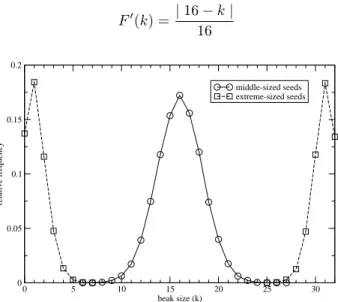
F′(k) = |16−k|
16
0 5 10 15 20 25 30
beak size (k) 0
0.05 0.1 0.15 0.2
relative frequency
middle-sized seeds extreme-sized seeds
Figure 4. Morphology of the population when only middle-sized seeds are abundant (circles) and when only small and large-sized seeds are left (squares). We show the fraction of the population with each beak size.
In Fig. 4 we show the distribution of phenotypes - in this case, the beak size - of the populations at time step12 000, up to which the fitness function was single-peaked, and at time step50 000, after it has been double-peaked for30 000
time steps. A stable polymorphism has clearly been estab-lished as a result of the duplicity of food resources. The frac-tion of selective females in the populafrac-tion has also increased to nearly1.0, and we now have two distinct populations each of which does not mate with a partner from the other, since hybrids are poorly fit to the environment: evolutionary dy-namics made it advantageous to develop assortative mating in this bi-modal ecology, and as a consequence of reproduc-tive isolation one single species has split into two.
III.3 Version with two traits
The version with two traits has two additional pairs of non-structured bitstrings in the genome of each individual. One of them is related to fitness, like in the previous ver-sion, and the second introduces a representation of a trait that drives sexual selection. The purpose here is to make the model more realistic by assigning different traits to different functions and to study the interactions between these traits [11], as well as to address issues raised by recent observa-tions of speciation in fish [12]. The dynamics of death and birth follow the rules already stated, and we map the pheno-type space for this new sexual trait onto an integer between0
For the results we show in this paper the mating strategy is defined as follows: Callf the phenotype of the female and
mthe one for the male, for the sexual selection trait. Then, the female follows the rules, if mutated into selectiveness, •Iff <16then it selects the male with the smallestm; •Iff >16then it selects the male with the largestm; •Iff = 16then the female chooses randomly to act as one of the above.
These rules amount to choosing a mating partner that further enhances the phenotype into which the trait is mapped. If we think about this mating trait as colour, for instance, and assignf <(>)16to a blue (red) character, a blue (red) female will choose the male that lies deepest into the blue (red) region.
III.4 Simulation results: version with two traits
Simulations were run with the same parameters as the ones for the single trait version, and the equilibrium popula-tion size is6×104
. The mutation probability for new sexual selection trait is set to1. The fitness function is set to a con-stant up to step12 000. The distribution of the fitness trait is single-peaked atk= 16at step12 000, as a consequence of the number of loci (16) where the1 allele is dominant, and moves into a polymorphism after the ecology becomes bi-modal. The sexual selection trait also shows a single peak at step12 000, and splits the population in two groups after-wards. But now a strong correlation develops between these traits, and the individuals with sexual selection phenotype
<(>)16have their fitness trait<(>)16. In other words, a female chooses a mating partner because of his colour, and its correlation with size allow them to generate viable off-spring. Fig. 5 shows the distribution of both traits at the end of the simulation.
0 0.02 0.04 0.06 0.08 0.1 0.12 0.14 0.16 0.18 0.2
0 5 10 15 20 25 30
Relative Frequency
number of bits 1
Beak Colour
Figure 5. Distribution of fitness (squares) and sexual (*) traits at the end of the simulation. These traits are correlated, and the pop-ulation with fitness trait to the left has its sexual trait also to the left of the plot.
Sexual selectiveness also develops as a result of the evo-lutionary dynamics. At the end of the simulation all females are selective, and again assortative mating and reproductive isolation are the proxies in this model to the development of
two separate species out of the single one that existed at the beginning.
IV
Summary
We presented three distinct versions of bit-string models de-veloped to study speciation. They are modifications of the original Penna model for ageing, and were discussed in an order of increasing complexity and realism. In the first, a simple interpretation of one locus in the genome as identi-fier of species, the imposition of assortative mating from the start, and a bi-modal ecology, lead to the flourishing and co-existence of two separate populations. The second version introduces a non-structured part in the genome and, by map-ping the genetic information onto a number, relates it to the fitness of the individual. Variability in the ecology from a single- to a double-peaked supply of resources generates a stable polymorphism. By introducing sexual selectiveness in the genetic information and using the fitness trait as the one that also codes for mating choice, assortative mating and reproductive isolation develops. The last version deals with two separate traits, one for fitness and another for sexual se-lection. Evolutionary dynamics again develops a splitting into two separate species by generating a strong correlation between the traits.
This work was partially supported by CNPq and FAPERJ.
References
[1] U. Dieckmann and M. Doebeli, Nature 400, 354 (1999). [2] S.V. Semovski, Y.S. Bukin, and D.Yu. Sherbakov, Int. J. Mod.
Phys. C 14, issue 8 (2003); see also M. Rost and M. L¨assig, Diapatric speciation, preprint.
[3] J.S. S´a Martins, S. Moss de Oliveira, G.A. de Medeiros, Phys. Rev. E 64, 021906 (2001).
[4] A. Nowicka, A. Duda and M.R. Dudek, cond-mat/0207198; A. Łaszkiewicz, Sz. Szymczak, S. Cebrat, Int. J. Mod. Phys. C 14, issue 6 (2003).
[5] D. Chowdhury, D. Stauffer, and A. Kunwar, Phys. Rev. Lett.
90, 068101 (2003).
[6] T.J.P. Penna, J. Stat. Phys. 78, 1629 (1995).
[7] S. Moss de Oliveira, P.M.C. de Oliveira and D. Stauffer,
Evo-lution, Money, War and Computers, Teubner, Leipzig and
Stuttgart 1999, ISBN 3-519-00279-5.
[8] P.T. Boag and P.R. Grant, Nature 274, 793 (1978); P.T. Boag and P.R. Grant, Science 214, 82 (1981).
[9] A.O. Sousa, Stuttgart University, priv. comm. (April 2003) [10] J.S. S´a Martins and S. Cebrat, Theory Biosc. 119, 156 (2000). [11] A.S. Kondrashov and F.A. Kondrashov, Nature 400, 351
(1999)