ABSTRACT
Hormone receptors and, specifically, estrogen receptors were described about four decades ago. For estrogens, there are two receptors, estro-gen receptor alpha (ERα) and estrogen receptor β(ERβ). The two recep-tors are coded by different genes and their tissue expression varies across organs. ERα is predominantly expressed in reproductive tissues (uterus, breast, ovaries) liver and central nervous system, whereas ERβ is expressed in other tissues such as bone, endothelium, lungs, urogenital tract, ovaries, central nervous system and prostate. More than seventy molecules that belong to the SERMS class have been described. There are 5 chemical groups: triphenylethylenes, benzotiophenes, tetrahydron-aphtylenes, indoles and benzopyrans. All of these non-hormonal com-pounds are capable of activating the ER, reduce bone turnover rate and, as an antiresorptive, clearly improve bone density. Estrogens reduce bone turnover rate and, as an antiresorptive, clearly improve bone density. They are also beneficial for the relief of menopausal symp-toms. An ongoing debate that extends over the decades, relates to to overall benefit/risk profile of estrogen or estrogen-progestin therapy since these therapies can increase the risk of serious health disorders, such as breast cancer. SERMs have increased our understanding of hormone-receptor regulatory mechanisms. Their development has permitted a tar-geted efficacy profile avoiding some of the side effects of the hormone therapy. Their clinical utility relies today mostly on the effects on breast cancer and bone. (Arq Bras Endocrinol Metab 2006;50/4:720-734) Keywords: Raloxifene; Tamoxifene; Estrogen receptors; Bone turnover; Breast cancer
RESUMO
Moduladores Seletivos do Receptor Estrogênico (SERMs).
Os receptores hormonais e especificamente os receptores estrogênicos, foram descritos há cerca de 40 anos. Para os estrógenos, existem dois tipos: o alfa (ERα) e os beta (ERβ), os quais são codificados por diferentes genes e sua expressão tissular varia de tecido para tecido. O ERαse expressa predominantemente no aparelho reprodutivo (útero, mamas, ovários), fígado e sistema nervoso central (SNC). O ERβ se expressa em outros tecidos como osso, endotélio, pulmões, urogenital, além dos ovários, SNC e próstata. Mais de setenta moléculas pertencentes ao grupo dos SERMs têm sido descritas, em 5 grupos químicos: trife-niletilenos, benzotiofenos, tetrahidronaftilenos, indols e benzopiranos. Todos estes compostos não hormonais são capazes de ativar o ER, reduzindo a remodelação óssea e melhorando a densidade mineral óssea. Os estrógenos reduzem a remodelação óssea e aumentam a densidade mineral óssea, como também melhoram os sintomas da menopausa. Um debate permanente existe a respeito da relação risco/benefício da terapia estrógeno-progestínica, em virtude do aumento do risco de problemas de saúde mais sérios como câncer de mama. Os SERMs aprimoraram o conhecimento sobre os mecanismos de regulação hormônio-receptor, e o seu desenvolvimento permitiu
Adolfo Diez-Perez
Autonomous University of
Barcelona, Department of
Internal Medicine, Hospital del
Mar-URFOA-IMIM,
Barcelona, Spain.
uma eficiente modalidade de ação terapêutica hormonal, evitando-se alguns dos efeitois adversos da terapia hormonal per si. (Arq Bras Endocrinol Metab 2006;50/4:720-734)
Descritores: Raloxifeno; Tamoxifeno; Receptores estrogênicos; Remodelação óssea; Câncer mamário
ESTROGEN RECEPTOR ACTIVATION BY
ESTROGENS AND SELECTIVE ESTROGEN
RECEPTOR MODULATORS (SERMS)
H
ORMONE RECEPTORS AND,
SPECIFICALLY, estrogen
receptors were described about four decades ago
(1-3). For estrogens, there are two receptors, estrogen
receptor alpha (ER
α
) and estrogen receptor
β
(ER
β
).
The two receptors are coded by different genes and
their tissue expression varies across organs. ER
α
is
pre-dominantly expressed in reproductive tissues (uterus,
breast, ovaries) liver and central nervous system,
whereas ER
β
is expressed in other tissues such as bone,
endothelium, lungs, urogenital tract, ovaries, central
nervous system and prostate (4-10). Both ERs are
formed by a single polypeptide chain with 565
aminoacids for the ER
α
and 530 for the ER
β
(11).
There are 6 homologous regions, A to F, with the ER
β
lacking the carboxiterminal F domain (12). The
domains of the estrogen receptors include sites for
nuclear location, hormone binding, dimerization,
DNA binding and transcription activation (12-16).
Estrogens and SERMS activate estrogen genes by a
series of events that occur after their binding to the
ER. The interaction of the hormone with the naïve
receptor induces conformational changes of the
lig-and-receptor binding to nuclear proteins or adaptor
proteins or corregulators (17,18) that induces the
dis-sociation of heat-shock proteins associated with the
inactive receptor. This results in receptor activation
and and an interaction with DNA (19). This
ligand-receptor complex binds to DNA response elements,
called Estrogen-Response-Elements (ERE), located in
the promoter region of the estrogen target genes,
ini-tiating the transcription process and mRNA synthesis.
The final result of the process, either inducing or
inhibiting gene transcription by the ligand-ER dimer,
depends on the type of cell and the presence of
cor-regulator proteins and gene promoters. Rapid acting,
non-genomic pathways are also activated by estrogens
and SERMS such as those dependent upon NO
(vasodilatation, ischemic myocardial damage, response
to endothelial damage, coronary artery relaxation or
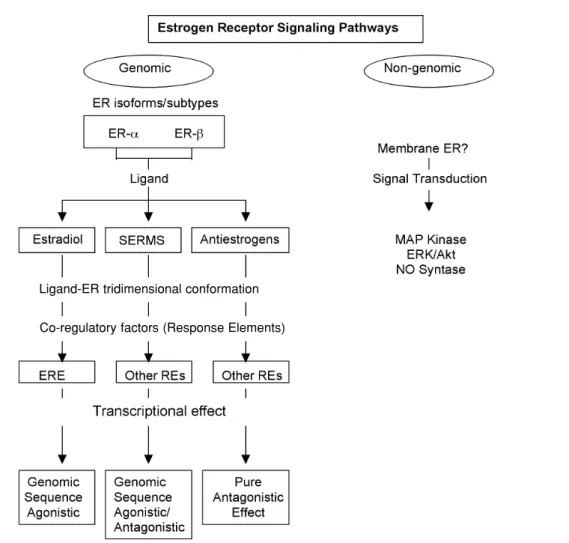
vasodilation in hypertensive rats) (20-24). Figure 1
summarizes the general activation pathways of the
estrogen receptor.
CHEMICAL CLASSIFICATION OF SERMS
More than seventy molecules that belong to the
SERMS class have been described (32). There are 5
chemical groups: triphenylethylenes, benzotiophenes,
tetrahydronaphtylenes, indoles and benzopyrans (33)
(table 1). All of these non-hormonal compounds are
capable of activating the ER.
Triphenylethylenes
were developed for the
treat-ment of the estrogen-dependent breast cancer.
Tamox-ifene is widely used for this indication and is a reference
compound for prevention and treatment (34-36).
Toremifene has been also marketed for breast cancer
treatment (37). Tamoxifene induces positive effects on
bone density whereas toremifene use is accompanied by
slight reductions in bone density (38). Both toremifene
and tamoxifene have an estrogen-agonistic effect on the
endometrium (39,40). Other compounds of the group
of the triphenylethylenes also induce uterine stimulation
and, for this reason, their development has been limited
and their use restricted to cases of advanced breast
can-cer (41-48) whereas others are in early phases of
devel-opment (49-52).
Benzotiophenes
constitute a second chemical
group. Raloxifene is the main molecule of this class and
is currently the most widely used for osteoporosis
treat-ment and prevention. This class of SERMS is
antire-sorptive on bone. There is no stimulatory effect on the
endometrium (53) and an estrogen-like effect on lipids
(53,54). Raloxifene has an inhibitory effect on
ER-pos-Figure 1.Summary of the estrogen receptor signaling pathways. The interaction of the ERsubtypes/iso-forms with the different ligands induces characteristic tridimensional conformations of the ligand-recep-tor complex. The interaction with the diverse response elements acting as co-regulaligand-recep-tory facligand-recep-tors pro-duces different transcriptional effects inducing a pure agonistic, pure antagonistic or a mixture of ago-nistic/antagonistic effects (33). The fast non-genomic signaling pathway acts through a potential mem-brane ER regulating MAP kinase, ERK/Akl and NO synthase responses (22-24).
Ligand-ER tridimensional conformation
itive breast cancer cells (55) and in clinical cases (56).
Arzoxifene is another SERM of this group currently in
a phase III trial. In breast cancer cells lines, arzoxifene
has a more potent effect than raloxifene but is similar or
more potent in skeletal systems (57-59).
Tetrahydronafthylenes
. Lasofoxifene is the main
representative of this group. In vivo animal experiments
have shown a great affinity for ER-
α
(60). The effect of
these molecules in ovariectomized (OVX) rat models is
prevention of bone loss and positive changes in lipid
profile. In male orchidectomized old rats, these SERMS
are also efficacious in preventing bone loss and
preserv-ing biomechanical properties (61,62). Lasofoxifene is
currently in advanced states of development (phase 3
clinical trials). Trioxifene, another member of the
group, was abandoned because of side effects (63).
Indoles
. Bazedoxifene and pipendoxifene are the
2 main molecules of this group. In a phase 3 clinical
trial, bazedoxifene demonstrated bone protective,
cho-lesterol lowering and no uterine effects in OVX and
intact rat models (64). This class of SERMS antagonizes
C3 gene and counteracts naloxone-induced vasomotor
responses in rats (65). In addition, mechanical strength
of bone is improved in treated animals (66).
Benzopyrans
. A number of compounds belong
to this group. Ormeloxifene is used as contraceptive
(67). The development of Levormeloxifene was
stopped because of uterine safety issues (68). Other
molecules in active development are SP500263 (69),
EM-800 and EM-652 (70,71) among others.
SERMS AND BONE
Estrogens play an important role in female bone
homeostasis; in the estrogen deficient state, bone
resorption is increased. As a result of these predictable
postmenopausal findings, estrogens have been
exten-sively used as the main therapy to prevent bone loss in
postmenopausal women. Estrogens reduce bone
turnover rate and, as an antiresorptive, clearly improve
bone density. They are also beneficial for the relief of
menopausal symptoms. An ongoing debate, that
extends over the decades, relates to to overall
bene-fit/risk profile of estrogen or estrogen-progestin
ther-apy since these therapies can increase the risk of
seri-ous health disorders, such as breast cancer (72,73).
It is in this area that SERMS became attractive.
Breast cancer patients treated with tamoxifen showed
protection against postmenopausal bone loss (74).
This observation led to a new appreciation that
estro-gen-like molecules (SERMS) can act in some organs
or tissues as estrogen agonists and in some others as
antagonists. The fundamental premise of SERMS is
based upon this concept, namely that they can be both
estrogen agonist and antagonists...
Preclinical models
Tamoxifen
The most extensively used animal model to evaluate
the action of SERMs on bone has been the
ovariec-tomized (OVX) rat. In rats, tamoxifen reduces bone
resorption, uterine growth (74,75) and reduces the
number and size of osteoclasts. Similar effects on bone
have been observed in dogs and immobilised male rats
(76,77). However, the antiresorptive potency of
tamoxifen is inferior to 17
β
-estradiol (78) and has no
effect when the endogenous production of estrogens is
normal (79).
Raloxifene
OVX rats treated with raloxifene show significantly
lower rates of bone remodeling (80) and preservation
of bone mineral density (BMD) as measured by single
photon absorptiometry (53) in distal femur metaphysis
and in proximal tibia, and by dual-energy X-ray
absorptiometry (54) in lumbar vertebrae and femur.
This prevention of bone loss is similar to that achieved
with ethinyl-estradiol (EE) (54,81).
Histomorphome-try in OVX rat models have demonstrated a reduction
of bone resorption area in trabecular surfaces similar
for raloxifene and EE treated animals (81,82).
Biomechanical testing shows an increased
strength in rats treated with raloxifene and EE vs.
con-trol rats (81) in both the femoral neck and vertebrae.
In another study in which raloxifene, EE, tamoxifen
and alendronate were all assessed (53), all drugs except
tamoxifen showed increased strength in comparison to
control animals. Moreover, treatment with raloxifene
was associated with a smaller number of microcracks
(83). A raloxifene analogue, LY 117018, inhibited
osteocyte apoptosis induced by oophorectomy in a rat
model (84).
Table 1.SERMS: Chemical groups (33).
Triphenylethylenes Tetrahydronafthylenes
Tamoxifen Lasofoxifene
Droloxifene Nafoxidine
Idoxifene Indoles
Clomiphene Bazedoxifene
Toremifene Benzopyrans
Benzotiophenes EM-800
Raloxifene Levormeloxifene
In transient cotransfection experiments using a
transforming growth factor-
β
promoter-chloram-phenicol acetyltransferase reporter construct (TGF
β
promoter-CAT reporter) and an ER expression
plas-mid in human MG63 osteosarcoma cells (85) it has
been shown that TGF
β
CAT expression was
signifi-cantly up-regulated by raloxifene (7-fold), and by 17
β
-estradiol or tamoxifen (2-fold). This suggests that
raloxifene regulates TGF
β
3 gene expression with two
possible sequellae: promotion of osteoblast numbers
and inhibition of osteoclast differentiation (85).
Different SERMs, as well as the natural ligand,
estradiol, can activate more predominantly one or the
other estrogen receptors (alpha or beta) creating
con-formational changes of the ER-ligand complex that
vary for different ligands (86). Furthermore, the
vari-ous ligands can activate different intracellular pathways
along with different response elements (26).
Altogeth-er, genomic responses for the various SERMS differ
within this class and in relationship to estradiol effects
on these 2 receptor subtypes (31).
Other SERMs
In rats, levormeloxifene increases lumbar spine and
tibial bone mass in a rat model, with a decrease in
osteocalcin and cholesterol levels. The uterus is not
affected (30,87)
.
In monkeys, it has been also
demon-strated that bone remodelling is controlled and bone
loss is prevented (88)
.
The actions of Idoxifene,
another SERM that activates the ER through the
clas-sical estradiol pathway, on bone are similar, serving as
a full antagonist on mammary and uterine tissue
(89,90)
.
Droloxifene is efficacious in the prevention of
bone loss in OVX rats as well as in the reduction of
serum cholesterol levels again without deleterious
effects on the uterus (44,91-94)
.
Ormeloxifene can
also prevent bone loss in animal models (95,96).
Lasofoxifene protects against bone loss, reduces
cholesterol levels and exerts a positive effect on bone
strength in male rats (97)
.
This compound is in the
lat-est stages of clinical development. Two other SERMs,
also in advanced phase III trials are bazedoxifene and
arzoxifene, both showing protective effects against
ovariectomy-induced bone loss. Arzoxifene has shown
to reduce the rate of bone remodelling with positive
effects on bone quality as well as reduction of
choles-terol levels in OVX rats (98).
A raloxifene analogue, LY117018 HCl, is also
effective in reducing bone loss in OVX rats (99). In
addition, the administration of this analogue permits a
significant reduction of the minimal effective dose of
human parathyroid hormone (PTH) required in the
treatment of osteopenic rats (59,100). Other
com-pounds are FC1271a (101) and HMR-3339 (47)
both with promising results in preclinical studies.
CLINICAL EFFECTS OF SERMs ON BONE
Tamoxifen
The effects of tamoxifen on bone have been evaluated
mainly in breast cancer patients who received the
product as adjuvant therapy. A number of observations
(102-106) have shown a decrease in bone formation
(102,104,106) and bone resorption by biochemical
markers (105-107).
Initial retrospective (107) and prospective
studies (108,109) that compared tamoxifen-treated
women against the placebo group, found no
signifi-cant differences in BMD at the lumbar spine or
femoral neck. Subsequent prospective and
random-ized studies also carried out with breast cancer
patients (102,103), revealed, over a 3-year period,
significant prevention of bone loss in women. Grey
et al. (105) studied the effect of tamoxifen on BMD
in healthy, late postmenopausal women who were
on average 11 years postmenopausal. There was no
significant difference in hip BMD but an incease in
lumbar spine BMD. Different from these
observa-tions in a breast cancer prevention study in
pre-menopausal healthy women, progressive reductions
in BMD in a tamoxifen-treated group was observed
(50).
Similarly, Wright et al. (105) found no
differ-ences in tamoxifen-treated subjects when
histomor-phometric changes in cancellous bone was assessed. In
the tamoxifen group, bone formation rate was
signifi-cantly decreased, the total bone-remodelling span was
longer and the trabecular connectivity indexes were
increased.
In summary, available evidence on the effects of
tamoxifen on the skeleton in human subjects seems to
parallel data obtained in animalss. As a partial estrogen
agonist, tamoxifen seems to have beneficial effects on
the preservation of bone mass in postmenopausal
women, while in estrogen-replete premenopausal
women it might act as an estrogen antagonist.
Raloxifene
Early studies indicate that raloxifene has an effect on
bone homeostasis similar to that of estrogens. In a
sur-vey by Draper et al. (110) in which postmenopausal
women aged 45–60 were monitored over 8 weeks
251, subjects were randomized to 2 treatment groups
(raloxifene or CEE) and placebo. Those in the
treat-ment groups showed a significant reduction in bone
turnover markers (osteocalcin, serum alkaline
phos-phatase, urinary pyridinoline crosslinks) and urinary
calcium excretion in comparison to the placebo group.
Similarly, the European survey (111), that monitored
601 postmenopausal women over 24 months, revealed
a significant reduction in bone turnover markers in
comparison to the placebo group. Lufkin et al. (112)
recorded similar data in a 1 year clinical trial of 143
postmenopausal women with osteoporosis.
The effect of raloxifene to prevent bone mass has
been assessed in several different studies including,
European (111), American (113) and International
cohorts. All 3 were concealed randomized
placebo-con-trolled studies. In the European and American trials, 3
treatment doses were tested (30, 60 and 150 mg daily),
while in the international trial, 2 raloxifene groups (with
daily 60 and 150 mg doses) and conjugated equine
estrogens (CEE) 0.625 mg daily were used. A total of
1,764 women were monitored, measuring the
bio-chemical markers of bone remodelling and BMD at the
lumbar spine and femoral neck. After 24 months of
treatment, BMD increased significantly at all monitored
skeletal sites in raloxifene-treated patients vs. the
place-bo group. This increase was detected after 12 months of
treatment and maintained for the next 12 months.
Other studies have evaluated the effect of raloxifene in
Asian women with similar results (114,115). A recent
meta-analysis has evaluated the overall efficacy of the
drug across the different trials showing homogeneity in
the drug effect and a consistent risk reduction for
verte-bral fracture (116).
The pivotal study on raloxifene is the Multiple
Outcomes of Raloxifene Evaluation (MORE), a
ran-domized, double-blind and placebo-controlled trial
with the primary end point being the occurrence of
vertebral fractures in a cohort of 7,705 women with
osteoporosis (117-119). The effect of the drug on
bone mass was also assessed in the study. After 4 years
of treatment, BMD increased at the lumbar spine and
femoral neck (119). In the extension of the MORE
trial, this positive effect on BMD was extended up to
7 years of treatment (120). The most important
out-come, however, was the significant risk reduction in
the occurrence of new vertebral fractures. Women
included in substudy 1 (cases with at least one
preva-lent vertebral fracture at baseline) had a significant
reduction in the risk of sustaining new (incident)
ver-tebral fractures after three (118) and four years (119)
of treatment of 34% (RR 0.66 [95% CI= 0.55, 0.81]).
Women enrolled in the substudy 2 (no baseline
verte-bral fracture) showed a risk reduction of 49% at the
end of the four-year treatment (RR 0.51 [95% CI=
0.35, 0.73]) (119)
.
The number needed to treat
(NNT) to prevent an event after 4 years of treatment
was 12 for patients with prevalent vertebral fracture
and 34 for those without. Subgroup exploratory
analy-ses showed a 93% reduction in the risk of suffering
multiple vertebral fractures (121) with sustained
effi-cacy during the fourth year. Other post hoc analyses
also suggested an early efficacy on clinical vertebral
fracture after 12 months of treatment (122), and
frac-ture reduction in women with previous treatment with
estrogens or estrogen-progestagens (123). Moreover,
in cases with osteopenia (no fracture and BMD in this
range) another exploratory analysis demonstrated not
only BMD improvement but significant fracture risk
reduction (124).
Ott et al. (127). In a group of 54 women enrolled in
the MORE study, 2 transiliac bone biopsies were
obtained at baseline and after two years of treatment.
The results confirmed the safety of the drug on bone
tissue since no woven bone, mineralization defect, cell
toxicity or medullary fibrosis were observed.
More-over, the decreased number of empty osteocytic
lacu-nae also suggested an anti-apoptotic effect on the
osteocyte. More recent experimental data further
con-firm this anti-apoptotic effect of raloxifene on
osteoblastic and osteocytic cells (128).
For years osteoporosis has been defined as a
disease induced by a decrease in bone mass.
Recent-ly, a National Institute of Health Consensus Panel
(129) has redefined the disease as a skeletal disorder
characterized by an alteration in bone strength that
predisposes a person to an increased risk of fracture.
This concept of bone strength represents a new
par-adigm in our concepts about the disease (130-132).
Added to the traditional element of bone mass are
other aspects of bone strength such as geometry,
microarchitecture, remodelling rate, mineralization
degree and homogeneity and fatigue damage
(54,130-137).
The relationship between the decrease in bone
mineral density, assessed in any of the skeletal regions
and measured by different techniques, with an
increased fracture risk has been widely demonstrated
(138-140). Marshall et al. (139) demonstrated in a
meta analysis that one standard deviation decrease in
bone mineral density (BMD) in lumbar spine, hip or
proximal radius increased the risk of fracture in these
locations by a 50 to 60%. While this relationship
between a reduction in BMD and fracture risk is very
powerful, the relationship between an increase in
BMD and a reduction in fracture risk is much less
cer-tain (118,141-145). This relationship is of particular
interest for raloxifene, a drug that has a limited effect
to increase BMD. Sarkar et al. (146) analyzed the
relationship between the observed increase in BMD in
the placebo and in the raloxifene-treated patients
from the MORE trial. Only a 4% of the fracture
reduction could be explained by changes in BMD.
These observations argue that other properties of
bone, presumably affected by raloxifene in a positive
manner, are more likely to account for most of the
antifracture efficacy of the drug.
Bone turnover replaces old bone with fresh new
bone. When in balance and not excessive, bone
turnover is a beneficial feature of skeletal homestasis.
However, in the adult, bone turnover is usually not
bal-anced, with bone resorption exceeding bone
forma-tion, and sometimos excessive. In these settings, bone
turnover can be deleterious for bone (130). The rapid
reduction in the fracture risk observed after only a few
months of starting antiresorptives can be explained by
their effects to reduce bone turnover well before any
improvement in BMD (130,147) .Bone remodeling
rate is also a determinant of intrinsic material properties
of the bone tissue such as the mean degree of
mineral-ization or their homogeneity (148,149). Clinical data
on raloxifene-treated patients demonstrate that the
drug preserves a normal degree of mineralization and
homogeneity (150), in accordance with the preclinical
data. Collagen composition is also modulated by the
remodeling rate since the crosslinking of the molecules
influences the mechanical competence and can vary
with aging (151).
There is considerable debate on what is the
normal remodelling rate and the potential
deleteri-ous effects of an excessive suppression given that
microdamage repair could be impaired (152).
Micro-damage increases with age, but also negatively
corre-lates with the rate of bone remodeling and is
associ-ated with high doses of antiresorptives in
experimen-tal animals (153,154). Therefore, the theoretical
concern is that an antiresorptive agent might depress
remodelling excessively (155) impairing the
replace-ment of old bone by fresh new units. Although no
fracture data support this highly controversial theory,
SERMs do not suppress bone turnover to an extent
that would cause such concerns. In fact, the data
show that raloxifene restores bone turnover to
pre-menopausal levels (156,157) and experimental data
demonstrate that the drug actually reduces
microc-rack density in bone tissue (84).
It has been demonstrated that the
simultane-ous use of a bisphosphonate with PTH impairs the
bone forming response (156,157). Preliminary data
suggest the opposite when the combined drug is
raloxifene (158). Furthermore, in patients previously
treated with raloxifene a full response to PTH was
observed (159). Altogether SERMs appear to be a
better partner for anabolic agents than some
bispho-sphonates. Also, in young postmenopausal women
raloxifene will not jeopardize an anabolic effect in
case PTH should be needed in subsequent
therapeu-tic considerations.
Future SERMs
(160, 161) has been studied for its pharmacokinetics,
safety, dosing and antiresorptive effects. However its
development was stopped after the phase II trials when
uterine safety problems where detected (162).
Idox-ifene has demonstrated positive effects on BMD after
12 months of treatment (163) and decreased turnover
in osteopenic postmenopausal women (164). Three
SERMS are currently in advanced (phase III) stages of
their clinical development: bazedoxifene, lasofoxifene
and arzoxifene.
EXTRASKELETAL EFFECTS OF SERMS
SERMs and the breast
Tamoxifen has a well-established efficacy for breast
cancer patients (34-36). Raloxifene showed a positive
effect on invasive estrogen-receptor positive breast
cancer after 3 years in postmenopausal women with
osteoporosis (118) and this outcome is sustained after
8 years of treatment, with no apparent loss of effect or
rebound effect (165). These observational data have
recently been confirmed in the recent preliminary
report on the results of the RUTH trial (166). Finally,
the STAR trial comparing the efficacy of raloxifene vs
tamoxifen in more than 19,000 women at high risk for
breast cancer has shown a similar number of invasive
breast cancer cases in both raloxifene and tamoxifen
groups (167). In some countries raloxifene is already
approved for prevention of breast cancer and all the
data suggest the efficacy of the drug for this indication.
Given their positive effects on bone, this beneficial
effect could extent the clinical utility of the drug.
However, the results of both the RUTH and STAR
trial are not fully analyzed yet and we await
peer-reviewed publication documenting these early
obser-vations. Other SERMs are currently under study for
this indication.
Cardiovascular effects
Tamoxifen induces a small but significant increase in
the incidence of deep venous thrombosis and
pul-monary embolism and in the risk of stroke (168).
Sim-ilarly, raloxifene use is associated with a 1.7-fold
increase in the risk of venous thromboembolic events
although the overall incidence is quite low (absolute
risk difference of 0.9 per 1000 woman-years) (169).
What has been more extensively assessed is the effect of
raloxifene on coronary and cerebrovascular events. In
post hoc results for a subgroup of the MORE trial,
namely, women at high risk for arterial events,
ralox-ifene decreased the incidence of coronary events and
stroke (170). However, after 8 years of treatment the
incidence of overall cardiovascular, coronary or
cere-brovascular adverse events did not differ significantly
between the raloxifene and placebo treated groups
(171). Patients at increased risk of cardiovascular
events showed no evidence of a beneficial or harmful
effect. The preliminary report on the RUTH trial
results confirm a neutral effect on coronary events and
incidence of stroke, although a small increase in the
stroke-associated mortality has been reported (166). In
addition, the preliminary report of the STAR trial
sug-gests a lower incidence in deep venous thrombosis and
pulmonary embolism in women receiving raloxifene vs.
those treated with tamoxifen (167). Again a full
analy-sis is needed in all these aspects of both studies.
Other health problems and SERMs
An increase in the number of hot flases limits the use
of available SERMs in a number of postmenopausal
women (169). Some preclinical results suggest that
new SERMs might avoid this problem (172).
Tamox-ifen is associated with an increased incidence of
endometrial carcinoma (173), vaginal bleeding (174)
and uterine sarcoma (175). Raloxifene has not
report-ed to increase vaginal blereport-eding, ovarian or uterine
can-cer (117,169,176). Analyses of the safety results from
the raloxifene trials also suggest positive effects on
uri-nary incontinence (177) with neutral effects on
cogni-tive function (178). Points related to cardiovascular
issues have already been noted.
CONCLUSIONS
SERMs have increased our understanding of
hor-mone-receptor regulatory mechanisms. Their
develop-ment has permitted a targeted efficacy profile avoiding
some of the side effects of the hormone therapy. Their
clinical utility relies today mostly on the effects on
breast cancer and bone. Future members of this class
may offer an improved risk-benefit profile and could
represent an integral approach for the health problems
of postmenopausal women.
REFERENCES
1. Toft D, Gorski J. A receptor molecule for estrogens: isola-tion from rat uterus and preliminary calcificaisola-tion. Proc Natl Acad Sci USA 1966;5:1574-81.
3. Evans RM. The steroid and thyroid receptor family. Sci-ence 1988;240:889-95.
4. Nilsson S, Mäkelä S, Treuter E, Tjuange M, Thomsen J, Anderson G, et al. Mechanisms of estrogen action. Physiol Rev 2001;81:1535-65.
5. Anderson E. The role of oestrogen and progesterone receptors in human mammary development and tumorigenesis. Breast Cancer Res 2002;4:197-201. 6. Palmieri C, Cheng GJ, Saji S, Zelada-Hedman M, Warri A,
Weiua Z, et al. Estrogen receptor beta in breast cancer. Endocr Relat Cancer 2002;9:1-13.
7. Kuiper GG, Carlsson B, Grandien K, Enmark E, Hagg-blad J, Nilsson S, et al. Comparison of the ligand bind-ing specificity and transcript tissue distribution of estro-gen receptor alpha and beta. Endocrinology 1996; 138:863-70.
8. Krege JH, Hodgin JB, Couse JF, Enmark E, Warner M, Mahler JF, et al. Generation and reproductive pheno-types of mice lacking estrogen receptor beta. Proc Natl Acad Sci USA 1998;95:15677-82.
9. Couse JF, Hewitt SC, Bunch DO, Sar M, Walker VR, Davies BJ, et al. Postnatal sex reversal of the ovaries in mice lacking estrogen receptors alpha and beta. Sci-ence 1999;286:2328-31.
10. Couse JF, Korach KS. Estrogen receptor null mice: What have we learned and where will they lead us? Endocr Rev 1999;20:358-417.
11. Kuiper GG, Enmark E, Pelto-Huikko M, Nilsson S, Gustafs-son JA. Cloning of a novel estrogen receptor expressed in rat prostate and ovary. Proc Natl Acad Sci USA 1996;93:5925-30.
12. Kumar V, GreenS, Stack G, Berry M, Jin JR, Chambon P. Functional domains of the human estrogen receptor. Cell 1987;51:941-51.
13. Beato M. Gene regulation by steroid hormones. Cell 1989;56:335-44.
14. Beato M, Sanchez-Pacheco A. Interaction of steroid hormone receptors with the transcription initiation com-plex. Endocr Rev 1996;17:587-609.
15. Fawell SE, Lees JA, White R, Parker MG. Characterization and colocalization of steroid binding and dimerization activities in the mouse estrogen receptor. Cell 1990;60:953-62.
16. Hall JM, McDonnell DP. The estrogen receptor beta-iso-form of the human estrogen receptor modulates ER-alpha transcriptional activity and is a key regulator of the cellular response to estrogens and antiestrogens. Endocrinology 1999;140:5566-78.
17. McGuire WL, Chamnes GC, Fuqua SA. Estrogen recep-tor variants in clinical breast cancer. Mol Endocrinol 1991;5:1571-7.
18. Navarro D, Leon L, Chirino R, Fernandez L, PestanoJ, Diaz-Chico BN. The two native estrogen receptor forms of 8S and 4S present in cytosol from human uterine tis-sues display opposite reactivities with the antiestrogen tamoxifen aziridine and the estrogen responsive ele-ment. J Steroid Biochem Mol Biol 1998;64:49-58.
19. Redeuilh G, Moncharmont B, Secco C, Baulieu EE. Sub-unit composition of the molibdate stabilized 8-9S non-transformede estradiol receptor purified from calf uterus. J Biol Chem 1987;262:6969-75.
20. Ho K, Liao JK. Nonnuclear actions of estrogen. Arte-rioscler Throm Vas Biol 2002;22:1952-61.
21. Salom JB, Burguete MC, Perez-Asensio, Centeno JM, Tor-regrosa G, Alborch E. Acute relaxant effects of 17-β estradiol through non-genomic mechanisms in rabbit carotid artery. Steroids 2002;67:339-46.
22. Simoncini T, Genazzani AR, Liao JK. Nongenomic mech-anisms of endothelial nitric oxide synthetase activation by the selective estrogen receptor modulator ralox-ifene. Circulation 2002;105:1368-73.
23. Simoncini T, Varone G, Fornari L, Mannella P, Luisi M, Labrie F, et al. Genomic and nongenomic mechanisms of nitric oxide syntesis induction in human endothelial cells by a fourth-generation selective estrogen receptor modulator. Endocrinology 2002;143:2052-61.
24. Wassmann S, Laufs U, Stamenkovic D, Linz W, Stasch JP, Ahlbory K, et al. Raloxifene improves endothelial dys-function in hypertension by reduced oxidative stress and enhanced nitric oxide production. Circulation 2002; 105:2083-91.
25. Brzozowski AM, Pike ACW, Dauter Z, Hubbard RE, Bonn T, Engström O, et al. Molecular basis of agonism and antagonism in the oestrogen receptor. Nature 1997;389:753-8.
26. Katzenellenbogen BS, Katzenellenbogen JA. Biomedi-cine. Defining the “S” in SERMs. Science 2002 ;295:2380-1.
27. Shiau AK, Barstad D, Loria PM, Cheng L, Kushner PJ, Agard A, et al. The structural basis of estrogen recep-tor/coactivator recognition and the antagonism of this action with tamoxifen. Cell 1998;95:927-37.
28. Brzozowski AM, Pike AC, Dauter Z, Hubbard RE, Bonn T, Engstrom O, et al. Molecular basis of agonism and antagonism in the oestrogen receptor. Nature 1997;389:753-8.
29. McDonnell DP, Wijayarate A, Chang C, Norris JD. Eluci-dation of the molecular mechanism of action of selec-tive estrogen receptor modulators. Am J Cardiol 2002;90(suppl):35F-43F.
30. Kian Tee M, Rogatsky I, Tzagarakis-Foster C, Cvoro A, An J, Christy RJ, et al. Estradiol and Selective Estrogen Receptor Modulators differentially regulate target genes with estrogen receptors alpha and beta. Mol Biol Cell 2004;15:1262-72.
31. Nuttall ME, Stroup GB, Fisher PW, Nadeau DP, Gowen M, Suva LJ. Distinct mechanisms of action of selective estrogen receptor modulators in breast and osteo-blastic cells. Am J Physiol Cell Physiol 2000;279: C1550-7.
32. Meegan MJ, Lloyd DG. Advances in the science of estrogen receptor modulation. Curr Med Chem 2003;10:181-210.
34. Fisher B, Constantino JP, Wickerham DL, Redmond CK, Kavanah M, Cronin M, et al. Tamoxifen for prevention of breast cancer: Report of the National Surgical Adjuvant Breast and Bowel Project P-1 Study. J Natl Cancer Inst 1998;90:1371-88.
35. Jordan VC, Morrow M. Tamoxifen, raloxifene, and the prevention of breast cancer. Endocr Rev 1999;20:253-78. 36. Wickerham L. Tamoxifen: an update on current data and where it can now be used. Breast Can Res & Treat 2002;75(suppl. 1):S7-12.
37. Buzdar AU, Hortobagyi GN. Tamoxifen and toremifene in breast cancer: comparison of safety and efficacy. J Clin Oncol 1998;26:348-53.
38. Marttunen MB, Hietanen P, Titinen A, Roth H-J, Viinikka L, Ylikorkala O. Effects of tamoxifen and toremifene on uri-nary excretion of pyridinoline and deoxypyridinoline and bone density in postmenopausal women with breast cancer. Calcif Tissue Int 1999;65:365-8.
39. O’Regan RM, Cisneros GM, England GM, MacGregor JL, Muenzner HD, Assikis VJ, et al. Effects of the antiestrogens tamoxifene, toremifene and ICI 182,780 on endometrial cancer growth. J Natl Cancer Inst 1998;90:1552-5. 40. Shapiro CL, Recht A. Side effects of adyuvant treatment
of breast cancer. N Engl J Med 2001;344:1997-2008. 41. Nuttall ME, Bradbeer JN, Stroup GB, Nadeau DP, Hoffman
SJ, Zhao H, et al. Idoxifene: a novel selective estrogen receptor modulator prevents bone loss and lowers cho-lesterol levels in ovariectomized rats and decreases uter-ine weight in intact rats. Endocrinology 1998;139:5224-34. 42. Gutman M, Couillard S, Roy J, Labrie F, Candas B, Labrie F, et al. Comparison of the effects of EM-652 (SCH57068), tamoxifen, toremifene, droloxifene, idoxifene, GW-5638 and raloxifene on the growth of human ZR-75-1 breast cancer in nude mice. Int J Cancer 2002;99:273-8. 43. Hendrix SL, McNeeley SG. Effect of selective estrogen
receptor modulators on reproductive tissues other than endometrium. Ann NY Acad Sci 2001;949:243-50. 44. Ke HZ, Chen HK, Simmons HA, Qi H, Crawford DT, Pirie
CM, et al. Comparative effects of droloxifene, tamox-ifen, and estrogen on bone, serum cholesterol, and uter-ine histology in the ovariectomized rat model. Bone 1997;20:31-9.
45. Shibata J, Toko T, Saito H, Lykkesfeldt AE, Fujioka A, Sato K, et al. Estrogen agonistic/antagonistic effects of miproxifene phosphate (TAT-59). Cancer Chemother Pharmacol 2000;45:133-41.
46. Willson TM, Norris JD, Wagner BL, Asplin I, Baer P, Brown HR, et al. Dissection of the molecular mechanism of action of GW5638, a novel estrogen receptor ligand, provides insights into the role of estrogen receptor in bone. Endocrinology 1997;138:3901-11.
47. Qu Q, Zheng H, Dahllund J, Laine A, Cockcroft N, Peng Z, et al. Selective estrogenic effects of a novel triph-enylethylene compound, FC1271a, on bone, choles-terol level, and reproductive tissues in intact and ovariectomized rats. Endocrinology 2000;141:809-20. 48. Taras TL, Wurz GT, DeGregorio MW. In vitro and in vivo
biologic effects of Ospemifene (FC-1271a) in breast cancer. J Steroid Biochem Mol Biol 2001;77:271-9.
49. Baumann RJ, Bush TL, Cross-Doersen DE, Cashman EA, Wright PS, Zwolshen JH, et al. Clomiphene analogs with activity in vitro and in vivo against human breast cancer cells. Biochem Pharmacol 1998;55:841-51.
50. Chavassieux P, Garnero P, Duboeuf F, Vergnaud P, Brun-ner-Ferber F, Delmas PD, et al. Effects of a new selective estrogen receptor modulator (MDL 103,323) on cancel-lous and cortical bone in ovariectomized ewes: a bio-chemical, histomorphometric, and densitometric study. J Bone Min Res 2001;16:89-96.
51. Bourrin S, Ammann P, Bonjour JP, Rizzoli R. Recovery of proximal tibia bone mineral density and strength, but not cancellous bone architecture, after long-term bis-phosphonate or selective estrogen receptor modulator therapy in aged rats. Bone 2002;30:195-200.
52. Ammann P, Bourrin S, Bonjour JP, Brunner F, Meyer JM, Riz-zoli R. The new selective estrogen receptor modulator MDL 103,323 increases bone mineral density and bone strength in adult ovariectomized rats. Osteoporos Int 1999;10:369-76. 53. Black LJ, Sato M, Rowley ER, Magee DE, Bekele A, Williams DC, et al. Raloxifene (LY139481 HCI) prevents bone loss and reduces serum cholesterol without caus-ing uterine hypertrophy in ovariectomized rats. J Clin Invest 1994;93:63-9.
54. Frolik CA, Bryant HU, Black EC, Magee DE, Chan-drasekhar S. Time-dependent changes in biochemical bone markers and serum cholesterol in ovariectomized rats: effects of raloxifene HCl, tamoxifen, estrogen, and alendronate. Bone 1996;18:621-7.
55. Anzano MA, Peer CW, Smith JM, Mullen LT, Shrader MW, Logsdon DL, et al. Chemoprevention of mammary car-cinogenesis in the rat: combined use of raloxifene and 9-cis-retinoic acid. J Natl Cancer Inst 1996;88 (2):123-5. 56. Dowsett M, Bundred NJ, Decensi A, Sainsbury RC, Lu Y,
Hills MJ, et al. Effect of raloxifene on breast cancer cell Ki67 and apoptosis: a double-blind, placebo-controlled, randomized clinical trial in postmenopausal patients. Cancer Epidemiol Biomarkers Prev 2001; 10:961-6. 57. Sato M, Zeng GQ, Rowley E, Turner CH. LY353381 x HCl:
an improved benzothiophene analog with bone effica-cy complementary to parathyroid hormone-(1-34). Endocrinology 1998;139:4642-51.
58. Li X, Takahashi M, Kushida K, Inoue T. The preventive and interventional effects of raloxifene analog (LY117018 HCL) on osteopenia in ovariectomized rats. J Bone Miner Res 1998;13:1005-10.
59. Curiel MD, Calero JA, Guerrero R, Gala J, Gazapo R, de la Piedra C. Effects of LY-117018 HCl on bone remodel-ing and mineral density in the oophorectomized rat. Am J Obstet Gynecol 1998;178:320-5.
60. Ke HZ, Paralkar VM, Grasser WA, Crawford DT, Qi H, Sim-mons HA, et al. Effects of CP-336,156, a new, nons-teroidal estrogen agonist/antagonist, on bone, serum cholesterol, uterus and body composition in rat models. Endocrinology 1998;139:2068-76.
62. Ke HZ, Qi H, Chidsey-Frink KL, Crawford DT, Thompson DD. Lasofoxifene (CP-336,156) protects against the age-related changes in bone mass, bone strength, and total serum cholesterol in intact aged male rats. J Bone Miner Res 2001;16:765-73.
63. Witte RS, Pruitt B, Tormey DC, Moss S, Rose DP, Falkson G, et al. A phase I/II investigation of trioxifene mesylate in advanced breast cancer. Clinical and endocrinologic effects. Cancer 1986;57:34-9.
64. Miller CP, Collini MD, Tran BD, Harris HA, Kharode YP, Marzolf JT, et al. Design, synthesis, and preclinical char-acterization of novel, highly selective indole estrogens. Med Chem 2001;44:1654-7.
65. Komm BS, Lyttle CR. Developing a SERM: stringent pre-clinical selection criteria leading to an acceptable can-didate (WAY-140424) for clinical evaluation. Ann NY Acad Sci 2001;949:317-26.
66. Komm BS, Kharode YP, Bodine PV, Harris HA, Miller CP, Lyttle CR. Bazedoxifene acetate: a selective estrogen receptor modulator with improved selectivity. Endocrinology 2005;146:3999-4008.
67. Singh MM. Centchroman, a selective estrogen receptor modulator, as a contraceptive and for the manage-ment of hormone-related clinical disorders. Med Res Rev 2001;21:302-47.
68. Goldstein SR, Nanavati N. Adverse events that are asso-ciated with the selective estrogen receptor modulator levormeloxifene in an aborted phase III osteoporosis treatment study. Am J Obstet Gynecol 2002;187:521-7. 69. Sutherland MK, Brady H, Gayo-Fung LM, Leisten J, Lipps
SG, McKie JA, et al. Effects of SP500263, a novel selec-tive estrogen receptor modulator, on bone, uterus, and serum cholesterol in the ovariectomized rat. Calcif Tis-sue Int 2003;72:710-6.
70. Labrie F, Labrie C, Belanger A, Simard J, Giguere V, Tremblay A, et al. EM-652 (SCH57068), a pure SERM hav-ing complete antiestrogenic activity in the mammary gland and endometrium. J Steroid Biochem Mol Biol 2001;79:213-25.
71. Gutman M, Couillard S, Roy J, Labrie F, Candas B, Labrie C. Comparison of the effects of EM-652 (SCH57068), tamoxifen, toremifene, droloxifene, idoxifene, GW-5638 and raloxifene on the growth of human ZR-75-1 breast tumors in nude mice. Int J Cancer 2002;99:273-8. 72. Writing Group for the Women’s Health Initiative
Investi-gators. Risks and Benefits of Estrogen Plus Progestin in Healthy Postmenopausal Women: Principal Results From the Women’s Health Initiative Randomized Controlled Trial. JAMA 2002;288:321-33.
73. Million Women Study Collaborators. Breast cancer and hormone-replacement therapy in the Million Women Study. Lancet 2003;362:419-27.
74. Powles TJ, Hickish T, Kanis JA, Tidy A, Ashley S. Effect of Tamoxifen on bone mineral density measured by dual energy X-ray absorciometry in healthy premenopausal and postmenopausal women. J Clin Oncol 1996 ;14:78-84.
75. Turner RT, Wakley GK, Hannon KS, Bell NH. Tamoxifen presents the altered bone turnover resulting from ovar-ian hormone deficiency. J Bone Miner Res 1987 ;2:449-56.
76. Turner RT, Wakley GK, Hannon KS, Bell NH. Tamoxifen inhibits osteoclast mediated reabsortion of trabecular bone in ovarian deficient rat. Endocrinology 1988; 122:1146-50.
77. Wakley GK, Baum BL, Hannon KS, Turner RT. Tamoxifen treatment reduces osteopenia induced by inmoviliza-tion in the rat. Calcif Tissue Int 1988;43:383-8.
78. Waters DJ, Caywood DD, Turner RT. Effect of Tamoxifen citrate on canine inmobilization osteoporosis. Vet Surg 1991;20:392-6.
79. Williams DC, Paul DC, Black LJ. Effects of estrogen and tamoxifen on serum osteocalcin levels in ovariec-tomized rats. Bone Miner 1991;14:205-20.
80. Evans G, Bryant HU, Magee D, Sato M, Turner RT. The effects of Raloxifene on tibia histomorphometry in ovariectomized rats. Endocrinology 1994;134:2283-8. 81. Sato M, McClintock C, Kim J, Turner CH, Bryant HU,
Magee D, et al. Dual-energy X-ray absorptiometry of Raloxifene effects on the lumbar vertebrae and femora of ovariectomized rats. J Bone Min Res 1994;9:715-24. 82. Turner CH, Sato M, Bryant HU. Raloxifene preserve bone
strenght and bone mass in ovariectomized rats. Endocrinology 1994;135:2001-5.
83. Evans GL, Turner NY. Tissue selective actions of estrogens analogs. Bone 1995;17(4 suppl.):181S-90.
84. Burr DB. Microdamage and bone strength. Osteoporos Int 2003;14(suppl. 5):67-72.
85. Colishaw S, Reeve J. Effects of SERM LY117018 on bone microdamage. J Bone Min Res 2003;18:S293.
86. Yang NN, Bryant HU, Hardikar S, Sato M, Galvin RJ, Glasebrook AL, et al. Estrogen and Raloxifene stimulate transforming growth factor β3 gene expression in rat bone: a potential mechanism for estrogen or Raloxifene mediated bone maintenance. Endocrinology 1996; 137:2075-84.
87. Bain S, Greenspan D, Kurman R, Shalmi M, Guldhammer B, Korsgard N. Levormeloxifene, a non-steroidal, partial estrogen agonist, prevents bone loss, reduces serum cholesterol, and exerts a non-proliferative action on uterine tissues in the ovariectomized rat. J Bone Miner Res 1997;12(suppl. 1):S347.
88. Nowak J, Hornby SB, Andersen A, Siogren T, Feslersen U, Christiensen ND. Effect of 12-month treatment with lev-ormeloxifene on bone, serum cholesterol, osteocalcin and uterus in ovariectomized rat. Bone 1998;23 (suppl): S610.
89. Stavisky R, Hotchkiss C, Nowak J, Kaplan J. Levormelox-ifene prevents bone loss and decreases bone turnover in ovariectomized cynomologus macaques. Bone 1998;23(suppl):S610.
90. Nuttall ME, Nadeau D, Prichett WP, Gowen M. Idox-ifene, a tissue selective estrogen agonist/antagonist has a mechanism of action in bone similar to estrogen and distinct from raloxifene. J Bone Miner Res 1997;12(suppl. 1):S170.
92. Ke HZ, Simmons HA, Pirie CM, Crawford DT, Thompson DD. Droloxifene, a new estrogen antagonist/agonist, prevents bone loss in ovariectomized rats. Endocrinolo-gy 1995;136:2435-41.
93. Chen HK, Ke HZ, Jee WS, Ma YZ, Pirie CM, Simmons HA, et al. Droloxifene prevents ovariectomy-induced bone loss in tibiae and femora of aged female rats: a dual absorptiometric and histomorphometric study. J Bone Miner Res 1995;10:1256-62.
94. Ke HZ, Chen HK, Qi H, Pirie CM, Simmons HA, Ma YF et al. Effects of droloxifene on prevention of cancellous bone loss and bone turnover in the axial skeleton of aged, ovariectomized rats. Bone 1995;17:491-6.
95. Ke HZ, Chidsey-FrinK L, Qi H, Crawford DT, Pirie CM, Sim-mons HA, et al. Droloxifene increases bone mass in ovariectomized rats with established osteopenia. J Bone Miner Res 1997;2(suppl. 1)
96. Bain SD, Edwards MW, Celino DL, Bailey MC, Stachan MJ, Piggott JR, et al. Centtochroman is a bone specific estrogen in ovariectomized rat. J Bone Min Res 1994;9:394.
97. Arshad M, Sengupta S, Sharma S, Ghosh R, Sawlani V, Singh MM. In vitro anti-resorptive activity and prevention of ovariectomy-induced osteoporosis in female Sprague-Dawley rats by ormeloxifene, a selective estrogen recep-tor modularecep-tor. J Steroid Biochem Mol Biol 2004;91:67-78. 98. Ma YL, Bryant HU, Zeng Q, Palkowitz A, Jee WS, Turner CH,
et al. Long-term dosing of arzoxifene lowers cholesterol, reduces bone turnover, and preserves bone quality in ovariectomized rats. J Bone Miner Res 2002;17:2256-64. 99. Biskobing DM. Novel therapies for osteoporosis. Expert
Opin Investig Drugs 2003;12:611-21.
100.Hodsman AB, Drost D, Fraher LJ, Holdsworth D, Thornton M, Hock J, et al. The addition of a Raloxifene analog (LY 117018) allows for reduced PTH (1-34) dosing during reversal of osteopenia in ovariectomized rats. J Bone Min Res 1999;14:675-9.
101.Hodsman AB, Watson PH, Drost D, Holdsworth D, Thornton M, Hock J, et al. Assessement of maintenance therapy with reduced doses of PTH (1-34) in combination with a Raloxifene analogue (LY 117018) following anabolic ther-apy in the ovariectomized rat. Bone 1999;24:451-5. 102.Ammann P, Bourrin S, Brunner F, Meyer JM,
Clement-Lacroix P, Baron R, et al. A new selective estrogen receptor modulator HMR-3339 fully corrects bone alter-ations induced by ovariectomy in adult rats. Bone 2004;35:153-61.
103.Love RR, Mazess RB, Barden HS, Epstein S, Newcomb PA, Jordan VC, et al. Effects of Tamoxifen on bone mineral density in postmenopausal women with breast cancer. N Engl J Med 1992;326:852-6.
104.Kristensen B, Ejlertsen B, Dalgaard P, Larsen L, Holmegaard SN,Transbol I, et al. Tamoxifen and bone metabolism in postmenopausal low risk breast cancer patients: A randomized study. J Clin Oncol 1994; 12:992-7.
105.Wright CD, Garrahan NJ, Stanton M, Gazet JC, Mansell RE, Compston JE. Effect of long term Tamoxifen therapy on cancellous bone remodelling and structure in women with breast cancer. J Bone Miner Res 1994;9:153-9.
106.Grey AB, Stapleton JP, Evans MC, Tatnell MA, Ames RW, Reid IR. The effect of antiestrogen Tamoxifen on bone mineral density in normal late postmenopausal women. Am J Med 1995;99:636-41.
107.Kenny AM, Prestwood KM, Pilbeam CC, Raisz LG. The short-term effects of Tamoxifen on bone turnover in older women. J Clin Endocrinol Metab 1995;80:3287-91. 108.Cuzick J, Allen D, Baum M, Barrett J, Clark G, Kakkar V, et
al. Long-term effects of Tamoxifen: Biological effects of Tamoxifen working party. Eur J Cancer 1992;29:15-21. 109.Gotfredsen A, Christiansen C, Palshof T. The effect of
Tamoxifen on bone mineral content in premenopausal women with breast cancer. Cancer 1984;53:853-7. 110.Draper MW, Flowers DE, Huster WJ, Neild JA, Harper KD,
Arnaud C. A controlled trial of Raloxifene (LY 139481) HCl: impact on bone turnover and serum lipid profile in healthy postmenopausal women. J Bone Miner Res 1996;11:835-42.
111.Delmas PD, Bjarnason NH, Mitlak BH, Ravoux AC, Shah AS, Huster WJ, et al. Effects of Raloxifene on bone min-eral density, serum cholesterol concentration and uter-ine endometrium in postmenopausal women. N Engl J Med 1997;337:1641-7.
112.Lufkin EG, Whitaker MD, Nickelsen T, Argueta R, Caplan RH, Knickerbocker RK, et al. Treatment of stablished postmenopausal osteoporosis with Raloxifene: a ran-domized trial. J Bone Miner Res 1998;13:1747-54. 113.Cosman F. Skeletal effects of selective estrogen recptor
modulators. Am J Man Care 1999;5(suppl):S168-79. 114.Kung AW, Chao HT, Huang KE, Need AG, Taecha
kraichana N, Loh FH, et al. Efficacy and safety of ralox-ifene 60 milligrams/day in postmenopausal Asian women. J Clin Endocrinol Metab 2003;88:3130-6. 115.Liu J, Zhu H, Huang Q, Zhang Z, Li H, Qin Y, et al. Effects
of raloxifene hydrochloride on bone mineral density, bone metabolism and serum lipids in Chinese post-menopausal women with osteoporosis: a multi-center, randomized, placebo-controlled clinical trial. Chin Med J (Engl) 2004;117:1029-35.
116.Seeman E, Crans GG, Diez-Perez A, Pinette KV, Delmas PD. Anti-vertebral fracture efficacy of raloxifene: a meta-analysis. Osteoporos Int 2006;17:313-6.
117.Ettinger B, Black D, Cummnings S. Raloxifene reduces the risk of incident vertebral fractures: 24-month interim analyses. Osteoporos Int 1998;8(suppl. 3):11(abstract) 118.Kung AW, Chao HT, Huang KE, Need AG,
Taechakraichana N, Loh FH, et al. Efficacy and safety of raloxifene 60 milligrams/day in postmenopausal Asian women. J Clin Endocrinol Metab 2003;88:3130-6. 119.Ettinger B, Black DM, Mitlak BH, Knickerbocker RK,
Nick-elsen T, Genant H, et al. Reduction of vertebral fracture risk in postmenopausal women with osteoporosis treat-ed with raloxifene: results from a 3-year randomiztreat-ed clin-ical trial. Multiple Outcomes of Raloxifene Evaluation (MORE) Investigators. JAMA 1999;282:637-45.
raloxi-fene on vertebral fracture risk reduction in post-menopausal women with Osteoporosis: Four-year results from a randomized clinical trial. J Clin Endocrinol Metab 2002;87:3609-17.
121.Siris ES, Harris ST, Eastell R, Zanchetta JR, Goemaere S, Diez-Perez A, et al. Skeletal effects of raloxifene after 8 years: results from the continuing outcomes relevant to Evista (CORE) study. J Bone Miner Res 2005;20:1514-24. 122.Lufkin E, et al. North American Menopause Society 12th
Annual Meeting Program and Abstract Book, P21, p. 70, October 4-6, 2001.
123.Maricic M, Adachi JD, Sarkar S, Wu W, Wong M, Harper KD. Early effects of raloxifene on clinical vertebral frac-tures at 12 months in postmenopausal women with osteoporosis. Arch Intern Med 2002;162:1140-3.
124.Johnell O, Cauley JA, Kulkarni PM, Wong M, Stock JL. Raloxifene reduces risk of vertebral fractures and breast cancer in postmenopausal women regardless of prior hormone therapy. J Fam Pract 2004;53:789-96.
125.Kanis JA, Johnell O, Black DM, Downs RW Jr, Sarkar S, Fuerst T, et al. Effect of raloxifene on the risk of new ver-tebral fracture in postmenopausal women with osteopenia or osteoporosis: a reanalysis of the Multiple Outcomes of Raloxifene Evaluation trial. Bone 2003;33:293-300.
126.Delmas PD, Genant HK, Crans GG, Stock JL, Wong M, Siris E, Adachi JD. Severity of prevalent vertebral frac-tures and the risk of subsequent vertebral and nonverte-bral fractures: results from the MORE trial. Bone 2003;33:522-32.
127.Heaney RP, Draper MW. Raloxifene and estrogen: Com-parative bone remodeling kinetics. J Clin Endocrinol Metab 1997;82:3425-9.
128.Ott SM, Oleksik A, Lu Y, Harper K, Lips P. Bone histomor-phometric and biochemical marker results of a 2-year placebo-controlled trial of raloxifene in post-menopausal women. J Bone Miner Res 2002;17:341-8. 129.Taranta A, Brama M, Teti A, De Luca V, Scandurra R,
Spera G, et al. The selective estrogen receptor modula-tor raloxifene regulates osteoclast and osteoblast activ-ity in vitro. Bone 2002;30(3):68-76.
130.NIH Consensus Development Panel on Osteoporosis, Prevention, Diagnosis and Therapy. JAMA 2001 ;285:785-95.
131.Heaney R. Is the paradigm shifting? Bone 2003;33:457-64. 132.Bouxsein ML. Bone quality: an old concept revisited.
Osteoporos Int 2003;14(suppl. 5):S1-2.
133.Van Rietbergen B, Eckstein F, Koller B et al. Trabecular bone tissue strains in the healthy and osteoporotic human femur. Orthop Res Soc 2000;46:33.
134.Hodgskinson R, Currey JD. Separate effects of osteo-porosis and density on the strength and stiffness of human cancellous bone. Clin Biomech 1993;8:262-8. 135.Hou FJ, Lang SM, Hoshaw SJ, Reimann DA, Fyhrie DP.
Human vertebral body apparent and hard tissue stiff-ness. J Biomech 1998;31:1009-15.
136.Schaffler MB, Choi K, Milgrom C. Aging and microdam-age accumulation in human compact bone. Bone 1995;17:521-5.
137.Akkus O, Polyakova-Akkus A, Adar F, Schaffler MB. Aging of microstructural compartments in human com-pact bone. J Bone Min Res 2003;18:1012-9.
138.Ahlborg HG, Johnell O, Turner CH, Rannevik G, Karlsson MK. Bone loss and bone size after menopause. N Engl J Med 2003;349:327-34.
139.Melton LJ III, Atkinson EJ, O’Fallon WM, Wahner HW, Riggs BL. Long-term fracture prediction by bone mineral assessed at different skeletal sites. J Bone Miner Res 1993;8:1227-33.
140.Marshall D, Johnell O, Wedel H. Meta-analysis of how well measures of bone mineral density predict occur-rence of osteoporotic fractures. BMJ 1996;312:1254-9. 141.Cummings SR, Black DM, Nevitt MC, Browner W, Cauley
J, Ensrud K, et al. Bone density at various sites for predic-tion of hip fractures. The study of osteoporotic fractures research group. Lancet 1993;341:72-5.
142.Chesnut CH III, Silverman S, Andriano K, Genant H, Gimona A, Harris S, et al. A randomised trial of nasal spray salmon calcitonin in postmenopausal women with established osteoporosis: The prevent recurrence of osteoporotic fractures study. Am J Med 2000;109:267-76. 143.Harris ST, Watts NB, Genant HK, McKeever CD, Hangartner T, Keller M, et al; for the VERT Study Group. Effects of risedronate treatment on vertebral and non-vertebral fractures in women with postmenopausal osteoporosis: a randomised controlled trial. JAMA 1999;282:1344-52.
144.Reginster J-Y, Minne HW, Sorensen OH, Hooper M, Roux C, Brandi ML, et al; for the VERT Study Group. Random-ized trial of the effects of risedronate on vertebral frac-tures in women with established postmenopausal osteo-porosis. Osteoporosis Int 2000;11:83-91.
145.Black DM, Cummings SR, Karpf DB, Cauley JA, Thomp-son DE, Nevitt MC, et al; for the FIT trial Research Group. Randomised trial of effect of alendronate on risk of frac-ture in women with existing vertebral fracfrac-tures. Lancet 1996;348:1535-41.
146.Cummings SR, Black DM, Thompson DE, Applegate WB, Barret-Connor E, Musliner TA, et al. Alendronate reduces the risk of vertebral fractures in women witout pre-exist-ing vertebral fractures: results of the Fracture Interven-tion Trial. JAMA 1998;280:2077-8.
147.Sarkar S, Mitlak B, Wong M, Stock JL, Black DM, Harper K. Relationships between bone mineral density and inci-dent vertebral fracture risk with raloxifene therapy. J Bone Miner Res 2002;17:1-10.
148.Parfitt AM. What is the normal rate of bone remodeling? Bone 2004;35:1-3.
149.Seeman E. Pathogenesis of bone fragility in women and men. Lancet 2002;359:1841-50.
150.Turner CH. Biomechanics of bone: Determinants of skeletal fragility and bone quality. Osteoporos Int 2002;13:97-104.
152.Wang X, Shen X, Li X, Mauli Agrawal C. Age-related changes in the collagen network and toughness of bone. Bone 2002;31:1-7.
153.Compston JE, Watts NB. Combination therapy for post-menopausal osteoporosis. Clin Endocrinol 2002;56:565-9. 154.Mashiba T, Hirano T, Turner CH, Forwood MR, Johnston CC, Burr D. Suppressed bone turnover by biphospho-nates increases microamage accumulation and reduces some biomechanical properties in dog rib. J Bone Miner Res 2000;15:613-20.
155.Mashiba T, Turner Ch, Hirano T, Forwood MR, Johnston CC, Burr D. Effects of suppressed bone turnover by bis-phosphonates on microdamage accumulation and biomechanical properties in clinically relevant skeletal sites in beagles. Bone 2001;28:524-31.
156.Chavassieux PM, Arlot ME, Reda C, Wei L, Yates J, Meu-nier PJ. Histomorphometric assessement of the long-term effects of alendronate on bone quality and remodelling in patients with osteoporosis. J Clin Invest 1997;100:1475-80.
157.Johnell O, Scheele WH, Lu Y, Reginster JY, Need AG, Seeman E. Additive effects of raloxifene and alendronate on bone density and biochemical markers of bone remodeling in postmenopausal women with osteoporosis. J Clin Endocrinol Metab 2002;87:985-92.
158.Stepan JJ, Alenfeld F, Boivin G, Feyen JH, Lakatos P. Mechanisms of action of antiresorptive therapies of postmenopausal osteoporosis. Endocr Regul 2003; 37:225-38.
159.Black DM, Greenspan SL, Ensrud KE, Palermo L, McGowan JA, Lang TF, et al. The effects of parathyroid hormone and alendronate alone or in combination in postmenopausal osteoporosis. N Engl J Med 2003;349:1207-15.
160.Finkelstein JS, Hayes A, Hunzelman JL, Wyland JJ, Lee H, Neer RM. The effects of parathyroid hormone, alen-dronate, or both in men with osteoporosis. N Engl J Med 2003;349:1216-26.
161.Deal C, Omizo M, Schwartz EN, Eriksen EF, Cantor P, Wang J, et al. Combination teriparatide and raloxifene therapy for postmenopausal osteoporosis: results from a 6-month double-blind placebo-controlled trial. J Bone Miner Res 2005;20(11):1905-11.
162.Ettinger B, San Martin J, Crans G, Pavo I. Differential effects of teriparatide on BMD after treatment with raloxifene or alendronate. J Bone Miner Res. 2004; 19:745-51.
163.Skrumsager BK, Kiehr B, Bjarnason K. Levormeloxifene: safety and pharmacokinetics after multiple dosing of fifty-six postmenopausal women. ASBMR 19thAnnual Meeting,
Cincinnati, Ohio, September 10-14, 1997. J Bone Miner Res 1997;12(suppl. 1):S346.
164.Bjarnason K, Skrumsager BK, Kiehr B. Levormeloxifene, a new partial estrogen receptor agonist demonstrates antiresorptive and antiatherogenic properties in post-menopausal women. ASBMR 19th Annual Meeting,
Cincinnati, Ohio, September 10-14, 1997. J Bone Miner Res 1997;12(suppl. 1):S346.
165.Warmig L, Christoffersen C, Riis BJ, Stakkestad JA, Del-mas PD, Christiansen C. Adverse effects od a SERM (levormeloxifene). Safety parameters and bone miner-al density after treatment withdrawminer-al. Maturitas 2003;44:189-99.
166.Chesnut C, Weiss S, Mulder H, Wasnich R, Greenwald M, Eastell R, et al. Idoxifene increases bone mineral density in osteopenic postmenopausal women. ASBMR IBMS Join Meeting, San Francisco, December 1998. Bone 1998;23(suppl.):S389.
167.Delmas P, Garnero P, MacDonald B. Idoxifene reduces bone turnover in osteopenic postmenopausal women. ASBMR IBMS Join Meeting, San Francisco, December 1998. Bone 1998;23(suppl.):S494-5.
168.Martino S, Cauley JA, Barrett-Connor E, Powles TJ, Mer-shon J, Disch D, et al. Continuing outcomes relevant to Evista: breast cancer incidence in postmenopausal osteoporotic women in a randomized trial of raloxifene. J Natl Cancer Inst 2004;96:1751-61.
169.McGrath KS of Eli Lilly and Company. Lilly announces preliminary coronary and breast cancer results from raloxifene use for the heart (RUTH) study. Available at < http://newsroom.lilly.com/ReleaseDetail.cfm?Relea-seID=192692>.
170.National Cancer Institute. Available at <http://www. cancer.gov/newscenter>.
171.Bushnell C. The cerebrovascular risks associated with tamoxifen use. Expert Opin Drug Saf 2005;4:501-7. 172.Martino S, Disch D, Dowsett SA, Keech CA, Mershon
JL. Safety assessment of raloxifene over eight years in a clinical trial setting. Curr Med Res Opin 2005 ;21:1441-52.
173.Barrett-Connor E, Grady D, Sashegyi A, Anderson PW, Cox DA, Hoszowski K, et al. Raloxifene and cardiovas-cular events in osteoporotic postmenopausal women: four-year results from the MORE (Multiple Outcomes of Raloxifene Evaluation) randomized trial. JAMA 2002; 287:847-57.
174.Ensrud K, Genazzani AR, Geiger MJ, McNabb M, Dowsett SA, Cox DA, et al. Effect of raloxifene on car-diovascular adverse events in postmenopausal women with osteoporosis. Am J Cardiol 2006;97:520-7.
175.Wallace OB, Lauwers KS, Dodge JA, May SA, Calvin JR, Hinklin R, et al. A selective estrogen receptor mod-ulator for the treatment of hot flushes. J Med Chem 2006;49: 843-6.
176.Fisher B, Costantino JP, Wickerham DL, Cecchini RS, Cronin WM, Robidoux A, et al. Tamoxifen for the pre-vention of breast cancer: current status of the National Surgical Adjuvant Breast and Bowel Project P-1 study. J Natl Cancer Inst 2005;97:1652-62.
177.Runowicz CD. Gynecologic surveillance of women on tamoxifen: first Do No harm. J Clin Oncol 2000; 18:3457.
179.Neven P, Goldstein SR, Ciaccia AV, Zhou L, Silfen SL, Muram D. The effect of raloxifene on the incidence of ovarian cancer in postmenopausal women. Gynecol Oncol 2002;85:388-90.
180.Goldstein SR, Neven P, Zhou L, Taylor YL, Ciaccia AV, Plouffe L. Raloxifene effect on frequency of surgery for pelvic floor relaxation. Obstet Gynecol 2001;98:91-6. 181.Yaffe K, Krueger K, Sarkar S, Grady D, Barrett-Connor E, Cox
DA, et al. Cognitive function in postmenopausal women treated with raloxifene. N Engl J Med 2001;344:1207-13.
Address for correspondence:
Adolfo Diez-Perez
Department of Internal Medicine Autonomous University of Barcelona Hospital del Mar-URFOA-IMIM P. Maritim 25-29