Printed in Brazil - ©2006 Sociedade Brasileira de Química 0103 - 5053 $6.00+0.00
A
r
ti
c
le
*e-mail: [email protected]
Novel Neodymium(III) Membrane Sensor based on
N
-(2-Furylmethylene)pyridine-2,6-diamine
Parviz Norouzi,*,a Mohammad Reza Ganjali,a Asieh Ahmadalinezhadb and Mehdi Adiba
a
Department of Chemistry, University of Tehran, Tehran, Iran
b
Faculty of Chemistry, Tarbiat Moallem University, Tehran, Iran
Através de nossos estudos, encontramos que N-(2-furilmetileno) piridina-2,6-diamina (FPD) pode ser usado como um excelente ionóforo na construção de um novo sensor baseado em membrana de poli(vinil cloreto) (PVC). Uma composição para a membrana, de 33% de PVC, 59% de nitrobenzeno (NB), 6% de FPD e 2% de borato de potássio tetrakis (p-clorofenil) (KTpClPB), levou a ótimos resultados. A seletividade do sensor frente a Nd(III), é relativamente boa em comparação com um grande número de íons de lantanídeos, tais como lantânio, cério, gadolínio, samário, térbio, európio, disprósio, e itérbio. A resposta do sensor é Nernstiniana (com inclinação de 19,6 ± 0,3 mV per década para íon carregado triplamente) em um largo intervalo de concentração (1,0 ×10⁻⁵ a 1,0 × 10⁻² mol L-1) com limite de detecção de 7,0 × 10⁻⁶ mol L-1, tempo de resposta relativamente rápido em todo intervalo de concentração (<15 s), e um tempo de vida considerável, de no mínimo seis semanas no intervalo de pH de 4,0 a 8,0.
We found that N-(2-furylmethylene) pyridine-2,6-diamine (FPD) can be used as an excellent ionophore in the construction of a novel neodymium(III) poly(vinyl chloride) (PVC)-based membrane sensor. A membrane composition of 33% poly (vinyl chloride), 59% nitrobenzene (NB), 6% FPD, and 2% potassium tetrakis (p-chlorophenyl) borate (KTpClPB), led to the optimum results. The Nd(III)-selectivity of the sensor, is relatively good in comparison to a large number of lanthanide metal ions, such as lanthanum, cerium, gadolinium, samarium, terbium, europium, dysprosium, and ytterbium ions. The sensor response is Nernstian (with slope of 19.6±0.3 mV per decade for the triply charged ion) over a wide concentration range (1.0 ×10⁻⁵ to 1.0 × 10⁻² mol L-1) with a detection limit of 7.0 × 10⁻⁶ mol L-1, a relatively fast response time, in the whole concentration range (<15 s), and a considerable life time of at least six weeks in the pH range of 4.0–8.0.
Keywords: neodymium(III), sensor, potentiometry, PVC, N-(2-furylmethylene) pyridine-2,6-diamine
Introduction
Neodymium is the most abundant of the rare earths, after cerium and lanthanum. It shows similar characteristics to the other trivalent lanthanides. Primary applications include lasers, glass coloring and tinting, dielectrics, and most importantly, as the fundamental basis for neodymium-iron-boron (Nd2Fe14B) permanent magnets. Neodymium has a strong absorption band centered at 580 nm, which is very close to the human eyes maximum level of sensitivity making it useful in protective lenses for welding goggles. Neodymium salts are used as catalysts in polymerization of 1,3-butadiene and isoprene.1,2
The common methods for determination of Nd3+ ion
are spectrophotometry, atomic absorption spectroscopy (AAS), and inductively coupled plasma atomic emission spectroscopy (ICP AES).3 The spectrometry method suffer
from the lack of selectivity and the AAS and ICP AES have higher amounts of detection limit for lanthanide ions (in the case of Nd3+ ion, 60 ppm and 20 ppb for AAS and
ICP AES respectively).
sensitivities, wide linear concentration ranges, long lifetime, and good reproducibilities.
There have been many studies on ion-selective electrodes for transition and heavy metal ions.4 Among
these metal ions, a little attention has been paid to the development of lanthanide electrodes,5-24 and especially
Nd(III).25 Although, this sensor has good sensitivity but
in the case of selectivity has serious interferences (especially for Cu2+ and Yb3+).
Due to the vital importance of neodymium in industry, and the need for an Nd(III)-selective electrode for the potentiometric monitoring of Nd(III), we were interested to prepare a novel sensor for the determination of Nd(III) ions based on N-(2-furylmethylene) pyridine-2,6-diamine (FPD) with higher selectivity than previously reported.
Experimental
Reagents
Reagent grade dibutyl phthalate (DBP), benzyl acetate (BA), acetophenon (AP), nitrobenzene (NB), potassium tetrakis (p-chlorophenyl) borate (KTpClPB), tetrahydrofuran (THF), and high relative molecular weight PVC were purchased from Merck and used as received. Neodymium chloride and the nitrate salts of neodymium and other cations used (all from Merck, Aldrich and Fluka), were of the highest purity available and used without any further purification except for vacuum drying over P2O5. 2-furaldehyde, 2,6-diaminopyridine, acetic acid, ethanol and methanol (all from Merck), were of the highest purity available. Triply distilled de-ionized water was used throughout.
Synthesis of FPD
For the preparation of N -(2-furylmethylene)pyridine-2,6-diamine, a mixture of 2-furaldehyde (0.01 mol, 0.96 g), 2,6-diaminopyridine (0.01 mol, 1.09 g) and catalytic amount of acetic acid, was refluxed for 1 h in absolute ethanol (20 mL). Then the mixture was cooled to the room temperature. The resulted pale yellow precipitate was filtered, washed with ethanol, and dried under reduced pressure.
mp 230 ºC (decomp), 1.6 g, yield 89%; IR (Schimadzu IR-460 Spectrometer, KBr) ν
max/cm
-1: 3342 and 3196
(NH2), 1589 (C=N), 1468, 1429, 1354, 1232, 1123, 997, 777, 764. MS (FINNIGAN-MATT 8430 at 20 eV), m/z
(%): 187 (M+, 100), 164 (24), 88 (17), 28 (15). Anal. Calc.
for C10H9N3O (187.20): C, 64.16; H, 4.85; N, 22.45. Found: C, 64.3; H, 4.9; N, 22.3%. 1H NMR (250.1 MHz Bruker,
DMSO-d6 solution): δ6.28 (1 H, d, J 6.9 Hz, CH), 6.42
(1 H, dd, J 3.7 Hz and J 1.5 Hz, CH), 6.66 (1 H, dd, J 3.7 Hz and J 1.0 Hz, CH), 6.84 (1 H, d, J 7.0 Hz, CH), 6.99 (1 H, d, J 6.8 Hz, CH), 7.36 (1 H, dd, J 1.5 Hz and J 1.0 Hz, CH), 7.95 (1 H, s, N=CH), 8.20 (2 H, br, NH2); 13C NMR:
δ 107.36, 108.21, 113.52, 117.98, 131.029, and 145.54 (6 CH), 157.87, 158.46, and 159.23 (3 C), 160.18 (CH).
Electrode preparation
33 mg of powdered PVC, 59 mg of NB, 6 mg FPD and 2 mg of KTpClPB were dissolved and mixed in 5 mL of fresh THF, in order to prepare a membrane of optimum composition and behavior. The resulted mixture was transferred into a glass dish of 2 cm in diameter, and its solvent was slowly evaporated, until an oily concentrated mixture was obtained.
A final membrane of about 0.3 mm thickness was formed on the tip of a Pyrex tube (3-5 mm i.d.), by dipping the tube into the mixture for 10 s, pulling it out of the mixture and keeping it at room temperature for 12 h.
The tube, containing the membrane, was filled with internal filling solution (1.0 × 10⁻³ mol L-1 NdCl
3) in the
next step. The resulting membrane electrode was finally conditioned for 24 h by soaking in a 1.0 × 10⁻² mol L-1
solution of neodymium nitrate. For a comparative study, a membrane containing no active component was also prepared. The ratio of different membrane ingredients, concentration of equilibrating solution and the time of contact were optimized to provide membranes, which result in reproducible, noiseless and stable potentials.
Emf measurements
All emf measurements were carried out with the following assembly:
Ag–AgCl| internal solution (1.0 × 10⁻³ mol L-1NdCl
3)
| PVC membrane| sample solution| Hg-Hg2Cl2, KCl (satd.) A Corning ion analyzer 250-pH/mV meter was used for potential measurements at 25.0 °C.
Results and Discussion
Potential responses
Some neutral ion carriers, containing nitrogen and sulfur donor atoms have been reported to use in the construction of the highly selective transition and heavy metal ion membrane sensors, lately.12-19
suitable ion carrier for special transition and heavy metal ions (due to their higher charge density), in the PVC membranes. Thus, at first, FPD was used as a neutral carrier to prepare PVC-based membrane electrodes for a variety of trivalent transition metal ions, including lanthanum, cerium, neodymium, samarium, europium, gadolinium, terbium, dysprosium, and ytterbium ions. The potential responses of the most sensitive ion-selective membrane electrodes based on FPD are shown in Figure 2. It is obvious that, among the nine lanthanide ions tested, Nd(III), with the most near-to-Nerstian response, can be suitably determined with the PVC membrane sensor based on FPD. This is probably due to both the selective behavior of the ionophore against neodymium (with relatively low charge density and hydration energy), in comparison to other metal ions and the rapid exchange kinetics of the resulting FPD-neodymium complex.
Effect of membrane composition
It is well known that some important features of the PVC-based membranes, such as the nature and amount of ion-carrier, the properties of the plasticizer, the plasticizer/ PVC ratio and, especially, the nature of additives used, significantly influence the sensitivity and selectivity of the ion-selective electrodes.26,27 To study the effects of
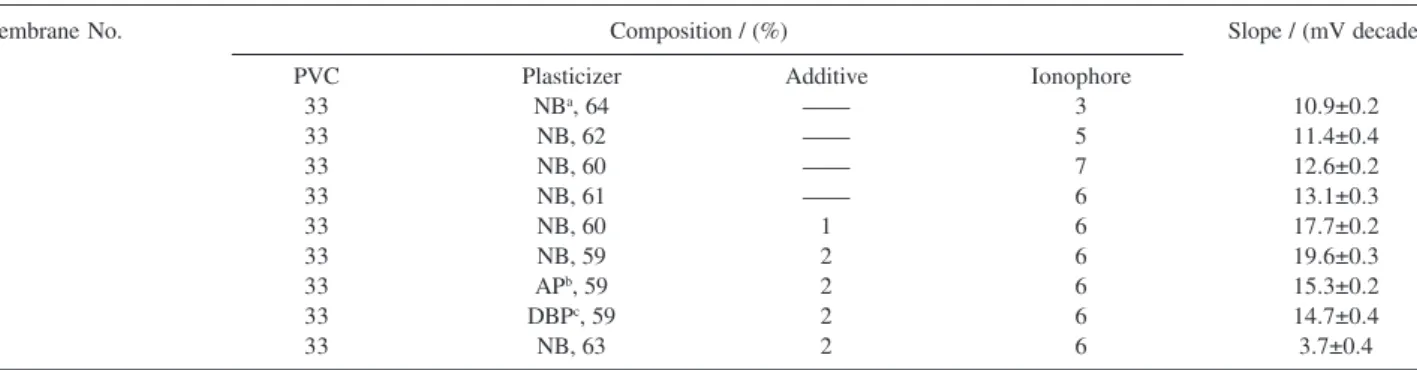
these parameters, different aspects of preparing a membrane based on FPD, were optimized (Table 1).
The results show that the quantity of FPD affects the sensitivity of the membrane electrode (No. 1-4). The sensitivity of the electrode response increases with increasing ion-carrier content until a value of 6% is reached.
The solvent mediator/PVC ratio in solvent polymeric membrane ion-selective electrodes is usually found to be about 2, because polymeric films with such a plasticizer/ PVC ratio will result in optimum physical properties and high enough mobility of their constituents. In this study, the same plasticizer/PVC ratio (about 2) was found to be the most suitable, for the construction of the membrane sensors.
The selectivity and working concentration range of membrane sensors are also affected by the nature and amount of the plasticizers used. This is due to the influence of the plasticizer on the dielectric constant of the membrane phase, the mobility of the ion-carrier molecules, and on the state of complex. The results of Table 1 shows that among the four different plasticizers used, NB (No. 6) having a higher polarity than the other three, namely DBP, AP and BA, is a more effective solvent mediator in preparing the neodymium membrane sensor. The optimum perm-selectivity of membrane sensors is known to be highly dependent on the incorporation of additional membrane compounds.28 It is has been accepted
that, the presence of suitable negatively charged lipophilic additives, improves the potentiometric behavior of certain cation-selective electrodes. The data given in Table 1
Table 1. Optimization of membrane ingredients
Membrane No. Composition / (%) Slope / (mV decade-1)
PVC Plasticizer Additive Ionophore
1 33 NBa, 64 —— 3 10.9±0.2
2 33 NB, 62 —— 5 11.4±0.4
3 33 NB, 60 —— 7 12.6±0.2
4 33 NB, 61 —— 6 13.1±0.3
5 33 NB, 60 1 6 17.7±0.2
6 33 NB, 59 2 6 19.6±0.3
7 33 APb, 59 2 6 15.3±0.2
8 33 DBPc, 59 2 6 14.7±0.4
9 33 NB, 63 2 6 3.7±0.4
aNB=Nitrobenzene; bAP= Acetophenon; cDBP=Dibutyl phthalate.
Figure 1. Structure of ionophore FPD.
revealed that the absence of a proper additive causes the sensitivity of the FPD based membrane to be relatively low (No. 4 with a slope of 13.1 mV per decade) while, the addition of about 2% of KTpClPB, as a suitable additive, in the membrane will improve the sensitivity of the neodymium membrane electrode considerably (no. 6 with slope 19.6 mV per decade).
Calibration curve
The optimum equilibration time for the neodymium membrane sensor in the presence of 1.0 × 10⁻² mol L-1
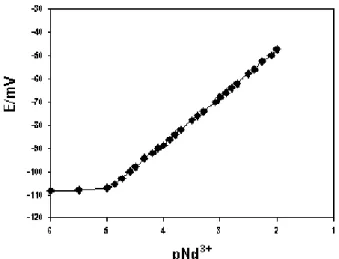
neodymium nitrate was 24 h, after which it would generates stable potentials in contact with the neodymium solutions. The proposed sensor displays a linear response to the activity of the neodymium ion in the range 1.0 × 10⁻⁵ to 1.0 × 10⁻² mol L-1 (Figure 2). The slope of the
calibration curve was 19.6 ± 0.3 mV per decade. The limit of detection, as determined from the intersection of the two extrapolated segments of the calibration curve, was 7.0 × 10⁻⁶ mol L-1.
For stability and lifetime evaluation, three sensors were chosen and using 1 h per day, and their slopes and detection limits were monitored. This experiment revealed that after six weeks, only a very slight decrease in the slopes and detection limits were observed (from 19.6 ± 0.3 and 7.0 × 10⁻⁶ to 18.7 ± 0.4 mV per decade and 1.0 ×
10-5 mol L-1, respectively).
Dynamic response time
Dynamic response time is one of the most important factors for the evaluation of any ion-selective electrode. In this report, the practical response times of the sensor were recorded by changing the neodymium ion concentration in solution, over a 1.0 × 10⁻² to 1.0 × 10⁻⁵ mol L-1. The actual
potentials versus time traces are shown in Figure 4. As it is seen, in whole concentration range the electrode reaches its equilibrium response very fast (<15 s).
To evaluate the reversibility of the electrode, a similar procedure in the opposite direction was adopted. The measurements were performed in the sequence of high-to-low (from 1.0 × 10⁻² to 1.0 × 10⁻³ mol L-1) sample concentrations and the results showed that, the potentiometric responses of the electrode was reversible; although the time needed to reach equilibrium value (35 s) was longer than that of low-to-high sample concentrations (1).
The effect of the pH
The effect of the pH of the test solution (1.0 ×10⁻³ mol
L-1 neodymium ions) on the potential response of the
sensor was investigated in the pH range 2.0–10.0 (the pH of solutions was adjusted by the 0.1 mol L-1 HNO
3 or KOH)
and the results are illustrated in Figure 5. As can be seen from Figure 5, the potential response of the sensor is independent on pH in the range 4.0–8.0, beyond which the potential changes considerably. The observed drift at higher alkali media could be due to the formation of insoluble Nd(OH)3 in solution. The observed increase in the potential at the acidic solutions indicates that the membrane responds to the proton (protonation of nitrogen atoms of ion carrier in the membrane).
Selectivity
Potentiometric selectivity coefficients of the proposed sensor were evaluated by the matched potential method
Figure 3. Calibration curve of the Nd3+ membrane sensor based on FPD (membrane No. 6) in pH=4.5.
(MPM).29 According to MPM, the specified activity
(concentration) of the primary ion (Nd3+) is added to a
reference solution, and the potential is measured. In a separation experiment interfering ions (B) are successively added to an identical reference solution until the measured potential matched that obtained before by adding the primary ions. The matched potential method selectivity coefficient, KMPM, is then given by the resulting primary ion to interfering
ion activity (concentration) ratio, K Nd3+,B = a Nd3+/aB. The
experimental conditions employed and the resulted values for the neodymium membrane sensor are given in Table 2. As can be seen, for the lanthanide ions with close properties to neodymium ions (gadolinum, lanthanum, and samarium ions), the selectivity coefficients are smaller than 2.7 × 10⁻² and for other ions tested (smaller ionic radius), selectivity coefficients are smaller than 8.9 × 10⁻³.
Stability and lifetime
The lifetime of the Nd(III) membrane sensor were tested over a period of 70 days. During this period, the electrodes were in daily use over an extended period of time (one hour per day), and the results are given in Table 3. As can be seen from Table 3, after 49 days a very slight gradual decrease and increase in the slopes and detection limit was observed respectively. This is due to the leaking
of membrane ingredients from membrane to the solution. This kind of behavior has been already seen for the most of introduced liquid membrane sensors.
Analytical applications
The proposed sensor was used as an indicator electrode in the titration of 25.0 mL neodymium solution (1.0 × 10⁻³ mol L-1) with a standard EDTA solution (1.0 × 10⁻¹
mol L-1) with the pH of 10.0, and the resulted titration
curve is given in Figure 6, that has a very sharp end point. As can be seen, the amount of Nd3+ ions in solution can
be determined with the electrode accurately (1.0 ± 0.1 × 10⁻³ mol L-1).
The sensor was applied to direct monitoring of Nd3+
in various binary mixtures, and the results are summarized in Table 4. As it is obvious, the recovery of Nd3+ ions is
very good (97.7-104.4%). This is due to the relatively good selectivity of the proposed sensor.
Comparison
Table 5 compares the selectivity coefficients, Detection limit, and dynamic linearity range of the proposed Nd(III)
Table 4. Determination of Nd(III) ions in various binary mixtures
Nd3+ / (mol L-1) Added cation / (mol L-1) Recovery / (%)
5.0×10⁻⁵ Na+ (5.0×10⁻³) 102.2±0.2 5.0×10⁻⁵ K+ (5.0×10⁻³) 102.3±0.3 5.0×10⁻⁵ Ca2+ (5.0×10⁻³) 103.5±0.2 5.0×10⁻⁵ Mg2+ (5.0×10⁻³) 102.6±0.4 5.0×10⁻⁵ Cu2+ (2.5×10⁻³) 99.7±0.2 5.0×10⁻⁵ La3+ (1.2×10⁻³) 104.4±0.4 5.0×10⁻⁵ Sm3+ (2.5×10⁻³) 103.6±0.3 5.0×10⁻⁵ Gd3+ (2.5×10⁻³) 103.5±0.2 5.0×10⁻⁵ Dy3+ (2.5×10⁻³) 103.3±0.4 5.0×10⁻⁵ Yb3+ (2.5×10⁻³) 102.2±0.4
Table 3. The lifetime of the Nd3+ membrane sensor
Week Slope / (mV per decade) Detection Limit
First 19.6 ± 0.3 7.0 × 10⁻⁶ mol L-1
Second 19.5 ± 0.6 8.0 × 10⁻⁶ mol L-1
Third 19.3 ± 0.2 8.5 × 10⁻⁶ mol L-1
Fourth 19.0 ± 0.3 9.3 × 10⁻⁶ mol L-1
Fifth 18.8 ± 0.5 9.5 × 10⁻⁶ mol L-1
Sixth 18.6 ± 0.3 9.9 × 10⁻⁶ mol L-1
Seventh 18.1 ± 0.4 1.0 × 10⁻⁵ mol L-1
Eighth 17.5 ± 0.2 4.0 × 10⁻⁵ mol L-1
Ninth 17.0 ± 0.5 7.2 × 10⁻⁵ mol L-1
Tenth 16.2 ± 0.7 8.7 × 10⁻⁵ mol L-1
Table 2. The selectivity coefficients of various interfering cations for Nd3+membrane sensor
Ion log KMPM log KSSM
Na+ -2.6 -2.9
K+ -2.6 -2.7
Mg2+ -2.5 -2.8
Ca2+ -2.4 -2.6
Cu2+ -2.0 -2.1
La3+ -1.6 -1.7
Gd3+ -1.8 -1.9
Sm3+ -1.5 -1.7
Dy3+ -2.1 -2.3
Yb3+ -2.2 -2.3
sensor, with previously Nd(III) electrode reported in the literature25. As can be seen from Table 5, the proposed
Nd(III) sensor in the terms of selectivity coefficient, specially for transition metals, is better than the previously reported sensor.
Acknowledgment
The authors express their appreciation to the University of Tehran Research Council for financial support of this work.
References
1. Rao, G. S. S.; Upadhyay, V. K.; Jain, R. C.; J. Appl. Polym. Sci.
1999, 71, 595.
2. Bodrova, V. S.; Piskareva, E. P.; Shelokhneva, L. F.; Poletaeva, I. A.; Vysokomol. Soedin.1998, 40, 1741.
3. Marczenko, Z.; Separation and Spectrophotometric Determination of Elements, 2nd ed., Ellis Horwood Ltd.: Chichester, 1986.
4. Bakker, E.; Bühlmann, P.; Pretsch, E.; Chem. Rev. 1997, 97, 3083.
Table 5. Comparison of the characteristics of the proposed sensor and the best reported Nd(III) sensors
Sensor Linear Dynamic Range Limit of Detection Slope / log KSSM / log KSSM /
(mV) (transition metal) (alkali and alkali metal ion)
Ref. 25 1.0 ×10⁻⁶ to 1.0 × 10⁻² mol L-1 7.9 × 10⁻⁷ mol L-1 20.1±0.2 La3+(-1.4); Gd3+(-1.4); Na+(-2.9); K+(-2.8); Sm3+(-1.6); Yb3+(-1.2); Mg2+(-2.8); Ca2+(-2.5) Cu2+(-1.5)
This work 1.0 ×10⁻⁵ to 1.0 × 10⁻² mol L-1 7.0 × 10⁻⁶ mol L-1 19.6±0.3 La3+(-1.7); Gd3+(-1.9); Na+(-2.9); K+(-2.7); Sm3+(-1.7); Yb3+(-2.3); Mg2+(-2.8); Ca2+(-2.6) Dy3+(-2.3); Cu2+(-2.1)
Figure 6. Potentiometric titration curve of 25.0 mL Nd3+ (1.0 × 10⁻³ mol L-1) with 10-1 mol L-1 EDTA using the membrane no. 6 as an indicator electrode in pH=10.0.
5. Ganjali, M. R.; Daftari, A.; Qomi, M.; Norouzi, P.; Sens. Actuators, B 2004, 98, 192.
6. Ganjali, M. R.; Daftari, A.; Rezapour, M.; Talanta2003, 59, 613. 7. Shamsipur, M.; Yousefi, M.; Hosseini, M.; Ganjali, M. R.; Anal.
Chem. 2002, 74, 5538.
8. Hassanien, M. M.; Abou-El-Sherbini, K. S.; Mostafa, G. A. E.; Talanta2003, 59, 392.
9. Itot, T.; Goto, C.; Noguchi, K.; Anal. Chim. Acta 2001, 443, 41. 10. Susheel, K.; Mittal, S. K.; Kumar, A.; Sharma, H. K.; Talanta
2004, 62, 801.
11. Ganjali, M. R.; Kiani, R.; Shamsipur, M.; Poursaberi, T.; Salavati-Niasari, M.; Talebpour, Z.; Emami, M.; Electroanalysis
2004, 16, 1002.
12. Gupta, V.; Suresh, C.; Chandra, C.; Anal. Chim. Acta2003, 486, 199.
13. Ganjali, M. R.; Mirnaghi, F. S.; Norouzi, P.; Adib, M. Sens. Actuators, B2006,115, 374.
14. Karami, H.; Mousavi, M. H.; Shamsipour, M.; Yavari, I.; Alizadeh, A. A.; Anal. Lett.2003, 36, 1065.
15. Ganjali, M. R.; Norouzi, P.;Adib, M.; Ahmadalinezhad, A.; Anal. Lett. 2006, 39, 1075.
16. Ganjali, M. R.; Pourjavid, M. R.; Rezapour, M.; Haghgoo, S.; Sens. Actuators, B 2003,89, 21.
17. Ganjali, M. R.; Norouzi, P.; Shamsolahrari, L.; Ahmadi, A. Sens. Actuators, B2006,114, 713.
18. Ganjali, M. R.; Rezapour, M.; Pourjavid, M. R.; Haghgoo, S.; Anal. Sci. 2004,20, 1007.
19. Ganjali, M. R.; Norouzi, P.; Tamaddon, A.; Adib, M.; Sens. Actuators, B2006,114, 855.
20. Ganjali, M. R.; Rahimi, M.; Maddah, B.; Moghimi, A.; Borhany, S.; Anal. Sci. 2004, 20, 1427.
21. Ganjali, M. R.; Tahami, M.; Shamsipur, M.; Poursaberi, T.; Haghgoo, S.; Hosseini, M.; Electroanalysis 2003,15, 1038. 22. Ganjali, M. R.; Naji, L.; Poursaberi, T.; Shamsipur, M.;
Haghgoo, S.; Anal. Chim. Acta 2003, 475, 59.
23. Ganjali, M. R.; Matloobi, P.; Ghorbani, M.; Norouzi, P.; Salavati-Niasari, M.; Bull. Korean Chem. Soc.2005, 26, 38. 24. Ganjali, M. R.; Ravanshad, J.; Hosseini, M.; Salavati-Niasari,
25. Shamsipur, M.; Hosseini, M.; Alizadeh, K.; Mousavi, M. F.; Garau, A.; Lippolis, V., Yari, A.; Anal. Chem. 2005, 77, 276. 26. Ammann, E.; Pretsch, P.; Simon, W.; Lindner, E.; Bezegh, A.;
Pungor, E.; Anal. Chim. Acta 1985, 171, 119.
27. Eugster, R.; Gehrig, P. M.; Morf, W. E.; Spichiger, U.; Simon, W.; Anal. Chem. 1991, 63, 2285.
28. Rosatzin, T.; Bakker, E.; Suzuki, K.; Simon, W.; Anal. Chim. Acta1993, 280, 197.
29. Umezawa, Y.; Umezawa, K.; Sato, H.; Pure Appl. Chem. 1995, 67, 507.
Received: February 22, 2006